Table of Contents
- The Last Night at Lorium
- From Modest Origins to the Purple
- The Making of a Philosopher-King’s Father
- The Quiet Empire Antoninus Built
- A Winter of Failing Strength
- The Final Illness at the Villa
- The Night of March 7, 161: Emperor on the Threshold
- The Message to Marcus Aurelius
- Dawn in Rome: News of the Emperor’s Passing
- Funeral Rites and the Apotheosis of a Quiet Ruler
- After Antoninus: The Joint Reign of Marcus and Lucius
- An Empire at the Turning Point
- How Contemporaries Remembered Antoninus Pius
- The Historians’ Debate: Golden Age or Missed Opportunity?
- The Human Being Behind the Laurel Wreath
- Legacy in Stone, Law, and Memory
- The Death of Antoninus Pius and the Idea of the Good Ruler
- Echoes Through the Centuries
- Why the End at Lorium Still Matters Today
- Conclusion
- FAQs
- External Resource
- Internal Link
Article Summary: On the evening of March 7, 161, in the seaside villa of Lorium along the old Via Aurelia, the long and measured life of Emperor Antoninus Pius came to a quiet close. This article follows the death of antoninus pius as both a personal moment and a hinge in Roman history, tracing how a seemingly peaceful passing opened an era of war, plague, and uncertainty for the empire. It explores his rise from provincial nobility to emperor, his long years of calm rule, and the winter of illness that culminated at Lorium. Moving through the final hours, the reactions in Rome, and the carefully staged funeral and deification, it shows how his death became a political performance and a lesson in continuity. Along the way, it examines how ancient writers framed the death of Antoninus Pius as the end of a golden age, and how modern historians debate whether his very successes left his successors unprepared for crisis. Through laws, architecture, coins, and the stoic reflections of his adoptive son Marcus Aurelius, the narrative reconstructs the emotional and institutional shock of losing such a steady figure. In doing so, it argues that the death of antoninus pius at Lorium was not an isolated event, but a catalyst that reshaped power, policy, and the very idea of what made a good emperor.
The Last Night at Lorium
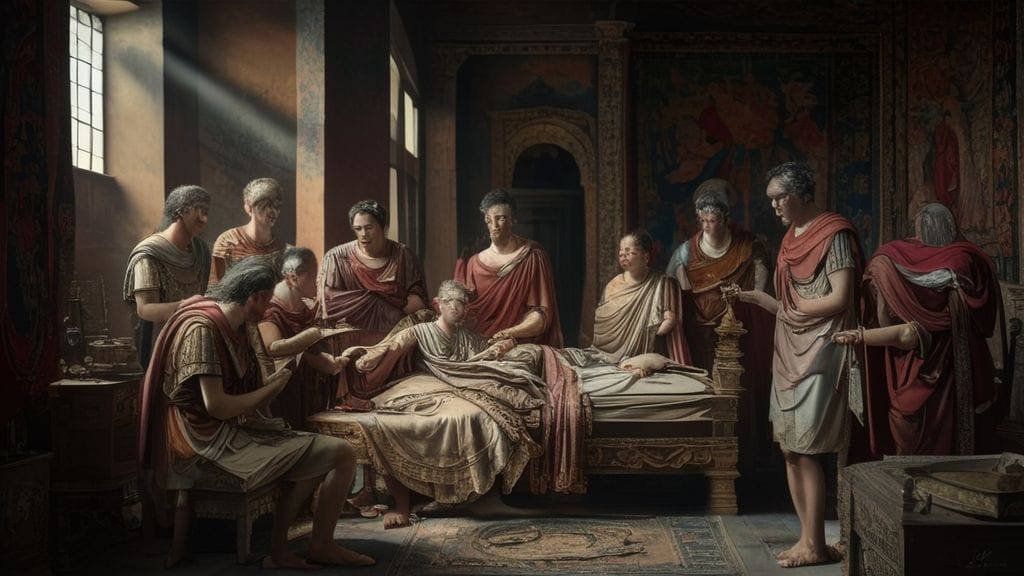
On the gentle Tuscan coast, where the Via Aurelia wound westward from Rome toward the sea, an imperial villa lay cradled among pines and low, windswept hills. It was March in the year 161, damp and cold, but the sea air that rolled up to the villa of Lorium had always soothed him. Here, away from the marble echo of the Senate House and the relentless petitions of office-seekers, Antoninus Pius had long found a measure of peace. Yet on this night, the quiet was not simply the calm of retreat; it was the hush that gathers around a deathbed. Servants moved softly through the corridors, lamps hooded, sandals muffled. Somewhere in the next room a physician whispered with a freedman, their low Latin murmurs carried beneath the cedar-beamed ceiling. The emperor, eighty years old and frail, lay on a couch, the same man whose reign had been celebrated for its stability, whose face—serene, bearded, almost gentle—looked out from coins across a vast empire.
The death of Antoninus Pius did not come with the sudden violence that had ended the lives of so many Roman rulers. No dagger, no praetorian coup, no drunken brawl in a camp. Instead, it unfolded like the waning of a long candle, the flame slowly lowering in a room that no one wanted to see go dark. But this was only the beginning of our story. For around his bedside in Lorium, the empire’s future was already taking shape: decisions about succession, messages to be sent, rituals to be performed, the careful choreography that would turn a dying man into a deified ancestor and clear the way for new power. As Antoninus drifted in and out of fevered sleep, the villa became a stage on which the final act of one of Rome’s most underestimated emperors played out.
Outside, the wind beat at the shutters. Inside, memory pressed in as heavily as the night. The emperor had spent twenty-three years on the throne, ruling more through patience than spectacle, during what later generations would call the calm before the storm. The death of Antoninus Pius at Lorium on March 7, 161, seems on the surface like a quiet footnote in imperial history. Yet if we listen closely to that night, to the rustle of wax tablets, the murmured oaths of attendants, and the weary breathing of the old emperor, we hear something else: the creaking of a great hinge on which Roman history was about to turn.
From Modest Origins to the Purple
Long before his final hours at Lorium, Antoninus Pius had been an unlikely candidate for such a serene end. Born Titus Aurelius Fulvus Boionius Arrius Antoninus in 86 CE, probably near Lanuvium or in southern Gaul, he came from a distinguished but not dazzlingly famous family. His father died young, and he was raised on the estates and in the carefully ordered world of the Roman senatorial aristocracy. It was an upbringing steeped in duty: the rhythms of estate management, the cadence of legal speeches in the courts, the gravity of civic ritual. From this soil grew the habits that would one day define his rule—moderation, caution, and habitually doing things by the book.
In Rome’s fierce competition for office, Antoninus advanced steadily, but without the air of a man racing toward glory. He served as quaestor, then praetor, moving through the cursus honorum with the inevitable momentum of an able and well-connected senator. His consulship in 120 CE placed him among the elite, yet he lacked the glamour or military charisma that surrounded figures like Trajan or Hadrian. Instead, he impressed by his reliability. When he governed Asia as proconsul—a rich and complicated province in western Anatolia—his term was remembered less for crisis than for scrupulous administration. Later writers, such as the biographer in the Historia Augusta, would stress his integrity and generosity as provincial governor, painting a portrait of a man who came back from Asia richer in honor but not in ill-gotten wealth.
The path from there to the purple ran through the towering figure of Emperor Hadrian. Near the end of his life, Hadrian, childless and increasingly ill, looked over the landscape of potential successors. He needed someone who could hold the center, soothe the Senate, and preserve his intricate reforms. Antoninus, then in his early fifties, fit the role with uncanny precision. In 138 CE, Hadrian formally adopted him, setting off a chain of legal and emotional transformations. Almost at once, Antoninus was called upon to prove his loyalty: Hadrian, by then hated in some senatorial circles for his executions, wanted full posthumous honors. The Senate, weary and resentful, hesitated. It was Antoninus who pleaded for his adoptive father, insisting on deification, assuaging the Senate with calm diplomacy. This act of piety earned him the cognomen “Pius,” whether for devotion to Hadrian or to the gods and Roman customs, and set a pattern for the rest of his rule.
The Making of a Philosopher-King’s Father
If Hadrian had already chosen Antoninus, Antoninus himself would in turn shape the future by his own adoptions. For embedded within the story of the death of Antoninus Pius at Lorium is the story of another man’s rise: the young Marcus Aurelius, future emperor and philosopher. As part of the adoption arrangement in 138, Hadrian required Antoninus to adopt two young men: Marcus Annius Verus (the future Marcus Aurelius) and Lucius Ceionius Commodus (later Lucius Verus). Antoninus did more than comply; he folded them into his household and his heart, crafting a dynasty of virtue as much as blood.
Marcus, already known for his serious temperament and love of philosophy, found in Antoninus a living model of duty. Later, when he wrote his private reflections now known as the Meditations, Marcus would recall with almost aching clarity the traits he had learned from his adoptive father: “In my father,” he wrote, “I observed mildness of temper, unchangeable resolution in the things which he had determined after due deliberation, no vainglory in those things which men call honors, and a love of labor and perseverance” (Marcus Aurelius, Meditations, Book I). It is astonishing, isn’t it, that behind the serene stoic lines we read today lies the memory of evenings at the palace, of Marcus watching Antoninus listen, decide, and rarely lose his composure.
Antoninus’ household in Rome thus became not only a court, but a school of governance. The young Marcus was gradually introduced to the work of empire: petitions from the provinces, legal disputes, correspondence with governors, the endless tide of imperial administration. Lucius Verus, more spirited and worldly, offered a different model, and Antoninus, perhaps hoping for balance, ensured that both were readied for power. The old emperor knew he would not live forever, and as the years advanced, the question of succession grew larger. In Lorium, on that final winter, these long-laid plans would be put to the test. The death of Antoninus Pius was not only the end of his own story; it was the hinge that would raise Marcus and Lucius to the front of the stage.
The Quiet Empire Antoninus Built
To understand why his death reverberated so deeply, we must pause and consider the world he fashioned. Unlike Trajan’s age of conquest or Hadrian’s restless tours of the provinces, the reign of Antoninus Pius is often described as uneventful. But uneventful for whom? To many in the empire, those twenty-three years were a gift: no civil wars, no bloody purges, no catastrophic defeats on the scale that would later scar Marcus Aurelius’ reign. The frontiers were tended rather than violently expanded; a wall rose in northern Britain, not so much to conquer as to stabilize. The empire’s vast machinery of law and administration hummed along, tweaked rather than torn apart.
This quiet masked an intense and tireless engagement with the details of governance. Antoninus rarely left Italy, preferring to manage the empire from the center. Modern historians have debated this choice. Some argue that his reluctance to travel allowed local elites more autonomy and avoided the strain of imperial itineraries. Others suggest that his staying home meant that dangerous fires on the frontiers smoldered rather than being extinguished. Yet his correspondence with governors, attested in legal rescripts and inscriptions, reveals a ruler deeply engaged with provincial affairs: resolving disputes over city boundaries, regulating the treatment of slaves, intervening in matters of civic debt.
His reign also saw significant developments in Roman law, particularly in the treatment of the vulnerable. Legal scholars have noted rescripts in which Antoninus limited the abuses of masters over slaves and provided stronger protections for orphans and minors. These changes may seem small, but in a society built on hierarchy, they marked a subtle moral turn. An emperor who would die quietly at Lorium was, in his official acts, quietly reshaping the legal conscience of Rome. When the death of Antoninus Pius finally arrived, it was not merely the passing of an individual but the loss of a particular style of rule—one that prized continuity over glory, law over spectacle.
A Winter of Failing Strength
The last winter of Antoninus’ life was marked, according to later sources, by a gradual and inexorable decline. He was nearly eighty—a rare age for a Roman of any class, let alone a man burdened by two decades of imperial responsibility. Accounts preserved in the Historia Augusta and echoed by later authors speak of a gastrointestinal illness, perhaps a fever, perhaps something more chronic. We must tread carefully; ancient biographers loved a good deathbed scene, and not every detail can be trusted. Yet we can imagine the rhythm of those final months.
Rome in winter was damp and heavy. The emperor’s body, once capable of bearing the strain of long audiences and difficult debates, began to falter. Meals became smaller, sleep more restless. Physicians, trained in the humoral theories of the day, prescribed rest, controlled diet, perhaps warm baths. There was talk of the villas along the coast—Lorium among them—where the air was thought to be clearer, the atmosphere soothing. Whether for health, habit, or both, Antoninus moved increasingly between Rome and his beloved retreats on the road to Etruria.
This gradual weakening threw into relief the structures he had so carefully prepared. Marcus Aurelius had already been elevated to the rank of Caesar, his role as successor clear to the Senate and army alike. Lucius Verus, too, stood in the wings. Still, the physical decline of an emperor, even a prepared one, was never merely private. Rumors would have spread in the capital: the emperor is ill; the emperor is resting at Lorium; the emperor no longer presides over lengthy audiences. Senators worried quietly about the future of their careers. Provincial governors, far away, wrote in cautious tones, not sure how much longer the old man would live. Yet behind the celebrations of a seemingly golden age, anxiety was crawling in at the edges.
The Final Illness at the Villa
At Lorium, the emperor’s condition worsened. The villa itself, perched near the coast along the Via Aurelia, had long been a favorite. Hadrian had stayed there; Antoninus had repaired and expanded it. It was a place where he could walk gardens rather than marble colonnades, listen to the hush of the sea rather than the murmur of petitioners. But in the last days, the gardens became glimpses through a window, the sea a distant sound heard from a couch. Later biographers describe a fever that would not break, a stomach that refused food. One poignant detail, perhaps colored by literary convention, has him asking during a period of delirium for a particular cheese from his native region—an old man’s craving for the taste of home as he approaches the threshold of death.
Ancient medicine could do little more than observe, adjust diet, and hope. Physicians felt the emperor’s pulse, studied his urine, and debated the balance of heat and cold, wet and dry in his body. They recommended rest, but the work of empire still arrived in the form of tablets and scrolls. Even now, Antoninus continued to read, to sign, to decide. We can picture him propped up on cushions, a stylus in hand that trembled more than it once had, while a secretary read aloud dispatches from the frontiers: minor skirmishes, requests for funds, judicial appeals. The empire did not stop because its ruler was tired, but those around him would have begun discreetly to shift decisions toward Marcus, already deeply involved in governance.
The presence of family colored these last days. Faustina the Younger, wife of Marcus and Antoninus’ beloved granddaughter, may have been at his side, along with other members of the imperial household. Freedmen who had risen through long service—men who knew the emperor’s habits better than any senator—hovered nearby, managing access, soothing fears. The villa became a small, self-contained world of worry and waiting. Outside, peasants and small landowners along the Via Aurelia went about their lives, seeing perhaps an unusual number of riders coming and going from the imperial estate, sensing that something was happening, but not yet knowing that history would later pause on this very place and date: the death of Antoninus Pius, Lorium, March 7, 161.
The Night of March 7, 161: Emperor on the Threshold
And then, the night came. Ancient narratives concentrate on a particular sequence of events. On the day before his death, Antoninus reportedly dismissed his attendants early, claiming fatigue greater than usual. His fever had risen; swallowing was difficult; his speech, once so measured, had grown faint. A physician may have urged him to take broth or wine, but little stayed down. As the light faded from the sky over Lorium, lamps were lit in the villa, their glow pooling along mosaicked floors and painted walls.
What does it mean to die as emperor, and yet in a manner so ordinary? Even now, as his body failed, rituals pressed in. There were prescribed formulas for imperial attendants, guards posted at the entrances, scribes on hand in case last decisions or dispositions needed to be recorded. But there was also the very human reality of a failing heart and lungs growing tired. Later sources, as if unable to resist poetic detail, tell us that at some point during these final hours, Antoninus took a golden statue of the goddess Fortune that he kept by his bedside and kissed it, as if acknowledging that the luck that had followed him through such a long and relatively peaceful reign was about to pass from him forever. Then, turning to the nearest attendant, he reportedly spoke a single word: aequanimitas—“equanimity.” Whether this is fact or a historian’s invention, it captures something essential about how his contemporaries wished to remember him.
The death of Antoninus Pius came, it seems, without convulsions or dramatic speeches. He simply weakened, slept, and did not wake. Somewhere in the small hours, attendants realized that the emperor was no longer breathing. They checked his pulse, felt the cooling of his hands, and quietly informed the senior official present. The room, already dim, must have seemed to grow even more still. Outside, the sea whispered on the shore, unaware that an emperor—one of the best Rome would ever know, according to some—had just left the world.
The Message to Marcus Aurelius
The first act after confirming the death was not mourning; it was communication. In a world where power could shift in an instant, the news of an emperor’s passing had to be managed carefully. The death of Antoninus Pius could not be allowed to drift northward along the Via Aurelia as rumor. It had to arrive in Rome as a formal, controlled truth—timed, framed, and accompanied by instructions. Messengers were summoned; wax tablets prepared; riders readied for the fast gallop to the capital.
Marcus Aurelius was likely nearby, perhaps in Rome or in another villa. His life had been oriented for years toward the moment that now arrived. Still, when a courier, dusty and anxious, demanded immediate audience to deliver the sealed message from Lorium, the news would have struck with the blunt force that death always brings, even when long expected. The emperor is dead. Your father, your patron, your example—gone. There was no time for private tears, or at least very little. Within hours, Marcus would have to stand before the Senate and army, to accept not only his grief but the burden of the imperial title.
Antoninus’ death triggered a ritualized chain reaction. Messages went out not only to Marcus, but to key officials: the praetorian prefects who commanded the imperial guard, principal senators in the capital, perhaps even select governors in strategically important provinces. The wording of these messages mattered. They needed to emphasize continuity: Antoninus had died peacefully, in bed, after a long and successful reign; succession arrangements were intact; the empire remained stable. Any hint of uncertainty could tempt ambition. The speed and clarity with which news traveled from Lorium to Rome ensured that the death of Antoninus Pius would not be the beginning of a civil war, but the solemn overture to a new chapter.
Dawn in Rome: News of the Emperor’s Passing
When dawn broke over Rome the next day, the city did not yet know it had lost its emperor. The markets opened as usual, artisans lifted their shutters, the smell of baking bread and wet stone rose into the cool morning. Then, as the messengers from Lorium reached the capital and officials began to stir, a different atmosphere slowly settled over the city. Notices would be posted; heralds dispatched; word would spread first through the Palatine and the Forum, and then outward to the crowded districts along the Tiber.
The Senate was hastily convened. Senators, summoned from their homes, draped themselves in their formal white togas and ascended the Capitol with expressions that mixed genuine sorrow and political calculation. Within the curia, the news of Antoninus’ death was officially announced. Whatever private grievances they may have harbored toward him over the years—over policies, appointments, personal slights—were now suspended in a public ritual of praise and mourning. Speeches would commemorate his moderation, his respect for the Senate, his refusal to let blood flow in purges or proscriptions.
For the people, the news came more slowly, in fragments: a neighbor repeating what he had heard from a clerk, a soldier telling a tavern-keeper that the emperor had died at Lorium. The reaction was not the wild anxiety that had greeted the deaths of emperors in more turbulent reigns. Antoninus had kept the peace, the grain dole flowed, the games took place on schedule. For many ordinary Romans, his death may have seemed like the loss of a distant but benevolent presence, a familiar name on coins and in official announcements. Yet behind the everyday routines, a deep shift had occurred. A man who had embodied stability for a generation was gone, and the serene surface of the empire concealed undercurrents that would soon rise.
Funeral Rites and the Apotheosis of a Quiet Ruler
No emperor truly leaves the world until he is properly buried and, in Rome’s imperial religion, sent to the gods. The death of Antoninus Pius set in motion the elaborate machinery of imperial funerary ritual. His body, embalmed according to custom, was transported from Lorium to Rome, likely along the very Via Aurelia that had so often borne him to his retreat. The procession, guarded and solemn, would have passed travelers and peasants, some of whom may have stepped aside, removed their caps, and watched in reverent silence as the imperial cortege moved toward the city.
In Rome, the funeral became a spectacle of unity. The body lay in state in a richly decorated hall, perhaps on the Campus Martius, where citizens could file past, pay respects, and see for themselves that the man whose portrait had adorned so many public spaces was now lifeless. Statues and images of Antoninus would be wreathed in laurel; the city draped itself in mourning. The Senate decreed an official luctus publicus, a period of public grief. Marcus Aurelius and Lucius Verus, standing together, appeared before the people, not simply as heirs but as grieving sons, a carefully curated blend of emotion and authority.
The climax of these rites was the apotheosis, the formal deification of the deceased emperor. A wooden, human-shaped effigy of Antoninus was placed atop a towering pyre on the Campus Martius. Below, incense, perfumes, and rich fabrics were heaped; above, the effigy, dressed in imperial garments, represented the emperor’s earthly form. As the pyre was lit and flames rose, an eagle was released from its summit, soaring upward into the sky. To the watching crowd, this eagle was the visible symbol of Antoninus’ soul ascending to the heavens, to join the other deified emperors as a new star in the firmament. This ritual, repeated since the days of Augustus, turned a man who had died quietly in a villa into Divus Antoninus—the divine Antoninus.
Monuments would soon follow. The Column of Antoninus Pius in the Campus Martius, commissioned by Marcus Aurelius and Lucius Verus, bore a famous relief showing the apotheosis: Antoninus and his wife Faustina borne aloft by a winged figure, watched by personifications of the Campus and the Roman people. In stone, as in ritual, the death of Antoninus Pius was recast as a triumphant departure rather than a mere extinguishing of breath.
After Antoninus: The Joint Reign of Marcus and Lucius
The political consequences of his death were immediate and far-reaching. For the first time, Rome would be ruled for any length of time by co-emperors. Marcus Aurelius, already designated heir and beloved by the Senate, might easily have claimed sole power. Yet, in deference to his adoptive father’s arrangements and perhaps sensing the challenges ahead, he insisted that Lucius Verus share the title of Augustus and rule alongside him.
This decision was rooted in loyalty and pragmatism. Lucius Verus, a decade younger, offered military vigor that Marcus, for all his intellectual and moral strength, may have felt he lacked. The Parthian frontier in the east simmered with potential conflict. Within only a few years of Antoninus’ passing, Lucius would be dispatched eastward to direct Rome’s response to Parthian aggression, while Marcus stayed in the capital. The partnership, shaped in part by Antoninus’ adoptions, thus provided the manpower and legitimacy needed to respond to crises that the old emperor had managed to hold at bay.
Yet the joint rule also revealed cracks. Lucius was less disciplined, given to luxuries that Marcus disdained; he traveled with actors and entertainers, raised eyebrows with his lavish banquets. Marcus, bearing the heavy weight of stoic expectation and imperial duty, tolerated his co-emperor’s foibles in public, but in private must have felt the strain. The contrast between the measured, almost austere image of Antoninus Pius and the more flamboyant Lucius highlighted the change of era. Still, the transition was peaceful. The death of Antoninus Pius, carefully staged and ritually secured, had allowed Rome to experiment with a dual monarchy without the chaos that often accompanied imperial succession.
An Empire at the Turning Point
Looking back, many historians have seen 161 as a watershed year. The death of Antoninus Pius closed the door on a long stretch of comparative calm and opened one that would soon admit armies, plagues, and new forms of spiritual anxiety. Under Marcus and Lucius, Rome would face the Parthian War, bringing soldiers into close contact with unfamiliar diseases that would ultimately erupt as the Antonine Plague—a pandemic that ravaged the empire’s population. Not long after, pressures along the Danube and Rhine would intensify, leading to brutal frontier wars that forced Marcus Aurelius to spend long years in military camps rather than in the palaces and villas familiar to his adoptive father.
Was this storm inevitable, or could Antoninus have done more to prepare the empire? The question still haunts discussions of his reign. Some scholars argue that by prioritizing peace and avoiding major campaigns, Antoninus preserved resources and spared countless lives, leaving the empire stronger financially and socially. Others suggest that he missed opportunities to secure frontiers more aggressively or to confront emerging threats before they metastasized. In this telling, the death of Antoninus Pius did not just remove a good ruler; it exposed the empire’s unaddressed vulnerabilities.
What is certain is that his passing shifted the emotional tone of Roman public life. The confidence of a generation that had grown up with stable rule gave way to a more anxious mentality, reflected in everything from legal petitions to religious practices. New cults, including increasingly visible Christian communities, found an audience among people seeking certainty in an uncertain world. The quiet, rational, law-focused governance of Antoninus receded like a memory of a more ordered time, as Rome entered what historian Edward Gibbon would later call, with characteristic nostalgia, the last phase of the greatest happiness for the human race during the rule of the “five good emperors.”
How Contemporaries Remembered Antoninus Pius
The immediate reaction to his death among contemporaries was strikingly positive. Senators praised his moderation and his respect for their body; provincial elites, who had found in him a consistent and predictable arbiter, honored him with inscriptions that spoke of his pietas and iustitia—piety and justice. Coins minted under Marcus Aurelius and Lucius Verus commemorated the deified Antoninus, showing him as a serene, idealized figure, often accompanied by symbols of eternity and divine favor.
Marcus Aurelius’ own testimony is perhaps the most moving. In the opening book of his Meditations, written decades later amid war and illness, he devoted several passages to the virtues he had learned from Antoninus: gentleness, patience, fairness, a complete absence of vulgar show. There is no bitterness there, no hint of unresolved conflict, only gratitude. For Marcus, the death of Antoninus Pius was not just the loss of an emperor; it was the loss of the man who had shown him that power could be exercised without cruelty, that one could rule the world and still sleep at night with a clean conscience.
Outside circles of power, memories are harder to reconstruct, but inscriptions from cities across the empire give us clues. Municipal councils thanked him for benefactions; associations of traders and craftsmen dedicated altars in his honor. In places like Asia Minor, where he had once governed as proconsul, dedications linked his earlier provincial service to his later imperial virtues. Even in death, Antoninus remained present in the daily lives of those who walked past his statues, handled coins bearing his image, or gathered in temples where priests offered sacrifices for the welfare of his successors and in memory of his reign.
The Historians’ Debate: Golden Age or Missed Opportunity?
Modern historians, however, have not always been so uniformly admiring. The long view of history invites comparison, and when Antoninus’ peaceful decades are set beside the crises that followed, questions arise. Did he, knowingly or not, leave his successors with problems he could have confronted? Some scholars argue that by refusing to engage in major military campaigns, he allowed external threats to gather strength on Rome’s borders. Others counter that the empire of the second century was already stretched to its natural limits, and that Antoninus wisely chose consolidation over reckless expansion.
The debate is sharpened by our knowledge of what came later: the pressures under Marcus Aurelius, the turmoil of the third century, the eventual division and transformation of the empire. In this light, the death of Antoninus Pius can be seen as marking the end of a fragile balance, a high plateau after which the descent, though slow and uneven, became almost impossible to halt. The historian Cassius Dio, writing in the third century, looked back on Antoninus with evident respect, but also with a sense that his reign had been a pause rather than a solution. “He himself,” Dio suggested, “never willingly caused anyone to be put to death and never exiled anyone, but he did not sufficiently restrain others” (loosely reflecting Dio’s general assessment).
At the same time, legal historians point to the enduring impact of his rescripts and judicial decisions. In Roman law schools centuries later, the opinions of Antoninus Pius continued to be cited, shaping legal thought long after the empire’s political structures had changed. The story of his reign and death has thus sparked a paradoxical verdict: an emperor at once deeply successful in his own time and yet, perhaps, tragically limited by the very moderation that made his rule so admired.
The Human Being Behind the Laurel Wreath
It is easy, surrounded by monuments and legal texts, to lose sight of the man who lay dying at Lorium. But to grasp the full meaning of the death of Antoninus Pius, we must try to see him not just as an emperor, but as a human being brought to the end of his span. He had known grief before: the deaths of children, of friends, of Hadrian himself. He had navigated the complex emotional landscape of adoption, becoming both son to an older man and father to younger ones who were not of his blood. The public cult of the emperor left little room for vulnerability, but age has a way of stripping away pretense.
We can imagine him in his later years walking in the gardens of Lorium, leaning perhaps on a staff, thinking not in grand narratives of empire but in smaller cycles: the turning of the seasons, the ripening of fruit, the changing sounds of birds at dusk. He may have recalled the vigor of his youth, the energy with which he had governed Asia, the intensity of his first years in power when every decision felt weighty. Now, in his seventies and then eighties, he saw young men take up responsibilities once his alone. Marcus, serious and heavily burdened even as a young man, and Lucius, with his easier charm, both reflected back to the aging emperor the passing of time.
At the end, as his body failed at Lorium, Antoninus may have found some measure of peace in the knowledge that he had done what he could to ensure continuity. He had adopted, trained, and honored his successors. He had avoided cruelty where possible, sought to rule justly, and preserved the empire’s core. Death, for him, was no assassin’s blow or rebel’s revenge, but the slow closing of a long life. In that sense, the death of Antoninus Pius stands almost alone in the annals of Roman imperial history: the end of a reign without scandal, bloodbath, or catastrophe, a conclusion befitting the temperament of the man himself.
Legacy in Stone, Law, and Memory
The traces of his life and death remain scattered across the old Roman world. In Rome, the Column of Antoninus Pius still stands, its base decorated with scenes of his apotheosis and games in his honor. In Britain, the Antonine Wall, though shorter-lived than Hadrian’s more famous barrier, bears his name as a symbol of the northern frontier policy under his rule. In legal texts like Justinian’s Digest, compiled centuries later in the Eastern Roman Empire, his decisions and rescripts live on in the fine print of case law and legal principles. Through stone and statute alike, we see the afterimage of a reign that favored order, routine, and measured reform over dramatic transformation.
Memory, too, took on a life of its own. In late antiquity and the medieval period, Christian writers sometimes looked back to the second century as a time of relative tolerance, though persecutions did occur under his rule at the local level. The image of Antoninus as a just pagan emperor coexisted uneasily with emerging Christian narratives that sought clear villains and heroes. Still, his name never became a byword for cruelty or madness, as had Nero or Caligula. Instead, he occupied a quieter corner in the gallery of the past: the good emperor whose death, though overshadowed by the more dramatic reigns around it, marked the end of something precious.
Archaeologists uncovering inscriptions in former Roman cities still occasionally find dedications to Divus Antoninus, the deified emperor, along with references to decisions he made that touched local lives: boundary disputes settled, building projects financed, festivals enhanced. In these fragments, we sense that the death of Antoninus Pius did not so much erase him as release him into a new form of existence—as a legal authority, a model of rulership, and a name invoked in stone prayers for imperial favor.
The Death of Antoninus Pius and the Idea of the Good Ruler
Ultimately, the meaning of his death lies not only in dates and rituals, but in the way it shaped Roman ideas about what it meant to be a good ruler. The “five good emperors”—Nerva, Trajan, Hadrian, Antoninus Pius, and Marcus Aurelius—became, for later thinkers like Machiavelli and Gibbon, a canon of exemplary leadership. Within that group, Antoninus often appears as the most understated: less conquering than Trajan, less intellectually dazzling than Hadrian, less philosophically famous than Marcus. And yet his very lack of spectacle hints at a different metric of greatness.
The death of Antoninus Pius allowed contemporaries and successors to crystallize his virtues into a narrative. He became the emperor who never left Italy yet kept the empire safe; who refused to indulge in bloodletting; who preserved the dignity of the Senate; who, at the end, died in bed, at home, surrounded not by plotting soldiers but by loyal attendants and family. In contrast to the violent deaths of emperors like Galba, Otho, or Domitian, his end offered a model of rulership that was compatible with personal peace.
This ideal resonated long after the Roman Empire itself had fragmented. In the Renaissance, humanist scholars, rediscovering the texts of Marcus Aurelius and ancient historians, found in Antoninus a rebuke to tyrants: proof that one could wield absolute power without sinking into paranoia or cruelty. His death, quietly recorded in annals and biographies, became part of a larger argument that history could produce not only monsters in purple, but also men who wore the laurel wreath lightly.
Echoes Through the Centuries
Across the centuries, the scene at Lorium has been reimagined, often indirectly, through art, literature, and scholarship. Nineteenth-century historians, steeped in romantic notions of decline and fall, saw the death of Antoninus Pius as the last sunset before a long night. They lingered over his virtues, contrasting them with the turmoil that would follow. Twentieth-century scholarship, more skeptical of golden ages, revised some of this nostalgia but still granted him a special place as a ruler whose reign offered a rare respite in Roman history.
In recent years, historians have become more interested in the textures of everyday imperial governance, and Antoninus has benefited from this shift. His rescripts and administrative choices, once overshadowed by more dramatic narratives of battles and conspiracies, are now studied as evidence of how Rome functioned as a legal and administrative system over vast distances. In this more technical light, the death of Antoninus Pius becomes a moment of institutional transition: the passing of a particular way of negotiating power between center and periphery, emperor and elites, law and custom.
Yet the emotional resonance remains. In biographies that aim to reconstruct the personalities of Rome’s rulers, Antoninus stands out as a rare case where the sources, though imperfect, sketch a consistent image: a measured man, neither saint nor villain, whose reign reminds us that history is not only shaped by crises, but also by long stretches of ordinary, competent stewardship. His quiet death at Lorium has become a symbol of that stewardship’s end.
Why the End at Lorium Still Matters Today
Why does the death of an emperor in a coastal villa eighteen centuries ago still compel our attention? Part of the answer lies in the perennial question of leadership. In an age fascinated—perhaps obsessed—with strongmen, dramatic gestures, and rapid change, Antoninus Pius offers another paradigm: that of the patient caretaker, the ruler who sees his primary duty as maintaining order, improving laws, and shielding his subjects from the violence that power can so easily unleash. The death of Antoninus Pius at Lorium forces us to consider not only how leaders live, but how they leave office, and what kind of world their absence reveals.
There is also something universal in the contrast between his serene personal end and the turbulent decades that followed. History rarely provides clean moral lessons, but in this case, it offers at least a meditation: that stability is precious and fragile; that the structures we take for granted—peaceful succession, reliable institutions, predictable laws—depend on people who are, at crucial moments, willing to choose restraint over glory. When such people die, whether emperors or local officials, societies often discover how much they relied on habits and virtues that were never formally codified.
In the final accounting, the death of Antoninus Pius on March 7, 161, in his villa at Lorium was both ordinary and extraordinary. Ordinary, because an old man, worn out by years and work, slipped away in his sleep. Extraordinary, because around that bed hovered the accumulated weight of an empire’s expectations and the invisible outline of futures yet to come: wars, plagues, philosophical works, dynastic struggles, religious transformations. To stand imaginatively in that darkened room in Lorium is to glimpse a turning point not with trumpets and banners, but with the soft closing of a door behind which a particular kind of Roman world quietly vanished.
Conclusion
In the end, the death of Antoninus Pius stands as one of those rare historical moments where the personal, the political, and the symbolic converge. A single man’s fading breath in a villa near the Tuscan coast coincided with the closing of an era of relative calm in the Roman Empire. His life, from modest senatorial beginnings through adoptive ascent to the throne, to his careful nurturing of successors, exemplified a style of rule grounded in continuity and restraint rather than conquest and showmanship. The tranquil manner of his passing at Lorium reinforced the image of an emperor who kept violence at bay, even in his final hours.
Yet, as we have seen, that tranquil end was also the prelude to profound change. The succession of Marcus Aurelius and Lucius Verus, the outbreak of distant wars and devastating plagues, and the slow alteration of Rome’s political and spiritual landscapes all unfolded in the wake of his departure. Whether we view his reign as a golden age or as a missed opportunity, the death of Antoninus Pius on March 7, 161, marked a crucial hinge in Roman history. It invites us to reflect on how leadership is remembered, how stability is built and lost, and how the quiet endings of careful rulers can echo for centuries in the stories we tell about power, virtue, and decline.
FAQs
- Where and when did Emperor Antoninus Pius die?
Antoninus Pius died on March 7, 161 CE, at his villa in Lorium, a coastal estate along the Via Aurelia west of Rome, within the Roman Empire. - What caused the death of Antoninus Pius?
Ancient sources describe a prolonged illness, probably involving fever and digestive problems, but they do not provide a precise medical diagnosis. Given his advanced age—around eighty—it was likely a combination of age-related weakness and an acute infection. - How did his death affect the succession of the Roman Empire?
His death activated a well-prepared succession plan: Marcus Aurelius and Lucius Verus, both adopted by Antoninus, became co-emperors. This peaceful transfer of power avoided civil war and inaugurated Rome’s first long-lasting joint reign. - Was Antoninus Pius popular with the Roman Senate and people?
Yes. Contemporary and later sources suggest he was widely respected for his moderation, legal fairness, and willingness to work with the Senate. His long, relatively peaceful reign and avoidance of purges or mass executions contributed to his positive reputation. - What rituals followed the death of Antoninus Pius?
After his death, his body was taken to Rome, where it lay in state and was honored with a grand funeral on the Campus Martius. He was then formally deified in an apotheosis ceremony, symbolized by the release of an eagle from his funeral pyre, and commemorated with the Column of Antoninus Pius. - Why is his death considered historically significant?
The death of Antoninus Pius is seen as a turning point because it ended a long period of internal stability and relatively peaceful governance. Almost immediately afterward, the empire entered a more turbulent phase marked by wars against Parthia and Germanic tribes, as well as the devastating Antonine Plague. - How did Marcus Aurelius view Antoninus Pius after his death?
Marcus Aurelius remembered Antoninus with deep admiration and gratitude. In his Meditations, he listed the virtues he learned from his adoptive father—mildness, justice, self-control, diligence—presenting him as an ideal model of a just ruler and a good man.
External Resource
Internal Link
Other Resources
- Encyclopaedia Britannica – general search for the exact subject
- Google Scholar – academic search for the exact subject
- Internet Archive – digital library search for the exact subject

