Table of Contents
- A Winter Treaty in a War-Scarred City
- From Crusading Zeal to Baltic Power Politics
- Poland, Lithuania, and the Long Shadow of the Teutonic Order
- The Road to Grunwald: A Continent Holds Its Breath
- After the Battle: Victory Without Total Triumph
- Gathering in Toruń: Delegations, Envoys, and Tense Silences
- Inside the Negotiating Chamber: Words Sharper Than Swords
- Terms of the First Peace of Torun: What Was Gained and Lost
- Kings, Grand Masters, and Bishops: The Personalities Behind the Pact
- On the Streets of Toruń: How Ordinary People Lived the Peace
- Diplomatic Reverberations Across Europe
- A Fragile Settlement: Disputes, Grievances, and Shifting Frontiers
- Memory, Chronicles, and Myths of the Peace of Torun
- From 1411 to 1466: How the First Peace Led to the Second
- The Legacy of the Peace of Torun in Polish and Lithuanian Statehood
- Toruń as Historical Stage: City, Space, and Symbol
- Modern Reflections: National Narratives and Contested Pasts
- Conclusion
- FAQs
- External Resource
- Internal Link
Article Summary: In the harsh winter of 1411, the first peace of torun brought a sudden halt to one of medieval Europe’s most dramatic conflicts between the Kingdom of Poland, the Grand Duchy of Lithuania, and the Teutonic Order. This article traces how a crusading order became a territorial power and how its ambitions collided with rising Slavic and Baltic states. From the epic carnage at Grunwald to the quiet, tense negotiations in Toruń, the story follows kings, grand masters, envoys, and common people drawn into the maelstrom of war and diplomacy. The peace of torun did not deliver a decisive, crushing victory, but instead produced a fragile compromise that left many grievances unresolved. Yet this treaty rebalanced power along the Baltic and signaled the beginning of the Teutonic Order’s long decline. We explore the political terms, the social impact, and the remembered myths that grew around the event. Finally, the article shows how the peace of torun shaped later conflicts, inspired the second Peace of Toruń in 1466, and still echoes in modern historical memory. Beneath the legal formulas and territorial clauses, the narrative reveals a deeply human story of exhaustion, hope, and unfinished peace.
A Winter Treaty in a War-Scarred City
The Vistula River moved sluggishly under sheets of ice as envoys rode into Toruń in the final days of January 1411. Snow lay piled against the town walls, muffling the sounds of hooves and wagon wheels, but inside the city the air hummed with urgent whispers. Messengers hurried between inns and guild houses, not carrying weapons but scrolls, seals, and nervous instructions. Less than seven months earlier, the fields near Grunwald had been strewn with bodies, armor, splintered lances, and the fallen banners of a humbled crusading order. Now, in this winter light, the victors and the vanquished gathered to attempt something both simpler and more elusive than battlefield glory: a lasting settlement. This was the stage upon which the first peace of torun would be signed, in a city that had long been a node of trade, faith, and conflict along the Baltic frontier.
Toruń itself bore witness to centuries of change. Founded in the thirteenth century by the Teutonic Knights, it had grown into a prosperous Hanseatic town, its red-brick churches and warehouses rising above the river like a carefully arranged statement of power and prosperity. Yet even as merchants counted coins and weighed sacks of grain, the city always existed in the shadow of armies. Polish nobles had marched near its walls. Lithuanian raiders had approached its hinterlands. Farther away, in the forests and marshes of Prussia and Samogitia, fire and sword had repeatedly tried to redraw the map. By early 1411, many of Toruń’s inhabitants had seen more than enough war. They lined the streets, peering from windows as riders bearing the arms of the Polish-Lithuanian union entered from one gate and representatives of the Teutonic Order from another. People wondered: would these strangers leave behind a treaty that meant real peace, or merely a pause before the next round of bloodshed?
Inside the hall where the delegations would eventually gather, cold seeped through stone walls. Torches sputtered and hissed in their iron brackets, leaking smoke and a faint smell of tallow. Scribes positioned their inkpots carefully, knowing they might soon be recording words that would echo far beyond Toruń: names of kings and grand masters, descriptions of frontiers, solemn pledges about prisoners and ransoms. On tables, wax seals lay ready, bearing the symbols of power: the crowned eagle of Poland, the mounted knight of Lithuania, the black cross of the Teutonic Order. Outside, carts arrived laden with fodder, wine, fish, and grain for the assembled households. Peace, it turned out, required logistics much like war.
It is astonishing, isn’t it, how the silence after a great battle can feel louder than the clash itself? The peace of torun was born in such a silence—an uneasy quiet in which all parties secretly counted their losses and calculated their futures. For the Polish king Władysław Jagiełło and the Lithuanian grand duke Vytautas, the victory at Grunwald had been overwhelming but not absolute. For the Teutonic Order, humiliation had not annihilated their state, but it had shattered the aura of invincibility they had carefully cultivated over the previous century. Toruń, caught between these powers, now became a crucible of compromise. On February 1, 1411, when quills finally scratched across parchment and the first peace of torun was sealed, the war-scarred city exhaled as if the very stones had been holding their breath.
From Crusading Zeal to Baltic Power Politics
To understand how this winter treaty came to be, one must step back nearly two centuries, to a time when the Teutonic Knights were not yet the rulers of a powerful state but a wandering military order searching for purpose. Formed during the Third Crusade in the 1190s to care for German pilgrims in the Holy Land, the Order of the Hospital of Saint Mary of the Germans in Jerusalem—soon simply called the Teutonic Order—had begun as a charitable and martial brotherhood. Their white cloaks bearing black crosses echoed the iconography of the Templars and Hospitallers, but their identity was rooted in German-speaking Europe. When the crusader kingdom of Jerusalem faltered and Christian strongholds in the Levant fell, the Teutonic Knights faced a crisis: where would they channel their spiritual mission and military discipline?
The answer emerged in the forests and wetlands of northeastern Europe, where pagan Baltic tribes still resisted Christianization. Papal bulls and imperial charters redefined the struggle in Prussia and Livonia as a legitimate crusade, and the Teutonic Knights, invited by Duke Konrad of Masovia in the 1220s, took up the task with zeal. Over the next century, they erected castles of brick and stone—Malbork (Marienburg), Toruń (Thorn), Elbląg (Elbing)—and launched repeated campaigns against Prussian and later Lithuanian groups. The rhetoric was religious, but the outcome was increasingly political: the Knights carved out a theocratic, militarized state along the Baltic shore, controlling ports, trade routes, and vast tracts of land.
By the fourteenth century, the Order had transformed into a regional power whose crusades attracted knights from across Europe. French, English, and German nobles traveled to Prussia as if on a chivalric pilgrimage, seeking honor and spiritual merit by striking at Lithuania, the last major pagan state in Europe. Yet behind the banners and rituals, the Teutonic leadership understood that land, tolls, and access to the Baltic were as important as conversions. Their expansion pressed them ever closer against Poland and Lithuania, two political entities undergoing their own profound transformations. The seeds of the future peace of torun were sown in this long, complicated process of frontier conquest and shifting ambitions.
Poland had endured its own fragmentation—the era of regional duchies and competing Piast princes—but by the late 1300s it was re-emerging as a more centralized kingdom. Lithuania, meanwhile, stretched as a vast, multilingual realm from the Baltic to the Black Sea, ruling over Ruthenian and other Slavic-speaking populations through a relatively loose grand-ducal structure. The Teutonic Order, hemmed in between these states and the sea, increasingly saw them not as partners in Christendom but as obstacles. Conflicts over borderlands, especially Samogitia, escalated into recurring wars. It was only a matter of time before these tensions coalesced into a dramatic confrontation that would redraw the map of power in the region.
Poland, Lithuania, and the Long Shadow of the Teutonic Order
The union of Poland and Lithuania in 1385, sealed at Kreva, sent shockwaves through the Baltic world. When the pagan Lithuanian grand duke Jogaila agreed to marry the young Polish queen Jadwiga, convert to Christianity, and become King Władysław II Jagiełło of Poland, the political geometry of the region changed overnight. What had been two separate, often rival polities became a dynastic union that, in theory, straddled a vast swath of Eastern Europe. For the Teutonic Order, which had long justified its campaigns as a holy crusade against pagan Lithuania, the conversion of the Lithuanian elite was both a theological and strategic crisis.
The Knights did not readily accept this new reality. They cast doubt on the sincerity of Lithuanian conversion, arguing that faith had been embraced for political convenience. Moreover, they focused on Samogitia, a region whose control would determine access between Lithuania’s core lands and the Baltic coast. Even after official baptisms, processions, and the building of new churches, Teutonic propagandists continued to claim a moral right to wage war. In their view, the newly Christianized rulers to the east were unreliable, their people only superficially converted, their customs still steeped in pagan practices. The old crusading logic was simply repurposed for a new geopolitical environment.
Within Poland and Lithuania, the union was delicate and complex. Władysław Jagiełło had to win over Polish nobles who viewed him as a foreigner, while still managing relations with powerful Lithuanian magnates, above all his cousin Vytautas, who remained grand duke. The Teutonic threat, paradoxically, helped solidify the union. Facing a common adversary with a sophisticated military machine and extensive European connections, Polish and Lithuanian elites found incentive to act together. But unity in principle did not immediately translate into efficient joint command in the field. These internal tensions would later influence how victory was used—or not used—after the great battle of Grunwald, ultimately shaping the terms of the peace of torun three decades after Kreva.
Meanwhile, in the borderlands, ordinary peasants and townsfolk bore the brunt of this long shadow. Raids, punitive expeditions, and retaliatory burnings of villages became a bleak, recurring rhythm. A winter might bring Teutonic horsemen to a Lithuanian settlement, torching storehouses and carrying off captives; the following summer, Lithuanian raiders would strike at a Prussian outpost. The grievances accumulated in charters and chronicles but also in the lives of countless unnamed people. Their suffering formed the invisible backdrop to the high political decisions that would eventually converge on that February day in 1411 in Toruń.
The Road to Grunwald: A Continent Holds Its Breath
By the first decade of the fifteenth century, the stage was set for a confrontation that contemporaries would recognize as extraordinary. The Teutonic Order, under Grand Master Ulrich von Jungingen, still commanded formidable resources: disciplined knights, fortified castles, and the ability to draw volunteers from across Europe. Poland-Lithuania, under the joint leadership of Władysław Jagiełło and Vytautas, could muster vast numbers of warriors from different lands, languages, and traditions. The conflict that culminated in 1410 did not erupt suddenly; it built gradually through border incidents, diplomatic feints, and accusations traded in letters dispatched to the papal court and the imperial chancery.
One could imagine scholars in Paris or Prague reading pamphlets and correspondence about the dispute, fascinated by this faraway struggle on the “edges” of Christendom. Was it still a crusade if both sides professed Christianity? Who had the rightful claim to Samogitia, to Dobrzyn Land, to the scattered fortresses along the Vistula and Niemen rivers? These were not mere abstract debates. Merchants in Lübeck and Gdańsk, envoys in Vienna, bishops in Rome—all had reasons to watch closely. The Baltic trade in grain, timber, and amber, the broader balance of power in Central Europe, and the prestige of Christian knighthood were all tied up in the outcome.
In 1409, open war broke out again, triggered in part by Samogitian uprisings encouraged by Vytautas. The Teutonic Order responded with force, capturing fortresses and ravaging territories. Yet this time, Poland and Lithuania coordinated a larger, more deliberate campaign. In the summer of 1410, their combined armies advanced toward the heart of the Teutonic state, aiming not only to relieve pressure on Samogitia but to strike a decisive blow. Chroniclers recall rivers choked with pontoon bridges, supply wagons creaking along muddy roads, and banners rippling over campsites that sprawled across fields and meadows. A chronicler like Jan Długosz, writing later in the century, would describe this mobilization in reverent detail, emphasizing the unity of Poles, Lithuanians, Ruthenians, and even Tatar auxiliaries under one common cause.
The Teutonic leadership, confident and perhaps overconfident, resolved to meet them in open battle. Thus, on July 15, 1410, near the villages of Grunwald (Grünfelde) and Tannenberg, the two great armies collided. The clash would resonate across Europe, not only for its sheer scale but for its symbolic meaning: a crusading order facing a coalition that represented a new kind of Christian polity in the east. The path to the peace of torun passed first through this field of mud, blood, and shattered lances.
After the Battle: Victory Without Total Triumph
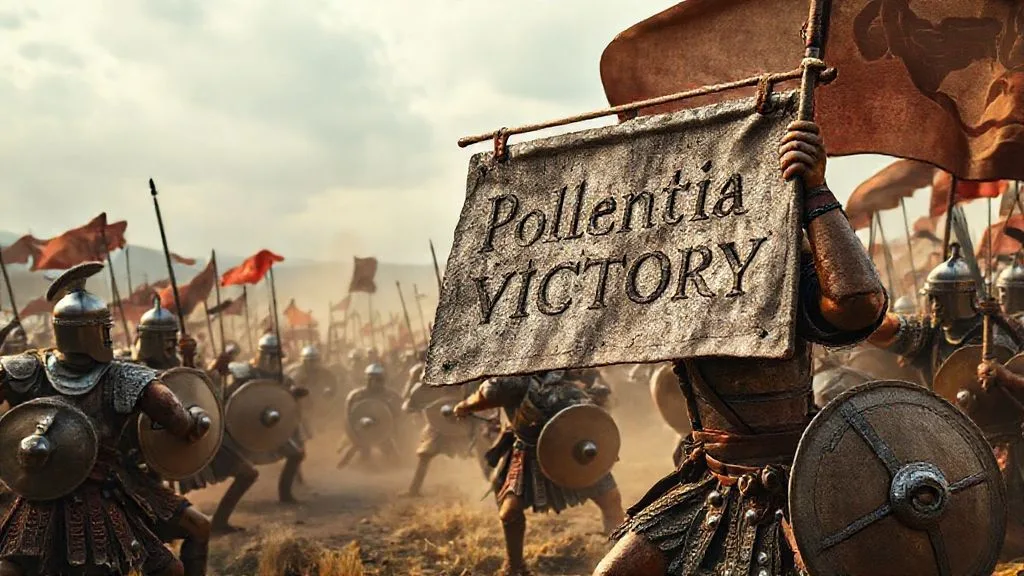
The Battle of Grunwald was an annihilation of Teutonic prestige. Grand Master Ulrich von Jungingen fell in battle, along with many of the Order’s highest officers. Chronicles speak of heaps of corpses, broken banners stained with mud, and discarded armor scattered under the July sun. Captured Teutonic knights were marched away under guard, their faces masked with shock, disbelief, or stubborn pride. The Order’s field army had been destroyed, but its fortified strongholds still stood, above all the mighty castle of Marienburg (Malbork), a sprawling brick fortress on the Nogat River that served as the Order’s capital.
In the weeks that followed, the victors faced a question that often haunts great triumphs: how to convert victory into lasting advantage. Władysław Jagiełło and Vytautas advanced deeper into Prussian territory, accepting the surrender of towns and fortresses. Yet coordination faltered, supply lines stretched thin, and the momentum of the campaign slowed. The siege of Marienburg, defended resolutely by the new Grand Master Heinrich von Plauen, failed to deliver the decisive blow that might have ended the Teutonic state altogether. Famine, disease, and the gathering of new enemy forces forced the Polish-Lithuanian leaders to withdraw before the autumn rains.
This failure to capture Marienburg has been debated for centuries. Was it caution, logistical necessity, or missed opportunity? Some later Polish commentators, writing with the benefit of hindsight, lamented that the potential to utterly crush the Order slipped through the victors’ fingers. Others have noted the complex reality of ruling a diverse union: Jagiełło and Vytautas had to think not only of glory but of sustaining the loyalty of nobles, maintaining order at home, and managing the diplomatic repercussions of a total annihilation of the Order. Whatever the reasons, the result was clear by late 1410: both sides were exhausted, both had suffered grievous losses, and neither could easily resume large-scale operations in the short term.
Under these conditions, the logic of negotiation became irresistible. The Teutonic Order, stripped of much of its manpower and deeply in debt, needed peace to survive. Poland and Lithuania, though triumphant, also had to consolidate their gains, repatriate prisoners, and address internal issues that had been deferred during the campaign. Letters began to circulate proposing truces and meeting places. Toruń, located within the Order’s territory but accessible via the Vistula to Polish envoys, emerged as a suitable venue. And so, the aftermath of one of medieval Europe’s most crushing battlefield defeats led directly to a treaty that would be remembered, centuries later, as the first peace of torun.
Gathering in Toruń: Delegations, Envoys, and Tense Silences
As winter tightened its grip on Prussia in late 1410 and early 1411, roads hardened under frost, making long-distance travel more predictable even if bitterly cold. Into this frigid landscape rode delegations draped in furs, faces wrapped against the wind, guarded by escorts that were small enough to appear peaceful yet large enough to deter ambush. Toruń’s city council prepared feverishly. Guest houses were assigned for the different parties, stables cleared, stocks of firewood amassed. The city was accustomed to hosting dignitaries and merchants, but the stakes now were unlike any previous gathering.
The Polish-Lithuanian delegation included representatives of the king and grand duke, bishops, and high-ranking nobles. Among them were men who had stood at Grunwald, who had seen comrades fall and banners captured, and who now had to sit across the table from survivors of the defeated Order. The Teutonic side, under the new Grand Master Heinrich von Plauen and his advisers, arrived conscious of their weakened position but determined to salvage as much as possible from catastrophe. There was a tension even in seemingly mundane details: who would be lodged closer to the negotiating hall? Which delegation would enter first? Each ceremonial gesture was laden with symbolism and potential insult.
In the streets, languages mingled: German, Polish, Latin, Lithuanian, and the Slavic dialects of Prussia’s rural hinterlands. Innkeepers hurried, bakers worked before dawn, and the city’s churches filled with prayers for peace—or, in some hearts, for a favorable judgment disguised as compromise. Rumors flew faster than any official announcement. Some citizens feared that failed talks might lead to another round of siege and devastation; others hoped that a strong Polish-Lithuanian position would curb the Order’s authority, loosening its grip on towns like Toruń itself.
Behind closed doors, before the formal sessions began, envoys met in smaller groups to test the waters. Could there be agreement on prisoner exchanges? On a temporary truce line? On the fate of Samogitia? These quiet, tentative conversations paved the way for the more theatrical confrontations that would follow. The air was thick not only with the smoky tang of torches but with unspoken questions: Had God’s verdict at Grunwald been final, or would human diplomacy reshape its implications? Could men who had seen each other as enemies of the faith now sit as negotiating partners? The very possibility of a peace of torun rested on their willingness to try.
Inside the Negotiating Chamber: Words Sharper Than Swords
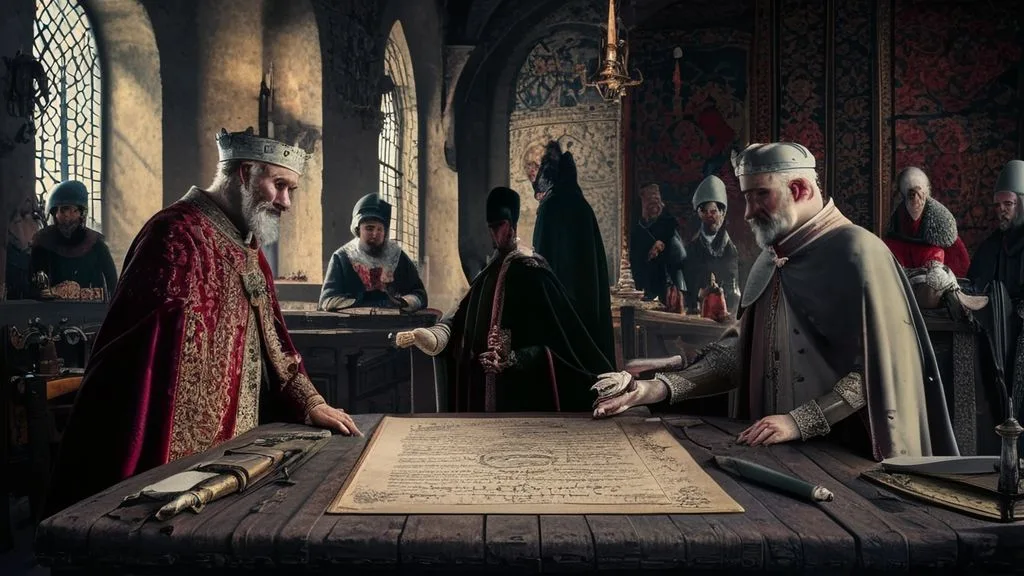
When formal negotiations opened, the scene was at once solemn and brittle. Representatives sat along long tables, documents laid out before them, seals close at hand. Interpreters and scribes hovered nearby, ready to transform spoken arguments into written records that might later be invoked as precedent. Latin, the language of learned Europe and the Church, predominated; it wrapped raw demands and grievances in a veneer of universal law.
The Polish-Lithuanian side pressed hard. They demanded recognition of their control over territories taken in the war, compensation for damages, and, crucially, the cession of Samogitia, at least for a defined period. They argued that the battle of Grunwald had revealed God’s will, demonstrating the injustice of the Order’s previous wars. Envoys invoked charters, previous agreements, even moral arguments about the conversion of Lithuania, insisting that the old crusading rationale was obsolete. “You claim to fight for the faith,” one could imagine a Polish envoy saying, “yet you shed Christian blood and violate Christian land.”
The Teutonic envoys countered with their own brand of legalism. They emphasized past imperial and papal privileges, portraying the Order as the rightful guardian of the frontier. They tried to minimize the scale of their defeat, insisting that while they had suffered a setback, their state and mission remained intact. Privately, they knew they could not reject every demand: their depleted treasuries, empty ranks, and restless towns made prolonged war impossible. But they maneuvered to limit territorial losses, offering instead monetary compensation and limited concessions. The resulting arguments could stretch late into the night, punctuated by appeals to canon law, feudal custom, and the ever-invoked concept of honor.
The atmosphere shifted from icy politeness to flashes of anger and back again. There were moments when tempers flared, when old accusations about burned villages or massacred prisoners resurfaced, threatening to derail the talks. Yet the discipline of diplomacy held. Each side had sent men skilled not only in warfare but in rhetoric and the choreography of concession. The peace of torun, as it emerged step by fragile step, was not the product of harmonious understanding but of grinding, often bitter bargaining in which every phrase mattered.
One can hear the scratch of quills as scribes drafted tentative clauses: lists of towns to be returned, formulas for ransoms, guarantees for merchants and clergy. An early modern historian later wrote that “in such treaties, ink becomes a subtler weapon than steel”—a sentiment that certainly applied here. The final document would be a patchwork of gains and compromises, influenced both by the victorious aura of Grunwald and by the Order’s continued control of key fortresses. The peace of torun would be a peace shaped as much by what each side feared it might still lose as by what it had already won.
Terms of the First Peace of Torun: What Was Gained and Lost
On February 1, 1411, the treaty was finalized and sealed. The first peace of torun did not read like a revolutionary remapping of the Baltic region. Instead, it resembled a careful, somewhat conservative attempt to stabilize a dangerous situation. Yet beneath its measured language, the treaty concealed profound implications for all three major actors: Poland, Lithuania, and the Teutonic Order.
In territorial terms, the settlement was modest compared to what many Polish and Lithuanian warriors might have dreamed of after Grunwald. Poland regained the land of Dobrzyń, which the Order had seized earlier, and saw its influence in the region strengthened. Lithuania secured the crucial region of Samogitia—but only for the lifetime of Władysław Jagiełło and Vytautas. This conditional arrangement reflected the Order’s desperate attempt to cling to some legal hope of eventual recovery, even as they acknowledged the current realities of power. Prussian towns captured during the campaign were to be returned to the Order, signaling that the victors had not insisted on completely dismantling Teutonic control in the region.
Far more immediate, however, were the financial clauses. The Teutonic Order was required to pay a staggering indemnity—often cited as equivalent to many tons of silver—to Poland and Lithuania, primarily as compensation for prisoners of war. Knights, squires, and common soldiers taken at Grunwald and in the aftermath were to be ransomed or released according to a structured system of payments. This war indemnity placed enormous strain on the Order’s finances. To raise the funds, the Teutonic authorities had to increase taxes, impose new levies on towns and peasants, and mortgage or sell properties. The economic basis of their military state began to erode from within.
The treaty also addressed the status of certain border territories and the rights of merchants and clergy. It aimed to normalize the flow of trade along the Vistula and through Baltic ports, recognizing that prolonged disruption would harm everyone. Yet many issues were left deliberately vague or postponed. The conditional nature of Samogitia’s cession, the unresolved resentment over wartime atrocities, and the lack of a broader constitutional settlement between the Order and its subjects all ensured that the peace of torun, while effective in ending immediate hostilities, was not the final word.
Still, for common people in the affected lands, the practical consequences were tangible. Fields could be replanted without fear of marauding cavalry. Villages burned in the war might be rebuilt, their charred timbers gradually replaced by new beams. Merchants once again loaded barges with grain and beer, sending them along the Vistula to Gdańsk and beyond. It was an imperfect peace, fraught with postponed conflicts, but it was peace nonetheless—a breathing space in which exhausted societies could try to heal.
Kings, Grand Masters, and Bishops: The Personalities Behind the Pact
Great treaties are often remembered by their clauses, but they are made by people: ambitious, fearful, idealistic, or pragmatic. The peace of torun was no exception. At its heart stood three figures whose personal trajectories shaped the outcome: King Władysław Jagiełło of Poland, Grand Duke Vytautas of Lithuania, and Grand Master Heinrich von Plauen of the Teutonic Order.
Władysław Jagiełło, born Jogaila in the forests of Lithuania, had navigated a remarkable transformation from pagan grand duke to Christian king. His marriage to Jadwiga and baptism into the Latin Church had bound him to the Polish crown, but he never fully escaped the suspicion of some nobles who saw him as an outsider. Victory at Grunwald immensely boosted his prestige, proving his ability as a commander and unifier. Yet in Toruń, Jagiełło had to show a different skill: restraint. He could not demand the total destruction of the Order without risking backlash from other European powers or destabilizing the delicate relationship with Lithuania. His approach in the negotiations reflected a long view, aiming not at immediate maximal gains but at a durable rebalancing of power in which Poland would steadily rise.
Vytautas, his cousin and sometimes rival, brought another layer of complexity. As grand duke, he had his own ambitions, seeking to solidify Lithuanian autonomy within the union and to expand eastward into Ruthenian lands. Grunwald had been as much his victory as Jagiełło’s; his Lithuanian and Ruthenian cavalry had played a crucial role in the battle. At Toruń, Vytautas was keenly interested in securing Samogitia, a region that touched deeply on Lithuania’s national and dynastic interests. The conditional terms of its cession were a compromise he tolerated for the sake of broader strategic stability. In the years to come, his relationship with the Order would oscillate between opposition and tactical cooperation, but the experience of 1410–1411 had permanently altered the balance between them.
On the other side stood Heinrich von Plauen, who had risen rapidly through the ranks of the Teutonic Order. It was he who had organized the defense of Marienburg after Grunwald, rallying the shattered remnants of the Order’s forces and persuading wavering towns to remain loyal. Without his efforts, the Polish-Lithuanian forces might have taken the fortress and ended the Teutonic state altogether. Yet this same man now had to sign away lands, accept crushing financial burdens, and symbolically acknowledge the Order’s defeat. His position was thankless; he was criticized by some brothers for conceding too much, and by enemies for not conceding enough. Within a few years, internal opposition would force his removal as grand master, a grim reminder that even apparent survival had come at a heavy internal cost.
Bishops and other clerics also played crucial roles, mediating, legitimizing, and recording the peace. Church officials, versed in canon law, helped frame arguments and structure compromises. Their presence added a layer of sanctity to proceedings but also injected ecclesiastical concerns into what might otherwise have been purely secular power politics. Through their pens and prayers, the peace of torun was inscribed not only in law but in the moral imagination of Christendom as a mediated end to a conflict between supposed defenders of the faith.
On the Streets of Toruń: How Ordinary People Lived the Peace
While diplomats debated clauses in heated chambers, life in Toruń continued with an air of anxious normalcy. Bakers still rose before dawn to knead dough; fishermen still tested the ice along the river’s edge; children still played in narrow alleys, imitating warriors with wooden sticks. Yet everyone knew that history was unfolding just a few streets away. Tavern owners overheard snatches of conversation from minor retainers and servants, piecing together rumors into speculative narratives about what the peace might bring.
For Toruń’s burghers, many of whom were members of German-speaking merchant families tied to the Hanseatic League, the Teutonic Order represented both protection and constraint. The Order had built and defended the city, anchored trade routes, and enforced a certain order. But it also levied taxes, controlled foreign policy, and dragged the town into wars whose ultimate benefits were unclear to those who simply wanted to buy and sell in peace. A treaty that weakened the Order without inviting chaos might, they hoped, tilt the balance in favor of urban autonomy and prosperity.
Polish-speaking artisans and laborers, some of whom had migrated from neighboring lands, viewed events through a different lens. The rise of the Polish crown promised a shift in cultural and political gravity that might, over time, favor their language and traditions. Among them, murmurs of satisfaction circulated when news of Grunwald reached the city months earlier. Now, they watched closely to see whether that battlefield triumph would translate into something more tangible: reduced levies, safer trade routes, perhaps greater recognition in municipal affairs.
One can imagine a scene in a modest inn near the city walls: a Teutonic squire with his arm in a sling sits at a rough-hewn table, sharing ale with a Polish archer who has come as part of the royal retinue. Their conversation, halting and mediated by a few shared words and gestures, might turn from personal losses to weary reflections on the futility of yet another war. Above them, beams blackened by decades of smoke bear silent witness. Outside, a local woman passes by, carrying a basket of turnips, her primary concern not territorial clauses but the hope that her sons will not be conscripted again. The peace of torun, for people like her, meant the possibility that the next planting season would not be interrupted by the thunder of hooves and the glow of burning thatch on the horizon.
Yet behind the celebrations that greeted the official proclamation of peace, a quieter anxiety persisted. Would this treaty hold? Were these powerful men really capable of restraining their ambitions, or was Toruń merely catching its breath between storms? The citizens of the city, like those in nearby towns and villages, understood all too well how quickly banners could change, how easily promises made at one table could be broken at another. Still, for that winter of 1411, they embraced the fragile calm as something precious and rare.
Diplomatic Reverberations Across Europe
The ink on the treaty had barely dried when news began to spread across Europe. Messengers carried copies or summaries to courts and ecclesiastical centers: Kraków, Vilnius, Prague, Lübeck, Rome. The first peace of torun was not merely a regional affair; it was watched by rulers and prelates who understood that the fate of the Teutonic Order and the rise of Poland-Lithuania had broader implications.
In the Holy Roman Empire, princes and city councils weighed the consequences with a mix of concern and calculation. Many German nobles had long viewed the Teutonic state as a prestigious crusading venture and an outlet for military energies that might otherwise disrupt the empire itself. The Order’s defeat at Grunwald and the constraints imposed by the peace of torun signaled that this outlet was no longer as secure or glorious as before. Some princes began to question the wisdom of committing resources to a cause increasingly framed as a political power struggle rather than a holy war.
In the Hanseatic cities, where merchants counted profits in barrels and bales rather than banners, the end of hostilities was greeted with cautious relief. Trade routes along the Baltic and up the Vistula could reopen more fully, and the risks of piracy, seizure, or military blockade diminished. Yet the weakening of the Teutonic Order also raised questions about who would now guarantee maritime security and uphold commercial privileges. In the shifting currents of Baltic politics, Poland and Lithuania appeared increasingly as powers to be reckoned with, their influence extending toward key ports and river mouths.
In Rome and among leading theologians, the settlement accelerated a reevaluation of the idea of crusade in the Baltic. If Lithuania was now Christian, if its king and grand duke sat as respected participants in diplomatic congresses, then continued war under the banner of conversion became harder to justify. As one later chronicler put it, “The cross was no longer a cloak for conquest, nor could the sword claim souls where baptism had already flowed.” The peace of torun thus contributed indirectly to a broader decline in enthusiasm for northern crusades, even as it did not immediately end all religiously tinged rhetoric in the region.
For Hungary, Bohemia, and other Central European realms, the rise of Poland-Lithuania heralded a new center of gravity to the north and east. Alliances and rivalries would adjust accordingly over the coming decades. The Battle of Grunwald and its diplomatic sequel in Toruń had demonstrated that the Polish-Lithuanian union was not a fragile experiment but a potent actor capable of defeating a renowned military order and negotiating on equal terms with European powers. In this sense, the treaty’s significance extended far beyond the frontier lines its clauses described.
A Fragile Settlement: Disputes, Grievances, and Shifting Frontiers
For all its immediate impact, the first peace of torun was never entirely secure. From the moment it was signed, both sides began interpreting—and in some cases, stretching—its provisions to their advantage. The conditional grant of Samogitia became a recurring source of arguments. What exactly did “for the lifetime of Władysław Jagiełło and Vytautas” entail? Could legal maneuvers or renewed appeals to the pope and emperor eventually overturn this concession?
The Teutonic Order, burdened by indemnities and internal dissent, struggled to maintain cohesion. To raise money, it increased taxes on peasants and towns, provoking discontent among Prussian estates. Town councils in places like Gdańsk and Elbląg started to view their relationship with the Order more critically, resenting both the financial hardship and the perception that the grand masters clung stubbornly to fading ambitions. In this simmering discontent lay the early stirrings of the Prussian Estates’ later opposition to Teutonic rule.
On the Polish-Lithuanian side, there was frustration that the treaty had not fully capitalized on the victory at Grunwald. Some nobles complained that the king had been too lenient, allowing the Order to survive when total victory had been within reach. These murmurs did not immediately translate into open opposition, but they contributed to a broader debate about royal strategy, the nature of the union with Lithuania, and the proper response to Teutonic provocations that would inevitably recur.
Border incidents continued, as they always had. A small fortress’s jurisdiction might be contested; merchants might complain of harassment at river toll stations; local commanders might test the limits of the agreed demarcation lines. Each such event risked escalating into a broader diplomatic crisis, especially in an environment where mutual trust was limited and memories of recent war were vivid. It is a reminder that peace treaties in the medieval world were more like fragile bridges over a torrent than solid dams blocking the flow of conflict.
Yet, the very existence of the peace of torun meant that disputes were increasingly framed in legalistic terms. Instead of immediately reaching for weapons, both sides often reached for parchments, comparing interpretations, collecting affidavits, and appealing to higher authorities. In this way, the treaty contributed to the gradual juridification of interstate relations in the region, an incremental step toward the more formalized international law that would develop in later centuries.
Memory, Chronicles, and Myths of the Peace of Torun
History is not only what happens; it is what is remembered, written, and retold. The first peace of torun quickly found its place in the chronicles of the age, standing in the shadow of the more spectacular Battle of Grunwald but carrying its own narrative weight. Chroniclers like Jan Długosz in Poland depicted the treaty as the culmination of a righteous struggle, emphasizing Polish and Lithuanian moderation and depicting the Teutonic Order as chastened yet unreformed. In Teutonic and German sources, the emphasis often fell on endurance in adversity and the hope of eventual recovery.
These texts were not neutral reports; they were works of interpretation. By choosing which details to highlight—Jagiełło’s clemency, Vytautas’s strategic savvy, von Plauen’s staunch defense of Marienburg—writers shaped how future generations would understand the meaning of 1411. Over time, the peace of torun also became wrapped in local legends and folk memories. In Toruń itself, stories grew about secret conversations in hidden chambers, about omens seen in the sky during the negotiations, about miraculous signs in churches that supposedly heralded peace. Whether literally true or not, such tales reflected a deeper truth: the treaty had touched the imaginations of those who lived in its aftermath.
As national identities developed in the modern era, the event was reinterpreted again and again. Polish historians tended to see it as an important but incomplete step in a longer arc of struggle against Teutonic and later German power in the region. Lithuanian narratives often emphasized Samogitia’s fate and Vytautas’s role, weaving the treaty into a story of resistance and state-building. German scholars in different periods sometimes framed the peace as a setback in the east, a cautionary tale about overextension and the dangers of conflating religious mission with territorial ambition.
One twentieth-century historian observed that “the Peace of Thorn in 1411 was less a conclusion than a comma in the turbulent sentence of Baltic history.” That neat turn of phrase captures the sense that the treaty was part of an ongoing, evolving story, rather than a final act. Myths and memories woven around it—heroic, tragic, nostalgic—reveal more about the societies telling them than about the parchment itself. Yet without that parchment, without the scribes bending over their tables in Toruń’s winter gloom, there would have been no focal point for such acts of remembrance.
From 1411 to 1466: How the First Peace Led to the Second
The peace of torun in 1411 was dubbed “the first” only retrospectively, after a second, more transformative Peace of Toruń was concluded in 1466. Between these dates stretched more than five decades of intermittent conflict, political realignment, and social upheaval. The first treaty, by allowing the Teutonic Order to survive albeit weakened, ensured that the underlying rivalry would continue to simmer.
Throughout the fifteenth century, the Order struggled with its finances and its relationship with its own subjects. To meet indemnity payments and maintain fortresses, it relied on heavy taxation that alienated burghers and nobles alike. Towns in Prussia, many of them German-speaking and merchant-dominated, increasingly resented being drawn into costly wars that seemed to serve the Order’s prestige more than their interests. These tensions eventually contributed to the formation of the Prussian Confederation in 1440, an alliance of cities and nobles opposed to Teutonic rule.
Poland, for its part, consolidated its internal structures and deepened its union with Lithuania. While there were rivalries and crises, the shared experience of confronting the Teutonic Order and the memory of victories like Grunwald and agreements like the first peace of torun reinforced a sense of common destiny. Polish rulers watched closely as discontent grew in Prussia, prepared to intervene when the opportunity arose.
That opportunity came in the form of the Thirteen Years’ War (1454–1466), when the Prussian Confederation sought Polish support against the Order. The resulting conflict was long and grueling, far more protracted than the 1409–1411 war that had led to the first treaty. Yet its outcome was decisive: the second Peace of Toruń in 1466 fundamentally reshaped the region. The Teutonic Order lost substantial territories, including Royal Prussia, which came under Polish sovereignty, and was relegated to the status of a vassal power in the remaining lands.
In this sense, the first peace of torun can be seen as the hinge between the age of Teutonic ascendancy and the age of its gradual eclipse. By failing to annihilate the Order but forcing it into structural weakness, the treaty set the conditions for future revolts and reconfigurations. It was a step in a longer process by which Poland-Lithuania emerged as the dominant power along the middle Baltic, and by which the cities and nobility of Prussia learned to challenge the authority of a once-mighty military order.
The Legacy of the Peace of Torun in Polish and Lithuanian Statehood
For Poland and Lithuania, the peace of torun represented both an affirmation and a test. It affirmed their ability to act together on the regional stage, to defeat a renowned martial order, and to impose terms that reflected their growing strength. It also tested their capacity to manage victory, to translate battlefield success into sustainable political gains without overreaching or fracturing their own union.
In the decades following 1411, Polish kings and Lithuanian grand dukes used the breathing space provided by the treaty to focus on internal governance and eastern expansion. The Lithuanian realm extended deeper into Ruthenian lands, while Polish influence grew in regions such as Red Ruthenia. The two polities maintained separate institutions but were bound by dynastic ties and the shared memory of joint struggle against the Teutonic Order. This experience contributed to the evolving idea that the union was not merely a marriage of convenience but a long-term partnership with strategic logic.
Symbolically, the events culminating in Toruń helped embed certain themes into Polish and Lithuanian political culture: the notion of resisting foreign encroachment, the ideal of cooperation between different ethnic and religious communities under one political roof, and the awareness that diplomacy could complement, and sometimes surpass, military force. Later Polish-Lithuanian diplomatic victories, such as the Union of Lublin in 1569, would be commemorated in a continuum that stretched back to Grunwald and Toruń.
In Lithuanian historical memory, the securing of Samogitia—however conditional in the 1411 treaty—was especially significant. Samogitia had long been a crucible of resistance, a stronghold of pagan traditions and a focus of Teutonic campaigns. Its formal recognition under Lithuanian control in the wake of the peace of torun underscored the success of Vytautas’s strategy and the resilience of local communities. It became a touchstone for later narratives of national identity and perseverance.
Over time, the treaty’s legacy would be refracted through the experiences of later centuries: partitions of the Polish-Lithuanian Commonwealth, foreign occupations, and national revivals. Historians and patriots in the nineteenth and twentieth centuries looked back at 1410–1411 as a moment when their ancestors had stood tall, had negotiated from a position of strength, and had briefly altered the course of European politics. The peace of torun, while less celebrated in popular imagination than the clash at Grunwald, remained an essential chapter in this larger story of statehood and survival.
Toruń as Historical Stage: City, Space, and Symbol
Toruń’s role in this drama is more than incidental. The city was not merely a convenient venue; it was a character in the story, a physical and symbolic space where competing powers met and where the textures of medieval life framed grand decisions. Its Gothic churches, imposing town hall, and stout walls spoke of centuries of investment and strategic importance. Situated on the Vistula, it linked inland Poland with the Baltic Sea, served as a hub for grain and timber exports, and, under the Teutonic Order, formed part of a chain of fortified urban centers securing their rule.
By 1411, Toruń’s identity was layered. It was a Teutonic foundation, a Hanseatic merchant town, and a liminal space touched by Polish and Lithuanian influences. Hosting the negotiations that led to the first peace of torun, the city embodied the overlapping loyalties and contested sovereignties that defined the region. Within its walls, one could hear sermons in Latin and German, market cries in Polish and other Slavic tongues, and perhaps the occasional Lithuanian word carried by visiting envoys. The city’s markets held goods from as far away as Flanders and Novgorod, while its citizens navigated the tensions between local interests and the directives of distant masters.
In later centuries, Toruń would gain additional layers of meaning: as the birthplace of Nicolaus Copernicus, as a contested site in Polish-Prussian and Polish-German struggles, and as a carefully preserved example of medieval urban architecture. Yet its moment in 1411, when the fate of the Teutonic state and the rise of Poland-Lithuania converged within its halls, continued to resonate. Modern visitors walking through its Old Town might see plaques or references to the treaty, reminders that beneath the tourist-friendly facades lies a history of war, negotiation, and fragile reconciliation.
Space matters in history. The fact that the peace of torun was concluded not in a remote castle but in a bustling commercial city shaped its character. Urban elites had a stake in peace; the rhythms of trade and craft life set their own tempo, often at odds with the marching cadence of armies. Toruń, as stage and actor, subtly pressed its guests toward accommodation. The city’s very existence as a crossroads of cultures mirrored the complex compromise eventually inked within its walls.
Modern Reflections: National Narratives and Contested Pasts
In the modern era, the first peace of torun has been revisited again and again through the lenses of nationalism, international law, and memory studies. Polish scholars in the nineteenth century, writing under partitions imposed by Russia, Prussia, and Austria, often celebrated the early fifteenth century as a golden age of resistance and victory. Grunwald, immortalized in Jan Matejko’s sweeping 1878 painting, became a powerful symbol; Toruń, and the treaty signed there, appeared in footnotes and scholarly monographs as the rational, diplomatic sequel to martial heroism.
German historians, particularly in the nineteenth and early twentieth centuries, sometimes approached the Teutonic Order with a mixture of nostalgia and critical distance. Some saw in the Order a precursor to later eastward expansions, while others criticized its rigidity and failure to adapt. Within these debates, the peace of torun could be portrayed as a tragic but instructive moment, when a once-dynamic institution confronted the limits of its medieval model in a changing world. After the catastrophes of the twentieth century, interpretations shifted again, with many scholars rejecting older nationalist frameworks and focusing instead on the shared, entangled history of the Baltic peoples.
In Lithuania, the treaty took on renewed importance during the twentieth-century struggles for independence and identity. Samogitia’s role, Vytautas’s strategy, and the broader success of Lithuania in resisting external domination were woven into narratives that connected medieval resilience to modern sovereignty. The fact that the peace of torun acknowledged, even conditionally, Lithuanian claims over fiercely contested borderlands became a point of retrospective pride.
Today, historians often emphasize the complexity and ambiguity of the settlement. Rather than casting it simply as Polish-Lithuanian triumph or Teutonic tragedy, they examine the treaty as a product of its time: an attempt by war-weary societies to stabilize a volatile frontier through compromise, legalism, and financial instruments. Recent scholarship—drawing on archival work, archeology, and comparative studies of medieval diplomacy—has highlighted how the treaty exemplifies broader trends in late medieval Europe, where interstate conflicts increasingly ended not in total annihilation but in negotiated order.
Yet for all these academic reinterpretations, the peace of torun continues to evoke powerful emotions in the lands once ruled by its signatories. Commemorations, reenactments, and educational programs use it as a touchstone for discussions about conflict resolution, regional cooperation, and the perils of ideological warfare. In a Europe that has repeatedly grappled with war and reconciliation, the story of how bitter enemies sat down in a winter-struck city to forge an imperfect but meaningful peace still carries a quiet, resonant lesson.
Conclusion
On that February day in 1411, when quills moved across parchment in Toruń, few present could have fully grasped the long shadow their actions would cast. The first peace of torun did not create a utopia, nor did it settle every dispute. It was a compromise born of exhaustion: a treaty in which victors moderated their demands and the defeated clung to what they could salvage. Yet through its measured territorial adjustments, its heavy indemnities, and its implicit recognition of new power realities in the Baltic region, the treaty marked a turning point.
It confirmed that the Teutonic Order’s age of unchecked expansion was over, while Poland-Lithuania’s ascent was underway. It offered war-ravaged communities a respite in which to rebuild lives and livelihoods. It redirected some conflicts from the battlefield to the negotiating table, encouraging the use of legal frameworks and written agreements even in an era still dominated by steel. Perhaps most importantly, it revealed the deeply human dimension of diplomacy: the way fear, pride, faith, and memory intertwine in the difficult art of making peace.
From the vantage point of centuries, the peace of torun appears as one chapter in a longer saga of rivalry and coexistence along the Baltic. The second Peace of Toruń in 1466, later conflicts, partitions, and modern national rebirths all form part of that narrative. Yet without the first treaty—without those tense winter days when envoys weighed words as carefully as they once had weighed weapons—the story would be incomplete. Toruń’s frozen streets, its crowded inns and echoing halls, became the setting where a continent’s frontier was quietly redefined.
In the end, the treaty reminds us that peace is rarely a single, triumphant act. It is a process, unfolding across time, shaped by both grand strategy and the quiet hopes of ordinary people who long simply for safety and dignity. The first peace of torun stands as a testament to that fragile, stubborn human impulse to stop the killing, to build again, and to imagine a future in which the clatter of arms fades, however briefly, into the background hum of everyday life.
FAQs
- What was the Peace of Toruń in 1411?
The Peace of Toruń in 1411, often called the first peace of torun, was a treaty signed on February 1, 1411, between the Kingdom of Poland and the Grand Duchy of Lithuania on one side and the Teutonic Order on the other. It ended the war that had culminated in the Battle of Grunwald (Tannenberg) in 1410 and set out territorial, financial, and political arrangements intended to stabilize the Baltic region. - Who were the main parties involved in the treaty?
The principal parties were King Władysław II Jagiełło of Poland and Grand Duke Vytautas of Lithuania, representing their dynastic union, and Grand Master Heinrich von Plauen representing the Teutonic Order. Envoys, bishops, and nobles from each side participated in the negotiations held in the city of Toruń. - What were the key terms of the first Peace of Toruń?
Key terms included the return of Dobrzyń Land to Poland, the conditional cession of Samogitia to Lithuania for the lifetimes of Jagiełło and Vytautas, and the restoration of several Prussian towns to Teutonic control. The treaty also required the Teutonic Order to pay substantial war indemnities, especially for the release of prisoners, placing a heavy financial burden on the Order. - Why is the Peace of Toruń considered important in European history?
The peace is significant because it confirmed the decline of the Teutonic Order as a dominant military power and the rise of Poland-Lithuania as a major regional actor. It also marked a shift from crusading rhetoric toward more secular, dynastic power politics in the Baltic, and contributed to the broader trend of resolving interstate conflicts through detailed treaties and legal mechanisms. - Did the treaty bring lasting peace to the region?
The treaty ended the immediate war but did not create permanent peace. Many issues, particularly the status of Samogitia and broader grievances against the Teutonic Order, remained unresolved or only partially addressed. Tensions and conflicts continued in subsequent decades, eventually leading to the Thirteen Years’ War and the second Peace of Toruń in 1466, which more radically reshaped the region. - How did the treaty affect the Teutonic Order internally?
The heavy indemnities and partial loss of prestige put enormous strain on the Order’s finances and authority. To pay its obligations, the Order increased taxes and levies, sparking discontent among Prussian towns and nobles. This internal pressure contributed to growing opposition from the Prussian Estates and ultimately to the formation of the Prussian Confederation, which played a key role in later wars against the Order. - What impact did the Peace of Toruń have on Poland and Lithuania?
For Poland and Lithuania, the treaty confirmed their military success and allowed them to consolidate power. Poland regained key territories and enhanced its regional standing, while Lithuania secured Samogitia and strengthened its western frontier. The shared victory and joint negotiations reinforced the logic of their union and provided a foundation for further political development in the fifteenth century.
External Resource
Internal Link
Other Resources
- Encyclopaedia Britannica – general search for the exact subject
- Google Scholar – academic search for the exact subject
- Internet Archive – digital library search for the exact subject