Table of Contents
- A City Holding Its Breath: Constantinople on the Eve of a Decision
- After Chalcedon: The Wounds That Would Not Heal
- An Empire Divided: Emperors, Bishops, and the Shadow of Schism
- The Death of Anastasius and the Hope Placed in Justin I
- July 518: The Crowds, the Palace, and the Pressure of the Streets
- Inside the Synod: Bishops, Confessions, and the Weight of Oaths
- Reaffirming Chalcedon: The Theological Heart of the Synod
- The Fall of Severus of Antioch and the Fate of the Monophysites
- Imperial Power and Sacred Doctrine: Justin I as Defender of Chalcedon
- From Constantinople to Rome: Popes, Letters, and Fragile Reconciliation
- Echoes in the Provinces: Alexandria, Antioch, and the Eastern Resistance
- Life in the Streets: Ordinary Believers in an Age of Dogma
- Long Shadows: How the Synod Shaped Eastern Christianity
- Memory, Chronicle, and Controversy: How Historians Read 518
- From 518 to the Schism of 1054: A Quiet Step Toward a Distant Rupture
- Conclusion
- FAQs
- External Resource
- Internal Link
Article Summary: On 20 July 518, the synod of constantinople 518 gathered under the dome of the imperial capital to confront one of the most bitter theological and political crises of Late Antiquity. In the wake of the Council of Chalcedon (451), the Christian world of the Eastern Roman Empire had been torn between Chalcedonian and anti-Chalcedonian visions of Christ’s nature, fracturing cities, monasteries, and imperial policy. The synod of constantinople 518, called soon after the accession of Emperor Justin I, became the moment when Constantinople publicly and officially reaffirmed Chalcedon, rejected Monophysite hierarchs, and sought reconciliation with the bishop of Rome. Yet behind the formal decrees of the synod of constantinople 518 lay decades of riots, imperial compromises, and the deep suffering of communities that felt betrayed or silenced. This article traces the path leading to the synod of constantinople 518, reconstructs its debates, and explores its repercussions from the palace to the provinces. It follows the fates of emperors, bishops, and ordinary believers swept up into a struggle about the mystery of Christ and the unity of the empire. Above all, it asks how a single gathering in Constantinople, the synod of constantinople 518, could radiate influence across centuries of Christian history.
A City Holding Its Breath: Constantinople on the Eve of a Decision
On a humid July morning in 518, the city of Constantinople awoke to a sense of expectancy that hung in the air like incense before a liturgy. The sea breeze off the Bosporus did little to cool the crush of bodies gathering around the great Church of Holy Wisdom and the nearby public squares. It had been scarcely weeks since a new emperor, Justin I, had been hoisted on the shields of soldiers and crowned beneath the golden mosaics of the palace chapel. Already the people were restless, chanting from streets and forums a phrase that echoed from stone to stone: “Orthodox faith! Restore Chalcedon!”
The synod of Constantinople that would meet on 20 July did not appear from nowhere. It grew out of years in which the very idea of “orthodoxy” had become contested, when processions of monks clashed with one another, and imperial officials consulted theologians as anxiously as they did generals. In the weeks leading up to the gathering, the capital was alive with rumor. Would the new emperor keep the ambiguous religious policy of his predecessor, Anastasius, or would he boldly declare for the Council of Chalcedon, which proclaimed that Christ is to be confessed “in two natures, without confusion, without change, without division, without separation”?
Market sellers in the bustling Mese thoroughfare heard reports that bishops were arriving from across Thrace and Bithynia. In the porticoes near the Forum of Constantine, students debated the merits of Cyril of Alexandria versus Leo of Rome, while elderly priests told stories of the council that had met at Chalcedon more than half a century earlier. Families remembered relatives who had fled riots in Antioch or Alexandria, caught up in doctrinal disputes whose technical language—“one nature,” “two natures,” “hypostasis”—seemed far removed from famine, tax levies, and barbarian raids. Yet everyone knew that what would be decided now, in the synod convened in the imperial city, would shape the future of the Christian faith and the Roman State alike.
Inside the Great Palace, the atmosphere was no less charged. Imperial secretaries drafted and redrafted formulas of faith, fearful that a single word could ignite rebellion in Egypt or Syria. Bishops who had once equivocated under Anastasius now rehearsed confessions that aligned them with Chalcedon, sensing the wind had changed. The synod of constantinople 518 was more than an ecclesiastical meeting; it was a public drama in which the emperor, the patriarch, and the people each claimed to guards the true inheritance of the apostolic faith.
And yet, for all the noise, there was also silence. In monasteries along the shores of the Bosporus, ascetic monks kept vigil, praying for the unity of the church. Some begged God to strengthen those who would defend Chalcedon. Others, loyal to the anti-Chalcedonian patriarch Severus of Antioch, pleaded that their bishops would not be condemned. Within this silence, the larger question pulsed: could one empire contain competing visions of Christ, or would unity demand exclusion? The day of decision, 20 July 518, was fast approaching, and Constantinople—as if holding its breath—waited.
After Chalcedon: The Wounds That Would Not Heal
To understand why the synod of constantinople 518 mattered so profoundly, it is necessary to step back nearly seventy years to another council, held not in Constantinople but across the water at Chalcedon in 451. There, bishops from across the Roman world assembled to address a storm that had broken out after the Council of Ephesus in 449, the so-called “Robber Council.” Nestorius, former bishop of Constantinople, had already been condemned; now the pendulum swung again, as monks and bishops from Egypt and Syria fought to defend the teaching of their own heroes, especially Cyril of Alexandria.
The Council of Chalcedon attempted a delicate balancing act. It affirmed the Christological theology of Pope Leo I, whose Tome insisted on the full humanity and full divinity of Christ, united in one person. At the same time, it professed continuity with Cyril’s insistence on the unity of Christ. Yet the formula “in two natures” struck many in the eastern provinces as a betrayal of Cyril’s preferred language of “one incarnate nature of the Word.” In the eyes of these believers, Chalcedon seemed to divide Christ into two, imperiling salvation itself.
In the decades after 451, the empire fractured along these theological lines. In major centers like Alexandria and Antioch, a powerful movement—later labeled “Monophysite” by its enemies—rejected Chalcedon and developed its own hierarchy, liturgy, and monastic networks. Many of these communities preferred to call themselves “Miaphysite,” emphasizing a single, united nature of Christ that was both divine and human. Political and ethnic grievances blended with doctrinal concerns: Egyptians and Syrians, weary of Greek-speaking officials and imperial taxes, embraced leaders who presented Chalcedon as an act of imperial oppression disguised as theology.
Imperial attempts at compromise soon followed. The emperor Zeno, ruling from Constantinople, promulgated the Henotikon around 482, a unifying edict that carefully avoided mention of Chalcedon’s formula. It condemned extremes on both sides, rejected Nestorius and Eutyches, and affirmed the ancient creeds—but stopped short of explicitly endorsing “two natures.” In theory, the Henotikon was meant to heal wounds; in practice, it opened new ones. Rome rejected it, leading to the Acacian Schism between the papacy and the patriarchate of Constantinople. Anti-Chalcedonian leaders saw it as a victory, while convinced Chalcedonians felt betrayed.
By the time Anastasius I came to the throne in 491, these wounds were deep and festering. The emperor, personally inclined toward anti-Chalcedonian theology, tried to maintain public order while quietly favoring bishops and patriarchs who opposed Chalcedon. Basiliscus, Illus, and other warlords had already shown that doctrinal loyalties could become rallying cries for civil war. Religion, in this context, was not an abstract exercise; it was a question of loyalty, power, and regional identity. Every imperial decision on doctrine risked uprisings in the provinces or unrest in the capital. The stage was thus set for the convulsions that would eventually make the synod of constantinople 518 both unavoidable and explosive.
An Empire Divided: Emperors, Bishops, and the Shadow of Schism
In the late fifth and early sixth centuries, an observer traveling across the Eastern Roman Empire would have encountered a patchwork of allegiances that revealed how thoroughly Christological debate had saturated public life. In Constantinople itself, many clergy remained officially committed to Chalcedon, but imperial favor could shift the balance. In the Syrian countryside, monasteries affiliated with Severus of Antioch thundered against “the blasphemies of the two-nature doctrine.” In Egypt, the majority of the population sided with anti-Chalcedonian patriarchs, even when the emperor himself tried to impose Chalcedonian rivals.
These competing loyalties shaped imperial politics. The emperor was not merely a secular ruler; he saw himself—and was seen—as the guardian of the church’s faith. Bishops gathered at councils under his auspices, and theological decisions were promulgated as imperial law. Yet emperors were not theologians by profession. Zeno and Anastasius, confronted with the choice between theological clarity and political unity, often chose ambiguity. Their policies, such as the Henotikon, tried to blend doctrinal moderation with political expediency, but each attempt pleased neither Rome nor the most committed Chalcedonians, while emboldening anti-Chalcedonian factions in the East.
The bishops, for their part, navigated a perilous path. Some, like the patriarch Acacius of Constantinople, tried to uphold imperial edicts while avoiding open rupture with Rome. Others, like Severus of Antioch, refused any compromise with what they regarded as Nestorianizing tendencies in Chalcedon. Severus, a brilliant theologian and charismatic leader, became the figurehead of the anti-Chalcedonian cause in the early sixth century. His letters and homilies circulated widely, inspiring monks and laypeople alike. When Anastasius elevated him to the see of Antioch in 512, it was a signal that the emperor was leaning decisively away from Chalcedon.
The shadow of schism loomed large. Rome, cut off from Constantinople since the Acacian Schism of 484, insisted that any reconciliation required a clear and public reaffirmation of Chalcedon and a condemnation of those who had supported the Henotikon. Hopes for unity flickered briefly when diplomatic envoys spoke of possible formulas that could satisfy both sides, but deep mistrust remained. Every new patriarchal appointment, every imperial edict, and every riot in the capital was scrutinized for its theological implications.
Nor were doctrinal lines always cleanly drawn. Some bishops tried to interpret Chalcedon in a Cyrillian way, emphasizing the unity of Christ while preserving the language of “two natures.” Others proposed variant formulas that blurred the distinctions. Local synods across the empire issued creedal statements, some more Chalcedonian, some more Miaphysite. The result was a religious landscape as complex as a mosaic: from a distance, a single imperial church; up close, a thousand tiny tesserae, each holding its own shade of belief.
In this environment, the significance of what would later be known as the synod of constantinople 518 becomes clearer. It was not a routine gathering but a decisive move in a long struggle over whether the empire would continue along the path of doctrinal ambiguity or finally declare itself unambiguously in favor of Chalcedon and reconciliation with Rome. The stakes were nothing less than the empire’s spiritual identity and its fragile internal cohesion.
The Death of Anastasius and the Hope Placed in Justin I
The turning point came, unexpectedly, with the death of Emperor Anastasius in July 518. An old man by then, Anastasius had reigned for nearly three decades, leaving behind a well-filled treasury but a church in turmoil. His religious policies had oscillated between appeasement and favoritism toward anti-Chalcedonian figures. In his later years, tensions in the capital had erupted into open conflict, notably in the “Blue-Green” riots, where chariot factions, often aligned with different doctrinal camps, clashed violently.
When Anastasius died without an heir, the succession was uncertain. In the confusion, the imperial guard and palace officials settled on Justin, a career soldier from Thrace who had risen through the ranks. Illiterate in his youth, Justin had learned enough Greek to navigate the corridors of power and commanded the respect of the army. His accession, on the surface, seemed like the triumph of a rugged provincial over the refined bureaucrats of the capital.
Yet Justin brought with him not only military credentials but a reputation for straightforward Chalcedonian piety. In the eyes of many in Constantinople who had grown weary of Anastasius’s religious policies, this was a cause for cautious hope. Almost immediately after his elevation, crowds began to press for a change in direction. Contemporary sources recount how, during Justin’s early public appearances, acclamations of “Orthodox emperor!” and “Restore the Council of Chalcedon!” rang out. The people knew that the death of Anastasius could open a new chapter in imperial theology.
Justin, for his part, recognized the opportunity and the danger. Any move toward Chalcedon might inflame anti-Chalcedonian strongholds in Syria and Egypt, where imperial authority depended on the cooperation of local elites and bishops. But continued ambiguity would prolong the schism with Rome and alienate influential Chalcedonian factions in the capital and the Balkans. To act or not to act—this was the dilemma that haunted the early months of his reign.
Furthermore, Justin was not alone. His nephew, the young and ambitious Justinian, soon emerged as his close adviser. Justinian, later famed as a great legislator and builder of Hagia Sophia, was at this time already deeply invested in church unity, legal order, and theological precision. Many historians have suggested that Justinian urged his uncle to move decisively in favor of Chalcedon, seeing in religious clarity a foundation for imperial revival. It is in this context that the call for a synod in Constantinople must be placed.
Within days of Anastasius’s death, pressure mounted on the city’s new patriarch, John II of Cappadocia, himself a cautious man who had tried to avoid clear commitments under the former emperor. Now the chants of the crowd and the whispers of the palace converged: the patriarch must publicly confess Chalcedon, break with the followers of Severus of Antioch, and initiate reconciliation with Rome. Such actions could not be taken lightly. They required a formal gathering of bishops, a synod whose decisions could be presented as the will of the church, not merely the whim of an emperor. Thus, amid the swirl of early summer 518, preparations began for the synod that would convene on 20 July.
July 518: The Crowds, the Palace, and the Pressure of the Streets
As July advanced, Constantinople turned into a theater of acclamation and protest. The Hippodrome, that great arena where the people and the emperor faced each other in the ritual of chariot races and political supplication, became a barometer of religious sentiment. The Blues, generally associated with the more fervently Chalcedonian populace, shouted slogans demanding the condemnation of Severus of Antioch and the restoration of Chalcedon. The Greens, less cohesive in religious alignment but no less vocal, sometimes countered, sometimes joined in, depending on local leadership and the shifting mood.
Accounts preserved in later chronicles describe how the people cornered Patriarch John in the Hippodrome, crying out: “Drive out the Manichaeans, the enemies of Chalcedon, the followers of Severus!”—an exaggeration perhaps, but one that shows how the theological opponent was demonized. At times the patriarch promised to look into their demands, at times he retreated behind the guarded doors of the church. Yet the message was clear: the crowd would not accept half measures. They wanted a public, unmistakable declaration that the capital’s church stood with Chalcedon.
The palace, too, felt the pressure. Justin and his advisers recognized in these chants not only pious zeal but also an opportunity to legitimize the new regime. If the emperor could present himself as the champion of orthodoxy, cleansing the church of ambiguity and schism, his authority would be strengthened. The synod of constantinople 518 thus became a political instrument as well as an ecclesiastical necessity. Emissaries were sent to bishops near the capital, instructing them to assemble. Letters were dispatched to distant sees, informing them of the impending deliberations.
Yet behind these official maneuvers lay a more diffuse but no less powerful force: the fear of disorder. The memory of earlier riots—over tax policy, doctrinal questions, or circus factions—reminded everyone of how quickly Constantinople could descend into chaos. Bishops who hesitated to commit to Chalcedon now saw that any perceived compromise with Severus and his followers could trigger violent backlash. In this sense, the synod was shaped not only by theological argument but by the voice of the streets, the looming threat that, if the church did not speak decisively, the people might act in its place.
It is astonishing, isn’t it, how an empire that stretched from the Danube to the Nile could find its destiny compressed into the shouting of a crowd in a single city? Yet that is what happened in Constantinople that summer. The synod was born out of conversations in palace halls and episcopal residences, but it was midwifed by the roar of the Hippodrome and the prayers of anxious believers who sensed that a dividing line was about to be drawn across their world.
Inside the Synod: Bishops, Confessions, and the Weight of Oaths
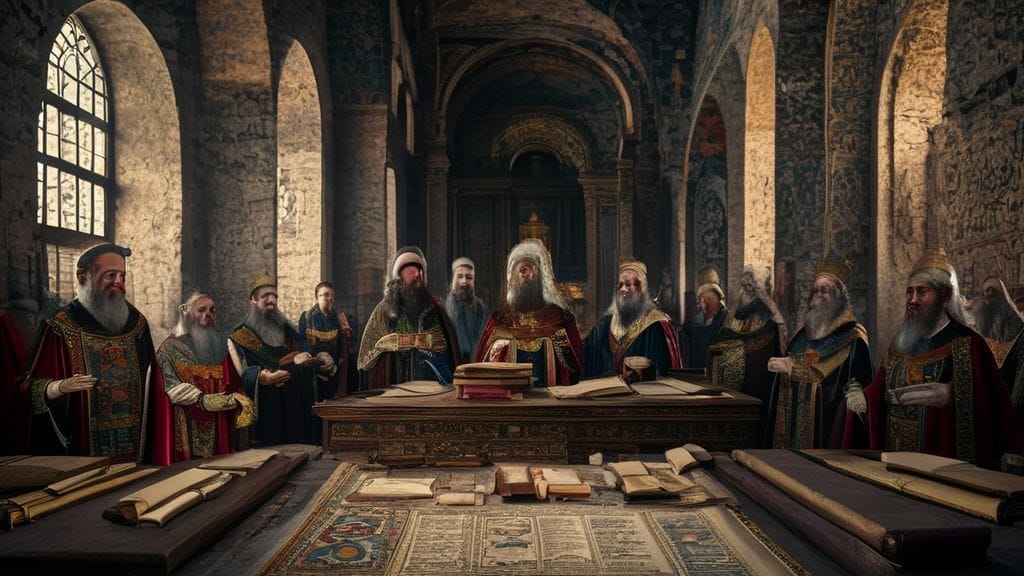
When the bishops finally gathered in Constantinople on 20 July 518, they entered not a quiet retreat but a charged assembly that combined solemn ritual with political theater. The synod took place under the presidency of Patriarch John II, with close involvement from imperial representatives. Although not an ecumenical council on the scale of Nicaea or Chalcedon, this synod had a clear mandate: determine the faith-position of the capital’s church and, by extension, signal the empire’s new direction.
The sources—fragmentary and partisan though they may be—allow us to glimpse the proceedings. One of the central acts was a collective confession of faith. Bishops who had previously subscribed to the Henotikon or had remained silent on Chalcedon were now required to affirm, publicly and unequivocally, their adherence to the Council of Chalcedon and to the Tome of Leo. This was more than a written signature; it was a spoken declaration, accompanied by oaths and liturgical gestures, in the presence of their peers and, indirectly, of the emperor and the people.
Some did so willingly. For these bishops, the synod of constantinople 518 was a long-awaited chance to clarify their stance and align themselves with what they saw as true orthodoxy. Others hesitated, mindful of their former associations with anti-Chalcedonian leaders or their pastoral responsibilities in provinces where Chalcedon was unpopular. To reject Severus of Antioch, for example, meant to break with a vast network of clergy and monastics who revered him as a confessor of the faith.
But the synod was not a neutral courtroom; it was a forum conducted under the gaze of imperial power. Bishops knew that to resist too strongly might mean deposition or exile. In this sense, the oaths they swore were shaped by more than conviction; they were also shaped by calculation and fear. Yet that did not make them meaningless. In Late Antiquity, to swear falsely in matters of faith was to risk not only imperial displeasure but divine judgment. Many participants likely felt a genuine sense of spiritual danger as they pronounced their formulas.
The synodal acts, now largely lost except in later quotations, reportedly included a condemnation of Severus of Antioch and those who persisted in rejecting Chalcedon. The names of bishops and theologians associated with anti-Chalcedonian positions were listed and anathematized. At the same time, the henotikon policy of Zeno and Anastasius was implicitly, if not always explicitly, set aside. What emerged was a portrait of an episcopate brought, perhaps reluctantly, into line with a Chalcedonian imperial program.
One can imagine the emotional weight of this moment. For some bishops who had lived through the earlier councils, it was like reliving old battles with a new outcome. For younger prelates, it was an initiation into a church where faith and imperial policy were intertwined more tightly than ever. And for the empire, the synod of constantinople 518 marked the point at which ambiguity gave way to declaration, even if the price was future alienation of those who felt abandoned by the new orthodoxy.
Reaffirming Chalcedon: The Theological Heart of the Synod
At the center of the synod’s work stood a simple yet contested task: to reaffirm the Council of Chalcedon. What might sound like a straightforward repetition of an older council was in fact a complex act of theological and political repositioning. Publicly, the bishops and the patriarch declared their acceptance of the Chalcedonian definition—that Christ is to be acknowledged in two natures, united in one person and one hypostasis. They endorsed the Tome of Leo as a reliable and authoritative exposition of the apostolic faith.
This reaffirmation had multiple layers. On one level, it was a doctrinal statement, aligning the Constantinopolitan church with the tradition of Nicaea and Constantinople (381) as interpreted through Chalcedon. On another level, it was a rejection of alternatives: the Henotikon, with its strategic silences, and the radical anti-Chalcedonian positions that dismissed Chalcedon as a betrayal. To reaffirm Chalcedon in 518 was to draw a line that had been blurred for decades.
The synod of constantinople 518 thus undertook a kind of retrospective reinterpretation. By presenting itself as the faithful heir of Chalcedon, the Constantinopolitan church implicitly recast the recent past as an unfortunate detour. Emperors and patriarchs who had wavered were now, in effect, corrected by their successors. The assembly emphasized continuity with the great councils and the mainstream of imperial orthodoxy, while marginalizing the compromises that had once dominated imperial policy.
Scholars today, examining the available fragments of the synod’s acts, note how carefully Scripture and patristic texts were marshaled to support this reaffirmation. Passages from the Gospels, especially those highlighting Christ’s human emotions and divine powers, were used to underscore the coherence of the “two natures” formula. Citations from earlier fathers—Athanasius, Gregory of Nazianzus, and of course Cyril of Alexandria—were interpreted to show that Chalcedon did not innovate but clarified what had always been believed.
Here, historiography becomes important. Modern historians like John Meyendorff and Aloys Grillmeier have pointed out that the synod’s portrayal of Chalcedon as a self-evident synthesis is somewhat retrospective; at the time, many sincere Christians found its language difficult. Yet the very act of rereading history—of saying, “this is what we have always meant”—was part of the synod’s strategy. By re-narrating the past, it sought to secure the future.
Behind the polished formulas, however, lay unresolved tensions. Could Chalcedon truly be reconciled with the deep suspicions of those in Egypt and Syria who feared it undermined Cyrillian Christology? Was the Tome of Leo fully compatible with earlier Greek theology, or did it risk introducing Western emphases into Eastern thought? The synod of constantinople 518 answered these questions decisively in one direction: yes, Chalcedon was the authentic expression of the undivided church. But the persistence of non-Chalcedonian churches to this day testifies that not everyone accepted that verdict.
The Fall of Severus of Antioch and the Fate of the Monophysites
No name hovers more ominously over the synod of constantinople 518 than that of Severus of Antioch. For nearly two decades, Severus had been the towering intellect and spiritual leader of anti-Chalcedonian Christianity in the Near East. Elevated to the see of Antioch in 512 by Emperor Anastasius, he used his position to consolidate a network of like-minded bishops, monks, and lay supporters. His theology, rooted in the Alexandrian tradition, insisted on the unity of Christ’s nature and rejected what he saw as the dyophysite division of Chalcedon.
Under Anastasius, Severus enjoyed imperial support and relative security. But the accession of Justin I turned the tide. As Chalcedonian sentiment surged in Constantinople, Severus’s presence in the capital became untenable. In 518, he was formally deposed and condemned by the synod, his writings anathematized, his name inscribed on lists of heretics. The synod’s acts targeted not just his ideas but his person, making him the embodiment of an entire doctrinal party now declared beyond the pale.
Severus fled into exile, ultimately finding refuge in Egypt, where anti-Chalcedonian sentiment remained strong. There he continued to write and to shape the theology of what would become the Syriac Orthodox and Coptic churches. Ironically, his condemnation in Constantinople strengthened his status as a confessor and hero among his followers. They saw in him a man willing to suffer displacement rather than compromise the faith as they understood it.
For the Monophysites—or, more accurately, the Miaphysites—the synod of constantinople 518 was a trauma and a turning point. It signaled that the imperial center had definitively chosen Chalcedon, closing the door on official reconciliation under the existing empire. Many anti-Chalcedonian bishops were deposed, others fled or were replaced by Chalcedonian appointees. Monasteries that refused to align with Chalcedon faced harassment, confiscation of property, or the exile of their leaders.
Yet persecution, as often in history, did not eradicate dissent. Instead, it hardened identities. In the rural villages of Egypt and Syria, local clergy and monks maintained their anti-Chalcedonian liturgies and teachings. Imperial decrees could change the name on a bishop’s throne but could not easily penetrate the daily religious life of distant communities. Over time, distinct non-Chalcedonian churches crystallized, with their own hierarchies and saints, increasingly detached from the official, Chalcedonian imperial church.
The synod, in trying to heal one schism—that between Constantinople and Rome—thus deepened another: the estrangement between the imperial church and large segments of the Eastern provinces. This outcome was not fully visible in 518; it would take decades, even centuries, to unfold. But in retrospect, the condemnation of Severus at the synod of constantinople 518 appears as one of those moments when a possible path of broader compromise narrowed into a line of separation that would shape the Christian map of the Near East down to the present.
Imperial Power and Sacred Doctrine: Justin I as Defender of Chalcedon
If the synod of constantinople 518 had a human face at the level of ultimate authority, it was that of Emperor Justin I. Unlike theologians trained in the subtleties of Greek metaphysics, Justin approached doctrine with the instincts of a soldier: loyalty, clarity, and obedience. For him, the Council of Chalcedon was the law of the church, sanctioned by previous emperors and rooted in the authority of the great councils. To deviate from it was not only error but insubordination.
Justin’s religious policy can be seen as a conscious reversal of Anastasius’s. Where his predecessor had sought compromise with anti-Chalcedonian forces, Justin sought consolidation around Chalcedon. This did not mean he favored indiscriminate persecution—political realities in Egypt and Syria counselled caution—but it did mean that, at the level of imperial symbology, the emperor presented himself as a new Constantine, safeguarding the true faith. The synod gave him the ecclesiastical imprimatur he needed to frame his reign in these terms.
Imperial involvement in the synod was not subtle. Official envoys attended the sessions, conveyed the emperor’s expectations, and ensured that the final acts aligned with imperial policy. The line between free theological debate and government-backed enforcement was thin at best. Bishops could persuade and be persuaded, but they could not easily resist the direction set from the palace. This intertwining of altar and throne was both the strength and the fragility of Byzantine Christianity.
From a modern perspective, one might question whether such close imperial control stifled genuine theological reflection. Yet within the worldview of Late Antiquity, the emperor’s role as pontifex and defender of the faith was largely taken for granted. The unity of the empire and the unity of the church were seen as mutually reinforcing. A divided church signaled a weakened empire; a strong emperor was expected to restore doctrinal order.
In this sense, Justin’s embrace of the synod’s decisions was not merely personal piety but a political program. By reaffirming Chalcedon, he aimed to mend relations with Rome, strengthen ties with Chalcedonian elites in the Balkans and Asia Minor, and present a united Orthodox front against external threats, whether Persian or barbarian. The subsequent reign of Justinian, with its vast legal reforms and church-building campaigns, would build on this foundation, even as Justinian’s own attempts at later doctrinal compromise—such as the condemnation of the “Three Chapters”—show that the tensions unleashed at Chalcedon and in 518 were not easily resolved.
From Constantinople to Rome: Popes, Letters, and Fragile Reconciliation
One of the most significant consequences of the synod of constantinople 518 was its impact on relations between Constantinople and Rome. Since the Acacian Schism, the two great sees had been estranged, their communion broken over the Henotikon and the refusal of Constantinople to clearly endorse Chalcedon and Leo’s Tome. Popes like Gelasius I had spoken forcefully about the primacy of the Roman see and had condemned Eastern ambiguities in matters of doctrine.
The synod, by publicly and formally reaffirming Chalcedon and condemning figures like Severus, created the conditions for rapprochement. Justin and Patriarch John II recognized that healing the schism with Rome would confer immense prestige and provide a theological anchor against both internal dissent and external critics. To that end, they dispatched ambassadors and letters to the pope—at this time, Hormisdas—explaining the steps taken at the synod and expressing their desire for restored communion.
The negotiations were delicate. Rome demanded not only verbal assent to Chalcedon but the inclusion of Pope Leo’s Tome among the official doctrinal standards and a clear condemnation of those who had previously compromised with the Henotikon. The so-called Formula of Hormisdas, a doctrinal profession required by the pope, insisted on the recognition of the Roman see as holding an indefectible faith. For many in the East, this language was hard to swallow, as it appeared to subordinate the imperial and patriarchal authority of Constantinople to Rome.
Yet the political advantages of reconciliation were compelling. Over the next few years, a slow process of negotiation unfolded, during which Eastern bishops were asked to sign the papal formula. The synod’s acts, endorsing Chalcedon and Leo, served as preliminary evidence that Constantinople was serious. Eventually, in 519, formal communion between Rome and Constantinople was restored, ending the Acacian Schism. The pope’s name returned to the diptychs of the Constantinopolitan liturgy; symbolically, East and West once again shared a common table.
This reconciliation was fragile, resting as it did on a particular reading of Chalcedon and on a balance of power that could shift. Still, the role of the synod of constantinople 518 in preparing the way cannot be overstated. It demonstrated that the capital’s church had, at least for the moment, chosen a clear side in the Christological debates, aligning itself with the positions Rome had long defended. As one modern historian has noted, “The path from the Hippodrome acclamations to the papal communion runs straight through the synod of 518” (to paraphrase the consensus found in several studies on the period).
Yet behind the celebratory language of reunion, unresolved questions remained. How far did papal authority extend in the East? Did the formula of Hormisdas imply a permanent doctrinal primacy for Rome, or was it a temporary concession in a particular crisis? As later centuries would show, the seeds of future disagreements were already present, even at this moment of apparent unity.
Echoes in the Provinces: Alexandria, Antioch, and the Eastern Resistance
While Constantinople and Rome moved toward reconciliation, the reaction in the provinces was far more ambivalent. In Alexandria, Antioch, and the broader regions of Egypt and Syria, the reaffirmation of Chalcedon and the condemnation of Severus were experienced not as a healing but as a betrayal. For many local Christians, their identity was bound up with resistance to Chalcedon, which they saw as imposed by distant emperors and insensitive to their own theological heritage.
In Alexandria, where deep loyalty to Cyril and the Alexandrian tradition persisted, imperial attempts to install Chalcedonian patriarchs met fierce resistance. Riots broke out, churches were contested, and the line between religious and social conflict blurred. The Coptic language, increasingly used in liturgy and devotional life, became a marker of a local Christian identity distinct from the Greek-speaking, Chalcedonian hierarchy favored by Constantinople.
Antioch, once a great center of Hellenistic culture and Christian thought, was likewise divided. The removal of Severus and the imposition of Chalcedonian bishops alienated many monks and urban believers. In the surrounding Syrian countryside, a vibrant monastic movement, often aligned with anti-Chalcedonian theology, continued to preach a Christology that emphasized the unity of Christ’s nature. These communities saw themselves as the true heirs of the faith, unjustly persecuted by an empire seduced by false doctrine.
The imperial administration tried a variety of measures to contain this resistance. Some governors enforced the new religious line rigorously, deposing bishops and closing monasteries. Others adopted a more pragmatic approach, tolerating local dissent so long as it did not spill over into rebellion or threaten tax revenues. The result was a patchwork of enforcement, with some regions outwardly Chalcedonian and others quietly retaining their older practices.
Over time, this divergence hardened into separate ecclesial structures. Anti-Chalcedonian bishops began to ordain successors outside imperial control, creating parallel hierarchies. Liturgical traditions diverged, saints’ calendars became distinctive, and theological treatises circulated in Syriac and Coptic that framed Chalcedon as a tragic error. The synod of constantinople 518 thus contributed, perhaps unintentionally, to the birth of what we now call the Oriental Orthodox churches—Coptic, Syriac, Armenian, and others—which continue to reject Chalcedon to this day.
From the perspective of these communities, the synod was not a moment of clarification but of exclusion. It marked the point at which the imperial church, claiming to speak for all, in fact chose one side in a complex debate and labeled the other as heretical. This dynamic, in which a central authority defines orthodoxy in a way that marginalizes significant minorities, is a recurring theme in religious history—and here, in 518, we see it in acute form.
Life in the Streets: Ordinary Believers in an Age of Dogma
It is easy, when tracing councils and synods, emperors and patriarchs, to forget that behind every theological decision lay countless ordinary lives. What did the synod of constantinople 518 mean to the baker in the forum, the soldier on the city walls, the widow lighting a candle in a modest parish church? For most, the technical language of “two natures in one person” or “one incarnate nature of the Word” was distant. Yet they lived in a world in which these formulas shaped friendships, marriages, and even personal safety.
In Constantinople, adherence to Chalcedon or opposition to it often aligned with particular neighborhoods, monasteries, and social networks. A family might attend a parish where the priest preached Chalcedonian sermons and commemorated the pope of Rome in the liturgy. Another family, perhaps of Syrian origin, might gather in a house-church where Severus of Antioch was revered in the prayers. Children grew up hearing stories of bishops as heroes or villains, depending on which side their parents favored.
The synod’s decrees filtered into this world gradually. Sermons began to reference the reaffirmation of Chalcedon, portraying it as a victory of true faith over heresy. Processions celebrated the emperor as a new defender of orthodoxy. Inscriptions on churches or public monuments might echo the language of the council. Over time, the theological decisions made in synodal halls became part of the city’s symbolic landscape.
Beyond the capital, in villages along the Nile or in the hills of Syria, the impact could be more muted or more explosive, depending on local preachers. Some villagers may have scarcely noticed the synod’s existence, concerned as they were with harvests and taxation. Others, particularly those whose bishops were deposed or whose monasteries were targeted, felt its consequences directly. A beloved bishop forced into exile, a saint’s feast suddenly removed from the calendar, a liturgical formula changed—these were tangible markers of imperial doctrinal policy.
Human stories abound in the scattered references preserved in hagiographies and chronicles. A monk torn between obedience to his Chalcedonian patriarch and loyalty to his Severian spiritual father; a widow whose son is conscripted into an army that now combats not only Persians but sometimes fellow Christians labeled heretics; pilgrims choosing shrines aligned with their theological convictions. Dogma, for these people, was not abstract. It touched the rhythms of fasting and feasting, marriage and mourning, penance and hope.
In this sense, the synod of constantinople 518 is a reminder that even the most elevated doctrinal clarifications ripple down to shape the imaginative and devotional life of entire populations. The Christ they prayed to at night—how they pictured his suffering, his divinity, his closeness to their pain—was indirectly influenced by the formulas hammered out in councils and synods. Whether they knew the names “Chalcedon” or “Severus” mattered less than the tone of the homilies they heard, the saints they invoked, and the communities they trusted.
Long Shadows: How the Synod Shaped Eastern Christianity
Looking back from the vantage point of centuries, the synod of constantinople 518 stands not as an isolated event but as a hinge in the history of Eastern Christianity. By definitively endorsing Chalcedon in the imperial capital and facilitating the reconciliation with Rome, it helped to crystallize a particular form of Eastern Orthodoxy—the Chalcedonian, Greek-speaking, imperial church centered in Constantinople. This church would, over the next centuries, develop its distinctive liturgy, spirituality, and canon law, often in conscious continuity with the decisions ratified in 518.
At the same time, the synod indirectly fostered the differentiation of non-Chalcedonian traditions. As the Coptic, Syriac, and Armenian churches grew increasingly distant from imperial structures, they cultivated their own theological vocabularies and saints. Severus of Antioch, condemned in Constantinople, became a revered teacher in Syriac Christianity. Cyril of Alexandria, whose legacy was interpreted one way in Chalcedonian circles, was read differently in Miaphysite communities. Thus the same fourth- and fifth-century heritage produced divergent trajectories, partly as a result of how the synod positioned Chalcedon at the center of orthodoxy.
This divergence had political as well as religious consequences. When Arab armies swept through the Near East in the seventh century, many non-Chalcedonian Christians found the new rulers more tolerable than the distant, doctrinally rigid empire that had long regarded them as heretical. Although simplistic narratives of “welcome liberators” exaggerate matters, it is clear that the lack of full integration between the imperial church and these communities weakened Byzantine cohesion. In a real sense, the decisions taken in 518 contributed to the long-term vulnerability of the empire’s hold over its eastern provinces.
Yet within the Greek and Slavic worlds that later came under Constantinople’s influence, the legacy of the synod was largely positive. The clear affirmation of Chalcedon provided a stable doctrinal foundation on which liturgical and mystical theology could flourish. The Christology defined and defended there undergirded the great hymnography of the Byzantine rite, in which Christ is praised as both fully human and fully divine, unconfused and undivided. The spiritual writings of figures like Maximus the Confessor, centuries later, presuppose this Chalcedonian framework, itself shored up by the commitments reaffirmed in 518.
Modern historians, studying the synod through surviving documents and later references, have debated its precise status: was it a local synod with unusually wide impact, or a quasi-ecumenical moment? While it is not counted among the ecumenical councils, its influence on the reception of the Fourth Council and on East–West relations is widely acknowledged. As one scholar put it in a recent study, “The synod of Constantinople in 518 functioned as the litmus test of Chalcedonian identity in the imperial capital” (a paraphrase internal to the secondary literature). This assessment captures the dual nature of the event: specific in time and place, yet projecting its meaning far into the future.
Memory, Chronicle, and Controversy: How Historians Read 518
Our knowledge of the synod of constantinople 518 comes not from a single, neutral archive but from a mosaic of sources, each reflecting particular perspectives and agendas. Byzantine chroniclers, writing under later emperors, tended to present the synod as a triumph of orthodoxy and imperial piety. They highlight the role of Justin, the acclamations of the people, and the defeat of “heretics” such as Severus. In these narratives, the story is clear: error was expelled, unity restored.
On the other hand, Syriac and Coptic sources, often composed in communities that revered Severus and rejected Chalcedon, portray the same events in a far darker light. Here, the synod appears as an act of persecution, a capitulation of bishops to pressure from an emperor more interested in political stability than in truth. Severus is described as a confessor forced into exile, his theology vindicated in the suffering of his followers. These accounts remind us that every “victory” in church history is experienced as a defeat by someone else.
Modern historians must navigate between these divergent memories, comparing texts, analyzing rhetoric, and situating the synod in broader social contexts. Philological work on surviving Greek and Syriac fragments has revealed not only what was decided but how the arguments were framed. Comparative studies of liturgical changes and episcopal lists help reconstruct the practical implementation of the synod’s decrees.
Interpretive debates abound. Some scholars emphasize the popular role in driving the synod, highlighting the acclamations in the Hippodrome and the demands of the Constantinopolitan laity. Others stress the primacy of imperial initiative, viewing the synod as a carefully orchestrated event designed to legitimate Justin’s rule. There is also disagreement over the extent to which the synod should be seen as closing off possibilities for compromise with Miaphysite theology. Could a more patient, less coercive approach have yielded a broader consensus, or were the doctrinal and identity differences already too entrenched?
Despite these controversies, there is widespread agreement that the synod marks a watershed. Its acts, though not fully preserved, stand at the crossroad of two major currents: the consolidation of Chalcedonian orthodoxy in the imperial church and the emergence of distinct non-Chalcedonian communions. The historian’s task is to resist any temptation to read the outcome as inevitable. Instead, by attending to the contingencies—the death of Anastasius, the character of Justin, the fervor of Constantinople’s crowds—we can see the synod as the result of human decisions, shaped by fear, hope, ambition, and faith.
In doing so, we are reminded that doctrinal history is not simply the unfolding of abstract truths but a drama of interpretations and power. The synod of constantinople 518 sits at the center of this drama, a moment when the church in the empire’s capital chose one narrative of Christ and community over another, and then wrote that choice into law, liturgy, and memory.
From 518 to the Schism of 1054: A Quiet Step Toward a Distant Rupture
It might seem a long leap from the synod of constantinople 518 to the famous schism of 1054, when legates of Pope Leo IX placed a bull of excommunication on the altar of Hagia Sophia. Yet the path between these events, while winding, is not entirely coincidental. The reconciliation achieved after 518 between Rome and Constantinople was real but also conditional. It rested on a common reading of Chalcedon and mutual recognition of authority that required constant negotiation.
In the centuries following the synod, new controversies emerged that tested this fragile consensus. Disputes over the use of unleavened bread in the Eucharist, clerical celibacy, and the precise wording of the creed (especially the Western addition of the Filioque) complicated relations between East and West. The papacy, building on precedents like the Formula of Hormisdas, increasingly articulated a robust doctrine of Roman primacy, while Constantinople, conscious of its status as the imperial city and “New Rome,” resisted any suggestion of subordination.
Within this long development, the memory of Chalcedon and of moments like the synod of constantinople 518 played a subtle but enduring role. For Rome, 518 was a moment when the East had effectively conceded to papal doctrine and authority; it could be cited as evidence that the Roman see had always been the guarantor of orthodoxy. For Constantinople, the same event could be remembered as a cooperative instance of conciliar agreement, in which Rome’s voice was important but not absolute.
As Eastern and Western Christians drifted apart linguistically, culturally, and politically, these differing memories hardened into distinct ecclesiological visions. The East emphasized the harmony of the patriarchates under the guidance of ecumenical councils; the West highlighted the unifying and corrective role of the bishop of Rome. When the crisis of 1054 erupted amid political tensions and mutual misunderstandings, the two sides looked back on shared milestones like 451 and 518 through very different lenses.
Thus, in a quiet way, the synod of constantinople 518 contributed to setting patterns that would later fracture. By grounding the reconciliation with Rome in a specific formulation of papal authority and doctrinal primacy, it planted seeds that, under changing circumstances, would bear the bitter fruit of division. This does not diminish its positive role in healing the Acacian Schism; rather, it underscores the paradox that solutions in one era can become problems in another.
History rarely offers final settlements. The decisions of 518 solved urgent questions for Justin’s empire but opened new ones for future generations. In that sense, the synod is emblematic of the entire history of Christian doctrine: a series of partial clarifications that illuminate mysteries even as they cast new shadows.
Conclusion
The synod of constantinople 518 unfolded in a city alive with tension and hope, under the watchful eyes of an emperor determined to anchor his reign in doctrinal clarity. Emerging from decades of ambiguity after the Council of Chalcedon, it marked the moment when Constantinople decisively affirmed the Chalcedonian formula, condemned leading anti-Chalcedonian figures like Severus of Antioch, and set the stage for reconciliation with Rome. In doing so, it helped define what would become the mainstream of Eastern Orthodox Christology: the confession of Christ as fully divine and fully human, in two natures united in one person.
Yet the synod’s achievements were inseparable from its costs. By aligning the imperial church so firmly with Chalcedon, it marginalized large Christian populations in Egypt, Syria, and beyond, pushing them toward the formation of enduring non-Chalcedonian churches. What for some was a victory of orthodoxy was for others a wound of exclusion. The synod exemplifies how the pursuit of doctrinal unity within a vast and diverse empire can simultaneously create new lines of fracture.
Across the centuries, the consequences of 518 have rippled through liturgy, theology, politics, and interchurch relations. Its role in ending the Acacian Schism linked it to the evolving relationship between East and West, while its condemnation of anti-Chalcedonian leaders shaped the religious landscape of the Near East and, indirectly, the empire’s resilience in the face of later conquests. Modern historians, piecing together the event from contested sources, see not inevitability but contingency—a moment when the interplay of imperial ambition, popular acclamation, and episcopal deliberation tipped the scales in favor of one vision of Christian truth.
To study the synod of constantinople 518 is therefore to confront the complex reality of how doctrines are forged and enforced, how empires use theology to bind—or fail to bind—their peoples, and how ordinary believers live in the long shadow of decisions they did not make. Standing at the crossroads of continuity and rupture, the synod reminds us that the history of Christianity is not only a history of councils and creeds but of the lived faith of communities struggling to understand, in their own time and tongue, the mystery of Christ proclaimed in those distant halls.
FAQs
- What was the synod of Constantinople in 518?
The synod of Constantinople in 518 was a gathering of bishops in the imperial capital, convened soon after the accession of Emperor Justin I, to clarify the doctrinal position of the church of Constantinople. It publicly reaffirmed the Council of Chalcedon (451), endorsed the Tome of Leo, condemned leading anti-Chalcedonian figures such as Severus of Antioch, and signaled a decisive turn away from the ambiguous Henotikon policy of earlier emperors. - Why did the synod reaffirm the Council of Chalcedon?
The synod reaffirmed Chalcedon to resolve longstanding tensions caused by attempts at compromise that had failed to satisfy either Rome or committed Chalcedonians. By 518, popular pressure in Constantinople, the theological convictions of many bishops, and the political aims of Emperor Justin I converged. Reaffirming Chalcedon offered a way to stabilize doctrine, restore communion with Rome, and present the emperor as a defender of orthodox faith. - Who was Severus of Antioch, and why was he condemned?
Severus of Antioch was a prominent theologian and patriarch who led the anti-Chalcedonian (Miaphysite) movement in the early sixth century. He rejected the Chalcedonian formula of “two natures” in Christ, favoring a Cyrillian emphasis on one united nature. The synod condemned Severus as a heretic, deposed him from his see, and anathematized his teachings, seeing him as the chief architect of resistance to Chalcedon in the East. - How did the synod of 518 affect relations between Constantinople and Rome?
The synod’s clear endorsement of Chalcedon and Leo’s Tome removed a major obstacle to reconciliation with Rome, which had broken communion with Constantinople during the Acacian Schism. Following the synod, Justin I and Patriarch John II entered negotiations with Pope Hormisdas, ultimately leading to restored communion in 519. The synod thus played a crucial role in healing one of the earliest major rifts between Eastern and Western Christianity. - What impact did the synod have on non-Chalcedonian Christians?
For non-Chalcedonian Christians in regions like Egypt and Syria, the synod’s decisions were experienced as marginalization and persecution. Many anti-Chalcedonian bishops were deposed, and loyalist monasteries faced pressure or suppression. Over time, these communities organized themselves into distinct churches—such as the Coptic and Syriac Orthodox churches—that rejected Chalcedon and preserved their own theological and liturgical traditions apart from the imperial church. - Was the synod of Constantinople in 518 considered an ecumenical council?
No, the synod of 518 is not counted among the ecumenical councils of the church. It was a regional or local synod, centered in Constantinople, though it had wide-reaching influence. Its importance lies in how it confirmed and enforced the decisions of the Fourth Ecumenical Council (Chalcedon) within the imperial capital and used those decisions as a basis for wider ecclesiastical and political realignments. - How reliable are our sources for the synod of 518?
Our sources are fragmentary and often partisan, coming from later Byzantine chroniclers, Syriac and Coptic writings, and scattered references in letters and hagiographies. While these accounts must be read critically and compared carefully, they broadly agree on the synod’s main outcomes: the reaffirmation of Chalcedon, the condemnation of key anti-Chalcedonian leaders, and the role of Emperor Justin I in directing the process. - Did the synod completely resolve the Christological disputes in the empire?
No, the synod clarified the official position of the imperial church but did not eliminate theological dissent. Non-Chalcedonian communities remained active and, in some regions, dominant. Later emperors, including Justinian, would continue to grapple with these divisions, sometimes attempting new compromises such as the condemnation of the “Three Chapters.” The synod of 518 was a milestone, not an endpoint, in a long and complex history of Christological debate.
External Resource
Internal Link
Other Resources
- Encyclopaedia Britannica – general search for the exact subject
- Google Scholar – academic search for the exact subject
- Internet Archive – digital library search for the exact subject

