Table of Contents
- A Summer Afternoon in London, 1613
- The World Before the Flames: How the Globe Came to Be
- Playhouses, Plague, and Power: London on the Eve of Disaster
- Inside the Wooden O: Life, Work, and Spectacle at the Globe
- A Play Called Henry VIII and a Cannon in the Rafters
- When the Globe Theatre Burns Down: The First Sparks
- Inferno in Southwark: The Audience Flees the Flames
- Fear, Smoke, and Ash: How London Watched the Globe Collapse
- Rumor, Blame, and Miracle: Picking Through the Ruins
- Shakespeare’s World in Crisis: Artistic Lives after the Fire
- Law, Morality, and Theatres on Trial
- Rebuilding the Dream: The Second Globe Rises from the Ashes
- From 1613 to the Civil War: A Theatre’s Afterlife
- Memory, Legend, and the Long Silence of the Globe
- Archaeologists in the Mud: Rediscovering the Globe in the 20th Century
- A Modern Globe for a Modern World
- Why the Day the Globe Theatre Burns Down Still Matters
- Conclusion
- FAQs
- External Resource
- Internal Link
Article Summary: On 29 June 1613, a London audience gathered beneath a bright summer sky to watch a new history play when, almost without warning, the Globe Theatre burns down in a roar of sparks and timber. This article traces the full story of that day, from the world that built the Globe to the moment its thatched roof went up in flames during a performance of Shakespeare and Fletcher’s Henry VIII. We follow the actors, the playgoers, and the city authorities as panic turns to relief that no one has died, and then to questions about guilt, sin, and the future of playhouses. We explore how the fact that the Globe Theatre burns down reshaped theatrical culture, forced a rebuilding effort, and later intersected with the political storms of the English Civil War. Across the centuries, antiquarians, historians, and archaeologists pursued the traces of this lost “wooden O,” ensuring that the memory of the day the Globe Theatre burns down did not fade entirely into rumor and anecdote. The narrative then moves into the 20th century, when the site was rediscovered and a new Globe rose on the South Bank, echoing its 17th‑century predecessor in timber, thatch, and open sky. By following this arc from fire to rebirth, the article shows why the story of how the Globe Theatre burns down is also a story about resilience, imagination, and the fragile power of live performance. In the end, the burning of the Globe becomes a lens through which to understand not just one theatre, but an entire city and an age in transformation.
A Summer Afternoon in London, 1613
The heat had settled over London in a white, hazy stillness on Sunday, 29 June 1613. The Thames glittered like beaten metal under a high sun, and from the north bank the cries of watermen, hawkers, and apprentices drifted across the river to Southwark. It was the Feast of St. Peter and St. Paul, a holiday, and crowds poured out of the City gates looking for diversion. They had no idea that by late afternoon observers would be telling one another, almost in shock, that the Globe Theatre burns down, that the most famous playhouse in London had been consumed by fire before their eyes.
They came in their hundreds: shopkeepers with a couple of hours’ liberty, gentlemen students from the Inns of Court, sailors and soldiers between voyages, artisans, servants, and the loose fringe of the city’s poor. Some paid a penny for entrance and stood in the open yard of the theatre, pressed together, already sweating. Others bought dearer seats on the wooden benches of the galleries that enveloped the stage. A few paid for the best vantage points, in the “lords’ rooms” overhanging the playing space, where they might be seen as much as they might see. Above them, the Globe’s famous thatched roof – a rarity in the post‑medieval capital – curved around the yard like a halo of straw and timber, giving to the whole a feeling of a great, open‑air vessel of noise and spectacle.
On the bill was a new play, a collaboration between William Shakespeare, nearing the end of his career, and his younger colleague John Fletcher: a chronicle history of Henry VIII. The title used in the playbills may simply have been Henry VIII, or the more enticing All Is True, hinting at revelations of royal scandal and courtly drama. Trumpets blared; the players, company men of the King’s Men, took their places. Onstage, they conjured Tudor pageantry, royal entrances, and processions. Somewhere in the cramped tiring‑house behind the stage stood a stagehand with a small cannon, or “chamber,” loaded with gunpowder for a special effect – the sound of ordnance announcing the arrival of the king.
It was, as far as we can see through the haze of time, a fairly ordinary performance at the outset, ordinary in the way that only something practiced and polished can be. And then, as later accounts would insist on repeating, the extraordinary occurred: in the middle of the show, during one of those cannon blasts, the Globe Theatre burns down. A single spark, spat from the cannon’s mouth, found a home in the dry thatch, and under the relentless summer sun, fire behaved as if it had been waiting for its cue.
Yet this was only the beginning of the story. The burning of the Globe was not just a theatrical mishap; it was a moment where art, urban life, and the precariousness of wooden London collided. To understand it, we need to step back from the heat of that June afternoon and ask how this “wooden O” came to stand on a Southwark field at all.
The World Before the Flames: How the Globe Came to Be
The Globe was already around fourteen years old when the flames took it. Its birth, in 1599, was itself a dramatic act. The story begins not with grandeur but with legal paperwork, greed, and a late‑night demolition across the river.
In the 1570s, James Burbage, father of the great actor Richard Burbage, had built one of the first permanent playhouses in England, simply called The Theatre, in Shoreditch just north of the City walls. For two decades The Theatre housed companies that included the young William Shakespeare. But as the century waned, the lease on the land beneath The Theatre ran into dispute with the landlord, Giles Allen, who saw the success of the playhouse and resented that he was not reaping the lion’s share.
For months the company—by then the Lord Chamberlain’s Men—existed in a sort of legal limbo. They played at other venues, such as the Curtain, while arguing over their rights to the timber that made up The Theatre. Finally, in the winter of 1598–1599, they seized their chance. In a legendary episode, men working for the Burbages and their allies descended on The Theatre during the Christmas season, when Allen was away, and dismantled the building piece by numbered piece. Beams, planks, and posts were ferried south across the frozen Thames, where the company had secured a lease on a patch of ground in Southwark.
There, under a new legal regime and beyond some of the City authorities’ stricter regulations, they reconstructed their playhouse. It was larger than before, with three tiers of galleries, a capacious yard for “groundlings,” and a thrust stage projecting into the audience. They named it the Globe: a bold claim, suggesting that the whole world could be represented within its walls, that audiences might, as the Chorus in Henry V would later put it, “piece out our imperfections with your thoughts.”
From the beginning, the building was both solid and vulnerable. It was largely timber, daub, plaster, and thatch: the old materials of England, crowded now into a metropolitan landscape already anxious about fire. Elites remembered the devastating fires that had visited London in previous centuries; ordinances had been issued against thatch roofs in the late medieval period within the City itself. But Southwark, across the river and under different jurisdiction, was a looser place. There, along with brothels and bear‑baiting pits, the Globe rose in a brilliant defiance of both risk and respectability.
It is astonishing, isn’t it, to imagine that such a structure—ringed with flammable thatch—would routinely employ cannons, fireworks, and smoke effects? Yet that was theatre in the age of Elizabeth and James: a negotiation with danger, a calculated risk taken in service of astonishment. The very things that made the Globe magical also made the sentence “the Globe Theatre burns down” a latent possibility from the first day carpenters drove nails into its girders.
Playhouses, Plague, and Power: London on the Eve of Disaster
By 1613, London was a city of perhaps 200,000 souls, one of Europe’s largest capitals, restless, noisy, and perpetually on edge. The court of King James I shuttled between palaces—Whitehall, Hampton Court, Greenwich—and the city looked anxiously to his policies on religion, foreign wars, and royal spending. The theatres thrived in this climate, perched at the edge of moral respectability but feeding the public’s hunger for stories in which kings, usurpers, lovers, and clowns acted out anxieties that could not be safely spoken in pulpits or council chambers.
The Globe was only one of several playhouses along the Bankside and nearby areas. There was the Swan, the Rose (by 1613 in decline), and, across the river, new indoor theatres such as Blackfriars, which also housed the King’s Men in a more exclusive, elite‑oriented space. Southwark, where the Globe stood, had long been a place where the City’s formal controls slackened—home to taverns, brothels, bear‑baiting arenas, and prisons like the Marshalsea and the Clink.
Religious tension simmered under the surface. Puritan preachers thundered against the playhouses, calling them “schools of vice” that lured apprentices from work and spread lechery. Theatres, they argued, provoked God’s wrath: plague, fire, and social unrest. City fathers sometimes agreed, pressing the Crown to limit performances. The royal government, however, cherished its licensed players, who could be summoned to court and who were, in their own way, instruments of royal image‑making.
Plague recurred in devastating waves. When mortality spiked, theatres were among the first institutions ordered closed, on the logic that they drew together dense crowds who might pass infection hand to hand and breath to breath. Shakespeare’s career is punctuated by these shutdowns; entire seasons vanished under the invisible hand of disease. When the theatres reopened, there was an urgency to performance: each day for playing was a day stolen from potential future lockdown.
Fire, too, loomed in the imagination. London houses were crammed close, and much of the city was still timber‑framed. Hearths burned hot; candles guttered in drafty halls; chimneys weren’t always clean. In 1583, a fire had consumed large parts of the city. Ordinances tried to regulate building materials, but enforcement was patchy. The phrase “globe theatre burns down” might not have yet been written in any chronicle, but Londoners were used to waking to rumors that something—some street, some warehouse, some wharf—had gone up in smoke.
In this tense, combustible environment, the Globe offered something extraordinary: a space where, for the price of a coin, you could lose yourself in other worlds. The same structural openness that let in plague‑bearing air and allowed sparks to drift out also allowed voices and stories to pour in. When we look back at the moment when the Globe Theatre burns down, we should remember that it did so in a city already primed to read fire as both accident and omen.
Inside the Wooden O: Life, Work, and Spectacle at the Globe
The Globe was not merely an architectural shell; it was a living organism, sustained by actors, musicians, costumers, scribes, carvers, and, above all, audiences. When we picture it on the morning of 29 June 1613, before disaster, we should imagine it in motion: stagehands mending props, sharers (senior company members) counting coin and debating repertoire, apprentices sweeping out the yard from the previous day’s litter of nutshells, fruit peel, and straw.
By then, the King’s Men had occupied the Globe for over a decade, and Shakespeare’s most famous plays had thundered through its galleries. Perhaps you can see Richard Burbage as Hamlet, standing upon that stage, or Othello raging, or Lear howling into an imagined storm. The building had heard lines that would echo through centuries, though no one yet knew that. To them, the plays were topical, profitable products, made quickly and changed as needed. The notion that the Globe Theatre burns down and that this would later be mourned as the loss of a cultural shrine would have baffled many contemporaries.
Before a performance, flags flew from the theatre’s roof to signal that a play would be held. Drums and trumpets advertised the attraction. Crowds jammed the narrow lanes of Southwark, paying their pennies at the door. Vendors sold ale and food. Inside, the yard filled with standing spectators, the “groundlings,” prone to jeering, laughing, and commenting loudly. The galleries offered a bit more comfort and distance, while the most prestigious seats, ironically, placed you in plain view over the stage, as much an exhibit as a spectator.
The stage itself was a masterpiece of functional design: a large, thrust platform with a tiring‑house behind for costumes and entries, a trapdoor for ghosts and graves, an upper level that could serve as balcony, battlements, or any other elevated locale. Above the stage, the “heavens” – painted beams and a canopy – offered cover for some special effects and machinery. From there, occasionally, would come the roar of gunpowder in miniature, as cannons announced battles or royal arrivals.
Actors performed quickly, often with limited rehearsal. Many played multiple roles in the same repertory week, cycling through comedies, tragedies, romances, and histories. They relied on “parts” or “sides,” cue scripts containing only their own lines and short prompts, protecting the company’s properties from theft but demanding nimble memory. Costume was lavish compared to scenery: rich fabrics, plumes, and borrowed court castoffs transformed the stage, while prose and poetry did much of the locational work.
On the day the Globe Theatre burns down, all of this human machinery was in motion. Apprentices had unpacked costumes for Henry VIII, which promised pageantry and the spectacle of court masques, so beloved by King James. Musicians tuned in the gallery. Somewhere backstage, a gunner running through his cues checked his small cannon, perhaps in a hurry, not knowing that the dry thatch overhead had turned the theatre into a kiln waiting to be fired. It was ordinary, all of it, and that is what makes the subsequent catastrophe so sharp: the sudden transition from routine to crisis.
A Play Called Henry VIII and a Cannon in the Rafters
Henry VIII was, in many ways, a perfect play for its time. It looked back half a century to the tumultuous reign of the king who had broken with Rome and married again and again, leaving a tangle of heirs and half‑reconciled faiths. In 1613, such history was still living memory for the oldest Londoners, but sufficiently distant to be safe for dramatization. In the wake of the Gunpowder Plot of 1605 and ongoing tension between Catholics and Protestants, a play about royal authority, marriage, and conscience carried a charge that audiences would surely have felt.
The text that survives, printed in the 1623 First Folio, is lavish with stage directions for processions, masques, and sound effects. “Drum and Trumpets,” it says, “Chambers discharged.” Those chambers were small cannons, mounted in the “heavens” or perhaps on the gallery, meant to create the thunder of artillery. Used indoors, they would have been deafening; even outdoors, at the Globe, they must have startled and delighted.
The fatal discharge seems to have occurred during one of these moments of pomp. Contemporary accounts differ slightly on the exact instant—whether at the entrance of Henry himself or during another royal appearance—but all agree that a cannon blast loosed more than noise. Tiny fragments of “wadding”—material used to plug the cannon’s mouth and tamp down the powder—or sparks of ignited powder flew up and out. They found the underside of the roof, where, above the timber frame, bundles of dried thatch had endured sixteen summers of heat.
It is easy to imagine the audience’s first reaction as curiosity rather than terror. A thin curl of smoke, a faint rushing sound in the rafters: these could be dismissed as some new effect, another attempt to simulate war and pageantry. The players, trained to hold the afternoon’s illusion in place, may have felt a twinge of annoyance rather than alarm. How often had they seen gunpowder misbehave, flaring too brightly or sputtering out? But then someone must have looked up and seen not a harmless puff but a fierce, growing glow spreading across the thatch.
In that moment, the equation changed. The theatrical metaphor that the world was a stage inverted itself with a cruel literalness: the theatre became the world, and the drama was life or death. The line between spectacle and catastrophe vanished as, for the first and only time in its career, the Globe Theatre burns down in front of an audience who had paid to watch a different sort of disaster.
When the Globe Theatre Burns Down: The First Sparks
The moment the fire caught hold marked an abrupt fracture in time. Londoners who wrote about that day later often framed it with a single clause: while playing a new play called Henry VIII, the Globe Theatre burns down. A Swiss observer, the theologian Thomas Platter the Younger, who had visited the Globe some years earlier, had praised its architecture and bustling crowds. By 1613, another visitor, Sir Henry Wotton, would famously write to a friend about how that same admired house was “burnt to the ground” by a misfired cannon.
The first sparks were almost invisible against the glare of the sun. Yet thatch is merciless when it has been baked for years. Within minutes, embers smoldering in the roof’s interior erupted into tongues of flame that began to lick along the ridge. People in the top galleries must have spotted the danger first. Perhaps a woman in a fine gown turned to her neighbor and pointed upward, her voice tight. A boy watching from the yard craned his neck and saw a flicker that did not belong to the world of the play.
Shouts cut through the dialogue from the stage. At first, the actors may have tried to continue. It was not unknown for rowdy spectators to cause a commotion. But as the flames surged, smoke poured down into the open theatre, biting into throats and stinging eyes. Some embers dropped from above, setting alight the straw and refuse that littered the yard. What had been a theatrical afternoon turned, with terrifying speed, into a struggle against an element no one could control.
Later writers would emphasize the providential mercy that, when the Globe Theatre burns down, no one is known to have died. A man’s breeches, one report notes with a hint of grim humor, caught fire, but he extinguished them with a bottle of ale. That these small anecdotes survived suggests the degree to which fire was not just terror but also narrative: people processed what they had seen by telling stories, by highlighting both peril and reprieve.
The King’s Men, stunned, must have watched their livelihood ignite over their heads. Props, costumes, playbooks, the very boards on which they had carved a career—all were suddenly in danger. And yet there was no time to mourn, not yet. The first duty was survival: to get the audience out, to prevent panic from trampling more people than the fire would ever touch. The actors, who knew the building as intimately as any, likely shouted directions, opened doors, ushered crowds down stairways that were already beginning to fill with smoke.
In those first minutes, as the Globe Theatre burns down from roof to yard, we glimpse not only the fragility of early modern performance but also its resilience. The same instincts that let players improvise on stage were now turned to crisis management. The drama had escaped the confines of fiction, but their skills—projection, commanding attention, directing crowds—might still save lives.
Inferno in Southwark: The Audience Flees the Flames
Once the alarm spread through the galleries and the yard, the Globe became a scene of chaotic flight. Imagine the sound: the crackling roar of thatch collapsing into fire, the sharp pops of burning timber, the pounding of hundreds of feet as men and women surged toward the exits. Cries tangled with curses; someone called out for a lost companion; another stumbled on the steep wooden steps and was jerked upright by a stranger’s hand.
The design of the Globe, so ideal for performance, was dangerous in such a moment. Narrow passages funneled the crowd toward only a few doors. Above, the galleries’ overhanging tiers meant that falling debris might tumble close to the audience. Embers drifted through the air like malevolent snow. And beyond the theatre’s walls, Southwark’s streets—hardly wide thoroughfares—were suddenly jammed with bodies streaming outward, seeking the relative safety of open spaces by the riverside.
Yet accounts agree that the evacuation, however frenzied, was remarkably free of fatality. Part of this may be luck; part may be that the performance took place in daylight, when visibility helped. Another factor was the nature of the building: unlike a closed, roofed hall, the open yard allowed smoke to vent upward even as more poured down from the blazing roof. People could see what they fled.
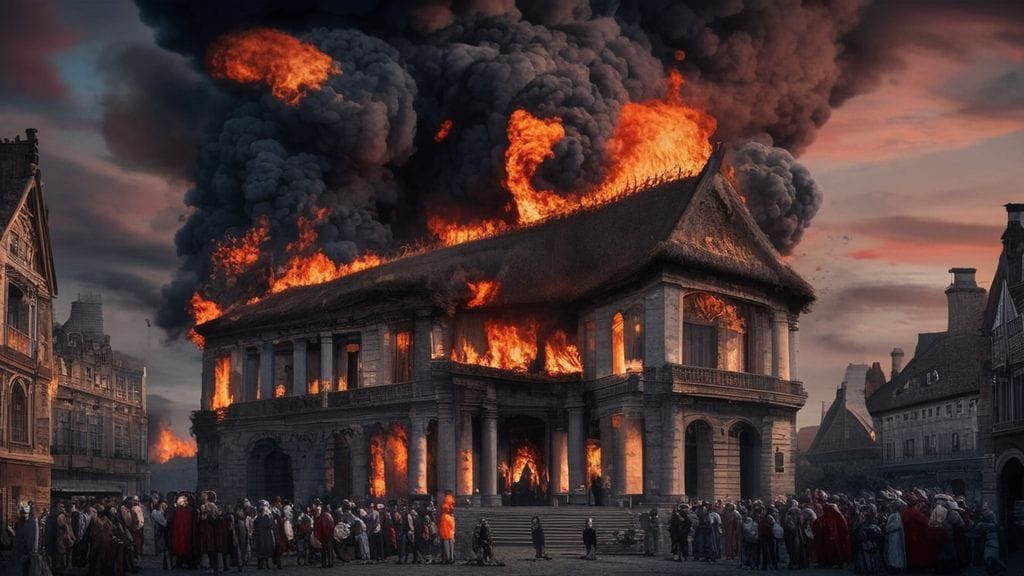
One can picture the moment when the last of the crowd burst out from under the galleries into the street, turning instinctively to look back. The Globe, which only an hour earlier had been a hive of voices and imagination, was now a gigantic torch, its thatch fully in flame, its galleries catching like kindling. The stage itself might have held out for a little while, but it too was doomed. The phrase “the Globe Theatre burns down” would, for those witnesses, never have been a categorical statement. It was a process they watched unfold in real time, in sickening detail.
Some spectators must have tried to help, forming bucket lines from nearby wells or seizing whatever vessels they could find. But the fire had too strong a head start. With each gust of wind, sparks flung themselves into the neighboring air, threatening adjacent buildings. The fear was no longer just for the theatre but for Southwark itself. Would this become one of those legendary conflagrations that consumed whole districts? City authorities on the north bank, seeing smoke rise above the Thames, surely wondered if they faced something greater than a single playhouse ablaze.
In the years after, as the story of the day the Globe Theatre burns down was retold in ballads and letters, the focus often flickered between horror and relief. It was a disaster, but it was bounded. The fire, voracious as it was, remained largely confined to the Globe’s fabric. The city would live to fret another day about thatch and gunpowder, about whether God had sent this as a warning or merely permitted an accident to run its natural course.
Fear, Smoke, and Ash: How London Watched the Globe Collapse
From the north bank of the Thames, the fire must have been visible as a dark smear of smoke against the long summer sky. Boatmen on the river slowed their strokes, pointing with oars. Children tugged at their elders’ sleeves. The Southwark shore flickered with the orange of flame, and word began to gallop along London’s streets: “The Globe is on fire!” “The playhouse burns!” Before long, in the telling and retelling, that simple phrase hardened into something definitive: the Globe Theatre burns down, the Globe is no more.
People crowded bridges and quays to watch. There was, for some, an uneasy thrill: they were witnessing something they would speak about for years. Others felt only dread. For Londoners, fire was not an abstraction; many had seen smaller blazes ruin families, devour homes, erase inherited wealth in a single night. The sight of the Globe’s silhouette collapsing inward, its galleries sagging and then falling, must have landed like a physical blow. That building was a landmark, a compass point in the mental map of the city. Losing it meant losing one more piece of familiar London.
As the blaze reached its height, the theatre’s interior became an inferno. The painted “heavens” over the stage, the carved columns, the benches of the galleries, all fed the hunger of the flames. Dense, greasy smoke rolled upward, carrying with it the smell of burning pitch, wood, cloth, perhaps even the faint whiff of roasted food left behind in the haste of evacuation. Ash began to drift out over the river, settling on the decks of barges and the shoulders of onlookers.
Then, as swiftly as it had roared to life, the fire exhausted its richest fuel. The thatch fell inward, the galleries were reduced to skeletons of charred beams, and the blaze, having eaten what it could, dwindled to a smoldering heap of ash and blackened timber. Firefighters—if we can call them that, for there was nothing like a modern brigade—spent hours dousing hotspots and ensuring that nearby buildings were damp enough not to ignite.
By evening, the Globe was a ruin. Where once there had been color, noise, and a constant churn of bodies, there remained only the rough outline of a circular foundation, strewn with debris. Smoke hung in the air. A few company members or sympathetic neighbors must have picked through the wreckage, hoping to salvage props, costumes, anything. But most of what gave the building life was gone. Standing in that heap of cinders, one could feel how quickly the sentence “the Globe Theatre burns down” had become an accomplished fact, the past tense pressing into the present.
Rumor, Blame, and Miracle: Picking Through the Ruins
No catastrophe in early modern London remained merely an event; swiftly it became a story, then a cluster of stories. Within days, the burning of the Globe made its way into letters, diaries, and printed ephemera. Sir Henry Wotton, writing from London on 2 July 1613, offered one of the most oft‑quoted accounts in a letter now preserved in the British Library. He described how, “the King’s players had a new play, called All Is True, representing some principal pieces of the reign of Henry VIII,” and how, “the chambers being shot off at his entry, some of the paper, or other stuff, wherewith one of them was stopped, did light on the thatch, where, being thought at first but an idle smoke… it kindled inwardly and ran round like a train, consuming in less than two hours the whole house to the very ground.”
Wotton’s tone is matter‑of‑fact, even a little ironic. Others were more moralizing. For years, preachers who scorned the playhouses seized on the episode. Did it not show that God disapproved of such frivolities? Was it not a sign that, in setting up theatres, London had invited divine correction? Pamphlets and sermons wove the phrase “the Globe Theatre burns down” into their warnings about lust, idleness, and the temptations of the stage.
At the same time, there was relief. The “miracle,” as some contemporaries framed it, was that no lives were lost. The tale of the man whose breeches caught fire but were quenched with ale became a darkly comic emblem of how close disaster had come. Some accounts suggested that only one man suffered major injury, reinforcing the sense that Providence had drawn a line between property and people. One ballad, now lost but known from references, reportedly celebrated how spectators escaped “with not so much as a single soul burnt,” though that boast may be more pious wish than verified fact.
Blame settled, as might be expected, on the use of gunpowder and stage cannons. Was it negligence? A freak misfire? Could stricter regulations have prevented it? There is no sign of criminal prosecutions, but the company had every incentive to tighten their own safety practices. More broadly, civic authorities had one more reason to eye the theatres with suspicion. If a single spark could reduce a major playhouse to ash, what might follow if another fire broke loose in a more crowded neighborhood?
The writers of the period also read the fire symbolically. Some later commentators, like the antiquarian John Stow’s continuators, folded the fire into a broader chronicle of London’s misfortunes, a minor prelude to the much greater Great Fire of 1666. To them, the sentence “the Globe Theatre burns down” was less a unique trauma than an early echo of a larger pattern: a city flirting always with conflagration, never truly safe until it rebuilt in stone.
Shakespeare’s World in Crisis: Artistic Lives after the Fire
When the Globe burned in 1613, William Shakespeare was about forty‑nine years old. His career as a full‑time actor was already winding down; he had purchased property in Stratford‑upon‑Avon and was spending more time there. We do not know with certainty whether he was present that afternoon, watching as the Globe Theatre burns down around his company’s newest play. Some historians think he might have been; others imagine him hearing the news days later in Warwickshire. In any case, the event struck at the heart of his professional world.
For the King’s Men, the loss was more than sentimental. The Globe was a revenue engine. Its destruction meant immediate cessation of income from its large public performances. True, the company still had the Blackfriars indoor theatre, a smaller but more lucrative space catering to a wealthier crowd, especially in winter. Yet the Globe’s absence shredded their summer schedule, forced them to juggle repertory, and demanded capital for rebuilding.
Shakespeare’s own late plays—The Winter’s Tale, Cymbeline, and The Tempest—had only recently premiered. Henry VIII was among this cluster of late romances and histories that blended spectacle, forgiveness, and the sense of an era ending. There is something eerily fitting, if we allow ourselves a historian’s cautious poetry, that the theatre most associated with Shakespeare’s imaginative reach would go up in flames in the very years when he was quietly withdrawing from the stage.
The company responded pragmatically. They continued to perform at Blackfriars and perhaps at other venues while plans for a new Globe took shape. Investors were sought; sharers like Richard Burbage and the playwrights themselves had to weigh the cost of rebuilding against the uncertain future of the theatrical trade. After all, court favor could shift, plague could close the theatres, religious sentiment could harden against them. Re‑erecting a large wooden playhouse was not a trivial decision.
For the broader community of writers and actors, the event was a sharp reminder of the precariousness of their world. A play, no matter how popular, could vanish in an instant if its only copy burned in a tiring‑house. Costly costumes, painstakingly acquired, could be reduced to ash. Patrons might look at the smoking ruin and decide that the theatre was too risky an investment. The day the Globe Theatre burns down thus stands as a moment when an entire artistic ecosystem trembled, forced to confront how contingent it really was.
Law, Morality, and Theatres on Trial
In the aftermath of the fire, London’s authorities did not launch a witch hunt against the King’s Men. Yet the episode fed into a longer debate over the theatres’ place in civic and moral life. The City of London Corporation had, for decades, sought to push playhouses beyond its boundaries. Southwark had absorbed much of that displaced entertainment, but the risk and the stigma remained attached.
Puritan critics seized on the fire as evidence that theatres were not just morally suspect but physically dangerous. They wrote tracts arguing that when the Globe Theatre burns down, it is a kind of divine verdict on the vanity of players and spectators alike. They warned that God might not be so merciful next time—that lives, not just timber, could be demanded. In their rhetoric, playhouses became tinderboxes drawing people away from work and worship into a space where sin and fire went hand in hand.
Civic leaders, always worried about crowd control and public order, added fire safety to their list of concerns. Regulations about thatch, already in place within the City, were extended more aggressively. One of the stipulations for the rebuilt Globe would be the use of tile rather than thatch for roofing, a direct legal consequence of the 1613 blaze. The material fabric of London’s entertainment district was thus reshaped: less picturesque perhaps, but marginally less combustible.
The Crown, however, had reasons to temper any crackdown. The King’s Men were royal servants, licensed and technically under the Lord Chamberlain’s and later the Lord Chamberlain’s and Master of the Revels’ supervision. James I enjoyed plays; his court revels featured elaborate performances. To punish the company severely for what appeared to be accidental would have cut against royal tastes and interests. So a balance was struck: some tutting, some tighter rules, but no ban.
This uneasy compromise would hold for a generation. Only with the coming of the English Civil War and the ascendance of the Puritan‑dominated Parliament in the 1640s would the axe finally fall. But already, in 1613, one can hear the drumbeat of that future conflict in the moralized reactions: those who saw in the phrase “the Globe Theatre burns down” a divine lesson, and those who saw only the misfortune of an art form they loved.
Rebuilding the Dream: The Second Globe Rises from the Ashes
Despite the loss, the King’s Men did not abandon their open‑air flagship. Within a year or two—sources differ on the exact completion date—they had rebuilt the Globe on the same foundations. This second Globe, opened around 1614, was similar in shape and size to its predecessor but with crucial modifications. Most notably, its roof was covered with tiles rather than thatch, reducing (though never eliminating) the risk that another stray spark would send it skyward in flames.
The decision to rebuild speaks volumes about the economic strength and cultural importance of the theatre. Investors came forward; carpenters and artisans were hired. The very act of reconstruction declared that the sentence “the Globe Theatre burns down” did not mean that the Globe’s story was over. Instead, it became a chapter heading in a longer narrative of resilience. The city, so used to fire as a force of erasure, here saw fire answered with renewal.
We know frustratingly little about the appearance of the second Globe beyond these broad strokes. It likely preserved the three‑tiered structure, the open yard, the thrust stage. Perhaps some decorative elements were updated; tastes had shifted slightly in the transition from the late Elizabethan to the Jacobean era. The company had also grown more sophisticated in its staging, integrating courtly masque techniques and indoor theatre practices into its outdoor work.
For playgoers, the new Globe would have felt both familiar and subtly different. Approaching it along Southwark’s lanes, they would see a familiar circular mass rising, flags once again proclaiming performances. Inside, they would feel the old thrill of standing in the yard as the actors took the stage. Yet somewhere in the back of their minds—and in the structure of the building itself—lingered the memory of fire. The tiled roof, glinting in sunlight, was a constant reminder that the old thatch, along with the original Globe, had gone up in smoke.
Shakespeare may have seen the rebuilt theatre or he may not; he died in 1616, only a few years after the fire. The second Globe thus belongs almost as much to the generation after him, to the actors and writers who carried forward the traditions he had helped to establish. Nonetheless, whenever the new Globe’s stage hosted revivals of his plays, audiences were participating in a curious continuity: they watched under a roof specifically designed so that they would not have to repeat the experience of that day in 1613 when the Globe Theatre burns down in front of an astonished city.
From 1613 to the Civil War: A Theatre’s Afterlife
For roughly three decades after its reconstruction, the second Globe continued as one of London’s principal playhouses. It weathered outbreaks of plague, changing tastes, and the gradual shift of fashion toward more intimate indoor theatres. Companies experimented with new genres; tragicomedies and dark city comedies joined the older histories and romances. The Globe’s audience, as ever, was mixed: apprentices and aristocrats, merchants and maidservants, all sharing the same open air.
Yet the political climate was darkening. Under Charles I, tensions between Crown and Parliament escalated over taxation, religion, and royal prerogative. Puritan influence grew in the House of Commons and among London’s merchant elite. These were the same ideological currents that had long scorned the theatres as dens of vice. The stage, which had once been a relatively safe space to explore questions of power and conscience, now looked increasingly suspect to authorities on both sides.
In 1642, as the first English Civil War broke out, Parliament issued an ordinance closing all theatres, ostensibly as a sign of national mourning and seriousness. Performances at the Globe and elsewhere ceased. Some clandestine playing continued in private houses, but the great open‑air amphitheatres fell silent. In 1644 (according to most evidence), the Globe was pulled down, probably on Parliament’s orders, and the site built over with tenements.
Thus the second Globe died not by fire but by policy, its timbers recycled or simply discarded. The phrase “the Globe Theatre burns down” remained attached primarily to the 1613 event; the later demolition was less spectacular, more bureaucratic. Over time, as new houses and streets overlaid the old foundations, the precise location of both Globes faded from common memory.
By the later 17th century, as diarists like Samuel Pepys frequented new indoor theatres in Drury Lane and Lincoln’s Inn Fields, the old Bankside amphitheatres were already part of a half‑mythic past. Fire would again ravage London on a massive scale in 1666, reshaping the City more profoundly than the burning of any single playhouse ever could. Yet that earlier sentence, “the Globe Theatre burns down,” survived in chronicles as a curious foreshadowing of a city’s larger vulnerability to flame.
Memory, Legend, and the Long Silence of the Globe
After the Civil War and the Restoration of the monarchy in 1660, London’s theatre culture revived, but in a new form. Indoor playhouses, candle‑lit and elaborately decorated, became the norm. Women appeared on stage as actresses for the first time on the public English stage. The Globe, as a physical entity, was gone; its memory persisted largely in books.
Shakespeare’s plays, meanwhile, gradually took on a new stature. In the 18th and 19th centuries, editors, actors, and critics elevated him to near‑mythic status as the “Bard of Avon.” Biographers combed through legal records, parish registers, and older chronicles to reconstruct his life. In doing so, they stumbled again upon the note that, in 1613, the Globe Theatre burns down during a performance of one of his plays. This detail acquired a romantic aura: the idea that the house most associated with Shakespeare’s genius had perished in the very act of staging his work was too poetic to ignore.
Victorian illustrators produced images of the Globe as they imagined it: a quaint, thatched rotunda beside a picturesque Thames. These drawings often depicted the 1613 fire, with tiny figures rushing from the yard and great tongues of flame devouring the roof. Accuracy mattered less than emotional resonance. The scene became a symbol of the fragility of art and the volatility of the urban environment that had nurtured it.
Meanwhile, antiquarians tried, with mixed success, to fix the Globe’s exact location. Streets had shifted; property boundaries had changed; the documentary trail was fragmentary. The fact that the Globe Theatre burns down and was then rebuilt on the same site added a layer of archaeological complexity: which postholes, which foundation walls belonged to which phase?
By the early 20th century, interest in “original practices” in Shakespeare performance and in the historical topography of London began to intensify. Historians like E.K. Chambers and later John Orrell examined surviving leases, court records, and maps. They treated Wotton’s letter and similar sources as not just colorful anecdotes but as data points. When exactly did the fire occur? How fast did the roof burn? What did that tell them about the building’s materials? Slowly, the fire of 1613 shifted from a moralizing lesson to an evidentiary event, a fixed star by which to navigate the otherwise murky sky of theatrical history.
Archaeologists in the Mud: Rediscovering the Globe in the 20th Century
The physical rediscovery of the Globe’s site came late. London is a palimpsest city; each generation has built over the last. But in the 1980s, as new construction projects on the South Bank triggered archaeological surveys, teams working for the Museum of London began to unearth curved brick foundations that matched the expected footprint of an Elizabethan amphitheatre. Careful excavation revealed a polygonal structure, consistent with documentary descriptions. The Globe, or at least part of it, had emerged from under centuries of rubble and paving.
Archaeologists crouched in the damp London soil, trowels in hand, mapping post‑holes, wall lines, and the scatter of domestic refuse that had accumulated after the theatre’s demolition. Small finds—tobacco pipes, shards of pottery, animal bones—spoke of the lives of those who had lived and worked on the site long after the curtain had fallen for the last time. Yet beneath these layers lay the footprint of the building in which, once upon a time, the Globe Theatre burns down during a summer matinee.
These discoveries did not give every answer—only a portion of the circumference was accessible—but they provided crucial confirmation of earlier scholarly reconstructions. They helped refine estimates of the Globe’s diameter, the size of its yard, the angle of its galleries. Researchers could now calibrate older images and models against physical evidence. As one archaeologist put it in a conference paper, “The 1613 fire, long a textual curiosity, now anchored itself in the ground we can touch.”
In parallel, historical research continued to mine textual sources. The combination of spade and archive allowed a more nuanced understanding of the Globe’s life and death. The fact that the first Globe had a thatched roof—the very feature that ensured the Globe Theatre burns down so swiftly—was corroborated by both ordinances after the fire and by the material remains of scorched thatch found in the strata above the foundations.
These findings fed directly into a bold new idea: that the Globe might be rebuilt, near its original site, as a working theatre. Not as a museum piece or static monument, but as a living laboratory for performance. If London had once watched the Globe Theatre burns down, modern London could watch it rise again, deliberately vulnerable to the same elements of rain, sun, and wind, but now with fire precautions that 17th‑century builders could never have imagined.
A Modern Globe for a Modern World
The driving force behind the modern reconstruction of the Globe was the American actor and director Sam Wanamaker. Visiting London in the 1940s and 1950s, he was astonished to find no significant memorial on the site of the Globe beyond a modest plaque on a brewery wall. How, he wondered, could a city celebrate Shakespeare worldwide and yet neglect the place where so many of his plays had first breathed before an audience?
Wanamaker devoted the rest of his life to rectifying that omission. Fundraising, lobbying, and public education took decades. The project faced skepticism: Was it possible to recreate a 16th‑century building in the late 20th century? Would it be safe? Would audiences come? Scholars debated whether the new structure should aim at literal authenticity or symbolic evocation. Conservationists worried about the use of flammable materials; local planners fretted about noise and traffic.
Yet step by step, the modern Globe took shape just a few hundred feet from the original site. Architects and historians pored over surviving documentation, archaeological plans, and comparative evidence from other amphitheatres. Carpenters skilled in traditional techniques raised oak timbers by hand. To honor historical accuracy, the new Globe used a thatched roof—the first permitted in central London since thatch had been outlawed after the Great Fire of 1666. This decision, of course, drew a direct line back to 1613, when the Globe Theatre burns down because of that very roofing material.
Modern fire codes demanded all manner of protections the original lacked: hidden sprinkler systems, fire‑retardant treatments, clear evacuation plans. Visitors today watching a play under that roof are, paradoxically, safer than their 17th‑century counterparts ever were. Yet they can still feel, in the roughness of the timber, the openness of the yard, the nearness of actors and sky, something of what it meant to be there on a summer afternoon, with the smell of the river and the city drifting in.
The rebuilt Shakespeare’s Globe opened its doors in the 1990s, after Wanamaker’s death, and quickly established itself as both a major tourist destination and a serious artistic venue. Productions range from meticulously “original practice” stagings with period instruments and costumes to boldly experimental interpretations that speak to contemporary politics and identities. Under its thatch, the idea that the Globe Theatre burns down has been transmuted into something more hopeful: the sense that, even after loss, performance finds a way to return.
Why the Day the Globe Theatre Burns Down Still Matters
Why linger over the detail that, on 29 June 1613, the Globe Theatre burns down in a burst of sparks during Henry VIII? After all, buildings catch fire; accidents happen; theatres have been lost to flame before and since. What makes this episode so resonant is less the blaze itself than what it illuminates about the world that surrounded it.
First, the fire exposes the material fragility of early modern culture. Shakespeare’s plays have survived in print, but many works by his contemporaries have not. Manuscripts perished in events like this; props and costumes that embodied characters’ presence vanished. The theatre, for all its cultural weight, was built of perishable stuff: wood, cloth, bone, memory. When the Globe Theatre burns down, we are reminded of how much of that world we have already lost, and how miraculous it is that anything at all has come down to us.
Second, the event opens a window onto London as a living, perilous organism. The fire sits at the intersection of technology (stage effects and gunpowder), urban planning (thatch regulations, building density), religion (interpretations of the blaze as divine judgment), and entertainment (the appetite that drew crowds there in the first place). In that convergence, historians glimpse the entangled forces that shaped the city’s growth and its self‑understanding.
Third, the story challenges us to think about memory. For contemporaries, “the Globe Theatre burns down” was breaking news; for their children, it became an anecdote; for the 18th and 19th centuries, a romantic flourish in biographies of Shakespeare. In the 20th and 21st centuries, the same phrase serves as a datum in academic debates and as a teaching tool in classrooms and on tours of the modern Globe. Each retelling bends the fire toward new purposes without wholly erasing the terror of that afternoon.
Finally, the trajectory from fire to reconstruction, both in the 1610s and in the 1990s, invites reflection on cultural resilience. Civil wars, puritan bans, urban redevelopment, and literal conflagration all erased the original theatre. Yet the idea of the Globe proved remarkably persistent. It could be mapped, excavated, reimagined in timber and plaster, and, most importantly, reanimated through performance. In that sense, the day the Globe Theatre burns down is not just an end but also a beginning: a turning point that set in motion new forms of memory, scholarship, architecture, and art.
Conclusion
On a hot June afternoon in 1613, an audience gathered to watch kings and courtiers strut upon a timber stage, only to find themselves thrust into a different sort of drama when a cannon blast sent tinder into a thatched roof. In a matter of minutes, the Globe Theatre burns down, and with it goes a beloved landmark of London’s entertainment world. Yet the story refuses to end in ash. The King’s Men rebuild, the city adjusts its laws, moralists sharpen their sermons, and centuries later archaeologists trace the arc of that fire in the soil itself.
In following this episode from its first sparks through its long echo in memory and reconstruction, we discover more than an anecdote about a theatre on fire. We see a city forever in dialogue with risk, a culture that balances its love of spectacle against its dread of catastrophe, and an art form that, even when its physical home is destroyed, manages to persist in print, in performance, and in the imagination. The modern Shakespeare’s Globe, standing today by the Thames under its cautious thatch, is both monument and answer: proof that what once was lost can, if incompletely, be found again. The flames of 1613 remind us that every performance is provisional, every building vulnerable—but they also suggest that the stories we tell, and the spaces we build for them, have a remarkable capacity to return from the fire.
FAQs
- Did anyone die when the Globe Theatre burned down in 1613?
Contemporary accounts consistently state that no one was killed in the 1613 fire. One man reportedly had his breeches catch fire but managed to extinguish them with ale, a detail repeated in multiple sources as evidence of how narrowly tragedy was averted. - Which play was being performed when the Globe Theatre burns down?
The play was a new history drama about Henry VIII, referred to by Sir Henry Wotton as All Is True and now known from the First Folio as Henry VIII. The fire appears to have started when a stage cannon was fired during a scene of royal pageantry. - Why did the fire spread so quickly?
The original Globe had a thatched roof, an unusual and highly flammable choice for a large public building in London. In the dry heat of late June, a spark or piece of burning wadding from the cannon easily ignited the thatch, and the fire raced around the roof and into the wooden galleries. - Was the Globe rebuilt after the 1613 fire?
Yes. The King’s Men and their investors rebuilt the Globe on the same site within a couple of years. The second Globe had a tiled roof instead of thatch, specifically to reduce the risk of another catastrophic fire, and continued in use until the theatres were closed by Parliament in 1642. - What ultimately happened to the second Globe Theatre?
The second Globe did not burn; it was demolished, probably in 1644, after Parliament ordered the closure of theatres during the English Civil War. The site was redeveloped for housing, and over time the exact location of the theatre was obscured by later building. - How do we know the details of the 1613 fire?
Information comes from contemporary letters and chronicles, notably a letter by Sir Henry Wotton describing how the “whole house” was consumed in less than two hours, and from later summaries by antiquarians. These textual sources, combined with archaeological evidence from the Globe’s foundations, provide a reasonably coherent picture of the event. - Where is the Globe Theatre site today?
The original and second Globe stood in Southwark on the south bank of the Thames, a short walk from today’s Southwark Bridge. Their foundations lie partly beneath modern buildings. Nearby, on London’s Bankside, stands the reconstructed Shakespeare’s Globe, which gives visitors a strong sense of the original theatre’s design and atmosphere. - Is the modern Shakespeare’s Globe an exact replica?
It is a careful, research‑based reconstruction using traditional materials and techniques wherever safety codes allow. The general shape, size, and configuration of stage and galleries are based on archaeological findings and historical documents, though modern requirements, particularly regarding fire safety, mean it cannot be a perfect copy. - Could a fire like the 1613 blaze happen at the modern Globe?
While the modern Globe has a thatched roof like its predecessor, it is equipped with discreet sprinkler systems, fire‑retardant treatments, and strict safety procedures. These measures make a catastrophic fire extremely unlikely, even though the theatre consciously preserves the feel of an open‑air, timber‑framed playhouse. - Why is the 1613 Globe fire significant for understanding Shakespeare?
The fire occurred late in Shakespeare’s career, during a performance of one of his last plays. It highlights the precariousness of the theatrical world he inhabited—financially, physically, and politically—and underscores how much of his work depended on fragile, combustible spaces that could vanish overnight.
External Resource
Internal Link
Other Resources
- Encyclopaedia Britannica – general search for the exact subject
- Google Scholar – academic search for the exact subject
- Internet Archive – digital library search for the exact subject

