Table of Contents
- Autumn Clouds over Kuyavia: Setting the Stage for Płowce, 1331
- Cross and Eagle: Poland, the Teutonic Order, and a Century of Rising Hostility
- A Fragmented Realm: Władysław the Elbow-high and the Struggle to Reforge Poland
- The Teutonic Machine: Knights, Castles, and the Myth of Invincibility
- A Year of Invasion: The 1331 Campaign and the Approach to Płowce
- March to the Unknown: Polish Mobilization and the Road to Battle
- Morning Mist on the Fields: Geography and Terrain of the Battlefield
- Steel Meets Prayer: Forces, Commanders, and Weapons on the Eve of Combat
- The Clash Begins: Ambush, Confusion, and the First Shock at Płowce
- Captive Grand Master, Fallen Standard: The Turning Points of the Battle
- From Triumph to Exhaustion: The Afternoon Struggle and the Bloody Stalemate
- Smoke, Cries, and Silence: Casualties, Prisoners, and the Human Cost
- A Victory Without Conquest: Political Consequences for Poland and the Teutonic Order
- Songs, Chronicles, and Memory: How Płowce Entered Polish Legend
- Echoes to Grunwald: Strategic Lessons and Long-Term Military Implications
- Between Cross and Crown: Diplomacy, Papal Politics, and Legal Battles After Płowce
- Faces in the Fog: Reconstructing the Lives of Those Who Fought
- Archaeology of a Battlefield: What the Ground at Płowce Still Whispers
- From Local Skirmish to National Symbol: Płowce in Modern Polish Identity
- Conclusion
- FAQs
- External Resource
- Internal Link
Article Summary: On a mist-laden September morning in 1331, on the fields near a modest Kuyavian village, the battle of plowce erupted in a clash that would echo far beyond its immediate tactical outcome. This article follows the story from the fractured politics of medieval Poland and the rise of the Teutonic Order, through the tense months leading up to the invasion, to the brutal hours of struggle in which banners fell, a Teutonic leader was captured, and the myth of Teutonic invincibility was shaken. It blends cinematic narrative with careful historical analysis, exploring the political, religious, and personal dimensions that converged on that blood-soaked ground. We meet Władysław Łokietek, the “Elbow-high” king struggling to reforge a kingdom, and Dietrich von Altenburg, the hard-edged commander of the Crusading knights, as they maneuver toward confrontation. The article examines why the battle of plowce became a psychological and symbolic victory despite its ambiguous military result, and how it prefigured later turning points like Grunwald in 1410. It also considers the voices of chroniclers, the silent testimony of archaeological finds, and the evolving memory of the battle in Polish culture. Finally, it asks what the battle of plowce can still teach us about resilience, identity, and the way small villages can become the stages on which empires stumble.
Autumn Clouds over Kuyavia: Setting the Stage for Płowce, 1331
The dawn that broke over Kuyavia on 27 September 1331 was not a peaceful one. Mists clung low to the earth, blurring the line between sky and soil, and somewhere beyond the veil of white, steel rang dully against steel as men buckled on armor and tested their weapons. Horses snorted, stamping the damp ground near the small village of Płowce. There was a heaviness in the air—of rain perhaps, but also of expectation, of fear. The battle of plowce would soon turn these quiet fields into a crucible of fire, faith, and iron.
Polish peasants in nearby hamlets had been watching the horizon for weeks. Rumors moved faster than armies: the German knights in white mantles were on the march again, the black cross of the Teutonic Order fluttering over their columns. Some said they had come to finish the work of conquest in Kuyavia, others that they sought to break the stubborn old king, Władysław Łokietek, once and for all. To many, this looming clash felt like a final reckoning in a long and bitter feud. Yet for the knights of both sides, dawn was not about grand politics. It was about surviving the day.
At the center of this unfolding drama stood a small, aging monarch whose nickname, “Elbow-high,” carried echoes of both mockery and affection. Władysław’s years of exile, defeat, and slow resurgence had taught him that kingdoms are not built in a single, glorious victory. They are reclaimed battle by battle, village by village, oath by oath. As he surveyed his mustered troops, partly professional retinues and partly hastily assembled levies, he knew he was risking everything—his crown, his fragile union of Polish lands, perhaps his life—on the outcome of a single encounter.
Across the fields, officers of the Teutonic Order rode among their ranks, issuing clipped commands in Low German and Latin. They had every reason to be confident. For decades they had been the iron fist of Christian expansion around the Baltic, their castles looming over conquered Prussian and Baltic tribes. Their chronicles recorded victory upon victory, their very identity forged in the idea that the brotherhood of the Order could not be broken in battle. Płowce, they assumed, would be yet another demonstration of their disciplined power against a fractured and backward kingdom.
But this was only the beginning. The events that would unfold at Płowce cannot be understood as an isolated collision of steel. They were the product of a century of shifting borders, broken promises, and the tangled relationship between faith and force in medieval Europe. The battle of plowce was, at once, a local struggle for a few pieces of contested territory and a symbolic confrontation between two visions of authority in Eastern Europe: one rooted in the aspirations of a reborn Polish monarchy, the other in the crusading zeal and administrative rigor of a militant religious order.
As the sun began to burn off the fog and the outlines of two hostile hosts emerged, ordinary soldiers adjusted their grips on ash-wood spear shafts or leather-bound sword hilts. None of them could know that future chroniclers would argue for centuries about what exactly happened that day, nor that modern historians would sift fragmentary accounts to reconstruct each maneuver and counterattack. They knew only that soon there would be shouting, and blood, and the desperate hope that their own side would stand firm while the enemy broke. The story of Płowce is their story too.
Cross and Eagle: Poland, the Teutonic Order, and a Century of Rising Hostility
To grasp why these men met in violence on a Kuyavian field, one must look back over the better part of a century, to the time when both Poland and the Teutonic Order were still in the act of becoming what they would be in 1331. At first, their paths were not destined to cross in enmity. In fact, the Teutonic knights were invited into the region as allies. That bitter irony would haunt Polish memory for generations.
The Kingdom of Poland, once formidable under rulers like Bolesław the Brave, had fallen into fragmentation after the death of Bolesław III Wrymouth in 1138. His attempt to divide his realm among his sons, while preserving unity under a senior duke, instead opened the door to continual partition and internecine struggle. Over the following century, Poland became a patchwork of duchies, each ruled by Piast princes with their own ambitions and rivalries. While this internal disunity sapped Polish strength, the peripheries of the realm became vulnerable to external predators and opportunists.
Meanwhile, to the north, German-speaking missionaries and military orders pressed eastward into the pagan lands along the Baltic coast. The Teutonic Order, originally founded during the Crusades in the Holy Land, gradually shifted its center of gravity to the Baltic. By the early thirteenth century, it had become a formidable power in its own right, endowed with papal privileges, imperial support, and the aura of a holy mission. Prussia, home to fiercely independent Baltic tribes, became their promised land of conquest and conversion.
In 1226, Duke Konrad of Masovia, beset by raids from pagan Prussians and unable to rely on divided Polish forces, made a fateful decision. He invited the Teutonic Order to help subdue the Prussian lands, granting them the region of Chełmno (Culmerland) as a base. What seemed like a short-term solution to a local problem soon turned into a structural shift. The Order treated Chełmno not merely as a fief, but as the nucleus of an independent state. With methodical determination, they built castles, cleared land, and imported German settlers.
From this moment, the relationship between Poland and the Order grew increasingly fraught. The Polish eagle and the black cross of the Teutonic knights were not yet sworn enemies, but they were competing authorities locked into incompatible trajectories. The Order’s expansion along the Baltic threatened Poland’s access to the sea, while their growing autonomy undermined Polish claims to overlordship over the lands they were supposed to pacify on Poland’s behalf. Each papal or imperial privilege granted to the Order felt, to many Polish elites, like a fresh insult.
By the late thirteenth and early fourteenth centuries, this latent tension hardened into open hostility. Disputes over Gdańsk Pomerania—especially the seizure of Gdańsk by the Order in 1308, accompanied, according to some sources, by a brutal massacre—cut deep. The Teutonic chronicler Peter of Dusburg offered a pious justification, while later Polish authors depicted it as treachery and slaughter; modern historians still debate the scale of violence, but not the political significance. What one side viewed as the inevitable consolidation of Christian authority, the other saw as the theft of a vital coastal region.
Within this broad tapestry of conflict and distrust, the battle of plowce stands as a stark moment when competing claims could no longer be handled by envoys and parchment. It represented the coming to a head of grievances that had been accumulating since Konrad’s invitation in 1226, grievances woven into legal disputes, papal courts, and diplomatic stalemates. The Order saw itself as a bulwark of Christendom, answerable more to pope and emperor than to any local prince. The Polish monarchy, painfully reconstructed after generations of division, saw itself as the rightful heir to early medieval statehood, endowed with its own sacred legitimacy.
It’s astonishing, isn’t it, that institutions born from shared Latin Christian culture could end up so bitterly at odds? Yet such was the medieval world. Sanctified violence, land hunger, and the fluidity of borders combined to turn allies into rivals and rivals into existential threats. The fields of Płowce would soon record, in blood, the moment when those tensions burned white-hot.
A Fragmented Realm: Władysław the Elbow-high and the Struggle to Reforge Poland
Amid this unstable landscape stepped Władysław I, later remembered as Łokietek—“the Elbow-high.” It was a nickname that likely referred to his short stature, but over time it acquired an almost affectionate resonance: the small man with a stubborn will, the underestimated prince who would not surrender. His long battle to reunite Poland forms the human backbone of the story that culminates in the battle of plowce.
Born around 1260, Władysław grew up in a Poland where power was a mosaic of petty courts, regional loyalties, and overlapping claims. The dream of a single Polish crown had not vanished, but it had been worn thin by decades of disputes. Władysław inherited the duchy of Kuyavia and other territories, but his ambitions reached further. Again and again, he tried to expand his authority, only to be checked by rival Piast princes, hostile magnates, and foreign powers eager to keep Poland weak.
His path was marked by exile and return. In one phase of his career, he fled to Hungary; in another, he relied on the support of the papacy. Over the years, Władysław gradually assembled a coalition of nobles and towns that believed in the restoration of a unified kingdom. Yet every step forward invited new opposition—from Bohemia, from Brandenburg, and, increasingly, from the Teutonic Order. With each reversal, the image of the small, tenacious duke refusing to abandon his cause took deeper root in the imagination of his supporters.
The turning point came with his coronation as King of Poland in 1320 in Kraków, recognized by the papacy. This ceremony was not merely a ritual; it was a statement to Europe that Poland, after nearly two centuries of fragmentation, claimed once more the status of a kingdom. But coronations do not instantly produce power on the ground. Władysław’s hold over many regions remained uncertain, and his authority was challenged from abroad. King John of Bohemia asserted rights over parts of Silesia, while the Teutonic Order clung tightly to Pomerania.
Władysław’s relations with the Order had deteriorated sharply following the seizure of Gdańsk and surrounding lands. Legal battles and papal arbitration followed, but with mixed and often frustrating results. The dispute over Pomerania simmered even as the old king wrestled with internal unrest and the demands of forging a governmental structure capable of linking Kraków to distant provinces. He needed a victory—not necessarily a crushing military triumph, but a symbolic success that would demonstrate that the reborn crown of Poland could stand up to its most fearsome neighbor.
By 1331, Władysław was nearing the end of his life. He was in his seventies—an advanced age for the time—yet still determined to assert his rule. His son, the future Casimir III the Great, stood at his side, learning the harsh lessons of kingship in a land ringed by potential enemies. The coming clash at Płowce would test not only the king’s strategic judgment but also the fragile political project that his entire life’s work had built toward.
There is something profoundly human in the image of this aging, short-statured monarch riding into the mist of Kuyavia to confront the most disciplined military order of his age. In another era, Władysław might have been remembered, if at all, as a regional warlord. Instead, through perseverance and a willingness to gamble in moments of crisis, he became the monarch who set the stage for the later golden age of the Polish kingdom. And the battle of plowce became, in Polish chronicles, a crucial chapter in that saga of resilience.
The Teutonic Machine: Knights, Castles, and the Myth of Invincibility
Facing Władysław’s patchwork host at Płowce stood the sleek war machine of the Teutonic Order. To contemporaries, the Order’s state in Prussia appeared almost unnervingly efficient. Rows of red-brick castles dominated the landscape: Malbork (Marienburg), Toruń, Elbląg—armed monasteries housing a caste of warrior monks bound by vows of poverty, chastity, and obedience, and by the discipline of steel.
The Order’s structure combined religious hierarchy with military chain of command. At its head stood the Grand Master, beneath him regional commanders called komturs, each ruling a district from a fortified seat. Within this framework, the brothers of the Order and their lay associates could mobilize forces with remarkable speed. They drew on a population of German settlers, allied knights, and local recruits, and they maintained a network of supply lines between river ports and fortresses. To men raised in the looser feudal levies of Central Europe, the Teutonic host must have seemed brutally organized.
Part of the Teutonic aura of invincibility came from their ideology. They did not see themselves as mere mercenaries or feudal lords, but as holy warriors enacting God’s will on the frontiers of Christendom. Their chroniclers, such as Peter of Dusburg, wrote of their battles against the pagan Prussians as a sacred mission, sanctified by the Church. This sense of righteous purpose hardened them in combat, while papal privileges and donations gave them resources beyond those of typical regional magnates.
Yet behind the austere white cloaks and the uniformity of their stone fortresses, the Order was also deeply political. It negotiated treaties, manipulated border disputes, and pursued its interests in imperial diets and papal courts. Its stance toward Poland was never solely about theology or even about security; it was about power, trade routes, and access to the Baltic. The seizure of Gdańsk and control of Pomerania had thrust the Order fully into the game of European statecraft.
By 1331, the Teutonic Order had enjoyed decades of military success. They had subdued many of the Prussian tribes and integrated their lands into a rigid framework of commanderies and parishes. Their knights had faced numerous uprisings and foreign incursions, and had generally emerged victorious or at least unbroken. Crusading contingents from Western Europe sometimes joined them seasonally, adding to their prestige. In the eyes of many contemporaries, they were not an enemy to be lightly challenged in open battle.
It was precisely this reputation that made the outcome of the battle of plowce so significant. For while historians still debate the precise balance of advantage that day, there is little question that Polish arms inflicted a sharp shock on the vaunted Order. The capture of one of their highest officers on the field, and the heavy losses sustained by their forces, punctured the illusion that the Teutonic army was an unstoppable divine instrument. Płowce showed that discipline could be matched by courage and clever maneuver, that the cross on a white mantle did not guarantee victory.
As the Order’s columns advanced into Kuyavia in 1331, they still moved with the confidence of an institution accustomed to being feared. Standard-bearers carried banners embroidered with black crosses; trumpeters signaled each stage of the march. Yet at Płowce, the machine met resistance of a kind it had not expected. In the fog and noise of combat, the Order’s famous discipline would be tested as never before by a king many had dismissed as weak and provincial.
A Year of Invasion: The 1331 Campaign and the Approach to Płowce
The battle of plowce did not erupt out of a clear blue sky. It was the culmination of a campaign season shaped by broader strategic decisions and a mesh of alliances and hostilities extending far beyond Kuyavia. To understand why the Teutonic forces were there at all, one must zoom out to the geopolitical chessboard of Central Europe in the early 1330s.
King John of Bohemia, sometimes styled “the Blind,” had his own ambitions in the region. Bohemia, a rising power, was pressing claims over Silesian duchies, many of which gradually fell under Bohemian suzerainty. Polish rulers, still consolidating their authority, were strongly opposed to this encroachment, but their capacity to resist was limited. Bohemia and the Teutonic Order found common cause in weakening Poland’s position, even if their ultimate aims differed.
In 1331, Bohemian and Teutonic forces coordinated operations aimed at putting pressure on Władysław’s kingdom from different directions. It was a dangerous situation for Poland: to the south and west, Bohemian intervention; to the north, the looming presence of the Teutonic castles. The Order saw an opportunity to strike deep into the Polish heartland, test the king’s resolve, and perhaps secure territorial concessions or at least a more favorable negotiating position.
The Teutonic plan involved multiple columns moving through Kuyavia, raiding and probing, destroying local infrastructure and undermining Władysław’s authority. Villages burned, churches were looted, and harvests were trampled under horses’ hooves. For peasants and minor nobles alike, the campaign season of 1331 would be remembered in ashes and cries. Chronicles suggest that Polish towns such as Inowrocław and Brześć were threatened or attacked, their populations suffering the all-too-familiar hardships of medieval war.
Władysław could not simply sit behind castle walls and watch his lands ravaged. Yet he also knew that his resources were constrained. He could not assemble a vast, permanent army like the Teutonic Order, nor could he rely too heavily on foreign allies without inviting new dependencies. Instead, he adopted a strategy of selective confrontation—avoiding battles when the odds were clearly against him, but seizing opportunities to strike when an enemy column was isolated or overextended.
It was such an opportunity that seems to have presented itself in late September. One Teutonic contingent, commanded by notable officers and carrying prisoners and loot, was moving near Płowce. Polish scouts, ranging through forests and across fields, observed their movements and brought word back to the king. Here was a chance to catch a fragment of the formidable Order’s force away from the main body, to deal it a sharp blow, and to demonstrate that the king still had teeth.
The decision to march toward Płowce was fraught with risk. If the Teutonic column was stronger than anticipated, or if reinforcements were nearer than expected, Władysław could find himself trapped. Yet delay also carried dangers; the destruction in Kuyavia could only erode his legitimacy. The old monarch opted for audacity. He ordered his forces to converge, moving through a landscape they knew intimately, toward the fields where the smoke of the invaders’ campfires was said to rise.
It is here that the story tightens into a drama of hours and miles. Messages flew by mounted couriers, calling nearby castellans and knights to bring their men. Local peasants guided Polish forces along lesser-known paths, perhaps through groves and marshy ground, while Teutonic units wore the ruts deeper on the main routes. Each side, in its own way, was groping toward an encounter that neither fully understood. None of them, as they approached Płowce, could foresee that their movements that week would be dissected by modern historians consulting mutilated parchments and archaeological surveys centuries later.
March to the Unknown: Polish Mobilization and the Road to Battle
For the men under Władysław’s banners, the march toward Płowce was both a physical and a psychological journey. Polish forces in 1331 comprised a mix of well-armed knights in the retinues of magnates and castellans, lighter-armed noble cavalry, and infantry drawn from towns and rural communities. Some had seen battle against the Order before; others had only heard tales of the white-mantled warriors and their fearsome charges.
The mobilization was swift by medieval standards. Trumpets sounded from castle towers, beacons might have been lit along known routes, and messengers arrived breathless at manors with the king’s summons. Knights scrambled to don mail shirts and plate elements where they could afford them, while their retainers checked saddles and lances. In small villages, the call to arms meant fathers and sons taking up spears, axes, and makeshift shields, leaving fields unharvested and families anxious.
Contemporary and near-contemporary sources, such as the later “Chronicle of Greater Poland,” suggest that Władysław personally took charge of the operation, despite his age. Even if he did not ride in the vanguard, his presence near the front inspired those who marched in his name. The future king, Casimir, likely rode with him—a young prince absorbing the lessons of campaigning from the saddle, watching his father weigh each risk.
The road to Płowce wound through a landscape of gentle hills, scattered woods, and fields just touched by autumn. The grain harvest would have been largely gathered, but straw stacks and stubble remained, and orchards were heavy with late fruit. To the soldiers moving through this countryside, each familiar landmark took on a new weight. They were defending, or reclaiming, their own soil—not campaigning in distant lands like crusaders in Prussia or knights in Italy.
Night marches, halts in improvised camps, and the constant tension of not knowing exactly where the enemy lay would have worn on already strained nerves. When scouts reported that a Teutonic column was encamped or moving near Płowce, the level of intensity spiked. Władysław and his advisers had to decide: would they risk an ambush, try to surprise the enemy at dawn, or simply meet them in open battle as soon as contact was made?
We cannot recover every detail of those councils of war, but the outcome suggests a mixture of premeditated surprise and opportunistic adaptation. The Polish forces seem to have approached the area with an intention to catch a segment of the Order’s army before it could fully deploy or before reinforcements could arrive. The mist that lay over the fields that September morning would prove both an ally and an adversary, masking movements but also creating confusion.
In the hours before dawn, as campfires dwindled and the sky turned from black to a muted grey, tension must have been nearly unbearable. Horses shifted endlessly, their warmth a comfort in the chill. Men whispered hurried prayers to saints and to the Virgin, and more than a few must have wondered whether the stories of Teutonic invincibility were true. The road to Płowce had brought them to a threshold. Soon, the threshold would be crossed.
Morning Mist on the Fields: Geography and Terrain of the Battlefield
The fields around Płowce, though humble in appearance, played a crucial role in shaping the encounter that unfolded upon them. Medieval battles were rarely fought on perfectly open, featureless plains. Instead, forests, streams, low rises, and marshy patches influenced how armies deployed and how their leaders chose to maneuver. Płowce was no exception.
Located in Kuyavia, a region of central Poland characterized by gently rolling land and fertile soils, Płowce sat amid fields tilled by generations of peasants. The area likely included open farmland interspersed with small patches of woodland, hedgerows, and perhaps shallow depressions that could become muddy after rain. Such features could be a blessing to a commander attempting surprise, but a curse if they blocked the movement of cavalry at a critical moment.
Although we lack detailed contemporary maps, later reconstructions, supported by archaeological surveys, suggest that the battlefield offered some elevated ground and some lower-lying tracts. The mist that clung to the countryside that September morning limited visibility—and thus situational awareness—for both sides. In close-quarters medieval combat, the inability to see the full shape of the opposing force could lead to miscalculations and sudden shocks when hidden units emerged.
For the Polish forces, familiar with local paths and the lay of the land, these conditions were not entirely unfavorable. They could use hedgerows and minor rises to conceal their approach, perhaps arraying part of their force in a position from which to strike the marching Teutonic column. For the Order’s men, accustomed to organizing their movement in relatively open files and ranks, any constriction or surprise could disrupt their carefully honed system.
The presence of a road—almost certainly not paved, but a well-trodden track—was a key element. The Teutonic column carrying prisoners and plunder from previous raids would have followed such a route, its wagons and supply trains slower than the cavalry. The Polish goal, as many historians argue, was to hit this column where it was most vulnerable: stretched out on the march, not yet formed for battle. Thus, the battlefield of Płowce began not as a deliberate choice, like a tournament field, but as a happenstance of where two moving forces chanced to collide.
Later, the exact spot where banners fell and commanders were captured would become part of local lore—as if the soil itself had absorbed something of the day’s violence. For centuries afterward, farmers turning the earth around Płowce occasionally unearthed fragments of metal, buckles, and arrowheads, mute relics of that morning mist. The land remembered, even when written sources were silent or biased. And in this quiet countryside, the myth of Teutonic invincibility would face its fiercest challenge.
Steel Meets Prayer: Forces, Commanders, and Weapons on the Eve of Combat
On the eve of the battle of plowce, the opposing forces represented not only different polities, but slightly different military cultures. Polish arms in the early fourteenth century were in a period of transition, gradually influenced by Western European developments but still rooted in local traditions. The Teutonic Order, by contrast, consciously modeled itself on the best practices of Western heavy cavalry, integrated into a tightly controlled institutional framework.
On the Polish side, we can imagine Władysław’s host composed of:
– Heavy cavalry: nobles and their retainers, wearing mail hauberks, sometimes reinforced with early plate elements such as greaves or simple breastplates, and armed with lances, swords, and shields bearing family coats of arms.
– Lighter cavalry: less heavily armored nobles or mounted sergeants, useful for reconnaissance, pursuit, and flexible flanking maneuvers.
– Infantry: townsmen and peasants, often equipped with spears, axes, falchions, and wooden or leather shields; some archers or crossbowmen drawn from urban militias or fortified towns.
– Clerics and banner-bearers: priests who would bless the army and carry relics, and standard-bearers holding the royal banner of the White Eagle, as well as regional and noble banners.
Opposite them, the Teutonic column would have included:
– Brothers of the Order: full knights in the white mantle, heavily armored and mounted on trained warhorses, forming the elite shock troops.
– Servants and sergeants: less prestigious but still disciplined fighters, some mounted, some on foot, carrying out a variety of support and combat roles.
– Allied knights and mercenaries: recruited from German lands or neighboring regions, drawn by pay and the aura of crusading.
– Wagon train and camp followers: carrying loot, provisions, and prisoners, protected but also a liability in case of surprise attack.
The Teutonic contingent at Płowce was reportedly under the command of Dietrich von Altenburg, a prominent figure of the Order who would later become Grand Master. His presence underscores how seriously the Order took the campaign. For the Poles, Władysław himself—possibly together with his son Casimir—embodied royal authority on the field. Beneath them, castellans and regional lords commanded subunits, each with their own banners fluttering in the chill air.
Weapons in use would have included the classic armament of high medieval warfare: lances for the initial cavalry charge, arming swords and maces for close combat, axes that could bite through mail, and spears and pikes wielded by infantry trying to hold formations against mounted attacks. Bows and crossbows added a deadly ranged element, their bolts and arrows whistling through the mist before steel met steel.
Before the lines closed, there would have been moments of ritual and silence. Priests on both sides intoned prayers: Latin words rising from Polish lips and German tongues alike, each side invoking the same God for victory over their Christian foes. Banners dipped for blessings, and relics were displayed. It is one of the great paradoxes of the battle of plowce that men who shared the same faith, attended the same mass, and revered the same saints, slaughtered each other under the conviction that they were serving sacred causes.
Then, as formations shook out and runners carried final orders from commander to unit, the ritual gave way to readiness. Lances were couched, shields raised, horses urged into position. The Teutonic column, realizing that an engagement was at hand, struggled to form lines from their marching order. The Polish host, trying to capitalize on surprise, sought to strike hard before the enemy could settle into their preferred arrangements. Steel met prayer—and prayer would not be enough to save every man who stood in those lines.
The Clash Begins: Ambush, Confusion, and the First Shock at Płowce
The opening moments of the battle of plowce were shaped by movement and confusion. Accounts differ in their details—unsurprising, given that those who survived had only partial views of the chaos—but a broad outline emerges from Polish and later Teutonic sources. The Polish forces, having closed in on the Teutonic column near Płowce, launched an attack designed to disrupt and fragment the enemy before they could fully deploy.
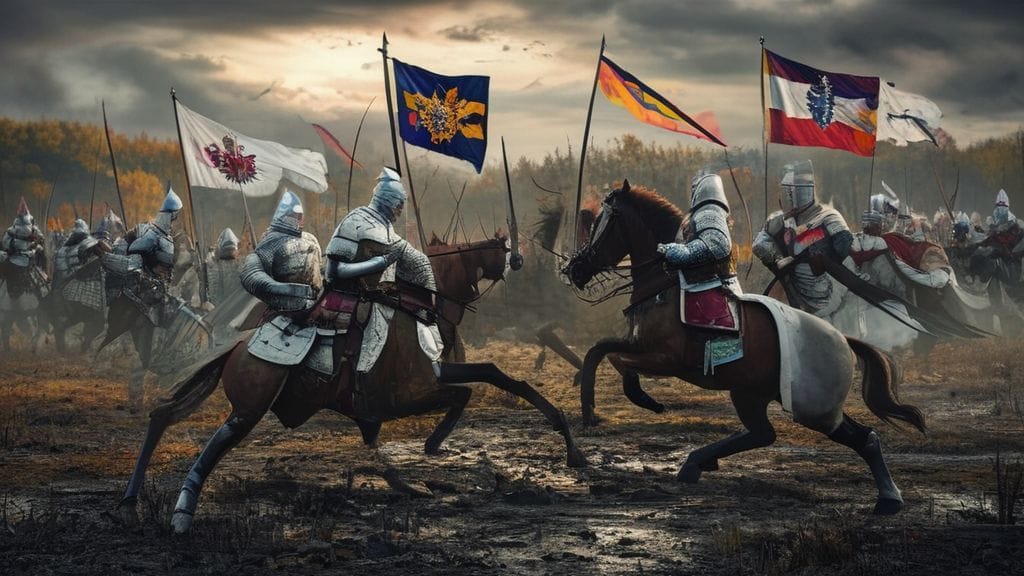
Imagine the scene: the Teutonic column, weighed down by wagons and prisoners, trudging along a country track. Sentinel cavalry ride ahead and along the flanks, but the main body is still in march order, not battle formation. Then, through the thinning mist, Polish cavalry suddenly appears, banners snapping in the air, shouting battle cries in Polish and Latin. Horns blare, and within seconds, the measured pace of the column dissolves into a scramble.
The first shock likely came from a Polish charge aimed at the forward elements and the vulnerable wagons. Horses burst into a gallop, hooves pounding the damp earth, lances leveled. For those in the Teutonic vanguard, the attack must have been terrifying: one moment a tense but orderly march, the next a wall of horseflesh and steel bearing down upon them. Men scrambled to draw weapons, to form a line, to buy time for the rest of the column to react.
In these opening minutes, the advantage lay with Władysław’s men. Surprise, local knowledge, and the element of aggression tilted the scales. Polish infantry pressed in behind the cavalry, seeking to cut down isolated enemies and seize control of the wagons. Teutonic officers called desperately for cohesion, rallying knights to form ad hoc defensive clusters. Horns and shouted commands struggled to be heard over the screams of men and animals.
One can almost hear the dissonant soundscape: German commands intermingling with Polish cries of “Na nich!” (“At them!”), the dull thud of lance impacts, the crackle of splintering wood as wagons were rammed or overturned. Dust and fog mixed into a murky haze that obscured who exactly was winning at any given moment.
Yet this first phase, no matter how successful for the Poles, could not last indefinitely. The Teutonic knights, even when surprised, remained professionals of war. As more of their men disengaged from the march and took up arms, the balance slowly began to shift toward a more evenly matched clash. The initial Polish attack had disrupted the column, but now both sides were increasingly locked in direct combat. The battle of plowce was transforming from an ambush into a pitched fight.
In this maelstrom, personal courage and quick thinking mattered as much as overall plans. Small units found themselves temporarily cut off, leaders made split-second choices whether to press forward, wheel to the flank, or pull back a few paces to regain order. For those on foot, the cavalry melee probably looked like a swirling blur of banners, shattered lances, and falling riders. For the commanders, the crucial question became: could the Poles capitalize on their early success before the Teutonic machine fully righted itself?
Captive Grand Master, Fallen Standard: The Turning Points of the Battle
Within this evolving struggle, certain moments stand out as decisive. One of the most celebrated episodes in Polish tradition, and one that shocked the Teutonic Order, was the capture of an exceptionally high-ranking commander—often identified as Dietrich von Altenburg, who at the time held the position of komtur of a major commandery and would later ascend to the office of Grand Master.
According to Polish chronicles, including later recensions of the “Chronicle of Greater Poland,” a fierce clash developed around the Teutonic banners. In medieval warfare, standards were more than mere pieces of cloth: they were focal points for morale and coordination. To seize or topple an enemy banner was to strike at the heart of its will to resist. Polish knights, recognizing this, hurled themselves again and again against the cluster of white-mantled warriors guarding their standard.
The fighting here was hand-to-hand, brutal and intimate. Swords rose and fell, maces crushed helmets, and the ground became slick with mud and blood. At some point in this prolonged melee, the Teutonic standard reportedly fell, and the commander at its center was unhorsed and overwhelmed. The capture of Dietrich von Altenburg—assuming the traditional identification is correct—was a stunning coup. To drag such a man from the field as a prisoner was a symbolic humiliation for the Order, a crack in its aura of divine favor.
Polish warriors, their arms and armor stained and dented, must have felt a surge of exultation when they realized who was in their hands. Shouts would have carried the news through their lines: a great commander of the Order was taken, the “unbeatable” knights were reeling. For a time, it seemed as though the Teutonic force might collapse completely under the strain.
Yet behind the celebrations, danger lurked. Victories in one sector of a battle could breed overconfidence or disorder. As Polish fighters focused on exploiting the capture and pressing their advantage, other parts of the sprawling battlefield were shifting. Teutonic reserves, or units that had finally managed to form from the chaos of the column, counterattacked. In some areas they succeeded in pushing back overextended Polish detachments, reclaiming wagons or rallying scattered men.
The battle of plowce thus entered a new phase—one of seesaw engagements, where neither side could claim a simple, sweeping triumph. On the one hand, the Polish capture of a leading Teutonic figure, along with numerous other prisoners, was a real achievement. On the other hand, the Order’s ability to hold parts of the field and inflict heavy casualties meant that this was not the rout Poles had hoped for.
As hours wore on, both armies grew exhausted. Men fought in smaller and smaller clusters, some barely able to lift their weapons. Horses foamed at the mouth, their flanks heaving. The royal banner of the White Eagle still flew, but around it the ground was littered with the dead and dying. The Teutonic crosses, though stained and sometimes trampled, had not vanished from the field. The clash at Płowce hovered in a tense balance, its ultimate meaning for the war still ambiguous even as blood continued to flow.
From Triumph to Exhaustion: The Afternoon Struggle and the Bloody Stalemate
As midday edged toward afternoon, the character of the battle of plowce changed. The initial fury and relative fluidity of the morning gave way to grinding, attritional combat. The air hung heavy with the smell of sweat, iron, and churned earth. Shouts grew hoarse, movements slower, as if the entire drama were being played out in a thickening medium.
Polish forces, buoyed by their early successes and the capture of Teutonic prisoners, tried to consolidate their hold over the field. They secured wagons where possible, formed more coherent lines, and used bits of captured gear. Yet their ranks had been thinned. Many knights lay dead or wounded; others, separated from their units in pursuit, took time to return to the main body. Communication in this era was always a challenge. A commander’s view was limited by terrain and dust; he relied on runners and visual signals to coordinate movements that could easily go awry.
The Teutonic troops who remained effective on the field were fight-hardened survivors. They knew retreat in disarray could mean slaughter, especially with a wagon train in tow. Instead, they clung stubbornly to positions they could defend, organizing counterattacks when opportunities presented themselves. Where Polish lines wavered or units overstretched, white mantles surged forward, striving to reclaim lost honor and comrades.
In many medieval battles, psychological factors could decide outcomes as much as raw numbers or weapon quality. Here, both sides had reasons to fear and reasons to hope. Poles had broken a Teutonic column, yet saw that the enemy still fought fiercely and that rumor suggested other enemy forces were not too far distant. Teutonic fighters had seen their commander captured and their banners threatened, yet also recognized that their Polish foes were not limitless and that they might yet inflict enough damage to turn a tactical defeat into a strategic draw.
The chronicles hint at a culminating phase in which both sides, depleted and exhausted, lacked the strength to press home a decisive blow. Eventually, as daylight waned, fighting ebbed. The Poles held many prisoners, including high-ranking Teutonic officers, and could claim the destruction or capture of a significant part of the enemy force. Yet they did not annihilate the Teutonic presence in Kuyavia, nor did they break the Order’s capacity to wage war.
From a narrow tactical standpoint, modern historians are inclined to describe Płowce as a costly and bloody engagement that ended without a clean winner. But from the perspective of Polish morale and the broader geopolitical struggle, it was something closer to a triumph. The Order had been visibly checked in open battle; its men had bled and fallen on Polish soil, and its leaders had been led off in chains. The old king could point to the field and say, with some justice, that he had stood and fought—and that the Teutonic machine had not rolled over him.
As dusk approached, the moans of the wounded replaced the clamor of clashing arms. Survivors from both sides stumbled among corpses, searching for comrades, finishing off enemies, or rummaging for anything of value in the debris of armor and broken spears. Ravens and other scavenger birds circled overhead, already drawing near. The land at Płowce, once another patch of ordinary Kuyavian countryside, had become a graveyard and a monument.
Smoke, Cries, and Silence: Casualties, Prisoners, and the Human Cost
Numbers in medieval chronicles are often slippery, but all sources agree that the battle of plowce was costly. The Order is said to have lost hundreds of men, including a notable portion of its heavily armored knights and officers. Polish casualties were also substantial; some estimates suggest that the combined death toll may have reached into the low thousands when knights, infantry, and camp followers are all considered. In an era of smaller populations and limited military manpower, such losses could not be easily brushed aside.
Beyond the statistics lay individual stories. A young Polish noble, perhaps riding in his first serious engagement, might have fallen beneath a Teutonic mace, his aspirations and family line abruptly cut short. A seasoned Teutonic brother, who had fought pagans in Prussia for decades, might have met his end at the tip of a Polish spear in a land he had once seen as merely a neighbor’s concern. The dead did not choose the banners under which they fought; they were shaped by birth, allegiance, and the currents of history.
For those wounded but alive, the aftermath could be a slow torture. Medieval field medicine was rudimentary at best. Arrowheads were dug out with knives, wounds cauterized with hot irons, limbs amputated without anesthetic. Infection and sepsis claimed many who had survived the initial fury. Priests moved among the fallen, offering last rites to men staring at the sky through fading eyes. The groans and pleas must have carried over the field long after the last organized cries of command had faded.
The capture of prisoners at Płowce was significant. Polish forces secured not only rank-and-file Teutonic fighters, but, as noted, high-ranking officers whose fates would become bargaining chips in later negotiations. Some would be held for ransom, a standard practice that turned noble prisoners into sources of financial or political gain. Others might languish in damp castle dungeons, their lives shaped by the outcome of diplomatic exchanges far from the battle whose mud still clung to their clothes.
Villagers from Płowce and surrounding settlements emerged nervously once the main forces withdrew. For them, the battlefield was a terrifying and yet inescapable reality. They collected weapons, stripped armor from the dead where possible—both a grim necessity and an opportunity in a world where metal was precious. At the same time, they had to bury or otherwise deal with the bodies before disease spread. Local tradition in many parts of medieval Europe held that mass graves of fallen warriors were sites of uneasy spirits, and special prayers were often offered to ease their passage.
The human cost of Płowce extended beyond those who fell or were wounded. Widows and orphans in both Poland and the Teutonic state would feel the effects. Fields left untended by conscripted peasants might yield less food; towns that had sent militias could find themselves short of labor. War, even when “victorious,” reached deep into the daily rhythms of society. The legacy of the battle of plowce was not only in chronicles and royal boasts, but in the quiet absences at hearths across the region.
A Victory Without Conquest: Political Consequences for Poland and the Teutonic Order
In the narrow sense of territorial change, the battle of plowce did not redraw the map. Poland did not suddenly reclaim Gdańsk Pomerania, nor did the Teutonic Order permanently seize swaths of Kuyavia as a result of this engagement. Yet politics in the fourteenth century was as much about perceptions, prestige, and bargaining positions as about direct annexations. In this arena, Płowce mattered greatly.
For Władysław Łokietek, the battle provided a crucial narrative victory. Here was a concrete example he could present to his nobles, towns, and foreign observers: the kingdom he had painstakingly reassembled could stand up to the most fearsome military order of the north. At a time when some Polish magnates may have doubted the wisdom of confronting the Order openly, Płowce showed that boldness could yield results.
This mattered not only internally but also in the broader diplomacy of Central Europe. Neighboring powers, from Hungary to the Holy Roman Empire, watched the contest between Poland and the Teutonic Order with interest. The Order’s mystique had made it a respected player at courts from Prague to Avignon. Its setback at Płowce sent a message that its expansion and power met limits—that it was not an unstoppable tide destined to engulf all neighbors.
Within the Order itself, the defeat and the loss of a leading commander stung. There would have been internal debates over whether the campaign had been overambitious, whether intelligence had been faulty, whether discipline had broken down in the face of surprise. Such introspection, though often hidden from external view, can subtly shift institutional priorities. The Order could ill afford many “Płowces” if it wished to maintain its aura and recruit knights from the German lands.
The legal and diplomatic disputes between Poland and the Order did not end with this battle. They would continue for decades, appearing in papal courts and in complex arbitration processes. Yet Władysław’s successors, especially his son Casimir the Great, inherited a stronger hand thanks in part to the moral capital earned on the fields of Kuyavia. As historian Paweł Jasienica later observed in his essays on medieval Poland, Płowce functioned as a “test of nerve” that Poland passed, even if it did not immediately change borders.
The immediate aftermath also saw a temporary slowing of Teutonic aggression into Polish core territories. While raids and smaller clashes continued, the Order now had to contend with the knowledge that its forces were vulnerable on campaign. Resources devoted to offensive operations could expose them to further ambushes. Thus, even in the absence of a formal treaty resetting boundaries, the reality on the ground was nudged toward a more cautious equilibrium.
In this sense, the battle of plowce stands as one of those medieval conflicts where the cartographer’s pen moves little, but the balance of fear and respect shifts palpably. The small, aging king had landed a blow that echoed in council chambers far from the smoke and cries of Kuyavia.
Songs, Chronicles, and Memory: How Płowce Entered Polish Legend
Long after the bodies had decayed and the grass had covered the scars of combat, the memory of Płowce lived on in words and songs. Medieval Poland did not possess a single, unified chronicle tradition, but various monastic and courtly authors recorded the events of their age. Among them, the anonymous author of the “Chronicle of Greater Poland” stands out for preserving the story of the battle of plowce in a distinctly Polish voice.
In this chronicle and others, Płowce appears as a moment when providence smiled upon a beleaguered kingdom. The capture of Teutonic leaders, the courage of Polish knights, and the personal presence of King Władysław on the field all became elements in a narrative of heroic resistance. Later authors, writing under different political pressures and in different stylistic modes, would rework these elements, but the core image—of Polish valor breaking Teutonic arrogance—remained remarkably consistent.
Oral tradition must have played a powerful role as well. Minstrels and local bards, singing in market squares or noble halls, would have recounted the battle in embellished form, adding flourishes and invented dialogues. A peasant from Kuyavia, hearing such a song decades later, might not learn accurate details about unit deployments, but he would absorb a clear sense of pride: once, on our soil, we stood against the black cross and did not yield.
Over the centuries, as Poland’s political fortunes waxed and waned, Płowce’s place in national memory shifted. In the glory days of the Jagiellonian dynasty, when the kingdom and later Commonwealth stretched from the Baltic to the Black Sea, Płowce was remembered as a precursor to greater triumphs, especially the victory at Grunwald in 1410. Chroniclers like Jan Długosz, writing in the fifteenth century, treated earlier struggles with the Teutonic Order as steps toward that grand reckoning. Within that arc, the battle of plowce appears as an early, courageous stand against an enemy later decisively beaten.
In the partitions era, when Poland vanished from the map between the late eighteenth and early twentieth centuries, older battles took on a different coloration. Romantic poets and historians looked back to episodes like Płowce as symbols of endurance and resistance against foreign oppressors, even if the Teutonic Order itself was long gone. The specifics of 1331 mattered less than the emotional message: we have fought before; we will rise again.
Modern historiography, while more critical and source-driven, has not entirely stripped Płowce of its mythic aura. Scholars emphasize the difficulty of reconstructing the battle in detail, pointing to contradictions in sources and the scarcity of impartial accounts. Yet many still acknowledge the battle’s lasting resonance in Polish consciousness. The way an event is remembered, they note, can shape and sometimes outweigh its immediate material consequences.
In this sense, the battle of plowce exists on two levels: as a historical event, with all the ambiguity and complexity such events entail; and as a story, retold and reshaped over seven hundred years to meet the needs of each generation. Both levels are real. Both have left their mark on how Poland imagines its past.
Echoes to Grunwald: Strategic Lessons and Long-Term Military Implications
Looking from the vantage point of the early fifteenth century, when Polish and Lithuanian forces met the Teutonic Order at Grunwald (Tannenberg) in 1410, Płowce can be seen as a distant but significant echo. The battle of plowce did not directly dictate the tactics or alliances of that later, larger confrontation, but it contributed to a tradition of engagement with the Order that shaped Polish strategic thinking.
One lesson drawn from Płowce concerned the vulnerability of the Order on campaign. The Teutonic knights were formidable when entrenched in their castles or when able to choose their ground carefully, but as Płowce showed, columns on the move could be surprised and mauled. The importance of mobility, scouting, and the use of local terrain became clearer. Polish leaders learned that the Order could be bled gradually, its aura chipped away, rather than only confronted frontally in showpiece battles.
Another takeaway was the value of integrating various troop types effectively. At Płowce, Polish heavy cavalry played a decisive role in the initial shock, but infantry and lighter elements were crucial in exploiting gains and holding captured positions. This interplay between arms, refined over subsequent decades and broadened to include Lithuanian and Ruthenian contingents, lay in the background of the grand coalition that confronted the Order at Grunwald.
Psychologically, Płowce helped to demystify the Order’s reputation. Once a supposedly invincible enemy had been seen to fall, its commanders captured, its banners threatened, the fear it inspired diminished. This is not to say that later Polish leaders treated the Teutonic state lightly—they knew better than anyone the danger it posed—but they did so with a steadier hand. Confidence, hard-earned, is a strategic asset.
From the Teutonic perspective, Płowce may have encouraged a shift toward even greater emphasis on fortified strongholds and set-piece campaigns, where they could exploit their organizational advantages. The Order invested heavily in castle-building and riverine logistics throughout the fourteenth century. While these efforts were driven chiefly by the ongoing conquest and administration of Prussian lands, they were surely informed by experiences in battles like Płowce, where looser columns had been caught at a disadvantage.
When Grunwald finally came, the scale dwarfed that of Płowce, and the coalition that opposed the Order included not only Poles but Lithuanians, Ruthenians, Tatars, and others. Yet to Polish chroniclers and military thinkers, the 1410 victory stood on the shoulders of earlier efforts. Płowce was among those efforts—a smaller, grim, and hard-fought engagement that showed the cracks in the Teutonic edifice long before its eventual toppling.
Between Cross and Crown: Diplomacy, Papal Politics, and Legal Battles After Płowce
Medieval Europe often settled on parchment what had been unsettled on the field. The aftermath of the battle of plowce involved not only tending to the wounded and burying the dead, but also sending letters, dispatching envoys, and framing narratives for faraway audiences. Both Poland and the Teutonic Order understood that how the battle was presented in courts and at the papal curia could influence long-term outcomes.
The Order, with its long-standing ties to the papacy and the Holy Roman Emperor, was adept at making its case on legal and theological grounds. It portrayed its actions as necessary defensive operations against a kingdom that, in its view, obstructed or undermined its mission. Polish diplomats, in turn, argued that the Order had violated its original mandate and usurped lands rightfully belonging to the Polish crown. The clash at Płowce became yet another exhibit in these competing briefs.
The papacy, based for much of the fourteenth century in Avignon, walked a delicate line. On the one hand, the Teutonic Order was a prestigious tool of Christianization, and its suppression or humiliation was not necessarily in papal interest. On the other hand, the papacy had little desire to see Christian polities locked in perpetual war. Arbitration efforts, commissions of inquiry, and rulings on territorial disputes took place intermittently, sometimes recognizing elements of Polish claims, at other times favoring the Order.
In these proceedings, memory of Płowce often served as rhetorical ammunition. Polish envoys could point to the battle as evidence that the Order was acting as an aggressor in Christian lands, ravaging the countryside and provoking legitimate self-defense. The Order, conversely, might present the engagement as a regrettable but necessary confrontation with a king who refused to accept rightful decisions over contested territories.
The legal battle over Pomerania and other disputed regions dragged on well beyond Władysław’s death in 1333. His son and successor, Casimir III the Great, would devote considerable energy to diplomacy, eventually reaching the Treaty of Kalisz in 1343, which temporarily settled some disputes with the Order. Casimir’s choices reflected a broader strategy: strengthen Poland internally, seek compromise where necessary, and wait for more favorable moments to press claims. Płowce provided a memory of strength that underpinned such bargaining, even as the kingdom accepted partial and sometimes unsatisfying solutions.
Ultimately, the struggle between cross and crown in the Polish–Teutonic relationship was fought as much in chancelleries and ecclesiastical courts as on battlefields. The battle of plowce gave the Polish side a powerful story to tell in those venues, one in which they were not passive victims but active defenders of their realm. It reminded interlocutors from Avignon to Prague that the Polish kingdom existed, that it could not be dismissed as a mere geographic expression beneath the weight of Teutonic or Bohemian claims.
Faces in the Fog: Reconstructing the Lives of Those Who Fought
Modern readers often encounter the battle of plowce through the names of kings and commanders, but the vast majority of those who bled in Kuyavia that day remain anonymous. Still, with careful imagination anchored in historical evidence, we can sketch the contours of their lives and bring some of their world into focus.
Consider a Polish knight, perhaps from a lesser noble family in Kuyavia. His ancestors might have held a modest estate since the days of fragmented duchies. He had grown up riding horses from a young age, practicing with lance and sword under the watchful eye of an older relative. His armor was precious—mail that might have been repaired repeatedly, a helmet perhaps inherited or acquired through the spoils of a previous campaign. When the king’s summons arrived, there would have been no question of refusal; service in war was both a duty and a marker of status.
For him, the battle of plowce was a chance to prove his valor, to win favor with higher lords, maybe even to capture a valuable prisoner whose ransom could transform his fortunes. But it was also a day of fear: the Teutonic Order’s reputation weighed on him. He had heard stories of their relentless charges and unbending discipline. As he rode into the mist with his companions, the clatter of armor and the muffled prayers around him reminded him that not all would ride back.
On the other side, imagine a sergeant of the Teutonic Order, perhaps of non-noble birth from a small town in Saxony. Drawn by promises of spiritual merit and worldly opportunity, he had joined the Order’s state in Prussia. Over years, he had fought Prussian rebels and participated in castle garrisons, gradually rising to a position of responsibility. He wore decent armor provided by the Order, followed a strict routine of prayer and drill, and obeyed his superiors with a soldier’s loyalty.
For him, the campaign into Kuyavia might have seemed like another step in the Order’s long struggle—intimidating local rulers, enforcing claims, reshaping the borderlands. The Polish king was an adversary, but not, in his mind, an equal to the sacred brotherhood he served. When Polish horsemen crashed into the column at Płowce, the sergeant’s training took over. He rallied a cluster of men around a wagon, formed a rough shield wall, and tried to buy time for knights to mount and form ranks. The din, the screams, the sudden appearance of enemy banners must have been disorienting. Whether he fell on the field or escaped with wounds, Płowce would mark him forever.
Between these two archetypes stood many others: peasants pressed into service, townsmen in militia bands, clergy carrying relics, even distant mercenaries drawn by the pay. Their fates at Płowce varied. Some died quickly, others lingered in pain, a few perhaps distinguished themselves in ways that earned them rare mentions in local records. Most slipped back into anonymity, their descendants unaware that their bloodline had once run through a battlefield famous in chronicles.
By reconstructing these human dimensions, we rescue Płowce from being merely an abstract engagement. The battle of plowce becomes a story not just of banners and boundary disputes, but of individual hopes, fears, faith, and desperation. In the end, it is those lived experiences that give battles their enduring poignancy.
Archaeology of a Battlefield: What the Ground at Płowce Still Whispers
Centuries after the battle of plowce, the soil around Płowce continues to yield clues to what happened in 1331. Archaeological investigation, though limited compared to some better-known battlefields, has added a layer of physical evidence that both confirms and complicates the written record. Each rusted nail, shattered blade fragment, or iron arrowhead offers a tiny window into the past.
Field surveys and occasional excavations in the vicinity of the traditional battle site have uncovered concentrations of medieval artifacts indicative of conflict: horseshoe nails, bits of weaponry, and pieces of armor. While not all can be definitively linked to the 1331 battle—other skirmishes and the normal churn of medieval life also left traces—the clustering of martial debris in particular zones supports the idea of intense fighting across specific stretches of land.
Some human remains, too, have come to light, often as chance finds by farmers or during construction. In certain cases, hasty burials suggest mass interments rather than individual graves. The positions of bones, the presence of trauma marks consistent with sharp or blunt weapons, and the lack of grave goods are all consistent with victims of battle buried quickly, perhaps by local villagers under duress of time and limited resources.
Archaeology can also help refine our understanding of equipment used. The thickness of mail rings, the design of spur fragments, or the form of arrowheads can be compared with finds from elsewhere in Poland and the Teutonic state to build a picture of comparative armament. Such analyses tend to confirm that the Teutonic Order fielded high-quality gear consistent with Western European standards, while Polish forces, though varied, were by no means crude or poorly equipped relative to their neighbors.
Yet archaeology also reminds us of the limits of our knowledge. The precise lines of advance, the exact locations where commanders fell or were captured—these often remain elusive. The passage of time, agricultural activity, and natural erosion have blurred many traces. What remains are fragments, suggestive but incomplete. As one modern Polish archaeologist noted in a conference paper on medieval battlefields, “The earth speaks in ellipses, not full sentences.”
Nevertheless, walking the fields around Płowce today with a knowledge of 1331 and of the artifacts retrieved, one cannot help but feel a certain resonance. The quiet of the countryside belies the violence once unleashed there. It is a reminder that history is not only in archives and monasteries, but also beneath our feet, waiting patiently to be read with careful eyes and patient tools.
From Local Skirmish to National Symbol: Płowce in Modern Polish Identity
In modern Poland, the battle of plowce occupies a curious space in public memory. It is not as universally recognized as Grunwald, nor as central to narratives of resistance as uprisings against partitioning powers. Yet it remains a touchstone in regional commemoration and in discussions of medieval Polish statehood, a reminder that even “small” battles can carry symbolic weight beyond their immediate results.
Local authorities and historical societies in the Płowce area have, over the decades, erected monuments and organized reenactments to keep the memory alive. These events draw participants in period costume, with replicas of armor and banners evoking the 1331 clash. Schoolchildren learn that their region once hosted a battle that pitted their Polish ancestors against the imposing Teutonic knights—and that, against the odds, those ancestors held their own.
In academic and popular histories, Płowce is often cited as evidence of Władysław Łokietek’s determination and of the resilience of the early unified kingdom. It appears in timelines as a marker of Poland’s struggle to define and defend its frontiers. Some modern authors, influenced by nationalist currents of the nineteenth and twentieth centuries, have perhaps overstated its decisiveness. Others, pushing back against myth-making, have emphasized its limited strategic impact. Between these poles, a nuanced picture has emerged.
What remains durable is the sense that Płowce symbolizes a refusal to bow. In Polish collective memory, repeated foreign invasions and occupations have made stories of resistance particularly resonant. Whether against the Teutonic Order, the Swedish Deluge, or the partitions, the idea of standing firm on one’s own soil, even at great cost, carries deep emotional charge. Płowce, though far removed in time, fits naturally into this pattern.
In literature and art, the battle surfaces sporadically. Historical novels set in the reign of Władysław or Casimir the Great sometimes feature it as a centerpiece of action, allowing readers to inhabit the drama from the vantage point of fictional knights or peasants. Paintings and illustrations, especially from the nineteenth century, depict heroic charges and dramatic captures of Teutonic leaders, consciously echoing older romanticized narratives.
Ultimately, the transformation of the battle of plowce from a localized, messy medieval encounter into a national symbol underscores how societies mine their pasts for meaning. The facts of 27 September 1331 are, in many respects, irretrievably incomplete. Yet the story that has grown around those facts—of courage, of partial victory snatched from probable defeat, of a small king defying a powerful order—continues to speak to contemporary concerns about sovereignty, resilience, and the price of independence.
Conclusion
On an autumn day in 1331, near a modest Kuyavian village, the clash that we call the battle of plowce unfolded in mist and blood. It did not topple kingdoms or redraw borders overnight. The Teutonic Order survived and remained a formidable adversary; Poland did not instantly secure its contested lands. Yet to judge Płowce solely by immediate territorial change is to miss its deeper significance.
The battle crystallized decades of tension between a reemerging Polish kingdom and a militarized religious order that had outgrown its original mandate. It showcased the tenacity of Władysław the Elbow-high, an aging monarch who gambled his fragile realm’s honor on an audacious strike against a fearsome foe. It revealed the vulnerability and humanity of the Teutonic machine, whose knights could be surprised, defeated in the open, and taken prisoner despite their discipline and divine pretensions.
In the lives of those who fought and died there, Płowce was a day of terror and courage—a day when, as steel met prayer, ordinary men were swept up into the violent currents of history. In the centuries that followed, chroniclers, poets, and historians turned that day into a story of resistance, a chapter in the longer saga of Poland’s struggle to define and defend itself amid powerful neighbors. Archaeological finds and careful scholarship have deepened our understanding, even as they remind us how much remains obscured by time.
Today, when we speak of the battle of plowce, we do more than recall a medieval engagement. We reflect on the ways in which small places can become theatres of momentous confrontation, on how partial victories can reshape perceptions and thus politics, and on how memory, once kindled, continues to burn long after the last embers of campfires have faded. Płowce stands as a testament to the complex interplay of force, faith, and identity in medieval Europe—and to the enduring human impulse to find meaning in the struggles of the past.
FAQs
- What was the Battle of Płowce?
The Battle of Płowce was a medieval engagement fought on 27 September 1331 near the village of Płowce in Kuyavia, between the Kingdom of Poland under King Władysław I Łokietek and a field force of the Teutonic Order. It formed part of a broader conflict over territories such as Pomerania and reflected the growing rivalry between a reunifying Polish kingdom and the powerful crusading order established in Prussia. - Who won the Battle of Płowce?
The outcome is often described as a tactical draw but a psychological and symbolic victory for Poland. Polish forces successfully ambushed and mauled a Teutonic column, captured many prisoners including high-ranking commanders, and disrupted the Order’s campaign. However, they did not destroy the Teutonic army as a whole, and the battle did not immediately change territorial control. - Why was the Battle of Płowce important?
The battle was important because it punctured the myth of Teutonic invincibility, boosted Polish morale, and strengthened the political position of King Władysław at home and abroad. It showed that the reorganized Polish kingdom could confront the Order militarily and contributed to the longer-term process that eventually culminated in larger confrontations like the Battle of Grunwald in 1410. - Who commanded the forces at Płowce?
The Polish forces were commanded by King Władysław I Łokietek, with the participation of his son, the future King Casimir III the Great. The Teutonic contingent was led by senior officers of the Order, most notably Dietrich von Altenburg, a prominent commander who would later become Grand Master and who, according to Polish tradition, was captured during the battle. - How reliable are the sources on the Battle of Płowce?
The sources are limited and often partisan. Polish chronicles such as the “Chronicle of Greater Poland” provide detailed but sometimes stylized accounts emphasizing Polish valor, while Teutonic records tend to downplay or frame the battle differently. Modern historians cross-reference these narratives with archaeological evidence and broader contextual knowledge, but many tactical details remain uncertain. - Did the Battle of Płowce end the conflict between Poland and the Teutonic Order?
No. The battle was a major episode but not a final resolution. Wars, raids, and legal disputes between Poland and the Teutonic Order continued throughout the fourteenth century. Some issues were temporarily settled by treaties such as the Treaty of Kalisz (1343), and the rivalry ultimately led to major later conflicts, including the Battle of Grunwald. - What role did religion play in the battle?
Religion shaped the identities and justifications of both sides. The Teutonic Order saw itself as a crusading brotherhood, though at Płowce it was fighting a Christian kingdom rather than pagans. Poland, for its part, regarded the conflict as a defense of a legitimate Christian monarchy against overreaching clerical warriors. Both armies invoked Christian symbols and prayers before fighting, underscoring the paradox of a “holy war” between co-religionists. - Can I visit the site of the Battle of Płowce today?
Yes. The village of Płowce still exists in modern Poland, and the surrounding countryside retains its quiet, rural character. Monuments and interpretive markers commemorate the 1331 battle, and periodic reenactments and local events keep its memory alive. While the landscape has changed over nearly seven centuries, visiting the area offers a tangible connection to the history described in chronicles.
External Resource
Internal Link
Other Resources
- Encyclopaedia Britannica – general search for the exact subject
- Google Scholar – academic search for the exact subject
- Internet Archive – digital library search for the exact subject

