Table of Contents
- Christmas in Rome: A Winter Morning That Changed an Empire
- From Warrior King to Father of Europe: Charlemagne Before the Crown
- The Fractured World After Rome: Setting the Stage for a New Emperor
- Pope Leo III in Peril: Violence, Trial, and the Search for a Protector
- The Long Road to Rome: Charlemagne’s Journey and the Weight of Expectation
- Inside the Old Saint Peter’s: Architecture, Ritual, and the Christmas Liturgy
- The Coronation of Charlemagne Emperor: The Moment the Crown Touched His Head
- Shock, Strategy, or Theater? Did Charlemagne Really Not Know?
- The Rebirth of a Title: Why “Emperor of the Romans” Mattered
- An Empire of Quills and Crosses: Education, Faith, and the Carolingian Renaissance
- Nobles, Monks, and Peasants: How Ordinary Lives Felt the Weight of a New Empire
- East Meets West: Byzantium’s Cold Reception of a Western Emperor
- Ink and Authority: Capitularies, Missi Dominici, and the Machinery of Rule
- Myths, Legends, and the Making of “Charlemagne the Great”
- From Carolingian Crown to Holy Roman Empire: The Long Echo of 800
- Conclusion
- FAQs
- External Resource
- Internal Link
Article Summary: On Christmas Day of the year 800, in the heart of Rome, the coronation of Charlemagne emperor of the Romans forged a political and spiritual drama whose echoes still shape Europe. This article follows Charlemagne from battlefields and royal assemblies to the candlelit interior of Old Saint Peter’s Basilica, where Pope Leo III placed a golden crown upon his head. It reconstructs the world that preceded this event—a fragmented West haunted by the memory of the fallen Roman Empire and shaken by the violence that nearly cost the pope his life. We explore whether the coronation of Charlemagne emperor was a surprise, a carefully staged ritual, or a moment of mutual manipulation between throne and altar. The narrative then traces how the imperial title altered diplomacy, law, culture, and daily life, sparking what historians call the Carolingian Renaissance. We examine the uneasy response from Byzantium, which still claimed the Roman legacy, and the gradual transformation of Charlemagne’s empire into the later Holy Roman Empire. Throughout, the article returns again and again to the coronation of Charlemagne emperor as a symbolic “second founding” of the West, a point where memory, myth, and power converged. In doing so, it reveals not only a ceremony, but a turning point where a warrior king became, for many, the father of Europe.
Christmas in Rome: A Winter Morning That Changed an Empire
The morning of December 25, 800, dawned cold and pale over Rome. Winter in the Tiber valley could be raw and damp; mist clung to the broken hulks of ancient monuments, and the once-mighty capital of an empire now felt more like a ghost of itself. Yet on that particular Christmas Day, people moved with unusual urgency through the narrow streets, pressed toward the Vatican hill, and converged on the great, aging basilica of Saint Peter. Pilgrims, Roman nobles, Frankish warriors in heavy cloaks, clerics with ink-stained fingers—all threaded their way toward a ceremony whose full meaning even they could not yet fathom.
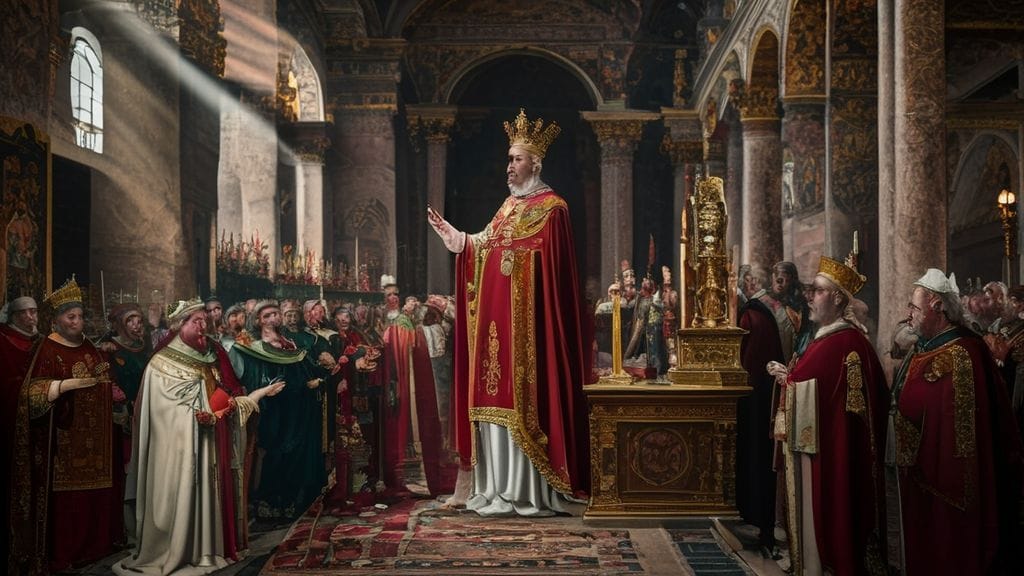
Inside Old Saint Peter’s, a forest of columns rose from the marble floor, and flickering lamplight danced on mosaics that glimmered gold and blue. The air smelled of wax, incense, and damp wool. At the heart of the basilica lay the shrine of the Apostle Peter, the fisherman whom Rome called its first bishop. Before this tomb, Charlemagne—king of the Franks and Lombards, ruler over vast stretches of Western Europe—knelt in prayer. He was tall, broad-shouldered, and imposing even in age, a seasoned ruler in his late fifties who had spent decades in the saddle, pushing the borders of his realm outwards in relentless campaigns.
The choir chanted. The pope, Leo III, prepared to celebrate the Christmas mass. The whispers among the crowd were not only about the birth of Christ, but also about politics and survival. Rome had been shaken by riots, Leo had been attacked and nearly blinded, and he had fled north to Charlemagne for help. Now, with the king in Rome, with Frankish soldiers in the city and Roman clergy watching every gesture, something larger seemed to be in the air. Some suspected a reward for Charlemagne’s protection. Others feared a bold theological and political experiment.
As the liturgy advanced, the tension thickened like incense in the basilica. Soon, in a moment carefully framed by ritual yet cloaked in mystery, the coronation of Charlemagne emperor would take place. A crown, said by one chronicler to be of gleaming gold, would be lowered onto his head; the Roman people would cry out an acclamation in Latin; and the pope would anoint this Frankish king as “Emperor of the Romans.” But this was only the beginning. The ceremony was more than a scene of medieval pageantry; it was a gamble with history, an attempt to resurrect an imperial dignity that had vanished in the West more than three centuries earlier.
Those who witnessed the scene, from bishops in their vestments to soldiers gripping spear-shafts, felt that something foundational was happening. In that dimly lit church, surrounded by decaying imperial ruins and under the troubled rule of a vulnerable pope, the coronation of Charlemagne emperor stitched together fragments of the Roman past, Christian theology, and Frankish military power into a new, uncertain order. It’s astonishing, isn’t it, to imagine that in a world humbler and darker than the marble Rome of old, a new kind of empire would be proclaimed.
From Warrior King to Father of Europe: Charlemagne Before the Crown
To understand why that Christmas in 800 mattered, we must first trace the long road that brought Charlemagne to Rome. Born around 742, probably in the lands of modern Belgium or western Germany, Charles—later called Charlemagne, “Carolus Magnus,” Charles the Great—grew up in a dynasty already on the rise. His grandfather, Charles Martel, had been the powerful mayor of the palace who effectively ruled the Frankish kingdoms and who famously defeated a Muslim army near Tours in 732, a battle later wrapped in legend as a defense of Christian Europe. Charlemagne’s father, Pepin the Short, went further: with the blessing of Pope Zachary, he deposed the last Merovingian king and had himself crowned king of the Franks in 751.
Charlemagne thus inherited not only land and warriors, but also a new kind of throne—one sanctified by the papacy. This connection between the Frankish monarchy and the bishop of Rome would become the core thread that, decades later, made the coronation of Charlemagne emperor possible. When Pepin died in 768, his realm was divided between Charlemagne and his brother Carloman, following Frankish custom. The relationship between the brothers was tense, and when Carloman died unexpectedly in 771, Charlemagne moved swiftly to secure control of the entire Frankish kingdom. In the eyes of contemporaries, this sudden consolidation seemed like providence.
Over the next three decades, Charlemagne waged constant war. He campaigned in Italy, crushing the Lombard kingdom and taking its iron crown. He battled the Saxons relentlessly in the forests of northern Germany, a struggle that combined brutal conquest with forced Christianization. His armies marched south of the Pyrenees into Spain, where in 778 the expedition ended badly; his rear guard was ambushed in the passes of the Pyrenees, an event that would later be transformed into the heroic tragedy of the “Song of Roland.” To his supporters, Charlemagne was the shield of Christendom; to those he conquered, especially the stubborn Saxons, he could be an implacable tyrant.
This relentless series of wars was not chaos, but a method. Each victory brought new lands, new churches, and new monasteries that tied frontiers back toward the royal center. Charlemagne established royal assemblies where nobles and bishops debated laws, heard royal capitularies, and pledged loyalty. He summoned scholars from distant lands, including the English cleric Alcuin of York, to help shape a reformed Christian kingdom. The king, often on the move with a traveling court, began to see himself—and to be seen—as more than a regional monarch. His dominion stretched from the Atlantic to the Elbe, from the North Sea to central Italy. Even before any imperial crown appeared, the scale of his power made people speak in grand terms.
Yet behind the victories lay uncertainty. The old Roman Empire of the West had collapsed in the fifth century; since then, no Western ruler had legitimately borne the title “emperor of the Romans.” In the East, in Constantinople, emperors still claimed to be the only true Roman emperors. The West had kings, dukes, bishops, and tribal leaders—but no unifying imperial figure. Charlemagne’s startling success raised the question: if someone could again claim that mantle in the West, why not him?
The Fractured World After Rome: Setting the Stage for a New Emperor
By the time Charlemagne was born, the Western Roman Empire had been gone for centuries. The last Western emperor, Romulus Augustulus, had been deposed in 476, when a Germanic general named Odoacer sent the imperial insignia to Constantinople. The political map of Western Europe became a mosaic of kingdoms: Visigoths in Spain, Ostrogoths and later Lombards in Italy, Franks in Gaul, and numerous smaller powers. The idea of “Rome” did not disappear—it survived in law books, in church Latin, and in the memory of cities like Rome and Ravenna—but its institutions had shattered.
In this fractured world, the Church emerged as a crucial bearer of continuity. Bishops and popes preserved Roman administrative habits and legal culture. Monasteries copied ancient texts and kept Latin learning alive. Yet the Church, especially in Italy, lived under pressure. The Lombard kingdom in northern Italy threatened Rome; the Byzantine Exarchate in Ravenna, claiming to rule Italy in the emperor’s name, weakened; and the popes found themselves in a tightening squeeze. One chronicler of the eighth century could still call the Byzantine emperor “our pious lord,” but distance, politics, and theology steadily eroded that bond.
This erosion became acute in the decades before the coronation of Charlemagne emperor. In the early eighth century, Byzantine emperors promoted iconoclasm, the rejection of religious images, sparking fierce resistance among many Western Christians who venerated icons and reliquaries. Popes in Rome opposed iconoclasm, and their relationship with Constantinople soured. At the same time, the Lombards pushed from the north, threatening the pope’s territory. In 751, the same year Pepin became king of the Franks, Lombards seized Ravenna, the seat of Byzantine power in Italy, effectively ending Eastern Roman protection of Rome.
Faced with Lombard pressure and distant, unreliable Byzantine support, the popes turned increasingly to the Franks. Pope Stephen II crossed the Alps in 753–754, something no pope had done before, to seek aid from Pepin. In return for anointing Pepin as king and confirming his dynasty’s legitimacy, the pope received promises of military support. This alliance laid the foundations of what historians call the “papal-Frankish partnership”—a relationship that fused sacred and secular power in new ways.
When Charlemagne succeeded Pepin, this alliance intensified. Victory over the Lombards in 774 allowed Charlemagne to style himself “King of the Franks and Lombards and Patrician of the Romans,” a title that hinted at imperial associations without yet claiming the full Roman legacy. Still, the idea that the Frankish king might be the champion of Rome, perhaps even its ultimate secular lord, began to take root. The stage was slowly being set for a decisive moment when crown and mitre would meet in a gesture that both sides would later present as providential.
Pope Leo III in Peril: Violence, Trial, and the Search for a Protector
The immediate trigger for the coronation of Charlemagne emperor was not a grand theological debate, but raw, personal violence. In 795, Leo III became pope, a man of modest background who inherited not just the spiritual care of the Christian world but also the tangled politics of Rome. The city was divided by rival aristocratic factions, many descended from old senatorial families who resented papal claims to power and the growing influence of the Franks.
On April 25, 799, during the procession of the Greater Litanies, Leo rode through the streets carrying relics, leading a penitential rite that wound through the city. Suddenly, conspirators attacked. They dragged him from his horse, tried to blind him, and attempted to cut out his tongue. These were punishments meant to unseat a ruler: a blind or mute pope could not properly preside over the liturgy. Leo’s assailants shouted accusations of perjury and immoral behavior. Blood ran in the streets, and the papal procession dissolved into chaos.
Leo survived, rescued by royal agents or loyal Romans—accounts differ—and was sheltered in the monastery of Saint Erasmus on the Caelian Hill. Yet his position in Rome was shattered. Even if he clung to his office, the accusations gnawed at his authority. And behind his enemies in the city stood powerful aristocratic families, determined to reassert their dominance over the papacy. For Leo, remaining in Rome meant living under the shadow of renewed attack and possible deposition.
So he fled. Accompanied by a small entourage, Leo III crossed the Alps and made his way to Charlemagne’s court at Paderborn, in Saxon territory, in the summer of 799. The image is striking: the bishop of Rome, successor of Saint Peter, seeking shelter in the encampment of a warrior king waging a frontier war. Charlemagne received him with honor, offering not only hospitality but also a stage on which Leo could defend his character. A public inquiry cleared Leo of the charges, at least in the eyes of the Frankish court.
Yet Charlemagne could not simply keep the pope in exile. Rome remained the symbolic center of Western Christendom. So king and pope crafted a plan: Leo would return to Rome, escorted by Frankish envoys, and a new inquiry would be held in the presence of Charlemagne himself. The implication was clear: the king would serve as arbiter over the internal conflicts of the Roman Church. In late 800, Charlemagne set out for Rome, entering the city as a protector. The pope, bruised by plots and partly restored but still contested, now had every reason to bind himself even more tightly to his Frankish savior.
The Long Road to Rome: Charlemagne’s Journey and the Weight of Expectation
When Charlemagne traveled to Rome in 800, it was neither his first visit nor a casual pilgrimage. He had been there in 774 to accept the Lombard crown; by now, the routes over the Alps and down the Italian peninsula were familiar to him and his retinue. Yet this journey carried a special weight. He came not as a conqueror, but as a judge and protector summoned by a pope under siege.
The royal party moved over mountain passes that, in winter or early autumn, could already be dusted with snow. Charlemagne’s entourage included nobles, bishops, legal experts, scribes, and armed guards. Along the way, local counts and bishops offered hospitality, and regional magnates presented petitions and complaints. The king remained, even in transit, the center of a rolling government. He held councils on the road, heard legal disputes, and issued orders. His presence was a kind of moving court, threading the empire together by sheer force of mobility.
By the time he reached Rome, news of his approach ran ahead of him. At the city gates, processions of clergy and nobles greeted him, bearing crosses, relics, and banners. Leo III, reestablished in office but still surrounded by enemies, presented himself humbly before the king, perhaps even holding the reins of Charlemagne’s horse according to some accounts—a symbolic gesture of submission that later chroniclers emphasized. The royal entry into Rome served as a visual proclamation: the pope might be spiritual father of Christendom, but the Frankish king stood as its temporal guardian.
In November and December 800, Charlemagne presided over hearings in Rome. The pope’s accusers renewed their charges; Leo protested his innocence. In a dramatic liturgical gesture, Leo swore an oath of purgation on December 23, declaring before God and man that he was not guilty of the crimes alleged. Charlemagne, rather than formally judging the pope, allowed this oath to stand as proof, avoiding the scandal of placing the bishop of Rome on trial like a common litigant. Politically, however, the message was unmistakable: peace and stability in Rome now hinged on the presence and authority of the Frankish king.
As Christmas approached, the city’s anxieties over politics mingled with spiritual anticipation. Everyone knew that Charlemagne would attend the solemn mass at Saint Peter’s. But not everyone knew what else might happen there. Some members of the Frankish entourage may have suspected something. Some Roman clerics may have whispered of a new honor to be placed upon Charlemagne. Yet if there was a detailed agreement about a coronation of Charlemagne emperor, it was not made public. The basilica became the stage, and only a handful of actors truly knew the script.
Inside the Old Saint Peter’s: Architecture, Ritual, and the Christmas Liturgy
To picture the coronation of Charlemagne emperor, we must step inside the vanished world of Old Saint Peter’s Basilica. Built in the fourth century under Emperor Constantine, the church stretched across the Vatican hill like a great marble ship anchored over the apostle’s tomb. A broad atrium led to a five-aisled nave, its floor worn by generations of pilgrims. Murals and mosaics shimmered above, and silver lamps hung before the shrine. The roar of the crowds outside diminished into a solemn murmur within, as wooden doors closed and the liturgy took command.
On Christmas Day, the basilica was full. Rome’s clergy, from humble priests to high-ranking deacons, took their places. Frankish counts in heavy cloaks jostled for a good view near the royal dais. Roman nobles in fine fabrics mingled uneasily with these northern warriors whose language and manners seemed rough but whose influence in the city was undeniable. The choir’s chanting filled the cavernous space, weaving Latin scripture with ancient melodies. The congregation followed the rhythm of the mass: readings, psalms, prayers, the Gospel.
Charlemagne himself, likely dressed in rich but not ostentatious garments—he was known for a certain personal modesty—knelt near the confession of Saint Peter, close to the pope. Leo III, in ornate vestments, presided at the altar. Candles flickered; incense smoke coiled upward. At this moment, the scene might have appeared as just another solemn Christmastide in Rome, albeit with a powerful foreign king in attendance. Yet beneath the chants and rituals, decisions made in private were about to surface in a single, irreversible act.
Sources diverge in describing the choreography that followed, but a broad outline emerges. After the reading of the Gospel, perhaps after certain prayers, Leo took a crown—fashioned of gold, studded with jewels—and approached the kneeling king. At this decisive instant, church ritual and political strategy fused. While one hand of the pope lifted the symbol of supreme worldly power, the other hand of history, as it were, opened a new chapter for Europe.
The Coronation of Charlemagne Emperor: The Moment the Crown Touched His Head
In the most famous account, written by the monk Einhard, Charlemagne’s close associate, the crucial moment came suddenly. As Charlemagne knelt in prayer, Pope Leo III stepped forward and placed the crown upon his head. The congregation erupted in acclamation: “To Charles Augustus, crowned by God, great and pacific emperor of the Romans, life and victory!” These words, shouted in Latin, echoed Roman imperial formulas while grafting them onto a Christian and Frankish context. The coronation of Charlemagne emperor thus unfolded as both a revival and a reinvention.
Leo then prostrated himself—or at least bowed deeply—before the new emperor, according to some sources, in a gesture that could suggest homage. Charlemagne was anointed with holy oil, reinforcing the idea that his authority derived not only from conquest and inheritance, but from God’s blessing mediated through the Church. For onlookers, the message was overwhelmingly clear: the Roman Empire, thought extinct in the West, had found a new bearer in a Frankish king who now wore the title “Emperor of the Romans.”
The ceremony fused many lines of meaning. The location, at the tomb of Peter, rooted the act in apostolic tradition. The timing—on the nativity of Christ—invited parallels between the birth of the Savior and the “rebirth” of empire. The presence of the pope and the use of anointing emphasized the sacred dimension of rulership. At the same time, the acclamation of the Roman people embedded the act in a time-honored Roman custom: emperors had long been acclaimed by army and populace.
For contemporaries, it must have felt like standing on a fault line where past and present meet. The old imperial titles had never entirely vanished from documents, but now they were anchored in a living, breathing monarch who ruled from Aachen, far from the marble halls of ancient Rome. The coronation of Charlemagne emperor was not just about one man’s prestige. It proposed a daring answer to a deep, lingering question: who, in a Christianized and fragmented West, possessed the right to claim universal secular authority?
Later chroniclers would invest this moment with theological language. Some described Charlemagne as a new David, a king anointed to unify God’s people. Others saw him as a latter-day Constantine, the emperor who had once embraced Christianity and given the Church freedom. For Charlemagne’s supporters, the crown did not merely sit upon his head; it wrapped his decades of warfare, administration, and patronage in a shimmering halo of legitimacy.
Shock, Strategy, or Theater? Did Charlemagne Really Not Know?
Almost as soon as the story of the coronation of Charlemagne emperor began to spread, so too did a fascinating claim: that Charlemagne had no idea what Leo III was about to do. Einhard famously wrote that his master would never have entered the church that day if he had known the pope’s intention, suggesting shock or even reluctance. This detail has tantalized historians for centuries. Was the emperor surprised? Was Einhard protecting his reputation? Or was this part of a carefully crafted myth in which the crown appears as a divine, unsolicited gift?
Modern scholars tend to be skeptical of complete surprise. It is hard to imagine that so momentous an act—reviving the Western imperial title, redefining the relationship between king and pope—could have been arranged without Charlemagne’s knowledge or at least his tacit consent. The logistics alone, from preparing the crown to orchestrating the acclamation, required planning. Moreover, the wider political context favored such a step: Charlemagne already wielded power on an imperial scale, and Leo desperately needed a powerful, honored protector.
So why, then, insist that Charlemagne had not expected it? One answer may be diplomatic. In Constantinople, the Byzantine emperors still claimed to be the sole legitimate heirs of Rome. If Charlemagne openly sought the imperial title, it might seem like open defiance, a usurpation. If, however, he appeared as a humble king surprised by a sudden, popular and papal acclamation, the act could be framed as a response to God’s will and the Church’s need, rather than as calculated aggression. A pious reluctance softened the hard edges of geopolitical reality.
There may also have been a deeper ideological motive. Medieval political thought often described good rulers as reluctant to wield power, assuming the burden of office from duty rather than ambition. By portraying Charlemagne as taken unawares by the coronation of Charlemagne emperor, Einhard and others cast him in this ideal mold: a man who did not grasp for the highest honors but accepted them for the sake of Christendom’s peace. The narrative of reluctance turned political pragmatism into moral virtue.
Yet behind the celebrations, there remained an undeniable core of strategy. The pope secured an emperor who, at least in theory, owed part of his legitimacy to papal action, strengthening the papacy’s claim to confer or recognize imperial authority. Charlemagne, for his part, gained a title that elevated him above rival kings and signaled a universal vocation. Surprise or no surprise, the crown was too useful a symbol for either side to discard.
The Rebirth of a Title: Why “Emperor of the Romans” Mattered
The words themselves—“Emperor of the Romans”—carried enormous weight. They did not merely add an honorific. They invoked centuries of tradition, legislation, and memory. When the coronation of Charlemagne emperor occurred, it reactivated this reservoir of meaning in the Western imagination. The Roman Empire had been the great organizer of the Mediterranean world, builder of roads, maker of laws. Its collapse had plunged the West into fragmentation and insecurity. To claim its mantle was to claim a unique kind of authority.
This title suggested that Charlemagne did not rule just the Franks or the Lombards, but all Romans, understood now as the peoples of his empire, bound together by Christian faith and shared law. In practice, his power remained limited by geography, communication, and local structures, but the symbolism mattered. It proposed that there was once again a single, overarching figure responsible for the earthly welfare of Christendom in the West.
The title also recast the balance between kingship and empire. Other kings—of the Anglo-Saxons, of the Spanish realms, of the Slavs—might be powerful, but they were now, at least in theory, of lesser rank. Their crowns existed within a world overshadowed by an emperor whose dignity surpassed that of kings. Some accepted this hierarchy; others resisted it. Yet the language of charters, correspondence, and church councils began to reflect the notion that Charlemagne held a preeminent place among rulers.
At the same time, the term “Romans” bridged past and present. The ancient Senate, the pagan temples, the gladiatorial games were gone, but Roman law and language survived. By presenting Charlemagne as “emperor of the Romans,” the coronation did not claim to resurrect the old empire in every detail. Rather, it insisted that the true inheritance of Rome now lay in a Christian monarchy allied with the papacy. As one later canonist would put it, the empire was “transferred” from Greeks to Germans, from Constantinople to the lands of the Franks.
This idea of translatio imperii—the transfer of empire—became a powerful medieval myth. It allowed thinkers across centuries to view history as a chain of legitimate succession, rather than as chaotic collapse and improvisation. In this story, the coronation of Charlemagne emperor was not an abrupt invention but a rightful continuation, a bridge between the classical and medieval worlds. Whether this was historically accurate in a strict sense mattered less than the fact that people believed it and acted upon it.
An Empire of Quills and Crosses: Education, Faith, and the Carolingian Renaissance
While Charlemagne’s sword carved out his empire, quills in scriptoriums gave it shape and memory. Long before 800, he had begun a wide-ranging program of reform and cultural renewal. His reign saw what modern scholars call the “Carolingian Renaissance”—a flourishing of learning, art, and religious life that did not rival the classical golden age in scale, but nevertheless transformed Western Europe. The coronation of Charlemagne emperor gave this movement a new ideological frame: now, these reforms could be seen as the cultural infrastructure of an empire.
Charlemagne urged bishops and abbots to establish schools, not just for monks and priests, but for promising boys from the laity. He issued capitularies insisting that clergy learn correct Latin so they could celebrate the sacraments properly and preach intelligibly. “Let the boys be taught the Psalms, chant, computation, and grammar in every monastery and bishop’s house,” one order instructed. Books became crucial tools of rule. Standardized liturgical texts bound far-flung churches to a common faith; law collections helped unify practice across regions.
At his court, scholars like Alcuin of York, Paul the Deacon, and Theodulf of Orléans debated theology, corrected biblical texts, and even dabbled in poetry. They helped shape a more uniform, disciplined, and intellectually coherent Christianity in the Frankish realms. The script they used—Carolingian minuscule, with its clear, rounded letters—was legible and elegant. It later became the basis for many modern typefaces, a subtle but enduring legacy of this period. In a sense, the letters in which laws, prayers, and histories were written formed the visual language of Charlemagne’s empire.
The coronation of Charlemagne emperor energized these efforts by embedding them within a worldview where empire and Church worked hand in hand to build a Christian society. As emperor, Charlemagne saw himself not merely as ruler but as shepherd and teacher of his people. He convened councils to correct doctrine, combat heresy, and regulate clerical behavior. He ordered the building and restoration of churches, and he patronized monasteries that became centers of both prayer and production.
Faith and power mingled in this project. The empire’s cohesion depended on shared beliefs as much as on force of arms. Missionaries in Saxony and beyond traveled with imperial backing, preaching a Christianity that was increasingly shaped by Frankish and Roman norms. The emperor’s universal title dovetailed with the Church’s universal mission: if there was one true God and one true faith, why should there not be one overarching Christian emperor in the West?
Nobles, Monks, and Peasants: How Ordinary Lives Felt the Weight of a New Empire
For high nobles and bishops, the coronation of Charlemagne emperor meant new possibilities for influence, promotion, and proximity to the center of power. But what about those who never saw Rome, never heard Latin acclamations echo beneath Saint Peter’s ceiling? How did the imperial title, proclaimed far away, touch the lives of peasants, minor clergy, and local lords across the sprawling realm?
In many ways, the impact was indirect but real. Charlemagne’s government relied on local counts and bishops to implement royal orders. These men, now serving an emperor, might feel an added sense of duty—or entitlement. Royal capitularies, read aloud in assemblies, now bore the name of “emperor” and sometimes invoked the universal mission of the realm. This could translate into stricter enforcement of tithes, harsher penalties for certain crimes, or more insistent demands for military service.
Peasants in a Frankish village might not care what title their distant ruler bore, but they would feel the weight of empire when a royal messenger—missus dominicus—arrived to inspect local courts, check accounts, and hear grievances. These missi, traveling in pairs (often a lay noble and a bishop or abbot), symbolized the emperor’s eyes and ears across the countryside. Their presence signaled that the center was watching, that the emperor’s justice extended even to remote valleys and forest clearings.
For monks in cloistered communities, imperial policy brought both burden and opportunity. Royal charters confirmed monastic privileges, granted lands, and protected communities from local interference. Yet imperial expectations also grew: monasteries were to pray for the emperor and empire, host travelers, preserve books, and cultivate lands efficiently. The empire’s spiritual backbone depended on such communities, and in turn they wove Charlemagne’s name into their daily liturgies.
Women, largely absent from official chronicles, nonetheless inhabited this imperial world in essential ways. Queens and noblewomen like Charlemagne’s daughters and sisters could mediate disputes, patronize religious houses, and influence succession politics. Peasant women worked the fields that supported the tax base, raised children who might one day march in imperial armies, and attended churches whose liturgy was being shaped by imperial decrees. Empire, though a grand word, ultimately rested upon the ordinary rhythms of households, harvests, and parishes.
East Meets West: Byzantium’s Cold Reception of a Western Emperor
If the coronation of Charlemagne emperor delighted Rome and Aachen, it produced a chill in Constantinople. The Byzantine Empire, heir to the Eastern Roman tradition, still saw itself as the one, undivided Roman Empire. Its emperors minted coins bearing the image of Christ, issued laws in the name of the “Romans,” and regarded Latin-speaking Westerners with a mix of disdain and wary respect. To them, the idea that a Frankish king could declare himself “Emperor of the Romans” was at best a misunderstanding, at worst a provocation.
At the time of Charlemagne’s coronation, Byzantium was ruled first by Empress Irene, a formidable and controversial figure who had deposed and blinded her own son, Constantine VI, in 797 to rule alone. This shocking act raised questions even within the Byzantine world about the legitimacy of her rule. Some Western thinkers argued that, because a woman now sat on the imperial throne in Constantinople, the empire’s dignity had been effectively forfeited. In their telling, this opened the way for the imperial title to be “transferred” to a more suitable male ruler in the West—namely, Charlemagne.
Byzantine sources, however, did not see it that way. For them, Rome remained theirs in principle, even if their actual control of Italy had shrunk drastically. Charlemagne’s new title was therefore diplomatically awkward. For several years, relations between the two courts were strained, marked by careful correspondence and cautious probing. Warfare in the Adriatic and over Venice added to the tension. Yet neither side desired an all-out rupture.
Eventually, a compromise emerged. Around 812, under Emperor Michael I Rangabe, Byzantium seems to have recognized Charlemagne as “Basileus,” a Greek term meaning “king” or “emperor,” without conceding that he was truly “Emperor of the Romans.” The wording was deliberately ambiguous. Both sides could claim victory: Charlemagne’s court could say the East had recognized his imperial dignity, while Constantinople could maintain that there was only one true Roman Empire—its own.
This uneasy coexistence of two emperors—one in the Latin West, one in the Greek East—shaped centuries of diplomacy. It foreshadowed later conflicts between popes and emperors, East and West, that would culminate in the Great Schism of 1054 and the bitter rivalries of the Crusades. In a sense, the coronation of Charlemagne emperor did not just revive an old title; it fractured the idea of empire itself, forcing the Christian world to live with two competing centers of universal authority.
Ink and Authority: Capitularies, Missi Dominici, and the Machinery of Rule
The imperial title might have been proclaimed in a single ritual moment, but sustaining empire required daily work in ink and parchment. Charlemagne’s rule, especially after his coronation, displayed a striking concern with administration. Capitularies—royal decrees divided into short chapters (capitula)—poured from the court, addressing everything from church reform to judicial procedure and military organization. They sought to impose order upon the sprawling diversity of his lands.
These texts reveal an emperor anxious about justice and salvation, yet also aware of human frailty. One capitulary might rail against corrupt judges; another would regulate the treatment of widows and orphans; a third would standardize weights and measures. The language could be stern: those who defied God’s law and the emperor’s commands risked fines, exile, or harsher penalties. Yet there was also an undercurrent of pastoral concern: rulers, in this view, were responsible for guiding their subjects toward virtue as well as obedience.
To carry these decrees into the countryside, Charlemagne relied on the missi dominici. These royal envoys, often assigned to specific circuits, embodied the emperor’s traveling authority. They visited local courts, inspected the conduct of counts and bishops, heard appeals, and reported back to Aachen. Their presence reminded regional elites that their power was not absolute. “Let no count or powerful man presume to prevent the poor from appealing to us through our missi,” one capitulary insisted. Here, the imperial ideal of justice tried to cut through local privilege.
In practice, the system was imperfect. Distances were great, roads rough, and personal loyalties often stronger than attachment to an abstract “empire.” Still, the machinery of missi and capitularies, of oaths and assemblies, created a political culture distinct from that of smaller, more localized kingdoms. The title “emperor” made sense not simply because Charlemagne ruled vast lands, but because he and his advisors imagined governance on an imperial scale.
Legal texts and church canons circulated widely, copied in monasteries and cathedral scriptoria. They formed a shared reference for judges, bishops, and royal agents. Over time, this body of writing would influence later medieval law, contributing to the legal traditions that eventually shaped Europe. One modern historian, Janet L. Nelson, has described Charlemagne’s empire as “a world of written norms and negotiated powers,” emphasizing how texts both expressed authority and invited interpretation. In this sense, the coronation of Charlemagne emperor crowned not only a man but also a project of rule that relied on the power of the written word.
Myths, Legends, and the Making of “Charlemagne the Great”
Long after Charlemagne’s death in 814, his figure swelled in memory and legend. The historical king who struggled with rebellious Saxons, negotiated with popes, and worried over church discipline slowly gave way to a larger-than-life emperor who strode across epics and chronicles. The coronation of Charlemagne emperor, fixed on a specific winter morning in Rome, became the focal point of a grand narrative in which he appeared as the chosen champion of God and Christendom.
In the chansons de geste—Old French epic poems like the “Song of Roland”—Charlemagne is an aged but indomitable emperor leading twelve paladins against the forces of Islam in Spain. The messy political reality of 778 and the ambush at Roncevaux Pass were transformed into a cosmic struggle between faith and infidelity. The emperor’s court in these tales is a place of chivalry, betrayal, and miraculous intervention. History yields to imagination, yet the imperial title remains central: Charlemagne is not just a king, but an emperor whose decisions ripple across the world.
Medieval chroniclers likewise elevated the Christmas coronation into a near-sacramental moment. The monk of Saint Gall, writing in the ninth century, pictured Charlemagne as a man of immense piety, wisdom, and strength, almost a saintly ruler. Later authors in the High Middle Ages turned him into a predecessor of the crusaders, a model of Christian kingship linked to holy war and territorial expansion. The effigy of Charlemagne appeared in cathedrals, imperial cities, and royal iconography, a visual reminder of shared roots.
Not all voices were uncritical. Some monastic writers, especially in regions that suffered under forced conversion or heavy taxation, remembered Charlemagne more harshly. They recalled the destruction of pagan sanctuaries, the massacre of Saxons at Verden, and the burden of military levies. Even so, the overall arc of memory bent toward glorification. To many later Europeans, “Charlemagne” and “emperor” became almost synonymous—a sign of how deeply the coronation of Charlemagne emperor had imprinted itself on cultural consciousness.
Modern historians, from the nineteenth century onward, have often debated the man behind the myth. Was he a ruthless conqueror or enlightened ruler, a proto-national king of the French or Germans, or a genuinely pan-European figure? The French historian Fustel de Coulanges emphasized the Roman legal legacy preserved under his reign, while others highlighted his Germanic warrior ethos. Still, across these interpretations, Christmas Day 800 persists as the hinge that transforms Charles the king into Charlemagne the symbol.
From Carolingian Crown to Holy Roman Empire: The Long Echo of 800
The empire Charlemagne forged did not long outlive him in its original unity. His son Louis the Pious struggled to hold together the vast territories, and after Louis’s death in 840, civil war among his sons led to the Treaty of Verdun in 843. This partition split the realm into three main kingdoms, laying early foundations for what would later become France and Germany. The dream of a single, tightly organized Western empire faded amid fraternal rivalry and local ambition.
Yet the idea of empire, sanctified by the coronation of Charlemagne emperor, did not disappear. In 962, more than a century after Charlemagne’s death, Otto I of Saxony traveled to Rome and was crowned emperor by Pope John XII. This act is often marked as the birth of the “Holy Roman Empire,” though that phrase came into common use only later. Otto consciously invoked Charlemagne’s memory, presenting himself as his successor and heir. The imperial title thus leapt from the Carolingian to the Ottonian dynasty, and from there to later German kings.
Over the following centuries, the Holy Roman Empire became a complex, often unwieldy constellation of duchies, bishoprics, and cities. Emperors tried to assert authority over Italy, battled with popes in the Investiture Controversy, and presided over imperial diets where princes jealously guarded their rights. Yet amid all this, the symbolic lineage back to Charlemagne remained precious. Imperial coronations in Rome continued, and Charlemagne’s Aachen palatine chapel was treated as a sacred imperial site. In 1165, Emperor Frederick Barbarossa even had Charlemagne canonized at Aachen, though this was never fully recognized by the wider Church.
The idea that Roman imperial authority had been transferred to the German kings legitimized their claims over contested territories and their interventions in papal elections. When later humanists and jurists debated the nature of empire and sovereignty, they often began with the assumption that the emperor, in some sense, embodied a universal Christian monarchy in the West. Even as the Reformation fractured religious unity and the Peace of Westphalia in 1648 recognized the sovereignty of individual states within the empire, the imperial title persisted as a thread connecting the medieval and early modern worlds.
Only in 1806, under pressure from Napoleon, did the Holy Roman Empire formally dissolve. Yet by then, Charlemagne’s coronation had been reimagined yet again, this time as a foundational moment in the histories of emerging nations. French and German nationalists both claimed him as a kind of founding father. Napoleon himself staged his own imperial coronation in 1804 with deliberate echoes of 800, even as he famously seized the crown from the pope’s hands to place it on his own head—a theatrical reversal of Charlemagne’s supposed humility.
Thus the coronation of Charlemagne emperor was not merely an episode locked in the distant Middle Ages. It became a reference point for debates about church and state, monarchy and nation, universal authority and local sovereignty—debates that shaped Europe’s modern political landscape. The crown that Leo III placed on Charlemagne’s head in Old Saint Peter’s became, across a millennium, a mirror in which countless rulers and thinkers sought to recognize themselves.
Conclusion
On that cold Christmas morning in Rome, no one could fully foresee the centuries of argument, imitation, and memory that would radiate from a single act: the coronation of Charlemagne emperor at the tomb of Saint Peter. To those present, it was at once a practical solution to immediate crises—a beleaguered pope seeking protection, a powerful king seeking a frame for his authority—and a daring reimagining of the past. In a world still haunted by the ruins of Roman forums and aqueducts, the ceremony claimed that Rome’s mantle had not died, only waited for a new bearer.
Charlemagne’s empire would fracture; borders would shift; new kingdoms and ideas would rise. Yet the pattern set in 800—the alliance and tension between emperors and popes, the desire to legitimize power by appealing to Roman and Christian tradition, the notion that Europe might be united under a single secular head—persisted. The imperial crown became a contested symbol, worn by German kings, invoked by humanists, resisted by reformers, and finally set aside in the age of nation-states.
Still, the story retains a peculiar power. It reminds us that political orders are not only built by armies and taxes, but also by rituals, words, and remembered images: a kneeling king, a pope with a golden crown, a crowd shouting acclamations in a basilica filled with incense. It invites us to see the Middle Ages not as a dark hiatus, but as a time of creative adaptation, when people stitched together Roman law, Germanic custom, and Christian theology into something new. And it suggests that every claim to universal authority, no matter how grand, is ultimately fragile—dependent on the consent, belief, and memory of those who live under it.
The coronation of Charlemagne emperor has become, in the end, more than a historical datum. It is a story about how societies remember and reinvent their past, about the enduring allure of empire, and about the human hunger for order and meaning in times of uncertainty. Standing in imagination beneath the vanished arches of Old Saint Peter’s, we can still feel the tremor of that moment when an aging warrior from the north rose from his knees wearing a crown that bound together heaven’s favor and earthly power—and set Europe on a path it is still, in some ways, walking today.
FAQs
- What was the coronation of Charlemagne emperor and when did it take place?
The coronation of Charlemagne emperor was the ceremony in which Pope Leo III placed a crown on the head of Charlemagne and proclaimed him “Emperor of the Romans.” It took place on December 25, 800, in Old Saint Peter’s Basilica in Rome, during the Christmas mass. This act symbolically revived the Western Roman imperial title, which had been vacant since the fifth century. - Why did Pope Leo III crown Charlemagne as emperor?
Pope Leo III crowned Charlemagne partly out of gratitude and political necessity. Leo had been attacked by Roman nobles, accused of serious crimes, and forced to flee to Charlemagne for protection. By crowning him emperor, Leo rewarded his protector, strengthened his own position by tying the papacy to a powerful ruler, and asserted the papacy’s claimed right to recognize or confer the imperial title in the West. - Did Charlemagne really not know he was going to be crowned emperor?
Einhard, Charlemagne’s biographer, claimed that the king would not have entered Saint Peter’s on Christmas Day had he known what Leo intended, suggesting surprise or reluctance. Most historians doubt complete ignorance, given the planning required and the political stakes. It is more likely that Charlemagne at least tacitly agreed to the idea, while later narratives emphasized his supposed surprise to portray the coronation as a spontaneous, God-given honor rather than a calculated power grab. - How did the coronation affect Charlemagne’s relationship with the Byzantine Empire?
The coronation complicated relations with Byzantium, whose emperors considered themselves the only legitimate Roman emperors. Charlemagne’s new title challenged this exclusivity. After years of diplomatic tension and limited conflict, a compromise emerged in which the Byzantine court recognized Charlemagne as an emperor (“Basileus”) without fully conceding that he was “Emperor of the Romans.” This created a world with two rival imperial centers, one in the Latin West and one in the Greek East. - What changes did the imperial title bring to Charlemagne’s rule?
The imperial title gave Charlemagne a universal, symbolic authority above that of ordinary kings and reinforced his role as protector of the Church. It encouraged the further development of administrative structures, such as capitularies and missi dominici, and gave ideological coherence to his reforms in education, law, and liturgy. While it did not suddenly transform daily life, it reframed his rule in a broader Christian-Roman context and influenced how contemporaries and later generations understood his reign. - What is meant by the “Carolingian Renaissance,” and how is it linked to the coronation?
The “Carolingian Renaissance” refers to the cultural and intellectual revival that took place under Charlemagne and his successors, marked by the promotion of schools, the standardization of Latin, the correction of biblical texts, and the flourishing of art and architecture. The coronation of Charlemagne emperor did not start this movement, which was already underway, but it gave it an imperial frame: reforms in learning and religion were now seen as part of building a Christian empire, not just a powerful kingdom. - How did the coronation of Charlemagne lead to the Holy Roman Empire?
Charlemagne’s empire fragmented after his death, but the idea of a Western Christian emperor persisted. In 962, Otto I of Saxony was crowned emperor in Rome, consciously invoking Charlemagne’s legacy. Over time, this line of emperors, mostly German kings, came to be known as the rulers of the Holy Roman Empire. They claimed to continue the Roman and Carolingian imperial tradition, even as their actual power varied and the political landscape changed. - Why is the coronation of Charlemagne emperor considered a turning point in European history?
It is considered a turning point because it symbolically reunited Roman, Christian, and Germanic elements into a new political order. The ceremony reintroduced the idea of empire in the West, reshaped the relationship between Church and state, and provided a model of Christian imperial authority that influenced politics, law, and culture for a millennium. It also contributed to the later emergence of distinct Western and Eastern Christian worlds, each with its own imperial center.
External Resource
Internal Link
Other Resources
- Encyclopaedia Britannica – general search for the exact subject
- Google Scholar – academic search for the exact subject
- Internet Archive – digital library search for the exact subject

