Table of Contents
- Storm over Christendom: Setting the Stage for a Broken Alliance
- The Making of a Stubborn Emperor: Frederick II’s Unlikely Childhood
- A Pope of Fire and Law: Gregory IX and His Vision of Christendom
- The Holy Oath: Crusade Vows and the Seeds of Suspicion
- Delays, Disease, and Defiance: The 1227 Excommunication
- A Crusade without the Pope: Frederick’s Journey to the Holy Land
- An Emperor’s Crown in Jerusalem and a Pope’s Fury in Rome
- From Fragile Truce to Open War: The Road to 1239
- March 20, 1239: When pope gregory ix excommunicates frederick ii Again
- Words as Weapons: The Bull of Excommunication and Its Rhetoric
- Thunder from the Pulpit: How Europe Heard the News
- Imperial Counterattack: Propaganda, Letters, and Loyalists
- War for Italy’s Soul: Sieges, Alliances, and Betrayals
- Life under the Interdict: Ordinary People in an Age of Curses
- Saints, Scribes, and Spies: The Church’s Internal Struggles
- Legends, Myths, and Monsters: The Black Legend of Frederick II
- From Excommunication to Collapse: The Longer Shadow over the Empire
- Why It Still Matters: Church, State, and the Ghost of 1239
- Conclusion
- FAQs
- External Resource
- Internal Link
Article Summary: On 20 March 1239, in Rome, the fragile balance of medieval Christendom cracked when pope gregory ix excommunicates frederick ii for the second time, turning a personal and political rivalry into a spiritual war. This article explores the tangled lives and ideals of both men: an emperor raised amid Sicilian chaos, and a pope forged in the fire of canon law and crusading zeal. From broken vows and disputed crusades to letters that branded Frederick the “Antichrist,” the narrative follows how accusations and counter-accusations pulled Europe into a battle of pulpits and swords. We move from imperial courts and papal councils to the daily fears of villagers whose sacraments were suddenly caught in a storm of anathemas. Along the way, we examine how the moment when pope gregory ix excommunicates frederick ii reshaped ideas of authority, obedience, and resistance. By tracing the myths and propaganda that surrounded them, we see how each man tried to claim the moral high ground. Finally, the article shows how this dramatic confrontation echoed through the later Middle Ages, influencing political thought and the perennial struggle between secular and spiritual power.
Storm over Christendom: Setting the Stage for a Broken Alliance
The story of 20 March 1239, when pope gregory ix excommunicates frederick ii in Rome, does not begin with a single angry decree sealed in red wax. It begins in the slow gathering of clouds over a fractured Christendom. To picture the moment, imagine Rome in early spring: damp stone, the Tiber swollen with recent rains, and the papal curia moving restlessly in its palaces as rumors from the south pour in—imperial troops in Apulia, imperial envoys in Lombardy, imperial gold changing hands across Italy. Over all of this, one question hangs like a storm: who truly rules the Christian world—the emperor crowned in Aachen and Palermo, or the pope enthroned beside the tomb of Saint Peter?
The twelfth century had ended with the Church triumphant. Popes like Gregory VII and Innocent III claimed they could depose emperors, redraw borders, and judge kings. Yet the thirteenth century opened with unexpected complications. New powers—Italian city-states, ambitious monarchs in France and England, restless nobles in Germany—began to contest the old harmony of sword and crosier. Into this shifting landscape stepped Frederick II of Hohenstaufen, King of Sicily, King of Germany, King of Jerusalem, and Holy Roman Emperor. Brilliant, aloof, multilingual, and utterly convinced of his own destiny, he seemed at once a savior of imperial grandeur and a threat to papal supremacy.
Gregory IX, old but unbending, saw in Frederick both promise and peril. The emperor held the Kingdom of Sicily, which wrapped around the Papal States like a steel chain. If Frederick were obedient, the papacy might wield an obedient “secular arm” to defend it. If he were defiant, Rome would face a neighbor with armies, fleets, and money beyond measure. The events that would culminate in that fateful March day in 1239 were, in many ways, an argument over geography and fear, as much as theology and sin.
But this was only the beginning. Beneath the political chessboard lay deeper convictions. Gregory believed that Christendom was a single body, with the pope as its head. Frederick believed that the empire was a divinely ordained order, in which the emperor’s law was no less sacred than papal decrees. Neither man could easily compromise on these absolutes. So when pope gregory ix excommunicates frederick ii—first in 1227, then more thunderously in 1239—it is the sound of two irreconcilable visions colliding.
The Making of a Stubborn Emperor: Frederick II’s Unlikely Childhood
Frederick’s path to this confrontation began in chaos. Born in 1194 in the northern Italian town of Jesi, he was the son of Emperor Henry VI and Constance of Sicily, last heir of the Norman kings of the south. Only two years later, Henry was dead. By 1198, Constance too had died, leaving the four-year-old boy technically king, but in reality a pawn amid the ruins of authority in Sicily.
His childhood in Palermo was less a royal upbringing than a feral struggle for survival. Chroniclers speak of the young king wandering half-guarded through the streets, picking up scraps of languages—Latin from priests, Greek from officials, Arabic from traders and scholars, Sicilian from servants. The German chronicler Otto of St. Blasien would later marvel that Frederick’s youth had unfolded “in the midst of wars and the utmost confusion.” It is astonishing, isn’t it? The future terror of the papacy grew up among market stalls and alleyways where church bells mingled with the call to prayer of Muslim communities left over from earlier conquests.
For a time, the papacy itself supervised this fragile orphan-king. Pope Innocent III, Gregory IX’s famed predecessor, took Frederick under his wing as a ward of the Holy See. It was a calculated move: by controlling the Sicilian child-king, the pope hoped to keep the dangerous southern kingdom from falling under hostile control. The memory of this guardianship would later be twisted into propaganda on both sides—Frederick insisting he had been shackled, popes insisting he had been raised like a spiritual son.
By his teens, however, Frederick was no one’s ward. He fought off rebellious nobles, intrigues by German princes, and rival claimants to the imperial crown. When he was elected King of Germany in 1212 and later crowned emperor in 1220, his personal experience had taught him two brutal lessons: mercy was rarely rewarded, and distrust was a necessary armor. He grew into a ruler who loved rational order and written law—he would one day codify the famous Constitutions of Melfi—but who harbored a deep suspicion of any power he did not directly control. The papacy, with its pretensions to judge emperors and kings, quickly became his chief concern.
It is in this crucible that the man standing on the receiving end when pope gregory ix excommunicates frederick ii was formed: a ruler who saw himself as chosen by God yet constantly thwarted by men in robes.
A Pope of Fire and Law: Gregory IX and His Vision of Christendom
If Frederick’s youth was chaos, Gregory’s was discipline. Born Ugolino di Conti, likely around the 1160s, into a distinguished Italian family, the future pope received a fine education in canon law at Paris and Bologna. These were the intellectual nerve centers of Europe, where scholars poured over Gratian’s Decretum and the latest papal decretals, weaving together the legal fabric of the Church. For Ugolino, the Church was not a vague spiritual community. It was a structured, ordered, and above all legal institution. Rules mattered; obedience mattered more.
Ugolino rose steadily through the ranks: cardinal, papal legate, trusted advisor to Innocent III. He witnessed up close the triumphs of papal authority—Innocent’s arbitration between kings, his calling of crusades, his interventions in imperial politics. He also watched the threats gathering at Christendom’s edges: Muslim powers in the Holy Land and Spain, heretical movements in southern France and northern Italy, and the ever-recurrent instability of the German monarchy.
When Ugolino was elected Pope Gregory IX in 1227, he was already an old man. Yet age had not softened him. One contemporary, the English chronicler Matthew Paris, described Gregory as “very fervent and zealous, but somewhat too harsh.” In Gregory’s worldview, the pope’s authority was not merely spiritual; it was the necessary keystone holding Christian society together. To question that authority was to risk the collapse of a world built on divine order.
Gregory’s pontificate would be marked by juristic projects—he commissioned the great collection of papal law known as the Decretals of Gregory IX—and by an unrelenting defense of papal prerogatives. It was, therefore, almost inevitable that he would collide head-on with Frederick II, whose very empire wrapped the papal territories like iron tongs. The scene in 1239, where pope gregory ix excommunicates frederick ii with solemn ceremony, was the logical culmination of decades spent training his mind to see disobedience as both sin and danger.
The Holy Oath: Crusade Vows and the Seeds of Suspicion
The immediate fuse of the conflict between pope and emperor lay not in Italy, but in the eastern Mediterranean. Since the loss of Jerusalem to Saladin in 1187, Latin Christendom had been obsessed with one question: who would win it back? Popes dreamed of holy kings marching under the cross; kings dreamed of glory and salvation. Frederick, like many rulers of his age, took a solemn vow to lead a crusade to the Holy Land.
Innocent III had extracted an early promise from the young Frederick, but it was renewed and solemnized at Frederick’s imperial coronation in 1220. There, in the presence of cardinals and German princes, Frederick confirmed that he would take up the cross within a set period. To take the cross was not a mere political commitment; it was a sacred vow, kneeling before the altar, receiving the cloth cross sewn onto one’s garments as a visible mark of obligation. To delay without good reason was to play dangerously with spiritual peril.
Yet delays came quickly. Frederick’s rule in Germany needed consolidation; his kingdom of Sicily was plagued by rebellions. Traders, bishops, and nobles whispered to Rome that the emperor was stalling, perhaps even hoping never to leave his Italian power-base. Some suspected that a ruler who saw the eastern Mediterranean as a field for diplomacy and trade might prefer treaties to holy war. Gregory IX, successor to Innocent from 1227, had little patience for such calculations. The Church had preached, organized, and wept for this new crusade. Every delay looked to Gregory like a betrayal, perhaps even an insult to God.
Behind the scenes, mistrust grew like mold in damp stone. Frederick suspected that the papacy enjoyed having him tied to an unfulfilled crusade, constantly under moral pressure. The papacy suspected that Frederick preferred earthly concerns to spiritual obligations. Letters crossed the Alps and the Tyrrhenian Sea, carefully phrased yet dripping with irritation. And hovering over every line was the threat of spiritual sanctions—most of all, the dreaded word: excommunication.
Delays, Disease, and Defiance: The 1227 Excommunication
In 1227, matters came to a head. Frederick finally assembled a crusading fleet at Brindisi in southern Italy. The harbors were crammed with ships, horses, armed men from Germany, Italy, and beyond. Yet even as the banners fluttered in the sea breeze, disease began to stalk the camp. Dysentery and fever tore through the packed ships. Men vomited over the gunwales, collapsed on the quays, died in tents that stank of sweat and seawater.
Frederick himself fell violently ill. To sail in such a state would have been near-suicidal. He sent part of the army ahead but turned back to Otranto and then to his Sicilian domains to recover. From his vantage point in Rome, Gregory IX saw only a broken promise. He had already been frustrated by earlier postponements. Now, smelling duplicity where there may have been genuine illness, he reacted with the full force of papal judgment.
On 29 September 1227, Gregory publicly excommunicated the emperor. Bells tolled; parchment was read in churches; scribes copied the decree for dissemination through Europe. For the first time, pope gregory ix excommunicates frederick ii, placing the most powerful layman in Christendom outside the Church’s sacramental embrace. The bull accused Frederick of bad faith, of “mocking Christ” by taking the cross and then abandoning his vow, of scandalizing the faithful.
The emperor raged. From his own chancery, letters flew to princes and bishops, insisting he had been truly sick, denouncing the pope as hasty and unjust. It was here that the bitter pattern of the next decade was set: Rome would thunder against Frederick; Frederick would reply that he was more Christian, more reasonable, more concerned for peace than his elderly adversary. Still, even under excommunication, Frederick prepared another departure. He would sail east, but he would not wait for absolution.
A Crusade without the Pope: Frederick’s Journey to the Holy Land
In 1228, under the shadow of the earlier condemnation, Frederick II finally departed for the Holy Land. To many of his contemporaries, it was a surreal spectacle: an excommunicated emperor leading a crusade. Priests and chroniclers struggled to interpret the paradox. Could a man cut off from the Church by the pope still legitimately wear the cross of Christ on his cloak?
Frederick answered by action. Rather than hurling his armies like a hammer against the walls of Muslim-held cities, he chose the weapon of negotiation. Drawing on his knowledge of Arabic and his respect for Muslim learning, he held talks with Sultan al-Kamil of Egypt, nephew of Saladin. The two rulers—one under church ban, the other a Muslim—conversed and bargained. In 1229 they concluded a treaty: Jerusalem, Bethlehem, and Nazareth would be returned to Christian control for a set term, with Muslims retaining certain rights and control over nearby sites.
There was no great pitched battle, no rivers of blood to sanctify the land, but the result was undeniable: Frederick had retaken Jerusalem through words instead of swords. Yet behind the celebrations in the East, clouds were darkening over Rome. Gregory IX was not impressed by this diplomatic success; he was offended by its implications. The pope had not absolved the emperor. In Gregory’s eyes, Frederick waged a crusade without legitimate spiritual authorization, as if he himself were arbiter of holy war.
The most astonishing moment came when Frederick entered the Church of the Holy Sepulchre and placed the crown of Jerusalem upon his own head. There was no papal legate to bless the coronation, no choir of bishops to chant. An excommunicate, alone before the empty tomb, crowned himself King of Jerusalem. To some, it was an act of bold piety. To others, an almost blasphemous assertion of imperial autonomy.
An Emperor’s Crown in Jerusalem and a Pope’s Fury in Rome
As imperial scribes in the East drafted letters announcing the peaceful recovery of Jerusalem, Rome replied with outrage. Gregory IX denounced the treaty as fragile and untrustworthy, a truce gained by concessions rather than a victory granted by God. Papal envoys warned that Frederick’s actions set a dangerous precedent: if emperors could make their own crusades, what stopped them from reshaping Christian warfare entirely?
Meanwhile, in Italy, papal and imperial supporters clashed with increasing ferocity. Gregory, convinced that Frederick’s absence created a moment of weakness, incited rebellions in the emperor’s southern lands. Frederick, hearing of the unrest, cut short his stay in the Holy Land and returned in fury. From then on, every move took place under the sign of mutual suspicion. When pope gregory ix excommunicates frederick ii anew in later years, it would be with these earlier grievances simmering underneath.
Upon his return, Frederick entered into negotiations with the papacy. The excommunication of 1227 was eventually lifted in 1230 after complex talks at San Germano. Publicly, there was reconciliation: pope and emperor exchanged the kiss of peace. Yet neither truly forgot. Gregory believed Frederick had manipulated him, playing sick to postpone the crusade, then returning triumphantly crowned with a treaty the Church had not choreographed. Frederick believed Gregory had abused the spiritual sword to constrain his political autonomy.
The peace of San Germano was a truce, not a resolution. On paper, it looked promising: mutual recognition, promises to respect each other’s rights, a reassertion of the pope’s spiritual supremacy and the emperor’s lay authority. In practice, every border fort, every city in central Italy, every succession in Germany became a contested ground. The men who had once smiled and exchanged blessings now prepared, quietly, for the next round.
From Fragile Truce to Open War: The Road to 1239
Between 1230 and 1239, the relationship between Gregory IX and Frederick II decayed in slow, almost inevitable steps. There was no single shattering moment, only a succession of irritations and provocations that gradually shredded the thin fabric of trust. At stake was no longer simply a broken crusade vow, but the future structure of Christendom itself.
First came the question of Lombardy, the northern Italian region dominated by fiercely independent city-states. Many of these communes—Milan, Piacenza, and others—traditionally aligned themselves with the papacy against imperial encroachment. Frederick, determined to impose order and reaffirm imperial rights, moved to assert control over the Lombard League. For the pope, this look like a direct attempt to surround the Papal States with hostile strongholds. For Frederick, it was a simple reassertion of ancient imperial prerogative.
Then came disputes in Germany over episcopal appointments and the election of kingly successors. Gregory supported some German princes who opposed Frederick’s plans to have his son Henry (and later Conrad) recognized as King of the Romans. Every such intervention fed Frederick’s belief that the papacy wanted a weak empire deliberately fracturing its unity. In one letter, the emperor complained that the pope “tramples underfoot the imperial dignity,” a phrase preserved by the chronicler Matthew Paris as a symbol of the deepening resentment.
Finally, the Kingdom of Sicily remained an open wound. Gregory feared the consolidation of this southern power ringed around his own papal territories; Frederick, ever the legislator, continued strengthening royal authority, curbing baronial independence, and, in the process, sometimes infringing on long-cherished church privileges. Clergy found their lands taxed, their courts challenged, their immunities questioned. Bishops and abbots poured complaints into Rome. Gregory, listening to these reports, decided that the truce of San Germano had been betrayed.
By the late 1230s, papal letters grew sharper. Frederick’s chancery responded in kind. The ideological language hardened: the pope cast Frederick as a rebel against God; Frederick painted Gregory as a usurper of imperial rights. When pope gregory ix excommunicates frederick ii again on 20 March 1239, it would be in the middle of a fierce propaganda war, not a quiet courtly dispute.
March 20, 1239: When pope gregory ix excommunicates frederick ii Again
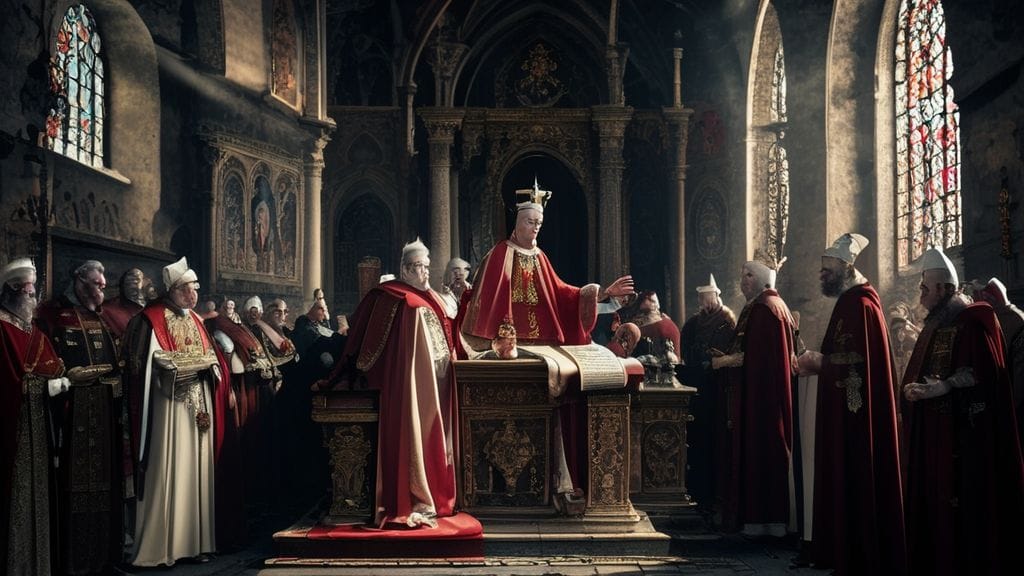
On 20 March 1239, in the city of Rome, the long-brewing storm finally broke. The curia had gathered; cardinals and prelates filled the hall, their crimson robes pooling like blood at their feet. Outside, pilgrims and merchants crowded the streets, mostly unaware that within the papal palace, a spiritual sentence of unprecedented gravity was about to be pronounced against the most powerful lay ruler in western Christendom.
Gregory IX, now well into his seventies, entered with a mixture of frailty and force. Though his hair had whitened and his health waned, his voice, contemporaries say, could still ring with iron conviction. Before him lay the carefully drafted bull of excommunication, a document that had been pondered, revised, and sharpened by canonists and advisors. This was no impulsive act; it was a calculated strike. As witnesses later reported, pope gregory ix excommunicates frederick ii with full awareness that he was not merely censuring a sinner, but declaring war on an emperor.
The liturgy of excommunication was theatrical, almost terrifying. Candles were lit, then symbolically extinguished to represent the cutting off of the sinner from the light of grace. The bull was read aloud, its accusations rolling through the chamber like thunder. Frederick was denounced for perjury, for violating the peace of the Church, for attacking papal territories, for consorting with Saracens, and for endangering the very fabric of Christian society. At the conclusion, the pope’s voice declared him separated from the communion of the faithful unless and until he repented and submitted.
In that moment, pope gregory ix excommunicates frederick ii not as a wayward monarch to be chastised, but as an enemy of the Church. The language, as we will see, went beyond ordinary censure into something resembling a demonization. The emperor was painted as a new Pharaoh, a persecutor, even in some texts as a figure of apocalyptic menace. The date, 20 March 1239, would enter the annals as the day when the papacy drew its sharpest line between altar and empire.
Word spread rapidly. Messengers carried copies of the bull north into Germany, south into Sicily, and across the Alps into France and England. Priests read the sentence from their pulpits, some with trembling hands, others perhaps with satisfaction. Wherever it was heard, it raised the same awful question: could a Christian obey an excommunicated emperor without endangering his own soul?
Words as Weapons: The Bull of Excommunication and Its Rhetoric
The 1239 bull was more than a legal instrument; it was a weaponized story. Medieval Europe lived and breathed on narrative: sermons, chronicles, saints’ lives, and royal charters all shaped how people interpreted events. Gregory’s chancellery understood this. The bull framed Frederick not simply as a disobedient ruler, but as a moral and almost cosmic threat.
One famous passage, preserved in the collections of papal letters, likens Frederick to the beast of the Apocalypse, “full of blasphemous names,” a figure who “raises his horn against the Church.” Though the precise wording varied in copies, the imagery was clear: the emperor was not just a bad Christian; he was positioned close to the figure of Antichrist. Historian David Abulafia notes how this rhetoric helped build what later scholars call the “black legend” of Frederick II—an image of him as atheist, secret Muslim, mocker of Christ. It is in documents like this that that legend was born.
The bull also recounted Frederick’s alleged crimes in painstaking, almost theatrical detail: his attacks on papal vassals, his occupation of church lands, his interference in episcopal elections, his “tyrannical” rule in Sicily, and his suspiciously friendly relations with Muslim princes. Every grievance was piled onto the scales. The repetition drove home a message to bishops and princes: this was not a petty quarrel. The Church was under siege.
At the same time, the pope portrayed himself as reluctant yet compelled by duty. Gregory claimed that he had long borne Frederick’s offenses with patience, “like a nursing mother,” as one surviving text puts it. Only now, compelled by conscience and the safety of souls, did he raise the sword of excommunication. By casting himself as a sorrowing father rather than an eager warrior, Gregory hoped to undercut imperial propaganda that he was a power-hungry pontiff manipulating spiritual weapons for temporal ends.
But in the court of public opinion, words could be turned. Frederick’s own chancery would soon seize on the extremity of the papal language to claim that the pope had gone mad with hatred—an accusation that would resonate from Sicily to the imperial diets of Germany.
Thunder from the Pulpit: How Europe Heard the News
Once pope gregory ix excommunicates frederick ii, the bull did not remain locked in a Roman archive. It was meant to be heard, feared, and obeyed across hundreds of dioceses. Imagine a Sunday in a small German town: the parish church packed, incense lingering in the air, peasants in rough tunics standing beside burghers in fur-lined cloaks. The priest unfolds a parchment stamped with the leaden bull of the pope and begins to read, his Latin translated roughly into the local tongue as best he can.
The villagers may have barely understood the distant politics of Rome and Palermo. But they understood this: their emperor, the man whose name was invoked in legal formulas and on coins, was now cut off from the Church. Did this mean his laws were void? His courts unjust? Could they die in battle for him and still hope for heaven? The excommunication of a local lord might cause anxiety. The excommunication of the emperor felt like an earthquake, its tremors rippling through the social order.
Reactions varied. In some regions, especially among bishops and princes inclined toward the papacy, the sentence was received with solemn assent. The emperor’s agents found doors closing, monastic hospitality cooling, and churchmen citing the excommunication as reason to drag their feet on imperial commands. In others, particularly in imperial strongholds and among nobles wary of papal interference, there was quiet skepticism. Was the pope overreaching? Did the Church risk undermining earthly stability by waging war on the very figure tasked with upholding law and peace?
The English chronicler Matthew Paris, though often critical of both sides, captured the sense of dismay that pervaded Christendom. Reporting on the conflict, he wrote with a mixture of fascination and horror at the sight of “priest against prince, and prince against priest, to the great scandal of the faithful.” The spectacle of pope gregory ix excommunicates frederick ii twice—first for crusade delays, then for political defiance—convinced some that Christendom’s leaders had become entangled in pride rather than piety.
Imperial Counterattack: Propaganda, Letters, and Loyalists
Frederick II did not accept the 1239 excommunication in silence. In an age when letters traveled slowly but words could live for generations, he understood that controlling the narrative was as important as controlling fortresses. From his chanceries in Sicily and southern Italy, he dispatched a flood of epistles to kings, princes, bishops, and cities throughout Europe.
In these letters, the emperor painted himself as a misunderstood defender of order, victim of an unjust and power-hungry pontiff. He reminded readers of his crusade, his peaceful recovery of Jerusalem, his efforts to enforce laws and suppress disorder in his lands. He accused Gregory of usurping imperial rights, of meddling endlessly in secular affairs, and of turning the keys of Peter into a weapon for worldly gain.
Frederick’s pen could be as sharp as any sword. In one famous letter, he described certain churchmen as “scribes and Pharisees,” echoing Christ’s condemnation of hypocritical religious authorities. It was a daring rhetorical move, implying that Gregory and his circle more closely resembled Christ’s enemies than his faithful servants. As historian Ernst Kantorowicz has noted, Frederick’s letters consciously presented him as a new kind of ruler: rational, lawgiving, almost philosophically minded in contrast to what he portrayed as papal fanaticism.
Loyalist clerics and scholars echoed these themes. At imperial courts, preachers spoke of the emperor as ordained by God to maintain justice on earth—a function the Church should respect, not sabotage. Some scholars pointed quietly to the writings of earlier canonists who had admitted that popes could sin, even err in judgment. The excommunication of 1239, they suggested, might be one such misuse of spiritual authority.
Thus the battle lines hardened, not only on campaign fields but in the minds of literate Europe. Every monastery library that shelved both papal bulls and imperial letters became, indirectly, a front in this war of interpretation. Those who copied and circulated these texts determined how future generations would see the moment when pope gregory ix excommunicates frederick ii as either righteous discipline or tragic overreach.
War for Italy’s Soul: Sieges, Alliances, and Betrayals
Words laid the foundation; steel did the rest. After 1239, Italy descended into a grinding conflict that was as much civil war as international struggle. On one side stood the papal party—the Guelfs—supported by many northern Italian communes, segments of the nobility, and clergy loyal to Gregory. On the other stood the imperial party—the Ghibellines—backed by imperial officials, pro-Hohenstaufen noble houses, and cities that saw in Frederick a bulwark against papal encroachment.
Frederick’s armies, trained in the disciplined styles he had perfected in Sicily, marched north along the spine of the Apennines. Castles fell, towns shifted allegiance, and the pattern of Italian politics took on the bitter colors it would retain for centuries: faction against faction, brother against brother. The pope, unable to field armies on his own, relied on alliances—encouraging foreign princes, especially in France, to prepare for intervention, and calling on loyal cities to resist the emperor to the last stone.
One of the most dramatic episodes came with the siege of papal allies and the emperor’s near-encirclement of the Papal States. At times, Frederick’s forces seemed poised to march directly on Rome, to repeat the shock of earlier emperors who had taken the city by storm. Gregory, however, managed through diplomacy and stubbornness to keep the heart of the papacy secure, even if its frontiers wavered.
Betrayals were common. Cities like Pisa, Genoa, and Venice weighed their mercantile interests against ideological allegiance, sometimes switching sides to gain trading privileges or imperial favor. Noble families split down the middle: one brother wearing the imperial eagle, another the papal keys. The 1239 excommunication was the moral framework that encouraged such divisions. Supporting Frederick now carried not only political risks, but spiritual ones; supporting the pope might mean abandoning a king who provided security and prosperity.
In this grinding war, both sides committed harsh acts. Imperial troops seized church lands and occasionally humiliated clergy; papal supporters attacked imperial officials and incited revolts that left towns in ruins. In the name of defending Christendom, Italy’s Christian communities bled.
Life under the Interdict: Ordinary People in an Age of Curses
While popes and emperors traded thunderbolts, ordinary people had to navigate life under the shadow of interdicts and excommunications. When a ruler was excommunicated, the Church sometimes extended sanctions to whole regions that supported him. Churches might be closed, bells silenced, sacraments limited. Weddings without full ceremony, burials without solemn rites, altars stripped of ornaments—these became hauntingly familiar sights for some communities caught on the wrong side of the papal-imperial divide.
Imagine a small Apulian village, loyal to the emperor because his officials have brought reliable justice and defended them from raiding barons. Suddenly, the local bishop, under orders from Rome, announces restrictions: no public Mass, no festive processions, no church bells on feast days. Children ask why the church doors are barred. Old men, remembering earlier, simpler times, mutter that “the great ones” have angered God again.
Some clergy found ways to soften the blow. They might quietly continue baptisms and confessions, arguing that the innocent should not suffer for the sins of their lord. Others, more fearful of papal reprisal, enforced the sanctions rigidly, even if it meant alienating their flock. The social fabric strained. People began to distinguish between “the Church” as a distant, Rome-centered institution and their local priest, who might or might not share the papal viewpoint.
Merchants, too, felt the strain. Trade routes threaded through territories marked as imperial or papal. A merchant who openly supported Frederick might find ecclesiastical courts hostile; one who backed the pope might struggle to get safe passage through imperial customs posts. The excommunication of 1239 thus had economic consequences reaching far beyond the immediate battlefields.
Yet life went on. Harvests had to be gathered, children raised, debts paid. In this continuity, one sees the resilience of medieval society: even as pope gregory ix excommunicates frederick ii and thunders against him from Rome, and the emperor replies in kind, most people labored, prayed as they could, and hoped the distant storm would one day pass.
Saints, Scribes, and Spies: The Church’s Internal Struggles
It would be a mistake to picture the medieval Church as a monolithic bloc uniformly aligned behind Gregory IX. Within the clerical ranks, opinions differed, sometimes sharply. Some saints and scholars became fierce defenders of the papal cause, while others harbored private reservations or even offered quiet sympathy for certain imperial arguments.
Mendicant orders, particularly the Franciscans and Dominicans, played a special role. Gregory IX favored them greatly, using them as preachers, inquisitors, and envoys. Many friars took to their pulpits to denounce Frederick as a danger to Christian unity, weaving tales of his alleged blasphemies and impieties. According to some hostile sources, they claimed he had said that “the world has been deceived by three impostors—Moses, Jesus, and Muhammad”—a phrase modern historians doubt he actually uttered, but which became part of the dark aura surrounding his name.
Meanwhile, in cathedral schools and nascent universities, canon lawyers debated the limits of papal power. Could a pope use excommunication as a political tool without risking sacrilege? Were there conditions under which obedience to an excommunicated ruler might still be permissible? The intellectual ferment produced by these questions quietly laid groundwork for later theories about the separation of powers and the rights of secular rulers.
Spies and informants added another layer of complexity. Gregory maintained networks of correspondence and information, relying on bishops, abbots, and loyal nobles to keep him apprised of Frederick’s movements and plans. Frederick, in turn, placed trusted agents in ecclesiastical circles, gathering intelligence about papal intentions. The war of 1239 was waged not only in open field and parchment, but in whispered conversations in cloisters and palaces.
This internal complexity meant that when pope gregory ix excommunicates frederick ii, the echo within the Church itself was uneven. Some cheered, others swallowed hard, still others grumbled in private. Unity was proclaimed, but never entirely achieved.
Legends, Myths, and Monsters: The Black Legend of Frederick II
Over time, the conflict between Gregory IX and Frederick II gave birth to a mythology that outlasted both men. The image of Frederick as an almost demonic figure—heretic, secret Muslim, blasphemer, sorcerer, womanizer, experimenter on human souls—spread in part thanks to the rhetoric of excommunication and the stories that grew up around it.
Some chroniclers, hostile to the emperor, described bizarre tales: that he conducted cruel experiments on prisoners to test the effects of language deprivation; that he kept a menagerie of exotic animals and astrologers, valuing them more than priests; that he laughed at Christian miracles and preferred the company of “infidels.” While there may be kernels of truth in some of these stories—he certainly maintained a cosmopolitan court with Muslim scholars and was fascinated by science and philosophy—their exaggeration served a purpose. They made it easier to see him as fundamentally alien to Christian society.
The papal excommunication of 1239 accelerated this process. Once pope gregory ix excommunicates frederick ii with language that verged on apocalyptic, every oddity about the emperor’s personality could be read as a sign of deeper depravity. A ruler who spoke Arabic? Surely he was secretly more Muslim than Christian. An emperor who preferred negotiation to slaughter in the Holy Land? Clearly he did not truly believe in the crusading ideal. A lawgiver who imposed rational statutes even on clerical lands? Obviously he hated the Church.
Modern historians, such as Abulafia and Kantorowicz, have painstakingly dismantled many of these legends, showing how political enmity distorted the record. Yet the very need for such scholarly correction testifies to the power of the stories launched in Gregory’s time. The 1239 excommunication did not just remove Frederick from the sacraments; it helped cast him as a kind of moral monster in the imagination of later ages.
On the other side, pro-imperial legends also flourished. In some German and Italian circles, Frederick became a quasi-messianic figure, the embodiment of rational monarchy against clerical tyranny. Centuries later, romantic nationalists would still invoke him as a hero. The clash of 1239 thus left not only scars, but mythic templates that future generations could adapt to their own debates about church and state.
From Excommunication to Collapse: The Longer Shadow over the Empire
The immediate result of the 1239 excommunication was escalating conflict; the long-term consequence was the weakening of the Hohenstaufen dynasty and the fragmentation of the empire. Although Frederick II continued to rule, to legislate, and to wage war, the stigma of recurring excommunication—even if sometimes lifted—undermined his ability to present himself as the unquestioned Christian emperor.
Gregory IX died in 1241, before he could see a definitive victory. His successors continued the struggle, most notably Innocent IV, who at the Council of Lyon in 1245 went even further, formally deposing Frederick as emperor in the eyes of the Church. Though this deposition had limited immediate practical effect—Frederick still commanded armies—it marked a symbolic rupture. The empire and the papacy, once united in a sometimes tense but shared vision of Christendom, now appeared as openly competing authorities.
Frederick himself died in 1250, still technically under church ban. His sons and grandsons struggled to hold together the Hohenstaufen inheritance against papal-backed claimants and rebellious princes. Within a few decades, the dynasty collapsed; the empire entered an era of weakened central authority, and Italy became a patchwork of competing powers, many of them shaped by the Guelf-Ghibelline divisions born in Gregory’s time.
It would be simplistic to say that the moment when pope gregory ix excommunicates frederick ii on 20 March 1239 “caused” the fall of the Hohenstaufens. Yet it undeniably accelerated trends already in motion. The use of excommunication and deposition against an emperor invited princes to question imperial authority more boldly. The intertwining of theology and politics made reconciliation harder. Every future conflict between popes and secular rulers—from Boniface VIII and Philip the Fair to the Investiture Controversy’s aftershocks—would echo, in some fashion, the dramas of 1239.
The Holy Roman Empire survived in name and structure, but its aura of universal Christian monarchy never fully recovered. The idea that an emperor could embody, almost sacramentally, the unity of Christendom had been fatally compromised. In that sense, the candles Gregory IX ceremonially extinguished in Rome in 1239 symbolized not only Frederick’s temporary exclusion from the Church, but the dimming of a certain vision of medieval unity.
Why It Still Matters: Church, State, and the Ghost of 1239
What does it mean, in the modern world, to look back on the day when pope gregory ix excommunicates frederick ii in Rome? We live in a time that, at least in many countries, formally separates church and state. Excommunication no longer dethrones kings; papal bulls do not close parliaments. Yet the underlying questions of 1239 remain uncannily familiar: Who has the ultimate right to define the moral order? Can religious authority command obedience from political power? What happens when conscience and law, altar and throne, point in different directions?
Gregory IX’s decision to wield excommunication as a tool against an emperor foreshadowed both the potential and the peril of spiritual sanctions in political life. On the one hand, it was an attempt to insist that rulers are not above moral judgment—a principle that resonates with modern ideas of human rights and ethical constraints on power. On the other, it demonstrated how easily moral language can become entangled in institutional self-defense, how accusations of heresy or impiety can be marshaled to protect jurisdiction as much as justice.
Frederick II’s response, presenting himself as a rational, law-focused ruler resisting clerical overreach, likewise speaks to ongoing debates. Secular authorities still claim a kind of higher rationality against what they portray as religious irrationality. The emperor’s supporters saw him as championing order and enlightenment; his enemies saw him as prideful and godless. Replace the medieval robes and crowns with modern suits and parties, and the outlines remain hauntingly similar.
Historians who study this period, drawing on chronicles, letters, and later commentaries, remind us that both men were more complex than their legends. As one modern scholar has observed, Gregory IX was not simply a fanatic, but a jurist who genuinely feared the collapse of spiritual integrity; Frederick II was not merely a cold skeptic, but a ruler trying to balance inherited piety with a fierce sense of imperial autonomy. To reduce either man to caricature is to miss the tragedy at the heart of their conflict.
Ultimately, the excommunication of 1239 matters because it captures a turning point: the moment when the dream of a single, hierarchically ordered Christendom began to unravel under the strain of competing universal claims. The echoes of that unraveling still sound in every modern argument over the proper place of religion in public life.
Conclusion
The drama of 20 March 1239, when pope gregory ix excommunicates frederick ii in Rome, was at once a culmination and a beginning. It culminated decades of mistrust, broken promises, crusading controversies, and territorial rivalries. An aging pope, formed in the high age of papal supremacy, confronted an emperor who embodied a new, more assertive vision of secular rule. The result was a sentence that rang like a thunderclap across medieval Europe, shaking not only political alignments but also the moral imagination of Christendom.
Yet it was also a beginning: the beginning of an open, nearly irreparable rift between the ideals of universal papal authority and imperial sovereignty. The war of bulls and letters, of sieges and sermons, that followed the 1239 excommunication illustrated how spiritual weapons could both challenge and corrode political order. Ordinary believers found themselves caught between loyalty to their ruler and obedience to their Church, their daily lives shaped by abstractions forged in distant councils and courts.
In the legends that grew up around Gregory and Frederick, we can trace the birth of enduring myths: the tyrannical pope, the godless emperor, the heroic defender of liberty, the sinister enemy of the faith. Modern scholarship has peeled back many of these layers, revealing more nuanced, human figures—an obstinate yet sincerely devout pontiff, a brilliant yet deeply wary monarch. Their clash, however, cannot be reduced to a misunderstanding. It reflected real, structural tensions between competing claims to universal jurisdiction.
Looking back, the moment when pope gregory ix excommunicates frederick ii stands as a stark reminder that institutions, like individuals, can become trapped by their own principles. Neither pope nor emperor could yield without feeling that they betrayed something essential: for Gregory, the sovereignty of the Church; for Frederick, the dignity of the empire. Between them, Europe was forced to confront questions about authority, conscience, and legitimacy that would echo for centuries. The candles snuffed out in Rome that March day did not plunge Christendom into immediate darkness, but they marked the dimming of an older, simpler order and the dawn of a more fractured, contested world.
FAQs
- Why did Pope Gregory IX excommunicate Frederick II in 1239?
Pope Gregory IX excommunicated Frederick II in 1239 because he believed the emperor had violated earlier agreements, attacked papal territories, interfered in church affairs, and posed a fundamental threat to the Church’s authority. The bull of excommunication listed a long series of alleged offenses, from broken oaths to alliances with Muslim powers, and portrayed Frederick as a rebel against God’s appointed order. - Was this the first time Frederick II had been excommunicated?
No. Frederick II had already been excommunicated by Gregory IX in 1227 for delaying his departure on a promised crusade. Although that earlier excommunication was lifted in 1230 after negotiations at San Germano, lingering mistrust remained. The 1239 excommunication was a renewed and even more severe condemnation, framed not just around crusade delays but around broader political and ecclesiastical conflicts. - How did the 1239 excommunication affect ordinary people?
The excommunication created uncertainty and fear among ordinary Christians, who worried about whether they could obey an excommunicated emperor without endangering their souls. In some regions, papal sanctions such as interdicts led to closed churches, restricted sacraments, and disrupted religious life. Merchants, peasants, and townspeople often found themselves caught between loyalty to the emperor and obedience to the Church. - Did the excommunication immediately remove Frederick II from power?
No. Excommunication did not automatically strip Frederick of his political authority. He continued to rule, issue laws, and command armies after 1239. However, the spiritual sanction weakened his legitimacy, encouraged rebellions, and made it easier for rival rulers and princes to question or resist his authority. Later, at the Council of Lyon in 1245, Pope Innocent IV went further and formally declared Frederick deposed, though this too had limited immediate practical effect. - What role did propaganda play in the conflict between Gregory IX and Frederick II?
Propaganda was central. Gregory IX used excommunication bulls, sermons, and allied preachers to cast Frederick as a dangerous, almost apocalyptic figure. Frederick responded with letters and manifestos portraying himself as a rational, lawgiving ruler persecuted by an overreaching papacy. These competing narratives shaped how contemporaries, and later generations, understood the conflict and contributed to powerful legends about both men. - Was Frederick II really an atheist or secret Muslim, as some sources claim?
Most modern historians doubt the more extreme accusations. While Frederick maintained close contacts with Muslim rulers, valued Arabic learning, and sometimes expressed unorthodox views, there is no solid evidence that he rejected Christianity outright. Many of the more lurid tales—such as calling Moses, Jesus, and Muhammad “impostors”—likely emerged from hostile propaganda spread in the wake of his excommunications. - How did this conflict influence later relations between Church and state?
The clash between Gregory IX and Frederick II highlighted the dangers of overlapping universal claims by Church and empire. It encouraged secular rulers to question papal interference in politics and contributed to the gradual erosion of the ideal of a single, unified Christendom under papal leadership. Later conflicts, such as the struggles between Boniface VIII and Philip IV of France, and eventually the debates of the Reformation era, echoed issues first sharply posed in the 1239 excommunication. - Did any contemporary observers criticize both sides?
Yes. Some chroniclers, like the English monk Matthew Paris, expressed dismay at the spectacle of pope and emperor tearing Christendom apart. While he sometimes leaned toward sympathy with the emperor, Paris also recognized Frederick’s pride and ruthlessness. His writings show that not all medieval observers accepted either papal or imperial narratives uncritically. - What happened to the Hohenstaufen dynasty after Frederick II’s death?
After Frederick’s death in 1250, his sons and grandson struggled to maintain control over the empire and the Kingdom of Sicily. Persistent papal opposition, internal rebellions, and foreign intervention gradually undermined their position. By the late thirteenth century, the Hohenstaufen line had effectively collapsed, and the empire entered a prolonged period of weakened central authority. - Why do historians still study the 1239 excommunication today?
Historians study the 1239 excommunication because it illuminates key themes in medieval history: the nature of authority, the limits of papal power, the development of legal and political thought, and the lived experience of religious sanctions. The episode when pope gregory ix excommunicates frederick ii offers a window into how institutions and individuals wrestled with conflicting claims of conscience, law, and power—questions that remain relevant in various forms to this day.
External Resource
Internal Link
Other Resources
- Encyclopaedia Britannica – general search for the exact subject
- Google Scholar – academic search for the exact subject
- Internet Archive – digital library search for the exact subject

