Table of Contents
- Storm Over the Black Sea: Setting the Stage at Sinop
- An Empire in Decline: The Ottoman World on the Eve of Disaster
- Tsarist Ambitions: Russia’s Road to the Black Sea Showdown
- Sinop Before the Flames: A Quiet Harbor Waiting for War
- The Ottoman Squadron at Anchor: Hope, Hesitation, and Fatal Orders
- Nakhimov’s Gambit: The Russian Fleet Closes In
- The Opening Salvo: How the Battle of 30 November 1853 Began
- Inferno in the Harbor: Shell, Fire, and the Destruction of an Ottoman Fleet
- Men in the Maelstrom: Voices, Fear, and Courage at Sinop
- Counting the Cost: Casualties, Wreckage, and the Smoking Ruins of Sinop
- From Victory to Shockwave: How Sinop Echoed Across Europe
- Diplomats and Newspapers: The Political Firestorm after Sinop
- Technology and Terror: Sinop as the First Modern Naval Massacre
- Into the Crimean War: From a Single Battle to a Continental Conflict
- Memory, Myth, and Blame: How Sinop Was Remembered at Home
- Lives Changed Forever: Survivors, Families, and the Human Aftermath
- Sinop in the Long Shadow of History: Lessons from a Burning Harbor
- Conclusion
- FAQs
- External Resource
- Internal Link
Article Summary: On 30 November 1853, in the harbor of a quiet Anatolian town, the naval battle of sinop ignited not only ships and men but also the fuse of a wider European war. This article reconstructs the world that produced the clash, from the fragile Ottoman Empire and the ambitions of Tsarist Russia to the wider tensions that fed into the Crimean War. It follows the Ottoman squadron as it sought shelter in Sinop, the Russian admiral Pavel Nakhimov as he prepared a devastating blow, and the terrible hours when explosive shells turned anchored ships into floating furnaces. Drawing on historical research and eyewitness accounts, it explores the political uproar that followed, as Britain and France interpreted the naval battle of sinop as an act of ruthless aggression. Beyond strategy and diplomacy, it lingers on the human stories—captains making impossible decisions, sailors trapped below decks, families waiting for news that would never come. It examines how the naval battle of sinop became a symbol of technological change at sea, marking the end of the age of wooden fleets and solid shot. Finally, it shows how this fiery encounter in a small Ottoman harbor helped transform a regional confrontation into the full-scale Crimean War and left a lasting imprint on collective memory, military doctrine, and international law.
Storm Over the Black Sea: Setting the Stage at Sinop
On the morning of 30 November 1853, the Black Sea was gray and restless, its waves rolling toward the Anatolian coast with a wintry chill. In the harbor of Sinop, a small Ottoman town on a natural crescent of land jutting into the sea, dozens of masts and spars pricked the low clouds. To a casual observer ashore, it might have seemed a tableau of routine naval life: sailors shouting over the creak of rigging, tenders rowing between anchored ships, smoke from galley fires rising gently in the cold air. Yet beneath this apparent calm lay tension so taut it was almost palpable. Word had spread that Russian squadrons were roving the Black Sea. The Ottoman warships at anchor, nominally safe under the guns of the town’s coastal batteries, were in fact trapped in a harbor that could become a killing ground.
The naval battle of sinop would be fought here within hours, though few among the younger sailors yet grasped the scale of what was coming. They knew of skirmishes in the Danubian Principalities, of arguments between Constantinople and St. Petersburg, of the vaguely distant concept of “European balance of power,” but these were abstractions. What they truly felt was the raw unease of being far from the capital, under uncertain orders, in ships still largely of wood and sail, at a time when the technology of naval warfare was quietly transforming. Offshore, beyond the horizon line, Russian hulls were already advancing, their magazines filled with explosive shells that would soon demonstrate a new and terrifying efficiency in the art of destruction.
This was not merely another naval encounter. In a sense, the battle that would unfold at Sinop was a hinge in history: the moment when wooden men-of-war met the modern age and were found fatally wanting. It was also a political spark, one that would soon draw Britain and France into a conflict we now remember as the Crimean War. But in that chilly morning light, the men on both sides—Russians and Ottomans, officers and ordinary seamen—were simply trying to do their duty amid uncertainty. That their actions would echo across Europe and into the history of naval warfare was something only later generations could fully appreciate.
An Empire in Decline: The Ottoman World on the Eve of Disaster
To understand why the guns roared at Sinop, one must first step back and walk the dimly lit corridors of the Ottoman Empire in the mid-nineteenth century. Once, this empire had projected power from the gates of Vienna to the deserts of Arabia, its fleets mastering the Mediterranean and challenging European rivals. By 1853, however, the Sultan’s realm was widely described in European capitals as “the sick man of Europe.” The phrase, supposedly used by Tsar Nicholas I himself in conversation with the British ambassador, had the cruel clarity of political shorthand: the empire was aging, weakened, and increasingly vulnerable to external pressure and internal decay.
The Ottoman state was engaged in a painful struggle to reform itself. The Tanzimat reforms, launched in 1839, sought to modernize administration, laws, and the military. In the navy, this meant attempts to introduce steam power, modern gunnery, and Western-style training. Yet the results were uneven. A handful of steam vessels flew the crescent flag, but the core of the fleet remained wooden sailing ships, many old and poorly maintained. Officers were often brave but divided by faction, patronage, and inconsistent education. Supplies and pay were erratic. Corruption gnawed at budgets. Above all, strategic cohesion was fragile; the Ottoman leadership faced threats on multiple fronts and struggled to prioritize among them.
At the same time, the empire’s geopolitical position made it both vital and vulnerable. The straits of the Bosporus and Dardanelles, leading from the Mediterranean to the Black Sea, were among the world’s most strategic waterways. Control of these straits meant influence over Russia’s maritime access and over trade routes linking Europe, the Caucasus, and the Near East. Britain and France, anxious to contain Russian expansion, saw the integrity of the Ottoman Empire as an unpleasant but necessary pillar of the European balance. Russia, by contrast, saw in Ottoman weakness both danger and opportunity: danger that other powers might dominate the straits; opportunity to gain influence over Orthodox Christians under Ottoman rule and, perhaps one day, access to warm-water ports freer of constraints.
These complex calculations trickled down into the daily realities of the Ottoman Navy. Admirals felt the weight of imperial anxieties on their shoulders. They knew that defeat at sea could embolden Russia, alarm Britain and France, and trigger a cascade of diplomatic reactions. Yet they also knew that their ships, though numerous on paper, did not match the most modern European standards. The empire stood at a crossroads between past and future, and its navy reflected that very instability. It is within this context of anxious modernization and geopolitical vulnerability that the Ottoman decision to send a squadron into the Black Sea—and eventually into the trap of Sinop—must be understood.
Tsarist Ambitions: Russia’s Road to the Black Sea Showdown
On the other side of the Black Sea, in the vast dominions of the Russian Empire, a different story was unfolding. Tsar Nicholas I ruled over millions, presiding over a state that saw itself as both the defender of Orthodoxy and a rising great power with legitimate claims to influence in the Balkans and the Near East. By the early 1850s, Russia had fought and won wars against the Ottomans before. Its armies had marched to the Danube; its diplomats had extracted concessions. Yet the ultimate prize—secure access to the Mediterranean and a decisive say over the fate of Constantinople—remained tantalizingly out of reach.
The Black Sea was at the heart of Russian strategic thinking. Its northern shores were Russian, its southern shores Ottoman, but its waters remained constrained by international agreements that limited Russian naval deployment through the straits. The Tsar’s naval planners therefore focused on achieving local dominance. If Russia could command the Black Sea, it could pressure the Ottomans, project power into the Caucasus, and negotiate with the Western powers from a position of strength. To this end, the Russian Black Sea Fleet was steadily modernized in the first half of the nineteenth century. While still relying largely on wooden ships of the line and frigates, it experimented earlier and more systematically with shell guns—cannon capable of firing explosive shells rather than just solid shot.
One of the leading figures in this resurgence was Admiral Pavel Stepanovich Nakhimov. A veteran officer, he had fought at Navarino in 1827 as a young man, witnessing the destruction of the Ottoman-Egyptian fleet at the hands of an allied British, French, and Russian squadron. That experience deeply impressed upon him the decisive nature of naval battles and the importance of bold action. By 1853 he was a seasoned commander in the Black Sea Fleet, respected by subordinates and trusted by superiors. He believed in aggressive tactics, close-range engagements, and the full exploitation of Russia’s growing edge in shell-based artillery.
When tensions with the Ottoman Empire escalated over the question of Christian holy places in the Holy Land and Russian claims to protect Orthodox subjects under Ottoman rule, the Tsar ordered his forces to pressure the Sultan. Russian troops crossed into the Danubian Principalities. Diplomatic notes flew between capitals. In Constantinople, the Porte responded by declaring war on Russia in late October 1853. The Black Sea was suddenly a theater of active hostilities. For Nakhimov, this was not only a duty but an opportunity: if he could find and destroy an Ottoman squadron, Russia would gain a powerful bargaining chip and spread fear among its enemies. As his ships patrolled the cold waters, reports soon reached him of Ottoman vessels gathered at Sinop, apparently isolated, their retreat to Constantinople cut off by distance and weather. The stage was set for a decisive strike.
Sinop Before the Flames: A Quiet Harbor Waiting for War
Sinop itself was an old town with a long maritime history, perched on a narrow peninsula curving protectively around a natural harbor. Ancient Greek colonists had once settled here; over centuries it had passed through the hands of Persians, Romans, Byzantines, and finally the Ottomans. In 1853, Sinop was no gleaming naval base like those of Western Europe. It was a provincial port with whitewashed houses clustering around narrow streets, a modest market, and a harbor that owed its usefulness more to geography than to infrastructure. Still, it had walls, a fortress, and coastal batteries mounting guns that, at least in theory, could keep enemy ships at bay.
For the townspeople, the arrival of the Ottoman squadron was both a spectacle and a source of anxiety. Children ran to the waterfront to count the ships, while shopkeepers watched the sudden influx of sailors with a mixture of curiosity and concern. The harbor filled with large hulls flying the red flag with its white crescent and star: frigates, corvettes, and smaller vessels, accompanied by transports carrying troops and supplies destined for the Caucasus front. The squadron’s commander, Vice Admiral Osman Pasha, sought refuge in Sinop after storms and the threat of Russian interception made further progress risky. Here, in protected waters, he hoped to repair damage, take on supplies, and await further orders from Constantinople.
But Sinop was both haven and trap. The town’s batteries were under-gunned and under-manned. Many of the cannons were old, their effective range limited. The positioning of the guns did not fully cover the outer approaches to the harbor. Moreover, the bay itself—beautiful in calm weather—offered a terrible disadvantage in battle: ships at anchor, with little room to maneuver, could become victims rather than opponents. Telegrams and messages passed between Osman Pasha and his superiors, but communications lagged behind events. Some Ottoman advisors urged that the squadron move to a safer, better-defended port. Others believed that the presence of the fleet in Sinop, under the empire’s own batteries, was security enough against a Russian attack.
For the sailors and soldiers aboard the Ottoman ships, daily life alternated between routine and rumor. They repaired rigging, scrubbed decks, prepared rations. Some, perhaps, strolled ashore on brief leave, visiting the little cafés and markets, unaware that they were walking the streets of a town about to become synonymous with destruction. The air of the harbor carried the smell of salt, coal smoke, and anxiety. On the horizon, to the north, lay open sea—and somewhere beyond that horizon, the Russian fleet. The naval battle of sinop was already approaching Sinop long before a single cannon had fired.
The Ottoman Squadron at Anchor: Hope, Hesitation, and Fatal Orders
The Ottoman squadron at Sinop in late November 1853 was impressive in appearance but brittle in reality. At its core was the 74-gun ship of the line Auni Allah and several frigates, including the flagship of Osman Pasha, the Navek-i Bahri. There were also smaller warships and transports loaded with troops, horses, and supplies. In numbers, the Ottomans seemed formidable; in training, armament, and readiness, they were less so. Many of their guns were smoothbore cannon firing solid iron shot—deadly at close range but limited in destructive power compared to the explosive shells now used by advanced navies.
Osman Pasha was a competent and personally brave officer, but he faced a cluster of constraints he could not easily overcome. His ships had suffered from storms and hard sailing. Ammunition stocks were not full. Several hulls needed maintenance. The weather in the Black Sea was deteriorating as winter approached, making any attempt to break out toward Constantinople dangerous. Reports of Russian squadrons patrolling the sea lanes added to the risk. In this context, Sinop seemed both a refuge and a staging point for future operations toward the Caucasus front, where Ottoman forces were confronting Russia on land.
Yet questions loomed over the decision to remain. Critics later argued that Osman Pasha should have dispersed his forces, sought better-defended ports, or at least arranged them in a manner more suitable for battle—perhaps nearer the harbor entrance, with a clear plan for joint action with the shore batteries. Instead, many of the ships lay anchored deeper in the bay, their broadsides not ideally positioned to cover the approaches. Communications between ships, always a challenge in the age of flags and signals, were sluggish and uncertain. Above all, there was an underestimation of the Russian willingness to mount a full-scale assault on a fleet lying under the guns of its own fortifications.
In Constantinople, the Ottoman leadership was preoccupied with multiple crises. Diplomatic exchanges with Britain and France, land operations on the Danube, and concerns about internal stability all competed for attention. The squadron at Sinop was important—but not, it seems, treated as a matter of the highest urgency. Orders directed Osman Pasha to support operations against the Russians in the Caucasus; they did not fully anticipate the possibility that the Russians would concentrate overwhelming naval power against him. As the days passed, the squadron’s very presence in Sinop became a dangerous gamble: if the Russians struck decisively, the Ottomans risked losing not just a handful of ships but a significant portion of their Black Sea naval strength in a single blow.
From the decks of the Ottoman ships, however, the strategic picture was hazier. The men saw the guns on the shore, the steep hills behind the town, the apparent shelter of the bay. Many likely believed that any Russian foray would be a skirmish, quickly beaten off by combined ship and shore fire. It is astonishing, isn’t it, how in so many battles through history, the calm of misjudgment lingers until the very moment the first shot is fired?
Nakhimov’s Gambit: The Russian Fleet Closes In
While uncertainty reigned in Sinop, the Russian admiral Pavel Nakhimov was moving with increasing clarity and purpose. Having received reports from scouting vessels that an Ottoman squadron lay concentrated in Sinop, he understood immediately the opportunity presented. If he could destroy it, he would establish Russian dominance in the Black Sea, intimidate the Ottomans, and send a signal to the European powers that Russia was not to be trifled with. Yet he was also mindful of the diplomatic risks: Britain and France watched Russian actions with suspicion, and an attack perceived as excessively brutal might provoke them.
The Russian Black Sea Fleet detached a squadron under Nakhimov’s command. It included several ships of the line, among them the Imperatritsa Maria, Chesma, Rostislav, and Paris, as well as frigates and smaller vessels. These ships were not the newest or most advanced in the world, but they carried a crucial advantage: Paixhans-style shell guns capable of firing explosive shells. At Navarino in 1827, the Russians, fighting alongside the British and French, had seen what concentrated naval fire could do to a wooden fleet trapped in harbor. Now, Nakhimov intended to apply that grim lesson himself, but with even more destructive technology.
As Russian hulls cut through the cold waters of the Black Sea, the crews drilled at their guns, checked powder, and prepared for the possibility of battle. Nakhimov’s plan was daring: sail into the vicinity of Sinop, reconnaissance the bay, and, if conditions allowed, enter the harbor to engage the Ottoman squadron at close range. He believed that the combination of disciplined gunnery, explosive shells, and coordinated broadsides could annihilate the enemy before they could inflict serious damage in return. It was, in essence, a calculated gamble that the technological and tactical edge of the Russian fleet would overwhelm the advantage of the Ottomans being under their own coastal batteries.
On 18 and 22 November, smaller Russian detachments under Rear Admiral Novosilsky probed Sinop, exchanging some distant fire with the Ottoman batteries and testing their range. These preliminary actions reinforced the Russian impression that the shore guns were poorly sited and of limited effectiveness. Nakhimov, arriving with the main force in late November, made his decision. He would risk entering the bay in force and bring the Ottoman squadron to battle at anchor. As he later wrote, Russian honor and the necessity of war required that the enemy’s fleet be struck where it stood. The diplomacy of Europe might frown; but, he believed, the language great powers ultimately understood was that of decisive action.
By the evening of 29 November, the Russian ships were closing in on Sinop. Lanterns glowed on their decks. Officers conferred over charts. The crews, many of them peasants in uniform, slept within reach of their guns. They could not know that they were about to participate in what some historians, such as Orlando Figes, would later describe as “the last major battle of the age of sail and the first of the age of shells”—a paradox that captures the transitional character of the naval battle of sinop.
The Opening Salvo: How the Battle of 30 November 1853 Began
Morning broke on 30 November with low clouds and an uneasy sea. From the heights above Sinop, lookouts in the Ottoman batteries scanned the horizon. Soon, dark shapes appeared—first a few, then more, resolving into the unmistakable silhouettes of large warships. Word raced through the town and the fleet: the Russians were here. Drums beat aboard the Ottoman vessels, calling sailors to quarters. The harbor, moments before a place of relative calm, turned suddenly frenetic as men ran to their stations, ammunition was hoisted, and captains shouted final instructions.
At around midday, the Russian squadron approached the entrance to the bay in battle line. The decision to sail into the harbor, under the theoretical fire of shore batteries, was a bold one. But the Russians held their nerve. As they entered, Ottoman guns from the fortifications opened fire, their iron shot splashing around the advancing hulls or bouncing off distant sides. The Russian ships responded with measured volleys, targeting the batteries systematically. The range was still long, the accuracy imperfect, but Nakhimov was not seeking a long artillery duel with the fort. His eyes were fixed on the cluster of Ottoman ships deeper in the bay.
Once inside, the Russian vessels began to take up assigned positions. Nakhimov intended to anchor his ships of the line in such a way that they could bring their full broadsides to bear on the Ottoman warships, many of which were moored parallel to the shore. The scene must have been surreal: massive wooden hulls maneuvering slowly, under fire, in a confined harbor, their sails and rigging creaking as they sought the angles for maximum devastation. Smoke from the first exchanges hung over the bay like a gray veil. Townspeople watched from windows and rooftops, fear and fascination mingled in their eyes.
When the Russians dropped anchor and ran out their guns, the real battle began. At Nakhimov’s signal, the first concentrated broadsides roared from the Russian line. Shells, not just solid shot, leapt from the muzzles, shrieking across the water toward the Ottoman ships. Within moments, wooden planks splintered, masts shuddered, and the first fires broke out on Turkish decks. The harrowing logic of the new naval warfare had made its entrance: explosive shells did not merely punch neat holes but burst inside hulls, spraying deadly fragments and igniting flammable material.
Inferno in the Harbor: Shell, Fire, and the Destruction of an Ottoman Fleet
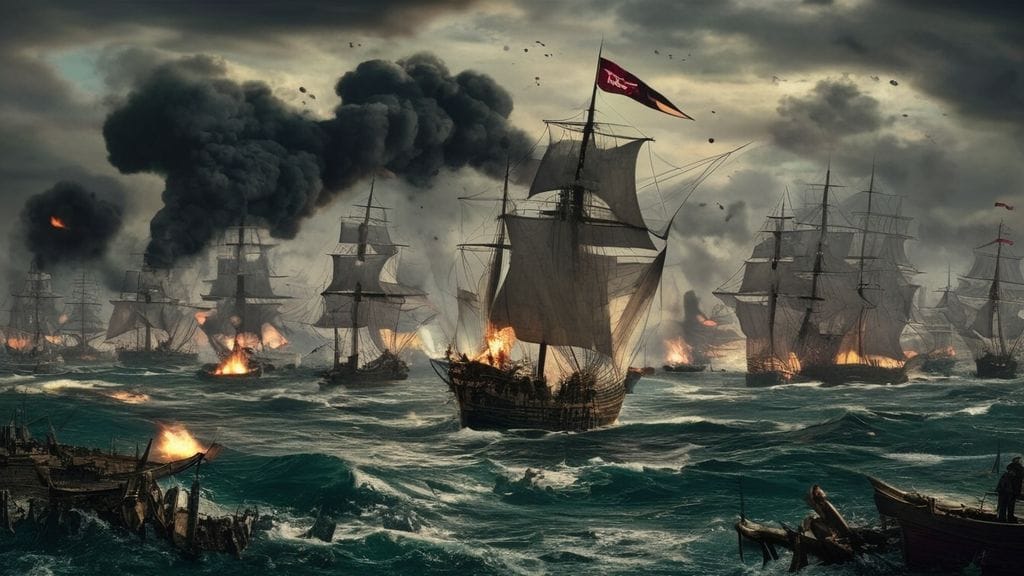
What followed over the next few hours turned the harbor of Sinop into a floating inferno. Russian broadsides were methodical and relentless. The ships of the line, anchored to maintain stable firing positions, poured shell after shell into the Ottoman squadron at relatively close range. The Ottoman vessels did not surrender meekly. They fired back with all the guns they could bring to bear, their iron shot smashing into Russian hulls, wounding and killing men, and occasionally starting small fires. But the disparity in destructive power quickly became apparent.
Each time a Russian shell found its mark, it erupted in splinters, flames, and shrapnel. One Ottoman frigate after another began to burn. Sails and cordage caught fire, sending flaming debris down onto the decks. Powder magazines, if not swiftly flooded or isolated, turned ships into bombs waiting for a fatal spark. The noise was overwhelming: the deep thunder of guns, the crack of splintering wood, the screams of the wounded, the roar of flames, the hoarse shouting of officers struggling to keep discipline amid chaos.
The town itself could not escape the violence. Stray shells and misdirected shots hit buildings along the waterfront. Some of the coastal batteries, under heavy Russian fire, were disabled or destroyed. Civilians fled into the hills or huddled in cellars as stone walls shook with each distant impact. For them, the naval battle of sinop was not an abstract strategic event but a direct assault on their homes, livelihoods, and sense of safety.
On board the Ottoman ships, desperate efforts were made to fight the fires and maintain return fire. Buckets of water were passed hand to hand; chains of men tried to smother flames with wet canvas. Some crews attempted to cut anchor cables and maneuver, but in the crowded harbor and under heavy shelling, such moves were perilous. A ship that drifted without control risked colliding with another, spreading fire or blocking fields of fire. To abandon ship meant leaping into icy water, often amid burning wreckage and falling spars.
One by one, Ottoman vessels were silenced. Some exploded as fire reached their magazines. Others, riddled with shot and aflame, sank slowly, their remaining crew jumping overboard or clinging to floating debris. From the Russian decks, the spectacle was horrifying even to hardened sailors. A few accounts describe officers standing in grim silence as entire enemy crews were engulfed in fire. Yet the order remained: continue firing until the enemy was utterly destroyed. In Nakhimov’s calculations, half measures would spare ships that might later threaten Russian interests. The battle was not merely about victory but about annihilation.
By late afternoon, the outcome was no longer in doubt. The Ottoman squadron was effectively destroyed. The harbor was littered with wreckage and bodies. Fires burned on the water’s surface where oil, tar, and debris floated. Russian ships, though damaged, remained afloat and in formation. Their crews were exhausted, their gun barrels hot, their decks stained with blood—but they had achieved a victory beyond even their own expectations. The cost to the Ottomans, in lives and material, was staggering. The Black Sea had just witnessed not only a decisive battle but a demonstration of how the combination of explosive shells and wooden fleets could turn harbors into charnel houses.
Men in the Maelstrom: Voices, Fear, and Courage at Sinop
Statistics alone cannot capture the human experience of the naval battle of sinop. To approach that reality, one must imagine what it meant to stand on those decks, to hear those orders, to feel the heat of nearby flames and the concussion of cannons. Eyewitness accounts, though fragmentary and sometimes colored by later memory, help bring us closer. Russian memoirs describe gun crews working “like men possessed,” stripped to their shirts in the cold air, sweat and powder grime streaking their faces as they loaded and fired, loaded and fired, hour after hour. One Russian officer later recalled seeing “the entire enemy harbor in flames, as if a great sacrificial altar had been lit to the god of war.”
On the Ottoman side, the picture is more difficult to reconstruct, as fewer written testimonies survived and many officers who might have left memoirs perished in the battle. Yet some voices reached us indirectly through reports, letters, and later oral traditions. A wounded Ottoman sailor, treated after the battle by neutral observers, supposedly spoke of “a wall of fire” advancing across the water, of comrades trapped below decks as burning rigging fell across hatches, and of officers trying to rally men on decks slick with blood and water. Whether every detail of such accounts is literally accurate matters less than the emotional truth they convey: terror, confusion, and a fierce, often futile determination to fight on.
Fear was omnipresent, but so was courage. Ottoman gunners remained at their posts even as their ships burned, some continuing to fire until their cannons were almost too hot to touch. Officers attempted to maintain order, sometimes drawing swords not against the enemy but to keep panic from turning into stampede. Priests and imams prayed on both sides, invoking divine protection in a battle that, from a distance, might seem determined more by physics and metallurgy than by providence. Yet to the men amid the blast and splinter, the line between fate and chance must have felt razor-thin.
Civilians, too, displayed a quiet bravery. In Sinop, townspeople risked their lives to rescue men who managed to swim ashore, regardless of whether they wore Russian or Ottoman uniforms. Some women reportedly tore up household linens to use as bandages. Others carried water to the wounded or guided shocked survivors to places of refuge. In later years, such acts faded into the background of grand narratives of war, overshadowed by discussions of strategy, diplomacy, and technology. But they formed an essential part of the lived experience of that day.
The human cost cannot be neatly tabulated. Estimates vary, but historians generally agree that roughly 3,000 Ottomans were killed, with only a few hundred surviving from the squadron. Russian losses were far smaller, perhaps around 37 killed and 233 wounded, though exact figures differ by source. The asymmetry is stark, highlighting both the imbalance in firepower and the vulnerability of ships trapped at anchor. Behind each number lay lives, families, and futures suddenly cut short or permanently altered. The battle left widows and orphans in distant Anatolian villages and Russian peasant huts alike, none of whom would ever see the Black Sea but whose fates were nonetheless shaped by what happened on its waters that day.
Counting the Cost: Casualties, Wreckage, and the Smoking Ruins of Sinop
When the guns finally fell silent and the smoke began to thin, Sinop presented a vision of devastation that shocked even seasoned observers. The harbor was choked with debris: shattered masts, charred planks, overturned boats, and bodies in uniforms blackened by fire or bloated by cold water. Several Ottoman ships had exploded outright; others lay on their sides, half-submerged, with their upper works still smoldering. The surviving Russian sailors peered across this landscape of ruin, some in grim satisfaction, others in disturbed contemplation.
The town itself had suffered damage as well. Shore batteries had been pounded, ramparts shattered, and nearby buildings set alight. Civilians, emerging cautiously from hiding, encountered not the familiar harbor of their daily routines but a scene more akin to the aftermath of an earthquake or volcanic eruption. Smoke drifted through the streets. Shattered glass and broken timbers littered the ground. The cries of the wounded—many of them Ottoman sailors dragged ashore from the water or recovered from damaged ships—echoed between the stone walls.
Casualty figures, though approximate, tell a grim story. Out of the entire Ottoman squadron, only a handful of ships escaped or remained even partially serviceable. The overwhelming majority of officers and crew were killed, wounded, or captured. The loss of trained sailors and experienced naval officers was, for the Ottomans, almost as disastrous as the destruction of the ships themselves. Training new men would take years; rebuilding the fleet would require resources the empire could ill afford to waste. As one later Ottoman commentator summarized, Sinop was “not a defeat but a catastrophe.”
The Russian fleet, though victorious, did not escape unscathed. Several ships took significant damage; their hulls bore the scars of iron shot, and their masts and rigging were pocked and frayed. Dozens of Russian sailors lay dead or wounded, to be buried at sea or interred in simple graves. In Russian naval circles, however, the battle was quickly framed as a triumph of skill, discipline, and new technology. Nakhimov and his officers were hailed as heroes, and the destruction of the Ottoman squadron was celebrated in dispatches sent to St. Petersburg.
Yet behind the celebrations, a darker realization flickered in some minds: the sheer scale of destruction, achieved in so short a time, hinted at a future in which navies and coastal cities alike would be far more vulnerable. What happened at Sinop was not just the result of Russian daring and Ottoman miscalculation; it was also the product of a technological revolution in naval gunnery. Explosive shells had turned ships into tinderboxes. In that sense, Sinop was a preview of horrors to come—not only in later naval wars but in the age of industrialized violence that would mark the late nineteenth and early twentieth centuries.
From Victory to Shockwave: How Sinop Echoed Across Europe
News of the battle traveled with surprising speed for the mid-nineteenth century. Couriers, ships, and telegraph lines carried the first reports from the Black Sea to Constantinople, St. Petersburg, London, and Paris. Within weeks, European newspapers were printing lurid accounts of the annihilation of the Ottoman squadron. Illustrations, often based more on imagination than direct observation, depicted towering flames, sinking ships, and mass drowning. The naval battle of sinop quickly ceased to be only a regional engagement; it became a symbol in a wider argument about power, justice, and the rules—if any—governing war at sea.
In Russia, the reaction was exultant. The Tsar and his court hailed the victory as proof of Russia’s naval prowess and divine favor. Official bulletins emphasized the destruction of enemy “piratical” forces and the supposed righteousness of Russian arms. Nakhimov was lionized; his conduct at Sinop joined earlier exploits to shape the image of a heroic admiral devoted to the Tsar and to Orthodoxy. For many Russians, long sensitive to Western condescension about their military capacity, Sinop offered a moment of pride, a demonstration that they could not only hold their own on the seas but deliver crushing blows.
In the Ottoman Empire, by contrast, the mood was one of shock and anger. The loss of the squadron devastated naval planning and morale. At court, questions swirled about who was to blame: Osman Pasha for remaining in Sinop? Naval leadership for failing to modernize sufficiently? Civilian ministers for neglecting the fleet? In the press—limited but increasingly active in the Tanzimat era—Sinop was invoked as evidence of the urgent need for reform. Some voices, echoing what had been said after earlier defeats, argued that only deeper Westernization, including more European officers and technology, could prevent future disasters. Others feared that excessive dependence on European advisors would erode sovereignty.
But the most consequential reactions unfolded in Britain and France. There, the destruction at Sinop was widely perceived not simply as a military victory over an enemy fleet but as a massacre carried out under conditions that seemed to deny the Ottomans any real chance of survival. Newspapers spoke of “butchery” and “slaughter,” especially focusing on the use of explosive shells against wooden ships in a confined harbor. The Times of London, a powerful voice in shaping public opinion, condemned the Russian action as “a wanton and cruel attack,” using moral language that intertwined with strategic concerns about Russian expansion.
British and French policymakers seized upon Sinop to argue that Russia had gone too far and that the Ottoman Empire needed not only diplomatic support but military protection. The fact that the Ottoman squadron had been anchored under its own guns yet still destroyed suggested that without Western backing, the Sultan’s navy was no match for Russian power. From this point forward, the path to direct British and French intervention in the conflict became shorter and more inevitable. Sinop thus acted as a political shockwave, shaking loose the last restraints on European involvement in what had begun as a localized Russo-Ottoman war.
Diplomats and Newspapers: The Political Firestorm after Sinop
In the great chancelleries of Europe, ambassadors pored over dispatches from the Black Sea and tried to read the emerging pattern. Was Sinop merely an aggressive action in wartime, or did it signify a deeper Russian intention to crush the Ottoman Navy and thereby gain uncontested control of the Black Sea? The answer, of course, depended on whom one asked. Russian diplomats insisted that the attack was a legitimate military operation against an enemy force; they stressed that the Ottoman Empire had declared war first and that, therefore, Russian actions were self-defense. British and French diplomats countered that while the legality of war was one matter, its conduct was another. The overwhelming and, as they saw it, unnecessarily destructive nature of the attack at Sinop crossed a moral line.
Newspapers played a crucial role in shaping these interpretations. The age of mass-circulation press was dawning, and public opinion was becoming an increasingly powerful force in foreign policy. Detailed, sometimes exaggerated stories of the burning Ottoman ships, the high death toll, and the terror in the town of Sinop stirred emotions among readers who might otherwise have remained indifferent to quarrels in distant seas. As historian Orlando Figes has noted, such coverage helped turn the Crimean conflict into one of the first “media wars,” in which images and narratives beamed to the home front influenced decisions at the highest level.
In London, hawkish politicians and influential commentators used Sinop to argue that Britain’s honor and strategic interests both required action. If Russia gained dominance in the Black Sea, they argued, it could have undue influence over the straits, threaten British routes to India, and unsettle the balance of power in Europe. Humanitarian outrage dovetailed conveniently with hard-nosed geopolitics. In Paris, the government of Napoleon III saw an opportunity to assert French prestige and recapture some of the glory associated with Napoleonic military prowess. Defending the Ottomans against Russian aggression, especially after the naval battle of sinop, could rally public opinion and strengthen the emperor’s political position at home.
Behind closed doors, negotiations took on a more urgent tone. Could Russia be persuaded to pull back without loss of face? Would the Ottomans accept mediated solutions that limited Russian influence but preserved some of its claims? Each new report from the front—on land and at sea—made compromise more difficult. Sinop, with its images of burning ships and drowned sailors, had hardened attitudes. What had begun as an argument over the rights of Christian communities in the Holy Land and the nuances of treaty obligations had, by early 1854, become a broader question: would Europe allow Russia to enforce its will on the Ottoman Empire by force of arms?
By March 1854, the answer was clear. Britain and France declared war on Russia, formally entering the conflict that would become known as the Crimean War. Without Sinop, that step might still have been taken—but almost certainly not with the same speed and the same moral fervor. The battle had given those advocating intervention a powerful symbol of Russian ruthlessness and Ottoman vulnerability. Sinop’s harbor, still smoldering in early December 1853, thus cast a long, invisible shadow over the diplomatic tables of Europe.
Technology and Terror: Sinop as the First Modern Naval Massacre
Viewed from the perspective of military technology, the naval battle of sinop occupies a pivotal place in naval history. It is often cited as the first major demonstration of the devastating potential of explosive shells used systematically against wooden ships. In previous wars, navies had experimented with such munitions, but at Sinop their power was displayed in concentrated form. The combination of well-handled shell guns on the Russian ships of the line and vulnerable wooden hulls of the Ottoman squadron produced an outcome that shocked even professional observers.
The basic difference lay in how damage was inflicted. Traditional solid shot, the staple of naval warfare for centuries, punched holes in hulls, smashed guns from their carriages, and killed or maimed men in its path. It could be devastating, but ships were built to withstand a certain amount of such punishment. Carpentry crews might plug holes; pumps could handle limited leaks. Fire was a danger but not always a constant threat. Explosive shells changed that equation. They did not merely penetrate; they detonated inside or upon impact, creating secondary explosions, splinters, and instantaneous fires. On a wooden ship laden with tar, rope, canvas, and powder, a single well-placed shell could start a blaze that was almost impossible to contain.
At Sinop, this new technology met old tactics. The Russians fought a close-range battle in a confined harbor, maximizing the accuracy and lethality of their shells. The Ottomans, anchored and without the ability to maneuver effectively, presented ideal targets. The result was less a duel than a systematic destruction. Military observers, including foreign attachés and analysts reading reports after the fact, understood that something new had occurred. The age of the wooden sailing fleet, already under pressure from the advent of steam propulsion, now faced a second, arguably more lethal challenge from shell-firing artillery.
In the decade that followed, navies around the world drew lessons from Sinop. Some sought to armor their ships with iron plating, a development that would culminate in the ironclads of the American Civil War and later European fleets. Others reconsidered the viability of large wooden ships of the line in the face of concentrated shell fire. The very concept of harbor defense came under scrutiny: if ships could be annihilated while lying under their own guns, perhaps the focus needed to shift to layered defenses, mines, and more powerful coastal artillery.
Sinop also had implications for international law and norms of war at sea. Critics in Britain and France argued that the Russian use of explosive shells against ships in port was excessive, bordering on barbaric. Supporters of modern warfare countered that war was inherently brutal and that such weapons were no more immoral than any others, merely more effective. This debate foreshadowed later controversies over torpedoes, submarines, aerial bombardment, and other technologies that blurred the line between traditional combat and what some would call atrocity.
In that sense, Sinop stands at the beginning of a long, troubling conversation about technology and terror. It reminds us that every advance in the means of destruction carries with it new ethical and strategic dilemmas. The sight of the Ottoman squadron burning in Sinop’s harbor in 1853 prefigured, in miniature, the great conflagrations of the twentieth century, when cities would replace ships as the primary targets of industrial warfare.
Into the Crimean War: From a Single Battle to a Continental Conflict
The guns that thundered over Sinop were, in retrospect, the opening notes of a much larger symphony of war that would soon resound across the Black Sea region and the Crimean Peninsula. Once Britain and France entered the conflict in early 1854, the Russo-Ottoman war ceased to be a bilateral clash and became a full-scale European struggle. The political stakes expanded from questions of religious protectorates and regional influence to the broader issue of whether Russia could be allowed to alter the European balance of power by force.
Naval strategy shifted accordingly. The overwhelming Russian success at Sinop had cleared the Black Sea of significant Ottoman naval opposition, but it also provoked the entry of two of the world’s most advanced naval powers. British and French fleets entered the Black Sea to protect Ottoman coasts and shipping, effectively neutralizing the Russian advantage. The Russian Black Sea Fleet, including ships that had fought at Sinop, now faced enemies with more modern vessels, better logistical support, and global experience. Ironically, the very battle that had showcased Russian strength also helped bring about a situation in which that strength would be contained and, in some respects, undone.
On land, the Crimean War unfolded in campaigns that have entered the annals of military history: the siege of Sevastopol, the Charge of the Light Brigade at Balaclava, the battles of Alma and Inkerman. Yet Sinop remained an important reference point, especially in discussions of naval operations and coastal defense. Russian commanders had to reckon with the possibility that Western fleets might attack their own ports in the same manner they had struck Sinop. They reinforced Sevastopol and other bases, laid mines, and adopted more cautious naval tactics. The days of sailing brazenly into enemy harbors with shells primed for destruction were, for Russia at least, largely over once Britain and France appeared on the scene.
For the Ottomans, the alliance with Britain and France after Sinop was both a salvation and a humiliation. On the one hand, Western fleets and troops provided critical support without which the empire might have suffered even greater losses. On the other hand, dependence on foreign protectors further eroded Ottoman prestige and autonomy. The Ottoman Navy, still reeling from the catastrophe at Sinop, played a secondary role in the subsequent war, overshadowed by the mighty squadrons of its allies. The battle that had destroyed part of its fleet also helped cement a pattern in which the empire’s security was increasingly tied to European guarantees.
In the peace settlement that followed the Crimean War—the Treaty of Paris of 1856—the Black Sea was declared neutral, closed to warships of all major powers, including Russia. This was a direct blow to Russian naval aspirations and a bitter reminder that the victory at Sinop had come at a strategic cost. Russia had demonstrated the power of its Black Sea Fleet only to see that fleet’s future severely constrained by diplomacy. The naval battle of sinop thus forms a paradoxical chapter in Russian history: a tactical triumph that contributed to a longer-term setback in the very theater it had briefly dominated.
Memory, Myth, and Blame: How Sinop Was Remembered at Home
As with many great battles, the memory of Sinop fractured along national lines. In Russia, it entered the pantheon of heroic naval victories. Nakhimov’s name was inscribed on monuments, and streets and ships would later bear his name. Russian historians emphasized the courage and skill of the fleet, portraying Sinop as a righteous blow against an Ottoman enemy allegedly backed by perfidious Western powers. The moral controversies that raged in London and Paris over the use of explosive shells rarely penetrated the Russian narrative, which focused on honor, bravery, and the fulfillment of duty.
Within the Ottoman world, Sinop became a symbol of both martyrdom and failure. On the one hand, the deaths of thousands of sailors were honored as sacrifices made in defense of the empire and of Islam. On the other hand, the battle served as a stark lesson in the dangers of complacency and incomplete reform. Ottoman commentators, and later Turkish historians, debated the causes of the disaster: Was it technological backwardness? Incompetent leadership? Structural weaknesses in the empire’s institutions? Each generation, facing its own challenges, found new meanings in the burning ships of 1853.
Blame, inevitably, became part of the conversation. Osman Pasha, who survived the battle and was taken prisoner, was alternately condemned and defended. Some saw him as reckless for staying in Sinop; others argued that he had been placed in an impossible position by indecisive superiors and inadequate resources. The Tanzimat reformers, too, were scrutinized: had they done enough to modernize the navy? Had they been too slow, too partial, too hampered by internal opposition? The answers varied, but few denied that Sinop laid bare the gulf between the slogans of modernization and the hard realities of war.
In Western Europe, Sinop’s memory intertwined with broader narratives about the Crimean War. British schoolchildren learned of the Charge of the Light Brigade and the heroism of Florence Nightingale; Sinop appeared, if at all, as a prelude, an outrage that had helped justify intervention. French memory focused more on the glory of the Second Empire and its military record. The complexities of Ottoman suffering and Russian calculations at Sinop were often flattened into a simpler story of “Russian atrocity” versus “civilized” response.
Only in more recent scholarship has Sinop received the nuanced treatment it deserves. Historians now tend to see it neither as a simple case of barbarism nor as an unproblematic triumph of modernity but as a complex episode in which technology, strategy, misjudgment, and politics combined with tragic effect. The burning harbor of Sinop became, in this more balanced view, a mirror reflecting the contradictions of mid-nineteenth-century empires: outwardly powerful yet internally fragile, moralistic in rhetoric yet ruthless in practice.
Lives Changed Forever: Survivors, Families, and the Human Aftermath
Long after the last cinders cooled in Sinop’s harbor, the battle continued to shape lives in ways that rarely make it into conventional military histories. For the survivors, physical scars were often matched or exceeded by psychological ones. Ottoman sailors who escaped the inferno, whether by swimming ashore or being rescued by Russian boats, faced captivity in a foreign land. Some were marched hundreds of kilometers into the Russian interior, far from the familiar landscapes of Anatolia or the Arab provinces. There, they lived in makeshift camps or were billeted among local populations, waiting for a peace that might bring exchange or release.
Russian sailors who had fought at Sinop carried their experiences into subsequent campaigns. Some would later serve at Sevastopol during the grinding siege that became the centerpiece of the Crimean War. For them, Sinop might have been remembered as a moment of clear-cut victory—a contrast to the attrition and uncertainty of trench and battery on the Crimean Peninsula. Yet even for those on the winning side, the memory of ships aflame and men drowning left a mark. Letters preserved in Russian archives occasionally allude to the horror of seeing “so many souls lost in a single day,” a reminder that victory does not erase the human cost of battle.
Families in distant villages felt the impact in quieter but no less profound ways. In Ottoman territories, the news of Sinop reached inland slowly, often in the form of rumors before official notification. Wives waited for husbands who never returned; mothers for sons whose fate remained unknown. The empire’s limited bureaucratic capacity meant that not all names were recorded properly, not all next of kin informed with clarity. Grief became entangled with uncertainty. In some places, local traditions developed to commemorate those lost at sea, with special prayers or modest monuments bearing generic inscriptions rather than specific names.
In Russia, the victory at Sinop sometimes translated into tangible benefits for families of the fallen, such as pensions or state recognition. But for most peasant households, the loss of a son or father meant an abrupt drop in labor and income, particularly in harsh rural environments. The state might honor the dead in ceremonies and proclamations, yet the daily struggle of those left behind continued with little relief. War, as always, redistributed suffering in ways that official narratives rarely fully acknowledged.
Sinop itself, the town that had involuntarily hosted the battle, had to rebuild both physically and psychologically. Houses were repaired; damaged fortifications patched. Life, in a sense, returned to normal: markets reopened, fishing resumed, children again played near the waterfront. But the memory of the day when the sky turned black with smoke and the sea burned remained embedded in local stories. Visitors would be shown the sites where shells had struck, the stretches of coast where bodies had washed ashore. The harbor’s beauty, undeniable on a calm summer day, was forever tinged with the knowledge of what it had once contained.
Sinop in the Long Shadow of History: Lessons from a Burning Harbor
Looking back from the twenty-first century, the naval battle of sinop may seem like a distant episode, overshadowed by larger and more famous conflicts. Yet its significance endures, not only as a key moment in the run-up to the Crimean War but as a case study in the interplay between technology, strategy, and human decision-making. It shows how a single engagement, undertaken for reasons that seemed clear and compelling at the time, can set in motion consequences far beyond what its planners anticipated.
On the strategic level, Sinop underscores the dangers of underestimating an opponent’s capabilities and intentions. The Ottoman command misjudged both the resolve of the Russian navy and the lethal potential of its shell guns. They believed that the combination of harbor shelter and shore batteries offered sufficient protection; they were wrong, and the price paid was catastrophic. At the same time, Russia misjudged the international reaction. Nakhimov’s success in annihilating the Ottoman squadron marginalized the Ottoman fleet but also galvanized Britain and France into active opposition, ultimately constraining Russian power in the very region Russia sought to dominate.
Technologically, Sinop stands at the crossroads of eras. It marked the obsolescence of unarmored wooden fleets in the face of explosive ordnance and accelerated the transition toward ironclads and steam-powered warships. In this sense, it belongs in the same conceptual lineage as Jutland, Tsushima, and Midway—battles in which new technologies reshaped not only tactics but geopolitical realities. As one military analyst writing decades later observed, “At Sinop, the future announced itself in fire.”
On a human level, the battle reminds us that grand narratives of progress and power are built upon countless individual stories of courage, error, suffering, and resilience. Admirals and ministers made decisions based on their understanding of honor, interest, and necessity; sailors and civilians bore the brunt of these decisions in their bodies and minds. The harbors and towns where they lived and fought became, for a time, focal points of global attention, only to sink again into relative obscurity once the cannons fell silent and attention shifted elsewhere.
There is also a moral lesson, though it resists easy formulation. Sinop invites us to question the ways in which victories are celebrated and atrocities condemned. Was the Russian action at Sinop a legitimate act of war or a massacre? Contemporary and later opinions differed, often along national lines. Yet the raw fact of thousands of men burned or drowned in a few hours should unsettle any attempt to neatly categorize the battle as either heroic or villainous. War, especially when amplified by new technologies, has a way of collapsing such distinctions into a blur of smoke and fire.
In the end, Sinop’s harbor remains a place where history and geography intersect. The sea that once reflected flames now mirrors the sky in relative peace. Fishing boats and commercial vessels ply waters where ships of the line once traded broadsides. Tourists may stroll the town’s streets unaware of the drama that unfolded there in 1853. Yet beneath this surface normalcy lies the enduring truth that even small, out-of-the-way places can become, for a moment, the center of the world—and that those moments can reverberate far beyond their immediate time and place.
Conclusion
The story of the naval battle of sinop is, at its core, the story of a world in transition. An aging empire seeking to modernize its navy without fully understanding the new rules of war; a rising power eager to assert itself, confident in its weapons yet blind to the diplomatic backlash they would provoke; European states anxious about the balance of power, ready to cloak strategic calculations in moral outrage—these are the forces that converged in the harbor of a modest Ottoman town on 30 November 1853. For a few hours that day, the abstract tensions of diplomacy and technology took on concrete form in the crash of cannon fire, the glow of burning masts, and the cries of men fighting for their lives.
Sinop did not determine the outcome of the Crimean War by itself, but it shaped the contours of that conflict. It destroyed a significant part of the Ottoman Black Sea fleet, pushed Britain and France from wary observers to active belligerents, and led to a peace settlement that, ironically, curtailed the very Russian naval ambitions that had driven the attack. It marked, too, the twilight of wooden fleets and the rise of a more mechanized, more destructive era of naval warfare—an era in which the distance between innovation and catastrophe would grow ever smaller.
Yet beyond grand strategy and technological change, Sinop endures as a human drama: of officers making irreversible choices under pressure; of sailors trapped between duty and terror; of civilians watching their harbor turn into a battlefield. Its lessons are many: about prudence in planning, humility in the face of new technology, and the unpredictable ways in which violence can ripple outward through politics and memory. To study Sinop is to be reminded that war is never confined to the moment of combat alone. It begins long before the first shot, in the assumptions and ambitions of statesmen and admirals, and it continues long after the last flame dies, in the stories we tell, the grievances we nurse, and the cautionary tales we pass on.
In that sense, the harbor of Sinop still speaks to us. Its waters, once lit by fire, reflect back questions that remain pressing in any age that prizes power and innovation: What do we truly control when we unleash new forms of destruction? How do we weigh tactical success against strategic and moral cost? And how many times must history show us burning ships and shattered lives before we fully grasp the price of miscalculation at sea?
FAQs
- What was the naval battle of Sinop?
The naval battle of Sinop was a major engagement fought on 30 November 1853 in the harbor of Sinop, on the Black Sea coast of the Ottoman Empire. A Russian squadron under Admiral Pavel Nakhimov attacked and virtually annihilated an Ottoman fleet anchored there, using explosive shells fired from ships of the line. The battle is often cited as one of the last large-scale clashes of wooden sailing fleets and an early example of the devastating effectiveness of shell guns at sea. - Why did the battle take place at Sinop specifically?
The Ottoman squadron under Vice Admiral Osman Pasha had taken refuge in Sinop after storms and the risk of encountering Russian forces made further movement toward the Caucasus dangerous. Sinop’s natural harbor and coastal batteries seemed to offer protection. Russian intelligence learned that a concentrated Ottoman force lay there, and Admiral Nakhimov decided to seize the opportunity to destroy it in a single, decisive strike, despite the shelter offered by the harbor. - How did technology influence the outcome of the battle?
Technology played a decisive role in the outcome. The Russian fleet was equipped with shell guns capable of firing explosive shells, while the Ottoman ships mostly relied on older smoothbore cannon firing solid shot. In the confined space of Sinop’s harbor, the Russian shells ignited devastating fires on the wooden Ottoman ships, leading to explosions and rapid destruction. This technological edge turned what might otherwise have been a hard-fought engagement into a one-sided disaster for the Ottomans. - What were the casualties and losses at Sinop?
Although figures vary, historians generally estimate that around 3,000 Ottoman sailors and soldiers were killed in the battle, with only a few hundred surviving out of the entire squadron. Almost all the Ottoman warships present were destroyed or rendered useless. Russian losses were comparatively light—on the order of a few dozen killed and a couple of hundred wounded—though several Russian ships suffered notable damage from Ottoman return fire and coastal batteries. - How did the battle of Sinop contribute to the start of the Crimean War?
The destruction of the Ottoman fleet at Sinop outraged public opinion in Britain and France, where newspapers portrayed the action as a brutal massacre rather than a conventional naval battle. Politicians used the event to argue that Russia posed a serious threat to the European balance of power and to the integrity of the Ottoman Empire. This helped tip the scales in favor of armed intervention, and in early 1854 Britain and France declared war on Russia, transforming a bilateral Russo-Ottoman conflict into the broader Crimean War. - Was the Russian attack considered legal under the rules of war at the time?
Legally, Russia and the Ottoman Empire were at war, so attacking an enemy fleet was not, in itself, a violation of contemporary international law. However, the scale and method of destruction—using explosive shells against ships anchored in harbor and causing heavy loss of life—sparked moral and political controversy. British and French critics condemned the action as excessively ruthless, while Russia defended it as a legitimate and necessary military operation. The debate highlighted how new technologies could outpace existing norms of warfare. - What happened to the commanders involved, Osman Pasha and Admiral Nakhimov?
Osman Pasha survived the battle but was captured and taken prisoner by the Russians. He spent time in captivity before being eventually released in a prisoner exchange; his legacy within the Ottoman world remained mixed, seen by some as a victim of circumstances and by others as a symbol of flawed decision-making. Admiral Pavel Nakhimov, by contrast, was celebrated in Russia as a hero of Sinop and later played a key role in the defense of Sevastopol during the Crimean War. He was mortally wounded there in 1855 and became a revered figure in Russian naval history. - Why is Sinop considered a turning point in naval warfare?
Sinop is considered a turning point because it clearly demonstrated how vulnerable traditional wooden ships were to explosive shells. The battle showed that a fleet equipped with shell guns could, in favorable conditions, annihilate a similar or larger force still relying on older technology. This realization accelerated the move toward armored warships and more modern naval doctrines, influencing shipbuilding and tactics for decades. In that sense, Sinop bridged the gap between the age of sail and the era of ironclads and industrialized naval warfare.
External Resource
Internal Link
Other Resources
- Encyclopaedia Britannica – general search for the exact subject
- Google Scholar – academic search for the exact subject
- Internet Archive – digital library search for the exact subject