Table of Contents
- Ships on the Horizon: First Rumors of a Northern Threat
- Al-Andalus in 844: A Glittering Frontier of the Umayyad World
- Men from the Sea: Who the Vikings Were When They Sailed South
- Crossing the Ocean of Darkness: The Long Voyage to Iberia
- Flames in the Northwest: The Vikings Strike Galicia
- Down the Great River: The Fleet Enters the Guadalquivir
- The Viking Raid on Seville Begins: Panic Inside the Walls
- Three Days of Fire and Plunder in the Suburbs of Seville
- Captives, Spoil, and Sacred Places: What the Raiders Sought
- Abd al-Rahman II Responds: Mobilization of an Emirate
- The Battle of Tablada: Umayyad Cavalry against Viking Shields
- The Turning of the Tide: Defeat, Pursuit, and Slaughter
- From Humiliation to Reform: Fortresses, Fleets, and Fire Ships
- Fear and Memory: How Andalusi Society Remembered the Attack
- Vikings and the Wider Mediterranean: Trade, Raids, and Echoes of 844
- Sources and Silences: Reconstructing the Viking Raid on Seville
- Long Shadows: Political and Cultural Consequences for Al-Andalus
- A Northern Storm Reconsidered: Modern Debates on the Raid
- Conclusion
- FAQs
- External Resource
- Internal Link
Article Summary: In the autumn of 844, a fleet of Viking longships cut across the Atlantic swells and up the wide mouth of the Guadalquivir River, bringing a northern storm to the flourishing Muslim city of Seville. This article follows the viking raid on seville from its distant origins in Scandinavian expansion to its fiery climax in the fields of Tablada, where Andalusi cavalry finally halted the invaders. It sets the raid within the political might and cultural brilliance of Umayyad al-Andalus, showing how a single shock from the sea exposed vulnerabilities in a seemingly confident emirate. Through chronicles, archaeology, and careful reconstruction, the narrative evokes three days of terror, plunder, and resistance in and around Seville. The article traces the military reforms, coastal fortifications, and naval projects that emerged from the trauma of 844, explaining how the Umayyads turned disaster into a catalyst for strength. At the same time, it explores the human dimension: farmers fleeing burning suburbs, Viking warriors bewildered by palm-lined riverbanks, and an emir determined to defend his realm. The viking raid on seville is revealed not as an isolated incident, but as part of a wider Viking push into the Atlantic and Mediterranean worlds. By the end, the event stands as a pivotal encounter between northern raiders and Islamic Iberia, leaving legacies that echoed for generations.
Ships on the Horizon: First Rumors of a Northern Threat
On a warm autumn morning in 844, fishermen along the Atlantic coast of al-Andalus squinted toward a hazy horizon and saw something that did not belong to their world. Dark silhouettes, low in the water and bristling with vertical lines, seemed at first like a trick of the light. But as the forms grew larger against the glinting sea, their outlines hardened into long, narrow hulls and high, curved prows. Word began to travel—first as a murmur, then as a rush of terrified speech—from hamlet to port, from port to provincial officials, that strange ships were moving along the shore.
In later Muslim chronicles, these vessels would be called Majus ships, ships of the “fire-worshippers,” a catch-all term the Andalusi writers used for northern pagans. The viking raid on seville, which would soon become infamous, began with this blur of rumor: reports of smoke rising over distant coastal settlements, tales of pale-haired warriors in conical helmets landing, killing, and vanishing, and frantic messengers riding south with news that no one in the bustling courts of Córdoba or Seville quite knew how to interpret. Were these Christian raiders from the north? Pirates? Agents of a rival power? The earliest clues were confused, but the fear was real.
For generations, the people of al-Andalus had worried most about enemies in the north—Christian kingdoms in the mountains of Asturias and León—or rivals across the Mediterranean in North Africa. The sea to the west, the vast “Ocean of Darkness,” was more a poetic boundary than a living frontier. Yet now, in the late summer and early autumn of 844, that ocean seemed to have opened, spitting out men who feared neither Muslim emir nor Christian king. Along the rugged coast of Galicia and the shores of the Cantabrian Sea, witnesses spoke of longships streaking past headlands, oars flashing like the legs of centipedes, drums beating time above the roar of the surf. Those who survived the first landings described warriors with axes and round shields, moving with a swift and terrible purpose.
By the time these fragmentary reports filtered down toward the Guadalquivir valley, they had already grown in the telling. Some swore these northerners drank from the skulls of their enemies; others insisted the raiders were demons, invulnerable to the sword. Officials in Seville’s administrative quarters tried to separate fantasy from fact, but the reality was alarming enough: foreign warships were probing the coast of the Umayyad emirate, landing where they pleased, and disappearing before local garrisons could be gathered. The people of Seville still believed that the capital, Córdoba, and the emir himself would shield them. Yet as the days passed, the river that sustained their prosperity would also become a highway for invasion.
Al-Andalus in 844: A Glittering Frontier of the Umayyad World
To understand why the viking raid on seville struck such a deep nerve, one has to picture al-Andalus in 844, not as a fragile borderland, but as one of the most sophisticated societies of its age. The Umayyad emirate, with its capital in Córdoba, had blossomed into a center of political power, trade, and culture that connected the Islamic world to the Atlantic edge of Europe. Under the rule of Emir Abd al-Rahman II (r. 822–852), the region was experiencing both internal consolidation and a remarkable flowering of urban life.
Córdoba, upriver from Seville, glittered with palaces, mosques, libraries, and markets that astonished contemporary visitors. Seville—Ishbiliya in Arabic—was a major node in this network: a thriving river port, surrounded by orchards and olive groves, alive with the clamor of merchants, sailors, scribes, and jurists. The Guadalquivir connected Seville to the sea, halfway between the Atlantic world and the heartland of al-Andalus. Barges carried grain, oil, wine (despite religious prohibitions, it circulated), textiles, and slaves up and down the river. Timber and iron from the north entered the city’s shipyards; luxury wares and silks arrived from the Mediterranean through coastal entrepôts.
Politically, Abd al-Rahman II’s authority radiated outward through a web of governors, judges, tax collectors, and military commanders. There were rebellions—Berber uprisings, disputes among Arab and local elites, Christian resistance in the north—but in 844 the emirate was not a decaying giant. It was dynamic, sometimes ruthless, and proud. Its rulers saw themselves as heirs to the Umayyad caliphs of Damascus, deposed in the east but reborn in Iberia. Poetry flourished at court, chroniclers recorded the deeds of emirs, and religious scholars debated law in the great mosques.
Yet behind this confidence lay structural vulnerabilities. The Atlantic coast, in particular, had not been a priority in strategic planning. The greatest concerns were inland: holding the Ebro valley, keeping an eye on the Christian kingdoms beyond the Duero, and managing tensions with the Abbasid caliphate in the east. Fleets existed, but they were modest and oriented more toward the Mediterranean than the wild western ocean. Seville’s prosperity depended on the river, but its walls and defenses had not been designed with an armada of hardened northern raiders in mind.
Socially, the city was a mosaic. Arab elites, local Iberian converts to Islam (Muwalladun), Berbers, Jews, and Christians all walked the same streets. Artisans hammered metal in crowded alleys, scribes copied books in lamp-lit rooms, and farmers on the outskirts tended fields that had been carefully irrigated under centuries of Roman and now Muslim rule. The diversity of Seville was its strength, yet it also meant that responses to crisis would be uneven. Some would flee at the first sign of danger; others, bound by loyalty to the emir or to local patrons, would stand and fight.
In this context, the idea that pale-skinned pagans from the far north might appear suddenly on the river, bypassing the usual lines of defense, seemed almost fantastical. But in the age of Abd al-Rahman II, the Mediterranean and Atlantic worlds were becoming more entangled than ever. That entanglement was about to be etched into Andalusi memory in fire and blood.
Men from the Sea: Who the Vikings Were When They Sailed South
The raiders who would carry out the viking raid on seville were part of the broader phenomenon we call the Viking Age: a period, roughly from the late eighth to the eleventh century, when Scandinavian warriors, traders, and settlers burst outward from their homelands. They came from what we now call Norway, Denmark, and Sweden, from fjords and forested coasts marked by harsh winters and short summers, where chieftains competed for power and prestige.
By 844, these northerners were no longer unknown in Western Europe. They had struck England, Ireland, and the coasts of modern France, famously sacking monasteries like Lindisfarne (793) and raiding deep inland by following rivers such as the Seine and the Loire. They were experts in amphibious warfare, able to sail up shallow waterways, beach their longships on mud or shingle, and launch swift attacks before local forces could assemble. Their reputation for ferocity was formidable, but their motives were not purely destructive. They sought silver, gold, portable wealth, captives for the slave markets, and sometimes land for colonization.
Their technology was central to their success. Longships—sleek, clinker-built vessels, light yet strong—could flex with the waves and survive ocean crossings. A typical warship could carry forty to sixty men, their shields hung along the gunwales, oars ready when the wind failed. In the stern, a single steerboard guided the hull. A square sail of wool billowed from the mast, dyed in reds and browns. Below deck, chests held weapons: spears, swords, axes, bows, and arrows. Armor was varied; some wore mail shirts, others only leather and helmets. Many went into battle with round shields and a confidence honed by decades of raiding.
Religion and culture also shaped how contemporaries saw them. To the Muslim chroniclers of al-Andalus, these northerners were Majus, a term borrowed from older usage for Zoroastrian “fire-worshippers,” and by extension for pagans. The Vikings did indeed practice their own pre-Christian religion, centered on gods like Odin, Thor, and Frey, on complex rituals, and on an ethic that valued courage, fame, and loyalty to the warband. Human sacrifice and other violent rites, while not everyday realities, filtered into the rumors that followed their fleets. In Islamic and Christian texts alike, they appeared as almost elemental forces—storms or plagues—rather than as men competing for wealth and power.
Yet behind the fearsome image lay practical calculation. To sail as far as al-Andalus required intelligence, planning, and leadership. Scandinavian crews had already probed the coasts of the Frankish kingdom, extracting tribute from rulers like Charles the Bald. They had discovered lucrative markets for slaves and plunder in places like the port of Dorestad and the trading towns of Ireland and Britain. The Mediterranean beckoned with promises of still richer cities: ports like Lisbon, Cádiz, Seville, and perhaps beyond, toward North Africa and the central sea where Muslim and Byzantine fleets contended.
It is unlikely that the raiders who attacked Seville thought of themselves as “Vikings” in a collective ethnic sense; rather, they were warbands bound to particular leaders, drawn from multiple Scandinavian regions and possibly from among their Christianized neighbors. But they shared a common seafaring culture that had taught them a potent lesson over the previous half-century: where there were rivers, there were routes into the wealth of inland civilizations. The Guadalquivir was about to become one more such route.
Crossing the Ocean of Darkness: The Long Voyage to Iberia
The decision to steer south, around the western edge of Europe and toward the Iberian Peninsula, was both daring and logical. By 844, Scandinavian raiders had grown familiar with the Atlantic littoral. They knew the coasts of Ireland and Britain, the Channel, and the estuaries of the great French rivers. But the journey to al-Andalus meant pushing beyond familiar raiding grounds, navigating treacherous waters and uncertain winds far from home support.
Reconstructing the exact route of the fleet that carried out the viking raid on seville is difficult, but historians generally agree that they likely sailed down the Atlantic coast of what is now France, perhaps wintering in river mouths like the Garonne or the Loire, then continued along the Bay of Biscay. The seas along this stretch could be brutal—towering swells rolling in from the open ocean, storms sweeping in with little warning. Longships, for all their seaworthiness, were open vessels; crews would have been soaked, cold, and constantly on alert.
At some point, the raiders probably put in along the Galician coast, where they attacked local settlements. The Christian kingdom of Asturias, clinging to the northern mountains, was already familiar with Scandinavian raids. Some chronicles from the Christian north hint at fires and battles along the shore, though the details are sparse. Coastal monasteries—repositories of silver chalices, jeweled reliquaries, and manuscripts with elaborately decorated covers—were particularly tempting targets. But the Andalusi sources remember Galicia mostly as a prelude, a testing ground before the fleet turned toward the richer prize of Muslim Iberia.
Sailing farther south, the raiders would have rounded the estuaries that opened into the heart of al-Andalus. The mouth of the Tagus, where Lisbon lay, may have drawn their attention, and some scholars argue that the Vikings hit Lisbon before they struck at Seville. Even if the exact sequence remains debated, the pattern is clear: the fleet moved methodically down the Atlantic side of the peninsula, probing for the most lucrative and least defended targets.
Imagine the scene on board one of these longships as they finally approached the southwestern coast of Iberia. The air grew warmer, the quality of the light changed, and the coast—no longer a bleak succession of rocky headlands—became softer, more wooded, punctuated by river mouths and low-lying lands. Seabirds wheeled overhead, and the smell of different vegetation drifted on the wind. To many of the men on board, this was a world beyond any they had seen: a land where the nights were softer, the stars different, and the languages spoken ashore utterly incomprehensible.
What they did recognize, however, was the wide mouth of a great river. The Guadalquivir opened into the Atlantic like a promise, its currents running inland between marshy banks and low hills. For raiders accustomed to using rivers as corridors of attack, it must have seemed an invitation. Somewhere up that broad, glittering artery lay cities, storehouses, mosques, and markets—concentrations of wealth unlike the scattered coastal communities they had harried so far. The decision to turn into the river, to trust its course into the heart of al-Andalus, would set in motion one of the most dramatic encounters between Vikings and the Islamic world.
Flames in the Northwest: The Vikings Strike Galicia
Before the longships entered the Guadalquivir, they had already made their presence felt in the northwest. Galicia, with its rugged coast and deep inlets, had long been vulnerable to seaborne attack. Here, the Vikings first tested the military reflexes of Iberia in 844. Christian chroniclers from the north, like the authors of the Asturian Chronicon Albeldense, mention “Normans” (a general term for northern raiders) descending upon the coast, burning and looting. The details are scarce, but the pattern matches what we know from elsewhere in Europe: sudden landings, rapid strikes, and a quick retreat to the ships.
These early assaults served several purposes. They brought immediate booty: livestock, metalwork, and captives who could be sold in the thriving slave markets that linked the Atlantic world to the Mediterranean and beyond. But they also provided intelligence. From prisoners and captured documents, the Vikings may have gleaned hints about the political landscape to the south: the power of the Umayyad emir in Córdoba, the wealth of the Guadalquivir valley, and perhaps rumors of cities like Seville, open to the river yet far enough inland to feel secure.
For the communities of Galicia and Asturias, the raids of 844 were part of an ongoing struggle to hold onto a precarious Christian polity in the face of both Muslim pressure from the south and seaborne raids from the north. Monks watching their libraries go up in flames, peasants fleeing inland with what they could carry, and hastily assembled militias would all become familiar stories in this frontier zone. But the scale of devastation, while painful, did not yet compare to what awaited farther south.
One can imagine messengers from these northern realms trying to warn their Muslim neighbors that a new kind of enemy had arrived. Yet political tensions, religious rivalry, and the sheer distances involved meant that such warnings, if they came at all, likely arrived late and were not fully believed. To the Umayyad authorities, the Christian kingdoms in the north were both adversaries and potential sources of unreliable intelligence. Even if word reached Córdoba that “Normans” or “Majus” had attacked Galicia, it might have been dismissed as an exaggeration—or as someone else’s problem.
By the time the raiders turned their prows definitively southward, they had tasted the riches of Iberian shores and seen firsthand that local resistance, though fierce in places, could be outmaneuvered. Their confidence grew with each successful landing. What lay upriver on the Guadalquivir promised to be the boldest strike yet, a chance to test the defenses of one of the great Muslim cities of the west.
Down the Great River: The Fleet Enters the Guadalquivir
When the Viking fleet finally entered the Guadalquivir, they were stepping into a landscape shaped by centuries of human habitation and by the recent transformations of Islamic rule. The lower reaches of the river were flanked by marshes, reeds whispering in the breeze, and flocks of birds rising in sudden bursts of white and gray. As the ships moved inland, the banks grew firmer, lined with fields and small hamlets whose inhabitants stared in disbelief at the approaching hulls.
For the villagers along the lower river, the appearance of these longships must have seemed surreal. The usual traffic consisted of broad-beamed riverboats and barges, slow and familiar. Now, strange vessels with dragon-headed prows and square sails slid past, their decks crowded with men in foreign armor, their shields glinting. Some peasants ran, abandoning tools and animals; others stood rooted until the first shouts from the ships—unintelligible yet obviously hostile—broke the spell and sent them scrambling toward safety.
The Vikings, seasoned river fighters by 844, moved with practiced coordination. Scouts likely went ahead in small boats, testing depths and currents, while the larger ships advanced in a loose formation that allowed them to respond quickly to obstacles or ambushes. They would have been alert for signs of fortified positions, chains across the river, or watchtowers. To their probable surprise, the defenses along much of the Guadalquivir were minimal. The Umayyads had not anticipated that a major hostile fleet could penetrate so far inland from the Atlantic.
As the fleet pushed onward, signs of greater wealth and population density appeared: larger farmsteads, irrigation channels, orchards heavy with fruit, and, eventually, the distant rise of city walls. Seville’s skyline, with its towers and minarets, would have emerged gradually above the horizon, framed by the shimmering river. Smoke from countless hearths marked a large, living settlement well before the raiders could distinguish individual buildings.
Inside Seville, river traffic brought early warnings. Bargemen and fishermen who had seen the strange fleet upriver rushed to tell officials and anyone who would listen. The city’s leaders suddenly confronted a nightmare scenario: enemies not at the gates, but already on the artery that linked them to the sea. Messages were dispatched urgently to Córdoba, calling for reinforcements from the emir. In the meantime, hastily assembled forces—local militia, garrison troops, perhaps even armed townsmen—prepared to meet the threat as best they could.
But the Vikings did not intend to announce themselves with prolonged delays. The element of surprise, the speed of the longship, and the psychological shock of their appearance were all weapons in their arsenal. As they rounded the last bends in the river and saw the suburbs of Seville spread along the banks, they were entering the most audacious phase of their campaign. The viking raid on seville was about to begin in earnest, and the city that had taken pride in its prosperity would face a test unlike any in living memory.
The Viking Raid on Seville Begins: Panic Inside the Walls
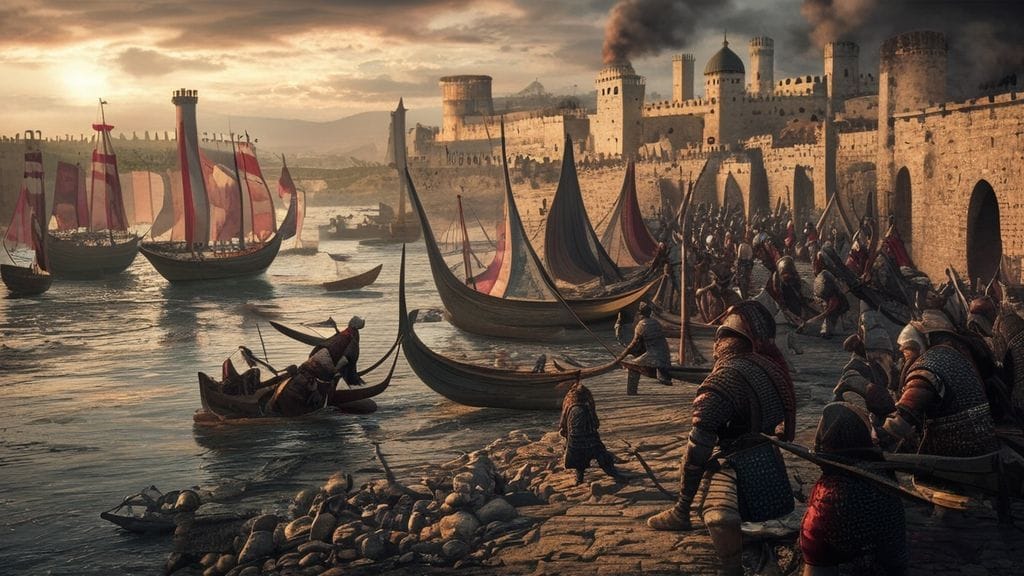
When the first longships appeared within striking distance of Seville, the city’s sense of security cracked. The viking raid on seville did not start with a formal declaration or a drawn-out siege; it began with the sudden realization that war had arrived by water. From watchtowers and rooftop terraces, Sevillans saw unfamiliar sails advancing, heard the distant thud of drums and shouted commands in a harsh, guttural tongue.
Within the city, the response was a mixture of confusion, fear, and frantic organization. The governor and military officers tried to assess the size of the fleet and the likely points of attack. Seville’s walls enclosed a dense urban core, but beyond those fortifications sprawled a ring of suburbs—workshops, warehouses, humble dwellings, and religious sites. It was there, outside the formal defenses yet vital to the city’s economy and daily life, that the first blow would fall.
Reports flew that the raiders had begun to land on the riverbanks, driving off or cutting down those who tried to resist. Smoke soon rose from outlying buildings as the Vikings set fire to structures near their beachheads, both to sow terror and to clear space. Mothers gathered their children and whatever valuables they could carry, fleeing toward the city gates; men argued in the streets about whether to defend their homes or retreat to the apparent safety of the walls.
Religious authorities urged calm, calling people to prayer and reminding them of God’s sovereignty in times of trial. Yet even as imams preached and jurists debated what martial obligations fell upon citizens, the reality outside the walls was chaos. Traders who had been transacting business that morning in the riverside markets now fought to get their goods inside; animals stampeded through alleys; the shouts of commanders trying to organize defense mingled with the cries of the terrified.
One can imagine a merchant whose warehouses lay in the suburbs pleading with soldiers to make a sortie, to defend his property. But the city’s limited garrison had to think strategically. To sally forth prematurely, without support from Córdoba, might result in a disastrous rout. Better, some argued, to hold the walls, protect the urban core, and wait for the emir’s reinforcements. This choice, pragmatic from a military standpoint, condemned many of the suburbs to fall, at least temporarily, into Viking hands.
Thus, as the sun moved across the Andalusi sky, the stage was set: inside the walls, a city tense and fearful; outside, on the riverbanks and among the sprawling outer districts, northern warriors prepared to unleash a storm of fire and steel. The three days that followed would sear themselves into Seville’s memory.
Three Days of Fire and Plunder in the Suburbs of Seville
The core of the viking raid on seville consisted of roughly three days of destructive dominance in the suburbs and immediate environs of the city. Muslim chroniclers, writing within living memory of the event, depict this period in stark, almost cinematic terms: flames licking at the sky, screams echoing through narrow lanes, and the relentless crash of axes against doors and chests.
The Vikings focused their initial efforts on securing a base along the river where their ships could be beached and defended. From there, raiding parties fanned out. Workshops and warehouses made attractive targets; they held tools, finished goods, raw materials, and the coinage that oiling the commerce of Seville. Raiders kicked down doors, struck down those who resisted, and seized anything that could be carried or later traded. Wooden buildings went up quickly when torched, sending thick, acrid smoke over the river.
Religious sites outside the main walls suffered as well. Mosques in the suburbs, perhaps monasteries or churches of the city’s Christian communities, and small shrines all fell within reach. To the Vikings, the distinctions among these buildings mattered little. They looked for precious metals, textiles, books with ornate covers, and ritual objects. To the Andalusi chroniclers, however, such desecration was particularly galling: it was not merely theft, but sacrilege.
Captives were a primary objective. Men, women, and children who fell into Viking hands were roped together or herded under guard toward the riverbanks. There they would be sorted, restrained, and eventually taken north as human booty. Some would be ransomed if their families or patrons could pay; others would be transported to slave markets reaching all the way to the Frankish hinterland or the marketplaces of the Irish Sea. For the raiders, learned from years of slaving along the coasts of Britain and Ireland, live prisoners were often more valuable than dead foes.
Yet resistance did not entirely collapse. Groups of armed townsmen and local fighters engaged raiding parties in alleyways and fields, using their knowledge of the terrain to attempt ambushes. Skirmishes broke out, sometimes ending with Vikings cut down far from the main force, at other times with local defenders routed and their villages burned as an object lesson. The psychological impact was immense. People who had grown up with relative confidence in the emir’s protection suddenly felt exposed, as if the world’s edges had frayed and chaos poured in.
By the third day, the Vikings had looted much of what was readily at hand outside Seville’s walls. Smoke hung over the suburbs like a second sky, and the smell of burning wood, charred flesh, and spilled grain made the air heavy. Inside the walls, anxiety blurred into anger. Where was the emir? Where were the promised reinforcements from Córdoba? Stories differ on exactly how many days elapsed between the first landings and the arrival of Abd al-Rahman II’s army, but the memory that endured was of an interval of helplessness, during which Seville watched its outer districts suffer while waiting for the distant center of power to act.
Captives, Spoil, and Sacred Places: What the Raiders Sought
The viking raid on seville was not an act of random savagery; it was a calculated expedition aimed at extracting maximum wealth in minimal time. The raiders’ priorities become clearer when we examine the kinds of targets they chose and the goods they carried away. Precious metals—gold dinars, silver dirhams, jewelry, and ornaments—were at the top of the list, easily transportable and universally valuable. The monetary economy of al-Andalus, more advanced than that of many northern regions, meant that coinage was available in larger quantities than in many of the monasteries and villages the Vikings had plundered elsewhere.
Slaves were equally prized. The Viking world was deeply embedded in a far-reaching slave trade. Captives taken from Seville and its environs could be transported up the Atlantic coast, sold in Frankish ports, or integrated directly into Scandinavian households and estates. Some would end up working land, others in domestic service, still others in the retinues of Viking leaders. Their sudden uprooting—from the irrigated fields of the Guadalquivir to the chill farms of Norway or Denmark—is one of the most haunting human consequences of the raid, largely invisible in the terse lines of the chronicles.
The raiders also sought high-value goods that signaled status: fine textiles, particularly silk; elaborately worked metalware; glass; and books. While the Vikings could not read Arabic treatises on law or theology, they could recognize that such objects were valued. Manuscripts bound in leather, with decorated covers and sometimes gilded fittings, were loot. Some might be ransomed back; others would simply be curiosities, exotic trophies from a distant land.
In targeting sacred places, the Vikings were following a pattern established in their raids on Christian Europe. Monasteries and churches often concentrated wealth in relatively undefended spaces. In al-Andalus, however, the religious and military landscapes were somewhat different. Mosques often lay within urban centers, better protected than isolated monasteries on northern coasts. Consequently, the raiders focused on suburban religious structures and on any Christian houses of worship that lay outside the main walls, where Christian communities had long practiced their faith under Muslim rule.
When Andalusi chroniclers describe Vikings burning mosques and slaying worshippers, they are not only cataloging atrocities; they are framing the conflict in spiritual terms. The invaders were not just enemies of the emir; they were enemies of God. This framing mattered for the political aftermath. It allowed Abd al-Rahman II not only to present his eventual victory as a military success, but as a vindication of divine favor. In the short term, however, it meant that the desecration of sacred spaces added a deeper layer of trauma to the already brutal realities of loss and displacement.
Abd al-Rahman II Responds: Mobilization of an Emirate
Word of the viking raid on seville reached Córdoba with all the urgency that couriers and river traffic could muster. For Emir Abd al-Rahman II, the news was a profound challenge to his authority. A foreign army had penetrated deep into his territory, bypassing the usual frontiers, and was wreaking havoc near one of his most important cities. The emir’s reaction, preserved in later chronicles, was swift and determined.
Abd al-Rahman II ordered the immediate mobilization of forces from across al-Andalus. Messages went out to provincial governors, commanders of frontier troops, and local militias. The emir’s standing army, including his elite cavalry, was assembled. Engineers and logisticians prepared the necessary supplies for a rapid march south. In a society accustomed to mustering armies for campaigns against Christian strongholds or rebellious factions, the notion of marching against seaborne pagans was new but not paralyzing.
The emir also grasped the symbolic stakes. If he failed to defend Seville, his prestige—carefully built over two decades of rule—would suffer. Rivals within and beyond his borders would sense weakness. Religious scholars could interpret the disaster as a sign of divine displeasure. By personally directing the response, Abd al-Rahman asserted both his temporal authority and his role as guardian of the Muslim community in al-Andalus.
As the army moved, so did rumors. Soldiers in the ranks traded stories of the “Majus” who had burned the suburbs of Seville, of their strange weapons and barbarous customs. Some feared that ordinary tactics would fail against such foes; others, hardened by years of frontier campaigning, scoffed at these northern raiders as just another kind of enemy. The emir’s officers, meanwhile, studied reports from Seville’s beleaguered defenders, looking for weaknesses in the Vikings’ deployment and for the best terrain on which to confront them.
It is in this interval—between the first devastation and the arrival of the main Umayyad force—that we see the dual nature of medieval power in al-Andalus. On the one hand, communication and mobilization were impressively rapid for the time. On the other, time still moved at the pace of horses and river currents. Seville had to endure days of terror while help was on its way. But when Abd al-Rahman’s army finally approached, it did so not as a hesitant response, but as a decisive counterstroke aimed at both punishing the invaders and deterring any future northern incursions.
The Battle of Tablada: Umayyad Cavalry against Viking Shields
The climactic confrontation between Abd al-Rahman II’s forces and the raiders took place on the plain of Tablada, just outside Seville. Here, according to the Muslim chronicles, the emir’s army met the Vikings in open battle. While the exact dispositions and numbers are lost to history, the outlines of the engagement reveal a classic clash between mobile, disciplined cavalry and heavily armed infantry oriented around shield walls.
The Vikings, aware that a major Andalusi force was approaching, had to decide whether to retreat to their ships and risk being harried along the river or to stand and fight near their riverine base. They chose to fight—perhaps confident from previous victories in Frankish lands, perhaps believing that their ferocity would again carry the day. They likely formed shield walls, interlocking their round shields into a solid front behind which spear-men and axemen could operate. This tactic had served them well in northern Europe, where many enemies lacked strong mounted forces.
The Umayyad army, by contrast, was built around cavalry. Arab and Berber horsemen, trained from youth to fight with lance and sword from the saddle, formed the core of Abd al-Rahman’s military power. Light infantry and archers provided support. On the open ground of Tablada, this combination offered distinct advantages. Chroniclers describe the Umayyad cavalry circling and charging, using their mobility to strike at the flanks and rear of the Viking formations.
One Andalusi source, the later historian Ibn al-Qutiyya, depicts the battle as a moment of divine vindication: the pagan invaders, who had burned mosques and slain believers, were humbled under the onslaught of the emir’s righteous forces. While the rhetoric is obviously shaped by religious and political agendas, it likely reflects a real turning of the tide. Shield walls, formidable in static defense, could be vulnerable when pressed from multiple directions by disciplined cavalry. As some Vikings fell, gaps opened; as gaps opened, panic spread.
The fighting at Tablada must have been brutal and close. Horses screaming as they went down under spears, men dragged from saddles, axes biting into shields and flesh, the dust of the plain mixed with blood. For Sevillans watching from the walls or from nearby vantage points, the outcome of the battle was not an abstract question. Their homes, families, and future depended on the ability of Abd al-Rahman’s troops to drive the raiders back to the river—or into it.
By the end of the day, the Vikings were broken. A substantial number were killed on the field. Others attempted to flee toward their ships, pursued by Andalusi cavalry and infantry. The once-confident raiders, who only days before had roamed the suburbs with impunity, now found themselves scrambling for survival along the same riverbanks they had used as avenues of attack. The victory at Tablada would become a central episode in Andalusi memory, a story of sudden humiliation turned into triumphant defense.
The Turning of the Tide: Defeat, Pursuit, and Slaughter
After the battle of Tablada, the Umayyad victory was not merely acknowledged on the field; it was pressed relentlessly along the river and into the remaining Viking positions. Chronicles emphasize that Abd al-Rahman II’s forces did not content themselves with repelling the invaders; they sought to annihilate them as a fighting force and to send an unmistakable message to anyone in the north contemplating a similar venture.
Those Vikings who reached their ships attempted to push off from the banks, to turn their prows downriver and escape toward the Atlantic. But logistics, confusion, and the press of pursuers made orderly withdrawal difficult. In some accounts, Andalusi archers and slingers targeted the men on deck as they scrambled to raise sails or take to the oars. In others, fire was used as a weapon against the longships—either by burning materials flung onto their decks or by launching fire ships downstream to crash into the raiders’ vessels.
However the details unfolded, the result was catastrophic for the attackers. Many ships are said to have been burned or captured; large numbers of Vikings died not only in open combat but also in the chaotic retreat. Some terrified survivors tried to flee overland, abandoning the river altogether. These stragglers would have been hunted down by local forces, their chances of surviving in an unfamiliar, hostile countryside minimal.
Muslim chroniclers, eager to highlight the emir’s decisiveness, dwell on the slaughter. Numbers like 30 or 70 ships destroyed and hundreds or thousands of raiders killed appear in the texts. While such figures may be inflated—a common feature in medieval battle narratives—they give us a sense of the perceived scale of victory. One report even claims that severed heads of Viking leaders were sent as trophies to Córdoba, there to be displayed as proof that the ocean-born threat had been crushed.
Among the captives taken by the Umayyads were likely both rank-and-file raiders and higher-ranking leaders. Some were executed, in part as retribution for the atrocities committed in Seville’s suburbs. Others may have been enslaved, their fate a grim mirror of what they had planned for their Andalusi victims. In the legal and theological discussions that followed, jurists would have debated the proper treatment of such captives—pagans, foreign, and guilty of grave crimes. Their discussions, fragmentarily preserved, offer a window into how al-Andalus processed the moral implications of victory.
By the time the smoke cleared over the Guadalquivir, the once-mighty Viking fleet was a ruin. A few survivors might have limped back to the Atlantic, carrying tales of disaster to their distant homelands. For al-Andalus, the immediate threat was over. But the shockwaves of the raid and its violent conclusion would ripple through the emirate’s politics, military planning, and cultural memory for decades to come.
From Humiliation to Reform: Fortresses, Fleets, and Fire Ships
If the viking raid on seville exposed the vulnerabilities of al-Andalus, the Umayyad response after 844 showed a remarkable capacity for adaptation. Abd al-Rahman II and his advisers understood that victory at Tablada, while satisfying, did not erase the fact that foreign raiders had penetrated deep into Andalusi territory. To prevent a recurrence, they embarked on a program of military and infrastructural reform centered on coastal defense and naval power.
One of the most significant measures was the construction and reinforcement of fortifications along the Atlantic and lower Guadalquivir. Watchtowers and small forts were erected or strengthened at key points where raiders might attempt landings. Garrisons were assigned to these positions, tasked with maintaining vigilance and providing early warning. The idea was to create a layered defense system in which no raiding fleet could move unobserved for long.
The emir also invested in the creation of a more robust naval capability. Shipyards along the Guadalquivir and in coastal towns began constructing warships, some modeled on existing Mediterranean designs, others perhaps incorporating lessons learned from captured Viking vessels. The introduction of so-called “fire ships”—vessels loaded with combustible materials, designed to be set alight and steered into enemy fleets—has been associated with this period. Although the exact technical details remain debated, Muslim sources emphasize that fire became a key tool in repelling future sea-borne threats.
Administrative changes complemented these physical measures. Coastal provinces were reorganized to ensure that military commanders had clearer authority in times of crisis. Systems of communication, including signal fires and fast couriers, were improved to reduce the delays that had plagued the initial response to the raid on Seville. Tax revenues were allocated specifically to maintain naval forces and frontier garrisons, an acknowledgment that the ocean was now a real frontier, not just a poetic boundary.
These reforms bore fruit. When Viking fleets returned to the Iberian Atlantic in later decades, they met stiffer resistance. Some still managed to raid, but the days of moving unchallenged up the Guadalquivir were over. The emirate of Córdoba—and later the caliphate that evolved from it—had learned from the trauma of 844 and woven that lesson into its institutional fabric.
The transformation did not happen overnight, nor was it uniformly successful. But in broad strokes, the raid on Seville marks a turning point in Andalusi maritime policy. A society that had once looked primarily inland now recognized that the sea, too, required garrisons, strategies, and budgets. In this way, a devastating attack that began with surprise and humiliation ended by strengthening the very state it had wounded.
Fear and Memory: How Andalusi Society Remembered the Attack
The physical scars of the viking raid on seville—burned suburbs, rebuilt warehouses, new fortifications—faded over time. The psychological and cultural scars did not. For generations, Andalusi Muslims, Christians, and Jews carried the memory of those days in stories, sermons, and chronicles. Fear of the Majus became part of a broader sense that the world was full of distant, unpredictable threats.
Chroniclers writing in the decades after 844 framed the raid as both warning and vindication. They emphasized the suddenness of the attack, the suffering of the innocent, and the desecration of sacred places. At the same time, they highlighted Abd al-Rahman II’s ultimate triumph at Tablada and the reforms that followed. In works like those attributed to Ibn Ḥayyān and later historians who drew on lost earlier sources, we see a narrative arc: trial, divine testing, and redemption through faith and strong leadership. One medieval author, quoted by modern scholars, put it bluntly: “They came like a tempest from the sea, and like a tempest they were scattered by God’s decree.”
Among ordinary people, the stories were more intimate. Families remembered ancestors taken as captives, never to return; others cherished tales of bravery—an uncle who helped defend a gate, a neighbor who rescued children from burning houses. Children grew up hearing that pale-haired men from beyond the Ocean of Darkness had once threatened their city, a kind of bedtime horror story rooted in real trauma. For coastal communities, every unusual sail on the horizon could, for years after, trigger anxiety.
Religious discourse incorporated the episode as an example of both divine punishment and mercy. Preachers could point to the raid as evidence that moral laxity and sin might invite calamity, yet they could also stress that repentance and rightful leadership brought deliverance. This double reading gave the story flexibility; it could be adapted to different political and spiritual agendas, whether to criticize current rulers or to praise them by analogy with Abd al-Rahman II.
Interestingly, the Vikings largely vanished from Andalusi day-to-day consciousness once the immediate threat diminished. They did not settle in significant numbers in the region, as they did in parts of France and England. They remained, in memory, an outsider menace—a nightmare that had receded but could never be entirely forgotten. When later raiders from the north appeared, their actions were interpreted through the lens of 844, reinforcing the narrative that vigilance against seaborne pagans was a permanent duty.
Vikings and the Wider Mediterranean: Trade, Raids, and Echoes of 844
The viking raid on seville was part of a larger pattern of Scandinavian engagement with the Mediterranean world. In the decades surrounding 844, Viking groups probed not only Iberia but also the coasts of North Africa, Italy, and even the eastern Mediterranean. Some of these expeditions were primarily raiding ventures; others developed into more complex relationships involving trade, mercenary service, and cultural exchange.
In the west, Vikings attacked cities like Lisbon and, according to some sources, even threatened Cádiz. In the central Mediterranean, they struck at places like Pisa and penetrated as far as the coasts of southern France. Farther east, Scandinavian warriors entered Byzantine service as members of the Varangian Guard, elite troops protecting the emperor in Constantinople. Through such contacts, the Viking world intersected with the Islamic world not only as enemy but also as trading partner and employer.
Silver was a crucial link. Islamic dirhams, minted in places like Baghdad and Córdoba, flowed north through trade networks, eventually being hoarded, melted down, or turned into jewelry in Scandinavia and the Baltic. Archaeologists have found caches of Islamic coins in Viking-age settlements from Russia to Denmark, physical testimony to these connections. As historian Thomas S. Noonan noted, “the steady stream of dirhams into the north was one of the main economic engines of the Viking Age.” The very coins seized during raids like that on Seville might thus end up buried in a hoard beneath some distant Swedish field.
In the case of al-Andalus, however, the relationship tilted strongly toward conflict. The Muslim rulers of Iberia had little use for Viking mercenaries, and the combination of religious difference and geographic distance limited peaceful contact. Instead, the memory of 844 reinforced defensive attitudes and suspicion toward the northern seafarers. When later fleets appeared, they found a realm more prepared—and more determined—to stop them before they could reach major river systems.
Yet even in conflict, there were exchanges. Captives from al-Andalus carried their language, skills, and beliefs into Viking societies. Some might have converted to Norse paganism; others, over time, helped transmit knowledge of the Islamic world to their new masters. Conversely, enslaved Scandinavians taken by Andalusi forces would have been absorbed into a cosmopolitan society that included people from across Europe and North Africa. In this sense, the raid on Seville was not just a collision of swords and shields, but a point of contact—violent and unequal, but nonetheless connecting distant human worlds.
Sources and Silences: Reconstructing the Viking Raid on Seville
Our knowledge of the viking raid on seville rests on a fragile foundation of texts, later compilations, and a few archaeological hints. No contemporary Viking account of the expedition survives, if one was ever written. Instead, historians rely mainly on Muslim chronicles from al-Andalus, supplemented by Christian sources from the north and by broader studies of Viking activity in the Atlantic and Mediterranean.
Key Andalusi sources include works like the now-fragmentary histories of Ibn Ḥayyān (11th century), who drew on earlier records no longer extant. Through later compilers and quotations, we catch glimpses of those lost accounts: references to the “year of the Majus,” descriptions of the burning of Seville’s suburbs, and details of the battle at Tablada. As with any medieval narrative, the authors’ agendas—political loyalty to the Umayyads, religious didacticism, and a taste for dramatic storytelling—shape how events are presented.
Christian chronicles from Asturias and later from the Frankish realm add context, mentioning Viking activity along the Galician coast and further north. These texts may refer to the same fleets that eventually attacked Seville, but they rarely connect the dots explicitly. Scholars thus have to piece together fragmented references, comparing timelines, names, and events to reconstruct a plausible sequence. Modern historians, such as Ann Christys in her work on Vikings in the south, have emphasized how careful cross-reading of these sources can yield a surprisingly coherent picture despite the gaps.
Archaeological evidence in Seville itself is muted. Urban layers have been built and rebuilt over many centuries, making it difficult to isolate traces of a three-day raid in 844. However, the broader pattern of fortified sites, the development of naval facilities, and the distribution of coin finds all support the textual record’s depiction of an Andalusi society reacting to a real and serious maritime threat.
One of the most intriguing silences is on the Viking side. Scandinavian sagas, written centuries later, focus mainly on exploits in the north and east. If they preserve any faint memory of the Iberian adventures, it is buried beneath layers of myth and narrative reshaping. A few later Norse texts mention journeys to “Serkland” (lands of the Saracens), but these typically refer to the eastern Islamic world rather than to al-Andalus. As a result, the voice of the raiders at Seville remains largely unheard, their motivations and experiences filtered through those who suffered their attack.
This asymmetry shapes modern interpretation. We see the raid primarily through the eyes of the Andalusi elite, for whom it was both a catastrophe and, ultimately, a story of redemption. Yet even within those constraints, the outlines emerge clearly enough: ships on the river, suburbs in flames, a decisive battle, and a flurry of reforms. Between what is said and what is omitted, the historian navigates, much as the longships once did on the Guadalquivir, through shifting channels and uncertain depths.
Long Shadows: Political and Cultural Consequences for Al-Andalus
The long-term impact of the viking raid on seville reached far beyond the immediate destruction and loss of life. Politically, the successful response to the raid bolstered the legitimacy of Abd al-Rahman II and the Umayyad regime. At a time when internal revolts and frontier pressures were constant concerns, the emir could point to Tablada as proof that he could defend the realm even against unexpected enemies. This image of strong, effective leadership fed into the later evolution of Córdoba from emirate to caliphate under Abd al-Rahman III.
Militarily, as we have seen, the raid prompted serious investment in coastal and riverine defense. These measures not only deterred future Viking incursions, but also enhanced al-Andalus’s ability to project power by sea in other contexts, including conflicts and diplomatic interactions across the Mediterranean. The awareness that the Atlantic was not a dead end but a corridor for both trade and danger subtly shifted strategic thinking.
Culturally, the memory of 844 became part of Andalusi identity. It reinforced a sense of belonging to a larger Islamic world that stretched, in the imagination at least, from Baghdad to the Atlantic shore. If the Vikings were a peripheral threat, they were nonetheless real enough to be woven into sermons, legal discussions, and historical narratives. The raid underscored the idea that al-Andalus, though distant from the traditional centers of Islam, was a frontline community whose faith and way of life needed constant guarding.
Socially, the raid deepened the experience of shared vulnerability across religious and ethnic lines within Seville. Muslims, Christians, and Jews all suffered from the violence and disruption, even if the chronicles focus largely on Muslim experiences. The event may have intensified both solidarity and tension: solidarity in the face of an external pagan enemy, and tension in the scramble to rebuild, redistribute resources, and assign blame for failures in defense.
In the wider Iberian context, Christian rulers in the north also watched the episode closely. The fact that the powerful Umayyad emirate had been surprised by Vikings, and yet had eventually crushed them, underscored both the reach of northern raiders and the resilience of Muslim power. For Christian polities, Vikings were both a curse and, at times, a tool—potential allies or distractions for their Muslim adversaries. Yet the example of Seville suggested that relying too heavily on such chaotic forces could be dangerous; seas that brought raiders to Muslim shores could just as easily carry them to Christian ones.
A Northern Storm Reconsidered: Modern Debates on the Raid
Modern historians have revisited the viking raid on seville with fresh questions: How large was the fleet? Were the numbers in the chronicles exaggerated? What broader patterns of Viking expansion does this episode illustrate? And how did the raid shape, and become shaped by, the narratives of both European and Islamic history?
On fleet size, estimates vary. Medieval sources sometimes speak of 80 or more ships, but such figures may be symbolic or rounded. Given what is known about contemporary Viking expeditions elsewhere, a fleet of a few dozen well-manned longships is plausible. This would mean perhaps a thousand to two thousand raiders, enough to devastate suburbs and challenge local garrisons, but not enough to besiege a major walled city for long. The quick turn to looting and then to battle at Tablada fits this profile.
Some scholars argue that modern fascination with Vikings has risked overemphasizing their role in Iberian history. In this view, the raid on Seville, while dramatic, was a relatively brief interruption in a much larger story dominated by internal Iberian dynamics: the evolving balance between Muslim and Christian kingdoms, the flourishing of Andalusi culture, and the rise and fall of local dynasties. Others counter that ignoring such raids underestimates the psychological and strategic impact of even short-lived shocks from the outside.
There is also debate about how to interpret the raid in terms of Viking motives. Was Seville a planned target from the outset, based on prior knowledge of its wealth, or an opportunistic strike identified only once the fleet had reached Iberian waters? The presence of earlier Viking activities in Galicia and possibly Lisbon suggests a pattern of exploration and opportunism rather than a single, meticulously pre-planned hit. Yet the choice to sail up the Guadalquivir, rather than simply skimming along the coast, indicates at least some awareness of inland opportunities.
In broader comparative terms, the raid on Seville offers a valuable lens on how a powerful, literate, and relatively centralized Islamic state responded to Viking pressure, in contrast to the often fragmented responses in parts of Christian Europe. The combination of initial surprise, rapid mobilization, decisive battle, and structural reform is striking. As historian Ann Christys notes, the Andalusi reaction demonstrates that not all victims of Viking raids were passive or long-term losers; some, like the Umayyads, used the crisis to strengthen their regimes (Christys, Vikings in the South).
For the modern imagination, the event also challenges simplistic boundaries. Vikings are often associated with northern, “European” history, while al-Andalus is placed in the “Islamic” or “Middle Eastern” narrative sphere. The 844 raid reminds us that these categories blur at the edges. Longships on the Guadalquivir, burning suburbs below minarets, slaves carried from Seville to Scandinavian farms—these images belong to a shared, entangled medieval world.
Conclusion
In the autumn of 844, when dragon-prowed ships slipped up the Guadalquivir and fire rose above the suburbs of Seville, distant worlds collided. The viking raid on seville compressed into a few harrowing days a drama of vulnerability and resilience, of terror and calculated response. For the people of Seville, it was an existential shock: a reminder that power and prosperity do not guarantee safety, that enemies can appear from horizons scarcely imagined.
Yet the story did not end with ruin. Abd al-Rahman II’s mobilization, the battle of Tablada, and the subsequent naval and defensive reforms transformed humiliation into a catalyst for change. The Umayyad emirate learned to see the Atlantic as a frontier to be guarded, not simply a poetic edge of the world. Fortresses rose, fleets were built, and systems of warning were refined, leaving al-Andalus better prepared for the uncertainties of a connected medieval world.
For the Vikings, the raid was likely remembered, if at all, as a costly lesson in the limits of their reach. Whatever short-term gains they achieved in plunder and captives were overshadowed by defeat and slaughter. The longships that did not return, the warriors who did not tell their tales, stand as an unspoken counterpart to the Andalusi chronicles that celebrate victory.
Today, historians sift through scattered texts and subtle archaeological traces to reconstruct this encounter. In doing so, they reveal a world where river and ocean linked cultures that prayed to different gods but shared a willingness to adapt, trade, fight, and remember. The Vikings on the Guadalquivir were not an anomaly; they were part of a wider current of mobility and conflict that shaped the medieval Mediterranean and Atlantic alike.
It is astonishing, isn’t it, to think of longships gliding past orange groves, of Norse axes flashing beneath Andalusi suns? Yet in that very contrast lies the enduring fascination of the raid on Seville. It reminds us that history’s most powerful stories often unfold where frontiers meet—where unfamiliar sails appear on a familiar river, and nothing can be taken for granted again.
FAQs
- When did the Viking raid on Seville take place?
The Viking raid on Seville occurred in 844 CE, during the reign of the Umayyad emir Abd al-Rahman II. It unfolded over several days, with the most intense destruction concentrated in roughly three days of looting and burning in the suburbs of Seville before the Umayyad army defeated the raiders at the battle of Tablada. - Why did the Vikings target Seville and al-Andalus?
The Vikings were drawn by the wealth of al-Andalus, which was one of the richest and most urbanized regions of western Europe in the ninth century. They had already raided along the Atlantic coasts of Galicia and possibly Lisbon, and the wide mouth of the Guadalquivir offered a natural route into the interior. Seville was a major river port with substantial trade, coinage, and goods, making it an attractive target for a raiding fleet. - How did the Umayyad forces defeat the Vikings?
The Umayyads, under Abd al-Rahman II, quickly mobilized an army that included elite cavalry from Córdoba and other regions. They confronted the raiders on the plain of Tablada near Seville. There, Andalusi cavalry tactics—using mobility, lances, and coordinated charges—broke the Viking shield walls. After the battle, the victors pursued the fleeing raiders to the river, burning or capturing many of their ships and killing or enslaving a large number of survivors. - What were the main consequences of the raid for al-Andalus?
The raid caused severe local destruction, especially in the suburbs of Seville, and many people were killed or taken as slaves. Politically and militarily, however, it spurred significant reforms. Abd al-Rahman II strengthened coastal defenses, built up a more substantial Andalusi fleet, and improved systems of communication and early warning. These measures made it harder for later Viking fleets to penetrate inland and contributed to the longer-term resilience of the Umayyad state. - Did the Vikings establish any settlements in al-Andalus?
No enduring Viking settlements were established in al-Andalus as a result of the 844 raid. Unlike in parts of England, Ireland, and northern France, where Vikings founded towns and states, their presence in Iberia remained that of raiders and occasional traders. The strong military and administrative response of the Umayyad emirate, combined with geographic and political factors, prevented any lasting Scandinavian foothold in the region. - How reliable are the sources about the Viking raid on Seville?
Our main sources are Andalusi Muslim chronicles written decades to centuries after the event, which draw on earlier, now-lost accounts, as well as some Christian texts from northern Iberia and the Frankish realms. These sources are colored by religious and political agendas, and they often exaggerate numbers or dramatize events. Nevertheless, when cross-checked and read critically, they provide a broadly consistent picture of a substantial Viking raid, a serious local crisis, and a decisive Umayyad victory. - Did the Vikings raid other parts of the Islamic world?
Yes. Vikings raided along the coasts of North Africa and in the central Mediterranean, attacking ports in places like Italy and southern France. Farther east, Scandinavian warriors also served in the Byzantine Empire’s Varangian Guard and came into contact with the Abbasid Caliphate through trade and conflict in eastern Europe. The raid on Seville is thus one episode in a wider pattern of Viking interaction with the Islamic world. - What happened to the captives taken during the raid?
Many inhabitants of the Seville area were seized by the Vikings and taken toward the Atlantic to be sold as slaves or kept as laborers in Scandinavian households and estates. After the Umayyad victory, some Viking raiders themselves became captives; they faced execution, enslavement, or, more rarely, ransom. Individual fates are largely lost to history, but the raid contributed to the broader, often brutal flows of people that characterized the medieval slave trade linking Europe, the Islamic world, and beyond.
External Resource
Internal Link
Other Resources
- Encyclopaedia Britannica – general search for the exact subject
- Google Scholar – academic search for the exact subject
- Internet Archive – digital library search for the exact subject

