Table of Contents
- A City Waiting for Peace: Vienna on the Eve of Decision
- The Long Shadow of Napoleon: Why Europe Needed a New Order
- An Invitation to Reorder the World: Calling the Congress
- The Men at the Green Table: Metternich, Castlereagh, Talleyrand and Company
- Behind Gilded Doors: Ballrooms, Backrooms, and the Art of Intrigue
- Drawing New Lines on Old Maps: Redesigning Europe
- Germany Without a Germany: Confederations, Compromises, and Lost Dreams
- Poland, Saxony, and the Price of Compromise
- Small Thrones, Big Fears: The Fate of the Lesser Powers
- Crowds, Rumours, and Hunger: Life in Vienna Beyond the Palaces
- A Treaty Takes Shape: Drafts, Deadlocks, and Breakthroughs
- The Thunder of a Fallen Emperor: Napoleon’s Return and the Congress in Crisis
- June 9, 1815: When the Congress of Vienna Ends
- Peace as a Prison: The Concert of Europe and the Suppression of Revolt
- Love, Scandal, and Whispered Promises: The Human Side of Diplomacy
- The Forgotten and the Silenced: Peoples Without a Voice
- Did It Work? A Century of War, and the Long Peace in Between
- Memory, Myth, and the Meaning of Vienna 1815
- Conclusion
- FAQs
- External Resource
- Internal Link
Article Summary: On 9 June 1815, as the congress of vienna ends in the heart of the Austrian Empire, the city stands at the crossroads between the smoking ruins of the Napoleonic era and a carefully engineered new Europe. This article follows the diplomats, soldiers, courtiers, and ordinary Viennese who lived through those tense months, tracing how war-torn states tried to turn blood-soaked battlefields into ink-stained treaties. It explores how the map of Europe was redrawn, how empires bargained over nations as though they were counters on a gaming table, and how fears of revolution shaped every clause. When the congress of vienna ends, it does not merely close a conference; it inaugurates the “Concert of Europe,” a fragile system intended to keep peace through balance and surveillance. Yet behind the solemn protocols and grand rhetoric, the story is one of human ambition, love affairs, rivalries, and quiet desperation. From Poland to Italy, from the German states to the Balkans, entire peoples discovered that their fate had been decided far away, in chandelier-lit halls. By following the path from initial summons to final signatures, the narrative reveals both the brilliance and the cruelty of this grand diplomatic experiment, showing why the day the congress of vienna ends still echoes through modern European history.
A City Waiting for Peace: Vienna on the Eve of Decision
On a warm June morning in 1815, the streets of Vienna carried a strange mixture of music and anxiety. Carriages clattered over cobblestones slick with last night’s rain, weaving past street vendors, soldiers on leave, and foreign visitors who had come to breathe the air of a city that seemed to sit at the center of the world. Inside cafés, talk still turned to battles—Austerlitz, Leipzig, Waterloo-to-come—but more and more, the conversations drifted to something different: clauses, boundaries, monarchs, and the massive treaty that lay waiting to be signed. The congress of vienna ends in this atmosphere of strained celebration and weary anticipation, though the people shuffling through narrow alleys and broad boulevards can scarcely grasp the scope of what is about to happen in their name.
For months, Vienna had been transformed from an imperial capital into a living stage for diplomacy. Inns were bursting, rents soared, and even spare attics were rented out to minor officers and clerks in the service of one delegation or another. It was said—half in pride, half in exhaustion—that the city housed more crowned heads and foreign ministers than ever gathered in one place in European history. The baker kneading dough before dawn, the seamstress squinting in candlelight over a ball gown, the coachman guiding sleek horses to yet another reception—they all sensed that something vast and impenetrable hovered over their days, like the mist on the Danube in early morning. Yet, when the congress of vienna ends, few of these ordinary Viennese will know exactly what has been decided behind brocade curtains and guarded doors, only that their city will fall quiet again.
Out on the city ramparts, sentries stood with muskets tucked under their arms, more by habit than necessity; the real war had moved far away. Vienna no longer trembled before the hoof beats of the Grande Armée. Instead, it vibrated with violins and the rustle of silk dresses on polished parquet floors. Yet behind the celebrations, there lingered the blunt memories of hunger, requisitions, and conscription. Many of the men limping through the narrow side streets had marched under Napoleon or against him, some even both. In their bodies, they carried the cost of the old Europe’s collapse and the new Europe’s possible rebirth. When rumors passed along the tavern benches that the congress of vienna ends soon, they were met less with cheers than with tired nods and the hopeful question: “Will that mean no more war?”
The Long Shadow of Napoleon: Why Europe Needed a New Order
To understand why so many crowned heads converged on Vienna, one must look back to a quarter-century of upheaval. Since the French Revolution erupted in 1789, Europe had been convulsed by wars that seemed to tear apart the very idea of monarchy and legitimate rule. Napoleon Bonaparte, that artillery officer who crowned himself Emperor, had redrawn the map of the continent as if it were a strategic puzzle. Old dynasties had been swept aside, new kingdoms erected—Westphalia, Italy, the Duchy of Warsaw—family gifts handed out like spoils to Bonaparte’s brothers and marshals. The Holy Roman Empire itself, a structure that had survived a millennium of conflict and compromise, had dissolved in 1806 under his pressure.
By the time the guns fell silent at Leipzig in 1813 and then again, temporarily, after Napoleon’s abdication in 1814, the victorious powers—Britain, Russia, Austria, and Prussia above all—faced a continent whose borders were a tangle and whose institutions were half-destroyed. The question was not only how to contain France, but how to rebuild trust and authority in lands where revolution and occupation had become a way of life. Some feared that if Europe failed to find a stable settlement, it would stumble from war to war, as ambitious generals and radical agitators exploited the chaos. Others were determined that this settlement would not only end Napoleon’s empire but also keep his ideas—liberal constitutions, national self-determination—firmly in check.
Thus, when the congress of vienna ends, it concludes more than a technical conference. It is meant to close an entire era of revolutionary storms. The men who came to Vienna carried scars of burned cities and emptied treasuries. They also carried hopes: for a balance of power that would prevent any one state from dominating the continent as France had done, and for an architecture of alliances that could smother new fires of revolt before they became infernos. The aim was ambitious: to design a Europe where war would be the exception, not the rule, and where monarchs, not masses, would decide the fate of nations. It’s astonishing, isn’t it, to think that they believed they could confine the forces unleashed since 1789 with pen strokes on parchment.
An Invitation to Reorder the World: Calling the Congress
The idea of a great congress to settle Europe’s affairs was born even before Napoleon’s first fall. Diplomats had long imagined some kind of “general peace conference,” but the scale envisioned in 1814 was unparalleled. As Allied armies closed in on Paris, letters flew between London, Vienna, St. Petersburg, and Berlin. Austria’s foreign minister, Prince Klemens von Metternich, eager to restore his empire to central importance after years in France’s shadow, offered Vienna as the meeting place. It was a shrewd choice: geographically central, politically significant, and culturally alluring. The city promised to be neutral ground adorned with imperial splendor.
Invitations went out not just to the four great powers but to a galaxy of lesser states: Spain, Portugal, Sweden, Denmark, the Papal States, various Italian principalities, dozens of German princes. Even defeated France received a place at the table—first as an unwelcome necessity, later as an indispensable partner in constructing the peace. By September 1814, the first waves of arrivals had begun. Envoys and their staffs trickled in, followed by monarchs and their retinues. The British foreign secretary, Viscount Castlereagh, made the slow journey from London by land and sea, dragging a wagon-load of paper, instructions, and drafts. Tsar Alexander I of Russia swept into Vienna in almost theatrical fashion, convinced that he was the providential architect of the emerging order.
The initial program seemed simple enough: convene in Vienna, negotiate a general settlement, and then disband once the major questions were answered. But as weeks turned into months, the congress took on a life of its own. Committees split and multiplied. Formal sessions were repeatedly delayed while private discussions raced ahead. “The Congress does not move; it dances,” the witty Prince de Ligne supposedly remarked—a line so apt that it has been quoted in countless histories. When, at last, the congress of vienna ends, the timeline bears little resemblance to the early plans. What was framed as a tidy legal procedure had become a sprawling social and diplomatic season, with decisions made as much in salons and boudoirs as in council chambers.
The Men at the Green Table: Metternich, Castlereagh, Talleyrand and Company
In the center of this diplomatic storm stood a small constellation of men, each bearing the fate of his country and his own ambitions. Metternich, the host, moved with feline grace through his own city, at once charming and manipulative, his powdered hair and carefully tied cravat giving him the air of a man who never rushed, never lost control. To him, the congress was a stage upon which Austria, bruised by past defeats and internal strains, could recover its role as arbiter of Europe. He believed in monarchy, hierarchy, and the quiet suffocation of dangerous ideas. In his private papers, he would later claim that he sought nothing less than the salvation of civilization from anarchy.
Across the table sat Lord Castlereagh, stiff-backed, haunted by long nights, and driven by a cool, almost mathematical vision of balance. Britain, shielded by its navy and wealth, had not suffered the devastation of continental invasion, but had spent staggering sums of money to fund coalition after coalition against Napoleon. Castlereagh wanted a settlement that would keep France in check and open trade routes, but he also wanted to prevent Russia or Prussia from becoming the new bully of Europe. He perceived, often more clearly than his contemporaries, that an overly harsh peace could plant the seeds of future conflicts.
Then there was Talleyrand, the French foreign minister, perhaps the most paradoxical figure in the room. Once a bishop, later a revolutionary diplomat, a servant of Napoleon, and finally the mouthpiece of the restored Bourbon king, Talleyrand embodied political survival. Lame in one leg, his face expressionless yet eyes piercing, he arrived in Vienna representing a defeated and humiliated France. Yet, through brilliance and patience, he gradually turned the tables, reminding the others that without France as a partner, the peace would remain fragile. By arguing for legitimacy—that ancient dynasties, rather than conquerors, should decide Europe’s future—he smuggled France back into the club of great powers. When the congress of vienna ends, France will stand not as an occupied pariah but as the fifth pillar of a new balance.
Behind these leading men clustered their advisors, secretaries, and rivals: Hardenberg of Prussia, ever pushing for territorial enlargement; Nesselrode and the fervent Tsar Alexander for Russia, eyeing Poland; lesser-known but diligent figures like the Austrian diplomat Friedrich von Gentz, who drafted and redrafted protocols late into the night. Their discussions were rarely simple. Every concession had to be balanced by another; every territorial award raised alarms elsewhere. One diplomat later wrote that in Vienna, “We all pretended to pursue justice, but none of us forgot our interest.” That blunt observation, half confession, half indictment, captures the spirit of the negotiations that would continue almost until the moment the congress of vienna ends.
Behind Gilded Doors: Ballrooms, Backrooms, and the Art of Intrigue
To imagine the Congress of Vienna as a solemn procession of men in uniform filing into austere rooms is to miss half the story. The city became a vast theatre of pleasure and display. By day, quills scratched across drafts and aides scurried along corridors with sealed envelopes. By night, chandeliers blazed to life and music spilled from palace windows into the chill air. Balls hosted by Metternich, by the Empress, by various archdukes, and by foreign delegations followed so quickly upon one another that some complained of exhaustion. Viennese society, from ancient aristocratic houses to rising middle-class families, gaped at the parade of uniformed officers and bejeweled ladies speaking a babel of languages.
But this was only the beginning of the true negotiations. Many of the decisive conversations occurred not at the formal green-baize tables, but while leaning over balcony railings, walking in palace gardens, or sharing a quiet corner during a waltz. A single dance with a princess or a powerful hostess might secure the promise of a sympathetic ear in the next committee session. The French writer Madame de Staël, observing this scene, saw clearly that social life and statecraft had become inseparable. Flirtations opened doors; whispered confidences reshaped alliances. Some mistresses became semi-official channels of influence, passing along impressions and threats as deftly as any envoy.
Behind those gilded doors, frustration also simmered. Delegates of small states, excluded from the inner circles of the “great powers,” seethed at their marginalization. They were invited to the grand dinners but not always to the decisive meetings. Newspapers, heavily censored, tried to report the glittering surface of the congress while hinting at the tensions that lay below. When, in later years, people would say that the congress of vienna ends in a triumph of monarchs over peoples, they remembered not just the treaties but this atmosphere of privilege and exclusion. The music and laughter were real, but so was the quiet fury of those who understood that they were being danced around, not danced with.
Drawing New Lines on Old Maps: Redesigning Europe
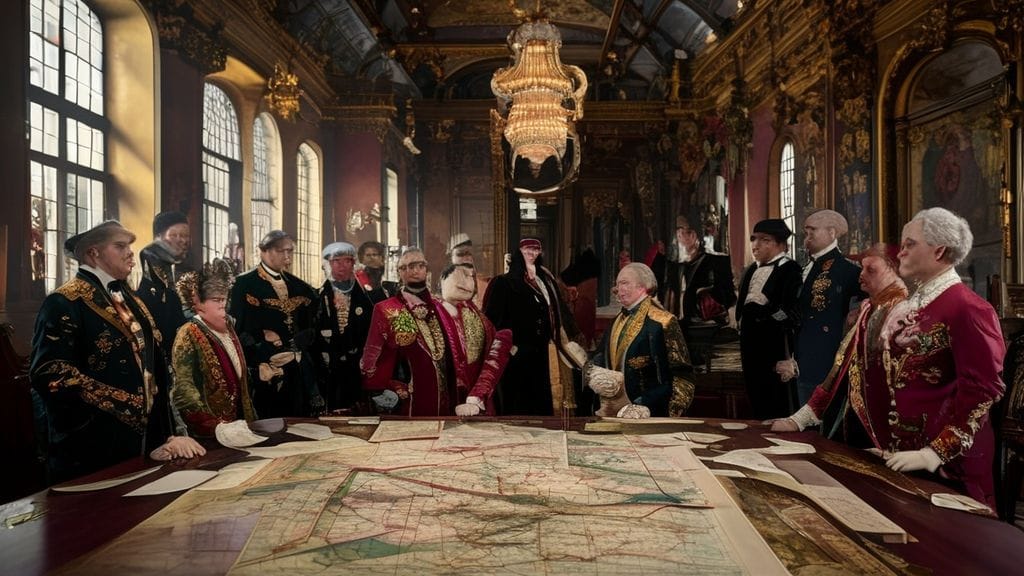
In grand rooms lit by candelabra, maps were unfurled and pinned to tables. Men leaned over them with compasses, rulers, and sometimes with little colored pins that marked claims, counterclaims, and fragile compromises. Europe, already scarred by decades of war, was to be stitched together like a torn garment. The principles guiding this work were not always consistent. “Legitimacy”—restoring rightful dynasties toppled by Napoleon—competed with “compensation”—rewarding states that had borne the brunt of the fight against him. The idea of a “balance of power” floated above these negotiations like an elusive but necessary ideal.
France was reduced to its 1792 borders, losing the gains of the revolutionary and Napoleonic years but spared harsher mutilations. The Netherlands were fused with the former Austrian Netherlands (roughly modern Belgium) into a stronger kingdom meant to guard France’s northern flank. In Italy, old rulers returned: the Habsburgs reclaimed Lombardy and Venetia, while smaller duchies were handed back to families whose names sounded like echoes from a pre-revolutionary age. Britain, secure behind its seas, took strategic colonial possessions—Malta, the Cape Colony, various islands—that served as stepping stones for its global empire.
The great suspense lay in Central and Eastern Europe. Prussia demanded territories in Saxony and along the Rhine; Russia sought to transform most of the old Polish lands into a quasi-kingdom under its tsar. Austria, fearing encirclement by two overgrown neighbors, resisted. Here, every inch on the map represented taxpayers, soldiers, and strategic positions. It was not uncommon for hours of argument to hinge on the fate of a single fortress town. When eventually the congress of vienna ends, the maps it leaves behind will show a Europe where many national aspirations have been postponed in the name of stability. It is a Europe designed less by the will of peoples than by the calculations of cabinets.
Germany Without a Germany: Confederations, Compromises, and Lost Dreams
Nowhere was the tension between old structures and new realities more evident than in the German lands. The Holy Roman Empire, that patchwork of free cities, bishoprics, and principalities, had vanished in 1806. In its place, Napoleon had erected the Confederation of the Rhine, clearing away some of the medieval clutter but leaving behind a region in which the idea of a united “Germany” had begun to take root. Poets and professors spoke of a common language, history, and destiny. Students, fired by nationalist ideas, imagined a future in which Germans would no longer be divided among dozens of petty courts.
Yet the rulers assembled in Vienna viewed such dreams with suspicion or outright alarm. A united Germany might be too powerful, too independent, or too influenced by popular sentiment. Austria, with its vast multi-ethnic empire, wished to preside over a loose association, not to dissolve its authority into some national parliament. Prussia, eyeing expansion, wanted lands and prestige, not necessarily a united polity that might limit its freedom of action. The solution, hammered out in committee rooms, was the German Confederation: thirty-nine states tied together in a flimsy legal framework, with a federal assembly in Frankfurt under Austrian presidency.
This Confederation was less a step toward unity than a cord meant to bind and restrain. It gave German rulers a platform for cooperation but also a pretext to suppress liberal and nationalist movements. When the congress of vienna ends, many patriotic intellectuals feel betrayed. The philosopher Johann Gottlieb Fichte’s call for a German nation, echoed in university lecture halls, finds no direct reflection in the final acts. For the time being, the fate of “Germany” remains in the hands of princes rather than people, preserved in a limbo that will last until the revolutions and wars of the later nineteenth century burst the Viennese corset.
Poland, Saxony, and the Price of Compromise
If the German question was complex, the Polish one was tortured. Poland had been partitioned at the end of the eighteenth century by Russia, Prussia, and Austria, erased from the map even before Napoleon used it as a pawn in his wars. The Duchy of Warsaw, created by him, had given Poles a tantalizing glimpse of semi-independence. Now that the French Emperor had fallen, the partitioning powers saw an opportunity to finalize their control. Russia, in particular, pressed for a large Polish kingdom under Tsar Alexander’s crown, arguing that he would grant it a liberal constitution and autonomy.
Prussia, in turn, wanted substantial parts of Saxony, whose king had remained loyal to Napoleon for too long in Allied eyes. The proposed dismemberment of Saxony and the enlargement of Russian-controlled Poland alarmed others. Castlereagh and Metternich feared a Europe tilted dangerously toward St. Petersburg and Berlin. For a moment, the dispute seemed so intense that yet another war among the former allies loomed. Secret defensive treaties were even drawn up, hedging against Russian and Prussian overreach. It was one of those moments when the whole Congress risked collapse.
The eventual compromise gave Russia the lion’s share of the Duchy of Warsaw as the “Kingdom of Poland,” but not as much as Alexander had wanted. Prussia received a smaller but still significant portion of Saxony and territories in the Rhineland, which would later become industrial powerhouses. Austria surrendered some Polish claims but secured Lombardy and Venetia in Italy. Saxony survived as a reduced kingdom. No one was entirely satisfied, but everyone could live with the outcome. “Diplomacy is the art of the possible,” an exhausted negotiator might have said as the ink dried. When, after all this haggling, the congress of vienna ends, it does so on the foundation of these uneasy bargains—compromises that postpones justice for Poles and Saxons but avoids immediate war among the victors.
Small Thrones, Big Fears: The Fate of the Lesser Powers
Beyond the grand plays of Russia, Britain, Austria, Prussia, and France, a supporting cast of smaller states crowded the stage, anxious not to be written out of the script. The kings of Sardinia and Naples, the dukes of Tuscany and Modena, the princes of Bavaria and Württemberg, the envoys of Spain and Portugal—all came with lists of grievances and petitions. Some sought restoration to lands taken by Napoleon; others begged protection against their neighbors. The Pope’s representatives argued for the return of papal territories, while Swiss envoys requested recognition of their confederation’s independence and neutrality.
For these smaller powers, the Congress was both an opportunity and a threat. A well-timed alliance with a great power might preserve a dynasty; a careless remark might condemn a principality to absorption. Protocol largely ensured that they were heard, but not that they were heeded. In private, the great powers often decided their fate without them. The King of Sardinia, for example, regained Piedmont and Savoy and was given Genoa, despite local opposition, as a buffer state against France. Switzerland received formal guarantees of neutrality that would endure for two centuries. Italy, however, remained a mosaic of restored dynasties and foreign influence, with Austria entrenched as the dominant power in the north.
Behind the formality, fear was palpable. Many of these rulers worried that if revolution returned, their precarious thrones would be swept away. They looked to Vienna not merely for borders, but for security against their own subjects. When the congress of vienna ends, it leaves them with assurances that uprisings will be treated as common threats. This web of mutual protection would later materialize as a system in which troops of one monarchy might march into the territory of another to crush a liberal or nationalist revolt. For now, though, these lesser sovereigns departed Vienna exhausted but relieved, clutching copies of treaties that promised to hold back the tide of change.
Crowds, Rumours, and Hunger: Life in Vienna Beyond the Palaces
While ministers debated flags and frontiers, life for ordinary Viennese moved at a different rhythm. The sudden influx of thousands of visitors drove up prices. Landlords, sensing opportunity, evicted tenants to rent rooms to wealthier foreigners. Some poor families, unable to compete, were pushed further to the outskirts of the city, beyond the glowing arc of festivities. In market squares, the cost of bread and meat rose with demand, and complaints simmered beneath the surface gaiety. Street musicians, however, fared well, as nobles tossed them coins to accompany carriages in processions or to enliven impromptu gatherings under windows.
News of the Congress filtered through the city in fragments and distortions. People in taverns argued over rumors: “They say the Prussians will get all of Saxony!” “No, no, the Russians will take everything to the Vistula!” Since the press was censored, pamphlets and clandestine sheets circulated in back rooms, offering exaggerated accounts of secret intrigues. Some pamphlets hailed the Congress as the dawn of peace; others mocked it as a carnival in which the rich feasted while the poor struggled. Foreign visitors wrote letters home describing a city of waltzes and wonders, but also of beggars at crossroads and children with thin faces staring into bakery windows.
The churches remained full. Priests preached sermons thanking God for the prospect of peace and urging patience and obedience to lawful rulers. Veterans, some of them mutilated, drifted around cathedrals and public squares, their loyalty to monarchs tested by the indifference they often encountered. When word began to spread that the congress of vienna ends soon, reactions were mixed. Some rejoiced that the flood of expensive guests might finally ebb. Others feared the loss of the business those guests brought. In every case, the people who had hosted Europe’s rulers could only guess at the final shape of the Europe that would emerge from their city.
A Treaty Takes Shape: Drafts, Deadlocks, and Breakthroughs
By early 1815, the mass of paper generated by the Congress had become almost legendary. Draft treaties, minutes of committee meetings, memoranda, private notes, and public declarations piled up in wooden cabinets and on desks. Secretaries worked late into the night, their hands cramped from copying pages in perfect script. The main document, later known as the Final Act, began to take shape as a complex scaffolding of territorial adjustments, guarantees, and principles. Each article had to be weighed against the next, so that no state felt unduly cheated or endangered.
Deadlocks were frequent. The Polish-Saxon question dragged; rival claims in Italy and on the Rhine flared up. At times, Castlereagh even considered returning to London without a full settlement, exhausted by what he saw as Russian and Prussian greed. Metternich juggled allies and adversaries with increasing desperation, aware that if Austria failed to hold the balance, it might one day be crushed between its neighbors. Talleyrand seized every opportunity to present France as the voice of moderation, cleverly turning his country’s former status as aggressor into a shield against excessive punishments for others.
Breakthroughs came in fits and starts. A clever phrase here, a face-saving formula there, a territorial swap that allowed two sides to declare victory to their home audiences—these were the bricks building the peace. Historians later have combed through the surviving papers to reconstruct these delicate manoeuvres. One scholar memorably wrote that the Congress was “less a symphony than a series of duets and trios, with occasional dissonant choruses.” When, at long last, the congress of vienna ends, it does so not after a single triumphant agreement, but after the gradual coalescing of many smaller bargains into one sprawling settlement.
The Thunder of a Fallen Emperor: Napoleon’s Return and the Congress in Crisis
Just when the delegates began to see the outlines of a final settlement, a thunderclap shattered their labors. In March 1815, news raced along the post roads: Napoleon had escaped from his exile on Elba and landed in France. In Vienna, the reaction was a jolt of fury and fear. Those who had tasted his victories or survived his defeats knew how quickly the continent could be plunged back into war. Within weeks, he marched triumphantly into Paris, the Bourbon king fleeing in panic. The Congress, which had itself been partly justified as a means to ensure that such a return would be impossible, now found its assumptions overturned.
Some delegates were briefly tempted to wonder whether the negotiations still mattered. If Napoleon re-established his empire, what would become of the carefully drafted partitions and restitutions? But the mood hardened quickly. The very existence of the Congress, with its assembled armies and ministers, made it easier to forge a renewed coalition. On 13 March, the powers issued a declaration denouncing Napoleon as an outlaw and committing to fight him again. The war that followed would climax at Waterloo in June 1815, just days after the Final Act in Vienna was signed.
This crisis paradoxically accelerated agreement. Issues that had seemed intractable now yielded to the urgent need for unity against the returning emperor. Concessions were pushed through, delays shortened. When the congress of vienna ends, it does so in the shadow of renewed conflict—but also with the sense that the allies, having defeated Napoleon once, could do so again. Waterloo, fought on muddy Belgian fields, would vindicate that confidence. The cannons spoke while the ink of Vienna was barely dry, binding the diplomatic settlement to a final military verdict.
June 9, 1815: When the Congress of Vienna Ends
On 9 June 1815, Vienna awoke under a sky streaked with early summer light. In the palaces where delegations lodged, servants moved quickly, preparing uniforms, pressing sashes, polishing boots and buttons. Today, the long labor of the Congress would be formally concluded. Delegates who had arrived the previous autumn, younger and perhaps more hopeful, now stared at their own faces in mirrors, marked with the strain of negotiations and the excesses of the Viennese season. Carriages rolled toward the Hofburg and other official buildings where the final signatures would be affixed.
The Final Act of the Congress of Vienna was not a single treaty between two states, but a comprehensive document to which the leading powers and many smaller states would accede. Its hundreds of articles codified the reshaping of Europe: the reconstitution of Switzerland, the enlargement of the Netherlands, the settlement of German and Italian affairs, the arrangements for Poland and Saxony, the guarantees and protocols on navigation and diplomatic rank. As pens dipped into ink and hands moved across parchment, the delegates committed themselves to a vision of Europe that, they hoped, would stand the test of time.
In that moment, when the congress of vienna ends in legal form, the room was likely filled not only with pride but with doubt. Some must have wondered whether paper could truly command the loyalties and resentments of millions who had never been consulted. Others, especially Metternich, believed that tradition and authority, once restored, would exert their own powerful gravity. Later memoirs offer glimpses of the atmosphere. One observer recalled a “grave sense of accomplishment, tinged with melancholy,” as if everyone present knew they had done something extraordinary, yet incomplete. Outside, the city moved as usual; artisans bent over their work, children chased each other in the streets, soldiers drilled in courtyards. The signing did not echo like a cannon shot. But in retrospect, that quiet day would be remembered as the hinge on which nineteenth-century Europe turned.
Peace as a Prison: The Concert of Europe and the Suppression of Revolt
With the Final Act signed, a new concept slowly took shape: the “Concert of Europe.” The term suggested a group of great powers playing in harmony, each instrument distinct but all coordinated. Behind the soothing metaphor lay a hard reality: the major monarchies—Britain, Austria, Russia, Prussia, and, increasingly, France—intended to manage European affairs collectively, meeting periodically to address crises and preserve the settlement. The aim was not just to prevent another Napoleon, but to prevent any disruptive upheaval, especially those sparked by liberal or nationalist ideas.
In practice, this meant that peace became, for many, a kind of prison. When revolutions broke out—first in Spain and Naples in the 1820s, later in parts of Germany and Italy—the great powers debated intervention. Metternich, ever fearful of contagion, saw revolution anywhere as a threat everywhere. Austrian troops marched into Naples and Piedmont to restore conservative rulers. Prussian authorities cracked down on student associations that dared to dream of a united, constitutional Germany. The Carlsbad Decrees of 1819 imposed strict censorship and surveillance across the German Confederation, a direct offspring of the arrangements put in place when the congress of vienna ends.
There were limits to this system. Britain, with its parliamentary tradition and maritime empire, often balked at full-scale intervention against constitutional movements. Over time, the unity among the powers frayed. Yet for several decades, the Concert of Europe did achieve something remarkable: it prevented a general war on the scale of the Napoleonic conflicts. The price was paid by those whose aspirations were smothered—Poles, Italians, Hungarians, Germans, and many others. Their stories would erupt into the revolutionary year of 1848, when barricades went up in cities from Paris to Vienna itself, challenging the settlement that had been designed to make such upheavals impossible.
Love, Scandal, and Whispered Promises: The Human Side of Diplomacy
No account of Vienna 1815 is complete without the human stories that threaded through the diplomatic tapestry. Many of these tales unfolded far from official minutes. Metternich himself was entangled in a series of affairs, some of which had political overtones. His relationship with Wilhelmine, Duchess of Sagan, for example, combined personal attraction with strategic calculation; she moved easily among foreign envoys and passed along insights that he could use at the negotiating table. Talleyrand, living in a household that included his clever and resourceful niece by marriage, Dorothée de Dino, cultivated a salon where French charm softened memories of imperial aggression.
Gossip spread quickly in this society. A snub at a dinner, a misplaced seat at a concert, a cold glance in a ballroom—such gestures could signal diplomatic shifts. Young officers fell in love with Viennese girls and faced the wrenching prospect of leaving them behind when the delegations departed. Some marriages were arranged or cemented during these months, linking families and fortunes across borders. For the high-born, the Congress was as much a marriage market as a peace conference.
But this was only the beginning of the private dramas. Servants overheard conversations that could topple ministries. A misplaced letter, found in the wrong hands, might force a change in negotiating positions. Personal rivalries burned beneath the veneer of courtly manners. Tsar Alexander’s mystical religiosity irritated some, while his flirtations fascinated others. Castlereagh, exhausted and tormented by the burdens of his role, would later fall into deep depression, ending his own life only a few years after the Congress. Behind the formal portraits that hang in museums today, there were beating hearts, aching bodies, and compromised souls.
The Forgotten and the Silenced: Peoples Without a Voice
Even as rulers and ministers debated the fate of kingdoms, the vast majority of Europeans had no seat at the table. It is here that the story of the Congress reveals its sharpest edge. Nationalities that had begun to form a sense of collective identity—Poles, Czechs, Slovaks, Serbs, Croats, Norwegians, Greeks, among others—saw their lands treated as bargaining chips. The principle of legitimacy, so loudly defended by Talleyrand and others, meant restoring dynasties; it did not mean recognizing the right of peoples to choose their rulers. The gap between the language of “order” and the lived experience of subject populations could be immense.
Consider Italy, divided once more into a patchwork of restored duchies, papal lands, and Austrian provinces. Young Italians who had marched under Napoleon, or who had read the fiery writings of patriots, chafed under the return of rulers they saw as backward and foreign. In Poland, the new Kingdom under the Russian Tsar was promised a constitution, but its autonomy would prove fragile. In the Balkans, still largely under Ottoman rule, the Congress gave little direct hope to Christian populations whose aspirations would later explode into wars of independence.
Women, too, remained overwhelmingly excluded from formal power, even as they played crucial roles in salons and households. The Congress shored up a patriarchal political order at the very moment when industrial and social changes were beginning to unsettle traditional gender roles. When the congress of vienna ends, it leaves behind a Europe that is orderly on paper but restless underneath. As one modern historian has put it, “Vienna 1815 froze a moving picture”—capturing a single frame in a rapidly changing society. That freeze would not hold forever.
Did It Work? A Century of War, and the Long Peace in Between
Judging the Congress of Vienna depends on the vantage point one chooses. Measured against the horrors of the Napoleonic Wars, the nineteenth century that followed looks, at first glance, relatively peaceful. There were conflicts—Crimea in the 1850s, the wars of Italian unification, the Austro-Prussian and Franco-Prussian wars—but there was no general conflagration involving all the major powers until 1914. Many historians argue that the balance-of-power system crafted in Vienna, and maintained through the Concert of Europe, deserves credit for this long peace. By institutionalizing regular consultation and making unilateral aggression more costly, the Congress may have bought Europe nearly a century without continent-wide war.
Yet the price of that peace, as we have seen, was often repression. The Congress bequeathed a framework in which legitimate grievances found few legal outlets. National movements sometimes had no choice but to express themselves through underground organizations or violent revolt. The revolutions of 1830 and 1848, and the eventual unifications of Italy and Germany, all unfolded in opposition to the order sanctified in Vienna. The settlement also did little to address colonial rivalries beyond Europe, where expansion and domination proceeded as usual, sowing seeds that would later contribute to global conflicts.
Looking back from the vantage point of the First World War, some critics saw Vienna as a failure, its system finally collapsing in a whirlwind of alliances and arms races. Others, more nuanced, suggested that nothing crafted by human hands could have contained the forces unleashed by industrialization, nationalism, and mass politics indefinitely. The fact that the Viennese system lasted as long as it did, they argued, was testimony to its partial success. In this view, when the congress of vienna ends, it does not close history but opens a distinct chapter—one in which the struggle between order and change, monarchy and popular sovereignty, is played out within parameters it helped define.
Memory, Myth, and the Meaning of Vienna 1815
Over the centuries, the Congress of Vienna has become more than a historical event; it has turned into a symbol. For conservatives of the nineteenth century, it was a golden moment when Europe’s rightful rulers, taught by the hard lessons of revolution and war, gathered to restore harmony. For liberals and nationalists, it was a dark bargain, struck over the heads of peoples yearning for freedom. Writers and playwrights have imagined the ballrooms, the intrigues, the love affairs, sometimes turning the Congress into a glittering backdrop for romantic drama. The line “The Congress dances but does not move,” often attributed to Prince de Ligne, has been recycled so many times that it has acquired a life of its own, even though scholars debate its exact wording and context.
Modern historians, armed with archives and a more critical eye, have complicated these myths. They remind us that the Congress was not a single coherent entity, but a messy, human process full of uncertainty and improvisation. The Austrian historian Heinrich von Srbik once observed that “Vienna 1815 was an attempt to restore the past by using tools forged by the revolution,” a paradox that explains much of its eventual unraveling. Another scholar, Paul W. Schroeder, famously argued that the Congress “fundamentally restructured European politics,” creating a system more cooperative and law-bound than any that had gone before. These interpretations coexist uneasily, just as order and upheaval did in the post-Napoleonic decades.
In contemporary debates about international order, the Congress is sometimes invoked as a model. Diplomats and analysts ask whether a new “Concert” might stabilize troubled regions or manage the rise of new powers. In such conversations, the day the congress of vienna ends becomes a touchstone: a reminder that durable peace cannot be imposed solely by force, but also a warning that peace built without the consent of peoples can crack from within. The gilded image of Vienna 1815 thus hides a deeper, more ambiguous legacy—one that still speaks to the dilemmas of our modern world.
Conclusion
On that June day in 1815, as the final signatures dried and the congress of vienna ends in formal terms, few could fully foresee the century that would grow from its decisions. The delegates believed they were closing the book on revolution and conquest, stitching together a Europe of stable thrones and carefully balanced frontiers. In some respects, they succeeded: the map they drew, and the habits of consultation they fostered, did contribute to an unprecedented stretch of relative peace among the great powers. Yet beneath the surface, the currents of nationalism, liberalism, and social change continued to flow, sometimes quietly eroding, sometimes violently shattering the structures that Vienna had tried to reinforce.
The story of the Congress is therefore one of contrasts: glittering salons and overcrowded tenements, noble sentiments about order and cynical horse-trading over provinces, declarations of legitimacy alongside the silencing of entire peoples. It invites both admiration for the skill of its architects and sympathy for the millions who found their fate decided without representation. To walk today through Vienna’s elegant streets, past the Hofburg and the ballrooms where waltzes once set the rhythm of diplomacy, is to be reminded that international order is always provisional, always human, always contested. The moment when the congress of vienna ends is not the end of conflict, but the beginning of a long, complex experiment in managing it—a legacy that continues to challenge and inspire those who seek, in our own turbulent age, to build a durable peace.
FAQs
- What was the main purpose of the Congress of Vienna?
The primary aim of the Congress of Vienna was to reshape Europe after the defeat of Napoleon, restoring a balance of power that would prevent any single state—especially France—from dominating the continent again. The delegates also sought to re-establish traditional monarchies and contain the spread of revolutionary and nationalist ideas. - When did the Congress of Vienna officially end?
The Congress of Vienna officially concluded on 9 June 1815 with the signing of the Final Act. Although some negotiations and diplomatic contacts continued afterward, this date marks the formal end of the Congress and the adoption of its comprehensive settlement. - Which major powers dominated the Congress of Vienna?
The Congress was dominated by five major powers: Austria, Britain, Russia, Prussia, and, somewhat unexpectedly given its recent defeat, France. Their representatives—Metternich, Castlereagh, Tsar Alexander I (and his ministers), Hardenberg, and Talleyrand—shaped most of the crucial decisions. - How did the Congress of Vienna affect France?
France was reduced to its 1792 borders and lost the territories it had gained during the revolutionary and Napoleonic wars. However, thanks largely to Talleyrand’s diplomacy, it was not dismembered or permanently humiliated. Instead, France was gradually readmitted as a full partner in the Concert of Europe, helping to maintain the balance of power. - Did the Congress of Vienna respect national self-determination?
Only rarely. The Congress prioritized dynastic legitimacy and the interests of established states over the aspirations of national groups. Poles, Italians, Germans, and many others saw their territories rearranged without direct input, which contributed to later nationalist movements and revolutions. - What was the “Concert of Europe” that emerged from the Congress?
The “Concert of Europe” was an informal system of great-power cooperation that grew from the arrangements made at Vienna. The major powers agreed to consult regularly and act together to preserve the settlement, resist revolutionary movements, and prevent any single state from upsetting the balance of power. - How long did the Vienna settlement last?
Many of the borders and principles established at Vienna endured for decades, some even into the twentieth century. While parts of the system were challenged and altered by the revolutions and national unifications of the nineteenth century, the basic idea of a European balance of power and multilateral diplomacy shaped international relations until the First World War. - Why is the Congress of Vienna still studied today?
The Congress is studied as a landmark in diplomatic history and international relations. It offers a case study in how states attempt to build a durable peace after massive conflict, the trade-offs between stability and justice, and the ways in which high-level diplomacy interacts with social and political forces on the ground.
External Resource
Internal Link
Other Resources
- Encyclopaedia Britannica – general search for the exact subject
- Google Scholar – academic search for the exact subject
- Internet Archive – digital library search for the exact subject

