Table of Contents
- A Roman Dawn on an Irish Shore: Setting the Stage, 431
- Rome Looks Westward: Church and Empire on the Edge of Collapse
- Before the Bishops: Ireland’s Pagan Kings, Druids, and Sacred Landscapes
- Whispers in the Curia: How Palladius Emerged from the Shadows
- A Mission Ratified: Pope Celestine I and the Decision to Send Palladius
- Across Stormy Seas: The Voyage from the Roman World to Ireland
- First Footsteps on Foreign Soil: Palladius Meets the Irish
- Between Druids and Kings: Negotiating Power, Belief, and Survival
- Founding the First Communities: Churches, Converts, and Quiet Failure
- A Short and Difficult Ministry: Resistance, Exile, and the End of Palladius’ Mission
- Enter Patrick: How Palladius Paved the Road for a More Famous Successor
- Memory, Legend, and Competition: Palladius in Irish and Latin Sources
- From Margins to Mainstream: The Long-Term Impact of a Brief Episcopate
- Religion and Power Reshaped: How Christianity Rewired Early Irish Society
- Archaeology and Echoes in Stone: Tracing Palladius’ Faint Footprints
- Reclaiming a Forgotten Pioneer: Palladius in Modern Historiography
- Conclusion
- FAQs
- External Resource
- Internal Link
Article Summary: In the year 431, long before St Patrick’s fame colored every telling of Ireland’s Christian origins, palladius sent to ireland as first bishop marked a quieter, more uncertain beginning. This article reconstructs the world that produced him: a crumbling Roman Empire, a restless Church, and a pagan Ireland of kings, druids, and sacred hills. It follows Palladius from the corridors of papal power to the storm-swept coasts of Leinster, exploring how politics, doctrine, and personal courage intertwined. Along the way, it shows how palladius sent to ireland was both a bold experiment and, in many ways, a failure that cleared the ground for Patrick. The narrative weaves sources, archaeology, and later legend to ask why one man became a saint of global renown, while the other faded into footnotes. By examining social and political consequences, it reveals how those early missions opened the door to monasteries, scriptoria, and a new Irish identity. Ultimately, the story of palladius sent to ireland becomes a meditation on memory, power, and the fragile beginnings of cultural transformation.
A Roman Dawn on an Irish Shore: Setting the Stage, 431
The year is 431. Imagine, not the emerald postcard of modern Ireland, but a harsher, more fragmented land: hills scoured by Atlantic winds, hillforts crowning the ridges, longhouses clustered around smoky hearths, and distant fires pricking the dark along river valleys. News travels slowly here, carried by traders, hostages, and wandering poets. The thunder of Roman legions has never shaken this soil. No imperial eagle has flown over these shores. And yet, in that year, a decision taken hundreds of miles away, in the fading glow of the Roman world, would send a quiet ripple across Irish water. It was palladius sent to ireland as the first bishop—an appointment that, at the time, seemed hardly world-shattering, but that would become a hinge in the history of an island.
To see Palladius’ arrival clearly, you must picture two worlds uneasy with each other. On one side stands the Latin Christian tradition, still bearing itself with imperial poise but already fraying at the edges—bishops writing letters in careful script while barbarian kings prowl just beyond their doors. On the other side stands Ireland: a place of clan loyalties, sacred groves, megalithic tombs older than Rome itself, an oral culture where memory is law and poetry a weapon as sharp as any spear. When palladius sent to ireland, he carried not only a cross and texts of Scripture, but also the weight of this older, tottering civilization. He was Rome’s envoy to a people Rome had never conquered.
The story usually told today is different. It begins and ends with Patrick: the shepherd boy seized by raiders, the slave-turned-missionary who baptized kings and toppled idols, the beloved saint whose feast day colors the world in green once every March. But this is only the afterimage. Earlier, in the shadowy foreground, another figure moves: quieter, less legendary, but no less real. To understand the full drama of Ireland’s Christianization, we must step back from Patrick’s bright halo and watch as palladius sent to ireland, the first official bishop dispatched “to the Irish who believe in Christ,” as one terse chronicle puts it.
It is astonishing, isn’t it? The first legally sanctioned bishop to minister to Irish Christians is today almost unknown outside scholarly circles. His mission was brief, his success limited, his memory tangled in confusion. Yet his very failure—or partial failure—shaped what came next. The bishop who landed on these shores in 431 confronted a country that did not yet have a script for being Christian, and an ecclesiastical authority that had only a vague sense of what to expect. Standing at this threshold, Palladius embodies the uncertainty of an age in transition: Roman yet marginal, authoritative yet vulnerable, a “first” whose legacy would be overshadowed, but not erased, by those who followed.
But this was only the beginning. To understand who Palladius was, why he was sent, and what happened when he stepped onto Irish soil, we must first turn back to the wider world from which he came—a world cracking under pressure, yet still capable of extraordinary, missionary ambition.
Rome Looks Westward: Church and Empire on the Edge of Collapse
When we speak of “Rome” in 431, we are no longer speaking of the confident empire of Caesar or Trajan. The western half of the empire is a wounded animal, scarred and limping. Only two decades earlier, in 410, Rome itself had been sacked by Alaric and his Visigoths. The shock reverberated through the Christian world. What did it mean for the city that once persecuted Christians now to fall—even briefly—to pagan invaders? Augustine of Hippo, writing his immense work The City of God, tried to make sense of it, reminding believers that no earthly order, not even Rome, was eternal.
Politically, power is fragmenting. Germanic kings rule in once-Roman provinces. Armies are composed less of loyal citizens, more of precarious federate troops whose allegiance can shift. Economies shrink, trade routes fray. In such a climate, the institutions of the Church paradoxically grow stronger in certain respects. Bishops step into roles once held by imperial governors: arbitrators, patrons, defenders of their cities. The prestige of the Bishop of Rome, later called the pope, is rising, not because Rome is politically secure, but because its spiritual authority offers a new kind of stability.
Into this landscape steps Pope Celestine I, whose pontificate (422–432) coincides with that of Nestorius in Constantinople and the theological battles that culminated in the Council of Ephesus in 431. Celestine grapples with doctrinal disputes in the East and also with pastoral concerns in the West: the spread of British ascetic movements, the moral laxity of elites, and the question of how to shepherd communities beyond the old imperial frontiers. When palladius sent to ireland, this was not an isolated whim. It was part of a broader vision: to extend Roman ecclesiastical order to outlying regions where Christian groups had already sprung up, but without clear oversight.
Scholars often emphasize that the Church did not simply follow imperial borders; it was more adventurous, more flexible. While emperors calculated the cost of military campaigns beyond the frontier, bishops weighed spiritual and reputational costs. A mission might fail, yes, but if it succeeded it would expand the moral jurisdiction of Rome, binding new converts into a network of allegiance no longer enforced by legions but by liturgy, penance, and hierarchical bonds. The appointment of Palladius as a bishop “to the Irish who believe in Christ” reflects this. It hints that some Irish, likely in the southeast and coastal regions, had already embraced Christianity through contact with Britain and Gaul. They needed a shepherd whose authority could be traced directly back to the papal chair.
At the same time, the Roman Church was reacting against theological deviations and unauthorized preachers. To send an official bishop was also to assert control, to say: this is the legitimate teacher, this is the line of communion. Palladius’ ordination at the hands of Celestine is both pastoral and political. It sends a signal to British Christians drifting doctrinally, perhaps flirting with Pelagian ideas, and to Irish chiefs experimenting with this new religion: authentic Christianity has a recognized chain of command. When palladius sent to ireland, Rome was not merely evangelizing; it was organizing, defining, and defending its brand of orthodoxy on a frontier where beliefs were fluid and boundaries porous.
Thus, behind the solitary figure of a bishop boarding a ship lies the anxious heartbeat of a civilization trying not to disintegrate. The Roman world, in its final western centuries, chooses one of its last great export strategies: not soldiers, not governors, but bishops.
Before the Bishops: Ireland’s Pagan Kings, Druids, and Sacred Landscapes
To the churchmen in Rome, Ireland—Hibernia, the “land of winter”—was a half-imagined periphery, a place known from travelers’ tales and traders’ gossip. But to those who lived there, it was the center of their own cosmology. Before Palladius set foot on its shores, Ireland was a patchwork of túatha, small kingdoms ruled by warrior-kings whose legitimacy was woven from blood, land, and ritual. Law was not written in codices but carried in the heads of brehons, learned jurists of an oral legal tradition so intricate that judgment could turn on a single remembered precedent or a well-quoted verse.
Religion in this world was not confined to temples. It was inscribed in the land itself. Hilltops like Tara in Meath or Uisneach in Westmeath served as symbolic centers, places where kings were inaugurated, oaths taken, and sacrifice—animal, perhaps once human—performed to guarantee the fertility of fields and the stability of rule. Standing stones, ancient mounds, and burial cairns linked the living to an ancestral past stretching back thousands of years. Druids—priests, diviners, poets of a kind—acted as intermediaries between people and the invisible forces that inhabited this landscape.
It is crucial to realize that this pagan world was not a simple field awaiting the seed of Christianity. It was a sophisticated system of meaning. Honor, kinship, and reputation governed social life. Hospitality was sacred; satire, delivered in verse by a skilled poet, could ruin a chieftain as surely as a defeat in battle. Cattle were wealth; fosterage bound noble houses together; hostage-taking ensured alliances. When palladius sent to ireland, he entered a society where every ritual action—lighting a fire on a royal hill, swearing an oath, giving a gift—carried spiritual weight and legal consequence.
This complexity meant that conversion could never be merely a private affair of the heart. It was necessarily public and political. For a king to accept Christian baptism was to align himself with a new hierarchy of spiritual authority, to reorient legal customs toward new ideals of mercy and penance, to invite foreign scribes and clerics into the inner circle of counsel. It risked offending druids, unsettling noble lineages, and provoking rivals. Yet it also offered new prestige: connection to the wider world of Latin literacy, to the powerful bishop of Rome, to a faith that by now couched itself in the mantle of civilized order.
By the early fifth century, traces of Christianity had already appeared in Ireland. Trade routes between the western coasts of Britain and the Irish east coast brought slaves, metalwork, wine, and, sometimes, ideas. Captives taken in raids—like the young Patrick, according to his own account—might bring rudiments of Christian belief with them, even as they tended flocks on Irish hills. Traders from Roman Britain may have prayed quietly to Christ before sailing home. Some local elites, impressed by the prestige of the Roman world, may have converted individually, even without organized oversight. It is these scattered believers whom Palladius was formally sent to serve.
In this sense, the mission of palladius sent to ireland did not break into virgin territory. It approached a borderland already crackling with religious experimentation and encounter. A Christian cross carved on a stone near a coastal settlement might share space with older symbols. A local lord might sponsor a small gathering of Christian slaves for worship while still sacrificing to the gods of his ancestors. For Palladius, the challenge would not be to invent Christianity in Ireland, but to shape it—to transform a scattered, perhaps syncretic set of practices into a Church with structures, doctrines, and discipline that mirrored, however imperfectly, the Roman norm.
Whispers in the Curia: How Palladius Emerged from the Shadows
Who, then, was Palladius? The sources are sparse, tantalizingly so. We know far less about him than about Patrick, whose own writings—Confessio and Letter to the Soldiers of Coroticus—give us a rare first-person window into a fifth-century Christian mind. Palladius leaves no such self-portrait. Instead, he appears in the historical record like a figure glimpsed between closing doors: briefly visible in a handful of lines, then gone.
One of the earliest mentions comes from Prosper of Aquitaine, a contemporary chronicler and defender of Augustine’s theology against Pelagianism. Writing in his chronicle, Prosper notes that in 431 “Palladius, having been ordained by Pope Celestine, is sent as first bishop to the Scots [i.e., Irish] who believe in Christ.” This statement, stark and simple, is our anchor. It tells us three crucial facts: he was ordained a bishop; he was sent by Celestine; and he was destined for Christians already present among the Irish. Prosper knew what he was talking about; he was close to the events in Rome and deeply engaged in the political and doctrinal currents of his day. Historians treat this brief line as a rare solid foothold in the slippery terrain of early Irish Christianity.
Later hagiographical sources, written centuries after the events, embroider on this minimal core. Some Irish traditions try to reconcile Palladius with Patrick by suggesting that Palladius adopted the name Patrick after reaching Ireland, effectively folding both figures into one illustrious saint. Others treat him as a kind of failed forerunner, emphasizing his difficulties and short stay to magnify Patrick’s later success. Modern scholarship, comparing dates and analyzing linguistic evidence, generally treats them as distinct individuals whose missions overlapped chronologically or followed each other in quick succession.
Before he was palladius sent to ireland, he likely spent years in the cultivated, tense atmosphere of the Roman Church. Some scholars have suggested that he might be the same Palladius who appears in documents from Gaul, a deacon actively engaged in ecclesiastical politics and anti-Pelagian efforts. If so, then he was a skilled administrator, versed in theological debates, and trusted by key bishops. This would make his selection for the Irish mission logical: he was not merely pious but politically reliable, committed to the Augustinian line upheld by Celestine against heresies that threatened to dilute the Church’s teaching on grace.
We can imagine him, then, not as a rustic wanderer but as a man who knew the inner workings of synods and papal correspondence, someone accustomed to the careful phrasing of doctrinal letters and to the maneuverings of rival factions within the hierarchy. When Pope Celestine weighed candidates for a new and delicate position on the fringes of the Christian world, he chose a man he could trust to plant not just any version of Christianity, but the right one. Thus palladius sent to ireland carried with him not only the Gospel but also a particular theological lineage. He was, in a sense, an ambassador of Augustine as much as of Christ.
It is tempting to speculate on his feelings as he received his commission: pride, apprehension, a sense of destiny or perhaps grim duty. Did he dream of a flourishing Irish Church that would, one day, send its own missionaries back to the continent? Or did he see this posting as exile to the very margin of the known world? The sources are silent. But we know that Rome, in those last days before his departure, was a city both venerable and frightened. Barbarian armies loomed; political intrigues simmered; theological disputes raged in council halls. Perhaps the prospect of leaving such turmoil for the wild, unknown Irish shore seemed, paradoxically, a kind of escape.
A Mission Ratified: Pope Celestine I and the Decision to Send Palladius
The decision to consecrate and dispatch a bishop was never taken lightly. Ordination, especially to the episcopate, carried legal, spiritual, and symbolic weight. In Palladius’ case, the act bore an additional prestige: he was the first bishop explicitly tasked with governing a Christian community in Ireland. When palladius sent to ireland by decree of Celestine, his appointment signaled a new phase in the Church’s engagement with the islands beyond Britain.
Celestine was already active in the affairs of the British Church. Around this same period, he had intervened against Pelagianism there, reportedly sending the Gallic bishop Germanus of Auxerre to combat what he saw as a pernicious heresy that overemphasized human free will at the expense of divine grace. It is in this context that Prosper famously writes: “He [Celestine] sent Germanus as his representative to root out heresy, and he ordained Palladius as the first bishop for the Scots believing in Christ.” The parallel is revealing: both missions aim to secure orthodoxy and proper oversight on the periphery.
Yet behind the formal language of ordination and mission lies a network of personal appeals and recommendations. Who first suggested that a bishop be sent to Ireland? Perhaps Irish Christians themselves, or British allies with Irish connections, petitioned Rome for support. Perhaps Palladius had firsthand knowledge of the situation through correspondence with British clergy. We do not know. But what is clear is that Celestine saw enough promise in these distant believers to invest in an episcopal mission, even as he was embroiled in the global controversy over Nestorius and the nature of Christ, which would culminate in the Council of Ephesus in that same year, 431.
The timing is striking. In a year when bishops from across the empire were gathering to debate subtle Christological formulations, the Bishop of Rome also turned his eyes to a wind-battered island at the edge of the world. High theology and raw missionary work, it seems, were two sides of the same coin. What good was articulating the correct doctrine of Christ’s natures if the Gospel did not reach those beyond the imperial horizon?
Thus, in a ritual probably conducted within one of Rome’s basilicas, under the watchful eyes of clergy and perhaps a small cluster of foreign petitioners, Palladius was consecrated. Hands were laid on his head; prayers were spoken; the Holy Spirit invoked. In that moment, palladius sent to ireland in intention before he ever boarded a ship. His new identity as bishop bound him indissolubly to his flock, even if he had not yet seen their faces. Canon law and custom would expect him to govern, teach, and sanctify them—an awesome responsibility for one man facing a society whose language, laws, and customs were largely alien to his own.
Rome’s decision was now made flesh in Palladius. The rest of the story would unfold far from the marble columns and fading frescoes of the city. It would be written in storms and negotiations, in misunderstandings and fragile alliances, on a shore where Latin words might sound as foreign and unsettling as thunder over the hills.
Across Stormy Seas: The Voyage from the Roman World to Ireland
To leave the Mediterranean orbit for the North Atlantic in the fifth century was to step off the map of familiarity. The sea routes between Gaul, Britain, and Ireland were known to traders and raiders, but they were treacherous. Ships were small, their hulls creaking under the strain of waves and wind. Navigation depended on stars, coastline, and the hard-won experience of sailors whose lives had been shaped by these gray waters.
We can picture Palladius’ journey as a series of edges: leaving Rome or Ravenna for a northern port of Gaul, then crossing to Britain, and finally striking out for the Irish coast. Each leg would have meant a change of climate, language, and even sky. Latin gave way increasingly to vernaculars; Roman stone walls yielded to wooden forts; the memory of Caesar’s conquests faded into stories of local kings and their feuds.
At some point, likely along the coasts of Brittany or western Britain, he would have encountered seasoned sailors familiar with the Irish Sea. They could tell him of the strong tides in the channel, the sudden storms, the rugged silhouettes of Irish headlands appearing out of the mist. They might also speak of the people there: fierce raiders; proud kings; and, in some places, peculiar groups who worshiped a single God and refused to eat meat offered to the old gods. For these men, palladius sent to ireland would have seemed an odd figure—part holy man, part foreign official—placing his fate in their calloused hands.
The voyage itself was as much spiritual test as practical endeavor. In Christian imagination, the sea often symbolized chaos, the primordial waters over which the Spirit had hovered in Genesis. To cross it for the sake of the Gospel was to imitate apostles and martyrs, to trust in Providence amid real danger. One can imagine Palladius praying the psalms as waves crashed against the hull, repeating lines that promised deliverance from the “deep waters” and from “stormy wind and tempest.”
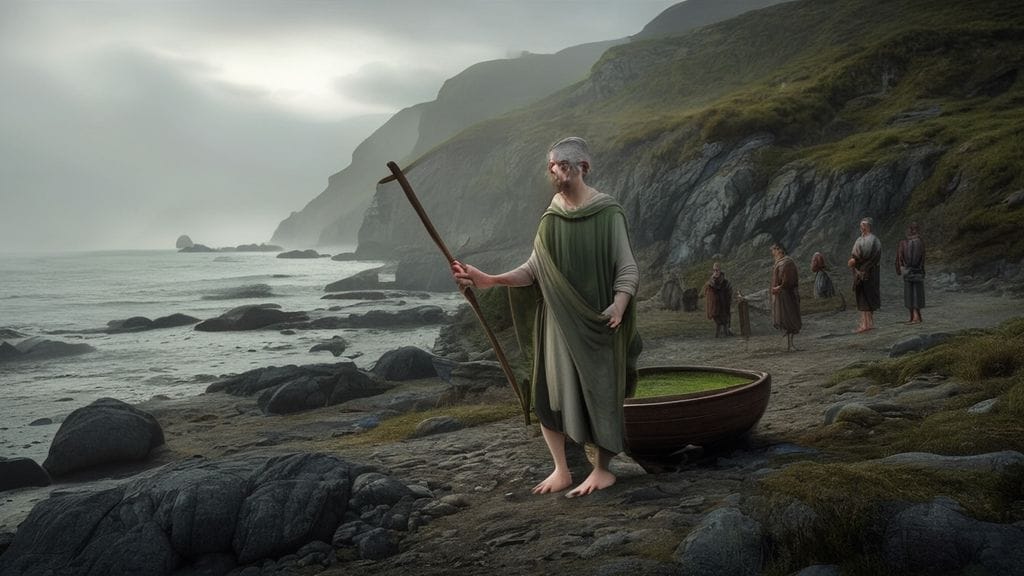
Landfall, when it came, was not marked by trumpets or processions. Instead, it may have been nothing more than a distant line of green resolving into cliffs and coves, seabirds wheeling overhead, and the frightened relief of sailors who had survived another crossing. The Irish shore he stepped onto—perhaps somewhere along the east coast, in Leinster—was no blank slate. Men were watching. Local chiefs monitored every arrival. News of his presence would have spread quickly: a foreign holy man, with a different dress and accent, claiming authority from a far-off bishop of Rome.
The sea lay behind him now; ahead lay an even more treacherous crossing: from one religious world to another.
First Footsteps on Foreign Soil: Palladius Meets the Irish
Picture the scene: A small party of foreigners disembarking, perhaps dragging a few chests containing liturgical vessels, books, vestments. Their crosses glint dully in the gray light. Watching from a distance are locals—fishermen, youths sent to monitor the shore, retainers of a nearby chieftain. The air smells of salt, peat smoke, and wet earth. Communication, at first, is halting. Palladius may have known some British dialects; if he landed near areas with long-standing contact with Britain, interpreters could be found. Still, each word traded across this gap is heavy with potential misunderstanding.
From the account of Prosper and from later traditions, we infer that Palladius did not come to a religious vacuum. There were already “Irish who believe in Christ.” Perhaps in some coastal settlements he found small gatherings of believers—former slaves returned from Britain, traders who had adopted Christianity abroad, local women who had heard of the new faith from kin across the sea. For them, the arrival of an official bishop, palladius sent to ireland by the pope himself, must have seemed almost miraculous. Here, at last, was someone who could baptize with recognized authority, confirm, celebrate the Eucharist regularly, and ordain clergy.
We can imagine his first assemblies: a handful of believers meeting in a wooden hall or in an open field, listening as Palladius preached through an interpreter. He would have spoken of the unity of the Church, the line of bishops stretching back to the apostles, the sacraments as channels of grace. Perhaps he carried letters from Celestine, which he or a companion translated aloud, testifying that their community was not forgotten, that it was embraced by the wider body of Christendom.
Yet behind the celebrations lurked complications. Local power structures were suspicious of anything that could reorient allegiance away from kin and king. The druids, whose status depended on their mastery of ritual and knowledge, could view Palladius as an interloper, introducing rival rites and interpretations of the sacred. Even basic practices—the prohibition of exposure of infants, the condemnation of certain forms of slavery, the Christian calendar of feasts and fasts—might clash with inherited customs.
Moreover, the bishop’s Roman habits and expectations may have fit poorly with the fluid, decentralized reality of Irish society. Accustomed to diocesan boundaries and urban centers, he found a land without cities in the Roman sense, with power dispersed among dozens of small kings. To build a stable Christian community, he would need noble patronage. But each alliance risked provoking rivals. A church founded near one royal residence might be seen as a threat by neighboring rulers, who could respond with violence or expulsion.
This tension between fragile hope and looming resistance defines Palladius’ first steps in Ireland. He had achieved what Rome had decided: palladius sent to ireland, consecrated and present. But fulfilling his mandate—to shepherd, to organize, to expand the faith—would prove far more arduous than his ordination ceremony had suggested.
Between Druids and Kings: Negotiating Power, Belief, and Survival
No missionary operates in a political vacuum. Every sermon, every baptism, every new building is also a statement about power—who wields it, under what authority, and toward what ends. For Palladius, the tricky task was to embed a foreign, text-centered, hierarchical religion within a society whose religious life was distributed among oral specialists and whose politics rested on kinship and honor.
The druids, although poorly understood by modern historians, can be imagined as the custodians of ritual knowledge, guardians of sacred places, and interpreters of omens. Their prestige depended on their ability to read the will of the gods and ensure the prosperity of the clan. A new holy man who claimed exclusive knowledge of the one true God, and who rejected traditional sacrifices, threatened not only their theology but their social role. Resistance could take many forms: public ridicule, theological debate, or quiet pressure on local kings to deny this foreigner protection.
Kings, meanwhile, weighed the costs and benefits of patronizing Palladius. To support him might open channels to Roman goods, literacy, and foreign allies. It could also offer a new spiritual grammar for kingship: instead of— or in addition to—sacrificing at ancestral sites, a king might be blessed by a bishop, receive sacred anointing, and claim authority under heaven’s single God. But such innovation came with risk. A rival might accuse him of betraying the ancestors or weakening traditional bonds. A bad harvest or military defeat could be blamed on forsaking the old gods.
Palladius’ strategy, as far as we can infer from scattered later clues, likely involved seeking the patronage of sympathetic rulers in Leinster and perhaps beyond. He would have offered them not just personal salvation, but a new kind of prestige: the honor of being counted among the first Christian kings of Ireland, linked via their bishop to the venerable see of Rome. Such alliances could enable the founding of churches on royal land, giving Christian communities a degree of legal and military protection—essential in a world where violence was a routine tool of politics.
It is here that the human dimension of the story emerges most vividly. Negotiations were not executed by disembodied “institutions” but by individuals, each with their own fears and ambitions. Imagine the conversations in smoke-filled halls, where Palladius, through an interpreter, tried to explain the concept of a universal church to a king whose world extended no farther than the next valley and the rumors brought by travelers. Imagine noblewomen hearing of a God who valued chastity and charity, slaves being told of a Lord who himself was humiliated and crucified, poets listening skeptically as biblical stories competed with their own rich corpus of tales.
In such a milieu, survival meant compromise and prudence as much as zeal. Palladius had to decide which customs could be tolerated, at least temporarily, and which practices—idolatry, certain sacrifices, perhaps violent raids on Christian neighbors in Britain—must be confronted directly. Every decision created both opportunities and enemies. It is in this delicate dance of accommodation and confrontation that many early missions either flourished or failed.
Founding the First Communities: Churches, Converts, and Quiet Failure
Over time, Palladius appears to have established at least a few Christian sites in Ireland, though their exact locations and extent remain subjects of scholarly debate. Later tradition associates him and his companions with certain places in Leinster and possibly in the southeast, where archaeological traces hint at early Christian occupation: simple wooden churches, small burial grounds marked by inscribed stones bearing crosses and occasionally Latin names.
The communities he founded were probably small and fragile. A “church” in this period might be no more than a modest timber structure, a surrounding enclosure, and a cluster of huts where a few clerics and lay families lived. But within these spaces, a different rhythm of life unfolded: psalms chanted in Latin, bread and wine consecrated in the Eucharist, catechumens instructed in the rudiments of the Creed and the Lord’s Prayer. Over time, habits formed—Sunday assemblies, annual feasts, Lenten fasting—that began to mark Christian time as distinct from the cyclical rhythms of sowing, harvest, and tribal festivals.
For Palladius, each new community was a victory, but also a burden. A bishop’s role included oversight and teaching; he could not remain in one place indefinitely if he wished to serve multiple groups. Travel across rough terrain, through territories governed by different kings, exposed him and his companions to danger. It also limited his ability to impose uniform discipline or to ensure that local leaders understood the faith beyond a bare outline. Christianity might spread in form—crosses accepted, baptisms performed—without Gregory’s or Augustine’s careful theology taking deep root.
This may be one reason why his mission has often been judged, both by ancient and modern commentators, as only partially successful. Some sources suggest he struggled to make lasting inroads, facing hostility or indifference from powerful kings. Others hint that he eventually left Ireland altogether, possibly withdrawing to northern Britain, where his skills and authority could be put to use under more favorable conditions. In later centuries, when the cult of Patrick crystallized and Irish Christianity looked back for a founding figure, Palladius’ ambiguous legacy made him an awkward ancestor.
And yet, to call his work a “failure” is to impose an unhelpful binary. The truth is more nuanced. Palladius planted seeds—of structures, alliances, even of vocabulary—that others would later cultivate. He demonstrated that a bishop could live and work in Ireland, that Christian communities there could be recognized and served from the highest reaches of the Roman Church. He may have ordained local clergy, baptized members of noble families, and established the precedent of granting land to the Church. These small, local shifts, barely visible in our sources, mattered deeply to the people who experienced them.
Still, by the time history’s spotlight swings fully onto Ireland a few decades later, it is not Palladius standing center stage. It is another man, whose own story would be fashioned into legend, and whose memory would overshadow that of the bishop who came before him.
A Short and Difficult Ministry: Resistance, Exile, and the End of Palladius’ Mission
How did Palladius’ Irish chapter end? Here the historical record thins to near transparency. Later sources, striving to reconcile the existence of both Palladius and Patrick, offer narratives that emphasize the brevity and frustration of Palladius’ tenure. Some hagiographical texts claim that he encountered stiff opposition from local rulers and druids, that his preaching bore little fruit, and that he eventually withdrew, perhaps discouraged or even forcibly expelled.
One strand of tradition has him leaving Ireland for northern Britain, specifically to a region such as Pictland in modern Scotland, where there were also “Scotti”—Irish settlers—and where his skills as a bishop and missionary could still find an audience. Some accounts suggest he died there among the Picts, his last years spent in a land that, like Ireland, occupied a liminal position relative to the old Roman world. If this is true, then palladius sent to ireland did not end his life in the place where his mission was first directed, but continued a restless ministry on yet another frontier.
The reasons for his departure from Ireland can only be guessed. Resistance from political elites, pressure from pagan religious leaders, and the sheer difficulty of sustaining multiple fragile Christian communities could all have contributed. Perhaps he misjudged local dynamics or failed to secure a strong alliance with any major king. Perhaps his Roman administrative style felt ill-suited to a culture where charisma, poetry, and personal patronage mattered more than canonical precision.
Whatever the cause, by the mid-fifth century his name had receded in importance, even as Christianity in Ireland began to flourish under other leaders. The institution of “palladius sent to ireland” as the first bishop remained a fact recorded by Prosper in his chronicle, but its emotional resonance diminished. The heroic, enduring, miracle-working figure needed for a national founding myth would be someone else. Palladius’ story, nuanced and mixed in its outcomes, lacked the kind of triumphant arc that hagiographers preferred.
Yet his apparent failure carries its own poignant power. It reminds us that history is not built only by the victors and the celebrated. Sometimes the groundwork is laid by those whose efforts seem, at first glance, to falter. Their courage in attempting what had never been tried before opens paths that others later walk more confidently. Palladius, stepping into Ireland in 431 under a sky heavy with unspoken doubts, was one such figure.
Enter Patrick: How Palladius Paved the Road for a More Famous Successor
The name Patrick looms so large over the story of Irish Christianity that it can obscure those who came before him. But carefully read, Patrick’s own writings suggest a context in which he was not the first missionary to Ireland. His Confessio speaks of “many priests” and Christians in Ireland already, hinting at a more complex scene than a single heroic founder arriving in a heathen land. Into this narrative, the figure of Palladius fits naturally as a predecessor whose work made Patrick’s later achievements more conceivable.
Modern historians debate the exact relationship between their missions. Some propose that Patrick arrived in Ireland not long after Palladius, perhaps in the 430s or 440s, working initially in different regions or among different social groups. Others suggest a partial overlap, with Patrick perhaps learning of Palladius’ experiences and adjusting his own strategy accordingly. What seems clear is that by the time Patrick undertook his extensive missionary journeys, the idea of a bishop—or quasi-bishop—operating in Ireland was no longer unheard of.
This is where the significance of palladius sent to ireland becomes apparent in retrospect. Even if his mission was limited, it established precedents. It showed that Irish kings could, under certain conditions, welcome a Christian holy man into their domains. It demonstrated that churches could be founded, land granted, and communities organized under clerical leadership. It might even have introduced particular liturgical practices and theological emphases that Patrick later inherited, whether directly or indirectly.
Patrick, of course, brought his own distinctive style: a deep personal sense of calling, a courageous willingness to confront kings, and a knack for embedding Christian teaching within the symbolic universe of Irish culture. He wrote in Latin but thought in the rhythms of a man shaped by both Roman and Irish worlds. The cult that grew around him after his death would elevate him into a national apostle, eclipsing Palladius entirely in popular memory.
Yet if we strip away this hagiographical halo and look at the plain sequence of events, a different picture emerges. The great Christianization of Ireland was not a single-person drama but a process unfolding across decades, with multiple actors. In this ensemble cast, Palladius was the first officially commissioned bishop on Irish soil, the one whose mission made later, more spectacular successes part of a growing pattern rather than isolated miracles. In that sense, he paved the road that Patrick would later walk, even if the road’s existence was nearly forgotten.
Memory, Legend, and Competition: Palladius in Irish and Latin Sources
The afterlife of Palladius—in texts, traditions, and legends—is as revealing as his historical life. Almost from the beginning, memory of him was entangled with the burgeoning cult of Patrick. As Patrick’s fame grew, chroniclers and hagiographers faced a challenge: how to account for Prosper’s clear statement that palladius sent to ireland as first bishop, while still affirming Patrick as the island’s primary apostle.
One ingenious solution, found in certain medieval Irish sources, was to merge them. In this interpretation, Palladius and Patrick were in fact the same person under different names: Palladius being his given name in the Roman world, Patrick his adopted name in Ireland. This elegant fiction allowed chroniclers to preserve the authority of Prosper’s account while feeding the emergent desire for a single founding saint. But philological and chronological analyses by modern scholars have shown this to be unlikely; the weight of evidence supports two distinct individuals.
Another strategy was to diminish Palladius’ importance. Some texts portray him as a sort of failed warm-up act: a bishop who came, tried, met with little success, and gave up, clearing the stage for Patrick, whose mission then unfolded with divine sanction and overwhelming effectiveness. In hagiographic logic, the failure of one makes the victory of the other more glorious. This narrative, too, seems tailored more to edification than to balanced history.
Latin sources outside Ireland, such as Prosper’s chronicle, are terse and neutral. Prosper’s interest was less in Irish ecclesiastical politics than in illustrating the missionary zeal of Pope Celestine, whom he admired as an opponent of Pelagianism. For him, the fact that palladius sent to ireland was evidence of Celestine’s concern for distant believers. What happened afterward in that far-off land was beyond the scope of his work. Thus, while Prosper’s testimony anchors Palladius historically, it offers no help in evaluating his actual accomplishments.
As centuries passed and Ireland’s monastic culture blossomed, producing scholars and missionaries who would, in turn, evangelize parts of Britain and the continent, the story of Christian origins in Ireland hardened around a single luminous figure. Patrick’s feast day, Patrick’s miracles, Patrick’s bell and crozier and staff—these outshone the faint, contested glimmers of Palladius’ memory. Monastic scriptoria copied Patrick’s Confessio and expanded his legend, while Palladius was relegated to brief mentions in annals and ecclesiastical lists.
Yet even these snippets matter. They remind us that behind polished origin stories lie complex realities and competing claims. Every community, every nation, simplifies its beginnings for the sake of coherence and identity. In this process, some figures are elevated; others are trimmed away. Palladius, the first bishop sent from Rome to serve Irish Christians, became one of those cut edges, visible mostly to those willing to look beyond the bright central panel of the familiar narrative.
From Margins to Mainstream: The Long-Term Impact of a Brief Episcopate
If we judge Palladius solely by visible, lasting institutions that can be confidently traced back to him, his impact might seem small. But influence does not always follow direct lines. The larger story of how Christianity became woven into the fabric of Irish life suggests that his mission contributed, even indirectly, to a series of crucial shifts.
First, the very fact that palladius sent to ireland as a fully consecrated bishop signaled to contemporaries in Britain and Gaul that Ireland was no longer a purely pagan land. It had Christians significant enough to warrant episcopal care. This perception, once established, may have encouraged other clerics, ascetics, and scholars to consider Ireland a possible field of labor. Over time, networks of correspondence, pilgrimage, and study linked Irish churches with those in Gaul, Britain, and eventually Rome itself.
Second, Palladius’ presence likely accelerated the process by which Christian ritual and legal concepts took root. Ideas about marriage, inheritance, sanctuary, and penance introduced by early missionaries gradually interacted with the existing Brehon law tradition. Centuries later, when the great Irish law tracts were written down, they bore the marks of this long, slow dialogue between indigenous norms and Christian ethics. It would be simplistic to credit any one man with this transformation, but Palladius was among the first to embody and articulate a Christian alternative to purely tribal codes.
Third, his mission provided a template, however imperfect, for how bishops might operate in a non-Roman environment. Unlike in Gaul or Italy, where cities served as natural diocesan centers, Ireland required a more flexible system: one that could adapt to scattered rural populations and multiple, overlapping kingships. Later Irish Christianity would become famously monastic, with abbots sometimes overshadowing bishops in practical power. Yet the initial idea of an episcopal presence, of a figure who linked local communities to a wider ecclesiastical universe, was one Palladius had embodied.
Finally, his story offers a counterpoint to triumphalist narratives of conversion. The Christianization of Ireland was not a sudden, linear process driven by a single heroic will. It was messy, contested, provisional. Palladius’ struggles and limits are as much a part of that story as Patrick’s successes. In recognizing this, we gain a more honest view of how religions spread: not as irresistible forces sweeping all before them, but as fragile endeavors vulnerable to personality, politics, and chance.
Religion and Power Reshaped: How Christianity Rewired Early Irish Society
Over the centuries that followed, Christianity in Ireland moved from being a marginal curiosity to the organizing center of a new cultural synthesis. Royal patronage of monastic foundations, the spread of literacy in Latin, and the emergence of a class of clerical scholars transformed the island’s intellectual landscape. By the seventh and eighth centuries, Irish monasteries like Armagh, Clonmacnoise, and Iona had become hubs of learning, art, and spiritual innovation.
This transformation altered structures of power in profound ways. Kings now sought not just the blessing of druids or the sanction of ancestral rites, but the support of powerful abbots and bishops. Monasteries accumulated land and wealth, often granted by noble patrons in exchange for spiritual benefits: prayers for the dead, commemoration in liturgical rituals, moral legitimation of rule. The result was a complex tapestry of secular and ecclesiastical lordship, overlapping and occasionally competing.
Christian notions of time and history also reshaped Irish identity. The genealogies of kings were now traced not only to mythical ancestors but also aligned with biblical chronologies, inserting Irish lineages into a universal sacred history stretching back to Adam and Noah. Monks compiled annals that synchronized local events—battles, deaths of kings, strange phenomena—with Easter tables and Roman calendars. This gave the island a new sense of situating itself within a global Christian story, even as its political structures remained stubbornly local.
The social effects were equally significant. Christian teaching on charity, sexual morality, and the sanctity of certain days and places began to influence legal norms. Sanctuaries—church enclosures and monastic precincts—offered protection to fugitives in ways that modified the absolute power of kin-based retribution. Marriage customs shifted slowly under pressure from Christian ideals of monogamy and indissolubility, though compromises and local deviations certainly persisted.
None of this was foreordained when palladius sent to ireland in 431. At that point, the idea that this peripheral island would one day be known as “the land of saints and scholars,” sending missionaries back to the continent to help re-evangelize post-Roman Europe, would have seemed improbable. Yet the line from Palladius’ fragile mission to the thriving monastic culture of later centuries, while broken and indirect, is real. The first crack in the pagan monopoly on sacred authority appeared with him; others widened it; eventually, the landscape of power itself was remade.
Archaeology and Echoes in Stone: Tracing Palladius’ Faint Footprints
Today, if a traveler wanders through the Irish countryside in search of Palladius, they will not find grand cathedrals bearing his name. His memory is faint, his cult minimal. But archaeology and place-name studies provide tantalizing hints of his presence—or at least of early Christian activity from his era.
In regions like Leinster and along the southeastern coast, simple ringforts and enclosed sites show early Christian reuse. Small stone crosses, ogham stones with later cross-incisions, and burial grounds oriented east-west speak of communities that had adopted Christian burial practices. Some scholars cautiously associate specific sites with Palladius’ mission based on later traditions, though definitive proof remains elusive. The absence of monumental architecture from his period is not surprising; early churches were often constructed in timber, leaving few traces.
Inscriptions from the fifth and sixth centuries, written in Latin or ogham script, sometimes preserve names that hint at Romano-British or Christian connections. A stone carved with a cross and bearing a Latinized name near a coastal landing point could mark the grave of one of Palladius’ companions or early converts. Yet archaeology rarely provides names; it offers patterns. Those patterns do suggest that by the later fifth century, Christian communities were present in clusters along the eastern and southern coasts, exactly where we might expect the first bishop to concentrate his efforts.
Beyond Ireland, some evidence points to early Christian activity in regions of Scotland traditionally linked with Palladius’ later career, if he indeed left Ireland. Sites in Pictland and Dalriada preserve traces of contact with Irish and British Christianity. While none can be securely assigned to Palladius himself, they form part of the broader frontier world in which he operated—a world where the edges of Rome blurred into the domains of tribal kings and where the cross migrated beyond imperial control.
For modern historians and archaeologists, the challenge is to weave these faint material echoes together with sparse textual references into a plausible narrative. It is an art as much as a science. Each new find—a carved stone, a fragment of imported pottery, a burial under a small stone cairn—can shift interpretations subtly. But the outline remains: by the mid-fifth century, Christian communities dotted the Irish landscape, modest in scale but real in their commitments. That they existed at all owes something to the decision, recorded so succinctly by Prosper, that palladius sent to ireland as first bishop.
Reclaiming a Forgotten Pioneer: Palladius in Modern Historiography
Only in recent centuries have scholars begun to rescue Palladius from near-oblivion. As the academic study of early medieval Ireland developed in the nineteenth and twentieth centuries, historians and philologists turned fresh eyes to both the Latin sources and the rich but often tendentious Irish hagiographical tradition. In that process, the figure of Palladius, overshadowed for more than a millennium by Patrick, slowly re-emerged.
Modern critical editions of Prosper of Aquitaine’s chronicle restored the clarity of his statement about palladius sent to ireland. Comparative analysis of annals, saints’ lives, and legal texts allowed researchers to disentangle later legendary accretions from plausible historical cores. Scholars such as T. F. O’Rahilly and others argued for a more complex picture of Irish Christian origins, involving multiple missions and overlapping figures rather than a single, monolithic “apostle.” While not all of O’Rahilly’s reconstructions have stood the test of time, his insistence on taking Palladius seriously as a historical actor marked an important shift.
Contemporary historians tend to view Palladius as part of a broader movement of Christianization around the Irish Sea—linked not only to Rome but also to British and Gallic ecclesiastical networks. They emphasize the fragmentation and localism of early Irish Christianity, warning against retrojecting later organizational models onto the fifth century. In this light, Palladius’ mission appears as one thread among many, but still a crucial one: the first explicit Roman attempt to create an episcopal structure for Irish believers.
Some modern writers have also seen in his story a cautionary tale about how historical memory is shaped by institutional needs. The dominance of the Patrick narrative, while understandable given the saint’s later importance to Irish identity, has obscured the more tentative and plural origins of the Church on the island. By re-centering Palladius as a legitimate “first bishop,” scholars invite us to embrace a more nuanced, less heroic, but more human account of how faith traditions take root.
In academic conferences and specialized monographs, the sentence “palladius sent to ireland in 431” now serves as a starting point for discussions about ecclesiastical authority, frontier missions, and the interaction between Roman and non-Roman worlds. While the general public may never know his name as well as Patrick’s, within the community of historians his journey has become emblematic of the complexities and contingencies of late antique Christianity.
Conclusion
On a windy shore in 431, a man stepped from a ship into a landscape that did not yet have words for many of the things he carried: diocese, canon, orthodoxy, the invisible yet binding authority of the bishop of Rome. That man was Palladius, and in the language of a single chronicle entry, palladius sent to ireland as first bishop. His mission was brief, his successes modest, his memory fragile. Yet the significance of his journey lies less in visible monuments than in the fact that he dared to cross not only seas but cultural and religious chasms.
Viewed from the vantage point of later centuries, when Patrick’s legend dominates and Irish monasteries illuminate manuscripts for all of Christendom, Palladius appears almost as a shadow. But history is not only the story of the winners of memory. It is also the story of those who prepared the soil in which others later planted more conspicuous gardens. Palladius, with his Roman training and his uncertain steps in an alien world, embodied the tension of a civilization at once collapsing and expanding, losing territory but gaining souls in places once considered beyond its reach.
His presence in Ireland signaled that the island had entered, however tentatively, the orbit of Latin Christendom. It encouraged further missions, modeled a bishop’s role in a non-urban society, and contributed to the intricate interplay between Christian teaching and indigenous law and custom that would eventually shape medieval Irish culture. That the narrative of his life is fragmentary, reconstructed from hints and hostile comparisons, only underscores how precarious the beginnings of great transformations often are.
In recovering Palladius’ story, we are reminded that history is rarely a tale of solitary heroes. It is a tapestry of overlapping lives, failed attempts, partial successes, and forgotten pioneers. The church bells that would one day ring across Ireland, calling monks to prayer and kings to coronations, echo faintly back to that first, uncertain arrival. In that echo, behind the more familiar voice of Patrick, we can just make out another name—Palladius—whispered by the wind off the sea.
FAQs
- Who was Palladius?
Palladius was a fifth-century churchman, likely of Roman or Romano-Gallic background, ordained as a bishop by Pope Celestine I. According to the chronicler Prosper of Aquitaine, he was sent in 431 as the first official bishop to minister to Irish Christians, making him a key—though often overlooked—figure in the early Christianization of Ireland. - What does the phrase “palladius sent to ireland” refer to?
The phrase comes from Prosper’s chronicle, which records that “Palladius, having been ordained by Pope Celestine, is sent as first bishop to the Scots [Irish] who believe in Christ.” It captures the moment when the Roman Church formally recognized and organized Christian communities in Ireland by appointing them a bishop. - Was Palladius the same person as St Patrick?
No, modern scholarship overwhelmingly treats Palladius and Patrick as distinct individuals. Some medieval Irish sources tried to merge them, claiming Palladius adopted the name Patrick, but linguistic, chronological, and textual evidence supports the view that Palladius preceded Patrick and that their missions were separate, though possibly overlapping in time. - Did Palladius’ mission to Ireland succeed?
His mission appears to have had only limited and short-lived success. He likely founded small Christian communities, especially in southeastern Ireland, but faced significant resistance from local powers and may have left the island after a relatively brief period. Nonetheless, his work laid groundwork that later missionaries, including Patrick, could build upon. - Why is Palladius less famous than St Patrick?
Patrick left personal writings and became the focus of an extensive hagiographical tradition, turning him into a national apostle and cultural icon. Palladius, by contrast, left no known writings, had a less dramatic story, and appears to have struggled more with local resistance. Over time, Irish Christian identity coalesced around Patrick, pushing Palladius to the margins of memory. - What was Ireland like religiously before Palladius arrived?
Before Palladius, Ireland was predominantly pagan, with religious life centered on sacred landscapes, ancestral rites, and the authority of druids. However, due to contact with Roman Britain, some Irish had already converted to Christianity, especially along the eastern and southern coasts. Palladius was sent specifically to serve these existing Christians. - Did Palladius have any lasting impact on Irish society?
Although his direct institutional legacy is hard to trace, Palladius’ mission signaled that Ireland had entered the Christian world’s horizon. He introduced Roman-style episcopal authority, helped structure early Christian communities, and likely influenced patterns of patronage and law that later shaped the development of Irish monasticism and ecclesiastical power. - How do we know about Palladius today?
We know about Palladius primarily from a brief entry in Prosper of Aquitaine’s chronicle and from later Irish hagiographical and annalistic sources, which discuss him in relation to Patrick. Archaeological evidence of early Christian sites in Ireland and Scotland provides contextual support but does not name him directly. - Where might Palladius have worked in Ireland?
Most scholars believe Palladius operated mainly in Leinster and possibly the southeastern coastal regions, where contact with Roman Britain was strongest and where early Christian archaeological remains are concentrated. Some later traditions also suggest he founded churches that were later overshadowed by Patrickine centers. - What happened to Palladius after he left Ireland?
Some medieval accounts claim that after facing resistance in Ireland, Palladius went to northern Britain, perhaps to minister among the Picts or Irish settlers there, and died in that region. While details are uncertain, this tradition fits the broader pattern of Christian missions circulating around the Irish Sea in the fifth century.
External Resource
Internal Link
Other Resources
- Encyclopaedia Britannica – general search for the exact subject
- Google Scholar – academic search for the exact subject
- Internet Archive – digital library search for the exact subject