Table of Contents
- A City Holding Its Breath: Constantinople on the Eve of Return
- From Prince to Exile: The Tumultuous Rise of Constantine V
- The Shadow of Artabasdos and the Empire at War with Itself
- Armies at the Gates: The Road Back to the Theodosian Walls
- The Morning of 2 November 743: When Constantine V Reenters Constantinople
- Trumpets, Chains, and Chants: The Ceremonial Reclaiming of the Capital
- Crowds, Fear, and Faction: How the People Witnessed the Return
- The Fall of Artabasdos: Trials, Blinding, and Public Punishment
- Icons and Empire: The Ideological Earthquake Behind the Triumph
- The Army’s Emperor: Constantine V and the Making of a Military Regime
- Churches, Monasteries, and the Price of Dissent
- Life in the Capital After the Return: Fear, Favor, and Survival
- The Long Shadow of 743: From Civil War to Imperial Reform
- Enemies at the Frontiers: Arabs, Bulgars, and the Reforged Army
- A Reputation Contested: Tyrant, Heretic, or Savior of the Empire?
- Memory and Myth: How Later Generations Remembered Constantine V
- From the Golden Horn to Modern Scholarship: Sources and Silences
- Echoes of a Triumphal Entry in World History
- Conclusion
- FAQs
- External Resource
- Internal Link
Article Summary: On 2 November 743, the Byzantine emperor Constantine V reenters Constantinople and transforms a battered, divided empire with his return. This article follows the story from his uneasy youth and exile to the civil war against the usurper Artabasdos that culminates in the dramatic re-entry of the rightful emperor through the Theodosian Walls. We move through streets thick with incense and tension, exploring how that day reshaped politics, faith, and daily life in the city. The moment when Constantine V reenters Constantinople becomes a turning point in the fierce struggle over icons and imperial authority. We examine the celebrations, the purges that followed, and the rise of a militarized, iconoclastic regime. We also weigh the contradictory images of Constantine V as both persecutor and savior of an embattled realm. Finally, we look at how historians, chronicles, and collective memory have turned this single day into a lens on Byzantine resilience and brutality alike.
A City Holding Its Breath: Constantinople on the Eve of Return
On the night before 2 November 743, Constantinople did not sleep. Lanterns glowed along the narrow streets of the capital, casting trembling cones of light on cracked paving stones and shuttered shops. Within the Theodosian Walls—the triple line of fortification that had turned back Huns, Avars, and Arabs—whispers traveled faster than the late autumn wind coming off the Bosporus. The rumor, spoken in low tones in taverns and monasteries, in barracks and aristocratic halls, was the same: the rightful emperor was returning.
For months the city had belonged to another. Artabasdos, once a trusted general and the emperor’s brother-in-law, had held Constantinople as his own. He had been crowned in the great church of the Holy Wisdom and hailed as emperor by a cheering crowd. Icons, once torn down or covered over, were lifted high again in processions, their gold backgrounds catching what light they could in a troubled city. Yet even as the incense wafted and hymns rose up, the people of Constantinople knew that this new order stood on unsteady feet. Far away, in the eastern themes of the empire, another emperor, Constantine V, marshaled armies and swore to reclaim the city that defined his rule.
By the time constantine v reenters constantinople, the city’s hunger for certainty had become almost physical. Granaries had been tapped to feed troops loyal to Artabasdos. Merchants watched nervously as shipments of grain from the Black Sea slowed with the rumble of civil war. Even the Hippodrome, that grand theater of Roman politics and popular rivalry, lay under a quiet cloud; the Blues and Greens, the city’s famous racing factions, had learned that taking sides could be deadly when emperors fell as quickly as horses on the sharp turns of the racing track.
It is astonishing, isn’t it, to imagine the confusion in that capital—once the confident “New Rome,” but now a city suspended between two emperors, two visions of piety, and two futures. Behind closed doors, some families were quietly repainting icons they had hidden away during the earlier waves of iconoclasm. Others, more cautious or more convinced by the anti-icon policies of Constantine’s father, Leo III, kept their walls bare, unwilling to gamble on the next change of course. Soldiers on night watch along the sea walls peered out into the darkness, trying to judge whether the fires lining the opposite shore were from fishing boats or from the campfires of an approaching army.
By dawn, no one could claim ignorance. The empire had reached a crossroads. The news that Constantine had won decisive victories outside the city, that his troops were closing in, had already slipped through the gates carried by deserters and spies. On that edge between fear and hope, Constantinople awaited the day on which constantine v reenters constantinople, a day that would seal not just the fate of her ruler but the spiritual and political direction of Byzantium itself.
From Prince to Exile: The Tumultuous Rise of Constantine V
To grasp why the re-entry of 743 mattered so intensely, we must follow Constantine back to his beginnings. Born in 718, Constantine was the son of Emperor Leo III, the Isaurian soldier who had seized the throne in a coup and then saved Constantinople from a massive Arab siege. Constantine’s childhood unfolded under the looming memory of that victory, when the city had survived by a hair’s breadth, aided by Greek fire and desperate faith. The boy grew up knowing that emperorship was not a serene inheritance but a prize wrested by force and guile, and easily lost.
From early on, Leo III built his son into the image of a military prince. Constantine was crowned co-emperor while still very young, a gesture meant to secure the dynasty and reassure the ambitious generals who surrounded the throne. He was trained in the arts of war, strategy, and the ritual of imperial power—how to ride in procession, how to sit on the throne, how to stand in the Hagia Sophia as if born to it. Yet running alongside this training in imperial ceremony was another, more dangerous inheritance: the iconoclastic policies that Leo III had begun to enforce.
Leo’s struggle against icons—a complex blend of religious conviction, political calculation, and military anxiety—would define Constantine’s life. When the young prince watched soldiers chip mosaics from church walls or saw bishops debate the nature of holy images in the palace halls, he was not just witnessing a theological quarrel. He was learning that in Byzantium belief was inseparable from empire, and that an attack on icons could be read as an act of faith, a program of reform, or a naked power grab, depending on who was watching. Later writers, especially those sympathetic to the icons, would paint Constantine as a monster in the making, call him “Copronymus,” the “dung-named,” weaving stories of an ill-omened birth and sacrilegious character. Those stories say more about later hatred than about the infant prince—yet they foreshadow the bitter memories his rule would leave.
When Leo III died in 741, the transition seemed initially smooth. Constantine V became sole emperor, inheriting not only his father’s throne but also his unresolved conflicts. But beneath the surface, enemies had been waiting. Among them was Artabasdos, the man who would briefly topple Constantine and take his city. A powerful general and Constantine’s own brother-in-law, Artabasdos embodied the volatile alliance between throne and army. When he turned, it was not as a mere rebel but as a man with a serious claim to imperial legitimacy, backed, crucially, by supporters of the holy icons.
The Shadow of Artabasdos and the Empire at War with Itself
The coup that cast Constantine V into exile did not explode without warning. Tensions had long simmered between factions in the army, the capital’s elite, and the religious establishment. Artabasdos, as commander of the powerful Opsikion theme in northwestern Asia Minor, commanded troops whose loyalty had the weight of provinces behind it. He also held a personal link to the imperial family through his marriage to Constantine’s sister, Anna. That connection gave him access, information, and a veneer of dynastic legitimacy. Yet his true weapon was his ability to promise an end to religious turmoil.
When Constantine traveled east to solidify his rule and attend to frontier concerns, Artabasdos struck. Seizing control of Constantinople and the capital’s garrison, he declared himself emperor. The city’s leading clergy, especially those who favored the veneration of icons, moved quickly to embrace the new ruler. To many, this was a providential reversal: the son of the iconoclast was expelled, and a champion of traditional piety entered the palace. Chroniclers sympathetic to icons would later describe the mood almost rapturously, as if a long night had ended.
But civil war is never as clear-cut as its later stories. Outside Constantinople, in the themes of Anatolia, loyalty to Constantine held firm. The empire, like the city that crowned it, was split in two. On one side stood Artabasdos, icons held high, proclaiming himself defender of orthodoxy from the imperial palace. On the other stood Constantine, campaigning far from the city that symbolized his legitimacy, yet commanding hardened troops and claiming to be the true heir of Leo III. The struggle that followed was brutal, composed of skirmishes, sieges, and shifting allegiances. Villages in Asia Minor were not debating theology; they were trying to survive the passage of armies.
The great historian Theophanes the Confessor, an iconophile writing decades later, preserved fragments of this conflict colored by his hostility toward Constantine. He tells of vicious reprisals, of blinding and mutilation, of a ruthless emperor who would rather burn the empire than submit to the veneration of painted wood. Yet even in such hostile accounts, the scale of the civil war that set the stage for the day constantine v reenters constantinople is clear: this was no brief palace scuffle but a struggle that tested the empire’s cohesion, its military organization, and its spiritual identity.
By 743, the tide had turned against Artabasdos. Constantine, rallying the eastern armies, had defeated his rival’s forces in key battles in Asia Minor. One after another, towns that had once cheered Artabasdos opened their gates to Constantine. With each victory, the story of who was emperor and who was usurper shifted. By autumn, Artabasdos’ hold on Constantinople was losing its grip. It was only a matter of time before the emperor in exile became the emperor at the gates.
Armies at the Gates: The Road Back to the Theodosian Walls
The final approach to Constantinople was not a simple march of triumph. Constantine’s army, drawn heavily from the Anatolian themes, carried the scars of recent battles. Some of his soldiers had fought neighbors and cousins across the battlefield; others had changed allegiance once already and knew that being on the losing side meant more than mere humiliation. As they advanced along the familiar roads toward the Bosporus, the fortune of their emperor was bound tightly to their own survival.
Constantine moved with calculated speed. He knew that if he lingered, Artabasdos might rally allies in Thrace or secure reinforcements from factions still on the fence. Yet he also understood the symbolic power of a measured, ceremonial approach. To simply storm Constantinople like a conquered city would undermine his claim as rightful emperor; he had to retake it as a capital returning to its natural ruler, not as a prize seized in civil war.
Outside the city walls, his forces spread along the land approaches, testing the defenses, probing for weakness, and sending envoys to negotiate surrenders. Within the city, the mood shifted day by day. Reports arrived that Artabasdos had lost another engagement, that frontier themes declared for Constantine, that troops loyal to the usurper were deserting. Some in the city’s army units began to calculate quietly whether it was wiser to die with Artabasdos or open the gates to the man they had once acclaimed as emperor.
The stage was now set. The triple walls of Theodosius loomed before Constantine’s armies. The Golden Horn gleamed to the north, its great defensive chain ready to close the harbor against invasion. To the south, the Sea of Marmara rolled, indifferent. Somewhere within that scattering of domes and rooftops and church towers, families were hiding icons or burning them, depending on which future they gambled on. The return to the capital would be both a siege and a ceremony, a test of arms and of political theater. In the moment when constantine v reenters constantinople, military strategy and ritual spectacle would merge into a single, indelible image.
The Morning of 2 November 743: When Constantine V Reenters Constantinople
On the morning of 2 November 743, autumn light crept over Constantinople’s massive walls, revealing banners fluttering where, days earlier, different standards had flown. The city awoke to the drumbeat of approaching troops and the shrill calls of trumpets echoing off stone. It was on this day that constantine v reenters constantinople, and the fact that he did so not as a conqueror from abroad but as a ruler reclaiming his own capital lent a strange, tense intimacy to the scene. This was not an encounter between foreign armies and a besieged city; it was the empire arguing with itself, now reaching its violent conclusion.
Accounts of the exact choreography of that entry vary, shaped by the loyalties and prejudices of those who recorded them, but the essentials emerge with clarity. Negotiations had smoothed the way; not every gate was held to the last. Some contingents within the city, gauging the inevitability of Constantine’s victory, had already made their choice. When the iron-clad gates on the land walls finally opened to him, it was both the victory of his arms and the collapse of his enemy’s will.
Witnesses would later recall the cacophony: the clatter of hooves on stone, the rattle of armor, the crying of hawkers who tried to turn even this day into an opportunity to sell food or wine to soldiers. Priests moved cautiously along the main avenues, unsure whether to greet the emperor with icons or with bare hands in deference to his iconoclastic stance. The crowds poured out, yet they did so with guarded faces. Who could be certain, in a civil war, that today’s victor would not be tomorrow’s exile?
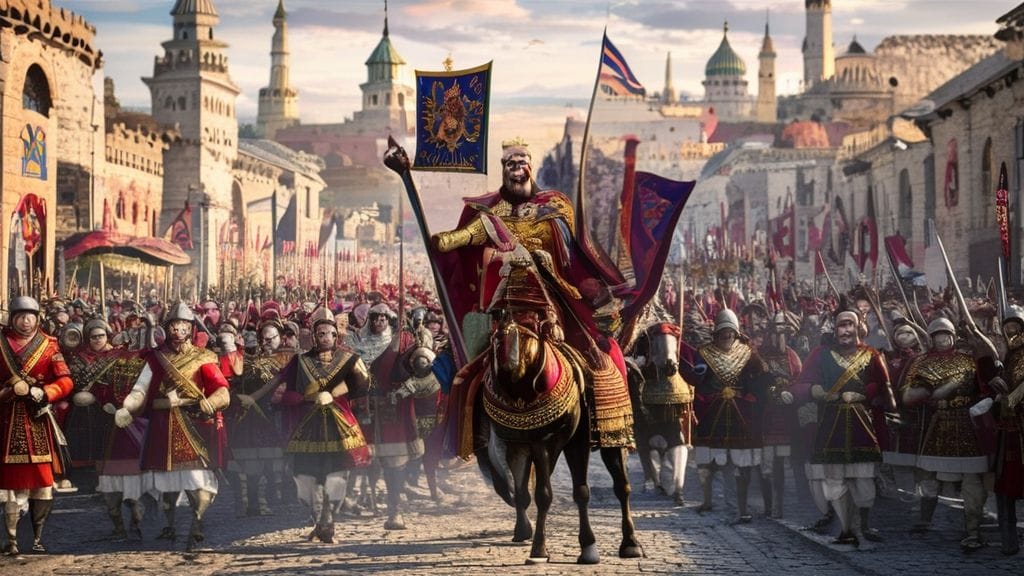
Still, the imperial ritual machine swiftly whirred into motion. Constantine, armored yet robed in imperial finery, processed along the Mese, the main thoroughfare of the city. Before him walked the imperial guards, behind him the officers who had shared his campaigns. It is said that some in the crowd shouted acclamations drawn from ancient Roman formulae—“Many years to Constantine, faithful emperor!”—while others merely watched, lips tight. The Hippodrome, that oldest theater of loyalty and opposition, awaited him; the palace complex, with its throne and its guarded chambers, lay open ahead.
In that single day, constantine v reenters constantinople not just physically but symbolically. His passage through the gates declared that the civil war had been decided. His mere presence on the city’s streets announced to allies and enemies alike that his iconoclastic dynasty had survived the gravest internal threat yet. Yet behind the celebrations and acclamations, a darker current ran: the knowledge that the emperor who had lost his city once would do anything to ensure that it never slipped from his grasp again.
Trumpets, Chains, and Chants: The Ceremonial Reclaiming of the Capital
By mid-day, the entry had become an orchestrated spectacle. One of the striking features of Byzantine political life was its mastery of ceremony. No act of power was simply practical; it was wrapped in layers of ritual designed to imprint a message on all who watched. As constantine v reenters constantinople, he steps into an elaborate script that previous emperors had rehearsed and perfected.
The route would likely have carried him from the land walls along the Mese toward the Augusteion, the main square before the Hagia Sophia, and then to the Great Palace. Flags snapped in the chilly air above porticoes and columns. From balconies, aristocratic families watched the slow, purposeful advance of the emperor’s retinue, measuring their future by the angle of his jaw, the set of his shoulders, the banners that fluttered behind him. Below, the populace pressed in, hoping to catch a glimpse of the man whose victories or defeats could mean the difference between feast and famine.
Inside the Hagia Sophia, the city’s spiritual heart and its architectural wonder, choirs stood ready. Whatever the precise stance of its clergy toward icons at this moment, they could not ignore the political reality before them. As Constantine entered the great church—whether to offer thanks or to make a show of divine favor—the shimmering mosaics, some defaced, some intact, bore silent witness. In that cavernous space, sound rose and mingled: the chanting of psalms, the muttering of onlookers, the barked orders of soldiers keeping watch at every doorway.
Another ritual likely followed in the Hippodrome. For centuries, emperors had used chariot races not just as entertainment but as a stage on which to display their authority and court public acclaim. There, in the huge elongated arena, the emperor could be seen by tens of thousands at once. On this day, if the traditional pattern held, Constantine V probably made a solemn appearance, greeting the factions and receiving shouts of “victory!” The chariots may even have raced again, their wheels cutting across a track that had seen riots and revolutions.
And yet, for all the ceremony, a layer of unease clung to the spectacle. The people knew that a defeated emperor and his supporters still lingered somewhere within the city’s walls. They knew that loyalty could be hazardous in the aftermath of civil war. Organized acclamations could not fully drown out the apprehension: What punishments will follow? What new laws? What new persecutions? The public triumph of constantine v reenters constantinople was inseparable from the quieter, bloodier reckonings that were about to unfold behind closed doors.
Crowds, Fear, and Faction: How the People Witnessed the Return
For the common people of Constantinople, the day’s events were a dizzying blend of spectacle and survival. Most were less concerned with theological nuances than with the practical consequences of a change in regime. In every neighborhood, from the wealthy districts near the palace to the bustling artisans’ quarters clinging to the slopes above the Golden Horn, talk turned to simple questions: Who would fall? Who would rise? Would bread be cheaper or dearer under the restored emperor?
The chariot racing factions, the Blues and the Greens, remained central to urban politics. Their loyalties had shaped riots, influenced coups, and served as an unofficial barometer of public opinion. During Artabasdos’ brief reign, some of their leaders had thrown their support behind the usurper. Now, as constantine v reenters constantinople, they faced the delicate task of realigning themselves without drawing imperial wrath. Their banners in the Hippodrome, the cheers or silences that greeted the emperor, all carried political weight.
In the markets, merchants watched the passing troops with mixed emotions. Armies brought business, but they also brought requisitions, quartering, and sometimes looting. Women leaning from upper-story windows studied the faces of officers, hunting for clues about the months ahead. Would the emperor’s henchmen move quickly to confiscate the property of those accused of supporting Artabasdos? Or would there be a period of clemency, a breathing space before the inevitable purge?
Among the devout, the reaction was more fractured still. Some of the faithful, especially in monasteries and among the urban poor, had rallied to Artabasdos because he seemed to promise restoration of the familiar world of icons and saints’ images. Others, wary of what they saw as the superstition and political manipulation surrounding icons, or simply loyal to the Isaurian dynasty, had always preferred Constantine. The city’s spiritual map was now tangled in guilt and fear. Those who had marched in icon processions under Artabasdos weighed whether to hide their painted panels and hope for mercy. Those who had opposed the usurper counted on imperial favor but worried that their enemies might denounce them out of envy.
For ordinary Constantinopolitans, the day on which constantine v reenters constantinople was less a day of clear triumph or defeat than a turning of the wheel, another violent lurch in a history that had already seen earthquakes, plagues, and sieges. They learned, as they always did, to watch, to listen, and to adjust. The emperor might reshape doctrine and policy, but they had to keep their families fed and their lives intact in a city where allegiance could be as fragile as the oil in a lamp burning down to its last drops.
The Fall of Artabasdos: Trials, Blinding, and Public Punishment
Triumphal entries are never only about victory; they are about what is done to the defeated. Once Constantine had secured the capital, his attention turned to the man who had driven him from it. Artabasdos, the former usurper, was captured along with his sons. Their fate would serve both as retribution and as a lesson to anyone who dreamed of claiming the purple without the blessing of the reigning emperor.
Byzantine political culture rarely killed high-profile rebels outright, at least not immediately. Instead, it relied on mutilation—especially blinding—as a way to neutralize rivals. An emperor was supposed to be not only powerful but physically intact; blinding made a man legally and ritually unfit to rule. According to the hostile but detailed narrative preserved by Theophanes, Constantine subjected Artabasdos and his sons to public humiliation in the Hippodrome, parading them before the same crowds that had once cheered their rule. Afterward, they were blinded, stripped of power, and consigned to monastic confinement or obscure imprisonment.
Such punishment carried a heavy symbolic charge. The arena that had seen imperial triumphs and charioteers’ glory now watched a broken family stumble, sightless, into the shadows of history. The people only had to look at them to understand the emperor’s message: this is what happens to those who raise their hand against the crowned and anointed. In a world saturated with Christian symbolism, the image of physical sight taken away from those who had “seen” themselves as emperors was hard to miss.
But Constantine’s retribution extended beyond the immediate circle of the usurper. Supporters of Artabasdos—especially officers, officials, and perhaps some clergy—faced trials, confiscations, exile, or worse. The line between justice and vengeance blurred, as it always did after civil war. Charges of treason mixed with accusations of religious error, as if to oppose Constantine politically was the same as opposing the truth theologically. For many, that was exactly the point: in Byzantine ideology, to stand against the emperor was to risk placing oneself outside the community of the faithful.
In the weeks and months after constantine v reenters constantinople, the echoes of those punishments reverberated through the city. Families of the condemned navigated a new, harsher world. Houses changed hands. Properties once owned by Artabasdos’ allies passed into the possession of loyalists, creating fresh resentments that would simmer for generations. Victory had returned Constantine to his throne, but it came drenched in the public suffering of his enemies.
Icons and Empire: The Ideological Earthquake Behind the Triumph
Behind the clash of armies and the spectacle of punishment lay a deeper battle over the soul of the empire. Constantine was not simply a ruler reclaiming his city; he was the champion of a controversial policy that sought to redefine the relationship between heaven and empire. The issue was icons: painted images of Christ, the Virgin, and the saints that filled Byzantine churches and homes. To many believers, these images were windows into the divine, channels of grace, and beloved companions in prayer. To Constantine and his iconoclast allies, they risked blurring the line between Creator and creation, encouraging idolatry and weakening the empire’s moral fiber.
When constantine v reenters constantinople, he brings with him not only military victory but also the momentum to press his iconoclastic program harder than ever before. His father, Leo III, had begun the campaign against icons with edicts and selective destruction. Constantine, hardened by exile and civil war, pushed further. Under his rule, imperial councils condemned the veneration of icons. Church leaders who resisted faced deposition, exile, and sometimes brutal punishment. Monasteries that clung stubbornly to their painted saints stood under suspicion as breeding grounds of treason.
It is crucial to understand that this was not simply a matter of piety. Iconoclasm served political and military ends. By presenting himself as the purifier of Christian practice, Constantine asserted control over the church and weakened alternative sources of authority. By attacking powerful monasteries—landowners in their own right—he tapped resources for the army and sent a message that no institution was beyond imperial scrutiny. Some modern historians, as Judith Herrin and others have noted, see in this program an attempt to streamline the empire for survival in an age of external threats and shrinking borders.
Yet for icon supporters, Constantine’s policies were devastating. Holy images were destroyed or whitewashed, pilgrims turned away, and cherished devotions declared suspect. Writers like the later patriarch Nikephoros and Theophanes the Confessor, composing their accounts after icon veneration had been restored, painted Constantine as a near-demonic persecutor. Their hostility colors our sources, but it also reveals how deeply his program wounded the religious imagination of many Byzantines. The day he reclaimed his city therefore marks not just a political victory but the unleashing of an ideological campaign that would scar Byzantine spirituality for generations.
The Army’s Emperor: Constantine V and the Making of a Military Regime
Constantine’s path back to power had been carved by soldiers, and he never forgot it. In an empire beset by Arab raids from the east and Bulgar pressure from the north, the ability to reward and retain loyal troops was central to survival. The civil war against Artabasdos had underscored a hard truth: the emperor who neglected the army risked losing his throne. In the years after constantine v reenters constantinople, the capital would feel the weight of a ruler whose deepest base of support lay not in its monasteries or urban elites but in its barracks and frontier camps.
He reorganized and strengthened the themes, the military-administrative districts that formed the backbone of Byzantine defense. Soldiers were settled on lands that supported them and their families, tying their livelihood to the empire’s stability and to the emperor’s favor. Taxation was adjusted to sustain armies capable of defending long and dangerous frontiers. In this sense, Constantine was a reformer: he built the structures that would allow Byzantium to survive as a militarized state for centuries to come.
Within Constantinople, this military orientation meant that regiments loyal to the emperor played an outsized role in public life. Palace guards, elite cavalry units, and naval forces based in the Golden Horn all became visible symbols of the emperor’s will. Their presence was reassuring to some, intimidating to others. Political opposition had to reckon with the fact that the man on the throne commanded a professional killing machine, proven in civil war and forged in his return to the city.
At the same time, this alliance with the army deepened the rift between the emperor and parts of the church. Many soldiers supported iconoclasm, perhaps in part because they associated the earlier veneration of icons with military disasters. As a result, the regime’s religious and military policies became mutually reinforcing. Those who criticized iconoclasm risked being seen as undermining the morale and cohesion of the army itself. In a city that had just survived internal war, such criticism could be framed as sabotage.
Churches, Monasteries, and the Price of Dissent
If the army was Constantine’s pillar, the monastic world was often his adversary. Monasteries—dotting the countryside of Thrace, Bithynia, and the islands close to Constantinople—were more than spiritual refuges. They were economic powers, centers of learning, and networks of influence that could mobilize popular resistance. Many monks were passionate defenders of icons. For them, the images were not decorations but witnesses to the Incarnation, proof that God had taken visible, depictable flesh.
After constantine v reenters constantinople, his government intensified pressure on these communities. Some monasteries were closed or had their estates confiscated. Monks who persisted in venerating icons were flogged, exiled, or forced to sign statements condemning the practice. Stories of their suffering, preserved later in hagiographies and chronicles, describe them as martyrs for the cause of images. One often-cited case is that of Stephen the Younger, whose death under Constantine’s policies became a rallying point for iconophile memory.
Bishops who refused to endorse iconoclasm faced deposition. Church synods were orchestrated to give theological legitimacy to imperial positions. The line between a church council and a political rally grew thin. Not all clergy opposed Constantine; some followed his lead for reasons of conviction, career, or fear. But the overall effect was to turn the church hierarchy into a battleground where loyalty to icons was weighed against loyalty to the throne.
In the city’s parishes, ordinary believers adjusted in complex ways. Some obeyed publicly but kept icons hidden in corners of their homes, lighting lamps before them only at night. Others, wary of attracting attention, removed images but continued to cherish them in memory and private prayer. The spiritual life of Constantinople became a palimpsest of erased and re-inscribed devotions. The same walls that once glowed with mosaics now carried bare plaster or austere crosses, yet under the surface the old images lingered in stories and in the hearts of the faithful.
Life in the Capital After the Return: Fear, Favor, and Survival
In the aftermath of Constantine’s return, daily life in Constantinople settled into a new but uneasy normal. The sight of soldiers drilling near the palace, of officials carrying rolls of tax records, of clerics arguing softly in corners of colonnaded courtyards—these became familiar features of the city’s rhythm. Yet beneath the routines, people carried their memories of the recent convulsions and adjusted their behavior accordingly.
Those who had publicly supported Artabasdos learned to keep their heads down. Some tried to ingratiate themselves with the restored emperor, offering gifts, pledges, or information on others who had been even more enthusiastic in their betrayal. Informers thrived. The court, rebuilt around Constantine, buzzed with intrigue, as rival factions positioned themselves to benefit from his favor. For a clever bureaucrat or ambitious general, the early years after constantine v reenters constantinople offered opportunities to rise, provided they showed absolute loyalty and a willingness to enforce his policies.
For the urban poor, concerns were more immediate. They watched prices at the markets, the availability of bread and oil, the frequency of state-sponsored distributions. A regime could be harsh in matters of doctrine, but if it kept bellies moderately full and the city safe from invaders, many would tolerate its ideological quirks. On this front, Constantine’s emphasis on military readiness and fiscal order brought a measure of stability, even as theological conflict continued to churn.
Cultural life, too, adapted to the new environment. Official art and inscriptions reflected iconoclastic sensibilities, emphasizing imperial power, crosses, and abstract or symbolic motifs over figural religious imagery. Literary works composed in or around the court praised Constantine’s victories, portrayed the civil war as a test of divine favor, and recast Artabasdos as a treacherous villain. In private, however, some writers and storytellers nursed a different narrative, one in which the emperor’s cruelty outshone his achievements and his return on that fateful November day marked the beginning of oppression rather than salvation.
The Long Shadow of 743: From Civil War to Imperial Reform
The significance of 2 November 743 did not end with the day’s ceremonies. When constantine v reenters constantinople, he initiates a period of internal consolidation and external ambition that shapes the empire’s next decades. The trauma of civil war hardened his resolve to control the levers of power—military, fiscal, and religious—more tightly than many of his predecessors.
He embarked on administrative reforms aimed at strengthening the themes and ensuring reliable revenue. Land records were updated, tax obligations clarified, and, where possible, imperial estates expanded at the expense of powerful magnates or monasteries. These measures were not always popular, but they helped create a leaner, more disciplined state apparatus. In frontier regions, new fortifications rose, garrisons were better supplied, and campaigns became more frequent.
In the capital, the rebuilt court projected a hybrid image of rigor and magnificence. Ceremonies at the palace and in the Hagia Sophia showcased a disciplined imperial presence, with a carefully controlled iconoclastic aesthetic. The emperor’s victories over Bulgars and Arabs were commemorated in state celebrations, reinforcing his claim that God favored his policies. Each military success retroactively justified his return and all that followed it, including the bloodshed against his domestic enemies.
Yet the long shadow of 743 also contained seeds of future conflict. The harsh treatment of icon supporters ensured that resentment would survive, to resurface when political conditions allowed. The memory of Artabasdos and the hope he had briefly kindled among iconophiles did not vanish completely; it sank into whispered tales, monastic chronicles, and liturgical commemorations of those remembered as martyrs. The empire had been reshaped by Constantine’s victory, but not all its inhabitants accepted that reshaping as final.
Enemies at the Frontiers: Arabs, Bulgars, and the Reforged Army
While the drama of Constantine’s return unfolded inside the walls, the empire’s old enemies watched and waited beyond them. The Umayyad Caliphate, stretching across the Near East and North Africa, had long pressed against Byzantine borders. To the north, the Bulgar khans ruled over a rising power in the Balkans. The survival of Constantinople under Leo III had checked one great Arab assault, but raids and campaigns continued. A civil war at the empire’s heart could easily have been the opportunity these rivals needed to strike a decisive blow.
That they did not do so, or at least not decisively, gave Constantine room to act. Once secure on his throne after constantine v reenters constantinople, he turned his attention outward with renewed vigor. Campaigns against the Arabs in Asia Minor, though often indecisive in grand strategic terms, demonstrated improved coordination and discipline in the Byzantine forces. Raids were repelled, fortresses reinforced, and borderlands depopulated or resettled to create more defensible zones.
In the Balkans, Constantine’s efforts were even more aggressive. He led multiple expeditions against the Bulgars, seeking to push back their frontier and reassert imperial dominance in Thrace. Though ultimate control of the region would remain contested, these campaigns strengthened the army’s sense of itself as a sharp, active instrument of imperial will. For many soldiers, their emperor’s willingness to ride with them into danger earned a loyalty that no theological pronouncement could match.
This outward-facing energy helped reframe the memory of his re-entry into the capital. For supporters, constantine v reenters constantinople became the prelude to military revival and a reaffirmation of Byzantium’s role as a surviving Roman power in a hostile world. For critics, it was the moment when a persecutor gained the platform from which to unleash his policies on church and people. Both were right, in different ways. Constantine’s reign cannot be separated from the battles he fought at the empire’s frontiers any more than it can be separated from his war on icons.
A Reputation Contested: Tyrant, Heretic, or Savior of the Empire?
Few Byzantine emperors have provoked as much polarized judgment as Constantine V. To his enemies—especially those writing in the aftermath of the restoration of icons—he was a tyrant and a heretic. Theophanes describes him in lurid terms, accusing him of grotesque blasphemies and moral depravity. Later iconophile tradition turned his very name into an insult, “Copronymus,” meant to stain his memory with filth. In their narrative, the day constantine v reenters constantinople was the beginning of a dark age of persecution and sacrilege.
Yet other sources, some official, some from regions that benefited from his military activity, remembered him quite differently. For soldiers and frontier communities, he was the emperor who paid attention to defenses, who invested in fortifications, who led campaigns in person. There, his name was associated not with desecrated icons but with repelled raids and a sense that the empire was no mere remnant waiting to die, but a fighting power capable of striking back.
Modern historians, sifting through these conflicting testimonies, have tried to offer a more balanced view. They note that our primary narrative chroniclers for this period are overwhelmingly hostile to Constantine because they were devoted to icons. They point out that material evidence—fortifications, administrative changes, and the survival of the empire over the following century—supports the image of a capable, even impressive, ruler in secular terms. At the same time, they do not deny the harshness of his religious policy or the suffering it inflicted.
The result is a complex portrait. Constantine V appears as a man forged by crisis: the son of a usurper, the survivor of a civil war, the restorer of his capital, and the architect of a disciplined, militarized empire. His re-entry into Constantinople in 743 becomes, in this light, a hinge moment not only in church history but in the broader story of Byzantine resilience. It forces us to grapple with an uncomfortable question: can a ruler who preserves a state through cruel means be called a savior, or does the cost cancel out the achievement?
Memory and Myth: How Later Generations Remembered Constantine V
The centuries after Constantine’s death saw his figure pass from living memory into the realm of legend, polemic, and historical reconstruction. As the empire shifted again—embracing the restoration of icons in the Ninth Century, enduring new waves of crisis and renewal—writers looked back on his reign through the lens of their own concerns. The moment when constantine v reenters constantinople was retold not just as a historical episode but as a moral tale, a warning or an inspiration depending on who narrated it.
In iconophile hagiographies, Constantine became the archetypal persecutor, the imperial Pharaoh against whom new Moses-like confessors and martyrs stood firm. Stories of monks being flogged for their icons, of nuns refusing to trample sacred images, of laypeople bravely hiding their devotional panels—all of these sharpened his image into that of a villain in a sacred drama. The civil war with Artabasdos was recast as a struggle between a wicked icon-smashing king and a divinely favored but ultimately defeated champion of orthodoxy.
In some military or administrative traditions, however, his memory remained more ambiguous, even positive. The survival of the empire through the turbulent Eighth Century, the stabilization of borders, and the continued functioning of the thematic system were sometimes implicitly or explicitly linked to his policies. Here, Constantine figured less as an anti-saint and more as a stern lawgiver, a necessary if harsh reformer in a dangerous age.
By the time modern scholarship began to study Byzantine history with critical tools, Constantine’s legend had accumulated layers of distortion. Historians like George Ostrogorsky and later Judith Herrin approached him with skepticism toward both extremes. They used administrative records, archaeological findings, and comparative analysis to place him in context. Their work does not exonerate him, but it does rescue him from the one-dimensional caricatures of medieval polemic. Through their efforts, the day he marched back into Constantinople emerges not only as a villain’s ascent or a hero’s return, but as a pivot point in a complex imperial evolution.
From the Golden Horn to Modern Scholarship: Sources and Silences
Reconstructing the events of 743 is an act of disciplined imagination. We rely on chronicles, legal texts, theological treatises, coins, and the mute testimony of ruined fortresses and altered churches. Each source comes with its own agenda, its own blind spots. When we say that constantine v reenters constantinople on 2 November 743, we base that statement on records copied and recopied by monks who may have loathed the emperor whose acts they preserved.
Theophanes the Confessor’s Chronographia, compiled in the early Ninth Century, is one of our primary narrative sources. Hostile to iconoclasm, it depicts Constantine as a near-monster. Yet Theophanes also provides crucial dates, sequences of events, and vivid details that we cannot easily discard. Other sources, such as the later patriarch Nikephoros’ historical work, reinforce and supplement his account, again from an iconophile perspective. Arab chronicles offer glimpses of Constantine’s military campaigns from the viewpoint of his opponents, adding further texture.
Material culture helps fill some of the gaps. Changes in coinage—where certain religious images disappear or are replaced—offer tangible evidence of iconoclastic policy. Archaeological work on fortifications and military installations in Asia Minor and the Balkans shows the intensity of military investment in this era. Yet even here, the silence of the stones can be deceptive; it tells us little about the fears of a monk facing exile or the hopes of a peasant watching soldiers march by on their way to reclaim the city.
Historians are acutely aware of these limitations. As one modern scholar has put it, “Every sentence we write about the iconoclast era stands on contested ground.” We must balance the voices of enemies and admirers, of chroniclers and commanders, to approach something like a usable truth. The story of constantine v reenters constantinople becomes, in this sense, not only a narrative about an emperor and a city, but also a case study in how history is written, erased, and rewritten across the centuries.
Echoes of a Triumphal Entry in World History
Viewed from a wider perspective, the return of Constantine V to his capital belongs to a long tradition of rulers who reclaim cities after exile or civil war. From the Roman emperors who marched back into Rome after crushing rivals, to medieval kings re-entering rebellious capitals, to modern leaders returning after revolutions, the pattern is both familiar and endlessly varied. Each time, the city becomes a stage on which legitimacy is performed and contested.
When constantine v reenters constantinople, we see many of the elements that recur across this tradition: the carefully arranged processions, the calibrated mercy and vengeance, the reshaping of public space through ceremony and punishment. Yet the Byzantine case stands out for the dense interweaving of theology and politics. In few other societies was the question of religious images so deeply bound up with questions of military defense and fiscal reform, so that an emperor’s stance on icons could shape tax policy and frontier strategy.
The echoes of 743 persist even today, not only in scholarly debates but in broader reflections on how societies remember divisive leaders. The conflict between Constantine’s role as a state-builder and his reputation as a persecutor mirrors dilemmas that modern nations face when assessing their own controversial figures. Streets, statues, and school curricula become battlegrounds where competing memories struggle for dominance, much as chronicles and liturgies did in Byzantium.
In the end, the story of that November morning in 743 is not just a remote episode in the history of a vanished empire. It is a mirror in which we glimpse enduring patterns: how power is regained and justified, how faith can be weaponized or defended, how cities endure leaders who save and scar them in the same breath.
Conclusion
On a chill November day in 743, as trumpets echoed against stone and anxious crowds filled the streets, constantine v reenters constantinople and changes the course of Byzantine history. His return marks the end of a brutal civil war, the downfall of a rival who had briefly ruled the empire’s greatest city, and the renewal of a dynasty forged in crisis. Yet it is far more than a military or political milestone. It is the launching point for a fervent, often violent campaign against icons, a reorganization of the army and administration, and a profound reshaping of daily life in the capital and beyond.
For some, Constantine’s triumph was a deliverance: the restoration of order, the empowerment of a capable commander in a dangerous world. For others, especially those devoted to the veneration of holy images, it was the beginning of suffering and spiritual dislocation. Over the centuries, his figure has been stretched between these poles, vilified as “Copronymus” and praised as a stern savior of the state. Modern scholarship, reading critically across hostile and admiring sources alike, portrays him as a complex, formidable ruler whose achievements and cruelties cannot be easily disentangled.
The city he reclaimed survived for centuries after his death, its walls still standing, its churches repeatedly rededicated and restored, its people adjusting as they always had to the temper of each new regime. The ceremonies of 2 November 743 have long since faded, but the questions they raise endure: how far may a ruler go in the name of reform and survival? What price do societies pay when ideological zeal joins hands with the machinery of the state? And when we look back at moments like the day constantine v reenters constantinople, are we seeing a necessary act of preservation, an unforgivable seizure of power, or—most truthfully—a tangled mixture of both?
FAQs
- Who was Constantine V?
Constantine V was a Byzantine emperor who ruled from 741 to 775, though his reign was interrupted by a civil war that briefly displaced him from Constantinople. He was the son of Emperor Leo III and became known both for his determined iconoclastic religious policies and for significant military and administrative reforms that strengthened the empire. - What happened on 2 November 743 in Constantinople?
On 2 November 743, constantine v reenters constantinople after defeating the usurper Artabasdos in a protracted civil war. His re-entry involved a carefully staged imperial procession, the submission or surrender of city garrisons, and the rapid reassertion of his authority over the capital’s political and religious institutions. - Who was Artabasdos and why did he oppose Constantine V?
Artabasdos was a powerful general and Constantine’s brother-in-law who commanded the influential Opsikion theme. In 741–742 he launched a coup, seized Constantinople, and had himself crowned emperor, presenting himself as a defender of icon veneration against Constantine’s iconoclastic leanings. His rule lasted only a short time before Constantine rallied loyal armies, defeated him, and returned to the city in 743. - How did Constantine V treat Artabasdos and his supporters after his return?
After regaining the capital, Constantine V punished Artabasdos and his sons with public humiliation and blinding, effectively removing them from the political stage. Many of Artabasdos’ supporters—military officers, officials, and some clergy—faced trials, confiscations, exile, or other severe penalties, as Constantine used the victory to send a clear warning against future rebellion. - What role did the icon controversy play in Constantine V’s reign?
The controversy over the veneration of icons was central to Constantine V’s rule. He pursued a strong iconoclastic agenda, condemning the religious use of images, deposing iconophile bishops, pressuring or closing monasteries, and promoting councils that supported his position. This ideological struggle shaped church life, imperial propaganda, and the way later generations judged his reign. - Why do some historians see Constantine V as an effective ruler despite his harsh policies?
Many modern historians acknowledge Constantine V’s cruelty in religious matters while also recognizing his achievements in strengthening the army, reorganizing the themes, and improving the empire’s defenses against Arabs and Bulgars. From a purely political and military perspective, his reforms contributed significantly to the survival and resilience of Byzantium during a period of grave external pressure. - How reliable are the sources about Constantine V and his re-entry into Constantinople?
Our main narrative sources, such as Theophanes the Confessor and Nikephoros, were written by later authors hostile to iconoclasm, which introduces bias into their accounts. However, when combined with material evidence—coins, fortifications, administrative records—and compared with external chronicles, they still provide a coherent if contested picture of the events surrounding Constantine’s return to Constantinople. - What long-term impact did Constantine V’s return and policies have on the Byzantine Empire?
Constantine V’s restoration to power in 743 reinforced the Isaurian dynasty, entrenched iconoclasm for several decades, and set in motion military and administrative reforms that helped stabilize the empire’s borders. At the same time, his harsh treatment of icon supporters deepened religious divisions that would resurface in later conflicts, ensuring that his legacy remained controversial well into the Middle Ages.
External Resource
Internal Link
Other Resources
- Encyclopaedia Britannica – general search for the exact subject
- Google Scholar – academic search for the exact subject
- Internet Archive – digital library search for the exact subject

