Table of Contents
- Rome in 422: A City Between Ruin and Resilience
- From Campania to the Tiber: The Early Life of Celestine
- The Shadow of Innocent I: Formation of a Roman Churchman
- An Empire in Fragments: Politics and Faith Before the Vacancy
- The Death of Pope Boniface I and the Silence that Followed
- The Gathering of the Clergy: Prelude to a Papal Choice
- September 10, 422: The Election of Pope Celestine I
- Voices in the Basilica: Factions, Fears, and Quiet Compromises
- Rome Reacts: How the People Heard the News
- From Local Bishop to Global Arbiter: Celestine and the Wider Christian World
- Between Heresy and Orthodoxy: Doctrinal Storms on the Horizon
- The Human Face of Authority: Celestine as Shepherd and Administrator
- After the White Smoke of Antiquity: Early Actions of the New Pope
- Echoes from Africa, Gaul, and the East: The Reach of Celestine’s Decisions
- A Turning Point in Papal History: Legacy of the Election
- Remembering 422: Historians, Sources, and the Shape of Memory
- Conclusion
- FAQs
- External Resource
- Internal Link
Article Summary: This article plunges into the fragile, anxious world of early fifth-century Rome to reconstruct the election of Pope Celestine I and the forces that shaped it. In a city still haunted by Alaric’s sack and uncertain of its future, the election of pope celestine i became more than a mere clerical procedure; it was a collective act of survival, a search for stability in a collapsing empire. Through a blend of narrative storytelling and historical analysis, we follow Celestine from his obscure origins in Campania to the corridors of Roman ecclesiastical power. The article traces how networks, rivalries, and imperial politics intersected with local piety in the days leading up to his elevation. It explores the doctrinal conflicts he would face, particularly in the East, and how decisions stemming from this election would shape the authority of the Roman See. We examine how ordinary believers, bishops abroad, and imperial officials perceived and reacted to the new pope. By the end, the reader sees the election of pope celestine i not as an isolated event, but as a crucial hinge between a persecuted church of martyrs and a confident, yet embattled, church of empire. In doing so, the article reflects on the fragile humanity that underlay every solemn ritual in late antique Rome.
Rome in 422: A City Between Ruin and Resilience
On the morning of September 10, 422, Rome did not look like the invincible capital that had once ruled the Mediterranean world. The air was hazy with the smoke of cooking fires and brick kilns, not the triumphant incense of a world-conquering empire. Along the Tiber’s banks, barges slipped past ruined warehouses, their crews shouting in a mixture of Latin, Greek, and rough provincial dialects as they ferried grain and oil into the hungry city. Stone by stone, Rome was learning to live with its scars.
Just twelve years earlier, in 410, the unimaginable had happened: Alaric and his Visigothic troops had stormed the city. For three days, the Eternal City had echoed with weeping, the crash of splitting beams, and the crackle of burning villas. By 422, some roofs had been patched, some statues raised again, but the memory of vulnerability clung to every street like dust. Many aristocratic families had not returned; their palaces on the Aventine or Palatine stood half-abandoned, tiles missing from their courtyards, gardens gone to seed.
And yet Rome lived—louder, more crowded, and more Christian than it had ever been. Pilgrims trudged through the city gates toward the tombs of Peter on the Vatican hill and Paul on the Ostian road. Poor families occupied crumbling porticoes where senators had once strolled. The pagan temples, though still visible, were no longer the city’s beating heart. That center had shifted into basilicas, into the great halls where Christians gathered to hear the Scriptures read and to see bread and wine elevated with trembling hands.
It was in this Rome—wounded yet stubborn—that the election of pope celestine i would unfold. The choice of a new bishop of Rome was not just a local ecclesiastical matter; it was a symbolic answer to the question haunting every citizen: could anything stable, anything enduring, still be built amid ruins?
The Western Roman Empire, nominally under the rule of the boy emperor Valentinian III and regent Galla Placidia, was a shadow of its former self. In distant Ravenna, safe behind its marshes, imperial officials debated tax revenues and troop movements. In Rome, people debated food prices and the reliability of the next grain shipment. Authority now had many centers: generals, bishops, city prefects, even local magnates who offered bread or protection. The pope of Rome, once persecuted under emperors, now shared in the burden of governing a frightened populace.
In 422, the bishop of Rome stood at the crossroads of secular and sacred power. He was expected to feed the poor, mediate between imperial bureaucrats and Roman congregations, and—more and more—to speak authoritatively for the faith of the whole West. Whoever would be chosen that September would inherit not only a chair in the Lateran but a city’s anxieties and an empire’s spiritual expectations.
From Campania to the Tiber: The Early Life of Celestine
We do not know the exact moment when the man who would become Celestine first saw the light, but we know roughly where: Campania, the fertile region south of Rome, watered by the Bay of Naples and ringed by once-luxurious villas looking out to sea. Here, among vineyards, olive groves, and smoking volcanic craters, a Roman child named Celestinus—or perhaps another name, later Latinized for posterity—grew into manhood.
Campania in the late fourth century was a landscape of both decay and stubborn elegance. Old senatorial houses clung to their libraries and mosaics, even as imperial income shrank and barbarian raids made coastal estates less secure. Paganism lingered longer here than it did in some other regions: sacrifices still whispered at night in certain groves, and old men muttered verses of Virgil as if reciting prayers. Christianity, however, was everywhere on the move—new churches being raised, bishops convening councils, processions threading through streets once reserved for civic pageantry.
In this environment, the young Celestine would have learned Latin with a precision and rhythm we still sense in the letters attributed to him later. His world would have included the crackle of parchment, the murmur of legal formulas, the authoritative roll of Scriptural readings in basilicas whose acoustics were designed to magnify the voice of a single man at the ambo. Whether his family was modestly well-off or part of the lower aristocracy, they were clearly close enough to ecclesiastical networks to send him northward to Rome, the center of the Latin Christian world.
The journey from Campania to Rome took several days by road, along the Via Appia, studded with tombs and milestones. For a young man called into service of the Church, the sight of the city’s distant silhouette—domes, half-broken arches, the massive outline of the Colosseum—must have landed on him with a mix of awe and foreboding. Rome was not only the capital of the West, but also the city of Peter and Paul, the city where bishops carried both the memory of martyrdom and the weight of new responsibilities.
Some traditions suggest that Celestine may have studied or spent time in Milan or other northern centers, but the firmest anchor we have is his later activity in Rome itself. There, in the bustling quarters around the Lateran and St. Peter’s, he likely served as a deacon or priest under the watchful eye of Pope Innocent I. He would have walked crowded streets smelling of tallow and incense, brushed shoulders with imperial messengers, and heard news from Africa, Gaul, and the East carried in on every caravan and ship.
The boy from Campania became a man of Rome. In a world where “Roman” was no longer just a political identity but a religious claim, Celestine’s path bent ever more toward the altar and the council chamber. Years before the election of pope celestine i, his mind was already being shaped by cases of disputed episcopal appointments, contested doctrines, and letters from bishops who wanted guidance—or approval—from the bishop of Rome.
The Shadow of Innocent I: Formation of a Roman Churchman
If Campania gave Celestine his roots, Pope Innocent I gave him his model. Innocent, who reigned from 401 to 417, was not the first pope to assert Roman primacy, but he articulated it with a clarity and firmness that would echo in later centuries. Around him, in the papal household and the Roman clergy, young churchmen learned that the bishop of Rome was not merely one bishop among many.
Under Innocent, the Roman See intervened decisively in disputes in distant lands. North Africa, with its vibrant Christian communities and turbulent Donatist controversies, often looked to Rome. So did Illyricum, Gaul, and Hispania. Each time a bishop wrote to Innocent, a precedent was carved deeper: the idea that Rome could judge, confirm, or admonish, standing as a kind of court of last resort in matters of discipline and doctrine.
Celestine appears in surviving documents as a Roman deacon during part of this period, and sources like the Liber Pontificalis later link his memory firmly to the Roman clergy. Imagine him in the bustling archive rooms of the Lateran, where scribes copied letters, cataloged dossiers, and arranged precedence among petitions. He would have seen firsthand how a carefully chosen phrase or a firm doctrinal stance could bring clarity to distant churches—or provoke resistance.
Innocent’s Rome was also a city still reeling from the sack of 410. Augustine of Hippo, in far-off North Africa, wrote his monumental City of God, against the charge that Christianity had weakened Rome and brought divine wrath. His letters crossed the Mediterranean, and it is likely that some of these texts passed through Roman hands, perhaps including Celestine’s. One can picture a winter evening in a dimly lit room, an oil lamp flaring as a deacon leans over a newly arrived manuscript from Hippo Regius, the words of Augustine unfolding like a counter-history to pagan nostalgia.
Innocent died in 417, leaving behind a legacy of strong papal leadership. The memory of his decisions would weigh heavily in the years that followed, especially in the election that would, a few years later, raise Celestine himself to the papal throne. To serve under such a pope was to be trained in a particular kind of confidence: that Rome had a voice the Church could not ignore.
The election of pope celestine i did not happen in a vacuum; it took place in a community of men—and increasingly, of women through monastic circles—who remembered Innocent’s example. Celestine’s later letters, terse and assured, bear the imprint of that earlier pontificate. They suggest a man who had watched, listened, and learned how authority and persuasion could be woven together to marshal the church through stormy waters.
An Empire in Fragments: Politics and Faith Before the Vacancy
By the early 420s, the Western Roman Empire was a patchwork map held together by habit, paperwork, and hope as much as by soldiers. Britain was gone, abandoned to local leaders and invading groups. In Gaul, barbarian federates had carved out territories they ruled in uneasy alliance with local Romans. In Hispania, the Sueves and Vandals sliced through the countryside like a slow-moving storm.
At the center of this fragile structure was the court at Ravenna. The young emperor Valentinian III, not yet ten years old in 422, played in palace courtyards while his mother, Galla Placidia, navigated alliances, military strongmen, and court intrigue. Ravenna, ringed by marshes and canals, felt safe behind its watery defenses—but spiritually and historically, it lacked the weight of Rome. When Galla Placidia needed sacred authority to buttress her secular one, her eyes turned towards the city of the apostles, and to its bishop.
This political fragmentation created a paradoxical opportunity for the papacy. As secular authority grew more localized, the universal claims of the Christian Church became more appealing. Bishops spoke across frontiers that armies could not easily cross. Letters flew where legions hesitated. When a doctrinal dispute arose in North Africa or Constantinople, the bishop of Rome could offer something no provincial governor could: a link, however contested, to an ancient apostolic past and a universal Christian present.
However, such authority was not uncontested. In the East, the bishop of Constantinople, backed by the imperial court of the Eastern emperor Theodosius II, was exerting growing influence. Alexandria, with its powerful intellectual tradition and fiery patriarchs, also flexed its muscles, often colliding with Constantinople. Antioch, Jerusalem—all claimed spiritual significance. Rome, proud but increasingly distant from the centers of imperial power, leaned more and more on the prestige of Peter and Paul.
In this context, the death of a pope and the election of his successor were never merely “church matters.” They were events with diplomatic and political implications. A strong pope might push back against imperial pressure or shape the doctrinal direction of the empire; a weak or compromised one might cede ground to Eastern initiatives or local strongmen. Thus, the approaching death of Boniface I in 422 was watched not only by Roman clergy but by bishops and statesmen from Africa to Constantinople.
The election of pope celestine i would take place against this backdrop of fracture and expectancy. Those who cast their votes, spoke in the courtyards, or whispered in the shadows of basilicas knew that the man they chose would be drawn into disputes that stretched far beyond the crumbling walls of Rome.
The Death of Pope Boniface I and the Silence that Followed
Pope Boniface I, who had ascended the papal throne after a bitter contested election against a rival, Eulalius, died on September 4, 422. His pontificate had been overshadowed at its beginning by that schism, which briefly brought Rome to the edge of chaos as rival bishops claimed the Lateran and the favor of the imperial court. By the time he died, however, he had secured his legitimacy and restored a semblance of quiet to the Roman church.
Accounts are sparse about the details of his final days, but one can imagine the sickroom: the papal bedchamber in the Lateran, heavy with the smell of old wood and incense, the flicker of lamplight across worn frescoes. A few trusted clergy gather at his bedside, perhaps reading psalms, perhaps waiting for final instructions that history has not preserved. Outside, in the courtyards and adjoining buildings, servants, deacons, and visitors glance at one another, wondering how long the pope will live—and what will follow when he is gone.
Death, when it came, likely did not shout. It slipped in on a late summer afternoon or evening, a breath growing shallow, a whispered prayer fading halfway through a word. Then silence. A messenger would have been dispatched; a notary took note; the news began to ripple outward from the Lateran complex. In the alleys nearby, people stopped what they were doing. “The pope is dead,” someone said, and the phrase, so stark and simple, spread through the city like a chill.
Rome remembered the chaos that had greeted Boniface’s own election. In 418, rival processions, backed by different factions of clergy and laity, had clashed in and around Roman basilicas. Imperial intervention from Ravenna had finally tipped the balance in Boniface’s favor, but the memory of that turmoil lingered. With the see now vacant again, there was a shared, unspoken fear: could such confusion return?
For several days, Rome lived in a state of suspended breath. The body of Boniface would have been prepared for burial, likely in one of the great cemeteries along the Roman roads. Clergy, especially those who had risen under his patronage, grieved not only for a leader but also for the fragile order that his presence had ensured. Bishops in neighboring towns began to receive news, making ready to travel or to send representatives. Imperial officials in Rome penned reports to Ravenna, knowing that the court would watch this election carefully.
In that brief window between death and choice, the future was wholly uncertain. Yet behind the public solemnity, conversations had undoubtedly already begun. Names were being weighed, alliances probed. Among these names was that of a seasoned cleric from Campania, long at home in Rome’s ecclesiastical corridors: Celestine.
The Gathering of the Clergy: Prelude to a Papal Choice
In late antique Rome, the election of a bishop was not a secluded conclave in the modern sense. It was a process involving the city’s clergy, representatives of the Roman laity, and often, implicitly or explicitly, the watchful presence of imperial power. In the days after Boniface’s death, key figures of the Roman church began to converge on the places where decisions would be shaped.
Presbyters and deacons, many tied to specific tituli—the parish churches of Rome—found excuses to visit one another. In shaded porticoes or quiet corners of basilicas, they traded observations: who was respected, who had shown prudence in past disputes, who might reassure Ravenna, and who might embolden Rome’s claims to spiritual primacy. Old rivalries re-emerged, but cautiously. The memory of the Eulalius schism hung in the air like a warning bell.
Not all voices were equal. Influential presbyters who administered wealthy churches, controlled charitable distributions, or had ties to senatorial families carried more weight. A few aristocratic houses, still resident in Rome, might lend discrete support to particular candidates—through financial backing, logistical help, or simple social pressure. Meanwhile, the ordinary faithful, though not at the center of the decision, made their preferences known in murmurs after liturgy or through the visible fervor with which they greeted certain clerics.
Letter carriers and messengers crisscrossed the city, carrying informal notes, invitations, or warnings. If we could have listened in on those conversations, we would likely hear Celestine’s name raised repeatedly. He was known, seasoned, and, crucially, not associated with the most explosive factions of earlier years. As a deacon and then a priest (and, according to some later traditions, possibly a bishop prior to his papacy), he had navigated conflict without becoming its emblem.
In these days of prelude, the election of pope celestine i was being prepared, not by formal decree but by the slow, intricate choreography of human relationships. Each nod of approval, each shrug of doubt, each recollection of a sermon or judgment rendered in the past nudged Rome closer to its choice.
Somewhere in the midst of this, Celestine himself would have moved quietly, keeping to his tasks. Did he seek the office actively or accept its possibility with reluctance? The sources are silent. But he would have known, as any experienced Roman cleric did, that the weight of the papal mantle could crush as well as exalt. Perhaps he prayed more intensely in those days, or perhaps he worked with deliberate ordinariness, unwilling to signal ambition. The drama around him gathered density, even if his own gestures remained measured.
September 10, 422: The Election of Pope Celestine I
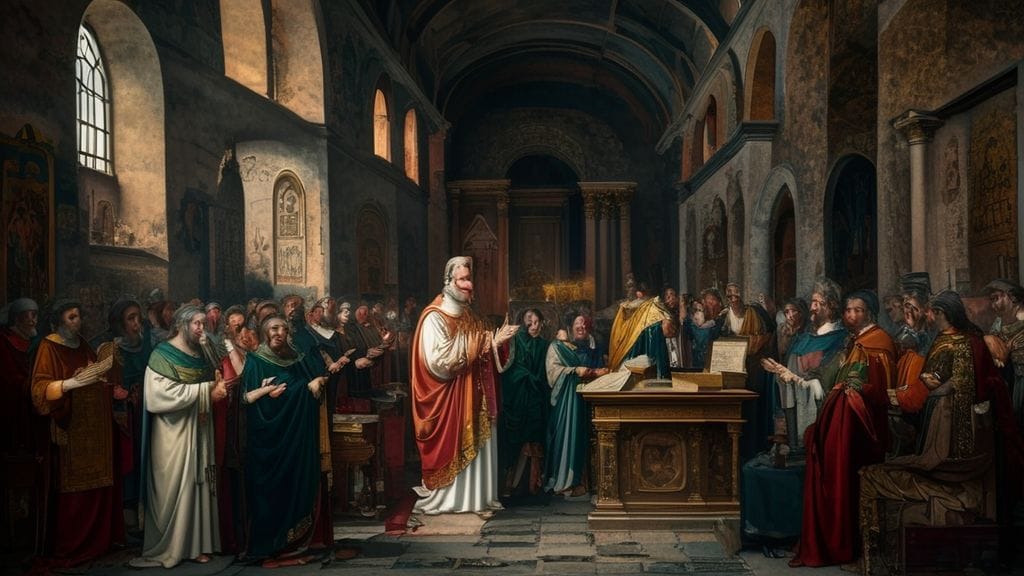
At last the day came. On September 10, 422, under a sky still warm with late summer light, Rome’s clergy and representatives of its Christian people assembled to choose their new bishop. The place was likely one of the great Roman basilicas—perhaps the Lateran, the official papal residence and cathedral of the Bishop of Rome—its massive nave filling with voices, footsteps, and the rustle of woolen tunics.
The air inside was cool despite the crowds, echoing with the faintest whisper of previous liturgies. The apse, crowned by a semicircular arch, looked down on the assembly like a solemn, unblinking eye. Lamps flickered near the altar scrim, illuminating mosaics that shimmered like still, silent witnesses to Rome’s turbulent history.
Clergy took their places: presbyters in rough but dignified garments, deacons with their diagonal stoles, acolytes moving more nervously at the edges, trying not to drop candlesticks or misplace documents. Somewhere there, among them, stood Celestine, his face perhaps unreadable, his hands folded or resting lightly on a wooden bench. Above, from the clerestory windows, sunlight striped the interior in bands of gold.
The process that followed, while not recorded in step-by-step detail, would have involved acclamations, consultations, and the gradual coalescing of consent. There was no secret ballot in the modern sense; there were, instead, voices and gestures, shouts of approval, silence of disapproval, the subtle way in which one name rose louder than others. One can picture the moment when “Celestine!” began to be pronounced with more conviction, when other potential candidates felt the ground soften under their feet.
As the acclamations swelled, the election of pope celestine i became not just a decision but a sound—Rome herself, in all her weariness and hope, giving voice to a choice. Perhaps at first it was uncertain, a ripple of support that met pockets of hesitation. But gradually, as more clergy and leading lay voices signaled agreement, resistance melted away into resigned acceptance or even genuine enthusiasm.
There would have been a formal acknowledgment, some formula of proclamation: Celestine was now bishop of Rome, successor of Peter, shepherd of this fractious, fragile flock. Hands were laid on him; prayers were chanted, calling upon the Holy Spirit to seal what human deliberation had begun. The ceremony did not erase the very human calculation that had preceded it, but it bathed that calculation in a sacred language that gave it meaning and weight.
In that moment, a life changed direction. Celestine, who had spent years advising, judging, listening, and serving under others, now found the gaze of Rome and much of the Christian world fixed on him. He had not sought the empire’s purple, but in the Christian imagination of the time, the pallium and the cathedra were garments of a different but no less daunting sovereignty.
When the assembly finally began to dissolve, and people spilled out into the sunlit streets, a new chapter in Rome’s story had quietly turned its first page.
Voices in the Basilica: Factions, Fears, and Quiet Compromises
Behind the apparent unanimity of Celestine’s election lay a web of competing hopes and anxieties. Not everyone had wanted him; not everyone saw his elevation as a triumph. Some had backed other clerics, perhaps men with stronger ties to certain families or with reputations as brilliant preachers, gifted administrators, or formidable theologians.
Yet the memory of the Eulalius schism was fresh, and few in 422 wanted to risk tearing Rome in two again. The disputes that had raged during Boniface’s contested election had left scars deep enough that prudence now counseled compromise. Celestine, steady and relatively unmarked by extreme allegiances, appeared as a man who could rally a broad spectrum of support without rekindling old fires.
Inside the basilica, low-voiced debates must have flickered around the edges of the formal proceedings. Some might have argued that Rome needed a more forceful personality, someone who would confront the imperial court or Eastern bishops with thunderous authority. Others, chastened by years of crisis, preferred a man who could maintain fragile peace, tend the city’s poor, and defend orthodoxy without provoking unnecessary confrontation.
We know little of specific factions by name, but the patterns of late antique politics suggest certain divisions: between clergy aligned with old senatorial nobility and those closer to emerging Christian elites; between those who emphasized doctrinal purity above all and those more focused on pastoral care and charity; between partisans of different theological currents aligned with major sees abroad. In the undercurrent of these conversations, Celestine’s biography was weighed like evidence before a jury.
When the decision finally settled on him, there would have been some quiet resignations. A presbyter who had hoped to become bishop might return home that night, his mind buzzing with what-ifs, his prayers tinged with bitterness. A faction leader might whisper to his friends that they would watch this new pope closely, ready to influence or resist him as needed. Acceptance did not mean forgetfulness; alliances that had failed to secure the papacy would now be redirected toward trying to guide or limit the man who had gained it.
Still, there was relief. The election of pope celestine i had avoided the open rupture many feared. And in a city, and an empire, jittery with uncertainty, averting open ecclesiastical warfare was no small achievement. In the interplay between hope and caution, Celestine emerged as the man who, at least for now, could hold Rome together.
Rome Reacts: How the People Heard the News
Outside the clerical circles, the reaction of ordinary Romans to Celestine’s election was likely a mixture of curiosity, indifference, and fervent devotion—depending on whom you asked. The day after the election, the news would have spread quickly: in the markets where women haggled over vegetables and stale bread, in the workshops where artisans hammered bronze or carved stone, and in the alleys where children chased one another through puddles and dust.
“They’ve chosen the new bishop,” someone would say. “Celestine, the Campanian.”
“Is he the one who preached at the titulus of so-and-so last Lent?” another might ask.
“The same. A serious man, they say. Knows his letters.”
For many, the name meant little beyond the reassurance that the Church’s hierarchy, like the turning of seasons, continued its cycle. There would still be liturgies at the usual times, alms for widows and orphans, baptisms during Easter, funerals conducted with psalms and incense. The earth had not shifted under their feet; it had simply received a new steward of the sacred.
But for others—the poor who depended on the Church’s charity, the widows supported by ecclesiastical stipends, the refugees who had fled barbarian invasions and found shelter near Rome’s shrines—the identity of the pope mattered deeply. A stern or indifferent bishop might tighten resources, or favor certain groups. A compassionate and organized one might expand aid, repair churches, secure new funding from distant patrons.
Some Christians in Rome, still within living memory of pagan triumphs and persecutions, felt an almost visceral thrill whenever a new pope was elected. In the rhythm of their spiritual lives, each bishop was a new link in the chain tying them back to Peter himself. Every papal name carved or painted near the tombs of martyrs was another sign that the Church had outlived emperors and would outlive them still.
At the same time, non-Christians still lived in Rome—pagans who clung to old rites or simply to family traditions, Jews who inhabited their own ancient communities along the Tiber’s bends. They, too, heard the news, but filtered it through different lenses. For them, the bishop of Rome was a powerful figure, but not a universal symbol. Some might have shrugged, others wondered how the new pope would treat them.
In the tenements, in the half-ruined villas, in the shops and on the bridges, Rome digested the event slowly. The election of pope celestine i was a churchly affair, yes, but in a city where the Church was one of the main distributors of hope and bread, it was also a civic one. Life went on—but now with a new name invoked at the Eucharist, a new signature at the bottom of letters, a new face glimpsed at the altar.
From Local Bishop to Global Arbiter: Celestine and the Wider Christian World
The office Celestine had inherited was rooted in the streets of Rome, but its implications stretched far beyond the city’s walls. Within weeks and months of his election, news would have traveled to other parts of the Western Empire and beyond. Bishops in North Africa, Gaul, and Hispania received messages that Boniface was dead and that Celestine now sat on the Roman cathedra.
Some may have felt simple continuity: another Roman bishop, another name. Others, especially those embroiled in ongoing conflicts, read the change with keen interest. In North Africa, for instance, the long aftermath of the Donatist controversy still simmered, and the episcopate that had corresponded so frequently with Rome under Innocent and Boniface would be eager to discern the new pope’s tone. Would he be as firm, as paternal, as eager to intervene?
In Gaul, where bishops often struggled with local magnates and shifting barbarian powers, some had already grown accustomed to invoking the authority of Rome to buttress their own positions. The election of pope celestine i gave them a new name to write when appealing against decisions or seeking confirmation of synodal decrees. Even before specific letters survive, we can imagine the calculations: if Celestine had a reputation for decisiveness, his support might prove invaluable.
Farther east, in Constantinople, Alexandria, and the other great sees, the news of a new Roman pope would have been noted with a mixture of protocol and rivalry. Official congratulations might be sent, and courtesies exchanged, but underlying those polite gestures were deep questions about the balance of power in the Christian world. Would Celestine lean into Rome’s claims of primacy more than his predecessor? Would he support Alexandria against Constantinople, or vice versa?
It is one of the paradoxes of late antiquity that a man with roots in Campania and a base in a battered Rome could influence decisions in cities he would never see. Through parchment and wax seal, through emissaries and synods, Celestine’s voice would carry into distant disputes. The election of pope celestine i thus marked not only the choice of a local bishop but the emergence of a new actor on a stage spanning from the Atlantic to the Euphrates.
Already in these early days, the papacy was becoming what one historian has called “the court of appeal of the Western church,” a place where contentious cases went when local remedies failed. Celestine stepped into that role at a moment when the Western Empire’s secular courts were weaker than ever. This made his judgments simultaneously more desired and more contested, as bishops and secular officials alike negotiated the limits of his authority.
Between Heresy and Orthodoxy: Doctrinal Storms on the Horizon
If the election of pope celestine i had been only about charity distributions and church repairs, its historical significance would be far more limited. But in the decades around 422, Christianity was being reshaped by fierce doctrinal debates. The lines between “heresy” and “orthodoxy” were being drawn, erased, and redrawn in councils and letters, and Rome was rarely a distant observer.
In the West, the lingering controversies around Pelagianism—centered on human freedom, grace, and original sin—still reverberated. Augustine of Hippo, by now an aging but towering figure, had poured immense energy into refuting Pelagius and his followers. Popes like Innocent and Zosimus had been drawn into the debate, sometimes wavering, but eventually condemning Pelagian teachings. Celestine now inherited that legacy. African bishops would look to him as a key ally in ensuring that Pelagian ideas did not resurface under new guises.
In the East, different but related debates were brewing, particularly around the nature of Christ and the manner in which divinity and humanity were joined in him. Within just a few years of Celestine’s election, this would erupt into the Nestorian controversy centered in Constantinople, where the patriarch Nestorius advanced views that critics argued divided Christ into two distinct persons. It was in this maelstrom that Celestine’s Rome would play a decisive role, aligning with Cyril of Alexandria against Nestorius and helping to shape the outcome of the Council of Ephesus in 431.
Though those later events lay in the future as Celestine was elected, the fault lines were already visible to attentive observers. The Christian world was stretching across cultures, languages, and philosophical traditions. Greek and Latin theologies, Alexandrian and Antiochene methods of interpretation, imperial politics and local pieties—all intersected in complex ways. Rome’s bishop had to learn to speak into that cacophony with both clarity and prudence.
For Celestine, the election was, in effect, his recruitment into this long doctrinal struggle. His letters, preserved in later collections, reveal a man unafraid of sharp judgments when he believed the faith was at stake. In one such letter regarding Nestorius, Celestine insisted firmly on the Church’s tradition and the necessity of correcting error. As the modern historian W. H. C. Frend observed, “Celestine stood squarely in the line of Roman bishops who saw no difference between the defense of the Church’s unity and the defense of its doctrine” (Frend, The Rise of Christianity).
The election of pope celestine i thus became a key link in the chain that would bind the decisions of Ephesus to the later formation of Catholic orthodoxy. Without his voice and authority, the balance of power in those doctrinal battles might have tilted differently. It’s astonishing, isn’t it, how a single day of acclamations in a Roman basilica could ripple into theological definitions that would shape Christian belief for centuries?
The Human Face of Authority: Celestine as Shepherd and Administrator
Beyond councils and controversies, Celestine had a daily, almost prosaic role: governing the church of Rome itself. This meant managing clergy, overseeing liturgical life, caring for the poor, and arbitrating disputes that ranged from property conflicts to accusations of moral failure. Authority, in late antique Rome, was exercised in scrolls and sermons, but also in face-to-face conversations and quiet visits to those in need.
We see glimpses of Celestine’s administrative style in his surviving letters and in later summaries of his pontificate. He appears as a man deeply concerned with discipline among clergy. In correspondence with bishops in Gaul, such as the famous Germanus of Auxerre, Celestine urged vigilance against heterodox teachings but also insisted on proper conduct and respect for ecclesiastical order. He intervened in disputes over episcopal appointments, attempting to ensure that unfit candidates did not grasp at office through secular patronage or intimidation.
Within Rome, he would have presided over the complex network of diaconiae—institutions responsible for distributing aid. Widows, orphans, the sick, and refugees all fell within the Church’s charitable gaze. Decisions about how to allocate limited resources could never be purely “spiritual”; they involved hard choices about who would go hungry and who would be comforted. The election of pope celestine i had placed one more pair of human hands on the levers controlling those choices.
In liturgy, Celestine continued the growing Christianization of Rome’s urban rhythms. Major feasts drew crowds into basilicas that had once echoed with senatorial debates or commercial negotiations before being repurposed for worship. On Easter, during vigils, he would have overseen baptisms, receiving new Christians into a faith now older than many of the city’s restored monuments. On ordinary Sundays, he might appear at different tituli, preaching or simply being seen, his presence a reassurance that the Church’s structures, like the city’s walls, still stood.
One can imagine him walking through Rome’s streets, flanked by a small retinue, passing by pagan temples whose doors stood increasingly unused, by statuary of emperors whose names few children now knew, and by simple shops where Christian symbols were carved or painted discreetly but confidently. The bishop of Rome was no longer an outlaw or a marginal figure; he was one of the few leaders whose authority touched rich and poor alike.
And yet, for all this, he remained human: subject to fatigue, misjudgment, personal likes and dislikes. The election of pope celestine i did not transform him into a flawless icon; it gave his already-formed character a larger arena. His virtues would now sustain more people; his weaknesses, too, would have broader consequences.
After the White Smoke of Antiquity: Early Actions of the New Pope
In the months following his election, Celestine began to leave his particular mark on papal policies. While we lack a detailed day-by-day chronicle, patterns emerge from the surviving documents. He confirmed the positions of bishops, responded to appeals, and gradually engaged with the larger controversies already on Rome’s horizon.
One of his early concerns involved maintaining Roman influence over the churches of Italy and neighboring regions. He corresponded with bishops in Illyricum, reaffirming Rome’s ancient, if sometimes contested, jurisdiction there. In doing so, he was not merely asserting pride but attempting to safeguard a certain unity in teaching and practice at a time when political borders were increasingly fluid.
Letters also show him taking an interest in monastic life, which was rapidly expanding in both East and West. He supported ascetic ideals but was wary of forms of monasticism that might stray into doctrinal extremes or challenge episcopal authority. The interaction between monks and bishops was one of the major shifts of this era, and Celestine’s balancing act reflects the papacy’s broader attempt to harness monastic fervor without letting it fragment the church.
The election of pope celestine i quickly proved to be more than a ceremonial succession; it initiated a pontificate that would increasingly be drawn into global debates. By 429–430, Celestine was already in correspondence with Cyril of Alexandria about the alarming teachings attributed to Nestorius in Constantinople. He convened a Roman synod to examine Nestorius’s doctrine and, siding with Cyril, authorized disciplinary action if Nestorius did not recant.
In one of his key letters—later read at the Council of Ephesus—Celestine spoke firmly of the need to safeguard the Church’s faith, endorsing Cyril’s condemnation of Nestorius. A councilor in Alexandria, reading this Roman support, would have recognized that Celestine was not a passive figurehead but an active theological ally. The man whom Rome had chosen in 422 now helped bring down the patriarch of Constantinople less than a decade later.
Thus, the quiet acclamations of that September day in Rome echoed, in time, through the halls of an Ephesian council chamber, where bishops debated Christ’s very identity. The line from the basilica of Rome to the church of Mary in Ephesus (where the council met) runs through ink and parchment but also through conviction and courage. Celestine, shaped by his predecessors, now shaped events far from the Tiber’s banks.
Echoes from Africa, Gaul, and the East: The Reach of Celestine’s Decisions
The influence Celestine exerted was not abstract; it touched communities struggling with concrete problems. In North Africa, for instance, bishops like Augustine continued to grapple with the wreckage of Donatism and the moral aftershocks of years of conflict. Celestine’s Rome provided a framework of authority that helped stabilize church life there, even as barbarian threats loomed on the horizon. Augustine died in 430, the same year Vandals besieged Hippo; during his final years, he would have known Celestine as the Roman voice backing the cause of Catholic unity.
In Gaul, Celestine’s reach was felt perhaps even more dramatically. Alarmed by the spread of Pelagian ideas in British and Gallic circles, he sent Germanus of Auxerre to Britain around 429 to combat Pelagian influence. This mission, celebrated later in hagiographies, shows the pope using trusted bishops as emissaries of both doctrine and discipline. The election of pope celestine i had supplied Germanus with a commission that would ripple through the Christian history of the British Isles.
Celestine also corresponded with bishops in Gaul about issues of ecclesiastical autonomy and the proper role of metropolitan sees. He resisted efforts by some Gallic prelates to establish an independent ecclesiastical hierarchy apart from Roman oversight, insisting that major disputes and important episcopal appointments should still look to Rome for confirmation. A letter of his admonishing the bishop of Arles, later reported by Prosper of Aquitaine, shows a pope willing to curb ambitious regional leaders in defense of what he saw as legitimate Roman prerogatives.
In the East, Celestine’s involvement in the Nestorian controversy has already been noted, but his influence extended further. His backing of Cyril of Alexandria helped tip the scales at Ephesus, and his endorsement of the council’s decisions strengthened their reception in the West. According to the early church historian Socrates Scholasticus, Rome’s support for Cyril played a key part in isolating Nestorius, illustrating once again how a Roman election could transform distant ecclesiastical politics (Socrates, Church History).
In all these regions, people encountered Celestine not as a distant abstraction but through letters read aloud at synods, through visiting bishops who carried his decisions, and through the subtle shifts in local power that followed from his judgments. The election of pope celestine i had thus extended its consequences outwards in widening circles, touching lives that had never seen Rome and would never know the details of that September day.
A Turning Point in Papal History: Legacy of the Election
Measured against the great councils and doctrinal formulations of the fourth and fifth centuries, the election of pope celestine i might seem, at first glance, like one more ordinary transition in a long line of bishops. Yet, when we step back and trace the arc of papal history, this moment stands out as a significant pivot within the evolving role of the Roman See.
Celestine’s pontificate (422–432) shows a papacy increasingly confident in its right to intervene beyond Italy, especially in doctrinal matters. It demonstrates the bishop of Rome acting as both guardian of orthodoxy and arbiter in disputes that crossed imperial borders. The precedents he helped consolidate would be invoked by his successors as they navigated new theological storms and political crises.
At the same time, his election came at an inflection point in imperial history. Within a few decades, the Western Roman Empire would crumble irreparably. Rome would face new sieges, new sackings, new rulers who spoke Germanic tongues and followed Arian Christianity. In that shifting landscape, the papacy often emerged as the one institution with claims to continuity, memory, and universal authority. The way Celestine wielded his office—grounded in tradition, conscious of Rome’s special role, and active in distant controversies—helped prepare the papacy to weather that coming storm.
Historically, Celestine sits between two more widely known popes: Innocent I before him and Leo I (“the Great”) after him. Innocent had sharpened Rome’s sense of itself; Leo would dazzlingly articulate papal primacy and theology at the Council of Chalcedon. Celestine’s election and pontificate form the crucial bridge between these figures. Without him, the line from Innocent to Leo would be thinner, the continuity less evident.
We might say that the election of pope celestine i was one of those quiet, structurally important events: not as celebrated as a council, not as dramatic as a martyrdom, but essential in solidifying a certain form of Christian leadership. It took the theoretical primacy of Rome and put it to the test in practical, contested arenas—from Britain’s Pelagian fields to the council chambers of Ephesus.
And, perhaps just as important, his election gave Rome in 422 a sense of stability. In a city still rebuilding from disaster, still uncertain of its place in the world, the presence of a capable, respected bishop offered a fragile but real anchor. That anchor, in time, would pull the histories of Italy, Gaul, Britain, and the Mediterranean into new configurations under the sign of the cross and the shadow of the papal throne.
Remembering 422: Historians, Sources, and the Shape of Memory
Our reconstruction of the election of pope celestine i rests on scant, scattered sources. Late antique Rome did not yet have the detailed conclave diaries or elaborate canonical records that later centuries would produce. Instead, we rely on brief notices in papal catalogues, on letters preserved in collections, and on references in chronicles and theological works.
The Liber Pontificalis, the early medieval book of papal biographies, mentions Celestine, summarizing his origins, key actions, and burial. It tells us he was from Campania and credits him with building or restoring churches and combating heresies. Yet it says little about the atmosphere of his election. That silence has forced historians to read between the lines, using knowledge of other elections and the broader context of the time to imagine how September 10, 422, likely unfolded.
Prosper of Aquitaine, a contemporary chronicler and staunch supporter of Augustine’s theology, records some of Celestine’s actions against Pelagianism and Nestorianism. Through Prosper’s eyes, we see a pope deeply engaged in theological struggle, and we catch indirect glimpses of why such a man might have been chosen in 422. This is not impartial reportage; Prosper had his own commitments, but they help color in the outlines.
Eastern church historians like Socrates Scholasticus and later writers mention Celestine in the context of the Nestorian controversy, emphasizing his alliance with Cyril of Alexandria and his role in condemning Nestorius. Their testimony reminds us that the election in Rome was noticed, and felt, in cities as distant as Constantinople and Ephesus.
Modern historians, piecing together these fragments, have tried to situate Celestine within the broader development of the papacy. Scholars such as J. N. D. Kelly and W. H. C. Frend note that his pontificate consolidates Rome’s involvement in doctrinal disputes and reveals a growing sense of papal responsibility for the universal church. These analyses, though necessarily speculative in places, offer an interpretive frame through which to view the significance of his election.
Remembering 422, then, is an act of historical imagination disciplined by sparse evidence. We cannot know every word spoken in the basilica on the day of Celestine’s election; we cannot list all the factions at play or weigh their precise motives. But we can situate that day within a web of events we do know: the sack of Rome, the controversies of Innocent and Boniface, the councils of the coming decade, the letters that still survive. In doing so, the election of pope celestine i emerges from obscurity, no longer a bare date in a catalogue but a living, complex crossroads of human decision and divine aspiration.
Yet behind the celebrations of later hagiographers and the abstractions of theologians, we must remember the ordinary humanity of those involved: clergy anxious about schism, laypeople worried about food and security, and a man from Campania who, on that September day, felt the entire weight of Rome’s hopes settle onto his shoulders.
Conclusion
The election of Pope Celestine I on September 10, 422, unfolded in a Rome at once diminished and determined, a city rebuilding from catastrophe and groping toward a new identity as the spiritual capital of a fading empire. From the silence of Boniface I’s deathbed to the gathering of clergy beneath basilican arches, the process mixed solemn ritual with all-too-human negotiation. Names were weighed, fears remembered, and fragile agreements forged until Celestine, the Campanian cleric shaped under Innocent I, emerged as the man who could hold Rome’s church together.
In the years that followed, the significance of that choice became unmistakable. Celestine did not confine himself to local administration; he reached into the disputes of Africa, Gaul, Britain, and the Eastern Empire, helping to combat Pelagianism, empowering Germanus’s mission to Britain, and taking a decisive stand against Nestorius in alliance with Cyril of Alexandria. Through letters, synods, and alliances, he strengthened Rome’s claim to serve as arbiter of doctrine and discipline for a church stretched across a fragmented political world.
Seen from a distance of centuries, the election of pope celestine i stands as a crucial link in the chain connecting the self-assertive Rome of Innocent I to the theologically luminous papacy of Leo the Great. It consolidated a vision of the bishop of Rome as both local shepherd and global guardian—a vision that would shape the medieval papacy and echo into modern debates about ecclesial authority. At the same time, the event reminds us how profoundly papal history is woven from ordinary threads: a wounded city, cautious clergy, whispering crowds, and one man trying to respond faithfully to a call that exceeded his own plans.
In the flicker of lamps beneath the basilica’s vaults that September day, no one could have fully foreseen councils at Ephesus, missions in Britain, or future barbarian sieges. Yet their decision made those histories possible. Rome’s choice of Celestine, born of fear and hope in equal measure, became one of the quiet hinges on which the door between an imperial church and a post-imperial papacy turned.
FAQs
- Who was Pope Celestine I before his election?
Before becoming pope, Celestine I was a Roman cleric originally from Campania in southern Italy. He likely served as a deacon and then as a priest in Rome, working closely within the papal administration under earlier popes, especially Innocent I. His experience with doctrinal disputes and church governance made him a respected, if not flashy, candidate when the see fell vacant in 422. - When did the election of Pope Celestine I take place?
The election of Pope Celestine I took place on September 10, 422, just six days after the death of his predecessor, Pope Boniface I. The rapid transition reflected both the urgency of securing stable leadership and the Roman church’s desire to avoid another schism like the earlier conflict with Eulalius. - Why was Celestine I’s election significant for church history?
Celestine’s election was significant because it placed a firm, administratively skilled, and doctrinally decisive leader on the Roman throne at a time of mounting theological and political crises. His subsequent actions against Pelagianism, his support of missions to Britain, and his participation in the Nestorian controversy helped solidify Rome’s role as a central arbiter of orthodoxy in the fifth century. - How did Celestine I influence major theological debates?
Celestine I played a key role in two major controversies. In the West, he supported Augustine’s anti-Pelagian stance and backed measures to curb Pelagian influence, especially in Gaul and Britain. In the East, he sided with Cyril of Alexandria against Nestorius, sending letters and decisions that were read at the Council of Ephesus (431), thereby helping to secure the condemnation of Nestorian Christology. - What was the political context of Celestine I’s election?
His election occurred during the reign of the boy emperor Valentinian III, with his mother Galla Placidia acting as regent from the court in Ravenna. The Western Empire was weakened, with barbarian groups settled in various provinces, and Rome itself was still recovering from the sack of 410. In this volatile context, the pope of Rome was increasingly seen as a stabilizing authority, both spiritually and socially. - How did ordinary Romans react to the election of Pope Celestine I?
While our sources are limited, it is likely that ordinary Romans received the news with a mixture of relief, curiosity, and, for many, indifference. For those dependent on church charity—widows, orphans, refugees—the identity of the new pope mattered greatly, as it could affect access to aid and protection. For devout Christians, the election reinforced the sense that the Church, and especially the see of Peter, continued to endure amid political instability. - Did Celestine I have conflicts with other bishops?
Yes. Celestine I sometimes clashed with powerful bishops, especially in Gaul, where he resisted attempts to build regional hierarchies independent of Roman oversight. His correspondence shows him admonishing certain Gallic prelates and insisting that key disputes and appointments be referred to Rome, reflecting his strong view of papal primacy in church governance. - How does Celestine I compare to other early popes like Innocent I and Leo I?
Celestine I stands between Innocent I and Leo I as a bridge figure. Like Innocent, he asserted Rome’s authority in doctrinal and disciplinary matters; like Leo, he participated in major Christological controversies. While perhaps less widely celebrated than Leo the Great, Celestine’s pontificate helped establish patterns of papal intervention and self-understanding that Leo would later develop more fully. - What are the main sources for understanding the election of Pope Celestine I?
The main sources include brief notices in the Liber Pontificalis, references in chronicles such as those of Prosper of Aquitaine, and the letters of Celestine himself, preserved in later collections. Eastern church historians, like Socrates Scholasticus, also mention him in connection with the Nestorian controversy. These fragmentary sources, combined with broader knowledge of late antique election practices, allow historians to reconstruct the context and importance of his election. - What long-term impact did the election of Pope Celestine I have on the papacy?
The long-term impact lies in the way Celestine exercised papal authority across regional boundaries and in major doctrinal disputes. His actions strengthened the notion that the bishop of Rome could serve as a universal judge in matters of faith and discipline. This helped shape the medieval papacy’s self-image and provided later popes with precedents for intervening beyond Italy, thereby making his election a quiet but crucial milestone in the history of the Roman See.
External Resource
Internal Link
Other Resources
- Encyclopaedia Britannica – general search for the exact subject
- Google Scholar – academic search for the exact subject
- Internet Archive – digital library search for the exact subject