Table of Contents
- A Winter Morning in Rome: The Day the Earth Opened
- Whispers Beneath the Vineyards: Rumors Before the Revelation
- The Vineyard on the Esquiline: A Pit, A Ladder, A Miracle
- From Marble Limbs to Living Men: First Reactions to the Laocoön
- Julius II and the Politics of Wonder
- Excavating the Past: Rome as an Archaeological Dreamscape
- Antique Voices, Renaissance Eyes: Pliny the Elder Meets 1506
- The Laocoön in the Belvedere Courtyard: A New Pantheon of Stone
- Agony in Marble: How Artists Studied Suffering
- Michelangelo, Raphael, and the Silent Dialogue with Antiquity
- Humanism Embodied: Theology, Myth, and the Dignity of Pain
- Copies, Casts, and Controversies: The Laocoön Spreads Across Europe
- Napoleon, Empire, and the Captive Statue
- Lost Arms, Lost Meanings: Restorations and Scholarly Battles
- Modern Eyes on Ancient Terror: Psychology, Politics, and Aesthetics
- Archaeology Becomes a Science: Methods Born from Marvels
- The Laocoön in Popular Imagination: From Engravings to Mass Culture
- Standing Before Laocoön Today: The Museum as a Stage
- Conclusion
- FAQs
- External Resource
- Internal Link
Article Summary: On a cold January morning in 1506, a Roman vineyard gave way to one of the most electrifying encounters between past and present: the discovery of laocoon group, a buried masterpiece mentioned centuries earlier by Pliny the Elder. This article follows that moment from the first crack in the soil to the statue’s triumphant installation in the Vatican, tracing how a single work of marble reshaped Renaissance art and politics. We move through the streets and palaces of Rome, watching popes, artists, and scholars compete to possess and interpret the group’s twisted bodies and frozen cries. Along the way, we see how the discovery of laocoon group helped transform scattered antiquarian curiosity into a more systematic archaeology. We explore how its depiction of suffering influenced Michelangelo and others, fueled theological debates, and later became a prize of Napoleonic conquest. The narrative then turns to modern scholarship, restoration controversies, and the uneasy beauty of pain turned into art. Throughout, we return again and again to that vineyard on the Esquiline Hill, where the discovery of laocoon group became a hinge between antiquity and modernity. By the end, the statue stands not merely as an artifact, but as a mirror reflecting five centuries of changing human hopes, fears, and interpretations.
A Winter Morning in Rome: The Day the Earth Opened
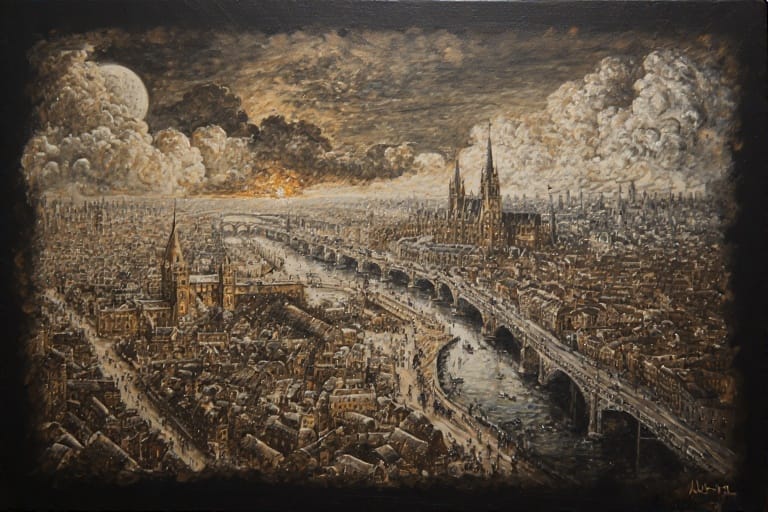
On 14 January 1506, Rome woke to a winter sky that hung low and grey over its ruins. The city was already a palimpsest of ages: triumphal arches half-buried in earth, broken columns rising like bleached bones, medieval houses clinging to shattered imperial walls. Somewhere on the slopes of the Esquiline Hill, in a vineyard that had taken root where once stood the palace of the emperor Titus, a few laborers set to work. They did not know that within hours they would breach not only a crust of underground masonry, but the boundary between imagination and reality. For centuries, learned men had read Pliny the Elder’s description of a miraculous statue—Laocoön and his sons entwined by serpents—as the greatest sculpture in the world. But it was a legend in ink. Then the ground gave way.
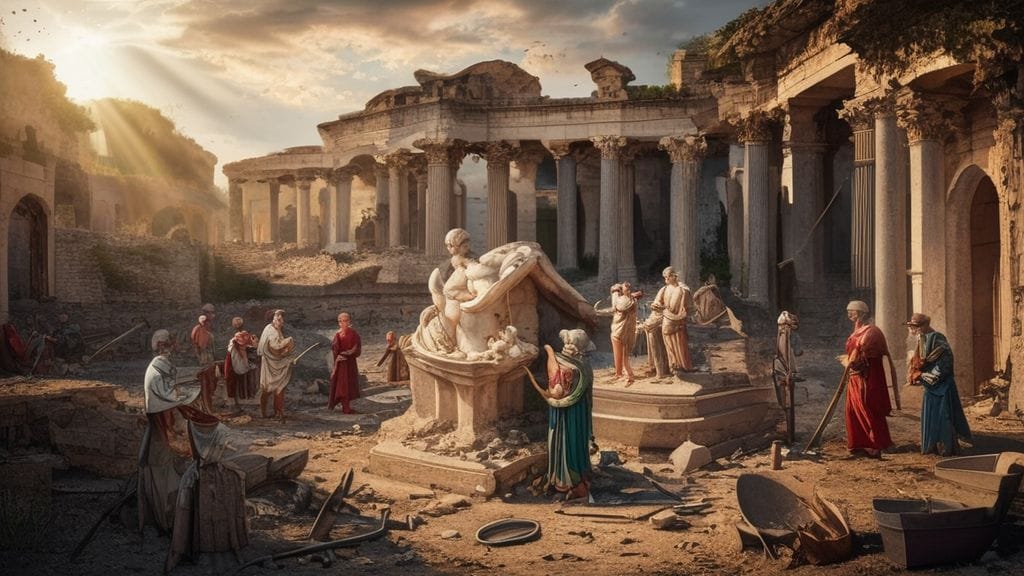
One can imagine the sounds first: the thud of shovels, the crack of a rock, the hollow echo that tells any digger that there is an empty space below. A stone shifted, a pocket of stale air exhaled from the earth. A workman peered into the darkness, eyes adjusting to the gloom, and saw shapes that seemed, at first, to be only rough stone. Yet these shapes had curves where stone rarely curves of its own accord—shoulders, torsos, a face drawn back as if in a silent scream. In that instant, the discovery of laocoon group was not yet a scholarly event; it was a raw encounter between living men and lifelike stone, a collision of flesh and marble across two thousand years.
Rome at the dawn of the sixteenth century was a place hungry for such marvels. The popes had returned from Avignon, the papal court was flexing its temporal muscles, and the city was slowly transforming from a half-abandoned religious town into the theatrical capital of a revived empire-in-miniature. Artists and humanists moved through its streets with notebooks and sketchbooks, always searching, always comparing the fragment here with the phrase in an ancient text there. When word began to spread that a remarkable statue had been unearthed—“a group of figures all tangled together, like men in a storm at sea,” someone might have said—the news moved faster than carts through muddy alleys. Before the day was out, the rumor would reach the ears of one of the most powerful men in Europe: Pope Julius II.
The discovery of laocoon group that morning was not simply an archaeological incident; it was a revelation staged by the city itself. Rome, seemingly exhausted by centuries of plundering and neglect, suddenly spoke again in the language it knew best: spectacle, emotion, grandeur. The earth had opened, and what it offered was not a docile fragment, but an explosive vision of agony, resistance, and divine cruelty—exactly the kind of image that the turbulent, ambitious Rome of Julius II was ready to recognize as its own.
Whispers Beneath the Vineyards: Rumors Before the Revelation
To understand the shock of that January day, one must step back into the years and decades leading up to it, when Rome’s ruins were slowly reclaiming their voices. By the late fifteenth century, the city’s hills were dotted not only with vineyards and vegetable plots but with men who collected, bought, and sold fragments of the ancient world. Marble torsos became garden ornaments; broken capitals were reused in palaces; Latin inscriptions turned into curiosities for the literate and wealthy elite. This was the soil—intellectual as much as physical—from which the discovery of laocoon group would emerge.
Humanists had long scanned ancient texts in search of references to lost works of art. Chief among these texts was Pliny the Elder’s “Natural History,” copied and recopied through the medieval centuries, rediscovered, glossed, worshipped. In one celebrated passage, Pliny praised a statue in the palace of Titus: a group showing Laocoön, a Trojan priest, and his sons being crushed by sea serpents, carved from a single block of marble by three sculptors from Rhodes—Agesander, Athenodoros, and Polydoros. “It is to be preferred to all that the arts of painting and sculpture have produced,” he wrote, and with that sentence he set a kind of trap for posterity. Where was this statue? Did it survive? Could it ever be seen again?
By 1506, there were already other great finds: the Apollo Belvedere, the Belvedere Torso, fragments of colossal emperors emerging from the rubble of forums and baths. Each new discovery was a piece in a puzzle nobody could complete but everyone wished to describe. Scholars argued in candlelit rooms over whether this or that statue matched an ancient description. Artists, especially the younger ones hungry for fame, roamed the ruins sketching anything that still bore the signature of a living hand. The city itself became an open-air academy where the past was the teacher and the present, eager and unsteady, was the pupil.
Rumors of buried marvels were common. An old woman might swear that under her house lay a sleeping giant. A mason might recall striking something metallic beneath a church floor. The line between legend and memory was thin. In coffee-hued ink on aging paper, contracts and letters recorded the sale of “an antique bust,” or “a torso of a hero,” traded like rare spices. Against this backdrop, the news that a full group—three figures, intact enough to be recognized as a single, dramatic scene—had been found was sensational. Some in Rome had read Pliny’s lines so often that they could recite them. The idea that this half-mythic Laocoön could spring from the ground like a prophecy fulfilled was almost too much to believe. And yet the city was ready to believe it; indeed, it longed to.
The Vineyard on the Esquiline: A Pit, A Ladder, A Miracle
The vineyard belonged, as far as the documents suggest, to Felice de’ Freddi or perhaps to the Sassi family—names that surface in legal records but would have been ordinary enough on the streets of Rome. They had no reason to expect their property to become the center of Europe’s artistic universe. The men who labored that day were almost certainly hired hands, more concerned with the stubbornness of the soil and the prospect of pay than with the mysteries that might lie beneath. Yet when they opened that void and lowered themselves by rope or ladder into a buried chamber, they entered the antechamber of immortality.
Accounts from the time, though colored by hindsight, sketch the scene. The room was small, perhaps a niche or part of a larger set of subterranean spaces. The air was stale, tinged with the faint bite of old mortar. In the dimness, someone raised a torch or candle. Yellow light crawled over white surfaces, breaking into sudden highlights and deep shadows. There, half-embedded in earth and brick, lay a tangle of bodies. One figure was central—a muscular man, older than youth but not broken by age, his torso twisted, his abdomen clenched. Two slighter forms, boys, pressed close by. Around them coiled the petrified forms of serpents, their bodies looping, mouths agape, pressing into flesh turned to stone.
The workmen called for the owner. The owner called for experts. Among those first alerted was Giuliano da Sangallo, architect and engineer, trusted advisor to Pope Julius II. When Sangallo received the message—perhaps via a hurried servant, perhaps by word passed through an intermediary—he knew immediately what to think: Pliny. Laocoön. He brought with him a young sculptor in his circle, Jacopo Sansovino, as if to bind the discovery to the future from its first breath. The pair rushed to the site. Years later, Sansovino would recall with something like awe how Sangallo, upon seeing the group below, is said to have cried: “This is the Laocoön, of which Pliny speaks!”
For a moment, time telescoped. The words of a Roman writer who had died in the eruption of Vesuvius in 79 CE fused with the image of sculpted bodies buried perhaps within a century of his writing, now re-emerging before two Renaissance eyes. The discovery of laocoon group at that instant became more than a find; it was verification, a rare instance where text and artifact reached across the abyss of centuries and clasped hands. How often had humanists dreamed of such moments? Here, in a cramped, dusty cavity under a vineyard, that dream had taken material form.
The practical matters began quickly. The group had to be freed from its cramped prison without damage. The marble was heavy—several tons—and the architecture above it uncertain. Workmen widened the opening, applied pulleys and ropes, and slowly hoisted the figures up toward the paling winter light. As the statue emerged from the earth, onlookers would have seen it properly for the first time: Laocoön’s head thrown back, his mouth open, muscles standing out in sharp relief; one son turned inward, the other already half-lost to the coils of the snake. Arms were missing, fractured at the joints; yet the expressive power of what remained was undeniable. What had been a rumor, then a shadow in a pit, was now an irrefutable presence on the surface of Rome.
From Marble Limbs to Living Men: First Reactions to the Laocoön
Word of the discovery raced through Rome like fire along dry straw. The first reactions, as preserved in letters and diaries, oscillated between scholarly excitement and a more primitive sense of awe. Here was a statue that did not simply adorn space; it dominated it, demanding an emotional response. Viewers spoke of the verisimilitude of the muscles, the tension of the limbs, the way the marble seemed almost to tremble with effort. Instead of the calm, composed heroes that had typified many admired ancient works, this group offered a different ideal: beauty convulsed by terror.
One chronicler, Francesco Albertini, mentioned the find that very year, identifying it with Pliny’s famed group. Humanists gathered around, some perhaps with copies of “Natural History” in hand, reading the Latin text aloud and pointing from page to statue, as if ticking off a checklist. Three sculptors from Rhodes? Possibly. A single block of marble? The breaks and joints sparked debates. But the bigger argument was internal—what did it mean that the greatest sculpture of antiquity, long presumed lost, had reappeared in the reign of a pope who was already fashioning himself as a second Julius Caesar?
For ordinary Romans, the group’s first impact may have been more visceral than intellectual. Stories would have spread: there is a statue of a man screaming in pain, with his children and snakes, in the pope’s city. Some may have recalled the tale of Laocoön himself—how in Virgil’s “Aeneid,” he had hurled a spear at the Trojan Horse and warned his people, “I fear the Greeks, even when they bear gifts,” only to be silenced by divine punishment. To see this story frozen in white, sinewy stone was to confront a highly charged image of piety, disobedience, and injustice. Was Laocoön a villain, punished rightly? Or a tragic seer destroyed for telling an inconvenient truth?
The discovery of laocoon group thus opened an immediate arena of interpretation. Preachers could use it as a moral lesson; scholars as a demonstration of classical excellence; artists as an open-school of anatomy and emotion. All the while, the statue still bore the marks of its long burial: stains of soil, chips, missing elements. It had not yet been polished, recontextualized, or idealized by the frameworks that would soon be built around it—physically in the Vatican, and intellectually in treatises and lectures. In those first days, the Laocoön was something raw and rupturing, a wound of the ancient world torn open in the heart of Renaissance Rome.
Julius II and the Politics of Wonder
Pope Julius II, born Giuliano della Rovere, did not hesitate. As soon as the discovery was confirmed, he moved to purchase the group for the Vatican. His motives were far from purely aesthetic. Julius was a man of granite will and imperial ambitions. He donned armor to lead troops, launched vast building projects, and sought to consolidate the Papal States into a coherent, formidable power. For him, art was not a luxury; it was a weapon—an instrument to project authority, legitimacy, and divine favor.
To claim the Laocoön was to claim the mantle of ancient Rome. The palace of Titus, where Pliny had seen the statue, had been a symbol of imperial opulence. For Julius to remove this masterpiece from its obscurity and display it in his own courtyard was a way of declaring himself heir not only to Peter but to the Caesars. In doing so, he fused Christian and classical lineages into a single narrative: the pope as spiritual and cultural emperor. The discovery of laocoon group thus fed directly into the political theater of the papacy, turning marble into propaganda.
The transaction itself underscored the asymmetries of power. The vineyard owners received money—less, likely, than the statue’s true worth even in a narrow economic sense. The pope received an icon. Within months, the group was installed in the Belvedere Courtyard of the Vatican, an open space Julius was transforming into a grand stage for antiquities and modern art alike. There, sunlight played on the twisting forms, casting sharp shadows into the furrows of muscle and serpent. Visitors to the papal court could not fail to pass the Laocoön, and in doing so, they were subtly reminded that what the ancients had, Julius had reclaimed and made his own.
Yet behind the celebrations of this acquisition lay more complex implications. By centralizing ancient masterpieces in the Vatican, Julius was also centralizing cultural capital. Rome’s other collectors—cardinals, nobles, even some wealthy merchants—might bristle at the pope’s ability to outbid or simply overrule them. The Laocoön’s new home sent a clear message: the ultimate treasures of antiquity belonged not to private individuals, but to the institution that claimed universal spiritual authority. It is astonishing, isn’t it, how stone can be drafted into the service of power?
This dynamic would repeat throughout the sixteenth century as popes, princes, and kings vied for statues, manuscripts, and paintings. The discovery of laocoon group set a precedent: when an unparalleled object appears, it must be drawn into the orbit of the most powerful. Art became a visible ledger of dominance. In the Belvedere, surrounded eventually by the Apollo Belvedere and the Belvedere Torso, the Laocoön stood not only as a testimony to ancient genius but as a monument to Julius II’s acute awareness that wonder could be governed, curated, and deployed.
Excavating the Past: Rome as an Archaeological Dreamscape
The early sixteenth century was not yet the age of modern archaeology, but the discovery of laocoon group helped push Rome in that direction. Excavations were largely opportunistic; building a foundation for a new palace, digging a well, planting vines—any of these could intersect with the buried city. Yet each spectacular find nudged the city’s elites toward more deliberate searches. If a single vineyard on the Esquiline could yield a masterpiece “preferred to all others,” what might lie beneath other properties?
Over the following decades, more systematic excavations appeared. Wealthy families hired agents to scour the hills and valleys for ancient masonry. Scholars began to keep more careful records of where significant works were found, and how they related to ancient topography as reconstructed from texts. The idea grew that one could, by combining written sources with physical clues, locate long-lost temples, palaces, and theaters. Pliny’s text had guided the identification of the Laocoön; perhaps Vitruvius could help rediscover forgotten buildings; perhaps Suetonius and Tacitus, elusive sites of imperial drama.
This mingling of scholarship and spade work created a new kind of figure in European culture: the antiquarian-excavator, part historian, part treasure hunter. The Laocoön became one of the touchstones of this emerging discipline. Later writers cited its discovery as an example of how text and artifact could confirm each other. One eighteenth-century antiquarian would later note, with admiration, that “the Laocoön, dragged from its earthy tomb, proved Pliny at once a faithful witness and a most discerning judge.” Such statements rested on a bit of wishful thinking, yet they reveal how powerfully the group shaped expectations about the recoverability of the ancient world.
Of course, “archaeology” at this stage was still entangled with plunder. Statues, reliefs, and inscriptions were removed from their original settings without much concern for context. The priority was the object itself—its beauty, its market value, its prestige—not the layers of history that surrounded it. Yet even amid this frenzy, the discovery of laocoon group fostered a sense that finds had stories, and that those stories could be pieced together. The notion that documentation mattered—that the place and manner of a discovery added to its meaning—began to take hold, however imperfectly. Slowly, the city’s scattered ruins coalesced in the imagination into a legible, if still fragmentary, narrative of Rome’s rise, fall, and reanimation.
Antique Voices, Renaissance Eyes: Pliny the Elder Meets 1506
If one had to choose a single witness to bridge antiquity and the Renaissance in this story, it would be Pliny the Elder. His “Natural History,” a vast compendium of knowledge, was both admired and mocked for its breadth and credulity. Yet in the case of the Laocoön, his authority suddenly seemed unassailable. The discovery in 1506 was like a citation leaping off the page and turning into stone. Humanists quoted the relevant lines with new reverence, copying them into marginal notes, repeating them aloud to visitors in front of the statue: “…in the palace of Titus, a work to be preferred to all that the arts of painting and sculpture have produced.”
This convergence of text and object became a founding myth for the relationship between classical literature and material remains. Here was proof that ancient authors could guide modern eyes to real artifacts. The discovery of laocoon group, when framed through Pliny’s authority, suggested a universe in which the past had left clues that, if patiently followed, might yield extraordinary rewards. It also flattered Renaissance intellectuals, casting them as collaborators with their ancient predecessors in a trans-historical project of knowledge.
But the match between Pliny’s description and the statue before them was not perfect. Pliny emphasized that the group was carved “ex uno lapide”—from a single block. Close inspection of the Laocoön revealed multiple pieces, albeit cunningly joined. Was Pliny exaggerating? Had he seen a version differently assembled? Did the group in 1506 represent the same work or a replica? These questions seeded a centuries-long debate about originality, copying, and the nature of classical sculpture. Scholars like Johann Joachim Winckelmann in the eighteenth century grappled with such issues, often taking the Laocoön as a central case study. In his famous “History of Ancient Art” (1764), Winckelmann would use the group to argue for a noble simplicity and quiet grandeur in Greek art—even as the statue’s convulsed bodies seemed anything but quiet.
The interplay between what Pliny said and what the eyes saw also highlighted the tension between literary and visual evidence. What if the statue had not survived? The story of Laocoön in art history would then be entirely textual. Instead, the group’s emergence forced commentators to reconcile their mental images, shaped by reading, with the stubborn realities of marble. The discovery of laocoon group thus challenged interpreters to recognize that antiquity was not a monologue written by authors, but a dialogue between words and things—between the voices of the dead and the gaze of the living.
The Laocoön in the Belvedere Courtyard: A New Pantheon of Stone
Installed in the Belvedere Courtyard, the Laocoön quickly became part of a curated pantheon. Julius II and, later, his successors orchestrated the space as a deliberate conversation between ancient and contemporary art. The Apollo Belvedere, discovered earlier and already celebrated for its poised elegance, stood nearby; the mutilated but majestic Belvedere Torso, which Michelangelo admired deeply, occupied another position. To walk this courtyard was to traverse a condensed, idealized history of form and beauty as seen through papal eyes.
The Laocoön, however, introduced a different tone. While Apollo embodied harmony and heroic tranquility, Laocoön embodied strife—between man and god, between body and fate. Visitors who stepped into the courtyard would have their senses guided through a sequence: from the serene to the tormented, from the composed line of Apollo’s contrapposto to the spiraling forms of Laocoön’s struggle. The installation itself became a kind of visual argument: antiquity was not uniform, but a spectrum ranging from calm perfection to charged emotion, and the Vatican, as custodian, could display all of it.
Artists flocked to the Belvedere, sketchbooks in hand. They drew the statue from multiple angles, tracing the tension of the muscles, the sinuous curves of the snakes, the anguished tilt of the father’s head. Some made wax or clay models to study the torsion of the bodies in three dimensions. These studies were not mere academic exercises; they fed directly into frescoes, altarpieces, and sculptural commissions across Italy. The Belvedere became a living workshop as much as a museum, long before the term existed.
At the same time, the Laocoön’s placement within a papal setting layered Christian meanings over its pagan myth. Some viewers read the group as a warning about the consequences of defying divine will, aligning Laocoön’s fate with biblical narratives of punishment. Others saw in the father’s suffering a prefiguration of Christian martyrdom, or even a distorted, desperate echo of the crucified Christ. The discovery of laocoon group had rescued a pagan story, but in the Vatican’s embrace, that story would never again be wholly pagan. It became part of a broader visual theology in which pain, sacrifice, and the inscrutability of God’s judgments took center stage.
Agony in Marble: How Artists Studied Suffering
The Laocoön’s most shocking quality was not its technical excellence—though that was extraordinary—but its unabashed representation of agony. Unlike so many ancient statues that presented idealized, placid expressions, this group showed a man at the precise instant when pain overwhelms composure. His mouth is open, ribs expanded, brows furrowed; his sons’ bodies twist in fear and incomprehension. In this, the statue offered Renaissance artists a new vocabulary for depicting suffering, one that would prove decisive for the next centuries of Western art.
Pain had of course appeared in medieval art: the crucifixion, the martyrdom of saints, the torments of the damned in Last Judgment scenes. But the visual conventions were different—flatter, more symbolic, often subordinated to theological clarity rather than anatomical veracity. The Laocoön changed that balance. Here was suffering rendered with a surgeon’s and a dramatist’s eye, every muscle tensed in a coherent, believable pattern. Instead of a stylized wound, viewers saw the whole body as a site of anguish.
Artists dissected this representation in their drawings. Where exactly did the muscles bulge under strain? How did the ribs press against the skin when the lungs filled with a final breath? How did fingers claw not at a visible enemy but at an invisible force—pain itself? Transferring these observations to Christian subjects, painters heightened the physical reality of Passion scenes and martyrdoms. Christ’s twisting body on the cross, the contorted limbs of saints grilled, flayed, or broken, took on a new intensity. The discovery of laocoon group thus helped to naturalize a more visceral, embodied approach to spiritual torment.
Yet the statue also raised alarms. Some moralists worried that such a seductive portrayal of pain could slide into voyeurism. Was it right to linger over the beauty of a suffering body? Did the Laocoön invite empathy for a tragic figure, or a aesthetic savoring of horror? These questions would echo in later centuries, revisited by critics like Gotthold Ephraim Lessing in his 1766 essay “Laocoön,” where he famously argued that visual art and poetry must handle the depiction of pain differently. The statue—itself the product of Hellenistic experimentation with pathos—became, through its rediscovery, the fulcrum for modern discussions of how art should represent the extremes of the human condition.
Michelangelo, Raphael, and the Silent Dialogue with Antiquity
Among the many who studied the Laocoön closely, two names stand out: Michelangelo Buonarroti and Raphael Sanzio. Both were working in Rome in the years after 1506, drawn by Julius II’s commissions. Both were already steeped in the forms of antiquity. But the discovery of laocoon group provided them, at precisely the right moment, with a crystallized example of dynamic composition and muscular expressiveness.
Michelangelo, tasked with painting the Sistine Chapel ceiling from 1508, had recently completed his colossal marble David in Florence, a work that already demonstrated his obsession with the male nude as a vehicle of spiritual and psychological intensity. The Laocoön confirmed and expanded his instincts. In the ignudi—those powerful, twisting nude youths that frame many of the ceiling’s panels—one can sense the echo of the Rhodian sculptors’ spiraling compositions. Likewise, in later works like the “Last Judgment,” the mass of writhing bodies bears kinship to the Laocoön’s theatrical yet coherent tumult.
Raphael, younger and more classically serene in temperament, absorbed the group differently. In his frescoes for the Vatican Stanze, especially the “Fire in the Borgo” and the “Heliodorus Driven from the Temple,” figures leap, twist, and contort with a vivacity that owes much to the lessons of the Belvedere. Raphael’s genius lay in integrating such movements into balanced, harmonious compositions. Where Michelangelo pushed toward the sublime and sometimes the terrifying, Raphael orchestrated Laocoön-like poses within a larger narrative clarity.
Contemporaries noticed these influences. A letter by the Venetian ambassador in Rome, describing the artistic ferment at Julius II’s court, spoke admiringly of how “the ancients have risen again from the earth to teach the moderns.” Though he did not name the Laocoön specifically, his words capture the spirit of the moment. The discovery of laocoon group turned the city into a living classroom, and its most gifted pupils were reshaping the visual language of Western art in real time.
The dialogue went both ways. As Michelangelo and Raphael internalized the ancient forms and reinterpreted them for Christian themes, they, in effect, completed a circuit of influence. Antiquity inspired the Renaissance, but the Renaissance, by exalting, reproducing, and theorizing works like the Laocoön, shaped how later generations would understand antiquity. When we stand today before the group in the Vatican Museums, we do not see it with ancient eyes, nor even with the eyes of 1506; we see it through the accumulated filters of Michelangelo’s frescos, Raphael’s compositions, Winckelmann’s treatises, and countless reproductions.
Humanism Embodied: Theology, Myth, and the Dignity of Pain
The Laocoön group sat at a crossroads of humanist thought. Here was a pagan myth, told by Virgil, referenced by Pliny, sculpted by Greek-trained artists under Roman rule, now rediscovered in a Christian city governed by a warrior pope. How to interpret it? For humanists, the statue offered an opportunity to reconcile classical literature with contemporary moral and religious concerns.
Some saw in Laocoön a cautionary tale about the limits of human knowledge. He had glimpsed the deceit of the Greeks’ wooden horse but could not avert Troy’s doom. The gods punished him cruelly, sending serpents from the sea to devour him and his sons. Why such harshness for a truth-teller? Was Laocoön impious, having violated some ritual injunction? Or did the myth encode a deeper anxiety about the cost of seeing too clearly? In a world where astronomers were beginning to challenge inherited cosmologies and explorers were redrawing maps, such questions resonated strongly. The discovery of laocoon group gave these abstract issues a flesh-and-blood—or rather, marble-and-vein—embodiment.
Theologians, too, entered the conversation. Some attempted to align Laocoön’s suffering with Christian narratives of innocent or near-innocent suffering, drawing parallels with Job or with persecuted saints. Others resisted such assimilation, insisting on the gulf between pagan and Christian dispensations. The intense physicality of the group—its almost erotic attention to the male body, even in torment—unsettled some, attracted others. It forced the Church to confront, in stone within its own precincts, the enduring power of pagan beauty and pathos.
Humanists, however, tended to emphasize a different theme: the dignity of the suffering man. Laocoön is not a coward; he does not collapse but strains against his fate. His sons cling to him, making the group a study in paternity under duress. In this, the statue aligned with a burgeoning Renaissance emphasis on individual character and psychological depth. Pain here is not an abstract punishment; it is experienced, resisted, made visible. In recognizing that, viewers were invited to recognize their own capacity for endurance, their own vulnerability to forces beyond their control.
One early commentator, the scholar Angelo Poliziano, though he died before 1506, had already written admiringly of antique sculpture that “captures in a moment the shifting fortunes of human life.” Later writers would seize upon the Laocoön as the supreme instance of this capacity. Citing Virgil, Pliny, and their own teary or stunned impressions, they painted the statue not as a mere relic, but as a philosophical text in three dimensions. The discovery of laocoon group thus intersected with—and accelerated—a broader shift in European thought towards valuing the interior life of individuals, the drama of conscience, and the moral ambiguity of suffering.
Copies, Casts, and Controversies: The Laocoön Spreads Across Europe
Almost as soon as the Laocoön was installed in the Vatican, it began to multiply. Artists produced drawings and small-scale copies for patrons who could not easily travel to Rome. Plaster casts were made, allowing the group’s complex forms to appear in academies and private collections far beyond the city. By the seventeenth century, one could find replicas in the studios of Paris, the palaces of Vienna, the academies of London. The discovery of laocoon group had unleashed not just a single sculpture, but an entire visual meme, endlessly reproduced and reinterpreted.
These copies were not always faithful. Some restorers added missing arms and elements according to their own sense of what the composition should be. In the seventeenth century, a flexed, outstretched right arm for Laocoön himself became common, projecting heroically into space as if he were hurling off the serpents in one last effort. This version cemented itself in the European imagination; engravings and prints showed the statue thus completed, and for generations, viewers hardly questioned it. They saw not the broken, ambiguous original, but a “restored” masterpiece that embodied Baroque ideals of action and dynamism.
Controversy simmered beneath these interventions. Was it legitimate to “finish” an ancient work according to modern taste? Some argued yes: the original intention of the sculptors, though lost, demanded that the piece be made whole. Others countered that such restorations falsified history, smuggling contemporary values into the past. The Laocoön, through its very incompleteness, highlighted a dilemma that would haunt conservation practices up to the present: where does preservation end and invention begin?
The spread of the statue through copies also democratized its influence. Students who might never see Rome could still study the group’s anatomy and composition in distant academies. In this way, the discovery of laocoon group helped to standardize a certain canon of “great works” across Europe—a canon that would be institutionalized in art academies, museums, and later in art history textbooks. At the same time, the endless reproduction risked a kind of visual fatigue. By the eighteenth century, some observers sniffed that the Laocoön had become too familiar, its once-shocking agony turned into a decorative motif in aristocratic salons.
Napoleon, Empire, and the Captive Statue
The Laocoön’s story took a dramatic, almost ironic turn in the late eighteenth and early nineteenth centuries, when the statue itself became a captive of imperial ambition. As Napoleon Bonaparte’s armies swept through Italy, they seized works of art as the spoils of victory, following a logic not so different from Julius II’s, but now under the banner of revolutionary France. The Vatican was compelled, after the Treaty of Tolentino in 1797, to surrender many of its treasures. Among them was the Laocoön.
Crated, packed, and transported north, the group left Rome for Paris, arriving as part of a triumphal parade of conquered masterpieces. Installed in the Musée Napoléon, the future Louvre, it now served a new master and a new narrative. For French officials, the presence of the Laocoön in Paris symbolized the transfer of cultural primacy from an old, clerical regime to a modern, secular empire. The statue, once a trophy of papal Rome, was recast as a testament to French rationalism and artistic leadership.
The irony was not lost on observers. Here was Laocoön, a victim of divine or political punishment, uprooted again by forces beyond his control. Now he was pressed into service as a symbol of a state that proclaimed liberty while ruling by force. Some wondered whether France, in taking the group, had simply repeated the divine cruelty the statue depicted, turning yet another seer—Rome’s cultural heritage—into a victim of power politics.
After Napoleon’s fall, the Congress of Vienna and subsequent negotiations mandated the return of many artworks to their original locations. The Laocoön was among those sent back to Rome in 1816. Its journey home was celebrated in the city as a kind of vindication, a restoration not just of marble but of dignity. Yet the episode left lasting marks. The discovery of laocoon group, once a symbol of Rome’s ascendant cultural centrality, had now intersected with a larger European story of nationalism, empire, and restitution. Its biography underscored how art could become hostage to geopolitical tides, elevated, displaced, and repatriated according to the fortunes of war.
Lost Arms, Lost Meanings: Restorations and Scholarly Battles
Among the most enduring controversies surrounding the Laocoön has been the question of its missing parts, especially the right arm of the central figure. As noted earlier, early modern restorers often gave Laocoön a heroic, fully extended arm, as if he were thrusting outward in defiance. This reconstruction fit well with Baroque and Neoclassical ideals but sat uneasily with some observers, who suspected that such a pose disrupted the internal cohesion of the group’s spiraling composition.
A remarkable twist occurred in 1905, when archaeologist Ludwig Pollak discovered a marble arm in a Roman builder’s yard. Bent at the elbow, it seemed to match the style and scale of the Laocoön group. Pollak proposed that this might be the original arm, showing Laocoön’s right hand drawn back toward his shoulder in a more inward, constrained gesture. The find went largely unheeded at first; the extended arm remained in place on the statue in the Vatican.
Decades later, however, as art historical methods grew more rigorous and reverent toward authenticity, interest in Pollak’s arm revived. Scholars compared the fragment with the group, noted the continuity of drill work and surface treatment, and argued that the bent arm was indeed original. Eventually, in the 1950s, the Vatican Museums removed the Baroque restoration and installed the Pollak arm, reshaping the statue’s silhouette. Laocoön now appeared less theatrically defiant, more inwardly trapped—the snake’s coils binding not only his body but his ability to gesture freely.
This change altered how viewers read the group. With the outward-extended arm, Laocoön had seemed almost like a tragic hero still fighting. With the bent arm, his struggle feels more desperate, less hopeful. The discovery of laocoon group, which had once confirmed Pliny’s text in a broad sense, now generated new debates about the fidelity of modern restorations and the ethics of undoing centuries of interpretive history. Was the Pollak arm a correction, or a new overlay? How many versions of the “original” could one meaningfully claim?
Such questions extend beyond this single statue. They touch on the entire discipline of conservation, where every intervention—even the decision to leave something unrestored—carries philosophical weight. The Laocoön, that emblem of suffering, thus became a site where scholars, curators, and the public grappled with the impossibility of returning wholly to a lost origin. The statue’s physical fractures mirror the fractures in our knowledge and our desires: to see as the ancients saw, yet inevitably seeing through the fissures of time.
Modern Eyes on Ancient Terror: Psychology, Politics, and Aesthetics
In the twentieth and twenty-first centuries, the Laocoön has continued to provoke new readings. Psychoanalysts have seen in it a primal scene of paternal anguish, a father unable to save his children from a force that overwhelms them all. Political theorists have read Laocoön as the intellectual crushed between oppressive powers—the serpents of ideology and coercion coiling around those who try to warn their societies of looming catastrophe. Each era, bringing its own anxieties, finds fresh resonances in the ancient group.
Art historians, meanwhile, have debated the balance between pathos and control in the statue. Does its highly formalized composition—carefully arranged diagonals, rhythmic repetition of forms—distance us from the rawness of the subject? Or does that formal mastery intensify our awareness of the contrast between aesthetic order and human chaos? Lessing, in his pioneering essay “Laocoön,” had argued that sculpture must freeze action at a moment that suggests but does not fully display the extremity of pain, lest beauty be overwhelmed. Modern scholars have challenged or nuanced this view, pointing out how the statue seems to push the boundary of what can be shown while still adhering to classical ideals.
We might say that the discovery of laocoon group initiated not just iconographic analyses, but a long conversation about the ethics of spectatorship. When we stand before the group, what is our responsibility to the figures it depicts? Do we empathize, aestheticize, intellectualize? Do we recognize that our gaze is implicated in a history of power—papal, imperial, academic—that has used this suffering body to various ends? Such questions are not easily resolved, but they ensure that the Laocoön remains, even now, a living interlocutor rather than a mute relic.
The statue has also found its way into contemporary culture in more diffuse forms: echoed in film posters, referenced in novels, deconstructed in modern art installations. Its silhouette has become shorthand for a certain kind of high cultural agony, the elite cousin of the screaming figure in Edvard Munch’s “The Scream.” In an age saturated with images of pain—from news footage to social media—the Laocoön stands as a reminder that representing suffering has always been fraught, always entangled with desire, empathy, and distance.
Archaeology Becomes a Science: Methods Born from Marvels
Although the field of archaeology would not fully professionalize until the nineteenth century, the long afterlife of the Laocoön helped shape its trajectory. The statue’s dramatic rediscovery, its connection to a specific textual source, and the later debates about its restoration all highlighted the need for careful documentation and method. Each new excavation in and around Rome, especially in the eighteenth and nineteenth centuries, took place in the shadow of that 1506 moment—both inspired by it and determined to improve upon its haphazardness.
By the time systematic digs were undertaken in places like Pompeii and Herculaneum, the lessons of past discoveries had sunk in. Excavators began recording stratigraphy, mapping findspots, and preserving contextual information. The Laocoön, frequently cited in scholarly literature, served as a cautionary tale: its original setting in the palace of Titus had been only partially recoverable, its precise ancient placement still debated. Historians lamented the loss of such data and urged greater care in future operations.
In this sense, the discovery of laocoon group contributed to a shift from a collector’s mentality—focused on beautiful objects—to an archaeological mentality focused on sites, layers, and processes. The statue’s fame made it a high-profile example in discussions about looting versus legitimate excavation, about export of antiquities versus in situ preservation. While practices often lagged behind ideals, the rhetoric changed. Ancient art was no longer just treasure; it was evidence. Each piece, including the Laocoön, was a fragment of a larger, reconstructible human story.
Even today, archaeologists and historians return to the find as a touchstone. They reconstruct the likely conditions of its burial: perhaps concealed during the late empire or early Middle Ages to protect it from looting; perhaps toppled and covered by collapsing architecture. They analyze soil reports, early sketches, and archival records, trying to understand not only how the statue was made and seen in antiquity, but how and why it survived at all. The Laocoön thus occupies a rare position as both an object of aesthetic admiration and a case study in the evolving practices of a scientific discipline.
The Laocoön in Popular Imagination: From Engravings to Mass Culture
From the sixteenth century onward, the Laocoön circulated not just among scholars and artists, but among broader publics via prints and, later, photographs. Early engravings, sold at markets and bookshops, allowed wealthy travelers to carry home a memento of the statue, much like a modern postcard. These images often included explanatory captions, quoting Pliny or Virgil, thus reinforcing the nexus between text and image for those who might never stand in the Belvedere.
By the nineteenth century, illustrated art histories and encyclopedias featured the group prominently, embedding it in a canon of “masterworks” that every educated person was expected to recognize. Schoolchildren traced its outline in drawing classes; amateur artists copied it in evening academies. The discovery of laocoon group, which had once electrified a small circle of Roman elites, thus cascaded into a slow, quiet diffusion across Europe and beyond, until the statue became almost a cliché of classical sculpture—instantly recognizable, perhaps insufficiently seen.
In the twentieth century, as mass media expanded, the Laocoön found new platforms. It appeared in documentaries, in art films, in the backgrounds of fashion shoots. Modern artists quoted or subverted it—casting its forms in new materials, fragmenting its bodies, overlaying it with contemporary political slogans. Each iteration both relied upon and subtly altered the statue’s cultural meaning. The group’s expressive agony could stand, by turns, for the sufferings of war, the tensions of modern family life, the torments of existential dread.
This proliferation raises a paradox. The more familiar the Laocoön’s outline becomes, the harder it is to recapture the shock that greeted its re-emergence in 1506. Yet that is precisely what historical reflection attempts: to strip away, if only for a moment, the layers of reproduction and cliché and see again what Giuliano da Sangallo saw in that vineyard pit—a startling, almost unbelievable encounter with a past that refused to stay buried.
Standing Before Laocoön Today: The Museum as a Stage
Today, visitors to the Vatican Museums approach the Laocoön not through a quiet courtyard but through a dense choreography of galleries, security checks, and tour groups. The statue stands in a niche-like setting, slightly elevated, encircled by a constant flow of cameras and whispers. To reach it, one has already passed through rooms filled with tapestries, maps, and other ancient wonders. And yet, for many, the encounter with the Laocoön remains one of the visit’s most arresting moments.
Standing before the group, one becomes the latest actor in a five-century drama of looking. Guides point out the veins in Laocoön’s arms, the expressions of the sons, the looping rhythm of the serpents. Some mention Pliny; others speak of Michelangelo. A few will allude to the statue’s seizure by Napoleon and subsequent return. The discovery of laocoon group lingers as a backstory—often compressed into a single sentence: “It was found in a Roman vineyard in 1506.” But what a sentence that is, and how much history it conceals.
The museum setting itself shapes the experience. Unlike the open-air Belvedere of the sixteenth century, today’s controlled environment isolates the statue from weather, from the smell of earth, from the accidental play of sunlight. We see it under electric lamps, behind protective barriers. This ensures preservation but also changes the terms of engagement. The Laocoön becomes one object among thousands, part of a curated sequence whose narrative we may or may not fully grasp as we shuffle past.
Yet even in this compressed, hurried viewing, there are often moments of stillness. A visitor pauses, perhaps having seen the group in a textbook years earlier, and suddenly recognizes it in person. The gap between reproduction and reality closes. The marble’s surface—subtle cracks, faint discolorations, the way shadows pool in the drilled curls of hair—asserts itself as something irreducibly material. The statue’s agony, though mediated by centuries of interpretation, retains its odd ability to pierce through. It is as if the serpents have found a new way to coil: around the modern viewer’s capacity for empathy and curiosity.
In these moments, the past feels unexpectedly near. The vineyard, the pit, the shouts of laborers, the excitement of humanists, the stern gaze of Julius II—they all hover, invisible but palpable, around the pedestal. The museum thus becomes not just a storage room of treasures but a stage where time folds, where a morning in January 1506 still casts a long, intricate shadow over our present.
Conclusion
The story that began when a shovel struck hollow ground on the Esquiline Hill is far from finished. The discovery of laocoon group was, at one level, a simple event: the unearthing of a statue long buried. But as we have traced, its ramifications rippled outward through art, politics, theology, archaeology, and popular culture. The group’s emergence confirmed a passage of Pliny, strengthened Julius II’s cultural authority, and offered Renaissance artists an unprecedented model for representing suffering and motion. It helped nudge antiquarian curiosity toward more systematic archaeology and became a touchstone in debates about restoration, authenticity, and the power of the visual arts.
Over the centuries, the Laocoön has been made to bear many meanings. It has stood as a symbol of fatherly anguish, of the tragic cost of truth-telling, of a pagan world’s fascination with the limits of human endurance. It has been dressed in Christian allegory, recruited into imperial propaganda, and diffused across the globe as a canonical emblem of classical sculpture. Each reinterpretation tells us as much about the era doing the interpreting as it does about the statue itself. To follow its history is to follow a shifting map of European and global consciousness.
And yet, beneath all this accumulation, there remains the raw encounter: three human bodies and two serpents frozen in an instant of irreversible catastrophe. In that sense, the Laocoön continues to do what it has done since it was carved—confront viewers with the inescapable fact of vulnerability. No amount of power, learning, or piety can exempt us from forces that coil around our lives, sometimes without warning. The group’s survival, its burial and rediscovery, suggest that even amid ruin and forgetting, some testimonies endure, ready to speak again when the earth opens.
As we step away from the statue, whether in Rome or in our imagination, we carry with us a layered memory: of a winter morning in 1506, of excited cries in a half-collapsed chamber, of artists bent over sketchbooks in the Belvedere, of debates in dusty libraries and glittering salons. The Laocoön’s marble is silent, but its history is noisy, crowded, full of argument and wonder. It reminds us that the past is never simply past; it waits beneath the surface, ready, with the turn of a spade or the turn of a page, to surge back into the light.
FAQs
- When and where was the Laocoön group discovered?
The Laocoön group was discovered on 14 January 1506 in a vineyard on the Esquiline Hill in Rome, an area that once formed part of the palace complex of the emperor Titus. Workmen digging in the soil broke into an underground chamber and found the statue partially buried. This chance event—later recognized as the discovery of laocoon group described by Pliny the Elder—quickly drew the attention of artists, scholars, and Pope Julius II. - Why is the discovery of the Laocoön considered so important?
The discovery is crucial because it confirmed a famous passage in Pliny’s “Natural History,” provided Renaissance artists with a powerful model of expressive anatomy and suffering, and helped shift antiquarian interests toward more systematic archaeological thinking. It also became a potent political symbol for Pope Julius II, who used the statue to assert the Vatican’s cultural supremacy and its claim on the legacy of ancient Rome. - Did Michelangelo and Raphael actually study the Laocoön?
Yes. Both Michelangelo and Raphael were in Rome in the years following 1506 and had access to the Belvedere Courtyard, where the Laocoön was displayed. Surviving drawings, stylistic parallels, and contemporary accounts all suggest that they studied the group closely. Its influence is visible in Michelangelo’s twisting, muscular figures on the Sistine Chapel ceiling and in Raphael’s dynamic, emotionally charged compositions in the Vatican Stanze. - What happened to the Laocoön during Napoleon’s rule?
In 1797, under the Treaty of Tolentino, Napoleon’s forces forced the Papal States to surrender many artworks, including the Laocoön. The statue was transported to Paris and installed in the Musée Napoléon (the Louvre), where it became a trophy of French imperial power. After Napoleon’s defeat, the Laocoön was returned to Rome in 1816 as part of a broader restitution of artworks. - Why is there controversy about the statue’s missing arms?
The controversy centers on how to restore the missing right arm of Laocoön. Early modern restorers gave him an extended, heroic arm that suited Baroque taste. In 1905, archaeologist Ludwig Pollak found a bent arm fragment that many scholars believe to be original. In the mid-twentieth century, the Vatican replaced the extended arm with this bent one, changing the statue’s overall expression and sparking debates about authenticity and the proper limits of restoration. - Is the Laocoön Greek or Roman?
The statue is generally considered a work of the Hellenistic tradition executed in a Roman context. Pliny attributes it to three sculptors from Rhodes—Agesander, Athenodoros, and Polydoros—suggesting a Greek origin for its style and makers. However, it was created for a Roman patron and installed in a Roman imperial palace, making it a quintessential example of Greco-Roman cultural fusion. - How did the discovery influence the development of archaeology?
While archaeology was not yet a formal discipline in 1506, the Laocoön’s discovery highlighted the value of relating texts to physical finds and helped inspire more deliberate excavations in Rome. Over time, it became a classic example in scholarly discussions about recording findspots, preserving context, and avoiding overzealous restorations, thus indirectly contributing to the methodological foundations of modern archaeology. - Can we visit the Laocoön today, and where is it located?
Yes. The Laocoön is on display in the Vatican Museums in Vatican City. Visitors encounter it along the standard museum route, usually after passing through several galleries of classical sculpture. It remains one of the institution’s most famous and frequently visited works, drawing scholars, artists, and tourists from around the world.
External Resource
Internal Link
Other Resources
- Encyclopaedia Britannica – general search for the exact subject
- Google Scholar – academic search for the exact subject
- Internet Archive – digital library search for the exact subject