Table of Contents
- Frontiers of Ice and Faith: Setting the Stage for Nöteborg, 1323
- The Long Shadow of Crusade: Sweden, Novgorod, and the Baltic World
- Karelia at the Crossroads: Land Between Two Powers
- War on the Waterways: Raids, Fortresses, and Frozen Campaigns
- The Road to the Negotiating Table: Why 1323, Why Now?
- The Castle of Nöteborg: A Stone Sentinel on the Neva
- Delegates and Power Brokers: Who Came to Nöteborg?
- Inside the Negotiations: Language, Faith, and Fragile Promises
- Drawing an Invisible Line: The New Border Through Karelia
- Villages Divided, Families Split: Human Lives Along the New Frontier
- Holy Men and Hard Politics: The Treaty’s Religious Dimension
- From Parchment to Reality: How the Treaty Was Enforced
- Trade, Silver, and Silence of Arms: Economic Consequences of Nöteborg
- A Peace That Could Not Last: Nöteborg and Later Nordic–Russian Wars
- Memory, Myth, and the Birth of a Frontier: Nöteborg in Later Imagination
- Historians at the Border: Debating the Meaning of Nöteborg
- Conclusion
- FAQs
- External Resource
- Internal Link
Article Summary: On 12 August 1323, at a fortress of stone and timber on the River Neva, Swedish and Novgorodian envoys affixed their seals to the treaty of nöteborg, creating one of the earliest formally demarcated borders in northern Europe. This article follows the long road that led to that moment: crusades, raids, and religious rivalry across the forests and lakes of Karelia. It explores how the treaty of nöteborg attempted to transform fluid frontiers of faith and trade into a clear line on parchment, and how that line sliced through villages, kinship networks, and landscapes that had never known such rigid division. Yet behind the solemn words of peace, rivalry continued to smolder, and later wars would repeatedly test the border established in 1323. By moving between grand diplomacy and the intimate experiences of peasants, traders, monks, and warriors, the narrative shows how the treaty of nöteborg both calmed and reshaped the Baltic world. It also follows the treaty’s afterlife in memory, myth, and modern historiography, where it has been invoked as a starting point for Swedish–Russian relations and for the long story of the Finnish frontier. Ultimately, the article argues that the treaty of nöteborg was less an end than a beginning: the birth of a new idea of boundary in the far north.
Frontiers of Ice and Faith: Setting the Stage for Nöteborg, 1323
In the late summer of 1323, the River Neva flowed dark and purposeful between fir-clad banks, carrying the waters of Lake Ladoga toward the distant Gulf of Finland. Mist clung to the low marshes at dawn, while at midday the sun broke through, glinting off the wooden towers and stone walls of a fortress known in Swedish as Nöteborg and to the Novgorodians as Orekhov. It was here, far from the courts of kings and the echo of cathedral bells in Stockholm or Novgorod, that a handful of men gathered to attempt something quietly revolutionary: to fix, in ink and wax, a lasting peace and a firm border in a region used to shifting power and unfixed frontiers.
The document they produced, the treaty of nöteborg, seemed almost modest at first glance. It listed boundaries drawn along lakes and rivers, spoke of “eternal peace” between Christian rulers who shared a faith yet quarreled over flocks and lands, and promised an end to the devastating raids that had scarred Karelia and the Finnish coasts. Yet beneath these formal phrases lay decades of conflict and centuries of slow expansion by two ambitious polities: the Kingdom of Sweden and the merchant republic of Novgorod. Each claimed divine sanction, each shouldered the legacy of crusade, and each sought to transform the wild, forested northeast into a secure hinterland and a profitable contact zone with the Arctic and the east.
It is astonishing, isn’t it, to imagine that in a world before printing presses or accurate maps, these men dared to define an invisible line that would cleave across lakes, bogs, pine barrens, and snowfields? This article traces how that line came to be: from the early Christianization efforts in Scandinavia and the Rus’, through the missionary wars known today as the Swedish “Crusades” against Finns and Karelians, to the high-stakes diplomacy that finally brought Sweden and Novgorod to the same table. The treaty of nöteborg appears often in schoolbook summaries as just a date and a name. But behind the bland listing—1323, Nöteborg, Karelia—were real people: Karelian farmers caught between rival lords, traders navigating new toll stations, warriors suddenly deprived of long-accustomed raiding grounds.
This is their story too. Before we watch the ink dry on the parchment, we must first step back into the world that made such a treaty necessary: a world of frozen rivers doubling as winter roads, of churches and monasteries rising amid pagan groves, and of reindeer paths that would soon, whether their herders liked it or not, be crossed by a border that neither herd nor hunter had asked for.
The Long Shadow of Crusade: Sweden, Novgorod, and the Baltic World
To understand why Sweden and Novgorod met at Nöteborg in 1323, one has to begin much earlier, in the turbulent centuries when Christianity, commerce, and conquest were remaking the Baltic Sea into a contested corridor between east and west. By the eleventh and twelfth centuries, Scandinavia and the lands of the Rus’ had both adopted Christianity, but they followed different liturgical and political orbits. Sweden looked increasingly toward the Latin West and the papacy, while Novgorod, as part of the broader Rus’, followed the Orthodox tradition under the spiritual authority of Constantinople.
These emerging Christian polities were not alone. German merchant cities along the southern Baltic shore were knitting themselves into the powerful Hanseatic League. The Danish king cast envious eyes over coasts and islands that might deliver tolls and tribute. Knights of the Teutonic Order rode east to carve out their own crusader state, baptizing with sword and fire along the Vistula and beyond. In such a world, the northeastern Baltic—Finland, Karelia, and the shores around the Gulf of Finland and Lake Ladoga—became less a distant periphery and more a prize to be claimed, or at least secured.
Sweden’s push eastward was long and hesitant, a blend of missionary work, dynastic ambition, and opportunistic warfare. The later medieval tradition would retroactively shape these campaigns into a series of “Crusades” into Finland, wrapping royal expansion in the mantle of holy war. Modern historians debate the accuracy of this label, but the rhetoric of the age—papal letters, royal charters, and the hagiography of figures like Saint Eric—clearly shows that Christianization and political control went hand in hand. The Finns, some of whom had accepted Christianity earlier in varied forms, were now drawn increasingly under Swedish ecclesiastical and secular influence.
To the east, Novgorod was following its own path. By the thirteenth century, this city on the Volkhov River had become a thriving commercial hub linking the Baltic with the Volga and the far north. Its veche, an assembly of powerful boyars and merchants, influenced policy, while princes—often drawn from the Riurikid dynasty—served largely as military leaders and figureheads. Novgorod’s interest in Karelia and the lands around Lake Ladoga was at once strategic and economic. Control over the portages and waterways leading from the Baltic to the White Sea and beyond meant access to fur-rich northern regions. Furs from these lands were not mere luxuries; they were critical commodities in the Eurasian trade network.
Thus, without a single battle, the stage was set for conflict. The two powers—Sweden and Novgorod—shared borders that were never quite clear, religious missions that overlapped in contested areas, and commercial ambitions that collided in river mouths and portage routes. In a sense, the treaty of nöteborg would later attempt to impose order on a frontier that had long been defined by its tangled, overlapping claims. But before that border could be drawn, decades of war and raiding had to burn themselves out.
Karelia at the Crossroads: Land Between Two Powers
Karelia, the region that became the heart of the dispute, stretches like a rough-hewn bridge between the Gulf of Finland and the vast inland seas of Ladoga and Onega, and still further north toward the White Sea. In the early fourteenth century, this was not an empty wilderness. It was a mosaic of communities whose lives were shaped by the seasons, the soil, and the waters. Karelian, Finnish, and other Finno-Ugric speaking groups hunted, fished, cultivated small fields, and tended their herds amid the coniferous forests and lakes.
These people were not passive pawns. They had traded for centuries, bartering furs, fish, and ironwork along routes that linked them to both Scandinavian and Rus’ merchants. They paid tribute—or sometimes refused to pay it—to whichever lord could reach them or credibly claim their loyalty. Christianity had filtered in from both directions, carried by priests and monks who erected small chapels and wooden churches, but older customs did not vanish overnight. A Karelian farmer in the early 1300s might attend a Christian feast one day and offer sacrifices in a sacred grove the next.
It was precisely this ambiguity—of allegiance, of faith, of tribute—that made Karelia a battleground. Sweden asserted that it had the right, backed by papal support, to shepherd the souls and secure the obedience of Finns and Karelians west of some vaguely understood line. Novgorod claimed that its historic dominance around Lake Ladoga extended naturally into adjacent forests and that many Karelian communities were its lawful tributaries. Both sides could point to episodes of cooperation or submission as evidence. A tax paid once to a Novgorodian official could be cast as proof of permanent overlordship; a baptism supervised by a Swedish priest could be cited as a sign of enduring religious jurisdiction.
For the locals, such distant claims mattered less than immediate survival. When a Swedish expeditionary force appeared, it was wise to accommodate them—at least for a time. When Novgorodian troops came through, the same logic applied. But the more frequently each power visited, and the more insistent each became, the harder it was for Karelian communities to navigate between them. Raids intended to prove dominance or punish disloyalty fell heavily on villages that had little say in who claimed them. Smoke from burned storehouses and barns rose into the forested sky, signaling not abstract politics but empty granaries and hungry winters.
In later centuries, when chroniclers and national historians wrote about the treaty of nöteborg, they often framed Karelia as a prize—territory to be gained or lost, converted or conquered. Yet lived experience in 1323 Karelia was not made of border lines but of paths through bogs, of the creak of wooden sledges across winter ice, and of tense bargains struck at market sites where Swedish and Novgorodian traders sometimes stood side by side. It was this landscape—social as much as geographic—that the treaty would soon try to divide.
War on the Waterways: Raids, Fortresses, and Frozen Campaigns
Hostilities between Sweden and Novgorod did not suddenly flare up in the early fourteenth century; they simmered and boiled over repeatedly from at least the mid-thirteenth century onward. The Baltic and northern wars of this period were not neat affairs of pitched battles and clear victors. Rather, they consisted of seasonal raids, sieges of wooden and stone strongholds, ambushes on forest paths, and daring attacks launched over frozen seas and rivers during the long northern winter.
One pivotal moment came in 1240, when Novgorodian forces under Prince Alexander Yaroslavich faced a Swedish-led army at the mouth of the Neva. Later known as Alexander Nevsky, the prince would become a symbol of eastern resistance to western crusaders. According to the Novgorod First Chronicle, Alexander struck swiftly at the Swedes and their allies, inflicting a defeat so resounding that the Neva itself was said to run red with their blood. The exact scale of the battle is debated by modern scholars, but its symbolic power is undeniable. It etched the Neva and its environs into the mental maps of both Swedish and Russian elites as a site of confrontation and destiny.
In the decades that followed, both sides fortified their positions. The waterways of the region were lifelines and invasion corridors rolled into one. Whoever controlled the Neva and the access from the Baltic to Lake Ladoga could not only secure trade but also mount attacks deeper inland. Sweden, seeking a foothold at this critical junction, launched campaigns along the Finnish Gulf and into Karelia. Novgorod responded with retaliatory raids, often enlisting Karelian and other local warriors familiar with the terrain to guide their forces.
War in this landscape often meant hardship more than glory. Campaigns were timed to the thaw and freeze of rivers; an early winter could trap an army far from home, while a thaw at the wrong moment could turn a march into a disastrous slog through mud and slush. Villagers hearing distant bells or horns could not be sure whether relief or ruin was approaching. Supplies were scarce, roads primitive at best, and the danger of starvation very real. Yet year after year, envoys and fighters crossed the Baltic or poled up the rivers to test each other’s resolve.
By the early fourteenth century, a rough stalemate had taken shape. Sweden held western Finland and looked eastward toward more secure shores and tributaries. Novgorod’s grip on the Ladoga region and eastern Karelia was strong but not unchallenged. Raids could inflict pain but rarely shifted the underlying balance for long. Each side was learning—painfully—that what they lacked was not courage or piety, but clarity. They needed a framework that would tell them where each could rule, tax, and preach without constantly sparking new cycles of reprisal. That framework, in the end, would be written into the treaty of nöteborg.
The Road to the Negotiating Table: Why 1323, Why Now?
Peace treaties seldom materialize simply because statesmen tire of war; they emerge when structural pressures make continued conflict unsustainable or unprofitable. Around 1323, several currents pushed Sweden and Novgorod toward the negotiating table at Nöteborg. Internally, both powers had their own problems to manage. Sweden, still consolidating royal authority after periods of factional struggle among its great noble families, could ill afford an open-ended, resource-draining frontier war. Novgorod, for its part, had to balance the interests of rival boyar clans, maintain its vital trade routes, and manage relations with other Rus’ principalities and with the ever-present threat of steppe powers to the southeast.
Added to this were broader geopolitical shifts. The Teutonic Order, firmly entrenched along the southeastern Baltic, had its own agendas in Livonia and Prussia. Denmark, intermittently powerful and ambitious in the Baltic, remained a wildcard. Hanseatic merchants wanted stability on the northern routes. Piracy, toll disputes, and naval conflict were bad for business; so too were constant raids into Finnish and Karelian territories. Merchants from Lübeck or Visby did not care which Christian prince claimed a distant lake shore, so long as their cargoes could reach their destinations safely.
Religious rhetoric still mattered, of course. Swedish chroniclers and ecclesiastics continued to frame eastward expansion as the spread of the Roman Church, while Novgorod’s spiritual authorities saw the defense of Orthodox believers and the protection of monasteries and churches as sacred duties. Yet by the early fourteenth century, papal enthusiasm for far-flung northern crusades was no longer as intense as it had once been, and local rulers had to reconcile their spiritual ideals with the sober arithmetic of men, money, and grain.
At ground level, frontier communities were exhausted. Although peasant voices are largely absent from the surviving documents, we can reasonably infer their interests from the pattern of events. Repeated raids devastated harvests, disrupted animal husbandry, and made long-distance trade hazardous. When both Swedish and Novgorodian representatives began tentatively exploring the prospect of formal negotiations, they were answering not only to ruling elites but also, indirectly, to the steady, desperate pressure of those whose labor sustained their realms.
Thus, by 1323, the idea of a binding agreement no longer seemed naive. It was, in many respects, the only way forward. The treaty of nöteborg did not emerge from idealism; it emerged from fatigue, calculation, and the dawning recognition that a workable border, however imperfect, was better than another generation of burning villages and intercepted merchant cogs.
The Castle of Nöteborg: A Stone Sentinel on the Neva
The choice of Nöteborg as the site for negotiations was anything but accidental. Situated on an island at the head of the River Neva where it flows out of Lake Ladoga, the fortress was a strategic keystone. Earlier fortifications at or near this spot had likely existed in various forms, but by the early fourteenth century, a substantial stronghold stood guard over the confluence of waterways that linked Novgorod’s heartlands with the Baltic Sea.
From a distance, approaching by boat, envoys would have seen wooden palisades, stone walls, and towers rising above the reeds and the churning water. The castle controlled traffic moving between Ladoga and the Gulf of Finland, making it not only a military outpost but also a gateway for trade. Grain, furs, wax, and other goods passed near its walls. Whoever controlled Nöteborg could levy tolls, monitor movement, and project power deep into both the interior and the coastal regions.
At this time, Nöteborg was held by Novgorod, which had every reason to demonstrate its strength by hosting the talks there. Yet the fortress’ location also made it a natural boundary marker between Swedish and Novgorodian spheres of influence. In a sense, the castle stood exactly where the two powers’ ambitions collided. It was a place where Swedish dreams of an eastern reach along the Gulf of Finland ran up against Novgorod’s determination to keep control over the Ladoga approaches.
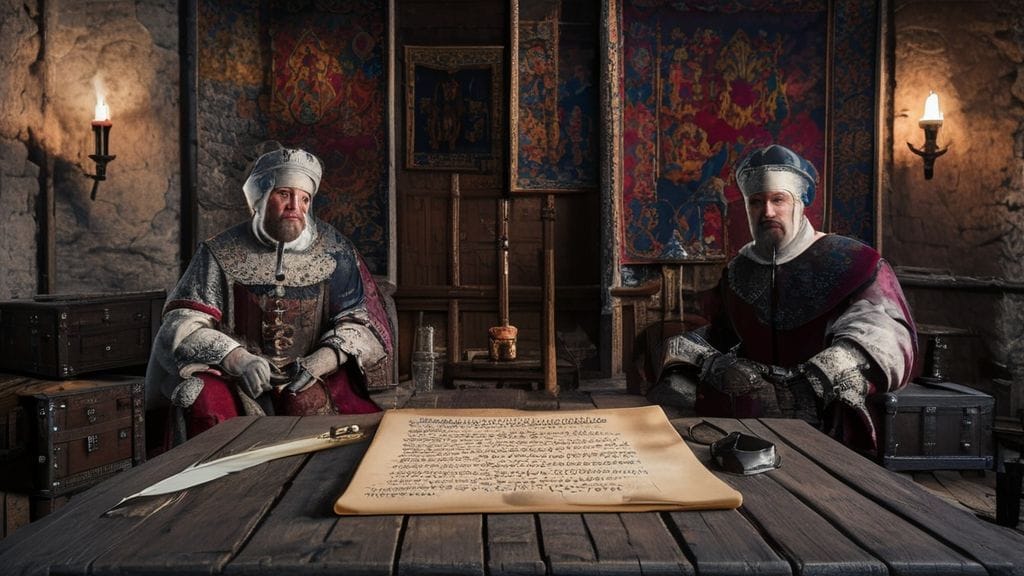
Inside the fortress walls, the atmosphere in August 1323 would have been a keen mix of ceremony and tension. Garrison troops drilled in the courtyards; servants hauled water and provisions; scribes prepared ink, quills, and sheets of parchment for the formal drafting of the agreement. The thick stone kept out the worst of the summer heat, but the air would have been heavy with the smell of tar, timber, and animal hide. Here, amid the practicalities of frontier military life, the fate of Karelia, and of many villages far beyond the immediate horizon, was about to be settled in careful, measured words.
When historians describe the treaty of nöteborg as an early “border treaty,” it is easy to forget the physical, tangible stage on which it was signed. The fortress was not just a neutral meeting place; it was an assertion. Its bulk whispered a message to the Swedish envoys: this is what you must reckon with, this is the power you must acknowledge. And yet, by coming here and by negotiating, Novgorod too acknowledged a reality—that even the strongest fortress could not guard every stream and clearing if peace could not be secured.
Delegates and Power Brokers: Who Came to Nöteborg?
The treaty that would bear Nöteborg’s name did not negotiate itself. Behind the dry, formulaic wording of the surviving texts stood real people—princes, nobles, ecclesiastics, and scribes—each bringing with them not only official instructions but also personal ambitions, fears, and prejudices. Unfortunately, the medieval sources do not always preserve the full list of participants, and later copies of the treaty lack the detailed protocols that modern diplomatic historians might wish for. Nonetheless, we can reconstruct a plausible cast of characters.
On the Swedish side, representatives of King Magnus Eriksson’s realm took the lead. Magnus was still a minor in 1323, having been born only a few years earlier, so practical authority lay in the hands of regents and influential noble families. Among them, men who already had deep interests in Finland and the eastern frontier likely played a prominent role. Bishops from the Finnish dioceses, or at least their trusted envoys, would have insisted that the Church’s institutional interests be protected—parishes, tithes, and the right to build and maintain churches in areas recognized as Swedish.
From Novgorod, a prince serving as military leader—possibly representing the interests of Grand Prince Yuri or his successors—would have lent dynastic legitimacy to the proceedings, while boyars from the city’s leading clans brought the weight of the veche, the city assembly. Churchmen of the Orthodox rite, perhaps from monasteries along the Volkhov or near Ladoga, advocated for their own flock and holy sites. Traders and officials with experience on the frontier might have served as informal advisors, explaining which rivers mattered most, which Karelian chiefs were cooperative, and which passes could not be effectively fortified.
The interpreters who mediated between Latin, Old Swedish, and Church Slavonic (not to mention local Finnic tongues) are almost entirely invisible in the record, yet their role was crucial. A badly translated phrase could mean the difference between a narrow agreement on one waterway and an expansive claim over an entire hinterland. One can imagine tense pauses as sentences were rendered from one language to another, with envoys watching each other’s faces for signs of acceptance or outrage.
These men were not equal. Novgorod was the host and held the fortress. Sweden, in seeking a defined border, implicitly accepted the reality of Novgorodian strength in the Ladoga region. Yet Sweden also arrived with the imprimatur of Latin Christianity and the growing prestige of western legal forms. The treaty of nöteborg thus became not only a negotiation between two states but between two political cultures. Seated at the same table, they brought with them very different ideas of how power should be exercised and recorded.
Inside the Negotiations: Language, Faith, and Fragile Promises
Reconstructing the exact sequence of discussions at Nöteborg is impossible, but the nature of the issues at stake allows us to imagine the contours of debate. At the heart of the matter were three intertwined questions: where to draw the border, how to define and protect religious jurisdictions, and how to prevent private or semi-private raiding from undermining whatever agreement was reached.
Border-making in a cartographically poor age was a delicate affair. The envoys did not unfurl accurate maps; instead, they invoked rivers, lakes, portages, and known localities by name. The treaty would later describe the line starting from the Gulf of Finland and running in a generally northeastward direction through a series of waterways and landmarks, until it reached points deep in the interior. Swedish negotiators likely pressed for access to key harbors or fishing grounds along the Gulf, while Novgorod would have been keen to secure unambiguous possession of the Neva and Lake Ladoga shores.
Religion complicated matters further. Both sides were Christian, but allegiance to Rome or to Constantinople mattered profoundly. The Swedish church hierarchy would not easily accept losing parishes it believed were under Latin jurisdiction; the Orthodox clergy felt the same about their flocks. The treaty of nöteborg therefore had to do more than apportion land; it had to, implicitly or explicitly, recognize spheres of spiritual influence. While the surviving text is more concerned with political sovereignty, the effect was to create zones within which Latin or Orthodox structures could grow with relative security.
Then there was the question of violence at the margins. Even if kings and city councils swore peace, frontier warriors and opportunistic nobles might still raid for plunder or to settle scores. The treaty included clauses that aimed to curb these practices: mutual promises to restrain subjects, to return captives, or to provide redress for violations. Yet everyone present must have known that enforcement in trackless forests would be imperfect at best.
One can picture moments when tempers flared. Perhaps a Swedish envoy cited a recent Karelian uprising against Novgorodian officials as proof that certain districts longed for Swedish overlordship, only to be met with laughter or outrage from the Novgorodian side. Perhaps a Novgorodian boyar recounted tales of Swedish-led raids that burned Orthodox churches, using them to argue that Swedish influence should be kept as far west as possible. Such anecdotal “evidence” would have spiced the formal arguments, reminding both sides that they were discussing not theoretical frontiers but places where people lived, worshiped, and died.
In the end, pragmatism overruled passion. Each concession was matched by a gain elsewhere. The final version of the treaty of nöteborg reflected the exhaustion and realism of its creators: it did not attempt to solve every grievance, but it did provide a skeleton of order upon which, they hoped, a more stable coexistence could be built.
Drawing an Invisible Line: The New Border Through Karelia
When the text was finally agreed upon and recited aloud, it outlined a border that modern scholars have painstakingly mapped onto today’s geography. Starting near the mouth of the River Sestra or a neighboring stream flowing into the Gulf of Finland, the line ran inland across a patchwork of lakes and watersheds, roughly separating what would later be known as “Western Karelia” from lands oriented toward Novgorod in the east. It crossed lakes whose surfaces in winter turned into sheeted ice roads, yet which now, on parchment, became markers of division.
From there, the border veered toward the north and northeast, following chains of lakes and rivers that were well-known to Karelian hunters and traders. It carved its way conceptually through forests where no surveyor’s stake had ever been driven. In practical terms, the treaty gave Sweden recognition of its control over southwestern Finland and parts of western Karelia, while Novgorod secured an acknowledged claim to the Neva, Lake Ladoga, and the bulk of eastern Karelia.
It is important to realize how radical this was in the northern context. Earlier medieval polities had often operated with vague zones of influence rather than sharply defined borders. What mattered was who could tax a community, protect a monastery, or call up fighting men in case of war. With the treaty of nöteborg, however, an attempt was made to define a continuous, if still somewhat imprecise, boundary. One historian of medieval frontiers has aptly called such documents “experiments in linear thinking” imposed on landscapes long accustomed to fluidities.
The border was not drawn with perfect symmetry. Sweden’s foothold along the Gulf of Finland remained more modest than some of its leaders might have hoped. Novgorod, for its part, accepted that western Finland was lost to it for the foreseeable future. Yet both sides received what they most urgently needed: recognized control over their core approaches. Sweden secured the Finnish heartlands that anchored its eastern flank; Novgorod protected the vital corridor that linked it to the Baltic.
On the day the treaty was sealed, no line appeared on the ground. The forests and marshes did not suddenly change color, nor did the rivers alter their course. Yet in the minds of rulers and their officials, a new mental map took shape. Over time, through the work of tax collectors, magistrates, priests, and soldiers, this invisible line would become increasingly real.
Villages Divided, Families Split: Human Lives Along the New Frontier
What did this new border mean for the people who lived nearest to it? Official texts are vague, speaking in broad strokes of lands and rights, but the implications at the village level were profound. In some areas, the line ran near established settlements, effectively dividing traditional territories used by extended families or clans. A fishing lake that had served several villages might now be claimed as lying under one ruler’s jurisdiction, leaving neighboring communities to renegotiate access or risk conflict.
Imagine a Karelian household whose meadow for haymaking fell on one side of the new line, while their winter hunting grounds, long shared with kin, now technically lay under another lord’s authority. Overnight, decisions that had once been purely practical—when to move herds, where to set traps, whom to trade with—acquired a political dimension. To cross a certain river or portage now meant crossing from Swedish to Novgorodian lands, or vice versa. Taxes might be demanded in the name of a ruler who lived hundreds of kilometers away, whose language the villagers did not understand.
Religious identity also promised to grow more complicated. Where Latin priests and Orthodox monks had once overlapped in their efforts, the treaty of nöteborg encouraged a more orderly sorting. Some villagers found themselves reassured: they now had a clear sense of which church to attend without fearing reprisal for being seen as “belonging” to the wrong one. Others, however, living near the border, might still feel pulled in both directions, keeping old ties alive even as new structures pressed upon them.
In the short term, the greatest boon was likely the reduction in large-scale raiding. Fields could be sown with a bit more confidence; barns could be stocked without the constant fear that a roving warband would appear at harvest time. Yet peace at the level of kings and veches did not guarantee justice. Local officials, eager to assert their authority in newly confirmed territories, could be harsh in collecting taxes or suppressing dissent. Border communities might experience a new intensity of governance precisely because their lands mattered so much to the credibility of the treaty.
In later folklore collected from Karelian regions, echoes of ancient displacements and divided loyalties still resonate. While these songs and tales cannot be straightforwardly tied to the year 1323, they remind us that frontiers are not just lines on maps but scars and seams in family memory. The treaty of nöteborg wrote one such seam across the north, stitching together a fragile peace while quietly fraying longstanding patterns of life.
Holy Men and Hard Politics: The Treaty’s Religious Dimension
Although the treaty text itself is more secular than one might expect, religious concerns hovered over the negotiations like an unspoken but omnipresent witness. Both Sweden and Novgorod styled themselves as defenders of the true faith. Each saw the frontier not only as a matter of walls and watchposts but as a zone where souls could be won or lost.
On the Swedish side, the bishop of Turku (Åbo) and other ecclesiastical authorities had, over previous decades, labored to extend Latin Christianity’s structures into Finnish and Karelian territories. New parishes were carved out, churches built, and tithes collected. The creation of a stable border offered the prospect of consolidating these gains. Within the lands recognized as Swedish by the treaty of nöteborg, bishops could preach, ordain priests, and build stone churches without the recurring fear that an Orthodox-backed uprising or a Novgorodian punitive expedition would sweep them away.
Novgorod’s Orthodox clergy read the situation in a mirror image. Monasteries in the Ladoga and Karelian regions—sometimes founded by charismatic ascetics drawn to the northern forests’ solitude—required protection from Latin encroachment. Icons painted in dimly lit wooden churches, incense rising before them, symbolized not only devotion but a claim to space. When the treaty confirmed Novgorod’s hold over the Neva and eastern Karelia, it also secured, implicitly, the Orthodox Church’s right to root itself more firmly in these lands.
Behind these institutional concerns lay a more personal spiritual anxiety. The frontier was a liminal space where older pagan practices had not been entirely erased, and where Christianity’s competing branches vyed for hearts and minds. Theologians in Rome or Constantinople might have argued over subtle doctrinal points, but on the ground, what mattered was which feast days were observed, which saints were invoked in sickness and danger, which language was heard in liturgy. The treaty of nöteborg did not answer these questions definitively, but by stabilizing political control, it gave each side room to pursue its missionary vision with less fear of direct armed interference.
Yet behind the celebrations in cathedral and monastery that must have followed news of the peace, a harsher truth lurked. Religious identity could become a sharper dividing line now that political boundaries were clearer. Those living near the frontier might, over generations, feel pressure to conform more fully to one rite or the other, as borderland ambiguity came to be seen less as a tolerated reality and more as a problem to be corrected. In this sense, a treaty intended to calm the region’s spiritual conflicts may also have planted the seeds of deeper, more clearly drawn religious distinctions.
From Parchment to Reality: How the Treaty Was Enforced
A treaty’s life truly begins after it is signed. For the agreement reached at Nöteborg to mean anything, both Sweden and Novgorod had to translate its clauses into practice. This meant sending out messengers to frontier officials, informing them of the new arrangements, and, in some cases, reorganizing administrative districts to align better with the agreed border.
Sweden likely strengthened its structures in western Finland and western Karelia, confirming noble land grants, bolstering fortresses, and assigning sheriffs or castellans with clear mandates. Taxation registers would have been adjusted to ensure that communities now recognized as Swedish were properly assessed. Royal envoys traveled the length of the realm and its periphery, carrying news of the king’s “eternal peace” with Novgorod, even as they quietly reminded local lords of their obligation to uphold it.
Novgorod, with its more decentralized system, relied on boyars and appointed governors in key strongholds to enforce the new line. The fortress of Nöteborg itself loomed large in this process, serving as a hub for announcements and as the command center for patrols along the Neva and Ladoga approaches. Tributary relationships with local Karelian leaders were confirmed or renegotiated in light of the treaty, ensuring that villages now unambiguously within Novgorodian jurisdiction paid their dues and recognized the city’s authority.
Even with best efforts, enforcement was patchy. Geography itself conspired against precision. Snowstorms, spring floods, and dense forests made travel difficult. A small border garrison might know only a handful of nearby landmarks and rely on the testimony of local inhabitants to determine whether a particular meadow or fishing site lay to one side of the line or the other. Inevitably, disagreements arose. Sometimes they remained minor, resolved by local compromise. At other times, they escalated into skirmishes, prompting formal complaints and demands for redress.
Yet the overall pattern seems clear. For several decades after 1323, the treaty of nöteborg provided a framework that, while imperfect, generally held. Merchants grew accustomed to speaking of Swedish and Novgorodian jurisdictions as if they were distinct and stable. Church authorities on both sides planned new foundations with an increasingly confident sense of where their flocks lived. Even those who resented new tax demands or chafed under distant rulers gradually learned the new vocabulary of power: this valley is under the king of Sweden; that forest belongs to Lord Novgorod the Great.
Trade, Silver, and Silence of Arms: Economic Consequences of Nöteborg
Peace, however fragile, bears its own economic fruits. With major hostilities subsiding along the divided frontier, trade routes that had been intermittently dangerous became more reliable. Boats could move with greater confidence between the Gulf of Finland, Lake Ladoga, and further inland toward Novgorod’s bustling markets. Swedish merchants from Turku and other coastal towns could sail eastward knowing that, at least in theory, they were entering friendly or neutral waters once they crossed into Novgorodian-controlled areas.
The fur trade benefited particularly. Karelia and the forest belt further north supplied highly valued pelts—sable, marten, fox—to markets across Europe and beyond. Novgorod had long been a central node in this trade, as attested by Western chronicles that marveled at its wealth. As the German chronicler Helmold of Bosau once remarked of the Slavic and Rus’ trading towns, their riches seemed inexhaustible, fed by the “vast forests and innumerable peoples” of the north. While he did not have Nöteborg in mind, his words capture the gravitational pull that such markets exerted on frontier societies.
Sweden, too, stood to profit from calmer conditions. Its eastern towns could now develop more stable commercial ties with Novgorod and with Hanseatic centers further south. Timber, tar, fish, and iron from Finnish and Swedish lands flowed into the Baltic networks, earning coin that in turn funded new fortifications, churches, and royal projects. Every ship that left a Finnish harbor without fear of capture or destruction was an argument in favor of maintaining the treaty’s peace.
Local economies along the border also adapted. Seasonal markets might spring up at crossing points, where Karelian, Swedish, and Novgorodian traders met under the wary eyes of border guards. Cattle, grain, and handicrafts changed hands, mingling cultures and dialects even as official documents insisted on separation. Taxes and tolls collected by royal or city agents became steady revenue streams rather than unpredictable spoils of war.
Of course, not all economic effects were positive. Smuggling flourished wherever borders were drawn, and the new line offered opportunities for those willing to evade tolls or move contraband across political boundaries. Restrictions on certain forms of trade, designed to prevent one side from supplying war materials to the other, could frustrate merchants. Yet on balance, the treaty of nöteborg ushered in a period where, for a time, silver coins and bolts of cloth flowed more readily than fire and steel.
A Peace That Could Not Last: Nöteborg and Later Nordic–Russian Wars
No medieval “eternal peace” was truly eternal. Over the course of the later fourteenth and fifteenth centuries, tensions between Sweden (increasingly entangled in the Kalmar Union with Denmark and Norway) and Novgorod’s successor states would resurface. Shifts in military technology, changes in dynastic fortunes, and the rise of new powers—notably the Grand Duchy of Moscow—gradually eroded the stability that the treaty of nöteborg had once underpinned.
Already within a century, disputes over the exact location of the border in certain sectors began to multiply. Expanding settlement on both sides pushed into previously uninhabited or sparsely used lands, raising questions that the 1323 text had never envisaged. Was a newly established village on a particular lake shore under Swedish or Novgorodian jurisdiction if the treaty had never named that lake explicitly? Local authorities, eager to grow their tax bases, often interpreted the ancient clauses liberally in their own favor.
As Moscow rose and eventually absorbed Novgorod in the late fifteenth century, the political geometry of the north changed again. The new Muscovite state brought a more centralized and often more aggressive approach to territorial claims. Old treaties, including that of Nöteborg, could be cited when convenient or dismissed as obsolete when they stood in the way of Moscow’s ambitions. Sweden, for its part, had by then embarked on a more assertive Baltic policy, seeking to become the dominant power along the sea’s northern and eastern shores.
Wars in the sixteenth and seventeenth centuries—such as the Russo–Swedish conflicts that culminated in treaties like Teusina (1595) and Stolbovo (1617)—re-drew the map that Nöteborg had once sketched. Each new agreement layered itself over the old, sometimes acknowledging, sometimes overwriting its provisions. Yet the memory of the treaty of nöteborg did not vanish. Even when new lines were drawn, diplomats and chroniclers would occasionally reach back to 1323 as a precedent, a moment when the principle of a formal border between Swedish and Russian spheres had first been solemnly recognized.
In a grim irony, later wars often set their aims partly in terms of undoing or surpassing the compromises reached at Nöteborg. What had once been hailed as a peace securing God’s will in the north became, with time, a benchmark of modesty that more ambitious rulers sought to exceed. In this way, the treaty’s legacy extended far beyond its immediate lifespan, shaping the very language of territorial ambition for centuries to come.
Memory, Myth, and the Birth of a Frontier: Nöteborg in Later Imagination
As the centuries turned, the treaty of nöteborg slipped from living memory into the realm of chronicles and, later still, national historiography. Yet its influence persisted in subtler forms, woven into the way Swedes, Finns, Russians, and Karelians thought about their lands and their neighbors. Once a border has been drawn, even if later revised, it leaves a faint imprint that future generations may reinterpret as a primordial division.
In the nineteenth century, as nationalism spread across Europe, scholars and politicians eager to trace the deep roots of their nations’ territories found in the 1323 treaty an attractive milestone. Finnish historians, working in a Grand Duchy under Russian rule, sometimes pointed to Nöteborg as the first moment when “Finland” in a proto-political sense was distinguished from the eastern lands. Swedish national historians, seeking to celebrate their kingdom’s medieval achievements, presented the treaty as an early assertion of Swedish statehood on the eastern frontier. Russian scholars, meanwhile, emphasized Novgorod’s role as a bulwark of the Russian world, viewing the treaty as a testament to long-standing Russian interests in Karelia and the Baltic access routes.
Such retrospective narratives could smooth over complexities. The treaty of nöteborg was not, in 1323, conceived as a statement about future national borders. Its signatories did not imagine modern Finland, Sweden, or Russia. They thought in terms of crowns, cities, churches, and tributary peoples. Yet later generations, reading backward through the lens of nationalism, found in the parchment what they wanted to see: an ur-document of their territorial claims.
Local memory told a different story. In Karelian oral tradition, as collected by Finnish and Russian folklorists in the nineteenth and early twentieth centuries, one sometimes hears laments about lands lost or ancestors pushed across borders by wars and rulers’ orders. While these cannot be pinned to Nöteborg specifically, they echo the long, cumulative experience of being the object rather than the subject of high diplomacy. For villagers whose ancestors had once moved freely between lakes and forests, the idea that their home lay on the “edge” of Sweden or Russia could be both a burden and, in time, a badge of identity.
Thus the treaty of nöteborg contributed, however indirectly, to the creation of a frontier culture—a sense among those living near the line that they were different from those at the cores of the great realms, closer to the Other, whether Swedish, Russian, or something in between. Such frontier sensibilities would outlive the medieval treaty itself, shaping responses to later wars, migrations, and political upheavals.
Historians at the Border: Debating the Meaning of Nöteborg
Modern scholarship has not been content to treat the treaty of nöteborg as a simple, benign act of peace-making. Historians, geographers, and legal scholars have sifted through the surviving copies of the treaty text, compared Latin, Swedish, and Russian versions, and debated how accurately its boundary descriptions can be mapped onto present-day terrain. Their conclusions vary, revealing as much about contemporary concerns as about medieval realities.
Some historians emphasize the treaty’s pioneering nature in the Nordic and Russian context. They argue that 1323 marked a decisive shift toward legally defined frontiers, an early Scandinavian and East Slavic experiment in the kind of boundary-making that would become characteristic of the modern state. In this view, Nöteborg stands alongside other medieval treaties—such as those between England and France over their continental possessions—as part of a broader European trend toward linear borders.
Others are more cautious. They note that the language of the treaty is often vague by modern standards, relying heavily on local toponyms whose meanings may have shifted or been lost. The practical enforcement of the line, they argue, was uneven, and in many border districts people’s lived sense of belonging remained more tied to local communities and lords than to any distant treaty. As one Finnish historian has remarked, “The line of Nöteborg ran more surely in chancery minds than under peasant feet,” a pointed reminder that parchment and practice did not always align.
There is also debate about the treaty’s long-term significance for national histories. Was it, as some nationalist narratives implied in the nineteenth and early twentieth centuries, a kind of “birth certificate” for the Finnish–Russian border? Or should it be seen as just one episode in a much longer, messier story of shifting frontiers in the northeast? Most contemporary scholars lean toward the latter interpretation, seeing Nöteborg as important but not determinative, a step rather than a starting point.
Yet even critical historians admit that the treaty of nöteborg holds a certain symbolic power. It encapsulates themes that resonate across time: religious rivalry, the hardships of frontier life, the ambitions of expanding states, and the sobering recognition that peace, when it comes, is often a compromise between competing injustices. By studying how this medieval border was imagined, negotiated, and remembered, we gain insight not only into fourteenth-century Karelia but into the enduring human struggle to draw lines across a world that rarely submits meekly to such divisions.
Conclusion
On a summer’s day in 1323, within the stout walls of a fortress on the Neva, men took up quills and wrote a new chapter in the history of the North. The treaty of nöteborg was, in many ways, an unremarkable medieval document: a series of clauses about borders, obligations, and peace between rival Christian powers. Yet when we peel back the dry legal phrasing, we find a richly human story of fear and hope, of exhausted communities longing for respite, and of ambitious rulers learning, however reluctantly, that they could not have everything they desired.
The treaty did not end conflict between Sweden and Novgorod, nor did it freeze the map forever. Later wars would redraw its lines, and new powers would rise to claim the forests and waterways it sought to divide. But Nöteborg mattered because it articulated a principle that would echo down the centuries: that even in a world of shifting allegiances and fluid frontiers, it was possible—and sometimes necessary—to attempt clear, negotiated boundaries. In doing so, it changed not only the politics of Karelia and the Baltic but also the mental landscapes of those who lived under Swedish or Novgorodian rule.
For the Karelian villagers, Finnish farmers, and frontier traders caught in its wake, the treaty brought a mixed legacy: fewer raids and more predictable taxation, but also new constraints on movement and identity. For churchmen, it opened space to expand their flocks while sharpening lines between Latin and Orthodox worlds. For merchants, it promised steadier routes and profits, even as smuggling and dispute continued in the shadows of legality.
Looking back from our own age of borders and passports, Nöteborg’s story feels both distant and familiar. The questions it raised—Who belongs where? Who has the right to rule and to tax? How can neighbors coexist without constant violence?—are still with us. The medieval negotiators did not find perfect answers, but their imperfect peace was, for a time, good enough to let fields ripen and ships sail. In that modest success lies the treaty’s enduring significance: not as a timeless solution, but as a reminder that even in harsh landscapes and harsher times, people have always sought ways to draw lines that might, at least for a while, hold back the chaos beyond.
FAQs
- What was the Treaty of Nöteborg?
The Treaty of Nöteborg was a peace agreement signed on 12 August 1323 between the Kingdom of Sweden and the Novgorod Republic at the fortress of Nöteborg (Orekhov) on the River Neva. It established one of the first formally demarcated borders in northern Europe, dividing spheres of influence in Finland and Karelia between the two powers. - Why was the treaty of nöteborg significant?
It was significant because it attempted to transform vague frontier zones into a linear border, clarifying which areas Sweden and Novgorod could tax, govern, and evangelize. This helped reduce large-scale raiding, stabilized trade routes, and provided a precedent for later border treaties between Nordic and Russian states. - How was the new border defined in the treaty?
The border was described using natural landmarks—rivers, lakes, and other recognizable features—running roughly from the Gulf of Finland northeastward through Karelia. While the exact interpretation of some toponyms remains debated, the general effect was to confirm Swedish control over western Finland and parts of western Karelia, and Novgorodian control over the Neva, Lake Ladoga, and eastern Karelia. - Did the treaty of nöteborg end all conflict between Sweden and Novgorod?
No. Although it ushered in a period of relative stability, local disputes, border skirmishes, and occasional larger conflicts continued. Over subsequent centuries, shifting power dynamics and the rise of Muscovy led to new wars and treaties that revised or replaced Nöteborg’s provisions. - What impact did the treaty have on local populations in Karelia and Finland?
For frontier communities, the treaty brought fewer major raids and somewhat more predictable governance, which aided agriculture and trade. However, it also imposed a new, more rigid political division on regions where people had long moved and traded freely, sometimes splitting traditional territories and kinship networks between Swedish and Novgorodian authority. - How did religion factor into the Treaty of Nöteborg?
While the text itself is largely secular, its consequences had a strong religious dimension. By stabilizing political control, it effectively created zones where the Latin (Catholic) Church under Swedish rule and the Orthodox Church under Novgorodian rule could operate with greater security, shaping the future religious landscape of Finland and Karelia. - Is the exact text of the treaty preserved?
Yes, but only in later copies and in multiple language traditions, including Latin and Old Russian. These versions show minor differences and raise questions about the precise meaning of some geographical terms, which is why historians still debate the exact course of the original border on modern maps. - How long did the treaty of nöteborg remain in effect?
In a broad sense, its basic division of spheres of influence lasted for roughly two centuries, although with many local violations and disputes. By the late fifteenth and early sixteenth centuries, new treaties and the rise of Moscow as a major power began to supersede or reinterpret it. - Did the treaty influence later national borders?
Indirectly, yes. Although the modern borders of Finland, Sweden, and Russia result from much later events, the 1323 treaty is often cited as an early moment in the long evolution of the Finnish–Russian frontier. It contributed to a historical memory of a dividing line in Karelia that later national movements and historians would reinterpret. - Why do historians still study the Treaty of Nöteborg today?
Because it offers a valuable window into medieval statecraft, frontier society, and the early development of the idea of linear borders in the north. Studying the treaty of nöteborg helps scholars understand how medieval rulers balanced war and negotiation, and how ordinary people experienced the imposition of distant political decisions on their daily lives.
External Resource
Internal Link
Other Resources
- Encyclopaedia Britannica – general search for the exact subject
- Google Scholar – academic search for the exact subject
- Internet Archive – digital library search for the exact subject

