Table of Contents
- A Winter Morning in 764: When Baghdad Knocked on Francia’s Door
- From Desert Revolution to Imperial Court: The Rise of the Abbasids
- Pepin the Short and the Making of a Frankish King
- Islam, Christendom, and the Mediterranean Chessboard
- Planning the Journey: Inside Al-Mansur’s Diplomatic Gamble
- Across Sands and Sea: The Route of the Abbasid Envoys
- First Sight of the Frankish Lands: A World of Stone and Forest
- At Pepin’s Court: Ceremony, Suspicion, and Curiosity
- Gifts, Letters, and Hidden Messages Between East and West
- Politics Between Empires: Byzantium, Lombards, and the Papacy
- Faith at the Negotiating Table: Islam and Latin Christianity
- Merchants, Translators, and Go-Betweens: The Human Fabric of the Embassy
- Echoes Through the Years: From Pepin to Charlemagne and Harun al-Rashid
- Memory, Legend, and the Thin Archival Trail
- Long-Term Consequences for Europe and the Islamic World
- Conclusion
- FAQs
- External Resource
- Internal Link
Article Summary: In the mid-eighth century, when frontiers were as much ideas as lines on a map, the abbasid embassy to pepin the short unfolded as a quiet yet momentous experiment in long-distance diplomacy. This article retraces that mission from the newly rising Abbasid court of al-Mansur to the forested heartlands of the Frankish kingdom. It explores the political calculations in Baghdad and Francia, the perilous routes across Mediterranean and mountain, and the charged encounter of Islamic and Christian rulers who were still learning to name each other. Through narrative, analysis, and reconstructed scenes, the story highlights how gifts, letters, and symbols helped shape early medieval geopolitics. The embassy did not rewrite the world overnight, but it helped redraw mental maps, making distant powers real to each other. Along the way, merchants, translators, and envoys became the fragile human bridges between two expanding civilizations. Seen in retrospect, the abbasid embassy to pepin the short anticipated a later age of more famous embassies and alliances, casting a long if understated shadow over the history of East–West relations. Yet behind the diplomatic formalities lay very human emotions: hope, anxiety, faith, and the ever-present fear of misunderstanding.
A Winter Morning in 764: When Baghdad Knocked on Francia’s Door
Snow lay in uneven patches along the rough tracks leading to Pepin’s court, clinging to ruts and churned mud, freezing at night and softening with the weak winter sun. The year was 764. In the wooden halls somewhere between the Loire and the Seine—sources differ on the exact location—the Frankish king’s men hurried about with an unfamiliar urgency. Word had spread that riders were approaching, men whose clothes, speech, and even manner of riding marked them as from another world. They were envoys from the East, from lands that the Latin chroniclers called simply “the Saracens” but whose political centers were far more complex: Damascus yesterday, now Kufa, soon Baghdad.
The abbasid embassy to pepin the short did not arrive with fanfare in the chronicles, as great battles did, but it carried something more delicate: a possibility. On that cold morning, in a kingdom where literacy was rare and maps even rarer, the idea that an Islamic caliph—al-Mansur, “the Victorious”—had singled out the Frankish king for contact must have felt uncanny. Francia was still consolidating itself, still emerging from the shadow of Merovingian figurehead kings and palace mayors. Al-Mansur’s empire, meanwhile, was rising on the ashes of the Umayyads, defining itself in opposition to its predecessors and in rivalry with Byzantium.
As the envoys dismounted, the sounds and smells they carried seemed almost as important as the messages they bore: the faint lingering scent of Eastern resins and spices on their cloaks, the sound of Arabic murmurs and perhaps a smattering of Greek or Latin from translators, the clink of metal containers, the soft clatter of carved wooden boxes. The abbasid embassy to pepin the short represented the meeting of two worlds that had mostly known each other as enemies, raiders along coasts or adversaries on distant battlefields. Yet here, face to face, speech and gesture had to replace the sword.
It’s astonishing, isn’t it, to imagine the silence that must have fallen in the hall when one of the envoys—perhaps an experienced courtier, perhaps a military officer trusted by al-Mansur—raised his hand in greeting. The Frankish nobles, in thick woolen cloaks, fingers roughened by weapon and plow, eyed the fine textiles and dark, neatly trimmed beards of the Eastern delegation. Somewhere a scribe prepared to jot down names he would later struggle to Latinize. A priest watched, measuring each word for doctrinal danger, each symbol for any whiff of alliance with unbelief. And above them all towered Pepin, a man of medium stature perhaps, but enormous in political ambition, listening closely for what this embassy might mean for his fragile but growing power.
Yet this was only the beginning. To understand how such a moment could happen at all, we must step back—far back—to trace the roads that led from desert uprisings and palace intrigues to that frost-edged Frankish dawn.
From Desert Revolution to Imperial Court: The Rise of the Abbasids
The embassy’s story begins not in Francia but in the scorching landscapes of the Middle East, amid shifting alliances and simmering resentments against the Umayyad caliphs. By the mid-eighth century, the Umayyad dynasty, ruling from Damascus, had achieved extraordinary territorial expansion—from the Atlantic coast of North Africa to the Indus River. But empires can crack from within long before they shatter from outside blows, and the Umayyads faced mounting discontent among non-Arab converts, religious scholars, and Sharifian partisans who claimed loyalty to the Prophet’s family.
Into this stew of grievances stepped the Abbasids, a family that could trace its descent, at least in their own genealogical memory, to al-Abbas, an uncle of the Prophet Muhammad. They cultivated a revolutionary movement that promised justice, a return to piety, and inclusion for the many Muslims who resented the ethnic hierarchies of Umayyad rule. In the east, particularly in Khurasan, charismatic missionaries and commanders turned this discontent into armed revolt. The famous black banners of the Abbasids rose there, marching westward with grim determination.
By 750, after a series of bloody confrontations, the Abbasids toppled the Umayyads. In a spectacle later colored by both horror and legend, many members of the defeated dynasty were executed; one prince, ʿAbd al-Rahman, escaped west and eventually founded the Umayyad emirate in al-Andalus. As the Abbasid revolution settled into governance, a new caliph emerged as its organizer and consolidator: Abu Jaʿfar al-Mansur.
Al-Mansur was not a romantic revolutionary; he was a methodical builder. Between 754 and 775, he worked to reshape the empire’s administrative structures, moving the political center of gravity away from Damascus and toward Iraq. He dreamt of a new capital, a city that would embody Abbasid legitimacy and power. This vision would soon take brick-and-mortar form as Baghdad, but during the 760s it was still an idea under construction, a promise more than a place. The abbasid embassy to pepin the short belongs to this early period, when the revolution’s flames had cooled into a cautious, calculating regime anxious to secure its frontiers, its image, and its alliances.
Within the Islamic world, al-Mansur had many enemies: remaining Umayyad loyalists, restive provincial elites, and rival claimants cloaked in religious language. Beyond its borders, the great rival was the Byzantine Empire, still powerful in Anatolia and the Aegean, still the iconic Christian bulwark against Islamic expansion. To manage this complex checkerboard, al-Mansur needed not just armies but relationships. Securing ties—however informal—with other powers at the Byzantine periphery could help hem the emperor in and open new possibilities. In that sense, the abbasid embassy to pepin the short represented one move in a larger, subtle game that spanned three continents.
It was not only strategy that pushed the Abbasids outward. They were heirs to a tradition in which caliphs, like earlier Persian shahs or Roman emperors, used embassies as mirrors. Through the reports of envoys, they could see themselves as others saw them; through the exchange of gifts and letters, they could test the limits of their fame. Did the rising Franks in the distant northwest even know who al-Mansur was? Would they recognize him as a monarch of equal or superior standing? These questions mattered in a world where prestige could be as useful as battalions.
Pepin the Short and the Making of a Frankish King
While the Abbasids remade the Islamic world, the Franks were undergoing their own revolution—quieter, perhaps, but no less significant. For generations, the Merovingian kings had reigned in name but not in fact, overshadowed by powerful mayors of the palace. These mayors, from the Carolingian family, controlled the armies, the land grants, and the machinery of power. By the mid-eighth century, the fiction of Merovingian authority was thin indeed, like a cloak grown so threadbare that everyone could see the shoulders beneath.
Pepin, known to later generations as “the Short” (a nickname more reflective of medieval humor than of detailed measurement), was the son of Charles Martel, the man famously credited—often with exaggeration—with halting an Arab-Berber raiding force near Poitiers in 732. Charles had ruled as mayor, but Pepin resolved to do something more daring: to transform his family from power behind the throne into the throne itself. Around 751, with the assistance of the papacy, he had the last Merovingian king, Childeric III, deposed, and he himself was anointed king.
This anointing, performed with holy oil, was a radical step in Frankish political culture. It framed Pepin as a chosen ruler, aligning him symbolically with Old Testament kings and, to some extent, with the sacral claims of the Byzantine emperor. Pepin’s partnership with the papacy—solidified when he intervened in Italy to protect Rome from Lombard pressure—was crucial. Yet alliances with distant Christian authorities were not enough. Pepin needed to demonstrate that his kingdom was recognized and respected beyond the Latin West. The arrival of the abbasid embassy to pepin the short, less than a generation after his coronation, thus resonated at a profound political level.
Frankish sources like the Royal Frankish Annals are terse, but even their few lines about embassies from the “king of the Saracens” suggest a new kind of self-confidence. The Franks were no longer just a regional power. They were being addressed by rulers whose lands lay beyond the old Roman limes, beyond even the reach of the Mediterranean imagination. For Pepin and his counselors, the embassy was both a compliment and a test. How should they respond? What balance to strike between curiosity and caution toward a Muslim ruler whose co-religionists had fought Frankish forces in Aquitaine and Provence only decades earlier?
In the wooden halls where Pepin held court, power was performed in very material ways: the distribution of land, the display of weapons, the public rendering of justice. A foreign embassy, especially one from the distant East, added a new dimension to that performance. It allowed Pepin to gather his nobles and bishops, to show them that even the caliph—this almost legendary Eastern sovereign—considered the Frankish king worthy of contact. The abbasid embassy to pepin the short thus strengthened the Carolingian claim to kingship, weaving it into a fabric of recognition that crossed confessional and cultural boundaries.
Islam, Christendom, and the Mediterranean Chessboard
To truly grasp the embassy’s significance, we must picture the Mediterranean of the 760s as a restless inland sea ringed by shifting frontiers. On its eastern shore, the Byzantine Empire clung to Anatolia, the Balkans, and pockets of the Levant, its navy patrolling waters that had once been Roman lakes. On its southern and eastern edges, the Abbasid caliphate extended across Syria, Iraq, and into Iran, stretching southward toward the Arabian Peninsula and westward toward Egypt and North Africa, though its authority waxed and waned with distance.
Along the sea’s western and northern shores, a patchwork of powers contended: the Lombards in Italy, the Visigothic remnant turned into an Islamic province and then a semi-autonomous emirate in al-Andalus, various Berber groups in North Africa, and the Germanic-Frankish world to the north. The papacy in Rome occupied an uneasy position, spiritually ambitious but militarily vulnerable, caught between Lombard pressure and distant imperial claims from Constantinople.
In this crowded arena, the abbasid embassy to pepin the short functioned as a subtle signal. It suggested that the Abbasids were willing to look past the immediate horizon of Byzantium and al-Andalus to engage a power that lay further inland and to the north. For al-Mansur, this had several possible advantages. First, it could help counterbalance the Umayyad remnant in Spain by creating a line of communication, however tenuous, with their Frankish neighbors. Second, it could send an implicit message to Byzantium: the caliph had options, he could speak over and around the emperor if he wished.
For Pepin, the Mediterranean chessboard was no less complex. His interventions in Italy had tied him to the papacy, but they had also brought him closer to Lombard and Byzantine affairs. To be seen in communication with the caliph added another layer to his profile. It allowed the Franks to appear as a power with wide horizons, engaged—even if cautiously—with both Christian and Muslim states. In a sense, this echoed the older Roman imperial tradition of engaging with Parthian or Sasanian rivals: enemies, certainly, but also peers.
The Mediterranean of the eighth century wasn’t just a battlefield; it was a marketplace. Merchant ships carried grain, cloth, wine, slaves, and luxury goods between ports controlled by Christians and Muslims alike. Piracy, tribute, and taxation blurred into each other, and sometimes an “embassy” could mask a trade mission or even a ransom delegation. In this environment, the abbasid embassy to pepin the short may also have borne a commercial dimension—opening or regularizing channels for the exchange of goods and information across the watery divide.
Yet behind the calculations swirled something less tangible: fear and fascination. For Latin Christians, the Islamic world was both terrifying and strangely alluring—home to formidable armies and dazzling cities but also to philosophers, physicians, and traders whose skills were increasingly recognized. For Muslims, the lands of the Franks were distant, colder, poorer perhaps, but also strategically placed and rich in hardy soldiers. In such a world, embassies became exploratory probes into the unknown, feeling for opportunities and risks.
Planning the Journey: Inside Al-Mansur’s Diplomatic Gamble
We do not possess the minutes of any Abbasid council at which the decision was made to send envoys to Pepin. But by piecing together what we know of al-Mansur’s reign, of Abbasid administration, and of later diplomatic patterns, we can sketch a plausible scenario. At the heart of it lay a single question: what did al-Mansur hope to gain?
One possibility was strategic isolation of the Umayyads in al-Andalus. Although the western Umayyads were a minor threat compared to internal revolts or Byzantine campaigns, they represented a symbolic challenge. Their existence denied Abbasid claims to be the sole legitimate caliphs. By reaching out to the Franks, al-Mansur could test whether Pepin might be willing to harass or at least constrain the Andalusi emirate along the Pyrenean borders, or perhaps to refrain from supporting any anti-Abbasid movements in Iberia or North Africa.
Another motive may have been informational. Medieval rulers depended on envoys not only to carry messages but to bring back news. Who were these Franks whose armies had proved so resilient in Gaul, whose rulers interfered in Italian affairs, whose alliance with the pope hinted at new political formulas? Through the abbasid embassy to pepin the short, al-Mansur could hope to obtain descriptions of Frankish fortifications, military organization, and political customs—intelligence that could prove valuable in future calculations.
The decision to send such an embassy would have involved the Abbasid chancery, where scribes trained in Arabic and, in many cases, in Greek or Persian drafted letters in elegant calligraphy. The tone of a caliphal letter mattered as much as its content. It had to project superiority without closing the door to cooperation, to offer compliment without conceding equality. Titles were weighed carefully. Would Pepin be addressed as “king of the Franks,” “patricius,” or in some more elevated style? Each phrase had implications in the symbolic economy of the age.
Then there was the question of personnel. Envoys had to be trustworthy, resilient, and adaptable. They needed stamina for the long journey, the ability to endure unpredictable delays, and the social dexterity to navigate foreign courts. Some may have been seasoned officials; others could have been merchants or military men with prior experience in borderlands where Arabic, Latin, and various vernaculars brushed against each other. Given the religious gulf, it was also crucial that they be firm in their own faith yet capable of respectful engagement with Christian ritual and hierarchy.
Before departure, the embassy would have been briefed on the caliph’s expectations: maintain dignity, observe local customs when they did not conflict with Islamic obligations, gather as much information as possible, and return with both an answer and impressions. In Baghdad’s predecessor centers—Kufa or al-Hira, and the growing administrative complex around al-Mansur—the air would have been thick with speculation. Would the Franks respond warmly, coolly, or not at all? Was this a bold stroke or a futile gesture?
Across Sands and Sea: The Route of the Abbasid Envoys
No medieval travel agency preserved the exact itinerary of the abbasid embassy to pepin the short, but historical geography offers multiple plausible paths. One likely route began in Iraq, following the great arteries of trade westward through Syria to the Mediterranean coast. From there, ships could carry the envoys to ports in North Africa or directly to southern Gaul or Italy, depending on winds, alliances, and the relative safety of sea lanes patrolled by Byzantine and Muslim fleets.
Imagine the envoys leaving the bustle of a garrisoned city like al-Raqqa or Damascus, descending toward the coastal plains and their mix of orchards, villages, and fortified towns. In caravanserais, they met traders from Egypt and Ifriqiya, learned of pirate-infested stretches of sea, and weighed reports of storms. Every step westward loosened their connection to the administrative heart of the caliphate and increased their dependence on local guides, sailors, and intermediaries.
The sea crossing itself would have tested their resolve. Medieval Mediterranean travel was perilous: sudden squalls, hidden reefs, or hostile ships could turn a diplomatic mission into a tragedy. Sailing along the Levantine and Anatolian coasts, slipping into harbors under the watchful eyes of Byzantine governors, or cutting across more open waters toward Sicily or Carthage, the envoys lived in a world where the boundaries between enemy and neutral were never entirely clear. They likely relied on treaties, local custom, and the shared practical interest of seafaring communities in avoiding needless bloodshed.
Once in the western Mediterranean, the envoys had choices. They might have sailed up the Rhône, landing at a port like Arles or Marseille, where the legacy of Roman infrastructure lingered in worn stones and fading amphitheaters. From there, river travel and overland roads led into the Frankish heartlands. Alternatively, they could have made landfall in Italy, then traversed Alpine passes into Gaul—a more arduous but politically significant route that would underscore the embassy’s awareness of papal and Lombard territories.
As they moved inland, the physical world changed. Palms gave way to oaks and beeches, sun-baked stone to dense forests draped in mist. The envoys would have encountered villages of wattle-and-daub houses, fields of grain farmed by peasants whose lives were bound to local lords, and monasteries whose bells marked the hours of prayer, echoing faintly the call to prayer back home. At each stop, they were observed with a mixture of awe, suspicion, and bargaining instinct—foreigners meant potential profit, trouble, or both.
Travel was slow. Weeks turned into months. Animals fell lame; carts broke; illness and fatigue took their toll. And yet, the mission pressed on, propelled by the weight of the caliph’s expectations and by the knowledge that failure would carry not only personal shame but broader political consequences. By the time they reached Pepin’s court, the envoys had already navigated not just physical distances but cultural chasms, each step a rehearsal for the delicate theater of the royal audience.
First Sight of the Frankish Lands: A World of Stone and Forest
For men accustomed to the bustling markets of Near Eastern cities and the cultivated landscapes of the Fertile Crescent, the Frankish realm must have appeared both raw and imposing. Dense forests loomed alongside muddy tracks. Fortified hilltops and riverside strongholds dotted the horizon, more wooden palisades than stone walls, but formidable to the eye of an outsider. Winter rains turned roads into quagmires, and the short northern daylight cast long shadows over everything.
Entering Pepin’s domain, the abbasid embassy to pepin the short would have passed through territorial markers—perhaps simple boundary stones, gauntlets of toll-collecting officials, or shrines where local saints’ relics watched over the land. They might have been greeted by regional counts or dukes tasked with escorting them safely to the royal presence. These intermediaries, in chainmail and wool, wielding long swords and speaking a Latin-tinged Frankish tongue, were the gatekeepers of a martial society.
The outskirts of the royal residence would have been alive with noise and activity. Herds of animals for slaughter, camp followers, visiting nobles with their retinues, monks carrying records and relics, artisans repairing weapons and horse gear—all mingled in an atmosphere of controlled chaos. To the envoys, the Frankish court might have seemed less a polished palace and more a heavily armed village swollen to the size of a small town.
Yet signs of sophistication were there for those who knew where to look. Clerics kept records and copied manuscripts; goldsmiths produced finely worked objects for liturgical use and personal adornment; imported goods—wine, oil, silks—hinted at long-distance trade networks. The envoys, trained to observe such details, would have taken mental notes: the quality of armor and horses, the discipline of the guards, the relative order or disorder of the court. These impressions would later shape the reports they gave to al-Mansur.
The atmosphere, too, was charged. Local onlookers, hearing that emissaries of the “king of the Saracens” had arrived, might have whispered stories passed down from the days of raids along the Mediterranean coast or from the legendary battle near Poitiers. Some imagined these men as emissaries of a near-mythical enemy; others perhaps simply saw them as strange merchants. Suspicion mingled with curiosity. A few bold children might have crept closer to stare at their unusual clothing and darker features before being shooed away by anxious elders.
At the center of it all, Pepin’s attendants prepared for the audience that would formally welcome the abbasid embassy to pepin the short. Protocols were reviewed, gifts arranged, interpreters summoned. It was nearly time to step from the chaos of the outer world into the carefully staged theater of diplomacy.
At Pepin’s Court: Ceremony, Suspicion, and Curiosity
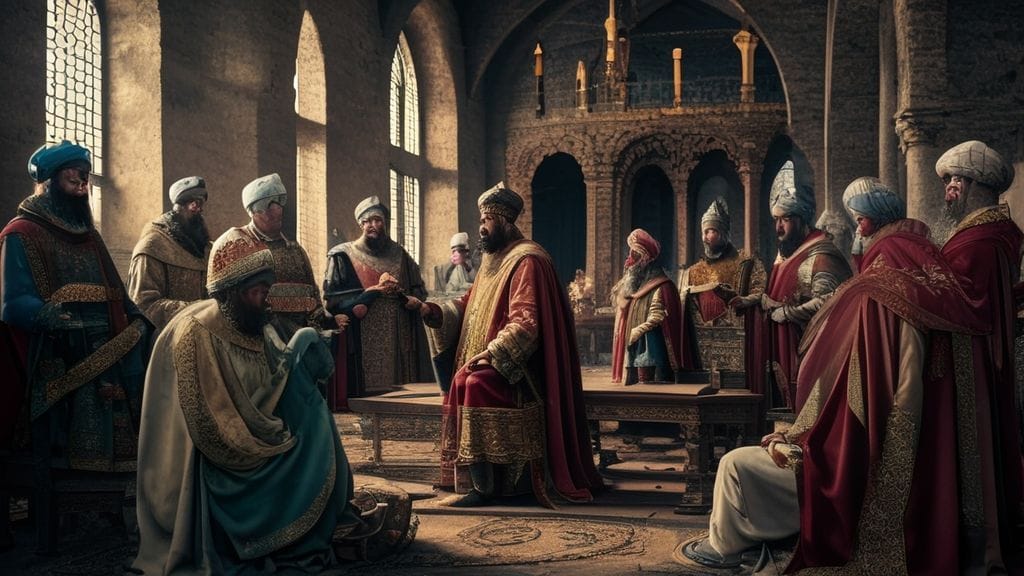
Inside the royal hall, light filtered through small openings and flickered from torches and hearths, glinting off metalwork and catching in the smoke that curled lazily under the high wooden roof. Benches and seats had been arranged according to rank. Bishops and abbots sat near the king, their robes marking them as the custodians of souls and texts. Secular nobles, warriors with scars and hard eyes, occupied their places with a mix of pride and restlessness, hands never far from the hilts of their swords.
The envoys were led in, each step echoing on the wooden floor. They bowed—how deeply, and according to whose standards, we do not know, but the choreographed exchange of obeisance and greeting would have been thick with meaning. In such settings, a gesture too humble might be read as submission, one too bold as insult. Every movement had to be calibrated between these poles.
An interpreter, perhaps a Christian from the eastern Mediterranean familiar with Arabic and Latin, stepped forward. The spokesperson for the abbasid embassy to pepin the short began to speak, his words flowing through the intermediary into the Latinized idiom understood by the Frankish court. He proclaimed the caliph’s titles, offered blessings in the name of God—whose oneness was emphasized in terms that would have sounded both familiar and foreign to Christian ears—and expressed al-Mansur’s desire for “amity” or “peaceful relations.”
Pepin listened, his face revealing little. The words, once translated, were weighed by bishops for their theological content and by nobles for their political implications. Somewhere in the back of the hall, a scribe scratched notes, capturing at least the gist of the exchange. The Frankish king then replied in turn, through the same interpreter, affirming his openness to peaceful dealings and perhaps invoking the Christian God’s favor on the relationship.
Suspicion lay just beneath the surface. Some of Pepin’s warriors may have remembered older campaigns against Muslim forces in Septimania or along the southern coast. The idea of seeking or accepting friendship from the caliph could feel like a dangerous compromise. Clerics, too, were cautious. They had to reconcile any political accommodation with the theological conviction that Islam was a false faith, its prophet an imposter. At the same time, Church tradition did allow for treaties and truces with non-Christians, so long as core religious claims remained intact.
And yet, curiosity was just as powerful. The envoys’ clothing—perhaps of fine wool or even silk—their controlled demeanor, their polished rhetorical style, and the very fact that they had come so far impressed many. They embodied a world that Latin texts increasingly recognized as learned and wealthy, its cities filled with scholars and artisans. To speak with them, to receive their gifts, was to glimpse that world across a divide that was moralized but not impermeable.
Thus the audience unfolded like a dance. Words, gestures, and glances formed a pattern that both sides strove to interpret. No one could be entirely sure how the other understood each phrase, each nod. Behind the formalities, each delegation measured the other: Is this king strong? Is his realm stable? Are his counselors united or divided? Such unspoken questions were the real undercurrent of the day.
Gifts, Letters, and Hidden Messages Between East and West
In early medieval diplomacy, gifts were never just gifts. They were texts written in silver and silk, arguments expressed through texture and weight. The abbasid embassy to pepin the short almost certainly brought offerings from al-Mansur to the Frankish king—objects chosen not only for their material value but for the impressions they would convey.
We can imagine finely woven textiles, perhaps of a quality unmatched in the Frankish world, embroidered with patterns that caught the eye and hinted at luxuries beyond the horizon. There might have been containers of aromatic substances—incense, musk, or other perfumes—that would have filled the royal hall with unfamiliar scents, transporting its occupants imaginatively to distant markets and mosques. Metalwork, too—delicate bowls, inlaid weapons, or intricate jewelry—could have showcased the technical skill of Abbasid artisans.
But the most important “gift” was the letter. Composed by scribes in a carefully controlled style, rolled or folded and sealed, it embodied the caliph’s voice across distance. When an interpreter read it aloud in Latin or a related vernacular, Pepin and his court heard a crafted message of respect, superiority, or partnership, depending on the tone chosen. Titles mattered immensely here. How al-Mansur referred to himself and to Pepin signaled the hierarchy, or lack thereof, that the Abbasid court wished to assert.
Pepin, in turn, would have responded with his own gifts. These might have included Frankish weapons—sturdy swords or axes—fine cloaks of northern wool, or even relics or religious objects, though sending explicitly Christian items to a Muslim monarch required delicate consideration. A horse bred in the Frankish lands, powerful and suited for heavy cavalry, would have been a particularly meaningful gift, prized in the East for its martial utility and symbolic resonance.
Hidden within these exchanges were layers of unspoken communication. A lavish gift from the caliph could be read as a claim to superior wealth and generosity; a generous counter-gift from Pepin might aim to demonstrate that the Franks were no mere supplicants. Even the relative speed and care with which the gifts were prepared spoke volumes about the priority each side accorded the relationship.
Letters traveled with the envoys back to al-Mansur, carrying Pepin’s words, titles, and tone. Did the Frankish king refer to the caliph in terms that acknowledged his claim to religious authority? Did he emphasize their differences or common ground as rulers guarding their realms? Arabic historiographers, where they mention such exchanges, often frame them in terms of honor and recognition, while Latin chronicles tend toward brevity, mentioning embassies almost in passing. One modern historian has aptly noted that “medieval embassies are remembered less for what they did than for what they allowed rulers to imagine about themselves” (to paraphrase a sentiment found in recent scholarship).
Thus, the abbasid embassy to pepin the short wove a web of tangible and intangible threads: goods that could be touched, smelled, and used; words that could be quoted, misquoted, or remembered; and implications that would reverberate long after the physical objects had worn out or disappeared.
Politics Between Empires: Byzantium, Lombards, and the Papacy
Neither al-Mansur nor Pepin operated in a vacuum. Every move they made was watched, directly or indirectly, by other powers with their own agendas. The embassy, modest in appearance, thus sent ripples across a geopolitical pond crowded with wary observers.
For Byzantium, the idea of an understanding—even a limited one—between the caliph and the Frankish king was worrisome. The emperor in Constantinople liked to imagine himself as the axis around which the Christian world spun. If Pepin, a Western ruler already entangled with the papacy and the Lombards, now cultivated contacts with the caliph as well, the emperor’s claim to centrality was subtly undermined. Even if no formal alliance emerged, the mere display of alternative diplomatic pathways reduced Byzantine leverage.
The Lombards in Italy, ever alert to shifts in Frankish and papal policy, also had cause for concern. If Pepin demonstrated the capacity to open channels with the distant Abbasid court, it signaled an ambition and reach that might one day be turned more fully toward Italian affairs. Moreover, any connection between the Franks and the caliphate that affected Mediterranean trade routes could impinge on Lombard economic interests.
The papacy found itself in an especially delicate position. On the one hand, the popes of the eighth century relied on Frankish military protection against the Lombards, having grown disillusioned with Byzantine support. On the other, they were the spiritual leaders of Latin Christendom, responsible for guarding the faithful against heresy and unbelief. How could they endorse or even tolerate too-close dealings with a Muslim ruler without raising theological alarms?
In practice, the Church had long experience with the messy realities of politics. Popes had negotiated truces with Lombard “barbarians” and dealt indirectly with Muslim authorities through intermediaries in Sicily and elsewhere. It is likely that the papal court, if informed about the abbasid embassy to pepin the short, regarded it with cautious pragmatism: useful, perhaps, in furthering Frankish strength, but to be carefully framed in religious terms as a purely secular interaction.
Even within each polity, factions debated the meaning of such contacts. In Frankish circles, some might have argued for leveraging the relationship to secure southern borders, others for maintaining strict distance from “infidels.” At al-Mansur’s court, voices could be raised warning against entanglement with unpredictable northern barbarians or advocating for expanded Western ties to outflank Byzantium. Diplomacy was rarely a simple line between two points; it was a web of opinions, hopes, and anxieties tugging in different directions.
Yet, for all this complexity, the embassy itself likely remained limited in scope: a gesture, a test, a creation of possibilities rather than a binding alliance. Its very modesty made it easier to overlook at the time—and yet, in retrospect, it stands as one of the earliest documented attempts to draw a line of formal communication between the Abbasid and Frankish worlds.
Faith at the Negotiating Table: Islam and Latin Christianity
Religious difference hovered over every word exchanged, like a shadow never quite leaving the room. The abbasid embassy to pepin the short brought into direct contact two universalizing faiths—Islam and Latin Christianity—each convinced of its unique access to divine truth, each accustomed to thinking of itself as the normative horizon of civilization.
For the envoys, daily life was structured around Islamic practice: the five daily prayers, the dietary laws, the invocation of God’s name before important actions. Arriving in a Christian court, where crosses adorned walls and priests intoned Latin hymns, they had to navigate a world whose symbols contradicted their own convictions. Eating was particularly fraught: they had to ensure that food was permissible (halal) or, at least, to avoid anything clearly forbidden, such as pork or wine. Pepin’s hosts, if they understood these scruples, may have interpreted them as signs of stubbornness or principled integrity—or both.
Conversely, Christian clerics were alert to any suggestion that the embassy implied religious compromise. They drew a sharp line between political accommodation and theological concession. While peace treaties and trade were allowed, worship, doctrine, and sacraments remained non-negotiable. Thus, even if the diplomatic language contained phrases like “in the name of God,” the Christian side would interpret “God” in Trinitarian terms, while the Muslim envoys used the term in its strict monotheistic, non-incarnational sense.
The shared Abrahamic heritage did, however, create some common ground. Both sides revered figures like Abraham, Moses, and David, though they situated them within different narratives. Both valued scripture, prophecy, and law. When envoys spoke of God’s justice, mercy, or sovereignty, their words found at least an echo in the theological vocabulary of their hosts. This shared layer, thin but real, allowed conversations to proceed without collapsing under mutual incomprehension.
Yet behind the courteous phrases lay sharp divergences. For the Abbasid delegation, Muhammad was God’s final prophet; for Pepin’s clergy, he was a false teacher. For the Franks, Jesus Christ was incarnate God and Savior; for the envoys, he was a revered but human prophet whose message had been superseded. These differences did not prevent diplomatic courtesies, but they raised the stakes of any perceived religious concession. Baptism, for example, was not even on the table; any suggestion of conversion from one side to the other would have been explosive.
In this atmosphere, the abbasid embassy to pepin the short functioned as a kind of experiment in coexistence without syncretism. It showed that two universal religions could, at least temporarily, bracket their ultimate claims in order to pursue limited common interests. That such a feat was possible in 764, however cautiously, complicates simplistic modern narratives of a timeless “clash of civilizations.” The clash was real enough at times, but so were the negotiations that threaded their way between battlefields.
Merchants, Translators, and Go-Betweens: The Human Fabric of the Embassy
Official chronicles often focus on rulers and formal envoys, but the success of any mission, especially one as ambitious as the abbasid embassy to pepin the short, depended on a host of less visible actors. Merchants, translators, sailors, guides, and local officials formed the living infrastructure of medieval diplomacy.
Translators were perhaps the most crucial. In an age before standardized diplomatic languages, communication had to pass through people who could move between tongues. Some may have been native Arabic speakers who had learned Greek or Latin in coastal cities once dominated by the Roman Empire. Others were Christians from Syria or Egypt, already used to navigating between the Arabized administration and older liturgical or commercial languages. Their role extended beyond mere word-for-word conversion; they had to grasp the political and religious nuances of what they translated, making split-second decisions about how to render titles, theological terms, or idioms that had no direct equivalent.
Merchants, too, were indispensable. They knew the routes, the safe harbors, and the going rates for everything from passage on a ship to the hiring of local guards. In many cases, trade networks had already linked the Islamic world and Western Europe via intermediaries in Italy, Spain, or North Africa. The abbasid embassy to pepin the short could thus plug into existing circuits, benefiting from relationships forged in marketplaces and caravanserais rather than palaces.
Local go-betweens—minor nobles, clerics, or even enterprising commoners—helped bridge micro-gaps of culture and expectation. In a port city, a Latin-speaking priest might advise the envoys on how to address a Frankish count; in a Frankish stronghold, a visiting Lombard or Aquitanian with knowledge of both northern customs and Mediterranean norms could smooth misunderstandings. These figures rarely appear by name in written sources, but their fingerprints are all over the practical success—or failure—of diplomatic ventures.
Their stories, when we try to imagine them, give the embassy a more human face. A translator lying awake at night, worrying about whether he had chosen the right word when rendering a key phrase. A merchant calculating not only his profit from the journey but the honor of being associated with a caliphal mission. A Frankish minor noble, drunk on a winter evening, boasting that he had spoken with men who had seen the deserts beyond the sea, only to wake the next morning unsure whether his listeners had believed him.
Paradoxically, it was these humble participants who did the most to knit the world together, even as kings and caliphs claimed the credit. Without them, the abbasid embassy to pepin the short would have been little more than a good idea stranded in one court, unable to reach the other.
Echoes Through the Years: From Pepin to Charlemagne and Harun al-Rashid
The embassy of 764 did not remain an isolated curiosity. It set a precedent, a narrow path through the woods of misunderstanding that could later be widened. When Pepin’s son Charlemagne inherited the Frankish throne in 768 and gradually expanded his realm into an empire, he stepped into a diplomatic landscape in which contact with the Islamic world was no longer unimaginable.
Charlemagne’s reign is famous for its later exchange of embassies and gifts with Harun al-Rashid, the Abbasid caliph who ruled in the late eighth and early ninth centuries. Medieval and modern writers have delighted in recounting how Harun sent Charlemagne a magnificent water clock and an elephant named Abul-Abbas, marvels that seemed to condense the wonders of the East into tangible form. Although separated by a few decades, these better-known contacts can be seen as descendants of the earlier, quieter abbasid embassy to pepin the short.
The pattern is suggestive: first, reconnaissance and tentative goodwill; later, more elaborate and symbolically rich exchanges. The Frankish court, having already hosted Muslim envoys and seen that such interactions could be managed without theological collapse, was better prepared to welcome Harun’s emissaries. The Abbasid chancery, too, had experience addressing Frankish rulers, gauging their sensitivities and pride. As one modern historian of Carolingian diplomacy has argued (drawing on a close reading of the annals and Arabic sources), “the early embassies cleared a space in which more ambitious gestures could later unfold.”
Moreover, the precedent of contact helped normalize the idea that Christendom and the Islamic world existed not as hermetically sealed blocs but as overlapping spheres with permeable borders. The abbasid embassy to pepin the short and its successors showed that even in an age of crusading rhetoric’s distant ancestors, rulers could recognize each other as peers in certain respects. Charlemagne’s imperial coronation in 800, presided over by the pope, and the Abbasids’ own imperial posture toward Byzantium both rested on this broader horizon of comparative kingship.
Of course, the story was not one of linear progress toward harmony. Wars, raids, and ideological hostility continued. But the memory—however faint—of embassies and mutual recognition complicated the simpler narratives that each side might tell about the other. It introduced ambiguity into the image of the enemy: somewhere beyond the ranks of faceless “Saracens” or “Franks” was a court where envoys were received, gifts exchanged, and words traded with care.
Memory, Legend, and the Thin Archival Trail
One of the most striking features of the abbasid embassy to pepin the short is how little our sources say about it. Frankish annals mention embassies from Muslim rulers, but they devote far fewer lines to them than to battles or ecclesiastical councils. Arabic chronicles, focused more on the caliphate’s internal affairs and its major campaigns against Byzantium and internal rebels, often relegate Western embassies to brief notices. What survives is more like scattered footprints than a detailed map.
This scarcity has invited both caution and imagination from historians. On the one hand, we must resist the temptation to build grand narratives on slender threads; on the other, we cannot ignore the implications of those threads altogether. As with so many episodes of early medieval history, a balance must be struck between philological rigor and informed reconstruction.
Over centuries, legends and retrospective interpretations sometimes grew around such encounters. Later chroniclers, writing in the glow of Charlemagne’s fame, may have projected aspects of his reign back onto Pepin’s, amplifying or reshaping earlier embassies in light of later developments. In Muslim historiography, where al-Mansur is remembered more for internal consolidation and the founding of Baghdad than for Western outreach, contacts with the Franks became just one tile in a vast mosaic.
Modern scholarship has tried to peel back these layers. By cross-referencing Latin sources, Arabic chronicles, numismatic evidence, and archaeological findings, historians have sought to place the abbasid embassy to pepin the short within a plausible chronology and network of interactions. They have also compared it to other early abbasid embassies—to Byzantium, to regional governors, to the nascent Umayyad emirate in Spain—to discern patterns and deviations.
What emerges is less a detailed narrative than a strong probability: that in the 760s, at least one and perhaps several embassies passed between al-Mansur’s court and the Frankish kingdom. The mission of 764, whether exactly that year or close to it, stands as a symbolic pivot: a moment when, however briefly, the gaze of Baghdad and the gaze of Francia met across distance and difference.
In some ways, the very thinness of the archival trail enhances the story’s poignancy. It reminds us how much of the past has vanished: the sounds of speeches now forever silent, the texture of garments disintegrated, the precise expressions on faces no one painted. What survives is a handful of mentions, a few suggestive details, and the enduring fact that the effort was made at all. Out of these fragments, we reconstruct not just an event but a possibility—of conversation amid conflict, of curiosity amid fear.
Long-Term Consequences for Europe and the Islamic World
Measured against the great upheavals of the eighth century—the Abbasid revolution, the consolidation of the Carolingian dynasty, the wars with Byzantium and the Lombards—the abbasid embassy to pepin the short might seem a small thing. No treaty of lasting fame was signed; no continent-spanning alliance was sealed. Yet its long-term consequences were real, if subtle and diffuse.
First, it expanded mental geographies. For al-Mansur’s administration, the Franks became not just rumor but direct experience. Reports returned describing their lands, customs, and rulers. Over time, such knowledge accumulated, influencing how later Abbasid statesmen thought about the West. For Pepin and his court, the caliphate ceased to be an abstract “land of the Saracens” and became a specific power with envoys who spoke, bargained, and observed. This mutual concretization of the other laid groundwork for more sophisticated interactions in the following centuries.
Second, the embassy helped normalize the idea that religious difference did not preclude limited forms of cooperation. This did not lead to tolerance in the modern sense—both sides remained deeply convinced of their own doctrinal correctness—but it did establish precedents for truces, trade agreements, and occasional joint interests. As the Carolingian and Abbasid worlds each confronted their own internal divisions and external threats, the capacity to think of the other not always as a mortal enemy but sometimes as a negotiable partner proved useful.
Third, the embassy indirectly fostered cultural exchange. Merchants and translators who facilitated the mission gained experience and contacts that could be repurposed for other ventures. Over time, goods, technologies, and even ideas trickled along these pathways. The Islamic world’s advances in mathematics, medicine, and philosophy would later reach Latin Christendom through complex routes involving Spain, Sicily, and the Mediterranean—routes whose social infrastructure owed something to earlier diplomatic and commercial experiments like the abbasid embassy to pepin the short.
On the European side, the habit of thinking beyond local or purely regional horizons contributed to the Carolingian Renaissance’s broader curiosity about the world. While the renaissance was primarily driven by internal reforms and a renewed engagement with classical Latin culture, awareness of other civilizations’ existence and achievements—however filtered—added to the sense that knowledge was wide and the world larger than old Roman boundaries.
For the Islamic world, sustained contact with Christian polities to the west, including the Franks, helped refine its own notions of “the other.” Legal scholars debated the status of non-Muslim allies and enemies; geographers and travel writers incorporated increasingly accurate descriptions of European lands into their works. The embassy was a tiny contribution to this process, but every strand counted in weaving the larger tapestry.
Finally, at a symbolic level, the embassy stands as an early reminder that history is not only made by conquests and doctrinal decrees. It is also made by conversations, by journeys, by carefully chosen gifts and carefully crafted letters. In a world that would later witness the violence of crusades and jihads, the memory—partial and fragile though it is—of the abbasid embassy to pepin the short offers a counterpoint: not peace in any idealized sense, but a moment of reaching across to listen, to speak, and to see.
Conclusion
Seen from the distance of more than a millennium, the winter morning when Abbasid envoys entered Pepin’s court appears at once faint and luminous. Faint, because the records are sparse, the details blurred, the voices largely lost. Luminous, because through that blurring we can still glimpse something rare: two expanding powers, each convinced of its divine mandate and cultural superiority, pausing long enough to acknowledge one another in person. The abbasid embassy to pepin the short did not rewrite the political map overnight, but it redrew the mental maps by which rulers and subjects alike imagined the orbit of their worlds.
In Baghdad’s yet-unfinished shadow and in the rough-hewn halls of Frankish Gaul, men argued, planned, and worried over this mission. They debated risks and rewards, honor and humiliation, faith and expediency. The envoys who traversed deserts, seas, and forests carried not only letters and gifts but also the hopes and anxieties of those who sent them. Their journey stitched together, however briefly, regions that would too often later be defined primarily by their conflicts.
Remembering this episode complicates easy stories of eternal enmity between Islam and the Latin West. It shows that even in an age of sharp religious boundaries, political vision could look past dogmatic lines long enough to pursue limited, pragmatic, and sometimes genuinely curious engagement. The embassy stands as a reminder that history’s most consequential acts are not always the loudest. Sometimes they are quiet audiences in smoky halls, carefully phrased letters carried across dangerous seas, wary but willing conversations between strangers.
Today, as we wrestle anew with questions of coexistence, rivalry, and mutual perception across cultural divides, the abbasid embassy to pepin the short invites reflection. It does not offer a blueprint or a comforting myth of harmony. But it does offer a precedent for recognizing the other not only as an enemy but also as a partner in a shared, if contested, world. Out of fragile human interactions, undertaken in cold winters and on uncertain roads, the long arc of global history is bent, one cautious handshake at a time.
FAQs
- What was the Abbasid embassy to Pepin the Short?
The Abbasid embassy to Pepin the Short was a diplomatic mission sent around 764 by the Abbasid caliph al-Mansur to the Frankish king Pepin. Its purpose was to establish contact, exchange gifts and letters, and explore the possibility of peaceful or cooperative relations between the rising Abbasid caliphate and the expanding Frankish kingdom. Though sources are brief, it is one of the earliest recorded formal contacts between these two powers. - Why did Caliph al-Mansur send envoys to a distant Frankish ruler?
Al-Mansur likely had several motives: to gather intelligence about the increasingly important Franks, to test the possibility of isolating or pressuring the Umayyad emirate in al-Andalus through its northern neighbor, and to show Byzantium that the Abbasids could cultivate relationships beyond the empire’s orbit. Embassies also served to project prestige, signaling that the caliph’s authority and fame reached far across the Mediterranean. - How did Pepin the Short benefit from receiving an Abbasid embassy?
For Pepin, the embassy offered valuable symbolic capital. As a relatively new king who had overthrown the Merovingian line, he needed to demonstrate that his rule was recognized by major powers, not only by the papacy and regional neighbors. Welcoming an embassy from al-Mansur allowed Pepin to present himself domestically as a monarch whose status was acknowledged even by the formidable caliphate of the East. - Did religion prevent cooperation between the Abbasids and the Franks?
Religion created boundaries and suspicions, but it did not completely prevent limited cooperation. Both sides saw each other’s faith as false, yet they were willing to bracket ultimate theological disagreements for the sake of diplomacy, trade, and strategic advantage. The abbasid embassy to pepin the short shows that early medieval rulers could maintain firm religious convictions while still engaging in pragmatic dialogue. - Is the embassy well documented in historical sources?
No, the embassy is only sparsely documented. Frankish annals and some Arabic chronicles mention contacts between the Abbasids and the Franks, but usually in very brief entries without detailed descriptions. Modern historians reconstruct the episode by combining these terse references with broader knowledge of Abbasid and Carolingian diplomacy, trade routes, and political contexts. - Did this early embassy influence later relations between Charlemagne and Harun al-Rashid?
Indirectly, yes. While the embassy to Pepin did not directly cause the more famous exchanges between Charlemagne and Harun al-Rashid, it helped establish a precedent and basic channels of communication. The experience gained by both sides in handling earlier embassies likely made later, more elaborate missions easier to conceive and carry out. - What kinds of gifts might have been exchanged during the embassy?
Although no detailed list survives, it is plausible that the Abbasids sent fine textiles, metalwork, aromatic substances, and a formal letter from the caliph, while Pepin responded with high-quality weapons, cloaks, horses, or other prestige items of Frankish manufacture. In that era, gifts were carefully chosen to display wealth, craftsmanship, and political intent. - How did the envoys travel from the Abbasid realm to the Frankish kingdom?
They most likely traveled overland through Syria to the Mediterranean coast, then by ship across parts of the sea—possibly via North Africa, southern Gaul, or Italy—before moving inland through river and road networks to reach Pepin’s court. The journey would have been long and dangerous, involving collaboration with merchants, sailors, and local guides. - What role did translators and intermediaries play in the embassy?
Translators were vital for converting Arabic into Latin or related languages, and vice versa, while preserving political and religious nuances. Merchants, sailors, local nobles, and clerics acted as intermediaries who knew routes, customs, and local expectations. Without this web of human go-betweens, the abbasid embassy to pepin the short could not have functioned. - Why does this embassy matter for understanding medieval East–West relations?
The embassy matters because it shows that contact, negotiation, and even limited cooperation existed long before the better-known episodes of crusade and conflict. It reveals a more complex picture of early medieval relations between the Islamic world and Latin Christendom—one in which curiosity, strategic calculation, and diplomacy coexisted with religious hostility and warfare.
External Resource
Internal Link
Other Resources
- Encyclopaedia Britannica – general search for the exact subject
- Google Scholar – academic search for the exact subject
- Internet Archive – digital library search for the exact subject

