Table of Contents
- A Winter Morning on the Rhine: Setting the Stage at Kaiserswerth
- The Boy Emperor: Henry IV and the Fragile Majesty of a Child King
- The Dowager and the Duke: Empress Agnes and Anno of Cologne
- A Realm in Tension: Nobles, Bishops, and the Crisis of Imperial Authority
- Planning a Seizure: Conspiracy at the Edges of the Empire
- February 23, 1062: The Day the Rhine Swallowed a Crown
- Terror on the Water: The Abduction of Henry IV
- Agnes in Shock: A Mother’s Loss and a Regent’s Collapse
- From Kaiserswerth to Cologne: The Re-Education of an Emperor
- The Justification: How the Conspirators Explained the Unthinkable
- Clerical Ambitions: Bishops, Reform, and the Holy Roman Crown
- A Boy Who Remembered: Henry IV’s Growing Resentment
- Echoes of Kaiserswerth in the Investiture Controversy
- The Fate of the Conspirators: Anno, Adalbert, and the Price of Power
- Chroniclers and Memory: How the Story of Kaiserswerth Was Told
- Moral Lessons from a Riverbank: Loyalty, Guardianship, and Betrayal
- From Fortress to Footnote: Kaiserswerth in the Long Arc of Imperial History
- Conclusion
- FAQs
- External Resource
- Internal Link
Article Summary: In the cold winter of 1062, a group of princes on the Rhine committed an act that would reverberate through the history of the Holy Roman Empire: the dramatic kidnapping of the young Emperor Henry IV, remembered as the coup of kaiserswerth. This article reconstructs the world that produced that coup, tracing the tensions between a fragile regency under Empress Agnes and ambitious churchmen like Archbishop Anno of Cologne. It follows the events of 23 February step by step, from a seemingly innocent boat ride to a moment of terror as the emperor nearly drowned in the icy river. From there the story widens, showing how this seizure of a child ruler shaped Henry’s character, reconfigured imperial politics, and fed into the great Investiture Controversy with the papacy later in the century. Through chronicles, letters, and later interpretations, we examine how contemporaries judged the conspirators—as guardians, as traitors, or as both at once. The narrative also explores the emotional and symbolic dimensions of mother and son separated by force, a crown made hostage, and a church that sought to rule through a child king. Ultimately, the coup of kaiserswerth emerges not as an isolated episode but as a turning point in the medieval struggle over who truly held authority in Christendom. By the end, the fortress on the Rhine stands revealed as a crucible where dynastic fear, religious reform, and personal ambition were fused into one decisive act.
A Winter Morning on the Rhine: Setting the Stage at Kaiserswerth
The Rhine in late February is cold, iron-grey, and deceptively calm. On 23 February 1062, the river flowed past the small fortress settlement of Kaiserswerth, north of Cologne, its currents veiled in mist. Few of those who walked its banks could have guessed that this quiet place would become the stage for a drama that would determine the fate of an empire. Yet the coup of kaiserswerth did not erupt from nowhere; it was the culmination of years of fear, discontent, and intrigue that swirled around the throne of a child emperor. The air that winter carried not only the chill of the season but the sharper, more dangerous frost of political mistrust.
Kaiserswerth itself was a fitting backdrop for such a crisis. Once an island in the river, later connected to the mainland, it had grown around a royal palace and a monastery founded centuries earlier. Its stone buildings and defensive works testified to the Carolingian and Ottonian tradition of itinerant kingship, where rulers moved from palace to palace across the realm. Here, in such places, emperors received envoys, held courts, issued charters. To bring a king to Kaiserswerth was nothing unusual; to steal him from it was unheard of. But as history often shows, familiar settings become extraordinary when trust breaks down.
Beyond the river and its fortress lay the fractured political landscape of the Holy Roman Empire in the mid-eleventh century. Stretching from the North Sea to the Alps, from Burgundy to the eastern marches, it was less a unified state than a vast constellation of duchies, counties, and bishoprics bound together by the person of the emperor. When that person was a child—Henry IV was not yet twelve in 1062—every fissure in the imperial structure widened. Regents, guardians, and ambitious magnates jostled for influence, each claiming to act in the name of the boy who wore the crown.
To understand how a handful of princes came to risk everything in the coup of kaiserswerth, we must begin in this world of palaces and cloisters, of armored dukes and mitred bishops, of an empire that seemed strong on parchment yet trembled wherever the young emperor’s authority had to be exercised in person. The winter light on the Rhine only sharpened the outlines of a deeper storm gathering behind closed doors.
The Boy Emperor: Henry IV and the Fragile Majesty of a Child King
Henry IV was born in 1050 into one of the most powerful dynasties of the age: the Salian kings. His father, Henry III, had been a commanding ruler, a man whose presence could quiet fractious princes and whose word weighed heavily in the courts of Europe. Under Henry III, the empire seemed to stand at the pinnacle of its strength, its ruler treating with popes, appointing bishops, and dominating the great duchies. But this fortress of power had a single vulnerability: succession depended on the life of one man.
When Henry III fell ill and died in 1056, his son was only six years old. The crown passed to a boy who had barely begun to understand its burdens. In theory, this was no disaster. Medieval kingship often involved periods of minority rule, with mothers or close kin acting as regents. Imperial ritual could cloak youth in sacred authority: the anointing with holy oil, the coronation, the oaths sworn by princes to serve their king “as long as he shall live.” In practice, however, the majesty of a child king was fragile, especially in an empire where princes—secular and ecclesiastical alike—guarded their privileges jealously.
Henry grew up surrounded by courtly splendor and subtle danger. He learned to ride, to hunt, to listen to Latin prayers and the chanting of the liturgy. But alongside tutors and chaplains, he was watched by men with more worldly interests: dukes gauging their future leverage, bishops calculating how to steer the kingdom’s resources. Every smile at the child was also a test: would he be pliable, grateful, dependent? Or would he grow into a ruler in the mold of his father, determined to master them all? The answer was still years away, and that uncertainty made Henry both precious and perilous.
For the boy himself, the language of politics must have been wrapped in the more immediate emotions of childhood. Chroniclers tell us, with a hint of sympathy, that he would later speak of betrayal at the hands of those who claimed to protect him. Those memories—of trust abused, of authority wrenched away—began on that February day at Kaiserswerth. But the seeds were sown long before, as he watched his mother struggle with burdens she had not been trained to bear, and as he sensed, perhaps more with intuition than reason, that the men who bowed to him did not fully bend their wills to his.
The Dowager and the Duke: Empress Agnes and Anno of Cologne
At the center of this fragile arrangement stood Empress Agnes of Poitou, widow of Henry III and mother of the young king. She was pious, well-born, and by temperament more inclined to religious devotion than to the rough arts of ruling a realm of warriors. Yet the crown had left her no choice: until Henry IV came of age, it was she who had to hold together the empire her husband had labored to dominate.
Agnes was not alone. From the beginning, a small circle of high-ranking princes gathered around the throne—some to support her, others to guide her, and still others to test her. Among them, two men would become particularly important: Archbishop Anno II of Cologne and Archbishop Adalbert of Bremen. It is Anno whose name is most closely entwined with the coup of kaiserswerth, but in 1056 and the years thereafter he was only one figure in a broader jockeying for influence.
Anno was cultivated, ambitious, and fiercely committed—at least by his own lights—to the reform ideals that were stirring in the Church. As Archbishop of Cologne, he ruled a wealthy and strategically placed diocese, with lands straddling vital trade routes along the Rhine. He believed, or claimed to believe, that the moral renewal of the Church and the strength of the empire went hand in hand. To achieve that, he needed access to the king’s ear. A child emperor, in that sense, represented both an opportunity and a danger; under bad guidance, he could become a tyrant or a puppet of corrupt nobles.
Agnes, wary of overmighty bishops and dukes, tried to balance their rivalries, assigning tasks and honors in ways she hoped would keep the peace. But every appointment—of a count, a bishop, a royal advisor—could be read as favoring one faction over another. Rumors circulated that favorites at court, some of them Italians, some of them lesser nobles, enjoyed too much sway over the empress. To critics, this looked like the soft decay of imperial authority, a drift away from the firm, almost authoritarian style of Henry III. To Agnes, it may have seemed like the only way to survive in a court she did not fully control.
Anno watched all this with increasing unease. Perhaps he saw genuine danger in what he viewed as poor governance. Perhaps he feared being outflanked by rivals. Most likely it was a blend of conviction and calculation. What mattered is that, by 1062, he had concluded that the empire could not wait for Henry IV to grow into his role under such conditions. The solution, in his mind, lay in seizing the boy and reshaping the regency around himself and like-minded princes. Thus the quiet seeds of the coup of kaiserswerth were sown in whispered conversations and measured looks across the court.
A Realm in Tension: Nobles, Bishops, and the Crisis of Imperial Authority
While mother and son occupied the symbolic center of the realm, its energies pulsed outward along the arteries of power: ducal courts in Saxony and Bavaria, comital strongholds along the Danube and the Main, episcopal palaces from Mainz to Magdeburg. Each of these nodes of authority had its own history of cooperation with, and resistance to, the crown. Under Henry III, many had been bent to the emperor’s will. With his death, old resentments stirred.
The great duchies—Saxony, Bavaria, Swabia, Carinthia—were not mere administrative regions but almost kingdoms in their own right. Their dukes commanded armies and claimed ancient rights. Many of them had reluctantly accepted the centralizing policies of Henry III, who had moved ruthlessly to depose recalcitrant dukes and install more pliant ones. Now, with a child on the throne, they tested the boundaries. They pressed for confirmations of privileges, resisted royal interventions, and maneuvered to ensure that no single advisor monopolized the royal favor.
At the same time, the so-called “imperial church system,” which had underpinned Salian power, was under strain. German kings had long relied on bishops and abbots as their chief officials, granting them lands and temporal authority in exchange for political loyalty. But the eleventh century was also an age of church reform. Voices from Cluny, from Rome, and from German reform centers demanded that the clergy be freed from secular interference—especially in the appointment of bishops. What Henry III had treated as a natural royal prerogative now seemed, to reformers, a sinful intrusion.
This contradiction was not yet openly explosive in 1062, but the tension was mounting. Within the empire, many bishops—Anno of Cologne among them—straddled both worlds. They owed their positions to royal appointment, yet championed tighter discipline and moral reform. They wanted a strong, pious king who would crush lay encroachments on church property while preserving episcopal power. A poorly guided boy emperor, surrounded by courtiers of dubious reputation, seemed a direct threat to that balance. The coup of kaiserswerth would be justified, in part, as a defense of this delicate equilibrium.
Underneath these high-level concerns lay the daily anxieties of governance. Bands of knights clashed over disputed lands. Peasants groaned under competing demands from local lords and royal agents. Merchants along the Rhine and in the imperial cities—Mainz, Worms, Speyer—worried about tolls, feuds, and the predictability of law. They had no direct say in who guided the young emperor, but they would feel the consequences of imperial weakness or overreach immediately. The political question of who controlled Henry IV was intimately connected to whether the empire would know order or chaos in the years ahead.
Planning a Seizure: Conspiracy at the Edges of the Empire
Conspiracies, by their nature, thrive in the shadows, leaving historians to reconstruct them from fragments. The planning of the coup of kaiserswerth is known to us only in outline, filtered through the stories of chroniclers who often wrote decades later, with their own agendas. Yet some contours emerge clearly enough to sketch the road to that fateful 23 February.
At the heart of the plot stood Archbishop Anno of Cologne, joined by a small but influential group of princes. Among them we find Otto of Northeim, a powerful noble destined to play a major role in imperial politics, and perhaps other regional magnates who saw in Anno’s plan a chance to break the perceived misrule of Empress Agnes’s court. Secret meetings were likely held at episcopal residences, in curtained side chambers of churches, and at hunting lodges where armed men could move without arousing suspicion. There, maps of the Rhine and lists of royal itineraries would have been quietly consulted.
The central problem was simple in concept and monstrous in implication: how to separate the emperor from his mother and guardians without plunging the realm into open civil war. Killing the boy was unthinkable; his person was sacral, his very body bound up with the idea of Christian kingship. Yet leaving him in the custody of Agnes and her circle seemed, to the conspirators, intolerable. They needed a way to lay hands on him in the name of protection, not assault, and to do so swiftly, before other factions could respond.
Kaiserswerth offered an opportunity. Its location on the Rhine allowed for the use of boats—fast, controllable, and, for a courtly entourage accustomed to travel by river, not suspicious in themselves. If the young emperor could be lured onto a vessel under the pretext of recreation or a short journey, his captors could steer him wherever they wished: downstream to Cologne, for example, where Anno’s authority was strongest. The risk was enormous. A misstep could mean violent confrontation with royal guards, or a failed attempt that branded the conspirators as traitors.
Nonetheless, sometime in late 1061 or early 1062, they committed. The coup of kaiserswerth was not the desperate improvisation of a single morning; it was a calculated gambit, born of months of festering dissatisfaction and bold ambition. Every detail—how to approach the boy, how many armed men to conceal, how to control the river—had to be thought through. Behind Anno’s pious rhetoric and episcopal robes lay a mind ready to gamble the peace of the empire on one decisive move.
February 23, 1062: The Day the Rhine Swallowed a Crown
The morning of 23 February 1062 dawned cold and clear, the kind of winter day when the sky seems almost painfully bright against bare trees and damp stone. The imperial party at Kaiserswerth, though smaller than at great feasts, still included courtiers, attendants, guards, and clerics. Life went on in the predictable rhythms of a traveling court: morning services, the reading of petitions, the consideration of routine matters. To all outward appearances, nothing marked this day as extraordinary.
It was then that Anno and his associates set their plan in motion. They approached the young emperor—perhaps after Mass, perhaps during a moment of leisure—with an enticing suggestion. Would he care to take a short boat excursion on the Rhine? The river, after all, was a familiar sight, and royal travel by water was not unusual. A trip with respected princes and bishops would have seemed, to a boy not yet twelve, an agreeable diversion from the solemnities of court. Henry accepted.
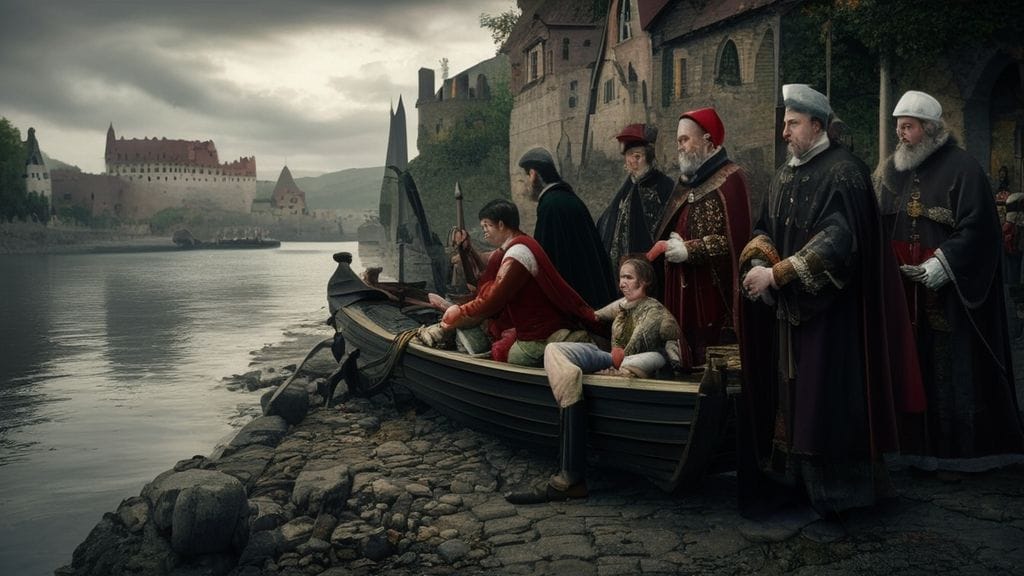
The boat awaited. Whether it was a single vessel or a small group of them, the chroniclers do not say with precision. But we know that once Henry IV was on board, surrounded by men who smiled at him, some crucial part of the plan snapped into place. The line tying the boat to the shore was loosed, the oars dipped into the icy water, and the vessel began to glide away from Kaiserswerth’s landing. For a moment, it might have seemed merely a pleasant cruise.
Then, quite suddenly, everything changed. The boat turned, not along the expected course for a brief outing, but downriver with purpose. Guards and attendants left behind on the bank must have realized something was amiss. The boy, looking back at the shrinking figure of the fortress, understood that he was being carried away from his mother and household. Panic surged. What happened next—his desperate attempt to escape—turned a political maneuver into a near tragedy that would sear itself into imperial memory.
Terror on the Water: The Abduction of Henry IV
The key scene of the coup of kaiserswerth, told and retold through the centuries, unfolds with terrible vividness. As the reality of his abduction dawned, Henry IV is said to have thrown himself from the boat into the freezing Rhine, preferring the peril of the water to the unknown designs of the men who claimed to guard him. Chroniclers like Lambert of Hersfeld, writing not long after the events, dwell on this moment with dramatic emphasis: a crowned child, garments heavy with water, struggling for breath as the current pulled at him.
Whether Lambert embellished details or not, the core episode—Henry’s leap into the river—is widely accepted by historians. It is a gesture at once instinctive and symbolic. In that instant, the young emperor chose self-endangerment over passive submission; he risked his life to avoid being torn from his mother and his court. The image of the emperor flailing in the water, flanked by astonished conspirators, speaks more eloquently than any political treatise about the trauma embedded in this act of “protective” seizure.
The coup nearly ended in disaster. If Henry had drowned, the conspirators would not only have committed regicide; they would have plunged the empire into a succession crisis with unforeseeable consequences. Someone—one of the princes on board, or perhaps a loyal attendant—lunged to pull him back into the boat. Hands grasped at wet cloth and chilled flesh. At last they managed to drag him to safety. Shivering, humiliated, and furious, the emperor had survived. The coup of kaiserswerth, that gamble on a swift, bloodless transfer of guardianship, had come within heartbeats of turning into a catastrophe for the entire empire.
Yet the plotters did not turn back. Once the boy was secured in the boat again, there was no question of returning meekly to Kaiserswerth and explaining away what had happened as a misunderstanding. The vessel continued down the Rhine toward Cologne, the conspirators now fully aware that they had crossed a threshold from which there was no easy retreat. On the shore, word raced through Kaiserswerth, then outward across the empire: the emperor had been taken. Whether people called it a rescue or a kidnapping depended entirely on which side of the emerging divide they stood.
Agnes in Shock: A Mother’s Loss and a Regent’s Collapse
Back at Kaiserswerth, Empress Agnes was confronted with a nightmare no mother—or regent—ever wishes to face: her child was gone, carried off by men who had smiled in her presence, sworn loyalty to the crown, and wrapped their intentions in the language of piety and care. No chronicle fully captures her immediate reaction, but we can imagine the panic: messengers dispatched in haste, boats ordered readied, guards questioning witnesses on the riverbank, courtiers half paralyzed by fear and uncertainty.
Agnes’s position was instantly undermined. The very fact that the conspirators had succeeded suggested that her control over the court and its military forces was weaker than many had assumed. If princes could abscond with the emperor in broad daylight, what did that say about the regency’s ability to protect the realm? For those already inclined to doubt her, it confirmed their worst suspicions. Even for her supporters, it was a bitter blow. The regent who had tried to steer a cautious course now found herself overtaken by events she could not reverse.
Emotionally, the separation from Henry must have been devastating. To lose a husband to illness and a throne to the demands of dynastic succession is one kind of loss; to see one’s son snatched away is another. Agnes had tried, in her own way, to be both mother and guardian of the empire. Now others claimed that function—and did so, cruelly, by placing themselves between her and the child who was both her heir and her last living bond to Henry III. The coup of kaiserswerth was not only a political act; it was a deeply personal assault on Agnes’s identity and authority.
Within a few years, she would withdraw increasingly from direct political involvement, eventually taking the veil and entering religious life. Chroniclers, especially those sympathetic to reform, later cast this retreat as a pious renunciation. Yet it is hard not to read in it the aftershocks of Kaiserswerth: the knowledge that her maternal and regnal roles had been violently stripped away, that men like Anno now claimed to act where she had once stood. In that sense, the river that separated her from Henry also marked the boundary between her brief, troubled regency and a new, harsher phase of imperial politics.
From Kaiserswerth to Cologne: The Re-Education of an Emperor
As the boat bearing Henry IV moved down the Rhine, the conspirators’ work entered a second phase: transforming their captive into a pupil. Cologne, with its great cathedral, wealthy abbeys, and formidable archbishop’s palace, became the new center of the emperor’s world. There, Anno and his allies could shape the narrative of what had happened. Henry, they insisted, had not been kidnapped but “rescued” from a court under dangerous influences. They spoke of his welfare, his education, and the good of the realm.
Daily life for Henry in Cologne likely mixed the familiar—prayers, lessons in Latin and governance, ritual observances—with subtle and not-so-subtle reminders of his dependence. His physical security, his access to information, even the people allowed into his presence were controlled by Anno’s circle. Tutors would have emphasized obedience, the divine duties of kingship, and the wisdom of heeding good counselors. The boy who had once been at the center of his mother’s household now found himself surrounded by men whose loyalty was to the archbishop as much as to the crown.
From their perspective, this was the necessary “re-education” of an emperor. The coup of kaiserswerth, they argued, had removed Henry from a feminized, poorly managed court and placed him under firm, moral guidance. It is likely that Anno hoped to create a ruler sympathetic to church reform yet respectful of ecclesiastical privileges, a new Henry III shaped by clerical hands rather than by noble factions. The boy’s earlier trauma—his leap into the river, his forced separation from Agnes—was something they probably tried to smooth over with assurances and religious rationalizations.
But children remember more than adults often think. Within Henry, humiliation mingled with a burning desire to reclaim his autonomy. Every lesson in obedience also taught him how power worked: how men cloaked their ambitions in talk of the common good, how control over his body and movements translated into control over the empire. In Cologne’s cloisters and halls, an emperor was indeed being shaped—but not perhaps in the docile form his captors imagined.
The Justification: How the Conspirators Explained the Unthinkable
No political act as bold as the coup of kaiserswerth could survive without a story to justify it. Once Henry IV was in their custody, Anno and his confederates set about crafting a narrative that would make their seizure seem not an act of rebellion but of loyal guardianship. They spoke in the language of reform, duty, and necessity.
Publicly and in communications to other princes, they portrayed Empress Agnes’s regency as a failure riddled with moral and political dangers. “The empire,” they suggested, “was in danger of ruin through the weakness of female rule and the influence of corrupt advisors.” Although we do not possess their exact words, chroniclers like Lambert of Hersfeld and later writers report this tenor of argument: that the princes, seeing the ship of state drifting toward disaster, had taken hold of the rudder. In this telling, Kaiserswerth was not the scene of a crime but the setting of a rescue mission.
They also invoked the longstanding medieval idea of the “tutela regis”—the guardianship of a minor king. As leading princes of the realm, especially as bishops charged with the care of souls, they claimed the right and the obligation to step in when the young ruler’s upbringing was judged inadequate. Anno, in particular, cloaked himself in the mantle of a moral reformer. He had risked his reputation, he implied, not for personal gain but for the salvation of the empire and the proper Christian formation of its king.
Not everyone was convinced. Some nobles, particularly those benefiting from Agnes’s rule, saw the coup as a naked power grab. They pointed to the near-drowning of the emperor as evidence of recklessness. Others, wary of open conflict, watched to see whether the new “regency” around Anno could deliver stability and order. The realm did not immediately fracture into war, which the conspirators took as a sign of tacit acceptance. But in the hearts of Agnes, Henry, and many observers, the moral stain of that day on the Rhine remained. Later historians, such as Gerd Tellenbach, would underline this duality: “The seizure of Henry IV at Kaiserswerth was at once an act of political prudence and a profound violation of the sacred person of the king.”
Clerical Ambitions: Bishops, Reform, and the Holy Roman Crown
The coup of kaiserswerth cannot be fully understood without situating it within the larger drama of eleventh-century church reform. The decades around 1062 were marked by intensifying efforts to combat simony (the buying and selling of church offices), to enforce clerical celibacy, and to free the church from what reformers saw as undue lay influence. The papacy itself was emerging from a period of imperial dominance into a phase of renewed self-assertion, one that would soon culminate in fierce conflict with Henry IV.
In this volatile environment, imperial bishops like Anno of Cologne occupied a precarious middle ground. They were products of a system in which kings appointed bishops and expected loyal service in return. Yet many also embraced aspects of the reform movement, seeking to clean up abuses and strengthen ecclesiastical discipline. They wanted a more moral, more orderly Christendom, but not necessarily a weaker episcopate or a humbler empire. In their eyes, the ideal solution was a godly, well-instructed king who would work in harmony with a reformed clergy.
The Kaiserswerth conspirators may thus be seen as clerical statesmen trying to preempt a perceived disaster. If the boy emperor grew up under bad influences—corrupt courtiers, pliant bishops, greedy nobles—the entire reform project could be imperiled. Controlling his upbringing meant, in their minds, safeguarding not only the political stability of the empire but also the moral health of Christendom. At least, that is how they wanted their actions to be perceived.
Yet there was an unmistakable dimension of ambition. To hold the emperor was to hold the keys to bishoprics, abbeys, and benefices. Anno’s influence surged after 1062, and although he later ceded some control to other royal advisors, his initial triumph illustrated the potential power of bishops who could manipulate royal minorities. In that sense, the coup of kaiserswerth foreshadowed the coming struggles over who, king or pope, would appoint bishops—and by extension, who would define the relationship between sacred and secular power in the Latin West.
A Boy Who Remembered: Henry IV’s Growing Resentment
Years passed, and Henry IV grew from child to adolescent to young man. The men who had seized him at Kaiserswerth may have hoped that with time, their actions would be reframed in his mind as stern but necessary guardianship. Instead, the memory festered. The leap into the Rhine, the cold shock of the water, the helplessness as stronger arms dragged him back—not to safety, but to captivity—became, in his recollection, an indelible symbol of treachery.
As he began, in his mid-teens, to take more direct control of government, Henry gradually pushed Anno and some of his early guardians to the margins. He favored other advisors, such as Archbishop Adalbert of Bremen, who presented different visions of imperial power. But whatever his shifting alliances, one constant seems to have remained: a deep suspicion of those who claimed to act in his name while denying his own will. The coup of kaiserswerth had taught him a lesson about the language of “care” and “tutelage.” He had seen how easily those words masked the raw reality of coercion.
Chroniclers hint that Henry’s later stubbornness, his tendency to hold grudges, and his insistence on defending royal prerogatives were all colored by this early trauma. When he faced off against Pope Gregory VII in the Investiture Controversy, defying papal claims to regulate episcopal appointments, he did so as a ruler who had once been told that others knew better what was good for him and for his realm. Now, as an adult and an anointed emperor, he was determined not to yield again. The personal history of Kaiserswerth intertwined with the grand ideological battles of the age.
On a human level, we can see in Henry’s life the scars of a childhood split by violence and manipulation. Trust, once broken so dramatically, is not easily restored. It is astonishing, isn’t it, how a single morning’s events can echo through decades of rule, bending the trajectory of an empire? The boy who flailed in the Rhine emerged as a man who would stand barefoot in the snow at Canossa—but also as one who would never entirely forgive those who had once wrapped chains of “protection” around his person and his office.
Echoes of Kaiserswerth in the Investiture Controversy
When historians look back on Henry IV’s reign, they often focus on the great Investiture Controversy that erupted in the 1070s: his clash with Pope Gregory VII over who had the right to appoint bishops and invest them with the symbols of their office. The dramatic scenes of excommunication, rebellion by German princes, and Henry’s penitent journey to Canossa in 1077 have overshadowed earlier episodes. Yet the coup of kaiserswerth lurks in the background of these events, an unspoken prelude.
At a basic level, both conflicts turned on the question of who held authority over the person of the king and the structures of the church. At Kaiserswerth, princes and bishops claimed the right to seize and “correct” a wayward royal household for the good of the realm. In the Investiture Controversy, the papacy claimed the right to discipline—and, if necessary, depose—a wayward emperor for the good of the Church. In both cases, Henry IV experienced power not as a stable birthright but as something constantly challenged, conditioned, and circumscribed by others’ visions of higher duty.
One chronicler, Bruno of Merseburg, pointedly observed that Henry’s misfortunes seemed to stem from his youth, “when he was taken away from his mother and given into the hands of men who sought their own advantage.” This earlier experience of control and humiliation must have shaped the ferocity with which Henry defended his prerogatives later on. When Gregory VII forbade lay investiture and asserted sweeping papal authority, Henry saw not only a theological or institutional issue but a reprise of an old pattern: others claiming to know better than the anointed ruler how the empire should be governed.
It is no coincidence that some of the princes who later opposed Henry in the Investiture Controversy had long histories of exploiting royal minorities and political crises. The culture that had made the coup of kaiserswerth possible—one in which nobles and high clergy did not hesitate to intervene directly in royal succession and education—also underpinned their willingness to challenge an adult king under papal auspices. In that sense, Kaiserswerth was both a rehearsal and a warning of the broader challenge to royal authority that would erupt a decade later.
The Fate of the Conspirators: Anno, Adalbert, and the Price of Power
What became of the men who, on that winter day in 1062, risked everything to seize the emperor? Their fates varied, but none entirely escaped the shadows cast by the coup of kaiserswerth. Some basked, for a time, in the power that came with controlling the king’s person. Others found themselves, in later years, outmaneuvered or disgraced as Henry asserted his independence.
Archbishop Anno of Cologne initially emerged as the dominant figure. He presided over imperial affairs, brokered alliances, and presented himself as a guardian of both the realm and the Church. He founded monasteries, supported reform initiatives, and cultivated an image of austere piety. Yet his hold on Henry did not last forever. As the emperor matured, he gravitated toward other counselors. Anno’s influence waned, and he spent his later years more focused on ecclesiastical matters within his diocese than on imperial politics writ large.
Adalbert of Bremen, who rose to prominence somewhat later, illustrates another trajectory. He became Henry’s close advisor and, for a time, seemed poised to overshadow older figures like Anno. His ambitions, too, were vast, and his accumulation of offices and revenues aroused jealousy and opposition. Eventually, Henry was forced to distance himself from Adalbert under pressure from discontented princes. The pattern was familiar: those who had helped shape Henry’s early reign found that their own power was precarious, subject to the same ruthless calculations they had once applied to others.
As for secular nobles involved in the coup, such as Otto of Northeim, their careers were no less turbulent. Some enjoyed periods of favor, others fell victim to shifting alliances and royal suspicions. The lesson is clear: seizing an emperor might yield short-term dominance, but it also made lifelong enemies and associated one’s name with an act that many saw as sacrilegious. Later writers did not forget who had engineered the coup of kaiserswerth; their reputations remained entangled with that episode, praised by some as saviors, condemned by others as traitors.
Chroniclers and Memory: How the Story of Kaiserswerth Was Told
Our knowledge of the events at Kaiserswerth comes largely from medieval chroniclers, each with their own biases and narrative aims. Among the most important is Lambert of Hersfeld, a monk who wrote a detailed chronicle of the period and who was generally critical of Henry IV. Interestingly, even Lambert—no friend of the emperor—presents the coup in morally ambivalent terms. He recognizes the conspirators’ claims to be rescuing the realm but lingers on the image of the terrified boy leaping into the river, casting a shadow over their righteousness.
Other chroniclers, sympathetic to reform bishops or hostile to female regency, highlighted Agnes’s alleged weaknesses and the court’s supposed corruption. In their accounts, the coup of kaiserswerth appears almost as a surgical intervention, painful but necessary to save the patient. They emphasize the high status and piety of Anno and his allies, framing them as reluctant heroes compelled to act for the common good.
Over time, as the Investiture Controversy unfolded and Henry’s reputation darkened in many ecclesiastical sources, Kaiserswerth came to be seen by some as the moment when his relationship with the reformed Church irreparably soured. Modern historians, however, have tended to adopt a more nuanced view. They note the complexity of motivations on both sides and the difficulty of accepting at face value any single medieval portrayal. As the twentieth-century medievalist Timothy Reuter cautioned, “Kaiserswerth must be read not only as event but as text: written and rewritten by those who needed it to prove a point.”
These layers of retelling remind us that history is not only what happened but how it is remembered and used. The coup of kaiserswerth became a touchstone in debates about proper kingship, the role of women in politics, the responsibilities of princes, and the nature of ecclesiastical reform. Every time the story was told, it was slightly reshaped to fit contemporary concerns. Yet certain images—above all, the boy in the river—remained stubbornly vivid, resisting any easy moralization.
Moral Lessons from a Riverbank: Loyalty, Guardianship, and Betrayal
Standing back from the details, the coup of kaiserswerth confronts us with enduring moral questions. What does loyalty mean when a ruler is a child? At what point does “guardianship” become usurpation? When is it justified to act against the will—or even the safety—of a sovereign for a claimed higher good? These questions tormented contemporaries and continue to interest historians because they touch on the tension between principle and expediency at the heart of politics.
The conspirators justified themselves by appealing to the common good and to divine law. They insisted that allowing the empire to drift under Agnes’s regency would have brought ruin: to the church, to the nobility, to the people. Their action, though harsh, was framed as a sacrifice of their own reputations for the sake of all. Yet the means they chose involved deceiving a child, terrifying him, and nearly causing his death. The line between moral courage and moral blindness is thin, and they stepped perilously close to, if not beyond, it.
For Henry, the lesson was simpler and bleaker: those who smile and invoke God’s will can still push you into a boat and sail away. Trust, once shattered so dramatically, is not easily restored. For Agnes, it must have taught the painful truth that even imperial majesty and maternal love could be overridden by determined men claiming spiritual authority. In that sense, the riverbank at Kaiserswerth became a kind of moral theater, where ideals of Christian kingship and princely responsibility collided with the hard realities of power.
Modern readers might be tempted to align themselves neatly with one side or the other: to condemn the conspirators as kidnappers or to laud them as reforming patriots. Yet the story resists such simplification. The empire did face genuine challenges; Agnes was not the iron ruler her husband had been; Henry did later act in ways that alarmed reformers. At the same time, the child’s terror, the mother’s helplessness, and the near-tragedy on the Rhine demand empathy. History here is not a morality play with clear heroes and villains, but a tangle of motives—some noble, some base, many mixed—played out at the expense of a boy who happened to wear a crown.
From Fortress to Footnote: Kaiserswerth in the Long Arc of Imperial History
Today, Kaiserswerth is a quiet district on the edge of Düsseldorf. Its medieval fortifications survive only in fragments, stones worn by time and overshadowed by modern life. Few who walk its streets or sit by the Rhine imagine that this unassuming place once saw an emperor leap into the river to escape his own guardians. The coup of kaiserswerth has faded from popular memory, overshadowed by grander, more famous episodes like Canossa.
Yet in the long arc of imperial history, Kaiserswerth marks an important inflection point. It signaled that the Salian dynasty’s hold on unquestioned authority, so strong under Henry III, was breaking. It revealed the willingness of princes—especially bishops—to intervene directly in royal upbringing and policy. It prefigured the kinds of coalitions and justifications that would later be used against Henry IV during the Investiture Controversy and the Saxon revolts.
The fortress on the Rhine also stands as a reminder of how localized acts can have expansive consequences. A single decision to lure a boy into a boat reshaped the psychological makeup of a ruler, reconfigured factional politics, and contributed to the climate of distrust that made later church–state conflict more bitter. It shows, too, how the geography of power—rivers, palaces, episcopal cities—intersects with the human geography of ambition, fear, and idealism.
In that sense, Kaiserswerth is no mere footnote but a lens through which to view the deeper currents of the eleventh century: the transformation of kingship, the rise of papal authority, the evolving role of princes and bishops. The coup of kaiserswerth may not be emblazoned in public memory, but in the patient work of historians it continues to illuminate how empires fracture and how, sometimes, a child’s desperate plunge into cold water can echo for generations.
Conclusion
The story of the coup of kaiserswerth begins as a tightly framed drama—a winter morning, a river, a boat, a frightened boy—and widens into a panorama of an empire in transition. What unfolded at Kaiserswerth on 23 February 1062 was not just an episode of high medieval intrigue, but a crystallization of broader forces: the fragility of child kingship, the ambitions of princes and bishops, the pressures of ecclesiastical reform, and the enduring tension between moral intention and political action. Henry IV’s near-drowning on the Rhine captured in miniature the precariousness of royal authority in a world where sacred monarchy could be both revered and manipulated.
For Empress Agnes, the coup marked the collapse of a regency already under strain, pushing her toward withdrawal and religious life. For Anno of Cologne and his fellow conspirators, it brought a fleeting ascendancy laced with lasting controversy. For Henry himself, it planted memories of betrayal that would color his dealings with church and nobility alike, shaping his responses to the far greater storms of the Investiture Controversy. The personal and the political, the emotional and the structural, intersected powerfully in that single morning’s events.
In tracing this narrative from its roots in Henry III’s imposing reign through the long shadow it cast over Henry IV’s troubled kingship, we see how history is made not only by formal decrees and battles, but by sudden acts of desperation, by gambles taken on rivers and in council chambers. The coup of kaiserswerth reminds us that claims to protect and reform can themselves become tools of domination, and that even those who see themselves as guardians may leave deep wounds in the lives they seek to guide. Yet it also reveals the resilience of political orders that, despite such shocks, adapt and endure.
Today, the Rhine still flows past Kaiserswerth, indifferent to the memories carried on its surface nearly a millennium ago. But for those who look back, that stretch of water is haunted by the image of a boy emperor flinging himself into its depths rather than submit, and by the men who, reaching out to haul him back, bound not only his body but the future of the empire to their own contested vision. In that image, the Holy Roman Empire’s eleventh-century crisis of authority is captured in a single, unforgettable moment.
FAQs
- What was the coup of Kaiserswerth?
The coup of kaiserswerth was the forcible seizure of the young Holy Roman Emperor Henry IV on 23 February 1062 by a group of princes led by Archbishop Anno of Cologne. Under the pretext of protecting and properly educating the emperor, they lured him onto a boat on the Rhine at Kaiserswerth and carried him away from his mother, Empress Agnes, effectively taking control of the regency and imperial policy. - Why did the conspirators abduct Henry IV?
The conspirators claimed they acted to save the empire from misgovernment under Empress Agnes and her advisors, whom they saw as weak, corrupt, or both. They believed that Henry IV was being poorly guided and that his future reign, and the stability of the realm, were at risk. At the same time, their actions clearly served their own ambitions, giving them direct control over the emperor’s upbringing and, through him, the machinery of power. - Did Henry IV really jump into the Rhine?
According to several medieval chroniclers, most notably Lambert of Hersfeld, Henry IV panicked when he realized he was being abducted and leapt into the cold waters of the Rhine in an attempt to escape. He was quickly pulled back into the boat by the conspirators or attendants. While details may have been dramatized, historians generally accept that some form of such an episode occurred, symbolizing the emperor’s terror and resistance. - How did the coup affect Empress Agnes?
The coup shattered Agnes’s authority as regent and deeply wounded her personally, separating her from her son and undermining her legitimacy. In the years that followed, her influence in imperial politics declined, and she increasingly turned toward a religious life, eventually entering a convent. Many historians see the coup of kaiserswerth as a decisive blow that ended her already fragile regency. - What role did Archbishop Anno of Cologne play after the coup?
After the coup, Archbishop Anno became one of the most powerful figures in the empire, effectively overseeing Henry IV’s education and serving as a leading member of the regency council. He used his position to promote church reform and to consolidate his own political influence. Over time, however, his dominance waned as Henry matured and other advisors, such as Archbishop Adalbert of Bremen, came to the fore. - How did Kaiserswerth influence the Investiture Controversy?
The coup of kaiserswerth shaped Henry IV’s character and his relationship with the church. His early experience of being “guided” through coercion contributed to his later insistence on royal autonomy and his suspicion of ecclesiastical interference in imperial affairs. These personal scars likely intensified his resistance to Pope Gregory VII’s attempts to restrict lay investiture, feeding into the broader ideological and political struggle of the Investiture Controversy. - Was the coup viewed as legitimate at the time?
Opinions were divided. Some princes and churchmen accepted the conspirators’ justification that they had acted to protect the realm and the emperor from misrule, and the absence of immediate civil war suggests a degree of grudging acquiescence. Others, especially supporters of Agnes and those alarmed by the near-fatal danger to Henry, regarded it as a shocking violation of the sacred person of the king and a thinly veiled power grab. - What sources describe the coup of Kaiserswerth?
The main narrative sources include the chronicle of Lambert of Hersfeld and other eleventh- and twelfth-century German chronicles, as well as later historiographical works that interpret these reports. These texts were written by clerics with varying political and ecclesiastical sympathies, so historians must read them critically, comparing accounts and weighing their biases when reconstructing the events. - Did the coup immediately weaken the Holy Roman Empire?
In the short term, the empire did not collapse, and some aspects of governance may even have benefited from stronger, more coordinated leadership among the princes around Henry. However, the coup damaged the perceived inviolability of the emperor’s person and deepened mistrust between the crown and the high nobility and clergy. These fractures contributed to the instability that later erupted during the Investiture Controversy and subsequent civil conflicts. - What is Kaiserswerth like today, and is there anything to see related to the coup?
Today, Kaiserswerth is a quiet district of Düsseldorf along the Rhine, with remnants of medieval fortifications and a picturesque old town. While no monument reenacts the coup of kaiserswerth itself, visitors can walk along the riverbank, see the ruins of imperial and episcopal structures, and imagine the landscape where the young Henry IV’s fate, and the empire’s future, took such a dramatic turn.
External Resource
Internal Link
Other Resources
- Encyclopaedia Britannica – general search for the exact subject
- Google Scholar – academic search for the exact subject
- Internet Archive – digital library search for the exact subject

