Table of Contents
- Rome on the Eve of an Ending
- From Shadow to Bishop: Sylvester’s Early Life
- The Church Before Constantine: A Time of Wounds
- The Constantine Revolution and the Rise of a Roman Bishop
- At the Heart of Power: Sylvester and the Imperial Court
- Council Fires: Nicaea and the Shaping of Creed
- Basilicas of Stone, Communities of Flesh
- Legends of a Healing Pope: Dragons, Leprosy, and Conversion
- The Old Rome and the New Faith: Tensions in the City
- The Long Winter of 334: Illness and Withdrawal
- The Final Day: 31 December 334 in Rome
- Mourning a Bishop, Celebrating a Saint
- Burial by the Catacombs: Memory Underground
- From Bishop to Legend: The Donatio Constantini and Its Shadow
- Power, Papacy, and the Legacy of a Quiet Pontificate
- Rome Transformed: Social and Political Consequences
- How Historians Read Silence: Sources, Myths, and Gaps
- The Death of Sylvester in Liturgy, Art, and Collective Memory
- Echoes into the Middle Ages and Beyond
- Conclusion
- FAQs
- External Resource
- Internal Link
Article Summary: On the last day of the year 334, in a Rome trembling between its pagan past and Christian future, Pope Sylvester I died, closing a life that had unfolded alongside the rise of Constantine and the legal triumph of Christianity. This article follows the story around pope sylvester i death, from his hidden youth under persecution to his quiet, almost understated role in an age of imperial upheaval. We will walk through the streets of Rome as basilicas rise, listen to theological battles that reshape creeds, and stand near the catacombs where his body was laid to rest. Yet behind the sparse lines of official documents, we uncover legends that recast him as healer of emperors and slayer of dragons. The narrative explores how his passing altered church politics, urban society, and the future image of the papacy. It also examines how later centuries weaponized his memory, especially through forged documents that magnified his authority beyond anything he knew in life. In the end, pope sylvester i death becomes a lens through which to view the transformation of an empire, the birth of papal power, and the complicated marriage of faith and politics.
Rome on the Eve of an Ending
On a winter evening at the end of the year 334, Rome lay beneath a low, gray sky. The Tiber moved sluggishly through the city, swollen with rain, pressing against its banks as though trying to escape the weight of history that clung to every stone. The markets had thinned; smoke from braziers and kitchens drifted up in pale ribbons, stinging the noses of those who walked the worn pavements. In scattered corners of the city, candles flickered in small Christian houses, and in a modest residence near the Lateran, the bishop of Rome lay dying.
His name was Sylvester. He had outlived emperors, persecutions, and the old order of the empire. He had watched as Constantine had taken up the cross as his battle sign and moved the balance of imperial power eastward to a new city on the Bosporus. In the early hours before dawn on 31 December 334, as the world counted down the final day of the year, his own remaining hours could be numbered in heartbeats, measured in breaths. Pope Sylvester I’s death, though lacking the drama of martyrdom or political assassination, occurred at a threshold moment, when the Roman world seemed to be pausing between two ages.
Outside, in the Forum, the old temples of Jupiter, Saturn, and Vesta still stood, proud yet increasingly hollowed out, their rituals practiced by fewer hands. But just a short walk away, a new Christian topography had begun to cut its outline into the city: the Lateran basilica, the first major church of Rome, and the growing complex on the Vatican hill. These were Sylvester’s Rome, as much as the imperial palaces and senatorial houses. Yet Sylvester himself, in life as in death, often seemed to hover at the margins of the grand spectacle of history, a quiet figure in the background of Constantine’s colossal shadow.
It is astonishing, isn’t it, that we know the emotional texture of that evening more from imagination than from documents? The sources that mention Sylvester are few and restrained. There is no diary of his final hours, no official imperial proclamation lamenting his passing. And yet, if we piece together the fragments—chronicles, church lists, inscriptions, and later legends—a picture begins to take shape. It is a picture of an elderly bishop whose tenure had coincided with nothing less than the public birth of Roman Christianity, passing away in a city that had not yet decided what to do with that fact.
Pope sylvester i death would later be overgrown with legend and pious embellishment, as though later centuries sensed that such a moment deserved more drama than the surviving evidence allowed. But first we must roll the story backward, into the shadows of his early life, into a Rome where being a Christian could cost you everything.
From Shadow to Bishop: Sylvester’s Early Life
When Sylvester was born—around the last decades of the third century—the Rome he inherited was tightening its grip against the “new superstition” of the Christians. The empire was a restless giant, torn by civil wars, economic strain, and external threats. Emperors rose and fell in brutal succession. The persecution under Decius in the 250s, and then under Valerian, had left scars on Christian communities, but these would not be the last.
We know almost nothing of Sylvester’s childhood, not even the exact year of his birth or the neighborhood in which he first opened his eyes. The “Liber Pontificalis,” the medieval book of papal biographies, offers only brief notices, and these are colored by later devotional interests. Still, we can imagine the everyday realities behind the silence. He likely grew up in a Rome where Christians worshipped discreetly in private homes and meeting places, where the fear of denunciation was never entirely absent. His formative years may have overlapped with the so-called Great Persecution under Diocletian (beginning 303), the most systematic attempt yet to extirpate the Christian faith from public life.
The memory of martyrs would have been part of the air he breathed as a young man. Stories of bishops dragged before magistrates, of books and liturgical vessels seized and burned, of congregations scattered—all of this would have formed a backdrop to his faith. One can imagine Sylvester in a candlelit gathering, listening as elders told stories of those who had refused to hand over sacred scriptures, who had chosen death rather than betrayal. Those tales were not only pious entertainment; they were scripts for how a Christian might be called to die.
Sylvester is said to have been ordained a priest before his election as bishop, and he may have served under Pope Miltiades (reigned 311–314), who himself was navigating the first fragile years after the Edict of Milan. That edict, issued by Constantine and Licinius in 313, granted religious toleration to Christians and reversed decades of repression. For Sylvester, as a cleric in the Roman church, this moment must have felt like stepping from a cramped cellar into the open air—dazzling, confusing, and filled with risk as well as possibility.
When Pope Miltiades died in 314, the Roman clergy and people elected Sylvester as bishop. He was not from the old aristocracy; he was, according to later tradition, the son of a certain Rufinus and Justa, obscure names that hint at an ordinary background. Yet the office he assumed was anything but ordinary. To take up the episcopate in Rome in the years just after Constantine’s victory at the Milvian Bridge (312) was to stand at the fault line of a shifting world. The young priest who had grown up in the shadows now found himself invited, cautiously, toward the edges of imperial light.
The Church Before Constantine: A Time of Wounds
To understand the significance of Sylvester’s pontificate—and eventually of pope sylvester i death—we must first look at the world his generation inherited: a church marked by wounds. For decades, Christians had lived as a suspect minority. They were accused of atheism (for refusing to worship the traditional gods), of disloyalty to the emperor, and even of dark rituals whispered about by hostile neighbors.
The Great Persecution initiated by Diocletian had tried to break the church’s spine. Churches were destroyed; scriptures were confiscated and burned; clergy were imprisoned and, in some cases, executed. In North Africa especially, the question of those who had handed over their sacred books—the “traditores”—would leave a bitter legacy that haunted the fourth century. These were not abstract debates for Sylvester’s generation; they were about friends and colleagues, about bishops who had cracked under pressure and those who had not.
When Constantine emerged victorious from civil war, bearing the sign of the cross as his battle emblem and issuing decrees of toleration, the church found itself thrust from the periphery toward the center of imperial life. But the old wounds did not vanish overnight. Communities were divided over how to treat those who had lapsed during persecution. Some argued for severe exclusion; others pleaded for reconciliation after penance. The Roman bishop, as arbiter and symbol, was drawn inevitably into these disputes.
Pain also took the form of doctrinal confusion. The third century had already seen intense debates about the nature of Christ, the Trinity, and the boundaries of orthodoxy. In the early fourth century, these tensions would erupt in the Arian controversy—named after the Alexandrian priest Arius, who argued that the Son was created by the Father and thus not co-eternal with him. This was not an academic squabble. It cut to the heart of Christian worship: could one truly adore Christ as God if he were not fully divine?
Sylvester stepped into office with these wounds still tender. The bishops of Rome were increasingly seen, especially in the West, as points of reference, but they were not yet the towering figures of centralized authority they would later become. Sylvester’s Rome was one episcopal see among many important centers—Alexandria, Antioch, Jerusalem, Carthage—all locked in a complex, often tense, communion. The bishop of Rome had honor, certainly, but his influence was still more moral than juridical.
Yet the situation was rapidly changing. The emperor now looked to bishops for religious legitimation; bishops, in turn, looked to the emperor for protection and support. It was into this new dance—uneasy, hazardous—that Sylvester was drawn, step by careful step.
The Constantine Revolution and the Rise of a Roman Bishop
By the time Sylvester was elected, Constantine had already won the Battle of the Milvian Bridge and issued his edicts of favor toward the Christians. The emperor was still a complex figure in religious terms—baptized only on his deathbed, retaining some attachment to traditional cults—but his political calculations were clear: the Christian God was a powerful ally, and the Christian church a potential source of unity in a fractured empire.
In this recalibrated world, the bishop of Rome gained a new visibility. Sylvester’s election coincided almost exactly with the moment when Christianity began to emerge from legal invisibility. Suddenly, the Roman church could own property openly, receive gifts from the emperor, and build monumental churches. The Lateran palace, once an imperial property, was granted by Constantine to the bishop of Rome, becoming the ecclesiastical and administrative heart of Western Christianity.
Imagine Sylvester walking through the halls of the Lateran for the first time, his footsteps echoing where imperial officials had once conferred. No longer confined to hidden meeting places, the Roman bishop now had a seat that rivaled senatorial mansions. Yet the grandeur of the setting masked uncertainty. What did it mean for a church formed in the crucible of martyrdom to accept the patronage of an emperor? Would wealth and favor blunt the edge of its witness?
The sources tell us almost nothing of Sylvester’s inner thoughts, but they do reveal the outer shape of his pontificate. He presided over a church that was expanding its institutional footprint rapidly. Deacons, priests, and subdeacons were organized; liturgical practices began to stabilize; claims of Roman precedence in doctrinal disputes quietly gathered force. And social pressures increased, too. As Christianity became advantageous—at least at the imperial court—conversions multiplied. Some were surely sincere; others more opportunistic.
The Roman aristocracy stood divided. A small but growing segment of noble families embraced Christianity, patronizing churches and supporting ecclesiastical projects. Others clung to ancestral cults, regarding the new religion as an upstart force eroding the pact between the city and its gods. Sylvester had to pastor a community in which these fault lines ran not only between families, but sometimes through them.
At the Heart of Power: Sylvester and the Imperial Court
When we look for Sylvester in the records of imperial politics, we find only his silhouette. There are no transcripts of meetings between him and Constantine; no surviving letters in which the emperor asks the bishop’s counsel on matters of state. Yet scattered traces suggest that the Roman bishop had a standing presence in Constantine’s imagination.
Constantine’s great civic works in Rome—especially the basilicas later associated with St. John Lateran and St. Peter on the Vatican hill—were begun during Sylvester’s pontificate. It is difficult to imagine such projects proceeding without close coordination with the city’s leading bishop. The “Liber Pontificalis,” writing centuries later but drawing on earlier materials, credits Sylvester with the dedication of the Lateran basilica and with detailed prescriptions about its liturgical use.
In these moments, the relationship between bishop and emperor was codified in stone. The emperor, nominally the supreme political authority, ceded moral and ritual primacy within the basilicas to the bishop. The bishop, in turn, presided over ceremonies that symbolically included imperial benefaction. It was an early rehearsal of a pattern that would shape European history for a millennium: the delicate intertwining of throne and altar.
Yet this closeness was double-edged. If the emperor supported a given theological position, bishops opposing him could find themselves isolated, even exiled. In the years after the Council of Nicaea, Constantine at times favored Arian-leaning bishops, such as Eusebius of Nicomedia. Sylvester had to navigate these shifting winds without being blown into a stance that would compromise Roman traditions or alienate the emperor entirely.
Modern historians, such as H. A. Drake in his studies of Constantine’s religious policies, have emphasized that the emperor sought not doctrinal purity but religious unity. This meant that a bishop like Sylvester, even if personally committed to Nicene orthodoxy, might find himself urged toward compromise for the sake of peace. It was a tightrope walk, performed over an abyss filled with the ghosts of recent persecutions and the promise of future schisms.
Council Fires: Nicaea and the Shaping of Creed
The most dramatic ecclesiastical event of Sylvester’s era was the Council of Nicaea in 325, convoked by Constantine to address the Arian controversy and other matters troubling the churches. It was the first ecumenical council in Christian history, a gathering of bishops from across the empire to deliberate doctrine in the presence—and under the patronage—of the emperor.
Sylvester himself, according to most ancient testimonies, did not attend in person. Age, distance, and perhaps political caution kept him in Rome. Instead, he sent legates—often identified as the priests Vitus (or Vito) and Vincentius—to represent the Roman see. This absence has sometimes been read as marginalization, but that is too simple an interpretation. By sending representatives, Sylvester both affirmed the council’s authority and preserved the Roman bishop’s supervisory distance.
In the smoky halls of Nicaea, under banners bearing imperial symbols, bishops argued fiercely over a single word: homoousios, “of the same substance.” Was the Son of God of the same substance as the Father, or of similar substance (homoiousios)? Beneath this technical vocabulary pulsed deep convictions about the nature of salvation and the meaning of worship. The council finally endorsed the stronger term, declaring the Son “begotten, not made, consubstantial with the Father.”
Although Sylvester did not sign the creed with his own hand, his legates did so in his name. Roman support, muted yet real, undergirded the Nicene position. From then on, the bishop of Rome could look back on Nicaea as a moment when the universal church, in communion with his see, had fixed the boundaries of orthodoxy. Sylvester’s Rome did not yet command the council, but it participated in and ratified its outcome.
The decisions of Nicaea did not end controversy; in some ways, they intensified it. Arian and semi-Arian parties regrouped, gained imperial favor at times, and mounted counterattacks. Bishops like Athanasius of Alexandria, staunch defenders of Nicaea, found themselves exiled more than once. Sylvester, from his vantage point in Rome, had to choose which exiles to welcome, which letters to endorse, which disputes to enter. Those choices would shape how later generations remembered the Roman see—as either a steady anchor or a hesitant participant in the storm.
Behind the council’s technical language, however, lay something more human: bishops who had once been enemies of the state now seated as honored guests at the emperor’s table. The reversal must have been dizzying. It marked a definitive break with the world into which Sylvester had been born, and it set the stage for the contradictions that would mark the last years of his life.
Basilicas of Stone, Communities of Flesh
If theological debates occupied bishops and emperors, ordinary Christians in Rome experienced the transformation of their faith in more tangible ways. Under Sylvester, the city’s sacred landscape began to change. Where once small house churches had sufficed, now great basilicas rose, echoing the forms of Roman civic architecture but repurposed for Christian worship.
The Lateran basilica, known as the “mother and head” of all churches of the city and the world, became the cathedral of the bishop of Rome. Its construction, supported by Constantine and overseen by the Roman clergy, was more than a building project; it was an assertion that Christianity now belonged in the very heart of Roman public life. On feast days, the basilica would have filled with a mix of social classes—former slaves, artisans, merchants, low-ranking officials, some nobles—standing side by side under its broad roof.
On the Vatican hill, above a modest necropolis and near the site honored as the grave of the apostle Peter, another basilica began to take shape during or soon after Sylvester’s time. Tradition later associated Sylvester directly with its dedication, depicting him as the bishop who first formalized the cult of Peter at that spot. Whether or not he personally presided over a grand ceremony, there is no doubt that the emerging complex on the Vatican became a focal point for Roman Christian identity.
The building of basilicas had social consequences. They became centers not only of worship but of charity. The bishop, through his clergy, distributed food, clothing, and alms from these new spaces. Widows and orphans, the impoverished and the sick, found themselves drawn into structures of support that bore the stamp of both imperial largesse and ecclesiastical organization. Sylvester, as head of this system, became a manager of resources as much as a spiritual leader.
And yet, as the church’s visible wealth increased—vestments, precious vessels, marble columns—some must have wondered whether something of the radical edge of the gospel was being dulled. The memory of bare, persecuted assemblies still lived in the songs and stories of the older generation. Now, as incense smoke curled up toward gilded ceilings, the faith had to find ways to remain rooted in simplicity and humility.
Legends of a Healing Pope: Dragons, Leprosy, and Conversion
If the surviving contemporary records give us a sparse, administrative Sylvester, later centuries would fill in the gaps with color and wonder. By the sixth and seventh centuries, a cluster of legends surrounded him, depicting a pope not only as bishop and administrator but as miracle worker and imperial tutor.
The most famous of these tales centers on Constantine’s supposed leprosy. According to the legend—preserved in later versions and echoed in the notorious medieval forgery known as the “Donation of Constantine”—the emperor suffered from a disfiguring disease and consulted pagan priests for a cure. They advised him to bathe in the blood of slaughtered infants. Horrified by the cruelty of the remedy, Constantine refused and instead turned to the Christian bishop of Rome, Sylvester.
In the story, Sylvester instructs the emperor in Christian doctrine, reveals the truth of the Trinity, and finally baptizes him in a great font. As Constantine emerges from the water, his leprosy is miraculously healed. Overwhelmed with gratitude, he not only converts to Christianity but also bestows upon Sylvester and his successors vast territorial and political powers, effectively handing the Western empire to the papacy.
Historically, this is fantasy. Constantine was baptized much later, likely in Nicomedia, and there is no evidence that he ever suffered from leprosy or that he ceded temporal rule to the pope. The “Donation of Constantine,” which claimed this as fact, was shown to be a medieval forgery by the humanist Lorenzo Valla in the fifteenth century. Yet the persistence of the story tells us something important: later generations felt that Sylvester—and the moment of his relationship with Constantine—deserved a narrative of dramatic transformation.
Other legends show Sylvester confronting a dragon that terrorized Rome, bound in a deep pit. By uncovering and chaining the beast, he frees the city from its choking breath. This imagery, while outlandish at face value, can be read symbolically: the pope as spiritual conqueror over the pagan, demonic forces that had long haunted the imperial capital. The dragon becomes a mythic shorthand for the old religions, tamed and contained by Christian authority.
These legends were not historically accurate, but they were historically effective. They reshaped how Christians in later centuries understood Sylvester’s place in the story. When we stand at the threshold of pope sylvester i death, we must acknowledge that we are also standing at the threshold of these myths, which would outlive him and, in some ways, overshadow his real, quieter life.
The Old Rome and the New Faith: Tensions in the City
Beneath the grand narratives of councils and miracles, the daily life of fourth-century Rome was a web of tensions. The city remained full of temples, shrines, and rituals that predated Christianity by centuries. The old priestly colleges still functioned, sacrifices were offered, festivals observed. Not every Roman, even among the elites, was ready to abandon Jupiter, Mars, and Vesta for the God of a previously despised minority.
Christians, meanwhile, were carving out a new cultural space. They rejected gladiatorial games and many traditional spectacles as morally corrupt. They refused to participate in sacrifices to the emperor’s genius, a civic duty under the old system. As Christianity gained imperial favor, these refusals took on a new meaning. Where once Christians were simply obstinate outsiders, now they were a rising force within the apparatus of power.
Sylvester, as bishop, stood at the intersection of these currents. He presided over a community that needed to define itself both against pagan practices and within a broader Roman identity. To be a Christian Roman was no longer a contradiction in terms, but the synthesis was still fragile. Some Christian intellectuals, like Lactantius, argued passionately that the Christian God had granted Constantine his victories as proof of divine favor, implying that the old gods were powerless. Others urged a more gradual approach, fearing backlash.
There were also intra-Christian tensions. Donatists in North Africa, rigorists who rejected the ministry of priests who had lapsed during persecution, looked to the Roman bishop with suspicion, seeing him as too lenient and too entangled with imperial power. While Sylvester’s direct involvement with the Donatist controversy is debated, the controversy itself is part of the world in which he operated: a world where the question of how to remember persecution remained live and painful.
The streets of Rome thus became a theater for silent contests: processions to Christian basilicas crossing paths with processions to pagan temples; senatorial banquets where Christian and pagan guests sat at the same tables, avoiding religious topics or arguing late into the night. In this world of contested loyalties, the bishop of Rome could never simply be a parish priest; he was a public figure whose every move was watched by friends and foes alike.
The Long Winter of 334: Illness and Withdrawal
As the year 334 advanced, Sylvester was an old man by the standards of his time. He had been bishop for two decades, long enough to see Rome’s Christian community move from tolerated minority to semi-official religion. While specific records of his health are absent, the simple fact of his death on 31 December suggests a period of decline; bishops rarely died without prior illness.
Imagine, then, the late autumn of that year. The air in Rome grows colder, the days shorter. Sylvester, perhaps suffering from some chronic ailment—fever, weakness, joint pain—withdraws increasingly from public ceremonies. Younger clergy take over the more strenuous liturgical duties, while the bishop remains seated more often, blessing with thin, aging hands.
Those who visited him in these months would have found a man carrying the weight of paradox. On one hand, he could look back on a pontificate in which Christians had gained unprecedented freedom and influence. On the other, he would have been aware of simmering doctrinal divisions, of the uncertain direction of imperial religious policy, of the unresolved question of how to live faithfully in newfound power.
The political climate of 334 was also unsettled. Constantine, now ruling over a vast empire and increasingly centered on his eastern capital at Constantinople, had divided administrative responsibilities among his sons and relatives. The unity of the empire, and with it the unity of the church, seemed precarious. Rumors of court intrigues and military campaigns would have reached Rome, carried by travelers and letters, discussed in the halls of the Lateran. The bishop, though far from the imperial court, could not be indifferent to these developments; the fate of emperors and bishops were now entangled.
As winter set in, Sylvester’s circle likely contracted to close clergy and attendants. Decisions still needed to be made—ordinations, the allocation of alms, responses to letters from other bishops—but the bishop’s role may have shifted from active leadership to quiet assent. Something in the Roman church was preparing for transition, even before the final breath was drawn.
The Final Day: 31 December 334 in Rome
The sources give us the date starkly: 31 December 334. They do not describe the hour, the weather, who stood at his bedside. Yet we can place that day against the rhythms of a late Roman year’s end. For many Romans, pagan and Christian alike, the close of December was a time of reflection and festivity—Saturnalia had recently passed, and the Kalends of January, with its exchanges of gifts and good wishes, lay just ahead.
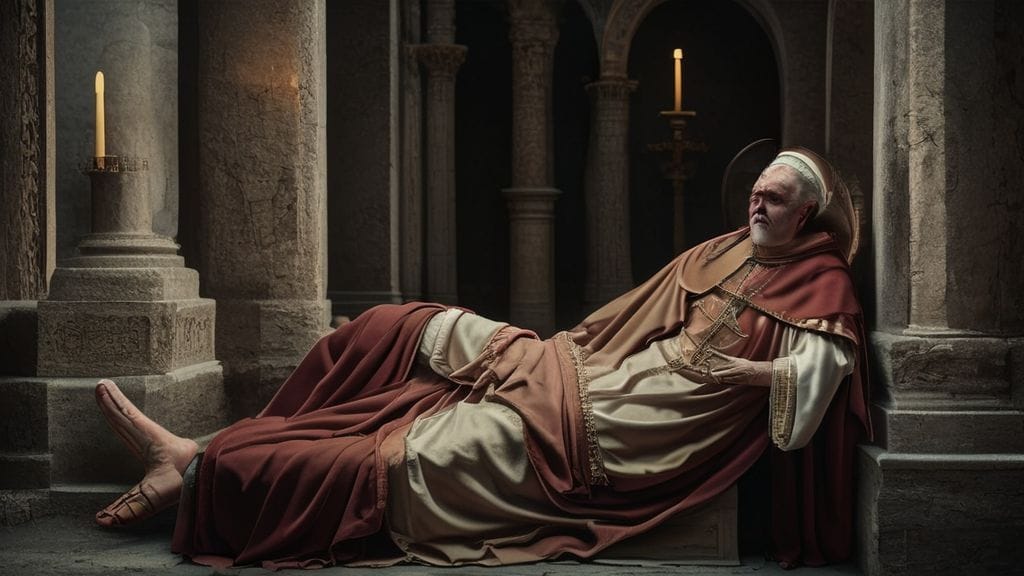
In the bishop’s residence, however, the atmosphere would have been more somber. The old man’s breathing, perhaps labored, may have grown shallower as the day wore on. A deacon might have read psalms quietly at his side; a presbyter could have anointed his forehead with oil, offering final prayers. The Christian understanding of death by this time was already rich with hope: to die in Christ was to pass from this world’s shadows into the light of God. But the immediacy of loss—the grief of those left behind—would have been palpable.
When pope sylvester i death finally came, sometime on that day, the news would have passed quickly through the clerical network of Rome. Subdeacons would have been dispatched to notify leading clergy; word would have spread among the faithful who attended the Lateran. Some wept for a spiritual father; others, perhaps, simply registered that the man whose name they had heard in the liturgy for twenty years was gone.
For those who had known the terror of Diocletian’s persecution, Sylvester’s peaceful passing may have seemed almost incongruous. He did not die in chains, in an arena, or in a prison cell. He died in his own bed, in a city where Christian basilicas now rose and the imperial patronage was real, if unpredictable. His death marked, symbolically, the end of an era in which the truly old Christians—the ones who remembered a wholly pagan empire—still held the highest offices.
From a modern point of view, pope sylvester i death can feel anticlimactic: no martyrdom narrative, no dramatic last words preserved for posterity. Yet there is a quiet significance to that very ordinariness. It signals that by 334, Christianity in Rome had begun to normalize its existence, to see bishops not only as potential martyrs but as administrators whose long, complex lives could end in the simple exhaustion of age.
Mourning a Bishop, Celebrating a Saint
Death in late ancient Rome was a public affair, and the death of a bishop even more so. Once Sylvester’s body had been washed and prepared, it would have been vested in liturgical garments and laid out for viewing, perhaps in or near the Lateran basilica. Clergy and laity alike would file past, some touching the hem of his garments, others simply standing in silence.
Prayers for the departed, rooted in Jewish and early Christian practice, would be recited. Psalms of lament and hope—“Out of the depths I cry to you, O Lord,” “The Lord is my shepherd”—would echo beneath the basilica’s arches. Bishop and people were bound not only by doctrine and discipline but by a shared emotional language of loss and hope. For many, Sylvester’s face, now still, would conjure memories of baptisms, Eucharists, blessings, perhaps even personal counsel in times of crisis.
Almost immediately, the line between mourning and veneration began to blur. In an age when martyr-cults were flourishing—Christians flocked to the tombs of those who had died for the faith—confessors and revered bishops also came to be honored. While Sylvester was not a martyr, his long service and his association with the pivotal era of Constantine marked him as a figure worthy of special remembrance.
It is likely that stories of his virtues began to crystallize in these days: his piety, his prudence, his endurance during the crisis years. Over time, these recollections would feed into more elaborate hagiographical traditions, eventually classifying him among the saints. The calendar would remember him; liturgical books would include his name in litanies; his feast day—celebrated on 31 December—would fuse his personal memory with the turning of the year.
Thus, from the outset, pope sylvester i death was not just an administrative event requiring the election of a successor. It was the beginning of a cultic and narrative process that would transform a once obscure cleric into an enduring presence in Christian memory.
Burial by the Catacombs: Memory Underground
After the vigils and prayers, Sylvester’s body was taken for burial. According to ancient tradition, he was laid to rest in the Catacomb of Priscilla on the Via Salaria, one of Rome’s oldest Christian burial sites. To modern ears, “catacomb” suggests a place of hiding, but in the fourth century these underground cemeteries were well-known and cherished spaces of remembrance.
The procession from the city to the catacomb would have carried both solemnity and triumph. A bishop who had once presided over a persecuted church was now interred with honor, his body placed among the loculi and arcosolia where earlier generations of Christians—some martyrs, some ordinary believers—had been laid. Flickering lamps would have lit the narrow passages as clergy chanted psalms and prayers, the sound echoing off the damp tufa walls.
To bury Sylvester in Priscilla, rather than in a new, isolated tomb, was to inscribe him into the existing fabric of Christian memory. Visitors would come to the catacomb not only to remember family members but to pray near the resting place of a bishop who had guided the church through epochal change. Small inscriptions, perhaps graffiti scratched by pilgrims, may have invoked his intercession: “Sancte Silvester, ora pro nobis”—Saint Sylvester, pray for us.
Archaeological studies of the catacombs, while cautious in assigning specific tombs to named individuals, affirm the broader pattern: fourth-century bishops were often buried in these communal sacred spaces, merging their memory with that of the wider Christian community. As the centuries passed, the cult of the martyrs would be joined by a cult of confessors and bishops, and Sylvester’s tomb would be a node in this growing network of sacred places.
Even underground, the politics of memory persisted. To be buried in a catacomb associated with ancient Christian families and martyrs lent Sylvester’s memory a particular prestige, anchoring his image not in imperial palaces but in the enduring soil of ordinary believers. This would matter later, when tales of his relations with Constantine threatened to make him seem more courtier than pastor. The stone and earth of Priscilla whispered another story: that of a bishop who, in death as in life, belonged to a community that had once found its only refuge beneath the ground.
From Bishop to Legend: The Donatio Constantini and Its Shadow
Centuries after Sylvester’s body had settled into the silence of the catacombs, his name would be called forth again—not by pilgrims alone, but by forgers. Sometime in the eighth century, in a Rome where the papacy was struggling to assert itself against both Byzantine claims and Lombard pressure, a document appeared that would alter the course of Western political thought: the “Donation of Constantine.”
This text, purporting to be an imperial edict issued by Constantine himself, told an extraordinary story. It claimed that after being miraculously cured of leprosy and baptized by Sylvester, Constantine had decided to move his imperial capital to the East and, in gratitude, had bestowed upon the bishop of Rome supremacy over all other churches and even temporal authority over Rome, Italy, and the entire Western provinces. In one breathtaking gesture, the emperor supposedly granted the pope both spiritual and imperial sovereignty.
For medieval popes, the “Donation” was a gift from heaven—or so it seemed. It provided historical and legal backing for their claims to temporal power, justifying papal involvement in the crowning of kings and emperors, and in the governance of territories. Sylvester, once a quiet fourth-century bishop navigating the first imperial-Christian relationship, was recast as the original recipient of the whole Western world’s political mantle.
Yet the text was a fabrication. Linguistic and historical anomalies eventually caught the attention of sharper minds. In the fifteenth century, the humanist scholar Lorenzo Valla subjected the “Donation” to painstaking analysis, demonstrating that its Latin style and institutional references belonged not to the fourth but to the eighth century. His “De falso credita et ementita Constantini donatione” (“On the Falsely Believed and Forged Donation of Constantine”) was a landmark in critical historical method, exposing how the desire for authority could rewrite the past.
The shadow of the “Donation” falls heavily over the memory of Sylvester. On one hand, it elevated him to an almost mythical status: the pope before whom emperors bent, the man to whom the West was given. On the other, it obscured his real historical circumstances, burying the subtlety of his actual relationship with Constantine beneath a mountain of invented grandeur.
Yet even as we strip away the forgery, the episode reveals something enduring: later centuries sensed that the moment of Constantine and Sylvester was foundational. It was there, in the early fourth century, that patterns of church–state relations began to crystallize, patterns that would shape medieval Christendom. The forgers, in a perverse way, recognized the symbolic power of pope sylvester i death and life, and sought to harness it for their own world.
Power, Papacy, and the Legacy of a Quiet Pontificate
Measured against the towering personalities of later popes—Gregory the Great, Innocent III, Urban II—Sylvester can appear almost muted. He left no corpus of letters like Gregory’s, no crusade, no sweeping legal reforms. His pontificate, however, stands at a hinge point in history, and its apparent quietness is part of its significance.
Under Sylvester, the Roman bishopric moved from marginal status toward the edges of imperial power. It acquired monumental buildings, legal recognition, and a new visibility in doctrinal debates. Yet the bishop himself did not attempt to dominate councils or to legislate for the entire church. His authority was still primarily moral and liturgical, not yet legalistic and juridical in the later medieval sense.
One could say that Sylvester’s legacy lies in the fact that, by the time of his death, the papacy had become imaginable as a central institution in the Christian world. The Lateran’s very existence, his role—however mediated—in Nicaea, the growing prestige of the Roman see: all of these would become building blocks for future claims. Later popes would look back on Sylvester as a bridge figure, one whose tenure marked the transition from persecuted bishopric to imperial partner.
There is also a more subtle legacy. By accepting imperial patronage while preserving a measure of independence in doctrinal matters, Sylvester helped establish a pattern of cautious collaboration. The church would work with emperors, but not always at their command; emperors would favor bishops, but could not simply dictate theology. This delicate balance would repeatedly be tested—sometimes shattered—in later centuries, yet its roots can be traced to figures like Sylvester.
Thus, even if the man himself remains dim in our sources, the institutional and symbolic footprint of his pontificate is large. The quiet death of a bishop on 31 December 334 became, in retrospect, the closing of a chapter whose consequences would echo for centuries.
Rome Transformed: Social and Political Consequences
To view pope sylvester i death only through the lens of church history would be to ignore the broader social currents he helped to set in motion. The Christianization of Rome under his watch, accelerated by Constantine’s policies, had far-reaching impacts on the city’s daily life and political culture.
Charity is one such area. As imperial support flowed into the church, bishops gained resources to organize relief for the poor. This did not erase poverty in Rome—far from it—but it created new networks of dependency and influence. Those who received bread at the doors of the basilicas were not only fed; they were integrated into a community defined by baptism and liturgy. In time, this would give the bishop a form of soft power that rivaled that of secular patrons.
Education was another arena of change. Christian catechesis—systematic instruction in doctrine and morals—began to shape the minds of future clerics and lay leaders. Pagan rhetorical schools still flourished, but Christian intellectuals began to challenge their monopoly on cultural prestige. A young Roman could now aspire to become not only an advocate in the courts or an officer in the army but a deacon, priest, even bishop, standing under the arcades of a basilica and teaching a different kind of wisdom.
Politically, the emerging alliance between imperial authority and the church created new expectations. Emperors were now judged not only by their military successes but by their religious policies. Bishops, in turn, were drawn into questions of loyalty and dissent. Sylvester’s Rome was a training ground for these dynamics. When he died, his successors inherited not only a set of buildings and liturgical practices but a political role within the city that would only grow with time.
On the level of symbols, the city’s very skyline changed. Where once the temples and triumphal arches had spoken a single language of pagan imperial power, now basilicas and martyr-shrines added new dialects. Processions on feast days claimed urban space for Christ; relics brought into the city carried stories from foreign lands and older persecutions. The Rome of 334 was still recognizably the Rome of the Caesars, but the seeds of a new Christian capital were already in the soil.
How Historians Read Silence: Sources, Myths, and Gaps
One of the most challenging aspects of writing about Sylvester is confronting the silence of the early sources. Unlike Augustine, Athanasius, or Jerome, he left no extensive writings. The fourth-century ecclesiastical historians—Eusebius of Caesarea, Socrates Scholasticus, Sozomen—mention him only in passing, focusing far more on eastern controversies and personalities.
This scarcity forces historians into a delicate exercise of inference. We rely on documents like the “Depositio Episcoporum” and the “Chronographer of 354” for basic chronological anchors, and on the “Liber Pontificalis” for later biographical traditions, always sifting legend from probable fact. Archaeology—especially the study of Christian monuments in Rome—provides another layer of evidence, allowing us to correlate building phases with papal reigns.
The legends that later centuries cherished—Constantine’s leprosy, the dragon, the “Donation”—are not simply to be discarded as lies. Rather, they are to be read as windows into how medieval Christians understood the relationship between pope and emperor, between spiritual and temporal power. As the historian Peter Brown has argued in his studies of late antiquity, stories and rituals can reveal mentalities that official documents leave unstated.
Yet critical distance is essential. When we reconstruct pope sylvester i death, we must resist the temptation to read back into the fourth century the fully developed papal monarchy of the thirteenth. Sylvester did not think of himself as a monarch ruling over kings; he thought of himself as a bishop among bishops, albeit in a particularly honored see, trying to shepherd his flock in a time of dramatic change.
The gaps in our knowledge invite humility. There are conversations we will never overhear, decisions whose motives we can only guess, prayers whispered in the darkness that left no trace on parchment or stone. But those silences are not empty; they are part of the texture of history, reminders that real lives are always richer and more complex than any surviving record.
The Death of Sylvester in Liturgy, Art, and Collective Memory
Over the centuries, pope sylvester i death and life were woven into the fabric of Christian worship. His feast day on 31 December became a recurring point on the liturgical calendar—remarkably, aligned with the turning of the civil year. In many Western countries, “St. Sylvester’s Day” became synonymous with New Year’s Eve, fusing civic celebration with the commemoration of an ancient bishop.
In churches dedicated to him—particularly in Europe—artists depicted Sylvester in rich vestments, often alongside Constantine. Frescoes and altarpieces show the dramatic legends: the healing of the emperor, the baptism scene, the dragon subdued. In these images, the quiet historical bishop is almost unrecognizable; he becomes a majestic, authoritative figure bestowing blessings on kings. Art, in this sense, canonizes the legend more than the man.
Liturgy also shaped memory. Prayers on his feast day invoked him as a defender of orthodoxy and a shepherd of the church in times of trial. The very act of repeating his name year after year in the Eucharistic prayers at Rome and elsewhere kept the association of Sylvester with the foundational age of Constantine alive. The faithful who heard his name may not have known the details of his life, but they knew enough to sense that he stood near the roots of their own Christian story.
Even today, in places like Germany, the term “Silvester” refers to New Year’s Eve, a linguistic echo of the ancient feast. Thus, in a curious twist, millions who know nothing of the fourth-century bishop still speak his name at the turning of the year, a faint yet persistent reminder that an old man once died in Rome on this date, and that his passing became entwined with the rhythms of time itself.
Echoes into the Middle Ages and Beyond
The centuries following Sylvester’s death saw the world he had known undergo further convulsions. The Western Roman Empire crumbled; barbarian kingdoms rose; the imperial court disappeared from Rome. In this chaos, the papacy emerged as one of the few enduring institutions, its memory of figures like Sylvester functioning as a claim to historical continuity.
Medieval reformers and polemicists frequently invoked the early popes as models. When Gregory VII confronted the German emperor in the Investiture Controversy of the eleventh century, the forged “Donation of Constantine” was already part of the papal arsenal, and with it a magnified image of Sylvester as imperial teacher. Preachers and canonists cited the story to argue that emperors derived their legitimacy from the church, not the other way around.
In the Renaissance, humanists like Valla pushed back, not against Sylvester himself but against the distortions of his memory. Their insistence on returning to the original sources, on parsing language carefully, gradually restored a more modest, historically grounded image of the fourth-century bishop. Modern scholars, working with improved textual and archaeological tools, have continued this work, disentangling legend from history while still acknowledging the power of the myths.
Today, Sylvester’s figure stands at a crossroads of interpretation. For church historians, he is a transitional pope whose tenure illuminates the early stages of Christian–imperial relations. For theologians, his connection to Nicaea and the formation of the creed is decisive. For cultural historians, the evolution of his legend into tools of medieval papal propaganda is a case study in how the past is constantly rewritten to serve the needs of the present.
Yet beyond all these scholarly frames, one simple fact remains: on 31 December 334, an old bishop died in Rome. Around that fact, layers of meaning have accumulated like sediment—some historical, some legendary, some political. To peel them back is not to diminish him, but to see, more clearly, how a single life can become a mirror for an entire civilization’s hopes and fears.
Conclusion
On the cold threshold between two years, pope sylvester i death brought to a close a life that had been quietly, almost unobtrusively, entangled with one of the greatest turning points in Western history. Born into a world where Christians hid in shadows, Sylvester died as bishop of a city where basilicas rose under imperial patronage and the cross had become a public symbol of power. His pontificate, though not marked by spectacular actions or surviving treatises, coincided with the legalization of Christianity, the convocation of Nicaea, and the first experiments in church–state partnership on an imperial scale.
In the centuries that followed, legends amplified his image, turning him into Constantine’s healer, dragon-slayer, and recipient of a forged imperial “donation” that would shape medieval political theology. These stories, while historically dubious, testify to the perceived significance of his era: a moment when the destinies of empire and church became inseparably intertwined. Historians, by contrast, work with the sparse contours that remain—burial notices, brief entries in chronicles, architectural clues—to reconstruct a more modest yet still profound portrait of a bishop who shepherded his flock through a time of dizzying change.
His death in 334 did not halt that transformation; it merely passed its burdens to his successors. The institutions he helped to consolidate, the churches he saw rise, the precedents he tacitly set in dealings with emperors—all continued to bear fruit, for good and ill, down the centuries. In remembering Sylvester, we are reminded that history is not only made by dramatic figures and loud events, but also by those who, in relative quiet, hold a steady line as the ground shifts beneath them. His story, and the story woven around him, remains a lens through which to see the emergence of the papacy, the Christianization of Rome, and the enduring tension between spiritual conviction and political power.
FAQs
- Who was Pope Sylvester I?
Pope Sylvester I was bishop of Rome from 314 to 334, presiding during the crucial years when Emperor Constantine legalized Christianity and initiated major building projects for the church in Rome. Although personally less documented than some contemporaries, he became symbolically central to later narratives about the rise of papal authority. - When and how did Pope Sylvester I die?
Ancient sources place pope sylvester i death on 31 December 334 in Rome. The circumstances appear to have been natural, likely after a period of age-related decline; there is no evidence that he died a martyr or through political violence. - What was Sylvester’s role in the Council of Nicaea?
Sylvester did not attend the Council of Nicaea in 325 in person, probably due to age and distance, but he sent legates—commonly named as Vitus and Vincentius—to represent the Roman see. They signed the Nicene Creed on his behalf, giving Roman support to the council’s affirmation of Christ as “consubstantial with the Father.” - Is it true that Constantine gave political power to Sylvester and the popes?
No, that story comes from the “Donation of Constantine,” an eighth-century forgery that claimed Constantine granted Sylvester and his successors supreme spiritual and temporal authority in the West. Renaissance scholar Lorenzo Valla proved this document to be false through linguistic and historical analysis. - Where was Pope Sylvester I buried?
Tradition holds that Sylvester was buried in the Catacomb of Priscilla on the Via Salaria in Rome, a significant early Christian burial site. This location associated him with the broader community of Roman Christians, including martyrs and ordinary believers. - Why is New Year’s Eve sometimes called “St. Sylvester’s Day”?
Because pope sylvester i death is commemorated on 31 December, his liturgical feast day coincides with the civil year’s end. In several European countries, especially in German-speaking regions, New Year’s Eve is known as “Silvester,” preserving his name in popular culture. - What is Sylvester’s main legacy for the papacy?
Sylvester’s legacy lies in his role at the dawn of the Christian empire. Under him, the Roman bishopric gained monumental churches, stronger institutional structures, and a new relationship with imperial power. These developments created a foundation on which later popes would build far more expansive claims to authority. - How do historians distinguish between the real Sylvester and later legends?
Historians rely on early documents, such as the “Depositio Episcoporum,” the “Chronographer of 354,” and archaeological evidence, while treating later hagiographical texts and the “Donation of Constantine” critically. By comparing language, context, and external corroboration, they separate probable historical facts from later devotional embellishments.
External Resource
Internal Link
Other Resources
- Encyclopaedia Britannica – general search for the exact subject
- Google Scholar – academic search for the exact subject
- Internet Archive – digital library search for the exact subject