Table of Contents
- A Winter Morning in Westminster: Setting the Stage for a Boy King
- From Turbulent Childhood to the Threshold of Power
- The Fall of Edward II and the Shadow Over the Crown
- England in 1327: A Kingdom Waiting for Direction
- Preparing the Abbey: Ritual, Symbol, and the Labor of Coronation
- The Dawn of 1 February 1327: London Awakes to a New Reign
- Procession to Westminster: The City as a Stage of Power
- Within the Abbey Walls: Sound, Incense, and Expectation
- Oaths, Anointing, and the Sacred Drama of Kingship
- The Crown Descends: Moment of Edward III’s Coronation
- Isabella and Mortimer: Power Behind the Throne
- Clergy, Lords, and Commons: Who Stood Where—and Why It Mattered
- Feast and Festival: How England Celebrated Its New King
- Rumor, Unease, and the Silent Questions of the Coronation Day
- The First Years After the Ceremony: A Puppet Crown?
- Casting Off the Regents: Edward III’s Bid for Real Power
- From Ceremony to Empire: The Coronation and the Road to War
- Legacy of a Winter Rite: Memory, Myth, and the English Monarchy
- Conclusion
- FAQs
- External Resource
- Internal Link
Article Summary: On a cold February morning in 1327, the edward iii coronation transformed a frightened fourteen-year-old boy into the anointed king of England, even as his crown rested in the long shadow of rebellion and regicide. This article reconstructs that day inside Westminster Abbey, exploring the sights, sounds, and emotions of the ceremony and the anxious city that surrounded it. It follows the path from Edward’s troubled childhood, through the downfall of Edward II, to the tense political theater in which his reign began. We examine how ritual, religion, and spectacle were used to soothe a restless kingdom, and how Isabella of France and Roger Mortimer wielded the young king’s authority for their own designs. Moving chronologically, the narrative traces how the promises and symbolism of edward iii coronation shaped his later break with his mother’s faction and his drive for independent rule. We also consider the longer arc of his reign—his wars in France, his cultivation of chivalry, and the image of kingship that he never ceased to measure against that first winter morning. In doing so, the article shows how a single, meticulously staged event helped redirect the English monarchy, and why the memory of the edward iii coronation continued to echo through chronicles, court ritual, and national myth.
A Winter Morning in Westminster: Setting the Stage for a Boy King
The morning of 1 February 1327 broke cold and uncertain over London. A pale winter sun struggled through the mist that clung to the Thames, turning its surface to dull pewter. Smoke rose from low houses packed against the city walls, mingling with the smell of damp wool, hearth ash, and the river’s own sour breath. Yet above this thick, everyday life, a different kind of air gathered around Westminster Abbey: charged, expectant, almost brittle. On this day, a boy of fourteen would be made a king, and not even the February chill could dampen the quiet tremor running through the capital. The edward iii coronation was not just a ceremony; it was a question posed to God, to England, and to history: could legitimacy be reborn on the ruins of a deposed and possibly murdered father?
Westminster itself had seen many processions of power before: the stately entry of Edward I, the melancholy rites for dead queens, the clang and murmur of great councils. But the air now was different, flavored with rumor and recent violence. In the echoing halls around the abbey, men spoke in low voices of the abdication forced on Edward II barely weeks earlier, of the king spirited away, of the queen and her lover ascendant. And somewhere within the precincts, servants and clerks prepared for the day’s elaborate liturgy with the nervous precision of people who knew that one misstep, one faltering note or misplaced banner, might be read as an omen. The boy waiting to be crowned had grown up in this atmosphere of suspicion and fracture. Now, as trumpeters rehearsed their calls and candles were set in high iron candelabra, he was about to be wrapped in a mantle of sanctity that might either heal the kingdom—or mask its continuing wounds.
From Turbulent Childhood to the Threshold of Power
Edward, future Edward III of England, was born into a royal house more troubled than triumphant. The eldest son of Edward II and Isabella of France, he arrived in 1312 to a dynasty that had already begun to fray. His grandfather, Edward I—“Hammer of the Scots”—left an imposing legacy of conquest and stern kingship, a standard that his son could not match. Edward II’s reign, overshadowed by personal favoritism and military humiliation, became the unstable cradle of the young prince’s childhood. The boy’s early memories likely included the distant roar of discontented parliaments, the shuffle of exiled favorites returning, and the sudden departures of courtiers whose fortunes had turned overnight.
There were splendors too—tournaments and progresses, glittering feasts, the feel of good horses beneath him as he learned to ride in the royal mews. Yet even these joys were edged with unease. The prince watched as his father’s attachments to men like Piers Gaveston and later the Despenser family tore the court into factions. He saw his mother, Isabella, gradually withdraw her open support from her husband. Chroniclers later wrote of his intelligence and reserve, the way he watched rather than spoke; the young Edward was learning early that survival in Plantagenet politics meant studying every glance and gesture. By the time he was old enough to understand the words “traitor” and “rebellion,” he had already seen them shape the fates of the men around him.
The Fall of Edward II and the Shadow Over the Crown
The path to the edward iii coronation began with a royal fall unprecedented in English history. Edward II’s rule had long been contested—his broken campaign at Bannockburn in 1314, where Scottish forces under Robert the Bruce shattered English arms, became a symbol of weakness no coronation rite could mend. Discontent simmered among the magnates, who resented both his military failures and the rise of his favorites, particularly Hugh Despenser the Younger and his father. In the late 1320s, this simmer finally boiled. Isabella, the queen, journeyed to France under the pretext of diplomacy and refused to return. There, she joined forces—politically and, most likely, emotionally—with the ambitious Marcher lord Roger Mortimer.
The invasion that followed in 1326 was swift and humiliating. As Isabella and Mortimer landed in England with a modest force, men flocked to their banner, weary of the Despensers’ dominance. Edward II’s support melted away; even London, crown jewel of royal authority, turned turbulent and unsafe. Like a tragic figure in a chronicle, the king fled westward, only to be captured with his favorite Hugh Despenser. Despenser met a gruesome public death, hanged and disemboweled in a spectacle meant to purge the kingdom of his influence. Edward II, by contrast, was smothered in procedure: parliament, deposition, and imprisonment—though darker rumors of his final fate soon leaked from Berkeley Castle. It is astonishing, isn’t it, how quickly the concept of sacral kingship could be turned on its head? A king, anointed with holy oil, had been forced to resign. The act tore a rent in the fabric of the English monarchy that his son’s coronation would struggle to mend.
England in 1327: A Kingdom Waiting for Direction
By the start of 1327, England was a kingdom both relieved and fearful. The terror of Despenser rule had ended, and many welcomed the fall of a king seen as disastrous in war and partial in justice. Yet the horizon was anything but clear. The country’s finances were strained by failed campaigns and mismanagement. Scotland remained defiant to the north, while relations with France—Isabella’s homeland—were a tangle of overlapping claims and tensions. Noble families, some newly triumphant and others nursing fresh wounds, looked anxiously toward Westminster to see what kind of regime would replace the old one.
Legally and symbolically, the answer seemed simple: the new regime would be ruled by the young Edward, proclaimed king in his father’s stead. In practice, everyone understood that the fourteen-year-old could not yet truly govern. Isabella and Mortimer moved with the confidence of victors, distributing lands and offices, restoring allies, and punishing enemies. But their power was precarious, for it rested upon an act of usurpation cloaked in the language of reform. To stabilize their position, they needed what medieval rulers always needed at such moments: a liturgical act that would wrap their political coup in the robes of divine approval. The edward iii coronation would be that act, a carefully choreographed demonstration that God and the Church, the nobility and the common people all assented to this new order.
Preparing the Abbey: Ritual, Symbol, and the Labor of Coronation
Long before the king-to-be arrived, Westminster Abbey had been turned into a theater of sanctified power. Monks moved through the chill nave, their breath faintly visible in the diffused light, arranging candles and vestments according to a script older than any of them. The coronation ordo—the official liturgy for an English royal crowning—prescribed in loving detail the garments, gestures, and prayers that would transform a mortal youth into God’s anointed. The Stone of Scone, taken from the Scots years before and placed beneath the coronation chair by Edward I, stood ready, its rough surface a silent boast of conquest and dominion.
Craftsmen had labored in the preceding days to polish metalwork, mend banners, and prepare the regalia. The crown itself, rich with jewels and history, symbolized both inheritance and expectation. Ornaments of state—the orb, the scepter, the rod—were checked and set in their places. Cloth-of-gold hangings were unfurled, softening the abbey’s stone with a shimmering skin. Outside, carpenters had raised platforms and seating for nobles, bishops, officials, and representatives of the commons, for the coronation was not a private sacrament but a public claim staged before the kingdom’s estates. Every object, every color, carried meaning: the purple and deep red fabrics evoked imperial majesty and Christ’s suffering; the gold thread suggested the unending radiance of divine favor. For those arranging it, the work was painstaking and physical, but they were also conscious actors in a drama that stretched back through the reigns of Henry III, John, and beyond, toward the misty legends of the Anglo-Saxon kings.
The Dawn of 1 February 1327: London Awakes to a New Reign
As the bells of London’s parish churches began their first slow tolling of the day, the city woke not just to the ordinary rhythms of trade and worship but to the prospect of spectacle. Word had spread for weeks that the prince would be crowned; now, people marked the day with nervous excitement. Traders adjusted their routines, some closing their shops entirely to join the throngs expected along the processional route. Apprentices craned for excuses to slip away. Women wrapped themselves and their children more warmly, prepared for a long, cold watching. Many had never seen a king close at hand. To behold the face of the monarch, even at a distance, was to feel more deeply connected to the great machinery that governed their lives.
Yet behind the impression of festival lay an undercurrent of whispered questions. “Is he like his father?” some might have asked, remembering tales of Edward II’s caprices. Others wondered about the queen, about Mortimer, about the future: would this boy king bring peace, or would new struggles follow? For many, the coronation was less about personal loyalty than about the hope that the crushing weight of taxes and levies might ease, that justice might be less partial, that the roads might be safer. The edward iii coronation, for them, was not an abstract rite of continuity. It was a fragile promise that the distant world of the court might finally remember the common man and woman standing in the cold, jostled by the crowd.
Procession to Westminster: The City as a Stage of Power
The royal procession from the palace precincts to the abbey turned London’s streets into a moving tapestry of sound and color. At its heart rode Edward, small in the saddle yet trying to sit straight, aware that every eye was upon him. He wore rich robes appropriate to the heir of the Plantagenets, their weight almost a physical embodiment of history. Around him clustered leading nobles and attendants, some in riotous fabric that flashed crimson, blue, and gold against the winter-grey sky. Trumpeters sounded periodic blasts, flashes of bright brass punctuating the steady clop of hooves on the frozen ground.
Spectators leaned out from upper windows, their breath fogging the air. Children, hoisted to shoulders or perched on door ledges, pointed and shouted when the king passed. Beneath the bright trappings, however, the procession also broadcast messages of power. Placements in the train—who rode near the king, who walked before or behind—were carefully decided signals. Isabella and Mortimer’s influence was apparent even if they did not overshadow the boy physically; their allies were conspicuously near the center of things. London’s civic authorities, though important, were constrained to their assigned role, a delicate reminder that the capital’s favor was welcome but not decisive. As the procession wound closer to Westminster, the music and shouting thinned, replaced by the solemn expectancy that attaches itself to sacred spaces. The city had done its part; now the abbey would take over.
Within the Abbey Walls: Sound, Incense, and Expectation
Inside Westminster Abbey, the world seemed to contract into a blaze of candlelight and the murmuring rise of Latin prayers. The great stone nave, normally austere, had been transformed by hangings and torches into a glowing tunnel of gold and shadow. The scent of incense curled through the air, mingling with the entirely human smells of wool, polished leather, and many bodies pressed together. At the crossing, under the soaring vaults, stood the coronation chair upon its raised dais, facing east toward the altar where the most sacred part of the rite would unfold.
Bishops in heavy miters waited with grave patience, their expressions caught between spiritual absorption and very human worry. They knew that this coronation would be read by contemporaries and posterity alike as a judgment on the chaotic years just past. If the ceremony stumbled, if omens seemed unkind, people would talk. Perhaps some of them recalled the chroniclers’ accounts of earlier coronations—for instance, that of Henry III, crowned hastily as a boy during civil war. A similar sense of emergency clung to the edward iii coronation: again, a young king, again, a kingdom seeking restoration through ritual. Edward himself, brought into the echoing space, must have felt both very small and frighteningly exposed. The eyes of abbots, lords, and Londoners fixed upon him as he moved toward the chair, each step folding him more tightly into the script of destiny others had written.
Oaths, Anointing, and the Sacred Drama of Kingship
At the heart of any medieval coronation lay the exchange of vows. Before crown or anointing, Edward had to speak aloud the promises that bound him to his people—and bound him, too, to an ideal of kingship far loftier than the faction-ridden reality around him. Standing before the assembled realm, he swore, in the traditional formula, to uphold the laws and customs of the kingdom, to render true justice, to defend the Church and the poor. The words were formal, yet they carried a charge sharpened by recent experience. Many listening would have contrasted them, silently, with the perceived failures of Edward II. This moment, at least, sounded like a new beginning.
Then came the anointing, the most intimate and theologically profound gesture of the day. Stripped of his outer garments and shielded from the crowd by a canopy held aloft, the boy knelt or stood while holy oil touched his head, breast, and hands. This oil, consecrated and precious, marked him not simply as a political ruler but as a quasi-sacred figure, a Christian king whose body was set apart. The ritual drew on Old Testament precedents—Samuel anointing Saul and David—and on centuries of Christian theory about the divine right of kings. One chronicle emphasizes that the congregation responded with loud acclamations, as though participating in a second baptism of the realm. In that moment, the edward iii coronation ceased to be only the work of Isabella, Mortimer, or any living faction. The Church had laid its claim upon the young monarch, and through him upon England’s future.
The Crown Descends: Moment of Edward III’s Coronation
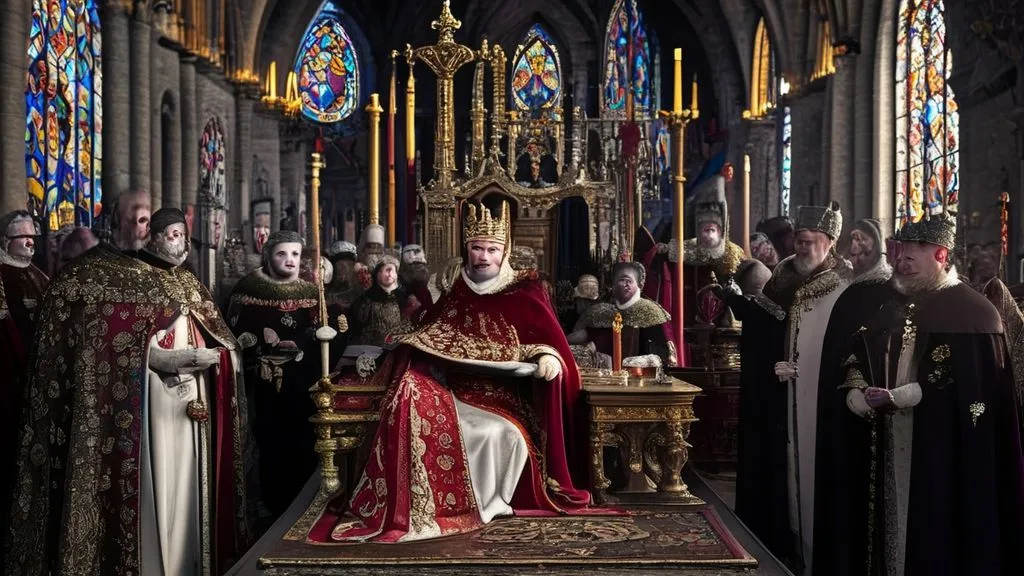
After the anointing came the vesting: the slow dressing of the king in ceremonial garments symbolizing each aspect of his office. Rich robes of state enfolded him, a mantle heavy with embroidery and tradition. He was given the sword of state—both a weapon and a sign of justice—to gird at his side. The orb and scepter followed, signifying dominion and the pastoral care of the realm. All of this led toward the central gesture: the placing of the crown itself upon his head. In a world where ritual often spoke louder than any parchment, this was the act that would fix Edward in memory as king.
When the crown finally descended—set reverently upon his head by the officiating prelate—the abbey erupted in sound. Trumpets pealed, and acclamations rose: “Vivat rex! Long live the king!” From the galleries and nave, from lay magnates and humble witnesses, came a roar that pushed against the stone vaults. For a few minutes, the political tensions that had brought Edward to this point seemed to melt into a shared exultation. Whatever misgivings some might have held about the path to this day, they now confronted a crowned monarch, anointed and acclaimed. The edward iii coronation was complete in its essential gesture: a youth, once merely heir and pawn, had taken upon himself the visible sign of sovereignty. Yet as the crown’s weight settled on his brow, so too did the invisible burdens of expectation, comparison, and doubt.
Isabella and Mortimer: Power Behind the Throne
Even in the glow of the crowning moment, shadows moved nearby. Isabella of France—the “She-Wolf,” as later generations would dub her with a mixture of fear and fascination—watched her son’s elevation with complex emotions. On one level, this was her triumph: she had broken the power of the Despensers, toppled a husband who had scorned her, and secured the crown for her child under her own guiding hand. Yet her presence also reminded all observers that the new king’s authority was entangled with the deeds that had placed him there. Some must have wondered: where did Isabella’s maternal care end and her political ambition begin?
Roger Mortimer, for his part, stood as living testimony to the slippery nature of loyalty and rebellion. Once a prisoner in the Tower, he had escaped, fled, and returned as the queen’s indispensable partner. Now his influence was woven into the highest levels of government. Although the coronation liturgy spoke constantly of God’s will, the eyes of many lingered on Mortimer’s position in the seating and procession, reading in it the outlines of a new, unofficial regency. Official documents would soon make it clear that the young king’s rule would be guided—some would say controlled—by his mother and her favorite. The edward iii coronation, then, functioned as both a consecration and a veil, sanctifying a settlement that left true power in the hands of those who had overturned the previous monarch.
Clergy, Lords, and Commons: Who Stood Where—and Why It Mattered
To understand the political meaning of the day, one must look not only at the crowned figure on the dais but also at those who surrounded him. The arrangement of clergy, lords, and representatives of the commons within the abbey formed a living map of England’s political landscape. Senior bishops, particularly the Archbishop of Canterbury, occupied places of honor near the altar, underlining the Church’s indispensable role in legitimizing royal power. The great earls and barons—some recently restored to favor by Isabella and Mortimer, others still nursing grievances—clustered in positions that reflected both their rank and their current standing at court.
Beyond them, further down the nave, stood lesser nobles, knights, and burgesses. Their very presence in the abbey, even at a distance from the sanctuary, indicated that the idea of the “community of the realm” had taken firmer root since the baronial conflicts of the previous century. The coronation oath, by now a familiar ritual, spoke of just governance and legal customs that bound king and people alike. Chroniclers such as the author of the Vita Edwardi Secundi had already articulated the notion that a king who defied these expectations could be called to account. In that sense, the edward iii coronation was a compact as well as a blessing. The king promised good rule; the estates of the realm offered obedience. But all involved were haunted by the knowledge that the last king to make such promises had been driven from his throne.
Feast and Festival: How England Celebrated Its New King
No medieval coronation ended with the final prayer in the abbey. The sacred drama spilled over into feasts, largesse, and revelry meant to cement loyalty and broadcast royal generosity. After the formalities, Edward—now unquestionably King Edward III—was escorted to the great hall for a coronation banquet. Here, candles and torches multiplied, casting flickering gold over long tables laden with meat, fish, spiced dishes, and sweetmeats. Minstrels played, heralds announced dignitaries, and servers moved in precise choreography to ensure that the highest nobles received the richest fare.
Such feasts were more than mere indulgence. They formed part of the language of kingship, demonstrating the monarch’s ability to provide and to honor his leading subjects. Gifts and offices might be confirmed or hinted at over the course of the day. Knights and younger men at arms watched closely, judging how the new regime treated its allies and former enemies. Outside the palace, Londoners held their own celebrations with bonfires, ale, and communal meals. The city authorities might sponsor pageants or processions, eager to show goodwill to the new king yet also to remind him of the capital’s importance. If one could step back from the detail, the edward iii coronation appeared, by evening, as a great vortex of eating, singing, and negotiating—a swirl of human bodies and ambitions orbiting around the thin, crowned figure at its center.
Rumor, Unease, and the Silent Questions of the Coronation Day
Yet behind the celebrations, whispers persisted. Even as the last courses were cleared from the coronation feast, some guests must have traded low words about the absent figure who haunted the day: Edward II. Officially, the former king had abdicated in favor of his son. Unofficially, tales circulated of harsh treatment in captivity and of darker possibilities. A living, deposed king remained a danger, a potential rallying point for unrest. How secure could a new monarch be while his predecessor still breathed? The question lodged, uncomfortable and unspoken, in the minds of many present.
Mortimer and Isabella understood this all too well. Their need to stabilize the realm—and their own authority—would soon lead, in September 1327, to Edward II’s reported death at Berkeley. The sensational rumors of his murder, including the notorious story of a red-hot poker, grew over time, but even contemporary accounts register public suspicion. Thus, when we look back on the edward iii coronation, we must read it with this tension in mind. It was both a heartfelt appeal for renewal and a careful attempt to fix in place a political settlement that still required violence to sustain it. For the boy at its center, some of these complexities might have remained opaque that day. But as he grew older, Edward could not help but see how his crown had been won, and at what cost.
The First Years After the Ceremony: A Puppet Crown?
In the months that followed the coronation, the question of who truly ruled England became sharper. Official documents were issued in Edward III’s name; seals were struck, writs dispatched, treaties negotiated. But it was Isabella and Mortimer who largely directed policy, using the authority conferred by the ceremony to reward their supporters and maintain control. The young king attended councils, presided at times over judicial proceedings, and performed the expected public rituals of monarchy. Yet decisions behind the scenes frequently bore Mortimer’s stamp rather than Edward’s emerging will.
For the nobility, this arrangement produced a complex mix of relief and frustration. On one hand, the worst abuses of the Despenser regime had ceased. On the other, a new form of over-mighty subject had arisen, a lord who seemed to wield royal power without wearing the crown. “It is as though we have exchanged one tyrant for another,” some might have muttered in private halls across the shires. Foreign policy too reflected this imbalance. The Treaty of Northampton with Scotland in 1328, which recognized Robert the Bruce’s kingship and ceded significant concessions, struck many English nobles as humiliating. To them, it seemed less the act of a proud, independent king than of a regent anxious to secure his own position. The dissonance between the solemn vows of the edward iii coronation and the realities of policy grew more pronounced, sowing seeds of future conflict.
Casting Off the Regents: Edward III’s Bid for Real Power
As Edward matured, the golden images and heavy oaths of his coronation must have worked upon his imagination. He had been anointed to defend the realm, to uphold justice, to stand as the supreme authority in England. Yet in practice, he watched as Mortimer occupied that role, dealing out patronage, commanding armies, and overshadowing the king at court. Resentment, once only a vague unease, hardened into resolve. Edward began to gather around himself a circle of loyal companions—young men who owed more to their direct bond with the king than to Isabella or Mortimer. Quietly, a parallel center of power formed within the very heart of the court.
In October 1330, only three years after the coronation, the simmering discontent boiled into action. At Nottingham Castle, Edward orchestrated a dramatic coup. With a small band of trusted allies, he entered the castle through a secret passage, surprising Mortimer, who believed himself secure under the queen’s protection. In the confusion that followed, Mortimer was arrested in the king’s name. Isabella, confronted by the son she had helped crown, is said to have cried, “Fair son, have pity on the gentle Mortimer!” But pity was no longer in Edward’s mind. Mortimer was tried, condemned for treason, and executed. Isabella lost her direct power, living out the rest of her days in honorable but real seclusion. Only now did the promise of the edward iii coronation begin to align with reality: the boy anointed in 1327 had become, at last, the effective ruler of his kingdom.
From Ceremony to Empire: The Coronation and the Road to War
With Mortimer removed, Edward III embarked on the phase of his reign that would define his image for centuries: wars in Scotland and, above all, the great conflict with France later known as the Hundred Years’ War. His sense of kingship, shaped in part by the grandeur and solemnity of that February day in Westminster, pushed him toward a vision of monarchy that was chivalric, martial, and expansive. The memory of his father’s failures and of the uneasy circumstances of his own accession seemed to goad him into pursuing glory on the battlefield and through carefully crafted ceremonies of knighthood and courtly display.
When Edward claimed the French crown in 1337, invoking his descent through Isabella from Philip IV of France, he was doing more than prosecuting a dynastic quarrel. He was asserting a conception of royal legitimacy that transcended borders, grounded in blood, rite, and the favor of God demonstrated in victory. The edward iii coronation had taught him the power of spectacle and sacred theater; he now extended those lessons to the fields of Crécy and Poitiers, to the founding of the Order of the Garter, to the tournaments and pageants of Windsor. Chronicles by writers such as Jean Froissart wove together his military successes and his piety into a tapestry that made sense of his violent age. Yet the threads of that tapestry can be traced back to the winter morning when a nervous boy felt the weight of a crown and the chill of holy oil on his skin.
Legacy of a Winter Rite: Memory, Myth, and the English Monarchy
Looking back from the vantage point of later centuries, the coronation of Edward III stands at a crossroads in the history of the English monarchy. It followed a deposition that seemed to shatter the old certainties about the inviolability of kings. Yet it also helped to repair and reshape those certainties, demonstrating that even a throne seized through rebellion could be re-sanctified through the right combination of liturgy, spectacle, and political settlement. Subsequent rulers drew lessons—both cautionary and inspiring—from Edward’s experience. Some, like Richard II, would overemphasize the sacred side of kingship, claiming a near-untouchable authority that ultimately contributed to their downfall. Others, like the early Tudors, would manipulate ceremony and memory even more consciously, aware that the crown rested as much on narrative as on blood.
For historians, the edward iii coronation offers a prism through which to view the interplay of religion, politics, and human emotion in the Middle Ages. Contemporary sources, from official records to monastic chronicles, allow us to reconstruct the broad contours of the day, even if many intimate moments remain forever lost. One modern historian has noted that “the coronation was both an ending and a beginning, the close of Edward’s childhood and the first page of a story he would spend decades trying to rewrite” (as discussed in recent scholarship on fourteenth-century English kingship). Through that lens, we can see the ceremony not as a static ritual frozen in time, but as the opening move in a long, often unpredictable game of power, faith, and memory. The boy who shivered in Westminster Abbey became the warrior king whose reign altered the trajectory of England and France alike, yet he never escaped the circumstances of his making.
Conclusion
The coronation of Edward III on 1 February 1327 was many things at once: a carefully scripted act of sacred drama, a political necessity born of rebellion, and the personal coming-of-age of a boy whose life had been shaped by conflict from the cradle. In the dim, incense-laden air of Westminster Abbey, a frightened youth was dressed in robes centuries in the making and burdened with vows he could not yet fully comprehend. Around him stood victors and survivors of a bitter struggle, men and women who hoped that by anointing this child they could both justify their own deeds and stabilize a kingdom shuddering from the fall of its anointed king. The edward iii coronation did not erase the violence and betrayal that preceded it, but it wrapped them in a story of renewal that many were eager to believe.
Over time, Edward worked—through war, administration, and the cultivation of chivalric ideals—to live up to the promises embodied in that ceremony, even as he was haunted by the example of his father’s failure and the shadow of Mortimer’s domination. His later triumphs on the battlefield and in the realm of symbolism can be read as attempts to transform the ambiguous legitimacy conferred in 1327 into something more secure and luminous. For later generations, from medieval chroniclers to modern historians, the scene in Westminster on that February day remained a touchstone for thinking about how power is made, unmade, and remade through ritual. The story of Edward III’s coronation thus reminds us that crowns are never simply placed; they are negotiated, contested, celebrated, and remembered—and that the cold air of a winter’s morning can carry the weight of centuries yet to come.
FAQs
- When and where did Edward III’s coronation take place?
Edward III was crowned king of England on 1 February 1327 at Westminster Abbey in London. The ceremony unfolded in the traditional setting used for English coronations, complete with the coronation chair and the Stone of Scone. - How old was Edward III at the time of his coronation?
Edward III was only fourteen years old when he was crowned. Because of his youth, real political power initially lay with his mother, Queen Isabella, and her ally Roger Mortimer, who effectively governed in his name. - Why was Edward III crowned while his father was still alive?
Edward II was forced to abdicate in favor of his son after Isabella and Mortimer’s successful invasion and the collapse of his support. Though he was deposed and imprisoned, Edward II was still alive at the time of his son’s coronation, a fact that cast a long shadow over the legitimacy of the new regime. - What were the key elements of the coronation ceremony?
The ceremony included the taking of oaths to uphold the laws of the realm, the solemn anointing with holy oil, the vesting in royal robes, and finally the placing of the crown on Edward’s head. Each element expressed different aspects of medieval kingship—justice, piety, authority, and the sacred nature of the monarch’s office. - What role did Isabella of France and Roger Mortimer play around the coronation?
Isabella and Mortimer were the driving forces behind Edward II’s deposition and Edward III’s accession. They organized and controlled the political settlement that the coronation was meant to legitimize, and in the years immediately afterward they ruled effectively as regents, using the young king’s authority to reinforce their own power. - How did Edward III eventually take full control of his kingship?
In 1330, Edward III led a coup at Nottingham Castle, arresting Mortimer and forcing an end to his mother’s political dominance. Mortimer was executed for treason, Isabella retired from active power, and Edward began ruling in his own right, aligning reality more closely with the promises made at his coronation. - Why is Edward III’s coronation considered historically significant?
The coronation followed the unprecedented deposition of a reigning king and therefore had to repair and redefine royal legitimacy. It became a key moment in the evolution of English kingship, showing how ritual and religious sanction could stabilize a throne seized through rebellion, and it set the stage for Edward’s long, transformative reign. - Did the coronation influence Edward III’s later wars and policies?
Yes. The ideals of kingship dramatized in the coronation—defense of the realm, upholding justice, and princely honor—informed Edward’s later pursuit of military glory in Scotland and France, as well as his emphasis on chivalry and ceremonial display, including the founding of the Order of the Garter.
External Resource
Internal Link
Other Resources
- Encyclopaedia Britannica – general search for the exact subject
- Google Scholar – academic search for the exact subject
- Internet Archive – digital library search for the exact subject