Table of Contents
- A Winter of Exhaustion: England on the Eve of the Truce
- From Roses to Ruin: The Road to Negotiation
- Kings, Queens, and Exiles: The Players Behind the Truce
- Diplomats in a Divided Realm: How Talks Were Opened
- Westminster in December: The Setting of the Truce of London 1463
- Words on Parchment: What the Truce of London Actually Said
- Beneath the Seal: Motives, Fears, and Hidden Calculations
- Merchants, Soldiers, and Peasants: How Ordinary People Lived the Truce
- France, Burgundy, and Scotland: The Wider European Chessboard
- Propaganda and Rumour: How the Truce Was Sold and Questioned
- A Fragile Peace: Breaches, Skirmishes, and Acts of Quiet Violence
- Shifting Allegiances: Nobles Testing the Limits of the Truce
- Women, Marriage, and Diplomacy in the Shadow of the Truce
- Faith, Oaths, and Betrayal: The Moral Weight of December 1463
- From Truce to Triumph and Disaster: The Short-Term Legacy
- Looking Back from Bosworth: The Truce in Long-Term Perspective
- Memory, Myth, and the Historian’s Task
- Conclusion
- FAQs
- External Resource
- Internal Link
Article Summary: In the bleak midwinter of 1463, as civil war and poverty gnawed at England, the truce of london 1463 was signed at Westminster in a desperate attempt to halt the spiral of destruction. This article follows the weary kingdom from the blood-soaked fields of the Wars of the Roses to the chambers where diplomats drafted the agreement. It explores the ambitions of Edward IV, the resilience of Margaret of Anjou, and the cautious maneuvering of foreign powers who watched England’s turmoil with interest. Beyond courts and kings, it considers how the truce touched the lives of merchants, soldiers, and villagers whose survival depended on even a temporary pause in violence. We will also examine the exact terms of the agreement and the uneasy motivations that lay beneath its formal language. The narrative traces how the truce of london 1463 briefly reshaped alliances, eased trade, and altered the rhythm of daily life, while never fully silencing the drums of war. Finally, the article assesses its short-lived success, its failures, and the ways later generations remembered—or forgot—this fragile winter peace. In doing so, it shows how a few strokes of the pen at Westminster echoed through the last decades of the medieval English crown.
A Winter of Exhaustion: England on the Eve of the Truce
The wind that scraped along the Thames in December 1463 carried more than cold; it carried the weariness of a kingdom that had bled for nearly a decade. England, once the proud victor of foreign wars in France, was now a house turned against itself. Villages spoke the names of battles—St Albans, Towton, Hexham—as if they were fresh wounds, not distant fields. In the months before the Truce of London signed at Westminster on 21 December 1463, the country laboured under an uncertainty so deep that even the changing of the seasons felt unreliable.
Edward IV sat on the throne in London, tall, charismatic, and still startlingly young for a king who had already won his crown in battle. His banners flew above the city, but his authority did not yet stretch into every valley or over every hill. The defeated Lancastrian cause, led in spirit by Queen Margaret of Anjou and in name by the exiled King Henry VI, still smouldered along the northern border and in pockets of loyal households. Raids, reprisals, and private scores settled under the cover of dynastic conflict had become part of normal life.
Soldiers drifted back through the capital, some still bearing the scars of the northern campaigns of 1462–1463. Their presence was a reminder that the wars never truly ended; they merely moved to new frontiers. In the ports of London, Bristol, and Hull, merchants glanced anxiously toward the Continent, wondering which treaties would hold, which trade routes would open or close with the next twist of royal policy. It was against this backdrop that the truce of london 1463 began to take shape—not as a noble vision of peace, but as an exhausted kingdom’s attempt to catch its breath.
The royal finances told a similar story of strain. Decades of war in France followed by civil conflict at home had drained the treasury. Taxation, purveyance, and forced loans had all been used heavily, leaving resentment among gentry and merchants alike. Many of those who had once cheered Edward’s meteoric rise now muttered in private about costs and casualties. The kingdom needed quiet borders and stable trade as much as it needed any military victory.
From the alleys of Westminster to the cloisters of great monasteries, prayer and politics intersected. Clergy preached on the sin of civil strife, invoking biblical images of brother against brother. Chroniclers, quills scratching late into the winter evenings, tried to make sense of the chaos. In this climate, talk of truces and treaties was not merely the language of diplomats; it was the whispered hope of a society edging toward exhaustion.
From Roses to Ruin: The Road to Negotiation
The story of the truce of london 1463 begins years earlier, with the slow disintegration of Lancastrian rule under Henry VI. His bouts of mental illness, his failure to secure lasting victories in France, and the corrosive rivalries among his counsellors created a power vacuum. Into this stepped Richard, Duke of York, whose claim to the throne and sense of grievance lit the fuse that became the Wars of the Roses.
By the early 1460s, the conflict had already consumed some of England’s most powerful men. The ferocious Battle of Towton in March 1461, often called the bloodiest battle ever fought on English soil, had secured the crown for Edward, York’s tall and charismatic son. Snow had fallen that day, and the rivers near the field reportedly ran red with the dead—images that would haunt survivors for decades. Edward’s victory was decisive but not final. The Lancastrian cause fractured, but it did not vanish. Henry VI and Margaret of Anjou refused to yield. They retreated into the wild north, into the shadows of Scottish politics, into exile and conspiracy.
In 1462 and 1463, the wars shifted northward. Margaret secured support from the Scottish court and made bold but risky moves, including a landing in Northumberland. Scottish raiders and Lancastrian loyalists probed the border counties, burning and seizing goods. The people of Northumberland and Cumberland, already pressed by years of conflict, found themselves once again on the front line. The line between foreign invasion and civil war blurred; to a farmer whose barn was burning, it hardly mattered whether the raiders rode under St George’s Cross or the Saltire.
Edward’s government responded with campaigns aimed at crushing these threats, capturing key castles like Bamburgh and Alnwick. But even successful sieges came at a cost. Garrisons had to be paid, castles repaired, supplies hauled across difficult countryside. Each new levy of men disrupted planting and harvests further south. Meanwhile, relations with foreign powers grew more complex. France, Burgundy, and Scotland all saw opportunity in England’s weakness, and the Channel became not just a trade route but a corridor of spies and envoys.
By 1463, the English crown was juggling too many dangers at once: a restless nobility, a lingering Lancastrian threat, unruly borders, and precarious trade with continental states. Negotiation, which might once have been seen as weakness, began to look like the only rational path to survival. The idea of a truce with Scotland—and by extension with the Lancastrian exiles sheltering there—was not born out of sudden goodwill. It was born of necessity.
Thus, step by step, campaign by campaign, England edged toward that December day at Westminster. The road to negotiation was paved not with idealistic peace plans but with burnt fields, unpaid soldiers, and cracked royal coffers. In this context, the truce of london 1463 appears less as an exception and more as the inevitable pause that even the most determined warmakers are forced to take.
Kings, Queens, and Exiles: The Players Behind the Truce
On one side of the diplomatic chessboard stood Edward IV, a monarch whose very presence seemed to mock the frailty of his deposed predecessor. Tall, imposing, and famously handsome, Edward embodied martial success. He had taken the crown not by inheritance but by conquest. Yet even he understood that no king, however formidable, could rule indefinitely through war alone.
Edward’s court, centred at Westminster and the Tower, gathered a mix of old Yorkist loyalists and newly reconciled Lancastrians. Chief among his supporters was Richard Neville, Earl of Warwick—the “Kingmaker”—whose military and diplomatic talents had been crucial to Yorkist success. Warwick’s experience with continental diplomacy, especially with Burgundy and France, made him a key architect of peace as much as of war. Though later decades would see him turn dramatically against Edward, in 1463 their interests still broadly aligned: stability, recognition, and profitable foreign ties.
On the other side were the fractured but stubborn Lancastrians. Henry VI, once seen as a pious and gentle ruler, now existed almost as a symbol rather than a sovereign. Frequently incapacitated by mental illness, he drifted in and out of lucidity, his authority grasped instead by his indomitable queen. Margaret of Anjou, a figure both admired and vilified by contemporaries, refused to accept the loss of her son’s inheritance. From Scottish strongholds and European courts, she plotted, negotiated, and begged for support. The truce of london 1463, by aiming to settle the border and halt open warfare, indirectly struck at her strategy of using Scotland as a base.
Scotland’s King James III, still a minor in 1463, appeared in these dealings more as an institution than an active ruler. Real power lay with his councillors and regents, who weighed English proposals with a cold eye. To them, the English civil war was both threat and opportunity. A weakening England could mean safer borders or advantageous marriages, but it could also unleash chaos along the frontier. A truce—carefully crafted—offered the chance to stabilise their southern flank without committing to a final decision in the Yorkist–Lancastrian struggle.
Surrounding these headline figures were the lesser-known but vital players: envoys, clerks, legal experts, churchmen. Ambassadors shuttled between Edinburgh, Westminster, and continental courts, their letters wrapped in waxed cloth, their words carefully weighed. Many left only faint traces in the record—names in account books, signatures on treaties, mentions in chronicles—but without them, the truce of london 1463 could never have been fashioned.
Exiles also haunted the fringes of the story. Lancastrian lords dispossessed of their lands lingered in Scotland, France, and Flanders, half guests and half prisoners of their hosts. For them, any truce that seemed to ratify Edward’s kingship was a bitter pill. Some hoped a pause in hostilities might give them room to negotiate pardons; others swore privately that peace would only last until they found an opportunity to strike again.
Diplomats in a Divided Realm: How Talks Were Opened
The decision to pursue a truce required a leap of imagination. Warfare had become the default language of politics, and trust was in short supply. Initiating talks meant admitting that victory was neither imminent nor cheap. It meant risking accusations of weakness from hardliners on both sides.
In 1463, channels of communication between England and Scotland, and between Yorkists and Lancastrians, never fully closed, even in wartime. Border commissions met to adjudicate disputes over cattle and land. Bishops and abbots, whose spiritual authority transcended faction, could carry messages that laymen could not. It is in such practical contacts, rather than in grand gestures, that the early steps toward the Truce of London were taken.
Envoys began by discussing the most urgent problem: the northern frontier. Raids by Scottish bands and Lancastrian exiles had devastated stretches of Northumberland and Durham. English reprisals, in turn, ravaged Scottish settlements. The people living along this shifting line of fire yearned for stability. As one chronicler later wrote, paraphrased by a modern historian, “the land between Tyne and Tweed was so wasted that men called it not England nor Scotland, but only the ‘debateable’ ground.”
Pragmatism pushed both governments toward negotiation. For the Scots, an open-ended conflict risked provoking a full-scale English invasion should Edward ever feel strong enough to turn his full attention northward. For Edward, maintaining large forces in the north drained money and manpower he needed elsewhere. Diplomats therefore explored the idea of a truce that would freeze the border situation and, crucially, limit the capacity of Scotland to shelter active Lancastrian invasions.
Talks were not linear. Promises were made, then unmade. Messages travelled slowly, and misunderstandings could linger for weeks before being corrected. The limits of medieval communication lent every negotiation an element of uncertainty. A noble who pledged good faith in Edinburgh might, by the time his words reached Westminster, have already reconsidered. This unpredictability drove negotiators to draft terms as precisely as they could—an effort that would be reflected in the clauses of the truce of london 1463.
Amid these discussions, religious figures played a subtle but important role. Bishops could remind princes of their Christian duty to prevent needless bloodshed, and the language of any truce or treaty naturally drew upon the moral framework of oaths, sin, and divine judgement. To perjure oneself on a treaty was to risk not only political disgrace but eternal punishment. Such beliefs did not prevent betrayal, but they added weight to the proceedings and underscored the drama of what was at stake.
Westminster in December: The Setting of the Truce of London 1463
On 21 December 1463, the ink dried on the agreement that posterity would remember as the Truce of London. Westminster, which hosted the signing, was not a quiet retreat but a bustling hub of administration, justice, and ceremony. The royal palace, the Abbey, the law courts, and the surrounding streets formed a dense, noisy world where politics and everyday life collided.
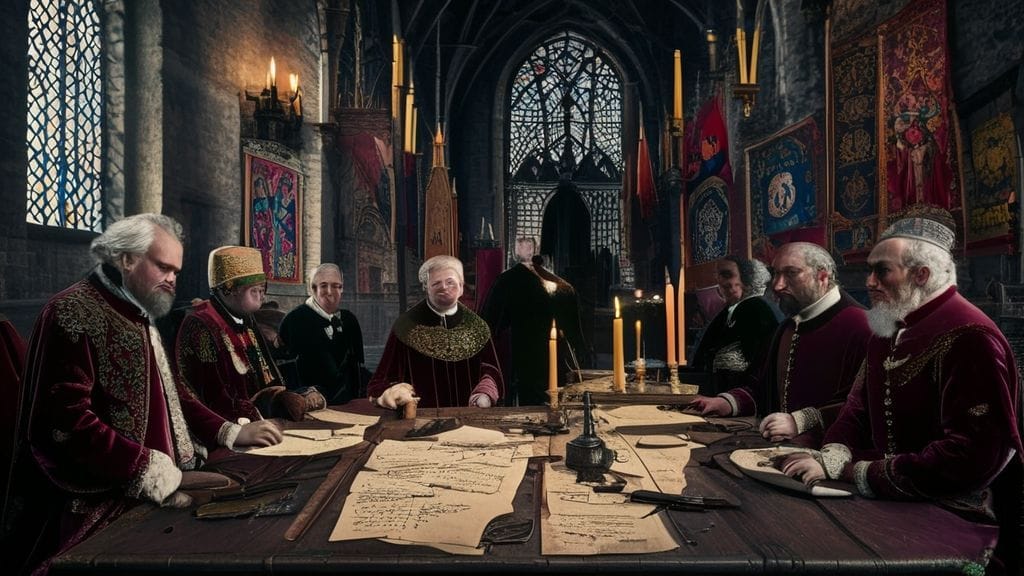
The air would have been sharp with winter cold. The shortest days of the year cast long shadows across the cloisters. Fires crackled in the great halls as courtiers and clerks wrapped their cloaks closer. In chambers warmed by braziers and tapestries, scribes bent over parchment, copying and correcting drafts. Seals, cords, and wax lay ready on the table. The setting itself lent gravity to the act. To sign a truce in Westminster was to draw upon centuries of royal authority embedded in stone and ritual.
We can imagine the scene: heralds and officers moving briskly through corridors; foreign envoys adjusting their attire; councillors conferring in hushed tones. Many present would have remembered recent horrors—Towton’s slaughter, the sieges of northern castles, the panic that had gripped London whenever rumours of invasion spread. For them, the truce of london 1463 was not an abstract diplomatic achievement; it was a possible turning point in lives that had already seen too much upheaval.
The choice of timing was also significant. December was a season when courts traditionally slowed their pace, when the approach of Christmas pushed men to think at least symbolically of peace, charity, and reconciliation. To secure an agreement at such a moment was a statement as well as a convenience. The midwinter truce could be cast as a gesture in keeping with Christian notions of mercy, even if its real motivation lay more in strategy than in scripture.
Still, behind the formalities lay an undercurrent of anxiety. Many in Westminster knew that treaties could be broken as easily as they were made. The memory of earlier, failed attempts at peace—both with France and within England—hovered in the background. As the quills scratched and the seals were pressed, some must have wondered how long this particular peace would last and who would be the first to test its boundaries.
Words on Parchment: What the Truce of London Actually Said
The essence of the truce of london 1463 lay in its clauses, carefully worded to define obligations and limitations. At its core, it was an agreement between Edward IV’s government and the Scottish crown to suspend open warfare for a fixed period. Exact details can vary among surviving copies and later summaries, but the structure followed the familiar language of medieval truces.
First, there were provisions for a cessation of hostilities along the Anglo-Scottish border. Both sides agreed to restrain their subjects from raids, invasions, and acts of violence across the frontier. Border communities were to be given breathing space, their crops and livestock protected from organized depredation. In theory, this would halt the cycle of retaliation that had made peace impossible in the previous years.
Second, the treaty included clauses dealing with the movement and support of exiles. Scotland was to limit the ability of Lancastrian fugitives to use its territory as a launching pad for renewed offensives against Edward. While the truce did not resolve the underlying dynastic dispute—no parchment could do that—it aimed to deprive Margaret of Anjou and her allies of their most obvious northern base.
Third, trade features appeared in the language of the agreement. Merchants were to be permitted safe passage under the king’s protection, and certain duties and tolls were regulated. The health of cross-border commerce mattered deeply to both realms. Wool, hides, and manufactured goods, as well as wine, salt, and spices from beyond, moved through English and Scottish ports. A formal truce reassured traders and shipowners that their investments might not vanish overnight in a burst of sanctioned piracy.
Finally, the document outlined procedures for resolving disputes and dealing with violations. Commissioners were designated or implied to oversee the implementation of the terms, and penalties were described for subjects who disobeyed. None of these mechanisms guaranteed compliance, but they represented an attempt to impose a minimum of legal order upon a world long accustomed to “might makes right.”
One historian, analysing such texts, has noted that medieval treaties were “half ideal, half admission of powerlessness”—a fair description of the truce of london 1463 as well. The ideal lay in the aspiration to tame violence through law; the admission lay in the fact that such laws were only as strong as the will of kings and nobles to enforce them.
Beneath the Seal: Motives, Fears, and Hidden Calculations
If the language of the treaty was precise, the emotions and intentions behind it were anything but clear-cut. Edward IV’s motives were layered. On one level, he wanted to secure his northern border and prevent future Lancastrian incursions via Scotland. A truce would free money and men for other tasks: pacifying discontented nobles, strengthening royal authority in the Midlands and south, and courting valuable alliances on the Continent.
On another level, Edward needed a diplomatic success to bolster his image as a legitimate, effective ruler. He had come to power through rebellion and battlefield victory, not orderly succession. Every treaty he signed, every foreign ruler who addressed him as “king,” helped cement his place in the crowded lineage of English monarchs. The truce of london 1463 thus had as much to do with theatre as with security. It allowed Edward to present himself as a peace-bringer as well as a warrior.
For the Scots, the calculus was equally complex. They had offered shelter and backing to the Lancastrian cause, but full commitment carried risks. Should Edward emerge permanently triumphant, Scotland could find itself isolated or punished. A truce allowed them to hedge their bets. Publicly, they could appear as responsible guardians of border peace; privately, they could watch the evolving English situation and decide later whether to shift allegiance or remain aloof.
Lancastrian exiles viewed the agreement with deep suspicion. For some, it seemed a betrayal by their Scottish hosts, a sign that the price of hospitality had grown too high. For others, it represented only a temporary obstacle. They believed that England’s internal divisions would someday reopen the path to invasion and vengeance. The treaty, to them, was at best an unwelcome pause, at worst a step toward recognising Edward’s rule as a fait accompli.
Among Edward’s own supporters, there were also doubts. Hard-line Yorkists who had lost family and fortune in the wars saw compromise as weakness. They feared that a truce would give their enemies time to regroup and foreign powers time to manoeuvre. Some may have whispered that a “real king” should press his advantage unrelentingly until every last Lancastrian was crushed. In council chambers, arguments must have flared about the risks of leniency versus the perils of overreach.
Thus, beneath the polished seals and solemn oaths, the truce of london 1463 was built on a shifting foundation of fear, weariness, calculation, and hope. Each party signed not because it trusted the others, but because it trusted its own reading of necessity. Peace, in that winter, was not an ideal state; it was a gambit.
Merchants, Soldiers, and Peasants: How Ordinary People Lived the Truce
The story of treaties is often told from the vantage point of kings and diplomats, but the truce of london 1463 mattered most to those far below them: the traders who risked their cargoes, the soldiers who risked their lives, the peasants who risked their harvests. For these people, political decisions translated into the most basic questions: Would there be food? Would there be work? Would there be safety on the roads?
In the northern shires, news of the truce likely arrived slowly, spread by travelling clergy, merchants, and officials. A farmer in Northumberland might hear, weeks after the fact, that the king had made peace with Scotland. His reaction would be cautious. He had perhaps seen truces signed and shattered before. Still, if fewer armed men crossed his fields without permission, if his cattle were less likely to vanish in the night, the treaty would feel real enough.
Merchants in London and other towns had a more direct stake in the agreement. Many had suffered during the instability of the early 1460s: disrupted routes, seized cargoes, and sudden shifts in royal policy. With the truce of london 1463, they could hope that cross-border trading with Scottish towns like Berwick and Edinburgh would resume with fewer interruptions. Insurance costs might lower, contracts might be honoured more reliably, and credit networks might stabilise.
For soldiers, the impact was more ambiguous. Some, particularly those in border garrisons, faced the prospect of discharge or reduced wages once large-scale raids ceased. Others welcomed the chance to return to their homes, marry, or take up crafts and farming once more. Demobilisation, however partial, always carried the danger that trained fighters, unable to find livelihoods, would turn to banditry. The line between soldier and outlaw was perilously thin in such times.
In towns and cities, the truce also altered the mood. Fewer rumours of imminent invasion meant fewer panicked purchases of provisions and weapons. Markets might feel less tense, taverns less charged with talk of war. Chroniclers who lived through these years sometimes wrote of “a breathing space,” a phrase that captures more than any legal clause the lived experience of those months and years when overt hostilities along the border were restrained.
Of course, not all suffering ended with the signing of the treaty. Taxes levied to pay for past campaigns still weighed heavily. Widows of fallen men did not suddenly find their grief eased by the announcement of peace. Yet the truce of london 1463 offered at least the possibility that fresh widows would be fewer, that the next planting season might proceed undisturbed, that a merchant caravan might reach its destination intact.
France, Burgundy, and Scotland: The Wider European Chessboard
England’s internal struggles unfolded on a European stage crowded with ambitious rulers. The Truce of London did not occur in isolation; it intersected with the policies of France, Burgundy, and other continental powers who saw in the Wars of the Roses a chance to tilt the balance in their favour.
France, recently invigorated under Charles VII and his successor Louis XI, watched England’s turmoil with a mixture of relief and concern. A divided England was less able to threaten French territory, but it also meant unpredictability along the Channel. Louis XI, known for his spider-like web of diplomacy, preferred instruments of influence to open conflict. A more settled England under Edward IV could be either a partner or a rival, depending on how alliances unfolded. The truce of london 1463, by stabilising the northern border, was one step toward Edward presenting himself as a serious, sustainable monarch on the European scene.
Burgundy, meanwhile, under the rule of Philip the Good and then Charles the Bold, had deep commercial ties to England, especially in the wool and cloth trades. Burgundian merchants and cities relied heavily on English wool, while English clothiers needed access to continental markets. Burgundy therefore had every incentive to support a peaceful and predictable English regime. Any truce that reduced the chance of sudden policy reversals or marauding fleets in the Channel was welcome.
Scotland’s role was more immediate. Positioned directly on England’s northern flank, it was both a neighbour and a historical adversary. Scottish leaders had used England’s internal divisions to seek better terms for themselves and to support the Lancastrian cause when it suited their interests. But they were also wary of provoking an England that might eventually reunite under a strong king and turn its energies northward. The truce of london 1463 was thus a gesture of prudent self-preservation as much as a diplomatic courtesy.
Foreign observers weighed the treaty in their own strategic calculations. A chronicler writing in the Burgundian Low Countries might note, with understated satisfaction, that England seemed to be “tending toward peace in the north,” a sign that trade and royal marriages could once more take centre stage. Ambassadors reported home that Edward IV was consolidating his position, that the Lancastrians were increasingly reliant on distant allies rather than immediate bases.
In this sense, the truce was both a domestic and an international event. By calming one front, Edward freed himself to court alliances in France and Burgundy, to explore marriage connections, and to position England as a player in the great game of European diplomacy once more. The parchment signed at Westminster thus had ripples far beyond the River Thames.
Propaganda and Rumour: How the Truce Was Sold and Questioned
No treaty succeeds on paper alone; it must also win, or at least manage, the battle for public perception. In a world without printing presses in England on a wide scale yet and without mass literacy, that battle was fought through proclamations, sermons, heralds, and rumour. The truce of london 1463 was presented to the people in ways that reflected both royal ambition and popular anxiety.
Royal proclamations, read aloud in marketplaces and at the doors of churches, would have framed the truce as a victory for Edward IV’s wisdom and strength. The language likely emphasised his role as peacemaker, protector of the realm, and defender of the common good. Such announcements carefully downplayed the fact that negotiation implied compromise; instead, they suggested that foes had been compelled by Edward’s might and God’s favour to sue for peace.
Clergy, especially those close to the court, could reinforce this message from the pulpit. Preachers might draw on biblical themes of kings who brought peace to their people, or warn against the sin of rebellion and the shedding of Christian blood. The treaty could be cast as a sign of divine mercy after years of chastisement, encouraging the faithful to pray for the king and for lasting concord.
At the same time, rumours moved along their own invisible pathways. In taverns, at fairs, along pilgrim routes, people speculated about the true meaning of the truce. Some might whisper that Edward had been forced to sue for peace because his coffers were empty. Others might insist that Scotland was only pretending to accept the terms while secretly plotting a renewed invasion. For Lancastrian sympathisers, the treaty was easy to portray as temporary, a mere pause before their rightful king’s eventual restoration.
Propaganda was not exclusively a royal tool. Scottish leaders spoke to their own subjects, framing the agreement as proof that they had defended national honour while prudently securing the kingdom. Continental courts used the news to advance their own narratives: France might suggest that Edward’s interest in truces showed his desire for broader peace, while Burgundy could point to the agreement as evidence that trade with England would be secure under his rule.
One modern historian, examining similar episodes, has observed that “medieval treaties were as much theatre as they were law,” a judgement that fits the truce of london 1463 well. Official words told one story; unofficial words told another. Between them, a complex public understanding of the treaty formed—part hope, part fear, and part scepticism.
A Fragile Peace: Breaches, Skirmishes, and Acts of Quiet Violence
No truce, however solemn, could instantly erase habits of hostility built over generations. Along the Anglo-Scottish border, local feuds, cattle-raiding traditions, and rivalries between clans and families persisted. The truce of london 1463 sought to restrain these impulses, but it could not uproot them.
There were, inevitably, violations. Small bands of armed men, perhaps former soldiers now turned to opportunism, took advantage of the confusion to cross the border at night, drive off livestock, or seize goods from isolated farms. Local authorities on both sides argued over responsibility: were these raiders merely criminals, or were they covert agents of hostile magnates and princes? Each incident threatened to spiral into broader conflict if not quickly contained.
Commissioners and wardens of the marches struggled to enforce the treaty’s terms. They organised inquiries, summoned witnesses, and negotiated compensation for damages. The process was slow, often frustrating, and easily derailed by stubbornness or bad faith. Still, these efforts showed that the truce of london 1463 had teeth, however small; it created a framework within which grievances could be channelled into words rather than blades.
For ordinary people, such breaches were terrifying reminders that peace was conditional. A quiet season might be shattered by a single brutal raid. A family that had started to rebuild after years of war could find its barns empty again overnight. The gap between high diplomacy and lived reality yawned wide, and yet the existence of the truce meant that victims could at least appeal to higher authorities, invoking the king’s word as a shield.
Not all violence was overt. Nobles sometimes tested the limits of the agreement by exerting pressure through legal harassment, intimidation, or the harbouring of outlaws who did their dirty work. These grey-zone tactics allowed them to pursue local grudges while maintaining plausible deniability at court. The very existence of the treaty encouraged such indirect methods; if open warfare was restricted, covert aggression became more attractive.
Nevertheless, the overall level of organised military action between England and Scotland diminished in the immediate aftermath of the agreement. That reduction alone was significant. The truce of london 1463 did not usher in an age of harmony, but it did blunt the worst edges of cross-border conflict, at least for a time.
Shifting Allegiances: Nobles Testing the Limits of the Truce
The English nobility, always sensitive to changes in the political weather, responded to the truce in ways that reveal the fluid nature of allegiance during the Wars of the Roses. Some lords saw in the agreement confirmation that Edward IV intended to rule as a stabilising monarch rather than a perpetual warlord. They drew closer to his court, accepted offices, and sought marriages that bound their fortunes to his.
Others remained wary. They remembered how swiftly fortunes had turned in the previous decade—how Lancastrians had once seemed secure, only to be toppled; how Yorkists had risen from opposition to power almost overnight. For such men, the truce of london 1463 was one more data point in a constantly shifting calculus. If Edward could secure his northern border and win foreign recognition, perhaps he would endure. If he faltered, those who had tied themselves to his chariot might be dragged down with him.
Border magnates in particular had to adjust rapidly. Families like the Percys, Nevilles, and Douglases, with kin on both sides of the frontier, navigated a maze of obligations. A truce meant curbing their private wars and moderating their long-standing raiding economies. It sometimes required surrendering captured lands or prisoners, writing off potential gains in exchange for the king’s favour.
Within this context, smaller gentry and knights also made choices. A squire in Northumberland who had quietly sympathised with Lancaster might decide that the writing was on the wall, that Edward’s ability to conclude a truce with Scotland showed his strength. Another might remain aloof, waiting for clearer signs before committing. Each decision added up, contributing incrementally to the consolidation—or erosion—of the Yorkist regime.
The truce also affected how nobles imagined the future. With the immediate threat of a northern invasion reduced, some turned their ambitions inward, competing for influence at court or pursuing local land disputes with renewed energy. The arena of conflict shifted from open battlefields to council chambers and law courts. In that sense, the truce of london 1463 was part of a broader transition from overt civil war to a more concealed, but still intense, struggle for power.
Women, Marriage, and Diplomacy in the Shadow of the Truce
While the treaty itself bore the names of kings and councillors, women, too, played critical roles in the political environment shaped by the truce. Queens, noblewomen, and heiresses were central to the web of marriages and kinship that underpinned medieval diplomacy. The relative quiet that followed the truce of london 1463 offered a window in which such arrangements could be negotiated with less immediate fear of disruption by war.
Margaret of Anjou remained a formidable presence, even if the truce limited her practical options. From exile, she explored alliances with continental courts, sought potential husbands for her son, Prince Edward, and maintained correspondence with loyalists in England. The treaty’s attempt to close Scotland as an active base for Lancastrian operations did not silence her; it simply forced her to look further afield for support.
At Edward IV’s court, women like his sisters and female relatives became valuable tokens in the game of alliance-building. A princess’s hand in marriage could bind a great house more firmly to the Yorkist cause or open doors at foreign courts. Negotiations over such unions required stability, or at least predictable conditions. The truce of london 1463, by signalling a desire for order, indirectly enabled the delicate work of arranging these matches.
Noblewomen within England also used the lull in overt violence to pursue legal claims, secure dowries, or manage estates deprived of male heads through war and execution. Their petitions to the crown, recorded in chancery rolls and petitions, show how they navigated a world where property, honour, and security were closely intertwined. Some pleaded for the restoration of confiscated lands; others sought protection from predatory neighbours.
Even at the lower social levels, women felt the consequences of the truce. Wives of soldiers welcomed husbands home, at least temporarily. Widows who had managed farms in their husbands’ absence now faced decisions about remarriage or continued independence. In border regions, women played key roles in rebuilding households, replanting fields, and re-establishing patterns of trade in markets that had long been overshadowed by conflict.
Though their names rarely appear in the formal text of the treaty, women’s actions and choices were interwoven with its outcomes. The partial peace of the mid-1460s created spaces—brief, fragile, but real—in which female agency could exert itself in matters both domestic and diplomatic.
Faith, Oaths, and Betrayal: The Moral Weight of December 1463
Medieval politics cannot be understood without appreciating the moral and religious framework within which people operated. To swear an oath on a treaty was to involve not only temporal authority but divine witness. The truce of london 1463, like other such agreements, invoked God’s name and often the saints as guarantors. Perjury was more than a legal offence; it was a sin that threatened the soul.
Clerics participated directly in the crafting and witnessing of the treaty. Bishops might affix their seals or serve as mediators. Their presence lent spiritual legitimacy to the proceedings, suggesting that peace was not merely convenient but virtuous. Sermons in the months after the signing likely dwelt on themes of concord, urging subjects to support the king in his efforts to stabilise the realm.
Yet the reality of political life often clashed with these ideals. Men who had sworn loyalty to Henry VI now served Edward IV; those who pledged to keep the peace might secretly plot rebellion. Chroniclers wrestling with this tension sometimes portrayed political reversals as evidence of divine judgement—God punishing perjury and rewarding faithfulness, or, in more pessimistic accounts, as evidence of human frailty and the inscrutability of Providence.
The truce of london 1463 thus carried a heavy moral charge. For some, supporting it was a way to break a cycle of sin—of bloodshed, theft, and vengeance—that had ensnared the kingdom. For others, especially committed partisans, the treaty represented a temptation to compromise with injustice. If one believed that Henry VI was still the rightful, anointed king, how could one in good conscience accept an agreement that strengthened his usurper?
In private chapels and parish churches, individuals grappled with these questions. A knight who had fought for Lancaster but now served Edward might confess his conflicting loyalties to his confessor. A widow whose husband had died at Towton might pray that the new peace would not dishonour his sacrifice. The treaty’s language did not answer such dilemmas, but it framed them: to live under the truce was to inhabit a world where law, faith, and expediency intersected uneasily.
Moments when treaties were broken—raids resumed, oaths discarded—were experienced not only as political shocks but as moral crises. Each act of betrayal undercut the belief that words sworn before God could restrain human aggression. The eventual collapse of the peace forged in the early 1460s would, in time, feed a broader late-medieval sense that the world was precarious, that human promises, however solemn, could not be relied upon.
From Truce to Triumph and Disaster: The Short-Term Legacy
In the immediate years following the truce of london 1463, Edward IV’s regime gained strength. With the northern border quieter, he was able to devote more attention to internal consolidation and foreign diplomacy. Economic indicators, though fragmentary, suggest some recovery: customs revenues stabilised, and trade with Burgundy in particular grew in importance.
Politically, Edward’s image shifted from that of a victorious rebel to that of a settled king. He began to project a more traditional royal authority, emphasising justice, prosperity, and the continuity of the crown. The truce formed part of the backdrop to this transformation, one element among many that signalled a move from revolution to governance.
But the peace-building efforts of the early 1460s were fragile. The very nobles who had helped Edward to power, including the Earl of Warwick, became increasingly dissatisfied with his policies, especially his marriage decisions and his growing reliance on new favourites. The seeds of future discord were sown even as the ink of the truce dried in Westminster.
By the late 1460s and early 1470s, England would again be plunged into crisis: Warwick’s rebellion, Edward’s brief deposition, the restoration of Henry VI, and then Edward’s triumphant return. The cycle of war resumed with brutal intensity. In retrospect, the calm that followed the truce of london 1463 looks less like the beginning of a new era and more like a pause before a second storm.
Still, even a temporary peace had lasting consequences. The relative stability of the mid-1460s allowed certain legal settlements, property transfers, and social adjustments to take root. Children born in those years grew up in an England that, for a time, experienced more law courts than battlefields. Merchants who rebuilt their businesses in that window helped lay the groundwork for the longer-term commercial growth that would continue into the Tudor age.
On the northern border, some of the agreements and practices established during the truce would shape relations between England and Scotland for years to come. Procedures for joint commissions, compensation for raids, and the treatment of cross-border criminals were refined in this period, providing a template that could be revisited whenever conflict flared again.
Looking Back from Bosworth: The Truce in Long-Term Perspective
When historians look back from the vantage point of 1485—the year of Bosworth, of Richard III’s defeat, of Henry Tudor’s ascent—they see the Wars of the Roses as a long arc of instability. Within that arc, the truce of london 1463 appears as a modest, easily overlooked episode. It did not end the wars, settle the succession, or prevent future bloodshed. Yet its significance lies precisely in what it reveals about the kingdom’s capacity for, and limits of, self-restraint.
By attempting to stabilise the northern frontier, the truce helped prevent England’s internal conflict from spilling more dangerously into full-scale Anglo-Scottish war. In that sense, it contained the damage. It also showcased the ability of Edward IV’s regime to engage in serious diplomacy and to be taken seriously by foreign powers. These achievements, however limited, contributed to the eventual survival of some Yorkist structures even after the Tudor takeover.
From a longer-term perspective, the treaty illustrates how late-medieval monarchies tried to adapt to the pressures of continuous conflict. They relied on written agreements, legal forms, and carefully staged ceremonies to manage violence. Though these tools often failed, they were the ancestors of more modern diplomatic practices. The truce of london 1463 stands as one minor building block in that slow evolution from a Europe of raids and feuds to one of embassies and standing treaties.
It is also a reminder that history is not only made in decisive battles and sweeping reforms. Sometimes it is made in cramped chambers on winter days, with pens, wax, and weary negotiators. The consequences may be partial and transient, but they are real. For the families that survived because one more raid was prevented, for the merchants whose ships reached harbour safely, for the children who grew into adulthood without knowing the terror of foreign troops in their villages, the treaty mattered profoundly.
When Henry VII founded the Tudor dynasty and sought to craft a narrative of restored order, he inevitably downplayed the achievements of his Yorkist predecessors. Yet the relative calm of certain Yorkist years, made possible in part by truces like that of 1463, provided a platform from which he could claim to bring final peace. In this indirect way, the truce of london 1463 helped shape the conditions under which the medieval English crown transitioned into its early modern form.
Memory, Myth, and the Historian’s Task
The Truce of London does not loom large in popular memory of the Wars of the Roses. Schoolbook narratives rush from dramatic battles to colourful monarchs, from Towton to Tewkesbury, from Edward IV’s charm to Richard III’s scoliosis and Shakespearean villainy. In that whirlwind of kings and clashes, a winter treaty signed at Westminster in 1463 can seem like a footnote.
Yet historians, poring over chancery rolls, diplomatic correspondence, and monastic chronicles, have long understood that such agreements were crucial threads in the tapestry. One scholar, writing of the period, observed that “peace was not an absence between wars, but a fragile structure constantly rebuilt and constantly at risk.” The truce of london 1463 is one such structure, a fleeting framework that nonetheless revealed the aspirations and anxieties of its age.
Reconstructing the story of the treaty requires careful attention to sources that are often fragmentary or biased. English and Scottish records may emphasise different elements. Later chroniclers, writing with the benefit of hindsight and the influence of Tudor propaganda, may minimise Yorkist diplomatic successes or exaggerate Lancastrian resilience. Diplomatic documents themselves, couched in formulaic Latin and French, veil as much as they reveal about the human drama behind them.
The historian’s task is to read between these lines: to imagine the cold halls of Westminster, the worn faces of negotiators, the tense discussions that preceded each clause. It is also to connect high politics to everyday experience, to ask how a line in a treaty changed the fate of a shepherd near the border or a cloth merchant in London. By doing so, the truce of london 1463 emerges not as an isolated curiosity but as a window into the ways medieval societies tried—imperfectly, fitfully—to limit the damage they inflicted upon themselves.
Myth-making plays its role as well. Stories of gallant knights and wicked queens, of sudden betrayals and miraculous victories, have long overshadowed the quieter, bureaucratic heroism of those who brokered truces and enforced them. In popular imagination, peace is passive, war active. Yet the more we examine episodes like the Truce of London, the more we see the labour, courage, and ingenuity that peace required.
Recognising that effort does not mean romanticising the treaty. It failed to prevent later upheavals; it left many injustices untouched. But it stands as evidence that even amid civil war, there were those who believed that words on parchment, backed by conscience and calculation, could at least bend the trajectory of violence. That belief, however fragile, is a vital part of our shared human story.
Conclusion
The Truce of London signed at Westminster on 21 December 1463 was born from exhaustion and necessity. It emerged at a moment when England, riven by the Wars of the Roses and strained by border conflict with Scotland, needed respite more than glory. Edward IV, Scotland’s rulers, and a host of envoys and churchmen crafted an agreement that sought to still the northern frontier, restrict the use of Scotland as a base for Lancastrian operations, and restore a measure of security for trade and daily life.
Though modest in scope and limited in duration, the truce of london 1463 illuminates the complex interplay of power, fear, and hope in late-medieval politics. It shows a realm in transition: from open civil war to a precarious peace, from improvisation on the battlefield to negotiation at the council table. It reveals how treaties could soothe suffering without resolving the deeper conflicts that produced it. Ordinary people—merchants, soldiers, peasants, and women managing shattered households—experienced the results not as abstract diplomacy but as the difference between hunger and sustenance, terror and uneasy calm.
The agreement did not end the Wars of the Roses. Within a decade, England would again be convulsed by rebellion, deposition, and counter-coup. Yet the structures and expectations forged in moments like December 1463—regarding borders, trade, and the moral weight of oaths—persisted and influenced later generations. From the vantage point of later Tudor stability, the truce appears as one of many incremental efforts by which a wounded kingdom tried to limit its own self-destruction.
Ultimately, the Truce of London reminds us that peace, even partial and temporary, is rarely accidental. It is crafted, argued over, sealed with trembling hands in cold halls, and then defended—imperfectly—against the ever-present pull of violence. In that winter of 1463, under the vaulted roofs of Westminster, men who had known too much war chose, however cautiously, to test the possibilities of restraint. Their choice did not save England from further bloodshed, but it did, for a time, allow its people to breathe, rebuild, and imagine that another path might be possible.
FAQs
- What was the Truce of London 1463?
The Truce of London 1463 was an agreement concluded on 21 December 1463 at Westminster between Edward IV of England and the Scottish crown. Its main aim was to halt hostilities along the Anglo-Scottish border and to limit Scotland’s role as a base for Lancastrian exiles during the Wars of the Roses. - Why was the truce of london 1463 necessary?
After years of civil war and cross-border raids, both England and Scotland were exhausted. Edward IV needed to secure his northern frontier to consolidate his rule and stabilise trade, while Scottish leaders wanted to avoid provoking a fully committed English invasion. The truce answered these mutual needs by providing a temporary framework for peace. - Did the truce of london 1463 end the Wars of the Roses?
No, the truce did not end the Wars of the Roses. It reduced the threat of invasion from the north and contributed to a short period of relative stability in the mid-1460s, but underlying dynastic tensions remained unresolved. Within a decade, England would again be plunged into major conflict. - How did the treaty affect ordinary people?
For commoners, the truce meant fewer large-scale raids in the northern counties, somewhat safer trade routes, and a greater chance that harvests and markets would proceed without violent disruption. While it did not erase hardship or taxation, it offered many communities a vital breathing space after years of chaos. - What role did foreign powers play in relation to the truce?
Continental powers such as France and Burgundy watched the truce closely because it signalled Edward IV’s growing stability and affected trade patterns. Burgundy in particular welcomed any settlement that protected its cloth trade with England, while France weighed whether a more secure English crown would be a partner or a rival. - Was the Truce of London kept or frequently broken?
Like most medieval truces, it was imperfectly observed. There were breaches in the form of raids and local feuds, especially along the border. However, compared to the preceding years, the overall level of organised Anglo-Scottish warfare diminished, showing that the treaty had a real, if limited, effect. - How do historians know about the truce of london 1463?
Information about the truce comes from surviving diplomatic documents, royal records, and chronicles from both England and Scotland. Modern historians cross-check these sources, aware of their biases, to reconstruct the terms of the agreement and its impact on politics and society.
External Resource
Internal Link
Other Resources
- Encyclopaedia Britannica – general search for the exact subject
- Google Scholar – academic search for the exact subject
- Internet Archive – digital library search for the exact subject

