Table of Contents
- Whispers from Pelusium: When an Invisible Enemy Arrived
- The Eastern Roman Empire on the Eve of Disaster
- Pelusium, Egypt, 541: Where the Plague of Justinian Begins
- Caravans, Grain Ships, and Rats: How Death Traveled the Empire
- From Port to Metropolis: The Road to Constantinople
- The Emperor’s City Under Siege by the Unseen
- Bodies, Burials, and the Shattering of Daily Life
- The Emperor, the Empress, and the Court in a Time of Pestilence
- Faith, Fear, and the Search for Meaning in the Plague
- War in the Shadows of Pestilence: Persia, Italy, and Lost Ambitions
- Economy in Freefall: Fields, Coin, and Empire in Ruin
- Ordinary Lives, Extraordinary Suffering: Voices from the Pandemic
- Waves of Death: Recurring Outbreaks Across the Mediterranean
- From Epidemic to Transformation: How the Plague Reshaped the Late Antique World
- Science, Bones, and Bacteria: Modern Investigations into an Ancient Killer
- Echoes Through Time: Comparing the Justinianic Plague to Later Pandemics
- Memory, Myth, and the Long Shadow of Justinian’s Plague
- Conclusion
- FAQs
- External Resource
- Internal Link
Article Summary: In the year 541, in the border port of Pelusium in Egypt, a strange sickness surfaced that would alter the fate of empires. What began as scattered fevers and swellings at the fringes of the Eastern Roman Empire soon became a rolling catastrophe: the plague of justinian begins here and then races along trade routes, reaching the heart of imperial power in Constantinople. This article traces the world into which the disease erupted—its politics, economics, and religious tensions—and then follows the epidemic as it unravels society. Emperors, generals, monks, merchants, and peasants move through these pages, each bearing witness to a world that feels both remote and shockingly familiar. We explore the science behind the disease, the patterns of its spread, and its long-term role in transforming the Mediterranean world from Late Antiquity toward the Middle Ages. Along the way, we examine the emotional landscape of fear, resignation, hope, and faith that people clung to while the plague of justinian begins its deadly work again and again in recurring waves. In doing so, the article connects ancient testimony with modern research, showing how a microscopic bacterium helped redraw maps, erase cities, and rewrite history.
Whispers from Pelusium: When an Invisible Enemy Arrived
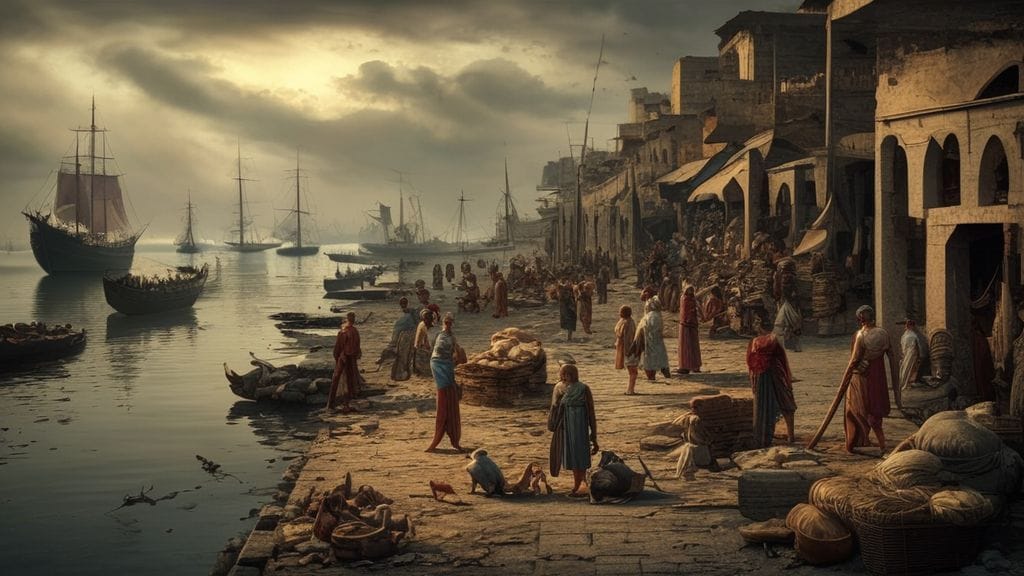
In the spring of 541, the port city of Pelusium in Egypt did not look like the birthplace of a catastrophe. It lay at the eastern edge of the Nile Delta, a place of mud-brick houses, warehouses, and half-rotten docks, where the fresh waters of the river mingled uneasily with the salt of the Mediterranean. Pelusium had always been a frontier: a gate between Egypt and the Levant, between desert and river, between the imperial heartland and the restless borderlands. But that year, something else slipped through its gates. It was here, sources tell us, that the plague of justinian begins its long journey—unseen, silent, and unstoppable.
The people of Pelusium were used to caravans arriving coated in desert dust, to shouting sailors tying up grain ships, to tax officials counting amphorae of oil and sacks of wheat destined for the great capital, Constantinople. They were not strangers to hardship: bad harvests, bandits, and the occasional military clash had all left their imprint. Yet the first signs of the new affliction must have seemed merely like another fever. A stevedore collapsed while hauling a sack of grain, his skin hot to the touch. A merchant developed a strange swelling in his groin and armpit, a throbbing lump that turned dark and tender. A woman in the markets complained of a sudden chill and splitting headache, then failed to open her stall the next day.
It was easy, at first, to dismiss these events as isolated misfortunes, the kind that every city absorbs into its daily story. But this was only the beginning. Word spread from neighborhood to neighborhood: of sudden deaths, of strange lumps—the buboes—that appeared in the neck, the armpits, the groin. Rumors traveled faster than the official notices. Some said the sickness came from the grain ships; others whispered of a curse sent from distant lands, a punishment for imperial arrogance, or for neglected prayers. In the dim corners of taverns, old men recalled biblical plagues and Pharaoh’s humiliation.
And still, ships sailed, caravans departed, and tax collectors wrote their ledgers. The machinery of empire did not stop because a few dozen, then a few hundred, had fallen ill. Yet behind the routine, something terrifying had set in motion. The plague of justinian begins here as an intimate event—a father gone overnight, a friend failing to rise from his bed—and only later would it be seen as a world-historical turning point. In Pelusium, it was first a story of individual families who sensed that something was wrong but could not yet name the scale of what was coming.
The Eastern Roman Empire on the Eve of Disaster
When the first victims in Pelusium succumbed in 541, the Eastern Roman Empire under Emperor Justinian I seemed, at least on the surface, to be ascending. Justinian had ruled since 527 and dreamed of restoring the glory of the old Roman Empire. Rome itself had fallen to Germanic kings long before, but from the glittering halls of Constantinople, Justinian believed he could reclaim the lost western provinces. His generals were already in the field: Belisarius had humbled the Vandals in North Africa and was waging war in Italy. The imperial project, ambitious and expensive, required an enormous flow of wealth, grain, and labor from provinces like Egypt.
Egypt, and particularly the Nile Delta, was the empire’s breadbasket. Enormous quantities of grain left its ports every year, bound for Constantinople, where the city’s survival depended on state-subsidized bread. Pelusium, perched at the threshold between river and sea, between Egypt and Syria-Palestine, was more than a provincial town; it was a vital artery in the imperial body. The plague of justinian begins not in some isolated village but at a nodal point of global trade, where goods, people, and, crucially, animals converged.
Politically, the empire was strained even as it expanded. Justinian’s various campaigns—against Vandals, Goths, Persians—drained the treasury. His ambitious building projects, most famously the reconstruction of the Hagia Sophia after the Nika riots, had transformed the skyline of Constantinople but at tremendous cost. The tax burden on provinces had climbed. Governors demanded more from cities and countryside alike. Resentment simmered. Religious tensions, too, ran deep: disputes over Christological doctrine—Monophysites versus Chalcedonians—divided communities, especially in Egypt and Syria, where many felt alienated from the theological stance of Constantinople.
In this tense atmosphere, the empire looked outward with a mixture of confidence and anxiety. It possessed a highly organized bureaucracy, a powerful army, thriving cities, and long-distance trade networks stretching from the Atlantic to the Indian Ocean. But that same interconnectedness made it vulnerable. Ships from the Red Sea and the Indian Ocean brought exotic spices, ivory, and textiles—and with them, rodents harboring fleas infected with a microscopic enemy, later identified by modern science as Yersinia pestis. The plague of justinian begins at a moment when the empire’s arteries are at their fullest, pulsing with commerce and conquest, unaware that these channels will soon carry a far more lethal cargo.
For ordinary people, the signs of strain were already there. Tax collectors were relentless; conscription stole away young men to distant wars; imperial decrees seemed to flow endlessly from a distant, gilded court. Still, markets bustled, churches filled, and seas thrummed with traffic. The world of 540 looked fragile in hindsight but solid to those who lived it. Just a year later, the illusion of solidity would be shattered by a disease that cared nothing for law codes, architectural marvels, or imperial dreams.
Pelusium, Egypt, 541: Where the Plague of Justinian Begins
According to the great historian Procopius of Caesarea, who lived through the events, the first clear sighting of the pestilence in the empire occurred in Pelusium. From there, he tells us, it moved outward “in both directions,” towards Alexandria and Palestine. With those few words, a small Egyptian port city becomes the known starting point of a pandemic. Here, the plague of justinian begins not as an abstraction but as a specific outbreak, tied to a particular place and time: Pelusium, 541.
Pelusium was an ancient city, older than the empire that now ruled it. It had seen Persian invaders, Ptolemaic courts, Roman governors. In 541, it was busy, crowded, and full of transient populations—perfect conditions for a new disease. Flea-infested black rats stowed away in cargo holds, among heaps of grain and bales of cloth. As ships from the Red Sea and Mediterranean bobbed against its wharves, the line between local and global blurred. A rat that scurried ashore from one of these ships could, unknowingly, carry the seeds of disaster.
Witnesses reported the same harrowing pattern that would repeat elsewhere. People fell sick with terrifying swiftness. One day a man walked the streets, bargaining for fish or grain; the next he lay in bed, wracked by fever and delirium, his body sprouting painful swellings. Some died within days, others in a matter of hours. In households across the city, the same questions must have echoed: What was this? Why now? Had some ritual been neglected, some sin gone unconfessed?
The plague of justinian begins, then, as a local horror, but we can already see its imperial dimension in the way it spreads. Procopius was vague on exact numbers, but the impression is of a rapidly mounting death toll. The authorities, likely overwhelmed and uncertain, had little precedent for what to do. There were laws about burial, about sanitation, about public order—but nothing to match the momentum of this new affliction. Bodies accumulated faster than the mechanisms of civic life could process them.
From Pelusium, the contagion fanned outward along the lines of trade and communication. To the west, the routes led to Alexandria, the great city of scholars, merchants, and monks. To the east, roads and coastal shipping lanes carried goods to Gaza, Antioch, and beyond to the frontier of the Persian Empire. Once again, the very things that made Pelusium important—its location, its traffic, its openness to the world—made it a perfect springboard for the plague. The phrase “plague of justinian begins” is not only a chronological marker. It is a geographical one: 541, Pelusium, the moment when an invisible enemy stepped onto the stage of history.
Caravans, Grain Ships, and Rats: How Death Traveled the Empire
To understand how a disease that erupted in Pelusium could devastate cities thousands of kilometers away, we have to follow the empire’s lifelines: roads, rivers, caravan tracks, and shipping lanes. These were the veins and arteries through which gold, grain, silk, and spices pulsed. They were also the paths along which fleas, rats, and Yersinia pestis quietly advanced. When the plague of justinian begins in Pelusium, it instantly has access to this vast vascular system.
Grain ships may have been the most important carriers. Every year, a massive grain fleet sailed north from Egyptian ports, bound for Constantinople. The empire depended on this supply for the capital’s bread dole. Ships, packed with sacks of wheat, also housed stowaways—black rats, a species well adapted to living alongside humans. Their fleas, once infected, passed the bacteria between rodent hosts. In times of ecological disruption—perhaps a drop in rodent populations or shifts in climate—fleas sought new hosts, including humans. As ships hugged the coastline, stopping at ports along the Levant and Anatolia, infected rodents could disembark and colonize new environments.
Caravan routes provided another conduit. Pelusium sat near lines of travel into Sinai, Palestine, and Syria. Camels laden with goods moved between towns and camps, their drivers sleeping in crowded khans and roadside shelters. While scholars still debate the exact balance between maritime and overland spread, there is little doubt that the dense network of Late Antique trade accelerated the pandemic. The plague of justinian begins in one port, but quickly, barked orders in a ship’s hold, tolls at city gates, and the braying of caravan animals blend into the same story: motion, contact, and multiplication.
We can imagine the disease moving almost like a ripple pattern. First, small coastal towns began to report illness; then larger inland cities; finally, the great metropolises. The delay between Pelusium in 541 and Constantinople in 542 fits the pace of medieval communication and travel. A traveler might take weeks to journey from Egypt to the Bosporus; the plague, relying on rats and ships, moved with a similarly measured, dreadful rhythm. But when it arrived, it did so not as a single visitor but as an army of unseen assailants, already entrenched in warehouses, granaries, and sewers.
Behind the statistics and routes, however, lay human decisions. Governors decided to keep trade flowing despite worrying reports. Merchants chose to sail, weighing potential profit against rumors of sickness. Soldiers marched along roads to distant garrisons, carrying stories and, unknowingly, the pathogen. No one could know that each choice contributed to the unfolding catastrophe. In a world bound together by commerce and administration, isolation on a large scale was nearly unthinkable. So the plague of justinian begins its empire-wide spread not because people were careless, but because their world was, in many ways, too successful, too interconnected for its own safety.
From Port to Metropolis: The Road to Constantinople
As 541 turned into 542, word from the southern and eastern provinces grew darker. Alexandria, one of the greatest cities of the Mediterranean, reported terrifying mortality. The plague that had first broken out in Pelusium now ravaged its larger neighbor. Contemporary writers speak of ships anchored offshore with crews too sick to disembark, of bodies floating in the harbor, of streets eerily quiet save for funeral processions. From Alexandria, the disease moved along the established coastal routes, advancing like a shadow that lengthened each day.
In the imperial capital of Constantinople, officials must have received scattered reports. Sickly caravans from Syria, delayed ships from Egypt, letters from governors describing unprecedented illness. Some of these dispatches reached the imperial chancery, were read by secretaries, and summarised for ministers. But between reading a report and grasping its significance there is a wide gulf. Constantinople in early 542 still thrummed with its usual vitality: processions, court ceremonies, races at the Hippodrome, and the clamor of markets around the Forum of Constantine and the Augusteion.
The journey from Pelusium to the Bosporus followed lines that had been in use for centuries. Ships could sail via Alexandria and the Aegean islands, stopping at ports like Rhodes and Ephesus. Alternatively, goods could move up through Palestine and Syria, then westward across Anatolia. Wherever the plague traveled, it followed people: sailors, merchants, soldiers, pilgrims. In one city after another, the pattern reasserted itself. First, scattered cases that might be chalked up to bad air or chance. Then clusters within neighborhoods or monasteries. Then, suddenly, an explosion—funeral pyres burning day and night, graveyards overflowing.
By the time the first unmistakable cases appeared in Constantinople, the empire’s ruling elite had already lost the luxury of ignorance. They now faced a reality that could no longer be dismissed as distant misfortune. The plague of justinian begins in Pelusium, but by 542 it had capital status; it was no longer peripheral. The city that claimed to be the “New Rome,” the center of administration, law, and faith, was about to experience an unthinkable trial. It’s astonishing, isn’t it? An imperial metropolis that had withstood sieges, riots, and theological schisms would now be undone, at least temporarily, by organisms too small to see, carried by creatures many barely noticed.
The Emperor’s City Under Siege by the Unseen
When the plague reached Constantinople in 542, even Procopius—no stranger to war and political intrigue—was shaken. In his History of the Wars, he devotes some of his most vivid pages to describing what he saw. People, he writes, developed swellings “in the groin and armpit” and succumbed rapidly. He estimated that at the height of the outbreak, as many as 10,000 people might be dying each day in the city. Whether or not this number is accurate, the psychological effect of mass mortality is undeniable. The plague of justinian begins its most dramatic act on the empire’s grandest stage.
Constantinople was a city of perhaps half a million people or more—a dense tangle of palaces, churches, baths, tenements, and markets, all crowded inside stout Theodosian walls. Its aqueducts and cisterns brought water; its granaries stored food brought from afar. Public life centered on the Hippodrome, where chariot races and faction rivalries had once boiled over into near-revolution. In this urban labyrinth, disease could move with terrifying ease. Rats thrived in warehouses and sewers; fleas jumped from fur to fur, and sometimes to human skin. As infections mounted, entire neighborhoods fell silent.
Procopius describes scenes of chaos: corpses lying unburied in the streets; the city’s ordinary burial places overflowing; the authorities resorting to throwing bodies into massive pits or, in some accounts, into the sea. Funeral services blended into one another until they were almost indistinguishable. The familiar rituals that made death bearable—proper washing, prayer, and interment—broke down under sheer volume. The plague of justinian begins to gnaw not only at bodies but at the very structure of civic life.
Workshops closed as craftsmen died or fled. Markets stalled as buyers and sellers stayed home in fear. The clatter of tools and the cries of vendors gave way to the creak of cart wheels carrying the dead. Dogs and birds of prey, drawn by the abundance of corpses, prowled the edges of the city. Even the imperial household was not immune; Justinian himself fell ill, hovering near death before recovering. His survival must have seemed almost miraculous to contemporaries, a sign—depending on one’s view—that God either favored him or withheld final judgment.
The city, which once saw itself as the secure heart of a vast dominion, now experienced a kind of existential vertigo. If the emperor, the patriarch, the senators, and the common laborers could all be struck down without warning, what did rank or privilege mean? Social distinctions blurred amid the heaps of corpses. In this sense, the siege of Constantinople by the plague was more profound than any assault by foreign armies. Walls, fleets, and fortifications could not keep it out. The plague came from within, riding the circuits of daily life and overturning the very logic of security upon which imperial confidence rested.
Bodies, Burials, and the Shattering of Daily Life
In every great epidemic, the most immediate and tangible crisis is what to do with the dead. Constantinople in 542 was no exception. As mortality soared, the city’s meticulously organized routines—its schedules for bakers, its legal courts, its baths and markets—were replaced by one overwhelming task: disposing of bodies. The plague of justinian begins as a medical disaster but quickly becomes a logistical, social, and spiritual one.
Contemporary sources describe workers being hired by the authorities to collect corpses from houses and streets. Carts creaked through alleys, their drivers calling out so that families might bring out their dead. In many places, there were simply too many bodies. Cemeteries overflowed. Mass graves were dug hastily; corpses were stacked layer upon layer, sprinkled with lime or earth. In some accounts, structures like the towers of the city wall, originally built for defense, were repurposed as temporary ossuaries, filled with human remains when no other space was available.
The impact on daily life was devastating. Parents buried children; children buried parents, and then, often, died themselves before the mourning period was complete. Marriages were cut short; apprenticeships ended abruptly as masters perished. Clergy members struggled to perform rites, moving from house to house until they, too, succumbed. Fear gripped those who remained. Some people locked themselves in their homes, hoping isolation would save them. Others, driven by desperation or fatalism, gathered in taverns and churches, seeking companionship in what they believed might be their last days.
Economic routines disintegrated. Fields outside the city lay untilled as peasants either died or refused to risk travel. Within the walls, bakers and butchers could not keep up with demand, or they themselves were stricken. Prices fluctuated wildly. Some commodities became unavailable; others lost value entirely when there were too few living to buy them. People resorted to barter, or even theft, as formal economic structures buckled. The plague of justinian begins its assault on institutions by attacking the individuals who kept those institutions functioning.
Yet even amid the horror, moments of solidarity and kindness emerged. Neighbors helped bury neighbors. Some wealthy citizens opened their estates to shelter the afflicted. Monks and nuns nursed the sick, often at the cost of their own lives. It is all too easy to reduce pandemics to statistics, but the reality was a mosaic of courage and cowardice, compassion and cruelty. Every mass grave contained not just anonymous bodies, but the remains of people whose lives had been as vivid and ordinary as our own until the day the fever came.
The Emperor, the Empress, and the Court in a Time of Pestilence
At the center of the storm stood Emperor Justinian and Empress Theodora, figures who dominated their age in both admiration and rumor. Justinian was the builder, the codifier of laws, the would-be restorer of the Roman world. Theodora, a woman of humble and controversial origins, had become one of the most powerful and shrewd political actors of the century. When the plague of justinian begins to tear through their capital, they are not remote symbols but vulnerable humans, suddenly confronted with their own mortality.
Procopius, in his more hostile Secret History, depicts the court as a nest of intrigues and cruelties, yet even he cannot entirely escape the gravity of the pestilence. Justinian’s illness during the outbreak threw the machinery of government into confusion. If the emperor died, who would succeed him? What would happen to the wars in Italy and the Balkans, to the fragile peace with Persia, to the carefully balanced factions within the court? Ministers must have whispered in corridors, plotting contingencies, recalling how swiftly power could shift in times of crisis.
That Justinian survived was interpreted by many as a sign of divine favor. The emperor himself may have read his recovery as a mandate to continue his grand projects. Yet his brush with death likely deepened his awareness of the empire’s fragility. Law reforms, building campaigns, and military conquests all depended on a living, tax-paying populace. What did it mean for imperial policy when tens or even hundreds of thousands had perished across the provinces?
Theodora’s role during this period remains partly shrouded, but her earlier actions during the Nika riots—when she famously refused to flee and declared that “royal purple is the noblest shroud”—suggest a will of iron. In a time when the plague of justinian begins to erode social order, such resolve at the apex of power mattered. Even if court politics remained ruthless, continuity at the top offered at least some sense of stability amid chaos.
Still, nothing could fully insulate the court. Servants, guards, scribes, and messengers fell ill. The intricate protocol of audiences and ceremonies was interrupted by funerals and absences. Gifts and foreign embassies arrived under the shadow of contagion. The very ritual that maintained imperial aura—aura of distance and divinity—was chipped away by the mundane realities of fear, infection, and loss. Within palace walls, as in the poorest quarters of the city, people listened for coughs in the night, felt for unusual warmth in a loved one’s forehead, and wondered if tomorrow they would still be alive.
Faith, Fear, and the Search for Meaning in the Plague
In a world saturated with religious meaning, no catastrophe could be interpreted as a mere accident. For Christians of the sixth century, the plague demanded an explanation. Was it punishment for sin? A test of faith? A sign of the approaching end times? As the plague of justinian begins to grind through the empire’s cities, pulpits and monasteries resounded with sermons, prayers, and debates.
Bishops called for days of fasting and repentance. Processions wound through streets, bearing relics of saints believed to offer protection. People crowded into churches, seeking sanctuary in sacred space even as such gatherings might have accelerated transmission. The Book of Exodus, with its account of plagues in Egypt, suddenly felt less distant, more like a template than a story. Some preachers drew parallels between Pharaoh’s hardened heart and the sins of the contemporary elite. Others appealed to Christ’s healing miracles, urging the faithful to trust divine mercy.
Not all interpretations were consoling. Some voices insisted that the plague struck the wicked and spared the righteous—an assertion belied by the random way in which the disease took rich and poor alike. When pious monks and virtuous matrons died alongside notorious tax collectors and corrupt officials, easy moral narratives crumbled. The plague of justinian begins to reshape theology, or at least to pressure it, by exposing the limits of seeing illness strictly as divine punishment.
Alternative explanations also circulated. Astrological theories blamed unfavorable alignments of planets. Old pagan ideas of miasma—corrupted air—lingered, leading people to burn incense or aromatic woods in hopes of purifying their surroundings. Amulets, charms, and magical formulas circulated in markets and household shrines. Officially, the church condemned such practices, but in times of terror, boundaries between orthodoxy and superstition blurred.
For individuals, faith offered both solace and torment. Those who believed deeply might find comfort in the idea of a providential plan, even one they could not fully grasp. Others, watching family members die in agony, struggled with anger or doubt. Letters and hagiographies from the period sometimes hint at spiritual crises, at people who could not reconcile unrelenting suffering with the goodness of God. Yet precisely because those questions were so intense, religious life often deepened. New monastic communities formed; almsgiving and charity increased in some cities; the liturgy absorbed new prayers and supplications shaped by epidemic experience.
War in the Shadows of Pestilence: Persia, Italy, and Lost Ambitions
Even as the empire wrestled with the plague at home, its borders remained dangerous. Justinian’s reign was defined by war: against the Sassanian Persians to the east, the Vandals in North Africa, and the Ostrogoths in Italy. The plague of justinian begins to intersect with these conflicts in ways that are hard to chart precisely but impossible to ignore.
In Italy, the reconquest against the Ostrogoths had already been grueling. Cities changed hands, sieges dragged on, and both sides suffered from famine and destruction. When disease struck the empire, it undercut the manpower and resources available for these campaigns. Soldiers fell ill; recruitment faltered as the peasantry shrank. The logistical networks needed to supply armies—grain shipments, animal fodder, weapons—were the same networks the plague had disrupted. Victories that might have been decisive in a healthier era became partial or temporary.
The eastern frontier with Persia presented similar challenges. Both empires were hit by the plague, although our sources are richer for the Roman side. Diplomatic and military initiatives slowed. At times, the devastation was so mutual that neither side could exploit the other’s weakness. War and pestilence fed each other: besieged cities were particularly vulnerable to disease, and armies, moving in close quarters and living off ravaged countryside, provided fertile ground for infection.
Some historians have argued that Justinian’s grand project of Roman restoration was, in the end, fatally compromised by the pandemic. Had the empire been able to maintain its population base and tax revenue, it might have held Italy more securely, perhaps even retained stronger control over the western Mediterranean. Instead, the plague of justinian begins a slow attrition that would, over decades, erode the empire’s capacity. After Justinian’s death, the empire struggled to defend its elongated frontiers. New enemies—Lombards in Italy, Slavs and Avars in the Balkans, soon Arab Muslim armies in the east—would take advantage of the weakened state.
The irony is sharp. At the very moment Justinian seemed closest to fulfilling his dream of a reunited Roman world, a microscopic enemy infiltrated his domain. No diplomatic negotiation, no military campaign, no legal codification could defeat it. The contrast between the grand strategies of emperors and the blind, relentless spread of bacteria is one of the most haunting features of this era. Human ambition played out under the indifferent gaze of a pathogen that altered the script without ever declaring its presence.
Economy in Freefall: Fields, Coin, and Empire in Ruin
Plague does not merely kill individuals; it rearranges economies. When the plague of justinian begins its widespread assault in the 540s, the Eastern Roman Empire’s finely tuned economic machine stalls. Labor shortages appear first in agriculture. In villages along the Nile and across Anatolia, in Syria and in North Africa, fields are left unplanted or only partially sown. Harvests shrink. Some estates lose entire households of slaves or tenant farmers. Land that once had a clear value becomes difficult to sell; who, after all, wants property that comes without workers?
Taxation, the lifeblood of imperial governance, suffers next. Fewer taxpayers mean less revenue; less revenue means the state struggles to pay soldiers, maintain roads, subsidize grain, and fund the court. Justinian’s fiscal officials tried to respond, sometimes remitting taxes in areas hardest hit, sometimes pressing survivors even harder to make up the shortfall. Either way, resentment deepened, and local elites had to balance between obedience to imperial demands and the anger of their own communities.
Urban economies withered. Artisans died or fled, guilds shrank, and the specialized trades that gave cities their dynamism faltered. Luxury goods—fine textiles, silks, jewels—found fewer buyers. Coin hoards from the period, discovered by archaeologists, may reflect people burying wealth in uncertain times, or simply a collapse in daily circulation. Long-distance trade did not vanish, but its volume and rhythm changed. When the plague of justinian begins to reappear in waves over the next two centuries, each new outbreak reinforces this pattern of insecurity and retrenchment.
Inflation and deflation coexisted uneasily. In some places, the sudden scarcity of labor drove wages up for a time, echoing what would later happen after the Black Death. In others, demand collapsed so thoroughly that goods piled up unsold. The empire’s complex regional networks—grain from Egypt, wine from the Aegean, oil from North Africa—no longer meshed smoothly. Local self-sufficiency gained ground over cosmopolitan exchange, a subtle but important shift that nudged Mediterranean society toward a more fragmented future.
In the countryside, some people seized opportunity amid ruin. Survivors could acquire abandoned land at little or no cost, gradually building larger estates. This concentration of property in fewer hands may have deepened social inequality even as population fell. The state, desperate to stabilize tax registers, sometimes tried to bind peasants more tightly to the land, foreshadowing forms of dependency that would characterize later medieval serfdom in parts of Europe. In this sense, when the plague of justinian begins its long economic shadow, it also begins to reshape class relations and patterns of landholding.
Ordinary Lives, Extraordinary Suffering: Voices from the Pandemic
Behind political and economic narratives are individual lives, often only glimpsed in passing through the historical record. Yet those glimpses matter. They show how the plague of justinian begins as a series of personal crises before it becomes a global one. Imagine, for instance, a small family in Pelusium: a father who works the docks, a mother who sells vegetables in the market, two children who play among the pottery shards beside the harbor. When illness comes, it does not arrive as “a pandemic” but as the father’s sudden fever, the mother’s dread as she feels a swelling under his arm, the children’s confusion as their world shrinks to a darkened room and whispered prayers.
In Constantinople, a minor silk-weaver might have experienced it as the abrupt disappearance of customers, followed by the sickness of his apprentice. Perhaps he tried to continue working, telling himself that business must go on, only to collapse at his loom. His wife, left with unfinished cloth and unpaid debts, might have turned to a local church for help, joining the swelling numbers of widows and orphans dependent on charity. These are scenarios, not names from chronicles, but they are rooted in the textures of daily life that contemporary sources evoke.
Some texts do preserve individual voices, however thinly. Letters from bishops mention the loss of beloved colleagues. Hagiographical stories—lives of saints—describe monks who tended the sick or prayed over dying crowds. One account tells of a monk in Egypt who remained in a village after others fled, believing that desertion was a betrayal of his calling. He buried the dead with his own hands until he succumbed himself, a quiet act of defiance against terror. In such stories, the plague of justinian begins to look less like an anonymous force and more like a field of moral choices.
Even humor, bitter and fragile, found a place. Procopius hints at people making grim jokes about the ubiquity of death, as if to rob it of some of its power. Others focused on practicalities: who would inherit a neighbor’s land, who could afford to bribe officials for a better burial spot, who might remarry in the wake of loss. Emotional responses ranged from resignation and piety to rage and reckless hedonism. Some embraced asceticism, convinced the world was ending; others spent their savings in sudden feasts, determined to enjoy what time remained.
In every case, the key is to remember that the sixth-century Mediterranean was filled with people as complex and contradictory as any modern population. They worried about their children, felt jealousies, dreamed of small successes. When the plague of justinian begins to erode their world, they responded with the full spectrum of human behavior. To reduce them to mere victims is to miss the resilience, ingenuity, and occasional grace with which they navigated the unthinkable.
Waves of Death: Recurring Outbreaks Across the Mediterranean
The pandemic of the sixth century was not a single, isolated episode but a series of recurring blows. Scholars now speak of a “First Plague Pandemic,” stretching roughly from 541 into the eighth century, with repeated outbreaks in different regions. The initial shock in Pelusium and Constantinople was only the first act. Over the next decades, the plague of justinian begins again and again, not always with equal intensity, but often with enough force to prevent full recovery.
Cities and countryside alike learned to live with the possibility of renewed disaster. A decade might pass with only scattered reports of illness, allowing births and migrations to replenish population. Then a new wave would surge through, once more felling thousands. Records from later sixth and seventh centuries mention subsequent outbreaks in places like Antioch, Carthage, and even as far west as Gaul. The geographical reach is still debated, but it is clear the Mediterranean basin and its hinterlands were locked into a long, uneasy dance with the pathogen.
Each recurrence had cumulative effects. Families that had rebuilt after one outbreak might find themselves shattered by the next. Economic systems that had begun to adapt were thrown off balance again. Generational continuity—the passing of skills, properties, and social roles from parent to child—was repeatedly disrupted. Cultural memory accumulated layers of trauma. Children grew up not just hearing about a single terrible year, but about a pattern of years when “the sickness” came back.
Political ramifications also deepened over time. The empire’s capacity to project power dwindled, not only because of immediate deaths but because sustained demographic decline made it harder to recruit armies and extract taxes. Peripheral regions slipped from control, either falling to external invaders or developing de facto autonomy. In North Africa and the Levant, communities that had been woven into a Roman-Byzantine world for centuries would, within a few generations, become part of an entirely different imperial and religious landscape.
Psychologically, living under the specter of recurring plague fostered a certain fatalism. Yet it also encouraged adaptations: changes in settlement patterns, greater reliance on local resources, shifts in devotional practice. The plague of justinian begins as a singular catastrophe in 541, but by the seventh century it has become a structural feature of life, one that shapes behavior and expectations much as climate or geography did. This chronic insecurity is one of the keys to understanding why Late Antiquity gave way, unevenly, to what we call the early Middle Ages.
From Epidemic to Transformation: How the Plague Reshaped the Late Antique World
Historians debate the precise role of the Justinianic Plague in the transformation of the Mediterranean world, but few deny it was a major factor. Demography, economy, culture, and geopolitics all shifted in its wake. When the plague of justinian begins in Pelusium, it sets off a chain reaction that, over generations, helps tip the balance between old and new powers and between urban, imperial life and more localized, rural structures.
Population decline, even if uneven, altered the social fabric. In some regions, there were fewer mouths to feed, which might have temporarily improved conditions for survivors; in others, communities were so thinned that they could not sustain the institutions that had defined Late Antiquity—large cities, elaborate bureaucracies, and sprawling estates. Urban centers shrank or partially depopulated. Some important cities remained, but their roles changed. Networks of smaller towns and fortified villages became more prominent, reflecting a world less centered on monumental capitals.
The cultural landscape also evolved. The church emerged from the crisis both challenged and strengthened. On one hand, its priests and monks had not been able to stop the plague; on the other, it was often the church that organized care for the sick and the distribution of food. Ecclesiastical institutions filled gaps left by weakened civil authorities, increasing their influence. Christian narratives about suffering, charity, and eternal life gained renewed resonance. Over time, a more overtly Christian, less classically Roman, sensibility permeated art, literature, and law.
Geopolitically, the plague created openings that others would exploit. As the Eastern Roman Empire lost ground, new powers rose. Most dramatically, the Arab conquests of the seventh century transformed the Near East and North Africa. While the success of those conquests cannot be explained by plague alone, the demographic and economic weakening of both the Byzantine and Sassanian empires helped create conditions in which a dynamic new force could advance with extraordinary speed. The world in which the plague of justinian begins was one of two dominant, rival empires; the world it bequeathed was multipolar and far more fragmented.
Even climate and environment entered the equation. Some scholars have suggested that the mid-sixth century was marked by significant climatic anomalies—a “Late Antique Little Ice Age”—that may have affected harvests and rodent populations. In this view, plague became one of several interlocking crises, including volcanic eruptions and cooler temperatures, that together pushed the old systems over a threshold. While debates continue, the overall picture is clear: the pandemic amplified existing stresses and hastened transformations already under way.
Science, Bones, and Bacteria: Modern Investigations into an Ancient Killer
For centuries, knowledge of the Justinianic Plague depended largely on texts: chroniclers like Procopius, later historians, and ecclesiastical writers. In the last few decades, however, science has added new layers to the story. Archaeologists, bioarchaeologists, and geneticists have joined historians in asking: What exactly was this disease? How far did it spread? What can the bones of its victims tell us? Through analysis of ancient DNA, researchers have identified Yersinia pestis, the bacterium responsible for bubonic plague, in human remains dated to the sixth century, confirming that the plague of justinian begins as a true bubonic pandemic rather than some vague, unidentified sickness.
Grave sites across the Mediterranean and beyond have yielded evidence. Mass burials, sometimes hastily arranged and lacking usual funerary goods, suggest emergency responses to sudden mortality. From the teeth and bones of these individuals, scientists extract genetic material, painstakingly reconstructing fragments of the pathogen’s genome. These reconstructions allow comparison between sixth-century strains and those from later outbreaks, such as the Black Death of the fourteenth century. The results indicate that the Justinianic strain was an ancestor of later lineages, part of a broader evolutionary history of plague.
Paleoclimatic data, gleaned from tree rings and ice cores, add another dimension. Some studies point to abrupt climatic changes around 536 and subsequent years, suggesting that environmental instability may have played a role in fostering conditions conducive to plague—perhaps through impacts on rodent reservoirs or human nutrition. While no single smoking gun explains the pandemic, the convergence of textual, archaeological, and scientific evidence paints a complex picture of ecological and social vulnerability.
Debate continues about the scale of mortality. Did the plague wipe out half the population of some regions, as older scholarship sometimes claimed, or did it strike more patchily and variably? New models, informed by both texts and data, suggest a wide range of outcomes across different areas. Yet even if some earlier estimates were exaggerated, the social and political shock was undeniable. When the plague of justinian begins in Pelusium and spreads outward, it leaves traces not only in frightened words but in the genetic fingerprints of a bacterium that scientists can still read today.
Modern pandemics have sharpened interest in these ancient ones. Comparisons with recent global outbreaks remind us that the same forces—trade, travel, urban density—can both enrich and imperil societies. A phrase like “the plague of justinian begins” now resonates not only as a historical marker but as a reminder that the interplay between microbes and human networks is a recurring feature of civilization, one that requires constant vigilance and humility.
Echoes Through Time: Comparing the Justinianic Plague to Later Pandemics
When people today hear the word “plague,” many think first of the Black Death of the fourteenth century. Yet the pandemic that erupted in Pelusium in 541 was, in many ways, its grim precursor. Both involved Yersinia pestis; both spread along trade routes and devastated urban centers; both altered the course of history. Comparing them illuminates not only similarities but the distinctive features of each age.
The plague of justinian begins in an empire still deeply Roman in its institutions, law, and urban culture. Cities were large, and the state exercised strong central control over taxation, justice, and military matters. When disease struck, responses were filtered through this imperial lens. The state organized burial crews, tax remissions, and, where possible, relief measures. The church was already powerful but still in some ways shared space with classical traditions. By the time of the Black Death, western Europe was a patchwork of kingdoms and city-states, with a more decentralized political landscape and a different economic structure, including widespread rural serfdom and emerging mercantile capitalism in some regions.
Demographic and economic consequences also played out differently. The Black Death appears to have caused sharper, more concentrated population losses in certain regions, leading to dramatic changes in labor relations, wages, and social mobility—famously, the weakening of serfdom in parts of western Europe. The Justinianic Plague’s impact, while severe, unfolded over a longer period with multiple waves, in a world where slavery and other forms of unfree labor were still significant. Its long-term effects were more about attrition and transformation of imperial systems than about sudden empowerment of surviving peasants.
Culturally, both pandemics provoked soul-searching, but the registers differed. Fourteenth-century Europe produced macabre art, flagellant movements, and detailed medical treatises. Sixth-century writers, operating in a still-Heavily Romanized literary culture, folded the plague into broader narratives of imperial decline, religious controversy, and divine providence. Procopius, John of Ephesus, and others are haunted but also somewhat reserved, couching horror in classical rhetoric and Christian theology.
And yet, across the centuries, certain continuities stand out. The fear of contagion, the breakdown of burial customs, the stigmatization of certain groups, the flight of the wealthy to rural estates, the overwork and courage of healers and clergy—all these recur. If anything, examining how the plague of justinian begins to echo in later events reminds us that human societies respond to crisis with a mix of pattern and improvisation. The script is never identical, but the themes—fear, faith, inequality, resilience—reappear with heartbreaking familiarity.
Memory, Myth, and the Long Shadow of Justinian’s Plague
As centuries passed, the Justinianic Plague receded from immediate memory but never vanished entirely from historical consciousness. Medieval chroniclers, writing long after 541, still referenced a time when a great sickness had ravaged the world, often conflating or confusing different outbreaks but keeping alive the notion of a vast, earlier pestilence. In Byzantium itself, annalists periodically noted years of “great mortality,” implicitly linking their own suffering to an original calamity when the plague of justinian begins.
Over time, stories hardened into motifs. In some traditions, the plague became a cautionary tale about imperial hubris: Justinian’s ambitions, his wars, and his heavy taxation were interpreted as provocations to divine wrath. In others, it was remembered more as a demonstration of the saints’ power, emphasizing miracles of healing or protection associated with particular relics or holy figures. Hagiographic literature ensured that certain episodes—like a saint walking unharmed among the sick—remained vivid even when the broader historical context faded.
Modern historiography, too, has had its myths to dismantle. For a long while, the Justinianic Plague was overshadowed by the Black Death in both scholarly and popular imagination. Only in the late twentieth and early twenty-first centuries did it reemerge as a major subject of study, thanks in part to figures like the historian William Rosen, whose book “Justinian’s Flea” vividly drew public attention to the event, and to scientific breakthroughs that confirmed its bubonic nature. Today, the idea that “the fall of Rome” was a simple, linear process has given way to a more nuanced picture in which disease is one actor among many.
Yet myth and memory still exert power. In popular retellings, the plague sometimes becomes a single, apocalyptic event that “ended the ancient world.” Reality was more gradual, more complex. The Eastern Roman Empire survived for nearly a thousand years after Justinian, albeit in altered form. Still, the intuition that something fundamental shifted in the mid-sixth century is not entirely wrong. The plague of justinian begins a new phase in Mediterranean history, one that we are still learning to map with precision.
Today, in an era marked by our own pandemics, the long shadow of Justinian’s plague feels newly relevant. It warns against simplistic narratives—of quick recovery or total collapse—and invites us to think instead about layered, long-term consequences. It suggests that giants like empires can be brought low by unseeable enemies, and that the stories we tell about such events will themselves shape how future generations understand their place in history.
Conclusion
In 541, when a few unexplained fevers and swellings appeared in Pelusium, no one could have known that the plague of justinian begins there would ripple outward to reshape an entire world. From that small Egyptian port, the disease traveled along the routes of empire, riding ships and caravans into Alexandria, Antioch, Constantinople, and beyond. It killed emperors’ servants and dockside laborers, bishops and beggars, leaving behind grief, fear, and a transformed landscape of power and faith. The Eastern Roman Empire survived, but it was never quite the same. Its ambitions were curbed, its cities altered, its economic and social structures bent under the strain of repeated outbreaks.
At the human level, the pandemic was a cascade of personal tragedies—families broken, communities scarred, children orphaned. At the structural level, it was a force multiplier, amplifying existing tensions and accelerating changes already underway. Trade patterns shifted; ruralization advanced; ecclesiastical institutions gained new prominence. Over generations, the echoes of that initial outbreak in Pelusium helped usher in a different Mediterranean world, one that historians now call “medieval” but that still bore many traces of Rome.
Modern science has confirmed what ancient witnesses intuited: that this was no ordinary sickness. The identification of Yersinia pestis in sixth-century remains places the Justinianic Plague firmly within a larger history of bubonic pandemics, linking it biologically as well as metaphorically to later disasters like the Black Death. Yet each outbreak unfolds in its own context. What makes the sixth-century pandemic distinctive is the way it intersected with an empire at its zenith of ambition, catching it mid-stride and altering the path ahead.
Looking back, we can see how fragile even the most powerful systems are, how dependent on the health of countless unseen workers, sailors, farmers, and clerks. We can also see the resilience of human communities that, despite unimaginable loss, adapted, reimagined institutions, and continued to seek meaning, justice, and beauty. The story that began when the plague of justinian begins in Pelusium is, in the end, not only a tale of devastation, but also a testament to the endurance of societies confronted with the unimaginable—and to the enduring need to remember, study, and learn from their ordeal.
FAQs
- Where and when did the Plague of Justinian begin?
The Plague of Justinian is generally believed to have begun in the port city of Pelusium, in the Nile Delta of Egypt, around the year 541. From there, it spread rapidly to Alexandria, Palestine, Syria, and ultimately to Constantinople, the capital of the Eastern Roman Empire. - What caused the Plague of Justinian?
Modern scientific research, including analysis of ancient DNA from human remains, has identified the bacterium Yersinia pestis as the cause of the Plague of Justinian. This is the same organism responsible for later bubonic plague outbreaks, including the Black Death. - How deadly was the Plague of Justinian?
Exact numbers are impossible to know, but contemporary sources like Procopius describe extremely high mortality, with reports of thousands of deaths per day in Constantinople at the peak. Modern estimates suggest that significant portions of the population in some regions may have died, and that repeated waves of plague over two centuries contributed to long-term demographic decline. - How did the plague spread across the empire?
The plague traveled along the main trade and communication routes of the Eastern Roman Empire. Grain ships, merchant vessels, caravans, and military movements all helped carry infected rats and fleas from one region to another. Ports, major cities, and crossroads were especially vulnerable to rapid spread. - What impact did the plague have on the Eastern Roman Empire?
The plague weakened the empire’s economy, reduced its tax base, and strained its military capacity. It contributed to labor shortages, disrupted agriculture and trade, and undermined Justinian’s ambitious plans to reconquer the western provinces. Over time, these effects helped make the empire more vulnerable to later invasions and territorial losses. - Was the Plague of Justinian a one-time event?
No. While the initial outbreak in the 540s was particularly severe, plague recurred in waves across the Mediterranean and Near East for roughly two centuries. These repeated epidemics prevented full demographic and economic recovery, reinforcing the pandemic’s long-term impact. - How does the Plague of Justinian compare to the Black Death?
Both pandemics were caused by Yersinia pestis and spread along trade routes, causing massive mortality and social disruption. The Justinianic Plague struck a still-Roman imperial world, while the Black Death hit a more fragmented, feudal Europe. The Black Death’s demographic impact in some regions appears to have been sharper and more concentrated, but the Justinianic Plague’s repeated waves over centuries produced a prolonged, erosive effect on Late Antique society. - How did people in the sixth century explain the plague?
Most people understood the plague in religious terms, seeing it as a punishment, a test, or a sign from God. Sermons, processions, and prayers were common responses. At the same time, older ideas about bad air, astral influences, and magical protections persisted, so people often combined Christian practices with folk remedies and superstitions. - Did Emperor Justinian himself catch the plague?
Yes, sources report that Justinian fell ill during the outbreak in Constantinople and was close to death before recovering. His survival was seen by many as a sign of divine favor, although it also underscored how vulnerable even the most powerful individuals were to the disease. - What can the Plague of Justinian teach us today?
The pandemic highlights the vulnerabilities created by interconnected trade networks, the importance of public health infrastructure, and the profound social, economic, and political consequences that widespread disease can have. It also reminds us that responses to pandemics are shaped by culture and belief, and that resilience often lies in communities’ ability to adapt, care for the vulnerable, and learn from crisis over the long term.
External Resource
Internal Link
Other Resources
- Encyclopaedia Britannica – general search for the exact subject
- Google Scholar – academic search for the exact subject
- Internet Archive – digital library search for the exact subject

