Table of Contents
- A City of Canals and Tension: Bruges on the Eve of 1375
- Echoes of a Hundred Years: The Road to the Treaty of Bruges 1375
- Kings, Regents, and Ambassadors: The Human Cast Behind the Treaty
- Intrigues in the Counting House: Why Bruges Was Chosen
- Spring 1375: When Peace Delegations Reached the Flemish Canals
- Inside the Chamber: Negotiations, Threats, and Whispered Compromises
- Drawing Lines on a Wounded Map: The Terms of the Treaty of Bruges 1375
- Merchants, Sailors, and Peasants: How Ordinary Lives Shaped the Peace
- Flanders Between Two Crowns: Local Politics and International Peace
- From Trumpets to Suspicion: Immediate Reactions to the Bruges Agreement
- Fragile Armistice: The Treaty in the Longer Arc of the Hundred Years’ War
- In the Shadows of the Archives: Chronicles and Voices Remembering Bruges
- Wool, Wine, and War: Economic Consequences of the Peace of 1375
- Faith, Fear, and Hope: The Emotional Climate Around the Negotiations
- A Peace That Didn’t Last: How Bruges Foreshadowed Later Treaties
- Bruges as a Stage: Urban Space, Ceremony, and Symbolism
- From Medieval Pact to Modern Memory: Historians and the Treaty of Bruges
- Conclusion
- FAQs
- External Resource
- Internal Link
Article Summary: On 27 June 1375, in the mercantile city of Bruges, English and French envoys gathered to shape a precarious peace in the long and bitter Hundred Years’ War, culminating in what we now call the treaty of bruges 1375. This article journeys through the crowded streets, counting houses, and guarded halls of Bruges to understand why a trading hub in Flanders became the stage for high diplomacy. It explores the political calculations of kings, dukes, and urban elites who hoped that a negotiated pause in war would save their wealth and their people. Moving from grand strategy to the fears and hopes of merchants, soldiers, and peasants, it traces the concrete terms and unwritten expectations of the agreement. The narrative shows how the treaty sought to freeze a shifting map of territories while reopening sea-lanes and markets. Yet behind the formal language of medieval documents lay suspicion, fatigue, and unresolved rivalries that would soon reignite conflict. By following both the paper trail and the human drama, we see how the treaty of bruges 1375 was at once a symbol of war-weariness and a stepping stone toward later, more decisive settlements. Ultimately, the article reveals how one June day in 1375 illuminates the deep entanglement of war, commerce, and diplomacy in medieval Europe.
A City of Canals and Tension: Bruges on the Eve of 1375
In late June 1375, Bruges did not look like a battlefield, and yet the war flowed invisibly through its canals and warehouses. Masts of ships bristled against the cloudy Flemish sky; bales of English wool were stacked beside barrels of Gascon wine, Italian silks, and Baltic timber. In the narrow streets, one could hear a dozen tongues—Flemish, French, English, Middle Low German, Italian—spilling from taverns and market stalls. The sound of church bells from the belfry mingled with the coarse laughter of sailors and the careful haggling of merchants. It was in this bustling, slightly nervous city that the treaty of bruges 1375 would come into being, not as an abstract diplomatic instrument, but as a deeply practical attempt to keep that noisy commerce alive.
Bruges had risen, over the previous century, from a modest port to the beating heart of the northern European trade network. It was no coincidence that such a place would be chosen to host peace negotiations between England and France. Here, war was not only measured in battles but in the stoppage of ships and the drying up of credit. A storm in the Channel might delay convoys for days; a naval raid by English or Castilian allies could ruin an entire trading season. In the taverns around the Burg and the Markt, grim stories were told of lost cargo, captured sailors, and families ruined by blockades. War was not a distant spectacle for Bruges—it was a daily calculation.
On the eve of the June talks, the city’s magistrates walked a narrow path between their formal obedience to the Count of Flanders—himself a vassal of the French king—and their informal dependence on English wool. Their ledgers told a brutal truth: if the flow of English wool stopped, the looms of Ghent and Bruges would fall silent, throwing thousands of workers into hunger. Yet if they angered the French crown, they could lose royal protection and face punitive expeditions. Every meeting of the town council therefore unfolded in a tense atmosphere of divided loyalty and urgent pragmatism.
Beyond the walls, the fields of Flanders bore quieter scars. Peasants had learned to fear the passing of armed men, whether they wore lilies or lions on their banners. War brought requisitions, burned barns, and trampled crops. Even when no foreign army appeared, local lords, mercenary companies, and unruly townsmen could inflict comparable harm. Rumors of fighting in distant Poitou or Brittany blew northward on the trade winds, but no one doubted that the flames of conflict could leap across the map without warning. Bruges, therefore, lived in a paradoxical state: rich but anxious, crowded with goods yet haunted by the possibility that a single political misstep could close its waterways and exile it from the European economy.
In June 1375, as delegations began to arrive, the citizens of Bruges had already been primed by years of intermittent truces and failed peacemaking. They had seen foreign heralds ride into town before, bearing sealed documents and elaborate promises. They had watched envoys depart with polite bows and guarded faces, only for the drums of war to begin again a season or two later. This time, however, felt heavier. The war had grown old; an entire generation had never known sustained peace. The rumor that both sides were at last exhausted, that kings and regents were willing to consolidate rather than gamble, spread like a cautious whisper through the markets. Still, few dared to voice open optimism. In Bruges, as a merchant proverb said, “Hope is counted in coins, not words.”
Echoes of a Hundred Years: The Road to the Treaty of Bruges 1375
The treaty of bruges 1375 did not emerge from a vacuum; it was the latest pause in a conflict that had already lasted nearly four decades and would be remembered as part of the Hundred Years’ War. The origins of that war reached back to 1337, when Edward III of England, angered by French interference in his continental possessions and emboldened by his dynastic claim through his mother, declared himself the rightful king of France. The early decades had been a brutal display of English military innovation and French disarray: Crécy in 1346, Poitiers in 1356—names that still rolled bitterly from French tongues in 1375.
After the catastrophe at Poitiers, where the French king John II was taken prisoner, the Treaty of Brétigny (1360) granted England vast territories in southwestern France and a hefty ransom. For a moment it seemed that the war might end with an English-dominated France. But treaties, as everyone in Bruges knew, are fragile when they run against the current of politics and pride. The French crown, under the capable and cautious Charles V, “the Wise,” set about reversing these concessions—not by glorious pitched battles, but through careful attrition, local alliances, and the shrewd employment of captains like Bertrand du Guesclin.
By the early 1370s the balance of power had shifted. The brilliant English victories of the mid-century, led by Edward the Black Prince, had given way to attrition and illness. The Black Prince himself, once the terror of France, was sick, his health broken by campaigns in Castile and the burdens of rule in Aquitaine. English finances were strained; the ransoms and plunder of earlier years had been consumed, and Parliament grew more restive about the cost of continuing campaigns. At sea, English dominance was challenged by Castilian fleets allied to France, making the Channel a dangerous gauntlet for merchants.
France, though recovering, was hardly at peace. The kingdom still grappled with the devastation of the Black Death, chronic local rebellions, and the unruly “free companies” of mercenaries who roamed the countryside. Yet Charles V had something the English increasingly lacked: a coherent long-term strategy. He sought not a dramatic victory but a series of careful gains, using truces and treaties as stepping stones. By 1375, French forces had retaken many territories originally conceded at Brétigny, and English enclaves were under pressure from all sides.
Under such conditions, both crowns found reasons to talk. The English, still proud of their past triumphs, wondered whether a well-negotiated peace could conserve their remaining conquests and allow them to recover strength. The French, ascendant but cautious, aimed to lock in their recent gains, ease the tax burden that fuelled discontent, and free resources for other theaters, from Brittany to the Iberian Peninsula. The war had spread tendrils into Flanders, Italy, Castile, and even the papal court at Avignon. The longer it went on, the harder it became to control its consequences.
By the mid-1370s, truces began to multiply: brief cessations of arms, local accommodations, and negotiations mediated by churchmen. Papal envoys, especially from the court of Pope Gregory XI in Avignon, pressed both sides toward a more durable peace, hoping to restore some moral authority to the Church and curb the violence that disfigured Christendom. It was in this climate of piecemeal truces and growing exhaustion that the idea of formal talks in Bruges took shape—a waypoint on the long, uncertain road of diplomacy within the Hundred Years’ War.
Kings, Regents, and Ambassadors: The Human Cast Behind the Treaty
Every treaty is written in the hands of a few but carried on the backs of many. The treaty of bruges 1375 was no exception. Though kings did not travel to Bruges in person, their shadows loomed over every conversation in the negotiation halls. In England, the aging Edward III, once the chivalric hero of the early war, was now frail, his mind and household increasingly dominated by courtiers and his surviving sons. The Black Prince, nominal ruler of Aquitaine and figurehead of English claims in France, was too ill to take the field. Authority, in practice, slipped toward Richard of Bordeaux—the future Richard II—still a child, and the ambitious uncles around him.
Across the Channel, Charles V of France governed with a quiet intelligence that belied the earlier disasters of his house. He had suffered through the kingdom’s humiliation after Poitiers, the captivity of his father, and the near collapse of royal authority. From those experiences he drew a deep suspicion of flamboyant action and a preference for deliberation. He rarely led armies in person; instead, he chose generals he could trust and relied on the slow, patient erosion of English power. To him, any treaty would be a tactical move, part of a larger game whose end might not be seen in his lifetime.
Between these distant monarchs and the council tables of Bruges stood the envoys: clerics skilled in canon law, knights tempered in war, and professional diplomats who had spent their lives shuttling between courts. On the English side, representatives of the king and his council arrived with instructions carefully worded and tightly constrained. They were to defend England’s remaining possessions, press for the recognition of Edward’s claims where possible, and secure the safety of English trade, especially the wool traffic so vital to their own realm and to Flanders.
The French delegation came armed with a different brief: to translate military successes into legal and territorial consolidation. They had no intention of legitimizing exaggerated English claims to the French crown, but they were willing to recognize certain possessions in exchange for broader recognition of French sovereignty elsewhere. Many of the French envoys were graduates of the University of Paris or veterans of earlier peace talks. They spoke the language of canon law fluently, turning verses of scripture and precedents of earlier treaties into tools of negotiation.
Lurking at the edges of these delegations were the interests of Flanders itself. The Count of Flanders, Louis de Male, had to balance French overlordship with the raw economic dependency of his towns on English wool. He and his counselors were keenly aware that if the talks in Bruges collapsed, the consequences would fall quickly on their own subjects. Flemish advisers and observers, therefore, hovered near the discussions, sounding out both sides, relaying information to their lord, and sometimes nudging the process along to protect urban commerce.
Contemporaries recognized that these high-born envoys—clad in embroidered surcoats and speaking in polished courtspeech—were not disinterested servants of peace. They had their own reputations, rivalries, and ambitions. Some may have hoped a successful treaty would enhance their standing at court; others, hardened by years of war, distrusted any concession and feared being blamed for perceived weakness. A chronicler writing a generation later in Flanders wryly observed that “peace wears the colors of the lords who profit by it,” a reminder that even the most solemn diplomacy was shaped by human vanity and calculation.
Intrigues in the Counting House: Why Bruges Was Chosen
The choice of Bruges as the site for this round of negotiations was itself a kind of political document. Medieval treaties were not signed in just any hall; they were performed in spaces thick with meaning. Bruges offered many advantages: neutrality of a sort, though under French suzerainty; centrality within the northern trade routes; and an urban elite that understood better than most the price of continued war. To convene in Bruges was to accept, tacitly, that the merchants’ logic of profit and loss had become impossible to ignore.
For the English, Bruges was familiar ground. English merchants had long maintained a presence in the city’s trading colonies, and many envoys could speak with local financiers whose fortunes depended on Anglo-Flemish exchange. The halls where cloth was measured and weighed by day became, at night, quiet venues where discreet conversations took place. In these dim chambers, away from the glare of ceremony, envoys gauged the appetite for compromise. The very walls bore witness; painted shields of towns and guilds looked down on men who knew that every clause they drafted could mean prosperity or ruin for those communities.
For the French, Bruges held a different resonance. It lay within the orbit of their power but not at its center. If the peace talks succeeded, the French crown could claim that reconciliation had been reached in a land both loyal and economically sophisticated, a signal that France was again the arbiter of order in the north. If they failed, Bruges was distant enough from Paris that the political embarrassment would be muted. Additionally, hosting the treaty negotiations in a Flemish city showcased the French king’s overlordship in a subtle but effective way: foreign envoys had to move through territory where French influence was never far from view.
Within Bruges itself, the town council understood the symbolic stakes. They did their best to present the city as a safe, orderly, and prosperous host. Streets along the main routes of the delegations were cleaned, inns were put on notice to maintain good order, and special guards were posted to prevent brawls between foreign sailors and local workers. The arrival of such illustrious company was, after all, a commercial opportunity. Tavern keepers, inn owners, and moneychangers all hoped that the coming days would be profitable, even if war hovered in the background like a stormcloud.
Yet beneath the polite hosting, there was a current of anxiety. Bruges was not a court city accustomed to absorbing the tensions of kings. It was a place where guilds could revolt, where crowds could turn quickly against perceived injustice, where economic panic could spill into violence. The memory of earlier urban uprisings in Flanders, such as the long and bloody conflicts in Ghent, hung over the magistrates like a warning. If these talks went badly and trade suffered as a result, the people of Bruges might decide that their rulers had failed them—something no prudent official could ignore.
Spring 1375: When Peace Delegations Reached the Flemish Canals
As the spring of 1375 warmed the lowlands, the physical movement of the envoys turned abstract policy into visible reality. Ships bearing English representatives crossed the choppy Channel, their sails stiff in the variable wind. They traveled with small escorts, relying more on diplomatic immunity and the temporary truces agreed beforehand than on armed strength. In the harbors of Sandwich, Dover, or London, sailors and dockworkers watched them depart with a mix of indifference and curiosity; another mission, another truce, another attempt to tame a war that had outlived many of those who started it.
Near the Flemish coast, pilots known for their knowledge of shallows and sandbanks guided the English ships into safer waters. Seagulls wheeled overhead; the smell of tar and brine filled the air. Upon arrival, the envoys disembarked under the gaze of local officials tasked with ensuring their security. There was always a certain tension in those first hours ashore: the risk of insult, the possibility of misunderstanding between armed retainers, the temptation of rougher soldiers to treat foreign dignitaries as enemies, not guests. But the stakes of the mission were too high for error, and both sides had instructed their people to show careful restraint.
The French envoys’ journey was more land-bound. They traveled along roads that had seen troop movements for decades, passing burned villages now slowly rebuilt, roadside shrines to the dead, and toll stations where clerks eyed their letters of safe conduct. As they approached Bruges, they joined the flow of merchants, pilgrims, and local travelers heading toward the city’s markets. The sudden appearance of riders in fine clothing, bearing heraldic devices well known across Christendom, must have made more than one passerby pause and wonder whether this heralded peace or new war.
When both delegations were lodged in Bruges—often in houses commandeered or rented from wealthy citizens—the city’s rhythm shifted slightly. Servants and scribes rushed through streets carrying sealed messages; interpreters were summoned; notaries prepared their ink and parchment. Inns hosting lesser members of the delegations filled with conversations late into the night, as men compared notes, shared gossip from their home countries, and speculated about the shape of any eventual agreement.
Outside the official lodgings, life went on. Flemish weavers worried about the price of wool; fishmongers shouted their wares; churches observed the usual rhythm of Mass and prayer. Yet the presence of foreign envoys lent everything an edge. In church, one might see an English cleric and a French one kneel side by side, reciting the same Latin words while pursuing opposite political ends. In a tavern, a Flemish host might serve beer to both camps on the same evening, careful to adjust his words and his smile to each language and each allegiance.
It is striking to imagine these arrivals not as grand, choreographed pageants, but as layered episodes of movement and encounter in a city already full of motion. The treaty of bruges 1375 began, in effect, when the first of those ships and caravans came into view, when local children pointed and whispered, when a dockworker recognized the emblem of an English lord he had once seen on a scarred shield. Diplomacy did not descend abstractly from the heavens; it arrived on tired horses and salt-streaked hulls.
Inside the Chamber: Negotiations, Threats, and Whispered Compromises
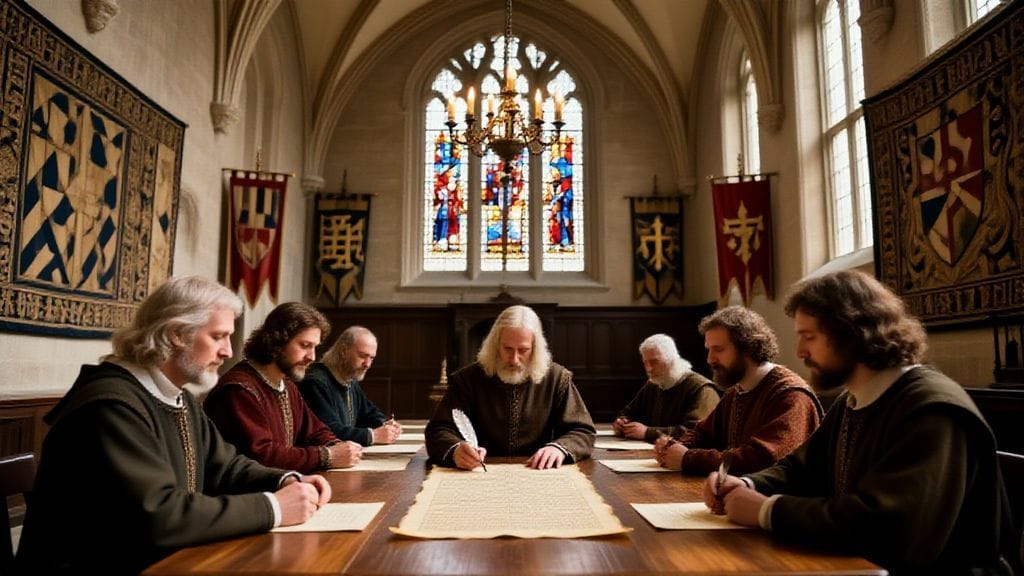
Once the delegations were in place, the real work of peace began behind closed doors. The hall chosen for the discussions—perhaps a chamber in one of the city’s administrative buildings or a noble residence adapted for the purpose—would have been large but not vast, with high beams, narrow windows for light, and plenty of space for tables, benches, and document chests. On the walls, the arms of various rulers and cities might be displayed, silent witnesses to the contest of wills about to unfold.
Every session was a ritual. Envoys entered according to agreed protocol, seating arranged to signal a delicate balance of status. Notaries positioned themselves where they could hear and record. Translators stood ready, though French remained the main language of high diplomacy. Clerics invoked God’s blessing, reminding those present that peace was a Christian duty—a moral charge that did not always sit comfortably with the realpolitik shaping each clause.
The first days were often consumed with procedural questions: confirming powers of representation, agreeing on the order of topics, ratifying the terms of the truce that protected the envoys. Each side tested the other’s firmness, floating preliminary demands and offers. The English sought recognition of their conquests and, at minimum, secure possession of strategic enclaves. The French pressed for recognition of their recent reconquests and insisted that English claims to the French crown remain theoretical, not substantiated in land and titles.
Voices in the chamber shifted from polite to sharp and back again. At moments, an envoy might slam a hand on the table, or a knight might bristle at perceived insult. But the very fact that they were sitting, talking, and writing instead of fighting marked a kind of progress. Some days ended in deadlock, the participants leaving in tight-lipped silence. Other days produced glimmers of compromise: agreements in principle about the status of certain towns, or about the duration of a truce in specific regions.
Outside formal sessions, the true art of negotiation revealed itself. Over meals, during walks in courtyards, or in smaller, more discreet gatherings, envoys sounded out each other’s red lines and hidden fears. An English representative might confess, in guarded language, that Parliament’s patience was running thin. A French cleric might hint at unrest in a province that made prolonged campaigning undesirable. These “off-the-record” exchanges slowly traced the real shape of possible agreement, beneath the grandstanding of formal debate.
Papal mediators, when present or consulted, added another layer. They reminded both sides that Christendom faced other tests—rising tensions in Italy, the lingering effects of the Black Death, the possibility of renewed crusades. Each new outbreak of war between Christian princes undermined the Church’s claim to moral leadership. Here and there, a papal legate would cite scripture—“Blessed are the peacemakers”—with a certain weariness, fully aware that such phrases could be used to camouflage coercion as well as compassion.
The longer the talks went on, the more pressure grew. News from the front filtered into Bruges: skirmishes, sieges delayed, mercenary companies restless in their camps, uncertain whether they would be paid to fight or ordered to stand down. Merchants, too, sent messages, begging that safe conduct be extended or that particular routes be reopened. In such a climate, every paragraph of the treaty text took on a life-or-death significance for someone somewhere. The treaty of bruges 1375 was being inked not on blank parchment, but on a landscape scarred by lived experience.
Drawing Lines on a Wounded Map: The Terms of the Treaty of Bruges 1375
The precise clauses of medieval treaties can be frustratingly hard to reconstruct, dependent as they are on surviving copies, later summaries, and chronicle references. Yet from the archival traces and the pattern of events, historians have pieced together a coherent picture of what the treaty of bruges 1375 tried to achieve. At its heart lay three interlocking priorities: the stabilization of territorial control, the regulation of military activity, and the protection of commerce.
First, territorial stabilization. After years of ebb and flow, both sides recognized that they needed to freeze, at least temporarily, the shape of their holdings. The French had made notable gains in recent campaigns, clawing back lands once ceded to England; the English still held key fortresses and regions that anchored their continental ambitions. The treaty sought to acknowledge, in cautious legal language, where effective control lay, even if ultimate sovereignty remained a point of contention. Castles, towns, and stretches of countryside were listed and cross-checked against prior agreements like Brétigny. To modern eyes, such lists may read as dry inventories, but each name represented thousands of lives and livelihoods.
Second, the regulation of military activity. The treaty included provisions for extended truces across multiple theaters of the war. Campaign seasons would be suspended; garrisons would hold but not expand their zones of operation; raids into enemy territory were explicitly forbidden. Special attention was given to the “free companies”—bands of mercenaries who had grown accustomed to living off plunder and protection money. Both crowns promised, at least on parchment, to restrain or redirect these groups, whose violence had become a scourge on local populations regardless of their formal allegiance.
Third, and crucially for Bruges, the treaty addressed commerce. It confirmed or restored safe-conduct arrangements for merchants traveling by land and sea, especially across the Channel. English wool exports to Flanders, French wine shipments, and the transit of Italian and Hanseatic goods through contested waters were all meant to benefit. Customs duties were specified; compensation mechanisms for seized goods were sketched out. It was here that the concerns of Bruges’s merchant class most clearly inscribed themselves into high diplomacy. In effect, the treaty tried to reconnect the veins of European trade that war had clotted.
Beyond these core elements, the treaty of bruges 1375 also engaged in the usual medieval ritual of hostage arrangements and oaths. Representatives swore, on behalf of their lords, to abide by the terms for a set period—often several years. Symbolic gestures of reconciliation, such as promises of future marital alliances or mutual support against rebels, may have been added, though their practical impact remained uncertain. What mattered most was that both sides publicly agreed to step back from the brink, to let exhaustion speak as loudly as ambition.
Importantly, the treaty did not resolve the fundamental dynastic question at the heart of the Hundred Years’ War: who was the rightful king of France. Edward’s claim, and its transmission to his heirs, remained an unhealed wound. The treaty functioned rather as a bandage, pressing the bleeding edges together for a time without knitting them fully. As one later chronicler in France observed with a hint of cynicism, “They wrote of peace while preserving the memory of war,” capturing the way such agreements bound and yet preserved enmity.
Merchants, Sailors, and Peasants: How Ordinary Lives Shaped the Peace
It would be easy to view the treaty of bruges 1375 only as an elite affair, but the pressure to sign it rose from below as much as from above. In Flanders, the weavers and fullers whose hands turned wool into cloth had lived through years of uncertainty. When Channel crossings were perilous or embargoed, English wool failed to arrive; when war threatened continental routes, finished cloth piled up unsold. The guild leaders who spoke for these workers carried with them not only their economic grievances but also a quiet, pervasive fatigue with war’s disruptions.
Sailors, too, bore the visible marks of prolonged conflict. Their bodies were scarred from boarding actions and shipwrecks; their minds attuned to the risk that any sail on the horizon might signal attack. Letters of marque, granting private shipowners permission to seize enemy vessels, turned parts of the North Sea into a legalized free-for-all. For each successful prize that enriched a captain and his crew, there were many obscure losses: ships taken, crews imprisoned or killed, and families left without news or income. A treaty promising safer passage offered something close to a reprieve from permanent danger.
On land, peasants and smallholders living in frontier zones had little say over the grand strategies of kings, but their suffering fed into the political calculus. Repeated requisitions, the menace of roving bands, and the destruction of harvests undermined the tax base on which rulers depended. Reports from local officials and clergy painted a picture of communities on the edge of collapse. It is not sentimental exaggeration to say that every burned field and abandoned village whispered, wordlessly, in favor of the truce formalized in Bruges.
In the city itself, ordinary Bruges citizens interacted with the negotiations in quieter ways. They rented rooms, provided food, translated for minor officials, repaired horseshoes and ship hulls. They overheard snatches of conversation in languages they did not fully understand, catching only the repeated word “paix” or “peace.” Many likely shrugged; they had heard such talk before. Yet when the terms of the treaty began to spread, and when they saw more foreign sails and fewer warships in the harbor, they would have recognized, however vaguely, that something had shifted.
At the same time, it is important not to romanticize popular enthusiasm for peace. War had also created opportunities: for some merchants who profited from scarcity, for soldiers whose only trade was arms, for nobles whose authority grew in crisis. Not all common folk viewed the treaty kindly. Some English archers, for example, might have grumbled that they were being denied the spoils of further campaigns. Certain Flemish traders, accustomed to smuggling and speculative gains during blockades, may have found a more regulated peace less lucrative.
Still, in aggregate, the weight of ordinary experience leaned toward a respite. The voices of those people rarely appear directly in official documents, but their needs lurk between the lines. When clauses speak of reopening markets and protecting pilgrims, they are, indirectly, responding to the cries of men and women whose lives had been stretched thin by war. The treaty of bruges 1375 can thus be read as a partial victory for those who, though voiceless in council, made the realm function day by day.
Flanders Between Two Crowns: Local Politics and International Peace
Flanders in 1375 was a land wedged uneasily between two great powers. To the French crown, it was a vital fief, rich in towns and taxes, whose count owed feudal allegiance to the king. To England, it was the indispensable customer that absorbed its wool exports, enabling the English nobility to finance their lifestyles and wars. The Count of Flanders, Louis de Male, found himself in a perpetual balancing act, trying to satisfy his French overlord without strangling the economic ties that bound his cities to England.
This tension had flared into open conflict more than once. The urban communes of Flanders—Ghent, Bruges, Ypres—were not passive entities. They bargained and occasionally rebelled, asserting privileges, resisting taxation, and sometimes seeking English support against their own count or the French crown. Over the previous decades, shifting alliances in the Hundred Years’ War had repeatedly drawn Flanders into the vortex of Anglo-French rivalry. The memory of English archers in Flemish uprisings, and of French royal interventions, remained vivid in 1375.
Against this backdrop, hosting the negotiations in Bruges allowed the count and the urban elites to reposition themselves as indispensable intermediaries. They could present Flanders not merely as a pawn but as a broker of peace, a place where the fury of kings bowed to the arithmetic of cloth exports and customs dues. If the treaty of bruges 1375 succeeded in calming the seas and stabilizing the frontier, the immediate beneficiary would be the Flemish economy—and, by extension, the revenues of the count and the wealth of the cities.
Yet local politics were anything but simple. Within Bruges itself, factions differed on how closely the city should align with France or England. Some guilds, more dependent on English wool, favored accommodation with London; others, whose trade routes ran deeper into the French interior, saw Paris as the more reliable partner. The count had to navigate these cross-currents, playing one city against another, occasionally calling on French royal power to discipline the towns, while also conceding enough autonomy to prevent full-scale revolt.
The treaty thus intersected with an internal Flemish drama about authority, identity, and survival. If peace enhanced Flemish prosperity, it might also strengthen the cities’ leverage over their count, enabling them to push for further privileges. If, on the other hand, the treaty proved fragile and conflict resumed, the count could argue that only firm princely control could guide Flanders through the storm. In this sense, the document signed—or sealed—in Bruges had a domestic as well as international dimension. It was a tool in a long-running negotiation over who truly governed Flanders: the king, the count, or the cities themselves.
From Trumpets to Suspicion: Immediate Reactions to the Bruges Agreement
When at last the text of the treaty of bruges 1375 was finalized, the moment of public proclamation carried both ceremony and unease. Town criers announced the agreement in the squares of Bruges, their voices echoing against stone facades as they recited the essential points: truces in specified regions, guarantees for merchants, arrangements for disputed strongholds. Church bells rang in cautious celebration, and special Masses of thanksgiving were held to mark what was presented as a Christian reconciliation.
For many locals, the immediate reaction was practical: could ships now sail with less fear? Would tolls or tariffs change? Would foreign soldiers be withdrawn from nearby garrisons? Merchants examined the clauses with a calculating eye, asking whether compensation mechanisms for past seizures were worth pursuing. Tavern conversations turned to speculation about how long this peace would last, and whether it signaled the beginning of the end of the long war.
Across the Channel in England, news of the treaty filtered slowly through court and country. Some nobles and veterans saw it as a much-needed breathing space; others grumbled that the crown was retreating from its rightful claims. Chroniclers sympathetic to chivalric ideals lamented that the great days of Crécy and Poitiers seemed distant, replaced by cautious truces and legalistic wrangling. Yet even the most martial spirits had to admit that the kingdom’s finances and manpower were under strain, and that a pause could prove strategically useful.
In France, the tone of reaction was more confident but no less complicated. Royal propagandists highlighted the treaty as proof that Charles V’s steady strategy was bearing fruit. They emphasized how French reconquests were now acknowledged or at least tolerated by the English, portraying the agreement as a sign of English weakness. At the same time, some royal advisers worried that any formal recognition of English holdings on the continent, however limited, could hinder future efforts to expel them completely.
Among ordinary people, reactions were more visceral. Relatives of captives hoped that prisoner exchanges might be accelerated; communities near war-torn frontiers prayed that the long columns of soldiers would finally vanish from their roads. Yet skepticism ran deep. Previous truces had been broken; treaties had proved porous. It is astonishing, isn’t it, how quickly hope and doubt can coexist in the same mind? Many villagers and townsfolk, having learned the hard lessons of the previous decades, greeted the news with a muted, conditional optimism: peace, yes—but for how long?
Fragile Armistice: The Treaty in the Longer Arc of the Hundred Years’ War
In retrospect, historians see the treaty of bruges 1375 as part of a pattern of truces and partial settlements that punctuated the Hundred Years’ War. It did not end the conflict; that would require many more years, shifting dynasties, and entirely different political circumstances. But it marked a moment when both sides, drained and reconfiguring their priorities, chose to institutionalize a breathing space.
In the immediate years after 1375, the truce architecture built in Bruges helped to reduce large-scale campaigning between France and England, particularly in certain regions. This allowed Charles V to focus on internal consolidation and other theaters, while the English grappled with succession issues and internal tensions. Some territories, especially in southwestern France, experienced a relative lull in devastation, giving communities a chance to rebuild fields, churches, and marketplaces.
Yet the underlying rivalries and claims remained untouched. The English crown still styled itself with French titles; the French monarchy still considered the English presence on its soil an affront to its sovereignty. The dynastic roots of the war—compounded by questions of prestige, honor, and the intricate web of noble loyalties—could not be severed by one treaty, however carefully crafted. Instead, Bruges contributed to a gradual shift from flamboyant conquest to more measured, often financially driven calculations of when and where to fight.
Later flare-ups in the war would both echo and contradict the logic of 1375. In some periods, rulers looked back to the treaty as a precedent for negotiating truces in trade hubs or neutral territories, recognizing that cities like Bruges or Calais had a structural interest in peace. In other phases, particularly when charismatic war leaders or ideological passions rose to the fore, the cautious diplomacy of Bruges seemed distant and uninspiring. The pendulum swung repeatedly between negotiation and confrontation.
What the treaty undeniably did, however, was to weave itself into the memory of diplomats and chroniclers as evidence that even amid a “hundred years” of conflict, there were intervals when reason and fatigue conspired to cool the fever of war. One 15th-century French commentator, reflecting on earlier attempts at peace, wrote: “We can see in the accords of Bruges and others like it that princes know in their hearts the vanity of endless arms, yet the chain of inheritance drags them back to battle.” It is a somber insight, suggesting that treaties like Bruges were both sincere and constrained, earnest efforts hemmed in by the structures of their time.
In the Shadows of the Archives: Chronicles and Voices Remembering Bruges
Our knowledge of the treaty of bruges 1375 comes to us through a scattered mosaic of sources: fragments of official documentation, city records, and narrative chronicles. Each piece must be handled with care. Medieval copyists sometimes altered texts, whether by error or design; chroniclers wrote from partisan perspectives, seeking to glorify one ruler or city while downplaying others’ roles. To reconstruct what happened in Bruges, historians have had to become detectives of parchment and ink.
City archives in Bruges and other Flemish towns preserve financial records showing expenditures related to hosting foreign envoys—payments for lodging, food, and special security measures. These seemingly mundane entries anchor the high diplomacy in the life of the city: we see, in literal figures of account, how much peace cost in bread, wine, and candles. They remind us that treaties are not only the product of words but of logistical labor carried out by anonymous individuals: cooks, stable hands, scribes.
Royal chanceries in England and France kept copies or summaries of the agreements reached, along with the letters of instruction sent to envoys. From these we glimpse the priorities of the crowns and the constraints placed upon negotiators. Gaps in the record—missing seals, lost pages—tell their own story of the fragility of documentation over centuries. Fire, damp, political upheaval, and simple neglect all conspired to erase parts of the historical trail.
Chronicles add color but must be read with caution. A French chronicler close to the Valois court might depict the treaty as evidence of English weakness and French ascendancy, emphasizing Charles V’s wisdom. An English writer, by contrast, might focus on the lineaments of honor preserved and present Bruges as a tactical pause before renewed exertions. One Flemish chronicle, composed in the following generation, treats the treaty primarily as a local event, highlighting how it affected the wool trade and town politics more than the abstract question of royal titles.
Modern historians supplement these texts with diplomatic comparison and contextual reading. For example, Philippe Contamine’s work on warfare and society in late medieval France, though not centered solely on Bruges, offers insights into how truces and treaties functioned within a long war economy. Scholars have also compared the treaty of bruges 1375 to other agreements, tracing continuities in formulae, legal structures, and the recurring involvement of intermediaries like the papal court.
Thus what survives of Bruges is not a single, clear voice but a chorus of partial testimonies. It falls to us, centuries later, to listen through the distortions and silences, to sense the underlying reality: a group of men gathered in a Flemish city, trying—within their own mental and political limits—to sketch a path away from endless bloodshed.
Wool, Wine, and War: Economic Consequences of the Peace of 1375
Among the most immediate effects of the treaty of bruges 1375 were economic. Within months of its signing, merchants began to test the new arrangements: ships ventured out with fewer armed escorts, caravans attempted routes that had recently been too dangerous, and contracts were drawn up with slightly less hedging against sudden seizure. In Bruges itself, the traffic through the harbor and the counting houses registered the change. Ledgers show a modest but noticeable uptick in transactions linked to English wool and French goods.
For English landowners and merchants, the reopening and regularizing of the wool trade offered a vital infusion of revenue. War had been expensive, and the extraordinary taxation required to sustain it was deeply unpopular. Stabilizing exports helped restore confidence among creditors and investors who had grown wary of funding royal campaigns. At the same time, renewed trade with Flanders supported English strategic interests, since a prosperous Flanders, dependent on English wool, could serve as a counterweight to French influence—though this dependency was complex and never absolute.
In France, the economic benefits were more diffuse but still real. Reduced military operations in certain regions meant fewer resources diverted to campaigning and more attention to domestic reconstruction. The wine trade, especially from regions like Bordeaux, stood to gain from safer sea-lanes, even if the political status of those territories remained contested. Urban centers in northern France, including Paris and Rouen, also profited indirectly from the more predictable flow of imported goods routed through Flemish ports.
For Bruges and Flanders, the treaty reasserted their role as a pivot of northern European commerce. More merchants meant more customs duties, more dock fees, more employment for porters and artisans. Specialized financiers who dealt in currency exchange and credit instruments found new opportunities as cross-border trade recovered. Economic historians sometimes speak of this period as a moment when, despite the overarching narrative of war, pockets of what we might call proto-capitalist dynamism persisted and even flourished.
Of course, not all problems vanished. Piracy did not disappear overnight; neither did banditry on land. Some local lords and mercenary leaders resisted demobilization, seeking to convert their military assets into new forms of leverage. Furthermore, the very success of renewed trade heightened competition and sometimes stoked jealousy between cities. Ghent, Bruges’s great rival, kept a wary eye on any advantage its neighbor gained from hosting the treaty.
Still, for a time, the calculus of profit and loss favored peace. The treaty of bruges 1375 demonstrated that commerce could shape diplomacy, not merely suffer under it. The bustling markets and bales of wool that framed the negotiations were not just a backdrop—they were a driving force, pushing rulers to reckon with the fact that their treasuries and legitimacy depended on a functioning economy as much as on battlefield glory.
Faith, Fear, and Hope: The Emotional Climate Around the Negotiations
We often speak of treaties in the dry language of law and politics, but the atmosphere in Bruges in 1375 was thick with emotion. Fear, first of all: fear among the envoys that any misstep could lead to collapse; fear among townsfolk that renewed war would empty the harbor and bring foreign soldiers back to their gates; fear among peasants and traders that the tenuous security afforded by the truce would be ripped away by some distant quarrel between princes.
Yet alongside fear there was hope. Church services during the negotiations were suffused with prayers for peace, for the softening of hearts, for the safety of travelers. Images of Christ as Prince of Peace, of the dove returning to Noah’s ark, and of swords beaten into plowshares resonated with congregations who knew full well the weight of those metaphors. Confessors heard from soldiers and merchants alike who wrestled with the morality of their roles in war and profit. Medieval faith did not necessarily oppose war outright, but it demanded at least a reckoning with its costs.
For the envoys themselves, emotions were no less complex. Some were veterans who had lost comrades and kin in the long conflict; others were younger clerics or lawyers whose careers had blossomed in the shadow of war. To sit across from representatives of a realm they had been raised to see as the enemy forced them to confront the human face of their adversaries. In the quieter moments, over shared meals or in conversation about neutral topics—scholarship, theology, the weather—small bridges of sympathy may have formed, however fleeting.
The people of Bruges expressed their feelings in more practical ways. On days when news from the negotiation chamber seemed favorable, markets buzzed a little louder; taverns sold more wine; conversations turned, hopefully, to next season’s prospects. When rumors spread of deadlock or insult, a chill seemed to settle over the town. Parents warned their children not to stray near the quarters of foreign soldiers, just in case tempers flared. Emotional weather shifted as rapidly as the coastal winds.
It is easy to underestimate how profoundly the rhythm of war and truce shaped mental worlds in 14th-century Europe. A generation born in the 1330s or 1340s had grown up with war as a constant. For them, the idea that England and France might one day coexist without the specter of invasion and reprisal almost bordered on fantasy. In that sense, the treaty of bruges 1375 may have felt not only like a political document but like a fragile experiment in imagining a different kind of future.
A Peace That Didn’t Last: How Bruges Foreshadowed Later Treaties
Looking forward from 1375, we know that the war the treaty tried to pause would flare up again in new forms. Successive generations saw new campaigns, new alliances, and eventually a profound shift when the conflict intersected with internal crises in both realms, such as the English Peasants’ Revolt of 1381 and factional struggles in France. In that longer story, the treaty of bruges 1375 appears as one of several efforts to institutionalize truces, to harness war to more predictable patterns.
Yet the experience of Bruges left traces that shaped later diplomacy. It confirmed that commercial hubs made effective negotiation sites, where the interests of trade could exert soft pressure on combatants. It also reinforced the practice of delimiting truce zones and time periods with increasing precision—a trend that would continue in later medieval and early modern treaties. By specifying routes, towns, and categories of people to be protected, the treaty anticipated more sophisticated notions of neutral spaces and protected actors.
Furthermore, Bruges exemplified a style of peacemaking that accepted the persistence of rivalry. Rather than attempting to solve every disputed issue in one grand settlement, it focused on managing conflict, limiting its scope, and creating frameworks for future talks. In that sense it resembled modern “confidence-building measures” more than a definitive end-of-war instrument. Historians sometimes contrast such pragmatic medieval treaties with the sweeping, ideological settlements of later eras, noting the former’s modest ambitions and relative flexibility.
In the centuries after the Hundred Years’ War, European diplomacy would grow increasingly formalized, with permanent embassies, standardized procedures, and complex congresses like those at Westphalia or Vienna. From the vantage point of those later developments, Bruges might look rudimentary. But if we strip away the trappings of modernity, the core remains familiar: adversaries sitting down in a third place, constrained by economic interdependence and domestic fatigue, trying to codify a pause that could serve as the seed of something more.
In that sense, the treaty of bruges 1375 stands as a modest but telling early chapter in the history of multilateral negotiation. It reminds us that the art of “managing” war, long before modern international law, was already being practiced with considerable subtlety in the candlelit chambers of medieval towns.
Bruges as a Stage: Urban Space, Ceremony, and Symbolism
Beyond the content of the treaty itself, the setting of Bruges shaped how the agreement was experienced and remembered. The city’s architecture and urban rituals provided a kind of stage on which political theater unfolded. The belfry, towering over the Markt, symbolized civic pride and autonomy; the churches signaled the presence of divine authority; the canals testified to the city’s engagement with the wider world. When processions of envoys moved through these spaces, they participated in a choreography that blended local identity with international affairs.
Ceremonial entries marked key moments. When the delegations first arrived, they were often greeted by civic dignitaries in formal dress, flanked by guild representatives carrying their banners. Such pageantry served multiple purposes: to honor the guests, to display the wealth and orderliness of the host city, and to signal that Bruges was not a mere backdrop but an active participant in the drama of peace-making. Musicians might play; church bells peel; crowds gather in tightly packed lines to watch the passing spectacle.
Religious ceremonies intertwined with these civic displays. Special Masses for peace would bring together envoys, local officials, and common townspeople. In the flickering candlelight of a Gothic nave, differences of language and allegiance receded temporarily before the shared rituals of kneeling, reciting prayers, and receiving blessings. The gap between the ideals expressed in sermons and the harsh bargaining in council chambers could be wide, but the juxtaposition reminded everyone of the moral claims involved.
Even more mundane urban elements carried symbolic weight. The counting houses where merchants tallied profits and losses reminded rulers that war had a price beyond honor; the fortifications surrounding the city underlined the constant threat of violence. Bruges’s position as a nodal point in networks of exchange meant that the treaty of bruges 1375 was in a sense an agreement about the city itself: about whether it would continue to thrive as a bridge between realms, or wither as collateral damage in a dynastic struggle.
Later visitors to Bruges, aware of its role in this and other diplomatic episodes, sometimes remarked on the city’s dual nature: at once serene and tense, beautiful and haunted by memories of conflict. The canals reflected not only sky and stone but the ghostly procession of envoys who had come and gone, leaving behind words that would shape lives far beyond the city’s limits.
From Medieval Pact to Modern Memory: Historians and the Treaty of Bruges
In modern scholarship, the treaty of bruges 1375 occupies a modest but intriguing place. It is rarely the star of narratives about the Hundred Years’ War, overshadowed by battles and by more famous agreements like the Treaty of Brétigny or the later Treaty of Troyes. Yet specialists in medieval diplomacy and economic history have learned to pay attention to such seemingly secondary treaties, recognizing in them the texture of how prolonged wars are actually lived and managed.
Historians have pursued several lines of inquiry. Diplomatic historians analyze the treaty’s language and structure, comparing it to other agreements of the period to trace the evolution of concepts like truce, sovereignty, and safe conduct. They note, for example, how the Bruges agreement underscores a growing awareness of the need to protect certain categories of people—merchants, pilgrims, clerics—even when hostilities continue elsewhere. In that sense, it hints at an early form of what we might now call humanitarian or commercial exemptions in wartime.
Economic historians have examined trade records and municipal accounts to assess the treaty’s impact on commerce. They debate how far the agreement actually succeeded in stabilizing trade, considering the persistence of piracy and local conflicts. Some argue that the psychological effect—the perception of greater safety—was as important as the legal clauses themselves, altering merchants’ risk calculations and encouraging investment. Others emphasize continuity, suggesting that long-distance trade had already developed mechanisms for operating in uncertain conditions.
Social and cultural historians, meanwhile, look at Bruges as a microcosm of late medieval urban life under the shadow of war. They ask how hosting such high-stakes negotiations affected civic identity and how local chroniclers framed the event. One line of research, for instance, explores how Bruges’s later nostalgia for its “golden age” of commerce incorporates, often implicitly, these episodes of international diplomacy as part of the city’s proud self-image.
Modern readers might be inclined to view the treaty of bruges 1375 as a curiosity, a footnote in a much larger story. But when we read it closely, and set it against the backdrop of human experience at the time, it becomes more than that. It is a window into the ways medieval societies tried to impose order on chaos, to reconcile ideals of Christian peace with the realities of dynastic ambition, and to keep ships sailing and fields planted in a world that seemed perpetually on the brink.
In studying Bruges, historians are reminded that peace, like war, is a process rather than a single moment. The treaty’s clauses, the negotiations that produced them, and the lives they touched form part of a chain stretching forward and backward in time, linking us to a June day in 1375 when men and women dared to imagine—however tentatively—that another way might be possible.
Conclusion
The treaty of bruges 1375 emerged from a landscape of exhaustion. After decades of intermittent warfare, catastrophe, and economic strain, both the English and French crowns found themselves in need of recalibration. Bruges, with its quays crowded by ships and its counting houses humming with cautious arithmetic, provided the stage on which that recalibration unfolded. Here, the logic of trade intersected with the logic of dynasties, and the prayers of ordinary people for security and livelihood seeped into the parchments drafted by diplomats.
By freezing territorial lines, regulating military operations, and reopening commercial arteries, the treaty did not solve the fundamental rivalry between England and France, but it reframed it. War would resume in new forms; the dynastic claims that had ignited conflict in the 1330s would not be extinguished for many decades. Yet, for a crucial interval, the brutal tempo of campaigns slowed. Fields were planted, ships sailed with fewer guns on deck, and communities scarred by years of violence tasted a measure of respite.
Bruges reminds us that peace is seldom pure or permanent. It is usually partial, contingent, and entangled with self-interest. Envoys came to Flanders in 1375 not because they were suddenly converted to pacifism, but because necessity—financial, political, and social—drove them. Still, the outcome was no less meaningful for being pragmatic. Behind the clauses and seals lay a recognition, however muted, that endless war corrodes the very foundations on which princely power rests.
Looking back across the centuries, we can see in the treaty of bruges 1375 an early instance of something that would become increasingly central to European history: the attempt to manage conflict through structured negotiation, in places where commerce and culture crossed borders. The canals and streets of Bruges, illuminated by the pale light of a North Sea summer, thus hosted not only a medieval political bargain but a step—small yet significant—toward the complex diplomatic world we inhabit today.
FAQs
- What was the Treaty of Bruges 1375?
The Treaty of Bruges 1375 was a negotiated truce between the kingdoms of England and France, signed in the city of Bruges on 27 June 1375, during the wider conflict known as the Hundred Years’ War. It aimed to stabilize territorial control, limit military operations, and protect key commercial routes, especially those affecting Flemish trade. - Why was Bruges chosen as the site for the treaty?
Bruges was a major commercial hub in Flanders, economically tied to both England and France. Its dependence on English wool and its formal subordination to the French crown made it an ideal intermediary space. Hosting the negotiations there harnessed the city’s interest in peace and symbolized the central role of trade in driving diplomacy. - Did the treaty of bruges 1375 end the Hundred Years’ War?
No. The treaty created a significant truce and reduced large-scale campaigning for a time, but it did not resolve the core dynastic dispute over the French crown. The Hundred Years’ War continued, with periods of renewed fighting and further truces, until the mid-15th century. - What were the main terms of the treaty?
The treaty sought to freeze the territorial status quo, formalizing control of various regions by each side, to extend truces across multiple theaters of the war, and to restore or protect commercial activity. It included provisions for safe conduct of merchants, regulation of mercenary companies, and oaths by representatives on behalf of their rulers. - How did the treaty affect ordinary people?
For merchants, sailors, artisans, and peasants, the treaty promised fewer raids, safer travel, and more predictable trade. While it did not erase the hardships of the previous decades, it offered a respite that allowed some communities to rebuild, markets to revive, and daily life to become less precarious—at least temporarily. - What role did Flanders and its cities play in the negotiations?
Flanders, and Bruges in particular, acted as both host and stakeholder. The Count of Flanders and the urban elites had a strong interest in ending disruptions to the wool and cloth trade. Their position between English economic power and French political overlordship gave them leverage and made Bruges a natural locus for peace talks. - How do historians know about the treaty of bruges 1375 today?
Knowledge of the treaty comes from a combination of royal and municipal records, financial accounts, and narrative chronicles from England, France, and Flanders. Modern historians analyze these sources critically, comparing fragments and considering biases to reconstruct the negotiations and assess the treaty’s impact.
External Resource
Internal Link
Other Resources
- Encyclopaedia Britannica – general search for the exact subject
- Google Scholar – academic search for the exact subject
- Internet Archive – digital library search for the exact subject

