Table of Contents
- Storm over the Archipelago: Japan on the Eve of Sekigahara
- From Unification to Uncertainty: The Legacy of Oda Nobunaga and Toyotomi Hideyoshi
- Tokugawa Ieyasu Rises: Ambition Wrapped in Patience
- Ishida Mitsunari and the Fractured Western Alliance
- Marching Toward Destiny: The Road to Sekigahara
- The Valley of Decision: Geography, Weather, and the Chosen Battlefield
- Armies Assembled: Banners, Numbers, and the Men Who Would Decide Japan’s Future
- Dawn of 21 October 1600: Mist, Drums, and Tension Before the Clash
- The First Thunderclap: Opening Movements of the Battle of Sekigahara
- Betrayal on the Hills: Kobayakawa’s Turn and the Shattering of the Western Army
- Blood, Steel, and Gunpowder: The Human Experience in the Maelstrom
- An Empire in an Afternoon: How a Single Day Forged the Tokugawa Order
- Winners, Losers, and the Vanished: The Fate of the Great Daimyo Houses
- The Birth of the Tokugawa Shogunate and Two Centuries of Peace
- Memory, Myth, and Propaganda: How Sekigahara Was Remembered
- Sekigahara in Culture: Chronicles, Drama, and Modern Imagination
- Echoes Through Time: Political and Social Consequences for Japan
- On the Ground Today: Visiting the Field Where Japan’s Future Was Decided
- Conclusion
- FAQs
- External Resource
- Internal Link
Article Summary: On 21 October 1600, in a mist-shrouded valley in central Japan, the battle of sekigahara determined the fate of the archipelago for more than two centuries. This article traces how Japan descended from decades of civil war into a single, decisive confrontation between Tokugawa Ieyasu and Ishida Mitsunari. Through narrative and analysis, it follows the ambitions, fears, and betrayals that shaped the battlefield and forged the Tokugawa shogunate. It explores the political calculus behind alliances, the human experience of the samurai and ashigaru on that bloody day, and the shattering impact of last‑minute defections. The story goes beyond the clash itself to examine how the battle of sekigahara became mythologized in chronicles, theater, and later popular culture. It also uncovers the long shadow the conflict cast over Japanese society, from rigid class hierarchies to enforced peace. Finally, the article brings the reader to the modern site of Sekigahara, where quiet fields now cover ground once soaked in blood, reminding us that a few hours of combat can redirect the course of history.
Storm over the Archipelago: Japan on the Eve of Sekigahara
On an October morning in the year 1600, a cold mist clung to the narrow valley of Sekigahara, hiding tens of thousands of men who waited, shivering, for orders that might decide the fate of an entire country. The battle of Sekigahara did not come out of nowhere; it was the climax of over a century of fragmentation and war. To understand the moment when banners snapped in the damp wind and conch-shell trumpets sent signals through the fog, we have to step back into a Japan that had been tearing itself apart since the mid-fifteenth century.
The era known as the Sengoku Jidai—the “Warring States period”—had begun with the breakdown of central authority under the Ashikaga shogunate. Local lords, or daimyo, clawed for territory, authority, and legitimacy, carving Japan into shifting mosaics of control. Peasant uprisings, monk-led armies, and pirate fleets in the Inland Sea contributed to a sense that order itself had shattered. Castles bristled atop hills; fields were scorched by raids; allegiances changed with the seasons. When we reach the year 1600, this long age of violence and possibility was tottering toward an ending, though no one on the ground could yet know which ruler—if any—would hold Japan’s future in his hands.
By the late sixteenth century, three towering figures had tried to impose unity: Oda Nobunaga, Toyotomi Hideyoshi, and Tokugawa Ieyasu. Their campaigns brought a measure of consolidation, but they also bred new resentments and rivalries. A generation of men had grown up with war as a profession, and victory for one faction meant dispossession or annihilation for another. The land itself bore scars: village boundaries redrawn, temples burned, rice fields trampled under the hooves of horses and the boots of ashigaru foot soldiers. It was in this volatile mix of exhausted populations, ambitious warlords, and fraying political compromises that the forces that would collide at Sekigahara were set into motion.
From Unification to Uncertainty: The Legacy of Oda Nobunaga and Toyotomi Hideyoshi
Before the battle of Sekigahara could ever be fought, two other men had to try—and fail—to finish the work of unification. Oda Nobunaga, the ruthless daimyo from Owari Province, began dismantling the old order in the 1560s. He crushed the military monasteries of Mount Hiei, broke the power of rival clans, and stormed into Kyoto as a self-anointed restorer of the imperial court. Nobunaga embraced firearms and innovation, making his name synonymous with merciless efficiency. Yet his meteoric rise ended abruptly in 1582, when he was betrayed and forced to commit suicide at Honnō-ji by a subordinate, Akechi Mitsuhide. Nobunaga unified much, but his death cracked open a power vacuum.
Into that vacuum stepped Toyotomi Hideyoshi, a man of almost mythic social ascent. Born a peasant of uncertain background, Hideyoshi became Nobunaga’s loyal retainer and rose through skill, charisma, and luck. By the mid-1580s, he had avenged his fallen lord and taken control of the mechanisms of power. Using a combination of military might and political cunning, he completed the unification of most of Japan. He launched massive castle-building projects—Osaka Castle being the greatest symbol of his rule—redistributed land, and implemented the sweeping “sword hunt” that disarmed peasants and fixed warriors as a distinct class. His regime altered the social DNA of Japan.
Yet Hideyoshi’s brilliance carried shadows. He had no adult heir and grew increasingly obsessed with external conquest, launching disastrous invasions of Korea in the 1590s. These campaigns bled resources and lives, pitting rival commanders against one another and sowing suspicion among them. As his health declined, Hideyoshi struggled to craft a system that would protect the inheritance of his young son, Hideyori. He created a Council of Five Elders—among them Tokugawa Ieyasu—to act as guardians and stewards of the Toyotomi legacy. On paper, it was a clever solution. In practice, it placed powerful, ambitious warlords into a fragile arrangement dependent on mutual restraint. When Hideyoshi died in 1598, that restraint began to crack.
The months after Hideyoshi’s death felt like the stillness after a storm, when the sky is too quiet, and the air is heavy with things unsaid. Many daimyo wondered: would the Toyotomi order continue under a child, or would one of the elders, perhaps the canny lord of the eastern domains, Tokugawa Ieyasu, seize the moment? It is here that the story’s key players began to move, quietly at first, toward the confrontation that would explode in the valley of Sekigahara.
Tokugawa Ieyasu Rises: Ambition Wrapped in Patience
Tokugawa Ieyasu’s life was a study in endurance. Born Matsudaira Takechiyo in 1543, he had spent his early years as a hostage, a pawn in greater men’s games. Through alliances, setbacks, and the constant trial of surviving among sharper blades, he learned to read people and opportunities with a cold, methodical eye. By the time he stood among Hideyoshi’s Five Elders, he was no longer simply the lord of Mikawa and the eastern provinces; he was one of the few men with a broad territorial base and enough military strength to rival any other daimyo.
Unlike Nobunaga’s explosive aggression or Hideyoshi’s theatrical energy, Ieyasu preferred measured steps. After Hideyoshi’s death, while other lords were still bound emotionally to the Toyotomi household, he began knitting together alliances with powerful families in eastern and central Japan. Through marriages and political pledges, he formed a web able to catch any who tried to oppose him. He moved the center of his power to Edo—what would later become Tokyo—turning a modest castle town into a fortress of influence and logistics.
But ambition never rests comfortably with other ambitions. To some daimyo, Ieyasu looked like a stabilizer; to others, he seemed an emerging tyrant. The guardianship of young Toyotomi Hideyori gave Ieyasu legal cover to intervene in national politics, but every intervention made it clearer that he was acting on his own calculations. The question hanging over Kyoto and Osaka was simple, blunt, and terrifying: was Tokugawa Ieyasu preparing to overthrow the Toyotomi legacy and claim the country for himself?
Those who would one day stand against him at Sekigahara read the signs and grew alarmed. Yet the complexity of personal loyalties, favors owed, and rivalries meant that resistance could not easily coalesce. It would take a different kind of man—a bureaucrat-turned-strategist named Ishida Mitsunari—to crystallize that opposition and draw a line that divided Japan into East and West.
Ishida Mitsunari and the Fractured Western Alliance
Ishida Mitsunari was not, by the standards of the age, an obvious warlord. Where many daimyo prided themselves on battlefield exploits and long genealogies, Mitsunari was known more for his administrative acumen and his loyalty to Hideyoshi. As a young man, he had impressed the future unifier with his sharp mind and meticulous attention to detail. He rose not through bloodlines but through service, becoming one of the most trusted members of Hideyoshi’s inner circle.
After Hideyoshi’s death, Mitsunari saw himself—whether accurately or not—as a protector of the Toyotomi legacy against the encroaching ambitions of Tokugawa Ieyasu. In his eyes, the promises made by the Council of Five Elders were sacred bonds now in danger of being broken. Ieyasu’s maneuvers, from interfering in succession disputes to crafting marital alliances without consulting the council, smelled of treachery. Mitsunari’s reaction was fueled not only by political calculation but by a personal sense of duty and a profound resentment of Ieyasu’s growing arrogance.
Yet Mitsunari’s strengths were also his weaknesses. Admired as an organizer, he was often disliked as a person. Many frontline samurai distrusted him, viewing him as a desk-bound strategist who lacked the charisma of a field commander. Veteran generals who had campaigned in Korea, such as Katō Kiyomasa and Fukushima Masanori, despised him for his attempts to control their actions and for his unwavering attachment to Hideyoshi’s bureaucratic system. Instead of uniting the Toyotomi loyalists, Mitsunari found himself facing hostility from men who shared much of his political anxiety but bristled under his leadership.
Despite this, he persisted. Through the summer of 1600, as tensions sharpened, Mitsunari worked feverishly to build a coalition of daimyo willing to stand against Ieyasu. He drew strength from western lords who held vast territories: the Mōri of Chōshū, the Ukita of Bizen, and others who had prospered under the Toyotomi order. His vision of a “Western Army” was both a military and moral project, an attempt to frame resistance as the defense of legitimate authority against Tokugawa usurpation. But the alliance he forged was riddled with doubt, rival agendas, and personal rivalries that would prove fatal when cannons began to thunder at Sekigahara.
Marching Toward Destiny: The Road to Sekigahara
The spark that lit the march to the battle of Sekigahara came in the form of accusations and counteraccusations. Ieyasu’s critics accused him of violating council agreements; Ieyasu, in turn, denounced Mitsunari and his faction as conspirators threatening national stability. In 1600, as regional disputes flared into open conflict, the country seemed to tilt from tense peace back into civil war. Each side framed its actions as defensive, even as both raced to mobilize armies.
In the summer, a campaign began far to the north in Aizu, where Uesugi Kagekatsu’s perceived defiance gave Ieyasu a pretext to march east with a large army. Ieyasu’s departure from the capital region created a power vacuum that Mitsunari and his allies tried to exploit. While Ieyasu was away confronting the Uesugi, Mitsunari moved to seize control of strategic locations in central Japan, including Fushimi Castle, held by the stalwart Tokugawa ally Torii Mototada. The siege of Fushimi in August 1600 became a grim prelude to Sekigahara; Torii’s heroic last stand delayed Mitsunari’s forces and gave Ieyasu precious time. According to later chronicles, Torii wrote a farewell letter declaring his willingness to die if it meant securing Ieyasu’s future.
As castles fell and roads filled with soldiers, it became clear that a decisive clash was inevitable. Ieyasu, learning of Mitsunari’s moves, abandoned his northern campaign and turned his army westward. The landscape of central Japan—its passes, river valleys, and castle towns—suddenly became a vast chessboard over which both sides maneuvered. Daimyo hesitated, weighing risks: to side with the wrong faction meant ruin. Some tried to sit on the fence, promising support to both, secretly hoping to be spared the full fury of war.
The convergence toward Sekigahara was not a single, simple decision but the outcome of many intersecting movements. Armies marching from different corners of Japan in the late autumn of 1600 naturally gravitated toward central crossroads. Sekigahara, a modest valley in Mino Province, lay at a critical junction of routes connecting the east and the west. Strategically, whoever held this crossroads could block or enable movement between Kyoto, Osaka, and the eastern domains. Politically, it would soon become the stage on which daimyo would declare, through action or inaction, where their loyalties truly lay.
The Valley of Decision: Geography, Weather, and the Chosen Battlefield
On most days, Sekigahara was an unremarkable place—a stretch of farmland bordered by gentle hills, where villagers tended rice paddies and travelers moved along the Nakasendō road. Yet on 21 October 1600, its geography turned it into a crucible. Framed by low ridges and overlooked by heights such as Mount Matsuo and Mount Nangū, the valley formed a natural amphitheater of war. Whoever controlled the hills commanded fields of fire and observation over troops below.
The weather that morning added another layer of tension. A thick, clammy fog hung over the valley, settling into the hollows and veiling banners and troop movements. Men could hear the rustle of armor and the mutter of distant commands but could not always see the source. For commanders, this meant uncertainty; for ordinary soldiers, it meant fighting ghosts until the sun burned away the mist. The moisture dampened powder, threatening the reliability of arquebuses, yet it also muffled sound. The stage for the battle of Sekigahara was not a clear, bright field of honor but a gray, shifting space of half-seen dangers.
Both sides understood the importance of terrain, and they positioned themselves accordingly. Mitsunari’s Western Army took advantage of the surrounding heights, deploying forces along the ridges and key passes. Kobayakawa Hideaki, whose decision would later tilt the battle, held a strong position on Mount Matsuo overlooking the plain. The Mōri and other allies occupied the southern heights, ideally placed to strike Ieyasu’s flank—if they chose to move. On the other side, Ieyasu’s Eastern Army deployed mainly on the lower ground to the east, facing the Western Army across damp fields crisscrossed by small streams and pathways.
Looking back, historians often marvel at how geography and human uncertainty intertwined that morning. The valley was both a prize and a trap. If the Western Army had coordinated a decisive attack downhill, they could have crushed Ieyasu’s forces between converging wings. If the Eastern Army held steady and exploited any hesitation, they could tear open the fragile alliances of their opponents. Beneath the gray sky, tens of thousands of lives and the fate of a nation were hostage to the delicate balance of hills, fog, and human will.
Armies Assembled: Banners, Numbers, and the Men Who Would Decide Japan’s Future
The scale of the forces at Sekigahara was staggering by the standards of the time. Most estimates place the Western Army under Ishida Mitsunari at around 80,000 men, while Tokugawa Ieyasu’s Eastern Army fielded some 74,000. These figures are approximations, woven from later chronicles like the “Tokugawa Jikki” and cross-checked with domain records, but they convey the magnitude of the confrontation. Nearly 150,000 warriors—samurai, ashigaru, arquebusiers, and mounted retainers—crowded into and around the valley.
The battlefield was alive with color and sound. Vibrant banners fluttered above troop formations, each emblazoned with family crests: the triple hollyhock of the Tokugawa, the rising sun of the Mōri, the distinct symbols of the Shimazu, the Ukita, and dozens of other houses. Drums pounded out signals, conch shells blared, and messengers galloped through the mist, passing orders on narrow paths already churned to mud. For many ordinary foot soldiers, this was the largest gathering of armed men they had ever seen, and the mix of fear and awe was almost physical.
The social composition of these armies reflected a Japan in transition. The warrior class had become more formalized, yet distinctions between highborn samurai and lower-status ashigaru remained stark. Some veterans bore scars from earlier campaigns under Nobunaga or Hideyoshi; others were raw recruits pulled from villages, barely trained to hold a spear or fire a matchlock. Many did not fully grasp the political contest—Tokugawa versus Toyotomi guardianship, East versus West. What they knew was simpler: follow your lord, survive if you can, win if fortune allows.
Commanders on both sides were a mix of legends and rising stars. For the Western Army, there were names like Ukita Hideie, Ōtani Yoshitsugu—fighting despite serious illness—and Shimazu Yoshihiro, an old and battle-hardened leader from Kyushu. The Eastern Army boasted men such as Honda Tadakatsu, famed for his loyalty and courage, and Fukushima Masanori, whose banner had flown in many of Hideyoshi’s earlier campaigns but now faced Mitsunari as an enemy. In that dense crowd of faces and reputations, unimaginable hopes were pinned to the decisions of a few, among them a young and conflicted daimyo who was about to betray his supposed allies.
Dawn of 21 October 1600: Mist, Drums, and Tension Before the Clash
As the first pale light seeped into the fog, men stirred in their camps. Armor was strapped on with numb fingers; helmets were adjusted; spears checked; arquebuses primed and loaded. For some, the final hours before the battle of Sekigahara were filled with ritual—quick prayers at portable shrines, quiet recitations of Buddhist sutras, last sips of water or sake. For others, they were moments of dread. Ashigaru whispered about omens, about dreams they had had the night before, about the sound of ravens overhead.
In the Western camp, Ishida Mitsunari moved between commanders, trying to solidify a fragile sense of purpose. He knew that several daimyo had joined him reluctantly, or under pressure from larger houses like the Mōri. He also knew that some had been courted by Ieyasu. Yet, he held to the belief that once the first blows were struck and the momentum of battle carried them forward, his allies would fight. Orders were given: maintain positions on the heights, do not descend until signals are clear, be ready to envelop the Eastern Army when the time came.
Over in the Eastern lines, Tokugawa Ieyasu was calm but not complacent. He spent the early hours surveying positions and issuing instructions to his sub-commanders. Crucially, Ieyasu had already been in secret communication with several Western-aligned daimyo, including Kobayakawa Hideaki. These correspondences promised safety, land, and favor in exchange for timely defection. As the sun struggled to pierce the fog, Ieyasu was gambling not just on the strength of his troops but on the corrosive power of doubt within the Western ranks.
The first movements were hesitant. Skirmishers crept forward. Scouts tried to pierce the fog. Time seemed elastic—stretching and tightening as everyone waited for the moment when the tension would break and turn into action. When the order finally came for the Eastern vanguard to advance, it was like a dam giving way. Drums rolled, war cries were raised, and the valley, until then filled with the whispers of anticipation, erupted into the brutal music of war.
The First Thunderclap: Opening Movements of the Battle of Sekigahara
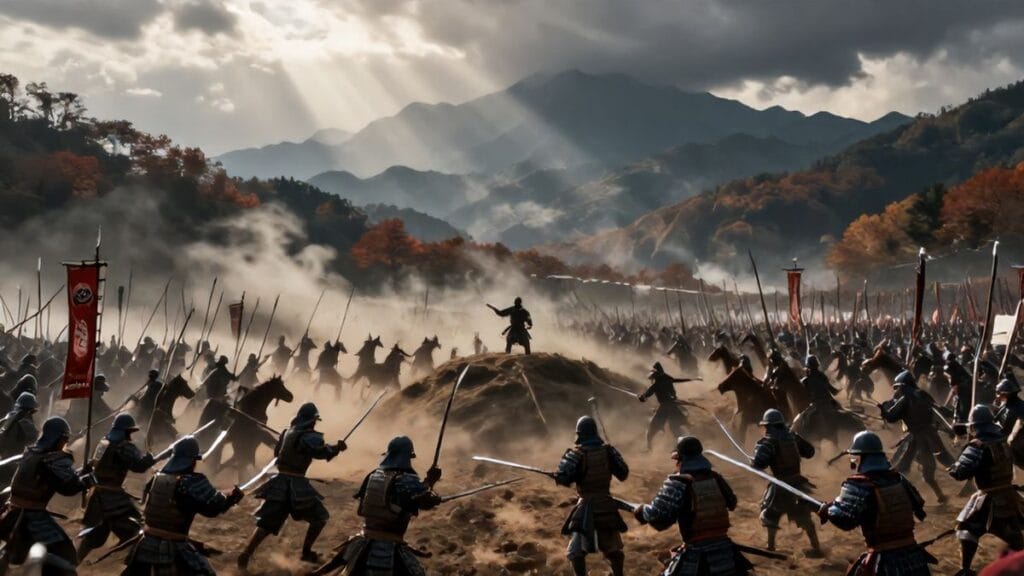
The opening phase of the battle of Sekigahara saw the Eastern Army pushing forward across the valley floor, seeking to dislodge Mitsunari’s central forces and probe for weaknesses. Fukushima Masanori’s troops engaged the units of Ukita Hideie, while other Eastern contingents pressed against the Western center. Arquebus volleys shattered the morning air, plumes of white smoke cutting through the thinning fog. Men fell screaming in the mud, their cries drowned by the roar of gunfire and the clash of steel.
For a time, the Western forces held their ground with determination. Ukita’s men, in particular, fought fiercely, repulsing assaults and counterattacking with disciplined spearmen. Ōtani Yoshitsugu’s troops on the flank, despite their commander’s debilitating illness, maintained a solid front against the Eastern left. From the ridges, Western commanders could see that their lines were not breaking. The defensive posture on the high ground seemed to promise eventual victory: if they could just time their downhill strikes correctly, the Eastern Army might be crushed.
Yet, as the hours passed, cracks began to appear—not in the formation, but in the fragile trust that bound the Western alliance. Several key contingents, including those under Kobayakawa Hideaki and portions of the Mōri forces, remained inactive on the hills. They watched as the battle raged below, banners unmoving. Ishida Mitsunari sent messengers urging them to engage, to exploit openings in the Eastern lines. The messengers returned with excuses or did not return at all. Every moment of hesitation eroded the Western Army’s advantage.
Meanwhile, Tokugawa Ieyasu, observing from his command post, recognized that the battle was approaching a turning point. He needed the promised defections to come, and come soon. Without them, his army might be worn down and encircled. With them, the precarious balance would tip sharply in his favor. On the ridge where Kobayakawa Hideaki’s men waited, history itself seemed to hold its breath.
Betrayal on the Hills: Kobayakawa’s Turn and the Shattering of the Western Army
Kobayakawa Hideaki was in many ways the embodiment of Sengoku-era contradictions. Young, of noble birth, and once closely tied to Toyotomi Hideyoshi, he had been both favored and humiliated by his overlord—rewarded with land and status, then publicly rebuked after perceived failures in the Korean campaigns. These mixed experiences left him resentful, insecure, and acutely aware of his precarious place in the power hierarchy. In 1600, courted by both Ishida Mitsunari and Tokugawa Ieyasu, he found himself at the center of a dangerous courtship.
On the morning of Sekigahara, Kobayakawa’s army occupied a commanding position on Mount Matsuo, overlooking the battlefield. Nominally aligned with the Western Army, he had privately been in communication with Ieyasu. Yet when the battle began, he held back, his banner motionless. Hours passed as he wavered, terrified of making the wrong move. To charge the Eastern Army and then learn that Ieyasu triumphed elsewhere would mean annihilation. To turn against Mitsunari and see the Western Army somehow win would brand him a traitor forever.
According to later accounts—colored by Tokugawa victory but widely repeated—Ieyasu, frustrated by Kobayakawa’s indecision, ordered arquebusiers to fire warning volleys toward Mount Matsuo. The shots were not intended to harm but to shock. They carried a blunt message: choose, now. Under this pressure, and tempted by the promises of future security, Kobayakawa finally moved. But he did not descend upon the Eastern lines; instead, his troops charged into the flank of Ōtani Yoshitsugu’s Western contingent.
The effect was catastrophic. Ōtani’s forces, already engaged to their front, suddenly found their side and rear under assault from supposed allies. Confusion turned to horror as men realized they were being attacked by those whose banners had, moments before, signified friendship. Other daimyo, seeing Kobayakawa’s move, took it as a signal. Several, such as Wakisaka Yasuharu, likewise defected or simply melted away from their positions. What had been a solid, if strained, Western line began to crumble into pockets of desperate resistance and chaotic retreat.
This moment of betrayal on the hills was the axis on which the battle of Sekigahara turned. With key elements switching sides, Ieyasu’s Eastern Army surged forward. Mitsunari’s carefully arranged deployment dissolved in the face of treachery. The fog of the morning had hidden troops; now the fog of betrayal obscured any hope of coordinated Western action. As one chronicler later put it, “The mountains themselves moved against Ishida, and the sky abandoned him.”
Blood, Steel, and Gunpowder: The Human Experience in the Maelstrom
From a distance, it is easy to speak of “wings collapsing” and “lines breaking,” but on the ground, the battle was experienced in screams, sweat, and the metallic taste of fear. Ashigaru in tattered armor found themselves suddenly flanked, watching comrades cut down by men wearing the colors of their supposed allies. Samurai who had sworn to die in defense of their lord faced choices in seconds: stand and fight surrounded, attempt a breakout, or flee and live with the shame.
Ōtani Yoshitsugu’s banner became a focal point of tragic heroism. Gravely ill with leprosy, unable to fight as a young man would, he had nevertheless come to Sekigahara to honor his alliance. When Kobayakawa’s betrayal struck his flank, his forces struggled desperately to hold. Stories tell of Ōtani ordering a retreat to save what men he could, then taking his own life so as not to be captured. Whether every detail is accurate or embellished by later romanticization, the core truth remains: countless such acts of personal courage and despair unfolded in a matter of hours.
Elsewhere, the Shimazu contingent from Kyushu, initially held in reserve and coolly observing the chaos, found themselves in a worsening position. Refusing to charge forward under conditions they deemed foolish, they eventually executed a brutal and skillful fighting retreat—known as the “Shimazu’s back charge”—cutting their way through pursuing Eastern troops. For the men in those units, survival demanded not just bravery but disciplined violence, hacking away through the press of bodies to carve a path out of the doomed battlefield.
The smell of gunpowder mingled with that of wet earth and blood. Broken spears and shattered matchlocks littered the fields. Horses screamed as they went down, pinning riders beneath them. The air, once filled with shouted commands, increasingly carried the anguished wails of the wounded and dying. In the midst of all this, some units continued to fight in orderly formations, while others dissolved completely, their members scattering into the surrounding countryside, stripping off armor to pass as peasants.
Casualty figures for Sekigahara are debated, but estimates often range between 20,000 and 30,000 dead. This means that across a single day, tens of thousands of lives were extinguished or altered beyond recognition. Each corpse on the mud-smeared ground was a person whose family would wait for news, whose village would feel the absence. It’s astonishing, isn’t it, how a national turning point is built on such intimate, individual endings?
An Empire in an Afternoon: How a Single Day Forged the Tokugawa Order
By early afternoon, the outcome was no longer in doubt. With the collapse of the Western center and the defection of key contingents, resistance became fragmented. Pockets of loyalists still fought bitterly—some to the last man—but they could no longer alter the overall tide. Tokugawa Ieyasu, seeing the opportunity, pressed his advantage. He ordered his men forward to engage retreating forces, ensuring that the broken Western Army could not regroup elsewhere.
When the last organized resistance faltered, the battle of Sekigahara effectively ended, but its consequences were just beginning to unfold. Mitsunari himself fled the field, only to be captured weeks later, betrayed once more by shifting loyalties and the cold calculus of survival among the lower-ranking samurai who knew which way the wind now blew. Many of his senior allies met similar fates—captured, forced into suicide, or executed publicly to send a message. The Toyotomi cause, while not yet extinguished, had suffered a blow from which it could not truly recover.
In a sense, Ieyasu achieved in a single day what generations of warlords had struggled toward: a position from which to claim mastery over the country. As some historians have noted, Sekigahara was not just a military victory but “a political earthquake” (as one modern scholar phrased it), realigning the fault lines of power. Daimyo who had fought on the losing side faced confiscation of lands, reduction in stipends, or complete eradication of their houses. Those who had supported Ieyasu—or been clever enough to switch at the right moment—found themselves rewarded with new domains and increased prestige.
The battlefield itself bore silent witness that evening as scavengers moved among the corpses, stripping armor and valuables. Local villagers, cautiously emerging from hiding, confronted the grisly task of dealing with the dead. For them, the shift in rulers might eventually mean new taxes or different banners over the local castle, but in that moment, what mattered most was survival and the return to some semblance of normal life. Yet, above these everyday concerns, political architects in Edo and Kyoto were already beginning to shape a new order out of the ruins of Mitsunari’s defeat.
Winners, Losers, and the Vanished: The Fate of the Great Daimyo Houses
In the months following Sekigahara, a vast sorting of winners and losers unfolded. Tokugawa Ieyasu acted with a mixture of ruthlessness and strategic generosity, rewarding loyalty while ensuring that no potential rival remained unbroken. The great houses of the Western coalition faced particularly harsh reckonings. The Ukita lost their domains; their lands were redistributed to Tokugawa allies. The Mōri, though spared outright destruction thanks to delicate behind-the-scenes negotiations and their limited engagement at Sekigahara, saw their territories drastically reduced, confined largely to Chōshū.
Ishida Mitsunari, the man who had dared to oppose Ieyasu, was executed in Kyoto alongside other key conspirators, their heads displayed as a grim warning. His fall symbolized the end of a certain vision of Toyotomi guardianship and bureaucratic governance. Those who had followed him from conviction now paid with their lives or their status. Others who had merely drifted into his camp out of circumstance scrambled to prove their loyalty to the victor, sometimes betraying old comrades to demonstrate their new allegiance.
Conversely, families that had thrown their weight behind Ieyasu—or defected in timely fashion—rose dramatically. Kobayakawa Hideaki was rewarded with extensive lands, though his story would end tragically a few years later, consumed by guilt and instability if later reports are to be believed. Men like Fukushima Masanori and Kuroda Nagamasa strengthened their positions, though they would always live under the shadow of Tokugawa oversight. Even those who played subtler roles, such as the Ii and Honda families, emerged as pillars of the new regime.
This redistribution of land and titles did more than reshuffle names on a map; it reengineered the political geography of Japan. Domains were assigned not just for reward but to create a buffer system around the Tokugawa heartland. Potentially troublesome daimyo were placed in regions where their power could be checked by Tokugawa vassals. Loyal houses were granted strategic frontiers, forming a protective ring. In the span of a few years, the aftershocks of the battle of Sekigahara turned a patchwork of rival warlords into a structured hierarchy centered on Edo.
The Birth of the Tokugawa Shogunate and Two Centuries of Peace
In 1603, three years after his victory, Tokugawa Ieyasu was appointed shogun by the emperor, formalizing a reality that Sekigahara had already made clear. The Tokugawa shogunate would rule Japan, in various forms, until 1867—over 260 years of relative peace known as the Edo period. The battle of Sekigahara thus stands not only as a military engagement but as the hinge between an age of endemic warfare and an era of enforced stability.
Ieyasu’s governance style mirrored the caution and long-term thinking that had brought him to power. He constructed a complex system known as the bakuhan taisei, a dual structure in which the shogunate in Edo coexisted with semi-autonomous domains ruled by daimyo, all bound by intricate regulations. One of his most significant tools was the sankin-kōtai system, later formalized under his successors, requiring daimyo to alternate residence between their home domains and Edo. This policy drained their resources and kept their families effectively as hostages, reducing the likelihood of large-scale rebellion.
Socially, the Tokugawa order solidified the class hierarchies hinted at under Hideyoshi. Samurai became a clearly defined warrior-administrator class, living in castle towns and receiving stipends rather than directly farming land. Peasants were tied to the soil as food producers; artisans and merchants filled urban niches but remained beneath samurai in official status, even as wealthy merchants quietly accumulated power. Mobility between classes became increasingly difficult, freezing the fluidity that had once allowed a peasant like Hideyoshi to rise to supreme leadership.
Religiously and intellectually, the Tokugawa regime favored Neo-Confucian ideals that emphasized hierarchy, obedience, and stability. The romancing of martial exploits did not vanish—far from it—but the reality of daily life for most people shifted from constant threat of war to predictable, if constrained, routines. Roads became safer, trade routes more reliable, and cultural life flourished in cities like Edo, Osaka, and Kyoto. Kabuki theater, ukiyo-e prints, and a blossoming of literature all trace their growth in part to the peace that Sekigahara made possible.
Memory, Myth, and Propaganda: How Sekigahara Was Remembered
As with any decisive battle, Sekigahara quickly escaped the bounds of simple record and entered the realm of memory and myth. Early Tokugawa-era chronicles naturally framed the conflict as a righteous triumph over treachery and disorder. Works like the “Tokugawa Jikki” and various domain histories emphasized Ieyasu’s sagacity, portraying him as a reluctant warrior forced to confront rebels who endangered national stability. In this narrative, the victory at Sekigahara was not a conquest but a restoration of proper order.
The losers, of course, were cast differently depending on who told the story. Officially, Ishida Mitsunari and his allies were painted as schemers, disloyal to their obligations, or as narrow-minded bureaucrats who lacked the vision to see Japan’s true needs. Yet outside official channels, more nuanced and sometimes sympathetic portrayals emerged. Folk tales and later dramas often depicted Mitsunari as tragically loyal to the Toyotomi, a man undone by fate and betrayal rather than simple villainy.
The role of betrayal itself became a central motif. Kobayakawa Hideaki, in particular, was transformed into a symbol of treachery—his name evoked in cautionary tales about the dangers of divided loyalty. At the same time, his actions allowed commentators to explore the moral ambiguities of feudal politics. Was he simply an opportunist, or was he acting in the belief that aligning with Ieyasu would spare Japan further bloodshed? Such questions rarely received definitive answers, but they kept alive a sense that Sekigahara was more than a simple clash of good and evil.
Over the centuries, as Japan changed, so too did the remembered meaning of the battle. In the Meiji era and beyond, some historians and novelists reinterpreted Sekigahara as a key step in the long trajectory that led to modern nationhood. Twentieth-century writers, influenced by both nationalism and critical scholarship, revisited sources, debating casualty numbers, motives, and long-term significance. One modern historian has called Sekigahara “Japan’s Gettysburg,” a shorthand used in English-language literature to convey its symbolic status as a single battle that decided a national future. The comparison is imperfect, but it captures how deeply the event has been woven into narratives of Japanese identity.
Sekigahara in Culture: Chronicles, Drama, and Modern Imagination
The impact of the battle of Sekigahara did not remain confined to dusty scrolls and official edicts. It seeped into art, theater, and eventually modern media, becoming one of the great set pieces of Japanese historical imagination. Edo-period bunraku (puppet theater) and kabuki plays dramatized episodes from the battle and its lead-up, often thinly veiling historical figures behind changed names to avoid direct political offense. Audiences thrilled to depictions of noble suicides, last stands, and heartbreakingly loyal retainers undone by their lords’ miscalculations.
Woodblock prints in later centuries captured romanticized scenes: armored warriors charging through clouds of smoke, banners streaming behind them; heroic generals making final speeches atop hills; defeated commanders composed in dignified seppuku. These images, while often more dramatic than accurate, fixed certain visual tropes in the public mind. Kobayakawa’s charge down Mount Matsuo, Ōtani’s doomed stand, and Tokugawa Ieyasu’s calm presence amid chaos all became stock moments for artistic reinterpretation.
In the modern era, the battle found new life in novels, films, television dramas, and even video games. Authors like Shiba Ryōtarō delved into the personalities behind the battle, weaving psychological depth into familiar events and inviting readers to question easy judgments. Film adaptations staged Sekigahara with cinematic grandeur, using vast extras and elaborate sets to evoke the awe and terror of massed armies. Popular strategy games allowed players to rewrite history, commanding either Eastern or Western forces in digital simulations of the famous valley, underscoring how deeply the battle has embedded itself in contemporary culture.
These cultural portrayals are not neutral. They continually reshape how new generations understand Sekigahara—who they see as heroes, what themes they emphasize (honor, betrayal, unification, tragedy), and how they interpret the costs and benefits of the Tokugawa order that followed. As one scholar has noted in an essay on Japanese historical memory, cultural retellings “create a second battlefield, on which meanings, not territories, are contested.” On that battlefield, Sekigahara is still being fought.
Echoes Through Time: Political and Social Consequences for Japan
The immediate political consequence of Sekigahara—the rise of the Tokugawa shogunate—is obvious. But its deeper echoes in Japanese society are more subtle and far-reaching. The rigidification of class structures under Tokugawa rule, for instance, has roots in the demographic and political realignment that followed the battle. Many samurai who survived but found their lords dispossessed had to adapt to new masters or retire into impoverished obscurity. The warrior class as a whole increasingly became administrators and bureaucrats rather than battlefield commanders, their swords worn as symbols more often than tools.
The economic landscape also shifted. The redistribution of domains meant that trade routes, castle towns, and patterns of taxation were recalibrated. Domains controlled by Tokugawa allies became key nodes in a national network centered on Edo. Peace enabled internal commerce to flourish, linking farmers, artisans, and merchants in more intricate webs of dependency. Over time, this contributed to the rise of wealthy urban merchant classes whose economic muscle quietly challenged the official supremacy of the samurai, sowing seeds of tension that would bear fruit in the late Edo period.
Politically, Sekigahara set a precedent about how legitimacy could be claimed in Japan: through a mixture of military victory and imperial sanction. Ieyasu’s careful cultivation of the imperial court, even as he held actual power in Edo, offered a template for balancing symbolic authority with real control. Later leaders, including those who engineered the Meiji Restoration, would draw from this model in their own efforts to reconcile tradition with transformation.
There were also less visible but profound psychological consequences. The memory of the Warring States chaos, capped by the decisive but bloody battle of Sekigahara, made many in subsequent generations deeply wary of internal conflict. The value placed on harmony, on avoiding open factional warfare, cannot be separated entirely from the memory of how costly systemic breakdown had once been. Even the Tokugawa policy of seclusion (sakoku), closing off much of Japan’s contact with the outside world, can be dimly seen as a continuation of a desire for controlled, stable order, fearful of destabilizing forces whether foreign or domestic.
On the Ground Today: Visiting the Field Where Japan’s Future Was Decided
Today, if you travel to the town of Sekigahara in Gifu Prefecture, you will find a landscape that appears peaceful, almost serenely indifferent to its own violent past. The valley is still flanked by gentle hills; rice paddies ripple in the breeze; trains pass in the distance. Yet scattered across this quiet terrain are markers, monuments, and small museums that invite visitors to step back into 1600 and imagine the thunder of the battle of Sekigahara echoing across the fields.
Signposts indicate the approximate positions of key commanders—Kobayakawa’s vantage point on Mount Matsuo, Ishida Mitsunari’s central camp, Tokugawa Ieyasu’s command post. It takes only a short climb to reach some of these sites, and from there the strategic logic of the deployments becomes clearer. Looking down from the heights, you can visualize how commanding those positions must have felt, and how devastating their betrayal became. On certain days, mists still pool in the low ground, offering a haunting reminder of the fog that cloaked the battlefield centuries ago.
The Sekigahara Battlefield Memorial Museum blends artifacts, reconstructions, and interactive exhibits. Armor fragments, weapons, and old maps are displayed alongside dioramas showing troop movements. Digital installations allow visitors to replay phases of the battle, following specific commanders or units as the tide turns. For those who come with prior knowledge, the experience can feel like finally walking onto a stage you have only ever seen described in scripts and illustrations.
Local tourism also leans into the battle’s legacy with reenactments, festivals, and themed trails. Yet there is an undercurrent of solemnity. This is, after all, a place where tens of thousands died. Some visitors leave small offerings at memorial stones; others simply stand in silence, letting the wind carry away their thoughts. In its modern tranquility, Sekigahara offers a paradoxical lesson: that the ground under our feet may once have been the fulcrum on which entire eras turned, and that peace is built, more often than we like to admit, on the memory of bloodshed.
Conclusion
The battle of Sekigahara, fought on 21 October 1600, compressed generations of conflict, ambition, and anxiety into a few decisive hours. It was both the culmination of the Sengoku Jidai and the prologue to the Tokugawa centuries. From the early struggles of Oda Nobunaga and Toyotomi Hideyoshi, through Tokugawa Ieyasu’s careful rise and Ishida Mitsunari’s desperate resistance, we see how personal loyalties and rivalries can steer the course of nations. On the damp fields of that Mino valley, alliances broke, banners fell, and betrayals reshaped the map.
Yet the significance of Sekigahara lies not only in who won and who lost, but in what came after. The Tokugawa shogunate transformed Japan’s political, social, and cultural landscape, bringing peace at the price of rigid hierarchy and carefully managed isolation. The memory of the battle continued to evolve, filtered through chronicles, theater, art, and eventually modern media, turning historical actors into symbols and the battlefield itself into a canvas for debates about loyalty, legitimacy, and national destiny.
Walking the valley today, it can be hard to imagine the smoke, the noise, and the terror that once filled the air. But to truly understand Japan’s early modern history—to grasp how a fractured archipelago became a relatively unified, stable polity—we must return to that foggy morning and the choices made there. Sekigahara reminds us that history’s turning points are rarely clean or uncomplicated; they are forged in confusion, fear, and calculation, their outcomes often visible only in hindsight. It also invites a humbler reflection: that behind every grand narrative of unification lies a multitude of individual lives, each with its own hopes and fears, swept up in the tides of events they did not choose but could not escape.
FAQs
- What was the Battle of Sekigahara and why is it important?
The Battle of Sekigahara was a massive clash fought on 21 October 1600 between forces aligned with Tokugawa Ieyasu (the Eastern Army) and those supporting Ishida Mitsunari and the Toyotomi legacy (the Western Army). It is widely regarded as the decisive battle that allowed Ieyasu to dominate Japan and later establish the Tokugawa shogunate. In effect, it marked the end of the long Warring States period and the beginning of over two centuries of relative peace under Tokugawa rule. - How many soldiers fought in the Battle of Sekigahara?
Estimates vary, but most historians agree that roughly 150,000 warriors took part in the battle—about 74,000 on Tokugawa Ieyasu’s side and around 80,000 for the Western Army. These numbers make Sekigahara one of the largest battles ever fought on Japanese soil. Exact figures are difficult to confirm due to incomplete records and later embellishments, but the scale was unquestionably enormous for the time. - Who led the opposing sides in the battle?
The Eastern Army was led by Tokugawa Ieyasu, a powerful daimyo who had risen to prominence under Oda Nobunaga and Toyotomi Hideyoshi and who would later become shogun. The Western Army was nominally fighting to preserve the Toyotomi regime and was organized by Ishida Mitsunari, a former Toyotomi administrator. While Mitsunari was not the most respected battlefield commander, he served as the political and strategic core of the Western coalition. - What role did betrayal play in the outcome?
Betrayal was crucial. Several daimyo who had originally been aligned with the Western Army either remained inactive or switched sides during the battle. The most famous defection was that of Kobayakawa Hideaki, whose troops charged into the flank of Ōtani Yoshitsugu’s forces instead of attacking Tokugawa’s men. This sudden reversal caused a chain reaction of defections and collapses in the Western line, turning what might have been a prolonged struggle into a decisive victory for Ieyasu. - Did the Battle of Sekigahara immediately end the Toyotomi line?
No. Although Sekigahara shattered the Toyotomi political network and eliminated many of its key supporters, the Toyotomi family itself survived for a time. Toyotomi Hideyori, Hideyoshi’s son, continued to reside in Osaka Castle and retained some influence. However, tensions between the Toyotomi and Tokugawa camps persisted, culminating in the Siege of Osaka (1614–1615), after which the Toyotomi line was effectively extinguished. - How did the battle affect ordinary people in Japan?
For commoners—peasants, artisans, merchants—the immediate effects were localized disruptions: conscription, requisitioning of supplies, and the danger of pillage. In the longer term, however, the Tokugawa victory brought relative internal peace, which meant fewer large-scale wars ravaging farmland and villages. At the same time, new tax systems, social regulations, and class boundaries imposed by the Tokugawa regime tightly constrained the lives of ordinary people, offering stability but limiting mobility and political voice. - Is the battlefield of Sekigahara preserved today?
Yes. The area around modern Sekigahara town includes marked locations indicating the approximate positions of various armies and commanders during the battle. There is also a dedicated Sekigahara Battlefield Memorial Museum that exhibits artifacts and provides historical context. While the landscape has changed over four centuries, visitors can still recognize key geographical features—valley floor, surrounding hills, and strategic passes—that shaped the battle. - How reliable are historical accounts of the Battle of Sekigahara?
Our knowledge of the battle comes from a mix of contemporary documents, domain chronicles, letters, and later narratives, many of which were written under Tokugawa patronage or influence. This means that some accounts are biased toward justifying the victors and vilifying the losers. Modern historians cross-check these sources with land registers, independent chronicles, and archaeological evidence to construct a more balanced picture, but some details—such as exact troop numbers or the precise sequence of certain actions—remain debated. - Did firearms play a major role at Sekigahara?
Yes, firearms were an important part of the battle. By 1600, matchlock arquebuses, introduced from Europe in the mid-sixteenth century, were widely used in Japan. Both Eastern and Western troops employed organized volley fire, particularly in the opening stages of the engagement. However, close-quarters combat with spears and swords remained crucial, especially once lines broke and formations deteriorated. Sekigahara was thus a hybrid battle, combining relatively modern gun tactics with traditional melee fighting. - Can Sekigahara be compared to major battles in European history?
In terms of national significance, some historians have compared Sekigahara to battles like Hastings (1066) or Waterloo (1815), or, in modern commentary, to Gettysburg in the American Civil War. Each of these battles decisively influenced political power structures and national trajectories. Such comparisons are approximations, of course, but they help convey how central Sekigahara is to understanding Japan’s transition from feudal fragmentation to centralized rule under the Tokugawa shogunate.
External Resource
Internal Link
Other Resources
- Encyclopaedia Britannica – general search for the exact subject
- Google Scholar – academic search for the exact subject
- Internet Archive – digital library search for the exact subject

