Table of Contents
- Rome in 422: A City on the Edge of Two Worlds
- From Tarsus to the Tiber: The Early Life of Boniface
- A Church under Siege: The Turbulent Papacy of Zosimus
- The Double Election: When Two Popes Claimed One Throne
- Political Chess: Emperors, Aristocrats, and Bishops
- The Bitter Struggle with Eulalius
- A Pope of Reconciliation: Boniface I in Power
- Doctrinal Storms: Pelagianism, Augustine, and the Roman See
- Letters across a Broken Empire
- The Final Summer: Illness, Rumors, and Quiet Preparations
- 4 September 422: The Day Pope Boniface I Died
- Aftermath and Suspicion: Was There Foul Play?
- A Divided Church Learns to Bury Its Dead
- The Long Shadow of a Short Reign
- Remembering Boniface I: Saint, Politician, or Survivor?
- How Historians Reconstruct a Papal Death
- The Death of Boniface I and the Transformation of the Papacy
- Legacy in Stone: Tombs, Basilicas, and Urban Memory
- From 422 to Today: Why Boniface’s Death Still Matters
- Conclusion
- FAQs
- External Resource
- Internal Link
Article Summary: In the late summer of 422, the death of Pope Boniface I closed one of the tensest chapters in early papal history, a period when Rome itself seemed to hover between ruin and rebirth. This article traces the world that surrounded pope boniface i death: a city still haunted by the sack of 410, an empire divided between East and West, and a Church torn by rivalry and heresy. Moving from his obscure origins to the bitter double election that pitted him against the rival Eulalius, it explores how Boniface navigated imperial politics, aristocratic factions, and theological battles. The narrative lingers on the human dimensions of his final days in Rome, and on the uncertainty and suspicion that followed his passing. It also examines how his letters, decisions, and alliances shaped the growing authority of the Roman bishop over other churches. By weaving together chronicles, letters, and later traditions, the article shows how historians reconstruct pope boniface i death and its impact on the developing papacy. Ultimately, it argues that his seemingly quiet end on 4 September 422 marked not only the close of a personal struggle, but a crucial stage in the transformation of the bishop of Rome into a figure of universal Christian leadership.
Rome in 422: A City on the Edge of Two Worlds
The Rome in which Pope Boniface I breathed his last on 4 September 422 was not the triumphant capital of Augustus or Trajan. It was a wounded city, still proud, still adorned with marble and memory, but haunted by recent catastrophe. Just twelve years earlier, in 410, the Visigoths under Alaric had breached its walls, looted its temples and palaces, and shattered the illusion that the “Eternal City” was immune to the tides of history. The smoke had long cleared by the time of pope boniface i death, yet the trauma lingered in stories, in ruined houses, and in the wary eyes of those who remembered the terror.
Politically, the Western Roman Empire staggered on, its emperors preferring safer courts like Ravenna over Rome itself. In 422, the boy-emperor Valentinian III had not yet ascended; instead the throne was occupied by the young emperor Honorius, overshadowed by generals, courtiers, and, crucially for the Church, by influential women at court such as the empress Galla Placidia. Power was fragmented: barbarian generals commanded armies, provincial aristocrats guarded their estates, and imperial decrees sometimes felt like faint echoes by the time they reached distant frontiers. Rome remained the symbolic heart, but it was a heart beating weakly in a body increasingly ruled from elsewhere.
Socially, the city was caught between old pagan traditions and the advancing tide of Christianity. The old senatorial families, many of them still attached to ancient cults even if nominally Christian, held onto their status through land and memory. Meanwhile, Christian basilicas rose along major roads and over the graves of martyrs, creating a new sacred geography that competed with, and gradually overshadowed, the pagan monuments. The bishop of Rome—by Boniface’s time already recognized as an authority of weight, though not yet the towering medieval “pope”—moved through a city where every ritual, every procession, was also a political statement.
And yet, behind the dignity of processions and the solemnity of liturgy, there was fragility. Grain shipments from Africa could be delayed; famine and plague lurked as constant threats. Refugees arrived from provinces ravaged by war. The Tiber, alternately gentle and destructive, washed against the quays below the Aventine and Trastevere, where poorer Romans lived close to the line between survival and disaster. When we speak of pope boniface i death in Rome, we are not conjuring some serene, timeless Vatican tableau. We are stepping into a city that was, in its own eyes, poised on an abyss—uncertain if it was witnessing the end of the world or the painful birth of something new.
In this atmosphere, the death of a pope was never a purely religious event. It was a signal that the intricate balance of factions, alliances, and hopes had been suddenly disturbed. The passing of Boniface in 422 threatened to reopen old wounds—the bitter schism that had marked his election, the question of imperial intervention in Church affairs, the broader issue of who, in an empire of failing emperors, could claim moral authority. Rome awaited his successor with tense curiosity. Rome also remembered what had happened the last time the papal throne fell vacant.
From Tarsus to the Tiber: The Early Life of Boniface
The early life of Boniface remains, like so many figures of late antiquity, partially obscured by the silence of the sources. Yet the few details we possess allow us to imagine the journey that carried him from provincial obscurity to the chair of Peter. Tradition, repeated in later papal catalogues, claims that Boniface was of Roman birth; some scholars, reading between the lines of later attributions and ecclesiastical placements, have suggested possible connections with Tarsus in Cilicia or other eastern regions of the empire. This ambiguity itself is telling: by the fifth century, the Roman Church was increasingly intertwined with the broader Mediterranean world, drawing clergy and ideas from distant shores.
We know that before his election, Boniface served as a Roman priest, likely attached to one of the city’s “tituli,” the early parish-like communities that formed the backbone of Christian life in the capital. As a presbyter, he would have celebrated the Eucharist, tended to the poor, and navigated the complex social expectations of Roman Christian households. He may also have engaged with embassies or correspondence on behalf of earlier popes; some later sources hint at his experience in diplomatic matters, a skill that would prove decisive in the crisis to come.
The career of a Roman priest in this period unfolded within a dense network of aristocratic patronage. Wealthy Christian families endowed churches, funded charitable distributions, and sought spiritual capital by associating themselves with rising clerics. It is likely that Boniface was known in such circles, perhaps as a reliable advocate for Roman traditions within the increasingly international church. The Roman clergy had a strong sense of their own dignity and of the prerogatives of the Roman see; the memory of martyrs like Peter and Paul was not an abstract doctrine but a living argument for Rome’s special authority.
Boniface’s formation also occurred in the shadow of momentous theological debates. The Council of Nicaea in 325 had set the stage for ongoing controversies about Christ’s nature and the Trinity. Debates flared over the relationship between grace and free will—issues that would later crystallize in the Pelagian controversy. While we have no direct record of Boniface’s early theological opinions, he moved in a world in which bishops and priests had to be not only pastors but also interpreters of doctrine in an age when heresy could tear communities apart. Rome’s clergy, though sometimes slower than eastern counterparts to engage in intellectual speculation, were aware that their responses carried weight across the Latin West.
By the time of his election, Boniface was no young revolutionary. Contemporary lists of popes and later hagiographical notes suggest a man of mature age, seasoned by years of service and well-versed in the protocols of the Roman Church. It is perhaps this very maturity—solid, cautious, rooted in tradition—that made him both a reassuring and a controversial figure when the papal throne fell vacant in late 418. To some, he represented continuity; to others, an obstacle to newer ambitions. In that tension, the drama of his papacy—and the significance of pope boniface i death—would emerge.
A Church under Siege: The Turbulent Papacy of Zosimus
To understand why Boniface’s election sparked a crisis, we must look to his predecessor, Pope Zosimus. Zosimus, who reigned from 417 to 418, governed a Church that appeared, at first glance, to be consolidating its authority. In reality, his short and stormy pontificate exposed the deep fractures beneath the surface. His handling of the Pelagian controversy—condemning, then seeming to waver, then condemning again—had confused and alienated important bishops in the West. Augustine of Hippo, whose letters and treatises were sharpening the Church’s doctrine on grace, watched Rome’s shifts with a mix of hope and alarm.
Zosimus also clashed with the Gallican bishops over the authority of the bishop of Arles, establishing a pattern of Roman intervention in the internal affairs of other churches. The papacy, under Zosimus, was learning to stretch its muscles, testing how far its claims could reach. Yet each assertion of authority risked backlash. The very idea that Rome could adjudicate disputes across distant provinces was still in the making, and the balance between moral leadership and naked power politics was fragile.
Internally, Zosimus’s court bristled with tension. Clergy jockeyed for influence, alliances formed and broke, and the imperial authorities watched with careful interest. The Western emperor, Honorius, ruled from Ravenna, but he could not ignore what happened in Rome. A strong, reliable pope could be an invaluable partner in maintaining order and moral legitimacy; a wayward one could complicate imperial aims or provoke unrest among the population. Zosimus, with his erratic decisions and abrasive style, had alienated some of the very people he needed.
When Zosimus died in late 418, he did not leave behind a unified church ready to acclaim a single successor. He left behind a tense vacuum. Factions within the clergy and among the laity, influenced by aristocratic backers and by links to the imperial court, were already positioning themselves. In this charged atmosphere, the selection of a new pope was as much about ensuring political alignment as it was about piety or theological acumen.
The papacy was becoming a hinge between two worlds: the fading classical empire and the emerging Christian order. Whoever occupied the throne of Peter would help define the relationship between these realms. As it turned out, the choice would not be simple. The crisis that erupted after Zosimus’s death would frame the story of Boniface’s rise, his reign, and the bitter legacy that still colored interpretations of pope boniface i death almost four years later.
The Double Election: When Two Popes Claimed One Throne
The drama of Boniface’s papacy began with a scene that reads today like something from a political thriller: a double election in the heart of Rome. When Zosimus died, the Roman clergy, laity, and aristocratic patrons moved swiftly to secure their preferred candidate. On one side stood Boniface, a respected Roman priest with a reputation for steadiness and a network of support among traditionalist circles. On the other side was Eulalius, the archdeacon of Rome, a man with strong ties to influential factions and, crucially, with apparent backing among segments of the city’s clergy.
Within a short span, both men were elected in separate assemblies, each claiming canonical procedure, each proclaiming himself the rightful successor of Peter. Eulalius seems to have been chosen first, installed in the Lateran, and recognized by segments of the Roman administration. Boniface, however, quickly rallied significant support, especially among those wary of Eulalius’s connections or doubtful of the circumstances of his election. The result was unprecedented: two rival popes, each surrounded by clergy, each with their own congregations and liturgies, each issuing statements and letters.
The city itself became a stage for competing processions and rival claims. Imagine the confusion of ordinary believers: Whom should they follow? Whose Mass should they attend? Whose authority over marriages, baptisms, and penance should they recognize? The schism threatened not only theological order but the very fabric of daily religious life. Aligned with each rival were senators, magistrates, and military commanders, all calculating which candidate would best serve their interests or protect their status.
Crucially, both camps appealed to the emperor Honorius in Ravenna. It was an astonishing development: the internal election of the bishop of Rome, the spiritual leader of Western Christianity, had spilled over into imperial courts and now demanded a political solution. Honorius, more concerned with stability than with canonical nuance, faced a dilemma. Recognizing one candidate might ignite unrest; recognizing the other could alienate powerful Roman factions. He needed a way to cool the situation without appearing weak.
The solution, at least on paper, was to convene a synod at Ravenna to examine the competing claims. Until then, both men were to refrain from acting as pope in Rome. This decree, however, was more easily written than enforced. The double election had already torn the city into camps, and each day that passed hardened loyalties. The crisis revealed how vulnerable the papal succession remained to worldly influences—and how, in the years leading up to pope boniface i death, the memory of this schism would continue to haunt perceptions of his legitimacy.
Political Chess: Emperors, Aristocrats, and Bishops
The struggle between Boniface and Eulalius was never just an argument over procedure. It unfolded at the intersection of imperial power, senatorial influence, and ecclesiastical ambition. At court in Ravenna, Honorius and his advisers tried to read the shifting landscape. They had at their disposal envoys from both camps, letters pleading their cause, and reports from Roman officials anxious to avoid riots. Among those who likely weighed in on the question was Galla Placidia, the emperor’s half-sister, a formidable political figure whose sympathies leaned toward stability and conciliation.
In Rome, the senatorial aristocracy watched closely. Some families backed Eulalius, perhaps seeing in him a pliable partner or someone aligned with their theological and political tastes. Others favored Boniface, whose sobriety and attachment to established forms might better protect their interests in a world where the empire’s grip was loosening. The choice of pope might decide not only spiritual leadership but also control over significant Church properties and charitable distributions—sources of both moral and material capital.
The bishops of Italy and beyond, too, understood that the outcome would shape the evolving authority of the Roman see. If the emperor could impose a candidate against the clear will of a substantial part of the clergy, what would that mean for the Church’s independence? Conversely, if Rome’s clergy defied imperial arbitration, would that not risk chaos and invite intervention by force? The balance between secular and spiritual power was at stake.
Honorius, seeking to avoid bloodshed during the crucial Easter season, at one point ordered that neither claimant should celebrate Easter in Rome. The city’s faithful were to be spared the humiliation of watching two rival popes enact parallel liturgies on Christianity’s holiest day. Yet Eulalius, either miscalculating or emboldened by his supporters, defied the imperial injunction. He entered Rome and attempted to assert his authority. The reaction from the authorities was swift and decisive: Eulalius was expelled, and the emperor shifted his support to Boniface.
Thus, imperial power tipped the scales. Boniface was recognized as the legitimate pope, and Eulalius faded into the shadows of history—a cautionary figure whose brief claim to the papacy survives only in the records of controversy. But the cost of this resolution was significant. Boniface owed his final confirmation, at least in appearance, to the emperor’s armed intervention. This fact would never be entirely forgotten. It would color the politics of his reign, and later, the reception of pope boniface i death, as some wondered whether imperial favor had been a blessing or a dangerous precedent.
The Bitter Struggle with Eulalius
The conflict between Boniface and Eulalius left deep scars. While Eulalius himself disappeared from public life after his expulsion, the memory of his brief, contested pontificate persisted. In the letters preserved from this period, we catch glimpses of anxiety and anger. Bishops sought clarity: Whose ordinations were valid? Whose decisions would stand? The struggle had not only divided Rome; it had sown confusion across the Western Church.
For Boniface, the victory was bittersweet. He had gained the throne of Peter, but in a way that gave his critics ammunition. Some could mutter that without Honorius’s intervention, the outcome might have been different. Others might whisper that Boniface had courted secular power to override canonical processes. Even if such accusations were exaggerated or unfair, they shaped the atmosphere in which he governed. Every decision he made, every letter he sent, would be scrutinized through the lens of that contested beginning.
The struggle also had a psychological cost. A man who ascends to high office through conflict may always be looking over his shoulder. Boniface, conscious of the precariousness of unity, seems to have governed with a mixture of firmness and caution. He worked to cement alliances with key bishops, to reassure those who had wavered or briefly supported Eulalius, and to present himself as a shepherd more than a political operator. It was a delicate balancing act: too much assertiveness could revive suspicions; too much hesitancy could invite challenges.
There were, however, moments of reconciliation. Some clergy who had backed Eulalius likely found their way back into Boniface’s good graces, perhaps after suitable displays of repentance. The Church had to find a way to live with itself after such a public rift. Liturgies resumed, councils met, and life went on. Yet beneath that surface, the memory of division lingered like a scar under healed skin. It is in this context that we must later place reports and rumors surrounding pope boniface i death. When a community has lived through a schism, it is more inclined to see intrigue behind every vacancy, poison behind every cup.
Modern historians, examining imperial rescripts and ecclesiastical records, have pieced together a nuanced view of the conflict. One can read in the imperial correspondence, as cited in the Collectio Avellana, how carefully court officials choreographed their responses—suspending judgment, convening synods, then finally choosing order over principle when Eulalius proved intransigent. This episode stands as an early, telling instance of the volatile relationship between pope and emperor, a relationship that would echo through centuries.
A Pope of Reconciliation: Boniface I in Power
Once firmly seated on the papal throne, Boniface I faced the challenge of transforming a contested victory into stable rule. His first priority appears to have been reconciliation—within Rome, with other Western bishops, and with the imperial court that had decided his fate. Far from asserting triumph, he seems to have adopted a tone of sober, almost restrained authority. The papacy could ill afford another rupture.
Boniface’s letters, preserved in fragments and later collections, reveal a man keenly aware of Rome’s unique position but cautious about overplaying his hand. He reaffirmed the dignity of the Roman see while appealing to collegiality with other bishops. In dealing with matters such as episcopal appointments and disputes over jurisdiction, he often framed his decisions as defense of established order rather than innovative claims. This was both a theological stance and a political strategy: continuity reassured allies and limited the ammunition available to critics still smarting from the Eulalius affair.
At home, Boniface had to manage a clergy whose loyalties had been tested. Some priests and deacons might have calculated their support based on personal advancement. Others had strong convictions about canonical procedure or doctrinal orthodoxy. Boniface’s ability to keep this fractious body functioning speaks to a quiet administrative skill often overshadowed by more dramatic episodes in Church history. He maintained the liturgical life of the city, oversaw charitable works, and ensured that Rome continued to present itself as the beating heart of Western Christianity.
Relations with the imperial court also required careful navigation. Boniface could not afford to seem ungrateful to Honorius, but neither could he allow the impression that the emperor controlled the papacy. Over time, he seem to have carved out a modus vivendi: the emperor respected the pope’s spiritual role, while the pope voiced loyalty to imperial authority in temporal matters. It was an uneasy peace, but for a time, it held. The memory of the double election, however, remained a warning of what could happen if this balance broke down.
Thus, in the years before pope boniface i death, Rome witnessed a papacy marked less by spectacular gestures than by quiet consolidation. Boniface was not a revolutionary theologian or a charismatic reformer; he was, by all surviving evidence, a patient restorer, a man seeking to heal divisions and give the papal office a steadier footing. It might seem an unremarkable legacy—until one considers this: sometimes, in times of crisis, it is the very ordinariness of leadership that keeps institutions from unraveling.
Doctrinal Storms: Pelagianism, Augustine, and the Roman See
If Boniface’s political instincts were shaped by schism, his theological stance was forged in the fires of doctrinal controversy. The great issue of his day was Pelagianism, the teaching associated with the British monk Pelagius and his followers, which emphasized human free will and downplayed the necessity of divine grace in overcoming sin. The debate, which had ignited under Innocent I and flared under Zosimus, continued to simmer under Boniface.
Augustine of Hippo, the towering North African theologian, saw in Pelagianism a profound threat to Christian faith. He argued that human beings, marked by original sin, could not achieve righteousness through their own efforts; divine grace was indispensable, unmerited, and transformative. Rome’s position in this controversy mattered immensely. A papal endorsement of Augustine’s view would not only settle the matter for much of the Latin West; it would also solidify the image of the Roman see as guardian of orthodoxy.
Under Boniface, Rome took a clear anti-Pelagian stance. He confirmed the decisions of African councils that had condemned Pelagian teachings and supported the expulsion of Pelagians from certain regions. In doing so, Boniface aligned himself with Augustine and with the African episcopate, a significant alliance at a time when North Africa was one of the intellectual and spiritual powerhouses of Western Christianity. Letters between African bishops and Rome, cited by later compilers, reveal a tone of cautious relief: after Zosimus’s wavering, Boniface brought a measure of doctrinal stability.
The Pelagian controversy was more than an abstract theological quarrel; it reached into the daily life of believers. Was baptism truly necessary for salvation? Could a person, through discipline and resolve, live without sin? The answers affected preaching, catechesis, and pastoral care. By standing with Augustine, Boniface helped to shape the spiritual imagination of the West for centuries. His decisions on this front, made in the years leading up to pope boniface i death, would long outlast the immediate political battles that had brought him to power.
The doctrinal storms Boniface weathered also reinforced a key development: the idea that Rome’s confirmations and condemnations carried particular weight. Even as he sought to present his actions as careful defense of tradition, his allies increasingly spoke of the Roman see as a court of final appeal in matters of faith. Here again, Boniface’s cautious style masked a deeper shift. The papacy, under pressure from heresy and schism, was learning to speak for the Church as a whole—even if that claim would be fully elaborated only in later centuries.
Letters across a Broken Empire
One of the most revealing windows into Boniface’s pontificate is his surviving correspondence. In late antiquity, letters were not private notes; they were instruments of governance, theological treatises, and symbolic gestures all at once. They traveled along precarious roads and shipping routes, carried by envoys who also bore oral messages and negotiated on the spot. When Boniface wrote, he did so to shape realities far beyond Rome’s walls.
His letters went to bishops in Gaul, Africa, and Illyricum, to imperial officials, and perhaps even, through intermediaries, to the eastern court in Constantinople. They dealt with issues such as episcopal disputes, appeals against local synodal decisions, and clarifications of doctrine. Each letter, though addressing a particular case, implicitly reaffirmed Rome’s role: the bishop of Rome as arbiter, counselor, and guardian of unity.
Consider, for example, his involvement in the affairs of the Church in Gaul. There, questions over the metropolitan status of Arles and the authority of its bishop, Patroclus, had prompted interventions from Zosimus. Boniface inherited both the political entanglements and the expectations. He had to weigh the desires of local churches for autonomy against Rome’s interest in maintaining influence. His rulings, while sometimes moderating the more aggressive claims of his predecessor, nonetheless reinforced the idea that major ecclesiastical reorganizations required Roman approval.
The tone of these letters matters as much as their content. Boniface rarely thundered. Instead, he argued from precedent, citing earlier popes and councils, and from the need to preserve peace. Yet behind his arguments lay a conviction: Rome had been entrusted with a special responsibility, derived from the apostles Peter and Paul. Over time, such carefully argued letters contributed to a growing body of papal jurisprudence. Later canonists and theologians would look back on such texts as evidence of continuous Roman primacy.
It is poignant to imagine the scene in Rome in the summer of 422, as scribes in the papal chancery continued to draft and copy such letters, unaware that their author’s life was drawing to a close. The same hands that recorded his decisions would soon record the news of pope boniface i death, and then turn to the election of his successor. In a world where empires crumbled and cities were sacked, these letters were attempts to stitch together fragile threads of communication across a broken landscape.
The Final Summer: Illness, Rumors, and Quiet Preparations
The sources are frustratingly sparse when it comes to the immediate circumstances of Boniface’s final days. No contemporary chronicle offers a detailed bedside account, no hagiographer describes miracles surrounding his deathbed. Yet from scattered notices and later tradition, we can sketch a plausible picture of the last summer of 422 in Rome, and the mood that may have accompanied the aging pope as he felt his strength wane.
By 422, Boniface had been pope for nearly four years—years of constant negotiation, tension, and responsibility. He was no longer a young man. The strain of office, combined with the ever-present threats of illness in a crowded ancient city, made mortality a familiar shadow. Perhaps he fell victim to a fever that swept through the population, or to a chronic ailment worsened by the heat of an Italian summer. We do not know the precise cause. We do know the date: 4 September 422, a day that later catalogues and martyrologies would record as the date of pope boniface i death.
As word spread among the clergy that the pope was gravely ill, memories of the double election must have come rushing back. Would factions again rush to secure a successor before the body was even cold? Would Eulalius’s old supporters attempt a comeback, or had their hopes been permanently dashed by imperial intervention? Boniface himself, shaped by the trauma of 418–419, may have taken steps to discourage further chaos—perhaps counseling unity, perhaps indicating candidates he considered suitable. Popes in this period did not designate successors directly, but informal signals could influence the clergy.
Within the Lateran complex, where the bishop of Rome resided, the atmosphere would have been tense and hushed. Deacons and priests moved through shadowed corridors; scribes waited for final instructions; notaries prepared to record the formal announcement of his passing. Outside, the people of Rome went about their business, but rumors always traveled faster than official proclamations. Whispers in the markets and at the baths would have asked the same question: How long does he have? Who will come next?
Yet behind the political anxieties lay a more intimate human reality. Boniface was, by this point, an old man who had spent decades serving the Church. He had watched Rome endure famine, invasion, and division. He had argued, prayed, and wept over disputes that seemed, at times, insoluble. As his body weakened, he faced not only his own end but the prospect of leaving unfinished tasks. The Pelagian controversy was not fully settled; the relationship with Gaul and Illyricum remained delicate; the broader future of the Western Empire looked grim. In that sense, the story of pope boniface i death is inseparable from the story of a generation that felt itself standing at the edge of history, with no guarantee that the institutions it had labored to build would survive.
4 September 422: The Day Pope Boniface I Died
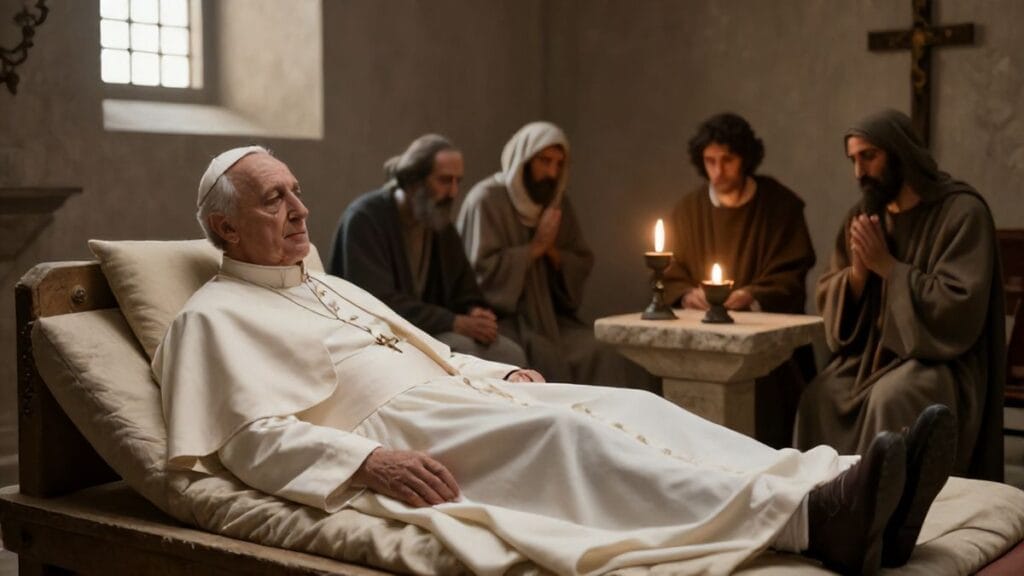
The day itself—4 September 422—comes to us as a date in a list, a bare coordinate in time. Yet it was, for those who lived it, filled with concrete sights, sounds, and emotions. At some hour, perhaps in the dimness before dawn or in the fading light of afternoon, the breath of Boniface I ceased. Around him, gathered clergy murmured prayers, reciting psalms and commendations of the soul in Latin phrases that had, by then, already become familiar rites of passage. The news, once confirmed, spread quickly through the Lateran and beyond.
The immediate response would have been liturgical and administrative. The body of the pope had to be prepared according to Christian custom, vested in appropriate garments, and laid out for veneration. Clergy and prominent laypersons would come to pay their respects, some in genuine grief, others with a calculating eye toward the future. Within hours, undoubtedly, conversations began about the next election. Even in mourning, the Church could not pause its governance.
Outside the clerical circles, the reaction in Rome was likely mixed. Some came to the basilica moved by sincere affection for a pope they had known only as a distant figure at the altar. Others felt only the vague unease that always accompanies the passing of a leader: a sense that the world has shifted, that what seemed stable yesterday is up for debate today. In a city that had once seen emperors come and go in rapid succession, the death of a pope added another note to the melancholy music of impermanence.
Official notices of pope boniface i death were probably dispatched to key bishops and to the imperial court at Ravenna. Scribes recorded the date carefully. Later compilations, such as the Liber Pontificalis, would summarize his reign in a few terse lines, noting his struggle with Eulalius, his doctrinal positions, and his burial place. One can almost hear the scratch of the stylus as a scribe wrote: “He died on the 4th day of September and was buried…” Such formulaic words freeze into permanence a moment that, for those present, was drenched in uncertainty.
Yet even as Boniface’s body lay in state, the institutional machinery of the papacy showed its growing resilience. There was no return to the chaos of 418. The memory of that crisis, combined with the lessons learned by both Church and emperor, helped prevent a repeat. However much people whispered about intrigue or speculated about future conflicts, Rome did not divide itself around rival altars in the days immediately following his death. In that sense, the peaceful transition that followed his passing was itself part of his legacy.
Aftermath and Suspicion: Was There Foul Play?
Whenever a powerful figure dies in a time of political tension, rumors of foul play are never far behind. It is thus hardly surprising that, in some later traditions and speculative modern works, questions have been raised about the circumstances of pope boniface i death. Did he die of natural causes, as the official silence seems to imply? Or might there have been more sinister forces at work, seeking to remove a pope whose past victory had embittered rivals?
The historical evidence for any plot is, in truth, thin. No contemporary chronicle explicitly accuses anyone of poisoning or violence. The Liber Pontificalis, our principal narrative source for many early popes, offers no hint of scandal in its brief account of his passing. Still, the very context of his pontificate—born in schism, dependent at a key moment on imperial intervention—has fueled imaginations. In an age when assassination and intrigue were common tools of politics, it would have been conceivable for enemies to mask a murder as a sudden illness.
Some modern historians argue that the absence of explicit accusations in the sources weighs heavily against the likelihood of foul play. After all, polemical rivals in later generations were not shy about attributing crimes to opponents. If strong suspicions had existed, they might have surfaced in the writings of those who had favored Eulalius or resented Boniface’s actions. The silence, in this case, might truly indicate that his death was unremarkable from a medical standpoint—perhaps the result of age and the unsanitary conditions in which even elites lived.
Yet suspicion is also part of the human response to power. The very fact that pope boniface i death followed a pontificate defined by conflict made it easy, especially centuries later, to imagine darker explanations. The scarcity of detail invites speculation. It is in this interplay between documented fact and imaginative reconstruction that historical writing must tread carefully. One may note the possibility of intrigue without mistaking it for certainty.
What we can say with greater confidence is that the Church, at the time, chose to remember Boniface not as a martyr to conspiracy but as a legitimate pope who had steered the ship through rough waters. Whatever private doubts may have circulated in whispered conversations, they did not crystallize into enduring accusations. Instead, the focus quickly shifted to the next occupant of the papal throne—and to the larger questions facing a Church and empire still tottering on the brink.
A Divided Church Learns to Bury Its Dead
The funeral and burial of Boniface I offered the Roman Church an opportunity both to mourn and to reaffirm its unity. Christian funerary rites, by the early fifth century, had taken on a solemn choreography: processions, psalmody, the reading of Scripture, the commending of the soul to God. For a pope, these rituals unfolded on a public stage. Senators, clergy, monks, and ordinary citizens would have joined, creating a moving tapestry of late antique Roman society gathered around a single body.
The location of his burial mattered. Sources indicate that Boniface was laid to rest in the cemetery of Saint Felicitas on the Via Salaria, outside the city walls. This choice linked him with the venerable tradition of martyr veneration and with the older Christian practice of burying the faithful near the graves of saints. Later, his relics were said to have been translated to other churches within the city—an indication of the enduring respect accorded to his memory. In stone and soil, the Church inscribed its judgment: Boniface was a pope worthy of honor, regardless of the controversy at his accession.
The act of burial also helped to heal the wounds of schism. Those who had once backed Eulalius could, by participating in the funeral or by venerating Boniface’s tomb in later years, signal their acceptance of the ecclesiastical order that had emerged. Death has a way of softening the hard edges of conflict. The man who, in life, had embodied a divisive election now became, in death, a symbol of continuity: one more link in the unbroken chain of Roman bishops leading back to Peter.
Liturgically, the Church would have commemorated Boniface in the lists of deceased popes prayed for at certain times. Over time, his name entered martyrologies and calendars, especially as his cult grew. This sacramental remembrance transformed the political struggles of his pontificate into a narrative of faithful service. The tensions that had once threatened to tear the Church apart were, in a sense, buried with him—though their lessons remained, etched in institutional memory.
Thus, the story of pope boniface i death is also a story about how institutions survive crisis. Through ritual, commemoration, and spatial memory—tombs, basilicas, catacombs—the Church domesticated conflict, transforming it into a past that could be honored rather than continually relived. The very act of burying a once-contested pope underlines a subtle but powerful truth: in late antique Rome, the Church was learning not only how to fight, but how to move on.
The Long Shadow of a Short Reign
Measured in years, Boniface’s time on the papal throne was modest. From late 418 to early September 422—less than four years—he governed a Church far larger than any single man could hope to master. Yet the shadow of his reign, cast forward through time, is longer than those bare numbers suggest. The issues he faced—papal elections, imperial intervention, doctrinal controversy, and the relationship between Rome and other episcopal sees—would remain central to the history of the papacy for centuries.
His contested election became, in later ecclesiastical thought, a kind of negative model: a demonstration of what must not be allowed to happen again. Canonists and church leaders, looking back, saw in the double election a warning about the dangers of factionalism and the importance of clear procedures. Although formal conclaves lay centuries in the future, the memory of Boniface and Eulalius contributed to the slow evolution of norms seeking to limit secular interference and prevent rival claimants from tearing the Church apart.
His engagement with the Pelagian controversy helped confirm the Roman bishop’s role as an arbiter of doctrine in the Latin West. By siding with Augustine and the African councils, Boniface tied the authority of his see to the emerging theological consensus on grace and original sin. Later generations, reading the letters of this period, would see in his decisions an early expression of what would one day be called “magisterium”: the teaching authority of the Church, embodied in the bishop of Rome in a special way.
The geography of his interventions—reaching into Gaul, Illyricum, and Africa—also prefigured the expanding horizon of papal influence. Though he did not, and could not, exercise the kind of centralized authority associated with much later popes, he helped to normalize the idea that appeals could travel to Rome and that Rome’s responses mattered. In that sense, his daily work as a letter-writer and adjudicator may have been more important for history than the dramatic scenes of his election.
In the end, the long shadow of pope boniface i death lies in its quietness. He did not die a martyr in a circus, nor a victim of a public scandal. He died, it seems, as many bishops did: worn down by office, in the midst of unfinished work. His absence was felt not through catastrophe but through the simple realization that someone else must now shoulder the burden. For an institution as enduring as the papacy, such moments of transition—the passing of one guardian and the arrival of another—are the true milestones of continuity.
Remembering Boniface I: Saint, Politician, or Survivor?
How should we remember Boniface I today? As a saint honored in liturgical calendars, as a canny politician who navigated a treacherous landscape, or as a survivor whose chief distinction was that he endured where others fell? The historical record allows for all these portraits, and each reveals something about the complexities of late antique papal leadership.
In the Church’s hagiographical memory, Boniface appears as a faithful pope who defended orthodoxy, upheld ecclesiastical discipline, and bore the burdens of office with patience. His inclusion in the Roman Martyrology places him among those whose lives the Church considers exemplary, even if he is not the subject of elaborate medieval legends. Here, pope boniface i death is simply the natural close of a life of service, a passage from earthly responsibility to heavenly reward.
Viewed through a political lens, he emerges as a more ambiguous figure. He accepted, and in some measure relied upon, imperial intervention to secure his claim; yet he also defended the integrity of papal elections and sought to limit secular overreach. He maneuvered among aristocratic factions without becoming merely their pawn. His skill lay not in daring innovation but in careful adjustment—a kind of political prudence that may not dazzle but is essential for institutional survival.
As a survivor, Boniface represents a generation of leaders who inherited a world in transition. Born into a still-pagan empire, he died in a Rome unmistakably Christian yet undeniably fragile. He survived invasion, famine, doctrinal storms, and internal schism. Many of his contemporaries—bishops deposed, cities destroyed, doctrines condemned—did not fare so well. That he managed to guide the Roman Church through such turbulence without further schism is, in itself, no small achievement.
These three images—saint, politician, survivor—are not mutually exclusive. Together, they offer a more textured understanding. The man whose death on 4 September 422 passed almost without comment in secular chronicles nonetheless occupies a crucial node in the chain of papal history. He reminds us that the story of the papacy is not only about towering figures like Leo the Great or Gregory the Great, but also about quieter souls who held the line in less celebrated years.
How Historians Reconstruct a Papal Death
To write about pope boniface i death is also to confront the methodological challenges that historians face when dealing with late antique papal history. Sources are sparse, biased, often written decades later, and heavily filtered through theological and institutional agendas. The historian’s task is to sift through these fragments—letters, imperial laws, papal catalogues, later chronicles—and to weave from them a plausible narrative without overstating what can be known.
Primary among our sources is the Liber Pontificalis, a collection of papal biographies begun in late antiquity and continued into the Middle Ages. Its entry on Boniface is brief but suggestive, noting his conflict with Eulalius, his doctrinal positions, and the date and place of his burial. As the historian Raymond Davis observes in his English translation of the text, the compilers often shaped their accounts to emphasize continuity and orthodoxy, smoothing over controversies that might unsettle later readers. Thus, their silence about any irregularities in Boniface’s death can be read as either evidence of normalcy or as a deliberate choice to avoid scandal—we cannot say with certainty.
Imperial documents preserved in collections like the Collectio Avellana shed light on the double election and on the emperor’s role in resolving it. These texts, often legalistic and dry, must be interpreted in the broader context of imperial politics. They do not mention Boniface’s final illness, but they help us understand the stakes that made his death a moment of potential instability. Patristic letters—from Augustine, from African and Gallican bishops—reference Rome’s decisions, allowing us to reconstruct the web of relationships in which Boniface moved.
Archaeological evidence plays a quieter role. Inscriptions on tombs, traces of ancient basilicas, and the stratigraphy of catacombs help confirm burial places and patterns of veneration. If Boniface’s remains were indeed translated from the cemetery of Saint Felicitas to another Roman church, as later tradition suggests, such movements speak to the continuing relevance of his memory long after his passing.
Modern historians, such as Peter Heather and others who study the late Roman world, often situate papal history within the broader collapse and transformation of the Western Empire. From this vantage point, Boniface’s life and death appear as part of a larger pattern: institutions recalibrating themselves as imperial structures faltered. His papacy becomes a case study in how the Church used legal forms, ritual, and claims of apostolic tradition to stabilize itself amid political fragmentation.
In all this, humility is essential. We must acknowledge the gaps, resist the lure of sensationalism, and remain honest about the limits of our knowledge. Yet within those limits, a vivid enough picture emerges to make the story of pope boniface i death more than a footnote. It becomes a window onto a world in which every death of a leader tested the resilience of emerging Christian institutions.
The Death of Boniface I and the Transformation of the Papacy
Boniface did not single-handedly transform the papacy. Yet his life and death belong to a crucial phase in that transformation. The bishop of Rome, once one among many prominent bishops, was gradually becoming something more: a figure whose authority transcended local contexts, whose decisions shaped doctrine and discipline across the Latin West, and whose very succession became a matter of imperial concern.
The double election that marked his rise underscored the growing importance of the office. Rival factions would not have fought so fiercely, nor kings and emperors intervened so decisively, if the papacy were a minor role. The dangers revealed by that struggle pushed the Church, slowly but inexorably, toward more formalized systems of election and a clearer sense of the pope’s distinctive position. The memory of the crisis stayed alive as a warning sign, a negative example against which later reforms would define themselves.
In doctrinal matters, Boniface’s tenure helped cement Rome’s image as a theological center aligned with key Western thinkers like Augustine. By endorsing anti-Pelagian decisions and reinforcing earlier condemnations, he strengthened the association between Roman orthodoxy and a particular vision of grace and human nature. Over time, such associations would contribute to the perception that Rome was the ultimate guardian of Christian truth—a perception that, in the Middle Ages, would become an article of faith for many.
His death, and the orderly succession that followed, also signaled that the papacy had developed enough institutional depth to weather the loss of a leader without descending into chaos. The fact that no new Eulalius appeared in 422 suggests that the lessons of the previous schism had been learned. The Church had become, in some measure, self-correcting. It could absorb the shock of leadership change and maintain continuity of governance.
Thus, when we place pope boniface i death within a longer arc, we see more than the end of a single pontificate. We see an episode in the gradual emergence of the papacy as a central, stabilizing force in a disintegrating Western Empire. The man who once seemed merely a compromise candidate chosen in the wake of turmoil now appears as one of the many stones laid in the foundation of an institution that would outlast emperors, kingdoms, and even the city that had birthed it.
Legacy in Stone: Tombs, Basilicas, and Urban Memory
Long after the last person who had known Boniface in life was dead, the memory of his existence persisted in the physical fabric of Rome. Tombs, inscriptions, and basilicas became silent witnesses to his presence. Initially buried in the cemetery of Saint Felicitas, his body lay among other bishops, priests, and martyrs—one more inhabitant of the Christian necropolis that ringed the city along its major roads.
Later traditions report that his relics were translated into a church within the walls, a common practice as Rome’s Christian topography evolved. Such translations reflected both practical concerns—protection from grave robbers, desire for more accessible shrines—and theological convictions about the communion of saints. If Boniface was venerated as a saint, his presence within a church would sanctify the space, attract pilgrims, and insert his memory into the daily liturgical life of the city.
The urban memory of a pope also survived in subtler ways: in the dedication of altars, in the inclusion of his name in litanies, in the stories told by clergy to new generations. A young deacon in the sixth century, serving under Pope Gregory the Great, might have heard elders speak of their predecessors who had known men who had, in turn, served Boniface. Oral chains of memory, while fragile, could extend surprisingly far, preserving particular anecdotes or judgments long after written records had been lost.
Archaeology occasionally brushes against these memories. A fragmentary inscription bearing his name, a reused marble slab mentioning the cemetery where he lay, a later church claiming his relics: each offers a faint echo. Combined with textual evidence, they allow us to see how the late antique and early medieval Church curated its own past, deciding which popes to highlight, which to leave in the penumbra. Boniface, never among the most famous, nonetheless remained present, a quiet but persistent figure in the city’s sacred landscape.
Thus, the legacy of pope boniface i death is not confined to archives and scholarly debates. It is inscribed, however faintly, in the stones of Rome. Every time a pilgrim, centuries later, knelt in a basilica where his relics were believed to rest, they participated—unknowingly—in the long afterlife of a man whose own world had fallen into ruins but whose institution had endured.
From 422 to Today: Why Boniface’s Death Still Matters
At first glance, the death of a relatively obscure fifth-century pope might seem distant from contemporary concerns. Yet the story of Boniface I’s life and death resonates with themes that continue to shape our world: the relationship between religious authority and political power, the challenges of leadership in times of crisis, and the ways institutions navigate succession and maintain continuity.
In modern debates about the papacy—its authority, its election processes, its interaction with secular governments—the echoes of Boniface’s age are unmistakable. The double election that brought him to power foreshadows later conclave struggles and contested papacies. The imperial intervention that resolved his conflict with Eulalius anticipates centuries of entanglement between popes and emperors, kings, and states. His efforts to heal a divided Church and to assert doctrinal clarity in the face of popular but, in his view, dangerous teachings find parallels in contemporary struggles over theology and discipline.
Moreover, the quiet normality of pope boniface i death offers a counterpoint to narratives that focus only on spectacular martyrdoms or dramatic councils. Most institutional history is made not in great crises but in the daily work of administrators, the slow clarification of norms, the careful handling of transitions. Boniface’s passing, and the orderly succession that followed, illustrate how much depends on leaders who are neither saints of legend nor notorious villains, but patient stewards.
For historians and readers alike, his story is a reminder of the discipline required to read the past responsibly. We must balance the allure of drama with respect for the mundane, the temptation to fill silences with speculation with the honesty to say, “We do not know.” The death of Boniface I invites us to value the fragmentary, to treasure the fragile sources that survive, and to accept that sometimes the most important events leave the faintest traces.
In the end, to reflect on his death is to look into a mirror of our own concerns. How do we handle contested authority? How do we ensure peaceful transitions of power? How do we balance tradition with adaptation in times of upheaval? Those were Boniface’s questions. They remain ours.
Conclusion
Pope Boniface I lived and died in a world that felt itself on the verge of collapse. Rome had been sacked; emperors seemed weak; borders crumbled. Within this maelstrom, the Church sought to define itself: to clarify what it believed, to determine who spoke for it, and to organize how its leaders would be chosen. Boniface’s rise through a double election, his struggles with imperial power and theological controversy, and the quiet ordinariness of his passing on 4 September 422 together form a chapter in this larger story.
His death did not come in a blaze of martyrdom, nor did it precipitate immediate catastrophe. Instead, pope boniface i death showed that the papacy had gained enough resilience to endure the loss of a leader without tearing itself apart. The memories of schism shaped a more cautious, more structured approach to succession. His doctrinal decisions, especially on Pelagianism, reinforced Rome’s role in shaping Western theology. His administrative work, preserved in scattered letters, helped normalize the idea of the Roman bishop as a point of appeal for distant churches.
To revisit his final days in Rome is to see, in miniature, the transformation of Christian leadership in late antiquity. Here was a man shaped by an older Roman world of aristocrats and emperors, yet laboring to build an institution that would outlast that world. His death marked the end of one papal life, but also the continuation of a line whose significance was only beginning to be felt. In the shadowed streets of early fifth-century Rome, as news of his passing spread and preparations began for a new election, few could have guessed how enduring the office he had held would become.
And yet, from our vantage point, we can see that the threads running through his story—conflict and reconciliation, doctrine and politics, mortality and continuity—are woven into the broader tapestry of Church history. Remembering Boniface I, and taking seriously the sparse but suggestive records of his life and death, reminds us that even seemingly modest pontificates contribute to the enduring architecture of institutions that shape human history.
FAQs
- Who was Pope Boniface I?
Pope Boniface I was the bishop of Rome from late 418 until his death on 4 September 422. He is best known for his contested election against the rival claimant Eulalius, his involvement in the Pelagian controversy, and his efforts to strengthen the authority of the Roman see while maintaining fragile unity in a divided Church and a declining Western Roman Empire. - What was significant about the election of Boniface I?
His election was marked by a rare double election, in which both Boniface and the archdeacon Eulalius were chosen pope by different factions in Rome. The dispute escalated to the imperial court of Honorius in Ravenna, leading to a synod and, eventually, to imperial intervention that expelled Eulalius and confirmed Boniface. This episode highlighted the growing political importance of the papacy and the dangers of factionalism. - What role did Boniface I play in the Pelagian controversy?
Boniface I supported the anti-Pelagian stance championed by Augustine of Hippo and the African councils. He confirmed the condemnation of Pelagian teachings, which minimized the role of divine grace in salvation, and thereby helped shape the Western Church’s doctrine on original sin and grace. His decisions reinforced Rome’s emerging reputation as a guardian of orthodoxy. - How did Pope Boniface I die?
The exact cause of his death is unknown. Contemporary sources simply record that he died on 4 September 422, likely of natural causes associated with age or illness. There is no solid historical evidence of foul play, though the political tensions surrounding his earlier election have led some later writers to speculate about possible intrigue without concrete proof. - Where was Boniface I buried?
Boniface I was originally buried in the cemetery of Saint Felicitas on the Via Salaria, outside Rome’s walls, in keeping with the early Christian practice of burial near the tombs of martyrs. Later traditions suggest that his relics were translated to a church within the city, reflecting his veneration as a saint and the evolving Christian topography of Rome. - Why is the death of Boniface I historically important?
The death of Boniface I matters because it marked a test of the Church’s ability to manage succession peacefully after a bitterly contested election. The relative calm that followed his passing indicated that the lessons of the earlier schism had been absorbed. His pontificate and its conclusion also contributed to the gradual transformation of the papacy into a central institution capable of providing doctrinal and administrative leadership in a fragmenting empire. - How do historians know about Boniface I and his death?
Historians rely on a combination of sources: the Liber Pontificalis (a collection of papal biographies), imperial documents preserved in collections like the Collectio Avellana, letters from contemporaries such as Augustine of Hippo and African bishops, and archaeological evidence from tombs and churches. These materials are fragmentary and biased, so scholars must interpret them carefully to reconstruct the events of his life and the context of his death. - Was Boniface I considered a saint?
Yes. Boniface I is venerated as a saint in the Catholic Church, and his feast day is associated with the date of his death, 4 September. Though he is not among the most widely known papal saints, his inclusion in martyrologies and calendars reflects the Church’s judgment that he lived a life of faithful service in a time of significant upheaval.
External Resource
Internal Link
Other Resources
- Encyclopaedia Britannica – general search for the exact subject
- Google Scholar – academic search for the exact subject
- Internet Archive – digital library search for the exact subject