Table of Contents
- A Fragile Peace in a City of Canals: Setting the Stage in Antwerp, 1609
- From Revolt to Stalemate: Four Decades of War in the Low Countries
- Merchants, Mariners, and Ministers: The World Around the Dutch Revolt
- Spanish Weariness and Dutch Ambition: How Both Sides Came to the Same Table
- The Road to Antwerp: Secret Contacts, Failed Talks, and Hard Lessons
- Inside the Negotiating Chambers: Voices, Fears, and Bargains
- The April Morning in Antwerp: Signing the Twelve Years’ Truce
- Recognition Without Saying the Word: Sovereignty and Legal Fictions
- Guns Silenced but Minds Alert: Military and Strategic Consequences
- A Republic of Traders Unleashed: Commerce, Colonies, and the Dutch Golden Age
- Winners, Losers, and Those Left in Between: The Spanish Netherlands Under Truce
- Faith, Tolerance, and Exile: Religious Lives in the Shadow of the Truce
- The View from the Streets: Ordinary People and the Price of Quiet
- Critics, Firebrands, and Spoilers: Those Who Hated the Truce
- A Global Pause: How the Truce Shaped War and Empire Beyond Europe
- From Hope to Fracture: Internal Strife in the Dutch Republic
- The Clock Runs Out: Why the Truce Failed to Become Lasting Peace
- Echoes Through Centuries: The Twelve Years’ Truce in Historical Memory
- Conclusion
- FAQs
- External Resource
- Internal Link
Article Summary: On 9 April 1609, in the bustling city of Antwerp, envoys of the Spanish Crown and the rebellious northern provinces signed an agreement that posterity would remember as the twelve years truce 1609, a pause in a war that had dragged on for decades. This article traces the conflict that produced the revolt of the Netherlands, the political exhaustion that drove both sides to negotiation, and the slow, tense diplomacy that culminated in a fragile truce. It follows merchants and soldiers, exiles and clerics, as they confronted a transformed landscape where guns fell silent but rival ambitions did not. The narrative explores how the truce reshaped European power politics, opened the door to Dutch global expansion, and locked the Spanish Netherlands into an uneasy dependence. It also reveals how the twelve years truce 1609 deepened religious divisions at home, even while it encouraged an image of the Dutch Republic as a haven of tolerance. As the story unfolds, we see how the truce’s terms were both daring and evasive, recognizing de facto independence without fully admitting it. By revisiting the twelve years truce 1609, the article shows how a temporary agreement can alter the trajectory of states, empires, and ordinary lives. And it argues that the memory of the twelve years truce 1609 is not merely about a pause in war, but about the birth of a new kind of European republic, forged between battlefield stalemate and diplomatic ingenuity.
A Fragile Peace in a City of Canals: Setting the Stage in Antwerp, 1609
The morning air over Antwerp on 9 April 1609 was laced with an odd quiet. For a city that had once throbbed with the noise of Europe’s richest marketplace, this hush felt almost ceremonial. Church bells rang, carts rumbled along cobblestones, and the Scheldt River flowed as it always had, but something had shifted. Within the ornate chambers of a city that had seen its fortunes rise and fall with the tides of war, delegates from the great Habsburg empire and the defiant Dutch Republic gathered to sign a document that would become known as the twelve years truce 1609.
It is easy, with the distance of centuries, to imagine this as a neat diplomatic tableau: dignitaries in stiff ruffs, pens scratching parchment, handshakes exchanged. Yet the atmosphere was not one of triumph; it was of exhalation, of calculation, of cautious relief. Behind every stroke of ink lay forty years of rebellion, siege, massacre, bankruptcy, and stubborn resistance. For the Spanish Monarchy, this agreement was an admission that sheer power could not bend the northern provinces back into obedience. For the United Provinces, it was a moment of semi-recognition—recognition wrapped in legal ambiguity, yet real enough to change the map of Europe.
Outside the council chambers, ordinary people wondered what this new calm would bring. Antwerp, now firmly within the Spanish Netherlands, had watched its northern cousins in Amsterdam and Rotterdam grow rich while its own trade withered under blockade. Merchants hoped that a truce might reopen channels of commerce, or at least reduce the risks of sending cargo out under hostile skies. Soldiers, garrisoned in nearby forts and citadels, listened to rumors that their regiments might be disbanded. Refugees pondered whether the border that had cut them from their birthplaces might soften, or whether this pause in war would only solidify division.
The twelve years truce 1609 did not appear at the end of a neatly resolved conflict. It emerged, instead, from exhaustion and deadlock. Spain’s once-unquestioned might was buckling under the weight of continuous war: the Dutch Revolt, the war against England, the endless struggle against the French, and the defense of a global empire stretching from Peru to the Philippines. The Dutch, for their part, had transformed from rebellious subjects into an assertive republic of merchants and sailors, but their victories had cost them dearly in blood and treasure. Both sides understood that they could not continue like this indefinitely.
Yet behind the solemnity of the signing lay a simmering tension: neither side cherished peace for its own sake. Spain hoped the truce would be a breathing space, a “suspension of arms” that would eventually lead the wayward provinces back into the Catholic fold and Habsburg obedience. The Dutch leadership, especially the grand pensionary Johan van Oldenbarnevelt, saw something else: a strategic respite in which the young republic could consolidate its institutions, expand its trade, and build the wealth necessary to stand alone in a world of monarchies. The twelve years truce 1609 was a pause, but it was also a proving ground.
As the ink dried in Antwerp, scarcely anyone believed that they were witnessing an end. They sensed, rather, a hinge—a moment when the direction of European politics might subtly swivel. Would the Habsburg empire manage to reassert itself, grander and more organized after a period of rearmament? Or would the Dutch transform this temporary reprieve into the bedrock of a new kind of power, based less on land and dynastic claims than on ships, credit, and trade? Those questions reverberated from court to dockyard, and they would not be settled for many years to come.
From Revolt to Stalemate: Four Decades of War in the Low Countries
To understand why the decision in Antwerp mattered, one must turn back to the tangled origins of the Dutch Revolt. When the troubles began in the 1560s, there was no “Dutch Republic,” no clear-cut north versus south, no accepted notion that sovereignty could rest with provincial estates rather than princes. There was, instead, a composite realm known as the Habsburg Netherlands, gathered under the rule of Charles V and later his son Philip II, stitched together by inheritance, purchase, and conquest. These provinces were wealthy, urbanized, and fractious. They boasted some of Europe’s most advanced agriculture and industry, and some of its most stubborn local privileges.
Religious change lit the first fuse. Protestantism—first Lutheran, later Calvinist—spread through the towns and countryside, mingling with existing grievances over taxation and noble resentment of royal officials. Philip II, a devout Catholic ruling from Madrid, saw the persistence of heresy as both a spiritual affront and a challenge to his authority. In 1567 he sent the Duke of Alba with an army to stamp out the unrest. What followed was the Council of Troubles—called by its enemies the “Council of Blood”—which tried and executed hundreds for rebellion. One nobleman who escaped execution, William of Orange, chose exile, resistance, and ultimately assassination over submission.
The war that unfolded over the next decades was brutal and ambivalent. It saw mutinous Spanish troops sack Antwerp in 1576, leaving the city in flames and sending shockwaves across Europe. It saw northern provinces unite in the Union of Utrecht (1579), while the southern provinces, more heavily Catholic and more dependent on Spanish garrisons, signed the Union of Arras and declared their loyalty to the king. It saw the Act of Abjuration (1581), in which the rebellious provinces formally renounced Philip II as their sovereign—a revolutionary document that some historians have compared, in spirit if not in wording, to later declarations of independence.
Yet military reality often lagged behind these bold political gestures. The Spanish governor-general Alexander Farnese, Duke of Parma, proved a formidable commander. By the mid-1580s he had reconquered much of the south and key towns in the north. Antwerp itself fell to his forces in 1585, its river blocked by a chain of fortifications that gave the Habsburgs firm control of the Scheldt. Merchants and artisans fled northward, carrying their skills to rising ports like Amsterdam. The Republic—still more aspiration than state—survived, but its survival seemed precarious.
Over time, however, the balance shifted. Geography favored the rebels: the watery maze of the northern provinces made them difficult to subdue. The so-called “watergeuzen,” or Sea Beggars, harassed Spanish shipping. Dutch garrisons could flood fields by opening dykes, turning battlefields into marshes that bogged down heavy infantry. The assassination of William of Orange in 1584 was a devastating blow, but subsequent leaders—like his son Maurice of Nassau—refined the art of war, professionalizing the army and introducing new drill and tactics that would make the Dutch a model for later European militaries.
International politics compounded Spain’s difficulties. The failed Armada against England in 1588 drained Habsburg coffers and tarnished their invincible image. France, too, oscillated between civil war and opposition to Spanish power, eventually emerging under Henry IV as a pragmatic counterweight to Habsburg ambitions. The Dutch found allies where they could: English troops under the Earl of Leicester briefly intervened, and although the experiment was clumsy, English support, subsidies, and privateers became a recurring thorn in Spain’s side.
By the turn of the seventeenth century, neither side could deliver a decisive blow. Spanish forces maintained powerful positions in the south and along the so-called “Spanish Road,” the route that linked Italian territories to the Low Countries. The Dutch, consolidated in the north, had begun to build a maritime empire, sending fleets to the East Indies and Brazil. Their victories at sea—particularly against the Portuguese, by then under Spanish rule—showed that war had spilled far beyond European fields. The conflict in the Low Countries had become “the longest war,” a grinding confrontation that drained treasuries, unsettled populations, and bred a generation that knew little but mobilization.
This stalemate was not a stillness; it was a shivering equilibrium. Forts changed hands in campaigns that cost thousands of lives. Towns were besieged, surrendered, or starved into submission. Taxes rose. Silver from American mines poured through Spanish hands and straight into creditors’ coffers. It became clear to many observers that if something did not change—if some sort of accommodation was not reached—the entire European system might begin to fracture under the strain.
Merchants, Mariners, and Ministers: The World Around the Dutch Revolt
Behind the clash of armies and the solemn language of political treaties lay a wider transformation. The war in the Low Countries unfolded at the crossroads of an emerging global economy. Flemish and Dutch merchants were not merely local traders; they were part of a network stretching from Baltic grain ports to Iberian spice depots, from North Sea fisheries to Mediterranean markets. The constant fighting threatened these connections, but it also pushed innovators to seek new paths and new partners.
When Spanish power tightened over traditional sea routes, Dutch merchants looked farther. The foundation of the Dutch East India Company (VOC) in 1602 was both a commercial revolution and an act of war. The company received quasi-sovereign powers: it could wage war, negotiate treaties, and govern territories in Asia. VOC fleets hammered at Portuguese fortresses, seized spice islands, and established bases from Ceylon to Batavia. In doing so, they attacked a pillar of Habsburg wealth, for Portugal’s empire had fallen under Spanish rule in 1580.
Within Europe, neutral and rival powers watched the struggle with fascination and concern. English merchants welcomed any extension of Dutch naval presence that weakened Spain, but they also feared Dutch competition. French officials weighed how best to make use of a divided Habsburg Monarchy on their borders. Italian bankers, lending to kings and republics alike, studied interest rates and risks, quietly shaping the limits of what even the mightiest monarchs could afford to do.
Religious ministers added their own fervor. Calvinist preachers in the north framed the revolt as a righteous stand against tyranny and papal superstition. Jesuits and other Catholic clergy in the south cast the rebels as heretics led astray by greedy nobles and foreign agents. Sermons turned battles into morality tales; victories signified divine favor, while defeats demanded introspection, repentance, or renewed zeal. In such an atmosphere, any notion of compromise looked suspicious, even treacherous.
This swirling context made the idea of a truce both attractive and deeply unsettling. A cessation of hostilities might allow merchants to ship their goods with less fear, insurers to lower their rates, and towns to rebuild. But it might also grant breathing space for rivals to grow stronger. In particular, some Spanish advisers worried that a pause would legitimize Dutch expansion overseas, letting them capture even more of the lucrative spice trade. Many Dutch firebrands likewise feared that once soldiers were sent home and taxes eased, the Republic’s will to resist might slacken, opening the door to diplomacy that would erode its hard-won liberties.
By the first decade of the seventeenth century, the war had become too enmeshed with commerce, religion, and imperial rivalry to be ended easily. Yet that very entanglement also generated pressure for a different kind of solution. As one contemporary chronicler observed—echoed later by historians such as Geoffrey Parker—“neither the King of Spain nor the States of Holland could live forever upon gunpowder.” Something would have to give. That something, as it turned out, would take the form of a limited, risky, but transformative agreement: the twelve years truce 1609.
Spanish Weariness and Dutch Ambition: How Both Sides Came to the Same Table
By the time talks for a cessation of arms became serious, both Madrid and The Hague were feeling the weight of continuous conflict. On the Spanish side, Philip II had passed from the scene in 1598, leaving a strained monarchy to his son, Philip III. The new king lacked his father’s intense personal involvement in governance, delegating much of the running of the realm to his favorite, the Duke of Lerma. Under Lerma’s watch, the monarchy’s finances remained in chronic crisis: repeated bankruptcies, spiraling debts, and ongoing commitments from Italy to Flanders to the New World.
It is tempting to see the Spanish Crown as a juggernaut, its tercios marching invincibly across Europe. By 1600, however, that image was more myth than reality. The tercios were still formidable, but they cost money to recruit, arm, and feed, and they depended on long, vulnerable supply lines. Troop mutinies were frequent, prompted by arrears in pay. The “Spanish Road”—the route by which reinforcements marched from Italy to the Low Countries—passed through territories like Franche-Comté and parts of the Holy Roman Empire, which were increasingly wary of being dragged deeper into Spain’s wars.
The Dutch Republic, for its part, had come a long way from the ragged rebellion of the 1570s. By the early seventeenth century, the United Provinces had a functioning federal structure, led by the States General. Key provinces such as Holland wielded enormous influence thanks to their wealth. The Stadtholder, Maurice of Nassau, had built a professional army that was the envy of Europe, organized around smaller, more flexible units and rigorous training. Dutch engineers had refined the science of fortress building and siege warfare, turning the lowlands into a chessboard of bastions and flooded fields.
Yet success brought new pressures. Maintaining a large standing army and navy demanded ever-higher taxation and constant negotiation with provincial estates. War was good for certain kinds of business—shipbuilding, arms manufacturing, privateering—but it also frightened away investment and disrupted long-distance trade. Leading merchants and regents, especially in Holland, began to consider whether continued fighting was the best path to prosperity. They wanted security for their ventures in Asia and the Atlantic, and more predictable conditions at home.
Political leaders on both sides had to navigate between pragmatic calculation and ideological commitment. In Spain, many counselors argued that a truce with the rebels would damage royal prestige and betray loyal Catholic subjects in the southern Netherlands. In the Republic, Calvinist ministers and the fiery stadtholder Maurice worried that any concession might unravel the unity that had held the provinces together in wartime. Johan van Oldenbarnevelt and other advocates of negotiation had to frame the prospective truce not as capitulation, but as a strategic reprieve.
Still, by 1607 the cost-benefit calculus tilted toward talks. Naval battles in the English Channel and off the Portuguese coast were draining Spanish resources. Dutch privateers had inflicted blows on Iberian shipping that could not be ignored. The war risked spinning off into endless, unprofitable skirmishing. As one diplomat wrote in a private letter, “We are like men locked in a house of flint, striking sparks that burn us both.” The image captured the sense that continued confrontation might prove mutually ruinous.
Into this fraught environment stepped intermediaries—envoys from France and England who saw advantages in brokering a limited peace. Henri IV of France, ever the opportunist, hoped to keep both Spain and the Dutch Republic at a manageable level of strength, so that neither could dominate the continent. James I of England, recently ascended to the throne in 1603, favored a more pacific approach than his predecessor Elizabeth I and was open to easing the burdens of conflict, particularly at sea. Their mediation offered both sides a face-saving framework within which to explore terms.
The Road to Antwerp: Secret Contacts, Failed Talks, and Hard Lessons
The path to the twelve years truce 1609 was not linear. It zigzagged through secret feelers, aborted meetings, and bouts of renewed fighting. Early attempts at negotiation foundered on basic questions: Should the Spanish Crown recognize the Republic? Would the Dutch accept any form of overlordship, even nominal? How would colonial and trade disputes be addressed? For years, each side clung to formulas that the other found impossible to accept.
In 1607, an important breakthrough occurred when Spain and the Dutch Republic agreed to a ceasefire at sea. This limited cessation of hostilities, reached with English and French mediation, allowed both sides to test the waters—literally and figuratively. Could they scale down their conflict without appearing weak? Could they trust that the other would not exploit the lull for a surprise assault? The ceasefire did not answer these questions definitively, but it created a window in which more substantial negotiations could be considered.
Discussions gathered pace in The Hague and in Spanish-held territories. Envoys shuttled between courts, sometimes in disguise or under assumed purposes, for open contact with rebels still carried a whiff of illegitimacy in Spanish circles. Debates raged in pamphlets and sermons. Advocates of peace published tracts arguing that even a long truce could bring the blessings of stability, while hawks warned that any softening would invite disaster. “Peace with a heretic,” thundered one Catholic polemicist, “is war with God.” On the other side, Calvinist preachers urged their flocks to remember that the enemy was crafty, likely to use any truce as a back door to spiritual and political domination.
The murder of France’s Henri IV in 1610 would later be seen as a turning point in European diplomacy, but even before his death, the limitations of relying on outside mediators had become clear. Ultimately, it was the hard arithmetic of war—troop numbers, coin, and credit—that pushed both sides into a more serious frame of mind. Spain’s Council of State recognized that without some relief, the monarchy might be forced into yet another humiliating suspension of payments. Dutch leaders faced the prospect that indefinite war could erode popular support for the Republic’s very existence.
Antwerp emerged as a logical venue for formal talks. Once a jewel in the Habsburg crown and the beating heart of European trade, it now stood as a symbol of both lost glory and enduring importance. The city was under firm Spanish control, but it sat close enough to the shifting frontiers of the conflict to remind everyone of the stakes. Its merchants understood better than most the price of conflict; they had seen their river sealed, their houses burned, their markets eclipsed by northern rivals.
By late 1608, delegations began to converge on Antwerp. The Spanish Netherlands were represented by figures loyal to Archduke Albert and Archduchess Isabella, the Habsburg couple who ruled the region in the name of the Spanish king but with a degree of autonomy. On the Dutch side, Johan van Oldenbarnevelt and other experienced statesmen took the lead, accompanied by legal experts steeped in the intricacies of Roman law and emerging concepts of international order. Observers from France and England hovered nearby, lending their presence as guarantors, witnesses, and subtle pressure points.
The stage was set for a negotiation that would test not just the patience of diplomats, but the very language of politics. How could one describe an agreement between a king and a republic he did not wish to recognize? How could one freeze a conflict without implying that the front lines were acceptable? It was in grappling with such dilemmas that the twelve years truce 1609 took on a character that would influence international diplomacy long after the ink in Antwerp had dried.
Inside the Negotiating Chambers: Voices, Fears, and Bargains
Inside Antwerp’s halls of negotiation, the soundscape was a mixture of clinking inkwells, murmured translations, and the scratch of quills on parchment. The participants were men of rank and reputation, but they carried with them the anxieties of entire societies. Every concession might stir uproar at home; every firm line might collapse the talks and plunge both regions back into full-scale war.
For the Spanish and their representatives in the Archducal court, one issue loomed largest: royal authority. To openly recognize the Dutch Republic as a sovereign state would seem to reward rebellion and encourage other subjects to dream of independence. Philip III and his ministers could not stomach such a precedent. At the same time, they could hardly insist on total obedience from provinces whose de facto autonomy had been entrenched by decades of self-government and military success. A formula was needed that could square this circle.
The Dutch delegates, by contrast, were determined to secure at least implied recognition of their freedom. Without it, any truce would be vulnerable to reinterpretation as a mere rebellion-in-recess, something the Crown might extinguish once its finances improved. Johan van Oldenbarnevelt, a man of formidable intellect and stubborn resolve, argued that the Republic should be treated in all practical respects as an independent commonwealth during the truce. The question was how to enshrine that status without forcing Spain to say the unsayable.
The talks ranged over other contentious subjects as well. Trade was a central battleground. The Dutch wanted unfettered commerce, particularly in the Indies and Atlantic, where their companies were carving out routes and posts. Spain, defending its vast overseas empire, sought restrictions that would prevent the rebels from openly marauding Iberian-bound convoys or seizing colonial possessions. After much debate, a deliberately vague compromise was reached: the truce would not extend to the territories overseas. On paper, this meant that war could continue outside Europe, even as it stopped within. In practice, it introduced gray zones that future captains and admirals would zealously exploit.
Religion was another ever-present concern, even when not spelled out in the articles. Catholic authorities worried that a truce would entrench heresy in the north and embolden clandestine Protestants in the south. Dutch leaders, mindful of their own religious minorities and the need for merchant cooperation, favored a relatively broad tolerance, at least compared to their European peers. Explicit guarantees were difficult to frame, but the very existence of a truce between a Catholic monarchy and a Calvinist republic sent an unofficial message: coexistence, however tense, was possible.
Witnesses later described how at certain moments negotiations seemed on the brink of collapse. A poorly chosen phrase here, an overinsistent demand there, could trigger walkouts or angry protests. The mediators’ task was to smooth these edges, suggesting alternative wording, proposing pauses, or offering their own reputations as guarantees. Over weeks and months, the articles of truce took shape, clause by clause, as if a war-weary Europe were teaching itself a new vocabulary.
One Spanish diplomat—quoted by a later historian—remarked with weary admiration, “The Dutch fight with words as stubbornly as they do with ships.” He was not wrong. The Republic’s envoys knew that every ambiguity could later shield their autonomy, and every carefully placed phrase could be cited as evidence that they were being treated as equals. The final text was less a blueprint for friendship than a highly structured armistice, but in its cautious balance lay the reason it would endure for twelve years.
The April Morning in Antwerp: Signing the Twelve Years’ Truce
And so the day came. On 9 April 1609, under the high timbered ceilings of Antwerp’s appointed chamber, the delegations assembled to ratify the agreement their words had carved from thin air. Outside, the city’s residents went about their business, some unaware, others whispering in taverns and at market stalls. A few veterans of the early years of revolt, now gray and limping, watched the movement of official coaches with uneasy eyes. Could it be that the long thunder of war was, for a time, to quieten?
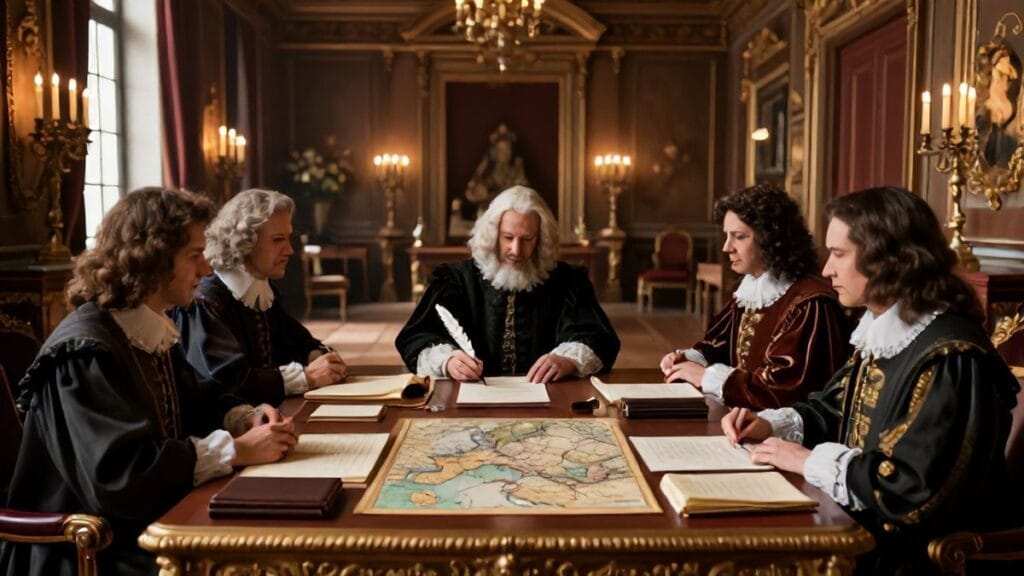
Inside, the air was heavy with incense and candle smoke. Tables were laid with thick parchment, ribbons, and the wax seals that would transform the negotiators’ work into binding commitment. Representatives of the Archduke Albert and Archduchess Isabella sat opposite those of the States General, flanked by observers from France and England. Notaries stood ready to record the proceedings, their pens already stained from weeks of drafting and redrafting.
The document before them set forth, in precise legal terms, that there would be a suspension of arms between the Spanish Monarchy (including the Archducal Netherlands) and the United Provinces for a period of twelve years. During that time, each side would retain possession of the territories it held at the moment of the truce’s commencement. The Republic would be allowed to conduct its trade and diplomacy much like any recognized state, though the language carefully avoided stating that it was equivalent to a monarchy. In all but name, however, the Dutch had achieved a form of recognition that Philip II would have considered unthinkable.
As the signatures were affixed and seals pressed, a strangely subdued mood settled over the chamber. Some envoys crossed themselves, others offered silent nods of acknowledgment to their counterparts. They knew that what they were doing could not please everyone they represented. Hardliners in Madrid and Brussels would call it weakness; zealots in The Hague and Amsterdam would brand it compromise with tyranny. Yet in that room, at least for an instant, there was a shared sense that they had pulled Europe back from an abyss of indefinite war.
When news of the twelve years truce 1609 spread, the reactions were as mixed as the negotiators had anticipated. Bells rang in some towns, while in others sermons thundered against the deal. Merchants in Amsterdam and Middelburg calculated new routes, scanning maps of Asia and the Atlantic for opportunity. Farmers along the war-torn frontiers looked at their fields with a cautious hope that the next harvest might not be trampled by marching feet. In Spanish-held cities like Antwerp, Ghent, and Brussels, Catholic processions gave thanks for the chance to rebuild piety and prosperity without the constant threat of siege.
It is astonishing, isn’t it, how a few sheets of parchment can reshape the expectations of millions? The twelve years truce 1609 did not change the convictions of those who signed it. It did not reconcile Catholics and Protestants, nor did it convince monarchists to love republics. What it did was force adversaries to accept, if only temporarily, that victory might not come through annihilation, but through endurance, adaptation, and clever use of time. In the space opened by that realization, new futures began to germinate.
Recognition Without Saying the Word: Sovereignty and Legal Fictions
One of the most intriguing aspects of the truce lies in what it did not say. Nowhere did the document brazenly declare, “The Dutch Republic is a sovereign state, equal in dignity to the King of Spain.” Such a sentence would have been politically explosive, perhaps impossible. Instead, the text wove a web of practical arrangements that together amounted to de facto recognition: the Republic could enter treaties, regulate its trade, and administer its territories without interference from Madrid or Brussels for the duration of the truce.
This careful ambiguity was not mere verbal trickery; it reflected a moment when Europe’s political vocabulary was stretching to accommodate new realities. Monarchies had long justified their rule through dynastic right, divine favor, and conquest. A republic of provinces asserting sovereignty based on mutual consent and resistance to tyranny posed a conceptual challenge. Was it legitimate? Could it exist alongside kings without undermining their claims?
Spanish jurists worked hard to interpret the truce in ways that preserved royal dignity. Some argued that the Republic was being treated as a rebellious subject provisionally tolerated for reasons of prudence, not as a true equal. Dutch thinkers, meanwhile, seized on every phrase that implied autonomy to bolster their claim that the Republic was fully sovereign. As later scholar Jonathan Israel has pointed out, this legal tug-of-war helped shape early modern understandings of statehood and international law.
In practice, diplomats from other European courts adjusted quickly. They opened or formalized relations with the States General, sent ambassadors or agents, and negotiated trade agreements. The Republic began to appear on maps not as a mere patch of contested territory, but as a distinct political entity. Amsterdam’s booming bourse became a hub of international finance, its bills of exchange circulating alongside those of Italian cities and southern Netherlandish centers like Antwerp and Brussels.
The Spanish Netherlands found themselves in a curious position. Loyal to the Habsburgs and officially part of a great empire, they now faced a neighbor to the north whose political existence, if not legally admitted in Madrid, was concretely manifest in every ship, treaty, and coin. The border between “obedient” provinces and “rebellious” ones hardened into something like a national frontier. Families remained divided; some individuals navigated the division with travels and business on both sides, but for many, the truce confirmed that two different worlds were coalescing in what had once been one composite realm.
Guns Silenced but Minds Alert: Military and Strategic Consequences
From a purely military standpoint, the twelve years truce 1609 froze an unfinished war. Fortresses remained in contested regions, garrisons stayed in place, and officers on both sides continued to drill their men. The difference was that these armies did not march against each other—at least, not openly—within the bounds of the Low Countries. The front became, in effect, a heavily armed ceasefire line.
For Spain, the pause offered a chance to reorganize its network of defenses, improve logistics, and reduce the immediate drain on its treasury. It did not, however, solve the underlying strain of global commitments. The monarchy still had to guard its transatlantic fleets, protect the silver routes, and hold onto vital possessions in Italy and beyond. The tercios, though no longer bleeding out daily lives in sieges of Dutch towns, remained a major budget item. Some Spanish strategists worried that soldiers idled by the truce would lose their edge or fall into undisciplined habits.
The Dutch, by contrast, used the breathing space in more transformative ways. While maintaining a capable army, they shifted increasing attention to their navy. Shipwrights expanded docks and refined designs, building faster and more capacious vessels. Officers analyzed recent campaigns, incorporating lessons into training regimes. Naval power, which had already begun to turn the tide in the late sixteenth century, became the Republic’s signature strength in the decades that followed.
Strategically, the truce allowed Dutch leaders to think beyond mere survival. Instead of planning year by year for the next campaign season, they could sketch longer arcs of policy. They invested in fortifications that would form a lasting defensive belt. They standardized aspects of military organization and supply, a step that some historians see as part of the broader “military revolution” of the early modern period. The Republic’s martial identity did not fade; it matured.
The truce also reshaped alliances. Without the daily urgency of shared battle, the ties that had bound England and the Republic began to loosen and evolve into a more competitive relationship at sea. France, freed from immediate fear of a massive Habsburg-dominated frontier, focused on its own internal consolidation and external opportunities. The Low Countries, long a battleground for others, became instead a pivot from which new patterns of enmity and cooperation would radiate, particularly as the Thirty Years’ War erupted in Central Europe after 1618.
A Republic of Traders Unleashed: Commerce, Colonies, and the Dutch Golden Age
If the guns fell silent in Europe, the cannons of commerce roared more loudly than ever. The twelve years truce 1609 turned out to be the incubation period for what posterity would call the Dutch Golden Age. Freed from the constant threat of invasion, and equipped with a form of international legitimacy, the Republic’s merchants moved with astonishing vigor to expand their ventures. Capital pooled in Amsterdam’s exchanges, underwriting fleets bound not only for Asia but also for Africa and the Americas.
The VOC, already active before the truce, grew into a colossus. Its ships sailed from Texel, Vlissingen, and other ports, rounding the Cape of Good Hope to reach the markets of the Indian Ocean. Pepper, cloves, nutmeg, textiles—these flowed back to Dutch warehouses, where they were repacked and sold across Europe. The West India Company (WIC), chartered later in 1621, would aim at the Atlantic world, but even before its creation Dutch merchants were probing Brazil’s sugar coasts and West African shores, eyeing both legitimate commerce and the darker profits of the slave trade.
Within the Republic, wealth manifested not only in numbers on ledgers but in bricks and paint. Canals were dug, warehouses erected, town halls built or refurbished in proud classical styles. A booming market for art emerged, as burghers commissioned portraits, landscapes, and still lifes that celebrated both worldly success and moral restraint. Painters like Rembrandt and Vermeer would flourish in this environment, though their greatest works lay a few decades in the future.
The truce’s role in this efflorescence was subtle but decisive. War had never fully strangled Dutch trade; indeed, conflict had spurred some of the overseas ventures. But the relative security of the twelve-year period allowed investors to plan for the long term. Insurance rates dropped, at least for European routes. Ships could be built not only as privateers or armed escorts, but as merchantmen optimized for cargo capacity. Networks of credit and information stabilized. Trade with the very regions that had once been rivals—such as parts of the Spanish Netherlands and even Iberian ports under neutral flags—found new, if sometimes indirect, channels.
It would be naive to imagine that all benefited equally. The Golden Age was built on hierarchies and exclusions. Urban elites of regent families tightened their grip on political offices, turning provincial and city governments into semi-hereditary oligarchies. Rural areas, especially in provinces like Overijssel, Drenthe, and Groningen, did not share in the same prosperity as Holland’s cities. Overseas, Dutch ventures often meant violence and exploitation: the seizure of the Banda Islands and the massacre of many of their inhabitants—a grim episode later chronicled as one of the worst atrocities of the VOC—occurred in 1621, just after the truce ended, but its planning and logic were rooted in habits honed during these years.
Still, for contemporaries within the Republic, the transformation was exhilarating. Amsterdam’s harbor became a forest of masts; its stock exchange, founded in 1602, buzzed with traders shouting prices for VOC shares and other securities. Foreign visitors marveled at the bustle and apparent openness of Dutch towns, where Catholics, Lutherans, Mennonites, and Jews lived in relative proximity, if not in full equality. A new self-image formed: that of a small, embattled republic that had turned adversity into opportunity through industry, thrift, and boldness on the seas.
Winners, Losers, and Those Left in Between: The Spanish Netherlands Under Truce
While the Dutch north soared toward a Golden Age, the Spanish Netherlands followed a more ambivalent path. The Archduke Albert and Archduchess Isabella, governing from Brussels, sought to make their territories a model of Catholic reform and princely splendor. They sponsored churches, monasteries, and charitable institutions, encouraging the Baroque style that would soon flourish in Antwerp under artists like Peter Paul Rubens. The truce gave them the respite needed to pursue these cultural and spiritual projects without constant fear of siege or rebellion.
Economically, however, the picture was mixed. Cities like Antwerp, Ghent, and Bruges recovered to some extent from the devastation of previous decades, but they never fully regained their pre-revolt primacy. The Scheldt River, crucial to Antwerp’s maritime access, remained effectively blocked by Dutch control near its mouth, constraining the city’s ability to compete with Amsterdam. Some trade shifted to overland routes or to ports like Dunkirk, but this could not entirely compensate for the loss of Antwerp’s old position as Europe’s “market of the world.”
The Spanish Netherlands also remained tethered to the broader fortunes of the Habsburg Monarchy. When Spain’s finances faltered, money available for local infrastructure, garrisons, and patronage dwindled. Local elites had to walk a careful line, balancing loyalty to their distant king with the immediate needs of their towns and provinces. The Archdukes’ relative autonomy softened some of the harsher edges of central control, but it did not erase the realities of empire.
Socially, the truce years saw consolidation of Catholic identity. Jesuits, Capuchins, and other orders spearheaded missions of re-Catholicization, organizing processions, teaching catechism, and commissioning art that celebrated saints and sacraments. Protestants who had remained in the south often faced pressure to conform or to practice their faith in secret; many opted instead to migrate northward, adding to the demographic and economic shift that strengthened the Republic.
Yet life in the Spanish Netherlands was not one of unrelieved decline. Artisans rebuilt their guilds, peasants reclaimed fields left fallow by war, and local markets hummed with everyday trade. Cross-border smuggling and semi-legal commerce persisted, as practical needs outweighed ideological divides. For many inhabitants, especially those far from the frontier, the truce simply meant that the thunder of artillery receded into memory, replaced by familiar concerns of harvests, taxes, and parish feasts.
Faith, Tolerance, and Exile: Religious Lives in the Shadow of the Truce
Religion had lit the fuse of revolt and sustained the fire of conflict; it did not simply cool with the signing of the truce. In the Dutch Republic, Calvinism was the public, privileged faith, but the authorities faced the challenge of governing a population that was far from religiously uniform. Catholics remained numerous, especially in provinces like Utrecht and parts of Holland. Lutherans, Mennonites, and other dissenting groups added to the mosaic. Jews, many of them refugees from Iberian persecution, found relative safety in cities like Amsterdam.
The twelve years truce 1609 nudged the Republic toward a more formalized, if still limited, tolerance policy. Open Catholic worship was generally restricted; large processions and conspicuous churches were not allowed in most areas. Yet “hidden churches”—schuilkerken, often housed in back rooms or upper floors of ordinary houses—proliferated. Authorities, influenced by commercial pragmatism and a desire to avoid constant unrest, often looked the other way as long as these practices remained discreet. In practice, many cities applied what historians have called “connivance”: a blend of official prohibition and unofficial acceptance.
This uneasy arrangement produced both stability and tension. For some Calvinist ministers, any tolerance of “idolatry” was a betrayal of the revolt’s ideals. They warned that God’s favor might be withdrawn if magistrates tolerated heresy for the sake of trade. Others, such as theologians aligned with the more moderate Arminian view, argued that coercion in matters of belief was both un-Christian and politically unwise. This internal debate would later erupt into a major conflict in the Republic, contributing to the crisis that ended the truce.
In the Spanish Netherlands, as noted, Catholic revitalization gathered pace. There, too, complex realities lurked beneath official policy. Some families maintained Protestant sympathies in private, or sent sons to study in more tolerant regions. Others embraced the rituals and art of the Counter-Reformation with genuine fervor. Exiles and returnees crisscrossed the emerging border: a Catholic bookbinder from Amsterdam might settle in Antwerp, while a Calvinist artisan from Mechelen could seek refuge in Leiden. Each carried stories of loss and adaptation that bound the two regions together even as official frontiers hardened.
Exile itself had become a recurrent theme in Netherlandish life since the 1560s. The truce did not end exile, but it changed its contours. Movement was somewhat easier, and some families took advantage of the relative calm to visit old homes, settle inheritances, or reconsider their loyalties. Yet many found that, after decades away, the places they remembered no longer existed in the same form, either physically or socially. The war had redrawn not only political maps, but the emotional geography of belonging.
The View from the Streets: Ordinary People and the Price of Quiet
Diplomatic history often speaks in the voices of kings and ministers, but the meaning of the twelve years truce 1609 also resided in small, unrecorded moments. In a village near the front line, a farmer might notice, for the first time in years, that no troops had requisitioned his hay that season. A widow in Haarlem, who had lost a husband and a son to sieges decades apart, might allow herself to imagine that her remaining children would not be called to the walls. In Antwerp, a dockworker might find that the ships he unloaded carried less cannon and more cloth.
For many, the price of even this incomplete quiet was a kind of resigned acceptance of division. People learned to live with new borders, new flags, and new regulations. Licenses were required to move goods across frontiers that had once been internal provincial lines. Family correspondence had to navigate censorship and suspicion. Rumors of renewed war surfaced regularly, tied to changes in leadership, crop failures, or distant crises like the eruption of religious violence in the Holy Roman Empire.
Not everyone welcomed the lull. Some soldiers, especially those whose livelihoods depended entirely on warfare, found themselves adrift. Mercenaries sought contracts in other theaters, from German principalities to the Mediterranean. Local economies that had catered to armies—inns, smithies, suppliers—had to adapt or wither. Even in peace, the long shadow of the war years persisted in the form of beggars, veterans with missing limbs, and ruined farmsteads slowly being reclaimed by grass.
Daily life during the truce was not idyllic; it remained precarious in many ways. Epidemics still struck, prices still fluctuated, and social conflicts simmered under the surface. But the absence of constant campaigning gave communities a chance to remember other rhythms: the cycle of planting and harvest, the liturgical calendar, market days and fairs. In that sense, the truce restored a measure of normalcy that had been eroded by forty years of almost continuous upheaval.
Critics, Firebrands, and Spoilers: Those Who Hated the Truce
From the moment it was signed, the twelve years truce 1609 acquired resolute enemies. On the Spanish side, hardline courtiers and theologians saw it as an intolerable stain on Habsburg honor. How could the most Catholic king, heir to Charles V, accept a deal that left heresy entrenched and rebellion effectively rewarded? Some critics at court whispered that Lerma and his allies had sacrificed principle for temporary fiscal easing, betraying both God and loyal subjects in the Spanish Netherlands.
Within the Republic, opposition took a different tone but was no less intense. Maurice of Nassau, while publicly loyal to the decision, remained deeply skeptical. His prestige and authority were tied to military success; extended peace risked diminishing his influence compared to civilian regents like Oldenbarnevelt. Calvinist preachers close to Maurice castigated the truce from pulpits, declaring that it gave the enemy time to regroup and undermined the divine mandate to resist Antichristian tyranny.
Pamphlet wars erupted in Dutch cities. Anonymous authors accused the truce’s architects of selling out the cause, trading the blood of martyrs for merchant profit. Others fired back that those who clamored for endless war were indifferent to the suffering of ordinary people. These debates were not mere intellectual exercises; they shaped political alignments that would later crystallize into the Remonstrant (Arminian) and Contra-Remonstrant (strict Calvinist) factions, embroiling the Republic in internal conflict.
Abroad, rival powers also viewed the truce through the lens of their own interests. English merchants bristled at the enhanced competition from Dutch ships once freed from the press of war. Some in France feared that a strengthened Republic might one day side with their enemies. Meanwhile, Habsburg allies in the Holy Roman Empire watched uneasily as the Dutch example seemed to show that persistent resistance to a great monarch could, under certain conditions, succeed.
Yet for all the criticism, the truce endured its twelve-year term. Spoilers and firebrands lacked either the unified support or the favorable circumstances required to derail it entirely. It was only as its expiration approached, and as new conflicts erupted both within and beyond the Low Countries, that the fragile balance began to fray irreparably.
A Global Pause: How the Truce Shaped War and Empire Beyond Europe
Although formally limited to Europe, the logic of the twelve years truce 1609 rippled outward into the wider world. In theory, the agreement did not cover colonial theaters: Dutch and Iberian forces could—and did—continue to clash in Asia, Africa, and the Americas. In practice, however, the relative stability in Europe allowed both sides to redeploy resources and attention to these distant frontiers.
The Dutch took particular advantage. Freed from the immediate threat of large-scale invasion, they could risk sending more ships and men on long voyages. VOC commanders pressed further into the spice archipelago, while merchants probed new markets in Japan and along the Indian coast. Their challenge to Portuguese and Spanish primacy intensified, eroding the Iberian monopoly on Asian luxuries and Atlantic commodities. One could say that while peace reigned on the fields of Flanders, a different kind of war—commercial, naval, and imperial—accelerated on the high seas.
Spain and Portugal, though still formidable, struggled to respond effectively on all fronts. The need to husband resources for eventual renewed conflict in Europe limited what they could commit overseas. Moreover, the psychological shock of having to tolerate a rebel republic as an almost-equal in one sphere weakened the aura of invincibility that had once surrounded Habsburg arms. Colonial subjects and rival European powers alike drew conclusions from this. If Spain could compromise in the Netherlands, might it not be forced to compromise elsewhere?
At the same time, the truce contributed indirectly to the wider conflagration that would become the Thirty Years’ War. Dutch diplomats, now more easily received at Protestant courts in Germany and Scandinavia, built networks of alliance and support that would later prove crucial. The sense that confessional and political lines were shifting, that Catholic and Protestant powers were testing new balances, fed into the tensions that exploded after 1618 in Bohemia and spread across the Empire.
Thus, the truce was both a local and a global phenomenon. It ended no empire, yet it marked a turning point in the slow erosion of Iberian dominance. It concluded no great ideological struggle, yet it signaled that confessional war in one region could be paused even as it began anew elsewhere. The patchwork nature of early modern conflict—simultaneously dynastic, religious, and economic—was on full display.
From Hope to Fracture: Internal Strife in the Dutch Republic
As the 1610s progressed, the Republic’s greatest threat came not from Spanish tercios but from its own divisions. The theological dispute between followers of Jacobus Arminius and the stricter Calvinists aligned with Franciscus Gomarus spilled beyond the university lecture halls into pulpits, councils, and city streets. At stake were doctrines of predestination and grace, but also broader questions of church governance and the relationship between religious and civil authority.
Arminians, later known as Remonstrants, advocated a more moderate view of election and stressed human responsibility. They tended to support a relatively broad tolerance and favored strong authority for the provincial and urban magistrates who were often their protectors. Contra-Remonstrants, by contrast, held to a more rigid Calvinist orthodoxy and often allied themselves with popular preachers and, crucially, with Maurice of Nassau, whose military prestige gave their cause weight.
The twelve years truce 1609 provided the temporal space in which this conflict could escalate. Without the constant external pressure of war, internal disagreements that might once have been postponed or muted now came to the fore. City councils divided, pamphlets proliferated, and occasional street clashes erupted between rival groups of supporters. The question loomed: who ultimately controlled the Republic—the oligarchic regents in provincial estates and city halls, or a coalition of orthodox clergy and the house of Orange with its military backing?
Johan van Oldenbarnevelt, architect of the truce and leading statesman of Holland, found himself at the center of this storm. He championed provincial sovereignty and the right of local authorities to regulate religious matters, thereby resisting efforts to impose a single, hardline orthodoxy across the Republic. Maurice, increasingly wary of Oldenbarnevelt’s influence and resonating with Contra-Remonstrant anxieties, slowly shifted from cautious neutrality to open opposition.
The crisis culminated in a political coup of sorts. In 1618, Maurice maneuvered to seize control of key cities, disbanding militias loyal to the regent faction and installing his own supporters. Oldenbarnevelt was arrested, tried on charges of treason by a specially appointed court, and executed in 1619. Hugo Grotius, another prominent Remonstrant thinker later famed for his work on international law, was imprisoned and then famously escaped concealed in a book chest. These dramatic events scarred the Republic’s political culture, demonstrating that internal conflict could be as ruthless as war with Spain.
The timing was no accident. As the clock ticked toward the truce’s expiration in 1621, factions positioned themselves for the next phase. Maurice and his allies argued that Spain had never abandoned its aim of subjugation and that renewed war was inevitable. Their opponents, weakened by purges and executions, had little capacity left to advocate for a further extension of peace. The stage was set for a return to arms.
The Clock Runs Out: Why the Truce Failed to Become Lasting Peace
From the vantage point of later centuries, it is tempting to ask: could the twelve years truce 1609 have evolved into a permanent settlement? The answer lies in the interplay of structural realities and contingent choices. Structurally, the conflict had begun as a struggle over sovereignty and religion, issues on which neither side was prepared to yield entirely. The Republic could not accept a return to Habsburg overlordship; Spain could not formally embrace the loss of the northern provinces without risking further fragmentation of its composite monarchy.
Economically and strategically, both sides had reasons to see the truce as temporary. The Dutch used it to strengthen their commerce and navy, making them ever more formidable rivals to Spanish and Portuguese interests. Spanish leaders watched with alarm as Amsterdam supplanted Antwerp and Lisbon in key trades, undermining the fiscal foundations of their empire. They hoped that a rebalanced military posture, combined with changing European alliances, might eventually allow them to recover at least some lost ground.
Contingent choices mattered, too. The execution of Oldenbarnevelt and the consolidation of Maurice’s authority tilted the Republic toward a more aggressive stance. Within Spain, factions argued over the best approach, but the prevailing mood hardened as Habsburg involvement in the Thirty Years’ War deepened. The idea of granting the Dutch any further formal concessions, such as explicit recognition of independence, became politically untenable in both Madrid and Brussels.
When negotiations to renew or extend the truce were tentatively explored, they ran aground on these shoals. Each side suspected the other of bad faith. Skirmishes and incidents at sea, especially in colonial waters, fueled mutual distrust. The ideological language of sermons and pamphlets once again cast the conflict in stark, providential terms. It was easier, for many, to imagine God’s will being fulfilled in renewed battle than in awkward compromise.
Thus, in 1621, the truce expired and the war resumed. Yet it did so in a transformed landscape. The Republic was now a recognized player in European politics; its trade networks and colonial footholds were firmly established. The Spanish Netherlands had settled into a distinct Catholic identity under Habsburg rule. The conflict that followed—the continuation of the Eighty Years’ War—was not a simple resumption of the old struggle, but its final phase, conducted by powers that the truce itself had reshaped.
Echoes Through Centuries: The Twelve Years’ Truce in Historical Memory
How should we remember the events of 9 April 1609 in Antwerp? For contemporaries, the truce was a practical arrangement, born of necessity. For later generations, it became a symbol of a turning point: the moment when the Dutch Republic stepped fully onto the European stage, and when the once-unquestioned Habsburg supremacy revealed its limits. Nineteenth-century nationalist historians, writing in a newly unified Netherlands and Belgium, parsed the truce according to their own agendas—celebrating it as a milestone in Dutch freedom, lamenting it as part of a narrative of southern subjugation, or weaving it into broader tales of nation-making.
Modern scholarship has often treated the twelve years truce 1609 as an early experiment in what we would now call conflict management and limited peace. It did not solve the underlying issues, but it managed them long enough for new structures—economic, political, cultural—to form. In a sense, it demonstrates that even “imperfect” peace can be profoundly consequential. As historian Heinz Schilling observed when discussing early modern religious wars, “Ceasefires and compromises, derided in their own time as half measures, frequently shaped the future more decisively than the grand settlements that came later.”
The truce also invites reflection on the uses of time in politics. By buying twelve years of reduced violence, the parties gave themselves room to adapt. The Republic used that time perhaps more effectively than Spain, but both had choices. The fact that they did not turn the truce into a lasting peace underscores how deep their ideological and structural conflicts ran. Yet the legacy of those twelve years persisted: in the enduring independence of the Dutch Republic, in the altered fortunes of Antwerp and Amsterdam, and in the evolving European practice of treating rebels as de facto states when circumstances demanded.
Today, as diplomats and policymakers grapple with frozen conflicts, partial agreements, and ceasefires that fall short of full reconciliation, the story of the truce in Antwerp offers both caution and inspiration. It reminds us that temporary arrangements can open doors to transformation—or simply defer confrontation. It shows that language and legal fiction can create space for coexistence without fully resolving disputes. And it underscores the human dimension: the farmers, merchants, refugees, and soldiers whose lives are shaped as much by pauses in war as by its eruptions.
Conclusion
On that April day in 1609, as signatures dried and seals cooled in Antwerp, none of the participants could have forecast precisely how far-reaching the consequences of their agreement would be. They knew only that they were weary, that their treasuries groaned, and that their peoples longed—however ambivalently—for respite. The twelve years truce 1609 emerged from this tangle of exhaustion and calculation, carving out a space in which a rebellious cluster of provinces could harden into a republic and a mighty empire could learn, reluctantly, to live with limits.
The truce did not bring reconciliation. It did not erase the deep religious and political rifts that had opened since the 1560s. It failed to become a permanent peace, and when it ended, war returned to the Low Countries and to much of Europe with renewed ferocity. Yet to judge it only by its inability to stop future conflict would be to miss its deeper significance. In those twelve years, the Netherlands and their neighbors were transformed. Amsterdam rose, Antwerp adjusted, the Spanish Netherlands crystallized a Catholic identity, and the Dutch Republic refined the institutions and global connections that would sustain it for centuries.
In the story of the Low Countries, the truce stands as a hinge between destruction and creation. Before it lay decades of revolt, sack, and siege; after it came a new era of commerce, culture, and statehood, shadowed but not wholly defined by ongoing wars. Seen from our own time, the truce invites us to look beyond the binary of war and peace, to recognize the power of “in-between” arrangements that, however fragile, grant societies room to breathe and to change. That is the quiet, enduring legacy of the agreement signed in Antwerp: a reminder that even partial, temporary peace can redirect the course of history.
FAQs
- What was the Twelve Years’ Truce of 1609?
The Twelve Years’ Truce was a formal suspension of hostilities between the Spanish Monarchy (including the Archducal Spanish Netherlands) and the Dutch Republic, signed in Antwerp on 9 April 1609 and lasting until 1621. It temporarily halted the Eighty Years’ War in Europe, granting the Dutch de facto recognition and the freedom to trade and govern their territories while leaving ultimate questions of sovereignty unresolved. - Why did Spain agree to the truce with the Dutch Republic?
Spain agreed primarily because decades of continuous war had exhausted its finances and overstretched its military resources. The monarchy faced multiple fronts—from France to the seas and its global empire—and could no longer afford an open-ended, inconclusive struggle in the Low Countries. A truce offered breathing space to stabilize finances and reconfigure strategy without formally conceding defeat. - Did the truce mean that the Dutch Republic was fully independent?
Legally, the truce stopped short of explicit recognition of full independence, since Spain refused to state this openly. In practice, however, the Dutch Republic functioned as a sovereign state: it conducted diplomacy, regulated its trade, maintained its army and navy, and administered its territories without interference. Many historians view the truce as the moment when Dutch independence became a political reality, even if formal recognition only came later in the Peace of Münster (1648). - How did the Twelve Years’ Truce affect ordinary people in the Low Countries?
For ordinary inhabitants, the truce meant a reduction in sieges, raids, and military requisitions, allowing fields to be cultivated and towns to rebuild. Taxes remained high and social tensions persisted, but the constant fear of marauding armies lessened. Some exiles could travel more easily, families attempted to reconnect across new borders, and markets revived, though the underlying political and religious divisions remained. - What impact did the truce have on Dutch overseas expansion?
The truce gave the Dutch Republic a secure base from which to expand overseas. With less immediate threat of invasion, investors and merchants could commit more ships and capital to ventures in Asia, Africa, and the Americas. The Dutch East India Company consolidated its presence in the Indian Ocean, and Dutch traders increasingly challenged Iberian dominance in global trade, laying the foundations of the Dutch Golden Age. - Why did the truce not become a permanent peace?
The truce failed to become permanent because it did not resolve the core issues of sovereignty and religious division. Spain remained unwilling to formally accept the permanent loss of the northern provinces, while the Dutch would not return to Habsburg rule. Economic competition, colonial conflicts, and internal political struggles in the Republic—especially the clash between Maurice of Nassau and Johan van Oldenbarnevelt—further undermined prospects for a lasting settlement, leading to renewed war in 1621. - What is the historical significance of the Twelve Years’ Truce today?
Historically, the truce is significant as a key stage in the emergence of the Dutch Republic as a major European and global power, and as an early example of using a long-term armistice to manage rather than fully resolve a deep political conflict. It helped shift the balance of power away from Habsburg Spain, contributed to the development of concepts of de facto sovereignty in international law, and demonstrated how temporary peace can profoundly shape economic, cultural, and political trajectories.
External Resource
Internal Link
Other Resources
- Encyclopaedia Britannica – general search for the exact subject
- Google Scholar – academic search for the exact subject
- Internet Archive – digital library search for the exact subject

