Table of Contents
- A Morning in Singapore: When Two Enemies Walked Toward Each Other
- From Korean War to Nuclear Standoff: The Long Road to a Handshake
- Sanctions, Missiles, and Fire: The Crisis Before the Opening
- Inside the Deal-Making Machine: Why Singapore and Why Now?
- Staging History: The Island, the Flags, and the Perfect Photo
- The First Glimpse: A Handshake Measured in Millimeters and Milliseconds
- Behind Closed Doors: One-on-One Talks and the Race Against Time
- Drafting Promises: The Making of the Joint Statement
- The Media Circus: Cameras, Narratives, and Competing Realities
- Hope on the Peninsula: South Korea, Japan, and China React
- The Human Dimension: Families, Defectors, and Prisoners of History
- Skeptics and Supporters: Analysts Dissect the Trump-Kim Gamble
- From Singapore to Hanoi and Beyond: The Unfinished Story
- Power, Image, and Legacy: What the Leaders Wanted from the Summit
- Global Diplomacy in the Age of Spectacle
- What Changed—and What Did Not—After the Summit
- Conclusion
- FAQs
- External Resource
- Internal Link
Article Summary: On 12 June 2018, Singapore became the unlikely stage for one of the most dramatic diplomatic encounters of the 21st century: the trump kim summit, where a sitting U.S. president met a North Korean leader for the first time. This article traces the long, violent arc from the Korean War and Cold War stand-offs to the carefully choreographed handshake at the Capella Hotel on Sentosa Island. It explores how years of missile tests, nuclear threats, sanctions, and insults gave way, at least briefly, to smiles, photo opportunities, and talk of peace. Through a narrative blend of history, political analysis, and human stories, the article shows how the summit raised immense hopes on the Korean Peninsula but also deep skepticism among experts. It examines the calculations of Washington, Pyongyang, Seoul, Beijing, and Tokyo, and the role of media in turning negotiation into global spectacle. The trump kim summit emerges not as a neat resolution, but as a fragile pause in a decades-long confrontation, shaped as much by personal ambition and image-making as by strategic interests. In the years that followed, broken promises and stalled talks revealed the limits of that moment. Yet the memory of that day in Singapore remains, a reminder that even hardened adversaries can walk toward each other—and that history is rarely finished after the cameras turn away.
A Morning in Singapore: When Two Enemies Walked Toward Each Other
On the morning of June 12, 2018, the air over Singapore hung thick and humid, even in the carefully cooled interiors of the Capella Hotel on Sentosa Island. Outside, palm trees swayed lightly in a controlled breeze, their movements almost theatrical against a backdrop of manicured lawns and discreet security details. For days, the city-state had been transformed into a fortified theater, its skyscrapers and immaculate streets hosting what the world had waited decades to see: the trump kim summit, the first-ever meeting between a sitting president of the United States and the leader of North Korea.
Motorcades had carved their routes through the city before dawn, suspensions humming over asphalt that had been swept, checked, and sterilized of unpredictability. Inside one convoy sat Donald J. Trump, real-estate developer turned reality television star turned 45th president of the United States, his red tie a streak of color in a dim backseat. In another, Kim Jong Un, the third ruler of a dynasty that had defied sanctions, famine, and isolation to maintain power in the world’s most secretive state. Each man carried something more than personal ambition: generations of fear, grievance, and ideology rode with them.
At 9:00 a.m. local time, they stepped into the frame—literally. The arrangement was as precise as any film set. Two long walkways, two separate entrances, one central meeting point. Flags of both nations—red, white, and blue, and red, white, and blue again, but in different patterns and histories—stood in dense ranks behind them. Cameras whirred to life from every angle, transmitting this moment to living rooms, offices, and cafés around the globe. In South Korea, some people paused in commuter trains to watch on their phones; in Japan, analysts sat in studios parsing every gesture; in North Korea, a different narrative would later be broadcast, carefully edited and choreographed.
The two men walked toward each other. Trump’s steps were long and deliberate, his shoulders squared, his expression somewhere between confidence and calculation. Kim’s stride was slightly more measured, his dark suit severe against the bright setting, eyes fixed ahead with the focus of a man well aware that his every movement was being dissected in capitals from Washington to Beijing. For more than sixty years, the United States and North Korea had been technically at war, their conflict frozen and periodically thawed, never fully resolved. Now, in a few seconds, history shrank that conflict into the space between two outstretched hands.
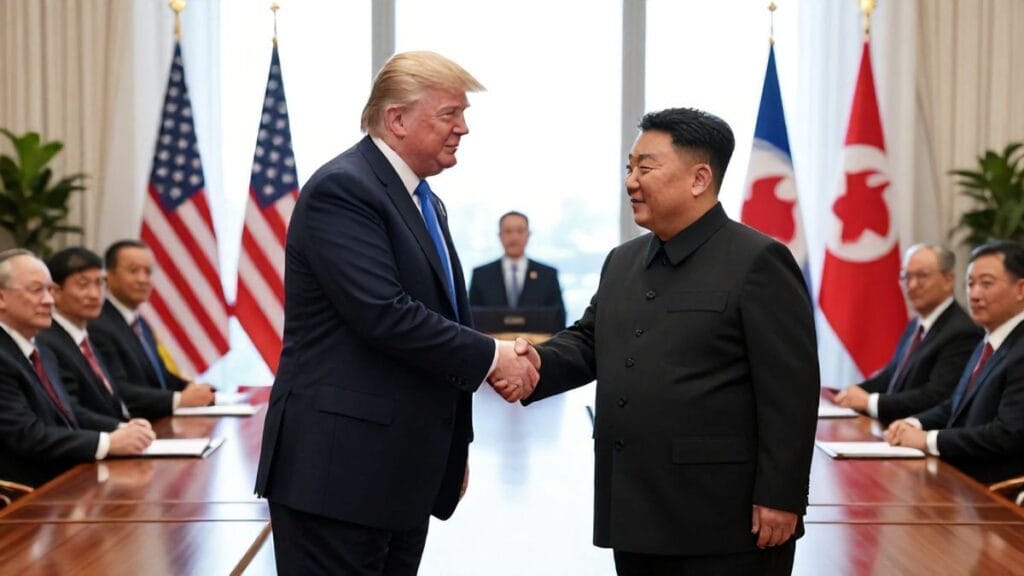
They met in the middle and shook hands. It lasted only a few seconds, but in diplomatic terms, it was an eternity. Trump patted Kim’s arm lightly, an echo of the physical dominance cues he favored. Kim smiled broadly, but his eyes remained probing, his posture stiff. Commentators timed the handshake, analyzed the grip, even magnified the knuckles. It’s astonishing, isn’t it, how entire decades of geopolitical tension can be distilled into the choreography of fingers and palms?
Behind the handshake lay months of unpredictable maneuvering: tweets promising “fire and fury,” insults exchanged across oceans, last-minute letters canceling and then reinstating the summit. Yet at this precise moment, the world paused. The trump kim summit was no longer merely an idea debated in policy papers and think tank roundtables. It was real, unfolding under the tropical sun of Singapore, where a city built on trade and stability had lent its shores to one of the riskiest diplomatic gambles in modern memory.
From Korean War to Nuclear Standoff: The Long Road to a Handshake
The story of that June morning in 2018 cannot be understood without traveling back nearly seven decades, to a peninsula devastated by one of the fiercest conflicts of the 20th century. In June 1950, North Korean troops, armed and encouraged by the Soviet Union and later supported by Chinese forces, poured across the 38th parallel, invading South Korea. The United States and a United Nations coalition intervened, and what followed was a brutal, seesaw war that left an estimated 2 to 3 million Koreans dead, alongside hundreds of thousands of Chinese and tens of thousands of Americans and other UN soldiers.
By 1953, when the guns finally fell silent, no peace treaty had been signed—only an armistice. The Korean Peninsula remained divided, scarred by trenches, landmines, and an artificial border running roughly along the 38th parallel. For North Koreans, the war became a founding trauma, a narrative of heroic resistance against American imperialism, replayed in school textbooks and in monuments that towered over Pyongyang. For Americans, it became the “Forgotten War,” overshadowed by World War II and Vietnam, yet it set the pattern for Cold War confrontations.
This unresolved conflict cast a long shadow. Over the decades, North Korea transformed from a relatively industrialized state into an impoverished, heavily militarized country under an all-encompassing one-family rule. Kim Il Sung, the founding leader, built his legitimacy on the war, on self-reliance—juche—and on the constant portrayal of external threats, especially from the United States. His son, Kim Jong Il, and grandson, Kim Jong Un, inherited not just power but a system wired for survival against perceived encirclement.
The United States, for its part, stationed tens of thousands of troops in South Korea and Japan, maintaining a nuclear umbrella over its allies and a long list of sanctions and designations against Pyongyang. Diplomatic attempts to resolve tensions—like the Agreed Framework of 1994, which sought to freeze North Korea’s nuclear program in exchange for aid and normalization—flared briefly and then collapsed under mistrust, verification disputes, and domestic political shifts in Washington and Pyongyang.
By the early 2000s, North Korea had withdrawn from the Nuclear Non-Proliferation Treaty, tested its first nuclear device in 2006, and launched a series of increasingly capable ballistic missiles. Each test pushed the peninsula closer to what felt like an irreversible threshold: a nuclear-armed North Korea able to strike not only its regional neighbors but, eventually, the continental United States. As one historian later observed, “Every failed agreement wasn’t just a diplomatic misstep; it was a brick laid in the road toward nuclear normalization for Pyongyang.”
The six-party talks—bringing together North Korea, South Korea, the United States, China, Japan, and Russia—tried to halt this trajectory. For a moment in the mid-2000s, there were glimmers of hope: shut-down reactors, disabled cooling towers, symbolic demolitions played out for international media. Yet the deeper issues remained: mutual distrust, regime survival, and the meaning of denuclearization itself. For North Korea, nuclear weapons became the ultimate guarantor against regime change. For the United States, they were an unacceptable threat to be rolled back.
By the time Donald Trump took office in January 2017, the long road from the Korean War had turned into a narrow, perilous path. North Korea had conducted five nuclear tests; a sixth, even more powerful, would follow later that year. Intercontinental ballistic missile tests suggested that, with further refinement, Pyongyang could indeed hit U.S. cities. Forecasters spoke of a “window” closing: the trump kim summit, when it eventually happened, would be framed as an attempt to pry that window back open before it slammed shut.
Sanctions, Missiles, and Fire: The Crisis Before the Opening
The year leading up to the summit felt, at times, like the prelude to catastrophe. North Korea accelerated its testing schedule. Missiles arced high into the sky, sometimes flying over Japan, their trajectories tracked in real time by defense ministries and television anchors. In September 2017, Pyongyang carried out its most powerful nuclear test to date, claiming it had successfully detonated a hydrogen bomb that could be mounted on an intercontinental ballistic missile.
Trump responded in a manner that broke with the often measured tones of prior U.S. administrations. Speaking at the United Nations General Assembly in September 2017, he threatened to “totally destroy North Korea” if forced to defend the United States or its allies. He mocked Kim Jong Un as “Little Rocket Man” on Twitter and in speeches, turning nuclear brinkmanship into a global spectacle of taunts and memes. Analysts winced. Allies worried. Yet domestic supporters applauded his perceived toughness.
Pyongyang answered in its own register. A statement attributed to Kim called Trump a “mentally deranged U.S. dotard,” an insult that revived archaic English vocabulary and raced across the internet. North Korean state media aired footage of missiles and war games, narrated in the fiery tones of announcers who had spent careers describing the inevitability of American ruin. For a moment, it seemed as if miscalculation, more than deliberate strategy, might pull the region into war.
Sanctions tightened as the United Nations Security Council—remarkably united on this issue—passed multiple resolutions targeting North Korean exports of coal, textiles, and seafood, and restricting fuel imports. The impact inside North Korea was difficult to measure, given the opacity of the regime, but reports suggested rising prices, strain on fuel supplies, and increased pressure on the country’s fragile markets. Behind closed doors, Chinese banks grew more cautious. Even North Korea’s closest and most pragmatic partner, China, appeared willing to squeeze Pyongyang more than before.
Yet behind the fire and fury, backchannels began to hum. South Korea, under President Moon Jae-in, pursued an opening, convinced that only dialogue could pull the peninsula back from the brink. The Winter Olympics in Pyeongchang in early 2018 served as a carefully staged opportunity. North Korean athletes marched with South Korean counterparts under a unified flag. Kim Jong Un’s sister, Kim Yo Jong, attended the opening ceremony, her poised demeanor seen by some as a softer face of the regime.
In the weeks that followed, South Korean envoys shuttled between Pyongyang, Washington, and other capitals. Then came the moment that startled even seasoned diplomats: during a visit to the White House in March 2018, South Korean officials emerged to announce that President Trump had agreed, in principle, to meet Kim Jong Un. The declaration shocked the policy establishment. There had been no months-long pre-negotiation process, no carefully crafted diplomatic choreography, at least not in the traditional sense. The summit seemed to materialize out of a mix of opportunism, urgency, and Trump’s own penchant for dramatic, made-for-television moments.
As preparations stumbled forward, there were jarring reversals. In May 2018, Trump abruptly canceled the meeting in a strongly worded letter, citing “tremendous anger and open hostility” from North Korea. It looked like the diplomatic experiment had collapsed before it began. Yet within days, both sides signaled willingness to continue, and quiet talks revived the prospect of the Singapore encounter. When the final decision was made, it felt less like the outcome of a linear process and more like the product of a volatile dance between threats and outreach, pride and necessity. The trump kim summit was on again—and the world braced for a spectacle unlike any previous negotiation with North Korea.
Inside the Deal-Making Machine: Why Singapore and Why Now?
Choosing a location for a summit of this magnitude is never merely a logistical matter; it is a statement of politics, symbolism, and trust. Singapore emerged as an almost ideal compromise: neutral, prosperous, famously secure, and accustomed to hosting high-level events. It maintained diplomatic relations with both the United States and North Korea, and its government was adept at managing complex security requirements discreetly.
For North Korea, Singapore presented an image of modernity and order, a vision of what its own capital might one day resemble, in a different reality. For the United States, it offered stability, robust infrastructure, and a setting that felt distant from the immediate tensions of the Korean Peninsula, yet geographically closer to Pyongyang than Washington or Geneva.
But why June 2018? Why then, after decades of deadlock and escalating hostility? Several forces converged. North Korea appeared to believe its nuclear and missile programs had crossed a critical threshold. Having demonstrated at least some intercontinental capability, Kim Jong Un could now negotiate from a position of greater strength, arguing that he was no longer pleading for survival but demanding recognition as a de facto nuclear power. At the same time, crippling sanctions and the risk of further isolation gave Pyongyang incentives to explore a diplomatic bargain.
Trump, for his part, was searching for a historic foreign policy achievement, something that would justify his unconventional style and validate his claim that he could achieve deals where traditional politicians had failed. Bringing Kim to the table, especially after a period of intense verbal confrontation, allowed him to cast himself as a bold risk-taker, unafraid of breaking with established protocol. In domestic terms, it played into his hunger for dramatic visuals and clear, simple narratives of victory.
South Korea’s President Moon Jae-in pushed tirelessly behind the scenes, convinced that his own political legacy was tied to achieving some form of reconciliation or at least de-escalation on the peninsula. His administration’s mediating role—shuttling messages, hosting inter-Korean summits, framing peace as both a regional necessity and a moral imperative—was crucial. Without Moon’s persistence, it is unlikely that the summit would have materialized so quickly, or perhaps at all.
China, too, watched the unfolding drama with mixed feelings. On one hand, it welcomed any process that reduced the immediate risk of war on its doorstep. On the other, it feared a scenario in which North Korea and the United States would make a grand bargain that sidelined Beijing. In early 2018, Kim Jong Un made his first known foreign trip as leader: a surprise visit to Beijing to meet President Xi Jinping. It was a reminder that, even as the trump kim summit drew global headlines, the old regional geometry of power still mattered deeply.
The timing, then, was less a sudden miracle and more a convergence of pressures and opportunities. The crisis had reached a point where continuing on the same path seemed increasingly dangerous for all sides. Yet that did not mean the road ahead was clear. As planes carrying the two leaders descended toward Singapore’s Changi Airport, the question hanging in the air was painfully simple: would this be a breakthrough, a piece of theater, or the prelude to yet another cycle of disappointment?
Staging History: The Island, the Flags, and the Perfect Photo
Singapore’s Sentosa Island carries a name that means “peace and tranquility” in Malay, a fact that did not escape the global press as they set up cameras along cordoned-off pathways. Once known for its colonial-era fortifications and later transformed into a leisure destination with beaches, resorts, and theme parks, it now bore a different weight. For a few days, Sentosa became a diplomatic crucible, a place where the choreography of power was as important as any policy paper.
The Capella Hotel, a blend of restored colonial buildings and modern architecture, was chosen as the summit’s venue. Its curved lines and secluded grounds offered both elegance and control. Security teams mapped every entrance, rooftop, and corridor. Snipers took positions. Volunteers and staff were briefed to an inch of their patience. Hundreds of journalists, each hungry for angles and exclusives, materialized along designated zones, their equipment forming small forests of tripods and cables.
Within this carefully constructed world, every visual detail mattered. The arrangement of flags—alternating U.S. and North Korean banners in equal number and height—signaled a meeting of supposed equals, a visual concession hotly debated in Washington. Some critics argued that placing the American flag alongside that of a regime notorious for its human rights abuses risked legitimizing Pyongyang’s dictatorship. Supporters countered that such symbolism was necessary to lure Kim into negotiations and to set the stage for bolder demands.
Rooms were meticulously prepared. Seating charts considered not only protocol but optics: who would sit closest to whom, which side would appear more relaxed or more rigid on camera. Menus reflected an attempt at balance, offering dishes that nodded to both Western and Asian palates. Even the pens to be used in signing ceremonies were discussed and, according to some reports, swapped at the last minute by cautious North Korean aides worried about hidden listening devices or poison.
Singapore itself embraced the role, if cautiously. Posters and banners announcing road closures and restricted areas were printed and distributed. Local citizens caught glimpses of black limousines gliding past hawker centers and shopping malls. Taxi drivers and hotel staff, often the unofficial narrators of global events passing through their city, traded stories of near-encounters and rumors. For a place built on predictability and efficiency, hosting such an unpredictable meeting was both a challenge and a badge of honor.
Yet behind the polished surfaces and curated images, tension simmered. The stakes were enormous, the distrust deep-seated. Both delegations knew that a single misstep, a poorly timed remark, or a perceived slight could derail the fragile process. The trump kim summit was at once a negotiation, a performance, and a stress test of how far symbolism could be stretched in the service of substance. And as dawn broke over Sentosa on June 12, the stage was set for the actors to step into their roles.
The First Glimpse: A Handshake Measured in Millimeters and Milliseconds
When Donald Trump and Kim Jong Un finally appeared at opposite ends of the long walkway leading to their first handshake, the world had already spent months imagining this exact moment. But the reality, broadcast live in countless time zones, still carried an electric charge that no rehearsal could fully predict.
Trump’s body language was familiar: the forward lean, the assertive stride, the slight jut of the chin. He had performed handshakes with world leaders many times before, often using them as subtle contests of strength, pulling counterparts closer, patting shoulders, maintaining eye contact to assert dominance. Kim, by contrast, was less known to the international audience beyond carefully curated North Korean footage. Here, under the glare of global media, he appeared both composed and somewhat stiff, his facial expression carefully calibrated between formality and cordiality.
They shook hands. Photographers captured dozens of frames per second, freezing micro-expressions and shifts in posture. Kim nodded slightly; Trump smiled broadly. Later, analysts would pore over slow-motion replays, noting how Trump’s hand briefly enveloped Kim’s elbow, how Kim adjusted his stance, how both men turned to face the cameras together. It seemed absurd, at one level, to attach such significance to physical gestures. And yet, in a world starved of real trust between these two nations, body language became a proxy, however flawed, for intent.
After the handshake, they walked side by side into the building, entering a room prepared for their one-on-one conversation, accompanied only by interpreters. This was a radical departure from standard diplomatic practice, where teams of advisors, note takers, and specialists typically surround leaders. In Singapore, much of the opening conversation would be filtered through the personal instincts of Trump and Kim, raising both the hope of candid exchange and the risk of miscommunication.
Before the doors closed, Trump spoke briefly to the press, saying the meeting would be a “tremendous success” and that “we will solve a big problem, a big dilemma.” Kim, for his part, remarked that “the path to here was not easy,” acknowledging “old prejudices and practices” that had “worked as obstacles on our way forward.” These were cautious, almost understated words, yet they hinted at an awareness, on both sides, of the historic stakes.
For viewers around the world, the image of the two men together—one the embodiment of the world’s richest democracy, the other leading one of its most repressive regimes—was jarring. It challenged familiar binaries of engagement and isolation, war and peace. It suggested, if only visually, that conversations long deemed impossible could indeed take place. Whether they would amount to more than pictures was another matter entirely.
Behind Closed Doors: One-on-One Talks and the Race Against Time
Once the heavy doors closed behind them, Trump and Kim entered a world beyond cameras, where only their interpreters could bear witness. Accounts of what transpired in those first forty minutes are, by necessity, fragmentary, pieced together from later recollections and briefings. Yet the very structure of the conversation—leader to leader, stripped of layers of bureaucracy—was telling.
For Trump, this format played to his self-image as a master negotiator who trusted instinct over expertise. He believed in the power of personal rapport, of looking an adversary in the eye and cutting through what he saw as diplomatic clutter. For Kim, the one-on-one setting had different implications. It elevated him to the same plane as an American president, a symbolic equality that no previous North Korean leader had attained. It also allowed him to gauge Trump’s personality firsthand, to test how far flattery, firmness, or ambiguity might go.
Denuclearization—the thorniest issue of all—loomed over the conversation. The United States entered the summit insisting on the “complete, verifiable, and irreversible denuclearization” of the Korean Peninsula. North Korea, in turn, used the term “denuclearization” in its own lexicon to refer to a much broader concept: the removal of all nuclear threats to the peninsula, including the U.S. nuclear umbrella over South Korea and Japan. The gap between these definitions was as wide as the ocean that separated Washington and Pyongyang.
Time, too, exerted pressure. The entire summit was scheduled to last only a few hours, including bilateral meetings with advisors, a working lunch, and a signing ceremony if all went well. This was an astonishingly short window for an issue that had defied resolution for decades. Negotiators had worked in advance on potential language for a joint statement, but much remained unresolved as the two leaders spoke. Every minute they spent together was both a potential breakthrough and a reminder of the limits of improvisation in statecraft.
Officials who later offered glimpses into the talks described an atmosphere that oscillated between cordiality and seriousness. Trump emphasized what North Korea could gain economically if it abandoned its nuclear arsenal—gleaming hotels on its beaches, investment, prosperity. Kim, reportedly, pointed to steps his country had already taken, such as halting nuclear tests and demolishing parts of the Punggye-ri test site, framed as good-faith signals. Yet beneath these exchanges lay layer upon layer of mistrust. Each side suspected the other of seeking unilateral concessions without genuine reciprocity.
The trump kim summit became, in that room, a compressed exercise in strategic storytelling: each leader trying to convince the other of his narrative. Trump cast himself as the man who could deliver what previous administrations had failed to achieve, if only Kim would seize the moment. Kim presented himself as a strong, modern leader prepared to make bold decisions, but not to surrender his regime’s security.
When the one-on-one session ended and advisors joined for broader discussions, the day’s outline began to crystallize. There would be a joint statement. There would be pledges, however vague, about the future. And there would be, most importantly for Trump, the optics of success. Yet even at this stage, key questions—timelines, verification mechanisms, definitions—remained blurred, tucked away behind smiles and generalities.
Drafting Promises: The Making of the Joint Statement
By late morning, attention turned to the tangible output of the summit: a document that could be signed, photographed, and presented to the world as evidence that the meeting had achieved something beyond symbolism. Drafts had circulated among negotiators in the days leading up to June 12, but final wording would depend on what Trump and Kim were willing to endorse in person.
The joint statement that emerged consisted of four main points. First, the United States and North Korea pledged to establish new relations in accordance with the desire of their peoples for peace and prosperity. Second, they would join efforts to build a lasting and stable peace regime on the Korean Peninsula. Third, North Korea committed to work toward the complete denuclearization of the Korean Peninsula. Fourth, the United States and North Korea committed to recovering and repatriating the remains of prisoners of war and those missing in action from the Korean War.
Each sentence carried layers of aspiration and ambiguity. The phrase “work toward” denuclearization was notably softer than the language favored by many U.S. officials before the summit. There were no detailed timelines, no explicit mention of verification protocols, no concrete list of steps that North Korea would take and what, in return, the United States would provide. For critics, this was the core flaw of the trump kim summit: it produced lofty yet vague commitments that allowed both sides to claim victory while postponing hard decisions.
Trump, however, framed the document as a major breakthrough. In his post-summit press conference, he described it as “comprehensive” and suggested that denuclearization would begin “very quickly.” He also made a surprise announcement: the suspension of “war games” with South Korea—large-scale joint military exercises that North Korea had long condemned as rehearsals for invasion. This concession, which appeared not to have been fully coordinated with Seoul or the Pentagon in advance, stunned many observers.
For Kim, the joint statement accomplished several goals. It secured a public pledge from the U.S. president to move toward improved relations, implicitly challenging the narrative of inevitable hostility that had underpinned North Korea’s domestic propaganda for decades. It also gave him images—handshakes, signing ceremonies, friendly exchanges—that could be used at home to demonstrate his status on the world stage. Importantly, it did so without forcing him to lay out a clear roadmap for surrendering his most prized strategic assets.
Signatures were applied with careful strokes, each pen stroke magnified by cameras. The leaders exchanged folders, shook hands again, and smiled for the assembled press. Interpreters and aides stood just behind, the unsung architects of the words on the page, their faces revealing only disciplined neutrality.
Later, some analysts would compare the statement to earlier agreements with North Korea, noting echoes of past formulations and warning that absent robust implementation, it risked joining a long list of unfulfilled pledges. As one scholar wrote in a contemporary journal article, “The structure of the Singapore statement is less a new architecture of peace than an outline sketch waiting for lines that may never be drawn” (International Security Review, 2018). Yet in that room, at that moment, the sheer fact of the signatures carried an emotional weight that spreadsheets and legalistic critiques could not fully erase.
The Media Circus: Cameras, Narratives, and Competing Realities
Outside the negotiating rooms, the trump kim summit unfolded as a media event of staggering scale. Over 2,500 journalists from around the world descended on Singapore, turning designated press centers into buzzing hives of commentary. Giant screens streamed live footage; analysts cycled between studios, offering instant interpretations; social media flooded with clips, jokes, concerns, and memes.
The summit’s visual grammar lent itself to the age of spectacle. There were motorcades at night, with Trump’s and Kim’s vehicles sliding through the city like armored shadows. There were shots of Trump waving from a balcony, of Kim touring Singapore’s nighttime skyline, reportedly visiting tourist landmarks that symbolized the prosperity his country lacked. Even the simplest gestures—a wave, a nod, a shared laugh over a lunch table—became fodder for frame-by-frame analysis.
Different media ecosystems crafted different stories. In the United States, coverage swung between cautious optimism and withering skepticism. Some commentators praised Trump for daring to engage directly with North Korea, arguing that diplomacy, however imperfect, was preferable to the drift toward war. Others condemned what they saw as the legitimization of a dictator in exchange for a superficial statement lacking enforceable commitments.
In South Korea, television screens in cafés and subway stations carried the images live. Passersby paused to watch. Many remembered the tensions of the previous year and hoped, quietly, that this might mark a turning point. For older Koreans who had lived through the war or its immediate aftermath, the sight of an American and a North Korean leader sitting together was surreal, almost unimaginable.
In North Korea, the narrative was shaped entirely by state media, which delayed coverage and presented the summit not as an equal negotiation but as a triumphant acknowledgment by the U.S. president of Kim’s strength and legitimacy. Lavish documentaries broadcast on Korean Central Television showed Kim’s arrival in Singapore, local crowds supposedly cheering, and his meetings framed as the world bowing to his leadership. The ideological message was clear: nuclear weapons had compelled the United States to the table.
Academic and diplomatic circles, meanwhile, debated the implications in real time. Some warned that the summit risked repeating the “photo-first, substance-later” pattern that had doomed previous efforts. Others saw value even in the optics, arguing that building a personal connection between leaders could, over time, help to humanize the adversary and open doors previously sealed shut.
Yet behind the wall of cameras, ordinary people affected by the long-standing conflict watched with their own private emotions. Korean families separated by the Demilitarized Zone, Japanese families of abductees taken by North Korea decades earlier, American veterans of the Korean War, defectors who had risked everything to escape the North—all carried hopes and doubts that rarely fit neatly into television soundbites. For them, the summit was not just news; it was the latest chapter in a life-long, unresolved story.
Hope on the Peninsula: South Korea, Japan, and China React
In Seoul, the atmosphere on June 12 mixed cautious celebration with anxious calculation. President Moon Jae-in watched the historic handshake and meetings from his own capital, having played a quiet but crucial role in bringing the summit about. His government hailed the trump kim summit as an “historic” step and expressed hope that it would lead to “a new era” on the Korean Peninsula. Public opinion in South Korea showed substantial support for dialogue, though skepticism about North Korea’s intentions remained stubbornly high.
For South Koreans, the stakes were immediate and deeply personal. The capital lay within artillery range of North Korean positions. Any misstep that triggered conflict would not be an abstract geopolitical shock but a direct threat to millions of lives. Yet the possibility—however slim—of a peace regime replacing the armistice that had frozen the Korean War since 1953 stirred intense longing. Inter-Korean projects, family reunions, and economic cooperation had waxed and waned over the years, often snuffed out by missile tests and political shifts. Could this time be different?
Japan, by contrast, reacted with more overt concern. Prime Minister Shinzo Abe publicly supported efforts to reduce tensions but worried about potential outcomes that might leave Japan exposed. Tokyo feared a scenario in which the United States, eager to declare victory, would accept a deal that froze North Korea’s intercontinental capabilities while leaving shorter-range missiles and nuclear warheads intact—still able to hit Japan. The issue of Japanese citizens abducted by North Korean agents in the 1970s and 1980s also weighed heavily; families of abductees pressed Abe’s government not to allow their cause to be sidelined.
China watched with a mixture of relief and unease. On one hand, the summit reduced the immediate danger of conflict, which would have sent refugees, economic shockwaves, and possibly foreign troops closer to China’s borders. On the other, Beijing was wary of any bilateral understanding between Washington and Pyongyang that might rearrange regional dynamics in ways that diminished China’s influence. In response, it intensified its own diplomacy with North Korea, hosting Kim Jong Un multiple times both before and after Singapore.
The broader region, from Russia to Southeast Asia, registered the summit’s echoes. Some countries saw it as a vindication of diplomacy, a moment when even deeply entrenched adversaries could be brought to the table. Others noted the fragility of the process, aware that unresolved details could quickly spiral into renewed tension.
Yet behind all these reactions lay a common recognition: the trump kim summit did not end the North Korean nuclear issue—far from it. Instead, it marked a shift from an acute crisis point toward a more ambiguous landscape of unfinished promises. The peninsula remained divided, the DMZ still bristled with barbed wire and landmines, and the gulf in expectations between Washington and Pyongyang remained vast. The region could exhale, but only slightly.
The Human Dimension: Families, Defectors, and Prisoners of History
Numbers and treaties often dominate discussions of nuclear diplomacy, but the conflict on the Korean Peninsula is, at its heart, a human tragedy measured in separated families, lost generations, and lives circumscribed by ideology and fear. The trump kim summit touched these lives obliquely, like a distant storm that might veer toward or away from them depending on shifts in the diplomatic wind.
In South Korea, tens of thousands of elderly people remained separated from relatives in the North, siblings and cousins who had not seen each other since the chaos of the early 1950s. Occasional, tightly controlled reunions organized over the years brought brief, tearful meetings in hotel rooms near the DMZ, followed by wrenching goodbyes. Many of these individuals watched the Singapore summit with a sense of urgency that younger observers could not fully share. Time was running out for them to see their loved ones again before death intervened.
In North Korea, the human cost of the regime’s policies was harder to quantify but no less real. Defectors who had escaped described labor camps, surveillance, and a climate of fear. The United Nations Commission of Inquiry on Human Rights in North Korea, in a landmark 2014 report, concluded that the regime had committed “systematic, widespread and gross human rights violations” that in some cases rose to the level of crimes against humanity. These findings cast a long moral shadow over any engagement with Pyongyang, prompting critics to argue that summits risked sidelining human rights in favor of narrow security concerns.
Yet some human rights advocates saw a glimmer of opportunity. If the summit led to sustained engagement, they reasoned, it might eventually create openings—however small—for humanitarian access, family reunions, and dialogue on human rights issues. Others feared the opposite: that once nuclear and missile questions dominated the agenda, the plight of ordinary North Koreans would be relegated to a distant second tier, mentioned in speeches but neglected in practice.
There were also prisoners in a more literal sense. American detainees held in North Korea had been a recurring, painful feature of the relationship. Just weeks before the summit, three such detainees were released and flown back to the United States, greeted by Trump in a nighttime arrival ceremony at Joint Base Andrews. Their release was both a goodwill gesture by Pyongyang and a public relations victory for the White House, used to highlight the administration’s supposedly tougher yet more effective approach.
For families of those killed or missing in the Korean War, the joint statement’s pledge to recover remains offered a quieter, more intimate form of hope. The return of remains is a deeply emotional act, bridging decades of uncertainty and grief. Such efforts had been undertaken before, then halted as relations soured. Whether Singapore would usher in a more consistent process remained uncertain, but even the mention rekindled memories for families who had waited since the 1950s for closure.
History imprisons as effectively as any cell. For North Koreans raised on a narrative of heroic resistance against American aggression, and for Americans taught to see North Korea as an irrational rogue state, the summit tugged at entrenched mental walls. Changing such narratives requires more than a single meeting; it demands sustained contact, education, and acknowledgment of past wrongs. Yet the image of an American and North Korean leader sitting side by side, however fraught, cracked the door open to imagining a different future.
Skeptics and Supporters: Analysts Dissect the Trump-Kim Gamble
In the days and weeks after the trump kim summit, a chorus of voices weighed in, turning Singapore into a case study in both daring diplomacy and dangerous naïveté. Supporters and skeptics alike found ample material to bolster their positions.
Those inclined to support the summit emphasized the alternative. Prior to the diplomatic opening, the Korean Peninsula had lurched toward the edge of open conflict, with talk of “preventive war” circulating in Washington and North Korea racing ahead with tests. Against this backdrop, even a vague commitment to dialogue and a reduction in military exercises looked preferable to the escalatory spiral of 2017. Some former officials argued that no previous U.S. president had managed to bring a North Korean leader to the table in such a public, direct way, and that this alone justified the attempt.
Critics, however, focused on the lack of concrete, verifiable commitments in the joint statement. They noted that key phrases—such as “work toward complete denuclearization”—essentially restated long-standing, aspirational goals without offering roadmaps or enforcement mechanisms. The unilateral suspension of major military exercises with South Korea also alarmed many defense planners, who feared erosion of readiness without commensurate concessions from Pyongyang.
Nonproliferation experts, in particular, sounded warnings. Some pointed out that North Korea had, historically, used negotiations to buy time, extracting concessions while continuing covert development of its programs. Without intrusive inspections and a detailed sequence of steps, they argued, the summit risked normalizing North Korea’s nuclear status under the veneer of progress. As one analyst wrote in a widely cited policy paper, “The danger is not just failure, but a managed illusion of success that allows the nuclear program to harden out of sight.”
Others situated Singapore in the broader pattern of U.S. diplomacy under Trump. Critics argued that his preference for leader-to-leader summits and bold announcements often sidestepped the painstaking preparatory work essential for sustainable agreements. They worried that the president’s hunger for dramatic visuals might lead him to accept superficial deals. Supporters countered that traditional approaches had consistently failed, and that a disruptive strategy might be the only way to crack the stalemate.
The academic literature that began to emerge in 2018 and 2019 reflected this divide. Some scholars framed the summit as an example of “personalized diplomacy” that, while risky, could complement institutional channels. Others emphasized the asymmetry in experience and resources between Washington and Pyongyang, fearing that Kim’s regime, with decades of practice in negotiating under pressure, might outmaneuver a U.S. administration only loosely coordinated across its own agencies. One study in the Journal of East Asian Studies argued that “the Singapore summit demonstrated the performative side of modern diplomacy, where narrative and image are deployed as tools of national strategy as much as tanks and missiles.”
In the end, both camps agreed on one thing: Singapore was not an endpoint but a starting line. Its success or failure could only be judged in the months and years that followed, as follow-on talks either built on or eroded its fragile foundations. And as the world would soon see, the road from Sentosa was anything but straightforward.
From Singapore to Hanoi and Beyond: The Unfinished Story
In the immediate aftermath of the trump kim summit, there were signs, however modest, of diplomatic momentum. Military tensions along the Demilitarized Zone eased. North Korea refrained from further nuclear and long-range missile tests for a time. Working-level talks were convened, with U.S. and North Korean officials trying to translate the broad strokes of the joint statement into operational steps.
But the gaps that had been glossed over in Singapore soon re-emerged. Washington pushed for a comprehensive roadmap committing North Korea to declare its full nuclear inventory, allow inspections, and take irreversible steps toward dismantlement. Pyongyang, by contrast, sought a phased approach: limited denuclearization steps in return for gradual sanctions relief, security guarantees, and movement toward a formal peace treaty ending the Korean War.
The next act in this unfolding drama came in February 2019, when Trump and Kim met again, this time in Hanoi, Vietnam. Expectations were high; some believed that a grand bargain might be in reach. Instead, the summit collapsed abruptly without an agreement. Reports indicated that North Korea had offered to dismantle parts of its main nuclear complex at Yongbyon in exchange for substantial sanctions relief, a trade Washington deemed insufficient given the likely existence of additional facilities and warheads elsewhere.
The failure in Hanoi exposed the limits of summit-centric diplomacy. Without detailed, prior technical agreements hammered out by negotiators, leaders could not simply will a deal into existence over dinner. The atmosphere soured. Working-level talks faltered. Trump’s domestic political troubles grew, diverting attention and political capital away from the Korean issue. Kim, for his part, seemed to conclude that the United States was unwilling to offer the scale of concessions he desired.
By late 2019 and into 2020, North Korea resumed testing shorter-range missiles and issued increasingly harsh statements about Washington’s “hostile policy.” The COVID-19 pandemic further isolated the country, as Pyongyang closed its borders even tighter, prioritizing regime stability and health security over external engagement. The brief era when headlines blazed with images of Trump and Kim walking together in Singapore and later stepping over the line at Panmunjom faded into a more familiar pattern of sporadic tension and silence.
Yet the memory of Singapore did not vanish. For some, it stood as a tantalizing what-if: proof that even entrenched enemies could meet, talk, and at least imagine a different path. For others, it was a cautionary tale about the dangers of conflating spectacle with progress. The nuclear issue remained unresolved. North Korea, by most expert assessments, continued to expand and refine its arsenal. The United States oscillated between outreach and pressure, its own domestic politics increasingly polarized.
In that sense, the trump kim summit belongs firmly to the category of unfinished history. It did not close the book on the Korean conflict or on nuclear proliferation in Northeast Asia. Instead, it wrote a dramatic, controversial chapter—one that future leaders might study either as inspiration for bold engagement or as a warning about the pitfalls of rushing into high-stakes diplomacy without a sturdy scaffolding beneath.
Power, Image, and Legacy: What the Leaders Wanted from the Summit
To understand the deeper meaning of Singapore, one must look beyond communiqués and focus on the personal and political calculations of the two men who sat across the table. Power, image, and legacy were as present in the room as any interpreter.
For Donald Trump, the summit offered an opportunity to redefine his presidency on the world stage. Beset by domestic controversies and criticism of his unconventional approach to allies and multilateral institutions, he sought a dramatic foreign policy victory that could be distilled into powerful images and simple slogans. The trump kim summit allowed him to claim that he had achieved what no previous president had: a direct meeting with a North Korean leader, a pause in nuclear and long-range missile tests, and a signed statement pointing toward peace.
Trump’s understanding of legacy was, in many ways, visual and transactional. He spoke frequently of his “chemistry” with Kim, of their “love letters,” as he later described the personal correspondence exchanged between them. He highlighted the absence of major North Korean tests during the period of his engagement, comparing it favorably to his predecessors’ records. In rallies and interviews, he pointed to the summit as evidence that tough rhetoric combined with high-level outreach could yield results.
Kim Jong Un pursued a different but overlapping set of goals. Domestically, he needed to cement his authority as a modern, capable leader, distinct from but continuous with his father and grandfather. Appearing on equal footing with an American president, in a wealthy foreign city, sent a powerful message to his domestic audience: North Korea, under his rule, could command attention and respect from the world’s superpower. The images of Trump walking beside him, praising his leadership, and treating him as a counterpart were priceless political capital at home.
Internationally, Kim sought to break out of isolation without compromising the essential pillars of his regime. Nuclear weapons, in his eyes, were the ultimate guarantee against foreign intervention or regime change. By reaching a point where his arsenal appeared credible enough to deter, he aimed to transition from being treated as a pariah to being treated as a player. The summit marked a significant step in that direction, regardless of the eventual fate of the joint statement.
Both leaders, then, were invested in the performance of the summit as much as in its substance. Each needed to walk away being able to claim a win. Trump needed headlines about historic breakthroughs and averted wars. Kim needed footage showing him as a peer of the U.S. president and proof he could secure practical concessions—like the suspension of major U.S.-South Korean exercises—without surrendering his nuclear arsenal.
History often judges leaders not only by their intentions but by their outcomes. For now, Singapore stands as a mixed legacy for both men. Trump can argue that his engagement reduced immediate tensions and opened channels of communication, even if it did not solve the nuclear issue. Kim can point to the summit as evidence of his regime’s resilience and its ability to force the United States to negotiate at the highest level. Yet the fundamental strategic puzzle—how to reconcile a nuclear-armed, authoritarian North Korea with a regional and global order that deems such a status unacceptable—remains unsolved.
Global Diplomacy in the Age of Spectacle
One of the most striking aspects of the trump kim summit is how perfectly it illustrated the fusion of diplomacy and spectacle in the digital age. Traditional diplomacy values discretion, incremental progress, and carefully vetted language. The Singapore summit, by contrast, unfolded in a storm of live broadcasts, tweets, and instant commentary, where perception often seemed to outrun reality.
Trump’s own communication style amplified this effect. He announced and framed key moments of the North Korea saga on Twitter, compressing complex issues into brief, emotional statements. Threats and praise traveled the same channels, blurring the line between public posturing and private negotiation. Kim, while not personally tweeting, used North Korean state media to craft a narrative of strength and respect, editing footage to highlight moments that served the regime’s message.
This performative dimension did not render the summit meaningless—far from it. Symbolism is integral to diplomacy, especially when dealing with deeply entrenched conflicts. But the intensity of the spectacle raised questions about how leaders and publics process such events. When every gesture is magnified in real time, space for quiet, unglamorous compromise shrinks. Domestic audiences and political rivals demand clear wins. Nuance, often the lifeblood of sustainable agreements, struggles to survive in an environment that rewards decisive, simple narratives.
The Singapore summit also highlighted the role of small states in global diplomacy. Singapore leveraged its reputation for neutrality, competence, and security to host the meeting, showcasing how even countries without large militaries can influence international affairs by providing trusted venues and logistical expertise. In doing so, it underscored an evolving landscape where non-traditional actors—cities, private organizations, even media platforms—shape the conditions under which diplomacy unfolds.
The summit’s spectacle, however, came with risks. If expectations are inflated beyond what any agreement can plausibly deliver, disillusionment can set in quickly, making subsequent efforts politically harder. This dynamic played out in the months following Singapore, as the absence of rapid, visible denuclearization sowed frustration among many of Trump’s critics and some of his supporters, while feeding North Korean cynicism about American reliability.
In the end, Singapore may be remembered as a prototype of a new kind of summitry: highly personalized, visually driven, and deeply intertwined with the 24-hour news cycle and social media. Whether this model can produce durable solutions to complex security problems remains an open question. The trump kim summit showed both the promise and peril of global diplomacy conducted under the unforgiving spotlight of the modern attention economy.
What Changed—and What Did Not—After the Summit
Years after the trump kim summit, historians and analysts still debate its real impact. Some changes are undeniable. The tone of U.S.-North Korean relations shifted, at least temporarily, from incendiary threats to cautious, if uneven, dialogue. The personal contact between Trump and Kim, supplemented by subsequent meetings and letters, humanized a relationship previously conducted largely through proxies and hostile rhetoric.
North Korea paused its nuclear and intercontinental ballistic missile tests for a significant period, a de facto moratorium that, while reversible, reduced immediate crisis pressures. Military exercises between the United States and South Korea were scaled back or modified, altering patterns that had persisted for decades. Channels between Seoul, Washington, and Pyongyang proved that even entrenched foes could, under the right conditions, move from brinkmanship to negotiation.
Yet the structural realities remained stubbornly in place. There was no comprehensive agreement dismantling North Korea’s nuclear arsenal. Satellite imagery and intelligence assessments suggested that the country continued to produce fissile material and expand its capabilities. The sanctions regime, while strained at the edges by enforcement challenges and evolving geopolitical alignments, largely endured. No formal peace treaty replaced the 1953 armistice.
Public perception also evolved. Early hopes that the summit marked the beginning of a swift denuclearization process gave way to more sober recognition of how deeply embedded North Korea’s nuclear identity had become. For many ordinary citizens in the region, the summit receded into memory as one episode in a long, oscillating pattern of tension and détente. For policy professionals, it became a case study in the limits of summit-first strategies and the need for patient, robust preparatory work.
Perhaps the most profound effect of Singapore was psychological. It broke a mental barrier that had long seemed immovable: the idea that a U.S. president and a North Korean leader could not meet face to face without first securing ironclad guarantees and elaborate frameworks. By shattering that taboo, the trump kim summit expanded the imaginative space of what might be possible in future crises—not only on the Korean Peninsula but in other intractable conflicts.
At the same time, its mixed legacy serves as a caution against overreliance on personalities. Leaders come and go; systems, institutions, and strategic interests endure. Without embedding breakthroughs into robust agreements and shared institutions, moments like Singapore can inspire but not transform. The Korean Peninsula remains, as ever, a place where past, present, and future collide uneasily, and where any handshake must wrestle with decades of blood, ideology, and mistrust.
Conclusion
The Trump-Kim summit in Singapore on June 12, 2018, unfolded like a scene from a film scripted against the backdrop of a long and often bloody history. Two leaders whose countries had stared at each other across barbed wire and nuclear crosshairs finally walked toward one another under the tropical sun, their handshake compressing nearly seventy years of conflict into a few charged seconds. The summit did not, in the end, deliver the sweeping transformation that some hoped for. North Korea’s nuclear arsenal remains, the Korean War has not been formally closed, and the region continues to live with the shadow of potential escalation.
Yet to dismiss Singapore as mere theater would be to ignore the power of breaking patterns in international politics. For a brief moment, the trump kim summit disrupted the rhythm of threats and isolation that had defined U.S.-North Korean relations for generations. It opened channels of communication, punctured myths of inevitability on both sides, and reminded the world that even deeply entrenched adversaries can choose to sit down and talk. At the same time, the summit exposed the dangers of rushing to the top without building sturdy foundations below: without detailed planning, clear definitions, and mutual trust, grand gestures struggle to mature into durable peace.
History rarely offers neat endings, especially in regions where old wars have never been formally concluded. The Singapore summit stands instead as a hinge moment—neither full breakthrough nor total failure, but a complicated turning point whose ultimate meaning will be shaped by what future leaders do with the space it momentarily opened. In that sense, its legacy lies not only in what happened on Sentosa Island in 2018, but in whether the world chooses to learn from its mixture of courage, spectacle, and unfinished business.
FAQs
- What was the main purpose of the Trump-Kim summit in Singapore?
The primary aim of the summit was to initiate high-level dialogue between the United States and North Korea, reduce immediate tensions on the Korean Peninsula, and lay the groundwork for negotiations on the denuclearization of North Korea in exchange for security assurances and the prospect of improved relations. - Did North Korea agree to give up its nuclear weapons at the summit?
North Korea committed in the joint statement to “work toward the complete denuclearization of the Korean Peninsula,” but the document did not include a detailed roadmap, timeline, or verification measures. As a result, it fell short of a concrete, enforceable agreement to dismantle its nuclear arsenal. - Why was Singapore chosen as the location for the summit?
Singapore was selected because it is politically neutral, highly secure, and maintains diplomatic relations with both the United States and North Korea. Its reputation for efficiency and its experience hosting major international events made it a practical and symbolically balanced venue. - How did the summit affect U.S.-South Korean military exercises?
Following the summit, President Trump announced the suspension of large-scale joint U.S.-South Korean military exercises, which he described as “war games.” This move was welcomed by North Korea but raised concerns among some defense officials and analysts about the long-term impact on alliance readiness. - What was the reaction in South Korea to the summit?
In South Korea, the summit was generally welcomed as a step away from the brink of war and toward potential reconciliation. However, many South Koreans remained cautious, aware of North Korea’s history of broken agreements and the lack of detailed commitments in the Singapore statement. - Did the summit improve human rights conditions in North Korea?
The summit itself did not produce explicit commitments on human rights, and there is little evidence that it led to significant improvements inside North Korea. Human rights issues remained largely overshadowed by nuclear and security concerns in the immediate diplomatic agenda. - What happened in the follow-up summit in Hanoi in 2019?
The follow-up summit between Trump and Kim in Hanoi ended abruptly without an agreement. The two sides could not bridge differences over the scope of sanctions relief the United States was willing to offer and the scale of nuclear dismantlement steps North Korea was prepared to take. - Is the Korean War officially over after the Singapore summit?
No. The Korean War ended in 1953 with an armistice, not a peace treaty, and the Singapore summit did not change that status. While the joint statement mentioned building a “lasting and stable peace regime,” no formal peace treaty was concluded. - Did the summit reduce the immediate risk of war?
Yes, in the short term the summit helped reduce the immediate risk of military conflict by opening direct communication channels and prompting a pause in North Korea’s nuclear and long-range missile tests, as well as adjustments to joint military exercises on the U.S.-South Korean side. - How is the Trump-Kim summit viewed by historians today?
Historians generally see the summit as a significant symbolic moment that broke long-standing taboos but delivered limited substantive change. It is often cited as an example of high-profile, leader-driven diplomacy that revealed both the possibilities and the limitations of summit-first approaches to complex security challenges.
External Resource
Internal Link
Other Resources
- Encyclopaedia Britannica – general search for the exact subject
- Google Scholar – academic search for the exact subject
- Internet Archive – digital library search for the exact subject