Table of Contents
- A November Morning in Old Bavaria
- Bavaria Before the Storm: Dynasties, Duchies, and Deep Grievances
- The Brothers of Wittelsbach: Louis and Rudolf on a Collision Course
- An Empty Ducal Chair: The Death of Stephen I and a Dangerous Regency
- The Call to Arms: How a Local Dispute Became a Regional Crisis
- Roads to Gammelsdorf: Marching Armies and Rising Tensions
- The Battlefield Revealed: Landscape, Villages, and Strategic Ground
- Knights, Banners, and Crossbows: The Armies That Faced Each Other
- The Clash Begins: Opening Moves of the Battle of Gammelsdorf
- Breaking the Line: The Turning Point on the Bavarian Fields
- Blood, Surrender, and Silence: The Aftermath on the Frozen Ground
- From Battlefield to Bargaining Table: The Treaty That Followed
- A Duke in the Making: How Victory Shaped Louis IV’s Path to the Imperial Crown
- Defeat and Diminishment: Rudolf the Stiff-Necked and the Cost of Ambition
- Villages, Monasteries, and Markets: Everyday Lives Changed by War
- Memory, Chronicle, and Legend: How Gammelsdorf Was Remembered
- The Battle of Gammelsdorf in the Long Arc of German and European History
- Echoes on the Modern Landscape: Visiting Gammelsdorf Today
- Conclusion
- FAQs
- External Resource
- Internal Link
Article Summary: On a cold November day in 1313, the modest Bavarian village of Gammelsdorf became the stage for a decisive confrontation that would echo across the Holy Roman Empire. The battle of Gammelsdorf was not a grand clash of civilizations, but a bitter family struggle within the powerful Wittelsbach dynasty, pitting Louis of Upper Bavaria against his cousin Rudolf of the Palatinate and their influential allies. What began as a dispute over a regency and the fate of two young heirs escalated into a full-scale conflict drawing in regional princes and the mighty Habsburgs. This article traces the deep political, social, and emotional currents that led to the battle, recreates the tense hours on the field, and follows the human consequences in villages, monasteries, and noble courts. It explores how victory at Gammelsdorf propelled Louis toward the imperial crown as Louis IV, while defeat reshaped Rudolf’s ambitions and the map of Wittelsbach power. Along the way, it examines how chroniclers, from anonymous monks to court historians, shaped the memory of the event, and how later generations interpreted this seemingly local clash as a key moment in German history. By weaving storytelling with analysis, the narrative reveals why the battle of Gammelsdorf still matters for understanding medieval politics, dynastic rivalry, and the fragile lives caught between banners. And finally, it reflects on the quiet modern landscape where, beneath ploughed fields and village roads, the echoes of that November morning still lie waiting to be heard.
A November Morning in Old Bavaria
The morning of 9 November 1313 broke cold and damp over the rolling fields near the small Bavarian settlement of Gammelsdorf. Low clouds pressed down on the landscape; a thin mist clung to the Isar valley and the scattered farmsteads that dotted the countryside. Frost had hardened the rutted tracks leading in from Moosburg and Landshut, so that the hooves of horses struck them with a dull, metallic sound. For generations, these fields had seen nothing more violent than the swing of a scythe or the slow ploughing of oxen. Yet on this particular day, they would witness the battle of Gammelsdorf, a clash of armored men and iron wills that would decide the fate not only of Bavaria, but of a future emperor.
Villagers woke early, as they always did, but their routines were shaken. Instead of the familiar quiet of rural labor, they heard the distant thunder of assembled cavalry, the rumble of wagons, and the harsh voices of men shouting orders in dialects from across the region. Smoke from campfires drifted over the fields, mixing with the fog and giving the morning an acrid tang. Women stood in doorways watching, clutching cloaks tighter around their shoulders, children peeking out behind them, trying to glimpse the banners rising and fluttering like bits of bright fabric against the dull sky. If any of them knew the names Louis of Wittelsbach or Rudolf of the Palatinate, they would have spoken them with a distant reverence. Those names now marched, it seemed, straight through their lives.
At the heart of one army rode Louis, Duke of Upper Bavaria, a man in his thirties hardened by years of political struggle. Plate armor reinforced his mail, and the cold bit at any exposed skin beneath his helmet. Beside him, his followers bore the blue and white colors of the Wittelsbachs, foreshadowing the later Bavarian identity. Across the field, leading the opposing force, Rudolf the “Stiff-Necked” sat astride a warhorse draped in heraldic cloth, surrounded by allies from the Rhineland and, crucially, by Habsburg supporters from Austria. What would later be called the battle of Gammelsdorf was, on that morning, an unresolved question hanging in the mist: which branch of a powerful family would dominate, and who would control the fragile duchy that held the loyalty of so many men now tightening their grips on lances and reins?
But this was only the beginning. To understand why thousands of men had been drawn to this quiet corner of Bavaria, why steel had to answer questions that parchment and seals could not, we must step back. The clash at Gammelsdorf was not an accident of sudden anger. It was the product of years of tension within the Wittelsbach dynasty, of the peculiar structure of the Holy Roman Empire at the dawn of the fourteenth century, and of the raw, human fear that power carefully built could suddenly slip away into another’s hands. The wind across those fields carried not only the scent of autumn and warhorses, but the weight of history converging on a single place and day.
Bavaria Before the Storm: Dynasties, Duchies, and Deep Grievances
Long before lances were lowered at Gammelsdorf, Bavaria had been a land of shifting alliances and deeply rooted noble power. As a duchy within the Holy Roman Empire, it was formally subject to the authority of the emperor. In practice, however, its dukes exercised near-sovereign control over their territory. In the thirteenth and early fourteenth centuries, that control meant managing a patchwork of ecclesiastical lordships, urban liberties, knightly estates, and peasant communities, all while navigating the ambitions of neighboring powers such as the Habsburgs in Austria, the Bohemian kings, and the Rhenish princes.
The Wittelsbach family had come to dominate Bavaria in 1180, when Otto of Wittelsbach was granted the duchy by Emperor Frederick Barbarossa. Over the following century, the family entrenched itself as the ruling dynasty, weaving marriage ties and feudal bonds to strengthen their position. But this success came at a cost. The more lands and titles the Wittelsbachs amassed, the more complicated their internal relationships became. Younger sons demanded appanages, collaterals claimed rights, and the question of how to divide territories without breaking the duchy apart loomed over every generation.
By the late 1200s, the empire itself was undergoing a period of uncertainty. The Interregnum, a time of weakened central authority, had been followed by contested kingships and fierce rivalries between noble houses seeking the imperial crown. The Habsburgs, most notably Rudolf I of Habsburg and later his son Albert I, had begun to position themselves as preeminent contenders. Against this backdrop, the Wittelsbachs needed both internal unity and external alliances. Unfortunately, they had too little of the former and too many conflicting visions of the latter.
Cities such as Munich, Landshut, and Regensburg were growing in importance, serving as economic hubs and administrative centers. Merchants and burghers pressed for stability, regular trade routes, and consistent privileges, while the rural nobility guarded their autonomy and traditional rights. The church, through its monasteries and bishoprics, acted both as a spiritual authority and a major landholder deeply intertwined with secular politics. It is astonishing, isn’t it, that amidst these competing interests, the fragile balance held at all.
Yet beneath the surface calm, grievances bubbled. Disputes over tolls on the Isar River, conflicts between town councils and ducal officials, quarrels among lesser nobles over jurisdiction or inheritance—these issues did not make chronicles, but they shaped the tense atmosphere of early fourteenth-century Bavaria. The field of Gammelsdorf would eventually become the place where some of these tensions, gathered like storm clouds, would finally break.
The Brothers of Wittelsbach: Louis and Rudolf on a Collision Course
At the center of the storm stood two men who were more than rivals; they were cousins bound by blood and yet poised to undo each other. Louis, later known to history as Louis IV “the Bavarian,” and Rudolf I, Elector Palatine and Count Palatine of the Rhine, were both members of the Wittelsbach dynasty, descendants of the same ducal house whose fortunes stretched back generations. Their relationship, however, was marked less by familial warmth than by the cold calculation of territorial politics.
Louis, born around 1282, was the son of Louis II of Bavaria and Matilda of Habsburg, thus linking him to one of the most powerful families in the empire. From an early age he was steeped in both Bavarian and Austrian politics. He learned not only the arts of war and governance, but the subtler skills of negotiation, patronage, and calculated defiance. Rudolf, his cousin, was born a few years earlier, the son of Rudolf I, Duke of Upper Bavaria and Elector Palatine. Known as “der Stiffe” or “the Stiff-Necked,” he garnered a reputation for stubbornness and unyielding pride, traits that would serve both as strengths and fatal flaws.
For a time, their careers advanced along parallel tracks. They shared the Wittelsbach ambition to maintain and expand their domains, to secure their family’s place within the complex tapestry of the Holy Roman Empire. Trouble came when questions of inheritance began to press. The Wittelsbach lands were extensive but not infinite. How to divide them among multiple lines without weakening them in the face of ambitious neighbors was the dilemma that haunted the family’s councils.
The brothers of the older generation—Louis II and Rudolf I—had divided responsibilities and territories in ways that never fully satisfied their successors. Rudolf of the Palatinate believed he had a leading role to play in directing the future of the dynasty and the duchy. Louis of Upper Bavaria, equally convinced of his own rights, saw partition as a danger that would leave Bavaria vulnerable to external encroachment. These differences simmered for years, occasionally erupting into sharp disputes, but usually contained by the need for a united front.
When they rode toward the battle of Gammelsdorf, each man carried not only personal pride, but decades of unresolved negotiation. The field would become an arena not just for military prowess, but for the settlement—by force—of the fundamental question: who truly spoke for Bavaria, and which branch of the Wittelsbachs would dominate its future?
An Empty Ducal Chair: The Death of Stephen I and a Dangerous Regency
The immediate spark for the crisis that led to Gammelsdorf was the death of Duke Stephen I of Lower Bavaria in 1310. Stephen, another member of the widespread Wittelsbach kin network, left behind several young sons—among them Henry, Otto, and Louis (not to be confused with Louis IV)—who were far too young to govern on their own. An empty ducal chair is always dangerous in a feudal society; it invites guardianship, regency, and the meddling of ambitious relatives.
By custom and according to political logic, the guardianship of Stephen’s minor sons should have fallen to close agnatic kin within the Wittelsbach clan, especially those able to protect the boys’ patrimony and manage the duchy in the interim. Louis of Upper Bavaria believed himself the natural regent. He was militarily capable, geographically close, and already engaged in Bavarian politics on a grand scale. Rudolf of the Palatinate, however, saw an opportunity of his own. His position along the Rhine, combined with his role as Elector Palatine, gave him substantial influence. If he could secure control over the Lower Bavarian inheritance through regency, he would dramatically extend his line’s reach.
Thus, a struggle for the guardianship ensued. Behind the legal language of charters and the formal deliberations of councils, there was a hard contest of diplomatic maneuvering. The Habsburgs, ever attuned to any chance to expand or influence their neighbors, were drawn into the fray. They had marital ties with various German principalities and were wary of a too-powerful Wittelsbach bloc dominating southern Germany. Aligning with Rudolf offered them leverage against Louis, whose Habsburg ties via his mother did not prevent him from pursuing an independent course.
The guardianship question was about more than who would sign documents on behalf of the young dukes. Whoever controlled their inheritance controlled Lower Bavaria’s revenues, its fortresses, and its loyal vassals. For nobles and lesser knights throughout the region, it suddenly mattered which side they chose. A miscalculation could cost them their lands or, worse, their lives. The seeds of the battle of Gammelsdorf were sown in council chambers, written into contested regency agreements, and whispered about in castle halls long before armies took to the field.
By 1313, the tension had escalated to the point where mediation seemed unlikely. Attempts at compromise failed, and the hope that imperial arbitration might resolve the feud faded in the face of a weak and divided empire. There would be no simple, peaceful settlement. Instead, the guardianship of three boys would be decided by steel, on a stretch of Bavarian earth that had never asked to bear such a burden.
The Call to Arms: How a Local Dispute Became a Regional Crisis
What should have remained a Wittelsbach family dispute was rapidly transformed into a regional confrontation by the logic of medieval alliances. When Louis and Rudolf realized that negotiation alone would not secure the regency of Lower Bavaria, both men turned to the most reliable currency they knew: armed support pledged through oaths, promises, and shared interest.
Louis drew primarily from his own Upper Bavarian power base. The knights of Munich, Landshut, and the surrounding castles owed him military service. Many among the regional nobility viewed him as the best defender of Bavaria’s integrity against external meddling. Town councils, ever pragmatic, leaned toward the party they believed would guarantee their privileges and protect trade routes. In Louis they saw a ruler who, though often forceful, was at least firmly rooted in the Bavarian landscape.
Rudolf, by contrast, looked west and south. As Elector Palatine, he could call upon his Rhenish territories. More ominously for Louis, he secured support from the Habsburgs of Austria. The Habsburg dukes saw in Rudolf a valuable partner: by bolstering his claim over Lower Bavaria, they could counterbalance Louis’s rise and perhaps lay the groundwork for future territorial gains or influence. Some chronicles suggest that Habsburg contingents, hardened by campaigns along the Danube, supplemented Rudolf’s core forces, adding numbers and prestige to his banner.
Alongside these great princes came a host of lesser figures: ministeriales—unfree knights who nonetheless commanded respect on the battlefield—free nobles, and contingents from ecclesiastical territories whose bishops or abbots had calculated that their interests lay with one party or the other. Each man who answered the call to arms did so for a mixture of loyalty, hope for favor, fear of exclusion, and sometimes simple obligation. The web of feudal bonds was complex, but in the end it pulled thousands toward the same point on the map.
As news of impending conflict spread, unease rippled through the countryside. A peasant near Erding or Freising might not grasp the intricacies of Wittelsbach inheritance law, but he understood what it meant when mounted men rode past in numbers, when levies were demanded, when prices in the markets wavered as merchants grew nervous. The battle of Gammelsdorf was, in conception, a dispute over noble guardianship. In reality, it became a crisis that touched almost every level of society in the region.
Roads to Gammelsdorf: Marching Armies and Rising Tensions
Once summoned, men had to move. In the weeks before 9 November 1313, the roads and tracks of Lower Bavaria bore the weight of war. Columns of cavalry, their horses’ breath steaming in the chill, wound through villages; infantrymen, less glamorous but essential, trudged alongside wagons laden with supplies—barrels of grain and ale, spare weapons, tents, and feed for the animals.
Louis’s forces gathered from across Upper Bavaria, converging near Landshut and then moving northward. The duke needed to select ground that favored his strengths. He commanded a sizeable cavalry force, and the open fields near Gammelsdorf offered space for mounted charges, but also gently rolling terrain that could complicate an enemy’s attempts to maneuver in tight formation. His captains reconnoitered the area: the slight rises and dips, the proximity of the small river and marshy spots, the location of farmsteads that might serve as temporary headquarters or supply points.
Rudolf’s host advanced from the west and south, a patchwork of contingents under different lords but united under his general command. The presence of Habsburg troops gave him both confidence and a political message to send: he was not alone; a wider coalition backed his claim. Yet coordinating these varied groups posed challenges. Differences in language and custom, in banner and precedence, had to be smoothed over. When they encamped within striking distance of Gammelsdorf, the night air hummed with the murmurs of men from the Rhine, the Alps, and Bavarian hill country alike.
For the locals, these marching armies were both awe-inspiring and terrifying. A chronicler from a nearby monastery, writing some years later, noted with a mixture of resignation and empathy, “The land groaned under the weight of armor, and the poor men of the fields did not know under whose peace they labored” (as cited in a modern study of Bavarian conflicts). Fields were trampled, wood was taken for fires, and livestock requisitioned—sometimes paid for, often not. War, even when brief, always sent ripples of disruption far beyond the battlefield.
On the eve of battle, tension was almost tangible. In both camps, men repaired equipment, sharpened sword edges, checked straps and buckles. Priests and chaplains moved among them, hearing confessions, offering blessings, invoking saints to watch over their lords. Campfires cast flickering light on faces tense with anticipation, bravado, or quiet dread. Somewhere, in a tent slightly larger and more elaborately furnished than the rest, Louis considered his dispositions; Rudolf did the same in his own quarters. By dawn, decisions would crystalize into lines of men and horses facing each other across the frost.
The Battlefield Revealed: Landscape, Villages, and Strategic Ground
Gammelsdorf itself was a modest settlement, essentially a village and surrounding farms, but in military terms its location mattered. The area lies roughly between Landshut and Freising, with the Isar River flowing nearby. In 1313 the landscape consisted of open fields, patches of woodland, and low ridges that offered slight elevation—enough to grant a commander a vantage point, but not so steep as to render cavalry useless.
Louis’s scouts likely noted several key features. First, the ground near Gammelsdorf was generally firm, important for mounted action in late autumn when rain could render some areas treacherous. Second, the existing road network concentrated movement through certain corridors. Control of these routes would affect not only the battle itself but also the pursuit or retreat that might follow. Third, the surrounding villages and farms provided immediate resources—fodder, food, and, if necessary, temporary defensive points.
Rudolf, approaching from the opposite direction, would have been equally attentive. He needed a deployment that allowed his numerically impressive coalition to spread its wings, with room for the Habsburg contingents to demonstrate their worth. Yet, as often happens in medieval warfare, local topography favored the side more familiar with it. Louis, whose power base lay closer, could draw on better local intelligence and perhaps subtle advantages known to his vassals—how mist tended to gather in certain low spots, where the soil held firmest after overnight frost, which slight ridge could conceal a reserve force.
We must imagine the scene in concrete terms. Before dawn, figures moved like shadows, planting banners into the frozen ground to mark positions. The faint outlines of hedges and boundary ditches defined the edges of fields. A few isolated farm buildings, perhaps a barn or a small chapel, punctuated the otherwise open terrain. To one side, the land dipped gently, collecting water and softening the soil. There, a careless cavalry charge might bog down, horses slipping, lines breaking in disorder.
This was the canvas upon which the battle of Gammelsdorf would be painted. Men often speak of glory in war, but the reality depends on such mundane details as soil composition, field boundaries, and the location of a narrow lane. On this field, as on so many others in medieval Europe, those details would decide whose banners still fluttered defiantly at sunset and whose were trampled into the mud.
Knights, Banners, and Crossbows: The Armies That Faced Each Other
The forces that lined up at Gammelsdorf were typical of early fourteenth-century German warfare, yet each had its particular character. While precise numbers are lost to us, most historians estimate that each side fielded several thousand men, with a core of heavy cavalry supported by lighter troops and infantry. What matters more than the exact count is the composition and spirit of those who came to fight.
On Louis’s side, the backbone consisted of Bavarian knights and ministeriales. These men fought as heavy cavalry, armored in mail reinforced with plates and carrying long lances for the initial charge. Many wore surcoats bearing their family arms—a riot of colors and symbols: lions, eagles, bars, and crosses, each representing a lineage, a castle, and a set of loyalties. Behind them stood squires and retainers, some mounted, some on foot, ready to assist, rescue, or exploit any breach in the enemy’s formation.
Infantry played a supporting role. Armed with spears, axes, and sometimes halberds, they could hold ground or protect vulnerable flanks. Archers and crossbowmen added a deadly ranged component, though in German warfare of this period, they were rarely the decisive arm. Yet a well-timed volley could unhorse a knight or disrupt a tightly packed cluster of men-at-arms. Louis, mindful of this, likely placed his missile troops in positions where they could harass the enemy before the main clash.
Rudolf’s army, strengthened by Rhenish and Habsburg contingents, mirrored this structure but with regional variations. Austrian knights, seasoned in conflicts along the Danube, rode under the red-and-white Habsburg colors, their presence a statement as much as a practical contribution. Rhenish lords brought their own followers, each under distinctive banners. Coordination among such diverse units was both a strength and a challenge: their numbers and prestige bolstered Rudolf’s claim, but differences in command style and expectations could complicate maneuvering.
Chroniclers sometimes exaggerate the grandeur of such gatherings, but there is no doubt that for local observers, the sight would have been overwhelming. Lines of armored men, their horses caparisoned, banners snapping in the wind, priests and standard-bearers moving among them—it was a spectacle of power and faith, of wealth displayed through metal and cloth. Yet beneath the glitter of polished helmets lay fear: every man knew that in the coming hours, fate would choose who lived to ride home and who would lie nameless in a field far from his own hall.
The Clash Begins: Opening Moves of the Battle of Gammelsdorf
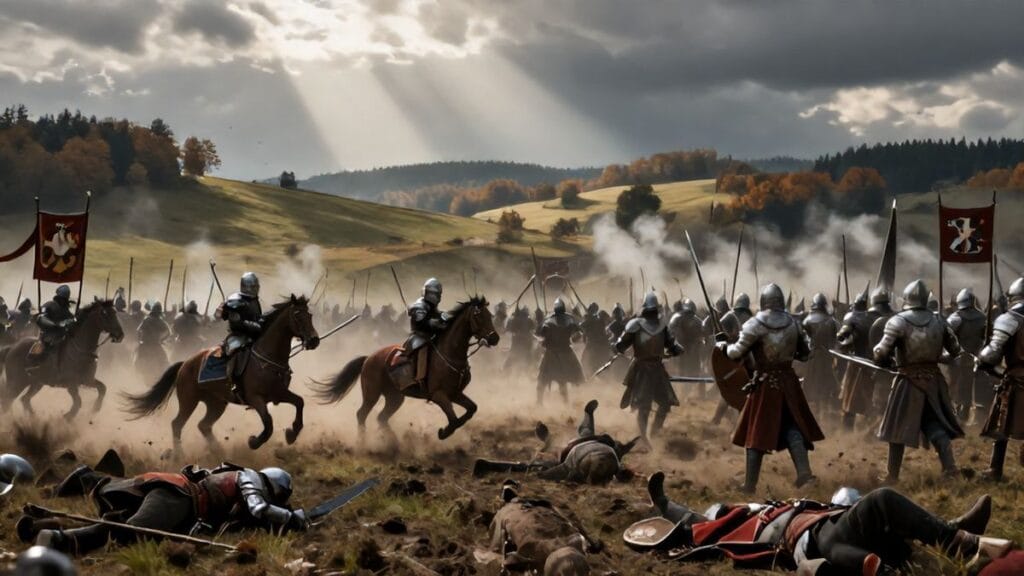
As the pale November sun struggled to break through the clouds, the two armies at Gammelsdorf completed their deployments. Trumpets sounded across the field, not in harmony but in a cacophony of signals—each lord’s musicians giving commands to his own contingent. Between the lines lay a stretch of cold, empty ground, soon to be crowded with men and horses, cries, and the metallic scream of clashing weapons.
Louis, ever the aggressive commander, appears to have taken the initiative. He could not afford a long, drawn-out confrontation in which Rudolf’s broader coalition might find ways to outflank or encircle him. Instead, he sought to strike hard at the enemy’s cohesion, counting on the discipline and determination of his Bavarian knights. According to later accounts, he arranged his cavalry in strong columns, with infantry supporting on the flanks and a modest reserve held back for decisive commitment.
Rudolf, aware of his numerical advantages and reinforced by Habsburg allies, may have aimed initially for a more measured engagement. If he could blunt Louis’s first assault and then bring his greater numbers to bear, the day might be his. He placed trusted commanders at critical points in the line, giving them discretion to respond to Bavarian moves. Yet the very complexity of his army, drawn from multiple regions, imposed limits on how swiftly he could shift forces in the heat of battle.
The opening phase likely began with skirmishing. Crossbow bolts and arrows arced across the gap, thudding into shields and, occasionally, finding joints in armor. Men shouted insults or prayers; horses stamped and snorted, sensing the tension. Then, at a signal from Louis—perhaps a raised sword, perhaps a blast of a distinctive trumpet—the Bavarian cavalry surged forward, lances leveled.
Imagine the ground trembling as hundreds of horses broke into a gallop, the front ranks lowering their heads, the riders bracing themselves in the saddle for the shock. The distance closed rapidly. On Rudolf’s side, lances came down in turn, forming a bristling hedge of steel points. A moment of terrifying, silent inevitability hung in the air—and then the two lines met with a crash that observers would remember for the rest of their lives.
The battle of Gammelsdorf had truly begun.
Breaking the Line: The Turning Point on the Bavarian Fields
The initial collision of cavalry at Gammelsdorf must have been chaotic and brutal. Lances shattered on impact, splinters flying; some riders were hurled from their saddles, others pushed back, their horses stumbling. What had been neat formations moments before dissolved into a swirling melee of close combat. Swords, maces, and axes replaced lances as the primary tools of survival.
Louis’s plan hinged on more than courage. He relied on the tight cohesion of his Bavarian forces, men who knew each other’s ways of fighting and had trained together. Even as the initial charge broke up, these knights could rally around familiar banners, reforming into compact groups that pressed forward. On Rudolf’s side, the diverse contingents responded with bravery but not always in harmony. Some units held firm, others wavered or advanced too quickly, creating dangerous gaps.
At a crucial moment, Louis committed his reserve. Spotting a weakness in Rudolf’s left or center—accounts differ on the exact location—he sent fresh cavalry thundering into the fray. This blow struck where Rudolf’s coordination was already strained, perhaps where Rhenish and Habsburg troops met along an imperfectly defined boundary. Under the renewed pressure, the line buckled. A banner fell; a commander was unhorsed or slain. Panic, the most contagious enemy on any battlefield, began to spread.
Infantry, seeing their protectors give ground, faced an impossible choice: stand and risk encirclement, or fall back and risk being cut down in retreat. Some fought valiantly, trying to stem the Bavarian advance with spears and polearms. But as Louis’s knights punched through the breach, they exploited their mobility, turning inward against the now-fragmenting enemy ranks.
Here, in this chaotic and bloodied space, the battle of Gammelsdorf was decided. Rudolf’s commanders attempted to rally their men, to form a new defensive line farther back, but the tempo of the fight now favored Louis. Every small success for the Bavarians—overrunning a position, capturing a banner, killing or capturing a notable opponent—further sapped Rudolf’s authority in the eyes of his followers. What had begun as a contest between two confident leaders was turning into a clear test of which side could maintain order in crisis.
By early afternoon, the outcome was becoming unmistakable. Rudolf’s forces, under mounting pressure, began to give way in more than one sector. Where once he had stood at the head of a powerful coalition, he now found that coalition fragmenting, each lord concerned first with his own survival and that of his men. Louis, sensing victory, drove forward relentlessly.
Blood, Surrender, and Silence: The Aftermath on the Frozen Ground
As Rudolf’s lines collapsed in places and withdrew in others, the battlefield at Gammelsdorf descended into a grim endgame. Routing troops sought escape routes through fields already churned into mud and blood. Bavarian cavalry pursued, though even in victory commanders had to restrain their men; pursuit too far or too recklessly could invite counterattacks or scatter units beyond recall.
Some among Rudolf’s retinue chose surrender over annihilation. High-ranking nobles, their armor and heraldry marking them as valuable captives, sought out Bavarian lords to whom they could yield. In an age when ransom was a central institution of warfare, being taken prisoner by a knight of honor could mean survival and, eventually, return home—for a price. Anonymous foot soldiers, lacking such value, were not always granted the same mercy.
Rudolf himself, faced with overwhelming evidence of defeat, had little choice but to negotiate. Whether captured in the fighting or compelled by the strategic situation to accept terms, he became a defeated prince in the hands of his cousin and rival. The proud “Stiff-Necked” had to bow, however reluctantly, to the man whose banner now flew unchallenged over the field.
When the shouting died down and the clamor of combat faded, a heavy silence settled over Gammelsdorf. The dead and wounded lay scattered across the land—knights toppled from their saddles, infantrymen cut down where they stood, horses fallen and struggling or already still. Survivors moved among them, searching for friends, kin, or lords, calling names that sometimes received no answer. Priests hurried from body to body, offering last rites where they could.
For the villagers and peasants who emerged cautiously from hiding places—cellars, barns, patches of woodland—the sight was appalling. Fields that had once promised grain now bore the imprint of hooves and the stains of battle. They would be left to clear the detritus of war, to bury the nameless, and to rebuild lives in a landscape marked by trauma. The battle of Gammelsdorf, for them, was not a dynastic milestone but a sharp rupture in the fragile continuity of their existence.
By evening, Louis’s camp was alive with the complex emotions of victory: relief, elation, and no small amount of exhaustion. Rudolf’s former allies, now faced with the hard reality of defeat, quietly recalculated their positions. The political map of Bavaria and its surrounding regions had shifted in a matter of hours, and everyone with a stake in it understood that new arrangements were now inevitable.
From Battlefield to Bargaining Table: The Treaty That Followed
Victories in medieval Europe were rarely complete without negotiation. The outcome of the battle of Gammelsdorf had decisively favored Louis, but he still needed to transform his battlefield success into enduring political gains. That meant sitting across from defeated princes and hammering out terms that would shape Bavaria’s future.
The resulting agreement, concluded in the wake of the battle, confirmed Louis’s control over Lower Bavaria and, more specifically, his guardianship of Stephen I’s sons. Rudolf abandoned his claim to the regency and with it his bid to direct the destiny of that branch of the Wittelsbach inheritance. In exchange, he received concessions that softened the blow: recognition of his rights in the Palatinate and perhaps certain assurances regarding his Rhenish territories.
For the Habsburgs, the treaty was a setback. Their attempt to use Rudolf as a lever in Bavarian affairs had failed. While they did not lose their own lands as a result, their prestige had taken a hit, and their capacity to dictate terms in southern Germany had been curtailed, at least temporarily. Louis had demonstrated that with resolve and skill, he could defy not only a cousin but also the broader coalition that had stood behind him.
Modern historians, drawing on scattered charter evidence and narrative sources, agree that the post-battle settlement significantly strengthened Louis’s hand. One scholar, analyzing the aftermath of Gammelsdorf, wrote that “Louis’s triumph over Rudolf was the true prelude to his imperial ambitions, for it secured his base and broadcast his capabilities to friend and foe alike” (a judgment echoed in several studies of early fourteenth-century imperial politics). The treaty was not merely the end of a local war; it was a stepping stone onto a much larger stage.
Within Bavaria, the agreement brought a measure of stability. The question of the young dukes’ guardianship was settled, at least in formal terms. Noble families knew whose court to address for favors, confirmations of rights, or redress of grievances. Towns could plan their commercial futures with somewhat more confidence. Yet behind the formal peace, memories of the battle and the fragile nature of power remained vivid. No treaty could erase the knowledge that family rivalries, when combined with external ambitions, could once again plunge the land into violence.
A Duke in the Making: How Victory Shaped Louis IV’s Path to the Imperial Crown
The significance of Gammelsdorf for Louis’s later career cannot be overstated. Before the battle, he was a forceful regional prince, engaged in a dangerous contest with a powerful cousin and constrained by the shifting politics of the empire. After it, he emerged as a man whose military and political talents had been tested and vindicated. The victory gave him not only territory and authority, but also something less tangible yet equally crucial: reputation.
Within a few years, circumstances at the imperial level created opportunities that Louis was uniquely positioned to exploit. The death of Emperor Henry VII in 1313—remarkably, the same year as the battle of Gammelsdorf—threw the empire into another contested election. Two main candidates emerged: Louis of Wittelsbach and Frederick the Fair of Habsburg. The very house that had backed Rudolf against him at Gammelsdorf now confronted Louis on an even larger battlefield, this time for the crown of the Romans.
Louis’s proven ability to defeat Habsburg-supported forces in Bavaria did not guarantee victory in the imperial election, but it shaped the perceptions of the electors. He was a man who could hold his own against one of Europe’s most ambitious dynasties. His consolidation of control in Bavaria gave him resources and legitimacy. In 1314, he was elected King of the Romans by a group of electors, while a rival group chose Frederick the Fair. The result was a dual kingship and years of conflict, culminating in Louis’s eventual victory at the Battle of Mühldorf in 1322.
Looking back, Gammelsdorf appears almost as a rehearsal for Mühldorf—a smaller stage on which Louis refined the combination of military audacity and political calculation that would carry him to the imperial throne. When he was finally recognized as Holy Roman Emperor Louis IV, those who had stood with him in the Bavarian fields could claim to have backed not just a duke, but a future sovereign of the empire.
Thus the battle of Gammelsdorf stands at the hinge of a career. Without it, Louis might still have contended for the crown, but with less authority behind his claim. With it, he stepped from the role of embattled regional prince to that of plausible imperial contender, his blue-and-white colors known and, in some quarters, feared across German lands.
Defeat and Diminishment: Rudolf the Stiff-Necked and the Cost of Ambition
For Rudolf of the Palatinate, the consequences of Gammelsdorf were stark. The proud prince who had marched into Bavaria at the head of a formidable coalition rode away diminished. His claim to guardianship over Stephen I’s sons was gone; his influence within the Wittelsbach dynasty was curtailed. Although he retained control over his Palatine territories and remained an important figure along the Rhine, the dream of directing Bavarian affairs as regent had evaporated on a single November day.
Defeat also carried a personal and psychological toll. Known for his rigid nature—hence the epithet “the Stiff-Necked”—Rudolf had to confront not only the strategic failure of his campaign but also the reality that his cousin had outmaneuvered him. Relations between the two branches of the family, already fraught, soured further. The Wittelsbach name would be carried forward in imperial glory by Louis, not Rudolf, and that fact cast a long shadow over Rudolf’s subsequent years.
Yet it would be wrong to see Rudolf as a mere foil in another man’s triumph. He embodied a particular vision of Wittelsbach power, one rooted in the Palatinate and its connections to the broader Rhineland. His alliance with the Habsburgs reflects a shrewd understanding of imperial politics, even if the bet turned out poorly at Gammelsdorf. His defeat serves as a reminder of the risks noble houses took when they bound their fates to external powers while contesting internal family matters.
In the long run, the Palatinate would retain its importance within the empire; later Wittelsbach electors played key roles in imperial elections and religious conflicts. But Rudolf himself became, in many accounts, the man who lost Bavaria’s inner contest. Where Louis’s legacy was gilded by imperial coronation, Rudolf’s was marked by the memory of a broken line on a Bavarian field.
Villages, Monasteries, and Markets: Everyday Lives Changed by War
While the chronicles tend to focus on dukes, banners, and treaties, the battle of Gammelsdorf also profoundly affected those with no voice in written history: peasants, artisans, monks, and merchants. For them, the conflict was not about dynastic strategy but about the sudden intrusion of war into the routines that kept them alive.
In the villages around Gammelsdorf, the weeks leading up to the battle must have been filled with anxiety. Armies on the move meant requisitioning and, all too often, outright plunder. A farmer who had spent months preparing his fields for winter might see fences broken, stores of grain emptied, or livestock driven off to feed warhorses. Some compensation might be offered by more disciplined lords, but in the confusion of large-scale movements, many losses simply went unacknowledged.
Monasteries, too, found themselves drawn into the orbit of the conflict. As literate centers of record-keeping and spiritual authority, they could not ignore such a major event in their vicinity. Yet they also had to navigate the dangers of taking sides. Sheltering a fleeing noble or lending support to one claimant’s forces could invite retribution from the other. Some communities must have prayed for neutrality, trying to offer alms to wounded of both sides and emphasizing their role as houses of God rather than as political actors.
Market towns, whose prosperity depended on stable trade routes, felt the disruption keenly. Merchants transporting salt, grain, or cloth encountered sudden levies as armed men demanded supplies or tolls. Travelers avoided routes rumored to be near encamped armies, causing traffic to shift and sometimes leaving certain towns eerily quiet. Prices fluctuated; essential goods became harder to obtain. For burghers in places like Landshut or Moosburg, Gammelsdorf was both too close for comfort and yet just far enough that the full details of the battle only reached them through rumor and intermittent reports.
In the months after the battle, the landscape had to heal. Fields once riven by hooves and blood were ploughed again. Villagers found rusting fragments of weapons or broken bits of harness in the soil, mute reminders of that November day. Children would have grown up hearing their elders’ stories: where the banners had been, where the ground shook the most, where bodies had lain waiting for burial. These local memories, though seldom recorded, were part of the living history of the region, passed from generation to generation long after the dukes and emperors had become names in distant chronicles.
Memory, Chronicle, and Legend: How Gammelsdorf Was Remembered
The way contemporaries and later generations remembered the battle of Gammelsdorf tells us much about medieval historical consciousness. In the immediate aftermath, monastic chroniclers in Bavaria and beyond recorded the event, often briefly but with clear awareness of its significance. For them, Gammelsdorf marked a shift in the balance of power within the Wittelsbach family and, by extension, within the empire.
One such chronicle, written in Latin in a Bavarian abbey, notes succinctly that in the year of our Lord 1313, “a mighty conflict arose between the Dukes of Bavaria, and Louis, by the grace of God, overcame his enemies near a place called Gammelsdorf.” The author’s tone, as preserved in later editions, suggests approval of Louis’s victory, perhaps reflecting the duke’s subsequent patronage of certain religious houses. Elsewhere, in Rhenish or Austrian sources, the tone is more restrained or even disapproving, with some chroniclers lamenting the discord among Christian princes at a time when unity was deemed necessary to face external threats.
As the centuries passed, Gammelsdorf receded from the center of European historical narratives but remained important in regional memory. Early modern historians of Bavaria, seeking to trace the rise of their duchy and later kingdom, highlighted the battle as a foundational moment in the consolidation of Wittelsbach power. Nineteenth-century scholars and nationalists, fascinated by the emergence of German states and identities, sometimes looked back to Gammelsdorf as an example of native Bavarian strength against external influence.
Local legend, too, undoubtedly took shape around the event, though many of these stories are now irretrievably lost. Perhaps villagers told of miraculous survivals, of saints’ images in chapels that supposedly protected the locality, or of omens seen in the sky before the battle. In a landscape littered with churches and wayside crosses, it is easy to imagine specific spots being linked, in popular imagination, to key moments—where a famous knight fell, where Louis is said to have prayed, where Rudolf’s standard was last seen.
Modern historiography has, in recent decades, begun to revisit such “regional” battles, understanding them not as minor footnotes but as revealing windows into the politics, society, and mentalities of their age. The battle of Gammelsdorf, while still less famous than Mühldorf or later wars, offers a case study in how dynastic conflicts, local landscapes, and the lived experiences of ordinary people intersected in medieval Europe.
The Battle of Gammelsdorf in the Long Arc of German and European History
Placed against the vast canvas of European history, the battle of Gammelsdorf may at first seem a small episode: a clash between cousins in a distant corner of the Holy Roman Empire. Yet its significance grows as we trace the lines that radiate from that frosty Bavarian field into the wider political and cultural developments of the fourteenth century and beyond.
First, Gammelsdorf contributed directly to the consolidation of Wittelsbach power in Bavaria. A fragmented or Habsburg-dominated Bavaria would have altered the delicate balance of forces within the empire. Louis’s victory preserved a strong, semi-autonomous duchy that could act as a counterweight to both Habsburg Austria and the Luxembourg rulers of Bohemia. When Louis later contested the imperial crown, he did so backed by a territory whose unity had been secured in no small part by his triumph at Gammelsdorf.
Second, the battle exemplifies a broader pattern in medieval German politics: the tendency for imperial questions to be decided through regional struggles. The empire’s decentralized nature meant that power accrued to those who could master local conflicts effectively. Louis’s success in Bavaria mirrored, on a smaller scale, the strategies he and others would use in imperial contests—alliances, calculated use of force, and the conversion of military victory into diplomatic leverage.
Third, Gammelsdorf illuminates the complex interplay between dynastic ambition and external influence. The involvement of the Habsburgs highlights how great houses constantly sought opportunities to expand their reach by intervening in the affairs of neighboring principalities. The failure of this intervention at Gammelsdorf did not end Habsburg ambitions, but it did check them and demonstrated that such ventures could backfire, creating powerful enemies rather than pliant allies.
Finally, on a more humanistic level, the battle reveals enduring themes in European history: the vulnerability of children whose inheritances became prizes in adult power games; the precariousness of rural communities caught between marching armies; the ways in which memory and narrative transform violent events into symbols of identity or warning for later generations. To study Gammelsdorf is to see, in microcosm, questions about authority, legitimacy, and the costs of political ambition that continue to resonate in different guises throughout history.
Echoes on the Modern Landscape: Visiting Gammelsdorf Today
Today, Gammelsdorf is a quiet place again, its fields once more devoted to agriculture rather than war. Modern roads and farm machinery have transformed the landscape, but for those who know the story, it is possible to stand on a small rise, look out over the countryside, and imagine the banners and armored ranks of 1313. The wind that crosses the fields now carries the sound of traffic and distant machinery rather than trumpets and shouts, yet the contours of the land remain.
Local history enthusiasts and scholars have, over time, tried to pinpoint the exact locations of the main engagements. While the absence of large-scale fortifications or enduring monuments makes this challenging, a combination of topographical analysis, old maps, and written sources allows for educated guesses. In some spots, modest markers or informational plaques recount the basics of the battle of Gammelsdorf, turning anonymous fields into sites of memory.
For visitors, the experience can be quietly powerful. Unlike more heavily memorialized battlefields with grand monuments, Gammelsdorf offers a subtler encounter with the past. One might visit a village church that, in its medieval form, already stood when Louis and Rudolf’s men marched nearby. One might walk along a lane that follows an old route once used by supply wagons. The absence of spectacle encourages contemplation: how many crucial turning points in history occurred in places that now seem unremarkable?
Local archives and regional museums in Bavaria sometimes devote exhibits or sections to the battle and its broader context. Documents, reproductions of medieval arms and armor, genealogical charts of the Wittelsbach family—these materials help flesh out the narrative for those who want to go beyond the landscape and into the minds of those who lived the events. To engage with Gammelsdorf today is to participate in an ongoing conversation between past and present, between the silence of the fields and the stories historians and communities continue to tell.
Conclusion
On 9 November 1313, near a small Bavarian village, the destinies of men and dynasties collided in a way that only later generations could fully appreciate. The battle of Gammelsdorf was, in its immediate sense, a contest over the guardianship of three young dukes and the control of a duchy. Yet in a deeper sense, it was a crucible in which the future Holy Roman Emperor Louis IV proved his mettle, a stage where the balance between Wittelsbach and Habsburg ambitions was briefly but decisively tested, and a moment when ordinary people saw war stride through their fields.
By retracing the path to Gammelsdorf—from the tangled inheritance of the Wittelsbachs and the death of Stephen I, through the mobilization of allies and the march of armies, to the clash of steel and the quiet after the storm—we see how medieval politics was both intensely personal and structurally constrained. Dynastic rivalry, legal claims, and the desire for honor played out within a framework of feudal obligations, fragmented authority, and ever-present uncertainty. Victory granted Louis not only land and guardianship but the aura of a man destined for greater things; defeat left Rudolf adjusting to a reduced role in the family drama.
The fields of Gammelsdorf, once soaked with blood, returned to their agricultural rhythms, but the memory of that day persisted in chronicles, legal documents, and local lore. Over time, historians have come to recognize the battle’s significance as a link between regional and imperial histories, between the lives of individuals and the slow evolution of political structures in the Holy Roman Empire. Seen in this light, Gammelsdorf is not a mere footnote but a vivid chapter in the story of how power was won, lost, and remembered in medieval Europe.
Ultimately, the story of the battle of Gammelsdorf invites us to consider how many seemingly local conflicts hold within them the seeds of larger transformations. It reminds us that behind every title and treaty stand people—ambitious, fearful, resolute, or simply trying to survive—whose choices and fates ripple outward through time. On that cold November morning in 1313, few could have guessed that history would still be speaking of Gammelsdorf centuries later. Yet it does, and in listening, we come a little closer to understanding the complex, human texture of the medieval world.
FAQs
- What was the Battle of Gammelsdorf?
The Battle of Gammelsdorf was a medieval military engagement fought on 9 November 1313 near the village of Gammelsdorf in Bavaria. It pitted Duke Louis of Upper Bavaria, later Emperor Louis IV, against his cousin Rudolf of the Palatinate and their respective allies, including Habsburg forces on Rudolf’s side. The conflict arose over the guardianship of the underage sons of the late Duke Stephen I of Lower Bavaria and control of their inheritance. - Why did the battle take place specifically at Gammelsdorf?
Gammelsdorf lay in a strategically useful area of Lower Bavaria, near important routes between Landshut, Freising, and the Isar River. The surrounding landscape offered open fields suitable for cavalry action, gentle ridges for advantageous positioning, and nearby settlements that could support large armies. As both forces maneuvered in the region, the terrain around Gammelsdorf proved to be the natural place where they finally confronted each other. - Who won the Battle of Gammelsdorf, and what were the main consequences?
Duke Louis of Upper Bavaria won the battle decisively. His victory forced Rudolf of the Palatinate to relinquish his claim to the regency over Stephen I’s sons and confirmed Louis’s control over Lower Bavaria. Politically, the triumph significantly strengthened Louis’s position within the Wittelsbach dynasty and the Holy Roman Empire, paving the way for his later election as King of the Romans and eventual coronation as Emperor Louis IV. - How did the battle affect Rudolf of the Palatinate and the Habsburgs?
Rudolf of the Palatinate suffered a serious setback. He lost the contest for influence in Bavaria and saw his standing within the Wittelsbach family reduced. The Habsburgs, who had supported him, also experienced a political defeat, as their attempt to shape Bavarian politics through Rudolf failed. While they retained their own territories, their prestige and immediate leverage in southern Germany were weakened by the outcome at Gammelsdorf. - What role did the Battle of Gammelsdorf play in Louis IV’s rise to the imperial throne?
The battle was a crucial milestone in Louis IV’s ascent. It secured his authority in Bavaria, provided material resources and a stable power base, and burnished his reputation as an effective military leader. When the imperial throne became contested after the death of Emperor Henry VII, Louis could present himself to the electors as a tested prince capable of defending and expanding imperial interests, a claim that would eventually lead to his victory over Frederick the Fair of Habsburg. - Do we know how many soldiers fought at Gammelsdorf?
Exact numbers are not preserved in contemporary sources, and later estimates vary. Most historians believe that each side fielded several thousand men, with a core of heavy cavalry supported by infantry and missile troops. The emphasis in the sources on the presence of many knights and noble contingents suggests a significant but not enormous engagement by medieval standards—large enough to be decisive regionally, but not on the scale of later mass armies. - How is the Battle of Gammelsdorf remembered today?
Today, the battle is primarily remembered in regional Bavarian history and specialized studies of the early fourteenth-century Holy Roman Empire. Local commemorations, informational plaques, and discussions in museums and scholarly works keep the memory alive. For residents and visitors, the largely peaceful modern landscape around Gammelsdorf offers an opportunity to reflect on how a seemingly ordinary place once hosted an event with far-reaching political consequences. - Can visitors see any remains or monuments from the battle?
There are no large fortifications or extensive physical remains directly linked to the battle, as it took place in open fields rather than around a castle or walled town. However, local markers and interpretive signs in the area provide historical context, and nearby churches, villages, and museums offer insights into the era. The main “monument” is the landscape itself, whose contours still reflect the terrain that shaped the fighting in 1313.
External Resource
Internal Link
Other Resources
- Encyclopaedia Britannica – general search for the exact subject
- Google Scholar – academic search for the exact subject
- Internet Archive – digital library search for the exact subject

