Table of Contents
- Rome on the Edge of Eras: The World into Which Stephen Was Elected
- From Obscurity to the Threshold of the Papal Throne
- The Day Pope Stephen II Was Elected: Rome, 22 March 752
- A Shadow Before the Dawn: The Brief, Ghostly Reign of Stephen the “Almost Pope”
- The Papacy between Lombards and Byzantines: A City without a Protector
- Negotiating with Kings: Stephen II and the Turn toward the Franks
- Crossing the Alps: The Pope on the Road to King Pippin
- Tears, Relics, and Oaths: The Dramatic Encounter with Pippin the Short
- The Birth of the Papal States: From Promise to Territorial Power
- Rome Transformed: How Ordinary People Lived under Stephen II
- Ideology and Forgery: The Donation of Constantine and the New Papal Imagination
- A Church of Stone and Song: Stephen II as Builder and Liturgical Reformer
- The Fragile Balance of Power: Lombard Rage and Frankish Calculations
- The Final Years of Stephen II and the Road to Charlemagne
- How Chroniclers Remembered Him: Between Silence and Subtle Praise
- Legacy of a Turning Point: Why the Election of Stephen II Still Matters
- Conclusion
- FAQs
- External Resource
- Internal Link
Article Summary: When pope stephen ii elected in Rome on 22 March 752, the city stood at a crossroads between collapse and reinvention. This article follows the arc of his life from relative obscurity to the dangerous heights of papal power in a world where the Byzantine Empire was distant and the Lombard kings threatened Rome’s very survival. It traces how his election triggered a radical geopolitical shift, turning the papacy away from Constantinople and toward the rising power of the Frankish kings. Through narrative scenes—his fraught dealings with the Lombards, his perilous journey across the Alps, and his emotional encounter with King Pippin—the story shows how a spiritual office became a political force. Again and again, we return to the moment pope stephen ii elected and how that choice by the Roman clergy and people unleashed long‑term consequences for Europe. The creation of the Papal States, the forging of new ideologies like the Donation of Constantine, and the transformation of Rome’s daily life all unfold from that turning point. By the end, we see why historians still consider the year 752 and the fact that pope stephen ii elected at that exact moment as a hinge between the ancient and medieval worlds. His pontificate reveals how fear, faith, and fragile alliances reshaped the map of Western Christendom.
Rome on the Edge of Eras: The World into Which Stephen Was Elected
On the morning of 22 March 752, the bells of Rome rang in a city that no longer knew quite who ruled it. The crumbling walls still bore the scars of earlier sieges, and beyond them, Lombard warriors moved like a slow, suffocating fog across central Italy. To the east, in distant Constantinople, emperors draped in silk still styled themselves lords of Rome, yet their ships were rare in Italian harbors and their soldiers rarer still. Somewhere between these fading claims and looming threats, Rome stumbled forward, clutching its saints’ relics like lifelines.
In this uneasy space between empire and invasion, the papacy had become something it had never entirely meant to be: not just shepherd of souls, but guardian of streets, walls, and grain supplies. The imperial officials—once omnipresent—were withdrawing like a receding tide, leaving behind dry sands of bureaucracy that no longer connected to a living center of power. The Roman people, hungry, devout, and anxious, turned increasingly toward the man in white, the bishop of Rome, as though he alone could hold back the tide of history.
When pope stephen ii elected by clergy and people in such a city, they were not simply choosing a spiritual father. They were appointing a negotiator with armed kings, a would‑be diplomat to absent emperors, and, if necessary, a wartime leader. The election took place in a world in which the old Roman Empire still haunted maps and prayers but could no longer guarantee safety. The Lombard Kingdom, with its capital at Pavia, was pressing hard upon the last Byzantine outposts—Ravenna, the Exarchate, and the patchwork of territories that notionally linked Rome with Constantinople.
It is astonishing, isn’t it, to realize that in this unstable environment, the quiet choice of a man named Stephen—a cleric of no spectacular reputation—would redirect the fate of Western Europe? Yet such are the paradoxes of history. The Rome in which he rose was not the gleaming capital of Caesar, but a shrinking, half‑ruined city whose glory rested now more on saints than on senators. Nevertheless, within its churches and palaces, decisions were about to be made that would call forth new kingdoms, new ideologies, and a new kind of papal power.
Old women lit candles before mosaics flaking upon church walls; children chased each other through abandoned forums, their laughter echoing where orators had once thundered. Soldiers on the walls looked northward with apprehension. And in the Lateran Palace, where the bishop of Rome resided, the machinery of an election—ancient, ritualized, but also deeply political—was beginning to turn.
From Obscurity to the Threshold of the Papal Throne
Stephen, the man who would become pope, entered this world not as a prince or a general but as a Roman cleric formed in an age of uncertainty. His early life is frustratingly obscure, shrouded by the silence of sources more interested in kings and battles than in the slow shaping of a priest’s vocation. Yet through scattered hints in later chronicles and papal lists, historians glimpse a figure typical of his time and yet destined for singular influence.
Born into a Rome where the empire’s grandeur had curdled into nostalgia, Stephen grew up amongst ruins that were not yet romantic, only practical. Marble was hauled off to burn into lime, statues toppled to reuse their bases, basilicas patched with spolia taken from half‑collapsed temples. The city was shrinking into its Christian core—clusters of churches around the tombs of saints, small markets sheltered near the Tiber, a population a fraction of what it had been under the Caesars.
From a young age, Stephen seems to have moved within the clerical milieu tied to the Lateran. He would have studied Scripture in dimly lit rooms where oil lamps struggled against the Roman dusk, learned the rhythms of chant which stitched together the city’s days, and mastered the legal formulas that governed not only ecclesiastical disputes but increasingly civil ones as well. As the imperial administration weakened, the clergy stepped into its vacuum. A priest might be called upon to bless a marriage in the morning, arbitrate a property quarrel at midday, and negotiate with Lombard captains before nightfall.
It was in this crucible of overlapping duties—spiritual ministrations entangled with civil responsibilities—that Stephen’s character took shape. Later narratives hint at a man cautious yet determined, not a fiery preacher, but a steady servant of the church. For years he served under earlier popes, perhaps dispatched to surrounding towns as an emissary, perhaps entrusted with managing church lands whose revenues fed Rome’s poor and paid its defenders.
By the time the question of his election arose, Stephen was no longer young. The generation that had grown up in the shadow of Justinian’s reconquest in the sixth century was long dead; Stephen belonged to those who had known only fragmentation. This gave him a certain grim realism. The empire would not ride in to save Rome. If salvation was to come, it would come from elsewhere—or not at all.
And yet, for all his experience, Stephen was not the obvious choice for a daring transformation. This is one of history’s ironies. When pope stephen ii elected, it was not because the electors foresaw a revolution in papal policy, but because they trusted his piety, his administration, and his capacity to steer the city through familiar storms. They did not yet realize that the storms themselves had changed.
The Day Pope Stephen II Was Elected: Rome, 22 March 752
The day itself began like so many others in Rome, with the murmur of prayer and the grazing of sandaled feet on worn stone. Yet the tension in the city was palpable. The previous pope, Zacharias, had died, leaving behind a Rome more isolated than ever. Lombard warriors loomed in central Italy; the Exarchate of Ravenna, keystone of Byzantine authority, was tottering. The people needed a shepherd, and they needed him quickly.
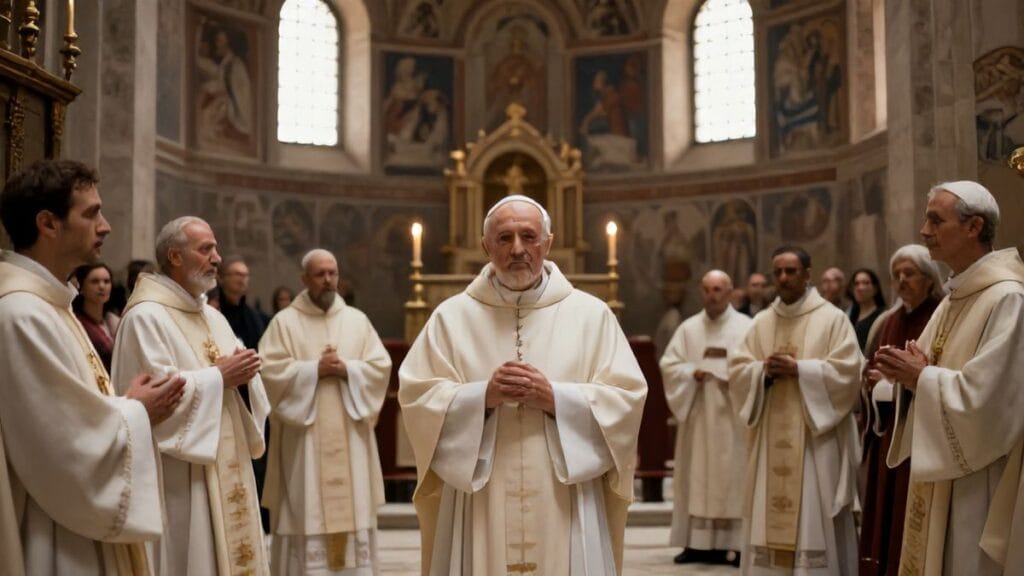
When pope stephen ii elected on 22 March 752, the ritual unfolded beneath frescoes depicting Christ, apostles, and martyrs—silent witnesses to a decision centuries in the making. The clergy gathered, chanting litanies; representatives of the Roman nobility hovered nearby; the urban populace, never entirely absent from such moments, surged at the edges of the ceremony, listening for the announcement that would shape their city’s fate.
The election of a pope in this period was not yet the tightly sealed conclave it would become in later centuries, but a more fluid and at times unruly event. Tradition held that clergy and people of Rome had the right to choose their bishop. In practice, powerful families, lingering Byzantine officials, and even foreign monarchs might attempt to influence the outcome. In 752, however, it was clear that Constantinople’s influence had waned to a whisper. The Romans were largely on their own.
Somewhere amidst the chanting, the name “Stephen” gathered force. Was it spoken first by a respected deacon, by a senior presbyter, by a noble whose lands bordered Lombard territory and who knew fear firsthand? We cannot say. But the pattern of surviving sources suggests a man whose virtues were known if not loudly trumpeted: capable, devout, not closely tied to any faction that might tear the city apart.
Once the decision coalesced, the acclamations would have risen—Sanctus Stephanus papa futurus!—echoing against the stone vaults. The ritual of elevation, with its complex blend of Roman and Christian symbolism, marked the moment when a local cleric became something more: heir to Peter, pivot of the Western Church, and, increasingly, focal point of Roman identity itself. When chroniclers later noted that pope stephen ii elected on that March day, they were recording more than an administrative detail; they were pointing, albeit unknowingly, to a hinge of European history.
Yet behind the celebrations, anxiety gnawed. Popes had been murdered before; Rome had known factions that turned sacred spaces into battlegrounds. Moreover, every new pope now faced the same urgent questions: could he hold back the Lombards, reassure the city’s grain supply, and negotiate the ever-more-complex relationship with the distant emperor? Those gathered to acclaim Stephen were not naïve. They were wagering that this man, grave and perhaps a little tired, could carry burdens that had crushed others.
As he accepted his election, Stephen would have felt the weight of expectations pressing upon his shoulders like an invisible pallium. In the eyes of his flock, he was now more than a symbol; he was the last line between Rome and the void.
A Shadow Before the Dawn: The Brief, Ghostly Reign of Stephen the “Almost Pope”
Yet history has a taste for complications, and Stephen’s papacy was born under the shadow of another Stephen. Just before him, another man of the same name had been chosen—often referred to by modern historians as Stephen II (or sometimes Stephen III), a figure whose strange, almost spectral presence haunts the chronology of the papacy.
This first Stephen, elected in March 752 just days before the subject of our story was chosen, died suddenly after only a few days and before he could be formally consecrated as bishop. In the canonical tradition of the early Church, a man was only truly pope once he had undergone episcopal consecration. Thus, in later lists, there would be debates about whether to number this near‑invisible Stephen among the popes. Some medieval catalogues counted him; others ignored him, considering the title “pope” too weighty for a man who had never been fully invested with his office.
This tangle of numbering—does our Stephen count as Stephen II or Stephen III?—is not a mere curiosity for specialists. It reveals how fragile the office seemed at that moment. Death could snatch a pontiff‑elect before he donned the full insignia of his power. Lombard swords, Roman daggers, or simple disease might end a pontificate before it began. The Romans, in 752, had not elected one Stephen but effectively two in quick succession, the first a brief flicker, the second a steady, if embattled, flame.
When we say today that pope stephen ii elected in Rome on 22 March, we are echoing a decision made in the very wake of sudden loss. The city had barely absorbed the shock of the first Stephen’s death. Mourning and apprehension hung in the air. The choice to turn again to a man named Stephen was, in a sense, an act of insistence: Rome refusing to let death or confusion unmake its fragile structures of authority.
This ghostly predecessor also underscores how little inevitability there was in what followed. Had the first Stephen lived, he, not our Stephen, would have confronted the Lombards, weighed the alliance with the Franks, and perhaps taken a different path. European history might have bent along another curve. That the first Stephen vanished so quickly, leaving scarcely a trace, amplifies the drama of the second Stephen’s long and consequential reign.
The Papacy between Lombards and Byzantines: A City without a Protector
To understand the stakes of Stephen’s election, we must leave the Lateran for a moment and look outward at the map of Italy—a map pocked with uncertainty. To the north, the Lombard Kingdom had taken firm root, a patchwork of duchies and royal domains stretching down the peninsula. Once barbarians in Roman eyes, the Lombards had become an established power, Christianized but not entirely tamed. Their kings nursed ambitions of dominating all Italy.
In the east, across the Adriatic, the Byzantine Empire still claimed sovereignty. Official documents continued to style the emperor as lord of Italy, and Byzantine gold still appeared occasionally in Roman coffers. Yet the Exarchate of Ravenna, the emperor’s outpost in Italy, was beleaguered, cut off by Lombard encroachment and unable to project force as it once had. The dream of a united Mediterranean empire was flickering.
The papacy, caught between these forces, was forced into a perilous balancing act. Earlier popes had tried to maneuver within the imperial framework, insisting on their loyalty to Constantinople as a way to guarantee protection. They had also attempted to cultivate ties with the Lombards, hoping to transform fierce neighbors into partners—or at least to blunt their aggression through diplomacy and pious persuasion.
By 752, this strategy was unraveling. The Lombard king Aistulf had seized Ravenna itself, effectively decapitating Byzantine power in northern Italy. With the exarchate fallen, there was no longer a buffer between Lombard armies and Rome. The pope stood face‑to‑face with a conqueror whose ambitions were no longer checked by imperial garrisons.
It was into this storm that pope stephen ii elected. The chronicler known as the Liber Pontificalis, a semi‑official book of papal biographies, later painted a stark picture of this moment, describing Aistulf as a wolf circling the flock. The metaphor was more than literary; it captured the feeling in Rome that the last barrier had fallen. Now, when the pope wrote supplicating letters to Constantinople, asking for troops or money, there were only long delays and evasive promises.
Stephen inherited, then, not simply a spiritual office but a geopolitical crisis. The Byzantine emperor continued to insist that Rome belonged to him, yet did not—or could not—protect it. The Lombard king claimed tribute and territory, encroaching ever closer. On whose favor could the pope rely? Where could he find an ally strong enough, and willing enough, to challenge Aistulf’s advance?
These questions were not abstract. They were visible in the faces of Roman citizens lining up for bread, in the hasty strengthening of city walls, in the nervous glances exchanged when rumors of Lombard raids blew down from the north. By the time Stephen sat fully in Peter’s chair, he understood that doing nothing was not an option.
Negotiating with Kings: Stephen II and the Turn toward the Franks
At first, Stephen followed the worn path of his predecessors: he tried to bargain with the Lombards and plead with the Byzantines. Letters flew back and forth, laden with biblical rhetoric and political calculation. The pope invoked mercy, justice, and the shared Christian faith, urging Aistulf to restore captured territories and spare Rome. He appealed to the emperor to fulfill his duty as protector of the church and the old capital.
The responses, when they came at all, were chillingly inadequate. Aistulf listened politely, perhaps even welcomed envoys into his halls, but his armies continued to tighten their grip. Each concession demanded from him—each fortress to be returned, each city to be spared—would have meant a concrete loss of power. Words, however pious, were cheaper than land.
From Constantinople, the emperor’s envoys might have expressed indignation at Aistulf’s audacity, yet they brought no effective plans. The empire was beset by threats on multiple fronts: Arab fleets in the Mediterranean, Slavic and Bulgar pressures in the Balkans, internal theological conflicts over icons. Italy, once central, had slipped down the list of priorities. For the first time in centuries, the pope looked around and saw that the emperor’s shadow no longer covered Rome.
It was then that another name began to surface in Stephen’s calculations: the Franks. North of the Alps, a vigorous kingdom was consolidating under the rule of Pippin the Short, the first of the Carolingians to wear the royal crown in place of the old Merovingian dynasty. Pippin had already sought legitimacy from the papacy, receiving papal blessing for his deposition of the last Merovingian puppet. Now the currents of necessity and opportunity converged.
When pope stephen ii elected, no one in Rome could have imagined that within a few years he would be crossing the Alps to plead personally with a Frankish king. Such a journey for a pope was unprecedented, almost unthinkable. Popes had sent legates, certainly, but they themselves stayed near Peter’s tomb. To leave Rome was to expose the city and the person of the pope to risk.
And yet Stephen began to contemplate just that. Negotiations with the Lombards were stalling. Byzantine assistance was a mirage. The Franks, by contrast, were strong, pious in their own fashion, and eager to wrap themselves in the mantle of Roman and Christian prestige. In a stroke of daring, or desperation, Stephen and his advisors considered what seemed a wild gamble: inviting a northern king to intervene in Italy on behalf of the papacy.
The move had risks. Once a foreign army crossed the Alps at the pope’s request, could it be controlled? Might the Franks replace the Lombards as overbearing neighbors? But Stephen’s options were narrowing. Between the immediate threat of Aistulf’s siege engines and the abstract danger of Frankish ambitions, the nearer peril weighed heavier. A decision was taking shape that would alter the fabric of Western Christendom.
Crossing the Alps: The Pope on the Road to King Pippin
In late 753, or early 754 depending on the chronology accepted, Stephen made his choice. He would leave Rome. The pope would cross the mountains to speak with Pippin face‑to‑face. The image is startling even now: a figure robed in white, more accustomed to processions through basilicas than to mountain passes, setting out on a journey that blended diplomacy with pilgrimage.
Accounts in the Liber Pontificalis and Frankish annals depict the journey with a mix of awe and practical detail. Stephen left behind a Rome that trembled at the thought of his absence, entrusting its spiritual and administrative care to trusted clerics. He traveled northward, passing through territories where loyalties were ambiguous, where Lombard patrols might lurk. Each stage of the journey required careful negotiation, safe‑conducts, and constant vigilance.
It is easy to imagine the scenes along the route: villagers gathering to glimpse the pope’s procession, mothers pushing children forward to be blessed by the frail but determined old man; priests and monks emerging from remote churches, clutching relics, astonished that Peter’s successor was walking their roads. For these communities, the pope was an almost mythical figure; to see him in person must have felt like a visitation.
The crossing of the Alps itself, shrouded in mist and danger, carried a powerful symbolism. For centuries, the mountains had marked a boundary between the ancient Roman world and the northern lands where “barbarians” once dwelled. Now, in an ironic reversal, the pope was climbing toward those barbarian lands in search of salvation. Snow, thin air, treacherous paths—these were no small obstacles for an aging pontiff. Yet need drove him on.
When pope stephen ii elected back in 752, none of the electors could have foreseen this: their bishop of Rome, stumbling on icy paths, reliant on the goodwill of local lords and the strength of his retinue. But this was only the beginning. The true drama awaited him on the other side of the mountains, in the halls of the Frankish king.
Modern historians, such as Thomas F. X. Noble in his work on the papal–Frankish alliance, have emphasized just how extraordinary this decision was. By choosing to go in person, Stephen signaled that the crisis was existential. Letters were not enough; only the physical presence of the successor of Peter, tearful, imploring, carrying sacred relics, might move Pippin to radical intervention.
Tears, Relics, and Oaths: The Dramatic Encounter with Pippin the Short
The meeting of Stephen and Pippin has about it the air of a staged drama, and indeed, it seems to have been orchestrated with great care. Frankish sources like the Royal Frankish Annals and papal biographical texts agree on its emotional intensity: a pope in distress, a king moved to pity and piety, and negotiations that would reshape the politics of Europe.
Stephen arrived at Pippin’s court—likely at Ponthion or Quierzy—exhausted but resolute. Pippin, aware that hosting the pope granted him immense prestige, received him with honor. The images preserved in later retellings are vivid: the king prostrating himself before the pontiff, lifting him from the ground, embracing him as both spiritual father and political partner.
The pope did not come empty‑handed. He carried the relics of saints, tangible fragments of holiness that in the medieval imagination mediated heaven’s power. He used them not merely as devotional objects but as instruments of diplomacy. Placing the relics before Pippin, he invoked the intercession of Peter and the martyr saints, urging the king to swear solemn oaths to defend the Church, liberate captured territories, and protect Rome from its enemies.
There were tears, according to the sources—Stephen’s tears of desperation and gratitude, Pippin’s tears of moved piety or perhaps astute theater. Oaths were sworn upon the relics and upon the Gospel, binding Pippin not only in honor but, in his own understanding, before God. In return, Stephen renewed and deepened papal support for Pippin’s kingship, reinforcing the legitimacy of Carolingian rule against any Merovingian nostalgia.
It was here, in this charged atmosphere, that the outline of what would become the Papal States emerged. Pippin promised not only to push back the Lombards but to “restore” to the papacy lands that had once belonged to the empire in central Italy—Ravenna, the Pentapolis, and other territories. The fiction, repeated in solemn language, was that Pippin was returning these lands not from the Lombards to the Franks but from the Lombards to Saint Peter, whom the pope represented.
Behind the piety lay shrewd calculation on both sides. Pippin saw a chance to present himself as champion of the Church, to gain a foothold in Italian affairs, and to claim a kind of spiritual seniority over other Christian rulers. Stephen, for his part, accepted the price of inviting northern arms into Italy in exchange for survival and newfound territorial autonomy.
When later chroniclers wrote that pope stephen ii elected at a moment of grave peril, they could not help but see this encounter as the decisive answer to that peril. From the narrow lanes of Rome to the snow‑streaked passes of the Alps, the road had led to this partnership. The consequences would be long‑lasting, for better and for worse.
The Birth of the Papal States: From Promise to Territorial Power
Pippin’s promises were not mere words. In 754 and again in 756, Frankish armies descended into Italy, engaging Aistulf’s Lombards in battle. The campaigns were grueling; the Lombards were no easy prey, and the terrain of northern Italy favored defenders. Yet Pippin’s forces ultimately prevailed, compelling Aistulf to yield.
Under Frankish pressure, the Lombard king agreed to hand over to the pope a swath of territories in central Italy. What had once been the imperial Exarchate of Ravenna and the so‑called Pentapolis (a cluster of cities along the Adriatic coast) now passed, in theory, under papal control. The act, sometimes summarized as Pippin’s “Donation,” marked a revolutionary moment: for the first time, the bishop of Rome was not only a spiritual leader and a de facto civic authority in the city but also a territorial prince in his own right.
The implications are hard to overstate. When pope stephen ii elected back in 752, the papacy was formally still a subject of the Byzantine emperor. Now, with these lands entrusted “to Saint Peter,” the pope stood at the head of a new kind of political entity: a swath of central Italy governed in the name of the Church, independent of imperial oversight and buttressed by Frankish arms.
In practice, organizing these papal territories was messy. Local elites, Lombard magnates, and residual Byzantine officials all had their own interests. Boundaries were contested; tax systems needed to be improvised or adapted; law and custom collided. The papal administration, used to overseeing church lands and urban governance, suddenly had to manage roads, fortresses, and distant towns.
Yet the symbolic resonance was immense. In Rome itself, ceremonies celebrated the liberation of Christian lands from Lombard domination. Papal scribes crafted documents that framed this shift as a divinely sanctioned restoration, with Pippin cast as a new Constantine and Stephen as the vigilant guardian of Peter’s patrimony. One can almost hear the rustle of parchment as new maps were sketched and old assumptions about imperial supremacy quietly buried.
The Papal States that emerged were not a fully formed kingdom. They were fragmentary, unevenly controlled, and dependent on Frankish military support. But they were real enough to alter the mental geography of Europe. No longer was the pope simply the first bishop among many; he was now ruler of land, commander of fortresses, and participant in the rough game of territorial politics.
Some later historians would argue that this was the moment when the spiritual authority of the papacy became entangled—some would say compromised—by temporal power. Others would suggest that without such power, the papacy might have been crushed altogether, swallowed by Lombard or later by other regional powers. Either way, the fact remains: the decision that began when pope stephen ii elected in a threatened Rome culminated in the birth of an institution that would endure for over a millennium.
Rome Transformed: How Ordinary People Lived under Stephen II
Amid treaties and armies, it is easy to forget the ordinary Romans who woke each morning under Stephen’s rule. How did his election, his journeys, and his alliances shape their daily lives? For them, the high politics of kings and donations translated into more tangible experiences: fear of siege, fluctuations in food prices, changes in law and ritual.
The creation of papal territories meant that revenues from newly acquired lands could, at least in theory, be directed toward the city’s needs. Grain shipments might become more regular; charity for the poor, widows, and orphans could be sustained. The Lateran not only led liturgies but also became a kind of economic nerve center, distributing resources that helped Rome survive lean years.
At the same time, the looming threat of conflict did not entirely vanish. Lombard resentment simmered, and Frankish interventions brought their own disruptions. Soldiers on the march needed food and shelter; local farmers might be requisitioned to provide for troops. For peasants in central Italy, the shift from Lombard control to papal authority might have seemed less like a liberation and more like exchanging one lord for another, even if the new lord wore a mitre.
Religiously, Stephen’s reign deepened the sense that Rome was not just any city but the beating heart of Western Christendom. Pilgrims continued to arrive, some of them now also Frankish nobles or warriors who had fought in Italy. They brought tales of the pope’s journey across the Alps, reinforcing the image of a pontiff willing to suffer for his flock. Liturgical celebrations grew more elaborate; processions through the city emphasized Rome’s status as custodian of saints’ relics and recipient of divine favor.
For artisans and traders, the new Frankish connection offered modest opportunities. Northern merchants followed in the wake of their kings, bringing different goods, customs, and perhaps even words. Rome’s markets echoed with a slightly broader range of accents, its inns filled with strangers who made the city feel less isolated than before.
Yet behind the bustling, there remained a sense of precariousness. The ruins were still there, the population still limited compared to ancient times. Disease, famine, and war always lurked in the background. The stories told in family courtyards at night mixed pious hope with grim realism: the pope had found a powerful protector, but the world was still dangerous.
Ideology and Forgery: The Donation of Constantine and the New Papal Imagination
Political transformations demand ideological justifications, and under Stephen and his successors, the papal court began to articulate new ways of understanding the pope’s place in the world. One of the most famous and controversial products of this period is the so‑called Donation of Constantine, a document that claimed the first Christian emperor had transferred imperial authority over Rome and the western provinces to the pope.
Modern scholarship, beginning with the brilliant critique of Lorenzo Valla in the fifteenth century, has demonstrated that the Donation is a forgery, composed not in Constantine’s time but centuries later—probably in the mid‑eighth century, in the broad orbit of the events we are describing. While opinions vary on whether Stephen himself had a direct hand in it, the text’s assumptions clearly reflect the new political reality brought about by his pontificate.
The Donation presents a sweeping vision: Constantine, healed of leprosy by Pope Sylvester I, is so grateful that he grants the pope rule over Rome and vast territories, even moving his own capital eastward to Constantinople so as not to overshadow Peter’s successor. In this way, the document retroactively legitimizes the papal possession of land and claims a kind of spiritual and temporal seniority over emperors.
As historian Walter Ullmann observed, the Donation crystallizes an ideology in which the pope stands at the center of both sacred and secular order in the West. Whether or not Stephen personally commissioned the text, its circulation during and after his era helped to frame the new Papal States not as a revolutionary novelty but as a restoration of an ancient, divinely sanctioned arrangement.
When pope stephen ii elected, no one yet had such a text in hand. The justification of papal territorial rule was initially pragmatic: survival, defense, charity. But as the years passed and the partnership with the Franks deepened, the desire for a grand narrative grew stronger. The Donation answered that need, weaving a tapestry in which history, piety, and power formed a seamless pattern—at least on parchment.
Of course, not everyone was convinced. Byzantine officials rejected such claims, and even in the West, the application of the Donation’s sweeping authority was uneven. Yet the document’s very existence signals how thoroughly Stephen’s decisions had altered the intellectual climate. The papacy was no longer content to be a local bishopric with exceptional traditions; it was now imagining itself as an institution with historical and legal claims to rule.
A Church of Stone and Song: Stephen II as Builder and Liturgical Reformer
Amid wars and diplomatic missions, Stephen did not neglect the inner life of the Church. He saw himself, and was seen by others, not only as a statesman but as a guardian of worship, doctrine, and sacred spaces. The Liber Pontificalis attributes to him various works of building and restoration in Roman churches, a common form of papal self‑expression in an age when stone and mosaic spoke as loudly as laws.
Basilicas dedicated to martyrs were repaired; altars were embellished; liturgical furnishings were renewed. Such works had practical and symbolic value. They provided work and sustenance for craftsmen, beautified the city, and signaled that despite political turmoil, the Church’s worship remained stable and rich. To step into a Roman basilica newly adorned under Stephen’s orders was to feel that the city’s true glory lay not in imperial forums but in sacred halls where heaven and earth met.
Stephen also took a keen interest in liturgy, the choreography of prayer that ordered Christian time. His era saw ongoing efforts to harmonize Roman and Frankish liturgical practices, especially as contacts with the northern kingdom intensified. Books of chant and prayer crossed the Alps, and Roman rites exerted an influence that would, in time, contribute to the formation of what we now call the Roman liturgy.
The pope’s personal piety, as described by sympathetic sources, blended ascetic severity with pastoral tenderness. He is said to have fasted often, to have spent long hours in prayer before relics, and to have wept for the sufferings of his flock. Whether every detail is factual or partly hagiographic, they reflect how contemporaries wished to remember him: as a man who carried political burdens but did not forget that his ultimate duty was spiritual.
The soundscape of Rome under Stephen was thus a curious mix: the clang of armor as soldiers drilled on the walls, the shouted orders of messengers bearing news of Lombard or Frankish movements, and, permeating everything, the steady rise and fall of psalms and hymns. In this blend, Stephen’s legacy as a liturgical and architectural patron anchored the papacy’s new political stature in the older, deeper rhythms of Christian worship.
The Fragile Balance of Power: Lombard Rage and Frankish Calculations
The alliance Stephen forged with Pippin did not end conflict; it merely reconfigured it. The Lombards, humiliated by Frankish victories and papal gains, nursed their grievances. Aistulf’s death in 756 did not erase Lombard ambitions; his successors looked hungrily at territories now claimed by the Church. For them, the idea that central Italy should fall under papal, rather than royal, authority seemed a provocation.
Frankish kings, too, had their calculations. Pippin’s campaigns were costly; his successors would have to decide how often to intervene south of the Alps. The papal alliance was valuable, but it also risked entangling the Franks in endless Italian quarrels. Each new conflict forced the question: was the spiritual capital of the West worth the blood and treasure required to protect it?
Stephen found himself constantly negotiating within this triangular relationship. He had to remind the Franks of their oaths without appearing demanding, to pacify the Lombards without yielding essential territories, and to navigate the residual claims of the Byzantine emperor, who still refused to recognize the papacy’s political independence. It was a delicate dance, and missteps could be deadly.
Inside Rome, not everyone agreed on the wisdom of the Frankish alliance. Some aristocratic families may have resented the growing influence of northern kings in Italian affairs; others undoubtedly profited from the new order. Factions formed and reformed, and Stephen had to exercise not only spiritual authority but political tact to keep the city from fragmenting.
Yet for all the instability, one fact stood out: Rome had not fallen. The nightmare scenario of Lombard conquest and the reduction of the papacy to a royal puppet had been averted, at least for the moment. In the fragile balance that emerged, Stephen’s political skill played a crucial role. He had turned the fact that pope stephen ii elected at a desperate hour into an opportunity to reset the regional alignment of power.
The Final Years of Stephen II and the Road to Charlemagne
As the 750s drew toward their end, Stephen aged. The man who had trudged across alpine passes and knelt before Frankish kings now found his strength waning. Yet the structures he had helped to create—the alliance with the Franks, the papal territories, the new ideological frameworks—continued to shape events beyond his personal energy.
In 757, Stephen II died, leaving behind a Rome different from the one in which he had been elected. His successors, beginning with Paul I, inherited both his achievements and his unresolved problems. The Lombards remained a threat; the Byzantines still claimed theoretical overlordship; the Franks, while friendly, were also increasingly absorbed in their own expansions.
Within a generation, the paths Stephen had opened would lead to even more dramatic developments. Pippin’s son, Charlemagne, would become the towering figure of early medieval Europe. In 774, Charlemagne would conquer the Lombard kingdom outright, styling himself “King of the Lombards” and further entangling Frankish and Italian affairs. And on Christmas Day in the year 800—an event famously described by Einhard—Charlemagne would be crowned “Emperor of the Romans” by Pope Leo III in Rome, symbolically reviving the western imperial title.
This coronation, which has fascinated historians from Edward Gibbon onward, is almost unimaginable without Stephen’s earlier choices. The idea that a pope might confer, legitimize, or reshape royal and imperial authority had been reinforced when Stephen anointed Pippin and blessed his rule. The pattern—papal blessing for Frankish might, Frankish arms for papal security—paved the way for Leo and Charlemagne’s partnership.
In this sense, Stephen’s final years radiate forward into events he did not live to see. The equilibrium he forged was temporary, but its underlying logic endured. The papacy would never again be merely a local institution. Its entanglement with northern kings, its claim to territorial sovereignty, and its readiness to act as arbiter among Christian rulers were all part of the legacy of the man elected in that fraught spring of 752.
How Chroniclers Remembered Him: Between Silence and Subtle Praise
The memory of Stephen II is strangely muted compared with that of figures like Gregory the Great or Leo III. He does not dominate the imagination of later ages in the same way; few cathedrals bear his name; he is rarely invoked in popular histories. Yet in the more specialized chronicles and scholarly studies, he emerges as a pivotal, if understated, protagonist.
The Liber Pontificalis offers the most substantial contemporary portrait, emphasizing his piety, his sufferings, and his courage in seeking Frankish help. It frames his actions as responses to divine prompting and necessity, casting him as a shepherd willing to risk his own life for his flock. Frankish annals, while more focused on Pippin, acknowledge Stephen’s role in legitimizing Carolingian rule and in shaping the narrative of holy war against the Lombards.
Byzantine sources, unsurprisingly, are cooler. From Constantinople’s perspective, Stephen’s alliances looked like betrayals; his acceptance of territorial authority seemed like a usurpation of imperial prerogatives. Yet even here, there is a grudging acknowledgment that he operated in a world where the empire’s reach had failed. His “rebellion,” if such it was, could be read as Rome’s adaptation to abandonment.
Modern historians, from the nineteenth‑century narratives of Leopold von Ranke to more recent scholarship, have grown increasingly interested in Stephen precisely because of this transitional quality. He stands at the foggy boundary between late antiquity and the early Middle Ages, between a world of imperial unity and a patchwork of kingdoms. As one scholar has succinctly put it, “when pope stephen ii elected, Europe stepped more decisively into the medieval era.”
The relative quiet surrounding his name in popular memory may itself be telling. Stephen’s greatness lies less in a single spectacular moment than in a series of determined, often painful decisions. He is a figure of thresholds, corridors, and negotiations rather than of glorious battles or soaring theological treatises. To appreciate him is to appreciate the slow, grinding work by which institutions survive.
Legacy of a Turning Point: Why the Election of Stephen II Still Matters
Looking back across the centuries, the election of Stephen II in March 752 can feel distant, buried beneath layers of later drama. Yet if we peel back those layers, we find that his pontificate marks several firsts whose reverberations have not faded.
First, his decision to call upon the Franks reshaped the map of alliances. It weakened the centuries‑old umbilical cord tying Rome to Constantinople and helped to forge a new axis of power between the papacy and the kingdom north of the Alps. This was not merely a tactical maneuver; it signaled a shift in the cultural and political center of gravity from the eastern Mediterranean to the Latin West.
Second, the creation of the Papal States under his watch established the pope as a territorial ruler. This dual role—pastor and prince—would define papal history for more than a thousand years, culminating only with the loss of most papal territories in the nineteenth century and the later creation of the tiny Vatican City state. Debates over whether this temporal power was a blessing or a curse largely trace back to choices crystallized in Stephen’s era.
Third, Stephen’s pontificate helped to articulate new ideological frameworks. From the anointing of Frankish kings to the eventual production of texts like the Donation of Constantine, his papacy encouraged the notion that papal authority could stand above, or at least alongside, that of emperors and kings. This idea would fuel medieval controversies over investiture, the status of secular rulers, and the very structure of Christendom.
Finally, on a more human level, the story of Stephen II reminds us that history’s turning points often hinge on acts of courage taken in conditions of fear. When pope stephen ii elected in a besieged and anxious Rome, he could have opted for cautious accommodation. Instead, he undertook a physically dangerous and politically risky journey to reshape his city’s fate. The fact that his gamble paid off—at least in the medium term—does not erase its peril.
Today, when we speak of the medieval papacy, the Carolingian Empire, or the long rivalry between papal and imperial claims, we are in some sense tracing the ripples of decisions made in the 750s. Stephen II may not be a household name, but the world he helped to bring into being still underlies much of Europe’s religious and political landscape.
Conclusion
From the crumbling streets of eighth‑century Rome to the lofty halls of Frankish kings, the life and pontificate of Stephen II form a bridge between eras. His election on 22 March 752, at a moment when Lombard armies pressed and Byzantine promises rang hollow, forced the papacy into choices that would have seemed unthinkable a century earlier. He crossed mountains, bent the knees of kings through relics and oaths, and oversaw the birth of a papal territorial state that would endure, in evolving forms, for more than a millennium.
Again and again, the phrase “pope stephen ii elected” stands as a reminder of how institutional continuity can conceal radical transformation. In accepting the tiara, Stephen accepted not just spiritual guardianship but the burden of geopolitical reinvention. His alliance with Pippin reoriented Rome toward the rising power of the Franks; his reception of donated territories inaugurated the Papal States; the ideological currents he set in motion flowed forward into the age of Charlemagne and beyond.
Yet behind these large structures lie quieter truths: the old man trudging across snowy passes, the Romans waiting anxiously for news, the peasants in central Italy who saw banners change over their towns. Stephen’s story is not one of unblemished triumph; it is a tale of precarious gains, moral ambiguities, and fragile balances. Still, when we look at the contours of medieval Europe—the partnership of pope and king, the map of Italy, the concept of a Latin Christian West—we can trace, faintly but unmistakably, the lines first drawn in his time.
In that sense, to remember Stephen II is to remember a moment when history could easily have gone another way: Rome annexed by Lombards, the papacy reduced to a local office, the Franks turning their energies elsewhere. That this did not happen owes much to the choices of a man who, in the eyes of his contemporaries, was simply their bishop, their negotiator, their last defense. Through him, the city of Peter stepped more fully into the medieval world—and the medieval world, in turn, stepped closer to us.
FAQs
- Why is the election of Stephen II in 752 considered a turning point?
The election of Stephen II came at a time when Rome faced imminent threat from the Lombards and neglect from the Byzantine Empire. His subsequent decision to seek aid from the Frankish king Pippin the Short created a new political and religious alliance that shifted the center of power in Western Christendom. This alliance led directly to the creation of the Papal States and laid the groundwork for the later coronation of Charlemagne as emperor. - What does the phrase “pope stephen ii elected” specifically refer to?
It refers to the choice made on 22 March 752 by the clergy and people of Rome to raise Stephen, then a respected Roman cleric, to the papal office. The phrase also carries a symbolic weight for historians, marking the moment when a man whose actions would transform the papacy and European politics first assumed his role as bishop of Rome. - How did Stephen II’s alliance with the Franks change the papacy?
By allying with the Franks, Stephen II shifted the papacy’s main protector from the distant Byzantine emperor to a powerful northern kingdom. This alliance brought Frankish armies into Italy to defend Rome and to wrest control of central Italian territories from the Lombards, which were then granted to the papacy. As a result, the pope became not just a spiritual leader but also a territorial ruler, inaugurating the Papal States. - What were the Papal States, and how did they originate?
The Papal States were a collection of territories in central Italy placed under the direct temporal rule of the pope. They originated from lands taken from the Lombards by the Frankish king Pippin and formally “donated” to Saint Peter and his successor in Rome. Stephen II was the first pope to exercise authority over these lands as a political prince, though the administration and boundaries evolved over time. - Did Stephen II really travel across the Alps to meet Pippin?
Yes. Contemporary and near‑contemporary sources, such as the Liber Pontificalis and Frankish annals, confirm that Stephen II personally crossed the Alps to meet Pippin the Short. This journey was unprecedented for a pope and underlined the seriousness of Rome’s crisis. His physical presence, together with relics and solemn appeals, helped secure Pippin’s military intervention in Italy. - What is the Donation of Constantine, and how is it linked to Stephen II?
The Donation of Constantine is a forged document that claimed Emperor Constantine granted the pope supreme authority over Rome and the western provinces. Although it was exposed as a forgery centuries later, it likely originated around the time of Stephen II or his successors and reflects the new political realities of the papacy’s territorial rule. It provided an ideological justification for papal claims to temporal authority that first took shape under Stephen. - Why is there confusion over whether Stephen II is actually Stephen II or Stephen III?
Immediately before Stephen II, another man named Stephen was elected pope but died before being consecrated as bishop. Medieval canon law generally considered a man pope only after consecration. Some papal lists count this first Stephen as a legitimate pope, making Stephen II into Stephen III, while others ignore him. Modern scholarship typically calls our subject Stephen II, but acknowledges the numbering disputes. - How did ordinary Romans experience Stephen II’s pontificate?
For ordinary Romans, Stephen II’s rule meant a mix of increased protection and continued uncertainty. His alliance with the Franks and acquisition of territories helped stabilize food supplies and city defenses, and boosted Rome’s prestige as a Christian center. At the same time, the presence of foreign armies, ongoing tensions with the Lombards, and the city’s lingering poverty meant that everyday life remained precarious. - Did Stephen II’s decisions directly lead to Charlemagne’s coronation?
Not directly, but his policies laid essential groundwork. By forging a strong alliance with the Carolingian dynasty and legitimizing Pippin’s kingship, Stephen II helped establish a pattern in which papal blessing and Frankish power were intertwined. This pattern would culminate in Pope Leo III’s coronation of Charlemagne as “Emperor of the Romans” in 800, a development made plausible by the earlier partnership Stephen had crafted. - How do historians today evaluate Stephen II’s legacy?
Historians generally view Stephen II as a pivotal but understated figure who presided over a major transition in the papacy’s role. He is praised for his political acumen in a time of crisis and recognized as a key architect of the papal–Frankish alliance and the Papal States. Some scholars also note the ambiguities of his legacy, since the fusion of spiritual and temporal power he helped inaugurate later fueled conflicts between church and state throughout the Middle Ages.
External Resource
Internal Link
Other Resources
- Encyclopaedia Britannica – general search for the exact subject
- Google Scholar – academic search for the exact subject
- Internet Archive – digital library search for the exact subject

