Table of Contents
- A Roman Empire on the Edge of Inheritance
- Sons of Constantine the Great: Brothers Raised in a Furnace
- From York to Nicomedia: The Making of Constantine II
- The Death of an Emperor and the Partition of a Continent
- Three Augusti, One Empire: Brothers in Uneasy Harmony
- Ambition in Armor: Constantine II’s Move Against Constans
- Road to Aquileia: Marching Toward a Fratricidal War
- The Battle Near Aquileia: Clash of Brothers’ Armies
- How Constantine II Was Killed in Battle: Accounts, Rumors, and Silences
- The Aftermath: Constans Triumphant and Alone
- Faith, Politics, and Propaganda: Crafting the Memory of Constantine II
- A Family of Blood and Baptism: The House of Constantine After 340
- Aquileia Remembered: Geography, Strategy, and Symbolism
- Historians at Work: Reconstructing a Shadowy Battle
- Cinematic Reverberations: How One Death Changed Roman History
- Legacy of a Fallen Augustus: Constantine II in Modern Scholarship
- Conclusion
- FAQs
- External Resource
- Internal Link
Article Summary: In the spring of 340, near the city of Aquileia in the Roman Empire, the young emperor Constantine II rode into battle against his own brother Constans—and never returned. This article explores why and how Constantine II killed in battle became a turning point, not only in the story of a dynasty but in the fate of a still-fragile Christian empire. Moving from the rise of Constantine the Great to the confusing partition among his sons, it traces the ambitions, rivalries, and fatal decisions that brought Roman legions to clash on Italian soil. It examines the contested details of how Constantine II killed in battle is described in ancient sources, and why those accounts are so terse, almost embarrassed. It also follows the political and religious repercussions of his death: a brief reunification of the western empire, the strengthening of Constans, and new precedents for fraternal bloodshed. Throughout, the narrative shows how the memory of Constantine II killed in battle was shaped, muted, or twisted by later writers. In the end, the story of Constantine II killed in battle, near Aquileia in 340, emerges as both a family tragedy and a decisive hinge in late Roman history.
A Roman Empire on the Edge of Inheritance
In the early fourth century, the Roman Empire was a colossus that had not yet decided what it wanted to become. The persecutions of Christians were still a fresh scar, yet the cross had already begun its quiet ascent onto imperial banners. Old pagan rituals unfolded in marble temples, even as bishops in crowded cities argued over creeds few common soldiers could understand. Into this world strode Constantine the Great, the man who would remold the empire and, perhaps unintentionally, plant the seeds for the tragedy that would end with Constantine II killed in battle near Aquileia in 340.
The empire Constantine inherited was fractured by years of civil war and administrative experiments. Diocletian’s Tetrarchy—two senior emperors, two junior—had tried to tame the chaos by imposing order from above. It had not lasted. Out of this shifting lattice of loyalties and rivalries, Constantine emerged as the supreme victor by 324, defeating his last rival Licinius. By then he was more than a general; Christian authors cast him as chosen by God, the emperor who had seen a sign in the sky—“In this sign, conquer”—and marched beneath the chi-rho emblem to victory at the Milvian Bridge.
But even the mightiest emperor is, in the end, a mortal father. And like many rulers before and after him, Constantine faced the question that unmade so many empires: who would come after him? The decisions he made in response would echo down the decades and culminate in the stark scene on an Italian field where Constantine II killed in battle, betrayed by his own ambition or by the overconfidence nurtured in his father’s shadow. It is astonishing, isn’t it, how the decisions of one generation can become the fatal inheritance of the next?
The empire Constantine fashioned was in many ways personal. New capital at Constantinople, new churches, new policies favoring Christians, carefully balanced relationships with bishops and court officials—these all bore the stamp of a single will. Yet this personal system had to be handed on to heirs who were not merely princes, but would-be emperors in their own right. The story that follows is not only about one battle near Aquileia; it is about the way a family wrestled with the burden of an empire that had grown too large, too divided, and too sanctified to be passed on without bloodshed.
Sons of Constantine the Great: Brothers Raised in a Furnace
Constantine the Great had several sons, but three of them would matter most for the events of 340: Constantine II, Constantius II, and Constans. They grew up in palaces gilded with victory and haunted by whispers. They saw their father elevate bishops, summon councils, and stride in processions flanked by guards who had once followed pagan emperors. They also saw him wage war against rivals who were sometimes kin. Power, in their childhood, was not an abstraction; it was the glitter of armor, the roar of acclamation in camp and city, the tremor of fear when a name disappeared from the roll of nobles.
Constantine II, the eldest of the three, was born around 317. From an early age he carried not just his father’s name but also the weight of expectation. To be the firstborn son of Constantine the Great was to live with destiny pressed like a seal upon one’s shoulders. He was made Caesar, a junior emperor, while still a child. At age seven, he was already being woven into the tapestry of imperial propaganda: coins proclaimed him nobilissimus Caesar, the noblest of Caesars, his small profile stamped beside his father’s stern image across the empire.
Constantius, younger yet no less ambitious, and Constans, the youngest, inhabited a dangerous intimacy with one another. They played together in palace courtyards, listened to the same tutors, watched the same rituals of command. But beneath the shared games ran unseen currents: they were also each other’s hardest competition. In a world where the frontier was guarded by hardened veterans and the capital itself was a stage for imperial rivalry, these brothers learned early that to fall behind in favor or prestige was to risk being forgotten—or worse.
Modern historians, piecing together these lives from orations, coins, letters, and the terse lines of chroniclers, have often noted how the sons of Constantine grew up “in a furnace of expectation.” The same father who granted them titles also kept the empire’s supreme authority indivisibly his own. They saw in him the standard by which they would always be measured. And as they grew from children into young men, it was already clear that one day they might not merely share an inheritance, but contest it. When we later read about Constantine II killed in battle at the age of about twenty-three, we are seeing not just a random misfortune but the end point of a childhood lived in the shimmering heat of imperial promise and fear.
From York to Nicomedia: The Making of Constantine II
To understand the young man who would die near Aquileia, we need to follow the arc of his short life across the map of the Roman world. Constantine II’s earliest years were marked by movement, both political and geographical. His father’s campaigns carried the family from western cities like Trier and York to eastern courts like Nicomedia, each place imprinting something upon the boy’s imagination.
In the west, the military culture of the Rhine frontier surrounded him: legionary camps, Germanic auxiliaries, the stern discipline of officers who’d fought in harsh winters. In the east, at Nicomedia and later at Constantinople, he saw a more ceremonial, even theatrical image of power: marble halls, jeweled courtiers, silk-robed clerics. From these dual worlds, Constantine II was forged as both a soldier and a court prince, trained to command not just men in battle but also the complex machinery of imperial administration.
He was given early responsibilities that might have fed a growing sense of entitlement. By his mid-teens, he was associated with campaigns along the Danube and in the east, though ancient sources disagree on how much real command he exercised and how much was symbolic presence. Eusebius of Caesarea, writing with a panegyricist’s enthusiasm, hints at the sons as promising heirs, almost mirrors of their father’s virtues. Such praise, even if exaggerated, must have reached Constantine II’s ears often enough to shape his sense of self.
What did the young Augustus think when he watched prisoners led in chains before his father, or when he sat at council tables where generals bent over maps marked with frontier lines and enemy tribes? How did he react when bishops, their voices urgent, argued over the relation of Father and Son in the Godhead at Nicaea and in later synods? One thing is clear: he was coming of age at a time when to rule the empire meant to stand at the crossroads of war and theology. The path from this upbringing to the moment when Constantine II killed in battle, taking the gamble of invading his own brother’s territory, is not so hard to trace. Confidence, even overconfidence, had been bred into him by rank, by victories claimed in his name, and by the mirage of imperial unity that his father projected.
It is easy for us, centuries later, to forget just how young he was. Crowned with titles before most modern students finish their schooling, Constantine II bore on his shoulders the expectation that he would someday be the new Constantine the Great. And perhaps that was the cruelest part of his inheritance: the assumption that the same empire which a single brilliant conqueror had welded together could be safely managed by three less-tested sons. As we move closer to Aquileia, the contours of that miscalculation will come sharper into view.
The Death of an Emperor and the Partition of a Continent
In 337, Constantine the Great died near Nicomedia, still planning campaigns and still dreaming in imperial dimensions. With his death, the carefully balanced edifice of his rule trembled. Officially, there were clear heirs: Constantine II, Constantius II, and Constans, all already bearing imperial titles. Unofficially, there were also cousins, uncles, and in-laws with varying claims and lingering resentments, including members of the extended Constantinian and Theodosian networks.
What happened in the months following his death remains shrouded in both blood and silence. Ancient sources hint at a purge: many male relatives in the broader imperial family, especially those descended from Constantine’s half-brother Dalmatius, were killed. Whether the three brothers orchestrated this massacre or whether it happened in a frenzy of military loyalty to the direct heirs is still debated. Ammianus Marcellinus, writing later, suggests a brutal elimination of rivals. The result, in any case, was unequivocal: the three sons of Constantine emerged as the only surviving male rulers from their line.
Then came the partition. The empire, vast and unwieldy, was divided among the brothers at a meeting, probably in Pannonia or some central location accessible to their armies. Constantine II, as the eldest, received the lion’s share of the western territories: Britain, Gaul, and Hispania. Constans held Italy, Africa, and Illyricum; Constantius dominated the East, with its wealthier provinces, strategic cities, and pressing frontier with Persia. On parchment and maps, the division looked orderly, a rational solution to an imperial puzzle.
Yet behind the celebrations of shared power, unease festered. Constantine II felt cheated. As the senior Augustus, he believed he deserved not only ceremonial precedence but also a more substantial slice of the imperial pie—especially Italy, the heartland of Roman tradition, and perhaps even Africa, with its crucial grain supplies. The settlement, no matter how carefully scripted, had left him in a position he perceived as less than his due. This sense of grievance would prove deadly.
The stage was set. The empire had been partitioned like an estate after a patriarch’s death, but the heirs did not trust one another. Constantine II watched from Trier and other western capitals as Constans grew into his role, supported by advisors and generals who saw in the youngest brother a malleable partner. Constantius, consumed with the Persian frontier, could not easily intervene in western disputes. Slowly, the lines were drawn that would, within three years, lead to Constantine II killed in battle, victim not of barbarians on a distant frontier but of Roman spears commanded by his own kin.
Three Augusti, One Empire: Brothers in Uneasy Harmony
From 337 to 340, the Roman Empire had the semblance of a three-headed unity. Coins bore the images of the three Augusti side by side, projecting a harmonious collegiate rule. Imperial edicts sometimes carried their names in careful order, a choreography of precedence and mutual recognition. On papyri, scribes dutifully wrote their titles as if the arrangement were not only stable but divinely sanctioned.
On the ground, the reality was more fragile. Constantine II held the far west, but his territories required constant attention: the Rhine frontier always simmered with the threat of Germanic raiders, Britain demanded rapid responses to local unrest, and Hispania, though quieter, needed secure lines of communication. Constans, theoretically subordinate as the youngest, controlled the key central provinces that any emperor wishing to dominate the west would need to cross. Constantius, in the east, commanded the resources and legions necessary to fight the Sasanian Persians, whose own ambitions along the Tigris and Euphrates matched Rome’s in scale.
Even if the brothers had been deeply affectionate, such a division would have been difficult to sustain. They were not. Constantine II, older and increasingly resentful, looked at the map and saw an injustice. Constans, coming into adulthood, sought to assert himself, and was influenced by advisors who did not necessarily share his brother’s view of the world. Constantius, preoccupied with campaigns in Mesopotamia and deeply engaged in the theological disputes over Arianism versus Nicene orthodoxy, could not play constant mediator.
It did not help that the empire itself encouraged rivalry. Each Augustus had his own entourage of generals, courtiers, and bishops. Each court produced panegyrics praising its emperor, often implying that his virtues outshone those of his colleagues. Religious factions gravitated toward different centers of power: some bishops found a more sympathetic ear in Constantine II’s western court, others in Constans’ Italy or Constantius’ Constantinople. The unity of the Constantinian dynasty was not only political but ideological, and that unity was fraying.
In this tense atmosphere, every dispute threatened to become a casus belli. One particular issue, the guardianship and oversight of the young Constans, would prove incendiary. Constantine II believed that as eldest brother he had a natural right to guide, even supervise, Constans’ affairs. Constans, however, had no intention of playing the perpetual junior partner. These conflicting visions of hierarchy transformed everyday governance into a simmering cold war—one that would soon turn hot on the road to Aquileia, where Constantine II killed in battle would bring that uneasy harmony crashing down.
Ambition in Armor: Constantine II’s Move Against Constans
By 339, the tension between Constantine II and Constans had grown more acute. Ancient sources, though terse, indicate that disputes over territory and authority were escalating. One key issue was an apparent attempt by Constantine II to exert control over Italy, either by demanding additional provinces or by claiming guardianship over Constans’ administration there. To the eldest brother, this would have seemed only natural: Italy, Rome itself, the symbolic center of empire—surely these belonged in the portfolio of the senior Augustus.
To Constans, and to those around him, this looked like encroachment. The young emperor was just beginning to enjoy his own realm, to feel the weight of imperial purple on his shoulders without someone else’s hand guiding his every move. Advisors, some no doubt motivated by their own position at his court, would have urged him to stand firm. Yielding to Constantine II now, they might argue, would condemn Constans to a lifetime of secondary status, forever in his brother’s shadow.
At some point, negotiations—or perhaps half-hearted communications—broke down. Constantine II, in command of the legions of Gaul and Britain, decided to act. He gathered troops and prepared an invasion of Italy, planning to cross the Alps and surprise Constans before his brother could bring his full forces to bear. It must have seemed a bold but reasonable gamble. After all, Constantine II had a reputation as a capable military leader, formed in the atmosphere of his father’s campaigns. His legions were loyal; his officers seasoned. What could stand in the way of a rapid strike down into northern Italy?
But this was only the beginning of his miscalculation. He underestimated both the resolve and the resources of Constans. Crucially, he may also have misread the situation within Italy itself, assuming that his prestige as eldest son of Constantine the Great would ensure support among local elites and garrisons. Instead, Constans, alert to the threat or quickly informed of his brother’s move, reacted with surprising speed. The youngest brother would not wait to be taught a lesson; he would give one.
So the armies were set in motion. Constantine II’s forces poured southward, crossing the Alpine passes as winter loosened its grip. Supply lines stretched behind them; scouts advanced ahead, testing the terrain and taking the measure of any resistance. In his mind, perhaps, Constantine saw himself repeating his father’s daring campaigns—another Constantine marching against a rival to secure the unity of the empire. What he could not yet see was the quiet city of Aquileia, waiting down the roads of northern Italy, and the anonymous field nearby where Constantine II killed in battle would become not a triumphant echo of Milvian Bridge, but its tragic inversion.
Road to Aquileia: Marching Toward a Fratricidal War
Aquileia lay like a hinge at the top of the Adriatic Sea, a strategic key to northeastern Italy and the Balkans. Founded in the second century BCE, it had grown into a bustling commercial hub, its warehouses filled with goods from across the Mediterranean, its streets pulsing with merchants and soldiers. For Constantine II in 340, Aquileia was more than a city; it was a gate. Control it, and he could command the approaches into the Italian heartland.
As his army advanced, the landscape itself told a story of empire: roads laid down by earlier generations of generals, bridges over churning rivers, milestones bearing the names of long-dead emperors. Along those roads marched men who likely had no clear idea why they were now being asked to fight other Romans. They followed orders, as soldiers do, but the enemy this time spoke Latin, wore similar armor, invoked the same emperor’s memory. The civil wars of the third century had not entirely faded from living memory; some veterans might have remembered, or heard from their fathers, what it meant to turn a sword against a fellow citizen.
The emotional weight of this march is easy to underestimate. Constantine II was not merely moving against an abstract rival; he was marching on his brother. Messengers must have ridden back and forth in those weeks, carrying demands, threats, maybe last-minute offers. None of them succeeded in halting the advance. It is tempting to imagine a final letter, sharply worded, in which Constantine II asserted his seniority and claimed his right to Italy. If such a letter existed, it has long since vanished. What remains is the outcome: an army from Gaul approaching the stronghold of Aquileia, another army, loyal to Constans, preparing to block the way.
Ancient chroniclers do not lavish detail on the campaign; their brevity has forced modern historians to reconstruct the route and sequence from isolated clues. We can, however, be reasonably sure that Constantine II’s invasion was meant to be swift and overwhelming. The longer he lingered near the frontier, the greater the chance that Constans would consolidate his forces or call upon help from Constantius in the east. Speed was essential. Yet speed also carried risks. Supply lines could fray, local support might falter, and the element of surprise could dissolve if scouts misjudged enemy positions.
By the time Constantine II’s army came within striking distance of Aquileia, the die had been cast. There would be no easy capitulation, no ceremonial surrender from a cowed younger brother. Instead, the road to Aquileia was leading inexorably toward a battle in which Constantine II killed in battle would not only lose a campaign but forfeit his very life—and with it, his claim to the destiny that had been laid out for him since childhood.
The Battle Near Aquileia: Clash of Brothers’ Armies
The confrontation that unfolded near Aquileia in 340 has left only faint traces in our sources, like footprints in dust scuffed by time. No ancient historian offers a detailed, scene-by-scene account. We do not have the equivalent of Caesar’s commentaries or Tacitus’ elaborate descriptions. What we possess instead are abrupt notices: a battle near Aquileia, Constantine II killed in battle, Constans victorious. From these fragments, we must imagine the clash.
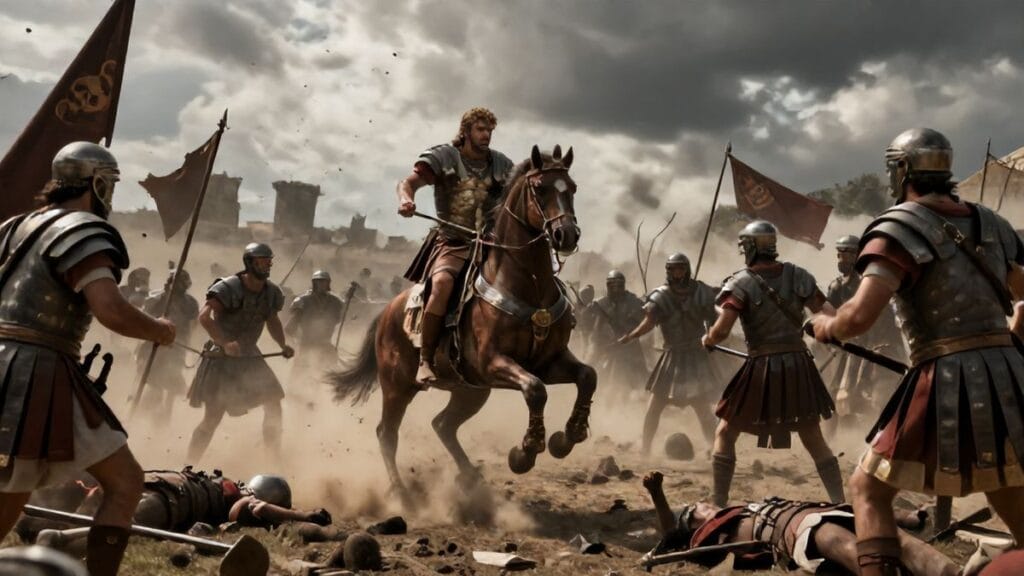
Picture an early spring morning, perhaps, the grass slick with dew, the air heavy with the smell of campfires and oiled leather. Constantine II’s troops, veterans from Gaul and Britain, form up in their assigned ranks: infantry in dense formations, cavalry on the flanks, standards rising above them like a small forest of colored cloth and gleaming metal. Across the field, Constans’ forces array themselves in similar lines. Many of these men would have served under Constantine the Great; they now found themselves facing his eldest son.
Trumpets blare. Orders pass down the lines, repeated in rough Latin by centurions and officers. Arrows arc overhead; the first clash of shields and spears echoes like thunder. Individual acts of courage and terror erupt everywhere at once—a soldier stumbling over a fallen comrade, another hurling his pilum with a cry, a standard-bearer refusing to drop his emblem even as he collapses. Yet none of their names have survived. History, in this moment, has room only for one: the emperor whose fate would seal the day.
It is possible that Constantine II, like many emperors before him, positioned himself near the thick of the fighting to inspire his troops. Emperors were expected to be visible, to share the dangers of battle. Some, like his father, had turned such visibility into a powerful tool of legitimacy. But visibility cuts both ways. An emperor on the field is also a target. Once he falls, morale can evaporate in minutes.
We do not know the precise tactics, the maneuvers, the feints and counterattacks that shaped the engagement. What we do know is the result: at some point during the fighting, Constantine II killed in battle became a brutal fact, not just a line in a chronicle. Whether he was struck down in a charge, surrounded by enemy soldiers, or caught in a rout as his forces broke, the end was the same. The eldest son of Constantine the Great, Augustus of the West, lay dead on Italian soil—slain not by barbarians at the frontier but by forces loyal to his own brother.
The shock of that moment is hard to overstate. For the officers around him, the realization that the emperor had fallen must have landed like a physical blow. For the rank and file, the rumor would spread unevenly—first as a fearful whisper, then as a confirmed horror. Some would fight on blindly, others would attempt to flee. Units might have dissolved in panic, leaving weapons and banners in the mud. And all around them, the ordinary countryside of northern Italy watched in mute indifference, its fields and vineyards scarred by the day’s violence.
How Constantine II Was Killed in Battle: Accounts, Rumors, and Silences
Though all our major sources agree that Constantine II killed in battle near Aquileia in 340, the details of his death are surrounded by ambiguity. This ambiguity is revealing. Lactantius and Eusebius, earlier celebrants of Constantine the Great, are silent; they had died before these events. Later chroniclers like Jerome, Rufinus, and the author of the Epitome de Caesaribus give us only brief summaries. The Chronicon Paschale notes his death but offers no dramatization. It is as if the empire itself preferred not to dwell too long on the spectacle of one Christian emperor killed by another’s troops.
Some sources suggest that Constantine II was killed after falling into an ambush or trap. Others imply that he advanced too rashly, outstripping his main forces and leaving himself vulnerable. Socrates Scholasticus, writing in the fifth century, hints that Constantine imagined an easy victory but instead “perished in a treacherous attack.” The vagueness of such phrases leaves ample room for speculation. Was there betrayal among his own officers? Did Constans’ generals use misinformation to lure him into a disadvantageous position? The record does not say.
Modern historians, such as Timothy Barnes and Noel Lenski, emphasize the political context rather than colorful battlefield detail. They point out that Constans, who emerged from the conflict with a strengthened position, had every reason to present the battle as a regrettable but necessary act of self-defense. To linger on the emperor’s final moments, to describe him pleading for mercy or abandoned by his men, would have cast an uneasy shadow over Constans’ legitimacy. Better to simply note: Constantine II killed in battle, the danger removed, the younger brother now master of the west.
There is also the religious dimension. By 340, the Constantinian dynasty had become closely associated with Christianity. To admit that one Christian emperor had marched on another and been slain in the attempt raised uncomfortable questions. How could such fratricidal conflict be squared with the rhetoric of divine favor and Christian unity that imperial propagandists liked to employ? The near silence may reflect a tacit decision among ecclesiastical writers to hurry past this embarrassment.
And yet, the silences speak. They tell us that Constantine II’s death was not the sort of heroic martyrdom or glorious last stand that later ages would readily celebrate. It was, more likely, a confused, squalid moment in the chaos of battle: dust, shouting, a sudden blow, perhaps a last glimpse of the imperial standard as it receded from view. We are left with the bare fact—that Constantine II killed in battle—standing starkly against a background of things unsaid. For a dynasty so wrapped in its own story, this blank space is itself part of the narrative.
The Aftermath: Constans Triumphant and Alone
When the fighting stopped and the dead were counted, the political calculus shifted with brutal speed. Constantine II was gone. His army, leaderless and likely demoralized, either surrendered or melted away. The territories he had ruled—Britain, Gaul, Hispania—did not collapse into chaos; instead, they passed into the hands of his victor. Constans suddenly found himself not the youngest of three Augusti but the sole ruler of the entire western half of the empire.
From Constans’ perspective, the outcome could be framed as vindication. His brother had invaded his jurisdiction; he had defended it. Official proclamations probably emphasized this line: there had been an unlawful aggression, and justice had prevailed. If the phrase “fraternal war” appeared, it would have been wrapped in language of necessity and providence. God, some bishops might have said, had protected the rightful emperor and punished the overreach of the arrogant.
Yet behind the solemn formulae, more complex emotions must have churned. Constans had, effectively, become the beneficiary of his brother’s death. He now ruled from the Atlantic to northern Africa and Italy, his authority echoing through cities that had previously taken orders from Constantine II’s envoys. Did he feel guilt? Triumph? Anxiety at the precedent that had just been set—that emperors could and would march on their kin if politics demanded it?
The immediate years after 340 saw Constans consolidating his rule in the west, while Constantius continued to grapple with Persia in the east. For a brief window, the empire had a relatively clear division: one Augustus in the west, one in the east, each secure in his sphere. But the memory of how this arrangement had been achieved—through a campaign ending with Constantine II killed in battle—could not be entirely washed away. The Constantinian ideal of a harmonious Christian dynasty had cracked.
On the social and military level, the repercussions were also significant. Officers who had served Constantine II needed to be integrated into Constans’ command structure or eased out. Western elites, especially in Gaul and Britain, had to adjust to a new line of communication with the imperial center. Soldiers who had fought on the losing side had to renew their oaths. Some might have drifted toward banditry or local strongmen; others would become the hardened core of future campaigns under new masters. The empire survived the shock, but the undercurrents of mistrust deepened.
Faith, Politics, and Propaganda: Crafting the Memory of Constantine II
As years passed, the raw facts of the Aquileian campaign began to calcify into narrative. How the story of Constantine II killed in battle would be told—and what would be left out—became a matter of political and theological importance. The Constantinian dynasty had draped itself in Christian imagery; it could not easily admit to fratricidal violence without risking its own carefully constructed aura of divine favor.
Church historians writing in the late fourth and fifth centuries tended to emphasize the religious policies of emperors, not their battlefield blunders. Constantine II’s reign was too short and too regionally limited to leave a strong theological footprint. Constans, by contrast, could be praised or criticized for his treatment of bishops and councils, especially in the turbulent debates over Arianism. The dead brother became a shadow figure, mentioned in passing primarily as a link in the chain of succession.
Some sources, sympathetic to Constans or to Constantius, took care not to portray Constantine II as a noble tragic hero. To do so would have raised uncomfortable questions about whether the wrong brother had prevailed. Instead, he appears in many accounts as impulsive, overconfident, and somewhat reckless. The invasion of Italy becomes almost a moral lesson: the proud eldest brother, refusing to accept a fair division, overreaches and is struck down. Providence, in this reading, sided with the more moderate ruler.
Yet not all evidence fits neatly into this pattern. In some western traditions, there lingered a sense that Constantine II had been the more natural heir to his father’s legacy in the Latin-speaking provinces. His early assumption of the title Augustus, his campaigns along the frontiers, and his long association with Gaul could have anchored a more heroic memory. That such a memory did not dominate suggests how strong the victorious side’s hold on narrative became.
Propaganda, in late antiquity, was not merely about statues and coins; it was about shaping what future generations would think had mattered. In that contest, the figure of Constantine II slowly faded. What remained was a skeletal storyline: Constantine II killed in battle near Aquileia, Constans becomes master of the west, the empire continues. Only modern historians, with their appetite for nuance and tragedy, have tried to peer behind the veil and restore some texture to the life that ended on that Italian field.
A Family of Blood and Baptism: The House of Constantine After 340
The Constantinian dynasty after 340 might have looked, from a distance, like an established Christian royal house. In reality, it was more like a family walking a narrow ridge, with civil war and assassination yawning on either side. Constantine the Great’s dream of a stable Christian empire ruled by his descendants was being tested by the harsh realities of power.
Constantius II, far away on the eastern front, learned of his brother’s death and Constans’ expanded authority. How did he react? We can only infer. On one hand, his primary concern was Persia; the eastern frontier would not wait patiently while he indulged in intra-dynastic feuds. On the other, the elimination of one brother left only two imperial centers—an arrangement that could be both simpler and more dangerous. With fewer players, every future quarrel would carry greater weight.
The pattern established in 340—imperial disputes resolved by force—would recur. In 350, Constans himself was overthrown and killed by the usurper Magnentius, a general who exploited discontent within the western army. Constantius spent the next years locked in struggle with this new rival, turning once again the armies of Rome against each other. The chain of events that had begun when Constantine II killed in battle near Aquileia had not ended with that first fratricidal clash; it had opened the door to further internal violence.
Christianity, in the midst of all this, continued to grow in importance. Emperors attended councils, exiled bishops, and used theological alignments as markers of political loyalty. Yet the faith that preached peace and brotherhood now found itself tied to a dynasty stained with bloodshed. Later church writers would wrestle with this dissonance, sometimes highlighting the personal piety of individual emperors to offset the harsher aspects of their rule.
Within the family itself, memory became a contested space. Surviving relatives of Constantine II, if any held minor positions, had to navigate a landscape where invoking his name could be politically risky. The younger generation, including the future emperor Julian, grew up under the shadow of these earlier purges and battles. Julian later wrote caustically about the Constantinian house, accusing his relatives of hypocrisy and violence cloaked in Christian language. His perspective, while biased, underscores how deeply the events of 337–340, including the episode when Constantine II killed in battle, had etched themselves into the psyche of the imperial clan.
Aquileia Remembered: Geography, Strategy, and Symbolism
Aquileia occupies an intriguing place in Roman military history. Long before 340, it had been a bulwark against incursions from the northeast, guarding the approaches from Pannonia and beyond. Its walls had seen more than one army pass beneath them, its garrison accustomed to the rumble of marching feet and the anxious silence before news of battle. That Constantine II killed in battle near this city was not incidental. Geography, once again, had intersected with imperial ambition.
From a strategic standpoint, Aquileia was the fulcrum on which any attack from Gaul into central Italy might pivot. Control it, and an invading army could move south with some security, knowing its rear was protected and its supply lines anchored. Lose it, and the advance risked stalling or collapsing. That Constans managed to block his brother near this critical node suggests either good intelligence or a rapid and competent mobilization—or both.
Symbolically, Aquileia also mattered. Though not Rome, it was still a city of stature, with senatorial families, wealthy merchants, and a lively Christian community. A battle fought in its vicinity would resonate with elites who understood its significance. The notion that an emperor had fallen there, leading an unauthorized invasion, could be woven into cautionary tales about overreach and hubris.
In later centuries, Aquileia would face its own trials, including sieges and eventual decline. Medieval chroniclers, looking back, might mention briefly that a Roman emperor met his end near its walls, but the details were increasingly blurred. The precise field where Constantine II killed in battle could not be marked on any map with certainty. The city that had once watched Roman legions clash now saw different banners flutter above its towers.
And yet, in the broader history of the Roman Empire, Aquileia remains a reminder that the fate of emperors was often decided not in the marble halls of capital cities but in the open spaces where roads converged and armies met. Its role in 340 is a testament to how geography and ambition conspired to draw Constantine II and Constans into fatal collision.
Historians at Work: Reconstructing a Shadowy Battle
Reconstructing the events around Constantine II killed in battle is, for modern historians, an exercise in humility. The sources are fragmentary, biased, and often frustratingly terse. There is no single authoritative narrative to rely on. Instead, scholars must sift through chronicles, panegyrics, legal codes, coinage, and later church histories, each with its own agenda and blind spots.
Take, for example, the fourth-century Latin historian Aurelius Victor and the anonymous author of the Epitome de Caesaribus. Their short notices about Constantine II’s death provide dates and bare facts but little color. Church historians like Socrates and Sozomen add some interpretive gloss, framing the conflict as a moral parable about ambition. Legal texts from Constans’ reign hint indirectly at his new status after 340, while the distribution of mints and coin types shows how imperial authority shifted geographically.
Archaeology and geography also play supporting roles. By mapping Roman roads, examining the topography around Aquileia, and identifying likely muster points for armies, scholars can sketch plausible routes and timelines. No smoking gun inscription has yet been found that reads, “Here Constantine II fell,” but patterns of fortification and settlement provide a kind of negative space in which the battle’s outline emerges.
Modern debates center on questions such as: Was Constantine II primarily motivated by territorial greed or by a genuine sense of seniority and duty? Was Constans acting defensively, or had he also been preparing an offensive move? How much did the eastern emperor, Constantius, know or influence events from afar? Different historians weigh the evidence differently, often reflecting broader theories about imperial politics in late antiquity.
One of the most influential modern works on the Constantinian period, by Timothy D. Barnes, treats Constantine II’s death as a key moment in the dynasty’s unraveling, while others, like the ecclesiastical historian H. A. Drake, place more emphasis on the evolving relationship between church and empire. In their footnotes, we see citations to Jerome, the Chronicon Paschale, and Ammianus Marcellinus (even though the latter’s narrative begins later), all marshaled to support one reconstruction or another. The result is not certainty but a spectrum of plausible stories, all agreeing on the central fact: Constantine II killed in battle near Aquileia while attempting to impose his will on Italy.
This multiplicity of voices, ancient and modern, reminds us that history is not a static archive of facts but an ongoing conversation. Each generation revisits the episode with new questions, whether about imperial legitimacy, Christianization, or the nature of civil war. Constantine II, silent in his grave, continues to be interrogated by scholars who see in his brief, dramatic end a window onto the deeper currents shaping the late Roman world.
Cinematic Reverberations: How One Death Changed Roman History
If we try to step back and view Roman history as a long, sweeping film, the scene where Constantine II killed in battle near Aquileia might seem, at first glance, a brief and brutal cutaway. No marble city burns, no entire dynasty falls in a single blow. The empire survives, its structures largely intact. And yet, like certain understated moments in a complex drama, its significance grows the more we understand what flowed from it.
Imagine a counterfactual sequence: Constantine II wins the battle, captures or forces the flight of Constans, and becomes the sole ruler of the western empire years earlier than in our timeline. Would he have proved a harsher or more lenient master? Would his relationship with Constantius II in the east have been more cooperative or more confrontational? Might the later usurpation of Magnentius have been prevented—or replaced by some other crisis?
Our actual history took a different turn. With Constantine II removed, Constans grew into a role he might otherwise never have held. His policies, his preferences in religious controversy, his personnel choices in the army and bureaucracy—all these began to shape the western empire in ways that diverged from what Constantine II might have done. Later upheavals, including Constans’ overthrow and Constantius’ eventual reunion of the empire under his sole rule, unfolded along paths that had been opened by that fateful battle in 340.
The cinematic metaphor is apt because late Roman politics often played out with a certain theatricality: processions, public speeches, coinage bearing carefully chosen images. But behind the spectacle were very real stakes. The decision of one young emperor to don armor, cross the Alps, and gamble his life for greater power was both a personal drama and a structural turning point. From that choice came not only Constantine II killed in battle but also a cascade of adjustments, resentments, and precedents that helped define how later emperors thought about the permissible limits of intra-dynastic violence.
In this sense, the field near Aquileia is more than just a dot on the map of Italy. It is one of those quiet hinges in history where, without fanfare or elaborate chronicling, the balance of power shifted and an entire imperial narrative tilted onto a slightly different course.
Legacy of a Fallen Augustus: Constantine II in Modern Scholarship
Today, Constantine II occupies a curious position in the study of late antiquity: neither obscure nor central, remembered but not revered. Most general histories of the Roman Empire mention him chiefly as a transitional figure, the eldest son whose impatience or misjudgment led to his demise. Yet within specialized scholarship, he has attracted increasing attention as a case study in the perils of dynastic succession and the nature of imperial authority in the fourth century.
Modern historians have asked: Was Constantine II simply reckless, or was he acting within a rational—if ruthless—logic of Roman power politics? Some argue that, given the tradition of seniority and the precedence accorded to firstborn sons, his attempt to assert control over Italy was not entirely unreasonable. They point to earlier precedents where senior emperors intervened in their colleagues’ territories without it being branded rebellion. Others emphasize his youth and the fact that his father’s extraordinary career had perhaps given him an inflated sense of what was possible.
There is also interest in how his brief reign fits into the broader story of Christianization. While Constantine the Great famously patronized Christianity and his sons continued to do so in varying degrees, Constantine II’s specific religious stance is harder to pin down. Some evidence suggests he favored Nicene bishops in the west, in contrast to Constantius’ more complex and shifting relationship with Arianism. If he had lived longer, his influence on doctrinal politics might have been more pronounced. Instead, Constantine II killed in battle before he could fully leave his mark on church affairs.
Recent works on imperial childhood and youth in late antiquity have also turned their gaze on him. Growing up under the constant public gaze, burdened with titles early, navigating a court that mixed Christian bishops with traditional aristocrats—this was no ordinary adolescence. Scholars have connected his trajectory to broader patterns of how empires manage the succession of charismatic founders. The problem of what to do with the children of a “great man” is not unique to Rome; it echoes in many monarchies and even some modern political dynasties.
In university seminars and monographs, then, Constantine II lives on not just as the emperor who died near Aquileia, but as a vivid example of how personal ambition, familial rivalry, and structural tensions can converge in a single moment of irreversible decision. His legacy is not in laws passed or buildings constructed, but in the questions his story forces us to ask about power, loyalty, and the fragile human beings who wear crowns.
Conclusion
The story of Constantine II killed in battle near Aquileia in 340 is, at its core, a human tragedy set against the monumental backdrop of empire. A young man, raised from childhood to see himself as heir to a world-spanning dominion, chose the path of arms against his own brother and paid with his life. Around him swirled the ambitions of generals, the calculations of advisors, the fervent prayers of bishops, and the mute obedience of thousands of soldiers who would bleed for decisions made far above their station.
Yet this is not merely a tale of one man’s downfall. It is also a revealing chapter in the longer saga of Rome’s transformation under Christian emperors. The same dynasty that had aligned itself so closely with the church now showed that baptism did not wash away the old Roman politics of force and fear. Civil war and purges, fraternal conflict and sudden death—these remained part of the imperial repertoire, even as crosses replaced eagles on some standards.
The battle near Aquileia changed the balance of power, enabling Constans to rule the west alone and shaping subsequent conflicts that would involve usurpers and further internal strife. It underscored the dangers of dividing an empire among multiple heirs without a clear mechanism for mediating disputes. It reminded contemporaries and later generations alike that the empire’s unity could fracture not only under external pressure but from within the imperial household itself.
Looking back across the centuries, we see in Constantine II not a cardboard villain or a forgotten footnote, but a vivid embodiment of the risks inherent in hereditary power. His brief life traced an arc from gilded promise to violent end, leaving behind questions that historians continue to explore: about authority and legitimacy, about family and state, about how a single decision to march south can reshape the destiny of millions. In the end, the field near Aquileia where Constantine II killed in battle becomes a symbol of how even the mightiest empires rest on choices made in moments of passion, fear, and hope—and how fragile those foundations can be.
FAQs
- Who was Constantine II?
Constantine II was the eldest surviving son of Constantine the Great, born around 317 CE. Elevated to the rank of Caesar as a child and later Augustus, he ruled over the western provinces of the Roman Empire—primarily Britain, Gaul, and Hispania—after his father’s death in 337. His short reign ended in 340 when he was killed during a failed invasion of his brother Constans’ territory near Aquileia in northern Italy. - Why did Constantine II invade Italy in 340?
Constantine II believed that, as the senior Augustus, he was entitled to a larger share of the empire, including Italy and possibly Africa. He also claimed a sort of guardianship over his younger brother Constans, who controlled those regions. Frustrated by what he saw as an unfair partition of power and perhaps encouraged by his western army’s strength, he decided to march into Italy to assert his claims, triggering a civil conflict. - How and where was Constantine II killed in battle?
Constantine II was killed in battle near the city of Aquileia in northern Italy in 340 CE. The exact details are unclear due to sparse and biased ancient sources, but it appears he advanced too boldly into territory defended by Constans’ forces and was either ambushed or decisively defeated. During the ensuing combat, he was slain—ancient chroniclers simply note that Constantine II killed in battle, ending his campaign and his life. - What happened to the Roman Empire after Constantine II’s death?
After Constantine II’s death, his territories in the west—Britain, Gaul, and Hispania—passed to his brother Constans, who then ruled the entire western half of the empire. Constantius II continued to govern the eastern half. This arrangement lasted until 350, when Constans was overthrown and killed by the usurper Magnentius, prompting another cycle of civil war before Constantius eventually reunited the empire under his sole rule. - How did Constantine II’s death affect Christian politics in the empire?
Constantine II’s death removed a potentially significant player from the complex religious politics of the fourth century, especially in the west, where debates over Arianism and Nicene orthodoxy were intense. While he seems to have leaned toward supporting Nicene bishops, his brief reign left little direct impact on church doctrine. Indirectly, his death strengthened Constans, whose own religious policies and alliances with certain bishops then shaped the western church’s development during the crucial decades that followed. - Why are the details of the battle near Aquileia so obscure?
The obscurity stems from several factors: the brevity of contemporary accounts, the political interest in downplaying a fratricidal conflict between Christian emperors, and the later historians’ focus on more extended reigns and larger-scale events. Writers sympathetic to Constans had no incentive to dwell on the grisly details of his brother’s fall, and church historians often preferred to emphasize theological issues over the messy specifics of civil warfare. - Was Constantine II considered a usurper when he attacked Constans?
In formal Roman terms, Constantine II was not a usurper at the start of the conflict—he was a legitimate Augustus, lawfully recognized as emperor. However, by invading his brother’s assigned territory without consensus, he effectively behaved as a usurper toward Constans’ authority in Italy. Later narratives often frame his actions as unjust aggression, using moral language to justify the outcome of the battle. - How do modern historians view Constantine II’s character and decisions?
Modern historians tend to see Constantine II as a complex figure shaped by youth, prestige, and the problematic legacy of his father’s vast empire. Some interpret him as impulsive and overconfident, while others argue that his actions followed a recognizable Roman logic of seniority and power-sharing. There is broad agreement that his early elevation and exposure to military command fostered expectations he could not easily reconcile with the partition agreed after 337. - Did Constantine II have a lasting legacy despite his short reign?
Although he left few laws or monuments, Constantine II’s legacy lies in the precedent his fate helped establish. His death highlighted the dangers of dividing the empire among multiple heirs and demonstrated that even Christian emperors were willing to resort to civil war. The shift in power to Constans and the later conflicts that followed can, in part, be traced back to the decisions that led Constantine II to Aquileia in 340. - Is there any monument or site today marking where Constantine II died?
There is no known, precise monument or archaeological marker that definitively indicates the exact spot where Constantine II fell. The battle is generally placed in the vicinity of Aquileia, in modern northeastern Italy, but the specific battlefield has not been securely identified. Any commemoration today is thus more historical and scholarly than physical, existing in books, articles, and museum exhibits rather than in a clearly labeled site on the ground.
External Resource
Internal Link
Other Resources
- Encyclopaedia Britannica – general search for the exact subject
- Google Scholar – academic search for the exact subject
- Internet Archive – digital library search for the exact subject