Table of Contents
- A Winter Morning in Reims: The Day a New King Rose
- From Capetian Heir to Controversial Monarch: The Early Life of Philip V
- France on the Brink: Crisis, Famine, and Dynastic Uncertainty
- The Death of Louis X and the Question of the Crown
- The Princess, the Infant, and the Regent: A Kingdom Without a Clear Heir
- Inventing Tradition: How Legal Arguments Forged the Salic Law
- Journey to Reims: Processions, Preparations, and Political Theater
- Inside the Cathedral: Ritual, Relics, and the Anointing of Philip V
- “The Tall” and the Crown: Personality, Presence, and Public Perception
- A Kingdom of Ashes: Famine, Unrest, and the Tasks Awaiting the New King
- Rewriting the Rules of Succession: The Long Shadow of 1317
- Burgundy, Navarre, and England: The Web of Foreign Reactions
- Royal Justice and Reform: Philip V’s Short but Restless Reign
- The Human Cost: Peasants, Townsfolk, and the Weight of Royal Decisions
- From Reims to the Hundred Years’ War: Echoes of a Crown Contested
- Historians, Chronicles, and Myths: How We Remember Philip V
- Conclusion
- FAQs
- External Resource
- Internal Link
Article Summary: On 9 January 1317, in the cold heart of winter, Philip V was crowned King of France in the cathedral of Reims, an event that would silently reshape European history. This article follows the tangled path that led to that day, from famine and political crisis to legal invention and calculated ritual. At a moment when the Capetian dynasty seemed to be fraying, the choice to see Philip V crowned King of France instead of recognizing a female heir or a newborn boy rewrote the rules of succession. Behind the glitter of coronation robes, church choirs, and sacred oils, we encounter the anxiety of nobles, the calculations of jurists, and the concerns of common people desperate for stability. We move through the streets of Reims, into the dim, echoing cathedral, and then outward again to the courts of Navarre, England, and Burgundy, where the decision in Paris was closely watched. The article traces how dynastic arguments in 1317 laid foundations for the so‑called Salic Law, helping to ignite, generations later, the Hundred Years’ War. At every step, it reveals how the moment when philip v crowned king of france was not merely a ceremony, but a turning point in the history of monarchy, legitimacy, and power. In doing so, it explores how a single winter day in Reims became an axis around which the fate of kingdoms would turn.
A Winter Morning in Reims: The Day a New King Rose
The bells of Reims began before dawn. Their iron throats groaned into the freezing air, rolling across the half‑snowed roofs, chimneys, and spires of the city. On 9 January 1317, Reims was not simply another northern town; it was the stage on which a kingdom would rewrite its future. It was here that philip v crowned king of france would take a fragile, contested claim and dress it in silk, incense, and sacred oil, hoping ritual could harden argument into fact.
Darkness still clung to the streets as people pressed toward the great cathedral. Peasants from the surrounding countryside, wrapped in wool and patched leather, mingled uneasily with merchants in fur‑trimmed cloaks and nobles glittering with metal thread and jewels. The bitter cold made rank irrelevant; everyone’s breath rose together in pale clouds. Yet beneath the shared discomfort lay different expectations. For some, this day promised the renewal of order after years of famine, scandal, and political disarray. For others—especially those whose fortunes were tied to rival bloodlines—this coronation tasted of usurpation, a legal trick played in the language of holiness.
The cathedral of Reims, a forest of stone and glass begun barely a century earlier, loomed like a ship of light against the heavy sky. Inside, candles already flared by the hundreds, their tiny flames fighting the drafts that slipped along the nave. Scribes, heralds, and clergy hurried through the side aisles, arranging banners, checking the placement of relics, rehearsing the choreography of an age‑old rite that nevertheless would feel dangerously new. For never before had a king of France been crowned under quite these circumstances—between a dead brother, a missing infant, and a niece whose claim was denied because she was a woman.
Somewhere nearby, in rooms warmed by braziers and tapestries, Philip of Poitiers—now called simply Philip V—stood as servants laced his garments and draped him in layers of weight and meaning. He was tall, “le Long,” the Tall, and witnesses would later remember his bearing, the way he seemed to fit the regalia even before it touched his shoulders. But this was no simple inheritance. Philip had served as regent in the name of a posthumous nephew who had survived only days. Now, he would have the Church and the coronation turn a regency into a reign. The distinction was thin in law yet enormous in memory, and he knew that what happened in Reims would echo for centuries.
Outside, horsemen bearing lances with fluttering pennons clattered into position. Inside, the canons of Reims rehearsed their chant: prophecies, psalms, and litanies that tethered this day to the anointings of biblical kings. Before the morning was over, sacred oil from the legendary Sainte Ampoule—the tiny vial said to have been sent from heaven for the baptism of Clovis—would touch Philip’s forehead, chest, arms, and hands. When philip v crowned king of france rose from his knees, the Church and the gathered peers would have turned a disputed dynastic solution into what looked, and sounded, like the will of God.
But this was only the beginning. To understand why the bells of Reims tolled with such urgency in January 1317, one must step back: into the hungry years of famine, the scandals of royal adultery, the deaths that emptied the Capetian cradle, and the arguments that would give birth to the doctrine later labeled “Salic Law.” Only in that wider darkness does the intense, flickering light of that coronation truly make sense.
From Capetian Heir to Controversial Monarch: The Early Life of Philip V
Philip was born around 1292 into a dynasty that seemed almost invincible. For over three centuries, since Hugh Capet in 987, the crown of France had passed smoothly—from father to son, from king to king—without the open civil wars that had often torn other kingdoms apart. He came into the world as the second surviving son of Philip IV, the so‑called “Iron King,” a ruler who bent popes, bankers, and nobles to his will and made France the dominant power in Western Europe. For a boy in such a family, the path ahead appeared clear: his elder brother, Louis, would be king; Philip would receive lands, titles, perhaps a rich marriage, and a life spent supporting the crown from a half‑step below the throne.
From his youth, Philip absorbed the lessons of power in a stern, almost unforgiving court. Philip IV was not an affectionate father; he was a strategist. The king’s sons learned more from watching how he humiliated the Knights Templar, challenged the papacy, and reformed royal administration than from any soft paternal advice. Chroniclers describe the young Philip as serious, intelligent, and reserved. Where Louis, the eldest, appeared impulsive and sometimes reckless, Philip cultivated a cooler demeanor—more patient, more calculating. He studied law and the complexities of royal finance in a kingdom whose coffers were both enriched and strained by constant wars and grandiose projects.
Philip’s marriage in 1307 to Joan of Burgundy cemented a powerful alliance. Joan was heir to the rich county of Burgundy through her mother, Agnes of France, herself a daughter of Saint Louis. The union promised territorial expansion and influence beyond the core royal domain. Yet even this marriage would later be touched by scandal: Joan’s sisters‑in‑law, Margaret of Burgundy and Blanche of Burgundy, were caught up in the infamous Tour de Nesle affair—accused of adultery with knights, imprisoned in grim castles, and used as pawns in a moral and political drama that shook the dynasty’s reputation.
Philip’s youth unfolded against the backdrop of a France that was growing more centralized yet more brittle. The legal reforms and financial exactions of his father had strengthened royal authority, but they also generated resentment among nobles, clergy, and townsfolk. The young prince saw, up close, both the triumphs and the vulnerabilities of a monarchy that seemed to stand above all others. He learned that legitimacy was not merely inherited; it had to be maintained, argued, and, at times, theatrically performed.
It’s astonishing, isn’t it, how quickly such a solid edifice can begin to crack? In 1314, Philip IV died unexpectedly after a hunting accident, leaving his three sons—Louis, Philip, and Charles—to inherit a tense, overextended realm. Louis X, the eldest, became king. Philip did not yet know that, within three years, he would be standing in Reims as philip v crowned king of france, trying to hold together that same realm under conditions his father could never have imagined.
France on the Brink: Crisis, Famine, and Dynastic Uncertainty
Years before the coronation at Reims, a more insidious crisis had already seized the kingdom: hunger. Between 1315 and 1317, much of northern Europe suffered the Great Famine. Relentless rains, failed harvests, and harsh winters devastated crops. Grain rotted in the fields; hay molded in barns. Prices skyrocketed, livestock died, and the poor, who lived only a heartbeat away from starvation even in good times, found themselves facing the abyss.
In France, as chroniclers like the anonymous author of the Chronicon Henrici de Hervordia and the Norman monk Robert of Reading recorded, people ate anything they could find: roots, leaves, the flesh of dead animals. Rumors circulated of cannibalism in the worst‑hit regions. Disease followed deprivation. Whole villages declined, their fields abandoned. Tax lists from the period, where they survive, reveal sharp drops in the number of households, a stark numerical echo of the human suffering hidden behind the ink.
The famine was more than a natural disaster; it was a political test. The French monarchy prided itself on being a protector of the realm, a stabilizing force in a chaotic world. When grain failed and people starved, they looked not only to heaven but to Paris. Could the king and his officials ensure imports, regulate prices, or at least prevent hoarding and speculation? The answers were mixed at best. Louis X, already under pressure from noble discontent and fiscal burdens left by his father, struggled to respond effectively.
As fields drowned and storerooms emptied, the royal image frayed. Taxation felt more intolerable when bellies were empty. Local revolts flared up, sometimes against lords seen as grasping, sometimes against officials seen as corrupt or indifferent. In such an atmosphere, rumors and prophecies thrived. Some claimed the famine was God’s punishment for sins at court—especially the notorious adultery scandals. Others whispered that the Capetian line had lost its divine favor.
The background of hunger is essential to understand the urgency with which many greeted the moment when philip v crowned king of france. To modern eyes, the debates about succession may seem like abstractions among elites. But for a peasant in Picardy or a weaver in Paris, what mattered most was whether the crown, under whomever wore it, could restore order, stabilize grain markets, and offer even a glimmer of security. The coronation at Reims, then, was haunted by empty fields and thin faces; behind the lit candles and rich fabrics lurked the shadow of the Great Famine.
The Death of Louis X and the Question of the Crown
The immediate crisis that made Philip’s coronation both necessary and controversial began on 5 June 1316, when Louis X died unexpectedly at Vincennes. He was only twenty‑six. Some said he succumbed to pleurisy; others suspected the after‑effects of a violent game of jeu de paume, an early form of tennis. In an age that saw plots everywhere, whispers of poison inevitably arose, though no proof has ever convinced historians.
Louis X left a kingdom reeling from famine and debt, but the most urgent problem was even more basic: he left no clear adult male heir. His only child at the time was a daughter, Joan, born of his first wife, Margaret of Burgundy. Margaret, however, had been convicted of adultery in the Tour de Nesle scandal and died in suspicious confinement. Was their child legitimate? Could a girl inherit the throne of France at all?
To complicate matters further, Louis’s second wife, Clementia of Hungary, was pregnant. In a scene almost theatrical in its tension, the fate of the crown hung on the sex of an unborn child. If Clementia bore a son, that boy would be the rightful king—eventually. But what would happen in the meantime, in a kingdom that could not afford a vacuum of authority?
Into this breach stepped Philip, Louis’s younger brother. The peers of the realm met, and Philip was acknowledged as regent, ruling in the name of the unborn child. It was a compromise: he did not yet claim the title of king, but he effectively wielded royal power. For months, the entire political community of France held its breath, waiting on the outcome of a pregnancy.
In November 1316, Clementia gave birth to a son: John, hailed immediately as Jean I, King of France. The baby was only days old, but the notion that kingship could be embodied even in an infant was deeply rooted in medieval political thought. For a moment, the issue seemed resolved. Philip would continue as regent; the Capetian line would pass, in time, from Louis to his posthumous son. Yet fate intervened cruelly. After just five days—some sources say barely four—the infant king died.
With that tiny life, a certain straightforwardness in French succession also died. Philip could now argue that he, as the next adult male in the direct line, should become king. But what of Joan, Louis’s daughter? What of the principle, never formally articulated but long assumed, that the throne passed from father to eldest child, regardless of sex? The stage was set for a conflict not of armies, but of principles, precedents, and political will.
The Princess, the Infant, and the Regent: A Kingdom Without a Clear Heir
Joan of Navarre, the daughter of Louis X and Margaret of Burgundy, was not yet ten years old when the debates over her rights began in earnest. Her mother’s conviction for adultery cast a long shadow over her legitimacy. Could a child born of a disgraced queen be trusted to embody the sacred dignity of the monarchy? Some argued that Margaret’s sins could not stain the bloodline itself; others, more ruthlessly, used the scandal to argue that Joan should be set aside in favor of a cleaner solution.
For Philip, now regent, Joan’s claim posed both a legal problem and a political threat. If she were accepted as queen of France in her own right, Philip’s power would be limited to that of a guardian or advisor, perhaps subject to the influence of other great lords or foreign suitors. If, however, France could be persuaded that a woman could not inherit the throne at all, then Joan’s existence became irrelevant to the crown of France (though not to other titles, like Navarre).
What makes this moment so fascinating is that France did not have a clear, codified rule about female succession to the throne. Previous kings had all been male; no queen regnant had ever tested the question. Custom seemed to favor men, but custom was flexible. It fell, therefore, to lawyers, theologians, and magnates to shape the principles that would guide the realm. They did so not in abstract treatises but in urgent councils and whispered negotiations, with the regency—and perhaps kingship—of Philip hanging in the balance.
In the months after the death of the infant John, Philip worked relentlessly to build a consensus. He called together the peers of France, the highest nobility and clerical leaders, whose theoretical role was to choose and acclaim the king in moments of uncertainty. Many of them owed their positions, debts, or hopes to the royal house; many feared the instability that a minority or female‑led reign might bring in such a troubled time. Gradually, the idea took shape that, while a woman could inherit lands, titles, and wealth, the “crown of France” was different—too sacred, too burdened with military and judicial duties—to pass through female hands.
Thus it was that the future event of philip v crowned king of france was first decided in dim chambers long before it unfolded beneath the high windows of Reims. The princess Joan remained a child at the margins of great decisions, her fate entangled with questions most adults around her barely understood. France, starving and anxious, seemed willing to accept the exclusion of a girl in exchange for the promise of a strong adult king—especially one who had already proven capable as regent.
Inventing Tradition: How Legal Arguments Forged the Salic Law
The legal doctrine that would later be known under the shorthand “Salic Law” did not descend ready‑made from the mists of antiquity. It was, in many ways, an invention of the early fourteenth century—an invention shaped and accelerated by the crisis that led to Philip’s coronation. Medieval lawyers were adept at combing old texts for usable precedents, and in the case of French succession they found a tool in an early Frankish law code, the Lex Salica, which barred women from inheriting certain kinds of property, particularly ancestral land.
The application of this principle to the royal crown was not automatic. Kingdoms were not simply estates; kingship was a function, a charge, a quasi‑sacramental office. Nonetheless, royal jurists, keen to justify the sidelining of Joan and the elevation of Philip, began to argue that the crown should be treated like that inalienable patrimony mentioned in the old law. If daughters could not inherit those family lands, it followed, they reasoned, that they could not inherit the bigger, more sacred patrimony of the French monarchy.
Here, one sees the delicate art of “inventing tradition”—giving new rules the aura of ancient custom. Councils were convened; arguments drafted; chronicles written with an eye to the emerging orthodoxy. By the time philip v crowned king of france in Reims in 1317, many of those around him were prepared to believe, or at least to act as though they believed, that France had always been a kingdom where only men could rule. Future generations would look back and see in this moment the crystallization of a supposedly immemorial principle, even though it was, in truth, a recent consolidation.
One chronicle from the years following Philip’s accession, reflecting this new orthodoxy, put it bluntly: “Women do not succeed to the throne of France.” Another, cited by later historians such as Jules Viard, elaborated that the kingdom was “too noble to be held in a woman’s hand.” This language reveals the assumptions beneath the doctrine: that warfare, justice, and the sacramental nature of kingship were tied to masculinity in the minds of those who made and recorded the law.
Yet behind these confident pronouncements lay anxieties. If the principle were not clearly stated and solemnly performed, rivals might later challenge it. Therefore, the coronation of Philip V was not only about placing a crown on a head; it was about inscribing a rule into the memory of the realm. The ceremony at Reims would function as legal argument made visible, a ritual commentary on the newly sharpened law of succession.
Journey to Reims: Processions, Preparations, and Political Theater
By the end of 1316, the decision had been made: Philip would not simply act as regent but would take the title of king. The road to Reims became more than a geographical route; it was a carefully staged procession meant to display legitimacy, piety, and power. When philip v crowned king of france set out, he did so surrounded by signs that he was no usurper but the inevitable, almost natural continuation of Capetian rule.
The royal entourage moved slowly through towns and villages, preceded by heralds who announced the passage of the new king and invited local elites to join the train. At each stop, clergy turned out in vestments to offer blessings; magistrates in towns presented symbolic keys, speeches, and sometimes money. The people—those who could break from their grinding struggle for food and fuel in the harsh winter—came to watch. For them, the spectacle of rich cloth, polished armor, and prancing horses was not mere entertainment; it was reassurance that, despite famine and deaths in the royal family, the visible body of the monarchy remained intact.
Behind the scenes, however, the preparations were tense. The cathedral chapter of Reims had to coordinate with royal officials on everything from seating arrangements to the order of the procession inside the church. The peers of the realm had to be summoned, persuaded, sometimes pressured to attend. If any major lord refused, his absence would be noticed and interpreted. Every arrival, every bowed head, became a public endorsement of Philip’s claim.
The symbolism extended down to small details: banners embroidered with the lilies of France but perhaps subtly emphasizing Philip’s personal arms; the presence of his queen, Joan of Burgundy, whose own family ties shored up support; the inclusion of jurists and counselors in the entourage, signaling that this coronation was anchored in learned counsel as well as ancient practice. The journey to Reims thus functioned as a moving prelude to the ceremony, shaping how people would interpret what they were about to witness.
At night, in the inns and great halls along the way, talk surely turned to the unresolved questions that still hummed beneath the surface. Was Joan of Navarre permanently excluded? What of the rights of other branches of the royal family? And what would happen if Philip himself failed to produce surviving sons? Few could foresee how these questions would resurface with tragic force in the generation after his death. For now, the kingdom’s gaze was fixed on Reims, on the promise that once the archbishop’s hands and the sacred oil had done their work, doubts would dissolve in the glow of sanctity.
Inside the Cathedral: Ritual, Relics, and the Anointing of Philip V
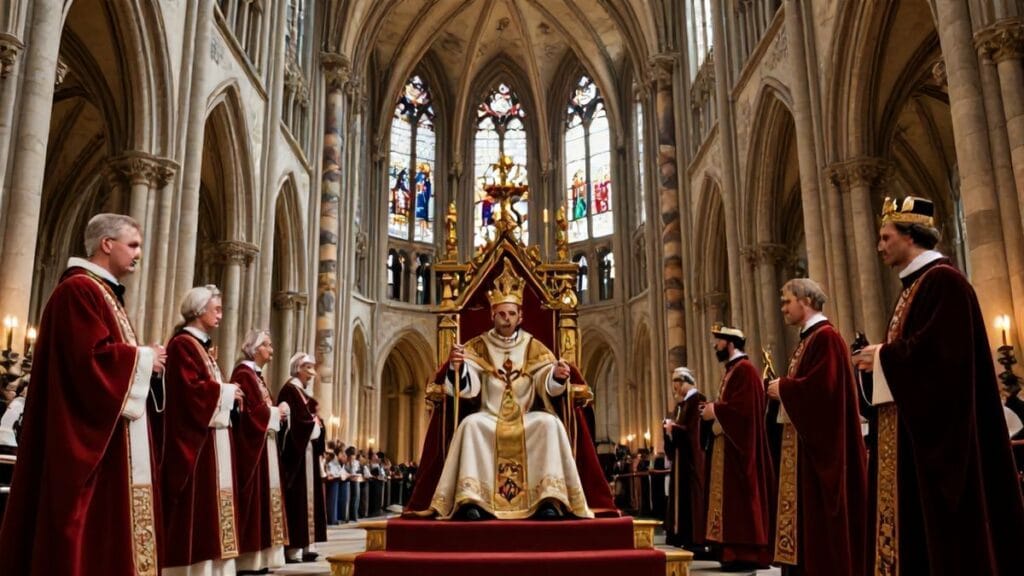
The morning of 9 January 1317 found the cathedral of Reims transformed into a theater of the sacred. Columns soared into darkness; stained glass filtered the pale winter sun into shards of color. The air was thick with incense, the murmurs of last‑minute instructions, and the rustle of heavy fabrics. This was the place where, according to tradition, nearly every king of France since the twelfth century had received the crown. For Philip, whose right to that crown was still contested in some hearts, the weight of that history was a blessing and a burden.
The ceremony began, as always, with entry and acclaim. Trumpets sounded as Philip, clad in a simple cloak over his rich garments, advanced up the nave, flanked by bishops and great lords. The archbishop of Reims, Guy de Roye’s predecessor—at this time the archbishop was Robert de Courtenay’s relative, Archbishop Robert de Courtenay having died earlier; sources differ, but the see was held by Archbishop Robert de Courtenay’s successor Guy de Joinville—met him at the door with holy water and blessings. The congregation—nobles in front, common folk crowded in the back—watched as the man they had known as regent approached the high altar to become king in God’s sight.
At a key moment, the assembled peers were asked to give their consent. This was not a vote in the modern sense, but a ritualized acclamation, an echo of older practices when kings were more explicitly chosen. In 1317, that echo mattered deeply. Their shouted responses, their formal gestures of acceptance, were woven into the choreography to signal that Philip’s elevation was no unilateral act but a decision of the realm’s leading men under God. One can imagine the careful listening: did any peers hesitate? Did any voice dissent?
The heart of the rite came with the anointing. An ancient legend held that when Clovis, the first Christian king of the Franks, was baptized in Reims, a dove descended from heaven bearing a vial of holy oil—the Sainte Ampoule. That vial, or what was believed to be its remnants, was carefully guarded at Reims and brought out only for coronations. On this day, it was borne in procession, surrounded by candles, like a relic of the Incarnation itself. When philip v crowned king of france knelt before the altar, the archbishop dipped a golden needle into the oil and traced crosses on Philip’s body: head, chest, shoulders, arms, palms.
In those touches, theology, politics, and emotion intertwined. The oil marked Philip as Christ’s anointed—literally another christus, a messiah in the lowercase sense. It was meant to seal a bond between king and God that no earthly rival could break. As one later chronicler would write, echoing earlier descriptions: “In the unction, the king receives a grace above that of other men, that he may rule them in justice.” To those watching, the glistening traces on Philip’s skin were signs that the divine had entered the legal dispute and chosen a side.
After the anointing came vesting and crowning. Layer upon layer of regal garments were draped over him: a tunic, dalmatic, royal mantle. Each piece bore symbolic weight—the armor of justice, the cloak of mercy, the colors of heaven. The crown itself, heavy with gold and gems, was lowered onto his head amid the pealing of bells and the roar of acclamation. “Vivat rex! Long live the king!” The choir burst into the Te Deum, the ancient hymn of triumph and thanksgiving.
In that moment, Philip was no longer simply the brother of a dead king, nor the regent of a dead infant. He stood as the living embodiment of French monarchy, wrapped in the sanctity of Reims. When he rose and turned to face the assembly, lifting his scepter and hand of justice, the transformation was complete in the eyes of most spectators. Later generations would condense all the subtle arguments and anxieties of those years into the simple phrase: philip v crowned king of france at Reims. But inside the cathedral on that cold January day, the participants knew how much soul and calculation had gone into making that phrase possible.
“The Tall” and the Crown: Personality, Presence, and Public Perception
Philip’s contemporaries called him “le Long”—the Tall. Physical presence mattered in a world where kingship was a performance as much as an institution. A ruler more visible above the crowd could more easily project authority. Chroniclers note that Philip combined his height with a reserved, almost austere demeanor. He did not charm with easy laughter or flamboyant gestures; he impressed with gravity.
This seriousness suited the times. After the perceived excesses and scandals of the late Philip IV’s reign and Louis X’s brief and troubled rule, many elites longed for a steadier hand. In the chronicles of the period, such as those later compiled by the historian and archivist Jules Viard, Philip emerges as a king attentive to administration, wary of reckless wars, and deeply involved in legal reforms. One might say he was more a manager than a conqueror—an image that did not always stir the imagination, but which could stabilize a realm exhausted by crisis.
Among the common people, impressions were harder to measure. Most peasants and townsfolk never saw the king at close range; their sense of him came through royal decrees, tax collectors, and the rare spectacle of a procession or visit. When philip v crowned king of france returned from Reims to Paris, some would have seen him riding in state, surrounded by banners and knights. For them, the key question was not his height or demeanor but whether his reign would bring relief from famine, fairness in taxation, and protection from local abuses.
Yet even here, image mattered. A king perceived as just and pious could deflect anger that might otherwise explode into open revolt. Philip cultivated such an image, in part by leaning on the language of reform and justice in his charters and edicts. He ordered inquiries into administrative corruption, sought to regularize coinage, and took an interest in the complaints of towns and provinces. Whether these efforts fully matched the rhetoric is a matter of debate among historians, but the pattern is clear: Philip understood that, after securing the crown through argument and ceremony, he needed to secure it through behavior.
A Kingdom of Ashes: Famine, Unrest, and the Tasks Awaiting the New King
Even as the echoes of the Te Deum faded in Reims, the problems awaiting Philip were immense. The famine had not simply vanished with the turn of the calendar. In some regions, 1317 still brought shortages and high prices. Fields required time to recover; livestock herds needed rebuilding. The demographic scars of the hungry years would shape labor markets, village life, and social tensions for decades.
Politically, Philip inherited a kingdom strained by his father’s financial experiments. Philip IV’s suppression of the Templars and confiscation of their wealth had provided only temporary relief. Wars in Flanders and elsewhere had consumed vast resources. Royal debts, both formal and informal, hung over the treasury like a storm cloud. To maintain the machinery of government—courts, garrisons, officials—Philip needed revenue. Yet increasing taxes risked fueling unrest among a populace already pushed to the edge.
There were also simmering conflicts with powerful vassals. The great lords of France—Burgundy, Brittany, Flanders, and the rest—expected a say in national affairs and jealously guarded their privileges. Some of them had backed Philip’s claim; others had acquiesced reluctantly. Any sign of weakness could tempt them to push for more local autonomy or even flirt with foreign alliances. Furthermore, the English king, Edward II, still held territories in southwestern France as duke of Aquitaine, a vassal yet a rival. The ambiguous status of this “English France” demanded constant diplomatic and sometimes military attention.
In this context, the coronation of philip v crowned king of france was both a solution and a starting line. The ceremony settled, at least for the moment, who wore the crown. It did not, by itself, solve the kingdom’s structural difficulties. Philip’s challenge was to convert the symbolic capital he had earned in Reims into practical authority—through reforms, negotiations, and, when necessary, displays of force. Every decision he made would be filtered through memories of the famine and the succession dispute, either reinforcing or undermining the fragile consensus his coronation had created.
Rewriting the Rules of Succession: The Long Shadow of 1317
The exclusion of women from the French throne, crystallized during the events leading to Philip’s coronation, did not end with him. Over the next two decades, as the direct Capetian line continued to face misfortune, the principles articulated in 1316–1317 would be invoked again and again. When Philip died in 1322 without surviving sons, his own daughters were barred from inheriting in favor of his younger brother, Charles IV. Here, the logic first used to bypass Joan of Navarre was reapplied to the very offspring of the man it had raised to the throne.
This recursive use of the doctrine gave it the appearance of natural law. Each new succession crisis confirmed the pattern: no daughters, no transmission of the crown through the female line. Only male agnates—men descended in the male line—could inherit. In time, jurists would retroactively wrap this practice in references to Salic Law and other supposed ancient customs, giving the impression that France had always been this way. In reality, the early fourteenth century had been a crucible in which those customs were tested, clarified, and hardened.
The long shadow of this shift extended beyond France’s borders. Other kingdoms watched with interest. Some, like Castile or England, maintained more flexible approaches to female inheritance, at least in theory. Others gradually adopted variations of the French model, especially where political elites saw advantages in limiting the pool of potential claimants. Yet no realm would feel the consequences more than France itself, when, in 1328, the last direct Capetian king, Charles IV, died leaving only daughters and a pregnant widow.
At that point, the nearest male heir in the strict agnatic line was Philip of Valois, a cousin from the cadet branch of the Capetian dynasty. Across the Channel, however, King Edward III of England—grandson of Philip IV through his mother, Isabella—claimed that, as a male descendant, he had a right to the French throne, even though his claim passed through a woman. The French jurists, leaning heavily on the precedents set under Philip V, rejected any transmission of the crown through the female line. Edward III’s claim did not disappear; it turned, instead, into a casus belli. Thus, the quiet, legalistic arguments that had once circled around the phrase philip v crowned king of france would eventually contribute to the roar of a far larger conflict: the Hundred Years’ War.
Burgundy, Navarre, and England: The Web of Foreign Reactions
The coronation at Reims was not an isolated French affair; it reverberated through the courts of neighboring realms. In Navarre, where Joan, the sidelined daughter of Louis X, had powerful supporters, the exclusion of women from the French throne did not automatically apply. In fact, in 1328, Joan herself would become Queen of Navarre, inheriting that smaller but symbolically significant kingdom, demonstrating that the Salic principle was not a universal rule but a specifically French construction.
From the perspective of Navarrese elites, the decision to crown Philip in 1317 may have felt like both an injustice and an opportunity. Joan had been denied the greater crown, but her royal blood still carried weight. Over time, Navarre would chart a path partly independent of French political logic, even as it remained entangled in the broader web of dynastic marriages and alliances.
In Burgundy, the response was layered. Philip’s queen, Joan of Burgundy, tied him closely to that region’s powerful nobility and economic resources. Her relatives had their own ambitions, sometimes aligned with, sometimes distinct from, the French crown. Philip’s accession reassured them that their kin sat at the heart of power, but it also raised stakes: failures in Paris would echo in Dijon and beyond. The Burgundian court would later play a pivotal role in the politics of the Hundred Years’ War, and its memory of Capetian precedents—including the approach to succession—shaped its choices.
England, perhaps, watched most intently. Edward II, ruling in 1317, had his hands full with internal baronial strife and the rise of figures like Piers Gaveston and later the Despensers. Yet the Plantagenet kings never forgot their status as dukes of Aquitaine, holding lands in southwestern France that made them, awkwardly, both vassals and rivals of the French crown. Any sign of weakness or controversy in Paris mattered to London. Philip’s consolidation of power through the coronation restrained English opportunities in the short term, but the legal arguments developed during his rise would, ironically, give Edward III a rhetorical weapon in the next generation.
Diplomatic letters from the period, preserved in various royal archives and later edited by historians, show cautious recognition of Philip’s new status, couched in the ceremonious language of the day. Titles were used carefully; envoys were sent to test the new monarch’s priorities. Behind the polite phrases, each realm calculated: Would this new king press old claims? Would he seek peace, alliance, or confrontation? In this way, the moment when philip v crowned king of france did not simply reshape domestic law; it adjusted the balance of expectation across Western Europe.
Royal Justice and Reform: Philip V’s Short but Restless Reign
Philip’s reign, lasting from 1316 (de facto) or 1317 (after his coronation) until his death in 1322, was short—barely six years. Yet within that compressed span, he pursued an ambitious program of administrative and legal reforms that reveal how he understood kingship. Having secured the crown through law and ritual, he sought to rule through law as well, strengthening the machinery of royal justice.
He ordered inquiries—enquêtes—into abuses by local officials, particularly in the royal domain. These investigations, carried out by royal commissioners, gathered complaints from towns, villages, and individuals. Some officials were reprimanded or removed; others had their powers clarified and circumscribed. Such actions served two purposes: they corrected, to some extent, genuine injustices, and they signaled to the populace that the king was listening, acting as a guarantor against arbitrary oppression.
Philip also took steps to stabilize the coinage, a critical concern in a period when debasements and revaluations could wreak havoc on commerce and savings. Monetary reform, though less visible than coronations, had immediate impact on merchants, artisans, and even peasants, who needed predictable values for rents and taxes. By promoting a more consistent currency, Philip aimed to restore confidence in royal economic policy, partially damaged under his father.
One of his notable measures was the 1318 ordinance regulating Jewish moneylenders and Christian borrowers, trying to strike a balance between fiscal needs and social tensions. The expulsion and readmission of Jews under previous kings had been both a moral and financial issue; Philip’s policy, though still discriminatory, sought a more ordered arrangement. In the realm of feudal relations, he confirmed or adjusted privileges of certain towns and lords, sometimes trading concessions for loyalty.
These efforts did not transform France overnight, but they demonstrated that philip v crowned king of france at Reims intended to be more than a placeholder on the throne. He wanted to leave behind a more orderly, more governable kingdom. As historian Elizabeth A. R. Brown has argued, Philip’s legislation reveals a ruler acutely aware of the interplay between royal authority, local rights, and the expectations of different social groups. His reign became a kind of bridge between the domineering centralization of Philip IV and the later convulsions of the Valois era.
The Human Cost: Peasants, Townsfolk, and the Weight of Royal Decisions
Amid the legal clauses and high ceremonies, it is easy to forget the countless lives that fluttered at the edges of these grand events. For the peasants who had walked barefoot to the edges of the road to glimpse the passing royal entourage, for the townsfolk who had craned their necks in the cathedral of Reims, the meaning of philip v crowned king of france was filtered through work, worry, and hope.
In the countryside, serfs and free peasants alike measured kings in harvests and taxes. If the new monarch’s agents collected dues more harshly, if grain prices remained punishing, if soldiers trampled crops in the name of some distant quarrel, resentment grew. Conversely, when a royal ordinance limited a lord’s ability to impose arbitrary levies or granted a village new rights to common lands, the crown’s prestige rose. Many of Philip’s reforms had precisely these local impacts, even if they were framed in the abstract language of justice and order.
In towns, guilds and councils watched the new king closely. Urban communities had been gaining in influence and wealth for generations. They sought charters guaranteeing autonomy in internal affairs, protection of trade routes, and redress against capricious nobles. Philip’s willingness to negotiate with cities—to listen to their petitions, to confirm their privileges—helped to knit them more tightly into the fabric of royal governance. Yet tensions remained, especially when fiscal demands collided with the realities of post‑famine recovery.
Women, too, experienced the consequences of Philip’s accession in ways both symbolic and practical. The formal exclusion of Joan from the throne sent a clear message about the perceived capacity of women to wield ultimate authority in the kingdom. That message rippled through noble families as they considered marriages, inheritances, and regencies. While noblewomen continued to manage estates, act as regents for underage sons, and even lead defenses of castles, the legal pinnacle of power was now clearly male. It is a striking irony that, even as queens and noblewomen played crucial roles in sustaining dynastic lines, the law forged in 1317 closed the door to their direct rule over France.
For ordinary women—peasants carrying water, merchants’ wives keeping accounts, widows pleading cases before local courts—the gendered message of succession law mingled with quotidian concerns. Did the king’s officers respect their property? Did taxes take into account their vulnerability? Did royal justice offer any recourse against violence or dispossession? In surviving court records, one occasionally glimpses such figures invoking the king’s name as a distant yet potent source of protection. Whether Philip’s reforms reached them effectively is hard to measure, but they lived in a world subtly reshaped by his elevation.
From Reims to the Hundred Years’ War: Echoes of a Crown Contested
The snow of that January in Reims melted long ago, but its footprints led into a century of conflict. When historians trace the origins of the Hundred Years’ War, they often return to a handful of key dates: the deaths of the last Capetian kings, the claims of Edward III, and the stubborn insistence of French jurists that the crown could never pass through a woman. At the center of this chain lies the decision, made solid by ritual when philip v crowned king of france, to resolve dynastic crises by narrowing, rather than broadening, the field of succession.
Had Joan of Navarre been acknowledged as queen, or had a more flexible doctrine allowed for transmission of claims through daughters, the later dispute with England might have taken a very different shape. Edward III’s argument rested precisely on the fact that his mother, Isabella, was a daughter of Philip IV. The French response—that no right to the crown could pass through a woman—was rooted in the precedents set under Philip V. Thus, the coronation at Reims in 1317 did not simply affect the immediate generation; it fixed in place a rule that would later be tested by foreign swords.
When war finally erupted in 1337, decades of tension over feudal obligations, trade, and territorial control converged with these dynastic claims. The resulting conflict devastated large parts of France, bringing new rounds of famine, plague, and social upheaval. In retrospect, the solemn, candlelit ceremony of 1317 can look chillingly like a prelude to this storm, the moment when one path of succession was chosen over others with less violent potential.
Of course, history is never so simple as a single cause and effect. Economic rivalries, cultural changes, and the ambitions of individual rulers all played their parts. Yet the narrative thread is hard to ignore. In choosing to solidify male‑only succession and to confirm that choice through the spectacular rite at Reims, France set itself on a trajectory that would shape its destiny for generations. The echo of voices shouting “Vivat rex!” in 1317 can be heard, faintly but distinctly, beneath the clash of arms at Crécy, Poitiers, and Agincourt.
Historians, Chronicles, and Myths: How We Remember Philip V
Philip V does not loom in popular memory as large as figures like Philip IV, Charles V, or Louis XIV. His reign was too short, his wars too limited, his personality too reserved to lend itself easily to mythmaking. Yet scholars have increasingly recognized his importance as a hinge between eras. The chroniclers closest to his time, such as the continuators of the Grandes Chroniques de France, painted him as a capable, even admirable ruler—pious, just, and attentive to governance. Later historians, from nineteenth‑century archivists like Jules Viard to modern specialists like Elizabeth Brown, have sifted through charters, ordinances, and diplomatic letters to reconstruct a more nuanced portrait.
One citation often invoked in scholarly discussions, from Maurice Powicke’s work on fourteenth‑century monarchy, emphasizes how Philip’s reign illustrated a broader European trend: the increasing reliance on law and bureaucratic structures to sustain royal authority. The phrase philip v crowned king of france thus serves, in academic writing, as a marker not just of a dynastic moment but of a stage in the evolution of medieval states. His coronation is analyzed alongside his ordinances, his dealings with the Church, and his handling of economic crises.
Myths have also grown around the succession debates. The “Salic Law” is frequently misunderstood as a rigid, ancient code that simply dictated the events of 1316–1317. Modern historians have labored to show that, in fact, the process was more improvisational, more contingent. Legal arguments were developed in response to immediate needs, then later projected backward as timeless truths. This reassessment does not diminish Philip; it highlights the creativity—and the risks—embedded in his claim.
Popular culture, where it brushes against this period at all, tends to focus on the more melodramatic elements: the Tour de Nesle scandal, the destroyed Knights Templar, the prophecies of cursed kings made famous (if somewhat distorted) by authors like Maurice Druon in his series Les Rois Maudits. In that fictionalized narrative, the line of Philip IV appears under a kind of supernatural curse, each successor paying for the sins of the father. Within that frame, the episode of philip v crowned king of france becomes one turn in a tragic spiral, a necessary but doomed attempt to hold the dynasty together.
Between chronicle and novel, between archive and legend, Philip V emerges as a figure both precise and elusive: a tall, thoughtful king who ruled in a time of scarcity and doubt, whose legalistic grasp of succession reshaped his world in ways he could not fully foresee. His memory is not marked by grand conquests or monumental buildings, but by the quieter, deeper currents of law, ritual, and legitimacy.
Conclusion
On that cold January day in 1317, when the bells of Reims tolled and the sacred oil gleamed on a tall man’s forehead, few could have traced all the lines that would radiate from that moment into the future. Yet the decision to see philip v crowned king of france was more than a response to a dynastic puzzle; it was a statement about what kingship meant, who could wield it, and how a realm understood its own continuity. Faced with famine, scandal, and the sudden deaths of kings and infants, France chose certainty over experiment, male lineage over broader inheritance, ceremony over lingering doubt.
The coronation did not erase hardship. Fields still needed to be sown, debts repaid, local injustices confronted. Philip’s reign, though marked by earnest reforms and administrative care, remained brief, and the questions his ascent raised would not vanish with him. Instead, they would reappear in new guises in 1322, 1328, and eventually on the battlefields of a protracted war with England. The principles improvised and solidified around his claim became the grammar of French succession for centuries, shaping not only who wore the crown but how that crown related to law, nation, and gender.
To walk back, in imagination, into the cathedral of Reims that morning is to stand at a crossroads. Around us, candles flicker; above us, colored light spills through glass; before us, a man rises from his knees to accept a scepter. Behind him stand jurists, bishops, and lords; before him stretch millions of lives that will feel, in small or vast ways, the ripples of his reign. The story of philip v crowned king of france reminds us that history’s turning points are often draped in ritual, wrapped in robes and hymns that seek to hide, even as they reveal, how fragile and contingent power can be.
FAQs
- Why was Philip V’s coronation at Reims in 1317 so significant?
It was significant because it resolved a major succession crisis after the deaths of Louis X and the infant John I, and because it helped establish the principle that women could not inherit the French throne. The decision to crown Philip V over Louis’s daughter Joan reshaped French succession law and set precedents that later contributed to the outbreak of the Hundred Years’ War. - What role did the so‑called Salic Law play in Philip V’s accession?
Jurists used ideas drawn from the early Frankish Lex Salica, which barred women from inheriting certain property, to argue that the French crown could not pass to or through a woman. While this “Salic Law” was not a fully formed, ancient rule about kingship at the time, it was adapted and promoted during the crisis of 1316–1317 to justify excluding Joan of Navarre in favor of Philip V. - How did the Great Famine influence Philip V’s coronation and reign?
The Great Famine of 1315–1317 devastated much of France, creating deep social and economic distress. This context made political stability urgent: many elites and commoners alike preferred an adult male king who promised order and reform over a regency for a child or a female ruler. Once crowned, Philip V focused on administrative and monetary reforms, partly in response to the hardships exposed by the famine. - Did Philip V’s daughters have any rights to the French throne?
No, under the succession principle that had been shaped partly to legitimize Philip’s own rule, his daughters were excluded from inheriting the crown. When he died in 1322 without surviving sons, the throne passed to his younger brother, Charles IV, rather than to his daughters, further entrenching male‑only succession in France. - How did Philip V’s coronation affect relations with England?
In the short term, his coronation stabilized the French monarchy and limited English opportunities to exploit a succession crisis. In the longer term, however, the legal doctrine developed to support Philip’s claim—excluding inheritance through women—was used in 1328 to reject the claim of Edward III of England to the French crown through his mother. That rejection became a key factor in the outbreak of the Hundred Years’ War. - Was there serious opposition to Philip V’s accession at the time?
There was discontent and some principled resistance, particularly from those who supported Joan of Navarre’s rights. However, many of the great lords and church leaders ultimately rallied around Philip, seeing him as the most practical option for stability. Any organized opposition was limited and did not coalesce into open rebellion, partly because the famine and general hardship made elites wary of plunging the kingdom into civil war. - What lasting legacy did Philip V leave to the French monarchy?
His most enduring legacy lies in the consolidation of male‑only succession and the strengthening of legal and administrative structures of royal power. Though his reign was short, he advanced reforms in justice and finance and set precedents that the Valois dynasty would inherit. The phrase philip v crowned king of france thus marks not only a personal elevation but a decisive stage in the evolution of French kingship.
External Resource
Internal Link
Other Resources
- Encyclopaedia Britannica – general search for the exact subject
- Google Scholar – academic search for the exact subject
- Internet Archive – digital library search for the exact subject

