Table of Contents
- Storm over Sicily: Setting the Stage for the Battle of the Fardus River
- Sicily Between Worlds: The Island All Empires Desired
- Emirates and Empires: The Rise of Aghlabid Power
- A Fading Shield: The Byzantine Presence in Sicily before 827
- Rebellion and Invitation: How A Sicilian Count Opened the Gates
- Across the Narrow Sea: The Aghlabid Expedition Sails for Sicily
- Before the Clash: March to the Fardus and the Gathering of Armies
- The First Shock: Opening Movements at the Battle of the Fardus River
- Steel, Dust, and Prayer: The Battle of the Fardus River Unfolds
- Turning of the Tide: Collapse of the Byzantine Line and Aghlabid Victory
- Aftermath on the Battlefield: Corpses, Captives, and Cold Calculations
- Siege on the Horizon: From the Fardus to the Walls of Syracuse
- An Island Transformed: Political and Social Consequences for Sicily
- Faith, Language, and Law: Cultural Ripples of a River Battle
- Voices from the Chronicle: How Medieval Writers Remembered the Fardus
- Between Memory and Myth: Modern Historians Revisit the Battle
- Echoes Across the Mediterranean: The Wider World Reacts
- Legacy of a Forgotten Field: Why the Fardus Still Matters
- Conclusion
- FAQs
- External Resource
- Internal Link
Article Summary: This article retraces the dramatic story of the battle of the fardus river, fought in 827 near Syracuse on the island of Sicily, at a moment when the Mediterranean was a crossroads of empires and faiths. It situates the clash within the long rivalry between the Byzantine Empire and the Aghlabid emirate of Ifriqiya, showing how a provincial rebellion invited foreign intervention. Through a chronological narrative, it follows the expedition from North Africa across the sea, to the tense marches along the Sicilian coast, and finally into the brutal hours of combat on the banks of the Fardus River. The battle of the fardus river becomes a turning point, opening the door to the gradual Islamic conquest of Sicily and reshaping trade, administration, and everyday life on the island. The article blends battlefield reconstruction with analysis of political decisions in Constantinople and Kairouan, and with the personal fears, hopes, and betrayals of those present. Drawing on medieval chronicles and modern scholarship, it shows how the memory of the battle of the fardus river was contested, embellished, and sometimes forgotten. In doing so, it invites the reader to see this single battle as part of a much larger story of shifting borders and shared cultures across the medieval Mediterranean.
Storm over Sicily: Setting the Stage for the Battle of the Fardus River
On a late summer day in 827, dust rose in long, trembling veils over a shallow river northeast of Syracuse. Men from different shores of the Mediterranean—Greeks and Slavs from Byzantine garrisons, Berbers and Arabs from the Aghlabid emirate, Sicilian militia caught between—stood facing each other across the banks of the Fardus. The battle of the fardus river was about to begin, though none of the soldiers gripping spear and shield could have guessed that chroniclers centuries later would mark this moment as the opening act in the long Islamic conquest of Sicily. To them it was something more immediate: the chance to hold or seize a province, to avenge an insult, to obey an oath, or simply to survive.
The air smelled of brine and trampled grass. Behind the Byzantine lines, the sea glittered—a reminder that, in theory, the Empire still ruled the waves. Behind the Aghlabid front, the hills and fields of an island they barely knew rolled away toward an invisible horizon, a landscape strange yet promising. Horses shifted nervously; the thin clink of harness chains broke the silence. Priests and imams moved among the ranks, blessing, exhorting, promising rewards in this world and the next. This was no random skirmish along a forgotten stream. It was the visible point at which decades of tension, ambition, and vulnerability converged.
Sicily, the stage of the battle of the fardus river, was more than an island. It was a fulcrum of the central Mediterranean, a fertile breadbasket and a naval stepping‑stone between North Africa and the Italian mainland. To control Sicily meant not only to tax its grain and its bustling ports, but to watch or threaten the sea‑routes of rivals. For the Byzantines, it was one of the last western outposts of a shrinking empire; for the Aghlabids, clients of the Abbasid caliphate yet jealous of their own prestige, it was the most tempting prize within reach.
Yet this was only the beginning. To understand how the battle of the fardus river came to pass, we must walk back through the years leading up to 827, to a Sicily already divided by local rivalries, imperial neglect, and the slow but relentless pressure of Muslim maritime raids. In that landscape of uncertainty, a single act of rebellion by a Sicilian governor and a calculated response by a North African emir would set armies in motion and determine who bled on the banks of that quiet river.
Sicily Between Worlds: The Island All Empires Desired
For centuries before 827, Sicily had been a prize that no great power could safely ignore. Greeks, Carthaginians, Romans, Vandals, Ostrogoths, and then Byzantines had ruled here in turn, leaving layers of stone, language, and memory. By the early ninth century, the island was formally a Byzantine theme, or military province, governed from Syracuse, but its identity was anything except simple. Greek‑speaking landowners in the coastal cities shared the island with Latin‑speaking descendants of old Roman settlers, Lombard immigrants from the Italian mainland, and a rural population whose dialects carried echoes of pre‑Roman times.
Economically, Sicily was rich. Vast estates of grain—wheat and barley—rolled across its central plains, and orchards of olives and vines clung to its hillsides. The port cities—Syracuse in the southeast, Palermo on the north coast, and smaller harbors like Messina and Catania—channeled grain, oil, wine, and textiles outward toward the markets of southern Italy, Constantinople, and, unofficially, even the Muslim ports of Ifriqiya and al‑Andalus. Merchants could be pragmatic about religion when profit was at stake.
Culturally, too, Sicily was between worlds. The liturgy in the main churches followed the Greek rite, and imperial officials arrived bearing edicts in the language of Constantinople. Yet many local customs, legal habits, and even landholding patterns retained a Latin flavor. Monasteries clung to isolated valleys and mountainsides, preserving both spiritual and economic independence. In this complex mosaic, the notion of “Byzantine Sicily” was more a legal fact than a uniform reality.
Strategically, the island’s position was its curse. To its south, across the narrow strip of water, lay the coastlines of what is now Tunisia and Libya, provinces of the Aghlabid emirate centered on Kairouan. To its north, across the Strait of Messina, lay the Italian mainland—fragmented, contested, but increasingly under the influence of Frankish and Lombard rulers. Control of Sicily meant leverage over both worlds. Whoever rose or fell along its shores altered the balance of power in the entire central Mediterranean.
By the early 800s, the ancient rivalry that had once pitted Rome against Carthage had returned in a new guise. In Constantinople, emperors still spoke of themselves as rulers of the oikoumene, the civilized world, but they had lost ground in Spain, North Africa, and much of the Near East. In the dar al‑Islam, the world of Islam, the Abbasid caliphate in Baghdad was the formal center, but ambitious regional dynasties from Egypt to North Africa exercised effective control. Sicily, floating between, was a tempting frontier where two universal claims to legitimacy could test each other.
Emirates and Empires: The Rise of Aghlabid Power
The other half of the story of the battle of the fardus river begins not in Sicily but across the sea, in the sun‑baked plains around Kairouan. There, in 800—nearly three decades before the fighting at the Fardus—the Abbasid caliph Harun al‑Rashid had invested Ibrahim ibn al‑Aghlab with authority over Ifriqiya. The Aghlabids were technically governors, not sovereign monarchs, but in practice they became hereditary emirs, building a semi‑independent state that balanced loyalty to Baghdad with its own regional interests.
Under the Aghlabids, Ifriqiya prospered. New irrigation works, land grants, and policies that favored Arab and Berber tribal elites allowed agricultural production to expand. Kairouan grew as a center of religious learning, law, and administration. At the same time, the Aghlabids invested heavily in coastal defenses and, crucially, in fleets. From Sousse, Sfax, and other ports, warships and corsair vessels began to range more widely across the central Mediterranean, testing the defenses of Byzantine outposts in Sicily, Sardinia, and southern Italy.
Religious ideology also played its part. The Abbasid world of the early ninth century was not dominated by a single monolithic idea of jihad, but notions of legitimate expansion into non‑Muslim lands were certainly part of elite discourse. For the Aghlabids, struggling to secure support among fractious tribal groups and religious scholars, sponsoring “holy war” by sea offered both ideological legitimacy and the lure of plunder. Raids on Byzantine holdings, sometimes authorized as summer expeditions, sometimes closer to private piracy, became regular features of the season.
By the 820s, these raids had convinced Aghlabid elites that the Byzantine grip on Sicily was weaker than it appeared. Captives returned from the island spoke of poorly paid garrisons, resentful local lords, and disputes among imperial officials. At the same time, the emirate was wrestling with unrest among Berber tribes in the interior. A bold overseas venture might redirect warrior energies outward instead of inward. Thus, an expedition to Sicily was not a sudden whim; it was the logical outcome of years of maritime predation, intelligence‑gathering, and political calculus.
Still, launching a full‑scale invasion of a large and defended island was a far greater risk than sponsoring raids. The trigger had to be compelling. That trigger appeared in the form of a disgruntled Byzantine officer who knew Sicily’s defenses from the inside and was willing to trade his loyalty for revenge and survival. When that man arrived in North Africa with his proposal, the path to the battle of the fardus river began to take a sharply defined shape.
A Fading Shield: The Byzantine Presence in Sicily before 827
On parchment maps in Constantinople, Sicily was a single administrative unit, the theme of Sicily, governed by a strategos appointed by the emperor. In reality, the island’s Byzantine administration in the early ninth century was a patchwork, held together by habit, fear of imperial punishment, and the prestige of being linked to the imperial capital. The strategos, resident in Syracuse, commanded regular troops and the fleet stationed in the island’s harbors. He also relied on local magnates and bishops, who controlled militias and land.
Yet the Empire’s ability to project power into Sicily was thinning. Continuous wars against Bulgars in the Balkans, Arabs in Anatolia, and various internal rebellions drained resources. The fleet that still patrolled the Aegean and the eastern Mediterranean could not be everywhere at once. Soldiers in Sicily complained of late pay; fortifications in smaller ports crumbled. Imperial edicts sometimes took months to reach the island, and were interpreted locally with generous flexibility.
Politically, the theme was also divided by faction. Some local commanders aligned themselves closely with the religious and political currents of Constantinople, especially those loyal to icons in the era when iconoclasm—imperial hostility to religious images—had roiled the Empire. Others took a more pragmatic view, trying to maintain local order and revenue regardless of the latest theological disputes. This disunity weakened the capacity to respond quickly and coherently to external threats.
Frontier anxiety weighed heavily. Coastal villagers knew the sight of dark sails on the horizon and the terrifying possibility that they heralded slavers from Ifriqiya. A handful of watchtowers and beacons could warn inland towns, but surprise raids were almost impossible to stop. Over time, ransom demands and sporadic depredations became a grimly accepted cost of living on a contested frontier. Still, the idea that an entire invasion force might cross the strait and seek to take the island itself seemed remote—until internal Byzantine troubles made the unthinkable thinkable.
In this environment, personal rivalries and ambitions could have outsize consequences. One such rivalry pitted the imperial strategos against a subordinate commander whose name would be preserved in various forms by later chroniclers: Euphemius. The details of their conflict—whether it centered on personal insult, disputed orders, or romantic scandal—would be colored by storytellers, but the result was clear. A powerful officer with an intimate knowledge of Sicily defected to the Empire’s most dangerous maritime rival, inviting them into the island’s heart.
Rebellion and Invitation: How A Sicilian Count Opened the Gates
The story of Euphemius is one of those episodes where the motives of a single man tilt the orbit of empires. Byzantine sources paint him in lurid colors: a rebel, a seducer of a nun, a man who forced a marriage and then defied imperial censure. Later Arabic accounts, and some modern historians, suggest a more complex figure—a military leader perhaps aggrieved over unpaid soldiers or mistreated by a jealous superior. The truth may lie somewhere in between. What matters for the battle of the fardus river is what he did after his revolt failed.
When the imperial government decided to make an example of Euphemius, it sent a new strategos to Sicily with orders to restore discipline. A clash followed. At first, Euphemius appears to have rallied some of the island’s garrison and even proclaimed himself ruler, minting coins in his own name and briefly controlling Syracuse. But he could not sustain his position. The weight of imperial resources, even weakened, was too great. As his fortunes sank, Euphemius looked southward across the water, toward Ifriqiya.
Somewhere in the mid‑820s, probably 826 or early 827, Euphemius crossed the sea, perhaps with a small entourage of loyal followers, and appeared at the court of the Aghlabid emir Ziyadat Allah I. There he offered a bargain almost unthinkable to a loyal Byzantine subject: if the emir would send an army to Sicily to support his claim, he would recognize Aghlabid suzerainty, pay tribute, and open the island to their influence. To accept meant war with Byzantium; to refuse meant letting an opportunity slip away that might not come again.
For Ziyadat Allah, the proposal came at a troubled time. His emirate was experiencing unrest, fiscal pressures, and criticism from religious scholars over what some saw as luxury and impiety at court. A spectacular military success could quiet his critics and channel discontent. Moreover, Sicily was, as one medieval Arabic chronicler put it, “like a ripe fruit hanging over the sea”—tempting, near at hand, and inadequately guarded. As the historian Michele Amari later observed in the nineteenth century, the invitation from a Byzantine rebel gave Aghlabid ambitions a cloak of legitimacy and a clear starting point.
It’s astonishing, isn’t it? The Byzantine Empire, with its grand palaces and solemn rituals in Constantinople, was opened to assault in one of its provinces because a single commander, outmaneuvered and condemned, chose treason over exile or death. Yet behind the outrage lay structural weaknesses: overdue pay, contested authority, regional resentments. When Euphemius bowed before Ziyadat Allah and proposed his alliance, the Aghlabid court was primed to say yes. From that yes, ships would be built, troops assembled, imams consulted, and an army of many tongues and tribes launched toward Sicily—and toward the Fardus River.
Across the Narrow Sea: The Aghlabid Expedition Sails for Sicily
The Aghlabid expedition that would fight at the battle of the fardus river did not spring up overnight. It required weeks, perhaps months, of careful preparation along the Tunisian coast. Command was entrusted to Asad ibn al‑Furat, a remarkable figure: a jurist and religious scholar in his seventies, who had studied in the great centers of Islamic learning, but also a man willing to don armor in his old age and lead men into war. His presence gave the expedition both legal sanction and spiritual prestige.
The force that gathered under Asad’s banner was heterogeneous. Arab troops, some drawn from established garrison families, stood beside Berber warriors from the interior and volunteers attracted by the promise of booty and adventure. Slave‑soldiers and freedmen, as well as sailors habituated to coastal raids, rounded out the ranks. Numbers are difficult to pin down, but medieval sources suggest several thousand infantry and cavalry, embarked on a fleet of perhaps a hundred ships of various sizes—transport vessels, larger war galleys, and lighter scouts.
Before departure, sermons and legal opinions framed the campaign as a legitimate undertaking against Christian enemies who had long harbored hostility and, at times, persecuted Muslims. Euphemius’s presence added a political dimension: the expedition could be cast as a response to the plea of a wronged ally seeking justice. Whether each man in the ranks cared about such justifications is another matter. Many likely focused on the more immediate prospects of land, wealth, and status.
When the fleet finally set out from Sousse and neighboring ports in 827, the crossing itself was a test. The Strait of Sicily was narrow but treacherous, with shifting winds and currents. Yet by this period, Aghlabid sailors were well acquainted with its moods. Ships sailed in loose formation, drums and shouted orders keeping some semblance of order. As the northern shore emerged from the haze—low cliffs, coves, and distant hills—the men aboard were seeing, many for the first time, the island whose fate they were about to alter.
They made landfall near Mazara, on Sicily’s southwest coast. There, according to Arabic accounts, local resistance was limited; surprise and the support of Euphemius’s partisans allowed the invaders to establish a foothold. From this beachhead they began to move inland and along the coast, probing defenses, gathering supplies, and testing the loyalties of local communities. Word would have spread quickly: armed men from Ifriqiya, led by a learned judge and a disgraced Byzantine, were marching through the fields of Sicily. The strategos in Syracuse could not afford to ignore them. The rendezvous at the Fardus was being set.
Before the Clash: March to the Fardus and the Gathering of Armies
The weeks between the Aghlabid landing and the battle of the fardus river were filled with tense maneuvering. Asad ibn al‑Furat needed to consolidate his position before confronting the main Byzantine force. His troops moved eastward along the southern coast, taking or bypassing towns, sometimes fighting skirmishes, sometimes negotiating surrenders. Local populations gauged the winds: some, resentful of imperial taxes or the heavy hand of local officials, may have welcomed an alternative authority—or at least chosen to submit in exchange for guarantees.
Euphemius, for his part, faced a bitter realization. He had imagined himself restored to power with Aghlabid backing, but events on the ground quickly showed that Asad’s goals extended beyond simply installing a client ruler. The Aghlabid army flew its own banners, collected its own taxes, and took its own captives. While Euphemius remained a useful guide to the island’s geography and politics, his influence drifted at the margins of the real power game. This simmering tension would have its own consequences as the campaign unfolded.
In Syracuse, the Byzantine strategos—often identified in the sources as Photinus, though names and details vary—rallied what forces he could. Regular troops from garrisons throughout the island were called in. Militia levies from loyal cities and estates were mustered: heavy‑armed infantry with spears and shields, archers, and a limited number of cavalry. Messengers likely crossed to the Italian mainland, requesting reinforcements from neighboring themes or from imperial holdings in Calabria. Whether any meaningful reinforcements arrived in time remains uncertain, but the sense of urgency would have been palpable.
Both sides understood the importance of choosing favorable ground. The selected site, near a watercourse called the Fardus in the Arabic sources and often linked by historians to a river in the environs of modern Syracuse, offered advantages and risks. For the defenders, it lay within a day or two’s march of the city, close enough to retreat toward its walls if disaster struck. For the attackers, engaging the main Byzantine force there could prevent them from being bottled up in the island’s southwest and open the road toward the island’s richest and most symbolic city.
As the two armies converged, scenes of preparation unfolded on a human scale. Artisans hammered out last‑minute repairs to armor. Priests in Greek and imams in Arabic intoned prayers. Some soldiers carved protective symbols into their shields, others packed small tokens from home into their belts. Around evening campfires, veterans of coastal raids told younger men what to expect from Byzantine discipline and tactics; in the opposing camp, older hands recalled stories of Arab and Berber horsemen from earlier clashes in North Africa and southern Italy.
The First Shock: Opening Movements at the Battle of the Fardus River
When dawn finally broke over the Fardus, a thin mist hung over the water. The river itself, more a broad stream in places than a mighty torrent, cut across the chosen field of battle. On one side, Asad ibn al‑Furat arranged his forces in depth, anchoring his line where possible on natural features and using the river to protect one flank. Cavalry—Arab and Berber horsemen accustomed to fast movement on open ground—clustered on the wings, poised to sweep around or exploit any gaps.
On the opposite bank or slightly downstream, the Byzantine forces formed up in more rigid array. Infantry stood shoulder to shoulder in formations that harked back to the disciplined legions of late Rome, though by the ninth century, equipment and organization had evolved. Heavy foot soldiers with long spears and large shields formed the core; archers and light troops were stationed forward and on the flanks. A smaller contingent of cavalry, perhaps tagging in from local landowning elites, formed a reserve behind the center. Standards bearing the cross rippled in the early light.
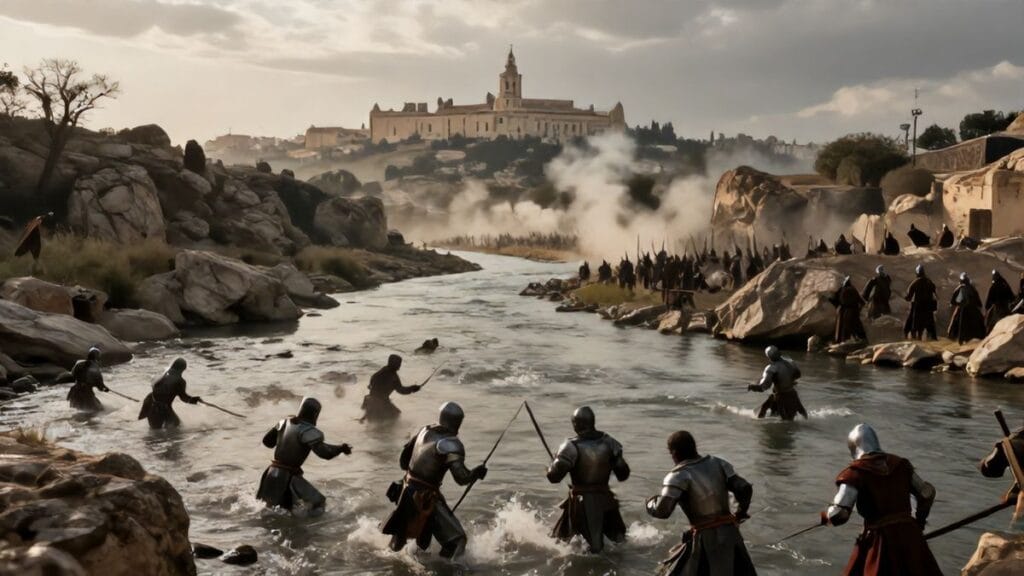
The opening moments of the battle of the fardus river were dominated by probing missile exchanges. Aghlabid archers and slingers advanced to the riverbank, loosing arrows and stones toward the Byzantine line. Greek and allied archers answered in kind, the hiss and thud of missiles filling the air. The aim on both sides was to disrupt formations, wound officers, and test the enemy’s resilience. The shallow water bore away shafts that missed, its surface soon thick with broken reeds and dropped equipment.
As volleys flew, commanders on both sides watched for weakness. Chronicles hint that Asad may have tried early on to seize a crossing point, perhaps ordering a small force forward to secure a ford or bridge. The Byzantines, for their part, sought to hold the line of the river, forcing the attackers to cross under fire. The tactical logic was sound: men scrambling up a bank from water or mud were easy prey for spears and arrows. But static lines could also be vulnerable to flanking maneuvers, especially if the battlefield’s edges were not well secured.
Soon, the preliminary skirmishing escalated. Trumpets (salpinx) in the Byzantine ranks and drums among the Aghlabids signaled advances. The battlefront, still somewhat fluid, began to stiffen around key positions where each side sensed the decisive engagement would occur. In those anxious minutes, before steel met steel at close quarters, many must have wondered whether they would live to see another sunrise—or whether the Fardus would be their grave.
Steel, Dust, and Prayer: The Battle of the Fardus River Unfolds
At last, Asad gave the order that would turn a tense standoff into a storm of violence. Units assigned to cross the Fardus surged forward, some at fords identified by scouts, others along improvised crossings where the water ran shallower. Shields were raised; banners dipped and then recovered; curses and prayers mingled as men splashed into the stream. Arrows rained down from the Byzantine side, felling some in the water and sending others stumbling, but momentum is a powerful force in battle. Where the leading elements managed to gain the far bank, comrades piled in behind, widening fragile beachheads.
The Byzantines responded with disciplined counter‑attacks. Infantry units, ordered to hold their ground in dense ranks, moved forward at key crossing points, seeking to push the enemy back into the river. Close combat now replaced distant archery. Spears thrust, swords rose and fell, shields splintered. Men slipped on wet stones and on blood. The cry of the wounded, in Greek, Arabic, Berber dialects, and local Sicilian tongues, rose above the clash of metal.
Asad, perhaps positioned where he could see both the river and his reserves, adapted as the situation evolved. Some medieval Muslim accounts emphasize his piety, reporting that he called on his men to remember the rewards of martyrdom and to see the struggle as both worldly and sacred. Whether each soldier believed this or not, such rhetoric could stiffen resolve. When a crossing threatened to collapse, fresh troops were thrown in; when resistance wavered on a different sector, mounted contingents were redirected to exploit it.
On the Byzantine side, the strategos and his subordinate officers also fought to maintain cohesion. The Empire prided itself on military manuals and tactical sophistication—texts like the later “Taktika” of Leo VI would formalize doctrines about defending river lines and using reserves. But parchment wisdom could not fully account for the chaos of actual combat. Dust began to rise from churned earth as the day warmed and the fighting shifted from the banks into the fields beyond. The once‑clear distinction between sides of the river blurred; pockets of Byzantines and Aghlabids now grappled across a patchwork of positions.
The battle of the fardus river became, in these grinding hours, a test of endurance and morale. Small successes and failures—capturing a banner, killing a local commander, pushing a unit off a low hill—had cascading psychological effects. Somewhere amid the melee, Euphemius’s contingent fought as well, though accounts differ on his exact role. Did his former comrades recognize him across the field? Did curses in Greek rise at the sight of a familiar face now fighting under foreign colors? The sources are silent, but the human drama is easy to imagine.
At one critical moment, Asad is said to have personally rallied wavering troops, possibly exposing himself to great danger. One later Arabic chronicler, Ibn al‑Athir, though writing centuries afterward, described him as “advancing with the courage of youth despite the burden of age,” a phrase that captures how memory wrapped the old jurist in a cloak of heroism. Whether the image is fully accurate or partly literary, it reflects a basic truth: leadership in the thick of battle could tip the balance when lines faltered and fear threatened to conquer men’s hearts.
Turning of the Tide: Collapse of the Byzantine Line and Aghlabid Victory
Every battle has a hinge, a moment when one side’s prospects narrow to a sliver and the other begins to sense that victory is within reach. At the Fardus, that moment seems to have come when a segment of the Byzantine line, perhaps on one flank, began to crumble under sustained pressure. Whether due to casualties among officers, fatigue, or a successful Aghlabid cavalry maneuver, a gap opened. Through that gap poured horsemen wielding spears and light lances, striking not at the heavily armored front but at the softer flanks and rear.
For the Byzantine infantry, trained to fight in ordered ranks, the sudden appearance of enemy riders to their side and behind was devastating. Some units tried to wheel and form new fronts, but coordinating such movements under fire is difficult. Others, seeing comrades break, felt the cold surge of panic. Rumors raced faster than messengers: “The flank is lost! We are surrounded!” In early medieval battles, such psychological shocks could be more decisive than the actual physical damage inflicted.
As formations dissolved, the controlled defense of the river line deteriorated into localized stands and chaotic retreats. Men who had held their ground for hours now cast anxious glances toward the rear, calculating escape routes. Officers shouted orders to fall back in good order toward Syracuse, but those orders often dissolved into a general rout. The Fardus, which had earlier served as a defensive asset, now became an obstacle: fleeing soldiers crowded at fords, trampling each other in their haste, some drowning under the weight of their own armor.
Aghlabid forces exploited the collapse with ruthless discipline. Pursuit followed the breaking of the line, but not indiscriminately; experienced commanders knew to let some fugitives go in order to avoid overextending and losing cohesion. Captives were taken where possible, especially among officers who might have ransom value or intelligence. The banners of the Byzantine theme of Sicily, once proudly held aloft, fell into enemy hands. For many of the defenders, the day ended not in a heroic last stand but in exhaustion, fear, and the desperate struggle to survive the retreat.
By late afternoon, the battlefield belonged to Asad. The battle of the fardus river had ended in clear Aghlabid victory. The cost had been high—several sources indicate heavy casualties on both sides—but the strategic outcome was unmistakable. The main organized Byzantine field army on the island had been shattered. Syracuse still stood, its walls and harbor a formidable challenge, but it now faced an enemy emboldened by triumph and no longer checked by a comparable force in the open field.
For the survivors who staggered into Syracuse as the sun sank, armor dented, faces blackened with grime and smoke, the shock must have been immense. The Empire, in their lifetime, had seemed distant but secure. Now, with comrades left unburied on the banks of the Fardus and enemy banners waving only a day’s march away, that sense of security was gone. The island’s future tilted toward a new center of gravity.
Aftermath on the Battlefield: Corpses, Captives, and Cold Calculations
As evening descended over the Fardus, the battlefield became a place of grim arithmetic. The dead, lying in tangled heaps, had to be counted, stripped, buried—or left to the elements. The victors moved among the bodies, seeking fallen comrades, looting equipment from enemies, and ensuring that wounded foes did not rise unexpectedly with a hidden dagger. For some, the sight of so many lifeless forms, faces contorted in final effort or fear, must have prompted reflection. For others, hardened by years of raiding and warfare, it was simply another field.
Captives were gathered into groups, bound or guarded closely. Among them may have been Byzantine officers who had tried to organize the retreat, or local notables who had accompanied the army. Their fate varied: some would eventually be ransomed back to their families or the imperial administration; others would be enslaved and taken to North Africa, destined for households, workshops, or garrisons far from the island of their birth. Such human transfers, multiplied over years, altered the demographic and cultural fabric of both Sicily and Ifriqiya.
In the Aghlabid camp, commanders assessed their own losses. Asad, if we follow the later chroniclers, grappled with the double duty of a jurist—ensuring that the distribution of spoils followed agreed‑upon rules—and of a general—deciding how aggressively to push the campaign now that the main obstacle had been removed. Some spoils were set aside for the emir’s share, others for the troops, still others perhaps earmarked for religious endowments or to support the widows and orphans of those who had fallen. Victories, like states, depended on such administrative details.
The psychological boost was enormous. Word of the victory at the battle of the fardus river would have spread swiftly among the troops and, via ships and messengers, back across the sea to Kairouan. For Ziyadat Allah, news that his risky expedition had crushed the Byzantine field army would have been a vindication. At the same time, he and his advisers would have understood that one battle did not equal total conquest. Sicily was large; fortresses remained; the Empire might still attempt a counterstrike.
On the Byzantine side, the aftermath was marked by recriminations and attempts to salvage order. Blame naturally sought targets: the strategos, for miscalculation; soldiers, for cowardice; perhaps even the emperor, for neglecting the island. Ecclesiastical writers could frame the defeat as divine punishment for sins, whether the sexual scandal of Euphemius, the imperial policies on icons, or the moral laxity of the age. Human grief—families mourning sons who would never return—became raw material for both administrative reports and moralizing sermons.
Siege on the Horizon: From the Fardus to the Walls of Syracuse
With the field won at the Fardus, Asad’s gaze—and that of every officer under him—turned naturally toward Syracuse. The city was more than just a stronghold; it was the political and symbolic heart of Byzantine Sicily, a city whose history reached back to the days of Greek tyrants and Roman governors. Controlling Syracuse meant more than occupying walls; it meant claiming legitimacy as the island’s new masters. The road from the river to the city, though, was not merely a straight march. It ran through the uncertainties of supply, morale, and internal politics.
The Aghlabid army, having taken casualties and expended supplies during the battle of the fardus river, needed to rest, regroup, and secure its lines of communication. Foraging parties went out into the surrounding countryside, gathering grain, livestock, and other provisions—sometimes by purchase, sometimes by force. Local populations, frightened by news of the Byzantine defeat, faced hard choices: resist and risk devastation, or acquiesce and hope for tolerable treatment. Some villages may have attempted to play both sides, secretly sending word to Syracuse while outwardly accepting Aghlabid demands.
Inside Syracuse, the atmosphere was one of urgent preparation. Walls and gates were inspected and reinforced where possible. Cisterns were checked; grain stores inventoried. The remaining garrison, bolstered perhaps by refugees from the battlefield, organized defensive sectors along the ramparts. The city’s bishop and clergy led processions and prayers, invoking saints and martyrs to protect the community. Civic leaders debated whether to seek negotiations or to hold out in the hope that imperial reinforcements might arrive by sea.
Asad advanced cautiously, moving his army closer but avoiding reckless commitments. According to some accounts, he initiated a siege, encircling the city partially and probing its defenses. Naval elements also came into play: Aghlabid ships that had supported the initial landing could attempt to blockade Syracuse’s harbor, though Byzantine control of the wider sea remained a significant factor. Siege warfare in this period was often a matter of patience—of attrition rather than quick storming—especially when the defenders were resolved.
Yet the story took an unexpected twist. Asad himself would not live to see Syracuse fall. Sources suggest that he died during the campaign, perhaps in 828, likely from disease that spread in the close quarters and poor sanitation of a prolonged siege environment. His death caused disarray in the Aghlabid ranks, leading to debates over leadership and strategy. The immediate effect was a weakening of the besieging force, buying Syracuse precious time. The long‑term effect, however, did not erase the foundational impact of the victory at the Fardus: the island could never quite return to its pre‑827 status quo.
An Island Transformed: Political and Social Consequences for Sicily
In the years after the battle of the fardus river, Sicily entered a protracted period of transformation. The conquest was not a single sweeping event but a slow, uneven process that would stretch over decades, with cities and strongholds falling at different times, and pockets of resistance persisting long after others had surrendered or come to terms. Yet the defeat of the Byzantine field army in 827 made these later developments possible. It turned the Aghlabid presence from a risky foothold into an enduring factor in Sicilian politics.
Politically, the authority of the Byzantine strategos was fatally undermined. Even where imperial governors continued to exercise power, they did so under the shadow of Aghlabid arms and the knowledge that reinforcements from Constantinople were unlikely to match the scale or immediacy of the threat. Local elites, always sensitive to the winds of power, began to hedge their bets. Some negotiated arrangements with Aghlabid commanders, paying tribute in exchange for protection of lands and privileges. Others sought to relocate to safer territories across the strait, taking their families and portable wealth to Calabria or further east.
Socially, the arrival of Muslim rule—initially partial, then expanding—reshaped landholding, taxation, and rural life. New land grants were issued to Arab and Berber soldiers, establishing a class of warrior‑settlers with a direct stake in the island’s resources. Existing landowners who submitted could retain their estates under new conditions, often paying the jizya (a head tax on non‑Muslims) and kharaj (land tax) in exchange for protection and the right to maintain their faith and property. Over time, these arrangements fostered a complex, multi‑confessional society in which Christians, Muslims, and eventually Jews coexisted under evolving rules.
Urban life, too, changed. Palermo, which would in time become the main Muslim capital of the island, grew in importance, while Syracuse—though still significant—lost its preeminence. Markets saw new goods and new coins. Arabic inscriptions began to appear alongside Greek and Latin. The soundscape of towns shifted subtly: the call to prayer from mosques, church bells, and the murmur of multiple languages in the streets created a layered auditory tapestry. The battle of the fardus river, by breaking the old regime’s military backbone, had opened the door to these transformations.
Not all consequences were immediate or purely political. Families disrupted by death and captivity faced new realities. Children orphaned in 827 might grow up under a new order they barely recalled emerging. For them, the old days of quiet Byzantine rule would be stories their grandparents told, colored with nostalgia or bitterness depending on personal experience. In this way, a single river battle echoed through generational memory, long after the sound of clashing steel had faded from the Fardus’s banks.
Faith, Language, and Law: Cultural Ripples of a River Battle
If politics and landownership changed in the wake of the battle of the fardus river, so too did the deeper currents of culture. Under Aghlabid—and later, more fully under Kalbid and Fatimid—rule, Sicily became a zone of intense cultural interaction. The arrival of Muslim jurists, scholars, and administrators introduced new legal concepts and practices. Sharia courts dealt with matters concerning the Muslim population, while Christian communities retained their own canon law jurisdictions for internal affairs, subject to overarching constraints. This legal pluralism, while unequal, allowed a degree of continuity and adaptation.
Language was perhaps the most immediately visible sign of change. Arabic gradually became the language of administration and high culture in Muslim‑controlled areas, joining or displacing Greek and Latin in various contexts. Place names, agricultural terms, and everyday vocabulary in the local Sicilian dialect absorbed Arabic elements. Over centuries, this linguistic layering would give Sicilian its distinct flavor, a living testimony to the island’s composite past. Even after Norman conquerors arrived in the eleventh century, they would find Arabic scribes and documents indispensable, a legacy traceable back to the first victories of the Aghlabid arms.
Religious life, always central in medieval society, also evolved in complex ways. Churches continued to function in many towns and villages, their congregations adapting to new fiscal and social realities. Monasteries, some of them wealthy landowners, faced harder choices: submit, relocate, or resist. At the same time, mosques and ribats (fortified religious communities) were established, serving both spiritual and military purposes. The presence of multiple faith communities, while occasionally explosive, also led to everyday interactions—shared markets, neighboring fields, pragmatic partnerships—that historians like Jeremy Johns have highlighted in modern studies of Islamic Sicily.
Law and custom interwove. Contracts between Muslim and Christian partners, for example, might reference both Islamic legal traditions and local customary practices. Disputes could end up before mixed audiences, requiring interpreters not only of language but of law. In such arenas, the memory of the Fardus’s bloody day was probably less immediately present than questions of debt, inheritance, or land boundaries. Yet all those mundane disputes played out in a framework that battle had helped erect.
Voices from the Chronicle: How Medieval Writers Remembered the Fardus
Our knowledge of the battle of the fardus river comes not from a single eyewitness account but from a tapestry of later chronicles, both Byzantine and Arabic, each with its own agenda and style. The Byzantine continuators of Theophanes, for instance, mention the Aghlabid invasion of Sicily and the treachery of Euphemius, emphasizing imperial victimhood and divine testing. They depict the defeat as a tragic but explicable setback in a long war with Islam, shading their narrative with moral lessons about loyalty and sin.
On the Arabic side, chroniclers like al‑Baladhuri and, later, Ibn al‑Athir and al‑Nuwayri, recorded the campaign as part of a broader story of Islamic expansion and jihad. They celebrated the courage of Asad ibn al‑Furat, sometimes in highly stylized prose, and highlighted the victory at the river—often named as the Fardus or with similar forms—as a sign of divine favor. One line in Ibn al‑Athir’s account, for example, describes how “the army of the Muslims stood firm upon the water’s edge, and God cast terror into the hearts of the Byzantines,” a statement that tells us more about theological interpretation than about tactical detail.
Latin Christian sources from Italy, such as the “Chronicon Salernitanum,” also allude to the Muslim entry into Sicily, though often in brief and geographically confused terms. To them, events across the strait were part of a wider pattern of Saracen incursions along the Italian coasts and into the Tyrrhenian Sea. The precise location of the Fardus mattered less than the sense that a new, unsettling force was taking root on a once‑Roman island.
These accounts must be read critically. Each is shaped by hindsight. For Byzantine writers, who knew that most of Sicily would eventually be lost, the battle could be framed as the beginning of a tragic arc, colored by laments for a vanished order. For Muslim authors, who wrote in a world where Palermo was a thriving Islamic city and Sicilian scholars contributed to Arabic learning, the victory seemed the obvious start of a divinely sanctioned conquest. Modern historians, confronting these sources, must sift bias from fact, rhetoric from event, and gaps from invention.
Yet their very differences are instructive. They remind us that what seems to us a clear “turning point” was to contemporaries one of many crises, one of many campaigns, and that its ultimate significance was not fixed in 827 but emerged as later generations looked back. Memory, like a river, reshapes its banks over time.
Between Memory and Myth: Modern Historians Revisit the Battle
In the nineteenth century, as European scholars began to systematically study the Arabic sources for Mediterranean history, the battle of the fardus river emerged more distinctly from the mists of the early Middle Ages. The Sicilian historian Michele Amari, in his monumental “Storia dei Musulmani di Sicilia,” drew together fragments from Arabic chronicles and Byzantine materials to reconstruct the campaign of 827–828. For Amari, writing in the context of Italian unification, Islamic Sicily was both a foreign episode and a foundational layer in the island’s identity.
Later historians, such as Alex Metcalfe and Jeremy Johns, have refined this picture, questioning earlier assumptions about numbers, timelines, and motivations. They note the tendency of medieval sources to exaggerate the size of armies and the decisiveness of particular battles. The Fardus, in their view, was indeed a crucial engagement, but it formed part of a series of clashes, sieges, and negotiations that collectively produced the shift in power. They also emphasize the agency of local Sicilian actors—not just Euphemius, but rural communities, civic elites, and church institutions.
One ongoing debate concerns the exact location of the Fardus. While the traditional identification places it near Syracuse, some have argued for alternative sites based on toponymic evidence or reinterpretation of campaign routes. The medieval habit of using river names that have since changed, or of transliterating local names into Arabic and then back into Latin, complicates efforts at precise mapping. Archaeological exploration may one day yield more tangible traces—weapon fragments, mass graves, or camp remains—but for now, the battlefield remains known more through texts than through soil.
Modern scholarship also relativizes the notion of “conquest” as a simple binary. The outcome of the battle of the fardus river was a military victory, but the subsequent decades in Sicily saw extensive negotiation, accommodation, and hybridity. Rather than a straightforward replacement of one regime by another, historians describe a layered process in which Byzantine, Arabic, Latin, and local influences intertwined. In this sense, the battle is both more and less than a clean break: more, because it inaugurated a rich intercultural era; less, because it did not instantly erase what came before.
Echoes Across the Mediterranean: The Wider World Reacts
News of the Aghlabid victory at the Fardus and their subsequent campaigns in Sicily reverberated across the Mediterranean. In Constantinople, already preoccupied with threats on multiple fronts, the imperial court confronted yet another alarming dispatch. The loss of much of its Sicilian field army and the precarious status of Syracuse forced hard choices. Should resources be diverted from the Balkan frontier or from the struggle against Arab forces in the east to shore up a distant western island? Often, the answer, constrained by reality, was “only partially.”
Among the Italian polities, the reaction was mixed. The Lombard principalities of Benevento and Salerno, the emerging maritime republics like Naples and Amalfi, and the Papacy in Rome all watched developments uneasily. Muslim control of parts of Sicily and a growing presence in the Tyrrhenian could threaten trade routes and coastal security. At the same time, some Italian cities concluded treaties with Muslim powers, trading grain, timber, and slaves in exchange for access to lucrative markets. Fear and pragmatism coexisted.
In the wider Islamic world, the success at the battle of the fardus river and in the early Sicilian campaigns enhanced the prestige of Ifriqiya. The emirate could present itself as an active frontier of jihad, extending the realm of Islam into former Roman territories. This prestige had domestic uses: it could placate critics at home, attract volunteers for further campaigns, and legitimize taxation policies framed as support for holy war. Yet the costs were real, too. Maintaining a long‑term military effort across the sea demanded ships, money, and men, and sometimes sparked grumbling among taxpayers and tribal groups.
Over the following decades, Muslim Sicily became a bridge between worlds, sending olive oil, grain, and sugar northward, while drawing in silver, timber, and slaves from Europe. Scholars, poets, and craftsmen traveled through its ports. Thus, a battle fought on a riverbank in 827 played a subtle role in shaping economic and cultural circuits that linked Baghdad and Cairo to Rome, Constantinople, and beyond. The Mediterranean, far from being a line of division, was a shared space of contestation and exchange, with Sicily near its center.
Legacy of a Forgotten Field: Why the Fardus Still Matters
Today, the name Fardus rarely appears on tourist maps of Sicily. Visitors flock to the Greek theater of Syracuse, the baroque splendors of Noto, or the bustling markets of Palermo, with little awareness that a few miles away—or perhaps under some unremarkable fields—the soil once ran dark with the blood of men whose struggle would determine the island’s trajectory for centuries. Yet the battle of the fardus river continues to matter, if we know how to listen for its echoes.
First, it reminds us that history turns not only on the grand decisions of emperors and emirs, but on the flawed, human choices of individuals like Euphemius, Asad ibn al‑Furat, and the unnamed strategos of Sicily. Personal grievances, ambition, and loyalty intersected with structural weakness and opportunity to set the stage for war. Second, it illustrates how a single military defeat can ripple outward into political realignments, cultural hybridity, and long‑term memory. Without the Aghlabid victory in 827, Islamic Sicily might never have taken the form it did—or might have failed to take root at all.
Third, the story shows how contested and constructed our understanding of the past is. Medieval chroniclers wrote with agendas; modern historians read them through their own lenses. The Fardus has been framed as a triumph of faith, a tragedy of imperial neglect, a step in the inevitable march of conquest, and a hinge of cultural fusion. Each framing highlights certain aspects and dims others, like a series of spotlights on a stage where the set never quite changes.
Finally, the battle invites us to see the Mediterranean not just as a frontier between “Islam” and “Christendom,” but as a dynamic arena where identities were made and remade. On that riverbank in 827, men who spoke different languages and prayed in different ways fought, killed, and died. In the aftermath, their descendants and the people they ruled would share streets, markets, and sometimes households. The distant sound of combat at the Fardus becomes, if we trace its consequences far enough, the murmur of a multi‑layered Sicilian culture that still carries traces of Arabic words, Byzantine icons, and Latin rites.
The field lies quiet now. But in archives, chronicles, and the lives shaped by its outcome, the battle of the fardus river is still being fought, remembered, and reinterpreted—an enduring reminder that even seemingly obscure conflicts can leave deep and lasting marks on the world.
Conclusion
The battle of the fardus river, fought near Syracuse in 827, was more than a clash between two armies at a shallow Sicilian stream. It was the crystallization of long‑gathering forces: the rise of the Aghlabid emirate and its maritime ambitions, the slow fraying of Byzantine power in the western Mediterranean, and the combustible mix of local grievances and imperial politics that produced Euphemius’s fateful defection. On the banks of the Fardus, these strands came together in hours of brutal combat that shattered the main Byzantine field force on the island and opened a path toward sustained Muslim presence in Sicily.
In the battle’s immediate wake, the Aghlabids gained momentum, pressing their advantage toward Syracuse and reshaping alliances across the island. Over the longer term, the victory laid the groundwork for a society in which Arab and Berber newcomers interacted with Greek and Latin Christians, creating a distinctive blend of law, language, and culture. Though the conquest would be contested and incomplete for decades, and though later powers—the Fatimids, the Kalbids, the Normans—would layer their own institutions on the island, the watershed of 827 remained a point of reference in both Muslim and Christian memory.
Modern historians, sifting through partial and partisan medieval sources, have come to see the battle of the fardus river as both decisive and contingent. Decisive, because without it the Aghlabids might never have secured a lasting foothold in Sicily; contingent, because its causes and consequences depended on a web of choices that could have unfolded differently. It teaches us to be wary of simple narratives of “inevitable” conquest and to attend instead to the lived realities of soldiers, peasants, merchants, and monks whose lives were abruptly touched by the outcome of a single day’s fighting.
Ultimately, the Fardus stands as a symbol of Sicily’s role as a crossroads—a place where frontiers blurred, where victories and defeats never fully erased what came before, and where the streams of history, like the river itself, flowed onward, carrying traces of all they had once swept along. To remember that battle is to acknowledge the depth of the island’s layered past and the enduring power of moments when history seems to pivot in the space of a few breathless hours.
FAQs
- Where exactly was the Battle of the Fardus River fought?
The precise location of the Fardus River remains a subject of debate among historians. Most scholars place it in the vicinity of Syracuse in eastern Sicily, likely corresponding to a river or stream whose medieval name has since changed or vanished. While textual evidence points clearly to the broader region, no definitive archaeological identification of the battlefield has yet been made. - Who were the main commanders in the Battle of the Fardus River?
On the Aghlabid side, the expedition was led by Asad ibn al‑Furat, an elderly but renowned jurist and military commander from Ifriqiya, acting with the backing of Emir Ziyadat Allah I. The Byzantine forces were commanded by the strategos of Sicily, often identified in sources as Photinus, though the exact form of his name and his prior career are less securely documented. The rebel Euphemius, whose invitation helped spark the invasion, also played a role alongside the Aghlabid leadership. - Why was the Battle of the Fardus River so important for Sicilian history?
The battle was pivotal because it destroyed or badly crippled the main Byzantine field army on the island, leaving Syracuse and other strongholds without an effective mobile defense. This shift allowed the Aghlabids to entrench themselves in Sicily and to pursue further campaigns and sieges over the following decades. Without the victory at the Fardus, the Islamic conquest of large parts of Sicily might have failed or taken a very different course. - Did the Battle of the Fardus River immediately lead to the fall of Syracuse?
No. Although the battle opened the way to Syracuse and led to an Aghlabid siege, the city did not fall immediately. The defenders reorganized behind their walls, and the siege was complicated by logistical challenges and by the death of Asad ibn al‑Furat, likely from disease. Syracuse remained a contested stronghold and would only be definitively captured by Muslim forces some decades later, after further campaigns. - What sources describe the Battle of the Fardus River?
The battle is described in both Byzantine and Arabic chronicles, though none are strictly contemporary eyewitness accounts. Byzantine continuators of Theophanes mention the invasion and defeat, while Arabic historians such as al‑Baladhuri and Ibn al‑Athir provide accounts framed within narratives of jihad and conquest. Later Latin chronicles from southern Italy allude to the campaign more obliquely. Modern historians compare and critique these texts to reconstruct the likely course of events. - How did the battle affect everyday life for Sicilians?
In the short term, the battle brought devastation to the regions directly affected: deaths, captives, and disruption of agriculture and trade. In the medium and long term, the Aghlabid foothold it secured led to new tax structures, land grants to Muslim soldiers, and an influx of Arab and Berber settlers. Christian communities adapted to new rulers by paying specific taxes and negotiating local arrangements, while cities like Palermo grew into major hubs of a more cosmopolitan, multi‑confessional society. - Was religion the main cause of the conflict at the Fardus?
Religion was an important element—both sides framed the struggle in spiritual terms—but it was intertwined with political, strategic, and economic motives. The Aghlabids saw an opportunity to enhance their prestige and control a lucrative island; the Byzantines sought to defend imperial territory and maintain a key naval base. Euphemius’s defection, driven by personal and political grievances, provided the immediate trigger. Thus, faith, power, and pragmatism were all at work.
External Resource
Internal Link
Other Resources
- Encyclopaedia Britannica – general search for the exact subject
- Google Scholar – academic search for the exact subject
- Internet Archive – digital library search for the exact subject

