Table of Contents
- A Roman Summer Darkened: Setting the Stage in 119 CE
- From Moorish Horseman to Roman General: The Rise of Lusius Quietus
- Under Trajan’s Eagle: Quietus and the Wars of Conquest
- A Hero of Fire and Fear: The Jewish Diaspora Revolts and Their Aftermath
- The Unexpected Emperor: Hadrian’s Accession and Quietus’s Changing World
- Whispers in Marble Halls: Court Intrigue and the Shadow of Succession
- From Imperial Favor to Mortal Peril: The Road Toward the Execution
- The Execution of Lusius Quietus: A Death in the Name of Stability
- Blood, Ink, and Silence: How Rome Recorded—and Erased—Quietus
- Race, Origin, and Power: A Berber General in a Roman World
- Hadrian’s Turning Tide: From Expansion to Consolidation
- Echoes in Judaea and Beyond: Memory of a Ruthless Commander
- Senators, Soldiers, and Subjects: Political Shockwaves of Quietus’s Fall
- The Thin Line Between Glory and Death in Imperial Rome
- Archaeological Traces and Lost Voices: Hunting for Quietus in the Sources
- Myth, Bias, and Historians: Reconstructing a Condemned Life
- Legacy in the Sand: North Africa After Quietus
- Conclusion
- FAQs
- External Resource
- Internal Link
Article Summary: In the summer of 119 CE, the execution of Lusius Quietus marked one of the most dramatic and enigmatic episodes of the early Roman Empire under Hadrian. This article follows Quietus from his beginnings as a Moorish horseman in North Africa to his meteoric rise as a feared and admired Roman general. It then traces the subtle, often invisible turn from imperial favor to mortal suspicion that culminated in the execution of Lusius Quietus and the quiet rewriting of his memory. Along the way, it explores the brutal wars that forged his reputation, particularly the Jewish Diaspora revolts, and the political calculations of emperors who both needed and feared their most successful commanders. The narrative dives into the social, racial, and cultural tensions behind his fate, asking how a provincial outsider could rise so high—and why that made him intolerable to a cautious new emperor. It also examines how ancient historians, inscriptions, and archaeology help us glimpse a life that imperial politics tried to erase. Above all, this story reveals how, in Rome, glory and death were separated not by justice or merit, but by the shifting anxieties of those who ruled the world. Yet even centuries later, the execution of Lusius Quietus continues to illuminate the fragile architecture of power at the heart of the Roman Empire.
A Roman Summer Darkened: Setting the Stage in 119 CE
Rome in 119 CE seemed, at first glance, to rest at the height of its power. The Forum gleamed with marble, the Colosseum still rang with cheers, and the empire’s frontiers stretched from the misty highlands of Britain to the baked deserts of Arabia. The emperor Hadrian, newly enthroned after the death of Trajan in 117, was striving to secure his legitimacy: distributing donatives, confirming key appointments, and performing the rituals that tied him to the gods and to Rome’s political class. Yet behind this façade of order, the air carried an almost inaudible tension. Veterans whispered in taverns. Senators spoke more quietly than usual in the shadowed porticoes. Names once shouted in triumph during victory parades were now spoken only in cautious tones, if at all.
Among those names, one carried both awe and unease: Lusius Quietus. Just a few years earlier, he had been one of Rome’s most effective generals—a man whose cavalry could appear like a sandstorm on the horizon and vanish just as quickly, leaving only bodies behind. His campaigns for Trajan in the east and against the Jewish communities of the Diaspora had made him both indispensable and terrifying. But in 119, that reputation no longer protected him. It had become a liability. The execution of Lusius Quietus, an event muffled in our sources but resonant in its implications, emerged from this uneasy convergence of glory and fear.
The early second century was an age of transition. Trajan had pushed the empire’s boundaries to their furthest limits, conquering Dacia and briefly annexing territories in Mesopotamia. Rome seemed unstoppable, driven by a vision of endless expansion. Hadrian, by contrast, would become known for drawing lines, not crossing them—for fortifying borders, not shattering them. Between these two visions of empire stood a handful of men whose careers had been built on conquest. They were the sword-arms of Trajanic ambition, now wielded by an emperor who preferred the shield. That uneasy mismatch of temperament and talent would help make the execution of Lusius Quietus both plausible and, from the perspective of Hadrian’s court, almost inevitable.
It is astonishing, isn’t it, how quickly a hero can become a threat? Within just two years of Trajan’s death, several of his most formidable generals were gone—quietly removed, forced to suicide, or formally executed. Quietus was one of them. While ancient sources such as Cassius Dio and the Historia Augusta are frustratingly terse, they agree on the stark facts: once a favored commander, Lusius Quietus was stripped of command and ordered to die. To grasp why, we must step back from that tense Roman summer and follow the path he took to get there—a path that began far from Rome’s marble core, in the dusty hills of Mauretania.
From Moorish Horseman to Roman General: The Rise of Lusius Quietus
Lusius Quietus did not begin life in a senator’s villa or a patrician townhouse. He was almost certainly born in Mauretania, in the western reaches of North Africa—somewhere in what is now Morocco or Algeria. He belonged to the indigenous Berber (Moorish) peoples whose relationship with Rome swung between alliance and rebellion. To the Roman elite, Moors were both exotic and fearsome: consummate horsemen, skilled at skirmishing warfare, able to melt into the rugged landscape that outsiders never truly understood. In that world, Quietus learned to ride, to fight, and to lead.
We do not have his own voice. No autobiography, no letter survives. Yet the very fact that he emerges from obscurity into the bright glare of imperial history speaks volumes. He must have distinguished himself early, placed in command of Moorish auxiliary cavalry in Rome’s service. Such units were critical to Roman warfare, filling the gaps that the slow-moving, heavily armored legions could not. In the fluid world of frontier skirmishes, Moorish riders were invaluable. Quietus, apparently, turned that skill into a career.
By the late first century or early second, his name appears linked to elite commands. This alone tells us something crucial: Rome was not a rigid fortress of ethnicity, at least not in its army. Ambitious men from the provinces—Spaniards, Gauls, Syrians, and North Africans—could rise, if they had the talent and luck. Quietus was one of those men. He did not merely serve; he excelled. Under Trajan, his cavalry became renowned for shock tactics and rapid movements across difficult terrain, fighting first in Dacia and then in the East. Each success brought him closer to the heart of Roman power.
Imagine the contrast. A man raised among tribal chieftains and harsh landscapes now stood in the marble corridors of Trajan’s court, wearing a Roman commander’s cloak, receiving orders directly from the emperor. Yet even here, his identity was double. To many, he was both Roman general and “Moor,” a foreigner at the highest ranks of an empire that claimed universal rule but guarded its core status carefully. That tension would never entirely fade. It lay silently under every promotion, every honor—waiting, perhaps, for the moment when his origins could be turned against him.
Still, in the years of conquest, competence mattered more than ancestry. Trajan, who valued success on the battlefield above almost all else, found Lusius Quietus invaluable. The Moorish general’s star rose swiftly, bringing him ever closer to the fateful culmination of his career—and, by a cruel irony, to the circumstances that would eventually make the execution of Lusius Quietus seem a politically convenient act.
Under Trajan’s Eagle: Quietus and the Wars of Conquest
When the emperor Trajan cast his gaze eastward toward Parthia, he did so with the confidence of a soldier-emperor surrounded by men like Quietus. Campaigning in Dacia had already proven the effectiveness of Rome’s combined arms: heavy infantry, auxiliary cavalry, and specialized units working in brutal harmony. Quietus, with his Moorish horsemen, had played a part in that bloody victory that filled Rome’s coffers with gold and its streets with triumphant monuments.
Trajan’s next ambition lay across the Euphrates. In 114–117 CE, he launched his grand campaign against the Parthian Empire, seeking to extend Roman rule deep into Mesopotamia. It was an audacious move, and it stretched Rome’s military capabilities to their breaking point. On those long, grueling marches, as legions pushed through foreign cities and dry plains, commanders like Lusius Quietus became indispensable. His cavalry acted as the empire’s eyes and claws—scouting, raiding, and punishing resistance with chilling efficiency.
Ancient accounts hint that Quietus was entrusted with important independent operations. He reportedly occupied key cities in Mesopotamia, helping secure Trajan’s fragile conquests. His name surfaces in connection with the suppression of uprisings and the pacification of newly conquered territories. These tasks required not just tactical skill but a certain temperament: the capacity to apply overwhelming violence when necessary, to terrify as well as defeat. Trajan, fighting far from Rome, needed men who could make local populations understand that resistance was futile.
For a while, it worked. Trajan took Ctesiphon, the Parthian capital, and briefly claimed to have reached the Persian Gulf. In the euphoria of these victories, figures like Quietus stood as proof that the empire’s frontiers were not limits but invitations. The world, it seemed, could be remade in Rome’s image. But the cost of that vision was already mounting—especially in the scattered Jewish communities who would soon feel Lusius Quietus’s iron hand.
As the eastern campaign dragged on, cracks appeared. Logistics faltered, local uprisings flared, and Rome’s overstretched forces struggled to hold what they had seized. In these volatile conditions, the same brutal efficiency that had made Quietus a hero of conquest would be turned inward, against subjects of the empire itself. The transition from expansive war to internal suppression would define the darkest part of his legacy—and set the emotional stage for how later generations, especially within the Jewish tradition, remembered his name.
A Hero of Fire and Fear: The Jewish Diaspora Revolts and Their Aftermath
While Trajan’s armies pressed deeper into the East, another kind of war erupted far from the front lines. Between roughly 115 and 117 CE, Jewish communities across the Mediterranean—particularly in Cyrenaica (modern Libya), Egypt, Cyprus, and Mesopotamia—rose in revolt. The causes were complex: local tensions, economic pressures, religious friction, and perhaps the disruptive presence of large Roman forces passing through the region. What we know is that the conflict was ferocious, mutually barbarous, and devastating.
Roman sources accuse the rebels of horrific massacres of Greeks and Romans. In response, imperial commanders were given a grim mandate: restore order at any cost. This was the kind of assignment for which Lusius Quietus had been shaped by years of frontier fighting. Trajan dispatched him—especially in the East—to crush the revolts and reassert imperial control. In this campaign, his name became synonymous with unsparing repression.
Cassius Dio, writing in the third century, provides a chilling summary: Quietus “destroyed many Jews” and brought Mesopotamia back under control. The details are scarce, but the tone is unmistakable. The campaign was not a measured police action; it was a storm. Cities were retaken, rebels slaughtered, survivors scattered. To Trajan and much of Rome’s elite, this was necessary, even admirable. A general who could quell such uprisings with ruthless speed was worth his weight in gold. To the Jewish communities, however, he became a figure of terror—a name spoken with dread.
In the wake of the Diaspora revolts, entire regions were transformed. Cyrenaica and parts of Egypt were depopulated; reconstruction would take decades. Thousands, perhaps tens of thousands, were dead. The psychological scars cut deep. Here, in the angry intersection of imperial policy and local desperation, Quietus carved his most indelible mark on history. It was also here that he may have crossed an invisible threshold—from loyal instrument of Roman order to man whose power and notoriety might one day trouble an emperor.
Yet behind the celebrations in Rome—te Deums offered to the gods, honors lavished on victorious commanders—there lurked unease. Men like Lusius Quietus had proven they could command armies, move swiftly across provinces, and impose their will through fear. To an emperor uncertain of his grip on power, that combination was both useful and terrifying. In a bitter irony, the very vigor with which Quietus crushed revolts and secured Trajan’s eastern dream helped make him seem, in the eyes of Hadrian’s circle, a man too dangerous to leave alive.
The Unexpected Emperor: Hadrian’s Accession and Quietus’s Changing World
When Trajan died in 117 CE, probably in Cilicia during his return from the eastern campaign, the Roman world trembled. Officially, the transition was smooth: Hadrian, a relative and long-time associate of Trajan, was proclaimed emperor. An adoption document was announced; the army accepted him; the Senate, after some hesitation, ratified his rule. But history rarely follows the neat lines of official inscriptions. Behind that narrative lay rumors, doubts, and the quiet mobilization of men who understood how fragile power could be.
Hadrian’s relationship with Trajan had been complicated. At times a favored protégé, at other times sidelined, he was not universally regarded as the obvious successor. In fact, other generals who had distinguished themselves in the Parthian campaign—like Avidius Nigrinus, Cornelius Palma, and, crucially, Lusius Quietus—were viewed in some quarters as potential rivals, or at least as unpredictable factors. They had armies behind them, victories to their names, and reputations burnished by years of Trajanic conquest.
In such a context, even silence could be suspicious. If Quietus did not immediately proclaim enthusiastic loyalty, it might be interpreted as hesitation. If he did, it might still be doubted. Moreover, Hadrian’s strategic vision diverged sharply from Trajan’s. Rather than hold the precarious eastern conquests, he began, quietly at first and then openly, to withdraw from Mesopotamia and other newly seized territories. For a general whose fame had been built on the eastern campaigns and the suppression of far-flung uprisings, this change was more than a mere policy shift—it was the unraveling of the world he had helped forge.
At first, Hadrian retained or even confirmed several of Trajan’s commanders in their positions. Lusius Quietus, remarkably, was appointed governor of Judaea—a province painfully marked by previous Jewish revolts and not far removed from the territories where he had recently fought. This appointment could be read as confidence in his military abilities. It might also have been a calculated move: keeping a potentially dangerous man occupied and far from the heart of power, while watching him closely.
But this was only the beginning. Over the next two years, a pattern emerged. The new emperor, deliberately or instinctively, began to prune Trajan’s old guard. Avidius Nigrinus was executed. Cornelius Palma disappeared from the record after accusations of conspiracy. Others, once secure in their authority, were suddenly vulnerable. In that gathering storm, Lusius Quietus found himself standing not as a hero of the past but as a reminder of an imperial philosophy—aggressive, expansionist, uncompromising—that Hadrian was increasingly determined to leave behind.
Whispers in Marble Halls: Court Intrigue and the Shadow of Succession
To understand why the execution of Lusius Quietus took place, we must listen, as best we can, to the whispers that once drifted through the marble halls of Rome and its provincial capitals. Succession in the Roman Empire was never simple. There was no fixed rule, no automatic transfer of power. Each new emperor had to weave a fragile web of legitimacy from military support, senatorial acquiescence, and public acceptance. In that delicate balancing act, powerful generals with strong reputations could become existential threats.
Ancient writers, including the often-embroidered Historia Augusta, suggest that Hadrian feared conspiracies early in his reign. Whether such plots were real or imagined, they served as justification for removing key figures. Quietus, with his battle-hardened troops, his recent governorship of Judaea, and his reputation for swift, decisive violence, would have loomed large in any list of potential rivals. Some modern scholars have speculated that he might have been considered by certain factions as an alternative emperor—or at least as a man whose mere existence made Hadrian’s hold on power feel less secure.
The atmosphere must have been thick with suspicion. Messages carried between legions, envoys traveling from province to capital, and sudden changes in command appointments—each could signal loyalty or danger. It would not have required an overt act of treason for Quietus to come under scrutiny. His past closeness to Trajan, his role in the eastern wars, and his identity as a formidable outsider all converged to paint him as a potential center of opposition.
Consider the psychology at work. Hadrian, a cultivated man, a lover of Greek culture and architecture, had inherited an empire that had just been driven to the edge of its capacity by long wars. He wanted peace, consolidation, and a shift from the brutal heroics of conquest to the subtler heroics of administration and defense. To accomplish this, he had to neutralize not only external threats but internal symbols of a different ideal of Roman greatness. Lusius Quietus, the Moorish general whose name evoked fire and terror in the East, embodied that older, harsher model of imperial achievement.
So the whispers grew. Perhaps they took the form of anonymous accusations brought before imperial advisors. Perhaps they emerged in private conversations where senators, fearing their own vulnerability, pointed to the ambitions of others. Whatever their origin, they converged on a single outcome: the emperor’s decision that men like Quietus could not be allowed to remain at large. The stage was set not just for dismissal or retirement, but for elimination.
From Imperial Favor to Mortal Peril: The Road Toward the Execution
The sources do not describe, step by step, the final months of Lusius Quietus’s life, but we can reconstruct the outline from scattered references and the broader patterns of Roman imperial politics. First came removal from command. At some point in 118 or 119, Quietus was stripped of his governorship of Judaea. To the ancient Roman elite, such a move spoke loudly: it signaled the emperor’s displeasure and foreshadowed further measures. In a system where honor and office were intimately linked, dismissal was often the first cut.
Next came accusations—perhaps of conspiracy, perhaps of disloyalty, perhaps of simple over-mightiness. The details are lost, but the mechanism is familiar. When emperors moved against powerful figures, they typically did so under a legal or pseudo-legal pretext. A charge of plotting against the emperor was the surest way to justify even the harshest penalty. In the case of Quietus, the Roman historian Cassius Dio simply notes that he was “put to death” by Hadrian’s orders, grouping him with other prominent men eliminated early in the reign.
Was there a trial? If so, it was likely a formality, conducted swiftly, perhaps in a provincial setting far from the Senate’s gaze. Romans prided themselves on process, even when that process was little more than ritual. Witnesses might have been summoned, documents produced—or invented. For a provincial-born general standing accused before a circle of Roman aristocrats and the emperor’s representatives, the outcome was almost predetermined. Success had turned into suspicion; service had curdled into supposed sedition.
The very efficiency that had once defined Lusius Quietus’s career now shaped his downfall. Just as he had rapidly crushed revolts and dispatched Rome’s enemies, so too would his own fate be decided quickly, cleanly, and with an eye toward discouraging any imitation. The execution of Lusius Quietus was, in that sense, both punishment and message: a demonstration that no glory, no record of service, could outweigh the emperor’s need for absolute security.
And yet, behind the coldness of that calculation, we can imagine a human drama. A man who had ridden through fire and blood for Rome now found himself escorted not by loyal cavalry but by guards who answered to the same imperium, the same eagle-and-thunderbolt symbols, that had once emblazoned his standards. In some quiet place—perhaps a courtyard, perhaps a barrack room, perhaps an improvised tribunal—he would receive the news. There would be no chance to argue that his loyalty had been proven on a hundred battlefields. The Roman state, which he had served so fiercely, was now the instrument of his destruction.
The Execution of Lusius Quietus: A Death in the Name of Stability
How exactly did the execution of Lusius Quietus unfold? The record is painfully thin. No detailed narrative survives, no scene etched in the style of Tacitus’s courtroom dramas. Yet within the sparse testimony, we can glimpse enough to reconstruct the essence, if not the minutiae, of his final hours. What we know is that in 119 CE, under orders from Hadrian, Quietus was executed—probably in a provincial location, most likely in the East, where he still wielded influence.
The method was almost certainly beheading or forced suicide, the customary ends for elites and high-ranking officers condemned by the imperial court. Rome took care, in such cases, to maintain a semblance of dignity even while extinguishing a life deemed dangerous. A direct, humiliating execution in public, like crucifixion or arena death, was reserved for slaves and rebels. Quietus, though now an enemy of the emperor, had held high rank; the empire could not entirely deny that.
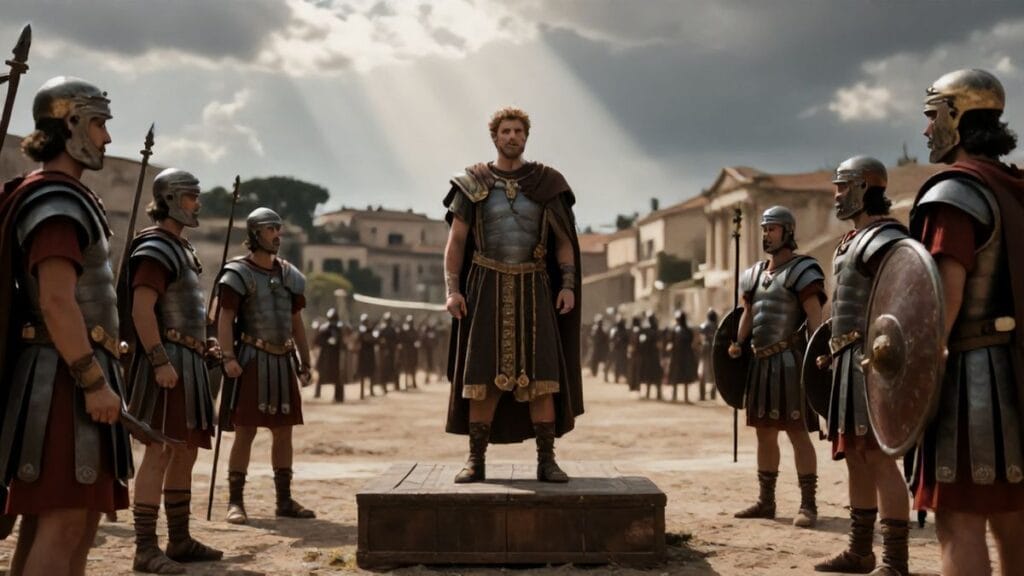
Picture the scene: a guarded room, perhaps, with a small group of officials present—a military tribune, a representative of the governor or the emperor, a clerk to record the act. Quietus, once clad in battle armor, now wearing the plain tunic of a condemned man, stands or sits as the sentence is read. Outside, the machinery of empire grinds on—soldiers drill, merchants haggle, priests perform sacrifices—largely unaware that a man who shaped their world is about to vanish from it.
In that moment, the execution of Lusius Quietus was not merely the end of one career; it was a decisive turn in Rome’s story. Hadrian was sending a message to the army: that the era of unbridled conquest was over; that independent-minded generals with personal followings would not be tolerated; that loyalty to the emperor outweighed any other measure of worth. The death of Quietus was thus wrapped in both practical and symbolic significance. It helped avert, or so Hadrian and his advisors believed, the possibility of rival claimants arising from the ranks of Trajan’s veterans.
Yet behind the political logic lies a simple, irreducible element: a human life cut short by the very system that had once elevated it. Quietus’s execution, stripped of formula and rhetoric, was an act of fear. It reflected an emperor’s anxiety, a court’s insecurity, a state’s brittle certainty that it could only remain safe by pruning its most powerful servants. The execution of Lusius Quietus, remembered in a few terse lines by Roman historians, thus becomes in retrospect a small but telling window into the emotional landscape of early Hadrianic rule.
For those who had suffered under his campaigns—the Jewish communities in particular—his death might have seemed a form of belated justice. But justice was not its driving purpose. Hadrian did not move against Quietus because of past atrocities; on the contrary, those atrocities had once been praised as necessary acts of imperial control. He moved against him because Quietus’s existence, his prestige and potential following, threatened the fragile balance upon which every emperor’s reign depended. That, in the end, was the true crime in the eyes of Rome’s rulers.
Blood, Ink, and Silence: How Rome Recorded—and Erased—Quietus
After the execution of Lusius Quietus, a quieter process began—one that would outlast the moment of his death. It was the process of managing his memory. The Romans had a word for this when done blatantly: damnatio memoriae, the condemnation of memory, in which names were chiseled off inscriptions and portraits destroyed. In Quietus’s case, we do not see the full, ritualized force of this practice. But we do see something subtler: a drifting erasure, a decision not to celebrate, not to dwell, not to remember.
Inscriptions that might have praised his victories are scarce or gone. Narrative histories pass over his early life in silence and mention his death almost in passing. Cassius Dio gives him only a line or two. The Historia Augusta, a later and often unreliable source, groups him with other supposed conspirators without dwelling on his character. There are no surviving panegyrics in his honor, no long speeches preserved in literary form. For a man who played such a pivotal role in crushing the Diaspora revolts and enforcing Trajan’s will in the East, this thinness of record is itself revealing.
Rome wrote history in stone and ink, but it also wrote it in omissions. By declining to foreground Quietus’s deeds, later compilers and chroniclers effectively pushed him to the margins of imperial memory. This was not pure accident. To celebrate him too openly might have raised awkward questions about Hadrian’s decision to kill him. To vilify him in detail might have cast a harsh light on Trajan’s use of his talents. Instead, the record compromises: he is present, acknowledged, but never fully fleshed out—a half-shadow against the brighter figures of emperors and great senatorial families.
And yet, traces remain. An inscription here, a passing mention there, the scattered acknowledgment that a Moorish general named Lusius Quietus once commanded fearsome cavalry in the service of Rome and then died under dubious political circumstances. For historians, these fragments are both frustrating and tantalizing. They force us to read between the lines, to interpret silences as carefully as statements, to ask what it means when a man both indispensable and dangerous is allowed to slip almost unnoticed into the background of official memory.
In many ways, this muted treatment amplifies the emotional resonance of his story. It reminds us that the empire’s narrative, as we inherit it, is not a simple reflection of the past but a constructed tapestry, woven as much from deliberate forgetting as from conscious remembrance. The execution of Lusius Quietus becomes, in this light, not only a historical event but a commentary on how power writes and unwrites those who serve it.
Race, Origin, and Power: A Berber General in a Roman World
Among the many striking aspects of Lusius Quietus’s career, one stands out with particular force in modern eyes: he was a North African Berber, a “Moor,” who rose to the highest levels of Roman military command. In an empire that spanned continents and absorbed countless peoples, such mobility was possible—but never uncomplicated. Ethnicity, origin, and cultural background mattered. They shaped perceptions, opportunities, and the unspoken boundaries of trust.
To many Romans, Moors were both admired and distrusted. They were prized for their horsemanship and toughness, deployed eagerly in frontier campaigns and as auxiliary troops. But they also carried the stigma of the “other”: dark-skinned, tribal, associated with the far edges of the civilized world. Quietus’s rise thus contained an element of paradox. His skills made him indispensable; his background made him, in certain eyes, perpetually suspect.
It would be simplistic to claim that the execution of Lusius Quietus was solely or primarily driven by racial prejudice. Roman politics were more tangled than that, and many provincials of diverse origins rose to prominence without suffering his fate. Yet it would be equally naive to pretend that his identity played no role at all. In moments of crisis, foreignness could be weaponized. A man whose loyalty might once have been praised as proof of Rome’s broad appeal could, in a different mood, be painted as inherently untrustworthy—a potential barbarian in imperial clothing.
In Judaea and the eastern provinces, his image was even more complex. To Roman officials, he was the very embodiment of imperial power: a hardened commander who knew how to crush revolts. To Jewish communities and other subject peoples, he was an outsider twice over—both a Roman agent and a Moor, a man whose presence signaled not negotiation but punitive violence. Over time, such experiences crystallize into collective memory, and though direct Jewish records from that period are sparse, later rabbinic tradition remembers the era of Trajan and Hadrian as one of deep suffering.
Quietus thus stands at the crossroads of empire and identity. His story forces us to see Rome not merely as a Latin-speaking monolith but as a patchwork of peoples, some of whom could rise very high indeed—until their origins, their power, and the anxieties of the ruling class collided. In that collision, as the execution of Lusius Quietus demonstrates, the official ideal of a cosmopolitan empire gave way to the age-old instinct to view the powerful outsider with a special, and sometimes deadly, suspicion.
Hadrian’s Turning Tide: From Expansion to Consolidation
The years surrounding 119 CE were a hinge in Roman history. Under Trajan, the empire had seemed drunk on conquest. Under Hadrian, it sobered up. The new emperor began methodically to withdraw from the most overextended territories, especially in Mesopotamia, and turned his attention to fortifying what Rome already held. This was not a retreat in panic but a strategic recalibration. Hadrian, a thoughtful if cautious ruler, sensed that endless expansion was unsustainable.
Such a shift required not only different strategies but different kinds of men. Instead of generals whose fame rested on storming enemy capitals, he needed administrators, architects, and frontier commanders skilled in defense and diplomacy. Men like Quietus, whose glory had been forged by conquest and suppression, found themselves out of step with the new mood. Their very presence within the imperial hierarchy symbolized an era that Hadrian wanted, if not to repudiate, then at least to redefine.
In this context, the execution of Lusius Quietus was part of a broader pattern often cited by modern historians: Hadrian’s systematic removal of figures closely associated with Trajan’s expansionist policies. As historian Anthony Birley notes in his biography of Hadrian, the early executions of generals and high officials “helped clear the political field,” allowing Hadrian to pursue his own agenda unencumbered by potential rivals or ideological holdovers. Quietus, Palma, and others became casualties of a changing vision of empire.
The symbolism extended beyond individuals. Hadrian’s famous wall in Britain, begun a few years later, embodied his strategy: mark the limits, fortify them, and make clear to both Romans and barbarians where the empire ended. In such a world, the swashbuckling cavalry raids of a Moorish general belonged to a different chapter. The empire still needed tough soldiers, but it no longer wanted warlords of reputation and charisma. It wanted professionals embedded in a system that left them powerful on the battlefield but weak as political actors.
Quietus’s death, then, was not merely about one man. It was about a turning tide in imperial policy, a migration from outward thrust to inward stabilization. The cost of this transition, measured in human terms, included the elimination of those who personified the old ideal of Roman greatness—men who had believed, perhaps rightly, that the empire could be pushed a little further, held a little longer, made a little larger. The new emperor disagreed, and in Rome, disagreement at that level could be fatal.
Echoes in Judaea and Beyond: Memory of a Ruthless Commander
Among the provinces most scarred by Lusius Quietus’s campaigns, Judaea and the broader Jewish world occupy a special place. The Diaspora revolts he helped suppress, and his subsequent appointment as governor of Judaea, left a trail of destruction and fear. Even if local records from that exact period are fragmentary, the cumulative memory of Roman oppression during the reigns of Trajan and Hadrian became deeply embedded in Jewish tradition.
While Quietus himself is not named in surviving rabbinic texts, the era of his actions forms part of a collective trauma. It precedes the more famous Bar Kokhba Revolt (132–135 CE) under Hadrian, but it contributes to an atmosphere of worsening relations between Rome and the Jewish people. In that escalating conflict, commanders like Quietus became the visible faces of imperial violence. In a sense, his later execution might have seemed, to some Jewish observers, a form of poetic, if opaque, justice: a man who had wielded power over their lives now falling victim to the very political forces he once served.
Yet such satisfactions, if they existed, were thin. The damage was done. Communities had been destroyed, holy places defiled, families scattered. The Roman system that empowered Lusius Quietus remained intact and, after his death, continued to produce other commanders and governors who would enforce imperial will with similar ruthlessness. The execution of Lusius Quietus did not herald a moral reckoning, only a change in the names and faces at the top.
Beyond Judaea, in the cities of North Africa and the provinces where Moorish auxiliaries were stationed, stories must have circulated about the fate of their most famous son. Did some see in his downfall a warning about the limits of provincial ambition? Did others quietly continue to admire him as a symbol of what a man from the margins could achieve, however briefly? We do not know. But human societies rarely forget such striking examples. They become part of local lore, resurfacing in altered form over generations.
Thus Quietus’s memory existed on multiple levels: as an almost anonymous “troublemaker” in Roman elite narratives; as a dark, half-remembered figure of oppression in Jewish recollection; and as a complicated, perhaps even inspiring, case study of social mobility in the North African imagination. His death did not unify these memories; it scattered them, leaving behind echoes that historians still strain to hear.
Senators, Soldiers, and Subjects: Political Shockwaves of Quietus’s Fall
The immediate political effects of the execution of Lusius Quietus radiated outward through Rome’s three main power audiences: the Senate, the army, and the provincial populations. Each received the same basic fact—that a prominent general had been eliminated—but interpreted it through the lens of its own anxieties and expectations.
For the Senate, Quietus’s death was both reassuring and unsettling. On the one hand, senators traditionally feared overmighty generals who could march on Rome, recalling the bloody precedents of Sulla and Caesar. The removal of a powerful military figure might therefore be seen as a restoration of balance, a reminder that the emperor, not any single commander, controlled the ultimate instruments of force. On the other hand, the manner of his removal—ordered from above, likely with minimal senatorial involvement—reinforced how little real power the Senate retained in the imperial system. If Quietus could be dispatched, so too could any senator who drew imperial suspicion.
The army read the event differently. Soldiers judge their leaders less by legal nuance than by perceived loyalty and effectiveness. Many had served under Quietus in Dacia, Mesopotamia, or the repression of the Diaspora revolts. They knew him as a hard, capable commander. His execution would have sent a chill through the officer corps: if such a man could fall, what protection did battlefield glory truly offer? It underscored the message that ultimate survival in Rome depended less on martial excellence than on aligning oneself with the shifting currents of imperial favor.
As for provincial subjects, most would have heard only rumors. A new emperor, it was said, had killed or dismissed some of his predecessor’s generals. In regions devastated by Quietus’s campaigns, such as parts of the eastern provinces, the news might have sparked quiet satisfaction. Elsewhere, it might have passed unnoticed, submerged in the day-to-day struggles of life on the empire’s periphery. Yet even localized reactions matter: at the scale of villages and towns, the fate of a man like Quietus could become a moral story, an example of hubris punished or of imperial caprice laid bare.
In the longer term, the pattern of which Quietus’s death was a part—the pruning of powerful officers, the recalibration of imperial strategy—helped stabilize Hadrian’s reign. It cleared the field of obvious rivals; it signaled to the army that political discretion was now as crucial as military prowess. But stabilization achieved through fear carries its own hidden costs. It fosters caution over initiative, conformity over daring. In eliminating Quietus, Hadrian may have reduced the risk of civil war, but he also contributed to an imperial culture in which the brightest talents had to think twice before standing too far above the crowd.
The Thin Line Between Glory and Death in Imperial Rome
The story of Lusius Quietus crystallizes a broader truth about life under the Roman emperors: the line between exaltation and annihilation was perilously thin. Rome had no greater honor than to be singled out by the emperor for trust and responsibility. Yet that same proximity to power—especially in the realm of military command—exposed a man to the full blast of imperial paranoia.
Consider the arc of Quietus’s career. He rose from a provincial background in Mauretania to command elite forces in some of the most important campaigns of his age. He earned, through competence and ruthlessness, the confidence of Trajan and the fear of Rome’s enemies. He was entrusted with crushing revolts, holding frontiers, governing restive provinces. At each step, the empire validated him with titles, pay, and authority. But those very honors created a figure who, in a moment of dynastic uncertainty, could be framed as a threat.
In this sense, the execution of Lusius Quietus was not an aberration; it was an expression of the system’s underlying logic. Security demanded vigilance; vigilance blurred into suspicion; suspicion, when aimed at someone with both ability and command of troops, often ended in death. The empire could not easily afford to let such figures drift into private life with their reputations intact. Better to remove them, however harshly, than to risk the kind of spiraling civil wars that had nearly destroyed Rome in the first century BCE.
For those within the system, this reality demanded a constant, exhausting self-surveillance. Ambitious men had to calibrate their ascent carefully: to rise high enough to satisfy their own ambitions and the needs of the state, but not so high that they cast a shadow over the emperor himself. It was a game played with human lives, reputations, and legacies. Some navigated it successfully, dying peacefully with honors. Others misjudged the moment—or found themselves trapped by forces larger than their own intentions—and paid the ultimate price.
Quietus belongs to this latter group. His execution reminds us that under the polished veneer of Roman civilization lay a hard, unsentimental calculus. No amount of service guaranteed safety. The empire’s gratitude could be profound but never permanent. A single decision at the top—driven by fear, strategy, or both—could erase, in an afternoon, a career that had taken decades to build.
Archaeological Traces and Lost Voices: Hunting for Quietus in the Sources
For modern historians, reconstructing the life and death of Lusius Quietus is an exercise in patience and humility. The primary literary sources, like Cassius Dio, offer only a skeletal outline. The Historia Augusta, written centuries later and riddled with invention, must be handled with extreme caution. Inscriptions that might have mentioned him have been lost, damaged, or never carved in the first place. Archaeology adds context—about the campaigns he fought, the regions he governed—but rarely yields direct testimony about his person.
Yet this very scarcity invites a particular kind of historical imagination: disciplined, evidence-based, but alert to nuance. For example, the archaeological record of the Diaspora revolts—in destroyed synagogues, layers of ash in Cyrenaica and Egypt, abandoned settlements in Mesopotamia—confirms the extreme violence reported in the texts and thus lends weight to the portrayal of commanders like Quietus as agents of devastating repression. Ruined urban strata, dated to the mid-110s CE, silently testify to the campaigns in which he was a central figure.
Epigraphic evidence from Mauretania and neighboring provinces illuminates the broader social context in which a man of his origins could rise. Inscriptions honor Moorish auxiliary units, praising their courage and loyalty. Some mention officers of non-Italian origin holding commands, suggesting that the empire, for all its prejudices, offered real avenues for advancement. Quietus, though not named directly in surviving stones, fits within this pattern—a particularly successful, and ultimately doomed, example of a larger phenomenon.
Modern historians, such as Fergus Millar and Miriam Pucci Ben Zeev, have grappled with the complexities of Rome’s eastern policy under Trajan and Hadrian, situating Quietus within debates about imperial overreach and provincial resistance. Their work does not romanticize him; if anything, it underscores the brutality of his campaigns. But by embedding his story in a wider analytical frame, they help us see him not as an isolated villain or victim but as a product of institutional choices and structural tensions.
Every fragment, every footnote, every half-erased name on a stone becomes a clue. Together, they allow us to sketch—if never fully paint—the figure of Lusius Quietus as he moved across the empire’s landscapes. The gaps in the record are not mere voids; they are themselves historical facts, testifying to the processes of forgetting and selective remembrance that followed his execution. In that sense, the difficulty of the historian’s task becomes part of the story: the missing voice of Quietus echoes most loudly precisely where the archive falls silent.
Myth, Bias, and Historians: Reconstructing a Condemned Life
Writing about the execution of Lusius Quietus means confronting not only Roman imperial politics but also the biases of our sources and ourselves. Ancient historians generally wrote from within or near the elite circles that benefitted from the imperial system. Their sympathies, fears, and blind spots influenced which stories they told and how they told them. When a man like Quietus, a provincial general removed under suspicion of treason, appears in their work, he does so filtered through layers of prejudice and political convenience.
Cassius Dio, a senator of Greek origin writing in the third century, had his own reasons to emphasize imperial control over ambitious military men. The memory of earlier civil wars loomed large in his narrative framework. The brief mention of Quietus’s death fits neatly into Dio’s larger theme that emperors had to be firm—even ruthless—to preserve order. The Historia Augusta, for its part, spins semi-fictional anecdotes that sometimes exaggerate conspiracies and character flaws to produce moral lessons. Neither source, in other words, offers a neutral portrait.
Modern historians must therefore read these accounts critically, cross-referencing them with material evidence and with what we know about patterns of imperial behavior. They must also guard against their own temptations: the impulse to romanticize Quietus as a tragic outsider-hero, or to demonize him as a simple butcher. The truth almost certainly lies somewhere in between. He was a man of his time and position: ambitious, hardened by war, capable of both strategic brilliance and terrible cruelty.
At the same time, it is important to recognize that Hadrian’s perspective, preserved indirectly in the decisions he made and the narratives that justified them, was not the only valid viewpoint. For those who lived under Quietus’s campaigns, the story looked very different. For his fellow Moors, it might have been a tale of astonishing rise and sudden fall. For Jewish communities, it was a story of suffering at the hands of a ruthless enforcer whose eventual execution provided only cold comfort. For later generations of Romans, if they thought of him at all, he was a minor figure in the transition from one emperor’s policy to another’s.
In acknowledging these multiple perspectives, historians transform Quietus from a mere footnote in Hadrian’s biography into a complex, contested figure. The execution of Lusius Quietus becomes not just an imperial decision but a focal point where different experiences of Rome—imperial, provincial, colonized—intersect and clash. And in that intersection, we can see more clearly both the power and the limitations of the historical record itself.
Legacy in the Sand: North Africa After Quietus
What of the lands from which Lusius Quietus had first emerged—the rugged regions of Mauretania, the deserts and hills that had shaped his early life? In the centuries after his death, North Africa grew increasingly central to the Roman Empire’s economy and military system. Its grain fed Rome and other great cities; its cavalry continued to serve on distant frontiers; its cities, like Volubilis and Caesarea, flourished as hubs of commerce and culture.
Within this evolving world, the memory of a Moorish general who had risen to imperial favor and then been executed must have lingered, at least for a time. Perhaps older veterans told stories to younger recruits about the days when a man from their own soil had commanded entire armies. Perhaps local elites, balancing loyalty to Rome with pride in their regional identity, invoked Quietus in private conversations as an example of both the opportunity and the danger that came with imperial service.
Over time, however, such specific memories would have blurred. The empire endured, evolving through the crises of the third century, the reforms of Diocletian, and the Christianization of Constantine’s age. New heroes and villains emerged. The story of Lusius Quietus, never heavily inscribed in official monuments, would have faded into the background. Yet his career remained, in structural terms, a harbinger of things to come: the growing prominence of provincial elites, especially from Africa, in the late imperial hierarchy. By the fourth and fifth centuries, emperors like Septimius Severus and countless bishops, generals, and administrators hailed from African provinces.
In this long perspective, Quietus’s life looks like an early, jagged sign of a broader transformation: Rome becoming, ever more clearly, an empire not of one city or one ethnicity but of many. That transformation was never smooth, never free from violence or exclusion. The execution of Lusius Quietus serves as a reminder that even as the empire opened doors to provincial talent, it also retained—and sometimes intensified—the mechanisms by which that talent could be abruptly curtailed.
Today, when we look at the ruined amphitheaters and city walls of North Africa, or the scattered inscriptions that record the names of auxiliary units stationed far from home, we can imagine, fleetingly, the world that formed and was formed by men like Quietus. His footprints have long since been erased from the literal sands, but the pattern of his rise and fall remains etched in the larger story of Rome and its provinces: a story of opportunity shadowed always by the possibility of sudden, decisive, and irrevocable loss.
Conclusion
The life and death of Lusius Quietus unfold, in our imperfect reconstruction, as a tightly coiled drama of ambition, violence, and political fear. Born on the periphery of the Roman world, he rose through sheer military talent to become one of Trajan’s most formidable commanders, carving his reputation on the battlefields of Dacia, Mesopotamia, and the scorched landscapes of the Diaspora revolts. His cavalry’s speed and ferocity made him indispensable to an empire bent on expansion, even as the methods he employed left deep wounds in the communities he subdued.
With the accession of Hadrian, however, the very qualities that had once ensured his rise made him dangerous. A powerful provincial general associated with aggressive conquest and brutal repression, he stood at odds with an emperor who sought consolidation and internal stability. In this tension, the execution of Lusius Quietus became both a practical move to neutralize a potential rival and a symbolic break with Trajan’s expansionist ethos. His death, probably carried out swiftly and with limited public fanfare in 119 CE, signaled to the army, the Senate, and the provinces that a new order had taken hold.
At the same time, the muted way in which Rome recorded and remembered him reveals how power shapes memory. Quietus was neither granted grand commemorations nor subjected to formal damnatio memoriae; instead, he was allowed to fade into the historical margins, mentioned briefly by elite historians and largely forgotten in monumental inscriptions. Yet his shadow persists—visible in the ruins of cities destroyed during his campaigns, in the structural patterns of provincial advancement and repression, and in the uneasy recognition that imperial gratitude is always conditional.
Ultimately, the story of Lusius Quietus is not merely about one man’s fate. It is about the nature of empire itself: the opportunities it offered to outsiders, the violence it unleashed to maintain control, and the ever-present fear that haunted those who stood closest to the pinnacle of power. In that world, the path from decorated general to condemned traitor could be frighteningly short. By retracing that path, we gain a sharper, more unsettling understanding of how Rome worked—and of the human costs concealed behind its triumphal arches and polished narratives.
FAQs
- Who was Lusius Quietus?
Lusius Quietus was a Roman general of Berber (Moorish) origin from the province of Mauretania. He rose through the ranks of the Roman army due to his exceptional command of Moorish cavalry, serving prominently under the emperor Trajan in campaigns in Dacia, Mesopotamia, and the suppression of the Jewish Diaspora revolts. His career illustrates both the opportunities and the risks faced by talented provincials in the Roman imperial system. - Why was the execution of Lusius Quietus ordered?
The execution of Lusius Quietus was ordered by Emperor Hadrian in 119 CE, likely because Quietus was seen as a potential political threat. As a successful general closely associated with Trajan’s expansionist policies, and as a man with a strong military following, he embodied the kind of figure who could be cast—fairly or not—as a rival claimant to the throne. Hadrian, seeking to secure his position and shift imperial policy from conquest to consolidation, chose to eliminate him along with other powerful officers. - What role did Lusius Quietus play in the Jewish Diaspora revolts?
Lusius Quietus played a central and brutal role in suppressing the Jewish Diaspora revolts of 115–117 CE, particularly in Mesopotamia. Dispatched by Trajan, he led forces that retook rebellious cities and inflicted severe casualties on Jewish communities. Ancient sources, such as Cassius Dio, emphasize the harshness of his methods, and archaeological evidence of widespread destruction in affected regions supports the picture of an exceptionally violent campaign. - Was Lusius Quietus a victim of racial prejudice in Rome?
Quietus’s Berber origin certainly colored how some Romans perceived him, as Moors were often stereotyped as fierce but “other.” However, his execution cannot be explained solely by racial prejudice. Roman politics, especially around imperial succession, were dominated by concerns about loyalty and power. His foreign background may have made it easier to cast him as inherently suspect, but the primary reason for his downfall appears to have been his prominence as a Trajanic general and the fear that he could become a rallying point for opposition to Hadrian. - How reliable are the ancient sources about Lusius Quietus?
The ancient sources on Lusius Quietus are sparse and biased. Cassius Dio offers a brief but generally credible account that he was executed on Hadrian’s orders, while the later Historia Augusta is more prone to exaggeration and invention. There are few inscriptions directly naming him, and no surviving writings from Quietus himself. As a result, modern historians must piece together his story from limited and partial evidence, cross-checking written sources against archaeology and broader patterns of imperial behavior. - Did the execution of Lusius Quietus change Roman imperial policy?
The execution itself did not cause a shift in policy, but it formed part of a broader pattern under Hadrian. By removing generals like Quietus who were associated with Trajan’s expansionist wars, Hadrian cleared the way for a new approach focused on fortifying borders and avoiding large-scale offensive campaigns. In that sense, his death was both an effect and a reinforcement of an existing strategic turn from conquest to consolidation. - How is Lusius Quietus viewed by modern historians?
Modern historians tend to view Lusius Quietus as a complex figure: a highly capable military commander whose ruthlessness was typical of Roman warfare, and a provincial outsider who rose remarkably high before being destroyed by imperial politics. He is neither celebrated as a hero nor condemned as a unique villain; instead, he is analyzed as a revealing case study of how the Roman Empire used—and disposed of—its most effective servants, especially during moments of political transition. - Is there any archaeological evidence directly linked to Lusius Quietus?
There is no widely accepted archaeological find that can be definitively linked to Lusius Quietus personally, such as a tomb or inscribed statue. However, the devastation in regions where he campaigned during the Diaspora revolts, and the presence of Moorish auxiliary units in inscriptions, provide strong contextual evidence of the military world in which he operated. These indirect clues help historians situate his actions within the broader material landscape of the Roman Empire.
External Resource
Internal Link
Other Resources
- Encyclopaedia Britannica – general search for the exact subject
- Google Scholar – academic search for the exact subject
- Internet Archive – digital library search for the exact subject