Table of Contents
- Dawn Over the Seine: Paris Awaits the Great Exposition
- A World in Transition: The Global Context of 1900
- From Dream to Blueprint: Conceiving the Paris Exposition Universelle 1900
- Building a Temporary Capital of the World Along the Seine
- Opening Day, 14 April 1900: When Paris Held Its Breath
- The New Face of Modernity: Electricity, Steel, and Speed
- The Grand Palais and Petit Palais: Cathedrals of Art and Industry
- Bridging the Future: Pont Alexandre III and the Architecture of Power
- Inside the Exhibition Halls: Nations on Display
- Art Nouveau Everywhere: A Decorative Revolution in Paris
- People of the Exposition: Workers, Tourists, and Visionaries
- The Darker Side of Spectacle: Empire, Exoticism, and Inequality
- Women at the Threshold of a New Century
- Sporting the Future: The 1900 Olympic Games and the Exposition
- Nightfall in an Electric City: Sights, Sounds, and Sensations
- Politics Beneath the Festivities: The Third Republic on Parade
- Technological Echoes: Legacies in Transport, Media, and Urban Life
- The Exposition Afterlife: Memory, Ruins, and Survivors in Today’s Paris
- Rewriting the Turn of the Century: Historians and the 1900 Fair
- Conclusion
- FAQs
- External Resource
- Internal Link
Article Summary: On 14 April 1900, when the gates of the paris exposition universelle 1900 swung open, Paris tried to package the entire planet—and its possible futures—into one glittering riverside spectacle. This article follows that moment from the first glimmer of an idea in ministerial offices to the thunder of feet on the opening morning along the Seine. It explores how the fair framed modernity through electricity, steel, and speed, while at the same time showcasing empires, hierarchies, and the politics of the French Third Republic. Through narrative vignettes, we meet workers, visitors, artists, and engineers whose lives briefly intersected in this colossal stage set. We trace how the architecture of the Grand Palais, the Pont Alexandre III, and countless pavilions mirrored new artistic currents such as Art Nouveau and new social tensions. Yet behind the fireworks lay colonial displays, gender inequalities, and anxieties about a world in flux. By the end, the article follows the long shadow of the exposition into the twenty-first century, showing how the paris exposition universelle 1900 still shapes the way we imagine modern cities, international exhibitions, and the very idea of the “turn of the century.”
Dawn Over the Seine: Paris Awaits the Great Exposition
Just before sunrise on 14 April 1900, a pale light slipped over the roofs of Paris and caught on thousands of panes of glass along the Seine. From the Champs-Élysées to the Champ-de-Mars, the city looked as if it had grown a second skin in metal, plaster, and electric wire. For months, Parisians had watched a new, temporary Paris being erected along their river—a dream city designed to last only from spring to autumn. On this particular morning the dream would open its eyes. Crowds gathered near the freshly laid entrances, shivering more from anticipation than from the chill. Vendors rehearsed their cries. Tram drivers steered their cars carefully through streets newly rearranged by officials. The paris exposition universelle 1900 was about to begin, and with it a new century, or so it felt.
The air carried the smell of wet stone, coal smoke, horse sweat, and something hard to name: the scent of varnished exhibits, newly painted facades, and freshly printed tickets. Over the river, banners in the colors of dozens of nations snapped in the breeze, transforming the Seine into an avenue of flags. The Eiffel Tower, itself a relic from the 1889 exposition, loomed above the scene like an iron witness, now decorated and repurposed to welcome a new wave of visitors. Engineers and electricians hurried through side gates, hiding their anxiety under official caps. They knew how fragile the spectacle was; all it would take was a flicker in the power supply, a broken moving walkway, or a transport strike to reveal the fragile machinery behind the illusion of effortless modernity.
And yet, as the minutes moved closer to opening time, the city’s nerves gave way to something like collective pride. Paris was not merely staging a fair; it was staging itself as the “capital of the nineteenth century” stepping boldly toward the twentieth. Newspapers had been calling the paris exposition universelle 1900 the great mirror in which humanity would see its own progress reflected. To stand in line that morning, clutching a ticket, was to feel for a moment that you were part of something larger than your own life—part of a story that began long before you were born and would continue far beyond your death.
A World in Transition: The Global Context of 1900
The exposition did not arise in a vacuum. At the turn of the twentieth century, the world seemed to be accelerating. Empires stretched across continents, telegraph cables threaded through oceans, and railways carved lines into maps that now reached almost everywhere. The United States had just emerged from the Spanish–American War with new colonial possessions. In southern Africa, the Boer War raged, a brutal sign that the old European obsession with territory was still far from resolved. In China, foreign powers carved out “spheres of influence,” and tensions that would soon explode into the Boxer Rebellion were already mounting.
Industrialization had produced enormous wealth for some and hard, grinding labor for many more. Cities like London, Berlin, Vienna, and New York were swelling with migrants pushed off the land and pulled into factories. Socialists, trade unionists, and anarchists organized in the streets, demanding better working conditions and sometimes plotting more radical transformations. At the same time, new technologies—electric light, telephones, motion pictures—made it possible to imagine different forms of community, of work, of leisure. Humanity, it seemed, was on the edge of something: either a leap forward or an abyss.
Against this background, the paris exposition universelle 1900 promised to do something audacious. It would gather the achievements, dreams, and anxieties of an entire world into a single, walkable space. Nations would set up pavilions; companies would assemble the latest machines; artists would display works that broke with tradition; colonial powers would reproduce fragments of distant lands for visitors to consume in an afternoon. To attend the fair was to be offered a temporary, curated version of the planet—a planet tidied up, translated into architecture and spectacle, and draped along the Seine.
France, still healing from its defeat in the Franco-Prussian War three decades earlier, saw in this project an opportunity not only to celebrate technical progress but to reclaim a wounded national pride. The Third Republic wanted to demonstrate stability, cultural leadership, and economic vitality. At the same time, the exposition would offer a stage for the ideals of the age: international cooperation, civilizational advancement, and an optimistic belief that technology might dissolve old rivalries. Of course, as the months ahead would reveal, the fair displayed as much competition as cooperation, as much hierarchy as harmony.
From Dream to Blueprint: Conceiving the Paris Exposition Universelle 1900
The first serious discussions about hosting a new universal exposition in Paris began in the late 1880s, not long after the success of the 1889 fair that had given the city the Eiffel Tower. That earlier exposition had celebrated the centennial of the French Revolution, framing it as a triumph of liberty and progress. By contrast, the planners of the 1900 event aimed to position France at the hinge of centuries. They wanted the paris exposition universelle 1900 to mark not a revolution but an evolution: the arrival of a fully modern age.
In government offices, ministers, engineers, and businessmen pored over maps and budgets. Where would the fair extend? How would it tie into the existing urban fabric? There were political obstacles; the memory of failures in 1870, the scars of the Paris Commune, and the more recent wounds of the Dreyfus Affair had left the political class wary of spectacle and division. Yet the prospect of hosting the world—and the economic benefits that came with millions of visitors—was too tempting to ignore. In 1892, an official decree made the intention clear. Throughout the 1890s, the project survived changes of government, financial crises, and fierce debate in the press.
Gradually, a vision took shape: the exposition would stretch like a long ribbon along both banks of the Seine, from the Champs-Élysées and the new esplanade of Les Invalides down to the Champ-de-Mars and beyond, even reaching into the wooded expanse of the Bois de Vincennes. This linear organization would allow visitors to promenade in one direction and discover, in sequence, the arts, the industries, and the colonial displays of the world. It was a masterstroke of urban imagination—turning the river itself into a central axis of spectacle. Architects competed for commissions; committees argued over the balance of entertainment and education, commerce and culture.
The budget soared. French taxpayers read with a mixture of alarm and fascination about the millions of francs being poured into what many sarcastically described as a temporary “world capital.” Yet advocates argued that the long-term benefits—in infrastructure, tourism, and international prestige—would outweigh the immediate costs. One influential supporter noted, as reported in the press, that “if France wishes to lead in spirit, she must also lead in spectacle.” That aphorism became a kind of unofficial motto for the entire undertaking.
Building a Temporary Capital of the World Along the Seine
Once the plans were approved, Paris became a construction site. From around 1897 onward, worksites multiplied. On the Right Bank, enormous steel skeletons rose where the Grand Palais and Petit Palais would stand, their arches and domes reaching for the sky. On the Left Bank, the Champ-de-Mars—already transformed once for the 1889 fair—underwent another metamorphosis, sprouting exhibition halls and pavilions like mushrooms after rain. Along the riverbanks, dredgers and laborers reshaped quays, built terraces, and installed new docks for the fleets of excursion boats that would ferry visitors.
The labor force was vast and diverse. Thousands of workers—masons, carpenters, glassworkers, electricians, plasterers—poured into Paris from all over France and beyond. Their days were long, their equipment often primitive by later standards. Accidents were common. Newspaper reports occasionally carried blunt notices of men who had fallen from scaffolds or been struck by beams. Yet the pace never slackened. Deadlines loomed like thunderclouds, and the world’s eyes were already turning toward Paris. Wages, though better than in many provincial towns, did not always match the intensity of the labor. Still, there was a sense among many workers that they were helping to construct something that would be talked about for generations, even if most of it would be dismantled once the fair closed.
Materials arrived in endless caravans. Steel from Lorraine and the Ruhr, marble from Italy, exotic woods from colonies and trading partners piled up in depots. Plaster molds created elaborate facades that mimicked stone but could be raised quickly and cheaply. The very ephemerality of the architecture became part of its charm. No one pretended that these palaces were built to last centuries. They were designed as theater scenery on a continental scale: convincing enough to fill visitors with awe, but light enough to vanish when the season ended.
Behind the plaster and glass, however, lay robust innovations. New systems of electric lighting, heating, and ventilation were embedded in the buildings. Underground conduits carried cables, water, and even compressed air to power tools and attractions. The infrastructure of the paris exposition universelle 1900 served as a vast experimental laboratory for what a fully modern city might look like. Even the logistics of feeding, housing, and entertaining millions of anticipated visitors forced officials to think anew about traffic management, sanitation, and safety.
Opening Day, 14 April 1900: When Paris Held Its Breath
When the gates finally opened on 14 April 1900, the work of years compressed into a single, breathtaking instant. Lines formed early in the morning, winding around blocks and across bridges. Families, workers, provincial visitors clutching suitcases, foreign tourists with guidebooks in hand—all pressed forward with slow determination. Contemporary reports estimate that on the very first day, around 120,000 people entered the grounds, though precise figures vary. The soundscape of the city shifted: the usual clatter of carts and the calls of market sellers mixed with band music, official announcements, and the excited chatter of languages from every corner of Europe and beyond.
The official ceremonies themselves were theater in the grand style of the Third Republic. Dignitaries arrived in carriages, escorted by cavalry. Flags lined the avenues. A choir of children’s voices rose above the noise as a specially composed hymn to progress was performed. The President of the Republic, Émile Loubet, walked past ranks of soldiers and into the heart of the exposition, accompanied by ministers, foreign ambassadors, and city officials. Speeches praised human ingenuity, peace between nations, and the glorious future promised by science. “Here,” one orator proclaimed, according to a contemporary newspaper, “humanity looks upon its own achievements and finds the courage to pursue new conquests—of knowledge, of comfort, of fraternity.”
But the most powerful impression was visual. Visitors stepping through the principal entrances found themselves immersed in a river of color and movement. To the right, domes and arches gleamed, ornamented with allegorical sculptures representing Science, Industry, Agriculture, and Art. To the left, the river caught and scattered reflections of banners and electric lamps. Stalls selling postcards and souvenirs already did brisk trade. Children tugged at sleeves, pointing toward moving walkways, towers, and pavilions promising “marvels never before seen.”
Yet behind the celebrations, there was also tension. Many installations were still unfinished on opening day; workers continued to hammer and paint in corners hidden from the main routes. Some visitors complained about confused signage or bottlenecks at popular attractions. Others felt overwhelmed. How could one possibly see everything? The guidebooks offered suggested itineraries—two days, five days, ten days—yet even in ten days, one would only skim the surface. The paris exposition universelle 1900 was, by design, larger than any individual human capacity to absorb it. It was meant to be a spectacle of abundance, even excess.
The New Face of Modernity: Electricity, Steel, and Speed
For many who attended, the most unforgettable element of the exposition was not a single building or exhibit, but the way electricity threaded through everything. Electric light turned night into a continuation of day. It traced the outlines of bridges, domes, and towers, turning architecture into luminescent drawings against the darkness. Inside the halls, machines whirred and glowed, powered by currents invisible but palpable in their effects. In an era when many homes were still lit by gas or oil lamps, this display felt almost supernatural.
Central to the experience was the moving sidewalk—the trottoir roulant—a marvel of speed and novelty. Stretching for several kilometers, it circled part of the grounds at different speeds. Visitors could step from the fixed platform onto a slowly moving band, and from there onto a faster one. For those unaccustomed to escalators, this demanded courage and balance. Some laughed nervously; others, especially the elderly, hesitated and grabbed at railings. But once on, many felt exhilarated. The city slid by at a pace more familiar from train windows than from footpaths. Paris, it seemed, had invited its guests not only to look at modernity but to ride on it.
Elsewhere, motor cars—still rare on the streets—appeared as exhibits and sometimes as practical vehicles. Internal combustion engines idled and roared, their oily smells mixing with the aroma of hot metal and machine grease. Visitors examined prototypes for electric trams, new locomotives, and even flying machines, some more plausible than others. In demonstration areas, engineers staged simulations of power stations, hydroelectric dams, and telecommunication networks. The message was clear: the future would be engineered, wired, and fast.
This focus on technology was not neutral. It served both commercial and ideological ends. Manufacturers sought customers and prestige. Governments sought to project modernity and strength. The organizers of the paris exposition universelle 1900 arranged exhibits to suggest a narrative in which humanity advanced steadily, overcoming obstacles through ingenuity. There were few hints, in these displays, of the environmental costs, the labor struggles, or the geopolitical rivalries that underpinned this industrial surge. To walk through the halls of machines was to enter a carefully framed dream of progress.
The Grand Palais and Petit Palais: Cathedrals of Art and Industry
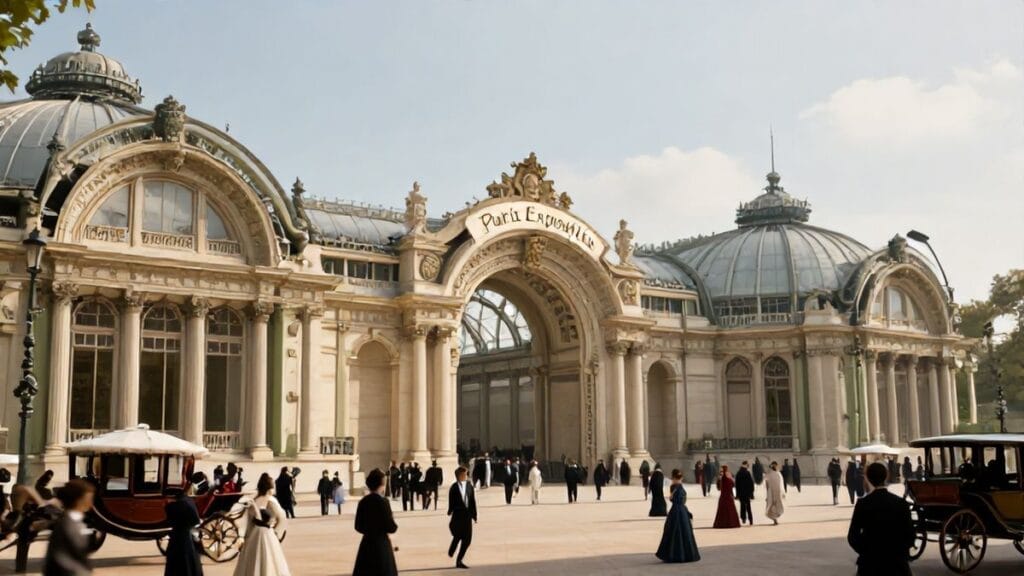
On the Right Bank, two structures quickly became emblematic of the fair’s ambition: the Grand Palais and the Petit Palais. Seen from afar, their glass roofs and ornate facades rose like secular cathedrals, built not for worship but for admiration. The Grand Palais, with its immense nave of iron and glass, housed exhibitions dedicated to industry, technology, and occasionally monumental art. Light poured through the vast roof, casting intricate patterns of steel beams onto machines, sculptures, and crowds. Walking inside, visitors often fell silent for a moment, overawed by the sheer scale of the space.
The Petit Palais, facing it across the avenue, presented a different but complementary vision. Its colonnaded facade, rich with sculpture and gilded details, welcomed visitors into galleries devoted to fine arts. Paintings from earlier centuries hung alongside contemporary works, tracing a line of French artistic achievement that the organizers hoped would impress foreign visitors. The arrangement also allowed for subtle polemics: new schools of painting and sculpture quietly challenged academic traditions, even as they were granted prestige by being shown under the same roof.
These buildings were more than mere containers. They embodied the architectural debates of their time. Their structures relied on modern engineering—steel frames, large panes of glass—while their decorative programs indulged in an eclectic mix of classical references and new forms. Reliefs, allegorical statues, and ornamental ironwork blended historical motifs with the sinuous lines that were slowly coming to be associated with Art Nouveau. In this sense, the Grand Palais and Petit Palais were themselves exhibits: material arguments about what a modern French architecture should look like.
Unlike many other constructions of the exposition, these palaces were built to endure. The decision to make them permanent signaled an intention to anchor some of the fair’s legacy in the city’s daily life. When the exposition ended, their uses would change, but their presence would remain as monumental reminders of that extraordinary year when the paris exposition universelle 1900 tried to gather the world under their glass and stone.
Bridging the Future: Pont Alexandre III and the Architecture of Power
Between the Grand Palais and the Esplanade des Invalides stretched perhaps the most theatrical of all the exposition’s creations: the Pont Alexandre III. Its inauguration, just before the opening of the fair, symbolized more than a convenient way to cross the Seine. It was, in stone and metal, a diplomatic handshake between France and Russia. Named after Tsar Alexander III, the bridge commemorated the Franco-Russian Alliance—a crucial counterweight to the growing might of Germany and the Triple Alliance. Walking across it, visitors traversed not just water but a map of European power relations.
The bridge’s design reflected this political importance. Rather than competing with the monumental silhouette of Les Invalides, it stayed low, with a gentle arch that did not obstruct the view. But it surrounded that modest line with flamboyant detail: gilded statues of winged horses perched atop tall pylons at each corner; ornate lampposts lined the balustrades; garlands, shields, and sculpted nymphs clung to the sides. This was engineering dressed as jewelry, a celebration of aesthetic excess made possible by modern metalwork.
At night, electric lamps cast shimmering reflections onto the river, turning the bridge into a luminous gateway between two halves of the exposition. For visitors wandering from the art displays of the Grand Palais to the administrative and military gravitas of Les Invalides, the Pont Alexandre III became a ritual passage. Lovers strolled arm in arm; families paused to watch the boats pass below; foreign dignitaries crossed in carriages, glimpsing the crowds like a sea of moving stars.
The bridge offered a potent metaphor for the paris exposition universelle 1900 itself. It connected old and new, art and politics, spectacle and infrastructure. It was both an everyday utility and a carefully staged symbol. Long after the temporary pavilions vanished, the Pont Alexandre III would remain, a gilded chord tying the memory of the exposition to the living fabric of Paris.
Inside the Exhibition Halls: Nations on Display
One of the core promises of the exposition was that visitors could “see the world in a week.” To fulfill that promise, nations from across the globe constructed pavilions and filled exhibition halls with carefully curated selections of their industries, arts, and customs. The Trocadéro hill, the Champ-de-Mars, and parts of the Left Bank blossomed with architectural fantasies in miniature: a Moorish palace here, a Russian wooden church there, a Japanese-style garden not far from a Swiss chalet.
Inside these pavilions, rivalries played out under the polite cover of internationalism. Germany, whose 1871 victory still haunted French politics, showcased its industrial might, precision engineering, and powerful chemical industry. Britain, at the height of its global empire, emphasized its naval strength and commercial networks. The United States, increasingly confident, displayed its machines, agricultural equipment, and consumer goods, hinting at a coming century in which American products would flood foreign markets. Smaller nations, too, seized the chance to shape their image: Scandinavian countries highlighted design and craftsmanship; Latin American republics sought to show themselves as modern and open for investment.
For many visitors, these halls were overwhelming. One might walk from an exhibition of Italian Renaissance art to a display of Argentine cattle-raising techniques in a matter of minutes. Guidebooks and catalogues tried to impose order, suggesting routes and pointing out must-see highlights. Yet the sense of controlled chaos remained. This was, after all, an attempt to condense the diversity of national histories and economies into a few rooms of maps, models, and objects. As a historian later observed, “no nation was represented as it really was, but as it wished to be seen.”
The very act of comparison—of walking from one national pavilion to another—invited judgments and hierarchies. Visitors, often unconsciously, ranked countries according to the scale and quality of their displays. Was the French section truly superior to the German? Did Russia appear old-fashioned compared to the United States? Such impressions would linger in minds long after the fair closed, influencing how people imagined distant lands and the balance of power in the decades that followed.
Art Nouveau Everywhere: A Decorative Revolution in Paris
Beyond the grand narratives of nations and technologies, the paris exposition universelle 1900 incubated a more subtle revolution: the spread of Art Nouveau. In architecture, furniture, jewelry, posters, and even the design of tickets and catalogues, flowing lines, floral motifs, and asymmetrical forms announced a break from the rigid historicism of the nineteenth century. To walk through certain sections of the exposition was to step into a world where iron blossomed like vines and glass curved like petals.
Art Nouveau had been developing for years in various European cities—Brussels, Glasgow, Vienna—but the Paris fair gave it an enormous international platform. The “Art Nouveau Bing” pavilion, sponsored by the influential dealer Siegfried Bing, brought together works by leading designers and artists. Visitors encountered rooms furnished as complete environments, where furniture, wallpaper, lighting, and small objects formed a harmonious whole. The idea that art could, and should, infuse everyday life—not only museums and palaces—felt radical and alluring.
Posters advertising the exposition itself used the new style to entice the public. Elegant women with flowing hair, wrapped in swirling robes, posed alongside stylized towers and pavilions. Decorative ironwork appeared on balconies, railings, and gates. Some critics scoffed, calling the style decadent or overly feminine. Others hailed it as the true artistic language of a new century. The tension between admiration and suspicion underscored deeper anxieties: if art abandoned classical symmetry and clear hierarchy, what else in society might be questioned?
In retrospect, the prominence of Art Nouveau at the paris exposition universelle 1900 marks a key moment in the broader shift toward modernism. Within a decade or two, even more radical artistic movements—Fauvism, Cubism, abstraction—would make Art Nouveau seem almost conservative. But in 1900, these curved lines and ornamented surfaces embodied the promise that the future could be not only more efficient but also more beautiful.
People of the Exposition: Workers, Tourists, and Visionaries
Behind the statistics—more than fifty million visits were recorded over the course of the fair—lay countless individual stories. We can imagine, for instance, a young provincial schoolteacher arriving at the Gare de Lyon with a cheap suitcase, her modest savings tucked into a stitched pocket in her skirt. She had read about the exposition in newspapers and dreamed of seeing the famous Eiffel Tower. Standing in front of the Grand Palais on that first evening, she must have felt that she had stepped into another world, one more dazzling and terrifying than any illustration had suggested.
Or consider a metalworker from a factory near Saint-Étienne, who had spent months in Paris erecting the skeletons of pavilions. On his rare days off, he wandered the grounds he had helped build. In the machinery halls, he recognized tools similar to those he used back home, but on a grander scale. In the colonial section, he saw images of lands he had only heard about through rumors. He may have felt pride in the human capacity to build, alongside a dull ache at the thought of returning to a less glamorous workshop once the fair ended.
There were also visionaries: inventors hoping to attract investors, artists searching for inspiration, social reformers collecting data and impressions. Some were already famous—like the Lumière brothers, whose motion picture technology fascinated crowds. Others would remain obscure. The fair was full of small stands where tinkerers demonstrated improbable machines, health elixirs, or educational devices. Most would fall into oblivion, but a few ideas, nurtured in those halls, would eventually shape future industries.
Tourists from abroad wrote letters home describing their impressions: the overwhelming crush of people on the quays, the glittering reflections on the Seine at night, the fatigue of feet sore from endless walking. As one visitor reportedly remarked, “To see Paris in 1900 is to feel that the world has grown too large for one lifetime.” That sentiment captured both the exhilaration and the vertigo that the exposition induced in those who wandered its avenues.
The Darker Side of Spectacle: Empire, Exoticism, and Inequality
For all its rhetoric of universal progress and fraternity, the exposition also displayed the hierarchies and prejudices of its age with painful clarity. Nowhere was this more evident than in the colonial pavilions. France, like other European powers, used the fair to showcase its overseas possessions—not as equal partners, but as trophies and markets. In the Bois de Vincennes and other designated areas, so-called “native villages” were constructed, populated by men, women, and children brought from colonies in Africa, Asia, and the Pacific.
Visitors, mostly white Europeans, wandered through these villages as if through open-air museums of “otherness.” They watched staged dances, rituals, and daily tasks, often simplified and distorted to fit European expectations. Signs described the inhabitants in language that today reads as unmistakably racist and paternalistic. Anthropologists and colonial administrators justified these displays as educational, claiming that they would foster understanding. In reality, they reinforced stereotypes and legitimized imperial control. As one later critic observed, the paris exposition universelle 1900 turned living human beings into exhibits, “curiosities in a human zoo.”
Inequality surfaced in other ways as well. The very structure of the exposition, with its expensive restaurants and luxurious pavilions, served as a reminder that not all visitors experienced the fair equally. The wealthy could reserve private carriages, dine in elite venues, and attend exclusive receptions. Workers, when they could afford the entrance fee, brought homemade food or ate at cheaper stands. Many Parisians, especially the poor, never saw the inside of the exposition at all, except perhaps as employees. For them, the fair might have felt like a distant mirage gleaming across a financial gulf.
The gendered dimension of the spectacle was also striking. While women appeared as allegorical figures atop facades and as elegant visitors in posters, their access to real power within the structures of the exposition remained limited. Few women sat on organizing committees. Many worked as waitresses, performers, or clerks—visible but rarely authoritative. The fair thus both reflected and reinforced the social boundaries of its time, even as it opened tiny cracks in them.
Women at the Threshold of a New Century
Despite these constraints, women played crucial, if often under-recognized, roles in the story of 1900. The exposition included a pavilion specifically dedicated to women’s work, echoing similar initiatives in earlier fairs. There, visitors could see examples of women’s contributions to industry, education, and the arts—textiles, teaching materials, books, paintings, and more. The message was ambivalent: on the one hand, it highlighted female achievement; on the other, by segregating it into a special space, it risked reinforcing the idea that women’s work was an exception rather than the norm.
Female writers and journalists covered the exposition with keen eyes, noting not only the official narratives but also the subtle dynamics of behavior and exclusion. Some commented on the paradox of a fair glorifying progress yet remaining so conservative about gender roles. One French feminist observer, cited in later studies, remarked bitterly that modern machines seemed more accepted than modern women: “We can imagine a steam engine in every village, but heaven forbid a woman in every parliament.”
At the same time, the fair also created opportunities. Women from different countries met, shared experiences, and exchanged pamphlets and addresses. The sight of women operating telephones, selling tickets, or even, in rare cases, lecturing on scientific topics, quietly expanded the range of what seemed thinkable. The paris exposition universelle 1900 thus functioned as both mirror and catalyst: it showed the limits of women’s status at the dawn of the twentieth century and nudged those limits, however slightly.
Outside the official grounds, in the streets and cafés of Paris, debates about women’s suffrage, education, and labor rights continued. The juxtaposition of glittering pavilions with the everyday struggles of working-class women—seamstresses, domestic servants, factory workers—reminded attentive observers that the new century would bring not only technical but also social battles. The lights of the exposition might fade in the autumn, but the arguments it illuminated about gender would burn on for decades.
Sporting the Future: The 1900 Olympic Games and the Exposition
Less visually spectacular but historically significant was another event intertwined with the fair: the 1900 Olympic Games. Held as part of the broader festivities, these early modern Olympics were dispersed across different venues in Paris and, at times, almost lost in the noise of the exposition itself. Competitions in athletics, swimming, fencing, cycling, and other sports took place between May and October, overlapping with exhibitions and national celebrations.
Organizational confusion was rife. Some participants later reported that they had not realized they were “Olympians” at all; they believed themselves to be competing in international championships linked to the fair. Events stretched over months, with little of the concentrated, ceremonial intensity that later Games would possess. Yet among the scattered contests and modest crowds, something new was taking shape: the idea that international sport could serve as a regular, structured meeting place for nations, parallel to the diplomatic and commercial gatherings inside the pavilions.
The presence of women in certain competitions—especially in tennis and golf—hinted at changing attitudes, though their inclusion remained controversial. Just as the exposition staged a world in which nations displayed their industrial and artistic prowess, the Olympic events sketched, in embryonic form, another arena in which national pride and rivalry would be played out: the sports field. The paris exposition universelle 1900 thus inadvertently helped to launch a tradition that would expand dramatically in the twentieth century, forming a global circuit of mega-events echoing some of the dynamics of the old world’s fairs.
If you look closely at the history of modern mass spectacles—from the Olympics to World’s Fairs, Expos, and Universal Exhibitions—you can trace a line that passes directly through Paris in 1900. The idea that a city could host the world, organize its diversity into themed zones, and broadcast a carefully crafted image of itself to millions of visitors and readers elsewhere owes much to this sprawling, sometimes chaotic, but undeniably influential experiment.
Nightfall in an Electric City: Sights, Sounds, and Sensations
As day turned to evening during the months of the fair, a different Paris emerged. The pale light that had greeted workers at dawn gave way to an artificial brightness that seemed to erase the very idea of night. Electric bulbs traced the outlines of pavilions; colored lanterns reflected on the water. Fireworks exploded above the Eiffel Tower, scattering sparks that momentarily outshone the myriad lamps below. For many visitors, the nocturnal face of the exposition was even more magical than the daytime version.
Music drifted across the river: military bands playing marches, orchestras performing the latest waltzes and operettas, street musicians picking up discarded melodies and turning them into improvisations. The hum of voices rose and fell in waves, punctuated by the occasional shout of a vendor or the laughter of a group of young people flushed with wine and excitement. Restaurants overflowed onto terraces; couples leaned over railings to watch the boats slide beneath illuminated bridges.
For a worker who had saved for months to attend, an evening at the exposition might begin with a modest meal at a food stand, followed by a slow walk through the brilliantly lit avenues. The moving sidewalk, more intimidating in the daylight, seemed almost irresistible under the colored lamps. Families posed for night-time photographs in front of fountains and facades, buying printed proofs as tangible souvenirs of their fleeting presence in this “city of light.” These images, preserved in albums long after the plaster palaces crumbled, would shape memories for generations.
Yet behind the enchantment lurked fatigue and disorientation. The sheer sensory overload—the lights, the sounds, the crowds—could be exhausting. Some critics worried about the impact of such stimuli on nerves; the word “neurasthenia,” then fashionable in medical circles, floated through conversations. Could the human body and mind adapt to this new pace, this constant brightness? The question hovered in the air like the faint haze of smoke above the illuminated quays.
Politics Beneath the Festivities: The Third Republic on Parade
For the French political class, the exposition was not just entertainment or even economics; it was a performance of regime legitimacy. The Third Republic, born amid defeat and civil war, had spent decades stabilizing itself. Governments rose and fell rapidly. Scandals, most notoriously the Dreyfus Affair, had shaken public trust and revealed deep fractures between republicans, monarchists, clericals, and anticlericals. In this context, the fair offered a welcome opportunity to present an image of national unity and confident governance.
Official speeches at the opening and during foreign visits emphasized republican values: education, secularism, civic participation. Ceremonies at Les Invalides, the resting place of Napoleon and other military heroes, tied the contemporary regime to a broader national narrative of glory and sacrifice. The presence of foreign delegations—Russian, British, American, and many others—signaled recognition on the international stage. To strolling citizens, the sight of their leaders presiding over such a complex, widely admired event could indeed inspire a certain pride.
But politics are never confined to podiums. In the cafés and working-class districts beyond the fairgrounds, socialists and anarchists criticized the exposition as a distraction from harsher realities: low wages, precarious employment, overcrowded housing. Some labor activists organized protests and meetings, arguing that the millions of francs spent on spectacle could have been invested in social reforms. The glittering displays of colonial wealth stirred anger among those who opposed imperial domination or resented the diversion of resources from domestic needs.
Even within the exposition, political messages were layered into exhibits. Some nations emphasized military hardware more than peaceful industry; others presented themselves as guardians of tradition against the onrush of modernity. The careful choreography of flags, anthems, and receptions concealed nervous calculations about alliances and rivalries. As one contemporary observer wrote, “beneath the smiling face of the fair, the teeth of politics remain sharp.” The paris exposition universelle 1900, like any great public event, was as much about what it concealed as what it showed.
Technological Echoes: Legacies in Transport, Media, and Urban Life
When the fair closed in November 1900, the physical dismantling began almost immediately. Pavilions disappeared, amusement rides were disassembled, and temporary restaurants shuttered their doors. Yet not everything vanished. Some structures, like the Grand Palais, Petit Palais, and Pont Alexandre III, remained as concrete legacies. More importantly, certain technologies and ideas that had dazzled visitors quietly integrated themselves into everyday life, altering how people moved, communicated, and inhabited cities.
One of the most tangible impacts lay in transport. To accommodate the millions expected in Paris, authorities had accelerated work on new forms of urban transit. Most notable was the inauguration of the Paris Métro in July 1900, during the exposition. Line 1 opened between Porte Maillot and Porte de Vincennes, linking key sites of the fair. For the first time, ordinary Parisians descended into tiled tunnels and stepped onto electric trains that whisked them beneath the streets. The initial stations, decorated in a restrained Art Nouveau style, became symbols of a new, subterranean modernity. Though the Métro would expand independently of the exposition, its launch during the fair signaled a joint birth of a new city and a new transport era.
Media, too, evolved in response to the event. Newspapers issued special supplements filled with photographs, engravings, and detailed reports. Advances in printing technology allowed for wider circulation of illustrated coverage, bringing the exposition to readers who would never see it in person. Early film cameras captured moving images of crowds, machines, and ceremonies. These short reels, later shown in cinemas or traveling shows, helped establish the idea that history could be recorded—not just written or painted, but filmed. The paris exposition universelle 1900 thus contributed to the development of a global media culture in which major events would be experienced simultaneously by those present and by distant spectators.
Urban planning drew lessons as well. The temporary reorganization of traffic, lighting, and public amenities forced officials to confront the needs of a modern metropolis. Experiments with electric street lighting, new sanitation systems, and crowd management informed subsequent policies. While no single innovation can be solely attributed to the exposition, the concentrated trial of so many solutions in one place over several months created a powerful catalyst. The fair acted as a rehearsal for the twentieth-century city—a rehearsal that would, in time, influence not just Paris but also other capitals seeking to emulate its prestige.
The Exposition Afterlife: Memory, Ruins, and Survivors in Today’s Paris
Walk along the Seine today, from the Pont Alexandre III toward the Eiffel Tower, and traces of 1900 still whisper beneath the traffic and tourist chatter. The Grand Palais, currently undergoing renovation, still dominates the vista with its glass canopy. The Petit Palais houses a museum where, among other treasures, you can sometimes find references to its own origin as an exposition building. The Art Nouveau entrances of the Métro, some original, some recreated, evoke the aesthetic atmosphere of that year when modernity was still a promise rather than a burden.
Yet most of the exposition has vanished. The elaborate pavilions, the colonial villages, the moving sidewalk—all are gone. Their absence is itself a kind of presence, a reminder that the city we see is only one layer in a palimpsest. Old photographs, postcards, and maps allow us to reconstruct in our minds the vanished panorama of 1900: the flags clustering along the quays, the temporary domes and towers, the torch-like lamps along the avenues. For historians and urban archaeologists, the exposition exists as both material remnants and a vast archive of images and texts.
Memory, however, is selective. For many Parisians, the year 1900 blends quickly with other eras of transformation. The exposition is overshadowed in popular consciousness by later traumas—the First World War, the Occupation—or by other moments of joy, such as the Liberation or various cultural booms. And yet, if you look at tourist brochures, coffee table books, or even certain films, you’ll notice that the image of “Belle Époque” Paris often draws heavily on elements associated with the fair: illuminated bridges, elegant women in long dresses strolling beneath electric lamps, horse-drawn carriages crossing newly built arteries.
The paris exposition universelle 1900 thus survives less as a clear, distinct event in public memory than as a diffuse aura—a symbol of a lost golden age of confidence and style, tinted with nostalgia and, sometimes, willful forgetfulness about its inequalities and imperialism. It is this mixture of beauty and blindness that makes the exposition such a compelling subject for historians today.
Rewriting the Turn of the Century: Historians and the 1900 Fair
Over the decades, interpretations of the exposition have shifted. Early accounts, written in the first decades of the twentieth century, tended to echo the self-congratulatory tone of the organizers. They emphasized technical achievements, architectural innovations, and the peaceful assembly of nations. One official report from 1902, often cited by scholars, declared that “humanity has never, and may never again, see so complete a synthesis of its genius gathered in one place.” Such sentences read today as both impressive and revealingly self-assured.
Later historians, especially from the 1960s onward, adopted more critical lenses. Influenced by decolonization, feminist scholarship, and the study of mass culture, they dug into the fair’s hidden structures of power. The colonial villages came under particular scrutiny, seen as instruments of dehumanization and propaganda. Researchers uncovered individual stories of people brought from colonies, sometimes against their will, to perform “otherness” for European audiences. Social historians examined the fair as a workplace, analyzing labor conditions, strikes, and the roles of unions.
Cultural historians, in turn, explored how the exposition shaped perceptions of time, space, and identity. The very idea of a “universal” exposition came under question: universal for whom? Whose achievements counted as progress? Whose voices were excluded? Some scholars argued that fairs like the paris exposition universelle 1900 laid part of the conceptual groundwork for later global exhibitions—and even for certain aspects of tourism and consumer society—by training visitors to move through curated spaces, sampling pre-packaged experiences of distant cultures and technologies.
In recent years, digital archives and virtual reconstructions have opened new possibilities. Scholars and enthusiasts have created online maps, 3D models, and databases of photographs, allowing users to “walk” through the vanished exposition, compare plans with present-day satellite images, and zoom into details of facades long since destroyed. This merging of cutting-edge technology with historical inquiry echoes, in a way, the fair’s original spirit: using the newest tools to make sense of a complex, rapidly changing world.
Conclusion
On that April morning in 1900, when the first visitors stepped through the gates and into the flood of color and sound, they could not have known how much weight posterity would load onto their footsteps. To them, the exposition was an extraordinary, exhausting, perhaps once-in-a-lifetime experience—a chance to see inventions, artworks, and people that otherwise existed only in newspapers and rumors. To us, looking back more than a century later, the paris exposition universelle 1900 appears as both a culmination and a prelude: the last great flowering of nineteenth-century optimism and the first rehearsal of the twentieth century’s mass spectacles.
It condensed into a single urban stage many of the contradictions that would define the next hundred years: the celebration of technology amid growing social inequality; the glorification of empires at the very moment when anticolonial movements were stirring; the expansion of women’s roles constrained by enduring patriarchy; the dream of peaceful internationalism overshadowed by rivalries that would soon erupt into global war. Its electric lights foreshadowed the neon glare of later cities; its moving sidewalks and motor cars hinted at a world in which speed would become not an exception, but a baseline expectation.
Yet the exposition was not just an abstract symbol. It was a lived experience for millions of individuals—workers who built it, visitors who wandered through it, performers who animated its “villages,” clerks who sold tickets, engineers who monitored power flows, children who stared open-mouthed at glowing machines. Their impressions, mostly unrecorded, constituted the true fabric of the event. The historian can reconstruct plans, budgets, and official reports; but the feeling of sore feet at midnight on a bridge lit like day, or the gasp of a child seeing an electric fountain for the first time, lives only in fragments of letters, diaries, and photographs.
Perhaps that is why the paris exposition universelle 1900 continues to fascinate. It stands at a crossroads where hope and blindness, beauty and violence, creativity and control intersect. To study it is to confront our own ambivalence about progress—our desire for new technologies and experiences, and our fear of what they might cost. The fair’s palaces have mostly crumbled, its pavilions returned to dust, but the questions it posed still echo each time a city bids to host a world’s fair, an Olympics, or any mega-event that promises to gather the planet in miniature. We are, in a sense, still walking along the Seine in 1900, dazzled and uneasy, trying to decide what kind of future we want to build.
FAQs
- What was the main purpose of the Paris Exposition Universelle of 1900?
The exposition aimed to showcase the achievements of the nineteenth century and to present France as a leading modern nation at the threshold of a new century. It brought together industrial innovations, fine arts, colonial displays, and national pavilions to demonstrate technical progress, cultural richness, and the supposed benefits of empire, all while boosting tourism and international prestige. - How long did the 1900 Paris Exposition Universelle last, and how many people visited?
The fair officially ran from April to November 1900. Over that period, it recorded more than fifty million visits, though this figure includes repeat entries. The sheer scale of attendance made it one of the largest public events of its time, turning Paris temporarily into a global crossroads. - Which buildings from the 1900 exposition are still standing in Paris today?
Several key structures survive, most notably the Grand Palais and the Petit Palais on the Right Bank and the Pont Alexandre III, which links them to the Esplanade des Invalides. Elements of the Paris Métro, inaugurated during the exposition, also remain, particularly some Art Nouveau station entrances that echo the fair’s aesthetic. - How was the exposition connected to the development of Art Nouveau?
The 1900 fair served as a major showcase for Art Nouveau, featuring dedicated pavilions, interior designs, posters, and architectural details in the style. By presenting Art Nouveau as both fashionable and forward-looking, the exposition helped popularize the movement internationally and accelerated its influence on architecture, decorative arts, and graphic design. - What role did the 1900 Olympic Games play in the exposition?
The 1900 Olympic Games were organized as part of the broader festivities and spread out over several months, often overshadowed by other attractions. Although poorly coordinated by later standards, they marked an important step in establishing the modern Olympics and introduced the idea of international sporting competition linked to large-scale cultural events. - How did the exposition represent colonial subjects and territories?
Colonial territories were displayed through pavilions and “native villages” where people from colonies were made to live and perform for visitors. These exhibits presented colonized populations through stereotyped, exoticizing lenses, reinforcing racial hierarchies and justifying imperial rule. Today, historians view these displays as emblematic of the fair’s darker side and of the broader ideologies of empire at the time. - Did the 1900 exposition leave any lasting impact on Parisian transport?
Yes. The need to move massive crowds prompted investments in transport infrastructure, most significantly the opening of the first line of the Paris Métro in July 1900. The system quickly expanded and became a backbone of urban mobility, influencing how Parisians and visitors navigated the city long after the exposition ended. - Why do historians still study the Paris Exposition Universelle 1900 today?
Historians study the fair because it encapsulates many tensions of the modern age: technological enthusiasm, imperial ambition, gender inequality, mass culture, and the rise of global media. It offers a rich case study in how societies stage themselves, manage diversity, and imagine the future, making it a valuable lens for understanding both the Belle Époque and the broader trajectory of the twentieth century.
External Resource
Internal Link
Other Resources
- Encyclopaedia Britannica – general search for the exact subject
- Google Scholar – academic search for the exact subject
- Internet Archive – digital library search for the exact subject