Table of Contents
- A City Between Empires: Edessa on the Eve of a Bishop’s Death
- Paul of Edessa: From Provincial Cleric to Reluctant Bishop
- Faiths in Collision: Chalcedonians, Miaphysites, and Imperial Power
- Edessa, the Syriac Soul of the Frontier
- An Emperor’s Creed: Justin I and the War for Orthodoxy
- Storm Clouds Over the Cathedral: The Final Years of Bishop Paul
- The Dramatic Fall: Deposition, Exile, and the Last Days of Paul
- The Death of Paul, Bishop of Edessa: A City Holds Its Breath
- Tears in the Baptistery: How the Faithful Remembered Their Bishop
- Edessa After Paul: New Bishops, Old Wounds
- Ripples Across the East: From Edessa to Constantinople and Beyond
- Chroniclers, Hymns, and Legends: How History Preserved Paul’s Fate
- Politics in the Pulpit: The Death of a Bishop as Imperial Strategy
- The Human Cost: Monks, Merchants, and Mothers Caught in Doctrine
- Between Rome and Persia: Geopolitics in the Shadow of a Bishop’s Grave
- From Edessa to the Modern Imagination: Why Paul’s Death Still Matters
- Conclusion
- FAQs
- External Resource
- Internal Link
Article Summary: In the year 520, the death of Paul, bishop of Edessa, marked far more than the end of one clergyman’s life; it crystallized a world where theology, politics, and identity were inseparable. This article follows the arc of Paul’s career, from a provincial priest to a bishop caught between an emperor’s decrees and a city’s deeply rooted Syriac Christian traditions. It explores how the controversy surrounding paul bishop of edessa death exposed the fragile balance between Chalcedonian and Miaphysite Christians on the eastern frontier of the Byzantine Empire. Through narrative scenes, historical context, and the voices of ancient chroniclers, we see how Edessa’s streets, monasteries, and marketplaces became battlegrounds of belief. The story then widens to trace the broader consequences of his removal and death for imperial authority, church unity, and relations with Sasanian Persia. Along the way, we encounter monks, merchants, mothers, and officials whose lives were reshaped by decisions taken in distant Constantinople. By the end, paul bishop of edessa death stands revealed not as an isolated event, but as a turning point in the religious and political history of the Christian Near East.
A City Between Empires: Edessa on the Eve of a Bishop’s Death
Picture Edessa in the early sixth century: a city rising from the semi-arid plains of Upper Mesopotamia, ringed by sturdy walls of stone the color of baked bread, its streets buzzing in Greek, Syriac, and the low murmur of traders from further east. By 520, when the story of paul bishop of edessa death begins its final act, Edessa had already lived many lives. Once the capital of the kingdom of Osroene, a client realm caught between Rome and Parthia, it had long since become a prized provincial city of the Eastern Roman—or Byzantine—Empire, guarding the approaches to the Euphrates and, beyond it, to the Sasanian Persian domains.
Edessa’s fame ran deeper than its walls. Christians knew it as the city of the Apostle Thomas’s eastern legend, as the home of the legendary King Abgar who, according to cherished local tradition, corresponded with Christ Himself. For Syriac-speaking Christians, Edessa was a kind of spiritual capital, a cradle of hymnography, theology, and asceticism. Its schools had once been the envy of the East. But by the early 500s, those schools had been dispersed, reshaped, or censored by successive theological struggles that defined the late antique world.
To walk the colonnaded streets of Edessa in 520 was to feel tension in the air. Roman soldiers in segmented armor stood guard at gates; Persian envoys occasionally passed through under truce; merchants displayed silk from as far as China, spices from India, and wool from the Syrian interior. Above all this commerce and diplomacy, church towers and monastery domes rose like stone proclamations of belonging. The people were devout, sometimes fiercely so. For them, theology was not an abstract but a language of loyalty: loyalty to Christ as they understood Him, to the saints, and—more warily—to the distant emperor in Constantinople.
This was the stage upon which Bishop Paul had to perform. His episcopal palace stood close to the great cathedral, a structure whose foundations rested on older sanctuaries and whose mosaics glittered with images of martyrs and prophets. From his residence, Paul could hear daily the low chant of monks, the echo of psalms through the nave, and, increasingly, the quiet undercurrent of discontent that ran through his city like water beneath a crust of ice.
Yet on the eve of his last year, Edessa did not know it was moving toward a moment that later chroniclers would treat as emblematic of the age. The death of a bishop might seem a local event, but here, amid the hard stone and brittle loyalties of a frontier city, the paul bishop of edessa death would become a lens through which the historian can glimpse the fragility of empire and the volatility of faith. For now, however, the oil lamps still burned each evening, the markets still closed at sunset, and Paul still presided over liturgy with a mixture of dignity and inner strain known only to a few intimate confidants.
Paul of Edessa: From Provincial Cleric to Reluctant Bishop
Before he was the central figure in a conflict that would outlive him, Paul was, by most accounts, an unremarkable cleric. The sources preserve only fragments of his early life, yet those fragments suggest a man shaped by both Syriac piety and the bureaucratic habits of the late Roman church. Born in the environs of Edessa—perhaps in a village that spoke more Aramaic than Greek—Paul would have grown up in a world saturated with stories of martyrs, desert ascetics, and long-vanished kings who had once stood up to pagan emperors and Persian shahs alike.
He likely received his education at one of Edessa’s ecclesiastical schools, where boys conjugated Greek verbs alongside Syriac ones, committed psalms to memory, and learned to navigate Scripture through the commentaries of great figures like Ephrem the Syrian. By the time he took minor orders, the Council of Chalcedon (451) was already seventy years in the past, its decisions still echoing like thunder years after the storm. Chalcedon had declared Christ to be in two natures, fully human and fully divine, “without confusion, without change, without division, without separation.” In Constantinople and much of the Greek-speaking world, that formula had become the touchstone of orthodoxy. In the Syriac heartlands, however, many clung to a different emphasis: Christ as “one incarnate nature of the Word,” a Miaphysite formula they believed more faithful to Cyril of Alexandria.
Paul came of age in this fault line. His future flock in Edessa contained both Chalcedonians loyal to the imperial formula and Miaphysites convinced that Chalcedon had betrayed the mystery of the Incarnation. To serve as priest—and later as bishop—was to walk a narrow bridge between these camps. Early references to Paul in the chronicles depict him as earnest, moderate, and, some say, too soft-spoken for the times. He was not a towering theologian like Severus of Antioch, nor a fiery monk-preacher. He was, above all, a pastor accustomed to compromise.
When the episcopal throne of Edessa fell vacant, perhaps in the late 510s, it was this capacity for balance that recommended Paul to those who made such decisions—both in the city and at the imperial court. The appointment of a bishop in a frontier metropolis was never purely spiritual. Constantinople watched Edessa closely. Whoever sat on its episcopal throne could help stabilize the region or ignite it. Paul’s name emerged as that of a man unlikely to provoke drama, but able to command respect among both Greek and Syriac speakers, among monks in black woolen habits and bureaucrats in crisp linen tunics.
Yet from the start, some suspected that he did not fully embrace the imperial line. Later commentators, writing with hindsight, hint that his heart leaned toward the local Miaphysite devotion that filled the monasteries and countryside. Others claim the opposite—that Paul agreed in doctrine with Chalcedon but hesitated to impose it with the iron fist demanded by new emperors. Between these portraits, one senses a man caught in a vice of expectations. In quieter times, he might have passed through his episcopate as a diligent if unremarkable shepherd of souls. But these were not quiet times, and his reluctance to be either a zealot or a tyrant would, in the end, mark the path toward the crisis of 520 and the paul bishop of edessa death that would follow soon after.
Faiths in Collision: Chalcedonians, Miaphysites, and Imperial Power
To understand why Paul’s fate matters, one must look beyond his personal qualities and peer into the doctrinal storm that raged across the empire. After Chalcedon, the Christian world of the East was divided not simply by words on parchment but by identities, memories, and fears. For many in Syria and Egypt, Chalcedon’s two-nature language seemed to undermine the unity of Christ, raising the specter of Nestorianism—a heresy they associated with Antiochene theologians and with the rival church in Persia. For imperial bishops and theologians closer to Constantinople, however, Chalcedon was the bulwark against a slide into a confused or monophysite Christ, neither fully human nor truly divine.
The result was a map of loyalties that seldom aligned neatly with imperial frontiers. In cities like Edessa, villages just a few miles apart might follow different Christological allegiances. Monasteries often became strongholds of Miaphysite resistance, shielding beloved bishops and rejected patriarchs. Meanwhile, imperial law increasingly tied orthodoxy to loyalty: to reject Chalcedon was, in the eyes of some emperors, to question not only the Church’s teaching but the emperor’s God-given authority to safeguard it.
By the late fifth and early sixth centuries, emperors had tried formulas of compromise—the Henotikon of Zeno, for instance—but these measures typically satisfied no one and sowed further mistrust. The Church was not a calm lake but a sea tossed by edicts, anathemas, and counter-anathemas. One can hear, in the tone of later chronicles, a weary recognition that councils and documents had become weapons, and that the laity were paying the price. A Syriac chronicler, John of Ephesus, would later lament that the flock “was scattered like sheep without a shepherd, or with shepherds who devoured instead of feeding.”
Against this background, every episcopal appointment became a test case. Was the new bishop a firm Chalcedonian? A secret Miaphysite sympathizer? Would he move cautiously, or purge his clergy? For Edessa—so close to the Persian frontier, so thick with monasteries—this question had special urgency. Both Rome and Persia watched the religious allegiances of frontier populations with interest. A bishop who alienated too many might drive his flock into the arms of rival powers; a bishop who defied the emperor might invite troops and sanctions.
Paul took his seat precisely when these tensions were reaching a new fever pitch. To some, he appeared promisingly loyal to the empire’s official creed. To others, he was an uncertain quantity, perhaps too open to compromise with local Miaphysites. It’s astonishing, isn’t it, that a set of Greek and Syriac adjectives about Christ’s nature could determine whether a bishop would die peacefully in his bed or in the shadow of imperial displeasure? Yet this is the world we must inhabit to understand the drama of paul bishop of edessa death that was soon to unfold.
Edessa, the Syriac Soul of the Frontier
If Constantinople was the head of the empire, Edessa was one of its hearts—at least for Syriac Christianity. The city carried layers of sacred memory that predated its full assimilation into the Roman system. Local tradition claimed it had embraced Christianity in the first century, long before the faith gained legal recognition. The story of King Abgar receiving a miraculous letter and a portrait of Christ—though legendary—soaked Edessa’s stones with a sense of chosenness. Pilgrims arrived not only to trade but to touch this antiquity of faith.
Syriac was the city’s pulse. In its churches, Christ was praised with the cadences of Ephrem’s hymns; in the bazaars, goldsmiths and scribes alike spoke a tongue that linked them to ancient Aramaic and to the language of Christ’s own time. Greek, of course, was also present, especially among officials and soldiers. But for the average believer, doctrines and decrees translated from Greek into Syriac took on new shades of meaning. Sometimes those shades caused friction. A term that seemed clear in Greek might evoke suspicion in Syriac, or vice versa. Edessa was thus not merely bilingual; it was bicultural in its theological imagination.
The city’s monasteries dotted the surrounding hills and valleys—small complexes of stone and clay, where men and women devoted themselves to prayer, fasting, and the copying of manuscripts. Many of these communities leaned strongly toward the Miaphysite camp. They revered figures like Severus of Antioch, who had refused to accept Chalcedon, and they nurtured a memory of bishops and monks who had suffered exile for their faith. For them, orthodoxy was a matter of fidelity to a lineage of confessors and saints, more than to imperial docket-books.
This atmosphere shaped Paul’s ministry. When he ordained priests, he knew some owed quiet allegiance to Miaphysite monasteries. When he preached in the cathedral, he looked out at faces marked by the austerity of monastic kin or the commercial anxieties of merchants whose trade depended on stable relations with both Romans and Persians. He could not simply ignore the monastic networks the way a bishop in a more thoroughly Greek and Chalcedonian region might have done. Nor could he defy Constantinople openly without risking intervention.
Edessa’s strategic position heightened every doctrinal quarrel. A wave of religious refugees from one side of the frontier could easily become a diplomatic incident. A crackdown on dissidents might prompt the Persian shahanshah to claim himself the protector of persecuted Christians under Roman rule, just as Roman emperors sometimes claimed to protect persecuted Christians in Persia. Thus theology translated directly into geopolitics.
When later chroniclers described paul bishop of edessa death, they often did so with Edessa itself as a character in the story: a city proud, bruised, and restless; attached to its traditions yet pulled toward the orbit of Constantinople. Paul’s life at the city’s helm was lived in the crosshairs of these competing allegiances. To understand his end in 520, we must now turn to the emperor whose decisions would seal his fate.
An Emperor’s Creed: Justin I and the War for Orthodoxy
In 518, two years before the year of Paul’s death, a new emperor had taken the throne in Constantinople: Justin I. A former peasant and soldier from the Balkans, Justin embodied the military backbone of the empire. He was no theologian, but he knew enough to realize that doctrine could unite or fracture his vast and heterogeneous realm. Under his predecessor, Anastasius, there had been efforts—sometimes clumsy, sometimes sophisticated—to accommodate Miaphysite sensibilities without abandoning Chalcedon. Justin, however, took a sharper line.
Almost as soon as he was crowned, Justin reopened relations with the bishop of Rome and sent signals that he would restore Chalcedon fully as the empire’s official standard. This meant, in practice, a sweeping policy of purging Miaphysite bishops and clergy from key sees and replacing them with staunch Chalcedonians. “The government,” as the historian J. B. Bury once put it, “embarked on a campaign to enforce doctrinal unity as a condition of imperial cohesion.” The frontier provinces—Syria, Mesopotamia, and Egypt—became prime targets of this policy.
Letters flew from Constantinople to provincial governors, bishops, and military commanders. True belief, the emperor’s advisors insisted, must be clearly enshrined at every altar. Bishops suspected of equivocating on Chalcedon were ordered to sign statements affirming the council or face deposition and exile. Those who resisted sometimes fled to monasteries; others went underground, continuing to minister in secret. In some cities, the imposition of new bishops led to riots and bloodshed. In others, the transition was quieter but no less painful, as congregations watched beloved shepherds forced into distant banishment.
Paul of Edessa became caught in the net of this policy. To some in Constantinople, he was insufficiently reliable, a bishop of a volatile frontier city who might, if pressed by local sentiment, concede too much to the Miaphysites. To others, he may have been suspected—rightly or wrongly—of harboring Miaphysite sympathies in his heart, even if he was outwardly compliant. We do not possess a trial transcript. We have instead the terse verdict of history: he was removed, and his fall was linked in contemporary minds with the broader anti-Miaphysite campaign.
Here, the imperial church-state dynamic shows its sharpest edge. A bishop was no longer simply a spiritual leader; he was, increasingly, an arm of central policy. For Justin and his circle, the removal and later paul bishop of edessa death were not acts against an individual alone, but a statement directed at a region: Edessa would be Chalcedonian, firmly and visibly. Whether people secreted away in monasteries agreed or not was another matter.
Storm Clouds Over the Cathedral: The Final Years of Bishop Paul
We can imagine Paul’s later years in office as a long, tightening spiral. At first, perhaps, the pressure came in the form of letters—imperial rescripts reminding him to ensure that all clergy under his authority subscribed to Chalcedon, to root out dissident preachers, to avoid hosting suspect monks. He may have answered diplomatically, affirming his loyalty, reporting modest actions taken. In his sermons, he probably sought to emphasize unity, few enough words on contested formulas, more words on charity, repentance, and the life of Christ.
But it was only the beginning. Envoys from the court or from the praetorian prefecture would eventually arrive in Edessa, bearing more specific orders. Lists of clergy were demanded; oaths of adherence to Chalcedon were to be signed under watchful eyes. Some priests, especially those with ties to the monasteries, hesitated or refused. Rumors spread that prominent monks were denouncing the imperial campaign in veiled language, likening it to the persecutions of pagan emperors. Paul found himself caught between the hammer and the anvil.
Was he too lenient in disciplining recalcitrant clergy? Did he protect certain monks from harsher measures? Later sources suggest that, at minimum, he did not display the uncompromising zeal his superiors desired. A bishop in another city might have moved more quickly to depose dissenters and install safe replacements. Paul, perhaps, moved more slowly, hoping to persuade rather than expel. He understood that in a city like Edessa, sudden crackdowns could ignite revolt. To the imperial mind, however, delay could look dangerously like disobedience.
The cathedral became the stage for these anxieties. On feast days, when throngs gathered and incense clouded the air, careful observers would note who attended, who stood where, who whispered with whom. Did certain deacons exchange knowing glances at the mention of Chalcedon in the diptychs? Did monks linger in the narthex instead of entering, in silent protest? Paul’s own homilies would be scrutinized for hints of equivocation or coded dissent. A single phrase could be seized upon as evidence.
Yet behind the celebrations of liturgy, an unease took root. Soldiers began to appear more frequently at public gatherings, ostensibly to keep order. Governors met in private with Paul, urging him to better align his flock. Letters from Constantinople became sharper in tone. The bishop, who had once hoped to be a simple pastor, now lived with the gnawing awareness that his every action might shape not only local peace but his own survival. It is in this atmosphere that we must situate the last year of his life and the chain of events culminating in the paul bishop of edessa death that would haunt Edessa’s memory.
The Dramatic Fall: Deposition, Exile, and the Last Days of Paul
The precise sequence of events can only be reconstructed in outline, but the essentials are clear. At some point close to 520, a formal accusation was leveled against Paul. Whether framed as doctrinal deviation, administrative failure, or simply insubordination, the charge led to a hearing—likely presided over not by a local council alone, but by imperial representatives determined to make an example.
One can imagine the setting: a hall near the governor’s residence, its stone floor cool beneath the feet of assembled clergy and officials. Paul, no longer young, stood before men younger and more ambitious, some in clerical garb, others in the gilded belts of civil office. Documents were produced. Witnesses might have testified that he had allowed certain Miaphysite-leaning priests to remain in their posts, or that he had failed to denounce anti-Chalcedonian preachers with adequate vigor. Perhaps a homily of his was quoted out of context, its subtle attempt at conciliation now twisted into evidence of heresy.
The outcome, we know, was deposition. Paul was removed from the episcopal throne of Edessa. Another bishop, whose name appears in later lists more as a cipher of orthodoxy than as a fully realized personality, was appointed in his place, one unquestionably loyal to Justin’s Chalcedonian vision. For Paul, this meant exile—probably ordered to leave the city he had served and return either to a remote monastery or a distant town under watch.
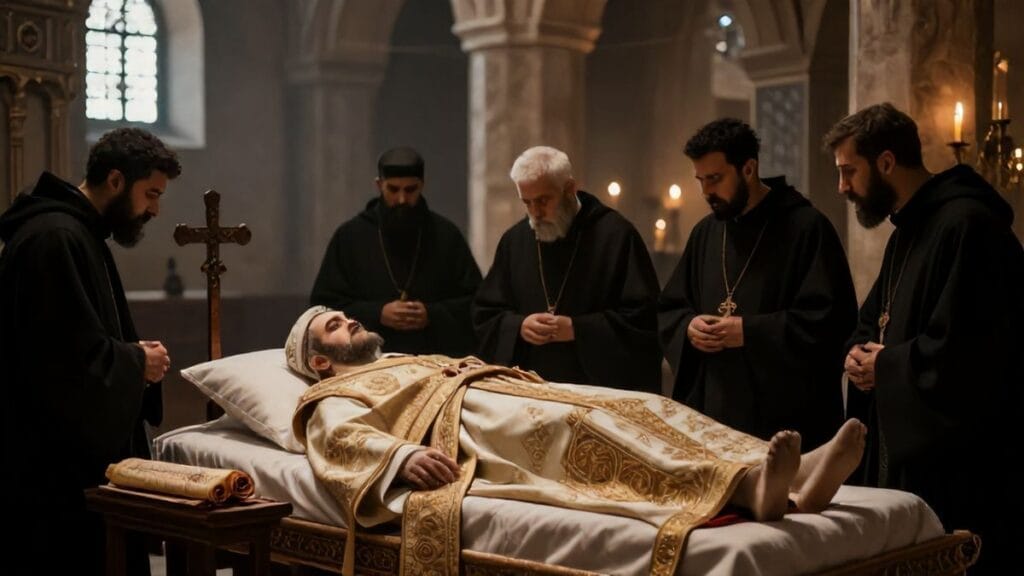
The exiled bishop’s last days seem to have been marked by sorrow rather than rebellion. Some sources suggest he died not long after his removal, worn down by age and humiliation. The story of paul bishop of edessa death thus becomes a story of slow extinguishing: a man whose authority had been stripped, whose flock had been transferred to another, fading away in a place no chronicler thought to name with precision. His passing, however, resonated loudly in Edessa, where many still regarded him as their rightful shepherd, a victim of political calculation more than doctrinal error.
Some monks may have visited him in his exile, bringing him letters or news of the city. Perhaps he asked about the cathedral, about the faithful who had once filled its aisles. Did they still speak his name in private? Did anyone pray for him in the liturgy, or had his memory been erased from the diptychs under imperial order? These questions, we can only pose in imagination. But in the piety of later Syriac writers, Paul’s death is tinged with martyr-like hues: not a martyr by blood, but a confessor of conscience, punished for refusing to wield doctrine as a cudgel against his own people.
When the news of his death finally reached Edessa, perhaps carried by a dusty courier or whispered by a monk at the city gate, it fell upon hearts already burdened. The tensions that had led to his deposition had not vanished with his removal; if anything, they had deepened. And so the paul bishop of edessa death became, for many, both an ending and a beginning: the end of a gentler episcopal era, and the beginning of a harsher phase of enforcement whose scars would last for generations.
The Death of Paul, Bishop of Edessa: A City Holds Its Breath
Paul’s actual death, in the year 520, likely took place quietly—no crowds, no trumpets, no imperial proclamations. Yet the emotional tremor it caused in Edessa was profound. News of a bishop’s passing, even one in exile, traveled quickly along the networks of kinship and piety that knit the region together. Within days, perhaps within hours, the story spread among monks, merchants, and widows alike: “Our bishop is dead.”
In some quarters, the reaction was muted. The new, court-approved bishop was in place; services continued. For the bureaucratic machinery of the empire, the event required little more than a brief notation: “Paul, deposed bishop of Edessa, deceased.” But among those who had admired his cautious, conciliatory approach, there was grief—and anger. They had watched him removed not for immorality or incompetence, but for failing to prosecute dissidents with sufficient severity. To them, the paul bishop of edessa death symbolized the victory of ideology over pastoral care.
One can picture small gatherings in the dim corners of city houses, where candles burned low and voices were hushed. Old women who had once brought their infants to Paul for baptism recalled his gentle hands. Younger men, who had listened to his sermons as boys, remembered the way his voice would soften when he spoke of Christ’s mercy. Now, that voice was silent, and in its place they heard the sharper tones of imperial orthodoxy, echoing from the lips of his successor.
Chroniclers writing a generation later preserved traces of this mood. In the pages of Syriac histories, we find laments for bishops “driven out by the envy of the powerful” and dying “far from their cities, like strangers among their own brethren.” While not always naming Paul directly, such lines evoke the sorrow that must have greeted the announcement of his passing. History, in such accounts, is less a sequence of events than a series of wounds inflicted upon the body of the Church.
Yet behind the mourning, there was also fear. If Paul could be removed and left to die in exile, what protection did any local leader have? What future awaited monks who continued to resist Chalcedon? The paul bishop of edessa death thus sent a clear message: the emperor’s reach extended even to the frontier’s holiest men, and compromise would no longer be tolerated. In that sense, the city held its breath not only in grief, but in anxious anticipation of what further measures might follow.
Tears in the Baptistery: How the Faithful Remembered Their Bishop
Publicly, the Church of Edessa had to move on. The new bishop presided over feast days, ordained clergy, and spoke the proper Chalcedonian formulas. The cathedral’s liturgy proceeded with solemn beauty; baptisms continued in the cool waters of the baptistery, where naked infants were plunged into the name of the Trinity. Life, outwardly, resumed its rhythm. But memory, especially in a city steeped in Syriac spirituality, was not so easily aligned with official narratives.
At night, in monasteries outside the city walls, monks chanted the Psalms for the departed, sometimes adding Paul to the long list of names they whispered before the icons. In family homes, where oil lamps cast trembling circles of light, parents told their children that they had once had a bishop who loved them and who had tried, as best he could, to keep peace during hard times. A few brave souls may have dared to refer to him as a confessor, hinting that his suffering for conscience’s sake placed him in continuity with those earlier figures who had faced pagan emperors or Arian Gothic kings.
The baptistery itself became a quiet place of remembrance. Some women, bringing their children to be washed in the waters of new birth, would recall that Paul had once traced the sign of the cross on their own brows. The stone steps, worn smooth by countless feet, now bore the invisible weight of unspoken grief. Those who did not dare to speak his name aloud during the liturgy might murmur it under their breath as they dipped their fingers into the water, entrusting both his soul and their city to the mercy of God.
Over time, stories attached themselves to his memory. One tale might recall how Paul had intervened to prevent soldiers from punishing a group of monks too harshly; another might insist that he had wept when forced to read out an imperial edict he privately opposed. Such anecdotes, whether strictly factual or shaped by pious imagination, reveal how the faithful processed their loss. They wanted to remember a bishop who had stood with them, not over them—a man torn between duty to the emperor and love for his city’s spiritual character.
In this subdued cult of remembrance, the paul bishop of edessa death became part of the city’s sacred history. He did not receive the official honors of a saint; no churches were openly dedicated to him, no feast day proclaimed. But in the hearts of many, he belonged to that gray zone of late antique holiness: figures neither canonized nor forgotten, whose suffering testified to the costs of conscience in an age when doctrine and power were tightly intertwined.
Edessa After Paul: New Bishops, Old Wounds
The replacement of Paul with a more reliably Chalcedonian bishop fulfilled Constantinople’s immediate objective. On paper, Edessa now had a leader whose orthodoxy was beyond question and whose loyalty to the emperor would not falter for the sake of local sentiment. Yet policy success did not necessarily translate into spiritual healing. In reality, Edessa after Paul was a city with deep, unhealed wounds.
The new bishop faced an uphill task. He had to establish authority among clergy who still bore affection for their deposed predecessor, and among monastic circles that viewed imperial interventions with suspicion. Some priests, perhaps, complied outwardly while nursing private resentment. Others, who had always leaned strongly Chalcedonian, may have greeted the change with relief, feeling that a clear alignment with the imperial church would secure Edessa’s place within the broader Christian world.
Miaphysite communities, meanwhile, responded in varied ways. Certain monks chose an uneasy truce, keeping their more controversial teachings confined to cloistered circles and focusing publicly on ascetic discipline and scriptural commentary. Others hardened their stance, viewing Paul’s fate and the paul bishop of edessa death as proof that compromise was impossible. For them, the new bishop represented not a pastor but an agent of persecution. Some may have withdrawn further into rural monasteries, deepening a parallel ecclesial network that would later blossom into a distinct Syriac Orthodox hierarchy.
The laity stood between these clerical alignments, trying to live ordinary lives under extraordinary theological pressures. Shopkeepers needed customers from both sides of the debate; artisans could not afford to alienate either imperial officials or monastic patrons. This practical need for coexistence softened some of the sharper edges, but it also created a nagging dissonance: a city officially united under Chalcedonian orthodoxy, yet internally fragmented in ways that liturgy alone could not disguise.
Over the following decades, Edessa would experience further upheavals—earthquakes, wars, and theological shifts under new emperors such as Justinian. Yet the episode surrounding Paul’s removal and death remained a formative memory. It taught the city that episcopal appointments could be instruments of distant politics, that the bond between bishop and flock could be severed by imperial fiat. This awareness would shape how Edessa received future bishops, making trust more fragile, reverence more conditional, and obedience more complicated.
Ripples Across the East: From Edessa to Constantinople and Beyond
The story of Paul and his death did not remain confined to Edessa’s walls. In an interconnected Christian world, news traveled along trade routes, pilgrim paths, and monastic correspondence. Miaphysite leaders in other provinces soon learned of what had happened to the bishop of Edessa, and they interpreted it as part of a wider pattern of repression under Justin I. In Alexandria, Antioch, and the monastic deserts of Egypt, Paul’s fate joined a growing dossier of grievances.
In Constantinople, strategists around the emperor likely regarded Edessa as a test case. If the city could be compelled to accept a rigorously Chalcedonian bishop without erupting into open rebellion, perhaps similar measures could be applied elsewhere. In this sense, the paul bishop of edessa death functioned as a political data point: a sign that imperial will could override local sentiment, at least for now. However, what looked like success in the capital often sowed seeds of long-term alienation on the periphery.
The Persian court, too, would not have been indifferent. Sasanian rulers had their own Christian populations to manage, including communities aligned with the Church of the East, often labeled “Nestorian” by their detractors. Reports of Roman imperial crackdowns on Miaphysites could be useful propaganda tools, casting the shahanshah as comparatively tolerant by contrast. In a world where religious discontent could translate into political defection, the treatment of figures like Paul mattered.
Moreover, the broader theological debate felt the tremor. Miaphysite writers pointed to the removal and death of bishops such as Paul as evidence that imperial Chalcedonianism had become a persecuting force. They argued that true orthodoxy was now to be found among those willing to suffer exile and dispossession for the sake of what they believed to be the authentic teaching of the fathers. In this polemical climate, the paul bishop of edessa death was not merely one story among many; it was part of a narrative of resistance.
Thus, an event in a single Mesopotamian city contributed to the widening gulf between Chalcedonian and Miaphysite churches. What had once been a painful internal dispute within a relatively unified Christian oikoumene was hardening into a schism of enduring structures, rival hierarchies, and distinct identities. Paul’s grave, wherever it lay, formed one small mound in the expansive landscape of this division—but a mound with symbolic height in the eyes of those who cherished his memory.
Chroniclers, Hymns, and Legends: How History Preserved Paul’s Fate
Our knowledge of Paul’s life and death comes not from a single authoritative dossier but from scattered references in chronicles, church histories, and later compilations. Syriac chroniclers like John of Ephesus, and later writers such as Michael the Syrian, record episodes of episcopal deposition and exile with a mix of factual notation and moral commentary. Typically, a line will note that “Paul, bishop of Edessa, was deposed under Justin for the sake of Chalcedon,” followed by a lament about the suffering of the Church.
Greek sources, when they mention him, tend to be briefer and more clinical, focusing on the success of imperial policy in securing orthodox bishops across the provinces. Yet even there, hints of unease appear. Church historians like Evagrius Scholasticus, writing later in the century, recount the violent and disruptive consequences of doctrinal enforcement, acknowledging that the pursuit of unity had come at a high human cost. One can almost hear beneath their sober prose an awareness that figures like Paul have been swept aside by history’s tide.
In the liturgical life of Miaphysite communities, Paul’s memory may have entered hymnography in veiled forms. Syriac poetry excelled at allusion: a reference to a shepherd exiled from his flock, or to a city bereft of its rightful bishop, could evoke specific episodes without openly defying imperial or later Chalcedonian authorities. Over time, these hints blur into legend. Some later communities might even have believed that Paul performed miracles in exile, or that visions affirmed his steadfastness. Whether historically verifiable or not, such stories reflect the emotional truth his supporters clung to: that his suffering had meaning.
Modern historians—drawing on manuscripts preserved in monasteries from Mosul to the Mediterranean—have tried to reconstruct a more precise picture. They cross-reference Syriac and Greek accounts, weigh biases, and situate Paul’s case within the broader patterns of Justin’s reign. One scholar, observing how many bishops shared a similar fate, has remarked that “the early sixth century witnessed a veritable migration of episcopal chairs, as men loyal to local traditions yielded place to those loyal to the capital.” In that pattern, paul bishop of edessa death becomes less an anomaly and more a representative case.
Yet the fragmentary nature of the evidence invites imagination, not in the sense of fabrication, but of empathetic reconstruction. By reading the chronicles carefully—attentive to what they emphasize, what they omit, whom they praise, and whom they condemn—we can glimpse the pain behind the lines. The historian’s task, in such cases, is not merely to state that Paul died in 520 after being deposed, but to narrate how that death resonated in hearts, policies, and liturgies across a region struggling to define its faith.
Politics in the Pulpit: The Death of a Bishop as Imperial Strategy
When power speaks through pulpits, deaths like Paul’s cease to be private tragedies and become components of grand strategy. From the vantage point of Justin’s court, the deposition and subsequent demise of bishops who resisted or complicated Chalcedonian enforcement helped clear the ecclesiastical landscape. It sent an unmistakable signal: the age of compromise was over; doctrinal ambiguity would not be tolerated from those who held crucial urban sees.
In this context, paul bishop of edessa death functioned almost as a negative sermon. The new bishop, installed in Edessa with imperial backing, preached Christ crucified and risen—but his very presence also preached the fate of those who failed to align themselves. Even without saying a word about his predecessor, his occupancy of the throne reminded clergy and laity alike that deviation had consequences. Every ordination he performed, every synod he attended, was framed by the memory of how he came to be there.
The synergy between imperial policy and episcopal authority was not unique to Edessa, of course. But frontier cities magnified its effects. Here, the empire could not afford lingering ambivalence: an episcopate nostalgic for Miaphysite sympathies might tilt local populations away from imperial loyalty. Conversely, a heavy-handed crackdown might push some Christians to see Persia as a lesser evil. The court had to calculate, and in its calculus, bishops like Paul were pieces on a vast board.
We must resist the temptation, however, to see Paul solely as a victim and the empire solely as villain. Justin, in his own mind, was defending what he believed to be the truth of the Incarnation and the necessary unity of his realm. His advisors were immersed in a theological-political vision that equated doctrinal precision with cosmic order. In such a worldview, tolerating bishops who hedged their bets or sympathized with local variations of doctrine could seem like dereliction of duty.
Yet the human cost of this vision is unavoidable. When imperial objectives colonize the pulpit, pastoral nuance dies early, often before the bishop who embodies it. Paul’s attempt—if we read the scattered evidence rightly—to walk a line between imperial orthodoxy and local sensibilities was ground down by a system that demanded clarity at any price. His death, therefore, is not only a religious event but a case study in how empires manage diversity—and how individuals are crushed in the process.
The Human Cost: Monks, Merchants, and Mothers Caught in Doctrine
Amid the grand narratives of councils and emperors, it is easy to lose sight of ordinary lives shaped by the fate of a man like Paul. Consider the monks of the hills around Edessa, who woke before dawn, recited psalms in half-frozen chapels, and then learned that the bishop they quietly supported had been cast out. For them, paul bishop of edessa death was not an abstraction but a challenge: should they now submit to a bishop they considered compromised, or should they withdraw further into isolation, deepening a gulf between monastic and episcopal authority?
Or consider a merchant whose trade wound along the road to Nisibis and beyond. His livelihood depended on predictable relations between Roman and Persian officials, between Christian communities on both sides of the border. Each new episcopal upheaval threatened to unsettle networks of trust. Would a Miaphysite-sympathizing counterpart across the frontier now view him as an agent of imperial oppression? Would an imperial tax collector suspect him of secretly financing dissident monks? The death of one bishop thus rippled through ledgers and caravans, as well as through psalters.
Then there were the mothers of Edessa, bringing children to church, nursing them in the shadow of its columns. Many had wept during Paul’s deposition; some had torn their garments, according to later reports, when soldiers escorted him out of the city. For them, the memory of his gentle presence at baptisms or funerals was now tinged with bitterness. Every time the new bishop processed down the nave in shimmering vestments, they remembered the simpler, humbler figure who had preceded him.
Theological slogans rarely capture such textures of experience. A creed can state that Christ has two natures or one incarnate nature, but it says nothing of the widow who now fears speaking freely in the marketplace, lest she be denounced as a heretic. Edicts proclaiming the removal of “heretical” bishops do not list the names of the orphans who miss the man who once visited their poor quarter on feast days. Yet it is precisely in these unrecorded spaces that the true impact of events like paul bishop of edessa death must be sought.
In this sense, the historian’s narrative becomes an act of restoration: restoring flesh to the bones of chronicle entries, restoring tears and whispers to what official documents record only as administrative changes. To tell Paul’s story fully is to honor not only his conscience, but the complex web of human lives entangled in his rise and fall.
Between Rome and Persia: Geopolitics in the Shadow of a Bishop’s Grave
Edessa’s position between Rome and Persia ensured that the city’s religious life always had a geopolitical dimension. Roman emperors claimed a special duty to guard the true faith; Persian shahs, while Zoroastrian, came to tolerate and even manipulate Christian communities within their realm. In such a context, the deposition and death of a bishop in Edessa could influence perceptions hundreds of miles away.
For Roman strategists, a firmly Chalcedonian Edessa served as a bulwark against any perceived contamination from the East—be it doctrinal or political. Paul’s ambivalence—or perceived ambivalence—threatened this bulwark. His removal and eventual death cemented a new alignment. But it also raised the risk that disaffected Miaphysites might find a more congenial home across the frontier, swelling the ranks of communities there that were already theologically distinct from Constantinople.
On the Persian side, Christian bishops and clergy often walked their own tightrope, emphasizing loyalty to the shah while maintaining religious ties—sometimes strained—with their Roman counterparts. Reports of Roman persecutions against Miaphysites could be used selectively, both by Persian authorities to assert their relative tolerance, and by Christian leaders to negotiate a bit more space. The story of paul bishop of edessa death could thus, indirectly, shape policy debates in far-off Ctesiphon or in border forts along the Tigris.
At a broader level, the episode illustrates how, in Late Antiquity, ecclesiastical events were never purely theological. A bishop’s standing influenced civic morale, tax compliance, even the willingness of local elites to fund defensive works or hospitals. In a city perched so close to hostile armies, the trust between bishop, populace, and imperial center was an asset as vital as walls and garrisons. By disturbing that trust through the removal of Paul, the empire gained doctrinal uniformity at the potential cost of soft power.
History would soon show that such trade-offs had consequences. Within a century of Paul’s death, new powers would rise in the region, and identities hardened in these Chalcedonian–Miaphysite disputes would shape how different communities responded to Arab conquests. The memory of earlier imperial interventions, including those that led to Paul’s deposition and death, played a subterranean role in those later choices. In this way, the bishop’s grave lay not only beneath the soil of 520, but under the shifting sands of the entire Near Eastern future.
From Edessa to the Modern Imagination: Why Paul’s Death Still Matters
Standing at a distance of fifteen centuries, one might wonder why the death of a single bishop in a frontier city should still command attention. Yet, as modern historians and theologians revisit the tangled story of early Christian divisions, episodes like paul bishop of edessa death help illuminate enduring questions about conscience, authority, and the cost of unity.
First, Paul’s fate highlights the perennial tension between local religious cultures and centralized doctrinal control. Edessa’s Syriac heritage, monastic networks, and distinctive piety could not be fully captured in the formulas hammered out at ecumenical councils dominated by Greek-speaking bishops. When imperial power attempted to impose a uniform solution, it often misunderstood or undervalued these local textures. In many ways, our contemporary debates about inculturation, religious pluralism within global churches, and the limits of central authority echo these older conflicts.
Second, his story underscores how confessional identities are forged not only by ideas but by memories of suffering. For communities that came to define themselves as Syriac Orthodox or Miaphysite, the depositions and deaths of bishops like Paul formed part of a shared narrative of endurance. As one modern scholar notes in a study of Syriac Christianity, “Martyrdom of the word, of office, and of exile became as potent as martyrdom of blood in shaping communal consciousness.” Paul belongs to this category: a man whose quiet passing in exile spoke loudly to those who kept his memory.
Third, the paul bishop of edessa death invites reflection on the ethics of religious leadership. Was Paul too cautious, insufficiently bold in resisting imperial overreach? Or was his pastoral hesitancy a sign of prudence and mercy in a time of polarization? The sources do not settle the question, and perhaps that is fitting. What they do show is a man striving to remain faithful amid crosscutting demands, and a system unwilling to tolerate his ambiguities.
Finally, Paul’s story reminds us that history is made not only by victors but by those pushed aside. The cathedrals and doctrines that survived into later centuries were often shaped in part by the absence of voices like his. To reconstruct his life and death is, in a sense, to restore a missing note in the symphony of Christian history, allowing us to hear more clearly the dissonances, regrets, and unrealized possibilities of that formative age.
Conclusion
In the year 520, in or near the city that had shaped him, Paul, bishop of Edessa, died—deposed, exiled, and removed from the throne he had once occupied with a mixture of humility and strain. His death, on the surface, could be summarized in a few words: another casualty of the Chalcedonian controversy, another bishop replaced by one more pleasing to an emperor intent on doctrinal uniformity. But beneath that sparse summary lies a complex human drama: a city torn between its Syriac traditions and imperial demands, a man caught between pastoral conscience and political expectation, a community forced to mourn in whispers.
We have followed the story from Edessa’s bustling streets to the corridors of Constantinople, and from monastic cells to the shadowy spaces where grief turned into memory and legend. Along the way, the paul bishop of edessa death has served as a thread connecting theology to trade, imperial policy to local devotion, and late antique events to modern questions about authority and identity. His removal marked a moment when the empire chose clarity over nuance, strategy over trust; his death sealed that choice in the hearts of those who loved him.
Yet Paul’s story is not only about loss. It is also a reminder that even when suppressed, local faiths and memories endure. Edessa’s spiritual life did not vanish with him; it adapted, resisted, and reimagined itself. Later centuries would bring further upheavals, but the patterns revealed in 520—of conscience against coercion, of center against periphery—would remain recognizable. To remember Paul today is to acknowledge that Christian history is woven as much from such contested lives as from the triumphant decrees of councils and emperors.
FAQs
- Who was Paul, bishop of Edessa?
Paul was a sixth-century Christian bishop of the city of Edessa, a major Syriac-speaking Christian center on the eastern frontier of the Byzantine Empire. He served during a time of intense conflict over the Council of Chalcedon and became known for his attempt to balance imperial doctrinal demands with the religious sensibilities of his local flock. - Why was Paul deposed from his episcopal office?
Paul was deposed because imperial authorities under Emperor Justin I judged him insufficiently reliable in enforcing Chalcedonian orthodoxy. He was accused, directly or indirectly, of tolerating or failing to suppress Miaphysite clergy and sentiment in Edessa, a city where such views were widespread. - How did the death of Paul, bishop of Edessa, occur?
Paul died in or around 520, after having been removed from his episcopal throne and sent into exile. The surviving sources are sparse, but they suggest he died quietly, worn down by age and the humiliation of deposition, rather than through direct physical persecution. - What is meant by “paul bishop of edessa death” in historical discussions?
The phrase “paul bishop of edessa death” refers both to the literal death of the deposed bishop in 520 and to the wider historical episode surrounding his removal, exile, and the political–theological tensions that led to it. Historians use it as a focal point to explore the enforcement of Chalcedonian doctrine and local resistance in the eastern provinces. - How did Paul’s death affect the city of Edessa?
Paul’s death deepened existing divisions within Edessa. Officially, a new Chalcedonian bishop consolidated imperial policy, but many clergy, monks, and laypeople mourned their former bishop and saw his fate as evidence of imperial overreach. The episode contributed to long-term mistrust between local communities and central authorities. - What role did imperial politics play in his deposition and death?
Imperial politics were central. Emperor Justin I sought to secure doctrinal unity as a pillar of imperial cohesion, replacing bishops who hesitated to enforce Chalcedon with more compliant figures. Paul’s deposition and subsequent death in exile were part of this broader strategy of aligning key sees—especially in frontier regions like Edessa—with the official creed. - How is Paul remembered in later Christian tradition?
Paul never became a widely recognized saint, but in Miaphysite and later Syriac Orthodox memory he is often treated as a kind of confessor, a bishop who suffered exile and death because he would not fully conform to imperial demands. Chronicles and pious stories preserve his image as a gentle, moderate pastor caught in the crossfire of doctrinal politics. - Why does Paul’s death matter for understanding early Christian divisions?
His death illustrates how doctrinal controversies like the Chalcedonian debate played out on the ground, in real communities. It shows that the formation of separate Chalcedonian and Miaphysite churches was driven not only by ideas, but by concrete acts of deposition, exile, and the imposition of new bishops over resistant populations.
External Resource
Internal Link
Other Resources
- Encyclopaedia Britannica – general search for the exact subject
- Google Scholar – academic search for the exact subject
- Internet Archive – digital library search for the exact subject