Table of Contents
- A World Pauses in Paris, 1783
- Empires in Crisis: The Long Road to Rebellion
- From Lexington Green to Global War
- Diplomats in the Shadows: Choosing Paris as the Stage
- Franklin, Adams, and Jay: Unlikely Architects of Peace
- British Weariness and American Persistence
- Drawing a New Nation on Old Maps
- The Human Cost Behind the Ink
- September 3, 1783: The Day the Pens Replaced the Guns
- What the Treaty Promised: Independence, Borders, and Debts
- Forgotten Voices: Loyalists, Indigenous Nations, and Slaves
- France, Spain, and the Silent Struggle for Advantage
- Across the Ocean: How News of the Peace Changed Everyday Lives
- Imperial Shockwaves: Britain, Europe, and the Loss of an Empire
- A Fragile Peace: Disputes, Broken Promises, and New Frontiers
- From Paris to Philadelphia: The Treaty’s Place in American Nation-Building
- Memory, Myth, and the Afterlife of the Treaty of Paris
- Conclusion
- FAQs
- External Resource
- Internal Link
Article Summary: On September 3, 1783, in the salons of Paris, diplomats quietly signed a document that would echo across centuries: the treaty of paris 1783, formally ending the American Revolutionary War. This article follows the long, painful road from colonial discontent to diplomatic victory, tracing how battlefield sacrifices and imperial rivalries converged on one decisive moment. It explores the personalities of Benjamin Franklin, John Adams, and John Jay, and the tense negotiations they led in a Europe still shaped by monarchy and empire. At the same time, it examines those left in the shadows of the treaty—Loyalists, enslaved people, and Indigenous nations whose futures were bartered away without consent. The narrative also shows how Britain, France, and Spain jostled for advantage even in peacemaking, as old powers tried to manage a world where a republic had suddenly appeared. Moving from the maps spread across Parisian tables to the farms, ports, and villages transformed by the news, it reveals the global and human consequences of this peace. By following the aftermath—new borders, broken promises, and rising ambitions—the article argues that the treaty of paris 1783 ended one revolution only to begin a far larger reshaping of the Atlantic world. It is, ultimately, the story of how ink on parchment redrew not just frontiers, but ideas of sovereignty, citizenship, and empire.
A World Pauses in Paris, 1783
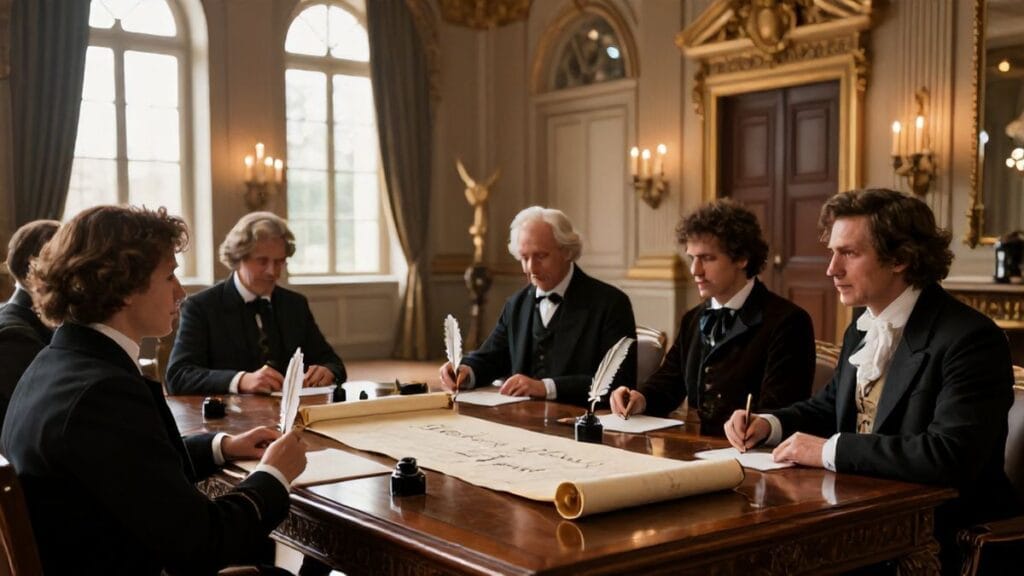
On a mild September day in 1783, far from the burned fields of Yorktown and the bitter snows of Valley Forge, the fate of an empire and the birth of a new nation were compressed into a few sheets of parchment laid out on a polished table in Paris. The room where it happened was more quiet than grand—no roaring crowds, no beating drums, only the scratch of pens and the soft murmur of interpreters. Yet as the final seals were pressed into hot wax, a war that had raged for eight long years, from New England forests to Caribbean waters, officially came to an end. This was the treaty of paris 1783, and in that subdued moment of ceremony, the world shifted.
Outside, Paris carried on with its usual rhythm: carriages rattled over uneven stones, vendors called out in the streets, aristocrats and clerks brushed shoulders in narrow passages. Few Parisians would have sensed that a new political creature—an independent United States of America—was being recognized within their city’s walls. But inside, those who signed knew they were doing more than burying a conflict. They were authorizing an experiment. A kingdom was acknowledging the independence of its former colonies, and in the age of kings and dynasties, such a concession bordered on the unthinkable.
It’s astonishing, isn’t it? For generations, power had been measured in territory, subjects, and the quiet obedience expected by distant crowns. Now, one of Europe’s most powerful monarchies was conceding that a people across the ocean had the right to govern themselves. The treaty of paris 1783 did not, by itself, create American democracy or guarantee its success, but it carved out the legal space in which that democracy could try to breathe. It brought an exhausted army home, reopened harbors to trade, and freed a continent’s political imagination.
Yet behind the celebrations and solemn signatures lay something darker: broken communities, unspoken betrayals, and the uneasy knowledge that peace for some would mean dispossession for others. Indigenous nations who had fought, negotiated, and survived between empires were not at the table. Loyalists who had wagered their lives on the British Crown now read themselves out of history in the fine print. Enslaved men and women who had tasted freedom in the chaos of war saw promises evaporate. The treaty of paris 1783 closed one set of wounds, but it also opened scars that would never fully heal.
To understand how that treaty came to be signed in Paris—rather than London or Philadelphia—to grasp why maps had to be redrawn and alliances recalculated, we must go back, years before the ink dried, to a world where no one yet imagined that thirteen colonies would become the axis of a global realignment.
Empires in Crisis: The Long Road to Rebellion
Decades before the treaty was ever conceived, the British Empire emerged from the Seven Years’ War in 1763 swollen with territory and debt. It had wrested Canada from France, extended influence in India, and asserted naval supremacy across the globe. Victory came at a price—one calculated not only in treasure, but in new anxieties. Governing this vast empire demanded money, men, and an administrative will that London was not sure it possessed. The North American colonies, prosperous and expanding, seemed an obvious source of revenue.
The British government looked at the colonies and did not see future rebels. It saw subjects who had benefited from imperial protection, who traded under the shelter of the Royal Navy, and who enjoyed a standard of living that, in many places, exceeded that of the average Englishman. From Westminster’s perspective, asking them to share a portion of the imperial burden through taxes was not oppression; it was common sense. But across the Atlantic, colonists were beginning to think of themselves less as extensions of Britain and more as distinct communities with their own political traditions.
The Sugar Act of 1764, the Stamp Act of 1765, and the Townshend duties that followed were, taken individually, not ruinous. Rather, it was the principle they represented—the assertion of Parliament’s right to tax unrepresented colonists—that set sparks hovering over dry tinder. Newspapers, pamphlets, and sermons carried the language of rights and liberties into taverns and town squares. Words like “tyranny,” “usurpation,” and “slavery” entered everyday political discussion, coloring how colonists interpreted every new gesture from London.
At the same time, Britain’s leaders were trapped inside their own assumptions. They could not fully imagine that colonies which had fought alongside them against France a decade earlier would risk everything in defiance. Colonial protests were dismissed as theatrical, their petitions as bargaining tools, not opening moves toward independence. The imperial center and its peripheries were no longer speaking the same political language, even though they used the same words.
The crisis grew not just from taxes and riots, but from underlying questions: Who had the final say in matters of law? Were the colonies extensions of the realm or communities with a right to consent in their own governance? These were not merely constitutional puzzles; they were questions about dignity and status. When British officials spoke of the colonies as “subordinate,” many colonists heard something deeper: that their voices, their assemblies, and their experiences were of lesser value. Insults and injuries blended until resistance became not just reasonable but morally necessary in the eyes of many.
No one signing the treaty of paris 1783 could claim ignorance about the long gestation of the conflict. They had lived through the years when grievances piled higher than petitions, when reconciliation remained possible, then improbable, then impossible. The ink in Paris in 1783 was the last residue of decades of misunderstanding, ambition, and stubbornness on both sides of the ocean.
From Lexington Green to Global War
The first shots at Lexington and Concord in April 1775 were clumsy, confused, and limited. Few participants imagined that volley would unfold into an eight-year war stretching from the Hudson River to the Caribbean Sea. But conflict, once begun, has a logic of its own. Bloodshed transformed political arguments into mortal commitments. After Bunker Hill, after besieging Boston, after the Crown’s proclamation that the colonies were in open rebellion, reconciliation receded into the realm of fantasy.
Even after the Continental Congress adopted the Declaration of Independence on July 4, 1776, the outcome was anything but certain. The British Empire was a global military power with professional regiments, experienced officers, and a navy that controlled most of the Atlantic. The Continental Army was under-equipped, often barefoot, and perpetually short of gunpowder, uniforms, and food. General George Washington spent nearly as much effort begging for supplies and men as he did planning campaigns. Behind every heroic painting of the revolution lies a quieter truth: that hunger, disease, and desertion stalked the Patriot cause more relentlessly than any redcoat.
Still, the war persisted and expanded, drawing in fresh participants like a whirlpool. France watched closely, scarred yet not defeated by its losses in the Seven Years’ War. To some French ministers, the American rebellion looked like an opportunity for revenge against Britain; to others, it seemed a gamble that could drain French finances past recovery. Only after the American victory at Saratoga in 1777 did France commit openly, signing treaties of alliance and commerce that transformed the rebellion into a proxy for European rivalries. Later Spain, and indirectly the Dutch, would also be drawn into the fray. What began as a colonial uprising evolved into a global contest over trade routes, colonies, and prestige.
This global dimension is vital to understanding why the war ended in Paris, of all places, and why its conclusion was as much a negotiation among European powers as a simple settlement between Britain and America. Even on distant Caribbean islands, plantation owners and enslaved laborers felt the rumblings. British and French fleets clashed in waters where sugar, not ideas, was the main currency. In India, skirmishes and maneuvers reflected a world in which every British setback could be an opening for someone else.
By the time Cornwallis surrendered at Yorktown in October 1781—after being cornered by Washington’s army on land and the French fleet at sea—the British Parliament confronted not just military defeat, but the possibility of a prolonged, ruinous global war. Yorktown was not the last battle of the conflict, but it was the moment when the political will to continue began to collapse in London. Inside smoky parliamentary chambers, voices grew louder calling for negotiation, for an honorable peace that would salvage something from the wreckage.
The path from Yorktown to the treaty of paris 1783 was neither straight nor smooth. It wound through back-channel talks, false starts, and delicate attempts to separate American aims from French and Spanish ambitions. American statesmen understood perfectly that their military victory had been secured only with European help, but they also knew that their long-term security required an independent peace, not permanent tutelage. In the gap between those needs, the drama of diplomacy began to unfold.
Diplomats in the Shadows: Choosing Paris as the Stage
Why Paris? The question seems obvious in retrospect—France had been America’s crucial ally—but in 1782 it was not the only possible stage. London would have symbolized British authority; Philadelphia, American triumph. But neither capital was neutral ground. Paris, by contrast, was a city of salons and embassies, of secrets traded in candlelit drawing rooms and information carried in whispers along the Seine. It was also, crucially, the home of the French foreign ministry, which hoped to shape the peace to its own advantage.
Paris in the late eighteenth century was a center of Enlightenment thought, where Voltaire’s wit and Rousseau’s ruminations had circulated in print and rumor. Philosophers debated the rights of man in the same city where royal carriages rattled past beggars at the palace gates. For the American envoys—steeped in Enlightenment ideals themselves—there was something fitting, even poetic, about negotiating the birth of a republic in a city that imagined itself at the forefront of reason and progress.
Yet beneath that philosophical gloss lay hard political calculation. France wanted Britain weakened, its naval power checked, and its colonial wealth diminished. But French ministers did not want the United States to become too strong, too quickly. A grateful yet dependent American republic, reliant on French loans and protection, would be ideal. An assertive, independent power with control of a vast continent and open access to trade might, in time, look very different.
Paris was therefore both a stage and a trap. While the Americans negotiated with British envoys, French officials tried to observe, influence, and occasionally restrain them. The city hummed with gossip about peace; every rumor about the war’s end might roil markets or unsettle an alliance. As one contemporary observer later noted, “In Paris, the war ended not once, but a dozen times, in conversation, before it ever ended in reality.”
For the British, sending negotiators to Paris amounted to an admission: they could no longer dictate terms alone. They had to operate under the suspicious gaze of their former enemy, France, and alongside American delegates who were fast proving themselves able strategists. Still, Paris offered one advantage: it was close to the theaters of European diplomacy, where other pending issues—the future of Gibraltar, disputes in the West Indies, and Dutch conflicts—would also be resolved. The treaty of paris 1783 would be one part of a larger mosaic, the Anglo-French and Anglo-Spanish peace agreements filling out the rest.
In choosing Paris, the participants accepted that peace, like war, would be a global affair. The city’s palaces and townhouses became, for a season, the crossroads of the Atlantic world’s future.
Franklin, Adams, and Jay: Unlikely Architects of Peace
At the heart of the negotiations stood three American figures, each different in temperament and background, yet bound together by necessity: Benjamin Franklin, John Adams, and John Jay. Each brought a distinct style to the table, and together—from cooperation to argument—they forged a strategy that would secure more than many expected was possible.
Benjamin Franklin, already a legend in Europe, arrived in Paris clothed in a kind of myth. The French adored him. He dressed simply, sometimes affecting rustic American plainness that charmed aristocratic audiences. Portraits depicted him with fur hats and lightning rods, a sage from the New World who had tamed electricity and now appeared ready to help tame politics. Behind the gentle grandfatherly image, however, was a shrewd mind and a lifetime of political experience. Franklin knew how to flatter, how to deflect, and how to extract concessions without appearing to demand them.
John Adams was a different creature altogether. Stubborn, principled, and often impatient, Adams lacked Franklin’s ease in salons but possessed a razor-sharp legal mind and an unwavering sense of the American cause’s righteousness. Adams had already served as a diplomat in Europe, hammering out loans and alliances with a persistence that bordered on obsession. He arrived in Paris for the peace talks determined not to be outmaneuvered—by Britain, France, or even his fellow commissioners.
John Jay, younger than Franklin and Adams, brought his own blend of caution and clarity. A skilled lawyer and future Chief Justice of the United States, Jay saw through the genteel theater of diplomacy to the core interests at stake. He was deeply suspicious of French motives, fearing that Versailles wished to limit American expansion and keep the young republic hemmed along the Atlantic. Jay’s skepticism would prove decisive when the Americans were forced to choose whether to negotiate jointly with France or pursue a more independent line.
Tensions among the three were inevitable. Franklin believed in working closely with the French; Adams and Jay grew increasingly wary of French designs, particularly when they sensed that French ministers might trade away American western claims to appease Spain. The American commission’s instructions from Congress urged them to consult and cooperate with France, but on the ground in Paris, they sometimes chose to ignore those instructions to preserve what they saw as vital national interests.
One of the treaty’s later historians, Samuel Flagg Bemis, would write that “the peace was made by statesmen who trusted their instincts over their orders,” and in the cramped negotiation rooms of Paris, that judgment rang true. The Americans’ willingness to negotiate secretly with the British—without informing France immediately—was risky, even duplicitous by some standards. Yet Adams, Jay, and eventually Franklin concluded that only by dealing directly with London could they secure favorable borders and fishing rights. Their gambit would shape the terms of the final settlement.
When the treaty of paris 1783 was finally drafted, it bore the marks of these men’s struggles, compromises, and occasional deceptions. It was not a triumph of pure idealism but of hard-nosed diplomacy cloaked in the language of liberty and friendship.
British Weariness and American Persistence
On the other side of the table, British negotiators carried the weight of defeat and the expectations of an empire that still spanned the globe. Britain was not a broken power—it still controlled India, Caribbean colonies, and a formidable navy—but the war in America had become costly in ways that reached beyond balance sheets. It undermined confidence in government, split political parties, and eroded faith in military invincibility.
The resignation of Lord North’s ministry after Yorktown opened the door to new leadership more inclined toward peace. Figures like Charles James Fox and Lord Shelburne, despite their differences, agreed on one essential point: the American war had to end. The question was not whether to recognize American independence, but on what terms and in what sequence. Some hoped to use recognition as a bargaining chip; others accepted that the longer recognition was delayed, the more rancorous and expensive the conflict would remain.
British envoys, including Richard Oswald, approached the talks in Paris with a mixture of reluctance and realism. They wanted to preserve British commercial access to the American market, limit American expansion westward, and secure protections for Loyalists who had remained faithful to the Crown. But they also knew that insisting on too much might push the Americans back into the arms of the French, turning a lost colony into a permanent enemy.
American persistence at the table was relentless. The American commissioners pressed for broad territorial claims: not merely the thirteen coastal colonies, but rights reaching to the Mississippi River. They insisted on fishing rights off Newfoundland and in the rich grounds of the Grand Banks—resources that would sustain New England economies for generations. They resisted British efforts to draw a narrow line around the new republic.
In this struggle of wills, British weariness proved an American advantage. The desire in London to close the American chapter and turn attention to other theaters gave American negotiators leverage that their military position alone might not have commanded. After all, British forces still held New York City, Charleston, and other key posts; the American army remained fragile. Yet public fatigue in Britain and growing pressure from merchants, who wanted trade restored, pushed the ministry toward concessions.
Thus the treaty of paris 1783 was shaped as much by exhaustion as by principle. It was the product of an empire that did not want to bleed any longer for a cause it no longer believed it could win, and of a young polity determined to extract the fullest possible recognition of its sovereignty before that imperial patience snapped back.
Drawing a New Nation on Old Maps
One of the most consequential—and contentious—tasks in Paris involved spreading maps across tables and deciding where a new nation would begin and end. Cartographers’ errors, outdated surveys, and vague descriptions from earlier imperial charters all combined to make this process as uncertain as it was momentous.
The Americans aimed high. They argued that the United States should extend from the Atlantic coast to the Mississippi River, from the Great Lakes south nearly to Spanish Florida. This claim built on a patchwork of colonial charters that stretched “from sea to sea,” as well as a practical desire to secure room for westward expansion. To the American mind, the interior was not empty, but it was open in a way that suggested opportunity and destiny.
British negotiators were torn. On one hand, giving the Americans such vast western territory seemed reckless—gift-wrapping a future rival. On the other hand, clinging to the trans-Appalachian frontier would mean continued expense, friction with settlers, and ongoing conflict with Indigenous nations. Moreover, the British wanted a buffer between their remaining Canadian possessions and the new republic. In the end, they acceded to wide American claims while reserving some strategic points and hoping that commercial ties might soften the strategic blow.
The resulting borders sketched in the treaty of paris 1783 look almost inevitable when viewed on a modern map, but they were anything but obvious at the time. Ambiguous phrases, like references to the “northwest angle of Nova Scotia” or the “highest sources” of rivers, planted seeds for future disputes. The line separating Maine (then part of Massachusetts) from British Canada would be contested for decades. The precise location of the Mississippi’s headwaters would become a subject of exploration and argument.
Behind every line lay unspoken realities: Indigenous nations, from the Haudenosaunee (Iroquois) to the Cherokee, whose homelands were partitioned without consent; fur traders whose routes suddenly crossed new political boundaries; frontier settlers who woke up one day as citizens of a new country without ever having cast a vote. The treaty treated the interior often as a chessboard, not a patchwork of living communities.
Still, for Americans, the sheer scale of their achievement was breathtaking. Overnight, or so it seemed, an uprising along the Atlantic seaboard transformed into a republic with continental ambitions. As John Adams later wrote in a letter, “We have bounded the United States by the Mississippi. This is an acquisition in which all mankind are interested, and of which posterity will bless the present age.” His pride barely concealed the enormity of the challenge: governing, defending, and settling that space would shape the next century of American history.
The Human Cost Behind the Ink
While diplomats turned lines into borders and paragraphs into binding obligations, the war’s human toll weighed silently over the proceedings. No clause in the treaty of paris 1783 could restore lives lost at Bunker Hill, on prison ships in New York Harbor, or on disease-ravaged southern campaigns. Estimates vary, but tens of thousands died—soldiers and civilians, Americans and British, Indigenous allies and enslaved people who sought freedom in wartime chaos.
Consider the families who had been torn apart by divided loyalties. Brothers served on opposite sides; fathers disowned sons; neighbors who had shared harvests now eyed one another with suspicion or hatred. Loyalist and Patriot were not abstract labels—they were identities forced upon communities, often at gunpoint. When the guns fell silent, those relationships did not suddenly heal. In many towns, the end of the war marked the beginning of long, slow reckonings with acts of betrayal, confiscation, and revenge.
Widows who had watched their husbands march away in homespun uniforms read of the treaty with mixed emotions. It meant an end to fear each time a messenger came riding down the road, but it did not pay debts or plant fields. Veterans, some maimed and many poor, faced a new struggle for recognition and compensation from a Congress perpetually short of funds. The glory of independence did not automatically translate into pensions or social support.
On the British side, thousands of soldiers returned to a country that had spent heavily, only to surrender its most populous American colonies. Some veterans found work in new garrisons across the empire; others slipped back into civilian life with little to show for years of campaign but scars and stories. For them, too, the treaty symbolized closure without reward.
War’s human cost extended beyond bodies and bank accounts; it burrowed into memory. Survivors carried the sights and sounds of battlefields into their old age: the crack of muskets along stone walls, the heat of a July day at Monmouth, the eerie quiet after an artillery barrage ceased. The treaty of paris 1783 did not erase these experiences, but it did offer a narrative frame in which to place them—a story of sacrifice leading to national birth. Whether one believed that story determined whether the treaty felt like redemption or bitter defeat.
September 3, 1783: The Day the Pens Replaced the Guns
The signing itself, on September 3, 1783, was not a grand spectacle. There was no need. The true theater of the war had already played out on battlefields and in parliaments; the ceremony in Paris was its quiet epilogue. American, British, and French officials gathered in rooms prepared for the occasion, documents laid out and translated as needed. The atmosphere was formal but not cold. These men had, over months, come to know one another’s habits, tempers, and limits.
We can imagine, though the record does not linger on it, the small gestures: an envoy adjusting his wig, another clearing his throat before signing; the careful avoidance of direct gloating or regret. Each man understood that history would preserve their names alongside this document, but none could fully foresee how that history would judge them. To the British, the treaty represented the most painful imperial concession in living memory. To the Americans, it was the long-awaited confirmation that their revolution had not been in vain.
When the last signatures were added and the seals were affixed, the treaty of paris 1783 became more than parchment. It became a legal fact that would ripple outward as copies crossed the Channel and the Atlantic. Couriers rode hard to reach London and Philadelphia, bearing news that was at once official and intangible. How does one announce that a war, with all its momentum and fury, is suddenly over?
In London, church bells would eventually ring, merchants would recalibrate their plans, and politicians would interpret the treaty to suit their arguments. In the American states, news traveled at the speed of horses and winds. Weeks, even months, could pass before farmers on the frontier learned that the flag under which they lived had changed, or that a distant king no longer claimed their allegiance. A peace concluded in a European capital seeped gradually into American lives, a distant echo becoming daily reality.
Yet in that modest Parisian room on September 3, a circle was closed. The empire that had claimed the right to tax, regulate, and command its American subjects now formally recognized them as a separate people. For the signatories, the day may have passed in a blur of protocol. For posterity, it would stand as the moment the revolutionary war shifted from present struggle to historical memory.
What the Treaty Promised: Independence, Borders, and Debts
The significance of the treaty of paris 1783 lies not only in its symbolism, but in its specific articles. Article by article, it defined the new relationship between Britain and the United States, as well as the expectations that would govern their uneasy peace.
First and foremost, Britain acknowledged the independence of the “United States of America,” listing them by name—New Hampshire, Massachusetts Bay, Rhode Island and Providence Plantations, Connecticut, New York, New Jersey, Pennsylvania, Delaware, Maryland, Virginia, North Carolina, South Carolina, and Georgia. This was no half-measure; it was a full recognition of sovereignty, with all the rights “as free and independent states” that other nations claimed.
The treaty then turned to boundaries. It granted the United States territory west to the Mississippi River, north to the Great Lakes and the St. Lawrence River’s outlets, and south to what would become the border with Spanish Florida. It recognized American rights to fish off Newfoundland and in the Gulf of Saint Lawrence—hard-won privileges that New Englanders insisted on as essential to their economic survival.
Other articles addressed civil and financial matters. The treaty stipulated that creditors on both sides would face no legal obstacles in recovering “bona fide” debts incurred before the war. This clause reassured British merchants and investors who feared that American independence might serve as a pretext to void obligations. It also affirmed, at least in theory, a sense that the rule of law survived even the rupture of revolution.
Another controversial provision concerned the treatment of Loyalists. The British negotiators pushed for strong protections for those who had remained loyal to the Crown—return of confiscated property, end to prosecutions, and safe passage if they chose to leave. The Americans, recognizing domestic anger against Loyalists, resisted. The compromise was carefully worded: Congress would “earnestly recommend” to the state legislatures that confiscated property be restored and that no further persecution occur. But this language lacked enforceable force. It exposed the fundamental truth that the treaty was not just an agreement between nations but a bridge between national diplomacy and local passions that national leaders could not fully control.
Finally, provisions addressed the withdrawal of British troops from American territory “with all convenient speed,” and the release of prisoners on both sides. These points aimed to translate legal peace into physical demobilization, an essential step in preventing new clashes from reigniting old grievances.
On paper, the treaty of paris 1783 seemed balanced, even enlightened. It promised mutual respect, legal continuity, and a framework for coexisting across the Atlantic. In practice, many of its promises would be delayed, contested, or broken. That tension between text and reality would define Anglo-American relations long after 1783.
Forgotten Voices: Loyalists, Indigenous Nations, and Slaves
Beneath the triumphant narrative of independence lay the stories of those for whom the treaty signaled loss, abandonment, or betrayal. Their names rarely appear in the main text, but their lives were profoundly shaped by its silences.
For Loyalists—Americans who had remained faithful to the British Crown—the treaty was both a lifeline and a hollow promise. Many had already suffered: tar-and-feather attacks, property seizures, imprisonment, or exile behind British lines. When the war ended, tens of thousands faced an impossible choice. Some hoped that the treaty’s recommendation to restore confiscated property would protect them; others, skeptical and fearful, chose to flee. Between 60,000 and 80,000 Loyalists eventually left, resettling in places like Nova Scotia, Quebec, the Bahamas, and Britain itself. They carried with them not only their belongings but their version of the war’s history—a story in which they, not the Patriots, represented true continuity and order.
Even more profound was the impact on Indigenous nations. Throughout the conflict, Native communities had pursued complex strategies to survive between warring empires. Some, like portions of the Haudenosaunee Confederacy, allied with the British, hoping that a British victory would halt American encroachment on their lands. Others sought neutrality, or supported the Americans, or shifted alliances as circumstances demanded. None were invited to Paris. Yet the treaty of paris 1783 treated Indigenous homelands as negotiable territory, casually assigning them to the United States or leaving them under British influence without consulting those who lived there.
For many Native nations, the treaty marked the beginning of a new and more precarious era. The British, while far from benevolent, had at least established certain boundaries to colonial expansion through earlier proclamations. The new American republic, hungry for western land, posed a more direct, immediate threat. War on the frontier, treaties made and broken, and forced removals would follow in the decades to come, carrying forward the unspoken violence embedded in that Paris agreement.
Enslaved people also felt the war’s end in stark and often brutal ways. During the conflict, the chaos of armies moving across the countryside created openings for enslaved men and women to escape. The British, most famously through Lord Dunmore’s 1775 proclamation in Virginia, had offered freedom to slaves who fled Patriot masters and joined British lines. Thousands responded, risking everything for a chance at liberty. When peace came, many of these individuals found themselves in limbo. American slaveholders demanded their “property” back, citing treaty clauses about returning prisoners and captured goods. British commanders, under pressure to enforce emancipation promises, sometimes evacuated freed people to Nova Scotia, the Caribbean, or even Sierra Leone.
Still, countless others were forcibly returned to bondage. The treaty of paris 1783 did not abolish slavery, nor did it fully recognize the freedom that war had carved out for some. It entrenched a paradox at the heart of the new United States: a republic founded on liberty that preserved human bondage within its borders.
These forgotten or marginalized voices complicate any straightforward celebration of the treaty. They remind us that while the document recorded an extraordinary step toward self-government and republicanism, it also reaffirmed hierarchies and exclusions that would shape struggles for justice well into the future.
France, Spain, and the Silent Struggle for Advantage
Though the treaty of paris 1783 is often remembered primarily as an Anglo-American settlement, it cannot be separated from the parallel negotiations involving France and Spain. The American Revolution had drawn these powers into a broader contest against Britain, and each sought compensation for its efforts and losses.
France, under Foreign Minister Charles Gravier, Comte de Vergennes, had invested heavily in the American cause, both financially and militarily. French troops and the French fleet at Yorktown were instrumental in securing the decisive victory that turned the tide. Yet when peace approached, France faced a dilemma: how to translate military contribution into diplomatic advantage without empowering the United States to the point where it might become a rival? Vergennes hoped to weaken Britain, reduce its colonial reach, and bolster French prestige, all while containing American expansion and preserving Spanish interests.
Spain entered the war with different goals. It had never recognized American independence directly and was more concerned with securing or regaining territories such as Florida, Minorca, and Gibraltar. Spanish leaders worried that a strong United States might eventually threaten their own vast holdings in the Americas, from Louisiana to Mexico and beyond. They pressed for limits on U.S. access to the Mississippi River and tried to shape western boundaries in ways that would shield their frontiers.
In this context, the American commissioners’ decision to negotiate directly with Britain—without France in the room at key moments—appeared almost treasonous to their French allies. John Jay, particularly, believed that French diplomacy aimed to confine the United States east of the Appalachians, leaving the trans-Mississippi region as a Spanish buffer under French influence. Whether this fear was entirely justified or not, it motivated the Americans to secure the generous western boundary they eventually obtained.
The final agreements signed in Paris that same day, or shortly after, gave France relatively modest territorial gains but a significant psychological victory. Britain acknowledged French rights in parts of the Caribbean and Africa, and the blow to British pride and prestige gratified Versailles. Spain regained Florida and Minorca, though it failed to retake Gibraltar, a rock that remained stubbornly in British hands.
Thus, while the treaty of paris 1783 granted the United States independence and vast territory, it also rebalanced the European state system in subtler ways. Britain had been wounded but not destroyed; France had gained honor but deepened its debts, which would help set the stage for its own revolution just six years later. Spain’s empire seemed reinforced on paper, even as the seeds of its eventual unraveling were already sown. The American settlement was not an isolated event; it was a node in the shifting lattice of global power.
Across the Ocean: How News of the Peace Changed Everyday Lives
When word of the treaty filtered outward, its impact was felt not in diplomatic cables but in markets, churches, taverns, and kitchens. People whose names will never appear in history books lived the consequences of decisions made in Paris with an intimacy no negotiator could fully imagine.
In American port cities like Boston, New York, and Charleston, merchants watched anxiously for confirmation that trade with Britain could resume without fear of capture or blockade. Ships had lain idle or diverted to risky smuggling routes during the war years; now, warehouses could once again fill with British textiles, manufactured goods, and colonial exports. The end of the war promised economic relief, but it also raised new questions: Would American goods find markets as easily as before? Would British merchants flood American ports and outcompete local producers?
Farmers in New England, the mid-Atlantic, and the southern backcountry felt peace in the soil. Fields trampled by marching armies could finally be replanted without fear that next season’s harvest would be seized for military use. Yet many rural Americans faced crushing wartime debts, inflation, and depreciated currency issued by Congress and individual states. The glow of independence had to compete with the stark arithmetic of unpaid bills and uncertain credit.
On the western frontier, settlers who had pushed past British-imposed limits during the war now believed the treaty of paris 1783 had vindicated their defiance. The river valleys of Ohio, Kentucky, and Tennessee beckoned with the promise of land, even as Indigenous nations resisted encroachment. Families packed wagons, loaded muskets, and moved inland, often with little more than hope and rumor to guide them. For them, peace did not mean an end to conflict; it meant that conflict would now take the form of skirmishes with Native neighbors, not redcoats.
In Britain, the effects were similarly mixed. Some urban workers lost military-related employment as contracts for uniforms, muskets, and shipbuilding declined. Others welcomed the return of sailors and soldiers to the civilian economy. London’s financial markets, jittery from years of war-related speculation and uncertainty, began to reorient toward peacetime investment. The empire’s gaze shifted: if North America was gone, India, the Caribbean, and new commercial ventures might take its place.
Among enslaved people in both the United States and British colonies, the end of the war brought a cruel clarification. In some places, such as parts of New England and the mid-Atlantic, gradual emancipation laws and court decisions were beginning to chip away at slavery. In others, particularly the plantation South and the Caribbean, peace meant the restoration of strict control after years of wartime disruption. Those who had gambled on British promises of freedom and found themselves resettled in Nova Scotia or the Caribbean confronted harsh climates, prejudice, and broken assurances. For them, Paris might as well have been on another planet; yet the ink dried there shaped the contours of their precarious freedom or renewed bondage.
The treaty’s arrival in newspapers, sermons, and street conversations gave people a new vocabulary: “our country,” “the United States,” “the British nation.” National identities that had been fluid hardened slowly into more defined forms. Still, for many, the primary realities remained local—village disputes, harvest cycles, family concerns. Empires rose and receded at a distance; lives continued one day at a time.
Imperial Shockwaves: Britain, Europe, and the Loss of an Empire
The loss of the American colonies forced Britain to confront uncomfortable questions about its identity and future. Was the empire diminished beyond repair, or merely transformed? Reactions among British elites were far from unified. Some lamented the separation as a national humiliation; others, more pragmatic, recognized that the American colonies had been costly to defend and awkward to govern.
Intellectuals and politicians debated what the war and its outcome revealed about the nature of empire itself. Could a composite monarchy—stretching across oceans and encompassing peoples with different laws and customs—be sustained without some form of shared representation? Or was the American rupture evidence that distant colonies would inevitably seek independence once they reached a certain level of prosperity and self-confidence? These questions were not academic. They would echo in Ireland, Canada, India, and across the empire for generations.
At the same time, Britain began to pivot. Its attention turned more sharply toward Asia, especially India, where the East India Company’s influence was solidifying into a form of direct imperial rule. Caribbean colonies, though always at risk from hurricanes and slave revolts, continued to pour sugar and profits into British coffers. The loss of the thirteen colonies bred a certain agility: Britain leaned harder into naval power, financial sophistication, and commercial networks. It would, in the nineteenth century, reemerge not as a diminished power but as the center of a new kind of global empire.
On the European continent, rival powers drew their own lessons. France, despite the satisfaction of seeing Britain humbled, had spent heavily on the American war. One French observer, the Marquis de Lafayette—who had himself fought in America—returned home to find a monarchy teetering under the weight of debt and social discontent. The ideals he had helped support across the ocean would soon inflame his own country. The irony is inescapable: the treaty of paris 1783 that recognized one revolution’s success helped set the fiscal and ideological stage for another, even more radical revolution in France.
Spain, too, watched the American example with unease. If colonies in North America could break free, what about Creoles in Mexico or Peru? What about restless merchants in Havana or Buenos Aires? Spanish authorities sought to tighten control and reform administration, but in doing so, they sometimes provoked the very resentments they hoped to forestall. The idea that a colonial people could assert their rights and form a sovereign nation could not easily be contained once it had been legitimized in an international treaty.
In this sense, the treaty of paris 1783 acted as a kind of political earthquake. Its immediate epicenter was the Anglo-American relationship, but its shockwaves rippled outward through the fault lines of empires everywhere. The notion that sovereignty resided in “the people,” however narrowly defined, now had a credential: recognition by other states. That notion would be invoked—and sometimes weaponized—in struggles from Haiti to Latin America in the decades to come.
A Fragile Peace: Disputes, Broken Promises, and New Frontiers
No treaty, however carefully crafted, can anticipate every future conflict. Almost as soon as the ink dried, cracks began to appear in the edifice built in Paris. Some clauses were honored in the breach; others became sources of contention that would darken Anglo-American relations in the 1790s and beyond.
Foremost among these was the question of British forts in the Northwest. Despite the treaty’s requirement that Britain evacuate its posts on American soil “with all convenient speed,” British garrisons remained in places like Detroit, Niagara, and Michilimackinac for years. British officials justified their presence by pointing to American failures to honor commitments to Loyalists and British creditors. They also wished to maintain influence among Indigenous nations and preserve a buffer against American expansion. To American eyes, this looked like bad faith and continued imperial interference.
Trade and debts also sparked frustration. British merchants complained that American courts and legislatures impeded recovery of pre-war debts, while Americans argued that British wartime disruptions and seizures had invalidated or complicated those obligations. The legal wrangling over what the treaty required mirrored a deeper mistrust: had the war truly reset the relationship, or had it simply transformed open conflict into a quieter economic struggle?
On the American side, western expansion brought the United States into frequent, bloody conflict with Indigenous nations who had never accepted the treaty’s authority. The new republic treated lands ceded by Britain as its own to dispose of, ignoring the fact that Britain had no legitimate right to grant what it did not possess in the first place. Treaties with Native nations multiplied, many of them coerced or later violated. In the Ohio Valley and beyond, warfare continued under a new name, as American settlers, militias, and federal forces pushed westward.
Even within the United States, the domestic peace remained uneasy. Economic distress, uneven enforcement of the treaty’s provisions, and lingering local animosities contributed to unrest. Shays’ Rebellion in Massachusetts in 1786–1787—an uprising of indebted farmers—revealed how thin the line was between social order and chaos. The same revolution that had thrown off British rule had left behind a weak central government, unable in some respects to enforce even the treaty that had sealed its victory.
For Britain and the United States alike, these tensions set the stage for further negotiation. The Jay Treaty of 1794, named for the same John Jay who had helped craft the 1783 agreement, attempted to resolve many outstanding issues—British withdrawal from forts, compensation for seized ships, and trade regulations. In that sense, it functioned as an unofficial sequel to the treaty of paris 1783, a recognition that the first peace, while momentous, had been incomplete.
From Paris to Philadelphia: The Treaty’s Place in American Nation-Building
Inside the fledgling United States, the treaty quickly became more than a diplomatic milestone; it became a touchstone in debates about what kind of nation had been created. The Articles of Confederation, under which the United States had fought the war and negotiated the peace, granted only limited powers to the central government. Congress could sign treaties, but it lacked effective means to force states to comply with their terms.
This weakness became painfully apparent as states dragged their feet on issues like restoring Loyalist property or enforcing debt repayment. British officials cited these failures as justification for their own noncompliance, trapping the new republic in a diplomatic cul-de-sac. American leaders who favored a stronger federal government seized on these difficulties as evidence that the Confederation system was inadequate.
When delegates gathered in Philadelphia in 1787 to write a new constitution, the experience of administering and enforcing the treaty of paris 1783 weighed heavily on their minds. They sought to create a federal structure that could both conduct foreign policy and ensure that its obligations were met domestically. The Constitution’s provisions regarding treaties—declaring them the “supreme Law of the Land”—reflected a desire to avoid the embarrassment and danger of being seen as an unreliable partner on the international stage.
At the same time, the treaty was woven into a developing national narrative. Orators and pamphleteers cast it as the capstone of the revolutionary struggle, the moment when principles articulated in the Declaration of Independence received global acknowledgment. The very phrase “Treaty of Paris” became shorthand for the transformation from colony to nation.
Yet memory is selective. Celebrations of the treaty’s role in nation-building often glossed over its more troubling aspects: the ambiguous treatment of Indigenous lands, the half-hearted assurances to Loyalists, the explicit silence on slavery. In constructing a usable past, Americans tended to highlight the soaring rhetoric of independence and minimize the compromises and exclusions that had made it possible.
Still, the legal and territorial framework the treaty provided was essential. It gave the United States recognized boundaries within which to experiment with republican governance. It opened western lands that would later become new states, extending the union’s reach. And by acknowledging American sovereignty, it compelled other nations to treat the United States not as a rebellious province but as a state among states.
Memory, Myth, and the Afterlife of the Treaty of Paris
Over time, the treaty of paris 1783 has taken on a life beyond the specific words penned in 1783. It has become part symbol, part reference point, invoked whenever Americans reflect on the origins of their independence or when historians trace the decline and reinvention of the British Empire.
In art and popular imagination, the treaty often appears as a moment of dignified closure—men in powdered wigs leaning over a table, quills in hand, portraits gazing down from walls. One famous unfinished painting by John Trumbull captures only the American delegation; the British negotiators, who declined to sit for the artist, remain forever absent, a visual metaphor for the uneasy, asymmetrical memory of the event. The painting suggests a neatness, a harmony, that the real negotiations never possessed.
In schoolbooks and civic rituals, the treaty is sometimes compressed into a single line: “In 1783, the Treaty of Paris ended the Revolutionary War and recognized American independence.” Technically accurate, this formula strips away the drama, the contingency, and the human complexity that made the treaty both possible and imperfect. It glosses over the months of maneuvering in Paris, the clashing ambitions of Franklin, Adams, Jay, and their European counterparts, and the fates of Loyalists, Indigenous peoples, and enslaved individuals.
Historians have slowly restored that complexity. Works by scholars from both sides of the Atlantic have emphasized that the treaty did not just end a war between Britain and America; it reconfigured an entire Atlantic system of trade, power, and ideas. It is, as one historian observed, “a document of endings that also reads, between the lines, as a charter of beginnings.”
Public memory tends to celebrate winners. For Americans, the treaty confirms a foundational story: that a people can fight, negotiate, and gain recognition as a nation. For British observers, it has often served as a cautionary tale about mismanaging colonies and underestimating the power of political principle. For others—Africans, Indigenous peoples, and Loyalist exiles—its memory is more ambivalent, a reminder of being written out of a future decided by others.
Yet despite those tensions, the treaty’s afterlife offers something more than a lesson in triumph or tragedy. It reveals the enduring importance of diplomacy as a counterpart to war. Guns can seize ground, but pens decide what that ground will mean, who it belongs to, and how future conflicts might be constrained. The treaty of paris 1783 stands as a testament to the moment when, after years of gunfire, human beings sat down and tried to give their struggle a durable shape in words. As flawed as that effort was, it remains the foundation upon which a great deal of later history was built.
Conclusion
The Treaty of Paris signed in Paris, France, on September 3, 1783, was neither a simple ending nor a perfect beginning. It closed the book on the American Revolutionary War, but in doing so, it opened countless chapters in the stories of nations, peoples, and empires. It transformed a rebellion on the far edge of the Atlantic into a recognized state, fixing the United States on the map and forcing the world to treat it as a sovereign actor. At the same time, it reshaped British strategy, reoriented French and Spanish priorities, and sent ripples of possibility and fear through colonial societies everywhere.
Yet the treaty of paris 1783 also carried within it contradictions that would haunt the future. It promised fair treatment to Loyalists but could not guarantee their safety or restitution. It treated Indigenous homelands as negotiable spaces, paving the way for expansion at the cost of dispossession and warfare. It allowed slavery to survive and even consolidate in a republic dedicated, in rhetoric at least, to liberty. In all these ways, it showed that revolutions, when translated into treaties, often sacrifice purity for practicality.
Still, the importance of that September day in Paris cannot be overstated. It was the moment when war’s chaos yielded to the order of law, however fragile. It proved that ideas—about representation, sovereignty, and rights—could ultimately force even a dominant empire to alter course. It offered, across oceans and generations, a demonstration that political communities could be remade, even if the process left deep scars.
Looking back from our own era, with its shifting alliances and contested borders, the treaty of paris 1783 invites both admiration and scrutiny. Admiration for the courage and skill that brought a small, embattled collection of states to the status of a nation; scrutiny for the exclusions and injustices baked into the peace settlement. To study the treaty is to see the origins not only of American independence, but of many of the promises and failures that have defined the modern Atlantic world.
FAQs
- What was the Treaty of Paris 1783?
The Treaty of Paris 1783 was the peace agreement that formally ended the American Revolutionary War between Great Britain and the United States, with France and Spain also involved in parallel negotiations. It recognized American independence, established national boundaries, and addressed issues such as debts, Loyalist property, and the withdrawal of British troops. - Why was the treaty signed in Paris instead of London or Philadelphia?
Paris was chosen because France had been a key ally of the United States and was central to the broader diplomatic process that also involved peace settlements between Britain, France, and Spain. The city was a hub of eighteenth-century diplomacy, with established embassies, experienced negotiators, and a political environment suited to multilateral negotiations. - Who were the main American negotiators?
The principal American negotiators were Benjamin Franklin, John Adams, and John Jay. Franklin leveraged his immense popularity and diplomatic skill in France, Adams pushed aggressively for broad American rights and territory, and Jay played a critical role in steering the Americans toward direct talks with Britain to secure favorable borders and terms. - What territories did the United States gain from the treaty?
The treaty granted the United States vast territory extending west to the Mississippi River, north to the Great Lakes and parts of the St. Lawrence River, and south to the border with Spanish Florida. It also guaranteed American fishing rights off Newfoundland and in the Gulf of Saint Lawrence, essential for New England’s economy. - How did the treaty affect Indigenous peoples in North America?
Indigenous nations were not represented at the negotiations, yet their homelands were divided between British and American spheres without their consent. The United States treated western lands as open for settlement, leading to intensified conflict, dispossession, and a series of wars and coercive treaties that would define U.S.–Native relations for decades. - What happened to Loyalists after the treaty?
The treaty “recommended” that American states restore confiscated Loyalist property and end persecution, but it did not compel them to do so. In practice, many Loyalists faced hostility, legal obstacles, or outright violence and chose to leave. Tens of thousands resettled in British North America (especially Nova Scotia and Quebec), the Caribbean, or Britain. - Did the treaty abolish slavery or free enslaved people who fought in the war?
No. The Treaty of Paris 1783 did not address slavery directly. While some enslaved people gained freedom by escaping to British lines and were evacuated after the war, many others were returned to bondage. The institution of slavery remained intact in both the United States and the British Empire, especially in the plantation economies. - Why did Britain agree to such generous terms for the United States?
Britain was exhausted by years of war and faced the prospect of continued conflict not just in America but around the globe. By recognizing American independence and granting generous boundaries, British leaders hoped to rebuild commercial ties, limit French and Spanish gains, and turn a costly colonial struggle into a more mutually beneficial trading relationship. - How did the treaty influence the later U.S. Constitution?
Experiences with enforcing the Treaty of Paris 1783 under the weak Articles of Confederation convinced many American leaders that a stronger federal government was needed. Problems with debt repayment, treatment of Loyalists, and British noncompliance exposed the Confederation’s limitations, helping drive the movement for the 1787 Constitutional Convention and the creation of a more robust national framework. - Is the Treaty of Paris 1783 still important today?
Yes. The treaty established the basic territorial and legal foundations of the United States as an independent nation and set precedents for how empires and colonies could separate. Its borders, promises, and omissions continue to shape discussions about sovereignty, Indigenous rights, and the long-term legacy of both the American Revolution and the British Empire.
External Resource
Internal Link
Other Resources
- Encyclopaedia Britannica – general search for the exact subject
- Google Scholar – academic search for the exact subject
- Internet Archive – digital library search for the exact subject

