Table of Contents
- Whispers of War and Dreams of Calm: The World Before 532
- Two Empires Facing Each Other Across a Continent
- From Endless Frontier Skirmishes to Open War
- Justinian’s Ambition and the Cost of Imperial Glory
- Khosrow I Ascends: Reform, Ruthlessness, and Realism
- The Nika Revolt and a City in Flames
- The Road to Negotiation: Exhaustion on Two Thrones
- Diplomats, Gold, and Silence at the Frontier
- Inside the Eternal Peace Treaty 532: Clauses, Gold, and Borders
- Celebrations in Constantinople and Ctesiphon
- Soldiers Without a War: Veterans, Families, and Frontier Towns
- Merchants, Monks, and Spies: The Human Traffic of Peace
- Faith Across Frontiers: Christians, Zoroastrians, and Minorities
- Peace as Strategy: Justinian Looks West
- Persian Reforms Under the Shelter of Peace
- Cracks in the “Eternal” Promise
- The Return of War and the Judgment of History
- Echoes Through Time: Why the Peace of 532 Still Matters
- Conclusion
- FAQs
- External Resource
- Internal Link
Article Summary: In the year 532, the Byzantine and Sasanian Empires attempted to halt centuries of rivalry by signing what they boldly called the eternal peace treaty 532, a pact meant to silence the clash of armies from the Caucasus to Mesopotamia. This article follows the long road that led to that moment, from brutal wars and religious tensions to the personal ambitions of Emperor Justinian I and Shahanshah Khosrow I. It dives into the diplomacy behind closed doors, the high cost of gold and concessions, and the fragile hope that followed in the streets of Constantinople and Ctesiphon. Yet behind the celebrations, it reveals the anxieties of soldiers suddenly without enemies, merchants sensing new opportunities, and religious minorities cautiously crossing borders. Through narrative detail and historical analysis, it shows how the eternal peace treaty 532 reshaped strategy, finance, and daily life on both sides of the frontier. It also explores how this “eternal” peace collapsed within a decade, teaching later generations about the limits of human promises. From imperial courts to dusty frontier forts, the story traces how a single agreement could both calm a continent and prepare the stage for future conflict. In doing so, it asks what truly makes a peace lasting, and what the eternal peace treaty 532 can still tell us about the fragile nature of stability between great powers.
Whispers of War and Dreams of Calm: The World Before 532
In the early sixth century, the lands stretching from the eastern Mediterranean to the high plateaus of Iran were saturated with the memory of war. Villages along the Euphrates remembered the thunder of hooves and the sudden glare of burning granaries. Officers in garrison forts slept with their boots close by, knowing that dawn might bring a raid, an order to march, or the arrival of tax collectors demanding revenue to pay for yet another campaign. The Byzantine Empire, heir to Rome, and the Sasanian Empire, heir to the ancient monarchies of Persia, had developed a grim rhythm: decades of tension, years of open conflict, followed by brief, uneasy truces.
Peace, when it came, felt less like reconciliation and more like a pause between blows. Generations had grown up knowing the other empire as both adversary and mirror—familiar enough to negotiate with, dangerous enough to hate. The border between them sliced across regions that had once known a different kind of unity: old Hellenistic cities, long-established caravan routes, Christian and Jewish communities that had learned to survive under both crosses and fire altars. At dawn, as the mists lifted over the Tigris or the upper Euphrates, shepherds could see more than hills and fields; in the distance, they knew, somewhere beyond the horizon, was another empire watching them in turn.
And yet, tired as the soil was of blood, there were always whispers of calm—rumors that this emperor or that shahanshah might seek a new order. Scribes in distant monasteries copied chronicles of earlier treaties, wondering if their own age would one day be described as an interval of peace rather than another chapter of ruin. It was into this world of fatigue and wary hope that, in 527, a new man took the throne in Constantinople: Justinian I, a ruler whose imagination reached from the Balkans to the sands of Africa. Across the frontier, only a few years later, another decisive figure would rise to power in Ctesiphon: Khosrow I Anushirvan, “of the Immortal Soul,” a king as pragmatic as he was proud.
The stage was almost set. But before the ink could dry on what would be trumpeted as the eternal peace treaty 532, war would first push both empires to the edge, until the cost of victory felt indistinguishable from defeat.
Two Empires Facing Each Other Across a Continent
To understand the significance of that treaty, one must first grasp the nature of the powers that signed it. The Byzantine Empire dressed itself in the mantle of Rome, yet by the sixth century its heart was Greek-speaking and Christian, ruled from the organized chaos of Constantinople—a city of domes, markets, ship masts, and law courts. Its emperors styled themselves not only as military commanders, but as guardians of a universal Christian order. Lawyers in the capital debated legal reforms while mosaic artists set glittering tesserae into the walls of new churches. From Egypt came grain, from Syria cloth and glass, from the Balkans recruits for the army.
Across the frontier, the Sasanian Empire claimed an even older heritage. Its kings evoked the memory of Achaemenid monarchs and the heroes of the Shahnameh’s oral traditions. Ctesiphon, their capital on the Tigris, did not boast the maritime bustle of Constantinople but instead radiated a different kind of grandeur: colossal palace arches, hunting parks dotted with gazelles, and fire temples where sacred flames were carefully tended by Zoroastrian priests. The Persian court revolved around the shahanshah—the “king of kings”—surrounded by noble families, cavalry commanders, and a bureaucracy increasingly aware that war was an expensive habit.
Despite their rival claims to universal authority, both empires were, in some ways, oddly similar. Each was a multiethnic state ruled by a central monarch; each fused religious ideology with politics; each depended on tax revenues from peasants and merchants to feed soldiers and fund monumental building projects. And each had a long memory. They knew that neither side could easily destroy the other. Instead, they maneuvered for advantage, for strategic fortresses in Armenia, for influence over client kingdoms in the Caucasus and Arabia, for control of trade routes that stitched together India, Central Asia, and the Mediterranean.
It is astonishing, isn’t it, how two enemies can resemble each other so closely and yet remain trapped in rivalry? The chronic stalemate between Byzantium and Persia created an environment in which any talk of “eternal peace” sounded almost ironic. But to those who lived along the frontier—farmers, traders, monks, Jewish craftsmen, Arab pastoralists—eternity meant something simpler: seasons that passed without the sight of smoke on the horizon.
From Endless Frontier Skirmishes to Open War
By the final years of the fifth century and the opening decades of the sixth, the thin line separating skirmish from full-scale war was easily crossed. The frontiers in Mesopotamia and the Caucasus were dotted with forts like Dara on the Byzantine side and Nisibis, a key stronghold on the Persian side. These fortresses were more than stone; they were symbols of commitment. Every new tower shouted to the other side: “We are here to stay.”
Incidents spiraled quickly. A dispute over a minor vassal kingdom, or complaints about the construction of a new fortification, could become the pretext for open conflict. Around 502, under the Sasanian king Kavadh I, war erupted. Persian armies seized the proud city of Amida after a brutal siege that lasted months. Ancient writers lingered over the horrors: walls collapsed beneath constant battering; disease gnawed at the overcrowded defenders; and, when the city finally fell, slaughter and enslavement followed. The memory of Amida’s fall remained as a kind of haunting prelude to the conflicts that would scar the first decades of the sixth century.
Byzantine responses varied between desperation and resolve. They reinforced Dara, poured money into troops, and tried to offset defeats by diplomatic gambits in the Caucasus. But each campaign demanded more taxes, and each new tax sparked resentment. The war dragged on intermittently until a “treaty” was concluded in 506, more a temporary truce than a genuine settlement. It bought time, not trust.
During these years, young men on both sides learned what it meant to fight not for plunder alone, but for an invisible line on a map defined by emperors and kings. Those who survived brought home scars and stories. An Armenian peasant might describe Byzantine officers arguing over supply lines while snow fell in the passes. A Persian cavalryman might remember the shock of seeing Greek fire hurled from city walls. Somewhere in a small monastery, a monk copied a sentence that centuries later would still chill the reader: “And the land lay empty, for the people had fled or perished.”
Under the surface of this grinding conflict, however, there were also channels of communication. Even as soldiers stared at each other across moats and palisades, envoys rode between capitals. Each side understood that, when the moment was right, words would once again matter as much as swords.
Justinian’s Ambition and the Cost of Imperial Glory
When Justinian became emperor in 527, he inherited not only an empire but a question: what should Rome be in an age when Rome itself was a shadow under Gothic rule? For Justinian, the answer was expansive and unapologetic. He wanted to restore imperial prestige, codify the law, assert theological orthodoxy, and pull the old western provinces back into the orb of Constantinople. But to do any of that, he needed a calm eastern frontier. Without peace with Persia, his grand designs were castles built on shifting sands.
Justinian’s early years were filled with projects that announced his intent to posterity. Commissioning the codification of Roman law would result in the Corpus Juris Civilis, a collection that would echo through European legal history for more than a millennium. He ordered new churches, grand and small, culminating in the rebuilding of Hagia Sophia after 532 into a structure that would make visitors gasp. “Solomon, I have surpassed thee,” he is later said to have boasted on entering the finished basilica—an anecdote that, true or not, captures his sense of destiny.
But glory was expensive. To pay for walls, churches, and armies, the state squeezed taxpayers harder. Provincial elites muttered against new levies; merchants grumbled at customs dues; city crowds, always volatile, found more reasons to resent imperial authority. In the background, the army maintained its posts against Persian forces in the east, and every casualty, every horse lost, every fortification damaged meant more bills.
Justinian’s foreign policy was a balancing act. He could not simply abandon the frontier, yet he could not afford to pour limitless resources into it while dreaming of reconquering North Africa and Italy. His eyes were already turning westward toward the Vandal kingdom in Carthage and the Ostrogothic regime in Italy. For his future plans to have any hope, the east had to be tamed—not conquered, but quieted through an agreement powerful enough to reassure his generals and bold enough to impress his subjects. The thought of an accord, something like an eternal peace treaty 532, must have hovered in the minds of his advisers as a kind of shining possibility long before negotiations actually began.
Khosrow I Ascends: Reform, Ruthlessness, and Realism
On the other side of the frontier, a drama of succession and reform was unfolding. Kavadh I, an aging monarch who had ridden out rebellions and war, needed to secure the future of his dynasty. Among his sons, Khosrow proved the most politically adept. Surviving palace intrigues and rival claimants, he emerged as crown prince and, upon Kavadh’s death in 531, became Khosrow I Anushirvan, one of the most formidable rulers in Sasanian history.
Khosrow was no mere warrior-king. Later Persian tradition would celebrate him as a just ruler and patron of culture, but contemporaries knew him also as a hard-headed strategist. He inherited an empire strained by warfare, social unrest, and religious tension. In the early sixth century, the Mazdakite movement—preaching communal ownership and radical redistribution—had challenged the established order. Whatever its nuances in reality, the aristocracy and priesthood saw it as a threat. Khosrow, seeking a stable foundation for his rule, moved decisively against the movement’s followers, brutally reasserting traditional hierarchies.
Reform and repression went hand in hand. Khosrow reorganized the tax system, seeking more predictable revenue. He paid attention to the army, particularly to the elite cavalry that formed the backbone of Sasanian military power. But he also understood that endless war with Byzantium could devour even the best-run state. The frontier conflict had brought prestige, yes, but also instability and a drain on resources he needed for internal consolidation.
Like Justinian, Khosrow was ambitious. Yet his vision leaned less toward reconquest of distant lands and more toward creating a stable, disciplined empire that could sustain itself in the long term. Somewhere amid the administrative papers in Ctesiphon, as reports on tax yields and garrison strengths piled up, it must have become clear: a durable agreement with Byzantium could be not a sign of weakness, but a tool of power. Peace, if crafted carefully, could be a weapon in its own right.
The Nika Revolt and a City in Flames
Before peace could be forged, Constantinople itself nearly tore apart. In January 532, factions in the city—originally chariot racing teams known as the Blues and the Greens—merged their resentment of imperial officials into a single, explosive force. What began as a protest escalated into the Nika revolt, a convulsion that left parts of the city in ashes.
For several days, the capital roared with chaos. Mobs burned public buildings, including the original church of Hagia Sophia; prisoners were released; imperial statues toppled. Some senators, harboring their own grievances against Justinian’s policies, quietly encouraged the uprising. The emperor’s authority seemed to evaporate in the smoke-choked streets.
In an oft-quoted account preserved by the historian Procopius, Justinian considered flight. It was his wife, Theodora, who, according to the narrative, stiffened his spine, allegedly saying that “royal purple is a noble shroud.” Whether these precise words were spoken or not, the outcome is certain: the regime chose to stand its ground. Troops loyal to Justinian, including detachments under the generals Belisarius and Mundus, were unleashed upon the crowd in the Hippodrome. Thousands were slaughtered in a single, ruthless operation that restored imperial control at staggering human cost.
When the smoke cleared, Constantinople was both wounded and—paradoxically—ready for renewal. Justinian now had an opportunity to rebuild the city on a grander scale, but he also had experienced a near-death moment for his regime. He knew how quickly an overstretched empire could crumble from within. The Nika revolt, coinciding almost exactly with the period during which peace with Persia would be finalized, must have pushed him toward clarity: the empire could not afford the pressure of major eastern warfare and internal unrest at the same time.
Thus, as masons began to plan the new Hagia Sophia, scribes and diplomats were already sketching the outlines of another project: a peace that could buy the breathing space his city—and his ambitions—desperately needed.
The Road to Negotiation: Exhaustion on Two Thrones
While Constantinople smoldered and then rebuilt, the war with Persia had continued in an exhausting see-saw. The Battle of Dara in 530 had given the Byzantines a shining victory, with Belisarius gaining fame for his defensive tactics. Yet triumphs in the field did not translate into final success. In 531, at Callinicum on the Euphrates, the Byzantines suffered a setback. Neither side could claim a decisive advantage, but both could count their dead.
Reports reached Justinian and Khosrow of provinces strained by troop movements, of fortresses demanding repair, of subjects tired of sending sons and grain to the frontier. The winter nights in both capitals must have been filled with calculations: how much more could be spent, how much longer could this continue? It is one of the ironies of history that “eternal” peace often emerges not from goodwill, but from shared exhaustion.
After Khosrow’s accession in 531, the logic of negotiation became stronger. A new king had the opportunity to reset relations, to signal magnanimity without appearing weak. Justinian, fresh from surviving the Nika revolt, needed external calm. Envoys began to move more frequently. Along the roads linking Mesopotamia to the Bosporus, horses were saddled for official delegations, carrying letters sealed with imperial and royal insignia.
In smoky halls and tented pavilions near the frontier, preliminary talks laid the groundwork. What price would the Byzantines pay for peace? What recognition would Persia offer in return? The men involved in these conversations were professionals of persuasion: interpreters able to turn Greek into Middle Persian and back again without losing the fine shades of meaning; negotiators who knew when to press a point and when to remain silent. Their names are mostly lost, overshadowed by those of emperors and kings, yet in a real sense the eternal peace treaty 532 was their work.
Bit by bit, concessions and demands were traded. The Persians wanted money—compensation, they would say—for the common defense of the Caucasus against northern nomads. The Byzantines wanted secure borders and the return of certain fortresses. Both wanted a formula that would allow them to claim victory in their own propaganda. Only when each side could present the coming peace as a success rather than a surrender would the “eternal” label be politically useful.
Diplomats, Gold, and Silence at the Frontier
Imagine the scene at the frontier outposts as rumors of serious negotiations took hold. A Byzantine officer at Dara, leaning on the battlements at dusk, might look east and wonder if the siege engines would soon fall quiet for good. A Persian cavalryman at Nisibis could hear talk in the barracks: “They say the king will make peace. Perhaps next year we’ll ride home for harvest instead of war.” Skepticism was natural; treaties had come and gone. But as weeks turned into months, something changed: the frenetic small-scale raiding, so characteristic of the frontier, began to subside.
The diplomats themselves operated in a world of coded language and careful ceremony. Protocol mattered. The order in which envoys were received, the titles used in letters, the gifts exchanged—all these details carried invisible weight. One can imagine a Byzantine envoy presenting bolts of silk, fine glassware, or icons framed in gold leaf, while Persian officials responded with intricately woven carpets or worked silver, each gift a symbol of the sender’s dignity.
Behind the rituals lay the numerals, precise and unforgiving. Peace would not come cheap. The Persians insisted on a substantial payment, not as “tribute,” which would have implied inferiority, but as a lump sum to cover the shared burden of defense. The Byzantines, mindful of their own pride, argued over wording, but in the end they were prepared to open the treasury. Coin by coin, a staggering amount of gold was counted out and prepared for transport eastward.
As the final rounds of talks progressed, the mood along the frontier turned almost surreal. Scouts, once accustomed to scanning for hostile movements, now delivered messages confirming that patrols were standing down. Garrison commanders received orders to avoid provocation. Traders, who had for years calculated routes to avoid hot zones, began to speak more confidently about journeys to cities previously too risky to visit. Even before the treaty was formally concluded, peace was already beginning to feel real in people’s daily routines.
Inside the Eternal Peace Treaty 532: Clauses, Gold, and Borders
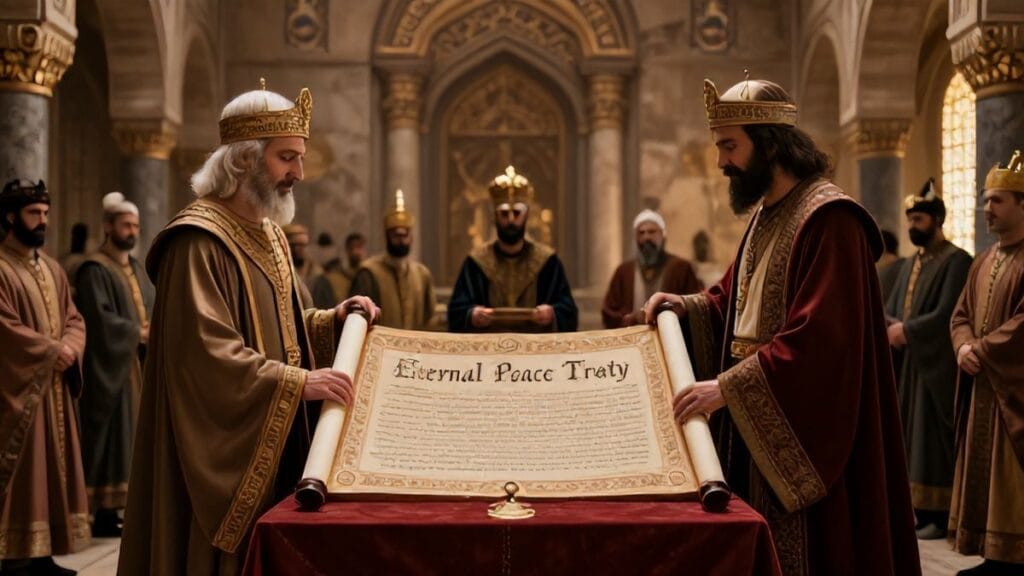
In 532, the negotiations crystallized into a formal agreement known to history as the “Perpetual Peace” between the Byzantine and Sasanian empires—the eternal peace treaty 532. The term “eternal” was an act of political theater as much as a legal claim, but within the ornate language of the accord lay concrete terms that would shape the region for years to come.
The centerpiece was payment. The Byzantines agreed to transfer a large sum of gold to the Persians—contemporary sources speak of 11,000 pounds of gold, an immense fortune. For perspective, this represented the labor of countless farmers and artisans, translated into coin. The money was presented as a one-time contribution to the joint security of the Caucasian frontier, where both empires faced the threat of nomadic incursions by peoples such as the Huns. By casting it as a cooperative defense cost, both sides could maintain their dignity: Persia as a partner, not a superior; Byzantium as prudent, not submissive.
Territorial clauses restored and clarified certain borders. The strategically vital fortress-city of Dara remained under Byzantine control, despite earlier Sasanian demands to dismantle or demilitarize it. At the same time, the Persians retained Nisibis and other key strongholds. A balance, if not absolute parity, was struck. In the Caucasus, arrangements were made for the shared oversight of client kingdoms and mountain passes, attempting to reduce the temptation for either empire to use local dynasties as proxies against the other.
Religious and commercial issues also appeared in the treaty’s fabric. Christians within the Sasanian realm, particularly in Mesopotamia and Persia proper, were assured a measure of protection, even as Zoroastrianism remained the state faith. Similarly, Zoroastrian communities within Byzantine domains were offered safeguards. Trade routes were to be kept open, with agreements on how merchants from each empire could operate within the other’s territory.
According to the historian Procopius, the two sides solemnly pledged that this peace would last forever, or at least as long as the sun and moon endured. Scribes wrote the terms in authoritative hands, seals were impressed, and messages carried the news back to both capitals. On parchment and papyrus, the eternal peace treaty 532 seemed unassailable, a legal wall built against the storm of history.
Yet behind the juridical language, everyone understood a harder truth: no treaty, however eloquent, could bind humans more tightly than their interests allowed. The true test of this “eternal” peace would come not in the signing, but in the years that followed, as emperors weighed opportunity against oath.
Celebrations in Constantinople and Ctesiphon
When the news arrived in Constantinople that peace had been concluded with Persia, the city exhaled. After the trauma of the Nika revolt and the smoke that had darkened its sky, the announcement felt like the first clear day after a storm. Public proclamations praised Justinian’s wisdom and divine favor. In the Hippodrome, the same space that had recently hosted slaughter, crowds now heard speeches about stability and mutual understanding between empires.
Of course, not everyone celebrated for the same reasons. For bureaucrats in the imperial palace, the treaty meant that spreadsheets of projected war expenses could be rewritten. For merchants along the Golden Horn, it hinted at safer caravans from the East, bringing spices, textiles, and perfumes. For ordinary residents, it simply meant the comforting thought that their brothers or sons posted along the eastern border might not be ordered into deadly campaigns in the near future.
Across the frontier, Ctesiphon also received the news with a mix of pride and relief. Court poets could celebrate Khosrow I as a king whose wisdom had secured gold from the Romans without a single arrow fired in the final agreement. Nobles and military commanders, while perhaps wary of a lull that might reduce their battlefield opportunities, could not ignore the financial and political benefits. The treasury was enriched; border provinces could recover; the king’s prestige, as a ruler who could win by words as well as swords, rose.
Yet behind the celebrations, there were murmurs. Some Byzantine soldiers grumbled that gold was being sent to “the fire-worshippers” rather than invested at home. Some Persian warriors muttered that any peace with the Romans was unnatural, a pause before inevitable renewed conflict. Religious hardliners in both lands whispered that making accommodations with those of a different faith risked divine displeasure.
Still, for an ordinary citizen in either capital, the mood was cautiously hopeful. In taverns and marketplaces, people spoke of journeys they might now dare to undertake, of investments suddenly less risky, of weddings that could be planned without fear of last-minute conscription. The eternal peace treaty 532 did not erase anxiety, but it allowed people—just for a while—to imagine a future where the next year might be better than the last.
Soldiers Without a War: Veterans, Families, and Frontier Towns
For the professional soldier, peace can be both blessing and crisis. On the Byzantine side, units stationed along the frontier faced a new reality. No longer could commanders justify continuous high alert or request endless supplies under the banner of imminent danger. Some troops were rotated away, others found their numbers reduced. Veterans, their bodies marked by old wounds, were discharged or encouraged to resettle in frontier towns as farmers and artisans.
In the Sasanian realm, similar dynamics played out. Elite cavalrymen, the fearsome savaran, still had roles to play in internal security and in guarding other borders, but the intensity of conflict against Byzantium diminished. For some, this meant a welcome reprieve, a chance to see their families, to breathe air not laced with the smoke of battle. For others, accustomed to the honor and plunder of war, it felt like an uncomfortable idleness.
Frontier towns themselves began to change. Inns that had catered primarily to officers and military supply agents started to welcome traders and pilgrims. Blacksmiths, once busy forging weaponry and repairing armor, turned more of their attention to tools for agriculture and craft. Markets stocked not only military surplus but also imported goods: dyed cloth from Syrian looms, metalwork from Iranian workshops, perhaps even the occasional exotic item carried along the Silk Road.
Families of soldiers, long accustomed to sudden departures and the fear of widowing or orphaning, experienced a subtler transformation. Letters, so often bearing bad news or requests for money, now contained calmer words. A mother in a village near the upper Tigris might hear that her son’s unit had stood down, that he had spent a month without marching orders. Her prayers, intense and habitual, might relax just a little.
But peace also meant questions about identity. A young man who had built his sense of self around service in the legions or in the cavalry might now have to reimagine his future. Some adapted, becoming minor officials, farmers, or merchants. Others drifted on the margins, potential recruits for future conflicts or rebellions. The human cost of ceasing war is rarely counted, but it is real: a reshaping of lives long oriented toward the battlefield.
Merchants, Monks, and Spies: The Human Traffic of Peace
If soldiers were the most visible protagonists of war, merchants and travelers were the quiet beneficiaries of peace. The eternal peace treaty 532 opened doors that had creaked on rusted hinges for years. Caravans once forced to take long, perilous detours now charted more direct routes from the Levant to Mesopotamia and beyond. Trade stations along the border, once tense and heavily policed, grew busier and, in some cases, friendlier.
Silk lay at the heart of many of these exchanges. Persia controlled vital segments of the overland silk routes connecting China and Central Asia to the Mediterranean. Byzantium craved silk—not only as a luxury commodity for the wealthy, but as an emblem of imperial grandeur. Peace permitted negotiations over tariffs, designated trade cities, and safe conduct for caravans. Money and goods flowed, and alongside them, ideas.
Christian monks saw an opportunity as well. With formal hostilities reduced, missionaries and scholars could contemplate journeys to churches under Sasanian rule, strengthening ties within the wide Christian world that stretched deep into Mesopotamia and even India. Likewise, Zoroastrian pilgrims and priests, though fewer in number, might visit expatriate communities in Byzantine lands. Jewish merchants, long adept at navigating between cultures, thrived in this relatively calmer environment, acting as brokers, translators, and financiers.
But where merchants go, spies follow. Both empires understood that peace did not mean ignorance. Agents embedded in trade caravans or religious missions collected tidbits of information: the number of troops in a western province, the state of a city’s walls, the mood of a provincial governor. Official embassies, ostensibly focused on routine matters, continued to observe and report. Peace altered the tone of interaction, not the underlying vigilance.
Still, this mingling of people produced something war never could: a thicker web of mutual knowledge. A Byzantine trader who spent weeks in a Persian city might return with tales of its markets, its customs, its festivals. A Persian artisan working temporarily in a border town within Byzantine territory could learn Greek phrases, taste unfamiliar foods, and observe Christian rituals. Each such encounter dissolved a tiny part of the wall of otherness that centuries of conflict had built.
Faith Across Frontiers: Christians, Zoroastrians, and Minorities
Religion had always been both a bridge and a barrier between Byzantium and Persia. The Byzantine Empire styled itself as a Christian commonwealth, with the emperor as protector of orthodoxy. The Sasanian Empire, meanwhile, upheld Zoroastrianism as the favored creed, its fire temples carefully maintained by the priestly class. Between these two great faiths lived a mosaic of others: various Christian communities in Persia, Jews in both empires, and smaller religious groups that threaded their way through the changing political winds.
For Christians under Sasanian rule, especially in the Mesopotamian heartland, the treaty brought a measure of relief. In previous decades, suspicion had periodically fallen on them as potential fifth columnists for the Christian Roman Empire to the west. Now, with formal peace and guarantees regarding religious practice written into the eternal peace treaty 532, they could hope for fewer accusations of disloyalty. Bishops might travel more freely, synods convene with less fear, churches be repaired without as much anxiety about provoking Zoroastrian authorities.
In Byzantine territories, small Zoroastrian communities, as well as Manichaeans and others, watched developments carefully. Official suspicion of non-Christian faiths did not vanish, but the logic of diplomacy made outright persecution risky. The empire needed to demonstrate, at least on paper, that it would not mistreat the co-religionists of its new partner. This diplomatic consideration did not create full tolerance, but it did temper the extremes of religious policy.
Jews, ever adaptable, took advantage of the calmer climate. Their communities spanned both worlds: from Antioch to Ctesiphon, from Egypt to the Persian Gulf. Peace allowed rabbis and merchants alike to maintain correspondence, to travel, and to continue the intricate work of preserving law and tradition in a time of shifting borders. In some cases, Jewish traders likely served as informal connectors between the two empires, trusted for their commercial reliability if not always fully embraced socially.
Yet not all was harmony. Theological disputes continued to roil the Christian world itself—Chalcedonians, Monophysites, Nestorians all debated and sometimes condemned each other. The Sasanian court at times found it useful to favor one Christian faction over another, seeing in intra-Christian divisions an opportunity to reduce the danger of unified political opposition. In Byzantium, imperial attempts to impose doctrinal unity sometimes drove dissenters eastward, seeking refuge under a ruler whose primary concern was not Christian orthodoxy but political stability.
Thus, faith flowed across frontiers in complicated ways: as devotion, as refuge, as diplomatic instrument. The eternal peace treaty 532 did not end religious tension, but it created spaces in which religious life could sometimes breathe more freely—and where believers could, cautiously, encounter the “other” not only as an enemy, but as a neighbor.
Peace as Strategy: Justinian Looks West
From the vantage point of Constantinople’s Great Palace, the treaty with Persia was less an endpoint than a starting gun. With the eastern frontier stabilized and the constant drain of war briefly staunched, Justinian could redirect energy toward his long-cherished aim: the reconquest of the western provinces. The gold paid to Persia may have been substantial, but in his strategic calculus, it was an investment—a premium paid to insure his flank while he pursued broader ambitions.
Within two years of the eternal peace treaty 532, Byzantine fleets and armies were sailing and marching against the Vandal kingdom in North Africa. The brilliant general Belisarius, who had proved his mettle at Dara, now led troops across the Mediterranean. In 533–534, after a series of swift campaigns, the Vandals were crushed; Carthage returned to imperial control. Not long afterward, Justinian’s gaze turned toward Italy and the Ostrogothic kingdom. The protracted and devastating Gothic War would consume enormous resources, but it was made politically imaginable partly by the lull in the east.
Thus, the treaty with Persia functioned as a strategic hinge. It allowed the empire to project force westward without the constant terror of a Persian assault on Mesopotamia or Syria. It reassured allies and alarmed enemies. To Gothic and Vandal rulers, a Rome whose eastern border was quiet looked far more dangerous than a Rome locked in a grinding stalemate with the Sasanian king.
Inside the Byzantine administration, budgets and logistics were reorganized accordingly. Troops who might have been needed to man distant forts against Persia could be reassigned. Grain shipments could supply western campaigns rather than eastern garrisons. Court rhetoric painted Justinian as a peacemaker in the east and a restorer of Roman order in the west—a flattering dual image that concealed the staggering human and financial toll of his projects.
Historians have long debated whether Justinian overreached, whether the empire could truly sustain such expansive policies. But there is little doubt that without the eternal peace treaty 532, his western campaigns would have been vastly more difficult, perhaps impossible. In this sense, the treaty’s impact reverberated far beyond the direct relationship between Byzantium and Persia; it reshaped the political map of the Mediterranean for a generation.
Persian Reforms Under the Shelter of Peace
While Justinian sent armies westward, Khosrow I used the respite to turn inward. Peace with Byzantium released pressure on the empire’s western border, allowing him to concentrate on consolidating and reforming his realm. The Sasanian state in the early sixth century was complex, with powerful noble families, influential Zoroastrian clergy, and diverse subject populations. Khosrow’s challenge was to strengthen royal authority without provoking irresistible backlash.
One key area was taxation. Khosrow is credited in later sources with instituting reforms that made taxation more systematic and, in some regions, more equitable. Instead of arbitrary levies demanded at irregular intervals, assessments were to be based more clearly on land and productivity. This provided the crown with more predictable revenue and reduced some of the distortions that had fueled corruption and resentment. Such reforms required time, administrative focus, and a degree of social calm—conditions far easier to obtain without an active major war against Byzantium.
Khosrow also invested in infrastructure and defense on other frontiers. In the northeast, against nomadic threats, fortifications and alliances were strengthened. In the south and southeast, trade routes toward India and the Persian Gulf were nurtured. Cultural life flourished under his patronage: philosophical and scientific works were translated, and scholars from various lands found their way to his court. The image of Khosrow as a “philosopher-king,” while doubtless idealized, reflects a real period of intellectual vibrancy.
Within the Sasanian military, the pause for peace allowed for reorganization. Units could be retrained, new tactics considered, equipment improved. The empire’s elite cavalry, the embodiment of Persian martial pride, remained a formidable force. Peace did not mean demilitarization; it meant selective preparation. In a sense, Khosrow used the eternal peace treaty 532 the way a chess player uses a quiet interlude: to reposition pieces for potential future moves.
Domestically, the king promoted an image of justice. Stories later told of him traveling in disguise to witness the condition of his subjects are almost certainly legend, yet their very circulation suggests what people wanted or expected from his reign. Whether or not Khosrow personally walked among peasants, his administration did try, in its own way, to present the monarchy as the guarantor of order after years of turbulence. Peace with Byzantium became part of that narrative, proof that under his rule, Persia could command respect abroad and stability at home.
Cracks in the “Eternal” Promise
No matter how solemnly proclaimed, eternity is a fragile concept in politics. Almost as soon as the ink on the treaty dried, forces began to work against its permanence. Some were structural: the sheer weight of history between the two empires, accumulated grievances, and the strategic value of contested regions like Armenia and the Caucasus. Others were more immediate and personal: shifts in advisors, local conflicts on the frontier, and the ambitions of men who had not been in the room when the eternal peace treaty 532 was signed.
On the Byzantine side, the westward campaigns that the treaty made possible soon stretched the empire’s capacity. The Gothic War in Italy dragged on far longer than Justinian had hoped, draining the treasury, depopulating regions, and risking military overextension. As resources were pulled toward Italy, the ability to respond flexibly to new tensions in the east diminished. Any disturbance on the Persian frontier now threatened to expose how thinly spread the Byzantine forces had become.
In Persia, Khosrow’s reforms and centralization efforts, though strengthening the state in the long run, also created losers: noble families who resented the curbing of their power, officials whose old privileges were curtailed. Discontent among elites sometimes sought expression in foreign policy—pressure to assert Persian might, to demonstrate that the shahanshah remained more than a king of bureaucrats.
Local incidents, those sparks that had so often ignited larger fires, continued. A border town might accuse a neighboring garrison of violating agreed limits; a tribal group allied to one empire might raid territory claimed by the other. Each such event demanded diplomatic skill to defuse. Over time, repeated small violations eroded the habit of trust that treaties seek to build.
Religion, too, played its part. Anti-Zoroastrian sentiment in some Byzantine circles and anti-Christian suspicion in Persia never fully disappeared. Whenever an episode of persecution, real or rumored, reached the other side, it could be used by hardliners to argue that the treaty partner was faithless. The conceptual distance between “those people with whom we made peace” and “those heretics who defy our god” could, in heated moments, collapse.
Still, for several years, these cracks did not yet shatter the edifice. The peace held, even if imperfectly. In that precarious stability, thousands of ordinary lives unfolded with fewer disruptions than before. The tragedy of the coming years would be not that the treaty failed instantly, but that it succeeded just enough to make its eventual collapse all the more painful.
The Return of War and the Judgment of History
By the early 540s, the conditions that had allowed the treaty to function were unraveling. The immediate trigger for renewed conflict remains a matter of historical detail and debate, but the broad contours are clear. Sasanian concerns about Byzantine involvement with Arab clients and other regional dynamics, combined with opportunistic calculations by Khosrow, pushed Persia to test the limits of the agreement.
In 540, Khosrow led a campaign into Byzantine territory, crossing the Euphrates and advancing into Syria. The capture and sack of Antioch, one of the great cities of the Byzantine East, sent a shock through the empire. Antioch’s fall was not simply a military event; it was a symbolic wound. For decades it had been a center of Christian learning and commerce; now, its splendid buildings were looted, its people killed or deported. Procopius, an eyewitness to many events of Justinian’s reign, later described the devastation with a mixture of grief and cold precision.
With Khosrow’s offensive, the eternal peace treaty 532 lay in ruins, its promises scattered amidst the rubble of cities. War flared again across Mesopotamia and the Levant. Byzantine resources, already strained by the Italian campaigns and by outbreaks of the terrifying Justinianic Plague, struggled to meet the renewed threat. Persia, too, paid a price. Campaigns were costly, and the reputation for reliability that Khosrow had cultivated took a blow.
How, then, should history judge the treaty? Was it a naive fantasy, disproven by events? Or was it a rational attempt by two exhausted empires to secure a breathing space, successful on its own limited terms? Many modern historians incline toward the latter view. The “eternal” label was propaganda; the real achievement lay in nearly a decade of relative calm between 532 and 540, during which both empires pursued major strategic and domestic projects.
The re-ignition of war does not retroactively erase the treaty’s effects. The reconquest of North Africa, the foundations of Byzantine presence in Italy, Khosrow’s internal reforms—all these outcomes were intertwined with the window of opportunity peace provided. At the same time, the treaty’s failure underscores a sobering lesson: without mechanisms to continually reconcile shifting interests, even the grandest-sounding agreements are vulnerable to the changing winds of power.
In the centuries that followed, chroniclers remembered the Perpetual Peace with a mixture of irony and nostalgia. Some saw in it an example of imperial hubris, others a glimpse of what might have been if human desires could be permanently tamed. Its story, with all its hope and disappointment, remains a case study in the limits of diplomacy when set against the relentless forces of ambition and fear.
Echoes Through Time: Why the Peace of 532 Still Matters
Standing back from the details—the weight of the gold, the names of the forts, the clauses in carefully inked scripts—we can ask: why does this story still matter? Part of the answer lies in the pattern it reveals. The eternal peace treaty 532 was not unique in seeking to turn fierce rivals into, if not friends, at least dependable neighbors. Across history, great powers have again and again tried to defuse their rivalry through ambitious agreements, only to find that paper cannot forever contain the volatility of human affairs.
Yet such treaties shape the world nonetheless. The Perpetual Peace reoriented the energies of two sprawling empires. It allowed Byzantium to momentarily resurrect Roman dreams in the West and Persia to solidify its own imperial framework. It influenced where soldiers marched, where merchants traveled, where monasteries were built, and where refugees sought shelter. For roughly a decade, from the perspective of those who might otherwise have died in battle or lost their homes to fire and plunder, the treaty was not a failure but a reprieve.
In the long arc of Late Antiquity, this moment of calm also precedes and frames later transformations. Within a century of the treaty, the Arabian Peninsula would give rise to a new religious and political force: Islam. The Arab-Muslim conquests of the seventh century would crash upon both the Byzantine and Sasanian Empires, forever altering the map the treaty had tried to freeze. Some historians have argued that the repeated wars between Byzantium and Persia, before and after 532, weakened both so thoroughly that they became vulnerable to this new power. In that sense, the treaty appears as a brief, shimmering pause before a far more radical reordering.
Yet we should not read history only backward, as if everything earlier were merely a prelude. For the men and women who lived through it, the eternal peace treaty 532 was not a footnote; it was a defining context of their lives. The farmer who rebuilt his house near the frontier, the merchant who risked a new caravan route, the monk who traveled to a distant monastery under assurances of safety—all of them used the space that peace provided to pursue their own futures.
There is also a more intimate lesson here about human promises. The word “eternal,” so casually attached to a treaty between two mortal empires, invites reflection. Perhaps, ultimately, the value of such promises lies not in their literal fulfillment, but in the seriousness with which they are made. In 532, Justinian and Khosrow, for all their flaws and ulterior motives, dared to imagine that the oldest rivalry of their world could be transformed, if only temporarily, into cooperation. Their attempt, half-successful and half-doomed, still echoes in every modern effort to turn enemies into partners.
Conclusion
The signing of the so-called Perpetual Peace in 532 was not a simple tale of idealism crushed by reality. It was, rather, a nuanced episode in which exhaustion, ambition, pragmatism, and hope converged. The Byzantine Empire, under Justinian, sought room to chase long-cherished dreams of western reconquest and internal renewal. The Sasanian Empire, under Khosrow I, grasped the chance to stabilize its finances, reform its institutions, and reinforce its other frontiers. For nearly a decade, the eternal peace treaty 532 functioned as intended: it calmed a dangerous frontier, encouraged trade and travel, and granted countless people the luxury of relatively predictable lives.
Its eventual breakdown, marked dramatically by the fall of Antioch in 540, does not negate those years of respite. Instead, it highlights how fragile great-power accommodations are when they rest on shifting interests and personalities rather than on deeper, more durable structures of trust and mutual dependency. The treaty’s lofty language of eternity collided with the finite patience, fears, and desires of rulers and elites who, when opportunity beckoned, chose risk over restraint.
Yet, in its imperfection, the Perpetual Peace offers enduring insights. It reminds us that diplomacy is often driven less by goodwill than by shared weariness and that even transient agreements can have far-reaching consequences—shaping wars fought on distant shores and reforms implemented deep in imperial heartlands. It also challenges us to look beyond the cynicism of hindsight. For those who slept more soundly because the frontier fell quiet, who sent children on journeys that would have been unthinkable in wartime, the treaty was not a hollow phrase but a lived reality.
History, ultimately, is built from such moments: when lofty words on a page intersect, however briefly, with the daily rhythms of ordinary existence. The story of the eternal peace treaty 532, with its promise of unending calm and its all-too-human end, stands as a poignant example of how far empires can reach toward peace—and how hard it is to hold it.
FAQs
- What was the Eternal Peace Treaty of 532?
The Eternal Peace Treaty of 532, also called the Perpetual Peace, was a formal agreement between the Byzantine Empire under Emperor Justinian I and the Sasanian Empire under King Khosrow I. It aimed to end a cycle of wars along their eastern frontier by fixing borders, ensuring protection for religious communities, and securing trade, in exchange for a substantial payment of gold from Byzantium to Persia. - Why did the Byzantine Empire agree to pay gold to Persia?
Byzantium paid a large lump sum of gold—often cited as around 11,000 pounds—to Persia as part of the treaty. Officially, this was framed as a contribution to the joint defense of the Caucasus against northern nomads, not as tribute. In practice, Justinian accepted the payment as the price of securing peace in the east so he could redirect military resources toward his ambitious campaigns in North Africa and Italy. - How long did the “eternal” peace actually last?
Despite being labeled “eternal,” the peace lasted less than a decade in its pure form. From 532 until around 540, large-scale warfare between the two empires subsided, though minor tensions persisted. In 540, Khosrow I invaded Byzantine territory, famously sacking Antioch, effectively ending the treaty’s core commitments. - What impact did the treaty have on ordinary people?
For people living along the frontier, the treaty meant fewer raids, less conscription, and more stable conditions for farming, trade, and travel. Soldiers were rotated out of constant warfare, merchants could plan routes with greater confidence, and religious communities—especially Christians in Persia and Zoroastrians in Byzantine lands—benefited from formal protections written into the agreement. - How did the treaty affect Justinian’s later conquests?
The treaty freed Justinian from the immediate threat of a major Persian war, allowing him to send troops and resources westward. This made possible his successful reconquest of the Vandal kingdom in North Africa and his long, costly campaign in Italy against the Ostrogoths. Without the calm on the eastern front provided by the treaty, these ventures would have been far riskier. - What did Khosrow I gain from the peace?
Khosrow I gained a large infusion of gold, international prestige as a ruler who could secure favorable terms without battle, and, crucially, time. Peace with Byzantium allowed him to focus on internal reforms—particularly in taxation and administration—and to strengthen Persia’s other frontiers. It enhanced his reputation both as a warrior-king and as a prudent statesman. - Why did the Eternal Peace Treaty eventually fail?
The treaty failed because the underlying rivalry between the empires remained unresolved and new strategic opportunities and pressures emerged. Shifts in regional alliances, frontier incidents, religious tensions, and the temptations created by Byzantine overextension in the West all played a role. When Khosrow judged that he could profit from a renewed offensive, the legal promises of 532 were overridden by political calculation. - How do historians view the treaty today?
Most historians see the treaty not as a naive or meaningless act, but as a rational attempt by two exhausted powers to secure a limited but valuable respite. It is often studied as a case of high-level diplomacy in Late Antiquity, illustrating how treaties can temporarily reconfigure power balances and enable ambitious projects, even if they ultimately succumb to renewed conflict. - Did the treaty influence religious policy in either empire?
Yes, to a degree. The treaty included commitments to respect the religious communities within each empire, especially Christians in Persia and Zoroastrians in Byzantine lands. While it did not end religious tension or persecution, it placed diplomatic pressure on both states to avoid overtly harsh measures that could be seen as violations of the agreement and provoke international crisis. - Is the Eternal Peace Treaty of 532 comparable to modern peace agreements?
In many ways, yes. Like modern treaties, it involved financial arrangements, territorial settlements, security guarantees, and provisions for minority rights, all wrapped in lofty rhetoric about lasting peace. Its eventual failure, despite these efforts, offers sobering parallels to contemporary struggles to convert adversarial relationships into durable stability between great powers.
External Resource
Internal Link
Other Resources
- Encyclopaedia Britannica – general search for the exact subject
- Google Scholar – academic search for the exact subject
- Internet Archive – digital library search for the exact subject

