Table of Contents
- Storm over the Empire: Setting the Stage for Breitenfeld
- From Prague to Leipzig: How the War Devoured Central Europe
- Gustavus Adolphus Rises: The Lion of the North
- Tilly and the Catholic League: The Veteran Opponent
- Saxony at the Crossroads: Fear, Faith, and Survival
- March to Breitenfeld: Two Armies Converge
- The Battlefield Revealed: Ground, Weather, and Formations
- Morning of 17 September 1631: Anxiety before the Clash
- Fire and Maneuver: The New Swedish Way of War
- Collapse on the Saxon Left: Disaster and Opportunity
- The Swedish Counterstroke: Turning Defeat into Victory
- Cavalry Whirlwinds and Shattered Squares: The Battle’s Climax
- Nightfall at Breitenfeld: The Field of the Dead
- Echoes across Europe: Political Shockwaves of the Victory
- Winners, Losers, and Survivors: Human Stories from the Battlefield
- Rewriting the Art of War: Tactical Lessons of Breitenfeld
- Faith, Propaganda, and Memory: How Breitenfeld Was Remembered
- From Breitenfeld to Lützen: The Road Ahead in the Thirty Years’ War
- Conclusion
- FAQs
- External Resource
- Internal Link
Article Summary: On 17 September 1631, on the gently rolling fields near the village of Breitenfeld in the Electorate of Saxony, Europe’s future tilted on a single afternoon of fire and thunder. This article follows the battle of breitenfeld 1631 from its roots in the religious and political chaos of the Thirty Years’ War through the clash between Gustavus Adolphus’s innovative army and Count Tilly’s hardened imperial veterans. It explores how the battlefield dissolved into terror on the Saxon wing, how Swedish discipline and flexible tactics reversed near-disaster, and how the imperial line finally buckled under relentless artillery and cavalry blows. Beyond the smoke and blood, it traces the wider shockwaves that reshaped alliances, emboldened Protestant states, and shattered the aura of Habsburg invincibility. Through personal vignettes, strategic analysis, and contemporary accounts, the narrative reveals how this victory became a symbol of divine favor for some and of grim modern warfare for others. The battle of breitenfeld 1631 emerges not just as a military turning point, but as a moment when technology, faith, and human courage collided in a way that would change European history. And yet behind the triumphal songs and pamphlets, the story of Breitenfeld is also one of burned villages, shattered families, and a continent learning that no victory in such a war came without a terrible price.
Storm over the Empire: Setting the Stage for Breitenfeld
The fields north of Leipzig, where Breitenfeld lay, did not look like a stage for world-changing events. They were open, rolling stretches of farmland, dotted with small villages and crisscrossed by tracks worn by ox carts and peasants’ feet. Yet by the autumn of 1631, those fields stood at the very center of a storm that had been building for more than a decade across the Holy Roman Empire. The battle of breitenfeld 1631 would erupt not as an isolated clash, but as the culmination of religious tension, imperial ambition, and the gradual transformation of warfare itself.
Since 1618, the empire had been unraveling. The Defenestration of Prague, when angry Protestant nobles hurled imperial officials out a castle window, had lit a conflagration no one could control. At first it seemed like a localized rebellion in Bohemia, a conflict that might be contained with a few harsh edicts and executions. But the currents that pulled the empire apart ran deeper than any single revolt. Centuries of friction between Catholic and Protestant princes, the competing power of dynasties, and the rising influence of foreign monarchs had all gnawed at the fragile balance that had kept peace since the Reformation.
By the time Swedish boots would churn up the soil at Breitenfeld, the empire had already known burned cities, massacres, and shifting loyalties. Imperial armies and Catholic League troops, fighting nominally for Emperor Ferdinand II and the Catholic cause, had smashed Protestant resistance in Bohemia and the Palatinate. Mercenaries wandered the countryside, half-soldiers and half-bandits, feeding off the land. Walled towns were stuffed with refugees. Some regions lost a third of their population in a single decade. In such a world, the idea of a clear, decisive battle felt almost like a memory from an earlier, more orderly age.
And yet people still hoped for moments of clarity. In Protestant courts from Saxony to Brandenburg, anxious rulers watched the emperor’s star rise and wondered when it would eclipse them entirely. Lutherans and Calvinists argued amongst themselves over doctrine and politics, but all of them saw the noose tightening. The Catholic victory at the Battle of White Mountain in 1620 had shown how ruthless the emperor could be when his authority was challenged. Confiscated lands, forced conversions, exiled nobles—these were not abstract possibilities, they were realities recorded in dozens of German principalities.
Into this world stepped new actors: Denmark first, then Sweden, foreign kings who saw in Germany both a battlefield of faith and a chessboard of power. The entry of Gustavs II Adolf—better known in history as Gustavus Adolphus—would give the conflict a commander with a vision very different from the aging generals of the empire. But in 1631, that vision still needed proof on the battlefield. The capitols of Europe waited to see whether the “Lion of the North” was a savior, a menace, or just another opportunist to be ground into the German mud.
From Prague to Leipzig: How the War Devoured Central Europe
The road to Breitenfeld began, in many ways, in Prague’s castle in May 1618. When Protestant nobles cast the emperor’s representatives into the moat—miraculously, they survived—they were not just expressing outrage over religious restrictions. They were reacting to years of creeping centralization under the Habsburgs, who wielded Catholic identity as both sword and shield. Their defiance sparked the Bohemian Revolt, and soon the emperor’s authority was openly defied in a key kingdom of his realm.
Ferdinand II responded with a mixture of piety and steel. A devout Catholic, educated by Jesuits, he saw himself as chosen to defend the faith and restore unity to the empire. His armies, led by seasoned commanders, shattered the Bohemian rebels at White Mountain in 1620. That victory did more than decide one campaign; it made an example of an entire country. Protestants were driven out or compelled to convert. Church property was restored. The old urban elites were replaced with Catholic loyalists, many of them from foreign lands. A shiver went through every Protestant court in the empire. If it could happen to Bohemia, why not to them?
From there, the war spread like an oil stain. The Palatinate, whose elector Frederick V had dared to accept the Bohemian crown, was invaded and carved up. Spanish and imperial troops moved along the Rhine, securing vital routes. The Dutch, long at war with Spain, watched uneasily as Habsburg power seemed to encircle them. Denmark’s King Christian IV, both a Protestant prince of the empire and a northern monarch with his own ambitions, stepped into the fray, hoping to defend the Protestant cause while expanding Danish influence in northern Germany.
The so-called Danish Phase of the war ended badly for Christian IV. The imperial side, increasingly reinforced by the Catholic League and the controversial general Albrecht von Wallenstein, proved too strong. Defeats in the 1620s forced Denmark to withdraw, humiliated and weaker than before. In 1629, the Edict of Restitution aimed to roll back decades of Protestant gains, demanding the return of ecclesiastical lands. Many princes read it as a declaration of war on their very existence. Resentment turned to dread.
By now, the devastation on the ground had become routine. Villages were plundered in the name of both God and pay arrears. Soldiers, often unpaid for months, “lived off the land,” a euphemism that meant starving peasants, burned barns, and spreading disease. Contemporary chroniclers wrote of wolves returning to abandoned fields, of whole districts where the church bells no longer rang because there was no one left to ring them. The war had slipped far beyond the control of any one ruler, and yet those rulers continued, grimly, to seek advantage in the chaos.
It was in this bleak landscape that Leipzig and the surrounding Saxon countryside took on new significance. The Electorate of Saxony, Lutheran and relatively powerful, had so far tried to balance, avoid provocation, and preserve its lands. But when the imperial armies moved closer, and when the Swedes landed on the Baltic shores, neutrality became an increasingly fragile shield. The path from Prague to Leipzig was not a straight line, but a jagged trail of broken treaties, shifting coalitions, and deepening wounds. By 1631, it led inevitably to the fields near Breitenfeld.
Gustavus Adolphus Rises: The Lion of the North
Gustavus Adolphus was not the first foreign king to intervene in the German conflict, but he would become the most decisive. Born in 1594, he ascended the Swedish throne at a young age and spent much of his early reign at war: against Denmark, against Russia, and most crucially against Poland-Lithuania. These conflicts hardened him and his kingdom in ways few in the empire fully understood. They forged an army that combined discipline with innovation, and a ruler who thought deeply about how to translate Sweden’s limited resources into battlefield superiority.
By the late 1620s, Sweden ruled key stretches of the Baltic coast, yet remained threatened by powerful neighbors. The war in Germany was not only about faith for Gustavus, though he presented it piously; it was also about securing influence, allies, and defensible frontiers. “I wage war not for pleasures, but so that I may live in peace,” he is reported to have said—a statement that captured both his ambition and his constant sense of insecurity. The Catholic Habsburgs, ruling both Spain and the empire, loomed over northern Europe like a great, encircling shadow.
Unlike many of his contemporaries, Gustavus did not treat military organization as a static inheritance. He experimented. Inspired partly by Dutch reforms and partly by his own experience, he lightened the equipment of infantry, emphasized mobile field artillery, and streamlined command structures. Where old-style tercios—great, lumbering pike-and-shot formations—dominated southern and imperial armies, the Swedes deployed smaller, more flexible brigades, capable of delivering rapid volleys and changing formation under fire.
In the Swedish army, coordination between arms was not just a theory. Infantry, cavalry, and artillery trained to act together, to exploit each other’s strengths. Artillery pieces were lighter and more maneuverable, able to shift position during battle. Cavalry were drilled not simply to charge and then gallop off in pursuit, but to regroup and strike again at decisive moments. Many of the men under Gustavus’s banner were not Swedes at all, but Germans, Scots, Finns, and others drawn by pay, plunder, or conviction. Yet, unusually for the time, Gustavus worked to impose a degree of discipline that restrained the worst excesses of mercenary behavior—at least in theory.
When Gustavus landed in Pomerania in 1630 with a relatively small force, many in the empire dismissed him as an irritant rather than a real threat. Spain and the emperor had defeated larger armies than his. But step by step, his position improved. He secured coastal footholds, allied with the powerful city of Magdeburg (though he could not save it from a horrific imperial sack), and began to attract German princes who saw in him a possible shield against the emperor. Still, it was not enough. Without a major German ally, his campaign would remain marginal, a northern sideshow.
That changed with Saxony. The Elector John George I had wriggled and hesitated, loath to commit fully to either side. But imperial actions would push him into Gustavus’s arms, and in the summer and early autumn of 1631, the Lion of the North finally gained the partnership—and manpower—he needed to confront Count Tilly on something like equal terms. The battle of breitenfeld 1631 would be his chance to show Europe whether Swedish methods could withstand the full weight of imperial power.
Tilly and the Catholic League: The Veteran Opponent
Opposing Gustavus Adolphus was one of the most experienced field commanders of the age: Johann Tserclaes, Count of Tilly. A Walloon nobleman who had fought for the Habsburgs and served in the Catholic League for decades, Tilly embodied an older generation of warfare—stern, methodical, and deeply shaped by the religious fervor of the Counter-Reformation. With his gaunt, ascetic face and rigid bearing, he seemed carved from the very dogmas he defended.
Tilly’s record spoke for itself. He had helped crush the Bohemian Revolt and destroy Protestant armies across Germany. His soldiers, a mixture of League contingents and imperial forces, were veterans of brutal campaigns. They knew how to hold steady under fire, how to storm a fortified town, and how to live off a ravaged countryside. For years, his tercios—massive blocks of pikemen flanked by musketeers—had carried the day against less well-organized foes.
But by 1631, cracks were beginning to show. The war had dragged on far longer than anyone expected, straining finances and morale. Many of Tilly’s units were no longer the homogeneous, disciplined formations of a decade earlier. Casualties and desertions had forced him to refill his ranks with new levies, less seasoned than the core veterans. Coordination with other imperial commanders, especially Wallenstein, was plagued by politics, jealousy, and diverging strategies. The emperor had temporarily dismissed Wallenstein, leaving Tilly as the principal military instrument—but also exposing him to all the expectations and anxieties of Vienna.
Tilly was no fool. He recognized that Gustavus Adolphus brought new ideas onto the field. He had heard reports of Swedish artillery flexibility, of strange light formations and rapid volleys. But he trusted the methods that had served him for years: deep squares, massive firepower concentrated in key points, and the moral certainty that God favored his cause. To many in his army and among his allies, he was still the unbeatable old general, the man who had never suffered a catastrophic defeat.
In the summer of 1631, Tilly made a diplomatic and strategic misstep that would haunt him. Seeking to break Saxon neutrality and punish what he saw as half-heartedness in supporting the emperor, he moved against Protestant territories in the region, including Saxony itself. The sack of Magdeburg in May, carried out under his overall direction, had already shocked Protestant Europe—upwards of 20,000 civilians were killed in a frenzy of looting and fire. When his troops approached Saxon lands, the careful balance John George had maintained crumbled. No ruler, he realized, could negotiate from a position of strength while imperial soldiers camped in his fields and threatened his cities.
Thus Tilly, in pressing his advantage, inadvertently drove Saxony into alliance with Sweden. The stage was set, not only for a military confrontation, but for a clash of reputations: the old master of Catholic arms against the upstart innovator from the north. It is astonishing, isn’t it, how often history pivots on decisions that must have seemed, in the moment, like routine applications of pressure.
Saxony at the Crossroads: Fear, Faith, and Survival
The Electorate of Saxony in 1631 was a land rich in resources, culture, and political significance. It was the cradle of Lutheranism, where Martin Luther had nailed his theses and argued his case before princes and theologians. Its elector, John George I, carried the weighty title and responsibility of one of the empire’s foremost princes. And yet, despite this legacy, Saxony had spent much of the war cowering on the sidelines, trying to survive.
John George was a cautious, conservative ruler. He mistrusted radical Calvinists as much as he disliked the Jesuits. For years he had tried to steer a middle course, upholding imperial law when possible but resisting what he perceived as overreach from Vienna. He feared that open alignment with a foreign king—especially one as controversial as Gustavus Adolphus—might spell disaster. His court was divided. Some advisers urged tighter cooperation with the emperor; others whispered that only Swedish steel could save Saxony from the fate of Bohemia.
The sack of Magdeburg changed everything. News of the inferno—of women and children cut down in the streets, of churches turned to charred shells—sent shockwaves through Protestant lands. Pamphleteers described rivers running red and bodies piled like timber. Though modern historians debate the exact numbers, there is no doubt it was one of the most terrible urban massacres of the war. John George, like many Lutheran princes, felt both guilt and fear: guilt for not having moved sooner to defend his co-religionists, fear that his own subjects would soon suffer the same fate.
As Tilly’s armies maneuvered near Saxony, the illusion of safety evaporated. The elector could no longer trust that carefully worded letters and pledges would keep marauding soldiers at bay. Meanwhile, Gustavus adroitly pressed his case. He presented himself as the defender of Protestant Germany, a king willing to risk everything on the battlefield for the faith that had taken root in places like Wittenberg and Leipzig. His offer was clear: alliance, mutual defense, and the combined strength needed to confront the imperial juggernaut.
In September 1631, John George finally committed. Saxon banners would fly alongside Swedish ones, their troops marching under a unified strategy for the first time. It was not an easy decision; it meant open defiance of the emperor and the near certainty that, win or lose, Saxony’s future would be reshaped. But at least it was a choice made in the hope of agency, rather than a helpless waiting for the storm to break.
For the ordinary Saxon peasant or townsman, the stakes were grimly practical. New armies meant new requisitions, more mouths to feed, more danger of plunder if things went wrong. Families braced themselves. Villages along the likely lines of march hid what food and valuables they could. Pastors preached that God’s judgment was upon the land, sometimes in tones of hope, sometimes in near-despair. The decision to ally with Sweden did not magically shield Saxony from suffering—but it did ensure that if a decisive confrontation came, it would come on Saxon soil, perhaps, ironically, offering the best chance to stop imperial encroachment once and for all.
March to Breitenfeld: Two Armies Converge
The movement toward Breitenfeld in early September 1631 resembled a slow tightening of a noose. On one side marched the combined Swedish-Saxon forces, still feeling out their partnership. On the other, Tilly’s imperial-Catholic League army, confident yet wary. Each side sought favorable terrain, supply, and the opportunity to force the other into battle on its own terms.
Gustavus Adolphus maneuvered carefully. He understood that his coalition was fragile. Swedish troops were hardened and well-drilled, but the Saxon contingents were newer to this scale of conflict, their officers less familiar with Gustavus’s methods. Communication between the allied staffs required tact as well as clarity. The king walked a fine line: he needed John George committed and proud, not humiliated; yet he also needed Saxon units placed where they could do the least harm if they broke.
Tilly, for his part, sought to bring the Swedes to battle before they could entrench their position or draw in more allies. He could not allow a foreign Protestant army to roam at will in central Germany, rallying princes to its banner. The prestige of the emperor, already tarnished by controversy over the Edict of Restitution and the dismissal of Wallenstein, could not survive the perception of weakness. Tilly aimed to repeat his earlier successes: crush his enemies in one decisive blow and then dictate harsh terms.
Skirmishes and scouting actions lit up the countryside. Cavalry patrols probed for weaknesses, occasionally clashing in sudden bursts of steel and pistol fire. Local villagers watched the tides of men and horses with a mixture of awe and terror. Some were pressed into service as guides or forced to provide carts and fodder. Fields already strained by years of war now had to feed tens of thousands of mouths. Every day that passed before battle meant deeper hunger later.
In the days before 17 September, scouts and staff officers on both sides converged on the vicinity of the village of Breitenfeld, a few kilometers north of Leipzig. The area offered open ground suitable for deploying large armies, with gentle slopes that could influence artillery effectiveness. Gustavus inspected the terrain, taking note of rises, dips, and potential lines of retreat. He made a fateful decision: he would fight here, on this ground, with the Saxons anchored on one wing and his Swedes on the other.
The convergence was almost ritualistic in its inevitability. From the north and west came the Swedes and Saxons; from the south and southwest, Tilly’s army, marching under Catholic banners and the emperor’s authority. Both sides brought their hopes and fears, their banners and artillery, their priests and chaplains. The battle of breitenfeld 1631 was about to begin—not yet in the crash of musketry, but in lines drawn quietly in the earth by commanders’ decisions.
The Battlefield Revealed: Ground, Weather, and Formations
Dawn broke on 17 September 1631 with a cool clarity. Accounts suggest that the weather was fair—good visibility, dry enough for movement, but not so hot as to bake the men in their armor and coats. A light breeze stirred the banners as two great hosts deployed facing one another across the fields near Breitenfeld.
The terrain favored neither side decisively, but it held nuances that a commander could exploit. The ground sloped gently, creating subtle advantages in fields of fire for artillery. To the Swedish-Saxon right, the land opened into a broad plain; to their left, slight undulations and villages offered both cover and potential complications. Gustavus arranged his line with careful attention to these details.
The allied army stretched across perhaps three kilometers. On the left wing, he placed the Saxon contingents under John George’s command. They formed in more traditional formations, closer in spirit to older imperial styles, with dense infantry and cavalry less integrated with artillery support. On the right, Gustavus positioned his Swedes: infantry brigades in thinner, more flexible lines, interspersed with batteries of light artillery, and cavalry units ready to surge forward or guard the flanks.
Tilly’s disposition reflected his confidence in familiar methods. His central infantry blocks—the feared tercios and similar deep formations—stood massed, backed by reserves. On his left and right wings, cavalry readied themselves to strike at what they hoped would be weaker enemy horse. Imperial and League artillery, though numerous, tended to be heavier and less mobile, reliant on initial placement rather than mid-battle maneuvering.
Between the two armies lay a killing ground soon to be filled with smoke and echoes. Priests and chaplains moved along the lines, blessing men, hearing hasty confessions, and urging courage. Flags fluttered: Catholic banners with saints and crucifixes; Protestant standards marked with psalms and plain crosses. Soldiers adjusted their armor, checked gunpowder flasks, re-tied straps. Some prayed quietly; others joked, laughed, or stared at the enemy with fixed, hollow eyes.
The formation itself told a story of an age in transition. On one side, the older model of war—great, cumbersome blocks designed to absorb shock and deliver crushing, concentrated fire. On the other, the new Swedish system: shallower, more linear, designed to pour continuous musket volleys and shift as the battle unfolded. The field at Breitenfeld, in this sense, was not just about Protestant versus Catholic, or Swede versus Bavarian. It was about which vision of organized violence would define the next century of European conflict.
Morning of 17 September 1631: Anxiety before the Clash
As the sun climbed, the stillness before the storm grew almost unbearable. Witnesses later recalled an eerie quiet that settled over the ranks once deployment was complete—a silence broken only by the calls of officers, the creak of wagons, the occasional snort of a horse. War, in that moment, was a waiting game. Each side knew that the first serious exchange of fire would set loose forces no one could fully control.
Gustavus rode along his lines, conspicuous in his armor and distinctive buff coat. He spoke to regimental commanders, checked artillery positions, and offered words of encouragement in Swedish, German, and whatever scraps of other tongues he could muster. To his men, he was not a distant figure; he was a king who risked his own life in their midst. Stories had already circulated of his narrow escapes in earlier battles, adding a layer of legend to his presence.
On the allied left, John George I also moved among his Saxons, though with a very different persona. Less of a battlefield king and more of a cautious prince, he nonetheless knew that his personal presence would be taken as a sign of commitment. For many Saxon troops, this was their first time standing in line with such a vast army before them. The sight of imperial banners—symbols of the same authority that had crushed Bohemia and ravaged the Palatinate—must have struck a chill in their hearts.
Across the field, Tilly prepared in his own way. He trusted in the experience of his soldiers and the righteousness of his cause. For him, war and faith were intertwined. Reports suggest he exhorted his men in the name of God and the emperor, reminding them of past victories. To the Catholic League troops, battle was more than a contest of arms; it was a test of God’s favor. Many believed that the Protestants, especially those led by a foreign king, were rebellious subjects to be brought back to obedience.
In the ranks, individual fears and hopes mingled with the broader causes proclaimed from pulpits and battle standards. A young Saxon musketeer might worry more about whether his matchcord would stay lit than about transubstantiation or the Edict of Restitution. A Swedish cavalryman might think of his distant farm, his wife, and the promise of pay and plunder. A Bavarian pikeman might silently recite prayers taught to him as a child, hoping that whatever happened, his soul would not be lost.
The battle of breitenfeld 1631 was, from the perspective of kings and generals, a matter of strategy and statecraft. But for the tens of thousands about to collide, it was also a matter of sheer survival from one hour to the next. And then, at last, the guns spoke.
Fire and Maneuver: The New Swedish Way of War
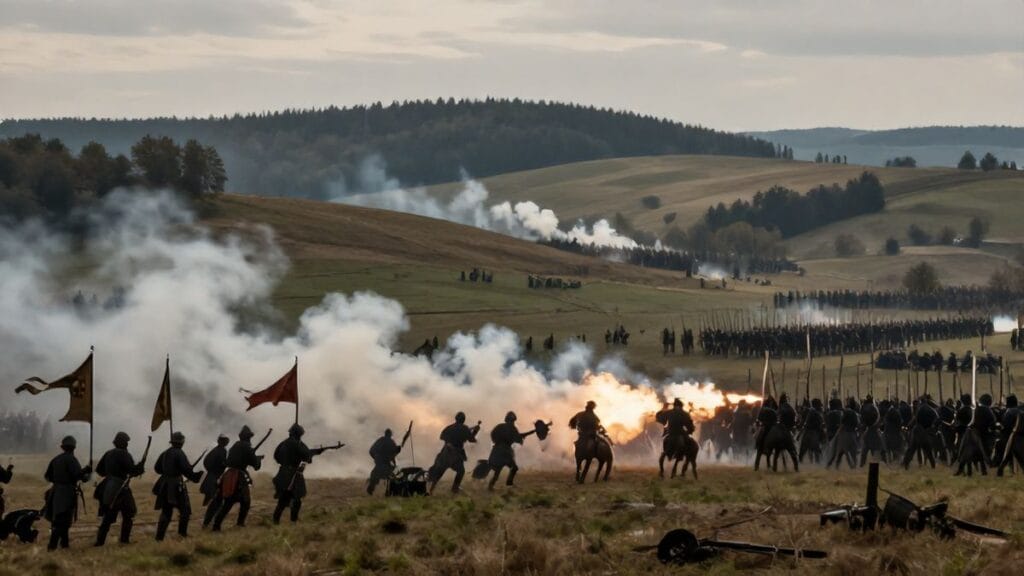
The opening phase of the battle belonged to the artillery. Gustavus ordered his guns to begin a methodical bombardment of the imperial lines. Here, the fruits of Swedish military reform became immediately apparent. Lighter, more maneuverable cannon allowed for faster, more accurate fire. Crews drilled to work briskly, turning what might have been sporadic booms into something closer to a rolling thunder.
Imperial and League artillery answered, but their heavier pieces fired at a slower rate. The exchange of shot tore gaps in formations, shredded standards, and hurled men to the ground in grim, random patterns. As smoke thickened, visibility shrank. The acrid smell of gunpowder settled over the field, mingled with dust and the faint screams of the first casualties being dragged to the rear.
Once Gustavus judged that the enemy had been sufficiently softened—or at least unsettled—he set his infantry in motion. Swedish brigades advanced in ordered lines, musketeers and pikemen supporting one another. Instead of the dense, deep masses favored by Tilly, these units spread out, presenting a thinner but more flexible front. They were trained to deliver coordinated salvoes, lines firing in succession so that a continuous wave of musket fire rolled forward.
This was the new face of European warfare. Rather than relying on sheer depth to absorb fire and push with pikes, the Swedes sought to win the contest of firepower itself: more shots, more quickly, into the enemy ranks. Their muskets, standardized and maintained with care, were not inherently superior as tools—but their method of use was. Officers shouted commands, drums beat time, and volleys flashed in sudden, synchronized bursts along the line.
Meanwhile, Swedish cavalry on the right wing began to feel out their opponents. Rather than charging recklessly, they engaged in controlled advances and retreats, looking for weak points and disrupting enemy attempts to mass. They had been trained to fight in tighter, more disciplined formations than many mercenary horsemen, delivering pistol fire at close range and then pressing home with cold steel.
Tilly’s initial reaction was to hold. He trusted that his tercios, with their interlocking pikes and muskets, would withstand this more “fragile”-looking Swedish system. After all, deep squares had triumphed again and again in earlier wars. But as the minutes stretched into an hour and more, the toll of sustained Swedish fire began to tell. One contemporary account later remarked that “the Swedes shot as if they were one great machine,” a striking image for the early modern age, and a hint of the more mechanized slaughter to come in later centuries.
Yet the outcome was far from settled. On the allied left, the story unfolded very differently.
Collapse on the Saxon Left: Disaster and Opportunity
If the Swedish right held firm and began to gain an edge, the Saxon left would soon unravel in devastating fashion. Tilly, recognizing that the less seasoned Saxon troops might be the weak link in the allied line, concentrated his efforts there. Imperial and League cavalry, backed by infantry pressure, advanced with determination against John George’s men.
The Saxon formations, less accustomed to the sheer intensity of modern battle, struggled under the weight of shot and the looming shapes of charging horsemen. Their artillery, less integrated with infantry support than the Swedish guns, could not respond as flexibly. When the imperial cavalry closed, some Saxon units held—at least briefly—while others wavered. The noise, the smoke, the sight of comrades falling in mangled heaps broke the fragile shell of their courage.
Then came the tipping point. Under heavy assault, with officers killed or unable to impose order, parts of the Saxon line began to give way. At first it was a drift, a few men stepping back; then it became a ripple, then a flood. Panic spread faster than any cannonball. Stories, perhaps exaggerated over time, described Saxon cavalry galloping from the field in disorder, infantry tossing down their weapons and fleeing toward Leipzig.
John George himself was swept up in the rout. He would later protest that he attempted to rally his troops, to no avail; whatever the truth, the allied left wing effectively ceased to exist as a coherent fighting force. A gaping hole opened in the combined army’s line, exposing the flank and rear of the Swedish center. For a moment that must have seemed to stretch into eternity, it looked as if Tilly had achieved the breakthrough he needed.
This was the kind of moment that, in earlier battles, had produced total defeat. When one wing collapsed, the rest of the army often lost heart and followed. News of allies fleeing the field seldom stiffened spines. Tilly’s seasoned infantry and cavalry began to wheel inward, seeking to roll up the now-exposed Swedes from the side. The imperial commander could almost taste victory, the chance to crush both Saxony and Sweden in a single blow and restore the aura of invincibility that had dimmed since Magdeburg’s controversial sack.
But this was only the beginning of Breitenfeld’s most extraordinary chapter. Gustavus Adolphus, faced with the catastrophe on his left, refused to accept the script that history usually followed. Instead of withdrawing or collapsing, he performed a feat of battlefield improvisation that would etch his name into military lore.
The Swedish Counterstroke: Turning Defeat into Victory
When reports reached Gustavus that the Saxon wing had broken, he did not ride for safety. He rode toward the danger. Observers later marveled at the speed with which he grasped the situation and ordered his army to adapt. This was the moment that would define not only the battle of breitenfeld 1631, but his reputation as a commander capable of fighting a modern, fluid war.
First, he stabilized his own line. Swedish infantry in the center and right tightened their formations, refusing to let panic spread from the deserted left. Officers barked orders, drums signaled shifts of position, and units pivoted to present fresh fronts toward the oncoming imperial forces. The king directed reserves and parts of his right wing to swing inward, effectively creating a new line at an angle to the original one—a maneuver that turned what might have been an open flank into a bristling hedgehog of pikes and muskets.
At the same time, Gustavus used his cavalry with remarkable precision. Rather than sending them in a wild, general charge, he coordinated a series of counterattacks designed to disrupt the imperial attempt to exploit the gap. Swedish horse crashed into imperial cavalry that had overextended in their eagerness to pursue fleeing Saxons. Some of Tilly’s units, caught between the desire for plunder and the need to maintain formation, found themselves struck at awkward angles and forced into defensive fights instead of triumphant pursuit.
Artillery, too, played a crucial role. The Swedes rapidly redeployed some of their lighter guns to bring flanking fire onto advancing imperial units. Where old-style armies might have left their guns largely fixed, Gustavus treated them as mobile assets. Cannon that had spent the early part of the day dueling with enemy batteries now turned to rake packed enemy infantry trying to wheel into the gap.
What resulted was a kind of battlefield judo. Tilly had used the weakness of the Saxon left to swing his weight into what he thought would be a decisive roll-up. Gustavus, in turn, used that very motion to pivot his own line, drawing the imperial forces into positions where their depth and rigidity worked against them. Instead of a collapsing allied front, there now emerged a dogged, reoriented Swedish force, braced against the storm and beginning to push back.
One German observer, quoted later by a Protestant pamphleteer, claimed in near-awe: “The king moved his squadrons as a man turns in his bed.” It is an image both simple and profound—conveying how, in an age of slow communication and cumbersome formations, Gustavus managed something that felt almost like the easy shifting of a single body. The field at Breitenfeld, however, was still a cauldron. The decisive phase was yet to come.
Cavalry Whirlwinds and Shattered Squares: The Battle’s Climax
As the afternoon wore on, the struggle at Breitenfeld escalated into a maelstrom of movement and violence. With the Saxons gone, the battle essentially pitted Gustavus’s reorganized army against Tilly’s full strength. But the momentum had subtly shifted. The Swedish counter-maneuvers had blunted the initial imperial advantage, and now the question became: whose troops would break first under sustained pressure?
In the center, imperial infantry fought tenaciously. Their tercios, though battered by artillery and musketry, still possessed formidable staying power. Pike blocks repelled early Swedish probes, and coordinated volleys from musketeers inflicted harsh losses. Yet each time they tried to push forward in mass, they ran into the layered fire of Swedish brigades and the harassing blows of mobile guns. Depth, which had once been a guarantee of resilience, now made them denser targets.
On the flanks, cavalry engagements grew increasingly chaotic. Swedish horse, reinforced by some German units loyal to Gustavus, launched repeated attacks into the imperial wings. Crucially, they did not allow themselves to be drawn into endless pursuit; instead, they regrouped to strike again where needed. Imperial cavalry, though brave and well-equipped, found it difficult to coordinate with their infantry once the battle’s lines had warped from their initial neat symmetry.
Gradually, Tilly’s army began to lose cohesion. With each failed attempt to crush the Swedish right or roll up the center, casualties mounted and formations frayed. The commander himself was injured—struck, according to several accounts, by a shot that broke his leg or hip. Carried from the field, Tilly could no longer direct the overall battle, leaving subordinates to make local decisions without a unified vision.
Gustavus sensed the moment and pressed harder. Swedish infantry advanced, sometimes at a trot, delivering controlled volleys and then closing in with pikes and swords. Artillery shifted yet again, now concentrating on zones where enemy morale appeared to falter. In some places, imperial units stood and died where they stood; in others, cracks opened as small groups started to fall back.
The climax came when key imperial formations finally broke under the relentless combination of fire and movement. What had been orderly, if embattled, lines turned into knots of men trying to withdraw, then into streams fleeing the field. Swedish and allied cavalry exploited these breaks, turning withdrawal into rout. Banners were captured, guns overrun, officers cut down or taken prisoner.
By evening, the once-proud imperial-Catholic League army was in ruins. Thousands lay dead or wounded; thousands more scattered, leaderless, across the Saxon countryside. The Swedish-Saxon coalition, though bloodied and deprived of its left wing, stood as the clear victor. The battle of breitenfeld 1631 had ended not in the tidy, decisive collapse that earlier wars sometimes produced, but in a grim, grinding attrition that nonetheless yielded a transformative result.
Nightfall at Breitenfeld: The Field of the Dead
As darkness fell over Breitenfeld, the battlefield revealed its full horror. The smoke that had veiled the afternoon fighting dispersed, and beneath the fading light lay a landscape of shattered bodies, broken weapons, and abandoned baggage. The cries of the wounded carried far into the night, an endless, ragged chorus. Victory and defeat both tasted of blood and ash.
Swedish and allied troops moved cautiously among the fallen, searching for comrades, finishing off wounded enemies in some cases, and securing prisoners in others. Surgeons and barbers did what they could in makeshift aid stations: sawing off shattered limbs, cauterizing wounds with heated irons, applying poultices and bandages. For many, their skill only postponed death by a few agonizing days.
Contemporary estimates of casualties vary, but the scale was undeniable. Imperial and League losses were catastrophic—perhaps as many as 7,000 to 8,000 killed, with even more taken prisoner or dispersed. Swedish losses were considerably lighter but still significant; Saxon casualties were difficult to tally, scattered as they were in the rout toward Leipzig. The numbers matter less than the impression they left on observers: that a mighty army had been broken and that the cost, even for the victors, was staggering.
Gustavus Adolphus, having risked his own life amid the fighting, now faced the work of consolidating his success. He ordered prayers of thanksgiving, framing the victory in explicitly religious terms. For Swedish propagandists and their Protestant German allies, Breitenfeld quickly became proof that God favored their cause. Yet behind the celebrations lay a quieter, more somber reckoning among officers and common soldiers alike. Each tent, each campfire, seemed haunted by the absence of men who had stood there that very morning.
For local villagers and townspeople, the aftermath was a terrifying mixture of opportunity and danger. Dead bodies had to be buried quickly to prevent disease. Horses, carts, weapons, and clothing lay scattered—valuable resources in a region drained by years of war. But scavenging could bring reprisals, and the presence of roaming bands of deserters made the nights perilous. Some peasants would later tell stories of finding mass graves or of stumbling over rusting swords years after the battle, ghosts of Breitenfeld preserved in the soil.
Night at Breitenfeld, in that sense, was not an end but a beginning—the first chapter in the long aftermath of a victory that would radiate outward through politics, strategy, and memory. By the time the last bodies were covered and the last wounded either died or healed, Europe had already begun to whisper a new narrative: the emperor’s might had been checked, and a foreign Protestant king had shown that the Habsburgs were not invincible.
Echoes across Europe: Political Shockwaves of the Victory
In the weeks and months that followed, news of Breitenfeld sped along Europe’s roads, rivers, and shipping lanes. Couriers clattered into capital cities bearing letters full of exultation or dismay. Pamphleteers seized on the story; ambassadors scrambled to adjust their reports. The battle of breitenfeld 1631, fought in a few hours on Saxon soil, became an event of continental significance.
For Protestant states, especially those long cowed by imperial successes, the victory was electrifying. In the Dutch Republic, still locked in conflict with Spain, Breitenfeld was read as a sign that Habsburg power could be challenged on multiple fronts. In England and Scotland, where many viewed the German war through the lens of their own religious and dynastic politics, Gustavus’s triumph stirred admiration and hopes—often unrealistic—of a broader Protestant resurgence.
Within the Holy Roman Empire itself, the impact was even more profound. Princes who had hesitated to align with Sweden now reconsidered. If the emperor could not protect them, perhaps Gustavus could—or at least provide leverage in negotiations. Some Catholic princes, alarmed by the severity of Ferdinand II’s policies and by the recent sack of Magdeburg, quietly welcomed a check on imperial absolutism, even if they would never admit it openly.
In Vienna and Munich, the mood was grim. The emperor and his allies had to confront the reality that one of their best generals had suffered a crushing defeat. The aura around Tilly, built over a decade of victories, was shattered. Ferdinand II faced pressure to rethink his strategy, including the controversial dismissal of Wallenstein. If one veteran commander could not contain the Swedish king, perhaps the other, even more ambitious one, would be needed again.
France, too, paid close attention. Cardinal Richelieu, the architect of French foreign policy, had long pursued a strategy of indirectly weakening Habsburg power despite France’s Catholic identity. Breitenfeld presented an opportunity. A stronger Sweden checked the emperor in Germany, freeing France’s hands on other fronts and creating openings for diplomatic maneuvers that would, in time, lead to direct French intervention in the war.
Thus the political reverberations of Breitenfeld were not confined to proclamations and sermons. They altered alliance patterns, emboldened opposition to imperial centralization, and set the stage for the war’s next, even more complex phases. A battle that began as a contest for Saxony’s fate and Protestant survival had, by its end, become a pivot point in the great power politics of 17th-century Europe.
Winners, Losers, and Survivors: Human Stories from the Battlefield
Amid grand strategies and shifting alliances, the human stories of Breitenfeld anchor the event in lived experience. They remind us that history’s turning points were, at ground level, days of terror, courage, confusion, and loss for ordinary people whose names rarely made it into official records.
Consider the figure of a hypothetical Swedish musketeer—let us call him Anders—from a small farm near Uppsala. He had enlisted some years before, drawn by the promise of pay and perhaps pushed by poor harvests at home. By 1631, he had seen enough skirmishing in Pomerania and northern Germany to know that war was a miserable business. At Breitenfeld, he stood in a brigade that advanced under Gustavus’s direct orders, feeling the crack of artillery in his chest and the sting of powder in his eyes. He fired in volley when commanded, reloaded by practiced motions even as men fell around him, and stumbled forward over bodies he dared not look at too closely. When the battle ended, Anders was alive—but several of his closest comrades were not. His reward would be coin, perhaps a share of plunder, and a story he would tell and retell for years, knowing that no telling could quite capture the day’s extremity.
On the other side, imagine a Bavarian pikeman—perhaps named Georg—from a village along the Danube. He had grown up hearing sermons about the dangers of heresy and the righteousness of the Catholic cause. Serving under the Catholic League banner, he had fought in earlier campaigns, including raids into Protestant territories where his unit seized food and valuables “for the war effort.” At Breitenfeld, Georg’s tercio endured hour after hour of punishing fire from Swedish guns and muskets. He may have felt pride in his unit’s initial steadiness, then mounting dread as the enemy refused to break and his own officers fell. When the line finally cracked and a Swedish cavalry charge slammed into the flank of his formation, Georg might have thrown down his pike and run—or he might have died where he stood, one more anonymous corpse in the pile.
There were also noncombatants drawn into the vortex. Sutlers sold food and drink near the camps, sometimes following the armies onto the field’s fringes. Wives and children of soldiers trailed behind companies, living a precarious existence in the shadow of war. Local peasants watched from a distance or hid in forests, waiting to see which flags would emerge victorious so they could decide whom to fear and whom to placate.
Some of these voices reached us through letters and chronicles. A Lutheran pastor from a nearby town might record how his congregation reacted to the thunder of guns, how they prayed for deliverance or vengeance. A Saxon noble who fled with the rout could later pen a defensive account, explaining that he had tried to rally his men but been overwhelmed. A Swedish officer might boast in a letter home of how their “new fashion of war” had humbled the emperor’s best.
One later chronicler, echoing sentiments of many survivors, wrote that “God showed His hand at Breitenfeld, yet the price was such that we tremble to see it.” This kind of ambivalence—relief mixed with horror—is perhaps the most honest human reaction to such victory. For while the political and military outcomes seem clear in hindsight, for those who walked among the dead on the evening of 17 September 1631, the glory was inseparable from grief.
Rewriting the Art of War: Tactical Lessons of Breitenfeld
In purely military terms, Breitenfeld quickly acquired an almost textbook status. Commanders and theorists across Europe studied what had happened there, drawing lessons—sometimes accurate, sometimes skewed by their own biases—about the future of warfare. The battle of breitenfeld 1631 was not the first engagement where new methods clashed with old, but it was among the clearest demonstrations of how flexibility, firepower, and coordination could overcome mass and tradition.
Gustavus’s use of shallower infantry formations, interleaved with artillery, showed that deep tercios were not invulnerable. The consistent, rolling volleys of Swedish musketeers, combined with the supporting fire of light guns, inflicted a steady attritional toll on the enemy that deep ranks could not simply shrug off. The old assumption that sheer weight and depth of pikes would eventually close and decide the battle had been badly undermined.
The integrated use of arms was equally significant. Cavalry, rather than being a mostly independent shock force or pursuit tool, operated in concert with infantry and artillery. At Breitenfeld, Swedish horse protected vulnerable flanks, smashed into overextended enemy units, and helped transform local successes into broader collapse. This foreshadowed the more sophisticated combined-arms tactics that would later define early modern and even modern battlefields.
Artillery mobility especially impressed observers. One French officer, writing an analysis a few years later, noted with some envy that “the Swede doth move his guns as if they were no heavier than muskets.” While this was an exaggeration, it captured the principle: lighter calibers, standardized equipment, and trained crews enabled Gustavus to use artillery dynamically rather than as static siege engines dragged onto the field.
Of course, not all lessons drawn from Breitenfeld were fully internalized right away. Many commanders, particularly in more conservative courts, clung to elements of the old system. Terrain, logistics, and the quality of troops still mattered enormously, and no single battle could erase centuries of practice overnight. Nonetheless, Breitenfeld accelerated a trend already underway: the gradual move toward linear tactics, increased emphasis on disciplined volley fire, and more elaborate coordination across arms.
In later treatises on the art of war, Gustavus Adolphus was often cited as a pioneer. Some of this borders on hagiography, yet the kernel of truth remains. Breitenfeld gave concrete, dramatic evidence that his way of fighting was not mere theory. It worked, and it worked against one of the most formidable armies of the age. As one military historian would summarize centuries later, “At Breitenfeld, the future defeated the past in a single afternoon”—a poetic, if simplified, encapsulation of the tactical revolution on display.
Faith, Propaganda, and Memory: How Breitenfeld Was Remembered
The memory of Breitenfeld was shaped almost immediately by a flood of pamphlets, sermons, songs, and official reports. In an age before mass newspapers, these were the channels through which ordinary people far from Saxony learned what had happened. Each side framed the story to fit its narrative, turning battle into moral lesson, propaganda, and, ultimately, myth.
For Protestants, Breitenfeld was a near-miraculous deliverance. Broadsheets depicted Gustavus as a divinely favored warrior-king, sometimes likening him to Old Testament figures like David or Gideon. Engravings showed Swedish troops standing firm while imperial forces fell like wheat before the scythe. One popular pamphlet, widely circulated in German cities, proclaimed that “the Lord hath broken the pride of Babylon on the plain of Breitenfeld,” an explicit biblical parallel casting the Habsburgs as tyrannical oppressors.
Lutheran pastors wove the battle into their preaching. They spoke of God’s wrath against the sins of the empire, of His mercy in sparing Saxony from destruction, and of the need to remain faithful lest such favor be withdrawn. In some churches, special days of thanksgiving were declared. The battle became not simply a historical event but a theological signpost, confirming that God had not abandoned the Protestant cause.
On the Catholic side, the defeat had to be explained without conceding divine disfavor. Some writers emphasized the courage and martyrdom of Catholic soldiers who died defending the true faith. Others blamed human failings: inadequate support, faulty intelligence, or perhaps even the sins of individuals within the army. A narrative emerged in which Breitenfeld was a temporary setback, a test of endurance rather than a sign of God’s rejection.
Over time, as the war dragged on and new crises erupted, Breitenfeld remained a touchstone in collective memory. It was invoked whenever Protestant forces faltered—“Remember Breitenfeld”—and whenever Catholic leaders warned against overconfidence. Historians in later centuries would return to it repeatedly, some emphasizing its tactical innovations, others its political consequences, still others its symbolic power.
In Saxony itself, memories were more ambivalent. While the land had been “saved” from imperial domination, it had also been turned into a battlefield, its people forced to shoulder the costs of war. Local traditions recalled both the pride of having stood in a decisive engagement and the sorrow of ruined farms and lost sons. The village of Breitenfeld, once an anonymous dot on the map, became synonymous with that great clash—its very name transformed into shorthand for a turning point in European history.
Thus, the battle of breitenfeld 1631 lived on far beyond the lifetime of those who fought it. It survived not only in dry chronicles but in the stories people told, the hymns they sang, and the political arguments they made. Memory, like war, is never purely objective; it is shaped, contested, and repurposed. Breitenfeld proves this as much as any event of the Thirty Years’ War.
From Breitenfeld to Lützen: The Road Ahead in the Thirty Years’ War
Despite its transformative impact, Breitenfeld did not end the Thirty Years’ War. If anything, it opened a new, more intense chapter. Gustavus Adolphus, buoyed by victory and swelling ranks of German allies, pushed deeper into the empire. Cities that had once cowered before imperial armies now opened their gates to the Swedish king. The strategic map of central Europe was suddenly fluid again.
In the months following the battle, Swedish and allied forces scored additional successes. They overran key territories, captured fortresses, and threatened the very heartlands of the Catholic League and the Habsburgs. For a time, it seemed as though a decisive Protestant victory and a radical reshaping of the empire might be within reach. Some visionaries imagined a reformed imperial constitution, greater religious toleration, and a more balanced distribution of power among princes.
But war is rarely so linear. The emperor, chastened but not defeated, recalled Wallenstein, granting him extraordinary authority to raise and command new armies. The conflict grew more complex as fresh actors, including France, became more deeply involved. What had begun decades earlier as a series of religiously inflected disputes now fully revealed itself as a pan-European struggle for dominance.
Gustavus himself would not live to see the war’s end. In 1632, at the Battle of Lützen, he again confronted imperial forces in a brutal encounter. There, amid swirling fog and chaotic fighting, the Lion of the North fell—killed while leading a cavalry charge. His death shocked Protestant Europe and deprived Sweden of the charismatic leader whose presence had done so much to mold and motivate its armies.
And yet the legacy of Breitenfeld outlived its architect. Swedish power in Germany persisted for years; the emperor never regained uncontested supremacy. The eventual Peace of Westphalia in 1648, though still far in the future in 1631, would codify many of the realities that Breitenfeld had helped to create: a more pluralistic religious landscape, greater autonomy for princes, and a Europe less amenable to domination by any single dynasty.
In that sense, Breitenfeld was both a climax and a beginning. It marked the high point of Gustavus’s meteoric rise and demonstrated the viability of a new way of war. But it also propelled the conflict into a broader, more entangled phase from which no simple victory could emerge. The fields near Leipzig had seen a clear winner on 17 September 1631; the continent, however, would endure many more years of bloodshed before it could claim anything resembling peace.
Conclusion
Near a small Saxon village in 1631, Europe’s fate did not change in a single instant, but in a long, harrowing afternoon when artillery roared, pikes bristled, and muskets spat fire across smoky fields. The battle of breitenfeld 1631 was, on one level, a contest between two commanders and two coalitions, fought with the tools and ideas of their age. Yet look closer, and it becomes a hinge in the story of modern Europe: a moment when the balance of religious power shifted, when the technical and organizational evolution of warfare leapt forward, and when the myth of Habsburg invincibility was irrevocably broken.
We have followed the conflict from the Defenestration of Prague to the cautious halls of Saxon power, from the reforms of Gustavus Adolphus to the iron discipline of Tilly’s veterans. We have watched as Saxon courage failed, only for Swedish resilience and flexibility to salvage and then reverse the tide. And we have traced the echoes of the victory in the chancelleries of Europe, the pulpits of Protestant cities, and the haunted memories of survivors.
Breitenfeld did not bring peace; if anything, it prolonged and widened the Thirty Years’ War by enabling new coalitions and encouraging fresh interventions. Its fields bore not only the seeds of tactical innovation but also the bitter harvest of continued devastation. Yet to ignore its significance would be to miss a rare moment when the currents of faith, politics, and military technique converged so visibly in one place. As later historians have noted, Breitenfeld announced to Europe that the future would not be written solely in imperial capitals and papal briefs, but also in the adaptable formations of armies that learned to fight, and win, in new ways.
In the end, Breitenfeld reminds us that turning points are rarely “clean” victories. They are messy, costly, and morally ambiguous. Still, they matter. On 17 September 1631, amid smoke and fear on Saxon soil, a path opened that led—through Lützen, through Westphalia, and through countless other battles—to a Europe of more fragmented sovereignties and more modern states. The men who fell there could not know this, but their blood marked a crossroads whose traces we can still discern in the political and military contours of our world today.
FAQs
- What was the Battle of Breitenfeld 1631?
The Battle of Breitenfeld 1631 was a major engagement of the Thirty Years’ War, fought on 17 September 1631 near the village of Breitenfeld in the Electorate of Saxony. It pitted the Swedish-Saxon coalition led by King Gustavus Adolphus against the imperial and Catholic League forces commanded by Count Tilly. The battle ended in a decisive Protestant victory that broke the aura of Habsburg and Catholic League invincibility. - Why is Breitenfeld considered a turning point in the Thirty Years’ War?
Breitenfeld is seen as a turning point because it halted the long run of imperial-Catholic victories and opened the door to a broader Protestant resurgence. It encouraged hesitant German princes to ally with Sweden, weakened the emperor’s grip on the empire, and demonstrated that new military methods could defeat traditional tercios. Politically and psychologically, it transformed the war from an almost one-sided imperial consolidation into a more balanced, pan-European struggle. - How did Gustavus Adolphus’s tactics differ from those of his opponents?
Gustavus Adolphus used lighter, more flexible infantry formations, integrated with mobile field artillery and closely coordinated cavalry. His brigades were shallower, enabling faster and more sustained musket volleys, while his artillery could shift positions during battle. In contrast, Tilly relied on deeper, more rigid tercios and heavier, less mobile guns. At Breitenfeld, Gustavus’s emphasis on firepower, maneuver, and combined arms proved superior. - What role did Saxony play in the battle?
The Electorate of Saxony, under John George I, allied with Sweden shortly before the battle, contributing a significant contingent of troops on the allied left wing. However, these Saxon forces were comparatively less experienced and broke under intense imperial attack, fleeing the field and exposing the Swedish flank. Despite this near-disaster, Gustavus reorganized his army and ultimately won the battle, while Saxony’s decision to side with Sweden had lasting political consequences. - What were the casualties at the Battle of Breitenfeld?
Exact figures are debated, but most historians agree that imperial and Catholic League forces suffered many thousands of casualties—perhaps 7,000 to 8,000 killed and additional thousands captured or dispersed. Swedish losses were significantly lower but still substantial, while Saxon casualties are harder to estimate due to the rout. The battlefield was left strewn with dead and wounded, reflecting the brutal nature of early modern warfare. - How did Breitenfeld affect the wider European balance of power?
Breitenfeld enhanced Swedish influence in Germany and weakened the Habsburgs’ ability to dictate terms to Protestant princes. It emboldened states like the Dutch Republic and opened new diplomatic opportunities for France, which sought to counter Habsburg dominance despite its Catholic identity. In the longer term, the victory contributed to the eventual settlement at Westphalia, which acknowledged a more pluralistic, decentralized European order. - Did the Battle of Breitenfeld end the Thirty Years’ War?
No, the battle did not end the war. Instead, it marked the beginning of the “Swedish phase,” during which Gustavus Adolphus and his successors played a central role in German politics and warfare. The conflict continued for another 17 years, expanding to include more states and culminating in the Peace of Westphalia in 1648. - What happened to the main commanders after the battle?
Gustavus Adolphus continued his campaigns in Germany and achieved further successes, but he was killed the following year at the Battle of Lützen in 1632. Count Tilly, already wounded at Breitenfeld, saw his reputation badly damaged; he was later mortally wounded at the Battle of the Lech in 1632 and died shortly afterward. Their fates underscore how even the most celebrated commanders were ultimately vulnerable to the grinding reality of war. - How is the Battle of Breitenfeld remembered today?
Today, Breitenfeld is remembered by historians as a key military and political turning point in the Thirty Years’ War and as a landmark in the evolution of early modern warfare. In Germany and Sweden, it features in historical scholarship, local commemorations, and occasionally in public memory through monuments and educational materials. While not as widely known as some later battles, it remains central to understanding the 17th-century European balance of power.
External Resource
Internal Link
Other Resources
- Encyclopaedia Britannica – general search for the exact subject
- Google Scholar – academic search for the exact subject
- Internet Archive – digital library search for the exact subject

