Table of Contents
- A November Death in Rome: Setting the Stage for an Emperor’s Last Days
- The Twilight of Empire: Italy and the West Before Olybrius
- From Noble House to Imperial Palace: The Formation of Olybrius
- Captive Ties: The Vandal Court and a Roman Aristocrat
- The Shadow of Ricimer: Power Behind the Western Throne
- A Puppet Crowned: Olybrius Becomes Emperor in 472
- A City on Edge: Rome’s Streets in the Year of Olybrius
- Rival Emperors and Civil War: Anthemius Falls
- Anxious Months on the Throne: Policies, Piety, and Silence
- November in Rome: The Final Illness of Emperor Olybrius
- Emperor Olybrius Death and the Shock of an Empty Throne
- Aftermath in the Palaces: Ricimer, Gundobad, and the Struggle for Control
- Rome’s People in the Wake of the Emperor’s Passing
- Echoes in Constantinople and Carthage: The Wider Mediterranean Reacts
- The Vanishing of the Western Empire: From Olybrius to Romulus Augustulus
- Historians Remember: Sources, Silences, and the Enigma of Olybrius
- Legacy of a Brief Reign: Faith, Dynasty, and the End of an Era
- Conclusion
- FAQs
- External Resource
- Internal Link
Article Summary: In November 472, in a Rome already worn down by sieges, civil wars, and famine, the Western Roman emperor Olybrius died after just a few months on the throne. This article traces the world that produced him, from the decrepit splendor of the late Roman aristocracy to the brutal politics of generals like Ricimer who made and unmade emperors. It explores how emperor olybrius death, apparently from natural causes, nonetheless triggered political tremors that shook what little remained of imperial authority in Italy. We journey through the streets and palaces of Rome, listening for the almost inaudible echo left by one of history’s most elusive emperors. Along the way, we examine the reactions in Constantinople, among the Vandals in Carthage, and across a fractured Mediterranean still calling itself Roman. We also consider how historians, faced with sparse and biased sources, have tried to reconstruct the man behind the diadem. Ultimately, the narrative shows that emperor olybrius death was not just the end of a life but another step in the slow collapse of the Western Roman Empire. It is a story of brevity, silence, and the haunting sense that an empire can die not with one great catastrophe, but through a sequence of small, almost unnoticed endings.
A November Death in Rome: Setting the Stage for an Emperor’s Last Days
On a damp November day in the year 472, somewhere within the crumbling grandeur of Rome, a man who wore the imperial purple lay dying. The marble halls outside his chamber were quiet, their faded frescoes and cracked mosaics whispering of better centuries. Guards in mismatched armor shifted uneasily, the sound of their sandals echoing faintly along corridors that had once bustled with envoys, generals, and senators. The man within—Anicius Olybrius, Western Roman emperor—had reigned only a few months, scarcely long enough for the city to grow used to his image on its coins. Yet emperor olybrius death would come to symbolize something larger than the end of a short and obscure reign. It would mark another small but irrevocable step toward the disappearance of the Western Roman Empire itself.
To the people of Rome, exhausted by decades of wars and usurpers, the final illness of their emperor may have seemed more like a private drama than a public catastrophe. No barbarian horde was at the gates this time, no raging fire lit up the night sky, no statues were toppled in frantic revolt. Life in the city went on: vendors haggled in the markets, beggars sought alms in the porticoes of basilicas, priests murmured Mass beneath the great domes of Christian churches built by stronger emperors long dead. And yet, beneath that surface, something essential was coming undone. The office of emperor, once the apex of Roman political life, had become a fragile ornament, a title bestowed and withdrawn by warlords and generals who wielded real power in the West.
Olybrius, unlike the soldier-emperors who had preceded him, was not a man forged on the frontiers or hardened in battle. He belonged to one of the most ancient and splendid noble families of Rome, a man more familiar with silken robes than with cuirasses, with theological debate than with the clash of shields. His rise to the throne occurred less because of personal ambition than because others saw in him an ideal instrument: respectable, well-connected, and politically harmless. When he fell ill in late 472, surrounded by palace attendants and perhaps a few anxious bishops, the empire did not shake as it had in earlier crises. Yet emperor olybrius death, as quiet as it may have been, would leave behind a vacuum that opportunists quickly moved to fill.
This was Rome in its twilight: still majestic in its physical shell, still capable of inspiring awe, but internally hollowed out by decades of neglect and fragmentation. The Senate, once the proud heart of republican governance, had become a cautious, diminished body, struggling simply to survive shifting allegiances. The population had shrunk drastically from its imperial height; large stretches of the city were abandoned, their grand houses overrun by weeds. Even the Tiber, once patrolled by fleets of grain ships, now bore fewer signs of the commercial lifeblood that had sustained urban life. Against this backdrop, the story of Olybrius’s last days unfolds not as an isolated episode, but as a scene late in a long, tragic play.
To understand why emperor olybrius death mattered—why a brief, almost anonymous reign deserves our attention—we must move backwards before we move forwards. His passing cannot be separated from the political labyrinth of the mid-fifth century: the rise of the barbarian general Ricimer, the restless ambitions of the Eastern court in Constantinople, the threat of the Vandals in North Africa, and the daily struggle of Romans to find bread, security, and some semblance of continuity. It is a story of faded splendor, of religious devotion, of calculated manipulations, and of a man who might have preferred to remain a wealthy aristocrat and devout Christian, but who, for a moment, was placed at the very center of a dying empire’s stage.
The Twilight of Empire: Italy and the West Before Olybrius
The death of Olybrius in 472 was not the beginning of the end for the Western Roman Empire; that ending had been unfolding for generations. By the time he drew his last breath, the West had already lost Britain, most of Gaul, Spain, and the vital province of North Africa. Italy remained the core, but it was a core stripped of much that had once supported it. Powerful barbarian groups—Visigoths in Gaul and Spain, Burgundians in the Rhône valley, Vandals in Africa—had carved out kingdoms that were partly Roman, partly something new. These kingdoms recognized, at least formally, the prestige of the Roman emperor, but only so long as it suited their needs.
Economically, Italy suffered from the loss of Africa above all. The grain ships of Carthage and its hinterland had once fed Rome and sustained its vast urban population. When the Vandals, under their king Gaiseric, seized those provinces earlier in the century, they did far more than win a military victory. They choked off the city’s food supply, undermined imperial revenues, and reduced the emperor’s capacity to reward soldiers and officials. Chroniclers speak of food shortages, of rising insecurity on the roads, of villagers abandoning farms that could no longer be adequately defended. From the vantage point of Rome, the empire was shrinking—not just in territory, but in its ability to promise a stable, predictable life.
Politically, a dangerous pattern had emerged. Emperors in the West no longer rose primarily through senatorial influence or hereditary legitimacy, but through the backing of powerful generals—often of barbarian origin—who commanded mercenary armies. Figures like Stilicho, Aetius, and finally Ricimer became “kingmakers,” placing emperors on the throne and discarding them when they ceased to be useful. The imperial title remained Roman, Latin, and wrapped in centuries of tradition. But the hands that moved the imperial pieces across the board increasingly belonged to men born beyond the old frontiers, whose loyalty lay first with their own followers and families.
Religion, too, reflected a world in flux. Christianity was now the official faith of the empire, and paganism—though surviving in some old aristocratic houses—had largely retreated from public life. Bishops exercised influence not only over the spiritual lives of their congregations, but also in politics, diplomacy, and charity. Rome’s bishop, by now commonly called the pope, was emerging as a key player in imperial affairs. Yet religious unity was an illusion. Sharp theological disputes—especially regarding the nature of Christ—divided East and West, and even within the Italian church there were tensions over doctrine, discipline, and the legacy of the great councils, such as Chalcedon (451). It was into this fractured landscape that Olybrius would step, carrying both his aristocratic name and his piety like fragile shields.
Socially, the old Roman hierarchy still existed, but it had frayed around the edges. The senatorial elite, of which Olybrius was a shining example, still controlled vast estates and immense wealth. They spoke highly polished Latin, patronized churches and monasteries, and prided themselves on their literary culture and links to a classical past. Below them, the urban poor and rural peasantry lived far more precarious lives, often at the mercy of local magnates or military commanders. The Romans of the 470s inhabited a world in which the forms of imperial order remained, but the substance had been steadily drained away. One can imagine, in this context, how emperor olybrius death would feel less like a thunderclap and more like another crack appearing in a structure already riddled with fractures.
The Eastern Roman Empire, centered on Constantinople, watched all of this with a mixture of concern, calculation, and occasional condescension. Eastern emperors still considered themselves the legitimate rulers of the entire Roman world, yet they were reluctant to pour men and money into a Western cause that seemed increasingly hopeless. Instead, they experimented with diplomacy, marriage alliances, and the careful positioning of “their” candidates on the Western throne. Olybrius, as we shall see, was one such candidate—a man whose personal story cannot be told without also tracing the ambitions of emperors and bishops across the Adriatic Sea.
From Noble House to Imperial Palace: The Formation of Olybrius
Anicius Olybrius did not begin his life in a barracks or on some windswept frontier. He was born into the Anicii, one of the greatest and most ancient senatorial families of Rome, whose name had been associated with high office since the days of the Republic. To be an Anicius meant living amid marble halls, surrounded by servants, scribes, and tutors; it meant a childhood steeped in rhetoric, law, scripture, and the memory of ancestors who had governed provinces and commanded armies. While the details of his early life are sparse—lost in the gaps of our sources—what we do know suggests a man shaped by privilege, education, and faith.
By Olybrius’s time, the Anicii had become not only political figures but also pillars of Christian society. Wealthy aristocrats like him endowed churches, funded monasteries, and supported bishops in building networks of charity. Contemporaries hint at his personal piety, describing him as devout and generous to the poor. This combination of aristocratic gravitas and religious seriousness would later make him an attractive candidate for the imperial throne: he embodied the continuity of old Rome, yet also the Christian ideals now expected of a ruler. It is telling that later ecclesiastical traditions remembered him less for policy or war than for his acts of pious patronage.
His family connections extended far beyond Italy. The Anicii had roots and properties across the empire, forming a web of alliances that blurred the increasingly fragile boundaries between East and West. Through marriage and patronage, they were linked to other great houses and to the imperial court in Constantinople. It is through one such connection that Olybrius’s life would take a decisive turn: his marriage into the family of the Eastern emperor Valentinian III. By wedding Placidia, one of Valentinian’s daughters, Olybrius was drawn directly into the orbit of imperial power, though still as a nobleman rather than as a ruler in his own right.
Life in such circles demanded a delicate balance. A man like Olybrius had to be sufficiently ambitious to preserve and enhance his family’s standing, yet cautious enough not to appear a threat to reigning emperors or powerful generals. He had to show public generosity, patronizing the church and assisting the needy, while privately managing vast estates and negotiating taxes, rents, and legal disputes. His world was one in which Latin authors like Augustine and Jerome were read aloud in salons, where bishops debated the meanings of Christ’s nature in refined, often heated language, and where news from Gaul, Africa, or the Danube reached Rome via letters carried along uncertain, often dangerous roads.
If we look closely, we begin to see how such a man could become emperor almost by accident. Olybrius’s social rank and imperial marriage gave him legitimacy; his piety made him acceptable in the eyes of the church; his lack of a military power base made him non-threatening to men like Ricimer, who preferred emperors they could control. Yet this same constellation of traits also explains why, when emperor olybrius death finally came, he left so faint a trace on the historical record. He was not a conqueror or a reformer; he did not leave behind sweeping laws or a transformed administration. He was, rather, a symbol—of a senatorial aristocracy that could still produce emperors, but could no longer save the empire.
Captive Ties: The Vandal Court and a Roman Aristocrat
To understand the peculiar path that brought Olybrius to the throne, we must leave Rome for a moment and sail southward and westward to the bright harbors of Carthage, capital of the Vandal kingdom in North Africa. There, amid palaces built from the stones of old Roman buildings, King Gaiseric ruled over a domain that had once been among the richest provinces of the empire. His Vandals, originally a wandering group pushed westward by pressures from beyond the Rhine, had seized Carthage in 439 and quickly become masters of the western Mediterranean. From their bases in North Africa, Vandal fleets launched raids on Sicily, Italy, and even the Greek coasts, capturing ships and plundering cities.
In 455, when Rome herself was sacked by Gaiseric’s forces, the city’s treasures and people were carried off to Africa. Among the captives were members of the imperial family, including Eudocia, daughter of Valentinian III and sister-in-law to Olybrius through his marriage to her sister Placidia. This grim episode created an enduring link between Olybrius and the Vandal court. Some sources suggest that Gaiseric, ever the strategist, began to see a potential advantage in this connection. If Olybrius could one day be raised to the Western throne—as a man tied to both the old Roman imperial line and to the Vandals through family bonds—he might serve as a useful, manageable partner.
It is likely that Olybrius, while still residing mainly in the East, negotiated indirectly with Gaiseric or his envoys. He had reason to wish for the release of his captive relatives or at least for their better treatment, and he had both the wealth and the status to serve as an intermediary in talks between East, West, and Vandal Africa. In this delicate triangle, Olybrius became an object of interest to multiple powers, each of which saw in him something slightly different: to Constantinople, a loyal Roman aristocrat tied to the old Theodosian dynasty; to Gaiseric, a potential client-emperor favorable to Vandal interests; to various factions in Italy, a possible solution to the ongoing chaos of succession.
These converging interests would help shape his eventual path to the throne. But they also illustrate the fractured reality of the fifth-century Mediterranean. An emperor of Rome could now be contemplated, not in terms of his command of legions, but in terms of his relationships with foreign courts that had once been enemies. The very fact that emperor olybrius death would later resonate in places as far apart as Constantinople and Carthage speaks to this interwoven world: a Roman aristocrat whose family had been both victim and ally of the Vandals, elevated with Eastern backing, ruling in an Italy dominated by a Germanic general, and dying in a city that still called itself caput mundi—the head of the world—even as its power ebbed away.
If Olybrius spent time at the Vandal court, as some scholars tentatively suggest, he would have witnessed a strange hybrid world. Latin was still spoken in administration, Roman law still applied in many matters, and Christian bishops ministered to both Roman provincials and the Arian Vandals who followed a different understanding of Christ. The spectacle of barbarians ruling over Roman cities and commanding Roman fleets must have made a deep impression. Whether he drew from this experience any particular political lesson is hard to say, but it would have confirmed a stark reality: the age in which Rome could simply “restore” its lost provinces by force was gone.
The Shadow of Ricimer: Power Behind the Western Throne
No story of Western imperial politics in the mid-fifth century can avoid the towering, if sinister, figure of Ricimer. Of mixed Suevic and Gothic origin, Ricimer was the quintessential barbarian kingmaker: officially a Roman general and master of soldiers, unofficially the arbiter of who would wear the purple in Italy. He never claimed the imperial title himself—barbarian blood and perhaps a shrewd sense of limits prevented that—but he made and unmade emperors with alarming ease. Majorian, Libius Severus, Anthemius: all rose with his backing; all eventually fell when they no longer served his interests.
Ricimer’s power rested on his command of troops, many of them Germanic federates bound to him personally rather than to the abstract authority of the empire. He controlled key fortresses, the flow of military pay, and much of the political network that linked Italy’s cities. Senators, bishops, and local magnates needed his favor to secure their positions; emperors needed his support simply to survive. In this atmosphere, the imperial office became less a position of supreme command than a kind of ceremonial mask worn by whichever candidate Ricimer selected.
When the Eastern emperor Leo I sent Anthemius to rule the West in 467, he hoped to curb Ricimer’s influence by imposing a strong, Eastern-approved emperor. For a while, the partnership worked: Anthemius and Ricimer cooperated in a grand campaign against the Vandals. But when this expedition failed disastrously in 468, the blame and suspicion began to circulate. Over time, personal animosity, strategic disagreements, and mutual distrust poisoned relations between emperor and general. Ricimer eventually turned against Anthemius, laying siege to Rome itself in 472. Civil war blazed through the very heart of the empire.
In this climate of tension and bloodshed, Olybrius emerged as a compromise candidate. He lacked an independent army, so Ricimer could feel secure; he had connections to the East and to the old imperial dynasty, which appealed to those nostalgic for a stronger Roman order; and his piety reassured the church. As later chroniclers like John of Antioch and the fragments preserved in the Chronicon Paschale indicate, there were competing schemes afoot in 472, with Leo I and Gaiseric both maneuvering to place their preferred figures in power. Olybrius’s eventual elevation was thus the result of overlapping calculations—a reminder that emperor olybrius death, though quiet, brought an end to a carefully calibrated but inherently unstable arrangement.
By the time Anthemius and Ricimer clashed openly, Rome’s inhabitants had grown accustomed to this pattern of imperial rise and fall. Yet each new conflict brought more destruction, more shortages, more refugees streaming into the city or fleeing from it. When Ricimer finally triumphed over Anthemius and prepared to install Olybrius, it was less a victory for Rome than a victory for Ricimer’s personal power. The throne that awaited Olybrius was thus already overshadowed by another man’s ambitions and by the civil war that had just torn the capital apart.
A Puppet Crowned: Olybrius Becomes Emperor in 472
The exact sequence of events that led to Olybrius’s elevation in 472 is tangled, reflecting the confusion of that turbulent year. According to one influential account, Eastern emperor Leo I initially sent Olybrius to Italy as an envoy, perhaps to mediate between Anthemius and Ricimer or even to replace Anthemius if circumstances allowed. A famous, if debated, anecdote holds that Leo, suspecting Ricimer’s intentions, also sent a secret letter to Anthemius instructing him to kill Olybrius—lest the envoy be used as a rival claimant. If true, this story captures the lethal, paranoid atmosphere among late Roman elites.
Whatever Leo’s original design, events on the ground moved quickly. Ricimer, locked in a brutal struggle with Anthemius, seized on Olybrius as his champion. With his troops tightening a siege around Rome, he had the Senate proclaim Olybrius emperor. The exact day is uncertain, but by late spring or early summer 472, the obscure aristocrat had become Augustus, lord of what remained of the Western Roman Empire. The city, battered by months of conflict, watched yet another coronation, the ceremonies perhaps diminished compared to the splendors of earlier centuries, but still replete with ancient rituals: the diadem, the purple cloak, the acclamations echoing in the Forum or perhaps within the walls of a basilica.
Olybrius, now emperor, faced a paradoxical situation. In theory, he was the supreme authority in the West; in practice, he owed his position to Ricimer’s soldiers camped around the city. Inside Rome, Anthemius still held pockets of resistance and had the loyalty of some urban defenders. The streets were tense, the aqueducts perhaps disrupted, the supply of grain uncertain. Contemporary accounts speak of famine and disease during the siege. The newly crowned emperor, instead of parading triumphantly through a peaceful capital, stepped into a city split by barricades and haunted by hunger.
The ultimate defeat and death of Anthemius—a tragic end for a capable but unlucky ruler—cleared the stage. His beheading, after he was lured from the sanctuary of a church, shocked many contemporaries. It was a clear sign that the old sacral aura of the imperial office had faded; even consecrated places were no guarantee of safety. With Anthemius gone, Olybrius stood alone as emperor in the West, but his authority rested on the same shaky foundations that had undone his predecessor. The Roman world, as one can almost hear it sighing through the terse lines of the chroniclers, no longer had the luxury of strong emperors. It produced, instead, fragile compromise figures like Olybrius, who entered history already entangled in the ambitions and betrayals of others.
It is astonishing, isn’t it, that in such a maelstrom, anyone could believe that stability was more than a fleeting hope? Yet for a few months after his coronation, there may have been moments when Romans allowed themselves to imagine that the worst was over—that with the civil war ended and a devout, aristocratic emperor on the throne, some measure of normal life might return. Those months, however, would prove to be all that Olybrius had.
A City on Edge: Rome’s Streets in the Year of Olybrius
To follow the story of emperor olybrius death, we have to walk, imaginatively, through the streets of Rome in 472. The city that greeted his reign was both familiar and profoundly altered. The great monuments still stood: the Colosseum’s arches, the Forum’s columns, the Pantheon’s dome, and the massive walls built by Aurelian two centuries earlier. Yet many temples had been converted into churches or left to decay; statues lay toppled or repurposed as building material; aqueducts damaged in earlier sieges still needed repair. Grass and shrubs sprouted in once-paved courtyards; entire neighborhoods had thinned out as residents fled or died.
The population, perhaps a few hundred thousand at most—down sharply from the million or more of the early empire—was a mix of old aristocratic houses, petty officials, artisans, soldiers, clergy, and the poor. Many of the poor depended on church charity after the old imperial grain distributions faltered. The basilicas of St. Peter, St. Paul, and other martyrs were not only places of worship but also centers of social support, where bishops and their staff organized almsgiving. The Christian liturgy, with its chants in Latin and occasional Greek, echoed through spaces once used for senatorial ceremonies or pagan rites.
Daily life was precarious. Food prices fluctuated wildly, especially during sieges. Disease spread easily in cramped quarters and among malnourished crowds. People lived under the shadow of rumors: that Ricimer’s troops might again march through the streets, that the Vandals might launch another raid, that Gothic or Hun mercenaries might turn against their employers. Yet amid all this, ordinary routines persisted. Bakers lit their ovens at dawn; children played in courtyards; scribes copied religious texts in monastic communities; senatorial households hosted carefully measured gatherings where politics were discussed in cautious tones.
In this setting, the emergence of Olybrius as emperor would have felt both momentous and strangely routine. Romans had seen too many emperors come and go in recent decades to invest each new reign with unqualified hope. But they might have taken comfort in his noble name and his reputation for piety. Some may have whispered that a man so deeply rooted in Rome’s senatorial tradition, so closely tied to the old Theodosian house, might finally reconcile the many factions that had torn the West apart. Others, more cynical, would have noted that he was Ricimer’s choice and that such a sponsorship rarely ended well.
What did the streets of Rome look like in those final months before emperor olybrius death? We can imagine processions of clergy moving through them, perhaps carrying relics to pray for peace or rain, or for deliverance from plague. We can picture the emperor’s few public appearances: a solemn visit to a major basilica, gifts distributed to the poor on a feast day, a meeting with senators in a half-empty curia. The purple cloak and diadem must have appeared almost like relics themselves, symbols of an imperial majesty that the city remembered vividly but now only dimly possessed. Yet for all the erosion, the rituals still mattered. They reminded Romans that, despite the Vandals in Africa and the Goths in Gaul, Rome was still, somehow, Rome.
Rival Emperors and Civil War: Anthemius Falls
Olybrius’s reign cannot be understood without confronting the tragic fate of his predecessor, Anthemius. Sent from Constantinople by Leo I in 467, Anthemius arrived in Italy as a beacon of hope: a capable general, well-connected in the East, determined to restore some measure of unity between the two halves of the empire. His most ambitious project was the grand offensive against the Vandals in 468, a massive, multi-pronged campaign intended to retake North Africa and reclaim its grain and revenues. Eastern, Western, and even some allied forces participated; it was, in many ways, the last great imperial attempt to reverse the tide of loss.
The expedition ended in disaster. Through a mixture of tactical errors, bad luck, and Vandal naval skill, the Roman fleet was defeated near Cape Bon. Ships were burned or captured, thousands of soldiers killed or enslaved, and vast sums of money wasted. The failure weakened both Anthemius and Leo, but in the West its effects were particularly acute. Ricimer, who had only half embraced Anthemius’s program, began to see his emperor less as a partner and more as a liability. Tensions between them escalated into open hostility, fueled by mutual suspicion and perhaps by differences in religious outlook and patronage networks.
By 472, their relationship had broken down entirely. Ricimer marched on Rome with his troops, while Anthemius holed up in the city, relying on whatever forces he could muster. The ensuing siege turned Rome into a battlefield once more. Chroniclers describe hunger, disease, and sporadic fighting in the streets. The civil war culminated in Ricimer’s victory and Anthemius’s capture. After seeking sanctuary in a church—some say the church of St. Chrysogonus—Anthemius was lured out and beheaded, his blood mingling with that of countless others who had died in this latest round of imperial strife.
Olybrius’s coronation unfolded amid this turmoil. To many observers, he must have looked like the emblem of a new political settlement: Anthemius, the Eastern-sponsored reforming emperor, had fallen; in his place stood a Western noble, chosen by Ricimer yet still acceptable to Constantinople and maybe even to Gaiseric. And yet, Anthemius’s death cast a long shadow. It underscored the fragility of imperial protection, the willingness of generals to spill imperial blood, and the inability of the Western court to resolve disagreements without violence. Every time a ruling emperor was slaughtered, the aura of the throne dimmed a little more. When emperor olybrius death followed so swiftly after Anthemius’s, Romans would have read it against this dark backdrop, as part of a pattern that had become terrifyingly familiar.
Historians like J. B. Bury and later Peter Heather have stressed that the West’s problem was not a single defeat or a single usurper, but the cumulative effect of chronic instability. Anthemius’s fall, followed within months by the death of his successor, was yet another symptom of a political culture that could no longer sustain long-term planning or coherent strategy. Rome was increasingly living from crisis to crisis, with no durable solutions in sight.
Anxious Months on the Throne: Policies, Piety, and Silence
Olybrius’s time as emperor was so brief and so overshadowed by war that our sources preserve almost nothing of his concrete actions in office. This very silence, however, is instructive. It suggests a reign in which the emperor’s presence was more symbolic than transformative, his days consumed by attempts to stabilize a city and a court still reeling from civil war. Coins minted in his name show a conventional Christian emperor, with familiar iconography of the cross and imperial authority; these images tell us less about him personally than about the standard script that late Roman emperors were expected to follow.
We may reasonably assume that Olybrius, consistent with his reputation, supported the church generously during these months. Donations to basilicas, support for the clergy, and contributions to the care of the poor were typical ways for emperors to display their piety and win goodwill. His senatorial background would have made him particularly sensitive to the expectations of Rome’s aristocracy and its bishop. Perhaps he convened meetings with leading bishops and senators, listening to petitions about ruined estates, legal disputes, or religious controversies. Perhaps he signed rescripts confirming tax privileges or granting exemptions to communities devastated by war.
Yet the larger strategic questions facing the West—how to deal with the Vandals, how to manage relations with the Visigoths in Gaul, how to coordinate with Constantinople—seem to have remained largely beyond his reach. Ricimer, not Olybrius, likely shaped foreign and military policy during this period. The emperor’s primary role, then, was to lend legitimacy to decisions made by others. This does not mean he was entirely passive; even a constrained emperor had some influence, especially in matters touching the church or ceremonial precedence. But it does mean that when emperor olybrius death came, it did not leave behind a distinctive set of reforms or decrees by which later ages could easily remember him.
The emotional texture of these months is harder to recover, but we can speculate. Imagine a man long accustomed to a certain rhythm of noble life—estates, religious patronage, careful political maneuvering—suddenly thrust into the highest office at a moment of acute crisis. Olybrius would have been acutely aware of the dangers: the fate of Anthemius was fresh in everyone’s mind; the city’s population was restless and hungry; the loyalties of troops were uncertain. The purple he wore was as much a target as a garment of honor. Each rumor of conspiracy, each news of troop movements, each new dispute among generals would have carried a potential threat to his very survival.
And yet, there must also have been moments of fragile hope. A successful negotiation, a grain shipment reaching Ostia, a religious festival celebrated without incident—these small victories might have suggested that a new equilibrium had been found. It was an illusion. Unknown to Olybrius, his reign would not be brought down by a coup or a foreign invasion, but by his own failing body.
November in Rome: The Final Illness of Emperor Olybrius
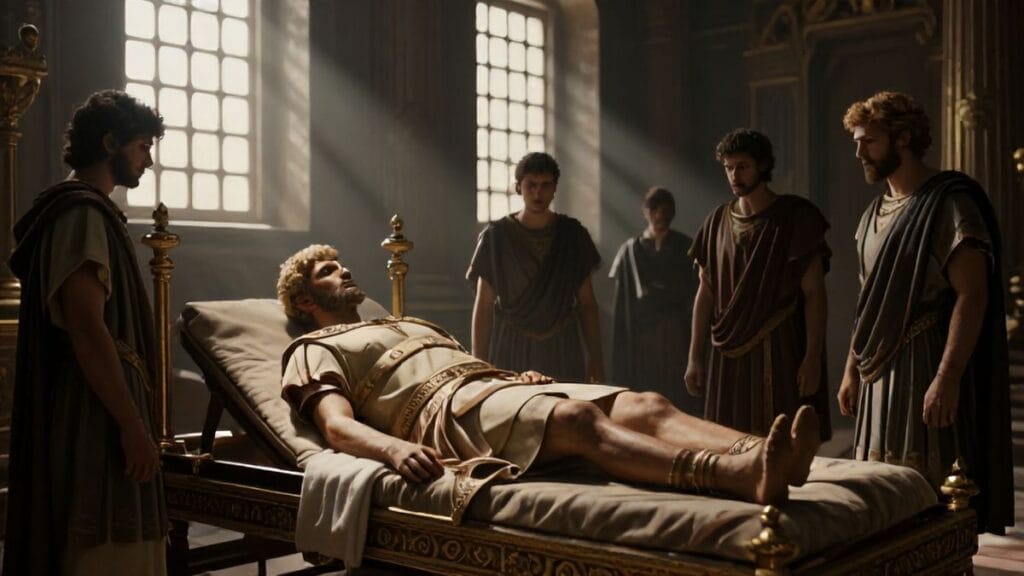
In the autumn of 472, Rome felt the first chills of winter creeping into its stone buildings. Fires burned in braziers; fog rose from the Tiber in the mornings, softening the outlines of decaying monuments. Within the imperial residence—perhaps on the Palatine Hill, perhaps in a later converted palace—Olybrius fell ill. Our sources do not give a diagnosis. They tell us only that he died in November, after a reign that likely lasted little more than six months. But we can imagine the whispered consultations between physicians, the anxious glances of attendants, the murmured prayers of clergy summoned to the emperor’s side.
Illness in late antiquity was a frighteningly common experience, and even the rich could not buy certain protection against it. Plague outbreaks, fevers, dysentery, and respiratory infections devastated populations weakened by war and hunger. Olybrius, probably not a young man by the time of his accession, would have been particularly vulnerable. A minor ailment in more peaceful times might have turned deadly in a body worn down by stress, irregular sleep, and the constant demands of imperial life. As his condition worsened, the routines of court must have shifted: important matters postponed, ceremonies canceled, succession plans whispered about in private corners.
One can picture the final days: bishops offering the sacraments at his bedside, perhaps reciting psalms in Latin, perhaps reading passages from the Gospels that had comforted so many other dying Christians. Olybrius, we may assume, faced death as a man of his faith and class would have been expected to—resigned, hopeful of divine mercy, perhaps concerned for the welfare of his family and the city he nominally governed. Emperor olybrius death in that chamber, away from battlefields and not at the hands of assassins, stands in contrast to the violent ends of so many of his contemporaries. Yet its political consequences were no less profound for being peaceful.
Outside, Rome continued its daily life, but word of the emperor’s worsening health would have spread quickly through the tightly knit networks of officials, clerics, and aristocrats. Rumors ran ahead of facts, as they always do: some may have whispered of poison, others of divine judgment, others simply of bad luck. The truth was probably more prosaic—a common illness settling into a body with too few defenses—yet in an age so accustomed to political murder, suspicions would have been inevitable. By the time Olybrius finally died, the city was likely already preparing itself, emotionally and practically, for another change of ruler.
We do not know where Olybrius was buried, though some traditions suggest a church burial consistent with his Christian standing. His body, wrapped in fine textiles, perhaps accompanied by modest imperial regalia, would have been carried in a solemn procession. Clergy chanted, incense rose, and Rome performed once more the rituals of farewell that had been enacted, in grander form, for giants like Constantine and Theodosius. But the scale was smaller now, the crowd thinner, the sense of an unbroken tradition more fragile. Emperor olybrius death closed not only a brief reign but also a particular configuration of power in Italy—one in which Ricimer had dominated from the shadows, and in which Eastern and Vandal interests had briefly converged around a single, somewhat reluctant figure.
Emperor Olybrius Death and the Shock of an Empty Throne
For Romans hardened by decades of upheaval, the news of yet another emperor’s death might, at first glance, seem almost routine. But the context in late 472 was different. Olybrius died in a capital recently scarred by civil war, in a kingdom where the real powers were already sick or embattled. Ricimer himself died only a few months after Olybrius—some sources say even before him, in August 472—leaving a power vacuum at the very center of Western politics. The twin deaths of kingmaker and emperor in such rapid succession shook the fragile structure of authority that had just been cobbled together.
When we speak of “shock” in this context, we do not mean theatrical despair or universal mourning. Many Romans, especially among the poor, might have felt more concern for the price of bread than for who wore the diadem. Yet among the political classes—senators, military officers, bishops—the death of Olybrius posed urgent questions. Who would the army accept as the next emperor? Would Constantinople try again to impose a candidate? Would the Vandals attempt to intervene, perhaps to install a ruler favorable to their interests? The very machinery of imperial decision-making, already creaking and worn, had to be set in motion again.
In the short term, emperor olybrius death meant uncertainty. The Western court had no clear, uncontested line of succession. Olybrius left no adult son ready to ascend the throne; his connections were more horizontal—into noble houses and foreign courts—than vertical in a dynastic sense. The Senate, though still the nominal voice of Rome’s ancient political traditions, lacked the independent military power to enforce its preferences. The armies, for their part, were increasingly loyal to their immediate commanders rather than to any abstract imperial institution.
This is why Olybrius’s quiet passing should not deceive us. In a system so dependent on personal relationships and so devoid of robust institutions, the removal of a single figure—especially the one who symbolized imperial legitimacy—could have disproportionate effects. Over the years, the repeated deaths, depositions, and assassinations of emperors had taught the Western elites to think in short-term, opportunistic ways. Each death became a chance to renegotiate alliances, settle scores, or stake new claims. Emperor olybrius death thus triggered not only sadness among those close to him but also a flurry of calculations in the minds of men who hoped to shape what would come next.
One contemporary chronicler, the anonymous author of the Chronicle of 511, notes Olybrius’s death tersely, without embellishment. Such brevity reflects not contempt but exhaustion: by the early sixth century, the fall of emperors had become a familiar refrain. And yet, from our vantage point, we can see how his death forms a crucial link in the chain that leads, only four years later, to the deposition of the last Western emperor and the conventional “end” of the Western Roman Empire in 476.
Aftermath in the Palaces: Ricimer, Gundobad, and the Struggle for Control
Power, like nature, abhors a vacuum. With Ricimer gone and Olybrius dead or dying, another figure stepped forward: Gundobad, Ricimer’s nephew, a Burgundian noble who had long served in the Western military hierarchy. For a brief period, Gundobad inherited his uncle’s position as the de facto master of soldiers in Italy. He also had a hand in elevating yet another short-lived emperor, Glycerius, in 473. Glycerius, like Olybrius, was a compromise candidate—acceptable to the Italian army, but not recognized by Constantinople, which favored Julius Nepos instead.
The speed with which new emperors appeared and disappeared in these years illustrates the degree to which the imperial office had become a tool in the hands of generals. Olybrius’s reign, from this perspective, was not an anomaly but part of a pattern: an aristocrat or official raised to imperial rank by a powerful warlord, then replaced or removed when that arrangement broke down. The difference in Olybrius’s case lay in the fact that his arrangement collapsed not because of a coup, but because emperor olybrius death and Ricimer’s own demise removed both the figurehead and the hand that controlled him.
In the palaces of Ravenna and Rome, factions quickly realigned. Some senators may have doubted the wisdom of continuing the cycle of dependent emperors and barbarian generals. Others, more pragmatic, simply sought to secure their estates and family positions amid the chaos. Bishops, conscious of the church’s growing role as a stabilizing force, maneuvered to maintain their influence regardless of which emperor sat on the throne. Meanwhile, the Eastern court in Constantinople watched and waited, eventually dispatching Julius Nepos as its own candidate to restore order in Italy. He would rule briefly before being overthrown by yet another military strongman, Orestes, who in turn placed his young son Romulus Augustulus on the throne.
In hindsight, the tangled politics that followed Olybrius’s death have a grim inevitability. Without a stable imperial institution, without reliable tax revenues, and without a loyal core army, each new regime was fragile. The death of any key figure—not only emperors but also generals like Ricimer—threatened to bring the whole structure crashing down. Olybrius’s short reign and quiet death thus serve as a lens through which to view the systemic fragility of late Western imperial politics. His life was shaped and ended by forces that no individual, however capable, could have mastered by the 470s.
Rome’s People in the Wake of the Emperor’s Passing
What did ordinary Romans make of Olybrius’s death? The sources, as usual, are largely silent about the thoughts and feelings of the poor, the artisans, the small landowners, and even many minor officials. Yet we can reconstruct something of their experience from the patterns of late antique urban life. Imperial deaths were public events: they involved mourning rituals, proclamations, and eventually the announcement of a successor. For the people, such news often meant one practical question above all: would the new emperor be able to keep them safe and fed?
In the immediate aftermath of emperor olybrius death, city dwellers might have gathered in marketplaces and church porticoes, trading rumors. Some would recall the siege of only months before, the shortages and fear that had accompanied Anthemius’s fall. Others might hope that a new emperor could find more favorable terms with the Vandals or secure more regular grain shipments. Still others, jaded by the rapid turnover of rulers, might shrug and focus on the next day’s work. Emperors came and went; rents were still due; taxes still needed to be paid or, more often, evaded.
The church likely played a central role in shaping popular reactions. Sermons could interpret the emperor’s death as a sign of divine will, a call to repentance, or simply as another chapter in God’s unfolding plan for history. Bishops might have urged the faithful to pray for the soul of the departed ruler and for the stability of the realm. In Christian thought of the time, earthly kingdoms were transient; the true kingdom was heavenly. Yet this did not mean indifference to politics. A stable, just emperor was still considered a gift from God, a bulwark against chaos and oppression.
Life, in any case, had to go on. Bakeries continued to bake; smiths hammered at their anvils; boatmen plied the Tiber. The great transitions of high politics often registered only as ripples in the daily routines of the majority. Yet over time, the accumulation of such ripples could become a wave. With each imperial death, each civil war, each raid, confidence in the imperial system eroded further. When Romulus Augustulus was finally deposed in 476, there were probably many in Italy who simply accepted the change as another in a long string of rearrangements—a sign less of dramatic rupture than of a gradual, weary acceptance that the old Roman order had faded beyond recall.
Echoes in Constantinople and Carthage: The Wider Mediterranean Reacts
News of Olybrius’s death did not remain confined to Italy. Messengers carried the information eastward to Constantinople and southward to the Vandal kingdom in Carthage. In Constantinople, the Eastern court had a particular interest in Western affairs, even if it sometimes seemed reluctant to intervene decisively. Leo I, who had played a role in sending both Anthemius and Olybrius to Italy, died in early 474, but during Olybrius’s lifetime and shortly after, Eastern emperors continued to dream of stabilizing the West under leaders sympathetic to their policies and theological positions.
For Eastern officials, emperor olybrius death marked the failure of yet another attempt to craft a workable partnership in the West. Olybrius’s connections to the Theodosian house and his respectable senatorial background had made him, on paper, a promising figure. His rapid disappearance from the stage, following hard on the heels of Anthemius’s violent end, underscored a harsh lesson: as long as the basic power structure in Italy remained dominated by unstable military strongmen and cash-strapped aristocrats, no emperor—however well-chosen—could long establish firm control. It is no surprise that when the East next intervened by sending Julius Nepos, the venture would prove equally short-lived.
In Carthage, the court of the Vandal king Gaiseric would have received the news with its own mixture of interest and calculation. Olybrius’s family ties to captive Roman princesses and to the Theodosian line had once made him a figure of particular Vandal concern. His marriage to Placidia, Valentinian III’s daughter, had created a web of relationships that Gaiseric had tried to exploit. With Olybrius dead, that particular thread of his long game unraveled. The Vandals, firmly entrenched in North Africa and masters of the western sea routes, likely felt little immediate threat from the new wave of emperors rising and falling in Italy.
Yet even if they did not fear a Roman reconquest, they still had to consider the risks of a desperate Western court seeking glory or legitimacy through a fresh war. Every new emperor brought the possibility, however remote, of renewed military ventures against Africa. As it turned out, the dwindling resources of the West and the shifting priorities of the East spared the Vandals from any campaign on the scale of 468. Olybrius’s death can thus be seen, from Carthage’s perspective, as one more sign that Rome’s capacity for coordinated action was crumbling.
Across the wider Mediterranean, merchants, diplomats, and bishops adjusted to this reality. The idea of a single, united Roman Empire persisted in law, liturgy, and imagination, but the practice of power was increasingly regional. Constantinople, Ravenna, Carthage, Toulouse, and other centers functioned as nodes in a network of overlapping authorities and identities. Olybrius had briefly embodied an older vision—a Roman emperor in Rome, linked by blood and faith to the imperial past—but his passing sealed the triumph of a more fragmented, plural world.
The Vanishing of the Western Empire: From Olybrius to Romulus Augustulus
In historical narratives, the year 476 looms large as the “end” of the Western Roman Empire, when the Germanic leader Odoacer deposed the boy-emperor Romulus Augustulus and sent the imperial insignia to Constantinople. But endings in history are rarely as neat as textbooks suggest. The world that collapsed in 476 had already been unraveling for decades. Emperor olybrius death in 472 belongs to this earlier phase of dissolution, when the symbols of empire still functioned but the substance had slipped away.
After Olybrius, a rapid succession of emperors highlighted the hollowness of the office. Glycerius (473–474), Julius Nepos (474–475), and finally Romulus Augustulus (475–476) each held the title without commanding the full respect or resources once associated with it. Julius Nepos, the Eastern-backed candidate, ended up ruling from Dalmatia after being ousted from Italy; Romulus, installed by his father Orestes, was at most a local ruler recognized by the Italian army and some segments of the Senate. Real power migrated increasingly to military leaders: Gundobad, Orestes, and finally Odoacer.
When Odoacer deposed Romulus in 476, he did something that, in retrospect, appears decisive: he chose not to elevate a new Western emperor. Instead, he presented himself as ruling Italy in the name of the Eastern emperor, effectively acknowledging that the fiction of a separate Western imperial court had become unsustainable. This act did not immediately transform life for most Italians; the administrative structures of the late Roman state persisted in many areas, and Roman law and offices continued to function. But symbolically, a barrier had been crossed. There would be no more emperors crowned in Rome or Ravenna to claim the mantle of Augustus in the West.
If we look back from 476 to 472, Olybrius’s brief tenure appears as part of the final flurry of attempts to preserve a dual-imperial structure. His aristocratic roots, his Theodosian connections, his Christian piety—all were pieces in a last-ditch strategy to stabilize the Western court through continuity and respectability. Emperor olybrius death robbed that strategy of one of its key elements. What followed was a shift toward ever more pragmatic, military-centered arrangements, in which the old Roman symbols could be dispensed with altogether when they became inconvenient.
Thus, while Olybrius rarely appears in popular accounts of Rome’s fall, his reign and death are integral to the story. They represent the moment when even the appearance of a strong, independent Western emperor began to feel implausible. From that point on, the Western throne became a short-lived platform for experiments that convinced fewer and fewer people. By the time Romulus Augustulus laid down his insignia, much of the empire he nominally ruled had already slipped into the hands of barbarian kings who called themselves not emperors but rex—and who nonetheless governed former Roman subjects, in former Roman provinces, under the lingering shadow of a world that Olybrius had briefly tried to embody.
Historians Remember: Sources, Silences, and the Enigma of Olybrius
One of the most striking aspects of emperor olybrius death is how little our sources say about it—or about him. Unlike charismatic figures such as Constantine or Theodosius, Olybrius did not attract extensive biographies from contemporary authors. We know him largely through brief notices in chronicles, a few references in ecclesiastical histories, and the small, mute testimonies of coins bearing his image. This paucity forces historians to read between the lines, to infer character and significance from context rather than from detailed narrative.
The fifth and sixth centuries were rich in writers, but their interests and perspectives were uneven. Eastern historians, like Procopius writing in the next century, focused more on the achievements and scandals of their own emperors. Western chroniclers, often monks or clerics, tended to summarize political events briefly while dwelling more on religious matters. The fall of Anthemius, the actions of Ricimer, and the death of Olybrius are typically recorded in a sentence or two. In the Chronicle of Marcellinus Comes, for example, entries for these years are terse, matter-of-fact, reflecting a world in which imperial change had become almost routine.
Modern scholars, confronted with these silences, have debated how much weight to give Olybrius’s reign. Some see him as almost a footnote, a minor figure whose brief months in power barely altered the trajectory of decline. Others argue that he represents, in distilled form, a crucial stage in the transformation of Roman politics: a nobleman-emperor raised entirely by the will of a barbarian general, lacking even the pretense of a military base of his own. In this view, Olybrius is important not because of what he did, but because of what his position reveals about the structures of power in his time.
Citation practices—how ancient writers refer to earlier events—offer clues about perception. When later authors mention Olybrius, it is often in the context of genealogies, marriages, or ecclesiastical benefactions, not in lists of great deeds. The Liber Pontificalis, the Book of the Popes, touches on emperors mainly in terms of their relationships to the Roman church; Olybrius appears as a pious supporter, not as a world-shaping statesman. Peter Brown, in his explorations of late antique aristocracy, has pointed to figures like Olybrius as emblematic of a senatorial class that increasingly expressed its ambitions through patronage and piety rather than high political office—though, in Olybrius’s case, the pull of the latter proved irresistible.
What emerges from this mosaic is an enigmatic figure, at once central and marginal. Emperor olybrius death punctuates many chronicle entries as a factual marker, but the man himself eludes us. Perhaps that is fitting. The late Western Empire was itself becoming spectral, leaving scattered traces in law codes, church inscriptions, and coin hoards, but seldom rich, coherent narratives. In the end, Olybrius stands as a symbol of the historian’s challenge: to reconstruct a lost world from fragments and to respect the silence of the past even as we seek to make sense of it.
Legacy of a Brief Reign: Faith, Dynasty, and the End of an Era
What legacy can one ascribe to a ruler who governed for only a few months, left no major reforms, and died quietly in his bed? At first glance, the answer seems to be: very little. Yet if we consider legacy not merely as a list of achievements, but as a reflection of what a life reveals about its age, Olybrius’s significance grows clearer. His reign illuminates the overlapping roles of faith, dynasty, and brute force in the final decades of the Western Roman Empire.
As a Christian aristocrat, Olybrius belonged to a generation that saw no contradiction between immense worldly wealth and deep religious devotion. His support for churches and the poor fits into a broader pattern in which senatorial families sought to align themselves with the church, both out of genuine piety and as a strategy for maintaining influence. After the collapse of strong central authority, the church would become one of the few institutions capable of bridging the gap between rich and poor, town and countryside. In this sense, Olybrius’s priorities foreshadowed the medieval world that followed, in which noble piety and ecclesiastical patronage were tightly intertwined.
Dynastically, Olybrius connected two powerful lines: the Anicii of Rome and the Theodosian emperors. His marriage to Placidia, Valentinian III’s daughter, preserved the veneer of continuity at a time when actual continuity in imperial institutions was crumbling. Even after the Western throne disappeared, descendants and relatives of such unions continued to play important roles in the politics of both the East and various barbarian kingdoms. Bloodlines, even when detached from the offices they once held, retained symbolic and sometimes practical weight.
Yet it is in the realm of political structure that Olybrius’s story most vividly captures the end of an era. His accession underlines how far the West had fallen from the days when emperors rose through elaborate bureaucratic hierarchies or triumphs on the battlefield. By 472, an emperor could be selected by a Germanic general chiefly because he was convenient: noble enough to impress, pious enough to placate the church, but weak enough to control. Emperor olybrius death, following so quickly upon his coronation, revealed how unsustainable this formula had become. Without a strong institutional framework, neither noble birth nor religious virtue could guarantee stability.
In the broader sweep of history, Olybrius stands at the intersection of two narratives. One is the decline and fall of the Western Roman Empire, a story of military overstretch, fiscal crisis, and political fragmentation. The other is the transformation of the Roman world into a patchwork of successor states that would give birth to medieval Europe. Olybrius’s Rome was a Christian, aristocratic, urban society still haunted by memories of imperial unity, yet increasingly accustomed to local power, foreign kings, and the guiding hand of the church. His short reign thus offers a window onto a moment when the old and the new coexisted uneasily, and when the imperial title itself was becoming a relic of a world that was vanishing before people’s eyes.
Conclusion
In November 472, when Olybrius died in Rome, no cataclysm announced the event. The city’s walls did not fall, its aqueducts did not crumble, its churches did not burn. An emperor passed from the scene much as he had lived in it—quietly, overshadowed by more forceful figures, leaving behind little in the way of grand achievements. Yet emperor olybrius death, seen in context, marks a significant waypoint on the road to the Western Empire’s dissolution. It ended a brief attempt to stabilize Italy under a noble, pious, Theodosian-linked ruler who might have reconciled at least some of the warring interests that tore the West apart.
Olybrius’s life and death reveal a world in transition. The institutions of the Roman state still functioned, but they did so increasingly under the control of generals rather than emperors. The church was rising as both moral authority and social safety net, while long-established aristocratic families like the Anicii navigated between old Roman identities and new Christian ones. Across the sea, Vandals, Visigoths, and other so-called barbarians ruled Roman populations in their own right, while Constantinople tried, and failed, to steer the course of Western politics through carefully chosen candidates.
In this fragile, fragmented landscape, Olybrius’s reign was a fleeting experiment, quickly undone by biology and circumstance. His death exposed once more the hollowness of the imperial office in the West and accelerated the shift toward a post-imperial order in which kings and bishops, rather than emperors and prefects, would dominate. If his name does not resonate widely today, that is partly because the age he embodied was itself one of fading resonances and diminishing horizons. Yet by tracing his story—from noble childhood to imperial coronation, from tense months on the throne to a modest deathbed in Rome—we gain a richer understanding of how empires do not simply fall, but slowly unravel through a succession of quiet, often overlooked endings.
FAQs
- Who was Olybrius before he became emperor?
Olybrius was a member of the powerful Roman senatorial family of the Anicii and the husband of Placidia, daughter of the Western emperor Valentinian III. He was known as a wealthy aristocrat and devout Christian, prominent in elite circles and closely tied to both the Roman church and the Eastern imperial court through family and marriage connections. - How did Olybrius become Western Roman emperor?
Olybrius was elevated to the Western throne in 472 during a civil war between the reigning emperor Anthemius and the dominant general Ricimer. Backed by Ricimer and acceptable to the Eastern court and possibly the Vandals, Olybrius was proclaimed emperor after Ricimer besieged Rome and defeated Anthemius. His noble lineage, Christian piety, and lack of an independent army made him an attractive, controllable candidate. - When and how did emperor Olybrius die?
Emperor Olybrius died in Rome in November 472, likely of natural causes following a period of illness. Ancient sources give no precise diagnosis, but they agree that his reign was very short—probably around six months—and that his death occurred soon after the violent fall of Anthemius and the end of the civil war that had ravaged the capital. - Why was emperor olybrius death significant for the Western Roman Empire?
His death mattered because it coincided with, and helped expose, a deep structural crisis in the Western Empire. Olybrius had been a compromise figure meant to stabilize Italy after civil war, but his rapid death, combined with the almost simultaneous loss of Ricimer, left a power vacuum. This accelerated the pattern of short, unstable reigns that culminated in the deposition of the last Western emperor, Romulus Augustulus, only four years later. - Did Olybrius achieve any notable reforms or military victories?
No major reforms, laws, or military campaigns can be securely attributed to Olybrius. His reign was too brief and too overshadowed by the aftermath of civil war and Ricimer’s dominance. His importance lies less in what he personally accomplished and more in what his reign reveals about the weakness of the imperial office and the dominance of military strongmen in the late Western Empire. - How is Olybrius viewed by modern historians?
Modern historians generally see Olybrius as a minor but revealing figure. While he is not credited with significant achievements, his elevation as a noble, pious “puppet emperor” illustrates the political dynamics of the 470s: senatorial aristocracy, church influence, barbarian generals, and Eastern intervention all converging on a man who lacked independent power. His death is treated as one of the key markers on the road to the end of the Western Empire. - What role did religion play in Olybrius’s life and reign?
Religion was central to Olybrius’s identity and public image. He was remembered as a devout Christian who supported churches and the poor, consistent with the broader pattern of late Roman aristocratic piety. As emperor, his Christian credentials helped legitimize his rule in the eyes of the Roman church and populace, even though his brief time on the throne did not allow for major religious policies or controversies to develop. - How was Olybrius connected to the Vandals in North Africa?
Olybrius’s connection to the Vandals came primarily through family ties. After the sack of Rome in 455, Vandal king Gaiseric took members of the imperial family, including Olybrius’s sister-in-law Eudocia, to Carthage. These relationships made Olybrius a figure of interest to Gaiseric, who saw in him a potential Western emperor linked to both the old imperial line and the Vandal royal court, useful in diplomatic maneuvering.
External Resource
Internal Link
Other Resources
- Encyclopaedia Britannica – general search for the exact subject
- Google Scholar – academic search for the exact subject
- Internet Archive – digital library search for the exact subject