Table of Contents
- Sands in Motion: A Desert Empire on the Edge of Change
- From Sanhaja Tents to Imperial Dreams: The Roots of the Almoravids
- Abu Bakr ibn Umar: The Ascetic Warlord of the Sahara
- Yusuf ibn Tashfin: The Quiet Commander Rising from the Ranks
- Marrakesh in its Cradle: A City of Tents and Ambition
- The Turning Year 1062: Why Delegation Became Destiny
- The Ceremony of Power: How the Delegation Was Performed
- Vows, Authority, and Trust: The Political Logic Behind the Shift
- Between Desert and City: Governing a Fractured Realm
- Faith as Constitution: Religious Legitimacy and the Almoravid Vision
- Forging an Empire: Yusuf’s Early Rule under Abu Bakr’s Shadow
- The Human Dimension: Soldiers, Traders, and Scholars in Transition
- Across the Strait: How a Delegation in 1062 Shaped al‑Andalus
- The Waning of Abu Bakr: Frontier Wars and a Distant Sovereign
- Memory and Myth: How Chroniclers Portrayed the Delegation
- Long Shadows: The Legacy of Almoravid Governance
- Echoes in Modern Historiography: Reassessing 1062
- Conclusion
- FAQs
- External Resource
- Internal Link
Article Summary: In 1062, in the dust and heat of a still‑young Marrakesh, a quiet but momentous decision was made: the abu bakr ibn umar delegation of power to his cousin and lieutenant Yusuf ibn Tashfin. This article traces the deep desert roots of the Almoravid movement, from Sanhaja tribal piety to the forging of an empire that would touch both sides of the Strait of Gibraltar. It follows the personal trajectories of Abu Bakr, the austere frontier commander, and Yusuf, the reserved strategist, to show how character, geography, and faith converged on that single act of delegation. Through narrative and analysis, we see how the transfer of authority reshaped politics in the Maghrib, stabilized the emerging city of Marrakesh, and prepared the way for intervention in fractured al‑Andalus. The abu bakr ibn umar delegation is presented not as a footnote, but as a hinge on which Western Islamic history turned, with profound social, military, and religious consequences. Along the way, vivid scenes from camps, courts, and caravan routes reveal how ordinary people experienced this change in rule. By revisiting chronicles and modern scholarship, we reconsider how one decision in 1062 helped define the Almoravid legacy and the future of Iberia.
Sands in Motion: A Desert Empire on the Edge of Change
The year was 1062, and the city that would one day rival the great capitals of the Islamic West was barely more than an idea traced in dust. Marrakesh was still in its first incarnation: an encampment of black wool tents, fenced by palisades and makeshift walls, laid out on a plain at the foot of the Atlas Mountains. Wind blew over half-buried stones; horses stamped in their pickets; the smell of leather, sweat, and woodsmoke hung in the air. Yet, in this seemingly fragile settlement, power was on the move.
At the heart of this story stands an act that historians now refer to as the abu bakr ibn umar delegation: the moment when Abu Bakr ibn Umar, commander and reformer of the Almoravid movement, entrusted the rule of the burgeoning Maghribi domains to his cousin Yusuf ibn Tashfin. It was neither a palace coup nor a theatrical coronation. There were no marble halls, no lined ranks of courtiers in silks. Instead, there was desert austerity—an emir preparing to ride south into more arduous campaigns, and another, quieter leader stepping into the everyday burdens of government.
This delegation was born from the particular world of the Almoravids: a coalition of Sanhaja Berber tribes forged in religious zeal, hardened by caravan routes and desert war. These men had crossed thousands of kilometers of sand, drawn together by preachers insisting on a stricter observance of Islam and a more disciplined social order. Their banners had already carried them from the Senegal River basin northward toward the lands that would soon be called Maghrib al-Aqsa, the Far West, anchoring what would become Morocco.
But this was only the beginning. The abu bakr ibn umar delegation did not simply shuffle authority within a single clan; it pivoted the entire trajectory of an empire. Abu Bakr, deeply committed to the harsh frontier south of the Sahara, recognized that governing a growing, more urbanized north required a different temperament. Yusuf ibn Tashfin, practical and patient, already showed signs of being that kind of ruler. In choosing to delegate power rather than cling to every command, Abu Bakr opened a path that would lead from the dunes of the western Sahara to the embattled cities of al-Andalus.
It is astonishing, isn’t it, that what might have looked like an internal family arrangement reached so far into the future? Within a few decades, Christian and Muslim chroniclers alike would know the name of Yusuf as the emir who crossed the sea, who defeated the kings of León and Castile at Zallaqa, who reshaped the map of Iberia. Yet behind those triumphs stands the quieter, earlier act: the abu bakr ibn umar delegation in 1062, made in a wind-stung camp before Marrakesh had truly become a city. To understand how this decision came to be—and what it meant for the soldiers, traders, villagers, and scholars beneath these rulers—we must first return to the deserts that birthed the Almoravids.
From Sanhaja Tents to Imperial Dreams: The Roots of the Almoravids
Long before the name “Almoravid” echoed in European chronicles, the Sanhaja tribes lived by the rhythm of the desert. They moved in loose confederations, following grazing lands and caravan trails, their tents the color of storm clouds, their lives tethered to camels and stars. In the tenth and eleventh centuries, three great Sanhaja groupings—Lamtuna, Gudala, and Massufa—dominated vast stretches of the western Sahara, controlling routes that linked the goldfields of the south to the markets of Sijilmassa and beyond.
Caravans were their arteries, and religion, for a time, flowed only shallowly through them. Islam had reached North Africa centuries earlier, but in the deep Saharan zones, it often mingled with older customs and remained loosely observed. That began to change in the mid-eleventh century, when religious reformers emerged among the Sanhaja. One of these was Abdallah ibn Yasin, a scholar reportedly from the Sous region, whom Sanhaja leaders invited to teach a stricter, more doctrinal Islam to their people.
What began as religious instruction turned quickly into a disciplined movement. Ibn Yasin demanded not only prayer and fasting but also social order, Islamic law, and obedience to a new kind of leadership. He was uncompromising. Tribes that rejected his call faced censure, then arms. According to later chroniclers such as Ibn Idhari and Ibn Khaldun, he and his Sanhaja allies began to wage jihad not only against “unbelievers” to the south but also against lax or syncretic practices among their own people.
In this crucible, the Almoravids were born. Their name—al-Murabitun—evoked ribat, the frontier forts where devout warriors withdrew from the world to fight and worship. It suggested both religious retreat and militant advance. Under ibn Yasin’s guidance, and with Sanhaja tribal leaders as military commanders, the Almoravids began their expansion in the 1040s and 1050s, pushing south into the lands of the Ghana Empire and north toward the edge of the Mediterranean world.
Abu Bakr ibn Umar emerged from within this landscape. He belonged to the Lamtuna, one of the most powerful Sanhaja groups, and early on he proved his mettle in the campaigns that knit together a new, more centralized authority over the desert. Yoked to faith and profit alike, Almoravid armies imposed tolls on caravans, reoriented trade under their auspices, and built the foundations of what would become a trans-Saharan empire. Gold, salt, slaves: all began to flow under banners of sable cloth, inscribed with Quranic verse.
Yet even as their influence spread, the Almoravids faced an inherent tension. Their strength came from the mobility of nomadic Sanhaja warriors, but their ambitions increasingly pointed toward the wealthy, sedentary lands beyond the dunes—the irrigated valleys, fortified towns, and coastal cities of the Maghrib. With expansion came the need for stable administration, for taxation rather than sporadic plunder, for judges and markets as well as commanders. This tension between movement and settlement, between tribal egalitarianism and centralized rule, would shape the decision Abu Bakr later made in Marrakesh.
By the mid-eleventh century, the Almoravids had already crossed the Senegal River and pressed upon the Ghana Empire, while in the north they shadowed the fractured petty dynasties of what would later be Morocco. The time had come to plant deeper roots. Yet, as so often in history, desert politics retained their own logic. Leadership remained a delicate art, balanced among tribal rivalries, personal charisma, and claims of religious legitimacy. The abu bakr ibn umar delegation of 1062 must be seen against this long backdrop: it was the solution crafted by a desert warlord facing the new, unsettling demands of a state.
Abu Bakr ibn Umar: The Ascetic Warlord of the Sahara
Abu Bakr ibn Umar was not the kind of ruler who surrounded himself with luxuries. Sources, though colored by later idealization, portray him as austere even by the standards of his own age. He ate simple food, slept in tents, and remained closely attached to the frontier campaigns that had forged the Almoravid identity. If many leaders are formed in courts and cities, Abu Bakr was formed along sand ridges and riverbanks, amid the dust of forced marches and the whistling of desert wind.
He inherited command in stages. After the death of the movement’s spiritual architect, Abdallah ibn Yasin, leadership passed to Sanhaja war-chiefs, among whom Abu Bakr rose as a central figure. He played key roles in consolidating Almoravid authority over the western Sahara and in projecting that authority north into the Maghrib. Under his aegis, campaigns pushed through the Draa Valley and into the plains where future Moroccan cities would be drawn upon the earth like sketches of permanence in a shifting landscape.
Abu Bakr, however, was not simply a brute conqueror. He carried the burden of religious responsibility. Chroniclers underline his devotion and justice, hinting that he saw himself not as a king but as the guardian of a community of believers. This self-image in turn influenced his political choices. The abu bakr ibn umar delegation would later be framed as an act of piety and prudence, not of weakness: he deferred to what he believed was necessary for the community’s stability.
His leadership style can be imagined in small, vivid scenes. Picture him seated on a woven mat at the edge of an encampment, receiving tribal elders by lamplight. They report on skirmishes at far oases, disputes over tribute, rumors of revolt among distant clans. He listens more than he speaks, his questions probing but calm. Armor and Qur’an rest equally close by his side. Such a ruler was well suited to the flowing, uncertain frontiers of the Sahara, where authority had to move with the herds and caravans.
But the north was changing. As Almoravid control extended into more heavily settled lands, new problems demanded attention: the integration of urban elites, the repair of irrigation works, the institution of regular taxation, the appointment of judges versed in Maliki jurisprudence. Abu Bakr frequently found himself drawn back south to deal with desert campaigns, leaving the nascent centers of the north in the hands of deputies. Over time, one deputy among them began to stand out—not for flamboyance, but for his ability to turn mobile conquests into stable order. This man was Yusuf ibn Tashfin.
Yusuf ibn Tashfin: The Quiet Commander Rising from the Ranks
Yusuf ibn Tashfin did not announce himself with thunder. He was not, according to the sources, a man of great speech or ostentatious gestures. Born into the same Sanhaja milieu as Abu Bakr, he belonged to the Lamtuna line, but his talents lay less in charismatic preaching or personal austerity and more in careful, patient organization. He understood not only how to win battles, but how to hold ground.
By the 1050s, Yusuf had already distinguished himself as a capable commander. Abu Bakr trusted him with key tasks in the northern campaigns, where the Almoravids encountered a very different world from the desert: fortified towns whose walls had stood for generations; fields edged with stone; irrigation channels threaded like veins through orchards; workshop districts ringing with hammers on copper and iron. Here the Almoravids confronted rulers who claimed old titles, formed alliances, and plotted betrayals with ink as often as with spears.
Yusuf moved through this terrain with a kind of understated competence that impressed even his rivals. Some later chroniclers describe him as waqar—dignified, composed. He was known for a certain modesty in dress and demeanor, even when his power grew. Yet his modesty concealed a mind alert to structures and systems. He saw that the Almoravid project could not rest forever on seasonal raids and shifting loyalties. What was needed was a seat of power in the north, an anchor against the turbulence of tribal politics and external threats alike.
It was Yusuf who oversaw much of the early development of the encampment that would become Marrakesh. He recognized the plain’s strategic advantages: close to the Atlas passes, open enough to host large armies, yet connected to trade routes snaking toward the Atlantic coast and inland valleys. In tents and makeshift enclosures, he began to arrange the tribes, assign quarters, establish paths that later would be traced in stone streets. Under his watch, a military camp took on the first faint outline of a city.
Yusuf’s rise did not threaten Abu Bakr; instead, it complemented him. Where Abu Bakr embodied the older, mobile essence of the Almoravids, Yusuf represented their emerging need for a settled administration. The two shared blood and cause, and for a time their spheres of action overlapped, intersected, and supported one another. But events in the far south—rebellions, renewed campaigns, the need to reassert Almoravid authority—would soon demand that Abu Bakr leave the north. The abu bakr ibn umar delegation, when it came, was the logical extension of Yusuf’s expanding responsibilities, yet it also required an extraordinary measure of trust.
Marrakesh in its Cradle: A City of Tents and Ambition
To imagine the scene of 1062, one must strip away the Marrakesh of postcards and palaces. There was no sprawling red-walled city yet, no Koutoubia minaret piercing the sky, no grand avenues thronged with merchants from Fez or Seville. There was instead a raw, pulsing camp, stretched under a harsh sun, where everything was provisional and yet charged with possibility.
The future city lay on a flat plain, with the snowy caps of the High Atlas glinting in the distance like a mirage of other worlds. Water, though precious, was accessible; wells had been sunk, and rudimentary channels were beginning to be carved. Herds grazed at the camp’s outer edges. Horses and camels jostled, tethered in rows. Black tents huddled in clusters by tribe, each cluster a little world with its own hierarchies and feuds, its own murmuring at night.
Within this ferment, Yusuf, acting as Abu Bakr’s lieutenant, began to lay down patterns. He arranged for markets where caravans could unload goods in relative security, introducing the regularity of trade schedules and tax collection. He encouraged the construction, however modest, of more stable structures—storehouses, rough enclosures, small mosques made first of packed earth and timber, then more substantial materials. What had been simply a military encampment began, by degrees, to attract artisans, traders, and families.
Yet behind the celebrations of growth lay anxiety. Many Sanhaja warriors felt unease at the creeping permanence of their surroundings. Their identity was rooted in movement; to exchange tents for houses risked dulling their edge, weakening the bonds that had made the Almoravids so formidable. Others, especially traders and jurists, saw in Marrakesh the promise of continuity and prosperity. A new balance was being sought between the desert and the city, between the sword and the inkpot.
At this fragile stage, the city’s fate was deeply tied to its leaders. Were Abu Bakr to withdraw his authority without leaving a capable, recognized successor, Marrakesh might splinter into factional strife. Rival tribes could vie for dominance; urban notables might appeal to outside powers; the very experiment in northern consolidation could collapse. The abu bakr ibn umar delegation thus became not only a personal choice, but the decision upon which an entire emerging urban order depended.
The Turning Year 1062: Why Delegation Became Destiny
The year 1062 did not arrive with signs in the sky, yet for the Almoravid world it marked a turning point. In the south, beyond the desert horizon, troubles had rekindled. The campaigns that had once subdued regions near the Senegal River and the remnants of the Ghana Empire required renewal. Vassals wavered; some tribes chafed under Almoravid authority, others saw opportunities in the movement’s northern preoccupations. Reports reached Abu Bakr in Marrakesh of unrest that could not be ignored.
To be an emir of such a world was to be pulled in opposite directions. Abu Bakr felt obligated, as both a political and religious leader, to attend personally to the troubled frontiers. His legitimacy among the southern Sanhaja and newly subdued populations relied on the perception that he remained one of them, sharing their hardships, defending their interests. To retreat into a northern camp and rule only by deputies would risk being seen as abandonment.
At the same time, the situation in the north was too delicate for a simple departure. The Almoravids had not yet fully pacified all rival centers; urban elites in older cities watched the rise of Marrakesh with wary eyes. If Abu Bakr left without a clear and empowered successor, his absence could invite opportunists. Civil war was not an abstract fear; in tribal polities, succession crises often bled into open conflict.
Faced with this dilemma, Abu Bakr chose a path that was both practical and visionary. He did not divide the empire formally, nor did he cling to personal control of every decision. Instead, he decided to delegate the day-to-day rule of the north, including the management of Marrakesh and its expanding territories, to Yusuf ibn Tashfin. The abu bakr ibn umar delegation was, at its core, an attempt to be in two places at once: to maintain Almoravid vigor in the south while ensuring steady governance in the north.
This decision rested on several pillars. First, familial ties: Yusuf was not only a trusted commander but a kinsman, a cousin whose loyalty was reinforced by lineage. Second, demonstrated competence: Yusuf’s record in organizing the camp, integrating local populations, and securing tribute made him a natural candidate. Third, shared religious commitment: Abu Bakr believed that Yusuf’s adherence to Maliki norms and Almoravid discipline would preserve the ideological core of the movement.
In a sense, the year 1062 asked Abu Bakr to decide what kind of leader he wished to be remembered as. To hoard authority might preserve personal power in the short term but risk institutional fragility. To devolve authority, even partially, meant trusting that the movement could transcend its founder-figures. He chose the latter. Historians, looking back, often see in this moment the seeds of the Almoravid Empire’s transformation from a desert coalition into a more durable state.
The Ceremony of Power: How the Delegation Was Performed
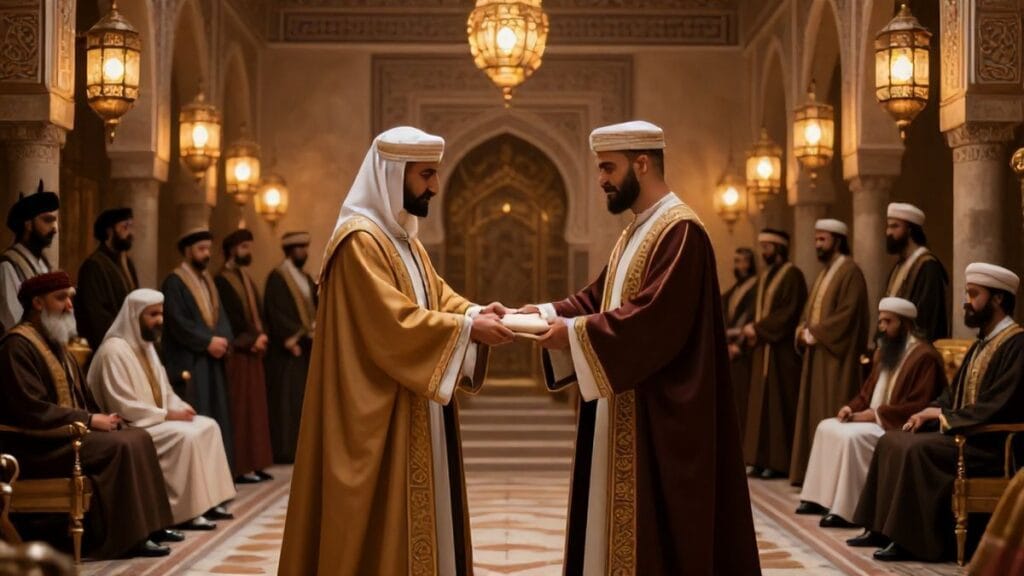
No chronicler offers a detailed, minute-by-minute account of the abu bakr ibn umar delegation ceremony in Marrakesh, but scattered references allow us to reconstruct its probable contours. It was not an audience in a marble hall; it was a gathering under the vast sky, dust swirling around the hooves of restless mounts, banners stirring in the wind.
Imagine the scene on a cool morning. The camp had been alerted; word had spread that the emir would address his commanders and notables. Tribal leaders, their cloaks wrapped closely against the dawn breeze, converged on the appointed space. Judges trained in Maliki law, scribes with ink-stained fingers, and merchants whose fortunes now hinged on Almoravid stability stood at the periphery. The scent of trampled grass and sweat rose as horses and camels were held in check.
Abu Bakr appeared not in regal finery, but in garments similar to those of his men: woolen cloak, turban wound against the sun, sword at his side. Yet every eye turned to him as he took his place—perhaps upon a raised platform of packed earth or an improvised dais. At his right stood Yusuf ibn Tashfin, slightly back, his posture suggesting both deference and readiness.
A speech was necessary. Abu Bakr likely framed his decision in terms of duty: duty to God, to the faithful, to the stability of the lands now under Almoravid sway. He would have spoken of the unrest in the south, the need to defend what they had gained there, and his obligation to lead that defense in person. But he would also have emphasized the importance of not leaving the north leaderless. According to later tradition, he publicly conferred authority on Yusuf to govern the northern domains in his absence, instructing the troops and notables to obey him as they would obey himself.
The act of delegation would have been sealed not only by words but by symbols: perhaps the handing over of a banner, the declaration of Yusuf’s right to collect taxes and command armies in Abu Bakr’s name, the endorsement by respected jurists who affirmed the legality and propriety of the arrangement. Qur’anic verses might be recited, emphasizing obedience to legitimate authority and unity among believers.
One can picture the murmur that followed, the rustling as men shifted, some weighing the implications. There were likely those who felt a sting of jealousy or doubt: why Yusuf and not another? Why concentrate power in one pair of hands? Others, more pragmatic, recognized the advantages of having a single, clear leader in the north. The ceremony must have ended with oaths—verbal pledges from key figures, binding them to support Yusuf’s rule under Abu Bakr’s overarching sovereignty.
Then, as quickly as speeches could fade into the wind, life resumed. Horses were prepared for Abu Bakr’s departure; orders were issued; scribes began drafting documents that would crystallize in writing what had just been performed in words. The abu bakr ibn umar delegation had taken place, not as a theatrical coup but as a carefully calibrated act of governance in a world where the line between loyalty and rivalry was never far from view.
Vows, Authority, and Trust: The Political Logic Behind the Shift
The abu bakr ibn umar delegation was more than a personal favor or a pragmatic adjustment; it was a calculated political move that sought to reconcile competing imperatives in Almoravid rule. At its core lay the question of authority: who held it, on what basis, and to what extent it could be shared without being diluted.
In the Almoravid conception, power was ideally anchored in three interlocking claims. First, tribal legitimacy: the Sanhaja, particularly the Lamtuna, saw themselves as rightful leaders, bound by lineage and custom. Second, religious legitimacy: adherence to Sunni orthodoxy, especially the Maliki school of law, undergirded their claims to righteous rule and jihad. Third, military success: in a frontier world, victory in battle remained a primary proof of divine favor and political capability.
By delegating northern rule to Yusuf, Abu Bakr preserved all three claims while reducing the risks associated with overextension. Yusuf shared his tribal lineage, thus maintaining continuity. His reputation for pious observance and his close collaboration with jurists gave his authority a religious seal. His record in battle, especially in the northern campaigns, convinced many that he could defend and expand what had been gained.
Yet behind the celebrations of such a neat alignment lurked quieter fears. Delegation can be a first step toward displacement. By giving Yusuf real power—control over troops, revenues, and appointments—Abu Bakr risked creating a rival almost as much as a partner. He relied on oaths of loyalty, familial affection, and shared ideological commitment to prevent that power from turning against him. This trust was not naive; it was informed by years of fighting and planning together. Still, it was a gamble.
The logic extended beyond personalities. Abu Bakr appears to have understood that for the Almoravid project to outlast any single leader, it needed structures: defined roles, chains of command, predictable lines of succession. The delegation in 1062 can therefore be seen as a tentative step toward institutionalization. While modern historians rightly caution against projecting later state forms backward, there is nonetheless a recognizably strategic effort here to make authority portable, capable of being exercised by more than one designated figure at a time.
The chronicler Ibn Khaldun, writing centuries later, would reflect on cycles of dynastic rise and decline, emphasizing how nomadic groups conquer, then settle, then soften. Though he does not dwell extensively on this specific moment, the abu bakr ibn umar delegation fits neatly into his pattern: a mobile warrior elite attempting to anchor its power without losing the asabiyya—the group solidarity—that made it strong. Trust between Abu Bakr and Yusuf was both the glue and the test of that solidarity.
Between Desert and City: Governing a Fractured Realm
With Abu Bakr riding south and Yusuf assuming greater responsibility in the north, the Almoravid Empire entered a new phase, one defined by the constant negotiation between its desert heartland and its emerging urban peripheries. Governance now meant far more than leading raids; it required harmonizing disparate worlds under a single banner.
In the desert regions, rule leaned heavy on tribal structures. Local leaders maintained day-to-day order, collecting tribute and rallying warriors when called upon. Law was applied through a blend of Islamic principles and older customs, mediated by judges who had to be as familiar with camel disputes as with the finer points of inheritance law. Abu Bakr’s presence in these areas reassured the Sanhaja that their values still defined the movement, even as it stretched into unfamiliar territories.
In the north, under Yusuf’s oversight, governance took on different textures. Cities and towns, some with centuries of history, possessed entrenched elites: merchant families, religious scholars, and lineages of local rulers. Their cooperation could not be taken by storm alone. Yusuf had to combine force with negotiation, offering protection, commercial advantages, and respect for property in exchange for allegiance and taxes.
One can imagine council gatherings in early Marrakesh where tribal leaders sat alongside urban notables. The language of such meetings must have been filled with subtle tensions: the proud confidence of nomads who had brought cities to heel, the wary deference of townsmen who understood accounting and irrigation better than cavalry charges. Yusuf’s task was to ensure that these tensions did not tear the nascent polity apart.
Administratively, Yusuf began to institutionalize certain posts. Governors were appointed over newly subdued areas, judges selected for cities and larger towns, market inspectors named to regulate commerce. Taxation systems were introduced or standardized, shifting revenue from sporadic booty to more regular flows. This evolution brought prosperity and predictability to some, but it also imposed new burdens, especially on rural peasants who found themselves now contributing to a distant power in Marrakesh rather than only to their local lords.
Through all this, the bond with Abu Bakr remained alive, at least in the early years. Orders, correspondence, and reports traversed the distances between south and north. In a world without postal services in the modern sense, couriers on horseback and camelback carried not only information but symbols of shared rule: commands issued in Abu Bakr’s name, confirmations of Yusuf’s decisions, reassurances that the dual center of authority functioned as one. The abu bakr ibn umar delegation had created a bifocal empire; keeping both eyes aligned was an ongoing challenge.
Faith as Constitution: Religious Legitimacy and the Almoravid Vision
For the Almoravids, faith was not a private matter. It was the very fabric of their political project. From the movement’s earliest days under Abdallah ibn Yasin, religious renewal had been both an inspiration and a justification for conquest. The abu bakr ibn umar delegation thus carried religious as well as political significance; it had to be framed not simply as a military or familial arrangement, but as an act sanctioned by Islamic principles.
The Maliki school of law, which had come to dominate the western Islamic world, offered a rich jurisprudential toolkit for thinking about authority, obedience, taxation, and war. Maliki jurists in the Maghrib and al-Andalus emphasized the importance of order and the avoidance of fitna—civil strife. In times of fragmentation, they often lent their support to rulers who promised unity and upheld the outward forms of piety, even if those rulers emerged from the rough margins of the desert.
Yusuf ibn Tashfin, more than Abu Bakr before him, actively courted the support of such jurists. Even as he consolidated power in Marrakesh, he made visible displays of humility: living simply, enforcing public morality, funding mosques and ribats. These gestures were not mere theatrics; they signaled that Almoravid authority would be exercised within recognizable Islamic norms, not as arbitrary tribal domination. When Abu Bakr entrusted him with northern rule, Yusuf thus took on not only the tasks of a governor but the mantle of a protector of orthodoxy.
Religious discourse framed the delegation as a necessity to fulfill obligations. Abu Bakr’s departure to the south could be described as a jihad effort, defending the faith’s frontiers and correcting injustices. Yusuf’s assumption of power in the north could be presented as a duty: to safeguard the faithful from internal disorder and external threat. In sermons and legal opinions, obedience to both leaders, within their respective spheres, would be urged as a religious requirement.
This fusion of piety and politics had far-reaching consequences. It helped the Almoravids rally support beyond their own tribes, attracting Muslim communities weary of lawlessness and eager for a ruler who could offer security and religious legitimacy. But it also imposed constraints. A ruler whose authority rests on being a defender of orthodoxy must himself remain within orthodox bounds. Later, when Yusuf extended his rule into al-Andalus, he would seek fatwas from prominent Andalusi scholars to justify deposing the fractious taifa kings—a strategy foreshadowed in the legitimizing narratives surrounding the abu bakr ibn umar delegation.
As one modern historian has observed, “the Almoravids built their empire as much with legal opinions as with lances” (to paraphrase a line of analysis reminiscent of the work of historian Amira Bennison). That empire’s reconfiguration in 1062 thus cannot be fully understood without grasping the religious lens through which Abu Bakr and Yusuf viewed their own decisions.
Forging an Empire: Yusuf’s Early Rule under Abu Bakr’s Shadow
In the years immediately following 1062, Yusuf’s authority in the north grew in scope and depth, but it remained, at least formally, under the overarching sovereignty of Abu Bakr. This duality produced a fascinating political dynamic: Yusuf acted with increasing autonomy, yet his rule was still cloaked in the legitimacy of his absent cousin.
Yusuf’s first priority was consolidation. The territories around Marrakesh, though under Almoravid influence, were not yet fully integrated. Rival power centers—tribal chieftains, local rulers, and urban elites—still held sway in various pockets. Through a combination of military pressure, negotiation, and the appointment of loyal governors, Yusuf worked to transform a patchwork of allegiances into a more coherent realm.
Campaigns against remaining opponents in the region strengthened his reputation as a capable military leader. Victories were framed as extensions of Abu Bakr’s overall jihad, maintaining the sense of a single movement with shared aims. Nonetheless, Yusuf made decisions that were increasingly his own: choosing which cities to prioritize, how harshly to treat defeated foes, when to integrate local elites and when to sideline them.
Economic measures also began to take shape. Marrakesh’s markets expanded, attracting merchants from the Atlas, the Atlantic seaboard, and farther afield. Taxes collected from these trades, from agricultural production, and from caravan tolls created a revenue base that Yusuf could deploy. Part of this income likely flowed southward, symbolically and practically tying his administration to Abu Bakr’s continuing campaigns. Part remained in the north, funding fortifications, garrisons, and the earliest public works.
Through it all, Yusuf remained careful. He did not, at this stage, assume grandiose titles that might have signaled a bid for complete independence. His image was that of a deputy who excelled at his assigned role. Chroniclers later emphasize his humility—stories circulate of him mending his own clothes, of refusing excessive ornamentation. While such tales may be embellished, they capture an important truth: Yusuf needed to project a certain kind of rulerliness, one that reassured both Almoravid warriors and new subjects that his growing power did not mean sudden tyranny.
The abu bakr ibn umar delegation thus created a political apprenticeship on an imperial scale. Under Abu Bakr’s distant but acknowledged sovereignty, Yusuf learned the arts of long-term governance: how to maintain an army over years rather than seasons, how to negotiate with jurists and merchants as well as with tribal elders, how to plan for a future when expansion would no longer be the only source of legitimacy. These lessons would later prove crucial when the Almoravid gaze turned toward the fractured kingdoms of al-Andalus across the sea.
The Human Dimension: Soldiers, Traders, and Scholars in Transition
The reconfiguration of power in 1062 did not touch only emirs and judges; it rippled through the lives of ordinary people whose names are lost to us. To feel the full weight of the abu bakr ibn umar delegation, we must step down from tents of command into the crowded, dusty spaces where soldiers argued, traders haggled, and scholars debated.
For the rank-and-file Almoravid warrior, the change in leadership in the north was both practical and psychological. Practically, it meant new chains of command, perhaps adjustments in where they were stationed, which campaigns they joined, how spoils and stipends were distributed. Psychologically, it meant shifting from seeing Abu Bakr as the immediate source of orders to recognizing Yusuf in that role. In societies where personal loyalty was paramount, such a transition required careful management. When Abu Bakr himself publicly endorsed Yusuf and instructed obedience to him, it eased the shift, but doubts and quiet grumbling surely persisted in some quarters.
Traders, especially those who had begun to invest in Marrakesh’s nascent markets, watched the transfer of power with keen interest. Stability was their lifeblood. The continuity of administration under Yusuf, anchored in the legitimacy of Abu Bakr, reassured many that contracts would be honored, caravans protected, and taxes predictable. Some likely seized the moment to deepen their ties with the new northern ruler, offering loans or services that would be remembered when appointments and favors were distributed.
Scholars, too, weighed the implications. Maliki jurists had long grappled with questions of obedience to rulers in situations of divided authority. The dual leadership of Abu Bakr in the south and Yusuf in the north posed fresh practical questions: Where should legal documents locate ultimate sovereignty? How should oaths be formulated? To whom did Friday sermons (khutbas) attribute dominion? These were not trivial issues; they shaped the symbolic universe within which ordinary believers understood who ruled them.
For villagers in the surrounding countryside, the effects were more diffuse but no less real. New tax collectors might arrive bearing Yusuf’s seals; garrisons stationed nearby brought both protection and burdens; disputes might now be appealed to courts in Marrakesh rather than to older centers of arbitration. Some would have welcomed the greater order; others resented the intrusion of a more assertive state. Over time, as Yusuf’s rule solidified, these communities would find their rhythms increasingly set not only by the cycles of planting and harvest but by the demands of a distant, but ever more present, emir.
Behind the celebrations of empire-building lie such lived experiences: the soldier choosing whether to re-enlist under a new commander, the trader calculating risks and profits, the peasant grumbling over an increased levy, the young student of law elated at fresh opportunities in a growing city. Their stories, though mostly unrecorded, are indispensable threads in the tapestry of what the abu bakr ibn umar delegation truly meant on the ground.
Across the Strait: How a Delegation in 1062 Shaped al‑Andalus
At first glance, the dusty encampment of Marrakesh in 1062 seems worlds away from the ornate palaces and fractious courts of al-Andalus. Yet the bridge between them was already being built, plank by plank, as Yusuf ibn Tashfin consolidated power in the Maghrib under the authority granted by Abu Bakr. The abu bakr ibn umar delegation, though confined geographically to the western Maghrib, set in motion structural changes that would soon make Almoravid intervention across the Strait of Gibraltar not only possible, but likely.
Al-Andalus in the eleventh century was a land of glittering decay. The collapse of the Umayyad caliphate of Córdoba had given birth to the taifa kingdoms—dozens of small, competing states centered on cities like Seville, Badajoz, Zaragoza, and Toledo. These realms produced poetry, philosophy, and architecture of astonishing brilliance, but they also engaged in relentless rivalry, often inviting Christian powers from the north to support them against Muslim neighbors. Tribute payments flowed northward to León, Castile, and Aragón, draining Andalusi coffers and eroding Muslim prestige.
From the vantage point of North Africa, this spectacle was both appalling and tempting. Appalling because many pious Muslims saw in the taifas’ behavior a betrayal of Islamic solidarity; tempting because the wealth of al-Andalus dwarfed that of many Maghribi cities. To intervene effectively, however, a Maghribi power needed internal cohesion, robust finances, and the logistical capacity to project force across a sea. The evolving order that followed the abu bakr ibn umar delegation provided exactly these prerequisites.
Under Yusuf’s increasingly firm control, Marrakesh and its surrounding territories became a secure base of operations. Revenue from trade and taxation, organized through emerging administrative structures, yielded the resources needed to equip fleets and armies. The integration of coastal regions north of the Atlas brought key ports within Almoravid reach. At the same time, the ideological posture refined under Abu Bakr and Yusuf—their image as champions of Sunni orthodoxy—positioned them as morally entitled, even obligated, to “rescue” Andalusi Muslims from their own wayward rulers.
It would still take years, and the further evolution of relations between Abu Bakr and Yusuf, before Almoravid banners would appear on Iberian soil. But the die was cast. Without the stability and clarity of rule that the abu bakr ibn umar delegation cemented in the north, Yusuf might have remained just one among several regional strongmen, too entangled in local disputes to look across the strait. Instead, he became the ruler of a relatively unified Maghrib, capable of answering later Andalusi pleas for help against the advancing Christian kingdoms.
In this way, the dust of Marrakesh in 1062 settled eventually on battlefields in distant lands. The echoes of words spoken under Berber tents could be heard, years later, in the clash of arms at Zallaqa (Sagrajas) in 1086, where Yusuf would defeat Alfonso VI of Castile. The chain of causality is not simplistic, but it is undeniable: the careful delegation and consolidation of Almoravid power in the mid-eleventh century laid the groundwork for one of the great cross-Mediterranean interventions of the medieval age.
The Waning of Abu Bakr: Frontier Wars and a Distant Sovereign
While Yusuf’s star rose in the north, Abu Bakr’s path in the south grew ever more arduous. The Sahara and the lands beyond were not easily tamed. As he rode away from Marrakesh, leaving Yusuf to oversee the northern territories under the terms of the abu bakr ibn umar delegation, Abu Bakr returned to a theater of war that demanded all his experience and resilience.
In the regions bordering the Senegal River and the remnants of the Ghana Empire, the Almoravids had earlier won significant victories, but their hold was not absolute. Local rulers, sometimes nominally converted to Islam, sometimes adhering stubbornly to older religious traditions, weighed submission against resistance with clear eyes. They knew that the Almoravids’ attention was divided. Some chose this moment to test the limits of Almoravid reach, staging uprisings or refusing tribute.
Abu Bakr responded as he always had: in person. His presence at the front reassured his troops and intimidated foes. Yet time, distance, and the sheer scale of the terrain made lasting control elusive. Campaigns traversed hundreds of kilometers; supply lines stretched thin. Victories were followed by withdrawals, which in turn were followed by renewed local resistance. The long grind of frontier war wore down even the most determined of leaders.
News from the north reached him sporadically. At first, reports would have emphasized Yusuf’s loyalty and competence: smooth administration, expanding revenues, successful pacification of remaining opponents. Over time, however, the very success of Yusuf’s governance would have sharpened the contrast with Abu Bakr’s more precarious position. While one emir struggled to hold an unruly frontier, another quietly built a stable heartland.
Eventually, the dynamic shifted irreversibly. Abu Bakr’s prolonged absence from the north eroded his practical authority there, even if formal recognition of his sovereignty persisted. The soldiers, traders, and scholars of Marrakesh grew increasingly accustomed to seeing Yusuf as their primary ruler. When Abu Bakr later returned northward—some sources suggest he did so briefly—he found a political reality already reshaped by his own earlier act of delegation.
The end of Abu Bakr’s life, according to tradition, came as befitted a frontier warrior: in battle, struck down while campaigning in the south. Whether or not the precise details recorded by later chroniclers are accurate, the broader picture is clear. He remained, until the end, a man of the desert, devoted to jihad and to the pastoral and trade networks that had formed him. His legacy, paradoxically, unfolded more fully through the urbanizing empire that Yusuf continued to forge in his name and then, increasingly, in his own.
Memory and Myth: How Chroniclers Portrayed the Delegation
Centuries after Abu Bakr and Yusuf walked the earth, scribes bent over their manuscripts in cities from Fez to Cairo, shaping how posterity would remember them. The abu bakr ibn umar delegation, while not always accorded a standalone narrative chapter, threaded itself into broader stories of Almoravid rise and rule. The way it was remembered reveals as much about later generations’ concerns as about the event itself.
Maghribi chroniclers like Ibn Idhari, writing in the fourteenth century, depicted the Almoravids as pious conquerors who restored religious order to a chaotic West. Within this frame, the handover of authority in 1062 becomes a model of virtuous leadership: Abu Bakr as the self-effacing emir who placed the community’s needs above personal glory, Yusuf as the humble deputy who accepted power as a burden rather than a prize. The delegation is tinged with nostalgia, a golden moment before the inevitable softening and corruption that chroniclers found in later dynasties.
Andalusian writers, especially those reflecting on Almoravid intervention across the strait, sometimes cast the delegation’s long-term outcome more ambivalently. On one hand, they praised Yusuf for halting Christian advances and unifying al-Andalus under stronger rule. On the other, some lamented the loss of local autonomy and the subordination of brilliant, if quarrelsome, taifa courts to what they viewed as a more austere, less refined Maghribi regime. In these narratives, the shift of power from Abu Bakr to Yusuf is less a central episode than the first step on a path that would eventually lead Almoravid armies into Iberian palaces.
Modern historians, drawing on these sources and on archaeological and economic evidence, have reexamined the episode with a critical eye. Some see in the abu bakr ibn umar delegation the decisive institutional innovation that allowed the Almoravid state to survive its founding generation. Others caution that it should not be romanticized; rather than a smooth, virtuous transfer of power, it may have involved tensions and negotiations that the sources gloss over. One scholarly article, for example, notes that “the apparent serenity of Almoravid succession traditions masks the very real contestations occurring beneath the surface” (a view in line with various interpretations of Almoravid politics).
What is striking, across these perspectives, is how the delegation becomes a touchstone for debates about leadership: Should rulers centralize or share power? Is it virtuous for a sovereign to step back for the sake of the realm? Can a movement rooted in tribal asabiyya successfully transition to urban, bureaucratic governance without losing its soul? The Marrakesh decision of 1062, refracted through the lenses of different ages, becomes a mirror in which each age sees its own preoccupations.
Long Shadows: The Legacy of Almoravid Governance
The decisions made in that formative decade around 1062 cast shadows far longer than the lives of Abu Bakr ibn Umar and Yusuf ibn Tashfin. Governance structures, ideological framings, and even the very geography of power they established resonated through later centuries in the Maghrib and al-Andalus.
First, there was the city. Marrakesh, nurtured from a camp into a capital under Yusuf, would remain a central node in Moroccan politics for centuries. Almohads, Saadians, and Alaouites would each, in their time, rule from its palaces, repurposing and rebuilding but rarely abandoning its strategic location. The choice, implicit in the abu bakr ibn umar delegation, to anchor northern rule in this place rather than in older cities like Fez or Sijilmassa altered the very map of power in the western Islamic world.
Second, there was the model of rulership. The image of the emir as both warrior and guardian of orthodoxy, living simply while commanding vast resources, remained an ideal to which later rulers paid homage even when they fell short in practice. Yusuf’s posture—carefully calibrated humility combined with firm control—offered a template for those who sought to legitimize new dynasties in the eyes of jurists and commoners alike.
Third, there were institutional precedents. The Almoravids did not invent taxation, courts, or provincial administration, but they adapted these to a context in which a nomadic-derived ruling elite governed largely sedentary populations. The experiment in divided-yet-unified rule inaugurated by the abu bakr ibn umar delegation foreshadowed later arrangements in which sultans might rely heavily on powerful viziers or governors, sharing effective control while maintaining symbolic supremacy.
Of course, the Almoravid state did not endure indefinitely. By the mid-twelfth century, it faced challenges from a new reformist movement, the Almohads, who criticized Almoravid religious practices and accused them of stagnation. Yet even the Almohads, in their revolutionary fervor, could not entirely escape the patterns the Almoravids had set: the need for a secure capital, the dance between desert and city, the central role of religious legitimacy.
In a broader sense, the story of Abu Bakr and Yusuf speaks to recurring dynamics in world history: how frontier movements transform into states, how charismatic or ascetic leaders navigate the transition from personal authority to institutional power, how decisions taken in moments of apparent necessity ramify across generations. The Marrakesh of 1062, with its tents and dust and whispered oaths, stands as one of those junctures where the possible paths of a region briefly fan out—only to narrow again along a course shaped by a single, pivotal choice.
Echoes in Modern Historiography: Reassessing 1062
In modern scholarship, the abu bakr ibn umar delegation has slowly emerged from the margins of footnotes into sharper focus. As historians have paid greater attention to state formation, frontier dynamics, and the social history of Islamic polities, this moment has come to be seen as more than just a quirk of Almoravid internal politics. It is now often interpreted as a key juncture in the making of the medieval western Mediterranean world.
Researchers draw on a variety of sources. Arabic chronicles provide narrative frameworks, though their biases and silences require careful reading. Archaeological studies of early Marrakesh, including excavations around its oldest walls and mosques, offer material clues to the pace and nature of its development under Yusuf. Numismatic evidence—coins minted in different names and with varying titles—helps trace the gradual shift from Abu Bakr’s overarching sovereignty to Yusuf’s more personalized rule.
Debates continue. Some scholars argue that Abu Bakr intended his delegation to be temporary, a practical adjustment while he focused on southern campaigns, and that only later did it evolve into a de facto transfer of sovereignty as circumstances changed. Others contend that, whatever Abu Bakr’s initial intentions, Yusuf’s ability to consolidate power in the north made full reunification of authority unlikely. The question touches on larger themes: to what extent do individuals control the long-term outcomes of their decisions, and to what extent are they swept along by structures and opportunities they themselves help create?
There is also renewed interest in the social underpinnings of the event. Who benefited from the new order in Marrakesh? How did Almoravid policies reshape trade networks, religious institutions, and local hierarchies? Studies of trans-Saharan commerce emphasize how Almoravid control of gold routes underpinned both their religious projects and their military forays. Without those revenues, Yusuf’s later campaigns—including in al-Andalus—would have been far more constrained.
In this scholarly reexamination, the figure of Abu Bakr himself undergoes a subtle revaluation. Once seen largely as a precursor to Yusuf’s more famous rule, he is now acknowledged as a crucial architect of the Almoravid system: a leader whose willingness to delegate and to divide labor between frontier warfare and settled governance made the later glories of the empire possible. The abu bakr ibn umar delegation, then, is no longer treated as an incidental precursor but as an essential chapter in the story of how a desert reform movement became a transcontinental power.
Conclusion
In the early 1060s, when the camp of Marrakesh was still more dust than city, Abu Bakr ibn Umar faced a dilemma that has confronted rulers in many times and places: how to govern a realm that was stretching beyond the reach of a single man’s hands. His answer, the abu bakr ibn umar delegation of power to Yusuf ibn Tashfin, was at once rooted in the specific world of Sanhaja tribes and Almoravid reform, and resonant far beyond it. By entrusting the northern domains to a capable, pious, and organizationally gifted cousin, Abu Bakr sought to maintain Almoravid vigor on the Saharan frontiers while building a stable base in the Maghrib.
The consequences were profound. Under Yusuf’s stewardship, Marrakesh grew from a cluster of tents into a capital, administrative structures took shape, and the Almoravids acquired the cohesion and resources needed to intervene decisively in al-Andalus. Meanwhile, Abu Bakr’s continued campaigns in the south maintained the trans-Saharan connections that fueled the empire’s economy and sense of mission, even as his personal influence gradually receded in the north. The movement he had helped forge outlived him, transformed but still bearing the marks of his choices.
Through the eyes of chroniclers, jurists, soldiers, and modern historians, this act of delegation has come to symbolize both the possibilities and perils of sharing power. It demonstrates how trust, framed by kinship and faith, can be harnessed to build political structures more enduring than the lifespans of their creators. At the same time, it reminds us that no arrangement is permanent: the Almoravid state itself would eventually yield to new forces, even as later dynasties borrowed from its models of rule.
Standing on the plain where Marrakesh once began, one might still feel the echo of that long-ago morning: the murmur of assembled tribes, the voice of Abu Bakr carrying over the wind as he named Yusuf his deputy, the susurrus of oaths repeated. In that moment, the sands of the western Sahara shifted—not in a storm, but in a deliberate rearrangement—and the history of the Maghrib and al-Andalus bent along a new course.
FAQs
- Who was Abu Bakr ibn Umar?
Abu Bakr ibn Umar was a leading commander of the Almoravid movement, emerging from the Lamtuna branch of the Sanhaja Berbers. He played a central role in consolidating Almoravid power in the western Sahara and extending their influence into the Maghrib, and is remembered for his austere lifestyle, devotion to jihad on the southern frontiers, and his pivotal decision to delegate northern rule to Yusuf ibn Tashfin. - What is meant by the “abu bakr ibn umar delegation”?
The phrase refers to Abu Bakr ibn Umar’s decision, around 1062, to entrust the governance of the northern Almoravid domains, including the emerging center of Marrakesh, to his cousin and lieutenant Yusuf ibn Tashfin. While Abu Bakr focused on campaigns and consolidation in the south, Yusuf was given authority to manage, stabilize, and expand Almoravid rule in the Maghrib, a division of labor that ultimately paved the way for a more centralized empire. - Why was Yusuf ibn Tashfin chosen as Abu Bakr’s deputy in the north?
Yusuf ibn Tashfin was chosen because he combined tribal legitimacy, military competence, and a reputation for pious, orderly governance. He had proven his skills in the northern campaigns, played a key role in founding and organizing Marrakesh, and maintained close relationships with Maliki jurists. These qualities made him a trusted figure capable of turning conquests into stable administration. - How did the delegation of power influence the rise of Marrakesh?
The delegation allowed Yusuf to concentrate on building Marrakesh into a permanent seat of Almoravid power without constant interruption from frontier duties. With clearer authority, he could organize markets, appoint officials, fortify the settlement, and attract traders and scholars. Over time, this transformed Marrakesh from a military camp into the political and economic heart of the Almoravid state and later dynasties. - Did Abu Bakr lose his authority after delegating power to Yusuf?
Initially, Abu Bakr did not lose his formal authority; Yusuf governed the north in his name, and Abu Bakr remained the overarching sovereign, especially in the southern regions. However, as years passed and Abu Bakr remained focused on the distant frontiers, Yusuf’s practical authority and prestige in the north grew steadily, leading to a gradual shift in the balance of power that later chroniclers described as a kind of peaceful succession. - What role did religion play in legitimizing the delegation?
Religion was central. Both Abu Bakr and Yusuf presented their actions as fulfilling Islamic obligations: Abu Bakr’s southern campaigns as jihad to defend and spread the faith, and Yusuf’s northern governance as a duty to maintain order and uphold Maliki orthodoxy. Maliki jurists lent legal and moral support, framing obedience to both leaders within their respective spheres as a religious duty aimed at preventing fitna, or civil strife. - How did this event affect the future of al-Andalus?
By stabilizing Almoravid rule in the Maghrib and building a strong base in Marrakesh, the delegation made it possible for Yusuf ibn Tashfin to later project power across the Strait of Gibraltar. The resulting intervention in al-Andalus, beginning in the 1080s, halted Christian advances for a time, unified many of the fragmented taifa kingdoms under Almoravid rule, and reshaped the political landscape of the Iberian Peninsula. - What are the main sources for our knowledge of the delegation?
Our knowledge comes primarily from medieval Arabic chronicles written centuries later, such as those by Ibn Idhari and Ibn Khaldun, as well as from legal texts, numismatic evidence, and archaeological studies of early Almoravid sites like Marrakesh. Modern historians cross-reference these sources cautiously, aware of their biases, to reconstruct the context and significance of the abu bakr ibn umar delegation.
External Resource
Internal Link
Other Resources
- Encyclopaedia Britannica – general search for the exact subject
- Google Scholar – academic search for the exact subject
- Internet Archive – digital library search for the exact subject

