Table of Contents
- A November Night in Goslar: Setting the Stage for an Emperor’s Birth
- The Salian Dynasty and the Weight of Imperial Expectation
- Agnes of Poitou and Henry III: Parents at the Pinnacle of Power
- The City of Goslar and the Imperial Palace on the Rammelsberg
- The Birth of Henry IV: A Prince Arrives on 11 November 1050
- Omens, Rituals, and the Sacred Imagination of the Eleventh Century
- From Cradle to Court: Early Childhood in the Shadow of the Throne
- An Heir in a Fragile Empire: The Political Stakes of a Newborn Prince
- Royal Progresses and Public Display: Presenting Henry to the Realm
- The Death of Henry III and the Unready Child-Emperor
- Regency, Factions, and the Shaping of a Temperament
- Church Reform and Imperial Ambition: The Fault Lines Beneath a Cradle
- The Long Shadow of Goslar: Memory, Myth, and the Making of a Ruler
- From Infant to Adversary: How the Birth of Henry IV Led to Canossa
- The Human Cost of an Imperial Childhood
- Goslar Across the Centuries: Pilgrims, Tourists, and Historians
- Why 11 November 1050 Still Matters in European History
- Conclusion
- FAQs
- External Resource
- Internal Link
Article Summary: On a cold November night in 1050, within the thick stone walls of the imperial palace at Goslar, a child was born whose life would reshape the medieval struggle between throne and altar. This article traces the birth of Henry IV from intimate chamber to imperial stage, showing how his arrival as heir to the Holy Roman Empire was a political event as much as a family moment. We explore the Salian dynasty’s ambitions, the hopes and fears of Henry III and Agnes of Poitou, and how the birth of Henry IV became a symbol of continuity in a fragile, sprawling empire. Moving from the rituals, omens, and religious beliefs that surrounded royal childbirth to the factional intrigues of the regency, the narrative reveals how a newborn prince was turned into a contested emperor. The article follows Henry’s path from Goslar to the Investiture Controversy and Canossa, showing how decisions made around his cradle echoed across Europe. It is a story of power and vulnerability, of a boy shaped by expectations too large for any one life to bear. Ultimately, the birth of Henry IV emerges not just as a dynastic milestone, but as a hinge on which the relationship between medieval church and state slowly turned.
A November Night in Goslar: Setting the Stage for an Emperor’s Birth
The evening of 11 November 1050 must have come early over the Harz Mountains. The sun, weakened by autumn, would have slipped quickly behind the jagged ridges, leaving the mining town of Goslar and its imperial palace wrapped in damp, metallic-smelling air. Smoke from countless hearths blurred the outlines of houses and workshops, where miners, smiths, and traders finished their day’s work, unaware that the birth taking place above them would ripple outward through centuries of European history.
Within the palace complex—more fortress than residence—the atmosphere was very different. Torches crackled in iron brackets, banners hung motionless in the still air of stone corridors, and the heavy doors of the great hall stood partly open to admit trusted attendants. Beyond the public rooms lay the more intimate, guarded spaces of the royal household. Here, close to the chambers of Empress Agnes of Poitou, the usual routine had given way to a tense, expectant stillness. The birth of Henry IV was not just a family event; it was a matter of state, the culmination of years of political calculation and prayerful anxiety.
Outside, the date marked the feast of Saint Martin of Tours, a saint associated with charity and just rule. Inside, the emperor Henry III, one of the most powerful rulers Europe had seen in generations, paced or prayed—sources differ, though both possibilities fit the moment. He already had daughters, but no living male heir. The empire he ruled stretched from the North Sea to central Italy and from the Pyrenees’ shadow to the borders of Hungary. Its stability, always delicate, rested in part on the clarity of succession. On that night, in that palace, clarity still hung in the balance.
And then, sometime during the hours when the bells of Goslar’s churches marked the monastic offices—maybe at Matins, maybe at Lauds—the event occurred that would be recorded in royal annals and later chronicles: the birth of Henry IV. A child’s first cry cut through layered silence, and with it, the future of the Holy Roman Empire shifted. It’s astonishing, isn’t it, to think that such monumental consequences can begin in a moment so universal and fragile as a mother’s labor and an infant’s breath?
Yet this was only the beginning. The newborn’s sex had to be confirmed, his body inspected, his survival for those precarious first hours and days watched anxiously by midwives, chaplains, and high-born ladies. Word spread quickly through the palace, then into the town. Bells rang; priests prepared to give thanks; scribes reached for their ink and parchment. The birth of Henry IV did not remain a private story for long. It became a datum in imperial propaganda, a line in chronicles, an omen interpreted by supporters and enemies alike.
The Salian Dynasty and the Weight of Imperial Expectation
To understand why the birth of a single child in Goslar mattered so much, one must look at the dynasty into which he was born. The Salians, who had ruled the empire since 1024, were still a relatively new royal house. They had risen from the ranks of the Rhineland nobility to claim a crown that was never securely hereditary, always reliant on a complex ritual of election and acclamation by powerful princes and bishops. Every Salian king had to prove that he was more than merely the son of his father; he had to demonstrate that he could hold together a patchwork realm whose unity was largely symbolic and ritual.
Henry III, Henry IV’s father, had proven himself brilliantly. He dominated dukes, intervened in papal elections, and managed to impose something like disciplined order over his aristocracy. To his supporters, he seemed almost the embodiment of the ideal Christian emperor: pious, forceful, and deeply committed to the notion that the ruler had a sacred duty to preserve peace and justice. For such a monarch, the lack of a son was not just a personal grief, it was a crack in the façade of imperial inevitability. One chronicler later suggested that the court watched the empress’s pregnancies with “pious terror,” a phrase that captures both the faith and the fear that attended every royal conception.
By the mid-eleventh century, the empire’s coherence depended on successful dynastic continuity. There were ambitious dukes in Bavaria and Saxony, restive magnates in Swabia and Lorraine, and always the distant, complex politics of Italy to manage. A strong adult king could hold them all in a delicate equilibrium; a childless monarch, or an infant heir, could not. Thus, the birth of Henry IV was greeted in 1050 not just as the happy arrival of a baby boy, but as the confirmation that the Salian experiment might continue for another generation.
Behind the ceremonial language of chronicles and charters lay a simple reality: an empire without an heir risked dissolving into regional lordships, its imperial dignity reduced to a title contested by rival clans. The Salians had no intention of letting that happen. By choosing Goslar as a favored residence, building a formidable palace, and surrounding themselves with loyal churchmen and nobles, they were planting a visible, stony heart in the body of the empire. The infant born there, on that November night, would be expected to inhabit that heart fully.
Agnes of Poitou and Henry III: Parents at the Pinnacle of Power
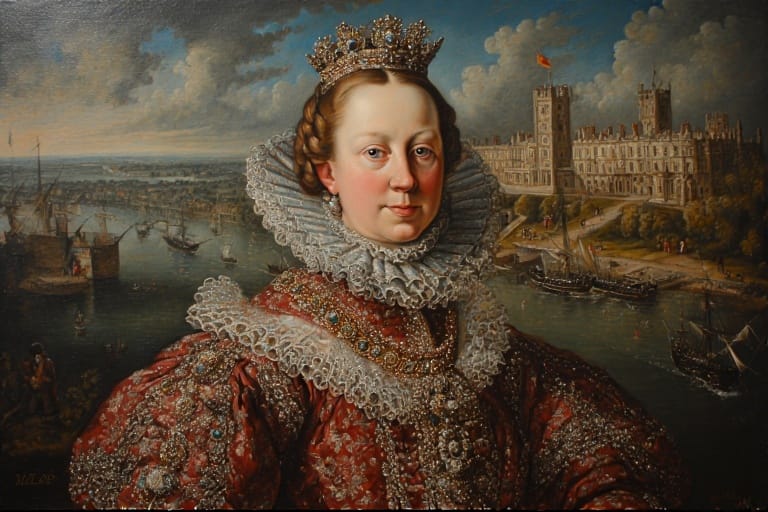
Empress Agnes of Poitou, Henry IV’s mother, was more than a consort. She was a living bridge between worlds: a granddaughter of the dukes of Aquitaine, a woman whose lineage connected the Salian court to the aristocratic networks of western France. Raised amid the refined culture of Poitou and Aquitaine, where poetry and politics were often intertwined, Agnes brought to the empire not only prestigious blood but also a certain cosmopolitan grace. Contemporary observers noted her piety and dignity, and later historians have emphasized her intelligence and political acumen.
Her marriage to Henry III in 1043 had been carefully arranged to strengthen the emperor’s position vis-à-vis both the French crown and regional lords. But marriage diplomacy counted for little if it did not produce sons. Agnes gave birth several times before 1050; some children survived—daughters who could be married off to secure alliances—but there was still no male heir whose very existence would silence succession rumors. It is easy to imagine Agnes, in those years before 1050, living under the double pressure of personal desire and public duty, her body both her own and a vessel for the empire’s future.
Henry III, for his part, was no distant or symbolic father. He appears in contemporary records as actively engaged in ruling, traveling ceaselessly from palace to palace, holding courts, presiding over synods, and making decisions that touched all parts of his sprawling realm. For such a man, the birth of Henry IV must have represented not only relief but the possibility of shaping a successor in his own image. Modern scholars like I. S. Robinson have emphasized that Henry III saw kingship as a moral vocation, a matter of conscience as much as authority. That sense of duty would mark how he approached his son’s early life.
In the private chambers of Goslar, however, the emperor and empress were also simply parents. Behind the jeweled crowns and formal portraits were two human beings who had risked loss and disappointment. The birth of Henry IV was therefore a convergence of these levels: the private joy and fear of new parenthood and the public, almost theatrical triumph of dynastic continuity. Courtiers would have congratulated them with elaborate phrases, bishops would have offered blessings, yet somewhere in the shadows of those hallways the empress lay exhausted, and the emperor, perhaps for a moment, simply marveled at the smallness and fragility of the child on whom so much depended.
The City of Goslar and the Imperial Palace on the Rammelsberg
Goslar was no accidental backdrop. Nestled near the rich silver deposits of the Rammelsberg, it was both a mining town and a royal stage, a place where wealth from the earth fed the symbolism of imperial power. The Salian rulers, especially Henry III, deliberately favored Goslar, transforming it into a key residence and political theater. The palace complex—its great hall with high wooden ceilings, its chapel where light filtered through small, colored windows, its stout towers—impressed visitors with an almost choreographed message: here dwells the emperor, lord of men and metals, protector of Christendom.
The choice of Goslar as the birthplace of Henry IV thus had meaning. It associated the new prince not with a random fortress, but with an emerging royal center in the northern part of the realm. From Goslar, royal processions could move toward Saxony, Thuringia, and beyond; messages could be dispatched to major bishoprics and monasteries; imperial authority could be performed and reiterated in elaborate ceremonies.
Life in Goslar’s lower town contrasted sharply with the court’s solemnity. Houses clustered along narrow streets, workshops rang with the noise of hammers, and the smell of smelting furnaces mingled with that of cattle and cooking fires. The miners who labored on the slopes of the Rammelsberg worked under conditions harsh and dangerous: poorly ventilated galleries, the constant threat of cave-ins, water seepage, and disease. Their toil underpinned the glitter of the court above, drawing a stark line between anonymous labor and imperial splendor.
When the birth of Henry IV was announced in Goslar’s churches, the miners and townsfolk would have understood that something momentous had occurred, even if they could not yet foresee its larger consequences. Priests would lead special prayers of thanksgiving; candles would be lit before altars; bells would announce the good news so that even those on the outskirts might hear the echoes. The child himself, wrapped in fine linens and watched by high-born attendants, remained far removed from the lives of his unofficial subjects. Yet their fates, as history unfolded, would be intertwined with his.
The Birth of Henry IV: A Prince Arrives on 11 November 1050
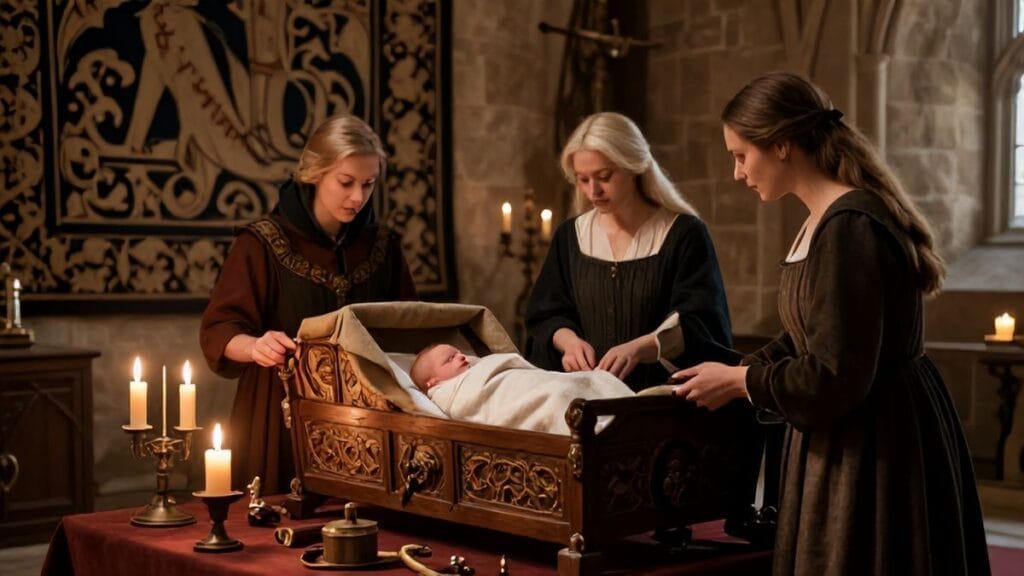
The birth of Henry IV took place in circumstances that were at once deeply physical and highly ritualized. Eleventh-century royal childbirth was a matter of women’s expertise—midwives, noble ladies, and servants—overseen by the invisible but ever-present authority of the church. In Agnes’s chamber, the air would have been heavy with the smells of herbs and sweat, wax and wool. Candles burned against the November gloom, casting uncertain halos over crucifixes and icons. Near the empress’s bed someone may have placed a relic—a fragment of a saint’s bone, a piece of cloth believed to have touched a holy body—to invoke protection for both mother and child.
Labor itself, with its pain and its unpredictability, brought Agnes as close as any medieval woman could come to death’s threshold. Childbirth was a leading cause of female mortality; even empresses were not spared. For the court outside that room, the hours of waiting were a trial of endurance. Messengers came and went, whispers circulated—had the child been born, was it living, was it a boy?—but clarity would arrive only when a trusted attendant emerged with the definitive news: a son had been delivered, and he lived.
When that moment came, the reaction in the palace must have been immediate and almost theatrical. Courtiers fell to their knees in gratitude; chaplains prepared to sing Te Deum; servants bustled to arrange what would become the first acts of ceremonial recognition. The birth of Henry IV was soon committed to parchment, turned into a neat line in the royal annals: “On the feast of Saint Martin, in Goslar, the empress bore a son, Henry.” The simplicity of the record conceals the intensity of the lived experience.
For the newborn, the first encounter with the world involved washing, perhaps in wine or warm water, and the immediate sign of the cross traced upon his forehead. In the hours following the birth of Henry IV, his survival remained uncertain. Infant mortality was high; a single night’s fever or a respiratory infection could snatch away even a king’s child. This uncertainty added urgency to the next major step in his life: baptism. Before that ritual, however, the court had already begun treating him as what he symbolically was—heir to an empire, the embodiment of continuity, a tiny, fragile anchor for enormous hopes.
Omens, Rituals, and the Sacred Imagination of the Eleventh Century
Eleventh-century Europeans inhabited a world thick with signs. Celestial phenomena, unusual weather, the strange behavior of animals—these were read as messages from God or warnings of future calamities. It is therefore almost certain that the birth of Henry IV was quickly surrounded by stories of omens, whether truly observed or invented after the fact. Did a sudden break in the clouds allow moonlight to spill across the palace roof? Did the bells of a distant church ring out unbidden? Later chroniclers loved such details, because they fit into a broader narrative in which rulers’ lives unfolded under divine scrutiny.
The most important ritual in the child’s early days was his baptism. Though the exact location and date are debated, it most likely took place not long after his birth, perhaps in one of the great churches associated with the court. Baptism transformed the newborn from a vulnerable body into a Christian soul, marked with indelible grace and inserted into the communal fabric of Christendom. For a future emperor, this sacrament also overlapped with political symbolism: he was cleansed, anointed, named. “Henry,” the name of his father and grandfather, signaled deliberate continuity, a chain stretching backward and, the court hoped, forward through time.
During the ceremony, which would have featured lit candles, chant, and the presence of ranking clergy, the child may have cried or slept, oblivious to the gravity of the words spoken over him. Yet everyone present would have understood that this was the first public moment in his life as a figure of power. The godparents chosen for him would be people of consequence—bishops, princes, or both—thereby binding them to the royal family through a relationship that was spiritual and political at once.
Behind the rituals lay a worldview in which the birth of Henry IV could not be mere biological accident. In the minds of Henry III and Agnes, and of many churchmen around them, his arrival was providential. The empire needed an heir; God had provided one. If later events suggested divine displeasure—civil war, excommunication, humiliation—then this, too, would be read through the lens of that origin story. God had given the empire a son on Saint Martin’s Day in Goslar; what, then, did it mean when that son came into conflict with God’s own vicar on earth?
From Cradle to Court: Early Childhood in the Shadow of the Throne
In the months and years that followed the birth of Henry IV, the baby grew into a child surrounded by an environment unlike that of almost any of his contemporaries. His nursery lay within castle walls; his toys, if we can call them that, might have included miniature versions of weapons or symbolic items representing the regalia he one day would bear. Yet his earliest experiences also included universal elements: the warmth of a mother’s body, the sound of lullabies, the gentle, rhythmic sway as a nurse carried him along dim corridors lit by flickering lamps.
Agnes, though occupied with affairs of state, likely took an active interest in his upbringing, especially in his moral formation. Court chaplains and tutors, perhaps monks drawn from respected monasteries, introduced the child to prayers, stories of saints, and the basic elements of Latin learning. The boy’s earliest words may have been in the vernacular of his household, but soon the liturgical language of the church would have entered his ear as well, recited at Masses and sung at Vespers in the palace chapel.
From an early age, Henry would have realized that he was different from other children—if not in emotional terms, then in the choreography of his days. He was displayed to visiting nobles; he was seated, perhaps, at banquets beside his father or in a slightly elevated position. Adults bowed to him, addressed him with respectful titles; servants obeyed his whims more quickly than they might have tolerated those of any other boy. Such treatment could not help but shape his temperament. Historians have suggested that the later Henry IV’s stubbornness, his fierce insistence on royal prerogative, may have been rooted in this early experience of deference and entitlement.
Yet there were also vulnerabilities. The same court that honored him was filled with factions and ambitions. Those who sought favor with the emperor might try to ingratiate themselves with the prince; others might whisper criticisms of his behavior, his health, his readiness to rule. The child lived under a microscope, every illness noted, every sign of precocious intelligence celebrated or exaggerated. To be raised as an heir in the Salian court was to grow up with very little privacy and perhaps even less genuine affection untainted by calculation.
An Heir in a Fragile Empire: The Political Stakes of a Newborn Prince
The birth of Henry IV immediately altered the calculations of men far from Goslar. In Bavaria, Swabia, Saxony, and Italy, powerful dukes and counts received the news through messengers riding over long distances. For some, especially those who had resented Henry III’s attempts to curtail their autonomy, the arrival of a male heir was unwelcome. It meant that the imperial project—centrally directed, morally confident, and sometimes heavy-handed—would likely continue for another generation.
For bishops and abbots, especially those whom Henry III had raised to office, the new prince represented continuity and protection. The emperor had often confirmed church property rights and intervened to support church reform; a son trained in his ways might be expected to do the same. Indeed, the relationship between throne and altar was not yet the antagonistic one it would become under Henry IV’s mature rule. Instead, the birth of Henry IV was interpreted by many ecclesiastical leaders as a sign that the divinely sanctioned order of empire and church would endure.
Yet even as this hopeful reading took shape, fault lines were already visible. The empire was less a unified state than a mosaic, held together by ceremonies, shared religious culture, and the personal authority of the emperor. Henry III’s efforts to impose discipline had generated resentments that would not simply vanish because a baby had been born in Goslar. Ambitious nobles could already imagine a future in which that baby, grown into a young king, might be more malleable than his domineering father—or, conversely, a ruler whose inexperience could be exploited.
The political stakes of the birth of Henry IV therefore cut both ways. On the one hand, he symbolized stability, a clear line of succession, and the possibility of long-term imperial policy. On the other, his youth at the time of his father’s eventual death promised a window of vulnerability—a regency during which factions at court could vie for influence, and regional lords might press their advantages. The joy of 1050 thus contained within it the seeds of the crises that would eventually engulf the very child it celebrated.
Royal Progresses and Public Display: Presenting Henry to the Realm
As Henry IV grew out of infancy, he began to appear more frequently in public, not just in Goslar but in other royal centers across the empire. Medieval kingship was a traveling institution; rulers and their households moved constantly, holding court in different regions, affirming their presence through ceremonies and judgments. The young prince accompanied these royal progresses, his small figure an essential part of the visual grammar of power.
Imagine a great assembly in Speyer or Mainz: nobles arrayed in fine clothing, bishops in liturgical finery, the air thick with incense and the low murmur of expectation. The emperor enters, followed—perhaps carried or led by the hand—by his son. The birth of Henry IV, once announced in formal letters and celebrations, was now manifested visibly to the realm. People could see him, assess him, whisper about his features: did he resemble his father, did he seem robust, did he carry himself with the nascent dignity of a future ruler?
These displays were not merely sentimental. They were political theater in which the princely body became a banner of continuity. By showing the child at his side, Henry III reminded all present that his authority would not die with him; it extended into the future through this boy. Ceremonies of homage might even include gestures directed toward the prince, hinting at or explicitly acknowledging his status as heir. Perhaps at some gatherings the assembled magnates and prelates swore oaths to him as well, binding themselves not just to the reigning emperor but to the dynasty he embodied.
For the boy, these events must have been overwhelming and confusing. One can imagine him blinking in the dim light of great halls, watching the sea of faces turned toward him, feeling the weight of heavy garments or small pieces of regalia placed in his hands for symbolic effect. Yet through constant repetition, such scenes became his normal environment. He learned, unconsciously at first, how kingship looked and sounded: the swell of chant, the rustle of silk, the clatter of spurs on stone, the language of petitions and grants.
The Death of Henry III and the Unready Child-Emperor
The dynastic story that began with the birth of Henry IV took a dramatic turn in 1056, when Henry III fell gravely ill. Still in the prime of life by modern standards, the emperor’s health had been undermined by years of relentless campaigning and travel, as well as by the medical limitations of his age. His impending death threw the carefully constructed edifice of Salian power into crisis. The child born in Goslar in 1050 was now six years old—old enough to understand fear and loss, but far too young to rule an empire.
On his deathbed, Henry III took steps to secure his son’s succession. He had already arranged Henry IV’s election as king in 1053, in a carefully staged assembly that confirmed the boy as his heir. Now, he extracted oaths from key princes and bishops that they would support the child’s rule and respect the regency of Empress Agnes. Such oaths were serious things, spoken before altars and relics, binding souls as well as reputations. Yet history shows how fragile such bindings could be when faced with ambition and fear.
For the six-year-old Henry, the death of his father must have been shattering. The man whose towering figure had dominated the landscapes of his early memories was gone, replaced by a whispering flock of advisors, guardians, and would-be mentors. One can imagine the boy at his father’s funeral, overwhelmed by the solemnity of the liturgy, the black garments, the tolling bells, the sight of grown men kneeling in grief. The birth of Henry IV had once promised stability; now it meant that imperial authority would reside in a child’s hands—symbolically, if not practically—for years to come.
Across the empire, reactions to Henry III’s death were mixed. Some mourned a powerful ruler who had attempted to embody the Christian ideal of kingship. Others, especially those who had resented his centralizing policies, saw opportunity. A regency under Agnes, a foreign-born woman, governing in the name of a boy, looked to them like an invitation to reassert local autonomy. The chain of events set in motion by the November night in Goslar was now entering a more turbulent phase.
Regency, Factions, and the Shaping of a Temperament
The regency of Agnes of Poitou, lasting roughly from 1056 to 1062, was a period in which the consequences of the birth of Henry IV became painfully clear. Agnes faced an impossible task: she had to protect her son’s position, maintain imperial authority, navigate complex church politics, and counter the ambitions of princes who no longer feared Henry III’s formidable presence. For all her intelligence and piety, she was hampered by gendered prejudices and the simple fact that a regency was always weaker than an adult kingship.
Court factions crystalized quickly. Some magnates sought to dominate the regency council, using their influence over the young king to extract concessions and offices. Others aligned themselves with reformist churchmen who were gaining moral authority across Christendom. In this atmosphere, Henry IV’s early experiences of governance were not those of a confident young monarch learning calmly at his father’s side, but of a child in the middle of competing adult agendas.
The “coup” of Kaiserswerth in 1062, in which a group of princes effectively seized the royal person by kidnapping the twelve-year-old Henry, was a shocking episode that left deep marks on the boy’s psyche. Lured on to a ship on the Rhine, he was suddenly held as a kind of honorable captive, separated from his mother, and placed under the tutelage of Archbishop Anno of Cologne. The birth of Henry IV had once been celebrated as a guarantee of stability; now that same princely body became the contested prize in a very worldly power struggle.
It is not hard to see how such experiences might have nurtured suspicion and resentment in the young Henry. He learned that oaths could be broken, that those who professed loyalty might act ruthlessly, that his own person could be manipulated to legitimize actions taken in his name but against his will. Later, when he came into his majority and began to assert himself more forcefully, he did so with the memory of these humiliations burning in his mind. The temperament that would collide so spectacularly with papal power in the Investiture Controversy was forged in part by these early betrayals.
Church Reform and Imperial Ambition: The Fault Lines Beneath a Cradle
Even before the birth of Henry IV, the eleventh century was vibrating with calls for reform within the Western church. Cluniac monasticism had revived ideals of spiritual purity and discipline; thinkers and preachers decried simony (the buying and selling of church offices) and clerical marriage; many sought to free the church from what they saw as corrupting secular influence. Henry III had supported certain reform measures, even deposing and appointing popes. But his model of involvement assumed that the emperor, as God’s anointed ruler, had a legitimate role in directing the church.
This was the unresolved tension into which Henry IV was born. The investiture of bishops—that is, the conferral of their office and its symbols by a lay ruler—lay at the heart of the problem. For kings and emperors, controlling episcopal appointments meant not just influence over souls, but control of vast lands and revenues. For reformers, it looked like an intolerable usurpation of spiritual authority by secular hands. When the birth of Henry IV took place in Goslar, this struggle was still in an embryonic stage. By the time he reached adulthood, it would have erupted into a full-blown confrontation.
In many ways, the infant Henry was a symbol of both sides of this conflict. To imperial loyalists, his arrival was proof that God favored the Salian dynasty, and by extension, its understanding of Christian kingship. To church reformers, the very closeness between throne and altar that his life represented—in his baptism, in the oaths sworn over his head, in the bishops who served as his tutors—was part of the problem. As he grew, these tensions coalesced around him personally, especially when he began to exercise his own will in episcopal appointments.
One modern historian has observed, in a line that could serve as a moral epitaph for this era, that “the child who was born in Goslar in 1050 could never escape the contradictions of his inheritance.” The birth of Henry IV did not cause the Investiture Controversy, but it created a specific imperial actor who would confront it in a particular way. His personal history—shaped by early traumas, factional education, and a deep sense of royal calling—merged with an institutional crisis centuries in the making.
The Long Shadow of Goslar: Memory, Myth, and the Making of a Ruler
As Henry IV grew into adolescence and then early adulthood, the memory of his origins acquired a life of its own. Chronicles and panegyrics crafted images of the prince that conveniently aligned with political needs. When it suited imperial propaganda, writers emphasized that he had been born on a major feast day, in an imperial palace, to a pious empress and a divinely favored emperor. The birth of Henry IV could be presented as nearly miraculous, a sign that God had chosen the Salians in a special way.
Alternatively, when Henry’s reputation suffered—as it did during periods of conflict with the papacy and the German princes—opponents found ways to reinterpret the same story. Rumors of ill omens at his birth, of parental sins that might have tainted his line, circulated in hostile circles. Though often impossible to verify, such tales reveal how intensely people of the time invested in origins. To explain later misfortune, they turned back to the beginning, searching for a fateful flaw.
In Goslar itself, the association with Henry’s birth enhanced the town’s prestige. Over time, local memory crystallized around the idea that this mining settlement and its palace had once cradled an emperor. Visitors could be shown the hall where he had played as a child, the chapel where he had first heard Mass, the very stones that had formed the walls of his mother’s chamber. The physical space of Goslar became a kind of reliquary for the imperial story, even as new rulers came and went.
The growth of such myths did not occur in a vacuum. They were tools used by both supporters and critics. A later chronicler, sympathetic to Henry, might write of his “noble birth at Goslar, under the watchful eye of God and Saint Martin,” while another, hostile voice could mutter darkly of eclipses and storms surrounding his arrival. What matters is less the literal truth of these accounts than the fact that the birth of Henry IV remained a reference point—a way to talk about destiny, legitimacy, and the mysterious workings of providence in history.
From Infant to Adversary: How the Birth of Henry IV Led to Canossa
The trajectory from the cradle in Goslar to the snowy roads leading to Canossa in 1077 forms one of the most dramatic arcs in medieval history. When Henry IV, now a grown man and embattled emperor, stood barefoot in the snow outside the castle of Canossa, seeking absolution from Pope Gregory VII, the world saw not just a penitent ruler but the culmination of decades of conflict between secular and ecclesiastical power. Yet this confrontation, immortalized in countless histories and artworks, was the long-term consequence of dynamics already present at his birth.
As an adult, Henry clung fiercely to the royal prerogatives that had been impressed upon him from his earliest years. He appointed bishops and abbots, treated church lands as part of the imperial resource base, and resisted efforts by reforming popes to curtail his influence. Gregory VII, for his part, represented a new, more assertive vision of papal authority, one in which the pope could depose emperors if necessary and demand obedience not as a negotiable courtesy but as a sacred duty.
When the conflict escalated—Henry convening synods to depose Gregory, Gregory excommunicating Henry and releasing his subjects from their oaths—the personal and the structural crashed together. The boy who had once been kidnapped at Kaiserswerth, who had seen oaths to his father and mother broken, now found his own supporters wavering under the weight of papal condemnation. German princes used the crisis to challenge his rule; some demanded that he reconcile with the pope or face deposition.
This led to the famous journey to Canossa, where Henry, in the depths of winter, crossed the Alps and presented himself as a penitent before Gregory. It is impossible not to hear, faintly, behind that scene, the echo of his birth. The same body that had once been celebrated in the halls of Goslar as a providential gift now stood humiliated on a snowy mountainside. The birth of Henry IV had filled the empire with hope of an unbroken line of powerful rulers; the road to Canossa revealed how fragile such hopes were when set against the complex interplay of conscience, power, and institutional rivalry.
Yet even in humiliation, Henry did not become a minor figure. The absolution he secured at Canossa allowed him to continue struggling for his throne, and the civil conflicts that followed further altered the empire’s landscape. The story that began with the cry of an infant in 1050 had become, by the late 1070s, a drama on which all of Europe’s elites kept a tense and fascinated eye.
The Human Cost of an Imperial Childhood
Amid the chronicle entries and legal charters, it is easy to forget that the birth of Henry IV also marked the beginning of a human life shaped by extraordinary pressures. Strip away the regalia and rhetoric, and one finds a boy whose experiences of trust and betrayal, love and fear, were anything but ordinary. His mother’s authority was undermined before his eyes; those who claimed to be his guardians sometimes treated him as a pawn; his father, the towering figure of his early years, vanished suddenly, leaving behind a mantle he was asked to wear far too soon.
Psychological categories from the modern world must be used cautiously in medieval contexts, but it is not unreasonable to suppose that Henry’s temperament—often described as stubborn, impetuous, and defensive—was a response to this environment. A child who grows up seeing oaths broken and power wielded capriciously might reasonably conclude that only unwavering firmness, even ruthlessness, can secure his position. The tenderness that likely marked parts of his relationship with Agnes, or with certain tutors, had to coexist with an ever-present awareness that his very existence made him both precious and dangerous to those around him.
There were also costs borne by others because of his life. The civil wars that broke out during his reign, the campaigns against rebellious princes, the violence that accompanied disputes over episcopal appointments—all of these brought suffering to ordinary people. Villages burned, fields trampled, lives disrupted by the movements of armies and the shifting allegiances of lords. The cry that had once echoed in the quiet chamber at Goslar thus sent out ripples of pain as well as power.
To acknowledge this human cost is not to condemn Henry uniquely; medieval politics, like politics in any age, exacted heavy tolls. But it reminds us that the birth of Henry IV was not just a moment of dynastic joy. It was the starting point of a story that would entangle thousands, perhaps millions, of lives in its unfolding. When we speak of “the birth of Henry IV” today, we are invoking not only a date and a place, but the threshold to a web of consequences stretching across decades and borders.
Goslar Across the Centuries: Pilgrims, Tourists, and Historians
Centuries after the November night in 1050, Goslar remained a place where the past felt unusually near. The imperial palace, though altered by time and restoration, still rose above the town, its stone walls bearing the marks of weather and war. Pilgrims and travelers, long before the age of mass tourism, were drawn to such sites not only for their architecture but for their stories. To stand in the hall where Henry IV might have walked as a child was to sense, however faintly, the presence of a lost world.
In the nineteenth and twentieth centuries, as German nationalism took on various forms, the figure of Henry IV and the memory of his birth in Goslar were sometimes pressed into ideological service. Romantic historians and novelists painted him as a tragic hero, a symbol of royal authority humbled by overreaching clerics, or alternatively as a flawed ruler whose struggles prefigured modern conflicts between church and state. The palace at Goslar became a stage for pageants and commemorations, layers of more recent politics draped over the older stone.
Modern scholarship, more cautious and critical, has tried to peel back these layers. Historians comb through charters, letters, and chronicles, weighing sources like the “Vita Heinrici IV.” or the works of Lambert of Hersfeld—himself a harsh critic of Henry—to reconstruct a nuanced picture of the man and his era. Yet even they cannot escape the gravitational pull of his beginning. The birth of Henry IV at Goslar remains a focal point in their narratives, a convenient, concrete moment around which to organize complex discussions of medieval kingship, ecclesiastical reform, and political culture.
Today, visitors to Goslar walk streets that have seen nearly a millennium of change. Cafés and shops line lanes once traversed by miners and monks. Yet when they climb toward the imperial palace and step into its great hall, a particular silence often falls—a sense of entering a space where something important began. Whether they know the details of Henry IV’s life or not, they are participating in a long tradition of remembering, one in which 11 November 1050 still shimmers as a date of more than local significance.
Why 11 November 1050 Still Matters in European History
Why, in an age saturated with information and crisis, should we still care about the birth of a medieval emperor in a small town near the Harz Mountains? The birth of Henry IV matters not because every moment of his life was noble or exemplary, but because his story crystallizes broader historical forces that continue to shape the world. In his life, we see the shifting balance between secular and ecclesiastical authority, the complexities of state-building, and the enduring tension between institutional power and personal conscience.
The birth of Henry IV also reminds us of the role of contingency in history. Had he died in infancy, as so many children of his time did, the Holy Roman Empire might have taken a very different path. Another dynasty might have risen sooner; the Investiture Controversy might have unfolded under different actors, perhaps with less intensity. Conversely, had his childhood been more stable, his relationships with German princes less scarred by betrayal, his approach to governance might have been more conciliatory, altering the trajectory of imperial-papal relations.
Moreover, his birth is a window into medieval mentalities: how people understood legitimacy, how they fused religious and political narratives, how they invested single bodies with immense symbolic power. The fact that chroniclers took care to record precisely that he was born in Goslar, on the feast of Saint Martin, to particular parents, reveals a world obsessed with beginnings. To understand their fascination is to reflect on our own. We, too, build myths around origin stories—of nations, leaders, movements—and we, too, often seek in the moment of birth an explanation for later glory or disaster.
Finally, the birth of Henry IV is a reminder of the human dimension embedded within what we call “the past.” Behind the march of events stand individual lives, marked by fear, hope, love, and pain. Agnes of Poitou, sweating and praying in a stone chamber; Henry III, pacing and murmuring psalms; the infant Henry, unaware of the weight laid on his tiny shoulders—all of these are part of the story. To remember 11 November 1050 is to grant them, and those like them, the attention owed to fellow human beings whose lives, however distant, still echo in ours.
Conclusion
The long arc that begins with the birth of Henry IV in Goslar on 11 November 1050 stretches across some of the most charged decades of medieval European history. In that single, fragile moment—a child’s first breath in an imperial palace—were condensed dynastic hopes, political calculations, and religious expectations. The Salians rejoiced at an heir; bishops and princes recalibrated their plans; chroniclers sharpened their quills. Yet no one present could have fully grasped how that infant would one day stand at the center of the Investiture Controversy, braving excommunication, rebellion, and the long, humbling journey to Canossa.
By following his story outward from Goslar, we see how personal experience and structural forces intertwine. The boy shaped by regency intrigues and kidnappings grew into a man determined to defend his understanding of royal authority, even at immense cost. The church reformers who saw in him a symbol of secular overreach pushed the papacy toward new heights of self-assertion, permanently transforming the landscape of Western Christendom. The empire he inherited was both strengthened and fractured by his reign, its future path altered in ways no one in 1050 could have foreseen.
In the end, to reflect on the birth of Henry IV is to confront history’s mixture of inevitability and contingency. Certain conflicts—over who may appoint bishops, over where ultimate authority lies—were perhaps bound to surface. But how they unfolded, and how profoundly they shook the medieval world, depended in part on this particular man, with his specific temperament, scars, and convictions. The stone walls of Goslar have outlived him, as have the institutions he fought and served. Yet within those walls, on that November night, began a life whose reverberations still help us understand the deep roots of European political culture.
FAQs
- Where and when was Henry IV born?
Henry IV was born on 11 November 1050 in Goslar, a town near the Harz Mountains in what was then the Holy Roman Empire. His birth took place in the imperial palace complex associated with the rich silver mines of the Rammelsberg, a favored residence of his father, Emperor Henry III. - Why was the birth of Henry IV so important?
The birth of Henry IV was crucial because Henry III, despite having daughters, lacked a surviving male heir, and the empire’s stability depended on clear succession. His arrival secured the continuation of the Salian dynasty, reassured church and secular elites, and immediately reshaped political calculations across the realm. - Who were Henry IV’s parents?
Henry IV’s father was Emperor Henry III, one of the most powerful and assertive rulers of the eleventh century, and his mother was Empress Agnes of Poitou, a noblewoman from Aquitaine with strong ties to the aristocracy of western France. Their marriage linked the Salian dynasty to influential networks beyond the empire’s formal borders. - How did Henry IV’s childhood affect his later rule?
Henry IV’s childhood was marked by his father’s early death, a contested regency under his mother, court factions, and the traumatic kidnapping at Kaiserswerth. These experiences fostered in him a deep mistrust of princes and advisors and contributed to a stubborn, defensive political style that shaped his later conflicts with nobles and the papacy. - What was the connection between Henry IV’s birth and the Investiture Controversy?
The birth of Henry IV placed him at the center of long-standing tensions over who had the right to appoint bishops and invest them with spiritual and temporal authority. As emperor, Henry insisted on traditional royal rights in church appointments, while reforming popes like Gregory VII claimed exclusive authority, leading to the Investiture Controversy and Henry’s eventual excommunication. - What role did Goslar play in Henry IV’s life?
Goslar was not only Henry IV’s birthplace but also an important royal residence in his youth, symbolizing Salian power rooted in the wealth of the Rammelsberg mines. The imperial palace there served as a key stage for early court ceremonies in which Henry was presented to nobles and clergy as heir to the empire. - How do historians know about the circumstances of Henry IV’s birth?
Information about Henry IV’s birth comes from contemporary and near-contemporary chronicles, royal annals, and later biographies such as the “Vita Heinrici IV.” While these sources are often colored by political or moral agendas, careful comparison allows historians to reconstruct key facts and to understand how his birth was interpreted over time. - Did people at the time see Henry IV’s birth as a sign from God?
Many contemporaries interpreted the birth of Henry IV in religious terms, seeing it as a providential answer to the empire’s need for an heir. The fact that he was born on the feast of Saint Martin and baptized into a court deeply concerned with Christian kingship encouraged a sense that his life had special divine significance, even if later events complicated this view. - How did Henry IV’s reign ultimately affect the Holy Roman Empire?
Henry IV’s reign, shaped by his contested authority and conflicts with both princes and the papacy, weakened the central power of the emperor and encouraged the rise of stronger regional principalities. The resolutions that eventually followed the Investiture Controversy limited imperial control over episcopal appointments, contributing to the more fragmented political structure that would characterize the empire in later centuries. - Can visitors today still see places connected to Henry IV’s birth?
Yes. The imperial palace in Goslar, though altered and restored over time, still stands and is open to visitors. Walking through its great hall and chapel offers a tangible connection to the environment in which Henry IV spent part of his early life and where his birth was first celebrated as a turning point for the Salian empire.
External Resource
Internal Link
Other Resources
- Encyclopaedia Britannica – general search for the exact subject
- Google Scholar – academic search for the exact subject
- Internet Archive – digital library search for the exact subject