Table of Contents
- A Quiet Harbor Before the Storm
- Brittany Between Crowns: The Political Chessboard of 1372
- Sea War in the Hundred Years’ War: From Sluys to La Rochelle
- Bourgneuf-en-Retz: Geography of a Trap
- Men, Captains, and Crowns: The Forces Gathering for War
- The Long Wake of La Rochelle and the Road to Bourgneuf
- On the Eve of Combat: Nightfall in the Salt Marshes
- Dawn over the Bay: The Fleets Take Their Positions
- Fire, Arrows, and Chains: The Battle of Bourgneuf 1372 Unfolds
- Blood in the Water: Boarding, Panic, and Rout
- Shattered Banners: Immediate Aftermath in the Harbor
- Winners, Losers, and Prisoners: Human Stories from the Bay
- Brittany’s Tightrope: Diplomacy, Autonomy, and Vengeance
- Salt, Trade, and Ruin: The Economic Shockwaves
- From Local Clash to Grand Strategy: Shifting the Course of the War
- Echoes Across Europe: Chroniclers, Rumors, and Reputation
- Living with the Memory: Bourgneuf-en-Retz after 1372
- How Historians Reconstruct a Battle in the Marshes
- Conclusion
- FAQs
- External Resource
- Internal Link
Article Summary: This article plunges into the turbulent waters of the late 14th century to retrace the little-known but decisive battle of bourgneuf 1372, fought off Bourgneuf-en-Retz in the Duchy of Brittany. It explores how a seemingly local naval clash was woven into the broader tapestry of the Hundred Years’ War, emerging from the wake of the Franco-Castilian victory at La Rochelle. Through a cinematic reconstruction of preparations, maneuvers, and brutal boarding actions, the narrative unpacks the strategies, miscalculations, and raw courage that defined the battle. Political tensions within Brittany, caught between the rival powers of England and France, provide a charged backdrop to the fighting at sea. The article also examines how the battle of bourgneuf 1372 affected trade, especially the vital salt routes, and reshaped alliances in the region. Drawing on chronicles and modern historical analysis, it revisits the human cost of war—sailors drowned in shallow waters, captains captured or killed, townspeople forced to rebuild their livelihoods. It then follows the long resonance of the battle in memory and historiography, asking why such an event, so important to contemporaries, faded into near-obscurity. By the end, the battle of bourgneuf 1372 stands revealed not as an isolated skirmish, but as a critical pivot in maritime power and Breton politics.
A Quiet Harbor Before the Storm
In the summer of 1372, Bourgneuf-en-Retz was, on the surface, a quiet corner of the Duchy of Brittany. The town lay low against the Atlantic winds, its houses clustered near a harbor that opened onto a broad bay, shallow and treacherous, threaded with sandbanks and encircled by salt marshes. Flat-bottomed boats slid along narrow channels, hauling heavy loads of salt from the evaporating pans that shimmered under the August sun. Fishermen mended their nets in the early light, while merchants bargained over barrels of dried fish and sacks of grain destined for distant markets. From a distance, it could have seemed as if the Hundred Years’ War had forgotten this place.
Yet war has a way of slipping into the most remote inlets. The people of Bourgneuf had heard the rumors moving down the coast like a storm front: English fleets gathering, French and Castilian squadrons patrolling, privateers preying on merchant ships that dared the Bay of Biscay. Only weeks before, the sea battle of La Rochelle had ended in catastrophe for the English, and news of that shattering defeat reached Bourgneuf on the lips of sailors and pilots drifting in from the south. Stories of burned ships, captured nobles, and hundreds drowned in armor were traded in taverns late into the night.
Among those listening were Breton shipowners, mariners, and minor officials, aware—perhaps more acutely than anyone—that their duchy sat between two great, hungry powers. To the east, the Valois kings of France claimed suzerainty over Brittany and demanded loyalty. To the north, the English crown, still clad in the memory of its victories at Crécy and Poitiers, tried to maintain its crumbling network of ports and garrisons. Between these giants, Bourgneuf’s quiet harbor was a hinge on which the fate of trade, and perhaps the war itself, might turn.
When the first warships were glimpsed on the horizon, they did not seem, at once, to belong to any great armada. But sails multiplied day by day, and the strange, uneasy mixture of silhouettes—high-castled English cogs, leaner Franco-Castilian vessels, and locally hired Breton craft—signaled that the bay of Bourgneuf was about to become the stage for a drama of steel, salt, and fire. The battle of bourgneuf 1372 was not yet named, but the sea and the sky were already preparing for it: tides rehearsed their turning, winds tested their strength, and men sharpened their weapons in the shadow of events they did not fully understand.
Brittany Between Crowns: The Political Chessboard of 1372
To grasp why warships were converging on a Breton harbor in August 1372, one must understand Brittany’s perilous place within the overlapping claims of the Hundred Years’ War. The duchy was technically a vassal of the French crown, yet its dukes had long guarded their autonomy jealously, forging shifting alliances with England or France according to the tides of advantage. The Breton War of Succession (1341–1364), a brutal conflict fought in the shadow of the larger Anglo-French struggle, had torn the duchy apart. Two rival claimants, Charles of Blois (backed by France) and John of Montfort (supported by England), plunged Brittany into more than two decades of siege, famine, and civil war.
The conflict ended, at least formally, with the Treaty of Guérande in 1365. John of Montfort—now Duke John IV of Brittany—secured his title, but at the price of promising homage to the French king. In practice, he still leaned toward England, whose soldiers and commanders had helped him survive. English garrisons dotted Breton strongholds, and English merchants enjoyed precious access to Breton ports. Yet this English presence stirred resentment among many Breton nobles and towns, who chafed at the foreign troops and longed for a more balanced, or even more distinctly French, order.
By 1372, King Charles V of France, the “Wise King,” and his brilliant constable, Bertrand du Guesclin, were methodically reversing earlier English gains. They preferred attrition and diplomacy to pitched battles. They courted discontented Breton lords, offered pardons, and played on the ambiguities of Breton identity: Was Brittany first a duchy, or first a French fief? The English, under the ailing Edward III and his increasingly embattled lieutenants, tried to hold together an overstretched empire of ports and alliances.
In this tense moment, every Breton harbor was a political statement as much as a commercial asset. Bourgneuf-en-Retz, facing the Bay of Biscay, lay on a route critical for communication between the English-held territories, Gascony, and further north. Control of such harbors meant more than customs dues; it meant the ability to supply, reinforce, or strangle whole regions. To French strategists, dislodging the English from the Atlantic sea lanes became as vital as victories on land. To English commanders, each Breton harbor retained was a foothold in a world rapidly shifting under their boots. It is in this chess game of crowns and duchies that the battle of bourgneuf 1372 takes its place, not as a random skirmish, but as a calculated move.
Sea War in the Hundred Years’ War: From Sluys to La Rochelle
Naval warfare in the Hundred Years’ War had always been marked by dramatic reversals. In 1340, the English victory at Sluys gave them temporary command of the Channel. Scenes of ships lashed together, packed with archers and men-at-arms, set the pattern for much of the century’s sea fighting: battles fought less as maneuvered exchanges of cannon, and more as floating melees resembling land combat transplanted onto decks and rigging. Control of the sea was fragile, secured by fleets hastily assembled from merchantmen and coastal vessels.
By the 1370s, the balance at sea was changing. The French, long disadvantaged by the stronger English navy, began cooperating with Castile, whose Atlantic fleets were well suited to both trade and war. The Castilian king, Henry II of Trastámara, had his own reasons to confront England, not least the memory of English involvement in Iberian dynastic struggles. This Franco-Castilian alliance bore spectacular fruit in June 1372 at the Battle of La Rochelle, a crushing naval defeat for the English. Their fleet, attempting to relieve the English-held fortress of La Rochelle, was trapped in the harbor and systematically dismantled by the combined forces of Castile and France.
Chroniclers such as Jean Froissart, though writing from a primarily Franco-English perspective, could not ignore the scale of the disaster. Ships were burned or captured; noblemen, including John Hastings, Earl of Pembroke, were taken prisoner; the English fleet’s prestige was shattered. “There,” one chronicler noted, “the sea itself seemed to rebel against the English,” a poetic summation of how wind, tide, and strategy combined to ruin their hopes. The sea had become a domain where England could no longer assume superiority.
In the weeks following La Rochelle, remnants of English power at sea tried to regroup, while the victorious Franco-Castilian forces sought to exploit their momentum. The coasts of Poitou, Saintonge, and Brittany became a contested frontier, where raids, counter-raids, and efforts to secure ports and anchorages unfolded almost daily. It is against this turbulent maritime background that fleets, squadrons, and opportunistic captains converged on the bay of Bourgneuf, setting the scene for the battle of bourgneuf 1372 as a kind of echo and extension of La Rochelle’s shattering outcome.
Bourgneuf-en-Retz: Geography of a Trap
To understand why Bourgneuf-en-Retz attracted naval forces in 1372, one must study its geography as closely as any muster roll. The Bay of Bourgneuf formed a wide, sheltered indentation in the coast, protected from the full fury of the Atlantic by a long, low stretch of sandbanks and barrier islands. Within this natural embrace, the water lay shallower than an unseasoned sailor might suspect. Approaching the harbor required local knowledge: channels shifted with the seasons, and even experienced pilots could misjudge the tides.
The surrounding land was dominated by salt marshes, whose intricate network of ponds and dykes had been cultivated over centuries. Salt, the “white gold” of medieval commerce, was Bourgneuf’s lifeblood. It preserved fish, seasoned meat, and served as a quasi-currency across Europe. Barges laden with salt crept toward markets in England, Flanders, and northern France. Consequently, the bay was not merely a military anchorage; it was an economic artery whose pulse was felt in far-off cities.
In wartime, these same features made Bourgneuf an enticing, and dangerous, refuge for fleets. The sheltered waters offered a place to regroup, repair, or lie in wait. But the sandbanks also formed a natural barrier that could transform an orderly harbor into a deathtrap if enemy fleets mastered the approaches. A squadron that entered without secure control of the sea could find itself cut off from escape, pinned against the shallow bottom by an adversary who knew the tides better.
Whatever precise configuration the bay had in 1372, its essence was this: a place that invited confidence, then punished overconfidence. The battle of bourgneuf 1372 would demonstrate how geography could magnify or shatter human plans. Anchors, moorings, and the lead-line were as much a part of the coming clash as sword, bow, and boarding hook. Local fishermen and pilots, whose days normally revolved around catch and cargo, might suddenly find themselves compelled—by pay, fear, or loyalty—to guide great warships into channels their fathers had known only as workspaces, not battlegrounds.
Men, Captains, and Crowns: The Forces Gathering for War
The precise order of battle at Bourgneuf remains, in the fog of medieval documentation, imperfectly known, yet historians can sketch the broad outlines. On one side stood a contingent under English command—merchantmen requisitioned or hired, troop transports, and a sprinkling of more heavily armed warships. Many of these vessels had been drawn from ports like Plymouth, Dartmouth, and Southampton, their crews a mixture of professional mariners, pressed sailors, and soldiers not entirely accustomed to fighting at sea. Among their number were knights and squires tasked with protecting cargoes and asserting royal authority amid an increasingly hostile ocean.
Opposing them were fleets aligned with the Franco-Castilian coalition and, crucially, backed or allowed by elements of the Breton leadership sympathetic to the French cause. Castilian galleys, lower in the water and built for agile maneuvering, formed a lethal complement to the bulkier French and Breton ships. Each vessel was a microcosm of medieval society afloat: nobles and commoners sharing cramped decks, archers shoulder-to-shoulder with sailors, priests blessing men who might within hours be feeding the crabs of the bay.
Behind these men stood the crowns and courts who had dispatched them. For Edward III’s ministers, any opportunity to restore English naval prestige after La Rochelle had to be seized. They could not afford to concede the Bay of Biscay to their enemies, lest supply lines to Gascony be irreparably severed. For Charles V and his advisors, every English ship captured or sunk was another thread cut from the web of English dominion in France. And for Henry II of Castile, each victory at sea strengthened both his alliance with France and his legitimacy against internal rivals.
Some later references suggest that Breton nobles who had once sheltered English forces were by 1372 increasingly hedging their bets, quietly offering aid to French-aligned fleets. Whether out of conviction, fear, or calculation, these choices would matter greatly in a place like Bourgneuf-en-Retz, where local pilots and supplies could turn a coastal raid into a decisive trap. Thus, the forces gathering for the battle of bourgneuf 1372 were not mere collections of ships, but expressions of overlapping ambitions, fears, and loyalties, all compressed into timber hulls and billowing sails.
The Long Wake of La Rochelle and the Road to Bourgneuf
La Rochelle had been a storm, and Bourgneuf lay in its wake. After the English defeat in June 1372, surviving ships limped northward along the coast, some seeking friendly anchorages, others merely trying to avoid capture. The Franco-Castilian victors, flushed with success and weighed down with prisoners, could not immediately pursue every stray enemy. Yet the principle had been established: the English were vulnerable at sea, and the Bay of Biscay was no longer their highway.
As weeks passed, the French crown worked to exploit this new advantage. Royal letters, orders to admirals, and agreements with allied captains encouraged vigilance. Enemy fleets reported in one harbor might, within days, be sighted far away, and Bourgneuf was one of many potential refuges. Chroniclers mention English attempts to reinforce or resupply pockets of resistance in western France after La Rochelle. It is plausible that an English squadron, perhaps tasked with escorting valuable cargo or reinforcements, found itself drawn toward the relatively sheltered bay of Bourgneuf, either as a staging point or as a necessity forced by weather and the threat of enemy patrols.
On the French side, there is evidence of coordinated movements meant to harry English remnants, cut off escape routes, and ensure no repeat of earlier English maritime dominance. A French or Breton flotilla informed of English movements could move swiftly along the coast, using local support to find anchorage and intelligence. Castilian galleys, built for speed, could close in once the enemy’s location was confirmed. In such a context, Bourgneuf’s geographical features made it an excellent place for an ambush, especially if English captains misjudged local conditions while seeking safety.
One can imagine the weeks before the clash as a slow tightening of a net. English captains thought in terms of wind and distance—how far to the next harbor, how long before their crews required food, water, or repairs. Their adversaries were thinking in similar terms but had the advantage of coastal support. From La Rochelle to the Loire estuary, watchful eyes tracked every unusual sail. When reports converged that English ships lay in or near the bay of Bourgneuf, the decision became inevitable: the victory at La Rochelle would be extended, if possible, by another blow. The stage was set for the battle of bourgneuf 1372.
On the Eve of Combat: Nightfall in the Salt Marshes
The evening before the battle must have fallen heavy and humid over Bourgneuf-en-Retz. The heat of early August lingered on the still surface of the salt pans; workers trudged homeward along narrow dykes, casting long shadows in the late light. Over the outer bay, the silhouettes of anchored ships rose like a forest of masts, faintly creaking as the tide shifted beneath them. Lights pricked the decks—lanterns swaying with every small movement, signaling quiet, urgent activity.
On the English ships, preparations carried a nervous edge. Men checked the bindings of shields, ensured arrows were dry, and tested the sharpness of boarding axes. Some veterans of earlier sea fights tried to reassure the younger men, telling embellished stories of survival at Sluys or along the Gascon coast. But La Rochelle was fresh in their memories, a dark omen. They knew the enemy fleets were near, and though the bay offered shelter, it also confined them. The question hung in the air: if they were attacked at anchor, would the water be their ally or their grave?
On the opposing side, Franco-Castilian and Breton crews readied their own vessels. There was an air of expectation, almost of inevitability. Priests moved among the men, offering blessings, hearing confessions whispered in a confusion of languages and dialects. Captains gathered around rough tables, studying makeshift maps of the bay, listening to pilots who sketched sandbanks with calloused fingers. The plan—arrive with the tide, block the exits, force the English to fight half-pinned in shallow waters—depended on timing as much as courage.
In Bourgneuf itself, townsfolk watched the enlarging silhouettes of ship clusters with apprehension. Some remembered earlier raids; others had only heard stories of coastal towns sacked in passing. Families debated whether to hide valuables or flee inland, but for many, the marshland itself was both refuge and trap. Where could they go, with the sea on one side and flat expanses of salt pans on the other? They could only pray that the fighting would stay on the water, that their homes and warehouses would not be drawn into the chaos.
As darkness fully settled, only the intermittent calls of watchmen and the faint clank of armor disturbed the night. Men lay down on hard decks, cloaks pulled tight against the cool, their thoughts circling fear, hope, and the distant faces of families far from the bay. Some would never see another dawn. In that heavy silence, the battle of bourgneuf 1372 was already taking shape, written in the contours of the bay, the positions of ships at anchor, and the unspoken resolve of those preparing to kill or be killed with the rising sun.
Dawn over the Bay: The Fleets Take Their Positions
Dawn came pale over the flat waters, a thin line of light widening behind the dunes and marshes. From the English ships inside the bay, lookouts saw first the familiar outlines of neighboring masts, then, farther out, unfamiliar sails thickening along the horizon. As the light strengthened, there was no room left for doubt: more vessels than the previous day were now visible, many approaching from the open sea, hulls cutting the swells with determined purpose.
Signals flashed from mast to mast. Trumpets were blown, drums beat to rouse slumbering crews. Men scrambled to their stations, pulling on helmets, stringing bows, hauling up anchors or strengthening moorings depending on their captain’s orders. For English commanders, the situation was delicate. Some may have hoped to slip out of the bay before the trap closed, but tides and the enemy’s positioning rendered this nearly impossible. Others chose to form a defensive line, lashing ships together into a floating fortification, a tactic that had worked before but which could become lethal if maneuver was entirely lost.
Outside the bay, the Franco-Castilian and Breton forces drew into formation, some holding back to seal off escape routes, others preparing for the direct assault. Galleys with oars offered rare maneuverability, enabling them to press forward even if the wind faltered. Larger, sail-driven ships took up positions that would allow their archers to bring fire down onto the English decks once within range. Local pilots, standing near the helmsmen, shouted depth readings and channel directions, keenly aware that a single misjudged sandbank could cost them a vessel before the first arrow flew.
As the fleets closed, the soundscape of the bay shifted. The quiet slosh of the tide was replaced by shouted orders, the creak and snap of rigging, the grind of oarlocks. Flags snapped in the strengthening breeze, bearing the symbols of crowns and lords who would never themselves feel the spray of this particular fight upon their faces. It’s astonishing, isn’t it, how the decisions of distant rulers could suddenly crystallize into a line of men bracing for impact, ropes in their hands, weapons at their belts, hearts pounding in their throats?
The battle of bourgneuf 1372 was moments away. The bay that had for generations reflected only the steady rhythms of commerce and fishing now carried a different reflection: lines of warships converging in a geometry of confrontation, each side hoping the other had miscalculated the tide, the distance, the courage of its men.
Fire, Arrows, and Chains: The Battle of Bourgneuf 1372 Unfolds
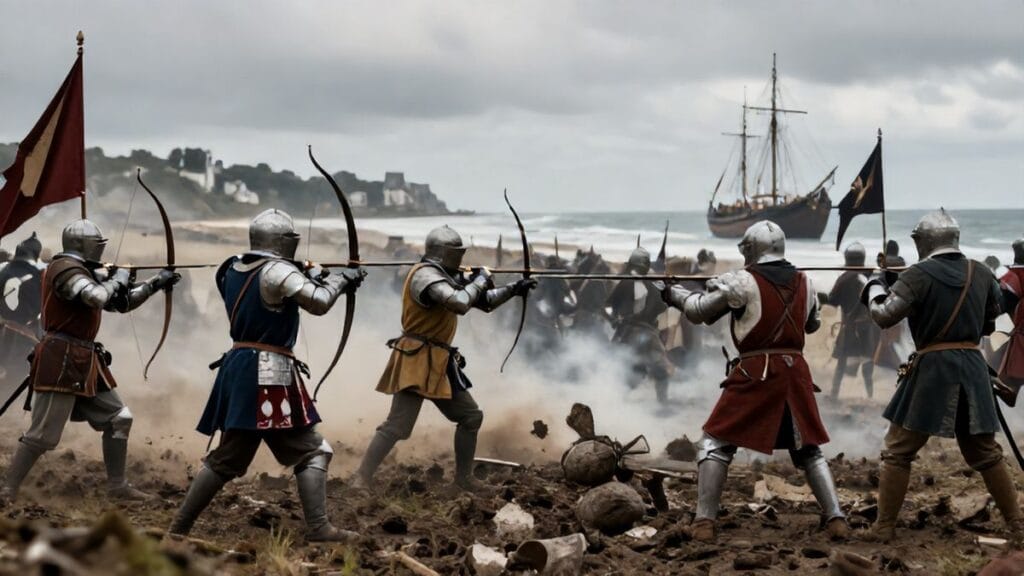
When the first arrows arced through the air, they did so almost ceremonially, the opening notes of a savage symphony. Bowstrings snapped with a familiar twang, and shafts whistled downward onto crowded decks. English archers, long-renowned for their deadly skill, answered in kind, forming dense clusters behind the protection of the ship’s sides. For a few moments, the battle of bourgneuf 1372 seemed like an exchange of missiles, each side testing the other’s nerve.
But the bay was too confined for a pure archery duel. The attackers pressed forward, using the wind and, in the case of galleys, the power of oars to close the distance. Chains and grapnels flew as soon as hulls neared one another, clanking against wood, biting into railings. Ships locked together, bobbing as single unstable platforms beneath men suddenly fighting hand-to-hand. The timbered world of the sailors narrowed to a few feet of planking slick with water and blood.
Some accounts, fragmentary though they are, describe French and Castilian vessels trying to ignite English decks with pots of burning pitch or oil-soaked projectiles. Fires kindled in such a setting could be devastating—yet also dangerous to the attackers if the wind shifted. Smoke mingled with the shouts of men and the snapping of masts. Amid this confusion, captains tried to maintain order, but command was quickly reduced to local acts of courage or desperation: a squire leading a boarding party, a group of sailors cutting a fouled rope to free their ship from a sinking neighbor.
The shallow nature of the bay meant that some ships, once pushed out of position, ran aground or stuck fast on sandbanks. Men found themselves fighting not only foes but the treachery of the sea itself. A listing, trapped ship became a death trap; archers lost their balance, and heavily armored men sliding toward the lower side risked tumbling into the water, where even strong swimmers found their gear becoming anchors dragging them under. The battle thus took a cruel form, with the very geography of Bourgneuf conspiring against the side less familiar with its hidden ridges and channels.
French and Castilian crews, benefiting from recent experience at La Rochelle and perhaps better coordination in these new conditions, gradually pressed their advantage. One English vessel after another was boarded, seized, or rendered helpless. The bay became a maze of half-burned hulls, interlocked ships, and floating debris. Over it all rose the screams of the wounded and the crack of broken spars collapsing upon the terrified men beneath. The battle of bourgneuf 1372, initially a contest of fleets, was degenerating into a series of brutal, localized struggles for survival.
Blood in the Water: Boarding, Panic, and Rout
As the morning wore on, the coherence of the English defense began to fray. With some ships grounded and others captured, remaining captains faced a grim choice: continue fighting in the hope of an improbable reversal, or attempt a breakout through enemy lines, risking annihilation in the shallows. Word traveled unevenly across the chaos, but the message, whether spoken or merely sensed, was clear: the day was going badly.
On the decks of embattled English ships, panic mixed with valor. Groups of men stood firm around their banners, determined to sell their lives dearly. Others, seeing their comrades cut down or hurled into the sea, faltered. Some tried to swing themselves across rigging to neighboring vessels, hoping to reach a less imperiled platform. A few cast off armor, gambling that lightness might offer a chance of swimming to shore if the ship went down. For many, these gambles failed; the waters of the bay swallowed them in moments.
On the attacking side, momentum fed confidence. Franco-Castilian crews cheered with each captured ship, each enemy banner toppled. But they, too, suffered losses: men crushed between colliding hulls, archers struck by desperate return fire, boarding parties swept back by last-ditch English resistance. Casualty figures, where they survive in records, are incomplete and contested, but the impression conveyed by later chroniclers is one of heavy English losses in ships, men, and prisoners.
At some point—exactly when is impossible to pinpoint—the English line ceased to function as a line at all. Some ships tried to cut grappling lines and back water, others simply surrendered when boarded, their captains preferring ransom and captivity to a pointless death. The attackers had what every naval commander dreams of: an enemy trapped in a confined space, increasingly disorganized, and unable to bring superior firepower or maneuver to bear. The rout was not a sudden flight but a progressive crumbling, visible in the sagging shoulders of men who realized that courage alone could not lift a grounded hull.
By midday or early afternoon, resistance had largely collapsed. Surviving English ships were either in enemy hands, beached and abandoned, or sunk in the shallows. The waters of Bourgneuf bay, once a cradle of commerce, ran dark with splinters, broken oars, drifting corpses, and floating gear. The battle of bourgneuf 1372 was over in all but name, its human consequences only just beginning to unfold.
Shattered Banners: Immediate Aftermath in the Harbor
In the eerie quiet that followed, the bay felt transformed. Smoke still hung low over groups of ships lashed together in uneasy alliance—conqueror and conquered now bound by practical necessity. Crews set about the grim work of securing prizes, disentangling grapnels, and checking for fire smoldering in hidden corners of the timber. Wounded men cried for surgeons, monks, or simply for water. The victors moved among the decks assessing which enemy captains might be worth ransoming and which prisoners were mere common sailors destined for the hard lot of captivity.
In Bourgneuf-en-Retz itself, the change in power at sea was immediately felt. Merchants and townsmen who had watched the early stages of the fight from shore now confronted the arrival of unfamiliar flags in their harbor. French and Breton officials, if present, quickly asserted control, confiscating enemy goods, listing captured ships, and drafting reports to be sent to their lords. For English agents or sympathizers in the town, the defeat in the bay meant sudden danger. Some may have tried to burn documents, hide arms, or slip away inland under cover of the confusion.
The shoreline became a makeshift hospital and interrogation center. Wounded were carried ashore on doors or rough litters, their groans mingling with the clipped questions of officers seeking intelligence: What orders had the English fleet carried? What reinforcements were expected? What alliances existed in neighboring ports? Information extracted in this raw aftermath could be as valuable as the captured ships themselves.
The bodies of the dead presented their own, more silent questions. Some washed up along the marsh edges, armor tangling with reeds; others lay tangled in the rigging of half-sunk vessels. Burial, always a challenge after naval battles, became an urgent matter of health and piety. Local priests, overwhelmed, did what they could to grant hurried rites. “There were so many,” one later account might as well have said, “that no man could count them with certainty.” The bay, which had given life to Bourgneuf-en-Retz through salt and trade, now returned death in terrible abundance.
In the immediate aftermath, there were also celebrations among the victors: tales of bravery retold, toasts drunk to captains and crowns. Yet behind the celebrations lay an understanding that this was part of a larger struggle. The battle of bourgneuf 1372 had not been fought for its own sake. It was a link in a chain of events that would determine the fate of English power in western France and the future of maritime dominance along the Atlantic coast.
Winners, Losers, and Prisoners: Human Stories from the Bay
Though medieval sources rarely preserve the names of common sailors, the human dimension of the battle emerges in glimpses. Captains and nobles entered the written record because of the ransoms they commanded and the letters that recorded their fates. An English knight captured at Bourgneuf might spend months or years in captivity, his family back home negotiating, petitioning, pledging lands or revenues to secure his release. For such men, defeat in the bay was not merely a military misfortune; it was a personal catastrophe and a prolonged humiliation.
Ordinary seamen suffered more anonymous fates. Many never left the water, pulled under by their gear or by exhaustion as they tried to reach the distant line of shore. Those who survived as prisoners faced uncertain futures: labor on galleys, confinement in coastal fortresses, or forced service under new captains. Medieval warfare at sea did not consistently spare prisoners, yet the prospect of profit through ransom often encouraged restraint toward higher-ranking foes. The common man’s value was measured more in immediate utility than in gold coins.
On the victorious side, too, there were widows and orphans made that day. A Breton archer struck down in the first exchange left behind a family that would have to manage without his earnings from war and sea. A Castilian sailor, killed by a desperate English blow during boarding, would be remembered only in the fading stories told in a distant fishing village on the Cantabrian coast. The glory recorded in chronicles always rested atop these countless, mostly unrecorded sacrifices.
Villagers and townsfolk along the bay experienced the battle’s human toll in a more immediate way. They found bodies in marsh inlets, nursed wounded strangers who spoke little of their language, and saw their harbors fill with ships flying foreign banners. Some profited, selling provisions to victorious fleets or salvaging wreckage and goods that washed ashore. Others suffered looting, requisitions, or the burning of warehouses suspected of housing enemy property.
By threading together these glimpses, historians seek to restore a measure of individuality to the faceless numbers often cited in summaries. The battle of bourgneuf 1372 was not just a shift in the balance of naval power; it was also the moment when a young sailor glimpsed death in the green-brown water below, when a ship’s boy realized that the captain he had admired was mortal after all, when a Breton pilot wrestled with the guilt of guiding war into his own home waters. Such moments, though rarely written down, form the true fabric of history.
Brittany’s Tightrope: Diplomacy, Autonomy, and Vengeance
For the Duchy of Brittany, the outcome at Bourgneuf carried immediate diplomatic weight. Every English ship destroyed or captured in Breton waters nudged the duchy’s precarious position closer to the orbit of France. Duke John IV, torn between his historic ties to England and the mounting pressures from Charles V, faced an increasingly difficult balancing act. A major victory for forces aligned with France in a Breton bay strengthened the hand of those at court who argued that the future lay with the Valois.
Conversely, Breton factions loyal to England—or at least to a more independent Brittany shielded by English power—found their arguments weakened. The fall of English prestige at sea meant fewer English resources could be spared to defend allies on land. It is not an exaggeration to say that battles like La Rochelle and Bourgneuf, though fought on water, eroded the political foundations of English influence across the region. “The sea itself,” as one modern historian paraphrased the mood of French sources, “became a French ally.”
There was also the question of vengeance and reparation. Merchants whose ships had been burned or seized in earlier raids demanded justice. Coastal towns that had suffered under English or allied privateers looked upon victories such as the battle of bourgneuf 1372 as a kind of moral settling of accounts. Each captured English hull, each imprisoned captain, could be seen as repayment for earlier losses. Such sentiments fed into broader narratives of national or regional identity, encouraging Bretons to see their fates intertwined with those of France, Castile, or England depending on where grievances and hopes found their echo.
Brittany’s rulers had to navigate these swirling emotional currents as well as the hard facts of power. Hostages taken after the battle became bargaining chips in negotiations. Promises of protection for Breton trade, whether from France or England, were now weighed against the reality of who actually controlled the nearby seas. The duchy’s famous autonomy—its right to chart a path between larger powers—was being tested with every wave that lapped against the battered hulls in Bourgneuf’s harbor.
Salt, Trade, and Ruin: The Economic Shockwaves
The economic impact of the battle rippled outward from the bay like circles in disturbed water. Bourgneuf-en-Retz’s salt trade depended on stable sea routes and predictable patterns of risk. War had already complicated these patterns, raising the cost of insurance and forcing merchants to hire armed escorts. A major naval clash, with clear winners and losers, could abruptly alter which trade routes were considered viable and which ports trusted under which flags.
In the immediate term, the destruction and capture of English shipping at Bourgneuf meant tangible losses: cargoes lost, ships gone, crews dead or enslaved. English merchants who had relied on Breton salt—key to preserving their fish and meat—faced shortages or higher prices. Some may have turned to other sources, shifting commercial relationships to different coasts or suppliers. In turn, Breton producers who had previously sold comfortably into English markets now had to adjust to a new reality in which French or Castilian merchants might become their primary partners.
The town of Bourgneuf found itself both advantaged and endangered. On the one hand, a victory for France and its allies in its very bay could translate into greater royal favor, investment in harbor defenses, and the promise of more secure trade under a protective fleet. On the other hand, it risked retaliation in future if the tides of war shifted and English privateers sought revenge on a port associated with their humiliation. Commerce in such conditions was a precarious calculation of profit versus risk, hope versus fear.
Beyond salt, other goods moved through these waters: wine from the Loire and Poitou, grain from inland fields, textiles from Flanders passing along the coast. Each convoy threatened, each ship sunk or captured, sent signals through a network of merchants and financiers that stretched to London, Paris, Bruges, and beyond. Credit arrangements were renegotiated; some fortunes collapsed, others swelled, depending on who had bet correctly on the security of a given route.
In the longer term, the battle of bourgneuf 1372 contributed to the tilting of maritime trade in favor of those aligned with France and Castile. Control of sea lanes enabled these powers to channel wealth toward their own ports, reinforcing the fiscal base from which they could fund further wars. The harrowing sight of burning ships in Bourgneuf’s bay was thus more than a local tragedy; it was part of the grand, often invisible rebalancing of economic power in late medieval Europe.
From Local Clash to Grand Strategy: Shifting the Course of the War
When modern readers encounter the name of Bourgneuf, if they do at all, it often appears in the shadow of more famous engagements. Yet within the strategic logic of 1372, the battle had outsized significance. Together with La Rochelle, it confirmed that England’s command of the sea was no longer a given. For a kingdom whose continental possessions depended on maritime supply, this was a revelation as shocking as any defeat on land.
In the months and years that followed, French policy grew bolder in the west. The weakening of English naval power made it easier to isolate English strongholds, encourage defections among their allies, and reclaim territory through sieges rather than open battles. Charles V’s preference for a war of attrition, nibbling away at English power rather than confronting it head-on, was vindicated. Each lost harbor and sunk ship brought England closer to the point where defending its French claims would become untenable.
For England, the cumulative effect of such defeats was a reassessment of priorities. Resources had to be diverted to rebuild fleets, protect coastal towns from raids, and reassure anxious allies. The image of invincibility, carefully cultivated since the victories of Edward III’s early reign, was tarnished. Internal political tensions, always present, were sharpened by the question of who was to blame for these naval disasters and how they might be prevented from recurring.
Brittany, too, felt the strategic aftershocks. The duchy’s ability to play England and France against each other diminished as French-aligned naval power solidified in its waters. While outright annexation was still a distant prospect, the space for truly independent Breton maneuver shrank. The duchy’s rulers had to think increasingly in terms of accommodation with France, even as they sought to maintain the forms of autonomy.
Thus the battle of bourgneuf 1372, far from being a footnote, was a cog in the machine that slowly ground down England’s continental ambitions. It exemplified how local conditions—shallow waters, a salt town’s harbor, a mix of fleets—could intersect with grand strategy to produce outcomes that neither common sailor nor plotting king could fully predict, yet all would have to live with.
Echoes Across Europe: Chroniclers, Rumors, and Reputation
News of the battle spread along the same routes that merchants and pilgrims traveled, carried by letters, testimony of survivors, and the ever-busy tongues of sailors in port taverns. In Paris, the court of Charles V received reports with satisfaction. The victory at Bourgneuf became part of a growing narrative of French resurgence—a welcome counterpoint to the earlier decades of humiliation at Crécy and Poitiers. Chroniclers close to the royal orbit shaped this story, emphasizing divine favor and wise strategy.
Jean Froissart, one of the most famous chroniclers of the era, gives extensive coverage to the naval shifts of the 1370s, especially La Rochelle. While Bourgneuf itself does not always receive a detailed standalone account in surviving chronicles, modern historians reconstruct its contours from scattered references and administrative records—lists of prisoners, notes on captured ships, royal correspondence about rewards and ransoms. As one scholar has observed, “the tide of history is traced as much by its stranded paperwork as by its battles.”
In England, the defeat fueled anxiety and anger. Rumors abounded: that captains had been incompetent, that wind and tide had conspired unfairly against English arms, that God was displeased with the kingdom. Some sought solace in the argument that such reverses were temporary, that English arms would triumph again as they had in the past. Others, more pessimistic, saw them as signs of an irreversible decline. Parliament and royal councils discussed the need for renewed investment in ships and defenses, but agreement on methods and funding was harder to reach.
Elsewhere in Europe, observers watched with keen interest. Italian city-states, deeply involved in maritime commerce, monitored shifts in Atlantic power that might affect their own trading patterns. The Iberian kingdoms, particularly Portugal, weighed the implications of Castile’s growing naval assertiveness. Even in the Hanseatic towns of the north, merchants took note when letters from England or France mentioned another lost fleet, another bay marred by wreckage.
The battle of bourgneuf 1372 thus lived on not only in formal chronicles but in the cautious calculations of traders, envoys, and soldiers of fortune. Reputation, that intangible currency of medieval politics, was altered by what had happened in the salty shallows off Bourgneuf-en-Retz, and that change influenced decisions made in palaces and counting houses far from the Breton coast.
Living with the Memory: Bourgneuf-en-Retz after 1372
For the people of Bourgneuf-en-Retz, the battle became part of the town’s long memory, even as the wider world’s attention moved on to new crises. In the years that followed, the harbor’s rhythms resumed—salt was raked and piled, boats came and went, markets buzzed with bargaining—but an undercurrent of remembrance persisted. Old men might point to a particular sandbank and say, “There, that’s where the great ship burned,” or gesture out to sea on a clear day, recalling lines of masts now long vanished.
Material traces of the battle lingered. Fragments of timber, thicker and more carefully shaped than those of local fishing boats, might wash ashore for years. Anchor stocks, rusted weapons, or the occasional human bone could be unearthed when storms bit deeper into the coastline or when new works were undertaken in the harbor. Such finds would stir stories, some accurate, others increasingly fantastical with each retelling.
The town’s relationship with distant powers also changed. Royal officers, French or Breton, appeared more frequently, inspecting defenses, discussing harbor dues, or reviewing ship lists. The presence of such officials was a reminder that Bourgneuf’s bay was no longer just a local resource but a recognized strategic asset. With recognition came both opportunity and constraint; privileges might be granted, but demands for service, money, or loyalty were never far behind.
As generations passed, the connection between lived memory and recorded history frayed. The battle of bourgneuf 1372, once a vivid recollection among survivors and their children, became a half-remembered event overshadowed by newer wars, plagues, and political dramas. It lingered at the edges of songs, local legends, and the subtle bends in family stories—“your great-grandfather was at the great fight in the bay”—before eventually receding into the broader, less personal narrative of the Hundred Years’ War told in books and lecture halls.
Yet the landscape kept its own counsel. The marshes, the tide channels, the line of the bay remained largely unchanged in their essentials, even as ships and flags came and went. To walk the shores of Bourgneuf centuries later is to move through a space where the echoes of that August day in 1372 are not wholly silent. Wind, water, and the cry of seabirds form a kind of ambient remembrance, suggesting that history’s most decisive moments are sometimes preserved less in monuments than in the enduring shapes of land and sea.
How Historians Reconstruct a Battle in the Marshes
Examining the battle of bourgneuf 1372 highlights the challenges historians face when reconstructing medieval naval warfare, especially in relatively minor harbors. Unlike great land battles that left behind mass graves, ruined fortifications, and extensive chronicles, clashes at sea often vanish with the tides, leaving behind only scattered documents and occasional artifacts. To tell the story of Bourgneuf, scholars have had to become detectives of the archive and the coastline alike.
Primary sources include royal records—orders to admirals, grants of reward for captured ships, lists of prisoners taken in “a fight in the bay near Bourgneuf”—and financial accounts that record the costs of refitting vessels or paying ransoms. One 14th-century administrative note might briefly mention, for example, the distribution of spoils from “ships seized off the coast of Brittany in the year of grace 1372,” an oblique reference that takes on new meaning when cross-referenced with reports from another chancery. As the historian Philippe Contamine once remarked about such evidence, “it is in the margins and totals that the war at sea often reveals itself.”
Chroniclers provide narrative color but must be handled critically. Their accounts can be biased, incomplete, or influenced by the agendas of their patrons. Some may conflate different engagements or exaggerate victories for rhetorical effect. Archaeology offers a potential corrective: underwater surveys, when feasible, can locate wrecks, confirm the presence of certain ship types, or recover artifacts that speak to the scale and nature of the fighting. Yet the shifting sands and dynamic siltation patterns of bays like Bourgneuf make such work difficult and sometimes inconclusive.
Modern historians synthesize these disparate strands into plausible narratives. They consider the broader strategic context—especially the aftermath of La Rochelle—then map likely routes and anchorages for fleets operating along the coast. They examine nautical charts, reconstruct historical coastlines, and consult specialists in tidal patterns to understand how geography would have shaped choices available to medieval captains. The absence of a single, clear “official” account does not doom the endeavor; instead, it encourages a careful, probabilistic approach.
In recent decades, renewed interest in maritime history and in the economic dimensions of warfare has brought battles like Bourgneuf back into scholarly focus. Articles in academic journals, chapters in broader works on the Hundred Years’ War, and specialized monographs all contribute to fleshing out what was once a near-forgotten engagement. Though uncertainties remain—and perhaps always will—the contours of the battle of bourgneuf 1372 have become increasingly clear, allowing it to take its rightful place in the complex mosaic of late medieval conflict.
Conclusion
Seen from a distance of more than six centuries, the Battle of Bourgneuf in 1372 might appear to be only a small wave in the great storm of the Hundred Years’ War. Yet, when traced in detail, it reveals much about the era’s shifting powers, fragile economies, and human experiences. Fought in a shallow bay more accustomed to commerce than carnage, the battle of bourgneuf 1372 brought together English, French, Castilian, and Breton interests in a violent convergence that altered careers, trade routes, and diplomatic calculations.
It emerged from the wider maritime crisis triggered by the English defeat at La Rochelle, and in turn reinforced the trend away from English dominance at sea. The geography of Bourgneuf—its sandbanks, marshes, and sheltered waters—played as decisive a role as any captain or king, punishing misjudgment and magnifying local knowledge. The people of Bourgneuf-en-Retz, whose livelihoods depended on salt and shipping, found their harbor abruptly transformed into a graveyard of ships and men, only slowly returning to a semblance of normality.
The battle’s consequences rippled outward: weakening English supply lines, nudging Brittany closer into the orbit of France, and reshaping the economic landscape of Atlantic trade. Politically and strategically, it contributed to a broader pattern in which England’s continental footholds became ever harder to sustain, while France and its allies consolidated power. Humanly, it left widows, orphans, captives, and scars—most of them unrecorded, but no less real.
In recovering this story from scattered documents and silent waters, historians remind us that history’s turning points are not always crowned by famous names or commemorated by grand monuments. Sometimes, they lie in forgotten harbors where the line between everyday life and extraordinary violence is crossed in a single summer dawn. Bourgneuf-en-Retz in 1372 was one such place, and its battle deserves to be remembered as a key moment in the long, uncertain struggle for mastery of the seas and the destiny of Brittany.
FAQs
- What was the Battle of Bourgneuf 1372?
The Battle of Bourgneuf 1372 was a naval engagement fought in early August 1372 in the bay of Bourgneuf-en-Retz, in the Duchy of Brittany, during the Hundred Years’ War. It pitted an English fleet against forces aligned with France and Castile, resulting in a significant English defeat that reinforced the erosion of English naval dominance after the earlier disaster at La Rochelle. - Why was Bourgneuf-en-Retz strategically important?
Bourgneuf-en-Retz sat on a sheltered bay vital to the regional salt trade and to maritime routes along the Atlantic coast. Control of its harbor meant influence over a key commercial artery and a useful anchorage for fleets operating between English-held territories, Gascony, and northern ports. Its shallow, complex waters could also be turned into a trap for unwary enemies. - Who were the main participants in the battle?
The primary belligerents were an English fleet—composed of merchantmen and warships under royal authority—and a coalition of French, Castilian, and Breton vessels aligned with the French crown. Local Breton pilots and officials played an important supporting role, guiding allied fleets through the bay’s channels and helping secure the harbor after the victory. - How did the Battle of Bourgneuf relate to the Battle of La Rochelle?
The battle was closely connected to the earlier Battle of La Rochelle, fought in June 1372. La Rochelle’s Franco-Castilian victory shattered a major English fleet, and Bourgneuf can be seen as part of the follow-up operations that exploited England’s weakened position at sea. Together, these battles marked a decisive shift away from English maritime dominance in the Bay of Biscay. - What were the consequences of the battle for the Duchy of Brittany?
The battle weakened English influence in Breton waters and strengthened the position of factions in Brittany more favorable to France. It made the duchy’s rulers increasingly aware that French-aligned naval power now predominated along their coast, narrowing their room to maneuver between the French and English crowns and subtly pushing Brittany toward closer cooperation with France. - Did the battle significantly affect trade and the local economy?
Yes. The destruction and capture of English shipping disrupted established trade patterns, particularly in the vital salt trade for which Bourgneuf was known. English merchants faced shortages and rising costs, while Breton producers and traders had to adapt to new commercial relationships, often favoring French and Castilian partners. The battle contributed to a broader shift in Atlantic trade dynamics. - Are there detailed contemporary accounts of the battle?
There is no single, comprehensive contemporary narrative devoted solely to Bourgneuf, but the battle is indirectly documented through royal records, financial accounts, prisoner lists, and scattered references in chronicles concerned with the wider war. Modern historians piece together these fragments, along with knowledge of local geography and naval practice, to reconstruct the engagement. - How did the battle influence the course of the Hundred Years’ War?
Though smaller than some land battles, the Battle of Bourgneuf contributed to a strategic shift in favor of France by further weakening English naval capabilities. It made it harder for England to supply and reinforce its continental possessions, supported Charles V’s policy of attrition, and reinforced the perception that English sea power could be successfully challenged in the Atlantic. - What role did geography play in the outcome?
Geography was crucial. The bay of Bourgneuf’s shallow waters, shifting sandbanks, and narrow channels favored fleets with local knowledge and agile ships. English vessels unfamiliar with the area were vulnerable to grounding and entrapment, while the attackers used tides and channels to hem them in. The physical shape of the bay turned what might have been a more balanced encounter into a lopsided defeat for the side caught in the trap. - Can traces of the battle still be found today?
Direct physical remains are scarce and difficult to locate due to centuries of shifting sediments and coastal change. However, occasional archaeological finds, combined with historical research and the enduring geography of the bay and marshes, allow scholars and visitors to sense the outlines of where the battle unfolded, even if specific wrecks or artifacts cannot always be definitively linked to the 1372 engagement.
External Resource
Internal Link
Other Resources
- Encyclopaedia Britannica – general search for the exact subject
- Google Scholar – academic search for the exact subject
- Internet Archive – digital library search for the exact subject

