Table of Contents
- Whispers Before the Storm: Seville and Its Jews on the Eve of 1391
- A City of Crossroads: The Long History of Seville’s Jewish Community
- Shadows of Crisis: Plague, War, and Religious Anxiety in Late Medieval Castile
- The Pulpit of Fire: Ferrán Martínez and the Road to Hatred
- Early Tremors: Anti-Jewish Violence Before the Massacre
- 6 June 1391: The Morning the Ghetto Walls Could Not Hold
- Inside the Judería: Flight, Resistance, and Forced Baptism
- Blood and Ashes: Numbers, Testimonies, and the Human Toll
- Aftermath in the Streets: Loot, Silence, and the Smell of Smoke
- From Jews to New Christians: Mass Conversions and Broken Identities
- Echoes Across Castile and Beyond: 1391 as a Turning Point
- Crown, Church, and Justice Denied: Political Responses to the Violence
- Memory, Fear, and Daily Life: How Survivors Lived with the Wounds
- From 1391 to the Inquisition: A Straight Road to 1492?
- Historians, Debates, and Sources: Reconstructing the Unthinkable
- Remembrance and Oblivion: Seville Confronts Its Past
- Conclusion
- FAQs
- External Resource
- Internal Link
Article Summary: This article delves into the massacre of jews seville on 6 June 1391, one of the most devastating pogroms in medieval Iberia. It traces the deep roots of Seville’s Jewish community, the mounting religious agitation, and the social and economic crises that set the stage for the violence. Moving hour by hour through that June day, the narrative reconstructs how sermons, rumors, and mob fury shattered centuries of coexistence. The massacre of jews seville is examined not only as an episode of brutality but as a pivotal moment that transformed Jews into conversos and reshaped the city’s religious landscape. The article then follows the longer shadow of 1391—its role in accelerating anti-Jewish policies, feeding suspicion toward converted Jews, and paving the way toward the Inquisition and the expulsion of 1492. Along the way, it weighs different historical interpretations, from economic envy to apocalyptic fear, and draws on chronicles and archival traces to give voice to the silenced. In closing, it reflects on how Seville remembers—or fails to remember—this past, and why the massacre of jews seville still matters for understanding intolerance, identity, and memory in European history.
Whispers Before the Storm: Seville and Its Jews on the Eve of 1391
On the eve of 6 June 1391, Seville did not yet know that by nightfall its Jewish quarter would be drenched in blood. The air above the Guadalquivir River was heavy with late spring heat, thick with the usual smells of a great medieval port city: tar from ships’ hulls, the sour odor of tanneries, spices from distant markets. Somewhere behind the walls of the Judería, a mother laid out bread for the Sabbath evening to come, merchants closed their ledgers, a rabbi reviewed tomorrow’s lesson. It was a Friday like many others—yet in the streets around them, words of hatred had already been circling for months, sharpening the edges of fear.
The massacre of jews seville would not burst out of a clear blue sky. It gathered slowly, like a storm building beyond the horizon, invisible at first to those immersed in the routines of daily life. Tax collectors still moved between Christian and Jewish homes, scribes still recorded contracts signed in a mixture of Romance and Hebrew, and at the city gates, customs officers hardly cared whether the goods belonged to a Jew or a Christian, so long as duty was paid. On paper, the Jews of Seville were protected by the king, integrated into the royal fiscal machine, and woven into the city’s economy. In practice, those protections would prove tragically fragile when passions overtook parchment.
In taverns and churchyards, a different conversation was unfolding. Preachers railed about sin and divine punishment. Artisans grumbled about debts owed to Jewish lenders and about the sight of Jewish homes built in stone while their own roofs leaked. Seville, a city accustomed to living on the fault line between cultures—Christian, Muslim, Jewish—was drifting into a more brittle, less tolerant age. It is astonishing, isn’t it, how a city can seem at peace while the very words its people speak are laying kindling for a future fire?
Yet even in this uneasy calm, few could imagine the full horror that was about to unfold. The massacre of jews seville would tear apart not only families and neighborhoods, but also the very idea of convivencia, that precarious coexistence which had given medieval Iberia its complexity and richness. To understand that day, we must step back and trace the longer arc of Seville’s Jewish history, the pressures squeezing the kingdom of Castile, and the rise of a man whose sermons would ignite the crowd.
A City of Crossroads: The Long History of Seville’s Jewish Community
Long before 1391, Seville’s Jewish community was woven into the city’s fabric. Under Roman rule, Jews are thought to have lived in the region, but their presence becomes more visible under the Visigoths and then, dramatically, under Islamic rule after 711. When Seville became part of al-Andalus, Jews took on roles that were at once familiar and new: translators, physicians, administrators, traders connecting Muslim-ruled Iberia with Christian Europe and the wider Mediterranean. Their knowledge of languages and law made them natural intermediaries at a frontier where faiths met and clashed.
Within the walled city, Jewish families clustered in certain streets but were not yet fully segregated. They moved in and out of Muslim and Christian spaces, bought and sold in common markets, and traveled along the same dusty roads that led from Seville to Córdoba, Granada, Toledo. Over time, a more distinct Jewish quarter emerged—a Judería that would later be reconfigured and constrained when Christian rulers took over. But in its early centuries, this was a living, breathing neighborhood composed of synagogues, small workshops, homes with whitewashed walls, and narrow lanes where children chased each other between courtyards filled with citrus trees.
Everything changed in 1248, when Ferdinand III of Castile captured Seville after a long siege. The city, once Muslim, became the jewel of a Christian king’s reconquest. Muslims and Jews did not simply vanish; the new Christian rulers needed their skills, their labor, and their taxes. Ferdinand granted legal charters—the famous fueros—that attempted to regulate the rights and duties of the city’s different communities. For Jews, the charter confirmed a paradox: they were protected royal servants, yet also marked as outsiders, subject to special taxes and restricted in how they could display status and wealth.
In the following decades, Seville’s Judería grew. The quarter occupied a sizable section within the eastern part of the city, with its own gates leading toward the cathedral and main market. At its heart stood synagogues where learned rabbis taught law and philosophy, and where cantors intoned melodies steeped in both Iberian and broader Jewish traditions. Bakers, butchers, scribes, moneylenders, artisans—these professions formed the textured daily life of the community. In certain years, Seville’s Jewish population may have numbered several thousand, making it one of the largest in Castile.
Relations with Christians were complex rather than simple friendship or open enmity. Some Jews served as tax farmers or royal financiers, roles that naturally bred resentment. Others sold cloth, leather, or wine to Christian neighbors; they met in markets, stood side by side at fountains, and navigated disputes through local courts. The Christian majority often depended on Jewish expertise, even while sermons and legislation reminded them that these neighbors were, theologically, “enemies of the faith.” This tension between everyday familiarity and official suspicion would form a volatile foundation for the events to come.
By the later fourteenth century, the Judería of Seville was a place of modest prosperity for some, precarious survival for many. Its boundaries were marked by gates that could be locked in times of danger—gates that, as 1391 would show, could also serve as traps. The massacre of jews seville was the brutal culmination of forces that had been growing for generations, forces that turned an ordinary urban neighborhood into a killing ground.
Shadows of Crisis: Plague, War, and Religious Anxiety in Late Medieval Castile
The fourteenth century was a harsh age for the people of Castile, regardless of faith. The Black Death arrived in Iberia in 1348, ripping through crowded cities like Seville, leaving corpses unburied in streets and terror in its wake. Even those who survived the initial wave lived with memory of the dead and a lingering sense that God was angry. Plague returned periodically, not with the same ferocity, but often enough to keep fear alive. Crops failed in bad years, bringing famine and higher food prices; war flared on frontiers and in dynastic disputes; and the economy, reliant on trade and royal privileges, wobbled under the strain.
In such conditions, people seek explanations. Medieval Christians read catastrophe through a theological lens: misfortune was punishment for sin. But whose sin? Was it the corruption of the clergy, the luxury of the nobility, the supposed impiety of ordinary believers—or the presence of religious minorities who, in traditional Christian teaching, had rejected the truth? Jews, visible and vulnerable, became convenient vessels for such blame. Rumors that Jews had poisoned wells or mocked Christian rituals, though often baseless, spread easily in times of panic.
Economic tensions intertwined with this religious anxiety. Some Jews, especially those engaged in tax farming and credit, occupied positions that fostered resentment. When peasants or artisans could not pay their debts, it was easier to hate the Jewish lender than the distant noble who demanded taxes or the king who financed wars. In Seville, where the royal treasury frequently leaned on Jewish financiers, the antisemitic image of the Jew as greedy usurer found receptive ears among the bitter and dispossessed. Behind such caricatures, however, lay a far more complex reality: many Jews were poor, some lived by manual labor, others by small trade. But angry crowds rarely distinguish.
Politically, the kingdom of Castile staggered through turbulent reigns. The civil war between Peter I and his half-brother Henry of Trastámara in the 1360s and 1370s unleashed widespread violence. Peter was known for favoring Jewish communities and employing Jewish officials at court, a fact that his enemies weaponized to depict him as “king of the Jews.” When Henry emerged victorious, the victors’ propaganda and the bloodshed of war left Jewish communities more exposed than before. Henry II’s reign and that of his successors saw periodic anti-Jewish legislation, some influenced by church councils calling for stricter segregation and the wearing of badges.
At the same time, new religious currents flowed through European Christendom. The late Middle Ages witnessed movements of passionate preaching, apocalyptic speculation, and lay piety. In this atmosphere, fiery sermons condemning Jews could resonate powerfully. Traveling preachers, mendicant friars, and local clerics all competed for influence, sometimes by presenting themselves as defenders of a pure, embattled Christianity. In Seville, this competition for moral authority would help propel one figure, Ferrán Martínez, onto a stage he would ultimately drench in blood.
All these elements—plague, war, fiscal strain, theological hostility, and the hunger of preachers for authority—converged in Seville in the 1380s. The city was no powder keg waiting for a single spark; it was a landscape already littered with smoldering embers. The massacre of jews seville in 1391 would fuse these embers into a firestorm, but the heat had been building for decades.
The Pulpit of Fire: Ferrán Martínez and the Road to Hatred
In the years before 1391, one man’s voice rose above the murmur of discontent in Seville: Ferrán Martínez, Archdeacon of Écija. As an ecclesiastical official, he was neither the most powerful churchman in the city nor the most learned. Yet he possessed a talent for speaking to popular fears, and he wielded his office like a weapon against those he regarded as enemies of the faith. From church pulpits, Martínez preached that Christians must separate themselves from Jews, that synagogues were a scandal to God’s glory, that the continuing presence of Jews in the heart of Christian cities blocked divine favor.
His sermons did not emerge from a vacuum. Canon law contained provisions about Jewish-Christian relations; church councils had periodically demanded that Jews live apart and wear distinguishing signs. But Martínez pushed further than many contemporaries, reading these restrictions not as administrative guidelines but as a crusade mandate within his own city. He demanded the demolition of synagogues built, in his view, too close to churches, and he urged local authorities to enforce radical segregation. In written complaints preserved in later investigations, Jewish leaders described how Martínez’s agitation encouraged Christians to insult, harass, and even physically attack them.
What made Martínez especially dangerous was not only his rhetoric but his defiance of attempts to restrain it. When royal authorities ordered him to stop inciting violence and to respect the legal protections owed to the king’s Jewish subjects, he ignored them. His status within the church gave him a shield of clerical immunity, while his popularity among segments of the populace gave him leverage. As historian Yitzhak Baer later noted, Martínez “acted as though he were bishop and king in one person,” using moral language to challenge both ecclesiastical and royal hierarchies.
In the late 1380s, tensions mounted. Reports reached the royal court that synagogues around Seville were being closed or converted to churches under Martínez’s influence, sometimes by force. Jews who appealed to the crown were promised protection, but enforcement was slow and uneven. The monarchy itself was not in a position of unchallenged strength: the minority of King Henry III, who came to the throne as a child in 1390, weakened centralized control and emboldened local powers. In this climate, Martínez’s defiance of royal orders carried little immediate consequence.
Meanwhile, from the pulpits, he continued to paint the Jews as a spiritual contamination. His sermons intertwined calls for repentance with calls for segregation, promising divine favor if Christians cleansed their cities of Jewish influence. Listeners, already burdened by economic and psychological insecurity, heard a simple equation: our suffering, their presence. Once that equation took root in enough hearts, the path to violence became frighteningly short.
Rumors spread that God would soon act decisively, that a cleansing was at hand. Street preachers echoed the archdeacon’s themes; lay confraternities and informal bands of devout Christians took up the language of “purification.” The massacre of jews seville was not yet scripted in detail, but the collective imagination had begun to accept the idea that radical action against the Jews might be both necessary and holy. Words prepared the way for deeds. And in medieval cities, as in our own time, once the boundary between speech and action is crossed, it is rarely the preachers who pay the first price.
Early Tremors: Anti-Jewish Violence Before the Massacre
Before the first stones were thrown in Seville’s Judería in June 1391, other tremors had already shaken the Iberian world. In the spring of that year, anti-Jewish riots erupted in other parts of Castile and in neighboring Aragon. Valencia, Barcelona, and other Catalan cities would see their own waves of violence later that summer. News of unrest traveled along trade routes and through the church’s networks, reaching Seville in fragments of rumor: synagogues burned, Jews forced to convert or die, local authorities either overwhelmed or complicit. Each story emboldened Seville’s would-be rioters, showing that what had once been unthinkable could be done.
Even closer to home, the daily texture of intimidation thickened. Young men jeered at Jews in the streets, hurling insults about their supposed wealth and stubbornness. Stones occasionally sailed over the walls of the Judería at night, shattering roof tiles or startling families awake. Christian debtors used the climate of hostility to delay or refuse repayment, testing how far anti-Jewish sentiment could be exploited. The institutions meant to protect order—the municipal council, the royal corregidor, the archbishop’s court—either did too little or too late, whether out of fear, sympathy with the agitators, or simple paralysis.
Inside the Judería, communal leaders sensed the danger. They wrote petitions to the crown, they negotiated with local officials, they urged their own people to keep calm and avoid provocations. Some quietly moved valuables out of the quarter in case of attack, arranging with trusted Christian associates to hold property in safekeeping. Others debated whether to send families away to smaller towns or to the countryside, where anonymity might offer safety. Yet leaving was not easy: homes and shops represented lifetimes of labor; aging parents resisted abandoning familiar surroundings; and many held to the hope that royal protection would ultimately prevail.
Mental preparation for catastrophe seldom matches its reality. The massacre of jews seville would arrive in a form more sudden and more brutal than most expected. But the early tremors could be felt in the tightening of curfews, the whispering in markets, and the way eyes followed Jews with a new, unsettling intensity. Some Christians, horrified by the direction of things, tried to reassure their Jewish neighbors, promising that they would never join a mob. Others simply avoided the quarter altogether, as if already rehearsing a city without it.
In late May, new rumors circulated that Ferrán Martínez had promised a kind of “holy action” against the Jews, though sources differ on his exact words. Whether or not he planned the precise date, his long campaign had prepared the soil. Mob violence does not require detailed choreography; it needs grievances, a target, and a story that transforms ordinary people into avengers. By the first days of June, that story had taken hold.
6 June 1391: The Morning the Ghetto Walls Could Not Hold
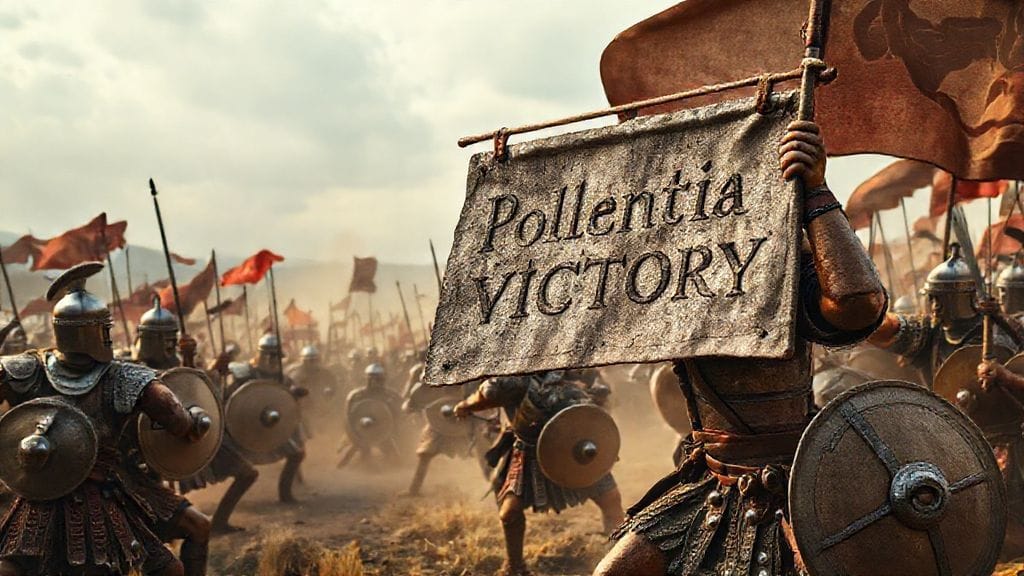
Dawn broke over Seville on 6 June 1391 with no special omen recorded in the chronicles. The sun rose over the Giralda tower and the half-finished Gothic shell of the new cathedral that was replacing the old mosque. Merchants rolled up shopfront shutters; carts creaked along cobbled streets; bells marked the hours of Matins and Prime. In the Judería, fathers recited morning prayers, boys fetched water from cisterns, women bargained with vendors through narrow windows. But outside the quarter’s gates, clusters of men were already forming—artisans with calloused hands, apprentices with restless energy, a few clerics with hard faces. Some carried staves or knives hidden under cloaks, others came empty-handed, expecting to find weapons where they were going.
The exact sequence of events remains partly shrouded in the patchy, partisan sources that survive. Yet the outline is grimly clear. At some point that morning, the crowd coalesced into a mob and moved toward the Judería. Shouts rose: accusations that the Jews had mocked Christ, that they had defied Christian rule, that their riches were stolen from honest believers. Someone—perhaps a low-ranking cleric, perhaps an eager layman—invoked Ferrán Martínez’s name, claiming that this was the day to act. The gates of the Judería, normally controlled and guarded, were either forced open or overrun as the mob surged forward.
From within the quarter, the first signs of danger might have been the sound of stone on wood, the sudden cry of a child, the too-familiar echo of breaking glass. A young Jewish man, looking up from his workbench, could have seen faces at the end of his street that did not belong there at that hour—faces twisted by anger, unfamiliar in their hostility. The alarm spread rapidly: “They are coming!” Doors slammed, shutters were pulled tight, and families scrambled for whatever protection their homes could offer. Some rushed toward synagogues, believing that sacred spaces might be spared; others fled in the direction of Christian friends who had quietly promised shelter.
But this was only the beginning. The first wave of attackers stormed through the streets, smashing doors, looting goods, dragging people into the open. Some households fought back with whatever they had: kitchen knives, tools, stones pried from the pavement. In the confusion, screams mingled with prayers in Hebrew and the shouts of attackers invoking Christ and the Virgin. Fire soon followed. A single torch hurled onto a rooftop might set an entire row of houses ablaze, turning narrow streets into funnels of smoke and heat. Those who had locked themselves inside now faced not only the mob but also the suffocating threat of flames.
Outside the Judería, other Sevillians watched, some in horror, others with curiosity or approval. Chroniclers note that the violence spread rapidly, suggesting that whatever efforts authorities made were half-hearted or quickly overwhelmed. The royal representatives had neither the troops nor perhaps the will to stop their own neighbors. As the day wore on, the massacre of jews seville became irreversible: an orgy of killing, looting, and forced baptism that would permanently alter the city’s demography and conscience.
Inside the Judería: Flight, Resistance, and Forced Baptism
To imagine the massacre of jews seville from within the Judería is to enter a world where time fractures into moments of raw terror. In one house, a mother pushes her children under a bed, whispering at them not to make a sound as boots pound up the stairs. In another, an elderly scholar gathers his prayer shawl around his shoulders and recites the Shema, preparing himself to die with the words of monotheistic faith on his lips. Neighbors call to each other across rooftops, throwing blankets and ropes, improvising escape routes from one burning building to another.
Resistance took many forms, most of them desperate and improvised. Young men and women barricaded doors with furniture, hurled stones from windows, and tried to repel attackers at narrow alleyways. Yet the imbalance in numbers and weaponry quickly told. The rioters, reinforced by new arrivals lured by the prospect of plunder, battered down defenses one by one. In some accounts, groups of Jews gathered in synagogues, hoping that attackers would hesitate to desecrate their holy places. But these hopes were often in vain. Chronicles speak of synagogues invaded, their sacred books torn, their interiors defiled, some later converted into churches as if to overwrite the memory of Jewish prayer with Christian ritual.
Alongside outright murder, forced baptism became a grim alternative. Rioters and clerics offered Jews a choice: convert or die. In the chaos, some Jews genuinely embraced Christianity, but many others accepted baptism under duress, seeing it as the only way to save their lives and those of their families. Parents faced excruciating decisions. Should they allow the priest’s water to touch their children’s heads, knowing that it would mark them forever as Christians, or should they refuse and risk seeing them killed? Late medieval sources, though often silent on individual cries, hint at these tragic debates in the references they make to “voluntary conversions” that were anything but free.
One can imagine a scene described in spirit by later chroniclers: a rabbi, battered and bleeding, standing in a smoky courtyard, surrounded by weeping congregants and an impatient mob. A priest thrusts a crucifix toward him, demanding that he acknowledge Christ. The rabbi looks at the faces of children clutching their mothers’ skirts, hears the wails of the wounded, and makes a calculation that mixes faith, duty, and despair. Some would refuse and die; others would bow their heads and step into a new, enforced religious identity. As historian Benzion Netanyahu later argued in another context, these conversions created a category of “New Christians” whose inner beliefs and outer labels often clashed, a tension that would haunt Spain for generations.
Not all Christians joined the violence. There are scattered reports—fleeting, but telling—of Christian neighbors hiding Jews in cellars, smuggling them through secret doorways, or standing before their homes like shields. These acts did not prevent the massacre of jews seville, but they remind us that even in a time of collective brutality, individual choices could tilt toward humanity. Yet the dominant rhythm of the day was set by the roar of the mob, the crash of doors, and the harsh syllables of threats shouted in Castilian. By evening, much of the Judería lay in ruins, its streets strewn with bodies and debris, its survivors stunned into numbness.
Blood and Ashes: Numbers, Testimonies, and the Human Toll
How many died in Seville on that June day? Medieval sources are notoriously imprecise, and later writers, moved by horror or polemical intent, often exaggerated figures. Some chronicles speak vaguely of “many thousands” killed; others emphasize the scale of conversion more than the body count. Modern historians, sifting through fragments of tax records, property transfers, and legal testimonies, have suggested that Seville’s Jewish community was effectively destroyed as an organized entity, with a large proportion either killed or baptized. Whether the dead numbered in the hundreds or several thousand, each was a life cut short, often in front of witnesses whose memories would carry the trauma forward.
What we lack in precise statistics we partially recover in evocative hints. A royal document issued not long after the massacre refers to “the great desolation inflicted upon Our Jews of Seville,” acknowledging both the economic and demographic loss. Petitions from survivors speak of widows and orphans left without support, of houses burned and looted, of synagogues “usurped” and turned into churches. One can almost see the lines of refugees filing out of the ruined quarter, clutching what little they have salvaged, their clothes singed, their eyes hollow.
Later chroniclers, writing in a Christian idiom, sometimes framed the events as an unfortunate but divinely permitted punishment for Jewish unbelief. Others, especially those closer to royal circles, were more pragmatic, lamenting the loss of tax revenue and the breakdown of order. Jewish sources, where they survive, are more anguished. Fragments of Hebrew poetry and liturgical laments refer to a “day of wrath,” a “city turned against its sons,” and “sanctuaries made desolate.” Similar language appears in laments for other medieval persecutions, but in the context of 1391 they acquire a painfully specific resonance: Seville, once a center of Jewish learning and trade, had become a cemetery.
The massacre of jews seville was not only about those who died. It was also about those who survived physically but endured profound psychological and spiritual violence. Many had seen family members killed before their eyes; many had been forced into baptism; many had lost homes, livelihoods, and the communal institutions that had anchored their identities. The human toll extended beyond the immediate hours of bloodshed into the slow, grinding years of grief, adaptation, and, for some, internalized shame or rage. Trauma does not show up neatly in tax rolls, yet it shaped every conversation, every family story told in hushed tones for generations after.
In assessing that toll, one must also consider the broader Jewish world. News of Seville’s destruction spread quickly to other communities in Iberia and beyond, casting a pall of fear. If one of the largest and most prestigious Jewish centers in Castile could be devastated so thoroughly, what hope was there for smaller, less protected communities? The massacre of jews seville thus sent shockwaves far beyond the city walls, signaling that the old assumptions of royal protection and limited, managed hostility had collapsed.
Aftermath in the Streets: Loot, Silence, and the Smell of Smoke
When the shouting finally subsided and the last pockets of resistance were crushed, Seville emerged into a brutal calm. Smoke still curled from burned homes; the cobblestones of the Judería were blackened and slick. Survivors crawled out from hiding places, stepping around the dead in search of the living. Some wept openly; others moved like sleepwalkers, stunned beyond tears. The city authorities, whether remorseful or simply anxious to restore order, began to patrol the quarter, surveying the damage and, inevitably, thinking about what to do with the newly “available” properties.
Loot was one of the main immediate rewards the rioters had sought. Furniture, clothing, jewelry, business tools, religious objects—these were carried off in the chaos, redistributed like spoils of war. A Jewish merchant’s chest, once filled with account books and carefully balanced coins, might now sit in a Christian artisan’s home, repurposed as a storage box, its origin unspoken. Torah scrolls, if not burned or desecrated, were sometimes sold as parchment or hoarded as curiosities. The everyday material culture of Seville’s Jewish life was thus dispersed, its sacred meanings rarely respected.
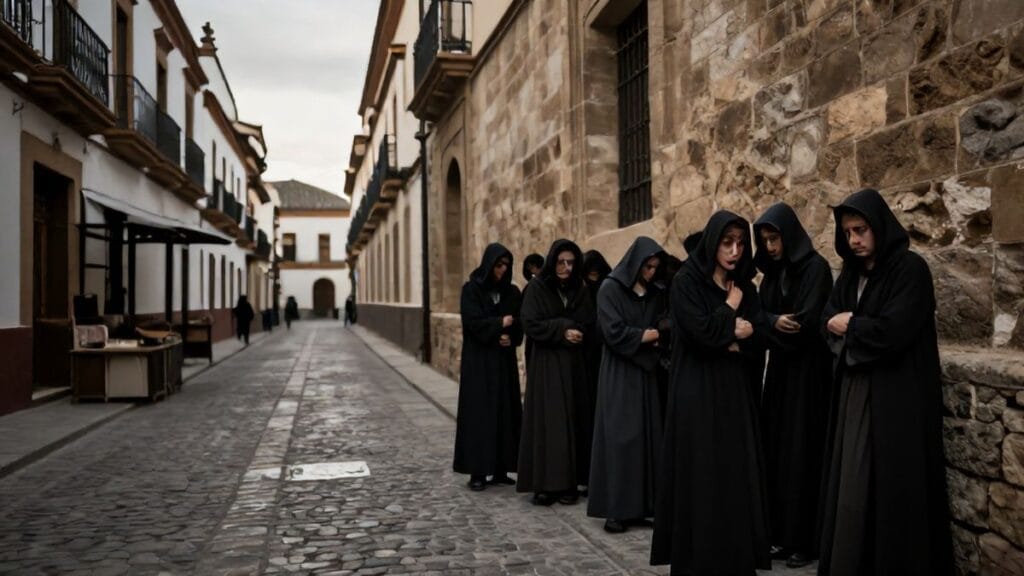
In the days that followed, a heavy silence settled over parts of the city. Some Christians, belatedly horrified by the scale of the violence, avoided the Judería, unable or unwilling to look at what had been done in their name or by their neighbors. Others frequented the ruins, scavenging for leftover goods or simply satisfying morbid curiosity. The smell of smoke lingered, mingling with the usual urban odors, a constant reminder of the quarter’s destruction. It is in such atmospheres that memory begins to take shape, through half-finished sentences and abrupt changes of subject whenever someone mentions “that day.”
The authorities moved to formalize the new reality. Royal officials took inventory of abandoned properties, issuing grants to Christian nobles, church institutions, or loyal citizens. Synagogues were seized, some quickly consecrated as churches. In at least one documented case, a former synagogue in Seville was rededicated to the Virgin Mary, its walls echoing with Latin chants instead of Hebrew psalms. This process of appropriation and re-signification served both practical and symbolic purposes: it solved the question of ownership while declaring that the old Jewish presence had been overwritten by Christian triumph.
For those Jews who had survived and not converted, the city had become an alien landscape. Some fled as quickly as possible, seeking refuge in nearby towns or other kingdoms where the violence had not yet reached or had been less severe. Others lingered, hoping that conditions might stabilize and that some measure of their former lives could be rebuilt. But the massacre of jews seville was not a passing riot; it was a rupture. Whatever emerged in its wake in terms of Jewish presence would be smaller, more fragile, and more entangled with the identities of converted kin and neighbors.
From Jews to New Christians: Mass Conversions and Broken Identities
One of the most far-reaching consequences of the massacre of jews seville was not visible in the rubble of the Judería but in the baptismal registers. Under the threats and the sword, large numbers of Jews accepted Christian baptism, entering the category that would later be known as “conversos” or “New Christians.” These men, women, and children did not simply disappear; they remained in Seville and other cities, now outwardly Christian but carrying within them the memory—and often the practices—of a Jewish past.
On the surface, the Church celebrated this outcome. Sermons spoke of hardened Jewish hearts miraculously softened, of entire communities returning to the “true faith.” Priests performed baptism after baptism, sometimes en masse, speaking the same formula over individuals whose inner attitudes varied wildly. For some, the ritual was traumatic, an enforced break with ancestors and traditions. For others, who had already been ambivalent or mixed in their beliefs, it may have felt like a door opening to full participation in the dominant culture. The spectrum of responses complicates any simple narrative of victimhood or betrayal.
Yet even when conversion was effectively coerced, it had deep social consequences. New Christians, though technically fully equal in the eyes of canon law, faced persistent suspicion from “Old Christians” who doubted the sincerity of their faith. Whispers arose: “They still light candles on Friday night,” “They refuse pork when they think no one is watching,” “They marry among themselves.” In some cases, these accusations were true; in others, they were malicious fantasies. Either way, they created a climate of chronic mistrust. A group that had once been externally separate by law and custom was now internally separated by genealogy and rumor.
Within converso families, identities fractured. An older generation might remember Hebrew prayers by heart, while their children learned the catechism in parish schools. Grandparents told stories of Jerusalem and Moses; priests taught them about Bethlehem and Christ. Some conversos maintained crypto-Jewish practices in secret: washing before prayer, reciting modified blessings, fasting on certain days. Others attempted to erase their Jewish past as thoroughly as possible, sponsoring Christian art, marrying into noble families, and emphasizing their new loyalty to the Church and Crown. The inner conflicts of such lives rarely left written traces, but their outlines emerge in later Inquisition records filled with accusations about “Judaizing” habits.
In this sense, the massacre of jews seville did not simply eradicate Jewish life; it transformed it into something more ambivalent and, for the dominant society, more unsettling. A visibly distinct minority had become an invisible, internal other. The seeds of what would later blossom into obsession with “purity of blood” (limpieza de sangre) and the machinery of the Inquisition were planted in these decades of uneasy coexistence between Old and New Christians. The violence of 1391 thus reverberated far beyond its immediate victims, reshaping Spanish notions of lineage, faith, and belonging.
Echoes Across Castile and Beyond: 1391 as a Turning Point
Seville’s tragedy did not unfold in isolation. In the summer and autumn of 1391, anti-Jewish violence spread across much of the Iberian Peninsula. In Castile, cities like Córdoba and Toledo experienced their own pogroms; in the Crown of Aragon, Valencia and Barcelona saw synagogues stormed and communities decimated. News of the massacre of jews seville likely emboldened rioters elsewhere, serving as an example of how far popular fury could go with limited immediate royal retaliation. A pattern emerged: incitement by local clerics or civic leaders, an initial clash, then a wave of killings and forced baptisms, followed by half-hearted attempts by authorities to restore order.
Historians often treat 1391 as a watershed in Iberian Jewish history. Before that year, despite intermittent violence and increasing restrictions, Jewish communities remained significant and, in some regions, economically and culturally vibrant. After 1391, the landscape changed dramatically. Many of the largest and most influential aljamas (Jewish communities) were shattered; their leadership dispersed or dead. Mass conversions reduced the size of openly Jewish populations while swelling the ranks of conversos. The balance between Judaism as a visible minority religion and Christianity as the majority creed shifted further toward religious homogeneity, at least in appearance.
The echoes of Seville’s massacre thus sounded in the debates of other cities’ councils, in the sermons of other pulpits, and in the quiet calculations of Jewish elders wondering whether to stay or flee. Some chose to migrate to Muslim-ruled Granada or to North Africa, where Jewish life, though not untroubled, seemed less precarious than in Christian kingdoms roiled by anti-Jewish fervor. Others looked further afield, to Italy or the eastern Mediterranean. The demographic and intellectual loss to Iberia from this outward movement is hard to quantify but significant.
Contemporaries did not immediately speak of 1391 as a turning point; such labels emerge from the vantage point of hindsight. Yet even in the generation that followed, one senses a before and after. Royal charters refer to reestablishing order “after the disturbances of ’91.” Church councils mention the problem of conversos and the need to discern true from false Christians—a problem that did not exist on the same scale before the pogroms. The massacre of jews seville, as one of the earliest and most destructive eruptions in this wave, became both symbol and catalyst for transformations that would unfold over the next century.
Crown, Church, and Justice Denied: Political Responses to the Violence
In the idealized self-understanding of medieval monarchy, the king was protector of all his subjects, including Jews, who were often described as “servants of the royal chamber.” The 1391 massacres exposed the frailty of that ideal. In Castile, the child-king Henry III could neither anticipate nor swiftly control the explosion of violence that tore through his realm. Regents and royal councils, preoccupied with factional struggles and fiscal challenges, reacted slowly and unevenly. By the time serious measures might have been taken in Seville, the Judería lay in ruins.
Nonetheless, the Crown did respond, at least on paper. Royal edicts condemned unlawful assaults on Jews and New Christians, reaffirmed that the Jews belonged to the royal fisc, and threatened punishment for rioters. In some places, limited reparations were ordered; in others, authorities were instructed to ensure that forcibly baptized Jews were not maltreated. Yet enforcement lagged, and when it did come, it rarely matched the scale of the crimes. Local elites, some of whom had participated in or benefited from the violence, were hardly eager to see thorough investigations.
The Church’s reaction was similarly ambivalent. Officially, the Church had long condemned mob violence and insisted that Jews should not be killed or forcibly baptized. Yet many clerics, like Ferrán Martínez, had actively stirred hostility. Higher-ranking prelates sometimes tried to curb the excesses of their subordinates but also shared the broader theological view of Judaism as obsolete and stubborn. After 1391, church authorities welcomed the influx of conversos, yet struggled to articulate a coherent policy toward those whose conversions were visibly coerced.
The question of justice for the victims largely went unanswered. Few rioters faced serious punishment, and the institutional church did not launch any large-scale investigations into clerical incitement. The Crown’s primary concern became the restoration of fiscal normality: how to tap the resources of New Christians and remaining Jews without provoking further unrest, and how to compensate for lost revenue in places where communities had been annihilated. Economic calculations overshadowed moral reckoning.
The absence of meaningful accountability had long-term consequences. It signaled that collective violence against a stigmatized minority could occur with relative impunity, especially when cloaked in religious rhetoric and carried out in periods of political weakness. This precedent would not be forgotten. In later centuries, when the Inquisition targeted conversos suspected of “Judaizing,” it did so under a very different institutional framework but within a cultural memory that included unpunished pogroms like the massacre of jews seville. The state learned to monopolize religious violence rather than eliminate it.
Memory, Fear, and Daily Life: How Survivors Lived with the Wounds
In the months and years following 1391, life in Seville resumed its routines—markets reopened, guilds met, ships came and went on the river. Yet beneath this surface normality, the wounds of the massacre pulsed. For survivors, both openly Jewish and newly Christian, memory was not an abstract concept but a daily presence. An alleyway where a father had been cut down, a church built over a synagogue, a piece of jewelry recognized on a neighbor who had taken it during the riot—such sights kept that day alive.
Jews who remained or later returned to Seville faced the challenge of rebuilding community structures from almost nothing. They needed to reestablish prayer services, to find or train new religious leaders, to reconstruct burial societies and charitable networks. Trust, however, was harder to rebuild. Could they rely on royal promises this time? Could they believe Christian neighbors who now expressed regret? Some must have felt that every friendly gesture carried an undertone of pity or guilt. Others, forced by necessity into economic relations with those who had once joined the mob, learned a bitter pragmatism.
Conversos navigated a different but related maze. Their new Christian identity opened some doors—access to craft guilds, political offices, and broader social circles—but closed others. Old Jewish friends might view them with a mix of envy, distrust, and grief. Old Christians might speak politely while wondering about the sincerity of their faith. In public, they were expected to display Christian piety; in private, they grappled with questions of belonging. Did they still think of themselves as descendants of Israel? Should they teach their children to remember what had happened in the Judería, or should they bury the memory in hopes of protecting the next generation?
Fear hovered over everyday decisions. A careless remark about the past, an absentminded gesture that resembled a Jewish custom, a conflict with a neighbor who might weaponize rumors about one’s ancestry—these could have serious consequences even decades later. Although the Inquisition would not be formally established in Castile until 1478, the social mechanisms that allowed for denouncing and policing religious deviance were already in place informally: gossip, confessional reports, and the ever-watchful eyes of neighbors.
Within homes, however, other narratives persisted. Children born after 1391 grew up hearing stories about the lost quarter, the slaughtered relatives, the synagogues turned churches. These stories were not always carefully crafted historical accounts; they were fragments passed down at family tables, in lullabies and laments, intertwined with biblical tales of destruction and exile. The massacre of jews seville thus entered Jewish and converso memory as one more episode in a long history of suffering and endurance, joining the destruction of the Temple and the exile from Spain in 1492 as key reference points of communal identity.
From 1391 to the Inquisition: A Straight Road to 1492?
Looking back from the vantage point of the late fifteenth century, it is tempting to draw a straight line from the massacre of jews seville in 1391 to the establishment of the Spanish Inquisition in 1478 and the expulsion of the Jews in 1492. The threads connecting these events are indeed numerous: the mass conversions that created a large converso population, the growing obsession with religious purity, the fear that many New Christians secretly practiced Judaism. Yet history rarely moves in straight lines, and scholars have debated how directly the pogroms of 1391 led to the policies of Ferdinand and Isabella.
In the generations following the massacre, conversos rose to prominent positions in royal administration, the Church, and urban economies. Some families, originally Jewish, became pillars of the new Trastámara monarchy and of urban elites. Their success provoked envy and resentment, especially among Old Christian nobles and burghers who saw their traditional privileges threatened. Anti-converso riots in Toledo and other cities in the mid-fifteenth century resembled, in some ways, the earlier anti-Jewish violence, but were now framed in terms of “blood” rather than explicit religious difference. The language shifted from attacking Jews to attacking “those of Jewish lineage,” regardless of outward faith.
Intellectuals and polemicists contributed to this shift. Treatises argued that Jewish ancestry carried an innate propensity toward heresy or moral vice, an early form of racial thinking embedded in a theological and social context. Statutes of limpieza de sangre began to appear, excluding those of Jewish descent from certain offices or honors even if they were devout Christians. This legal and cultural infrastructure did not arise ex nihilo; it drew on memories of forced conversions and on suspicions that the newly baptized had entered the Church’s fold through fear rather than conviction—a suspicion rooted in events like the Seville pogrom.
When Ferdinand and Isabella sought to consolidate their power and religious unity in the late fifteenth century, they inherited this fraught legacy. The Inquisition, officially tasked with rooting out heresy among baptized Christians, focused intensely on conversos. Trials, denunciations, and autos-da-fé created an atmosphere of dread. Many of those brought before inquisitorial tribunals were accused of practices that harked back, in attenuated form, to a pre-1391 Jewish world: lighting candles on Friday evenings, fasting on Yom Kippur, avoiding pork. The grand irony was that the very violence that had forced Jews into the Church now served as justification to suspect them of insincerity.
In 1492, the Catholic Monarchs decreed the expulsion of the remaining Jews from their realms. The edict argued, among other things, that contact between unbaptized Jews and conversos encouraged the latter to persist in Judaizing. Thus, the presence of openly Jewish communities was blamed for the supposed failings of New Christians whose ancestors had been coerced into conversion a century earlier. While 1391 did not make 1492 inevitable, it created conditions—mass converso populations, entrenched narratives of insincere conversion, weakened Jewish communities—that shaped the choices of rulers and the fears of the populace. In this broader arc, the massacre of jews seville stands as an early, bloody milestone on the road to a Spain that would define itself as both fiercely Catholic and haunted by the ghosts of its plural past.
Historians, Debates, and Sources: Reconstructing the Unthinkable
Reconstructing the events of 6 June 1391 in Seville is a challenging task. The sources that survive are fragmentary, often biased, and rarely interested in the granular human detail that modern readers crave. Royal edicts, municipal records, ecclesiastical correspondence, chronicles, and occasional Hebrew laments provide pieces of a mosaic whose missing tiles can never be fully replaced. Historians must read these documents critically, aware of what they emphasize and what they ignore.
Christian chronicles, for example, sometimes describe the violence in Seville and elsewhere in formulaic language, presenting it as a sudden outburst of popular fury or as a sign of divine displeasure. They typically focus on the moral lessons for Christian society, not on Jewish suffering. Jewish sources, by contrast, emphasize the theological and communal dimensions of catastrophe, interpreting the massacre through the lens of exile, martyrdom, and the hope for eventual redemption. As one medieval Hebrew poet lamented in words that echo across time, “Our city has turned her hands against her children, our sanctuary is made a heap.” Such lines convey emotion more than detail, yet they are indispensable for understanding how the events were lived from within.
Modern scholars have debated the underlying causes and meanings of the massacre of jews seville. Was it primarily a religious explosion, driven by theological hatred and apocalyptic fear? Or was it, as some argue, a form of social rebellion against royal fiscal policies and the perceived collusion of Jewish financiers with oppressive taxation? Others emphasize the role of local power struggles, with preachers like Ferrán Martínez using anti-Jewish agitation to undermine royal and episcopal authority. These interpretations are not mutually exclusive; like most historical events, the pogrom was overdetermined, fueled by multiple intersecting grievances.
In twentieth-century historiography, figures such as Yitzhak Baer and Julio Valdeón Baruque offered influential syntheses. Baer stressed the religious and legal dimensions of Christian-Jewish relations, showing how centuries of doctrinal hostility made episodes like 1391 possible. Valdeón highlighted socio-economic tensions and the weaknesses of late medieval monarchies. More recent work incorporates perspectives from cultural history, memory studies, and the history of emotions, asking how fear, envy, and collective fantasies shaped perceptions of Jews and conversos.
No single narrative can claim absolute authority, but careful cross-reading of sources allows us to outline what happened and why it mattered. One constant in these debates is the recognition that the massacre of jews seville was not an anomaly. It was part of a broader European pattern of anti-Jewish violence, from the Rhineland massacres of the First Crusade to the expulsions from England and France. Yet its timing, scale, and aftermath—especially the mass creation of conversos—give it a distinctive place in the history of Iberia and of Jewish-Christian relations more broadly.
Remembrance and Oblivion: Seville Confronts Its Past
Walk through Seville’s historic center today, and you can trace the faint outlines of the old Judería in street names and architectural quirks. Certain alleys twist in ways that recall medieval urban planning; a church’s foundations reveal the footprint of a former synagogue. Yet for centuries, the memory of 1391 lay largely submerged beneath layers of civic pride and religious triumphalism. The city celebrated its Christian reconquest, its Baroque churches, its role in the Spanish Empire, while saying little about the quarter once filled with Hebrew prayers and the day it was destroyed.
This selective memory is not unique to Seville. Many European cities have struggled to integrate episodes of persecution into public narratives that prefer tales of heroism and glory. In Seville’s case, the later expulsion of 1492 and the more visible institutions of the Inquisition overshadowed the earlier pogrom in popular memory. It was only with the rise of modern historical scholarship, and later with renewed Jewish interest in Sephardic heritage, that the massacre of jews seville began to receive more focused attention.
In recent decades, local historians and cultural initiatives have worked to identify and mark sites connected to the medieval Jewish community. Guided tours explore the former Judería; plaques honor figures of Jewish Seville; conferences discuss the legacy of convivencia and its violent end. These efforts coexist with a tourist industry that often romanticizes medieval Spain as a land of harmonious coexistence, softening the sharp edges of historical conflict. Yet behind the commercialized images, a more serious conversation has emerged about how to remember both the creativity and the cruelty of the city’s multi-religious past.
For descendants of Sephardic Jews, some of whom trace their roots to Andalusian cities like Seville, 1391 is part of a long genealogy of loss. In family stories told in different corners of the Mediterranean, from Salonica to Istanbul to North Africa, the memory of “Sefarad” includes not only the greatness of Andalusian Jewry but also its betrayals. When contemporary Spain has taken steps to recognize its Sephardic heritage—such as laws offering citizenship to some descendants of expelled Jews—these gestures resonate against the distant echo of pogroms and expulsions that once proclaimed Jews as permanently alien.
Remembering the massacre of jews seville is not an exercise in cultivating guilt for its own sake. It is, rather, an invitation to face how fragile coexistence can be when fear and demagoguery are left unchecked, and how quickly neighbors can become perpetrators or bystanders. In a world still haunted by ethnic and religious violence, Seville’s 1391 stands as both warning and mirror. The stones of the old Judería cannot speak, but the historical record, however incomplete, gives them a voice if we are willing to listen.
Conclusion
On 6 June 1391, the streets of Seville’s Judería became the stage for a tragedy that would reverberate across centuries. What had been, for generations, a bustling Jewish neighborhood embedded in the life of a great Iberian city was torn apart in a single day of orchestrated fury. The massacre of jews seville was not an inexplicable eruption of ancient hatred; it was the product of accumulated crises—plague, war, economic strain—channeled and inflamed by preachers like Ferrán Martínez and enabled by weak or complicit authorities. Its violence killed bodies, shattered families, and destroyed communal institutions, but it also reshaped identities, turning many Jews into New Christians whose ambiguous status would trouble Spanish society for generations.
The pogrom’s immediate aftermath saw looted homes, burned synagogues, and terrified survivors navigating new realities of exile, conversion, and cautious return. Politically, it revealed the limits of royal protection and the dangers of clerical incitement. Socially, it recast the boundaries between majority and minority, public faith and private conviction. Over the longer term, 1391 helped create the conditions for the rise of the converso question, the obsession with blood purity, and the establishment of the Inquisition—developments that culminated in the expulsion of 1492 and the near-erasure of openly Jewish life from Spain.
Yet even amidst destruction, threads of continuity endured. Memories of the Judería lived on in family stories, Hebrew laments, and the whispered practices of crypto-Jews. Architectural traces and archival fragments testify that Seville was once home to a community whose disappearance left a lasting void. To remember the massacre of jews seville today is to acknowledge both the depth of that loss and the dangers of forgetting. It challenges us to see medieval Iberia not as a static tableau of convivencia or conflict, but as a dynamic, fragile world where everyday interactions coexisted with the potential for sudden, devastating rupture.
In confronting this past, we gain more than historical knowledge. We gain a clearer sense of how narratives of purity and contamination, of divine favor and punishment, can be turned against vulnerable neighbors; how institutions fail when they prioritize power over justice; and how violence, once unleashed, escapes the intentions of those who think they can control it. Seville’s 1391 is distant in time, but its lessons about prejudice, demagoguery, and the fragility of pluralism remain unsettlingly close. The duty to remember, then, is not only to the dead of the Judería, but also to the living, who still stand, knowingly or not, at similar crossroads.
FAQs
- What was the massacre of Jews in Seville in 1391?
The massacre of Jews in Seville on 6 June 1391 was a large-scale pogrom in which Christian mobs, incited by long-term clerical agitation and fueled by economic and religious tensions, stormed the city’s Jewish quarter. Many Jews were killed, their homes and synagogues were looted or burned, and large numbers were forced to accept Christian baptism. The event effectively destroyed Seville’s organized Jewish community and became a catalyst for similar violence elsewhere in Iberia. - What role did Ferrán Martínez play in the events?
Ferrán Martínez, Archdeacon of Écija, played a crucial role in preparing the ground for the violence through years of inflammatory preaching against Jews in and around Seville. He called for the demolition of synagogues and stricter segregation, openly defied royal orders to protect Jewish subjects, and presented the presence of Jews as an obstacle to God’s favor. While the exact extent of his direct involvement on 6 June 1391 is debated, his sermons and actions created the ideological and emotional climate that enabled the massacre. - How many people were killed during the massacre?
Exact numbers are unknown because medieval sources are imprecise and often exaggerated. Some chronicles speak of “many thousands,” but modern historians, using tax records and other documents, suggest that a substantial portion of Seville’s Jewish population was either killed or forced to convert. Whether the dead numbered in the hundreds or more, the community as a coherent entity was effectively destroyed, and the demographic, economic, and cultural losses were profound. - What happened to the Jewish community of Seville after 1391?
After the massacre, the openly Jewish community of Seville was drastically reduced. Many survivors either fled the city or accepted baptism and became conversos, or New Christians. Synagogues were seized and converted into churches, and Jewish properties were redistributed. Although some form of Jewish presence persisted for a time, it never regained its former size or prominence, and Seville ceased to be a major center of Jewish life in Castile. - How did the massacre of jews seville influence the later Spanish Inquisition?
The massacre contributed to the creation of a large converso population whose sincerity as Christians was often questioned. Suspicion that many New Christians secretly practiced Judaism fueled social tensions and anti-converso riots in the fifteenth century. When the Spanish Inquisition was established in 1478, it focused heavily on prosecuting alleged Judaizers among these conversos. Thus, the forced conversions and trauma of 1391 helped shape the environment in which the Inquisition arose, even though nearly a century separated the two events. - Was the massacre purely religiously motivated, or did economic factors play a role?
Both religious and economic factors played important roles. Theologically, medieval Christian hostility toward Judaism, intensified by fiery preaching, framed Jews as stubborn rejecters of the truth. Economically, some Jews occupied positions as tax farmers, lenders, and royal agents, which made them targets of resentment in a time of plague, war, and fiscal strain. Many historians argue that the pogrom expressed not only doctrinal hatred but also social and economic frustrations channeled against a vulnerable minority. - Did any Christians in Seville try to protect their Jewish neighbors?
Yes, although they were a minority. Scattered accounts mention Christian individuals who hid Jews, helped them escape, or tried to shield their homes from attack. Some Christian officials also attempted, belatedly, to restore order and enforce royal protections. However, these efforts were not sufficient to prevent or quickly halt the massacre, and the overall behavior of the urban population ranged from active participation to passive complicity. - How do historians today know about the events of 1391 in Seville?
Historians rely on a combination of sources: royal edicts and correspondence, municipal records, ecclesiastical documents, Christian chronicles, and a smaller number of Jewish texts such as laments and letters. They also use later testimonies, property records, and architectural evidence to reconstruct the layout of the Judería and the fate of its institutions. Critical comparison of these sources, along with broader contextual knowledge of medieval Iberia, allows for a reasonably detailed, though never complete, picture of the massacre. - Is the site of the old Jewish quarter visible in Seville today?
While the medieval Judería no longer exists as a distinct Jewish neighborhood, its approximate area can still be traced within Seville’s historic center through street patterns and a few preserved structures. Some churches stand on or near the sites of former synagogues, and local historians and guides offer routes that follow the contours of the old quarter. However, many physical traces have been erased or transformed over the centuries, making historical reconstruction partly dependent on documents rather than visible remains. - Why does the massacre of jews seville remain significant for understanding European history?
The massacre is significant because it illuminates how religious ideology, economic stress, and political weakness can combine to produce targeted mass violence. It also shows how forced conversions create enduring social tensions and categories of suspicion that can persist long after the initial crisis. As a precursor to the Inquisition and the expulsion of 1492, the 1391 pogrom helps explain how medieval Spain moved from relative religious pluralism to a rigidly Catholic identity, offering broader lessons about intolerance, identity construction, and the long shadow of collective trauma.
External Resource
Internal Link
Other Resources
- Encyclopaedia Britannica – general search for the exact subject
- Google Scholar – academic search for the exact subject
- Internet Archive – digital library search for the exact subject