Table of Contents
- A March Morning in Koblenz: The Day a New King Emerged
- The Fractured Empire: Germany on the Eve of Change
- The Long Shadow of the Salians and the Rise of the Staufen
- Lothair III’s Death and the Scramble for the Crown
- Roads Converge on the Rhine: Princes, Envoys, and Ambitions
- Inside the Election: How Conrad III Was Chosen in Koblenz
- A Double Crown: Rival Kings and a Kingdom Divided
- The Church, the Pope, and the Politics of Legitimacy
- Queens, Mothers, and Noblewomen in the Struggle for Power
- War for a Crown: Campaigns, Sieges, and Smoldering Cities
- Conrad III and the Ideal of Kingship in the Twelfth Century
- The Road to the Second Crusade: From Koblenz to the Holy Land
- Family, Legacy, and the Making of Frederick Barbarossa
- The Human Face of Civil War: Peasants, Towns, and Minor Lords
- Memory and Chronicle: How Medieval Writers Saw Conrad III
- From Election to Empire: Long-Term Consequences for Germany
- Conclusion
- FAQs
- External Resource
- Internal Link
Article Summary: On a cold March day in 1138, in the Rhenish city of Koblenz, the princes of the German kingdom gathered to choose a new monarch, and there, in an atmosphere thick with tension and hope, conrad iii elected king of germany marked the beginning of a new era. This article traces the crumbling of the Salian order, the uneasy transition after Emperor Lothair III’s death, and the bruising rivalry that erupted when Conrad’s election was contested. We follow the maneuverings of bishops, dukes, and queens, the shadow of papal influence, and the eruption of civil war that turned villages, castles, and roads into battlegrounds. From the great halls of the princes to the muddy fields of ordinary peasants, the story examines how one election reshaped lives across the empire. The narrative also connects conrad iii elected king of germany at Koblenz to the launch of the Second Crusade and the maturing ideals of medieval kingship. It explores the complex legacy of a king who never wore the imperial crown but prepared the way for his more famous successor, Frederick Barbarossa. Above all, it shows how a single political decision on the banks of the Rhine echoed through generations of German and European history. In doing so, it reconsiders why conrad iii elected king of germany remains a turning point that historians still debate, reinterpret, and rediscover.
A March Morning in Koblenz: The Day a New King Emerged
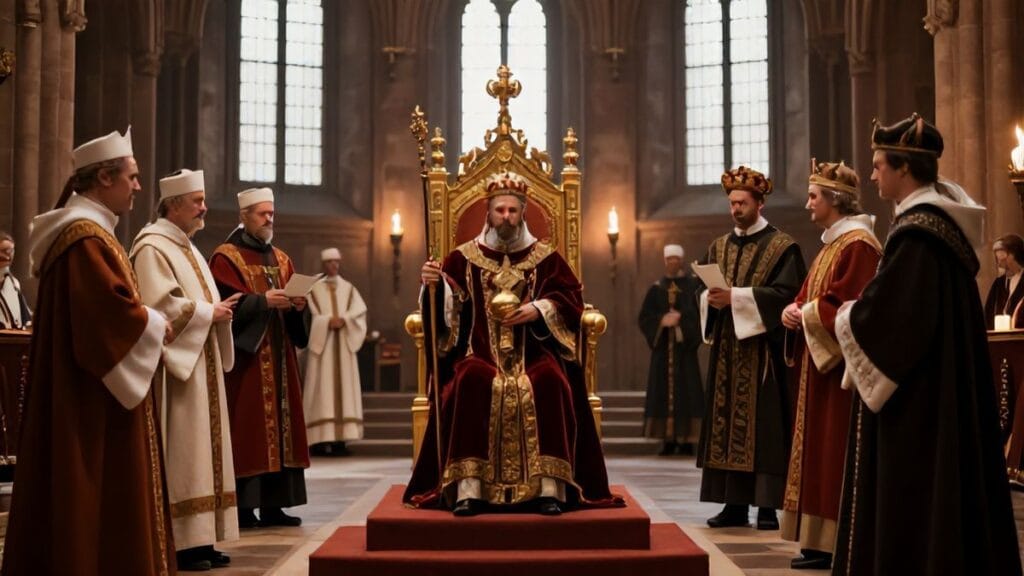
The morning of 7 March 1138 broke gray and cold over Koblenz. Mist clung low to the confluence of the Rhine and Moselle, muffling the sounds of hooves on frozen ground and the murmurs of men in cloaks of wool and fur. Beneath the city’s walls incense drifted from church doors, colliding with the sharper smells of horses, leather, and iron. Here, in this frontier town of river trade and Roman memories, the princes of the German kingdom were gathering. By midday, they would have set in motion an event whose significance few of them could fully grasp: conrad iii elected king of germany, and with him, the rise of a new ruling house.
It is tempting to imagine silence as the lords processed into the meeting place—likely a church or the hall of a powerful prelate—yet the air would have been anything but still. Messengers brushed past one another with hurried whispers. Servants adjusted the cloaks of bishops, wiped mud from polished boots, and steadied hands stiff from the cold. Around them flickered the colors of power: deep reds and blues of dyed cloth, glints of gold thread in ecclesiastical vestments, the muted gleam of sword pommels and belt fittings. But this was not a coronation yet, only an election—a fragile human agreement over who would hold the most dangerous office in Latin Christendom.
The man at the heart of it all, Conrad of Hohenstaufen—already seasoned by war, retreat, and failed claims to the crown—stood no taller than other nobles in the crowd, yet his presence drew glances. He was in his thirties, hardened by years of conflict against the late Emperor Lothair III, and scarred in pride by his earlier defeat in the royal election of 1125. To many nobles Conrad was both a familiar figure and a controversial one: a duke without a duchy, a warrior from the powerful but embattled Staufen family, nephew of the last Salian emperor yet viewed by others as the champion of southern German interests against Saxon and papal-backed influence.
Outside, ordinary townsfolk of Koblenz—traders, craftsmen, and servants—watched the movements of the mighty with guarded curiosity. They could not hear the arguments inside, but they understood enough to know that the kingdom stood at a crossroads. Lothair III was dead, and with him the frail balance that had held together rival aristocratic blocs. Rumors had flown downriver for weeks: some said the Saxon faction wanted to exalt one of their own, perhaps a Welf duke; others muttered that no one could agree, that the princes would quarrel and the land would descend into civil war. It must have felt, to many of those watching, that history itself was walking through their streets.
By the end of that day, one fact would be clear: conrad iii elected king of germany at Koblenz was not just a change of ruler. It was the opening of a new chapter in the drama of the medieval German kingdom and the Holy Roman Empire. The decision the princes made—who to elevate, whom to slight, and on what terms—would bring not peace, but years of contested authority and civil conflict. Yet in the moment itself, as formal words were spoken and ritual gestures exchanged, the atmosphere would have been one of solemn gravity, laced with hope. A king, they believed, could restore order, uphold justice, and shield the land from chaos. Whether Conrad III would be that king was still an open question.
But this was only the beginning. To understand why the election in Koblenz mattered, one must step back into the decades before 1138, into a Germany torn between competing dynasties, a papacy eager to influence imperial elections, and nobles determined to guard their privileges.
The Fractured Empire: Germany on the Eve of Change
When the princes gathered in Koblenz to choose their new ruler, they brought with them the weight of nearly half a century of tension and transformation. The German kingdom they represented was no simple monarchy, but the core of the sprawling Holy Roman Empire, stretching from the North Sea down to the Alps, and from the Rhine almost to the plains of Hungary. Its cities flourished on trade—Cologne, Mainz, Regensburg, and others—but its political life pulsed through the castles and abbeys of great lords. Power here was negotiated, not commanded.
In the decades before conrad iii elected king of germany, the empire had been riven by the Investiture Controversy, that long and bitter conflict between the papacy and the Salian emperors over who had the right to appoint bishops and invest them with the symbols of spiritual office. The names of Gregory VII and Henry IV still resounded in sermons and in the memories of older nobles who had lived through the times when German kings marched on Rome and popes excommunicated emperors. The empire survived, but at a price: royal authority was weakened; princes and prelates had tested their strength and found it substantial. As one chronicler later put it, “The crown shone still, but its rays were dimmed by the shadows of many lords.”
By the 1130s, the Salian dynasty had died out with Emperor Henry V, leaving a vacuum at the apex of the imperial structure. The election of Lothair III of Supplinburg in 1125 had already signaled that the princes would not pass the crown automatically to the nearest blood relative. Instead, they claimed the right to choose, weighing family ties, political convenience, and personal ambition. Some historians, like Gerd Althoff, have argued that this period witnessed the crystallization of what we might call a “culture of consensus,” where royal elections became elaborate negotiations among the leading families rather than straightforward dynastic succession.
Germany, in geographic terms, was a patchwork of power. Saxony in the north, Swabia and Bavaria in the south, Franconia in the center, and the rapidly developing eastern marches along the Elbe and Oder all nurtured competing interests. Powerful ducal houses such as the Welfs and the Staufen vied for preeminence, while bishops like those of Mainz, Cologne, and Trier wielded both spiritual influence and vast estates. The election in Koblenz would have to reconcile these regional tensions—or at least appear to.
Economically, the German lands were on an upward trajectory. Towns were growing; monasteries multiplied as centers not only of prayer but of literacy and administration. Pilgrimage routes, trade roads, and river traffic bound together regions that had once felt remote. Yet prosperity brought conflict as well: the wealth of bishoprics tempted lay lords, and the revenues of duchies and counties became fuel for feuds and alliances.
Into this world stepped Conrad of Hohenstaufen, bringing with him the hopes of some and the fears of others. His election in 1138 must be seen against this fractured, fluid background—a kingdom still licking its wounds from a struggle with Rome, still searching for a balance between centralized monarchy and the proud autonomy of its princes. The very fact that the crown was contested, that the choice of king was not predetermined, was both a symptom of weakness and an opportunity for reinvention.
The Long Shadow of the Salians and the Rise of the Staufen
To understand why conrad iii elected king of germany mattered so profoundly, we must look back to the Salians, the dynasty that had dominated the empire from the early eleventh century. The reigns of Henry III, Henry IV, and Henry V had linked imperial authority with a sweeping vision of Christian rulership. They built palaces, intervened in ecclesiastical disputes across Europe, and marched to Italy to claim the imperial crown from the popes. Yet their boldness also sowed the seeds of conflict, culminating in the humiliating scenes of Henry IV at Canossa in 1077, standing barefoot in the snow to seek absolution from Pope Gregory VII.
The Salians left a curious legacy: a conception of kingship as sacral and universal in scope, paired with a reality of embattled kings who relied ever more on the support—or tolerance—of powerful dukes and bishops. When Henry V died childless in 1125, his nephew, Conrad of Hohenstaufen, may have believed that the crown would pass to him as a matter of course. After all, the Hohenstaufen were kin to the Salians through Conrad’s mother, Agnes, and had been raised into the front rank of the German aristocracy. Conrad’s older brother, Frederick II of Swabia, already held one of the great duchies of the realm.
But the princes had other ideas. In that election of 1125, they chose Lothair of Supplinburg, Duke of Saxony, over Conrad. The rejection stung, and it transformed the political map. The Hohenstaufen became the leaders of a powerful opposition to Lothair, fighting for years to defend their lands and dignity. At one point, Conrad even had himself elected anti-king, setting up a rival court and issuing charters in defiance of Lothair’s authority. For a time, Germany had two kings, and the scars of that division did not fully heal even after Conrad submitted in 1135.
The rivalry between Lothair and the Staufen overlapped with the rise of another great family: the Welfs. Henry the Proud, duke of Bavaria and son-in-law of Lothair III, emerged as one of the most formidable nobles of his generation. Lothair’s decision to marry his only daughter to Henry the Proud and to shower him with lands and honors—including the Duchy of Saxony—created a rival to the Staufen whose power nearly overshadowed that of the king himself. When Lothair died, Henry the Proud controlled two great duchies, vast estates, and the prestige of being the late emperor’s closest ally.
Thus, when news of Lothair’s death spread in December 1137, the struggle over the succession sharpened around two poles: the Welf Henry the Proud, heir to Lothair’s political network, and Conrad of Hohenstaufen, the once-rebellious cousin of the last Salian emperor. The election at Koblenz in March 1138 would decide which of these power centers would control the royal title—and on what terms. The long shadow of Salian kingship, with its imperial ambitions and its bruised authority, lay over every discussion, every whispered consultation among bishops and dukes.
Lothair III’s Death and the Scramble for the Crown
Lothair III died on his way back from Italy, in late 1137, after having secured from the pope and the Norman rulers of southern Italy at least a symbolic recognition of his imperial preeminence. His body was taken to the monastery of Königslutter, a magnificent foundation he had himself endowed, where sculpted lions still stand guard over his tomb. But even before his funeral rites were complete, the question burned: who would be king now?
Henry the Proud believed the answer was obvious. He was Lothair’s son-in-law, the most powerful duke in Germany, and the man to whom Lothair had entrusted the rich Italian margraviate of Tuscany and the imperial regalia during his lifetime. Henry’s possession of the imperial insignia—the crown, scepter, and orb—gave him not just symbolic prestige but a tangible lever. In an age when the rituals of kingship mattered deeply, to control the regalia was to claim a certain right to the throne.
Yet the very scale of Henry’s power alarmed many princes. Could any king flourish under the shadow of such a man? Would not Henry the Proud, if elected, tower over the rest, seizing lands and privileges as he pleased? Bishops in particular feared a ruler so closely allied with Saxon aristocratic interests and so willing to press his claims by force. It is astonishing, isn’t it, how frequently in medieval Europe the greatest strength of a candidate—his wealth, his titles, his alliances—could suddenly be recast as his most dangerous flaw.
Conrad of Hohenstaufen, once the rebel, reemerged as a possible alternative. He and his brother Frederick of Swabia had reconciled with Lothair before the emperor’s death, accepting a compromise that restored some of their honor without giving them mastery. This reconciliation made it easier for bishops and princes to imagine Conrad not as a permanent foe of the royal office but as a potential occupant of the throne. Moreover, Conrad did not come to the election with Henry’s overpowering concentration of lands. To some electors, that made him safer.
In the weeks between Lothair’s death and the gathering at Koblenz, envoys rode across the wintry kingdom carrying offers, pleas, and veiled threats. Letters were exchanged between princes and prelates; abbots weighed in, and local counts calculated how each outcome might affect their own fragile privileges. The chronicler Otto of Freising, Conrad’s learned half-brother and later biographer, would write that the matter of the election was “handled in many counsels and secret conversations” before the princes finally converged on the Rhine. The scramble for the crown was not a single dramatic confrontation, but a mosaic of small, anxious decisions taken in cold halls, lamplit chambers, and monastic cloisters.
By the time the leading nobles arrived in Koblenz, few illusions remained that the election would be unanimous. Some had already thrown their lot in with Henry the Proud; others leaned toward Conrad or hoped to extract concessions before committing. Yet from this tangle of interests and fears a decision would have to emerge. The kingdom could not remain kingless for long; enemies abroad and feuds at home would feast on such uncertainty. And so the stage was set for the moment when conrad iii elected king of germany would be proclaimed before men who had once denied him that very dignity.
Roads Converge on the Rhine: Princes, Envoys, and Ambitions
As winter slowly loosened its grip, the roads that led to Koblenz filled with movement. From the north came Saxon nobles and prelates, many of them wary of the Hohenstaufen but wary too of the sheer force of Henry the Proud. From the south and west arrived Swabian, Franconian, and Rhenish lords, closer to Conrad’s power base yet not wholly in his pocket. Along the river routes, barges carried not only food and supplies but messages, tokens, and, perhaps, secret letters pledging support.
At the center of these converging paths stood the Archbishop of Mainz, the traditional archchancellor of Germany and the man whose influence over royal elections was formidable. Albero of Trier, another powerful archbishop, also played a major role. Their sees lay strategically along the Rhine, giving them both spiritual prestige and logistical leverage. For bishops like these, the election was not just about political alignment but also about the ongoing tug-of-war between royal and ecclesiastical power. A king they could negotiate with was preferable to one who might overwhelm them.
Envoys of the papacy did not formally direct the election, but the pope’s preferences mattered. Lothair III had been closely aligned with the reformist popes, and the curia in Rome looked skeptically at any candidate who might revive the old Salian pretensions. Conrad, because of his earlier opposition to Lothair and his Staufen lineage, elicited concern. Yet Henry the Proud, whose family claims in Italy and Germany seemed almost boundless, could appear even more threatening to papal interests. It was a delicate calculation: which candidate would uphold the rights of the Church without turning the empire once again into a relentless adversary?
Behind the formal assemblies, personal ambitions played out. Younger sons of noble houses hoped that a grateful king would reward early support with counties or lucrative offices. Knights in the retinues of the great lords gambled that the outcome would open new campaigns, chances for plunder and advancement. Even urban elites in cities along the Rhine had stakes in the decision; some towns would later receive confirmations of their privileges from Conrad, others from his rival. The election, in other words, was a hinge upon which countless private calculations turned.
We do not possess a detailed transcript of the debates in Koblenz. Medieval chroniclers were more interested in outcomes than in the minute choreography of words. Yet we can infer the mood: tense, layered with unspoken threats, heavy with the memory of earlier disputes. Men who had faced each other across battlefields only a few years before now sat at the same tables, drank from the same cups, and exchanged veiled courtesies. They knew that their decision could either stabilize the kingdom or plunge it into another round of civil war. That fear, coupled with the desire not to be outmaneuvered, lent every gesture a double edge.
Inside the Election: How Conrad III Was Chosen in Koblenz
The day of the election itself, 7 March 1138, unfolded with a ritualized rhythm that masked the underlying uncertainty. While the exact sequence of actions is lost to us, the pattern of twelfth-century German royal elections provides a likely framework. The leading princes—archbishops, bishops, dukes, and a select group of counts—gathered in a designated assembly place, probably a church or cathedral, under the presiding authority of the archbishop of Mainz or another senior prelate.
There, discussion would have turned from broad principles to specific names. Henry the Proud’s claim must have been forcefully presented: he was the late emperor’s son-in-law, entrusted with the regalia, commanding unequaled power in Saxony and Bavaria. His supporters likely argued that such strength was precisely what the kingdom needed, that only a prince of his stature could maintain the outward dignity of the empire. Opponents replied—with equal conviction—that no king should be so dominant as to overshadow the rest, that the balance of the realm would be shattered under a monarch who was already almost an overlord in his own right.
Conrad’s advocates, by contrast, emphasized his royal lineage—kin to the Salians—combined with his recent reconciliation with Lothair III. They portrayed him as a man chastened by past conflicts, ready now to rule as a consensus-builder. Some likely pointed to his brother Frederick’s loyalty and the strength of the Hohenstaufen in Swabia and Franconia as a reassuring counterweight to northern magnates. The rhetoric of the day probably painted Conrad as a middle way: powerful yet not overpowering, noble yet dependent on the goodwill of the princes.
At some point, discussion gave way to decision. Medieval elections did not proceed with ballots or formal tallies as in modern assemblies, but through acclamation and visible agreement. Those in favor of Conrad would have stepped forward, spoken his name, perhaps lifted him up physically or led him to a prominent place near the altar. A prayer might be said, asking God to bless the choice. Banners could have been raised, and a shout sent echoing through the hall. In that moment, conrad iii elected king of germany ceased to be a hypothetical and became a new political reality.
Yet behind the celebrations, uncertainty still lingered. Not all the princes consented; Henry the Proud and his closest allies were absent or unpersuaded. The regalia themselves—those potent symbols of kingship—were not in Conrad’s hands. Moreover, it remained for Conrad to be anointed and crowned, likely at Aachen, the old royal city of Charlemagne, where German kings traditionally received their crowns. The election at Koblenz was a decisive step, but it did not end the story—it began it.
Conrad’s own reaction, as imagined through the eyes of later chroniclers like Otto of Freising, must have been a blend of solemn pride and sober awareness of the challenges ahead. He had pursued the crown once and failed; now, more than a decade later, it came to him in a different political landscape. He could not afford triumphalism. Already, the figure of Henry the Proud loomed in his mind, a rival who would not easily accept being passed over. The election in Koblenz, though real, was also fragile. It would have to be cemented not just with words and rituals, but with swift, decisive action.
Still, that day in Koblenz marked a turning point. Those present could say that they had seen conrad iii elected king of germany, had participated—willingly or not—in the birth of a new royal house. For the first time, a Hohenstaufen held the German crown. The Staufen, who had long hovered in the wings of imperial politics, now stepped onto center stage. The consequences would reverberate from the Rhine to Rome, from the Alpine passes to the shores of the Holy Land.
A Double Crown: Rival Kings and a Kingdom Divided
Conrad’s election did not persuade everyone. Almost immediately, the kingdom slid into a familiar and dangerous pattern: the emergence of a rival king. Henry the Proud, deeply offended by the princes’ choice, was not a man to quietly abandon his ambitions. Possessing the imperial regalia and commanding immense support in Saxony and Bavaria, he could present himself as the true continuation of Lothair’s legacy. If Conrad was a king by the decision of some princes, Henry could argue that he was king by right of strength and inheritance.
Within months, the conflict hardened. Some princes and bishops rallied firmly to Conrad’s side, convinced that he represented the only way to prevent a single aristocratic house—the Welfs—from overwhelming the monarchy. Others hedged, delaying open support or playing both ends against the middle. In certain regions, local lords swore oaths to Conrad while maintaining covert ties to Henry, hedging their bets in case fortune shifted. The kingdom became a chessboard on which both rivals sought to move pieces, seize strategic fortresses, and secure key cities.
In a bold move, Conrad acted against Henry the Proud by stripping him of his duchies. Bavaria was offered to Leopold IV of Austria, from the Babenberg family, while Saxony would eventually be granted to Henry the Proud’s own young son, Henry the Lion, but under terms that restricted Welf influence. These acts of royal authority were intended to break Henry’s power, but they also risked deepening resentment among those who saw them as unjust or dangerous precedents. For some, Conrad looked like a king protecting the realm from overmighty subjects; for others, he appeared as a usurper rewarding allies with confiscated lands.
The double kingship—Conrad crowned in Aachen, Henry asserting his rights by force of arms—plunged Germany into an extended period of civil war. Battles and sieges became common, especially in Bavaria and Saxony. Castles changed hands, sometimes more than once. Peasant communities found themselves trapped between rival armies, their harvests plundered, their sons taken as soldiers or hostages. The political decision made in Koblenz now exacted its price in blood and ash.
This period is particularly revealing for what it tells us about medieval kingship. The title alone did not suffice; legitimacy had to be proved in the field, in the courts of princes, and in the favor of the Church. Conrad’s claim, born at Koblenz, was tested relentlessly. Every victory he won, every alliance he cemented, served to strengthen the reality that conrad iii elected king of germany was not just a phrase but a fact on the ground. Conversely, every setback could embolden his enemies, who were ready to revive the memory of Lothair and question Conrad’s right to the throne.
The Church, the Pope, and the Politics of Legitimacy
No medieval king ruled alone. Above and around him stood the Church, whose bishops, abbots, and ultimately the pope could validate or undermine his authority. For Conrad III, whose ascent was contested, ecclesiastical support was decisive. From the outset, his relationship with the Church was a careful dance of deference and assertion.
The archbishops of Mainz, Cologne, and Trier played crucial roles in bolstering Conrad’s claim. Their participation in his election and coronation lent sacred weight to the process. A king, after all, was not merely chosen; he was anointed, marked with holy oil as God’s instrument of justice and protector of the faithful. When conrad iii elected king of germany was proclaimed in the churches and cathedrals of the realm, the language of liturgy wrapped the political decision in biblical resonance. Conrad, like the kings of Israel, was depicted as the Lord’s anointed, charged with defending the Church and punishing evildoers.
Yet Rome watched cautiously. Pope Innocent II had worked closely with Lothair III to reduce the influence of the anti-pope Anacletus II and to secure papal interests in Italy. The appearance of a Staufen king—linked by blood to the old Salian house—revived anxieties that the empire might again challenge papal supremacy. For several years, Conrad’s relationship with the papacy remained cool, if not hostile. He did not, at first, receive the kind of warm endorsement that Lothair had enjoyed.
Over time, however, a new alignment emerged. The death of old enemies, the shifting patterns of conflict in Italy, and Conrad’s own need for spiritual and political legitimacy drew him gradually closer to Rome. When the call for the Second Crusade arose in the wake of Edessa’s fall in 1144, Conrad took up the cross at the urging of Bernard of Clairvaux, the most influential religious figure of his age. Here, religious fervor and political calculation intertwined. By leading a crusade, Conrad could demonstrate his piety, align himself with papal aims, and present himself as a truly Christian king before Christendom.
Historians like Jonathan Phillips have argued that the crusade became a stage on which kings like Conrad and Louis VII of France could display their devotion and authority to a pan-European audience. For Conrad, whose reign had begun amid controversy, the chance to appear as defender of the Holy Land was a powerful tool of image-making. It is one of the ironies of his life that his greatest opportunity to bolster his legitimacy ultimately became a source of disappointment and criticism due to the military failures of the expedition. Still, the very fact that the pope and the leading churchmen of the time were willing to enlist Conrad in such an enterprise speaks to how far the perception of his kingship had evolved since the tense days of Koblenz.
Queens, Mothers, and Noblewomen in the Struggle for Power
The story of conrad iii elected king of germany, like most medieval political narratives, is often told in terms of male princes, dukes, and bishops. Yet women shaped the outcome and consequences of the election in subtle and sometimes decisive ways. Royal marriages, maternal influence, and dynastic alliances all ran through the lives of queens and noblewomen who, though lacking formal offices, wielded soft power in the corridors of authority.
Conrad’s own lineage bound him to a formidable maternal figure: Agnes of Waiblingen, daughter of Emperor Henry IV and widow of Duke Frederick I of Swabia before her marriage to Leopold III of Austria. Through her, the Staufen brothers inherited not just blood ties to the Salians but a legacy of imperial ambition and spiritual patronage. Agnes’s second marriage linked the Hohenstaufen to the Babenberg house of Austria, a connection Conrad would later reinforce politically by granting the duchy of Bavaria to Leopold IV, a Babenberg prince, in the struggle against Henry the Proud. Agnes’s dynastic foresight, though exercised years earlier, thus echoed in the choices made after 1138.
On the opposing side, Henry the Proud’s power rested partly on his marriage to Gertrude, Lothair III’s daughter. Through her, he could claim continuity with the deceased emperor’s line, and their son Henry the Lion became heir not only to Welf lands but to the symbolic capital of the Supplinburg legacy. Gertrude’s status as the last link to Lothair lent emotional and political weight to Henry the Proud’s challenge to Conrad. In monastic chronicles and legal charters, her name appears alongside her husband’s, a reminder that dynastic legitimacy often ran through female veins.
The queenship of Gertrude of Sulzbach, Conrad’s wife, also played a role. As queen, she participated in royal ceremonies, confirmed donations to churches, and may have endued the court with an atmosphere of piety and justice that chroniclers admired. Marriages arranged for their children and relatives knit together alliances that underpinned Conrad’s fragile consensus. The twelfth century, after all, was a time when a well-placed marriage could transform enemies into in-laws, softening boundaries between rival factions.
Beyond the royal family, countless lesser noblewomen influenced the outcome of local feuds and alliances that shaped support for Conrad or his rivals. The lady of a castle, managing estates while her husband rode to war, had to negotiate with neighbors, protect serfs, and decide which lord’s banner to allow into her hall. Their stories rarely appear in chronicle narratives, but the survival of families and estates during the civil wars of Conrad’s reign depended heavily on their prudence and courage. In the shadows of the great political theater of 1138 stood many such women, steadying the structures that men tore at in their quest for crowns.
War for a Crown: Campaigns, Sieges, and Smoldering Cities
The election of Conrad III at Koblenz was followed, almost inevitably, by the clash of arms. Royal authority had to be enforced, and rival claims had to be broken or accommodated. The conflict between Conrad and Henry the Proud, and later between the Staufen and the Welfs more broadly, turned large swaths of Germany into military zones where loyalties were tested by fire and steel.
One of Conrad’s first tasks was to secure control over the Rhineland and Franconia, regions vital to the communication arteries of the realm. Fortress by fortress, he sought the submission of local lords. Some yielded, swearing oaths and receiving confirmation of their lands. Others resisted, hoping that Henry the Proud would soon march to their aid. When negotiations failed, Conrad resorted to sieges. Medieval siege warfare was slow, brutal, and deeply disruptive to surrounding communities. Fields were trampled by soldiers’ horses, livestock seized, and villages stripped to feed the besieging armies.
Henry the Proud, for his part, rallied his supporters in Saxony and Bavaria. The Welf network of alliances enabled him to field substantial forces capable of challenging Conrad’s agents. Instead of a single, decisive battle, the conflict unfolded as a series of campaigns, raids, and local confrontations. Written sources often focus on the actions of great dukes and bishops, but one must imagine the countless minor knights, foot soldiers, and commoners drawn into the vortex. For a peasant whose barn was set alight or whose sons were pressed into service, the nuances of who had been kinged in Koblenz likely mattered far less than simple survival.
Over time, Conrad gained the upper hand, assisted by opportunistic defections among Henry’s allies. In 1139, Henry the Proud died unexpectedly, removing the most formidable personal rival to Conrad’s authority. Yet the Welf cause did not disappear; it was inherited by his young son, Henry the Lion, whose long and stormy career would later intersect with that of Conrad’s own nephew, Frederick Barbarossa. The immediate civil war eased, but the lines of faction and memory remained.
Historians have struggled to quantify the destruction of these years, but there is no question that the political choice made in Koblenz rippled out into the lives of ordinary people as smoke rising from burned out farmsteads and the echo of marching feet on frozen ground. If the legitimacy of conrad iii elected king of germany was written in charters and church ceremonies, it was also etched into the landscape by the scars of war.
Conrad III and the Ideal of Kingship in the Twelfth Century
Beneath the day-to-day struggle for control lay a deeper question: what kind of king should Conrad be? In the twelfth century, kingship was undergoing a subtle transformation. Influenced by legal thought from revived Roman law, by reform movements in the Church, and by shifting social realities, writers and preachers increasingly portrayed the king as a guardian of peace, justice, and the poor. He was expected to be both warrior and judge, pious pilgrim and stern disciplinarian.
Conrad’s reign offers a window into these evolving expectations. His charters often emphasize his role as defensor ecclesiae—the defender of the Church—and as protector of widows and orphans. Through these formulae, he presented himself as more than a warlord; he was the embodiment of an order that transcended individual feuds. Nor was this purely rhetoric. In some cases, Conrad intervened to end local conflicts, imposed settlements, or confirmed rights to free cities and monasteries. Each such action stitched another thread into the tapestry of his kingship.
At the same time, the memory of Conrad’s earlier rebellion against Lothair and his contested election haunted his image. Chroniclers sympathetic to the Welfs portrayed him as a usurper, a man who had seized the crown by intrigue rather than by unanimous acclaim. Others, like Otto of Freising, wrote of him with a mixture of admiration and sorrow, praising his intentions but lamenting the misfortunes that dogged his reign. “He was a man,” Otto wrote, “of admirable counsel and moderate desires, who spared the blood of Christians as far as the burden of his office allowed.” That line, preserved for us, captures something of how contemporaries wrestled with Conrad’s legacy.
In public rituals—processions, crown-wearings, royal assemblies—Conrad enacted the ideals of kingship that shaped his age. He listened to petitions, pronounced judgments, granted privileges to towns or monasteries. Wherever he traveled, the monarchy appeared not just as an abstract concept but as a living presence, surrounded by banners, attendants, and the shimmering boundary between sacral authority and everyday governance. The fact that conrad iii elected king of germany had to work harder than some of his predecessors to persuade doubters only intensified his need to embody these ideals convincingly.
The Road to the Second Crusade: From Koblenz to the Holy Land
Perhaps the most dramatic episode of Conrad’s reign—aside from his election itself—was his participation in the Second Crusade. The fall of the crusader county of Edessa to Zengi, the atabeg of Mosul, in 1144 shocked Latin Christendom. Preachers across Europe called for a new holy expedition to defend the Holy Land. At the Council of Vézelay in 1146, Bernard of Clairvaux, the Cistercian abbot whose charisma seemed to many almost superhuman, urged the assembled crowd to take the cross. King Louis VII of France did so publicly. Before long, attention turned to the German king.
For Conrad, whose claim to the throne had once been viewed with suspicion by Rome, this was a pivotal opportunity. A king who led armies eastward in defense of Jerusalem could not easily be cast as an enemy of the Church. After some hesitation, Conrad accepted. On 27 December 1146, in Speyer, he took the cross, committing himself to the arduous and dangerous journey. Chroniclers describe processions, sermons, and the emotional swell as knights and commoners followed suit. The king who had emerged from the political intrigues of Koblenz now reimagined himself as a pilgrim-warrior in the grand narrative of Christendom.
The resulting expedition, however, was a military disaster. Conrad’s army, marching overland through Hungary and the Balkans, suffered from poor provisioning, hostile or distrustful local authorities, and disastrous tactical decisions in Anatolia. At Dorylaeum in 1147, his forces were ambushed and badly mauled by Turkish troops. Disease and desertion took a terrible toll. By the time Conrad reached the Holy Land, his once-mighty host had been reduced to a shadow of itself. Joining forces with Louis VII, he participated in the ill-fated siege of Damascus in 1148, which ended in confusion and recrimination.
From a strictly military perspective, the Second Crusade tarnished Conrad’s reputation. Yet politically and spiritually, his participation still mattered. The pope could not deny his devotion. European opinion, though critical of the expedition’s failures, recognized that Conrad had borne heavy personal risk in answering the call to crusade. His royal presence on the crusade marked a new phase, in which kings rather than local lords took leading roles in such enterprises—a development that would continue with Richard the Lionheart and others in later generations.
Looking back, one can see a line running from that March day in Koblenz, when conrad iii elected king of germany first gained his crown, to the dusty roads of Anatolia and the walls of Damascus. The kingship born in the anxious councils of German princes thus became entangled in struggles thousands of kilometers away, tying the fate of the empire more closely than ever to the wider currents of Mediterranean and Near Eastern history.
Family, Legacy, and the Making of Frederick Barbarossa
Conrad III’s own reign ended without an imperial coronation. He never received the imperial crown in Rome, and he died in 1152, still technically “king of the Romans” rather than emperor. Yet his most enduring legacy may not lie in his personal achievements or failures, but in the path he cleared for his nephew, Frederick Barbarossa, one of the most renowned rulers of the medieval empire.
Frederick was the son of Conrad’s brother, Frederick II of Swabia, and Judith, a Welf princess. Through this parentage, he united in his blood the rival dynasties that had torn Germany apart—the Staufen and the Welfs. As a young man, he accompanied Conrad on campaigns and on the Second Crusade, absorbing lessons in war, diplomacy, and the precarious art of kingship. The experiences of watching his uncle struggle to maintain authority in a divided kingdom would shape Frederick’s own more assertive and carefully structured approach once he came to the throne.
When Conrad lay dying in 1152, he is said to have designated Frederick as his successor, bypassing his own young son. Whether this story is literally accurate or later embellished, it reflects an underlying truth: the princes were ready for a ruler who might combine the legitimacy of the Staufen line with the reconciliatory potential of Welf blood. The election of Frederick Barbarossa soon after Conrad’s death was far less contentious than the Koblenz assembly of 1138. The political groundwork laid during Conrad’s reign, including the partial pacification of Germany and the weakening of Welf domination, made this smoother transition possible.
Frederick’s subsequent reign, marked by ambitious lawmaking, repeated expeditions to Italy, and a renewed attempt to assert imperial supremacy, has often overshadowed Conrad’s in popular memory. Yet the roots of Barbarossa’s achievements—his careful cultivation of princely support, his use of symbolic gestures and ceremonial, his engagement with the legal and theological discourse of kingship—can be traced back to the world Conrad inhabited and helped to reshape. As one modern historian has noted, “Barbarossa did not arise from a vacuum; he grew from the soil tilled by Conrad III’s troubled, often underestimated kingship.”
Thus, when we recall that conrad iii elected king of germany in 1138 inaugurated the Hohenstaufen era, we should see not just a single man winning a contested throne, but the opening act in a dynasty that would dominate imperial history for much of the twelfth and early thirteenth centuries.
The Human Face of Civil War: Peasants, Towns, and Minor Lords
The chronicles that narrate Conrad’s election and reign tend to focus on high politics, but beneath the vaulted ceilings of princely halls lay a broader, quieter story: how ordinary people experienced the turbulence unleashed by the struggle for the crown. The election in Koblenz, the rivalry with Henry the Proud, and the subsequent wars disturbed patterns of life in villages, towns, and small lordships across the German lands.
For peasants, royal politics most often arrived as the tread of soldiers’ boots and the demand for supplies. Armies needed grain, livestock, and shelter; they took fodder for horses, wood for siege engines, and sometimes the very beams from barns and churches to fortify camps. A field freshly plowed could be ruined by the passage of a war host. In some regions, taxes were increased to pay for fortifications or to support a lord’s retinue as he followed Conrad or his rivals. Famine, already a recurring specter in medieval agrarian societies, could be sharpened by such disruptions.
Townsfolk in places like Mainz, Speyer, Regensburg, and Cologne faced their own dilemmas. Many cities sought royal charters confirming their rights of trade, self-government, and local justice. A divided kingship meant divided sources of confirmation. Some councils looked to Conrad; others accepted charters from Welf leaders or from later claimants. Merchants worried about safe passage along trade routes threatened by roaming bands of soldiers or brigands taking advantage of weakened royal oversight. At the same time, war could bring opportunities: provisioning armies, selling weapons and clothing, or hosting noble retinues could enrich certain urban entrepreneurs.
Minor lords—the owners of a castle and a handful of villages—were caught in between. They had to choose which banner to follow. An oath to Conrad might shield them from being labeled traitors by the royal court, but if Henry the Proud’s forces controlled their region, that same oath could bring retribution. Some switched allegiance more than once, attempting to read the winds of fortune, others tried to stand aloof and suffered for their caution. The fluid, contested nature of kingship in Conrad’s early years made stable, predictable governance a rare luxury.
Yet even in these hard times, life went on. Children were baptized; crops were sown; saints’ days were celebrated. Monasteries copied manuscripts and rang their bells for the daily offices. People told stories, shared rumors about distant battles, and prayed for peace. In a sense, the endurance of everyday routines formed a quiet counterweight to the noise of political conflict. The reign that began when conrad iii elected king of germany in a river town on the Rhine thus unfolded not only in parliament-like gatherings and on warfields, but also in the stubborn persistence of ordinary communities determined to outlast their rulers.
Memory and Chronicle: How Medieval Writers Saw Conrad III
Our understanding of Conrad III rests heavily on the words of those who observed or remembered his reign: chroniclers, annalists, and later historians who framed his story through their own agendas and perspectives. Among these, Otto of Freising, Conrad’s half-brother and a Cistercian bishop, holds a special place. His “Deeds of Frederick Barbarossa” (Gesta Friderici), though focused on Frederick, includes careful reflections on Conrad’s kingship. Otto presents Conrad as a pious, moderate, and thoughtful ruler, constrained by circumstances rather than by personal failings.
Other chroniclers were more critical. The Welf-friendly Saxon sources tended to emphasize the injustices done to Henry the Proud, depicting Conrad as the beneficiary of an unworthy election and the perpetrator of arbitrary confiscations. From their vantage point, the events at Koblenz in 1138 represented not the rightful conrad iii elected king of germany, but a coup carried out by jealous princes fearful of Welf greatness. These divergent traditions show how malleable royal reputation could be in the hands of local writers.
Later medieval writers, living under the shadow of Frederick Barbarossa and his successors, often interpreted Conrad’s reign primarily as a prelude. They contrasted his relative lack of imperial adventures in Italy with Barbarossa’s frequent Italian campaigns, casting Conrad as a more domestic, perhaps less glorious king. In some accounts, his failures on the Second Crusade overshadow his attempts to pacify Germany and fortify royal authority. Yet there remained a strain of respect for his personal virtues: his religiosity, restraint, and apparent reluctance to shed Christian blood unnecessarily.
Modern scholarship has sought to reassess Conrad, moving beyond the simple dichotomy of successful or failed ruler. Some historians emphasize the structural challenges he faced: a kingdom exhausted by earlier conflicts, a powerful rival house, and a European political climate in flux. Others highlight his adaptability, his careful use of marriage alliances, and his skill in reconciling with former enemies. Taken together, these interpretations paint a more nuanced portrait of a king struggling to navigate a transformation in the very nature of royal power.
In this way, the memory of the day conrad iii elected king of germany at Koblenz has itself evolved over time, refracted through the needs and prejudices of each generation that retold the story. Conrad’s reign, less famous than those of some successors, continues to invite re-examination precisely because it sits at the hinge between the old Salian world and the more consolidated Hohenstaufen empire to come.
From Election to Empire: Long-Term Consequences for Germany
When the princes assembled at Koblenz in 1138, they could not have known how far-reaching their decision would be. In choosing Conrad III, they were not merely selecting a new monarch; they were altering the trajectory of the German kingdom and the wider Holy Roman Empire for generations. Looking back from the vantage point of later centuries, several long-term consequences stand out.
First, the election cemented the principle that the German crown was elective, not hereditary in a straightforward dynastic sense. The refusal in 1125 to pass the throne automatically from the Salian Henry V to his Staufen nephew, and the similar tension underpinning the choice of Conrad over Henry the Proud, underscored the princes’ role as kingmakers. Conrad’s accession, contested but ultimately accepted, confirmed that royal legitimacy arose from the consent—or at least the acquiescence—of the realm’s leading men rather than from simple bloodline. This elective principle would shape German politics deeply, complicating succession crises for centuries.
Second, the rise of the Hohenstaufen under Conrad laid the institutional and ideological groundwork for the more assertive imperial policies of Frederick Barbarossa and his successors. Conrad’s reign saw renewed efforts to clarify the rights and obligations of princes, to regularize royal courts, and to balance the crown’s need for resources with respect for local privileges. While not always successful, these attempts moved Germany slowly toward a more structured political life in which law and written agreements mattered as much as sheer military might.
Third, the rivalry between the Staufen and the Welfs, sharpened by the disputed succession of 1138, became a defining fault line in German aristocratic politics. Even after temporary reconciliations, such as the elevation of mutual descendants like Barbarossa, the memory of confiscated duchies and civil war fed into later conflicts. The axis of Staufen-Welf rivalry influenced alignments in Italian campaigns, papal-imperial struggles, and internal reforms. The echoes of the Koblenz election could be heard, faint but insistent, in disputes long after Conrad’s death.
Finally, Conrad’s kingship intertwined the German monarchy more closely with the crusading movement and with the spiritual currents of twelfth-century Europe. His participation in the Second Crusade, despite its failures, signaled that the German king was no longer primarily a regional power but an integral part of pan-European Christian initiatives. The image of a crusading king, forged partly in the corridors of Koblenz when the princes asked themselves what kind of ruler they wanted, would influence the expectations placed on later monarchs.
In retrospect, the phrase conrad iii elected king of germany serves as a kind of hinge in European history. Behind it lay the waning age of the Salians and the Investiture Controversy; ahead of it stretched the more centralized, more ideologically self-conscious empire of the high Middle Ages. The march morning in Koblenz, with its fog, its murmured consultations, and its solemn rituals, thus stands not as an isolated episode but as the pivot of an era.
Conclusion
The election of Conrad III in Koblenz on 7 March 1138 was, at first glance, a political maneuver among princes: a choice between two powerful candidates, each backed by networks of relatives and allies. Yet as we have traced, conrad iii elected king of germany signified much more than a change at the top. It revealed the fragility and resilience of the German monarchy after the turmoil of the Investiture Controversy, brought the Hohenstaufen from the periphery to the center of imperial politics, and set off a chain of events that reshaped the balance of power within the realm.
Conrad’s reign was marked by contested legitimacy, civil war, and an ambitious but ill-fated crusade. He never wore the imperial crown in Rome, and his afterlife in historical memory has often been overshadowed by the blazing figure of his nephew, Frederick Barbarossa. Yet his kingship was crucial in stabilizing a kingdom riven by rival dynasties, in negotiating a new relationship between crown and Church, and in embedding the elective principle deeply into the fabric of German rulership. The anxieties and hopes that filled Koblenz in 1138 echo in every later imperial election.
On a human level, the choice of Conrad shaped lives far from the princely councils: peasants who endured armies on their fields, townsfolk who negotiated charters with a traveling royal court, minor nobles who had to decide whether to risk all by standing with or against him. The drama of his election and the conflicts that followed remind us that kingship in the Middle Ages was never merely a matter of titles and lineages; it was a lived reality, inscribed in the fates of countless individuals.
In the end, Conrad III stands as a liminal figure—between dynasty and dynasty, between older and newer forms of kingship, between the world of domestic German feuds and the broader theater of crusading Christendom. To look closely at the day he was chosen in Koblenz is to glimpse the moment when the medieval empire pivoted toward a new direction, bearing within it both the burdens of the past and the seeds of the future.
FAQs
- Who was Conrad III before he became king of Germany?
Conrad III was a member of the Hohenstaufen family, nephew of the Salian Emperor Henry V through his mother Agnes of Waiblingen. Before his election, he held the title of Duke of Franconia and had previously been an anti-king in opposition to Lothair III after the disputed election of 1125. He reconciled with Lothair in the 1130s, which helped make him an acceptable candidate to many princes by 1138. - Why was Conrad III elected king instead of Henry the Proud?
Although Henry the Proud was immensely powerful, holding both Bavaria and Saxony and being Lothair III’s son-in-law, many princes feared that electing him would give one aristocratic house overwhelming dominance. Conrad was seen as a compromise candidate: royal by blood, militarily capable, but less overmighty than Henry. Concern over the balance of power among princes was a decisive factor in the election at Koblenz. - Where and when was Conrad III elected king of Germany?
Conrad III was elected king of Germany on 7 March 1138 in the city of Koblenz, located at the confluence of the Rhine and Moselle rivers. The assembly of princes gathered there after the death of Emperor Lothair III to decide on his successor. - Did Conrad III ever become Holy Roman Emperor?
No, Conrad III never received imperial coronation in Rome. He ruled with the title “King of the Romans,” which designated the elected ruler of the German kingdom and heir to the imperial dignity, but he died in 1152 before being crowned emperor by the pope. - What role did the Church play in Conrad III’s election and reign?
The Church was central in legitimizing Conrad’s kingship. Powerful archbishops such as those of Mainz and Trier participated in his election and coronation, offering spiritual sanction. Initially, Conrad’s relations with the papacy were cautious, but his decision to lead the German contingent of the Second Crusade improved his standing with Rome, showing him as a pious ruler engaged in the defense of Christendom. - How did Conrad III’s election affect the Welf–Staufen rivalry?
Conrad’s election sharpened the rivalry between the Hohenstaufen (Staufen) and the Welfs. By denying the crown to Henry the Proud and later confiscating his duchies, Conrad set in motion a prolonged conflict that would shape German aristocratic politics for decades. This rivalry continued into the reign of Frederick Barbarossa, who, as a descendant of both houses, tried to reconcile and manage their competing claims. - What was Conrad III’s involvement in the Second Crusade?
Conrad III took the cross in 1146 and led a large German army overland to the Holy Land as part of the Second Crusade. His forces suffered heavily in Anatolia, particularly at the battle near Dorylaeum, and the campaign ultimately failed to achieve its goals, including the unsuccessful siege of Damascus in 1148. Despite the military setbacks, Conrad’s participation enhanced his spiritual prestige and integrated the German monarchy more fully into the crusading movement. - How did Conrad III’s reign influence his successor, Frederick Barbarossa?
Frederick Barbarossa, Conrad’s nephew, learned from his uncle’s experiences in dealing with rival princes, balancing Church relations, and managing civil conflict. Conrad’s efforts to stabilize the realm, curb Welf power, and develop more structured royal governance created conditions that allowed Frederick’s later, more assertive imperial policies. In many ways, Barbarossa’s reign built on the foundations laid during Conrad’s troubled kingship. - What were the main challenges Conrad III faced during his reign?
Conrad faced several major challenges: the immediate opposition of Henry the Proud and the Welf faction; the need to assert his authority over a kingdom weary of civil war; the complex relationship with the papacy after the Investiture Controversy; and the costly, ultimately unsuccessful Second Crusade. Additionally, he had to navigate an increasingly assertive group of princes who regarded royal power as something to be negotiated rather than obeyed automatically. - Why is the election of Conrad III considered a turning point in German history?
The election of Conrad III is seen as a turning point because it established the Hohenstaufen as the ruling dynasty, entrenched the elective nature of the German kingship, and defined the balance of power between the crown and the great princes for generations. It also set in motion a new phase of imperial history, leading to the influential reign of Frederick Barbarossa and reshaping Germany’s relationship with the papacy, Italy, and the crusading world.
External Resource
Internal Link
Other Resources
- Encyclopaedia Britannica – general search for the exact subject
- Google Scholar – academic search for the exact subject
- Internet Archive – digital library search for the exact subject