Table of Contents
- A Distant Shore and an Unfinished Crusade
- From Saintly King to Seasoned Warrior: Louis IX Before Tunis
- Mediterranean Crossroads: Tunis and Ifriqiya on the Eve of War
- Schemes, Sermons, and Strategies: Why the Seventh Crusade Turned Toward Tunis
- The Fleet Sets Sail: Hope, Rumor, and Fear Across the Sea
- Landing in Ifriqiya: The Siege and the Scorching Summer of 1270
- Pestilence in the Camp: The Death of a King and the Shattering of a Crusade
- Diplomacy Amid Graves: The Road to the Treaty of Tunis
- Clause by Clause: Inside the Treaty of Tunis of 1270
- Merchants, Missionaries, and Money: The Hidden Engines of the Treaty
- Winners Without Glory, Losers Without Defeat: Immediate Reactions to the Accord
- Christians in a Muslim Port: Daily Life After the Treaty
- Echoes in Europe: How the Treaty of Tunis Reshaped Crusading Zeal
- Ifriqiya Between Cairo and Marseille: Regional Power After 1270
- Chroniclers, Legends, and Myths: How Memory Rewrote the Treaty
- Long Shadows on the Maghreb: Economic and Cultural Legacies
- From Crusade to Commerce: The Treaty of Tunis in the Wider Mediterranean Story
- Modern Eyes on a Medieval Pact: Historians Debate Tunis 1270
- Conclusion
- FAQs
- External Resource
- Internal Link
Article Summary: On 10 November 1270, on the shores of Ifriqiya, the treaty of tunis brought a strange ending to what had begun as a holy war. Instead of triumphant conquest or catastrophic defeat, both the Crusader forces and the Hafsid rulers of Tunis signed an agreement grounded not in faith alone, but also in trade, diplomacy, and survival. This article traces the journey from King Louis IX’s fervent crusading dreams to the fever-ridden camp at Tunis, where disease felled thousands and claimed the king himself. It explores how the treaty of tunis blended religious concessions with commercial privileges, recasting an armed crusade into a negotiated coexistence. The narrative moves through the emotional experiences of soldiers, merchants, and townspeople who watched their city become a hinge between Christian Europe and the Muslim Maghreb. It examines how contemporaries judged the treaty of tunis—some as a betrayal, others as a necessary truce—and how later historians have reinterpreted its clauses and consequences. Ultimately, it shows how the treaty of tunis symbolized a turning point: from the age of crusading conquest toward a messier, more pragmatic Mediterranean world of power, profit, and fragile peace.
A Distant Shore and an Unfinished Crusade
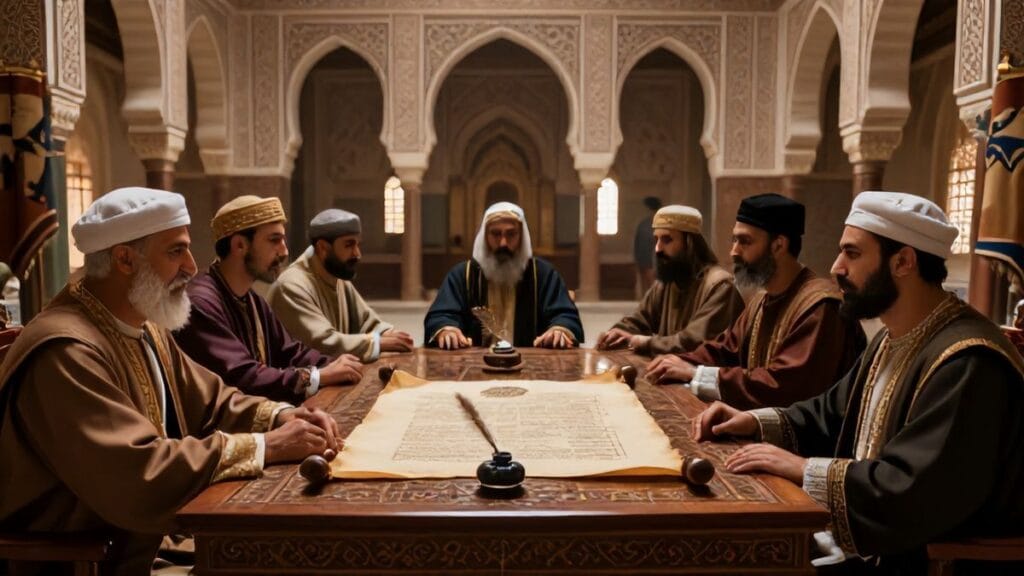
On a windswept November day in 1270, the air above the Bay of Tunis carried the smell of salt, smoke, and something darker—rot from the mass graves that dotted the scrubland beyond the Crusader camp. The banners that had once billowed proudly with painted crosses now hung limp, faded by the brutal North African sun and stained by dust and sickness. On that day, a circle of weary men—French nobles, papal envoys, Genoese captains, and emissaries of the Hafsid sultan—sat beneath a hastily erected canopy. No one raised a sword. Instead, they dipped quills into inkpots. The treaty of Tunis, conceived from exhaustion rather than triumph, began to take shape on parchment while the cries of the sick carried faintly from the nearby tents.
The Crusade that had come to Tunis was already a broken thing. Its patron and spiritual heart, King Louis IX of France—venerated by many in his own time as a living saint—lay dead, victim not to enemy steel but to the invisible armies of dysentery and fever. Around him, a great Mediterranean project was dissolving. Soldiers spoke in hushed voices of going home, of abandoned farms in Champagne, of wives and children they had not seen in years. Italian merchants, who had traveled with the armies as quartermasters of war and opportunity, watched the negotiations with sharp eyes. If no Christian kingdom would be carved from Tunis, perhaps privileges could be wrested from the Hafsid ruler instead—privileges to trade, to preach, perhaps even to collect tribute.
This was the setting in which the treaty of Tunis was born: an uneasy shoreline between holy war and pragmatic peace. It was not a famous battlefield like Hattin or a dramatic siege like Jerusalem. Instead, Tunis offered something subtler and, in its own way, more modern—a recognition that force alone could not bend this corner of the Maghreb to European will, and that power in the Mediterranean would increasingly flow not only from castles and cathedrals, but also from harbors, marketplaces, and negotiated agreements. Yet behind these cool calculations of diplomacy were human beings: crusaders who felt cheated of glory, Hafsid subjects wary of Christian merchants in their streets, and families in Europe who would only learn months later that their king had died far from home, his last great endeavor ending not in conquest but in signatures.
From Saintly King to Seasoned Warrior: Louis IX Before Tunis
To understand why a Crusader host found itself outside Tunis in 1270, one must first follow the long arc of Louis IX’s life. Born in 1214, Louis became king of France as a boy, his mother Blanche of Castile guiding the kingdom through rebellions and the uncertainties of minority rule. Under her fierce protection and guidance, Louis’s piety deepened into something unusual even for his age: a rigorous, almost ascetic devotion. He heard Mass daily, washed the feet of the poor, and was known to sit in the gardens of the royal palace at the Île de la Cité listening to petitioners with a calm, attentive gaze. Yet his gentleness coexisted with an iron determination to shape Christendom according to his sense of justice and order.
His first encounter with crusading came not as a hero, but as a penitent. After a grave illness in 1244, Louis took a vow to lead a crusade to the East, perhaps believing that God had spared him for this purpose. The Seventh Crusade, launched in 1248, took him to Cyprus and then to Egypt, where he attempted to strike at the powerful Ayyubid state that supported Muslim control of Jerusalem. The campaign ended in catastrophe at Mansurah, where his army was cut to pieces and Louis himself was captured. It is astonishing, isn’t it, that the man later canonized as Saint Louis is one of the few medieval kings to have experienced the humiliation of being held prisoner by Muslim forces, ransomed at a staggering price before being allowed to leave.
Yet this failure did not break him. If anything, it seared into him a deeper conviction that crusading was both a duty and a test. Louis spent years in the Latin East after his release, shoring up the crumbling Crusader states, negotiating with local rulers, and learning hard lessons about the complex politics of the eastern Mediterranean. He returned to France subdued but not defeated, carrying with him the memory of captives, martyrs, and distant holy places he believed Christendom had abandoned too easily. The treaty of Tunis, when it came many years later, would take place in the shadow of Mansurah: the old king determined to redeem his past defeat with one final, decisive act in God’s service.
Back in France, Louis reigned with an eye toward moral reform at home as well as holy war abroad. He restructured royal justice, pursued what he saw as fairness between his subjects, and took a keen interest in combating what he called “impurity”—heresy, blasphemy, and usury. For many contemporaries, he embodied the ideal Christian monarch. For others, his severity was unsettling. But by the 1260s, no one doubted that Louis’s word carried immense weight in European politics. When such a king announced, late in life, that he would once more take the cross, the response was one of awe, concern, and—among some—quiet skepticism. Another crusade meant another vast expenditure of blood and treasure; it also meant another roll of the dice in a game whose stakes were growing ever more uncertain.
Mediterranean Crossroads: Tunis and Ifriqiya on the Eve of War
While Louis aged into a gray-headed saint-king in Paris, Tunis thrived as a beating heart of the western Mediterranean. In the thirteenth century, Ifriqiya—the region that roughly corresponds to modern-day Tunisia and parts of eastern Algeria and western Libya—was a coveted prize. Coastal cities like Tunis, Mahdia, and Sousse had long histories as centers of trade, scholarship, and political power. Carthage’s ancient ruins still whispered of an even older rivalry with distant European shores. By 1270, the Hafsid dynasty ruled from Tunis, having emerged from the debris of the Almohad empire to forge a polity that was powerful, fractious, and deeply connected to broader Islamic and Mediterranean currents.
The Hafsid sultans managed a delicate balancing act. On one side loomed the Christian powers of Europe—Aragon, Sicily, Genoa, Venice, and the ever-watchful Papacy—whose ships crisscrossed the sea bearing cloth, metal, timber, and pilgrims. On the other side, the Mamluk sultanate in Egypt had grown into a formidable champion of Islam, defeating the Mongols at Ayn Jalut and crushing Crusader strongholds one by one. Ifriqiya sat between these worlds, both threatened and enriched by them. Its ports welcomed European merchants, who traded for grain, olive oil, gold from the sub-Saharan routes, and slaves from the interior. Its mosques and madrasas were centers of Maliki legal learning, producing jurists whose influence spread across the Maghreb.
Tunis itself was a city of contrasts. The upper town, fortified and bustling, housed palaces, administrative buildings, and the Great Mosque. The lower districts near the harbor overflowed with warehouses, markets, and the smells of spices, tar, and livestock. Arabic and Berber intermingled with the Italian of the Genoese and Pisans, the Catalan of Aragonese sailors, and even, occasionally, the French of pilgrims and envoys. The Hafsid court tolerated this mix not out of charity, but out of calculation: trade revenues filled their coffers, and keeping Christian merchants relatively satisfied was a hedge against naval attacks. Yet clerics periodically warned of the moral dangers of too much intimacy with unbelievers, and popular agitation against “Franks” sometimes flared in the streets.
Into this dynamic, precarious world, the rumor of a new crusade arrived like a distant thunderclap. Stories spread that the pious but stubborn King of France had taken the cross again and that, this time, he might not sail for Egypt or Syria, but for North Africa itself. Why Tunis? Why Ifriqiya, which had not been a main target of major Crusader armies since the ill-fated Norman and Pisan expeditions centuries earlier? The answers lay in a tangle of motives—religious, political, and personal—that would eventually crystallize in the conditions of the treaty of Tunis.
Schemes, Sermons, and Strategies: Why the Seventh Crusade Turned Toward Tunis
Louis IX’s decision to make Tunis the focus of his final crusade puzzled contemporaries and has intrigued historians ever since. Officially, the Holy Land remained the central wound crying out for healing: Jerusalem was in Muslim hands; the remaining Crusader states were shrinking; and the Mamluk Sultan Baybars was a looming menace. Yet the fleets that left France in 1270 did not steer first for Acre or Cyprus. They angled instead toward the African coast, toward a Muslim ruler who was not at the forefront of crusading rhetoric. How did this come to pass?
Part of the answer lies with Charles of Anjou, Louis’s ambitious younger brother, who had carved out a kingdom in Sicily with papal blessing. Charles looked south across the narrow waters that separated his island from the African coast and saw both threat and opportunity. The Hafsid rulers of Tunis had longstanding ties with Sicily, including tributary arrangements with earlier Norman and Hohenstaufen kings. Charles hoped to revive or reshape these ties in his favor, turning Tunis into a satellite or at least a client state—a position from which he could dominate trade and extend his influence into the Maghreb. A crusade that landed at Tunis could serve his dynastic aims as much as Louis’s spiritual ones.
There were also whispers—hard to verify, easy to believe in an age hungry for miracles—that the Hafsid ruler, Muhammad I al-Mustansir, was secretly sympathetic to Christianity, perhaps inclined to convert if given the right pressure or incentives. Whether Louis himself gave weight to these rumors is impossible to know with certainty, but they dovetailed neatly with his conviction that moral persuasion and example could transform enemies. If the sultan of Tunis were to embrace the faith, or even merely become a steady ally, it would create a Christian-friendly bridgehead in North Africa, potentially encircling the Islamic east. Such a dream was intoxicating for a king who saw history as a stage upon which God’s designs might be realized through the pious courage of rulers.
Sermons in France painted the coming expedition in glowing colors. Preachers spoke of a land rich and near at hand, where Christ’s enemies had grown complacent. They invoked ancient struggles against the “Saracens” of Spain and Sicily, implying that North Africa was the next, logical front. Yet behind the pulpits and pageants, more pragmatic conversations unfolded. Merchants from Marseille and Genoa understood that a French-led victory at Tunis could weaken their rivals or open up lucrative monopolies under royal protection. Papal legates weighed the possibility of breaking the web of alliances that linked Ifriqiya to other Muslim powers. All of these threads converged in a decision whose consequences no one fully grasped at the time: the armies of France would sail not to the Levant, but to Tunis.
Thus, when the treaty of Tunis was eventually drafted, it bore within it the residue of these layered expectations. The document did not simply end a local conflict; it marked the transformation of Louis’s expansive, half-mystical vision into a far more constrained reality. In this sense, the treaty is both an ending and a mirror, reflecting what had been hoped for and what had actually been possible.
The Fleet Sets Sail: Hope, Rumor, and Fear Across the Sea
In the spring and early summer of 1270, as ships clustered in Mediterranean ports, Europe hummed with speculation. Along the coasts of Provence and Languedoc, villagers watched as great transports, galleys, and supply vessels gathered—forests of masts crowding the harbors. Carpenters hammered late into the night, reinforcing hulls and fitting ships with extra decks. Priests moved among the encampments, blessing weapons and hearing confessions. For many of the men boarding these vessels, this would be their first journey far from home; for veterans of the earlier crusade to Egypt, the muster stirred uneasy memories.
Word spread that Prince Edward of England, later Edward I, would join the expedition, though his forces would lag behind. Italian sailors muttered among themselves about winds, currents, and the dangers of late-summer campaigns in the south. In taverns of Marseille, one could hear both fervent vows of victory and dark warnings about the “African fevers” that had broken earlier armies. Yet the momentum was irresistible. Louis, now in his mid-fifties but still driven by a youthful zeal, moved with a quiet, grave determination through the preparations. He distributed alms, settled disputes among the barons, and spent long hours in prayer. According to the chronicler Joinville, the king’s confessor tried once more to dissuade him, warning of the risks; Louis replied gently but firmly that his vow and his conscience would allow no retreat.
As the fleet finally slipped its moorings and spread out along the sea, crews and soldiers saw familiar coasts fall away. The sky above the Mediterranean can seem endless at that time of year, a bright, scorching dome. Below, the water is deceptive, sparkling by day and turning black and mysterious at night. Men crowded the decks to glimpse strange sea creatures or far-off silhouettes of islands, then retreated below to stew in the suffocating heat among bales of supplies and casks of water. Disease, that constant companion of medieval armies, was already whispering in the cramped quarters. Still, spirits remained high when the first outlines of the African shore appeared as a darker band on the horizon.
On the other side of that sea, in Tunis, watchers on the coastal towers scanned the northern waters, seeing at first only single ships, then clusters, then entire squadrons. Messenger riders hurried inland, kicking up dust. The Hafsid authorities were not wholly surprised—intelligence networks across the Mediterranean had long since warned of crusading mobilizations—but the scale and timing kept them off-balance. Some expected Louis to strike further east; others thought he might first negotiate. Whatever their guesses, by midsummer 1270 there was no doubt: a Christian armada had come not as a trading guest but as an armed intruder.
Landing in Ifriqiya: The Siege and the Scorching Summer of 1270
The Crusader landing near Tunis in July 1270 unfolded under a burning sky. Bodies encased in armor moved slowly through sand that sucked at their boots, while horses, already thirsty from the crossing, fought the reins. Louis’s forces established themselves near the old ruins of Carthage, a place heavy with its own ancient memories of siege and destruction. To some clerics in the host, this geography felt like a sign: once, Rome had crushed Carthage and remade the western Mediterranean; now, perhaps, Christian France would perform a similar feat against the heirs of Islam.
Yet from the beginning, the realities on the ground countered such grand symbolism. The Crusader army struggled to secure enough fresh water. Wells were scarce and sometimes fouled. Supply lines from the ships to the inland camps were vulnerable to raids by Hafsid cavalry, who knew the terrain intimately and struck like wasps before vanishing into the shimmering distance. The summer heat broiled the tents by day, while at night a chill wind sometimes rolled in from the desert, carrying fine dust that settled into every crack and mouth. The city of Tunis itself, with its walls and watchtowers, loomed as a stubborn target—too strong to take by storm without enormous losses, too close to ignore.
Combat was frequent but rarely decisive. Skirmishes erupted as Crusader detachments tried to scout or forage. Muslim archers on swift horses harassed them, arrows whistling from beyond easy reach of the heavy Frankish cavalry. Inside Tunis, city life adapted to the siege with grim efficiency. Gates were watched more carefully; food stocks were rationed; mosques filled with supplicants praying for deliverance from both the foreign army and the hunger and uncertainty that war brings. Some merchants cursed their luck, fearing ruined trade; others quietly imagined the profits that might follow if an accommodation could be reached with these powerful but evidently struggling newcomers.
For Louis, the early weeks likely felt like a test of endurance rather than a sign of outright failure. Medieval warfare often unfolded slowly, and the king had trained himself to bear hardship as a form of spiritual discipline. However, a more implacable enemy soon bore down upon the camp: disease. Contaminated water, rotting supplies, cramped tents, and swarms of insects created a perfect breeding ground. What began as scattered cases of stomach cramps and fevers grew into a wave of dysentery and plague-like illness that did not respect rank. Knights, squires, sailors, and servants doubled over with cramps, staggered to makeshift latrines, and collapsed in the dust. Mass graves were dug hastily as the dead accumulated faster than proper burials could be arranged.
Pestilence in the Camp: The Death of a King and the Shattering of a Crusade
The epidemic that swept the Crusader camp in late summer 1270 changed everything. Armies can adapt to poor terrain. They can rally after battlefield losses. But pestilence eats away not only at numbers but at morale, at the very belief that one’s cause is favored by God. As leaders fell ill, rumors multiplied. Was this a punishment for pride? Had someone sinned grievously in secret? Did the king himself doubt? The heat did not relent; flies swarmed on the lips of the dying, and the stench of bodily fluids and decay clung to the air even above the pervasive smell of cooking fires and animals.
King Louis IX did not escape the contagion. Chroniclers describe him wasting away, racked by fever and intestinal agony. Even on his sickbed, he reportedly insisted on being informed about the state of the army, the negotiations, and the welfare of the poor in the camp. He asked for the Passion to be read to him, identifying his own suffering with that of Christ, though in miniature. The scenes around his tent were as political as they were devotional: barons whispering about succession, envoys wondering whether to press ahead or seek terms, clerics pondering how history would remember a king who might die, once again, without reclaiming Jerusalem.
On 25 August 1270, Louis IX died on African soil, not far from the broken stones of Carthage. The image that later hagiographers favored was that of a king lying on ashes in the form of a cross, speaking his last words about Jerusalem. Whether this occurred exactly as described is less important than what it reveals about the desire to cast his death as a final, pure offering. For many around him, however, the immediate feelings were confusion and dread. Their leader, the one whose holiness was meant to be a shield, had been struck down. The crusade no longer had a clear heart or direction.
The emotional shock radiated outward. In the camp, some soldiers wept openly; others muttered that the campaign had been cursed from the start. Command passed to his son, the future Philip III, but Philip was inexperienced and himself affected by the harsh conditions. Charles of Anjou, arriving with fresh forces from Sicily, saw his influence surge in the vacuum. Meanwhile, the Hafsid ruler watched from within the walls of Tunis as his enemies faltered not in battle, but in their own tents. His advisers counseled both caution and boldness: should they attack while the Crusaders were debilitated, risking a desperate fight from a still-dangerous army, or wait for the sickness and internal tensions to do their work?
It was in this context of grief, attrition, and uncertainty that the logic of negotiation began to outweigh the logic of conquest. The treaty of Tunis did not spring from mutual respect or shared vision; it emerged from a stalemate in which both sides sensed that pressing further would cost more than it could possibly gain. For the Crusaders, the death of Louis transformed a holy mission into a question of survival and reputation. For the Hafsids, the presence of a large Christian host, however diminished, threatened to drag the region into deeper instability if not carefully managed. Under such pressure, the pen, not the sword, suddenly looked like the more powerful weapon.
Diplomacy Amid Graves: The Road to the Treaty of Tunis
Negotiations do not appear in chronicles with the same drama as charges of cavalry or storming of walls, yet in 1270 they became the decisive battlefield. Envoys moved carefully between the Crusader camp and the city, accompanied by small escorts and carrying symbols of parley. They threaded their way past open pits where the dead lay buried, past lines of emaciated horses, past piles of broken equipment abandoned by units too weak to carry it home. The messengers from Tunis saw with their own eyes the exhaustion of the Christian host; those from the crusaders glimpsed the intact walls, the steady rhythms of life within a city that, though under pressure, was not close to falling.
On the Christian side, Charles of Anjou’s voice grew louder in discussions about terms. He had long-standing interests in Tunis as a potential tributary and commercial partner. To him, a successful conclusion might look less like a glorious annexation and more like a network of economic and political strings binding the Hafsid ruler to his own Sicilian kingdom. The Papal legates sought guarantees for Christian clergy and merchants. Philip III, burdened with the grief for his father and the responsibility of a failing army, needed an agreement that would allow a dignified withdrawal while preserving the aura of moral victory that clung to Louis’s name.
Inside Tunis, al-Mustansir and his advisers weighed similar calculations from a different vantage. Their city had withstood the siege, but at a cost. Trade had been disrupted; fields near the coast had been trampled; some outlying settlements had suffered raids. The Hafsids had to think not only of present danger but also of longer-term positioning between the rising Mamluk power in Egypt and the watchful Christian states to the north. A crushing defeat of the Crusaders might lift al-Mustansir’s prestige among Muslim neighbors, but it could also invite counter-raids from European fleets or entangle Ifriqiya in wider conflicts. A negotiated settlement that preserved sovereignty while normalizing certain relations with Christian powers might prove more sustainable.
Gradually, through offers and counteroffers, a framework emerged. The treaty of Tunis would not declare one side victor and the other vanquished. Instead, it would acknowledge a reality in which both had something to give and something to gain. Religious questions—always sensitive—were addressed, but in measured terms. Economic arrangements loomed large. Security guarantees were promised in both directions. The diplomats, scribes, and interpreters shaping the document probably sensed that they were doing more than ending a single campaign; they were sketching the outlines of how Christian and Muslim powers might coexist along this contested coast.
Clause by Clause: Inside the Treaty of Tunis of 1270
The exact text of the treaty of Tunis has not survived in a single, universally agreed-upon version, but chroniclers and later compilations allow us to reconstruct its main provisions. It was, in essence, a pragmatic peace accord between the Hafsid Sultanate and the crusading coalition led officially by the French crown but effectively influenced by Charles of Anjou and other Mediterranean interests.
First, there was the question of security. The treaty stipulated that hostilities between the Hafsid ruler and the Christian powers involved would cease. The Crusader army would withdraw from Ifriqiya, lifting the de facto siege of Tunis and its surroundings. In return, the sultan pledged to maintain peaceful relations and to refrain from aiding enemies of the signatory Christian states. This did not amount to an open alliance, but it signaled a cooling of the religiously charged rhetoric that had accompanied the crusade’s launch.
Second, the treaty addressed trade and the status of Christian merchants. Latin merchants—particularly from Italian cities like Genoa and possibly from territories under Charles of Anjou—were to receive the right to reside and trade in Tunis with a degree of legal protection. They could have their own fondacos or merchant quarters, enjoy relative safety for their goods, and seek redress in cases of dispute. In return, they would pay agreed customs duties and respect local laws. This formalization of commercial rights did not create something entirely new; Christian traders had frequented North African ports for generations. But setting these privileges within the framework of a treaty following a crusade gave them a heightened political significance.
Third, and perhaps most controversially for contemporaries, the treaty of Tunis included provisions concerning Christian religious practice in the Hafsid domain. Christians already present in the city—mostly merchants and perhaps a few captives or long-term residents—gained some assurances for freedom of worship. Chapels could be maintained; priests could minister to the Latin community. There is debate among historians as to whether the treaty explicitly allowed new mission activity or simply solidified existing toleration. In any case, for many pious crusaders who had hoped to see mosques converted to churches, this modest guarantee of limited worship must have seemed a pale consolation.
Finally, there were financial arrangements. It appears that the Hafsid sultan agreed to a form of tribute or indemnity, possibly framed as arrears of an older payment owed to Christian rulers like Charles of Anjou. This could involve lump-sum transfers and ongoing annual payments. From a Christian perspective, such clauses could be spun as evidence of Muslim submission; from the Hafsid side, they might be viewed as the price of ensuring that powerful but distant Christian princes stayed satisfied and far away.
What is striking, when one steps back, is how the treaty of Tunis stitched together religious coexistence, commerce, and political calculation. It did not proclaim the triumph of Christ or Muhammad; it codified, instead, the messy realities of interdependence. As one modern historian has written, “the crusade ended not in the clash of arms but in the quiet shuffle of parchment” (to paraphrase a sentiment found in contemporary scholarship on Mediterranean diplomacy). In doing so, it prefigured many later accords that would manage rivalry and contact between Christian Europe and the Muslim Maghreb.
Merchants, Missionaries, and Money: The Hidden Engines of the Treaty
Behind the formal clauses of the treaty stood three forces that shaped the thirteenth-century Mediterranean as surely as armies did: merchants, missionaries, and money. Even before the crusade, Tunis was a magnet for Latin traders. Genoese, Pisan, and later Venetian communities had carved out spaces in the city’s commercial life, sometimes enjoying written agreements with previous rulers. These men knew the value of olive oil and grain, the ebb and flow of gold from the Sahara, and the risks of piracy and political upheaval. When Louis’s crusade darkened the horizon, many such merchants must have felt torn between fear that their livelihoods would be destroyed and hope that a victorious Christian power could expand their privileges.
As it became clear that outright conquest was not on the table, those hopes narrowed but did not vanish. Instead, merchants pivoted, advocating for the best possible guarantees under a negotiated peace. Having a royal patron like Charles of Anjou or the French crown behind them in treaty clauses would give future leverage if Hafsid officials proved obstructive. These commercial actors were not altruistic mediators; they sought profit. Yet in seeking it, they also became unexpected architects of interfaith contact. Through them, goods, coins, languages, and even ideas flowed between Tunis and ports as far away as Pisa and Barcelona.
Missionaries, too, had their part to play. The Papacy’s interests in Tunis were not purely commercial. Orders such as the Dominicans and Franciscans had grown increasingly active in preaching not only within Christendom but also at its margins. Some friars had ventured into Muslim-ruled areas, engaging in debates, hoping for conversions, and occasionally suffering martyrdom. In the context of the treaty of Tunis, the question arose: could Christian clerics in the city function openly, at least among resident Latins? Might they also, quietly or openly, seek to convert Muslims or Jews?
Any such ambitions had to be tightly constrained. The Hafsid ruler could tolerate pastoral care for a minority merchant community, but open proselytizing among Muslims would have sparked public outrage and clerical condemnation. Thus, the treaty’s religious concessions were likely phrased in careful terms, allowing chapels and priests without endorsing a broader missionary project. Still, friars who arrived in Tunis after 1270 would have felt themselves on the frontier of faith, practicing their ministry under the wary eyes of Muslim authorities.
Money, finally, seeped into every corner of the treaty’s logic. War is expensive; failure doubly so. The Crusader camp bled treasure as quickly as men: wages, supplies, ransoms for captives taken in skirmishes, compensation for ships damaged or lost. For the Hafsids, mobilizing troops, maintaining defenses, and enduring trade disruptions also carried a heavy financial toll. Any agreement that could stabilize the situation and restore commercial flows was precious. An indemnity paid by Tunis may have looked like submission, but it was also an investment in future peace. Conversely, for Christian rulers, securing a stream of tribute—even modest—allowed them to present the expedition as yielding tangible returns despite the lack of territorial conquest.
Winners Without Glory, Losers Without Defeat: Immediate Reactions to the Accord
When word spread through the Crusader camp that an agreement had been reached and that preparations for departure would soon begin, reactions were mixed and often bitter. Some knights, hardened by years of campaigning, felt cheated. They had crossed the sea in the name of Christ, suffered heat and disease, and now were told to pack their armor and go home without a single captured city to boast of. For them, the treaty of Tunis tasted like ashes. They muttered about cowardice, about deals made behind closed doors by princes more interested in coin than in the Cross.
Others, especially among the rank-and-file infantry and sailors, exhaled in relief. Surviving the African summer had felt like a near-miracle; every day of continued exposure to disease threatened their lives. These men were eager to see the coasts of home again, even if their return would be overshadowed by the news of Louis’s death and the lack of visible triumph. Some may have taken comfort in the idea that their suffering had at least purchased safer conditions for future Christian merchants and pilgrims in Tunis. But such abstractions rarely comfort those who have watched their comrades die.
Within Tunis, news of the treaty also traveled by rumor and proclamation. Some citizens rejoiced that the Christian armies were finally leaving, thanking God for sparing their city from sack and slaughter. Merchants cautiously welcomed the reopening of safe maritime traffic. Religious scholars and preachers examined the terms with concern: did the concessions to Christians risk encouraging arrogance or further interventions? The sultan’s supporters emphasized that he had preserved the city’s independence, its mosques, and its laws, while extracting peace from a formidable foreign power. His critics, if any found the courage to speak, might have whispered that any tribute paid to Christians was a stain on honor.
In Europe, when the news finally arrived—months later, carried by ships and scattered travelers—it sparked a wave of mourning and re-evaluation. The death of Louis IX overshadowed all else. Poets and chroniclers dwelled on his piety and his final illness, elevating him toward sainthood. The outcome of the crusade itself seemed almost secondary, an unfortunate but perhaps inevitable result of God’s inscrutable plans. Still, churchmen and laypeople alike debated: had the king erred in going to Tunis instead of directly to the Holy Land? Had Charles of Anjou manipulated the expedition for his own gain?
Some chroniclers, like the sober and often candid Joinville, were critical of the decision to attack Tunis at all, implying that the entire venture had been strategically unsound. Others looked for silver linings in the treaty of Tunis: improved trade, new prospects for missions, a fresh foothold in the Maghreb. The mood was one of disillusion tempered by the need to salvage meaning from a costly endeavor. In that search for meaning, the treaty became a kind of Rorschach test: optimists saw it as a useful compromise, pessimists as a monument to miscalculation.
Christians in a Muslim Port: Daily Life After the Treaty
Once the Crusader fleet departed and the coastal camps were dismantled, life in and around Tunis settled into a new pattern shaped by the treaty’s provisions. The most visible change was the presence—and relative security—of Latin Christian communities in the city. They were not newcomers, but the treaty gave them a more formal status. Merchants reoccupied or expanded their fondacos near the harbor, those hybrid spaces that were part warehouse, part inn, part chapel, and part embassy.
Inside these compounds, the sounds of Italian, Provençal, and perhaps a little French mingled with Arabic and Berber. Deals were struck over bolts of cloth and sacks of grain, stamped with seals, and recorded in ledgers. Christian priests offered Mass in small oratories tucked away from the main streets, careful not to broadcast their rituals too loudly. On Fridays, the call to prayer from the Great Mosque rolled across the city, reminding everyone of who held ultimate authority here. On Sundays, bells rang softly from within the Latin quarter—discreet, but undeniable.
Encounters between ordinary Christians and Muslims were often practical rather than ideological. A Hafsid official might haggle with a Genoese importer over customs dues; a local craftsman might work leather or metal for a foreign client; disputes might arise over debts or insults and be submitted to judges, whether Muslim qadis or, in some cases, consular courts for Latins. Over time, familiarity bred a cautious mutual understanding. Each side learned the other’s rhythms: fasting during Ramadan, feasting at Easter, closing shops on Fridays or Sundays.
Of course, tension simmered beneath this surface. A careless remark about religion, an interracial romance, or a brawl in a tavern could quickly flare into a wider disturbance. The Hafsid authorities knew that their own legitimacy depended in part on showing firmness toward the unbelievers in their midst. Christian leaders understood that their communities’ safety hinged on restraint. Thus, daily life for treaty-protected Christians in Tunis was a balancing act—enjoying unprecedented security and opportunity, yet always aware that their welcome rested on a foundation of political calculation that could shift with the winds of war and diplomacy.
Echoes in Europe: How the Treaty of Tunis Reshaped Crusading Zeal
The ripple effects of the 1270 expedition and its negotiated end reached far beyond Ifriqiya. In courts and cloisters across Europe, the outcome forced a reckoning with the viability and meaning of crusades. This was not the first time a crusade had ended inconclusively, but the stark contrast between the lofty rhetoric surrounding Louis’s departure and the modest, transactional nature of the treaty of Tunis sharpened doubts that had long been growing.
Preachers who had once invoked Louis as a model crusader now had to explain why God had allowed such a man to die of disease in a foreign camp, his mission unfinished. Some interpreted his death as martyrdom, proof of sanctity rather than failure. Others, more quietly, wondered whether the age of great mass expeditions to the East was drawing to a close. The costs—in treasure, lives, and political capital—were immense; the returns, increasingly, were limited to coastal footholds and precarious treaties rather than sweeping conquests.
The Papacy, too, adjusted its strategy. While popes would continue to call crusades in various theaters—against Muslims, heretics, and political enemies—the scale and frequency of large overseas campaigns to the Holy Land declined after the late thirteenth century. The fall of Acre in 1291 would seal this trend. In that trajectory, the events at Tunis occupy a transitional place, showing how even a highly motivated, well-resourced Christian monarch could not bend the Mediterranean to his will. The treaty of Tunis subtly underlined that the road to Jerusalem might now run more through negotiations and alliances than through blood-soaked battlefields.
Among secular rulers, the lessons were equally complex. Charles of Anjou emerged from the affair with mixed gains: he had strengthened his role as a Mediterranean broker and secured financial and commercial advantages, but he also attracted criticism for hijacking a holy cause for dynastic ends. Other monarchs watched and learned. Future engagements with the Muslim world—whether by the Crown of Aragon in the western Mediterranean or by Portuguese explorers along the Atlantic coast of Africa—would blend crusading motives with calculations of profit and geopolitical advantage. The clear-cut dichotomy of “holy war versus wicked commerce” gave way, increasingly, to a more ambiguous reality in which the two coexisted.
Ifriqiya Between Cairo and Marseille: Regional Power After 1270
For the Hafsid Sultanate, the years following the treaty were marked by both opportunity and pressure. Having weathered a major Crusader incursion without losing its capital, the regime could claim a kind of moral victory in the eyes of many Muslims. Al-Mustansir had preserved Tunis, protected Islam in his domain, and even extracted peace on terms that allowed trade to flourish. At the same time, he had not delivered a decisive blow against the Christian invaders, nor had he fully aligned his policies with the militant anti-Crusader stance championed by the Mamluks in Egypt.
This balancing act defined Ifriqiya’s position between east and west. To the east, the Mamluk sultans watched events in Tunis with a mixture of suspicion and pragmatism. They shared a broad religious solidarity with the Hafsids, but they also understood that each Muslim polity had its own interests. So long as Tunis did not openly side with Christian powers against them, they could tolerate its separate arrangements. To the west and north, the Christian kingdoms of Aragon, Castile, and Sicily looked toward North Africa with enduring ambitions. The treaty of Tunis did not extinguish these; it simply channeled them, for a time, into commercial routes and diplomatic overtures.
Within Ifriqiya itself, the presence of recognized Latin communities in Tunis and the ongoing flow of Mediterranean trade helped to entrench the city’s status as a cosmopolitan hub. This brought wealth and cultural exchange but also invited new vulnerabilities. Pirates—some Muslim, some Christian—continued to prey on shipping. Economic downturns or famines could inflame popular resentment against foreign merchants, making the sultan’s balancing act more precarious. Still, the overall trajectory suggested that the Hafsid realm would navigate its relationships with Christian Europe not solely through war but also through treaties, tariffs, and occasional shows of force.
Chroniclers, Legends, and Myths: How Memory Rewrote the Treaty
Medieval events rarely remain fixed in the minds of later generations; they evolve into stories, symbols, and, sometimes, cautionary tales. The treaty of Tunis, though a relatively dry document, became enmeshed in layers of narrative spun by chroniclers on both sides of the Mediterranean. In France, the life and death of Louis IX dominated the historiographical landscape. Works such as Joinville’s famous biography focused on the king’s virtues, his justice, and his piety. The Tunis expedition appeared as the final, bittersweet chapter of a saintly life, its outcome less important than the purity of the king’s intention.
In this frame, the treaty could be downplayed or reframed as a necessary compromise following the earthly tragedy of the king’s death. Some writers emphasized that even in apparent defeat, Louis’s crusade had forced a Muslim ruler to make concessions, thus salvaging a sense of honor. Other accounts, written with more distance or candor, hinted that the whole venture had been ill-conceived, the treaty a bandage over a self-inflicted wound. As one later chronicler summarized, “He sought Jerusalem and found Tunis; he sought victory and found a treaty.”
In the Maghreb, the siege and treaty were woven into a broader tapestry of resistance against the “Franks.” Local memory could celebrate the survival of Tunis as a sign of divine favor, while acknowledging that dealings with Christian powers were a fact of life. The details of customs rates or tribute schedules interested merchants and officials more than poets, who tended instead to frame the episode as another instance of valiant defense of the Muslim community. Over time, the specifics of the 1270 agreement blurred, but the idea that Tunis had once stared down a great Crusader king and held firm contributed to regional pride.
Modern historians, working with scattered Latin and Arabic sources, have attempted to peel back these layers of myth. They debate the exact scope of the treaty’s religious concessions, the sincerity of the supposed Hafsid inclination toward Christianity, and the degree to which Charles of Anjou shaped the final text. One scholar has noted that “Tunis 1270 is less about the triumph or failure of crusading than about the emergence of a Mediterranean diplomacy that could clothe rivalry in the garments of mutual interest” (an observation that captures the spirit, if not the precise wording, of recent academic interpretations).
Long Shadows on the Maghreb: Economic and Cultural Legacies
When we trace the longer-term impact of 1270 on North Africa, the most tangible legacies lie in the realms of economy and culture rather than in straightforward politics. The treaty of Tunis helped consolidate patterns of trade and coexistence that would characterize the western Mediterranean for centuries. Christian merchants operating under its aegis expanded their networks, linking Tunis more tightly to hubs like Genoa, Pisa, and later Barcelona. These links funneled not only goods but also techniques, fashions, and even culinary tastes among different shores.
North African textiles, ceramics, and metalwork found new markets in Europe; European wool, timber, and silver flowed southward. Muslim and Jewish traders from Tunis and surrounding regions used the same maritime arteries to reach Christian ports, sometimes sailing on Latin ships under arrangements that blurred religious boundaries. As a result, the frontier between “Christendom” and “Islam” in this period was, in practice, often a shared economic space where practical cooperation took precedence over ideological hostility, at least in the countinghouses and on the docks.
On a cultural level, the continued presence of Latin Christians in Tunis and other ports fostered a low-level but persistent exchange of knowledge. Medical texts, mathematical treatises, and astronomical ideas traveled with scholars, translators, and curious merchants. Arabic loanwords entered Mediterranean Romance languages, particularly in the domain of trade and navigation. Conversely, some European artistic motifs, legal concepts, and liturgical practices found echoes, however faint, in the Maghreb’s cosmopolitan enclaves.
Of course, these exchanges did not erase the underlying asymmetries of power and the periodic outbreaks of violence. Raids, enslavements, and forced conversions remained grim realities on both sides of the sea. Yet the treaty of Tunis stands as an early, vivid marker of a mode of interaction in which enemy powers could also be business partners, and in which religious difference did not exclude negotiated coexistence. That is a legacy as consequential, in its own way, as any battlefield victory.
From Crusade to Commerce: The Treaty of Tunis in the Wider Mediterranean Story
Looking beyond the immediate context, the 1270 treaty sits at a crossroads in the broader history of the Mediterranean. Earlier centuries had witnessed spectacular clashes: the Arab conquests, the Reconquista in Iberia, the Norman and early Crusader ventures. Later centuries would see the rise of the Ottoman Empire, the expansion of Iberian powers into the Atlantic, and new, more global forms of confrontation and exchange. In this arc, the treaty of Tunis can seem modest, a local peace accord tucked between grander episodes. Yet its nature—religiously inflected war ending in practical compromise—embodies a shift that historians increasingly emphasize.
By the mid-thirteenth century, the Mediterranean was no longer simply a theater for binary holy wars. It had become a dense zone of interlaced interests, where city-states like Genoa and Venice, kingdoms like Aragon and Sicily, and Muslim polities from Egypt to Morocco constantly recalibrated their relations. Treaties did not end enmity, but they structured it. Maritime truces, commercial capitulations, and agreements over prisoners and tribute proliferated. They testified to a growing recognition that no single power could dominate the entire sea, and that even deeply opposed religious blocs had to find frameworks for limited cooperation.
In this sense, the Tunis agreement foreshadows later capitulations granted by Ottoman sultans to European powers, or the treaties negotiated between Spanish and North African rulers in the early modern period. Each such accord, however unequal, acknowledged a basic fact: that ships and merchants, pilgrims and envoys, would continue to cross the waters regardless of ideological campaigns to seal the frontiers. The failure of Louis’s final crusade to achieve a clear, enduring military victory hastened the shift of Western energies toward other forms of expansion—commercial, colonial, and missionary—which would reshape global history in centuries to come.
Modern Eyes on a Medieval Pact: Historians Debate Tunis 1270
Today, scholars from different disciplines approach the treaty of Tunis with a range of questions. Military historians ask whether Louis’s decision to attack Tunis was a strategic blunder, an understandable gamble, or an inevitable attempt to leverage Sicily’s position against North Africa. Diplomatic historians examine the treaty itself as part of a developing corpus of cross-cultural agreements in the medieval Mediterranean, comparing it with earlier pacts in Spain or the Levant. Economic historians look at customs records, merchant letters, and port data to gauge whether the treaty measurably boosted trade.
One recurring theme in recent scholarship is skepticism about the idea that al-Mustansir was ever seriously inclined to convert to Christianity. Earlier narratives, often relying on Latin sources, sometimes took these rumors at face value and interpreted the treaty’s religious clauses as the frustrated outcome of a failed conversion campaign. Modern historians, reading Arabic chronicles and contextualizing Hafsid politics, generally see such rumors as either wishful thinking or deliberate propaganda designed to justify the expedition. From this angle, the treaty of Tunis appears less as an aborted mass conversion and more as a rational bargain between two ruling elites who shared at least one priority: preserving their own power.
Another debate concerns the long-term impact of the treaty on crusading ideology. Some argue that it marks one of the closing chapters in the classic age of eastern crusades, dramatizing the limits of what even a saint-king could achieve by arms alone. Others caution against overstating its significance, pointing out that crusading continued in various forms for centuries and that many contemporaries saw Tunis as a tragic but not definitive setback. Still, there is broad agreement that analyzing the treaty pushes us to see the crusading era not only as a parade of battles and sieges but also as a time when law, commerce, and negotiation increasingly shaped Christian–Muslim relations.
In an age when scholars place growing emphasis on connected histories and entangled pasts, the treaty of Tunis offers a rich case study. It reminds us that medieval frontiers were as much about tolls and tariffs as about fortresses, and that religious hostility coexisted with mundane, daily cooperation. The document’s very existence suggests that even in 1270, amid plague and piety, leaders on both sides of the sea could imagine a future with the enemy not entirely absent, but instead contained, managed, and—at times—profitable.
Conclusion
The November day in 1270 when envoys finalized the treaty of Tunis brought a curious stillness to a landscape that had recently echoed with war cries and the groans of the dying. Under canvas awnings and within palace chambers, ink on parchment replaced steel on flesh. The treaty emerged from failure—an unfinished crusade, a dead king, a city never taken—but it also embodied a kind of reluctant wisdom. Both the Crusader leaders and the Hafsid ruler recognized that neither side could fully bend the other to its will without courting disaster. In compromise, they found a path that allowed each to claim something: honor, security, trade, or simply survival.
In the centuries since, memory has often preferred clearer narratives. It is easier to celebrate saints and heroes or to lament catastrophic defeats than to dwell on negotiated settlements. Yet the story of Tunis in 1270, with all its heat, dust, grief, and ink, points to a truth that resonates far beyond the medieval Mediterranean. Conflicts grounded in profound ideological and religious differences do not always end when one side vanquishes the other. More often, they trail off into arrangements that feel unsatisfying to purists but indispensable to those who must live with their consequences.
The treaty of Tunis did not usher in an age of peace between Christian Europe and the Muslim Maghreb. Raids, wars, and rivalries continued. But it did carve out a space where commercial interests, legal norms, and limited tolerance could coexist with enduring hostility. It ensured that Christian merchants and clerics would walk the streets of Tunis under a form of protection, and that the Hafsid state would integrate itself more deeply into Mediterranean networks. For Louis IX, the campaign ended far from the Jerusalem he had longed for; for Tunis, it marked another chapter in the city’s long history as a crossroads of empires and faiths.
Standing today amid the ruins of ancient Carthage or the old quarters of Tunis, it is possible to imagine the ships on the horizon, the fever-ridden tents, and the negotiations that unfolded between them. The treaty signed on 10 November 1270 was not the glorious culmination of a holy war but the sober acknowledgment of a shared sea. In its quiet way, it signaled that the age of absolute crusading certainty was giving way to a more ambiguous, negotiated world—one in which ink and coin would often matter as much as sword and cross.
FAQs
- What was the Treaty of Tunis of 1270?
The Treaty of Tunis was a peace agreement concluded on 10 November 1270 between the Hafsid Sultanate of Tunis in Ifriqiya and the leaders of a Crusader army led nominally by King Louis IX of France. It ended the campaign of 1270—often considered part of the later crusading movement—by guaranteeing peace, commercial privileges for Latin merchants, and limited religious rights for Christians in Tunis, in exchange for the withdrawal of Crusader forces and certain financial and political concessions by the Hafsid ruler. - Why did Louis IX target Tunis instead of the Holy Land?
Louis IX’s decision to strike at Tunis rather than sail directly for the Levant was shaped by a mix of religious hope and political strategy. Influenced partly by his brother Charles of Anjou, king of Sicily, Louis believed that winning over or subduing Tunis could create a Christian-friendly bastion in North Africa, encircling the Muslim East and supporting future campaigns for Jerusalem. Rumors that the Hafsid ruler might be sympathetic to Christianity and the commercial interests of Mediterranean powers also played a role, although in retrospect the choice proved costly and strategically dubious. - Did the Treaty of Tunis mean that Tunis became a Christian city?
No. The treaty did not convert Tunis into a Christian city or place it under Christian rule. The Hafsid sultan retained full political and religious authority over Tunis and Ifriqiya. What changed was the formalization of rights for Christian merchants and residents: they were allowed to live and trade in the city with legal protections and to practice their religion in designated spaces. Mosques, Islamic law, and Muslim governance all remained firmly in place. - How did disease influence the outcome of the 1270 crusade?
Disease was decisive. The Crusader camp near Tunis was ravaged by dysentery and other illnesses brought on by heat, poor sanitation, and limited fresh water. These conditions killed thousands of soldiers and, crucially, King Louis IX himself. The loss of manpower and morale, combined with the king’s death, made a full-scale assault on Tunis impossible and pushed Crusader leaders toward negotiation. Without the epidemic, the campaign might have continued longer—though whether it would have succeeded militarily remains doubtful. - What were the main provisions of the Treaty of Tunis?
The main provisions included a cessation of hostilities and the withdrawal of the Crusader army from Ifriqiya; guarantees of safety and commercial rights for Latin Christian merchants in Tunis; limited recognition of Christian worship for existing Latin communities; and financial arrangements, likely including tribute or indemnity payments from the Hafsid ruler to certain Christian powers, notably Charles of Anjou. These terms reflected a compromise in which neither side achieved total victory but both secured important interests. - How did the Treaty of Tunis affect later crusades?
The treaty contributed to growing doubts about the effectiveness of large, royal-led crusades to the East. The failure of Louis’s expedition, ending in a negotiated settlement rather than a clear victory, underlined the difficulties of projecting European military power deep into Muslim territory. While crusading ideology persisted and other crusades were launched, the focus gradually shifted, and by the end of the thirteenth century the classic era of eastern crusades was drawing to a close. The Tunis episode is often seen as one of several turning points in this process. - How did people in Tunis react to the presence of Christian merchants after 1270?
Reactions were mixed. Many in Tunis were accustomed to foreign traders, and the economic benefits of commerce with Christian ports were widely recognized. Merchants and officials generally welcomed the stability and opportunities the treaty provided. However, religious scholars and some segments of the population viewed the growing Latin presence with suspicion, fearing moral corruption or political interference. The Hafsid authorities managed these tensions by allowing Christian activity within set boundaries while asserting Islamic norms and sovereignty in public life. - Was the Treaty of Tunis unique in medieval Christian–Muslim relations?
While not unique—similar agreements existed in Iberia, Sicily, and the Levant—the Treaty of Tunis is notable for occurring at the end of a major crusading expedition and for its clear blend of religious, commercial, and political clauses. It stands as a representative example of how, by the late thirteenth century, Christian and Muslim rulers in the Mediterranean often turned to diplomacy and treaty-making to regulate conflict and coexistence, even in the aftermath of ideologically charged wars.
External Resource
Internal Link
Other Resources
- Encyclopaedia Britannica – general search for the exact subject
- Google Scholar – academic search for the exact subject
- Internet Archive – digital library search for the exact subject

