Table of Contents
- A Cold Dawn on the Recknitz: Setting the Scene in 955
- Frontiers of Faith and Power: The German–Slavic Borderlands Before the Storm
- Otto I, the Reluctant Emperor in the Making
- The Slavic Uprising: Obotrites, Veleti, and the Fury of the Frontier
- From Lechfeld to the North: A Kingdom Under Siege on Two Fronts
- March to the River: The Road to the Battle of the Recknitz
- Armies Face the Marshes: Strategies, Weapons, and Terrain
- The Eve of Battle: Prayers, Councils, and Quiet Fears
- Clash at the Crossing: The Battle of the Recknitz Unfolds
- Blood in the Water: Rout, Pursuit, and the Slavic Defeat
- Captives, Executions, and Messages of Terror
- Chroniclers and Memory: How the Battle of the Recknitz Was Recorded
- Consequences for the Slavic World: Submission, Survival, and Silent Resistance
- Forging the German East: Marches, Missions, and New Frontiers
- Otto I’s Rising Star: From Battlefield King to Holy Roman Emperor
- Religion, Conversion, and the Cross on the Riverbank
- Archaeology and Landscape: Traces of a Forgotten Battlefield
- Legends, Silences, and Modern Interpretations of Recknitz
- Echoes Across a Millennium: Why the Battle Still Matters
- Conclusion
- FAQs
- External Resource
- Internal Link
Article Summary: On a cold October day in 955, along the marshy banks of the Recknitz River in what is now northern Germany, a seemingly peripheral clash became a turning point in European history: the battle of the recknitz. In the wake of his famous victory over the Hungarians at Lechfeld, King Otto I turned north to confront a powerful coalition of Slavic tribes who believed the moment ripe to shake off German overlordship. This article reconstructs the world that led to the confrontation, from frontier politics and religious tensions to the fragile authority of a king who had not yet become the Holy Roman Emperor. Through narrative, analysis, and close reading of medieval chronicles, it follows the march to the river, the strategies and fears on both sides, and the brutal reality of combat amid reeds and shallows. The battle of the recknitz emerges not as an isolated engagement, but as part of a twin crisis that forced Otto I to define his rule in blood and iron. We examine the consequences for the German eastward expansion, for Slavic polities on the Baltic frontier, and for the Christianization of the region. Finally, we explore how the memory of the battle of the recknitz was shaped, distorted, and sometimes forgotten, and why this obscure river crossing still whispers into the long history of Central and Eastern Europe.
A Cold Dawn on the Recknitz: Setting the Scene in 955
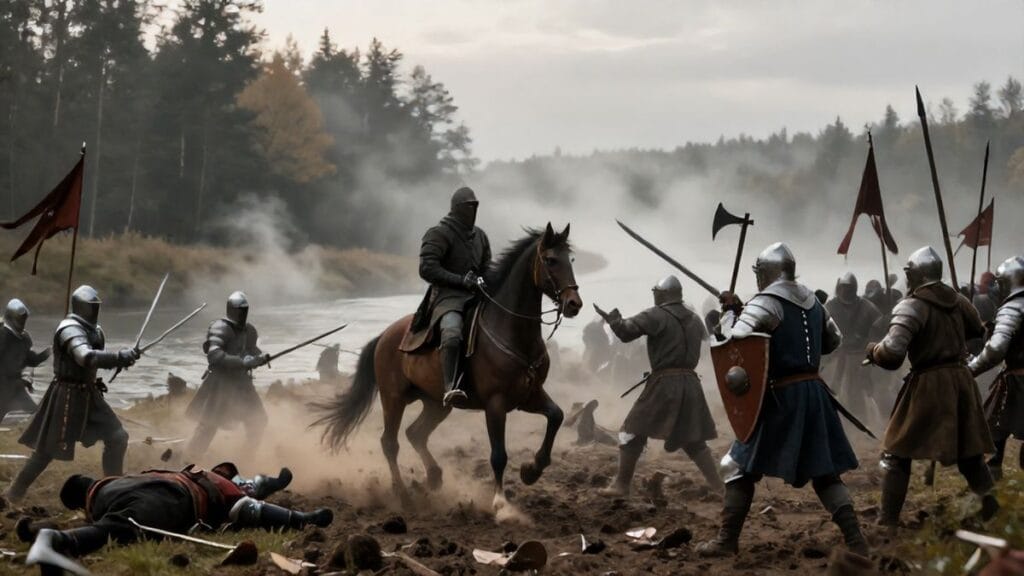
On the morning of 16 October 955, mist hung low above the dark, slow water of the Recknitz River. Reeds shivered in the autumn wind, and somewhere beyond the gray veil, men waited with hands wrapped around spear-shafts, fingers numb, breath clouding in the chill air. Ravens circled overhead, as if summoned by the anticipation of bodies. This was the stage for the battle of the recknitz, a clash so overshadowed by more famous victories that it would fade in much of Europe’s memory, yet in its time it marked a violent hinge between worlds.
To the west and south stood the forces of King Otto I of East Francia, the future Holy Roman Emperor, fresh from a triumph that already echoed through monasteries and royal halls: the crushing defeat of the Hungarians at Lechfeld in August of the same year. To the north and east, gathering in thick formations around their banners, stood the Slavic Obotrites and Veleti, joiners in a broad uprising from the Baltic littoral. They were not faceless “pagans,” as later chroniclers would simplistically label them, but communities with their own gods, customs, and ambitions, determined for once to strike Brandenburg, Saxony, and the German frontier lords before they themselves were struck down.
Here on the Recknitz, between swamp and open field, two visions of the future looked at each other through spear-forests. For Otto and his magnates—men like the loyal Margrave Gero and other warrior-nobles of Saxony—this was about more than revenge or frontier order. It was about whether the fragile structure of power cobbled together over two restless decades would collapse. For the Slavic leaders—some named in the sources, others reduced to mere stereotypes—it was a last, desperate wager that German weakness after years of Magyar raids could be turned into Slavic autonomy. The battle of the recknitz was born from this tense calculus, out of fear and hope entangled on both sides.
The river itself seemed to judge them. It had no memory of borders, kings, or conversion campaigns, only of seasons, floods, and crossings. Yet on this October day in 955, it would become an actor in human history, its banks guiding cavalry charges, its marshes swallowing the unlucky, its fords deciding who would live and who would die. So much of what would later be called “German eastward expansion,” the drawing of lines between Latin Christendom and the Slavic world, would, in the eyes of chroniclers at least, run back to this mist-covered battlefield.
Frontiers of Faith and Power: The German–Slavic Borderlands Before the Storm
To understand why men bled into the waters of the Recknitz, we must travel back to the shifting frontier zones of the early tenth century. East Francia, the eastern fragment of Charlemagne’s empire, was not yet the centralized “Germany” later ages would imagine. It was a patchwork of duchies—Saxony, Bavaria, Swabia, Franconia—held together by dynastic alliances, personal loyalties, and the charisma (or ruthlessness) of the ruling Ottonian line. To its east lay not a void but a complicated mosaic of Slavic peoples: Obotrites and Veleti along the Baltic, Liutizi, Hevelli, and others scattered across forests, plains, and wetlands.
These were borderlands defined by tribute and conflict. Since the time of Henry I—the “Fowler,” Otto’s father—the Saxon kings had pushed eastward, subduing some Slavic tribes, exacting tribute from others, erecting border fortresses at places like Brandenburg and Meissen. Sometimes the relationships took on the form of vassalage and alliance, with Slavic leaders sending hostages, attending royal courts, or even accepting baptism, at least outwardly. Other times they boiled over into raiding, counter-raiding, and campaigns that left villages burned and fields trampled. It’s astonishing, isn’t it, how often the medieval “frontier” was less a line and more a living, fraying seam?
Religion played a vital but complex role. Missionaries from the West, many from bishoprics in Saxony, entered the Slavic lands bearing crosses, relics, and the Latin liturgy. They were guarded, sometimes enthusiastically supported, by local German lords who saw in conversion both a spiritual mission and an excellent justification for political control. Slavic shrines, sacred groves, and temples—like the famous site later described at Arkona—became focal points of cultural resistance. In the eyes of Christian chroniclers, these places were dens of idolatry; in the eyes of the locals, they were cords binding communities to ancestors and gods.
By the 940s, the pressure on the borderlands had intensified. Henry I’s successes against the Slavs and especially against the Hungarians in earlier decades had emboldened his son Otto I. Tribute demands increased. Fortifications appeared like stone thorns in the Slavic heartland, their garrisons watching river crossings and trading routes. German counts and margraves, many ruthless and ambitious, took their own initiative in extorting wealth and spreading their influence. As historian Timothy Reuter once noted of these frontier lords, “Their piety and their greed marched side by side.”
Slavic elites weighed their options. Submission meant relative internal autonomy but at the price of annual payments, hostages, and long-term dependence. Revolt meant risking devastation but offered the only real path to sovereignty. For a time, pragmatic compromise prevailed. But by the early 950s, conditions had shifted. To the south and east, Magyar (Hungarian) raiders still harried Bavaria and beyond, occasionally threatening the very heart of the East Frankish realm. Dukes rebelled against Otto I’s authority. The king’s hold over his own magnates seemed weak. Across the frontier, tribal leaders watched and waited.
Otto I, the Reluctant Emperor in the Making
Otto I did not stride onto the stage of history as an invincible emperor. He began, like many medieval rulers, as a contested king, his crown smeared with the anxieties of contested succession. Born around 912, the son of Henry I of Saxony and Queen Matilda, Otto inherited from his father both a strengthened monarchy and a host of enemies who resented that strength. When Henry died in 936, Otto was crowned king at Aachen amid lavish ceremony borrowed from the Carolingian past. Yet the golden glow of his anointing hid growing tensions.
Powerful dukes, some of them his close kin, detested Otto’s attempts to centralize authority and place his own favorites in key positions. Rebellions broke out in the 930s and 940s, forcing Otto to fight not only border enemies but his own aristocracy. His rule was, as one might say, hammered on the anvil of civil war. He suffered humiliations—defects by trusted nobles, the open defiance of his brother Thankmar, and later plots involving his own son Liudolf. Each crisis left scars but also strengthened the crown when Otto eventually prevailed.
Foreign threats compounded this internal turmoil. Hungarians on the plains of Pannonia still rode westward, their light horsemen a terror to settled Christian lands. In Italy, rival claimants, nobles, and kings strained relations with the papacy and dangled before Otto the glittering but dangerous prize of the imperial title. To the north and east, Slavic chiefs watched a ruler who seemed perpetually on the back foot, struggling to keep his kingdom from disintegration. Surely, they must have thought, the time would come when they could strike.
Yet Otto had strengths not easily seen from afar. He cultivated bishops and abbots as allies, granting lands and privileges to the Church, which in turn supplied not only spiritual legitimacy but written memory: chronicles, annals, and charters that still sing his praises. He developed bonds with a core group of loyal magnates, especially among the Saxons, who would ride with him from crisis to crisis. And he had patience. He waited out rebellions, struck decisively when his enemies faltered, and never forgot that a king who looked weak for a moment could recover and become feared.
By 955, Otto stood at a crossroads. He had faced down internal revolt, but scars remained. His kingdom’s eastern and southern borders simmered with unrest. If he failed in one great confrontation, the edifice of power he had so carefully rebuilt could collapse. It is in this context that the twin dramas of 955 unfolded: the legendary victory at Lechfeld against the Hungarians in August, and then, scarcely two months later, the lesser-known yet crucial battle of the recknitz against the Slavic uprising in October.
The Slavic Uprising: Obotrites, Veleti, and the Fury of the Frontier
The Slavic revolt that culminated in the battle of the recknitz was not a sudden, irrational outburst. It was the result of years of tension, exploitation, and opportunistic calculation. Among the tribes most involved were the Obotrites and the Veleti (sometimes conflated or misrepresented in the sources), inhabiting the lands along the Baltic coast and inland rivers, including the region drained by the Recknitz.
These communities had long dealt with German neighbors—sometimes as foes, sometimes as trading partners. Furs, slaves, and amber flowed west; weapons, cloth, and silver flowed east. Yet beneath the exchanges lay a stark imbalance. German lords, buoyed by royal backing, demanded tribute that bit deeper into Slavic resources. Fortified outposts pushed ever closer, garrisoned by troops who treated the locals with more arrogance than diplomacy.
Religion complicated matters. Some Slavic leaders had accepted baptism, often to gain favor with the king or to secure breathing space on the frontier. But beneath these public gestures, many communities clung fiercely to their old rites, honoring deities tied to rivers, forests, and war. German missionaries condemned the “idols,” describing them with horror and fascination. From the Slavic side, we have no surviving texts, but we can imagine anger at the pressure to abandon ancestral customs and resentment at the role of Christianity as the ideology of foreign rule.
By the early 950s, rumors of German weakness circulated. Otto I had been mired in internal conflict. To the south, the Hungarians had humiliated Christian armies on multiple occasions. Slavic emissaries, moving along rivers and forest paths, likely carried tales of battles lost, fortresses briefly abandoned, and kings whose troops had to be recalled from the frontier to deal with revolts at home. The chance seemed ripe.
Some historians see the uprising of 955 as coordinated; others as a wave of local rebellions that began to feed off one another. What we know from contemporary writers like Widukind of Corvey is that the Obotrites and Veleti rose up, attacked German positions, and threatened the fragile order that had been imposed east of the Elbe. The king’s representatives and allied Slavic chiefs loyal to Otto were in danger. Fortresses long assumed secure now faced the immediate prospect of siege.
The uprising was also, in part, a revolt of dignity. Frontier populations are often described by central powers as “rebellious” simply because they refuse indefinite subordination. In 955, as banners were raised and war horns sounded in Slavic villages, men and women may have believed they were striking not from folly but from necessity. Either they pushed the Germans back, or the tightening grip of the Saxon kings would eventually crush them. And if there was ever a time to gamble, it was now, when the mighty Otto was allegedly occupied far to the south with the Hungarian threat.
From Lechfeld to the North: A Kingdom Under Siege on Two Fronts
In August 955, on the fields near Augsburg, Otto I met the Hungarians in what would become his most celebrated victory—Lechfeld. Chroniclers waxed lyrical about angels, relics, and divine favor as the king’s heavy cavalry broke the raiders and ended, for a generation, the Magyar terror in the German lands. Ecstatic messengers carried news of the triumph through towns and monasteries. Otto’s prestige soared.
But this was only the beginning. Even as celebrations rang in the churches of Bavaria and Saxony, word reached the royal court that the northern frontier was in flames. The Slavic uprising had intensified. Margraves and bishops who had barely dared to hope for Hungarian relief now feared encirclement. What did it matter if the plains of Bavaria were safe if the Elbe and beyond fell away into hostile hands?
For Otto, the situation was both dire and strangely opportune. On the one hand, to have fought a major campaign against the Hungarians only to immediately turn north into another war was exhausting for his troops, his nobles, and his resources. On the other hand, Lechfeld gave him something he had not possessed in years: the aura of unchallenged military success. That aura could be projected northward, a psychological weapon as potent as any spear.
The king could not simply ignore the Slavic revolt. A failure to respond would signal weakness to his own dukes and to external enemies. The eastern marches were not incidental; they were integral to the kingdom’s economic and military structure. Silver mines, trade routes, tribute streams—all were bound to the security of the frontier. If Otto allowed the rebellion to consolidate, he risked losing more than just a few forts; he risked encouraging imitation uprisings elsewhere.
Thus, after securing his southern flank and entrenching the victory of Lechfeld, Otto began to gather forces for a march north. He called upon the same core of loyal magnates who had fought under his banner in August. Saxon contingents, especially, were crucial; they knew the land, the Slavic languages, and the grim rhythm of frontier warfare. Banners that had barely been furled after the Magyar campaign were hoisted again. Wounded men limped or rode north with their king, while new levies filled the gaps in the ranks.
The decision to confront the uprising swiftly and decisively set the stage for the battle of the recknitz. Had Otto delayed, winter might have hindered his movements, and the rebels could have dug in, strengthened alliances, and perhaps drawn in additional Slavic groups. Instead, the king intended to carry the momentum of Lechfeld straight into the northern war. That continuity—one great victory flowing into another—would later be central to how chroniclers framed 955: a year in which God reaffirmed Otto’s right to rule.
March to the River: The Road to the Battle of the Recknitz
The march from central Germany to the Recknitz River was, in itself, a feat of logistical endurance. Medieval armies did not move like chess pieces on a smooth board. They trudged along muddy tracks, crossed rivers on hastily constructed bridges or precarious ferries, and relied heavily on the goodwill—or fear—of local populations for supplies. Autumn made the journey harder; rain turned paths into ruts, and the shortening days limited marching time.
Otto’s armies advanced in stages, drawing reinforcements from Saxon strongholds along the way. At each stop, messages were dispatched ahead, probing for news of Slavic movements. Scouts rode out in small, fast groups, risking ambush in the dark forests. Some accounts hint that Otto or his commanders may have coordinated with loyal or semi-loyal Slavic leaders who opposed the uprising, using them for intelligence or as auxiliary troops.
The rebels, for their part, tried to use the landscape to their advantage. They understood that in open field battles, well-trained German heavy cavalry and disciplined infantry could be deadly. The Obotrites and Veleti were adept at guerrilla tactics: raiding, ambushes, and quick retreats into marshes and forests where horsemen struggled. Yet success in this style of warfare depended on avoiding being pinned down in a decisive confrontation. The approach of Otto’s main army forced a choice—continue to harry and risk being cornered, or rally forces for a stand.
Somewhere in this tense process of maneuver and counter-maneuver, the Recknitz River emerged as the focal point. It offered natural defensive advantages: marshy banks, limited fords, and a landscape that could easily bog down attackers. For the Slavic coalition, it was a place to concentrate their forces, to present a front that harnessed both terrain and numbers. For Otto, it was a line that had to be crossed to show his dominion extended fully over the rebellious lands.
The closer the Germans drew, the more charged the atmosphere became. Rumors flew within the ranks: tales of massacred settlers, burned churches, desecrated crosses. Some were true; others, no doubt, were exaggerations or deliberate propaganda to stoke hatred. For the Slavs, similar stories surely circulated about German cruelty, forced conversions, and the impalement or hanging of captured warriors. Each camp framed the other as enemies of God or of their gods, heightening the emotional stakes of the coming clash.
By mid-October, both sides had converged near the Recknitz. Otto’s banners fluttered on one side of the river, Slavic standards on the other. Skirmishes tested the defenses, raiding parties probed for weaknesses, and the muddy ground drank the blood of scouts long before the main forces collided. The battle of the recknitz was no longer a distant possibility; it loomed as an inevitability, drawing in men’s thoughts like a storm cloud closing over a gray horizon.
Armies Face the Marshes: Strategies, Weapons, and Terrain
The battlefield at the Recknitz was shaped as much by mud and water as by steel. Unlike the relatively open plains of Lechfeld, the riverine environment here offered narrower spaces for maneuvering large cavalry formations. The Germans, relying heavily on armored horsemen as the cutting edge of their forces, had to take this into account. Otto’s commanders likely spent hours surveying the banks, identifying fords, and deciding where to commit their main thrust.
The Slavic forces, more familiar with the terrain, would have sought to use it to their advantage. They could position archers near the reed-choked edges, sling stones from cover, and attempt to channel any German attack into cramped zones where superior numbers and agility would tell. Their infantry, less heavily armored but more accustomed to fighting in uneven conditions, could wage a brutal, close-quarter struggle among tussocks and shallow pools.
On both sides, the core technology of war was similar: spears, shields, axes, swords, bows, and the occasional crossbow on the German side. Armor differed. Otto’s leading warriors and knights wore mail shirts, helmets, and carried robust wooden shields with iron bosses. The Slavic nobles might have possessed some mail and metal helmets, often acquired through trade or as plunder, but many of their warriors fought with leather or textile protection, if any. In raw terms, German elites were better equipped for frontal clashes.
Yet equipment was only part of the equation. Morale, cohesion, and purpose mattered deeply. Otto’s troops had the confidence born of their recent victory over the Hungarians. Many believed they were instruments of divine justice, convinced that God had shown His favor in August and would not withdraw it now in October. Priests and chaplains moved through the ranks, offering blessings and hearing confessions. Relics might have been carried with the army, tangible links between heaven and the muddy earth on which they stood.
The Slavic warriors, on the other hand, fought for their homes. For them, this was not a distant campaign but a struggle whose outcome could determine whether their children would grow up free or tributary subjects of a foreign king. Their priests and seers—though absent from Christian chronicles except as “sorcerers” or “idol-priests”—would have invoked the protection of their gods, perhaps making vows of sacrifice in exchange for victory. Whatever their beliefs, they needed to compensate for their organizational disadvantages with ferocity and local support.
Tactically, Otto seem to have aimed for a decisive confrontation that would shatter the backbone of the revolt in one stroke. The Slavic coalition, having concentrated at the river, may have hoped to hold, bleed, and then counter-attack once the Germans were committed. Both plans hinged on control of crossings: he who controlled the fords controlled the battle’s rhythm. It was around these crucial points that the battle of the recknitz would ignite.
The Eve of Battle: Prayers, Councils, and Quiet Fears
The night before the battle carried its own kind of weight. On Otto’s side, commanders gathered in a war council. They consulted maps scratched into the dirt, argued over where to commit the heavy cavalry, how far to trust local guides, and what reserves to keep back in case of a feigned retreat or a flank attack. Voices were surely raised; these were men of rank and pride, not automatons. But they understood that before dawn broke, disagreements had to be settled.
In the German camp, torches flickered as priests held mass beneath makeshift awnings. Men knelt in the mud, their armor creaking, lips moving in Latin prayers many only half understood. In the telling of Widukind of Corvey, Otto was a pious king who led his men with both sword and prayer. Whether he personally addressed the troops that night, we do not know, but it is easy to imagine him riding along the lines, exchanging a word here, a nod there—human gestures fastening the abstract thread of loyalty into something tangible.
Across the river, the Slavic encampment pulsed with its own rituals. Fires burned in circles, casting long shadows as warriors sharpened blades and checked shield-straps. Chants rose to the night sky, accompanied by drums or rattles. We must reconstruct this from hints and analogies, as the Slavic voices of 955 are mostly lost to written record. Yet it would be absurd to imagine only silence. These men were about to risk everything. They, too, would have sought signs—flight of birds, behavior of flames, dreams—that might foretell the morrow’s fate.
In both camps, individual fears and hopes intertwined with vast narratives. Some Germans likely dreaded the marshes, fearing drowning more than enemy blades. Some Slavs may have doubted the unity of their coalition, recalling old rivalries between tribes forced into alliance by necessity. Sleep did not come easily. The sounds of horses, the clink of metal, the murmur of voices carried over the water, each side faintly aware of the other’s restlessness.
Yet behind the surface of ceremony and bravado lay something more intimate: the knowledge of mortality. Many of the men who traced the cross or touched a talisman that night knew they might not see another dawn. The battle of the recknitz, as we call it now, was for them a terrifying uncertainty. Would their names be remembered, or vanish into unmarked graves by the reeds? In the stillness before dawn, such thoughts have a way of cutting through all slogans and banners. Then, at last, the sky began to pale, and there was no time left for doubt.
Clash at the Crossing: The Battle of the Recknitz Unfolds
At first light, the river valley shifted from ghostly gray to muted color. Otto’s forces began to form up, banners rising above lines of spearmen and the more scattered knots of mounted knights. Trumpets or horns signaled formations; orders moved down the ranks like ripples across the surface of water. The king—whether stationed at the center or slightly behind the front as some scholars suspect—would have been visible, a figure in gilded armor, a living anchor for his troops.
The Slavs were ready. Their warriors lined the opposite bank, shields interlocked where footing allowed, archers and slingers positioned to rain death on any attempt to ford. Their leaders, some mounted, moved along the lines shouting encouragement. The aim was clear: hold the crossings, break the first German assaults, and let the difficult terrain sap enemy strength.
The battle opened, most likely, with missile exchanges. Arrows and stones arced over the reeds, thudding into shields or soft ground. Men cried out as weapons found flesh. Under this hail, German detachments probed the shallows, some attempting direct crossings while others skirted the river to seek less defended fords. Slavic defenders, warned by scouts, shifted their lines to meet each threat.
At some point, a crucial crossing was forced. Chroniclers tell us little of the tactical minutiae, but we can infer that Otto concentrated his best troops at one or two key points. A wedge of armored infantry, perhaps flanked by horsemen dismounting to fight more effectively in wet ground, pushed into the water. Shield locked with shield, they advanced step by grinding step, arrows rattling on their helmets. On the far bank, Slavic warriors waded in to meet them, screams mixing with the crash of wood and iron.
The water turned red. Men slipped on submerged stones, fell into deeper pockets, and drowned under the weight of their own equipment. In such chaos, discipline mattered. German units that had drilled together, that had fought side by side at Lechfeld, could maintain cohesion even amid panic. The Slavs, though ferocious, might have found it harder to coordinate under such conditions, especially as their leaders had to rush from point to point to shore up faltering sections.
Once a foothold was secure on the far bank, Otto unleashed his cavalry. Horses that had waited impatiently now splashed through the shallows, clambering up onto firmer ground where their speed and mass could be deadly. Slavic lines, designed to hold at the water’s edge, struggled to adapt to mounted charges from unexpected angles. Where the terrain allowed, German knights drove into clumps of enemy infantry, hacking with swords and lances, breaking the formation’s spine.
The battle of the recknitz, in this decisive phase, became a grinding melee. Isolated groups fought to the death in pockets, separated by reeds and pools from the broader lines. Some Slavic units managed organized withdrawals, drawing the Germans into ambushes along drier ridges or forest edges. But the momentum, once lost, is hard to regain. Otto’s troops, fueled by their king’s presence and perhaps believing they fought again under the same divine favor as at Lechfeld, pressed relentlessly forward.
As midday approached, the outcome tilted irreversibly. Gaps in the Slavic defenses widened. Messages ceased to move efficiently between their wings. A leader cut down here, a banner captured there, and the fragile coherence of the coalition shattered. What had begun as a defensive stand along the river turned into a staggered, desperate attempt to avoid encirclement and annihilation.
Blood in the Water: Rout, Pursuit, and the Slavic Defeat
Once the line broke, the slaughter began in earnest. Medieval battles often killed fewer men than we imagine during the main clash; it was during the rout, when order collapsed, that death spread most brutally. At the Recknitz, this rule held grimly true. Slavic warriors, realizing the battle was lost, tried to run for the relative safety of nearby woods or marshlands deeper from the main river. German cavalry followed, spurring their horses through mud and shallow streams, cutting down stragglers.
Some attempted to swim or wade back across the river, hoping to escape to the far side and regroup. Weighed down by makeshift armor or simply exhausted, many did not make it. The water, which had glinted softly in the dawn, now held the bodies of the fallen, drifting against reeds. Ravens and other scavengers would feast well in the days that followed.
Otto’s commanders knew that victory was not simply a matter of holding the field. They wanted to ensure that the uprising was broken decisively, that those who had dared rise would not easily rise again. Pursuit, therefore, was merciless. Groups of Slavic fighters who tried to form rearguards were overwhelmed. Captured leaders were identified where possible; common warriors were often slain on the spot.
Numbers given by medieval chroniclers are always suspect, prone to exaggeration for dramatic effect. Widukind of Corvey does not offer precise figures for the battle of the recknitz as he does for Lechfeld, but later writers imply heavy Slavic losses, speaking in terms of thousands. Even if we halve or quarter such claims, the proportional impact on local communities would have been severe. Entire cohorts of fighting-age men from some villages may have perished in a single day.
The psychological dimension of the rout cannot be overstated. Those who escaped carried with them not only physical wounds but the memory of collapse. Tales of comrades trampled, drowned, or hacked down in the mud would travel from hearth to hearth, shading future decisions about whether to resist or submit. For years afterward, the name of the Recknitz may have been invoked as a grim warning among the Obotrites and Veleti, even if no written Slavic record has preserved that side of the story.
By late afternoon or evening, organized resistance had ceased. The battlefield was Otto’s. German troops began the grim work of stripping the dead, collecting loot, and tending to their own wounded. Priests moved through the carnage, giving last rites to the dying Germans, while Slavic corpses lay mostly unattended. Fires were lit; tents erected. For the victors, exhaustion mingled with a kind of stunned elation. They had survived another trial, one that, in some ways, mirrored and completed what they had begun at Lechfeld.
Captives, Executions, and Messages of Terror
Victory was not only declared on the field; it was carved into bodies. One of the most chilling aspects of the aftermath of the battle of the recknitz was the fate of captured leaders. Medieval sources, shaped by the perspective of the victors, describe how prominent Slavic chiefs were taken and then executed in ways designed to broadcast a message: rebellion would be met with extremity.
Some were hanged, a punishment that humiliated as much as it killed. Others may have been beheaded, their heads displayed at German fortresses or along key roads. Chroniclers hint at public executions staged before assembled troops or local populations. The goal was clear: to transform the shame of being captured into a weapon of terror that might deter future uprisings.
Ordinary captives faced uncertain fates. Some were likely killed in the heat of pursuit, others spared to be sold as slaves. The medieval slave trade, often sanitized in later narratives of Christian kingship, was a brutal economic reality. Slavic men, women, and children could be transported westward, ending up in Saxon households or further afield in other parts of Europe, their personal stories erased within the broader tale of victory and punishment.
Otto’s own role in ordering or approving such measures is filtered through the lens of adoring chroniclers, who naturally depict him as just. Widukind of Corvey, for instance, emphasizes the king’s righteousness in crushing rebellion and restoring order. A modern reader, however, can see clearly the calculated cruelty behind the spectacle. The execution of leaders was not only vengeance; it was political theater.
Still, there are hints that not all who fought against Otto were treated equally. Some lesser chiefs or communities, quick to surrender after the battle, may have been offered terms—tribute in exchange for lives, hostages in place of mass punishment. The line between rebel and subject could be redrawn rapidly when the balance of power shifted. Those whose cooperation was deemed useful might be spared or even restored to local authority, now tethered more tightly to the German crown.
In the end, the message radiating from the banks of the Recknitz was unmistakable. The uprising had failed catastrophically. Its leaders were dead or captive, its fighters scattered, its communities exposed to whatever punitive campaigns Otto and his governors deemed necessary. The river had become, symbolically, a place where the will of the Saxon king bent the northern frontier once more to his design.
Chroniclers and Memory: How the Battle of the Recknitz Was Recorded
We know what we do about the battle of the recknitz largely because men in monasteries decided it mattered enough to write down. Chief among these voices is Widukind of Corvey, a Saxon monk who composed the “Res gestae Saxonicae” (“Deeds of the Saxons”), a crucial narrative for Otto’s reign. Writing from within the cultural world that celebrated the king, Widukind framed the events of 955 as a double miracle: first Lechfeld, then the northern victory that shortly followed.
In his account, Widukind portrays Otto as God’s chosen instrument, emphasizing divine favor and the righteousness of crushing pagan foes. He describes how, after defeating the Hungarians, the king was almost immediately tested again by a Slavic revolt, and how he rose to meet this new danger with equal resolve. The sequence is no accident; it creates a compelling storyline of continuous triumph, reinforcing not only Otto’s prestige but Saxon identity itself.
Other sources, such as the later continuations of the “Annals of Fulda” or works by chroniclers like Thietmar of Merseburg, mention the conflict on the northern frontier in 955 but with varying emphasis and detail. Over time, Lechfeld overshadowed Recknitz in historical memory. The Hungarian threat had menaced a wide swath of Latin Christendom, making its defeat a pan-European milestone. The battle of the recknitz, by contrast, was more regional, its meaning clearest to those living in Saxony, on the Elbe, and along the Baltic approaches.
Yet if we read these chronicles carefully, we see how they quietly acknowledge the interconnectedness of the two battles. The same king, the same year, the same sense of a kingdom tested on multiple fronts. Historians such as Karl Leyser have noted that without the northern victory, the southern triumph might have appeared less decisive; Otto would have remained a ruler who saved Bavaria while losing the frontier. The chronicled emphasis, therefore, reflects a deep awareness that Recknitz was part of a broader pattern.
Of course, these texts are one-sided. We lack any written Slavic account of the battle, any lamentation or justification penned in the language of the Obotrites or Veleti. Their memories were oral, and over time, those too may have been eroded by conquest, Christianization, and assimilation. What survived in writing was the German and Latin perspective, in which the Slavs appear primarily as antagonists or objects of conversion.
Modern scholarship has tried to read between the lines. By comparing different chronicles, by examining charter evidence and the evolving map of bishoprics and marches, historians reconstruct a fuller picture. One historian has remarked—paraphrasing here—that “955’s northern campaign was the shadow twin of Lechfeld, less luminous but no less formative.” Through such careful reading, the battle of the recknitz emerges from its relative obscurity, revealing itself as a critical episode in the narrative of East Frankish expansion and Slavic resistance.
Consequences for the Slavic World: Submission, Survival, and Silent Resistance
For the Slavic tribes involved, the defeat at the Recknitz ushered in a harsher era. Otto and his marshals moved rapidly to capitalize on their victory. Tribute systems were reimposed and, in some cases, increased. Hostages were demanded from key families, young boys and girls taken to German courts or monasteries where they would grow up far from their homeland, their loyalties reshaped. Fortifications were built or reinforced at strategic points, anchoring German influence more firmly across the riverine networks.
Some communities were subjected to punitive expeditions. Villages suspected of harboring rebel leaders or refusing tribute could face burning, confiscation of livestock, and forced relocations. The message was clear: the time for testing the limits of German tolerance had passed. For the next generation, the shadow of the battle of the recknitz would hang over any whispered talk of rebellion.
Yet submission did not mean the disappearance of Slavic culture. In many places, local customs, languages, and religious practices continued, albeit increasingly under pressure. Christian monasteries and churches gradually dotted the landscape, yet the process of conversion was uneven. Some accepted baptism sincerely; others outwardly embraced Christianity while privately continuing older rites. The frontier thus remained a zone of blending and contestation rather than simple replacement.
Political structures among the Slavs adapted as well. Some leaders chose a strategy of accommodation, aligning themselves more closely with the German crown in exchange for recognition and protection. They might serve in Otto’s armies, help police the frontier, or act as intermediaries between German authorities and local populations. Others retreated further from direct contact, moving into regions where German power was thinner and maintaining a greater degree of autonomy.
The defeat also likely intensified eastward and northward displacement. Groups unwilling to live under strengthened German dominance may have migrated, contributing to the restless movements of peoples around the Baltic during this era. Such movements, invisible in the chronicles, have to be inferred from archaeological evidence and later ethnographic patterns. Still, they remind us that not all responses to conquest were simply submission or rebellion; sometimes, they were the quiet decision to leave.
In a sense, the Slavic world of the tenth century entered a new phase after 955. The possibility of pushing back the German frontier in a decisive, coordinated fashion had dimmed. Resistance would continue, sometimes flaring into new uprisings in later centuries, but the Recknitz defeat had shown the terrifying cost of such attempts. Silence and survival, as much as open warfare, became strategies in the long story of Slavic–German relations.
Forging the German East: Marches, Missions, and New Frontiers
In the wake of the battle, Otto and his successors tightened their grip on the eastern marches, those liminal border districts governed by margraves. These men—figures like Gero, already notorious for his ruthless dealings with Slavic neighbors—wielded considerable power. Tasked with both defense and expansion, they became spearheads of what later historians would call the Ostpolitik, the policy of pushing German control eastward.
Fortresses multiplied. Earth-and-timber strongholds were upgraded or replaced with more durable stone constructions as resources allowed. Each castle was both a military outpost and a symbol. From its towers, German banners fluttered as visual assertions of sovereignty over lands that, in practicality, still contained large and often restive Slavic populations. Around these fortresses grew market settlements where German merchants, craftsmen, and clerics mingled—sometimes uneasily—with locals.
The Church played a parallel role. Bishoprics were established or reinforced in frontier regions: Brandenburg, Havelberg, and later others. Missionaries ventured further, often escorted by soldiers. Their tasks were multiple: preach, baptize, build churches, and administer land grants from the king or emperor. Conversion was never just a spiritual project; it was also a way of restructuring landholding and allegiance. Once a region fell under the spiritual jurisdiction of a bishopric loyal to Otto, its political incorporation to the realm became easier to justify.
Yet this forging of the German East was not linear or uncontested. Periodic reversals occurred. Some fortresses were overrun in later uprisings; some bishoprics struggled to maintain influence beyond a narrow core. The legacy of the battle of the recknitz thus did not guarantee unbroken advance but provided a powerful precedent: when challenged, the crown would respond with decisive military force and then entrench its gains institutionally.
Economically, the consolidation of the frontier opened new opportunities. Trade routes linking the interior of East Francia with the Baltic Sea became more secure. German merchants could tap into networks that brought furs, wax, honey, and slaves from the east and north into broader European markets. Tribute from subjugated Slavic communities, whether in goods or in labor, contributed to the growing wealth of Saxon monasteries and noble families.
This evolving frontier order, set on a firmer course after 955, had long-term implications. It laid part of the groundwork for the much later, more systematic eastward movement of German settlers and institutions in the High Middle Ages, a process often labeled the Ostsiedlung. While that wave of colonization lay centuries ahead, the victory at the Recknitz helped ensure that the eastern bank of the Elbe and beyond would remain within the gravitational pull of the German kingdom rather than slipping away into a separate Slavic political sphere.
Otto I’s Rising Star: From Battlefield King to Holy Roman Emperor
In political terms, the twin victories of 955—Lechfeld in August and the battle of the recknitz in October—transformed Otto’s standing. Before these battles, he had been a strong but embattled king, his authority repeatedly tested by rebels at home and raiders from abroad. After them, he appeared almost invincible. Few rulers in early medieval Europe could claim, within the span of a few months, to have crushed both a decades-long external menace and a serious frontier uprising.
This new aura of success mattered profoundly in the complex chessboard of Italian and papal politics. In Rome, the papacy was at the mercy of local aristocratic factions and rival claimants. The idea of a powerful northern king riding south to restore order—and in return revive the imperial title—became increasingly attractive. Otto, basking in the glow of 955, was better placed than ever to imagine himself not just as a German king but as heir to Charlemagne’s broader imperial mantle.
In 962, less than a decade after the Recknitz campaign, Otto traveled to Rome and was crowned emperor by Pope John XII, an event often taken as the formal birth of the Holy Roman Empire. While historians rightly point out continuities with earlier Carolingian traditions, there is no doubt that the deeds of 955 had smoothed Otto’s path. Without the military prestige won on those fields and riverbanks, his bargaining position with Italian powers and the papacy would have been weaker.
Domestically, the victories strengthened the monarchy’s relationship with its key supporters. Dukes and margraves who had fought at Otto’s side shared in the glory, receiving lands, titles, and influence in return. Their loyalty, already hardened in the fires of previous civil wars, now took on a triumphant sheen. Monasteries and churches commemorated the battles in their liturgy and art, inscribing Otto’s name into the sacred memory of the realm.
Of course, success bred new challenges. A powerful emperor could inspire fear as well as admiration. Italian nobles resented outside domination; some German princes worried about too much centralization. Yet Otto’s personal prestige gave him room to maneuver, to mediate disputes, and to assert his role as arbiter and overlord. The year 955, with its climactic conflicts, had pushed him across a threshold. He was no longer simply surviving; he was shaping the political map of Europe.
Religion, Conversion, and the Cross on the Riverbank
The battle of the recknitz was framed, by its chroniclers, as a Christian victory over pagans. This religious narrative was not mere window dressing; it influenced how contemporaries understood the conflict and justified its brutality. Priests and monks saw in Otto’s success evidence that God favored the spread of the faith and the discipline of rebellious peoples who clung to their old gods.
After the battle, missionaries could move with slightly greater security through the devastated frontier. Some Slavic captives were baptized, whether out of genuine conviction, coercion, or the hope of better treatment. New churches were founded, sometimes quite literally erected over older sacred sites. The riverbank itself, once a place where Slavic warriors might have made offerings to their deities before battle, now symbolized triumph of the cross in Christian storytelling.
Yet the reality on the ground was layered. Conversion was rarely instantaneous. In many villages, the first generation to encounter Christianity blended its stories and symbols with pre-existing beliefs. A holy spring might now be associated with a Christian saint rather than a local god, but the ritual of visiting it for healing remained. Festivals were reinterpreted rather than eliminated. Priests who raged in their writings against syncretism on the frontier nonetheless often had to accommodate it in practice if they wished to make any headway.
German ecclesiastical authorities took the long view. Bishoprics planted after 955 were not expected to produce overnight saints; they were meant to be institutional anchors that would, over time, reshape the spiritual and cultural landscape. Donations of land, often obtained from conquered territory, endowed these institutions. Monks and nuns, in their cloisters, prayed for the souls of both victors and vanquished, while out in the fields, peasants—Slavic and German alike—labored under new arrangements of power and piety.
In some sense, then, the battle of the recknitz was as much a symbolic turning point as a practical one. It allowed churchmen to speak more confidently of a Christian frontier pushing outward, of paganism in retreat. “The Lord,” one might imagine a monk writing in a lost homily, “has shown at the river that His arm is mighty in judgment.” Such rhetoric did not erase local realities but provided a story within which elites could frame their actions and demands.
Archaeology and Landscape: Traces of a Forgotten Battlefield
Unlike better-known medieval battlefields, the site of the Recknitz engagement has not yielded a wealth of spectacular archaeological finds. The exact locations of key crossing points and the densest fighting remain matters of scholarly debate. The river, over a millennium, has shifted its course in places; marshes have drained or expanded; human settlement and agriculture have altered the terrain.
Nonetheless, the landscape still whispers. Archaeologists and landscape historians have studied old fords, embankments, and place-names that may preserve echoes of conflict. Occasional finds—weapon fragments, pieces of armor, clusters of burials—are examined for possible connection to tenth-century warfare. While none offers a smoking gun, together they help sketch a picture of a region whose very geography invited battles over control of movement and resources.
In some areas near the Recknitz, burial sites show a mix of Christian and non-Christian practices. Graves with simple crosses carved on stones lie not far from others containing grave goods more typical of older Slavic traditions. This juxtaposition reflects the overlapping cultural zones of the time. Were some of these graves those of men who fell in or around 955? Perhaps, though definitive proof eludes us.
Modern visitors traveling through Mecklenburg-Vorpommern might pass over bridges or drive along roads that cross the Recknitz without any awareness of its martial past. Unlike the battlefields of later centuries, marked by monuments and tourist centers, this river remains relatively anonymous. It is a quiet anonymity, born partly of the fact that the battle of the recknitz lost prominence in broader European memory even as it continued to matter in more specialized historiography.
There is a certain poignancy in this. A place that once resounded with shouts, clashing metal, and the desperate cries of the wounded now hosts the calls of birds and the hum of traffic. Yet in the folds of its banks and the layering of its soils, there are still traces—material and intangible—of that October day when two worlds collided. For those who take the time to look, the Recknitz is a reminder that even seemingly quiet landscapes can be thick with unspoken history.
Legends, Silences, and Modern Interpretations of Recknitz
Over the centuries, the memory of the battle of the recknitz faded from popular storytelling even as scholars continued to note it in chronicles and academic works. Unlike Lechfeld, which inspired enduring tales of Magyar raiders and heroic kings, Recknitz became, in many ways, a story told mostly by specialists. Yet silence in popular tradition can be as telling as abundance; it suggests that the meanings attached to the battle were contested or overshadowed.
On the German side, later medieval and early modern historiography often absorbed the battle into a broader narrative of inevitable eastward expansion and Christianization. The complex realities of Slavic life and resistance were flattened into a simple tale of pagans overcome. It was only in the nineteenth and twentieth centuries, as national histories of Germans and Slavs were written in the context of modern nation-building, that Recknitz began to be revisited with new questions. Who were these Slavic communities, really? What did they lose—and what did they preserve?
In some Slavic national historiographies, especially those examining the medieval Polabian Slavs, the battle appears as one episode in a long story of struggle against German encroachment. Yet even here, it often competes with other, later events that left clearer marks in oral tradition or documentation. The Obotrites and Veleti, as distinct political entities, did not survive into the age of nationalism; their descendants were gradually assimilated or displaced. Without a direct line of communal memory, their defeats and victories had to be reconstructed rather than simply remembered.
Modern historians approach the battle with a blend of empathy and critical distance. They recognize that Widukind’s story is partisan but also invaluable; that the Slavic perspective is largely lost but still partially recoverable through interdisciplinary work; that the language of “civilizing missions” and “pagan uprisings” must be scrutinized rather than accepted. As one scholar noted in a recent study, “The Recknitz campaign reveals not a border between barbarism and civilization, but the brutal negotiations of power at the edges of overlapping worlds.”
In recent decades, local historical societies and regional museums in northern Germany have shown renewed interest in the early medieval past of the Recknitz valley. Small exhibits, guided walks, and publications highlight the area’s role as a frontier zone long before modern borders. While not always centered explicitly on the 955 battle, these initiatives build a cultural space in which events like the battle of the recknitz can be reintroduced to public consciousness, now framed not as simple triumph but as a moment of profound human drama for all sides involved.
Echoes Across a Millennium: Why the Battle Still Matters
Why, then, does the battle of the recknitz matter over a thousand years later? Partly because it captures in miniature so many themes that shaped medieval and modern Europe: the tension between center and frontier, the meeting of different religious worlds, the interplay of conquest and resistance, the creation of memory through power. It was not the largest battle of its age, nor the most widely remembered, but its consequences rippled outward.
Politically, it helped secure Otto I’s reign at a critical moment, enabling him to move toward the imperial coronation that would anchor the idea of a Holy Roman Empire in the centuries to come. Without the stability ensured on both southern and northern frontiers in 955, his prestige in Italy and at the papal court would have been far less compelling. In this sense, the fate of a river in northern Germany is entangled with the fate of crowns in Rome.
For the Slavic peoples of the Elbe and Baltic regions, the battle marked a tightening of the net of domination. It is a waypoint in a longer narrative that saw many of these communities absorbed into the cultural and political orbit of the German kingdoms and, later, the German nation-state. Remembering Recknitz is a way of acknowledging that this process was not peaceful or inevitable but forged in violence and loss as well as exchange.
In a broader cultural sense, the battle challenges simplistic dichotomies. The Germans were not monolithically “civilized,” nor the Slavs monolithically “barbarian.” Both sides contained complex societies with internal divisions, aspirations, and moral ambiguities. Otto’s armies could be both defenders of hard-won order and instruments of brutal suppression. Slavic warriors could be both resisters against foreign imposition and raiders who inflicted suffering on their neighbors. The river witnessed no easy heroes, only fallible humans shaped by their time.
Finally, Recknitz invites us to think about how history is remembered—or not. Its relative obscurity in popular narratives reminds us that what a culture chooses to commemorate often says more about present needs than past realities. By recovering and retelling the story of the battle of the recknitz with nuance, we resist the flattening tendency of grand national myths and instead honor a more intricate, shared past in which victors and vanquished were bound together by geography, conflict, and the enduring flow of a northern river.
Conclusion
On 16 October 955, the banks of the Recknitz River became a crucible in which power, faith, and fear were melted together and reshaped. The battle that raged there ended with a decisive German victory under King Otto I, crushing a major Slavic uprising and stabilizing the eastern frontier at a moment when the very integrity of the East Frankish realm hung in the balance. Alongside the more famous triumph at Lechfeld, the battle of the recknitz formed the other half of a decisive year—a year that turned Otto from a contested ruler into the architect of an empire.
For the Slavic tribes of the region, the defeat ushered in a period of intensified subjugation, tribute, and missionary pressure, though not immediate cultural erasure. Their worlds persisted in altered form, negotiating between resistance, accommodation, and gradual transformation. For the German monarchy and Church, the victory cleared the way for deeper entrenchment in the eastern marches, laying foundations that later centuries would build upon in the long, often violent process of eastward expansion.
The battle’s memory, preserved chiefly in Latin chronicles and later scholarly reconstructions, is uneven and partial, marked by the absence of Slavic voices and the biases of triumphant monks. Yet through careful reading, archaeological hints, and an awareness of the broader context, we can glimpse the multiple human stories that converged on that misty October morning. What emerges is neither a simple tale of light over darkness nor a one-dimensional saga of conquest, but a layered narrative of fragile kingdoms, frontier societies, and lives caught in forces larger than themselves.
Today, the Recknitz flows quietly through fields and towns, its waters indifferent to the battles once fought along its course. But for those who pause to listen, its currents still carry echoes of armor clashing, horses struggling through marsh, and voices raised in prayer to different gods. Remembering the battle of the recknitz is not about celebrating one side’s victory; it is about acknowledging a moment when history could have taken other paths, and recognizing how the choices and conflicts of 955 helped shape the Europe that followed.
FAQs
- What was the Battle of the Recknitz?
The Battle of the Recknitz was a major conflict fought on 16 October 955 near the Recknitz River in northern Germany between King Otto I’s forces and a coalition of Slavic tribes, notably the Obotrites and Veleti. Coming shortly after Otto’s famous victory over the Hungarians at Lechfeld, it resulted in a decisive German victory that crushed a significant uprising on the eastern frontier. - Why did the battle take place?
The battle arose from a large-scale Slavic revolt against German overlordship, tribute demands, and growing pressure from Christianization and frontier fortifications. Slavic leaders believed Otto I was weakened by internal revolts and Hungarian raids and sought to exploit this moment to regain autonomy. Otto, fresh from success at Lechfeld, marched north to reassert royal authority and prevent the loss of his eastern marches. - Who were the main opponents in the battle?
On one side stood King Otto I of East Francia (the future Holy Roman Emperor) and his Saxon-dominated army, including heavy cavalry and frontier troops. On the other stood a coalition of Slavic tribes from the Baltic and Elbe regions, especially the Obotrites and Veleti, who mustered large infantry forces and used the marshy terrain of the Recknitz to their advantage. - What were the main outcomes of the Battle of the Recknitz?
The battle ended in a decisive German victory, with heavy casualties among the Slavic forces and the capture or execution of key rebel leaders. It ended the immediate uprising, reinforced Otto’s control over the eastern frontier, and allowed him to tighten tribute systems and expand ecclesiastical and political structures into Slavic lands. The outcome significantly strengthened Otto’s prestige and contributed to his later coronation as Holy Roman Emperor. - How reliable are our sources about the battle?
Our knowledge comes primarily from Latin chronicles written on the German side, especially Widukind of Corvey’s “Res gestae Saxonicae.” These sources are partial and biased, emphasizing divine favor and Otto’s heroism while portraying the Slavs mainly as pagans and rebels. There are no surviving Slavic accounts, so historians must read critically, compare different texts, and supplement them with archaeological and landscape evidence to reconstruct the events. - How did the battle affect the Slavic tribes involved?
The defeat weakened the political independence of the Obotrites, Veleti, and related groups, subjecting them to stricter tribute, loss of leaders, and closer oversight by German margraves and bishops. Some communities suffered punitive campaigns; others adapted through accommodation or migration. While their cultures did not disappear overnight, the battle marked a clear shift toward increased German dominance and accelerating Christianization in the region. - What role did religion play in the conflict?
Religion served both as a genuine motivating force and as a powerful ideological framework. Otto’s supporters framed the battle as a Christian victory over pagans, seeing success at the Recknitz as confirmation of divine approval following Lechfeld. On the other side, Slavic warriors fought under the protection of their own gods and sacred places. After the battle, the Church expanded its presence, founding or strengthening bishoprics and missions along the frontier. - Is the exact site of the Battle of the Recknitz known today?
The general region of the battle is known to be along the Recknitz River in what is now Mecklenburg-Vorpommern, Germany, but the precise locations of key crossings and the main fighting remain debated. Changes in the river’s course, landscape alterations, and the limited archaeological record make it difficult to pinpoint exact spots, though scholars have proposed several plausible areas based on terrain and historical clues. - How is the battle connected to Otto I’s imperial coronation?
The victory at the Recknitz, combined with the earlier triumph at Lechfeld in the same year, dramatically raised Otto’s prestige and stabilized his kingdom’s borders. This enhanced authority allowed him to intervene more decisively in Italian and papal politics, culminating in his coronation as emperor in Rome in 962. Without the security and prestige gained in 955, his path to the imperial title would have been far more uncertain. - Why is the Battle of the Recknitz less famous than Lechfeld?
Lechfeld dealt with the Magyar threat, which had terrorized many parts of Latin Christendom and thus resonated across a wider geographic and cultural area. The Battle of the Recknitz, while crucial for the eastern frontier, had a more regional focus and was remembered chiefly in Saxon and specialized chronicles. Over time, broader European narratives highlighted Lechfeld as a “civilizational” turning point, leaving Recknitz relatively overshadowed in popular memory.
External Resource
Internal Link
Other Resources
- Encyclopaedia Britannica – general search for the exact subject
- Google Scholar – academic search for the exact subject
- Internet Archive – digital library search for the exact subject

