Table of Contents
- A City Before the Storm: Antioch on the Eve of Catastrophe
- An Empire of Ambition: Justinian’s Grand Designs and Persian Anxiety
- The Making of a Shahanshah: Khosrow I and the Reforging of Persia
- Borderlands on Edge: From Uneasy Peace to Open Hostility
- The March to Syria: Khosrow’s Army Approaches the Orontes
- Antioch in Shadow: Fear, Faith, and Daily Life as War Loomed
- When Parley Fails: Broken Negotiations and the Price of Delay
- Khosrow I Sacks Antioch: Fire, Steel, and the Fall of a Metropolis
- Captives of the Shah: The Forced Deportation and the Birth of “New Antioch”
- Echoes in Constantinople: Shock, Propaganda, and Imperial Resolve
- Faith Under Siege: Churches, Relics, and the Spiritual Meaning of Disaster
- Winners, Losers, and Survivors: The Human Cost of a Single Campaign
- From Ruins to Reform: How the Sack Reshaped Roman-Persian Strategy
- Memory and Myth: How Later Generations Remembered the Fall of Antioch
- Antioch’s Long Twilight: From Great City to Historical Ghost
- Conclusion
- FAQs
- External Resource
- Internal Link
Article Summary: This article follows the dramatic story of how, in 540 CE, the Sasanian ruler Khosrow I led a meticulously planned invasion that culminated in the infamous moment when khosrow i sacks antioch, one of the crown jewels of the Eastern Roman Empire. It opens with the glittering life of Antioch before the catastrophe and then sets the stage with Justinian’s imperial ambitions and Khosrow’s sweeping reforms in Persia. Step by step, the narrative tracks the breakdown of diplomacy, the Persian advance into Syria, and the panicked, divided response of the city’s defenders. At its heart lies the brutal day when khosrow i sacks antioch: streets choked with smoke, churches plundered, thousands killed or enslaved, and the survivors marched east into exile. The article then follows these captives to “New Antioch” in Mesopotamia and explores how both empires spun the disaster into propaganda and policy. It traces the political, religious, and psychological fallout across the Eastern Mediterranean, from court debates in Constantinople to sermons in ruined churches. Finally, it examines how chroniclers, theologians, and modern historians have retold the moment when khosrow i sacks antioch, turning a single campaign into a symbol of imperial rivalry, human suffering, and the fragility of even the mightiest cities.
A City Before the Storm: Antioch on the Eve of Catastrophe
In the spring of 540, Antioch still glittered on the banks of the Orontes River, a city of colonnaded streets and crowded markets, of echoing churches and private gardens perfumed by citrus and jasmine. To stand beneath its long arcades, where polished stone caught the bright Syrian sun, was to feel that history itself had pooled there, in one of the oldest and proudest cities of the Eastern Roman Empire. Antioch was no provincial town; it was the “metropolis of the East,” a city that had once crowned kings and hosted emperors, a place where Greek philosophers, Christian bishops, and merchants from as far as India shared the same streets and the same dust.
The city’s layout testified to its layered past. Founded in the late fourth century BCE by Seleucus I Nicator, one of Alexander the Great’s successors, Antioch had grown into a cosmopolitan center under the Hellenistic dynasties, reshaped by the Romans, and then refashioned again under Christian emperors. Its great main street, flanked by marble colonnades and paved with stone slabs darkened by centuries of footsteps, ran on a long axis across the urban core. Statues of emperors rose at intersections, their bronze faces often blackened by smoke and time. To the north, the slopes of Mount Silpius loomed, with houses and fortifications clinging to its ridges, while the Orontes flowed to the west, the river that connected Antioch to the sea and to the world.
By 540, Antioch had survived earthquakes, riots, fires, and previous wars. It had endured the great earthquake of 526, when, as chroniclers report, tens of thousands died and flames devoured whole districts. Rebuilding had been hasty and uneven. Some neighborhoods remained scarred, with collapsed structures turned into makeshift gardens or dumping grounds, yet the city’s energy persisted. Artisans hammered bronze in cramped workshops; silk traders weighed shimmering bolts of cloth; moneychangers shouted rates above the murmur of the crowd. Bishops argued in hushed, bitter tones over doctrine, while circus factions—the Blues and the Greens—still fought in both the hippodrome and the streets.
And like all cities on the frontiers of empires, Antioch lived with a constant, low thunder of danger beyond the horizon. The Sasanian Empire of Persia lay to the east, powerful and watchful. Caravans from Persian lands still came to Antioch, their drivers speaking Middle Persian, Aramaic, and a dozen dialects, but behind every traded bolt of cloth and bag of spices lingered the memory of war. The great Roman-Persian conflict was centuries old, a seemingly endless struggle over borderlands, tribute, prestige, and faith. Antioch, nestling in Roman Syria but facing the routes from Mesopotamia, could never quite forget it.
Yet in 540, daily life pressed more urgently on people’s minds than geopolitical dread. Households worried about the price of grain, the reliability of the imperial tax collectors, and the tension between the Orthodox (Chalcedonian) Christians supported by the emperor and the many non-Chalcedonian, or Miaphysite, believers who dominated much of Syria. Theological arguments filtered down into family conflict and neighborhood feuds; a man could fall out with his neighbor over the nature of Christ as easily as over a boundary wall.
But this was only the beginning of the story. Under the ordinary hum of Antioch’s life, something was stirring far to the east—a patient, calculating ruler who would soon forever entwine his name with the city’s fate. Before this tale ends, Khosrow I sacks Antioch and turns its luxuries into ash and plunder. To understand how such a catastrophe could befall such a great city, we must step beyond its crowded streets and into the broader theater of imperial ambition.
An Empire of Ambition: Justinian’s Grand Designs and Persian Anxiety
In Constantinople, more than a thousand kilometers from Antioch, Emperor Justinian I envisioned a different future—one in which his empire would reclaim the lost glory of Rome. He looked westward and saw Vandals in North Africa, Ostrogoths in Italy, and Visigoths in Spain, and he dreamed of banners bearing his monogram over Carthage and Rome. At the same time, he gazed eastward at the Sasanian Empire and saw, not a stable partner, but a rival to be constrained, bought off, or humbled.
By 540, Justinian had already committed enormous resources to his western wars. His general Belisarius had crushed the Vandals in North Africa with breathtaking speed and was now embroiled in the long struggle for Italy. The emperor’s coffers strained under the cost of these campaigns, of monumental public works (including the resplendent new Hagia Sophia), and of his complex network of payments to foreign powers. Around his court swirled lawyers, theologians, generals, and courtiers, all seeking to shape imperial policy to their advantage.
Persia was always present in these discussions. The Romans and Sasanians had, at times, found it expedient to buy peace through gold rather than blood. Justinian had agreed to payments as part of a so‑called “Perpetual Peace” signed in 532, a treaty that, in theory, fixed the border and guaranteed stability. In practice, it was a brittle arrangement. Roman elites grumbled that the empire paid Persia far too much; Persian elites believed they were not paid enough for the military burden of containing nomadic threats from the steppe.
Within this uneasy balance, Justinian sought to free his hands in the west by stabilizing the east—yet his own policies inadvertently stoked Persian suspicion. He meddled in the affairs of kingdoms on the Armenian plateau and in the Caucasus, areas where Roman and Persian influence collided. He received envoys from the Lakhmids and Ghassanids, Arab client kingdoms that anchored the desert frontier, and he shifted subsidies and favor in ways that looked, from Ctesiphon, like attempts to encircle Persia.
The emperor’s self-image was that of a divinely guided lawgiver and restorer of Roman greatness. His legal codification projects, his patronage of church councils, his resplendent building program—all announced an almost messianic mission. Yet behind the celebrations in Constantinople, a quiet reality gnawed at his plans: an overstretched treasury, unsettled provinces, and a rival ruler in the east who watched Roman moves with a calculating eye.
It’s astonishing, isn’t it, how decisions made in marble halls by men draped in silk can determine the fate of men and women living in plastered houses two weeks’ march away. When khosrow i sacks antioch, the flames that rise into the Syrian sky are, in part, the reflection of Justinian’s choices and his failure to keep the eastern peace truly perpetual.
To grasp why the Sasanian response was so forceful, we must understand the man who led it—Khosrow I Anushirvan, the shahanshah, the “King of Kings,” who saw himself not merely as Justinian’s counterpart but as his rival in empire-building and reform.
The Making of a Shahanshah: Khosrow I and the Reforging of Persia
When Khosrow I came to the throne of the Sasanian Empire in 531, he inherited a realm both powerful and troubled. His father, Kavadh I, had navigated palace coups, internal revolts, and foreign wars with a ruthless pragmatism. Under Kavadh, the Mazdakite movement—a radical religious and social reform current that preached communal property and challenged aristocratic privilege—had shaken the aristocracy. The empire needed order, coherence, and a vision that could bind nobles, priests, and commoners to the crown.
Khosrow emerged as that figure. Later tradition remembered him as “Anushirvan the Just,” a ruler who appointed honest judges, reformed taxation, and disciplined both corrupt officials and unruly nobles. The truth, as so often, was more complex. His justice was inseparable from iron control. He broke powerful families who threatened royal authority, professionalized tax collection to ensure steady revenue for his armies, and invested in fortifications that stretched like a great scar along his northern frontiers.
Persian chroniclers and later Islamic historians regarded Khosrow with a kind of awe. He cultivated the image of a philosopher-king. He invited scholars, including those fleeing Justinian’s closure of the pagan philosophical schools in Athens, to his court. Under his patronage, Greek works of philosophy and science were translated into Middle Persian; stories that would become part of Persian epic literature were copied and embellished. The Sasanian court at Ctesiphon shimmered with ceremony and ideological grandeur: the shahanshah was the pivot of the world, guardian of order, champion of Ohrmazd against the forces of chaos.
But this cultivated image hid sharp anxieties. Khosrow ruled a state that felt pressure from many sides: nomadic raids from the steppe, Christian kingdoms in the Caucasus swaying between Rome and Persia, and the perpetual tug-of-war over Mesopotamia and Armenia. The financial drain of frontier defense was heavy. To justify taxation and mobilization, Khosrow needed both external enemies and internal legitimacy.
When Justinian poured resources into the western Mediterranean and boasted of reconquests, Persian observers saw a Rome that still regarded itself as universal, a state that, given time, might refocus eastward and attempt to alter the balance in Mesopotamia. At the same time, Justinian’s diplomatic games in the Caucasus looked, to Ctesiphon, like attempts to pry key allies away from Persia.
Khosrow could not ignore such moves. If Justinian was the restorer of Rome, then Khosrow would be the renewer of Iran. Roman gold could be extracted not merely as a subsidy but also as tribute, proof of Persian superiority. And what better way to puncture Justinian’s aura of invincibility than to strike at the very heart of his eastern possessions, to show the world that even the greatest cities under Roman rule could be humbled?
Thus, when opportunity arose to break the “Perpetual Peace” and move westward, Khosrow was ready. And in the long shadow of his ambition, Antioch—proud, wealthy, and strategically vital—began to glow like a target.
Borderlands on Edge: From Uneasy Peace to Open Hostility
The breakdown of peace between Rome and Persia was not a single dramatic event but a slow erosion, like water wearing at the foundations of a dam. Local disputes along the frontier, quarrels over client kings, and arguments about the meaning of past treaties all accumulated. Each minor affront, each ambiguous incident, each late payment became another stone in the foundation of war.
One flashpoint lay in the Caucasus, where Iberia (roughly modern Georgia) and neighboring regions were contested ground. Byzantine envoys met with local rulers, promising protection and religious solidarity. Persian envoys did the same, emphasizing their long-standing overlordship. Fortresses changed hands, sometimes by siege, often by intrigue. Every time a fortress on a mountain pass flew a different banner, calculations in Constantinople and Ctesiphon shifted.
Another point of tension was money. The 532 treaty had included Roman payments to Persia, justified as contributions to the cost of defending the Caucasian passes. But Justinian’s finances were strained by wars in Italy and North Africa. Delays and disputes over the exact sums owed gave Khosrow a pretext to claim that Rome had violated the agreement. The “Perpetual Peace” began to look, from the Persian side, like a temporary lull cynically used by Justinian to free his hands elsewhere.
Religious factors complicated matters further. The Roman Empire was officially Chalcedonian, insisting that Christ had two natures, human and divine, in one person. Many Christians in Persia, especially in Mesopotamia, adhered to doctrines that diverged from Constantinople’s line, and the Sasanian authorities sometimes looked on them with suspicion as potential fifth columnists. Conversely, Justinian liked to present himself as a protector of Christians even beyond his borders. When persecution or pressure on Christians in Persia increased, it provided another source of friction. Although both empires could be pragmatic, they also used faith as a moral weapon.
By the late 530s, Khosrow judged that the balance had tipped. Justinian was deeply embroiled in Italy, his treasury strained. The Roman eastern field armies were strong, but not overwhelming, and key generals were far away. A massive, well-planned Persian incursion might achieve quick, spectacular results before a coordinated Roman response could be mounted. According to Procopius, Justinian’s most famous contemporary historian, Persian envoys delivered formal complaints and ultimatums, but these were as much theater as diplomacy, the prelude to a campaign already taking shape.
When khosrow i sacks antioch, that moment is only the culmination of this creeping hostility. Before the first Persian spear glinted on the Syrian plains, the peace was already dead in all but name. It lingered only as a brittle legal fiction, soon to be burned away in the fires consuming Antioch’s houses and churches.
The March to Syria: Khosrow’s Army Approaches the Orontes
In the winter and early spring of 540, reports began to filter across the Euphrates: Persian forces were on the move. Scouts, merchants, and local villagers carried rumors westward—cavalry columns on the march, siege engines creaking along ancient roads, royal banners unfurled. At their head rode Khosrow himself, armored and composed, a ruler making a statement as much as waging a campaign.
The Sasanian army that crossed into Roman territory was no ragged horde. It was a highly organized force anchored by heavy cavalry, the famed savaran, whose mail-clad riders and armored horses formed the hammer of Persian assaults. Behind them came infantry, siege specialists, and a logistical train of pack animals bearing grain, fodder, and equipment. The army moved with discipline, guided by officers who understood both war and the need to impress the local populations they hoped to overawe or bribe.
Khosrow’s strategy was subtle. Rather than simply bludgeoning his way forward, he offered terms to towns along his route: pay, open your gates, and you will be spared; resist and face ruin. In some places, local leaders chose accommodation. The empire’s distant promises weighed less heavily for them than the immediate sight of Persian ranks drawn up outside their walls. In others, fear of imperial retribution or an ingrained loyalty to Rome prompted resistance, and the Persian army responded with force.
On the Roman side, regional commanders scrambled to react. Messages flew from fortified cities to Antioch and onward to Constantinople: the Persians were across the frontier, and the threat was real. Yet the Roman field armies were scattered. Some garrisons were understrength; others were commanded by men who had more experience in suppressing internal revolts than in facing a coordinated invasion led by the shahanshah himself.
Procopius, who offers our most detailed account, suggests that Khosrow’s initial movements were rapid and devastating, catching local defenses off guard. But he also hints at negotiations—bribes, tributes, and hurried talks conducted outside city walls—that allowed Khosrow to conserve his forces for a climactic blow. The shahanshah had no intention of dispersing his strength in endless sieges of modest towns. His eyes were fixed on a greater prize.
Word that Khosrow’s banners were pointed toward Antioch spread like a contagion of dread. The thought that the shahanshah might bring his armies to the very heart of Roman Syria was almost unthinkable to many. Yet the logic was clear: strike at Antioch, and one struck at an imperial nerve center, a symbolic twin—though lesser—to Constantinople itself.
As the Persian host moved west, smoke sometimes marked its path: villages burned, crops trampled. But in other places, the army passed through without devastation, leaving only fear and heavy payments behind. It was as if Khosrow were painting two possible futures for the region: one of destruction for those who resisted, another of coerced coexistence for those who submitted. Antioch, proud and divided, would have to choose its path—and pay the price.
Antioch in Shadow: Fear, Faith, and Daily Life as War Loomed
In Antioch, news of the approaching Persians arrived in fragments. A merchant’s caravan came in light, missing several wagons. A group of villagers reached the city gates at dusk, exhausted, speaking of cavalry columns on the eastern horizon. Letters from smaller towns to the east arrived with ominous gaps in the narrative—sentences hinting at disaster and then broken off, replaced by hurried postscript lines begging for help.
Inside the city, the first reaction was disbelief. Antioch had seen Persian forces in the region before, but the city itself, with its walls and status, had been spared direct assault for generations. The notion that Khosrow might come personally seemed, to some, absurd. The empire would surely respond. The emperor would send generals and gold; God would protect one of the great sees of Christianity.
Still, the mood shifted. Traders hesitated to send caravans eastward. Families with relatives in the countryside debated whether to bring them inside the walls. Rumors flew: that a nearby town had paid an enormous sum to buy safety, that a Roman field army had been surprised and routed, that local Arab allies were wavering in their loyalties. In the markets, the price of grain began to creep upward. Locksmiths and armorers found their services suddenly in demand.
Religious leaders stepped forward, as they often did in moments of crisis, but even here unity was elusive. Antioch’s Christian community was deeply divided between Chalcedonians, aligned with imperial orthodoxy, and Miaphysites, who felt increasingly marginalized by Justinian’s policies. Each group saw divine meaning in the threat. For some, the looming danger was punishment for doctrinal errors and moral laxity. For others, it was a test, a crucible through which the faithful would pass cleansed and vindicated.
Ordinary people prayed in crowded churches where candles burned low and smoke blurred icons. Some bishops urged steadfastness and trust in God’s providence. Others, more politically minded, urged the city authorities to strengthen defenses, stockpile food, and send urgent appeals for imperial aid. A sense of unreality haunted these scenes. Past disasters—earthquakes, riots, fires—had always seemed at once sudden and vaguely distant, as if calamity were a force that could be remembered but not truly imagined.
Now, however, calamity had a face and a name. Khosrow’s progress westward was charted on maps in Antioch’s administrative offices; his demands for tribute were discussed in hushed tones in the council chambers. When khosrow i sacks antioch in the days to come, some of the decision-makers huddled in those rooms would look back at this time and wonder whether a different choice—more money sent, more troops summoned, more gates strengthened—might have altered the outcome.
But for the people in the streets, time narrowed to immediate concerns. Parents wondered whether to keep their children close or to send them with kin to villages farther west. Craftsmen rushed to finish orders for the elites who wanted armor repaired or valuables secured. Some wealthy citizens quietly transferred portable wealth—gold coins, jewelry, reliquaries—to safe hiding places or entrusted them to patrons in other cities.
Yet daily life, stubbornly, continued. Bread was baked, business disputes argued, weddings celebrated in modest courtyards. Human beings, even under the shadow of catastrophe, still fell in love, still gossiped, still worried about the small slights and joys of existence. The storm had not yet broken, and in that strange twilight, Antioch hovered between normalcy and nightmare.
When Parley Fails: Broken Negotiations and the Price of Delay
As Khosrow’s forces drew near, diplomacy made a final, desperate appearance on the stage. A king who styled himself “Just” did not want to appear as a mere pillager without first offering terms. A city that treasured its wealth and status above almost anything else was, at least in theory, willing to pay for its own survival.
Envoys shuttled between Antioch and the Persian camp. They rode out under flags of truce, their horses’ hooves kicking up dust on the roads eastward. They carried with them proposals and questions: How much gold would satisfy the shahanshah? Would he accept hostages instead of siege? Would he agree to spare churches, to leave certain districts untouched?
The numbers were staggering. Khosrow, aware of Antioch’s wealth and Justinian’s pride, set his demands high. The city’s leaders balked. Some argued that paying a vast sum would ruin Antioch almost as surely as plunder, stripping it of reserves needed to trade, rebuild, and defend in the future. Others countered that nothing—nothing—was more valuable than human life and urban continuity. Better a poor, surviving city than a rich, dead one.
Behind this debate lay fear of Constantinople. Would Justinian interpret a large payment to Khosrow as treachery, as collaboration with the enemy, especially if it was negotiated independently of imperial oversight? Might Antioch’s leaders save their city from Persian attack only to face imperial wrath later? Political calculations, not just moral and practical ones, weighed on every suggestion.
Procopius tells us that, at key moments, Antioch’s envoys hesitated, asked for time, or tried to bargain Khosrow down. Time, however, favored the Persians. With every day that passed, their siege works advanced, their reconnaissance improved. Khosrow could observe the city’s defenses, gauge the morale of its people, and refine his plans. The more Antioch dithered, the stronger Khosrow’s hand became.
The final breakdown came when it became clear that the city would neither pay what Khosrow demanded nor open its gates without conditions that would have undercut the shahanshah’s aim of dramatic, demonstrative victory. Humiliation was part of his strategy: to show not only that Persia could threaten Roman capitals, but that Roman authorities were powerless to stop it. A quiet, negotiated tribute that allowed Antioch to emerge relatively unscathed would not send the message he intended to send to Constantinople and beyond.
Thus diplomacy, half-hearted and constrained by fear of both Persia and Rome, collapsed into silence. The envoys returned to the city walls with grave faces. Negotiation had failed. Outside, the Persian army tightened its cordon. Inside, defenders prepared as best they could, knowing that the next time Khosrow’s name would be on everyone’s lips, it might be in the same breath as fire and ruin.
Khosrow I Sacks Antioch: Fire, Steel, and the Fall of a Metropolis
The day the assault began, there could be no more illusions. Before dawn, watchers on Antioch’s walls saw movement in the Persian lines: units forming up, siege engines being rolled into position, cavalry massing in tight formations. The air carried the sounds of preparation—clanking metal, shouted orders in Middle Persian, the creak of wooden frames. Smoke from a hundred campfires drifted low, mingling with the morning mist.
When the first missiles arced toward the walls, a new sound joined the city’s memory: the sickening crack of stone as projectiles struck towers, the hiss of arrows, the shatter of roof tiles as bolts overshot and crashed into the streets within. Defenders scrambled to their posts. Some were professional soldiers, veterans of the eastern frontier; others were city militia, merchants and artisans handed spears and bows with only minimal training.
Khosrow’s commanders probed for weaknesses. Attacks focused on points where the walls were old, damaged from previous earthquakes, or poorly maintained. Siege ladders were rushed forward under covering fire; sappers tried to undermine foundations. At other sections, Persian forces feigned assaults to pin defenders in place while the main effort gathered momentum elsewhere.
Inside Antioch, chaos unfolded in layers. While some citizens rushed to the walls to assist, carrying extra stones, water, or medical supplies, others headed in the opposite direction. They sought to flee toward the river, toward the western gates, toward any imagined route to safety. The narrow streets, already crowded in normal times, became choking arteries of panic. Mothers clutched children; old men leaned on younger relatives as they tried to move through the press.
For hours, perhaps longer, the outcome remained uncertain. The city’s defenders fought with desperate courage. Roman officers shouted orders along the parapets; arrows darkened the sky. A single repelled assault could buy another day, another round of negotiation, another chance for help from the emperor. But Khosrow, after testing the defenses, committed his forces with methodical relentlessness.
Eventually, somewhere along the circuit—Procopius suggests a sector near the Daphne Gate—the Persians broke through. Maybe a wall segment failed under sustained bombardment; maybe a ladder assault succeeded where defenders were exhausted; maybe treachery opened a postern gate. However it happened, it was the turning point. Once Persian troops established a foothold inside the walls, the logic of urban defense began to unravel.
Street fighting is the most brutal of warfare’s theaters. In Antioch, it meant combat among houses and shops, in colonnades and courtyards. Persian soldiers pressed forward, cutting down resistance where they found it, while others moved to secure gates and key intersections. The city’s defenders, outmaneuvered, tried to form new lines, to hold bridges and plazas, but they were now fighting in their own streets, with civilians—friends, neighbors, family—screaming and fleeing around them.
Khosrow I sacks Antioch not with a single swing of a metaphorical sword, but through an accumulation of such moments: a defender slipping on blood-slick stone, a gate guard overwhelmed, a barricade abandoned under missile fire. Word spread that the enemy was inside. Panic surged. Some defenders threw down their weapons and tried to blend with the crowd; others resolved to fight to the death.
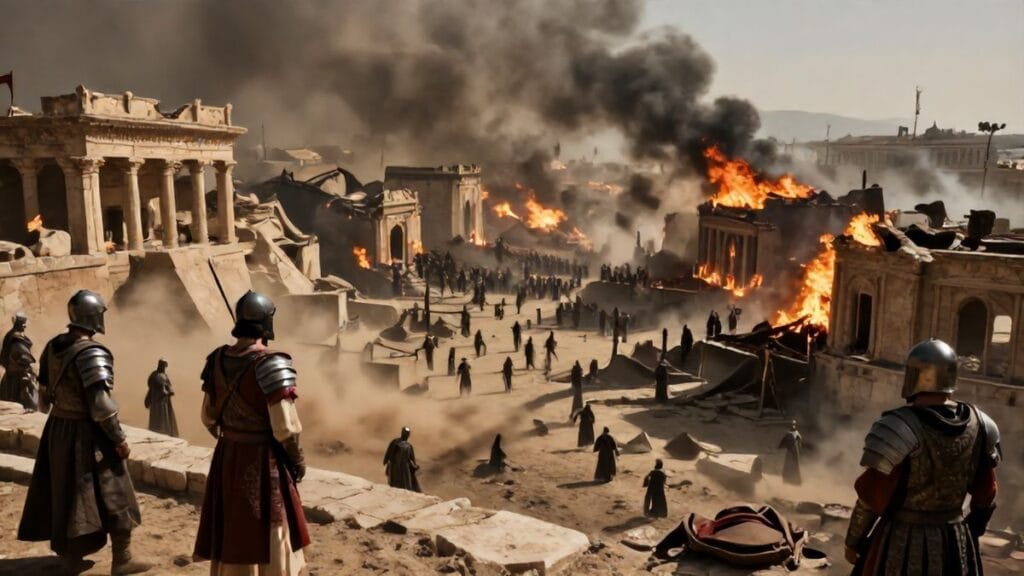
Fire followed steel. Whether set deliberately by Persian troops, kindled accidentally in the chaos, or lit by desperate defenders to block streets, flames soon leaped from wooden roofs to balconies draped with cloth. Antioch, a city already scarred by earlier conflagrations, now burned in multiple quarters at once. Smoke poured into the sky, turning day into a dim, red-tinged half-night in some districts.
Churches, palaces, and homes all became targets. The great churches of Antioch, repositories of relics and wealth, drew special attention. Altars were stripped, reliquaries seized, sacred vessels carried off as trophies. Some priests died at their posts, refusing to abandon their sanctuaries; others led small groups of the faithful in desperate attempts to hide or evacuate holy objects. Many failed. The Persian army, though not on a religious crusade in the way later medieval forces would conceive it, understood the value—material and symbolic—of Christian treasures.
In the streets, the human toll mounted. Men were cut down as they tried to defend their families. Women and children were seized as captives, herded together by soldiers barking orders in unfamiliar tongues. A few lucky—or ruthless—souls found hiding places: cellars, cisterns, dense garden thickets. Others met their end in burning houses, trapped as roofs collapsed under protesting beams.
By the time organized resistance had ceased, Antioch was no longer a functioning city. It was a battlefield littered with corpses, shattered masonry, and the possessions of thousands strewn across the ground. Khosrow, according to some reports, entered the city to inspect his victory. Whether he rode through its streets in person or surveyed from a distance, he knew that he had achieved something extraordinary. One of the Roman Empire’s brightest jewels had been taken—and broken.
The phrase “khosrow i sacks antioch” compresses into four words a universe of terror. For those who lived it, there was no neat summary, only the shattering of everything familiar in a single, relentless day. And yet, for many of Antioch’s survivors, the ordeal was not over. Conquest was followed by captivity.
Captives of the Shah: The Forced Deportation and the Birth of “New Antioch”
In the wake of the sack, the city’s ruins became a sorting ground. Persian officers directed the grim work of categorizing Antioch’s human spoils: those to be killed, those to be ransomed, those to be deported. Wealthy citizens, if they survived, might buy back their lives with remaining treasures; artisans and skilled workers were particularly valuable as living assets to be transplanted to Persia.
Long lines of captives were assembled—men with bound hands, women clutching children, the elderly stumbling as best they could. They were marched out of the city that had been their universe, past landmarks now ruined or burning, past the familiar silhouette of Mount Silpius, and onto roads leading east. Behind them, Antioch burned and smoldered. Ahead lay an unknown exile.
Khosrow did not intend to let this mass of people simply disappear into slavery across his empire. He had a more deliberate plan. According to sources like Procopius and later chroniclers, he ordered a special settlement to be created for many of the Antiochene captives near Ctesiphon. This new town was to be called “Weh-Andiyok-Khosrow” in Middle Persian—often rendered as “New Antioch of Khosrow” or “Khosrow’s Better Antioch.”
The shahanshah’s decision was laced with both practicality and symbolism. Practically, transplanting a large, urban population—replete with craftsmen, merchants, and administrators—could energize the local economy near the Persian capital. Symbolically, replicating Antioch in miniature on Persian soil proclaimed that what Rome could build, Persia could seize and imitate, even improve upon. The phrase “Better Antioch” was a taunt as much as a proud boast.
For the captives, the journey east was a nightmare. Days of marching, poorly fed and under guard, brought them into landscapes many had never seen: the plains of Mesopotamia, the broad flow of the Tigris, the vicinity of Ctesiphon’s great palaces. Some died along the way; others fell ill and were left behind. Those who survived arrived in an alien world where the language of authority, the rites of religion, the styles of architecture—all were different.
Yet even in captivity, Antioch lived. Its people carried their memories, their dialect, their saints’ names. In New Antioch, churches were eventually built, streets laid out, workshops opened. Khosrow, whether out of a desire to secure their productivity or to display magnanimity, is said to have granted at least some concessions: allowing them their own internal organization, perhaps even limited self-governance under chosen leaders.
Imagine a child born in New Antioch a decade after the sack, listening to elders speak of a city by the Orontes that he or she had never seen. There, they would say, was a river with different light, a mountain with a different profile; there, the churches had once held relics now lost, the hippodrome had once roared with chariot races whose dust stung the eyes. In their memories, Antioch became part city, part mythic homeland.
When khosrow i sacks antioch, he does more than destroy a city; he relocates a culture. Fragments of Antiochene life, severed from their native soil, take root in Mesopotamian ground. The human consequences of that spring of 540 thus reverberate on both sides of the frontier, reshaping communities in ways neither Justinian nor Khosrow could fully predict.
Echoes in Constantinople: Shock, Propaganda, and Imperial Resolve
News of Antioch’s fall did not travel instantly, but when it reached Constantinople, it struck like a thunderclap. Messengers arrived by sea and land, bearing stories whose horror outpaced the imagination of the imperial court. The emperor’s great eastern metropolis, jewel of Syria, had been captured and ravaged by the Persians. Priests were dead, citizens enslaved, churches burned. The great rivalry that had for so long remained on the frontier had suddenly invaded the heart of Roman self-confidence.
Justinian, surrounded by advisors and courtiers, faced both a political and a psychological crisis. He had staked his reign on the narrative of restoration and divine favor. Now, critics could whisper that God’s protection had faltered, that the emperor’s focus on Italy and the West had left the East exposed. The image of inviolable imperial order lay shattered alongside Antioch’s colonnades.
The imperial response was twofold. Publicly, Justinian and his propagandists framed the disaster in moral and eschatological terms. Sermons in the capital spoke of Antioch’s sins, of the mysterious workings of divine providence. Some preachers cast the sack as a chastisement meant to call the empire to deeper piety and doctrinal unity. A few, sympathetic to the emperor’s theological positions, hinted that the divisions stirred by heretics—by non-Chalcedonian dissenters in Syria and elsewhere—had weakened the body politic, inviting catastrophe.
At the same time, official narratives emphasized Justinian’s continuing vigor and resolve. Orders were issued to strengthen key fortresses, to reorganize eastern commands, to ensure that remaining cities in Syria and Mesopotamia would not fall as Antioch had. Envoys were dispatched to negotiate, threaten, or bribe as circumstances required. The empire could not simply re-take Antioch by force—its resources were stretched too thin—but it could show that it remained capable of defending its core.
Privately, rage and grief circulated through the elite. Senators who had family connections in Antioch mourned lost relatives and ruined estates. Bishops in Constantinople read letters from their colleagues in the East that recounted, sometimes in harrowing detail, the fate of specific churches, monasteries, and communities. One can imagine, in some cloistered corner of the capital, a scribe copying out a report that described the exact moment when Khosrow’s troops burst into a particular sanctuary, cutting down clergy and scattering relics.
A few voices, like that of Procopius in his more candid writings, hinted that Antioch’s fall was also a failure of policy, of planning, of attention. But criticism had to be measured; to attack the emperor too directly was dangerous. Instead, some blame was shifted to local commanders, to corrupt officials who had supposedly failed to maintain the city walls, to the intransigence of Antioch’s own leaders who had, allegedly, mismanaged the negotiations with Khosrow.
From Constantinople’s perspective, the sack of Antioch was both a humiliation and a test. It revealed the vulnerability of the empire’s eastern flank but also offered an opportunity for renewed mobilization and ideological tightening. The shock would shape Justinian’s subsequent decisions, pushing him to seek, eventually, another peace with Persia that might free resources once more for his western ambitions.
Faith Under Siege: Churches, Relics, and the Spiritual Meaning of Disaster
For the Christian communities of the Eastern Mediterranean, the sack of Antioch was more than a geopolitical event; it was a theological earthquake. Antioch was no ordinary city in the Christian imagination. It was the place where, according to the Acts of the Apostles, followers of Jesus were first called “Christians.” It had been home to great bishops and theologians, to John Chrysostom’s fiery sermons, to councils and debates that had shaped the very language of doctrine.
To see such a city humbled by a Zoroastrian ruler provoked difficult questions. How could God allow this? What did it say about the faith of Antioch’s Christians, about the orthodoxy of Justinian’s policies, about the cosmic struggle between Christ and the powers of this age? Some saw the disaster as a repetition of biblical patterns: like Jerusalem’s fall to the Babylonians, a sign of divine displeasure. Others argued that martyrdom and suffering were themselves signs of chosenness, that the blood of Antioch’s dead would be the seed of renewal.
Stories soon circulated about miraculous survivals and tragic losses. One account told of relics that had been smuggled out of the city in the chaos, wrapped in cloth and hidden among ordinary goods, ensuring that the saints would not be entirely severed from their flock. Another story, perhaps embroidered through retelling, claimed that an icon of Christ had wept or bled as Persian troops burst into its church, a sign that the Lord himself grieved for Antioch’s fate.
At the same time, the presence of captives in Persia created new, ambiguous spiritual networks. Christian communities already existed within the Sasanian Empire, often aligned with the Church of the East (loosely labeled “Nestorian” by their critics). The arrival of Antiochene Christians—many of them Chalcedonian—introduced fresh doctrinal tensions and opportunities for exchange. In New Antioch and other places of captivity, churches were built that sometimes stood at the crossroads of different traditions.
Later theologians and historians used the episode as a cautionary tale. One Byzantine chronicler, writing generations later, would cite Antioch’s fall as evidence that “arrogance before God is more perilous than any barbarian host.” Modern historians, such as those whose interpretations are synthesized by scholars like James Howard-Johnston, have emphasized how the disaster intensified the sense of an embattled Christian world on Rome’s eastern frontier.
When khosrow i sacks antioch, then, he unwittingly participates in a drama that transcends his own ideological frame. For him, the campaign is about imperial prestige, gold, and strategic advantage. For many of those who lived through it—or inherited its memory—it becomes a lens through which to view suffering, faith, and the mysterious interplay between divine providence and human cruelty.
Winners, Losers, and Survivors: The Human Cost of a Single Campaign
History often speaks in the language of empires—victories and defeats, treaties and borders. But the sack of Antioch, like every act of large-scale violence, etched itself most deeply into individual lives. For each chronicle that records that “Khosrow I sacks Antioch,” there were thousands of unwritten stories: a mother searching among the dead for her son, a craftsman forced to teach his trade in a foreign land, a child who would never again hear the sound of the Orontes at dawn.
The dead, by some accounts, numbered in the many thousands. Exact figures are elusive, and ancient sources often exaggerate or compress numbers to fit moral narratives. Yet even conservative estimates suggest a catastrophic loss of life. Death did not come only by the sword; it came by fire, by suffocation in collapsing houses, by dehydration and disease in the days that followed as the city’s infrastructure failed.
The enslaved and deported endured another kind of death—a social death. Torn from their networks of kin and patronage, stripped of property and free status, they had to rebuild identities under the eyes of new masters. Some may have risen in their new contexts, valued for their skills or knowledge. Others, less fortunate, labored and died in obscurity, their Antiochene origins remembered only in fading family stories.
Those who escaped or were ransomed faced a different burden: survivor’s guilt and the struggle to rebuild. Refugees from Antioch poured into other cities of Syria and beyond. They brought with them tales of horror that influenced the decisions of other civic leaders when faced with future threats. They also competed for resources with existing urban populations, adding tension to already strained economies.
On the Persian side, victory had its costs as well. Soldiers died in the assault; resources were consumed in the campaign and in the subsequent maintenance of deported populations. Some Persian nobles may have grumbled at the strain, even as they benefited from the influx of skilled captives and war booty. The glory of the sack came entwined with a logistical and administrative burden that would shape Persian policy for years.
Psychologically, the event imprinted itself on both societies as a symbol of vulnerability. Romans learned that no eastern city, however great, was beyond reach. Persians, seeing the ease with which a major Roman metropolis could be taken under the right conditions, tasted a heady mix of triumph and overconfidence. For individuals, these broader moods translated into a keen, personal awareness that the world could change overnight, that walls and customs and assumptions could all be swept away by forces beyond any one person’s control.
From Ruins to Reform: How the Sack Reshaped Roman-Persian Strategy
The shock of 540 did not freeze the empires in place; it forced them to adapt. In the years that followed, policymakers in both Constantinople and Ctesiphon integrated the lessons of Antioch into their strategic thinking. The sack became both a warning and a precedent.
For the Romans, the clearest lesson was that their eastern defenses were dangerously thin when attention and resources were focused elsewhere. Justinian ordered reinforcements to key strongholds and began to think more systematically about layered defense in depth, not just relying on a few major cities. Command structures were revised; new generals rose to prominence; temporary expedients—such as ad hoc levies or rushed payments of tribute—gave way, at least in planning, to more durable arrangements.
Diplomatically, the empire oscillated between confrontation and accommodation. After further campaigning, both sides eventually returned to the negotiating table, leading to a new arrangement in the 540s and 550s that saw Rome resuming regular payments to Persia in exchange for relative quiet on the eastern front. The memory of Antioch’s fate loomed over these talks. Roman negotiators knew what was at stake if peace collapsed; Persian negotiators had the confidence of those who had already proven their ability to strike deep.
On the Persian side, the campaign validated Khosrow’s more assertive approach. Yet it also highlighted the risks of overextension. Maintaining forward operations far from core territories was costly, and while Antioch had been a glittering prize, not every Roman city promised such returns. Over time, Khosrow sought to balance spectacular raids with more sustainable arrangements—arms-length dominance through tribute and influence rather than constant warfare.
Military thinkers on both sides took note of the importance of negotiation and psychological warfare. Khosrow’s careful probing of local loyalties, his offers of favorable terms to some cities while threatening others, became a model for future campaigns. Roman commanders, chastened, became more aware of the need to engage with local elites, to ensure that fear of imperial displeasure did not outweigh fear of the invading army when decisions about surrender or resistance were made.
In this sense, the phrase “khosrow i sacks antioch” came to mean not just a single event, but a turning point that altered the texture of Roman-Persian relations. The empires had long danced along their shared borders; after 540, the tempo and steps of that dance changed. Both sides understood more clearly the potential rewards and catastrophic costs of deep penetration into enemy territory.
Memory and Myth: How Later Generations Remembered the Fall of Antioch
Centuries after the flames of 540 had died, the sack of Antioch lived on in texts, sermons, and stories. Medieval chroniclers, working from earlier sources like Procopius, embellished details, shaped narratives to fit their own times, and folded the event into broader arcs of meaning. For some, it was one episode in an age-long conflict between Christendom and the “pagans” or “fire-worshipers” of Persia. For others, it illustrated a familiar moral lesson: pride comes before the fall.
In Syriac and Arabic chronicles, Antioch’s fate was sometimes paired with later disasters—earthquakes, conquests, and plagues—creating a sense of the city as perpetually vulnerable, a place where the earthly glory of urban life was always being tested by divine or worldly forces. In Byzantine literature, the name of Khosrow became shorthand for a certain kind of royal cunning and glory, tinged with menace. One historian might write of “the time when khosrow i sacks antioch” as a benchmark by which to measure subsequent calamities.
Modern historians, with access to both Roman and Persian traditions, have revisited the episode with more critical tools. They weigh Procopius’s sometimes dramatic prose against archaeological evidence and Persian sources. Some argue that the scale of destruction, while immense, may have been somewhat less apocalyptic than certain accounts suggest, noting signs of subsequent reoccupation. Others emphasize the long-term demographic and economic blows that the deportations and devastation inflicted on northern Syria.
Yet even in sober academic analysis, the sack retains its drama. As the historian Geoffrey Greatrex has noted, the campaign of 540 stands as one of the most audacious Sasanian offensives into Roman territory, unmatched in its symbolic impact until the even more catastrophic invasions of the early seventh century. It occupies a crucial place in the story of late antiquity, illustrating both the resilience and fragility of Mediterranean and Near Eastern urban life on the eve of the Islamic conquests.
The mythic dimension persists as well. In popular retellings, Khosrow becomes almost a character from epic, a figure who strides across the stage of history, toppling cities, patronizing philosophers, and outwitting emperors. Antioch, in turn, becomes a tragic heroine—beautiful, beloved, and doomed. The emotional resonance of the story continues to draw readers, listeners, and viewers, reminding us that even in an age saturated with images of destruction, the fall of a single city can still move the imagination.
Antioch’s Long Twilight: From Great City to Historical Ghost
After 540, Antioch did not simply vanish. The city’s story continued, though in fits and starts and increasingly in minor keys. The Romans, unwilling to abandon such a strategically and symbolically important site, undertook rebuilding efforts. New fortifications were constructed; damaged neighborhoods were partially restored. People trickled back—some returning survivors, some newcomers drawn by opportunity in a city that, though wounded, still occupied a privileged geographic position.
Yet Antioch never fully reclaimed its former stature. The combination of demographic loss, economic disruption, and the psychological blow of the sack left lasting scars. Subsequent decades brought new challenges: further wars, outbreaks of plague (including the infamous Justinianic Plague), and continued theological tensions. The city remained important but no longer felt invulnerable, no longer quite the rival to Constantinople or Alexandria it had once imagined itself to be.
In the early seventh century, renewed Persian invasions under Khosrow II and then the dramatic rise of the Arab-Muslim armies again brought Antioch into the path of conquest. Each wave of conflict reshaped the city’s population and built environment. By the time it settled into its role under Islamic rule, Antioch was still a notable urban center, but its moment as the “Queen of the East” in the Roman imagination had passed. Other cities—Damascus, for instance—began to eclipse it.
Earthquakes and later medieval wars inflicted further damage. Neighborhoods were abandoned; once-busy thoroughfares shrank into modest streets. The Orontes still flowed, Mount Silpius still cast its shadow, but the soundscape of the city changed. The roar of the hippodrome faded into memory; bells gave way, in time, to calls to prayer; Greek and Latin gave ground to Syriac and Arabic.
Modern archaeology has helped retrieve some sense of Antioch’s former magnificence: mosaics of extraordinary artistry, fragments of colonnades, traces of massive walls. Yet for many, Antioch remains more a name in books than a living place, a ghost twining through late antique history. The phrase “khosrow i sacks antioch” encapsulates one moment in that long twilight when the city’s fate turned sharply, setting it on a path from dominant metropolis to historical echo.
Standing on the site today—or in nearby Antakya, the modern successor—you walk on layers of time: Hellenistic foundations, Roman pavements, Byzantine churches, Islamic mosques, Ottoman houses. Somewhere beneath your feet lies the dust of 540, the ash from fires lit when Khosrow’s troops burst through the walls. The city did not die that day, but something in its self-understanding did. What remained was a more fragile, more contingent urban life, forever marked by the knowledge that even the greatest of cities can fall.
Conclusion
When we say that Khosrow I sacks Antioch, we compress into a single phrase an entire world of causes and consequences. The sack was not an isolated eruption of violence but the product of decades of imperial rivalry, of Justinian’s overextended ambitions, of Khosrow’s reforms and thirst for prestige, of frontier disputes and financial strains. It unfolded against the backdrop of a richly textured urban life in Antioch, a city whose people prayed, traded, argued, and loved under the shadow of walls they believed would keep them safe.
The fall of Antioch in 540 demonstrated, with merciless clarity, the fragility of that safety. In one campaign, a shahanshah crossed boundaries that Romans had imagined secure, shattered a metropolis that had survived earthquakes and riots, and carried off its people to populate a “Better Antioch” on foreign soil. The flames that consumed the city’s houses and churches illuminated more than stone and wood; they exposed the limits of imperial power and the vulnerability of human communities caught between great powers.
Yet the story does not end in fire. Survivors rebuilt; captives forged new lives in exile; the city itself, though diminished, endured for centuries. The memory of 540 shaped policies, sermons, and stories on both sides of the Roman-Persian frontier. It became a reference point for later disasters, a touchstone in discussions of divine justice, imperial hubris, and the meaning of suffering.
To trace this episode is to see late antiquity in sharp relief: its glittering cities and reforming kings, its theological controversies and frontier wars, its capacity for both creativity and destruction. Antioch’s ordeal reminds us that history is made not only by the grand designs of emperors and shahanshahs but also by the decisions of city councils, the bravery of defenders on crumbling walls, and the resilience of families who, even after losing everything, find ways to begin again.
FAQs
- Who was Khosrow I, and why did he attack Antioch?
Khosrow I (Khosrow Anushirvan) was the shahanshah of the Sasanian Empire from 531 to 579 CE, renowned for his administrative reforms and military prowess. He attacked Antioch in 540 as part of a calculated offensive against the Eastern Roman Empire, aiming to extract tribute, weaken Justinian’s prestige, and demonstrate Persia’s ability to strike at major Roman cities deep inside imperial territory. - Why was Antioch such an important target?
Antioch was one of the largest and most influential cities of the Eastern Roman Empire, a major administrative, commercial, and religious center often called the “metropolis of the East.” Striking Antioch allowed Khosrow I to hit not just a strategic location but also a powerful symbol of Roman power, second only to Constantinople in prestige. - How did the sack of Antioch actually unfold?
The Persians advanced through Roman territory with a mix of force and diplomacy, demanding payments from towns along their path. After negotiations with Antioch’s leaders failed—largely over the scale of tribute and political fears—the Persian army besieged the city, breached its defenses, and engaged in brutal street fighting. Once resistance collapsed, Persian troops looted the city, set fires, and seized thousands of inhabitants as captives. - What happened to the people of Antioch after the sack?
Many were killed during the assault and subsequent violence; thousands more were enslaved or deported. A significant portion of the surviving population was resettled near Ctesiphon in a new town called “New Antioch” or “Better Antioch of Khosrow,” where they formed a transplanted community under Persian authority, preserving aspects of Antiochene culture in exile. - How did Justinian and the Eastern Roman Empire respond to the disaster?
The sack of Antioch shocked Constantinople and undermined Justinian’s aura of invincibility. The empire reinforced its eastern defenses, reorganized military commands, and eventually negotiated new peace arrangements with Persia, including renewed tribute payments. Publicly, the event was framed in moral and religious terms, as both a chastisement and a call to greater piety, while privately it spurred strategic reassessment of the eastern frontier. - Did Antioch recover from the sack of 540?
Antioch was partially rebuilt and continued to function as a regional center, but it never fully regained its former prominence. Repeated wars, earthquakes, and later conquests eroded its status over time. By the medieval period, it remained important but no longer occupied the near-legendary place it once held in the Roman and early Byzantine imagination. - Why is the sack of Antioch in 540 historically significant today?
The event illuminates the nature of Roman-Persian rivalry in late antiquity, the vulnerability of even major cities to sudden military shocks, and the human cost of imperial ambition. It serves as a case study for how warfare, diplomacy, religion, and urban life intersected in the sixth century—foreshadowing the even greater upheavals that would remake the Near East in the decades that followed.
External Resource
Internal Link
Other Resources
- Encyclopaedia Britannica – general search for the exact subject
- Google Scholar – academic search for the exact subject
- Internet Archive – digital library search for the exact subject

