Table of Contents
- Whispers of Holy War: Setting the Stage for Barbastro, 1064
- A Frontier of Faiths: The Shifting World of the Taifa of Zaragoza
- From Cloister to Court: How the Idea of Barbastro Was Born
- Knights on the Road to Aragon: The Cross-Border Army Assembles
- Barbastro Before the Storm: Life in a Frontier City
- The March on the Cinca: The Christian Coalition Advances
- Encircling the Walls: The Opening Moves of the Siege
- Engines of Devastation: Tactics, Technology, and Terror
- Inside the Besieged City: Hunger, Faith, and Defiance
- Breaking Point: The Fall of Barbastro
- Plunder, Slaughter, and Captivity: The Human Cost Revealed
- Triumph and Unease: How Christendom Read the Victory
- The Muslim Counterstroke: Barbastro Recaptured
- Echoes Through Europe: From Barbastro to the First Crusade
- Faith, Propaganda, and Memory: Writing the Story of Barbastro
- Lives in the Shadow of the Walls: Ordinary People and the Siege
- A Laboratory of Holy War: Was Barbastro a “Proto-Crusade”?
- Legacy on the Iberian Frontier: Reconquista, Jihad, and Coexistence
- Modern Historians and a Contested Past
- Conclusion
- FAQs
- External Resource
- Internal Link
Article Summary: In the summer of 1064, the siege of Barbastro turned a modest frontier city in the Taifa of Zaragoza into a stage for some of the most brutal and revealing events of the eleventh century. A coalition of Christian warriors from across the Pyrenees, sanctioned by the papacy and welcomed by King Ramiro I of Aragon, descended on the Muslim-held city in what many historians now see as a rehearsal for the later crusades. Over days of encirclement and assault, the siege of Barbastro exposed the fragile balance of convivencia—coexistence—between Christians and Muslims in Iberia, replacing it with a new, harsher language of holy war. The city’s fall unleashed slaughter and mass enslavement, whose memory and exaggeration echoed from monastic chronicles to royal courts. Yet the victory proved fleeting when Muslim forces retook Barbastro, revealing the limits of both Christian ambition and papal power at this early date. This article follows the story from the political intrigues of the Taifa of Zaragoza to the cries of families on the walls, from medieval battle tactics to the long afterlife of the event in European memory. By tracing how the siege of Barbastro has been told, retold, and contested, we can better understand how an obscure frontier battle helped shape the imagination of crusade and Reconquista alike.
Whispers of Holy War: Setting the Stage for Barbastro, 1064
The story of the siege of Barbastro begins not with the crash of battering rams against stone but with rumors moving quietly along the roads of western Europe. In the early 1060s, long before the thunderous call of Pope Urban II at Clermont, anxious voices in cloisters, courts, and marketplaces were already speaking of a different kind of war—one that promised both the forgiveness of sins and the spoils of conquest. In Aragon, a small Christian kingdom wedged between the Pyrenees and the Ebro valley, the name “Barbastro” began to draw the attention of men whose lives otherwise would have remained confined to local feuds and narrow horizons.
Barbastro itself was hardly a metropolis. Perched near the River Cinca, it was a fortified town in the northeastern corner of the Taifa of Zaragoza, one node in the patchwork of Muslim-ruled principalities that had arisen after the collapse of the Umayyad Caliphate of Córdoba. Yet its very position—a Muslim stronghold pressed up against ambitious Christian neighbors—made it a target and a symbol. To some, taking Barbastro meant security, a bulwark against enemy raids; to others, it meant prestige, a stepping stone toward greater influence in Iberia’s brutal game of dynastic survival.
But this was only the beginning. As word spread that Pope Alexander II, or perhaps his circle in Rome, was willing to bless a military campaign in Spain, Barbastro’s fate slipped out of local hands. The city, with its mixed population of Muslims, Christians, and Jews, suddenly stood at the edge of a gathering storm—a storm fueled by the energies of northern French knights, Italian adventurers, and Aragonese lords seeking allies and redemption. The siege of Barbastro would grow out of this convergence: local politics, global religious rhetoric, and the personal ambitions of warriors in search of glory.
It’s astonishing, isn’t it, that a town unknown to most of Europe could, in a single summer, become a symbol of holy war? Yet that is what happened in 1064. To understand why, we must travel back a little further, into the shifting landscapes of eleventh-century Iberia and the fractured world of the Taifa kingdoms, where emirs courted Christian kings even as they prayed toward Mecca, and where alliances shifted as quickly as the desert winds.
A Frontier of Faiths: The Shifting World of the Taifa of Zaragoza
By the time the siege of Barbastro unfolded, the Iberian Peninsula had already lived through centuries of turbulence. The great Umayyad Caliphate of Córdoba, which had once projected an image of dazzling stability—of libraries, palaces, and ordered government—had collapsed in the early eleventh century. In its place rose the taifas, small, often fragile principalities carved out by ambitious families and military strongmen. One of the most important of these was the Taifa of Zaragoza, whose rulers looked both south to their Islamic rivals and north to the Christian kingdoms beyond the Pyrenees.
The emir who presided over Zaragoza during the mid-eleventh century, Ahmad al-Muqtadir, was a cultured and capable ruler, but he inherited a fractured world. He controlled a rich region anchored by the city of Zaragoza, with its grand mosque and bustling markets, but his authority over outlying fortresses and towns like Barbastro was never completely secure. Local governors, often from powerful military families, kept one eye on their emir and another on the Christian lords of Aragon, Navarre, and Catalonia. Tribute, or parias, passed northward in regular streams of gold, grain, and hostages—payments meant to buy peace, or at least postpone invasion.
This uneasy arrangement produced a frontier that was neither simple battlefield nor peaceful border. In towns like Barbastro, Muslim artisans worked alongside Mozarabic Christians who kept their own rites and liturgies, while Jews served as translators, tax officials, and merchants. Markets sold wool, wine, oil, and weapons; languages mingled—Romance dialects, Arabic, Hebrew—sometimes harmoniously, sometimes not. Raids crossed the frontier in both directions: Christian cabalgadas slicing into Muslim lands for plunder, Muslim counter-raids burning villages and seizing captives. Yet even amid these violences, treaties were signed, marriages arranged, and mercenary contracts negotiated.
This was the world that made Barbastro strategically vital. The town guarded the approaches from the Pyrenees toward the fertile valley of the Ebro. Whoever held Barbastro could threaten the heartlands of Zaragoza or, conversely, could project raids deep into Aragonese territory. For al-Muqtadir, the town was a forward shield; for Ramiro I of Aragon, it was both a dangerous spear in Muslim hands and a tempting prize. In this fractured landscape—where faith identities were sharpening, but political loyalties flowed with pragmatism—the siege of Barbastro would soon reveal the darker possibilities of frontier life.
From Cloister to Court: How the Idea of Barbastro Was Born
Before siege engines rolled across the dusty roads toward Barbastro, there were letters and sermons. In northern Italy, in the circle surrounding Pope Alexander II, reports from Spain began to accumulate. They described Christian communities living under Muslim rule, paying taxes to emirs, and enduring, at least in the eyes of these distant clerics, the “yoke of the infidel.” Such descriptions were certainly partial and exaggerated, filtered through the concerns of clergy who saw the world through a stark lens of faith and heresy. But they were powerful. They suggested that, on the far edge of Western Christendom, there was a theater where violence could be sanctified.
At the same time, rulers in Iberia looked northward for allies. Ramiro I of Aragon was engaged in the slow, grinding process we call the Reconquista—a term later historians would use to describe centuries of intermittent expansion by Christian polities over lands held by Muslims. In reality, Ramiro’s goals were more immediate and personal: security against raids, control of routes through the mountains, prestige among Iberian and Frankish peers. Facing powerful Muslim neighbors, he recognized that his own resources were limited. Foreign warriors—restless knights from Aquitaine, Burgundy, and beyond—might change the balance.
Somewhere in this mess of interests, a proposal coalesced. A campaign would be launched against Barbastro, a Muslim stronghold whose capture could be framed as both strategic and sacred. Clergymen in the cities of southern France, such as Narbonne, as well as in the monasteries of Cluny’s vast network, preached the cause. They offered the promise that those who fought in Spain for the faith would receive spiritual rewards. One near-contemporary source suggests that Pope Alexander II granted some form of indulgence or remission of sins to those who took part—a bold innovation, anticipating the full-blown crusade indulgence of the late eleventh century.
The idea began its journey from cloister to court. Envoys rode from Aragon to Toulouse and Poitiers; messengers crossed the Alps to the papal court. The language used was increasingly apocalyptic: Muslims were depicted not merely as political rivals but as enemies of Christendom. A war for land became, in the rhetoric of letters and charters, a war for souls. Historians like Jonathan Riley-Smith and Carl Erdmann would later see in these documents the outlines of what might be the first “papally endorsed holy war” in the Latin West since late antiquity—a direct forerunner of the crusading movement.
In this sense, the siege of Barbastro was born twice. Once, as a practical decision by Aragonese rulers and their allies to attack a crucial frontier fortress. And again, as a rhetorical construction in the minds of churchmen and chroniclers, who framed the campaign as a sacred undertaking. It is at this intersection—between pragmatic politics and spiritual imagination—that Barbastro becomes more than just another medieval siege. It becomes a key episode in Europe’s slow, violent pivot toward the age of Crusades.
Knights on the Road to Aragon: The Cross-Border Army Assembles
The roads of 1064 were not empty. Across the kingdoms of France and beyond, armed men were already accustomed to moving—whether to tournaments, to local feuds, or to pilgrimages. Yet the force that converged on Aragon that year was something new. It was not a single army following a clear feudal hierarchy, but rather a patchwork coalition of lords and knights drawn together by a mix of motives: piety, greed, adventure, and political calculation.
Sources, including the Chronicon Sancti Maxentii and other annals from Aquitaine and Burgundy, suggest that a significant contingent came from northern France. Some accounts mention William VIII of Aquitaine, the powerful duke whose lands stretched from the Loire valley to the Pyrenees. Others hint at noblemen from Burgundy, perhaps influenced by the reforming zeal of Cluniac monasteries. Catalan counts, whose own lands bordered the Muslim territories to the east, likely joined as well, bringing local knowledge and longstanding grievances.
What did these knights expect? Many probably imagined a limited expedition, a chance to win booty and prestige, then return home with tales of valor. Others, especially those tutored in the language of reforming churchmen, believed that fighting Muslims in Spain could cleanse them of the sins accumulated in a life of violence and feuding. For them, the road to Barbastro was also a road of penitence, lined with prayers, relics, and masses said for safe passage and spiritual favor.
As they moved south, these warriors entered landscapes increasingly unfamiliar. The Romance dialects spoken in Aragon differed from those of Poitou or Burgundy; the sight of mosque towers on the skyline and the call to prayer in the distance must have seemed both strange and thrilling. The frontier world of the Ebro valley, dotted with castles bearing Arabic inscriptions and vineyards worked by Christian peasants under Muslim landlords, offered a contrast that sharpened their sense of religious difference—even if the local reality was far more entangled than their sermons had suggested.
By the time these contingents reached Ramiro I’s domains, the coalition had swelled to a formidable size. Exact numbers are impossible to know—medieval chroniclers loved exaggeration—but it is reasonable to imagine several thousand combatants, including heavy cavalry, infantry, and support personnel. Their banners, emblazoned with crosses and family emblems, fluttered over encampments where Latin prayers mingled with the smell of horse sweat, woodsmoke, and oiled armor. The siege of Barbastro was no longer an idea; it was an army on the move.
Barbastro Before the Storm: Life in a Frontier City
While this coalition assembled, life in Barbastro followed its wary routines. Behind its defensive walls, the city clung to the slopes above the Cinca, clustered around a central mosque and market. Narrow streets wound between houses of mud brick and stone, with inner courtyards shaded by vines or fig trees. The local governor, appointed—at least nominally—by al-Muqtadir of Zaragoza, balanced the demands of his emir with the pressures of a restless frontier.
The city’s population was diverse. The majority were Muslims: Arab and Berber families whose ancestors had come to the peninsula generations earlier, along with local converts who had embraced Islam for faith, opportunity, or both. A smaller but visible group of Christians, often called Mozarabs, maintained their own churches and rites under the protection—and taxation—of the Muslim authorities. Jewish families, some long-established, some recent arrivals drawn by trade, worked as merchants, moneychangers, and intermediaries.
Everyday life was punctuated by the rhythms of religious observance. The call to prayer rose five times a day from the mosque, answered in quieter fashion by the bells of small Christian churches. The Friday sermon might mention distant politics—shifts in the balance of power between the taifas, rumblings of conflict in North Africa—but it also spoke to local concerns: the harvest, trade routes, the need for vigilance against raids.
People in Barbastro were used to danger. Stories of Christian incursions from the north were told around hearth fires: villages burned, livestock seized, captives led away in chains. Likewise, some of Barbastro’s own fighters had ridden out on raids into Aragonese or Navarrese territory, returning with goods and prisoners. War, in this world, was both terror and opportunity. But the idea of a massive, cross-border Christian coalition descending with something like divine license—that was not part of their everyday imagination. Not yet.
Still, signs of approaching trouble must have filtered in. Traders and shepherds carried rumors: more Christian knights than usual gathering in Aragon, new alliances being sealed, unusual movements along the roads. The governor likely strengthened patrols, inspected walls, and took stock of the garrison. Grain was measured, cisterns checked, and messages dispatched downriver to Zaragoza. The people of Barbastro had endured sieges before; the town’s very walls were testimony to a history of attack and defense. Yet nothing in their past quite prepared them for the ferocity of the siege of Barbastro in 1064.
The March on the Cinca: The Christian Coalition Advances
When the allied Christian forces finally set out toward Barbastro, they did so as participants in what some contemporaries already saw as a holy expedition. Crosses were displayed; priests accompanied the column; masses were said at significant stopping points. But beneath the religious drama lay the hard facts of logistics and strategy. An army, whatever its motives, must eat, must rest, must navigate terrain and enemy counterattacks.
The march from the Pyrenean foothills toward the Cinca valley took the coalition through rough country. Paths clung to hillsides, and river crossings sometimes became bottlenecks. Scouts rode ahead, seeking news of Muslim forces and assessing possible ambushes. Local Aragonese guides, familiar with both the geography and the shifting alliances of the region, pointed the way. Behind the vanguard came the main body: armored cavalrymen leading warhorses, infantry with shields and spears, wagon trains laden with food, tents, siege tools, and perhaps the disassembled components of wooden towers and rams.
From time to time, smaller Muslim detachments may have attempted to shadow or harass the advancing host. Yet the sheer scale of the Christian coalition made any full engagement risky. Al-Muqtadir and his commanders had choices: rush to Barbastro’s relief before the Christians could settle into a siege, or conserve forces and wait for a more favorable moment. The decision, whether driven by miscalculation, logistical constraints, or political hesitations, ended with Barbastro largely left to fend for itself.
As the Christian army approached, the landscape itself bore witness. Fields were trampled, villages stripped of supplies, livestock seized. For peasants on both sides of the frontier, the language of “holy war” might have mattered less than the immediate reality of foraging soldiers at their door. War was not an abstract contest of faiths; it was the loss of grain stores, the burning of barns, the fear that one’s children might be taken as spoils of victory.
At last, the towers and walls of Barbastro came into view. For the men in the Christian ranks, the sight must have stirred adrenaline and unease. This was the object of months of preaching and planning, the city whose fall would earn them both booty and, so they had been promised, a share in heavenly favor. For the inhabitants watching from the walls, the growing forest of enemy banners below signaled that the time of rumors was over. The siege of Barbastro had begun in earnest.
Encircling the Walls: The Opening Moves of the Siege
Any medieval siege was an exercise in grim patience. The first step for the attackers was to encircle Barbastro, cutting it off from supplies and possible relief. Camps were established on the surrounding heights, chosen for tactical advantage and access to water. Tents and makeshift shelters of cloth and wood sprang up in clusters organized by lordship and region: Aquitainians here, Burgundians there, Aragonese and Catalans closer to familiar terrain. Fires burned day and night, their smoke drifting up to the watchmen on the walls.
Negotiation, too, was part of the opening act. It is likely that emissaries were sent to the city’s governor, demanding surrender under certain terms: perhaps safe conduct for those who left, perhaps a heavy tribute and control of the fortress. Such offers served several purposes. They allowed the attackers to present themselves as rational and, in their own eyes, just; they tested the morale and resolve of the defenders; and, when refused, they offered a pretext for inflicting harsher measures. In the climate of holy war rhetoric surrounding the siege of Barbastro, refusal could be framed as stubborn defiance against the will of God.
The defenders, for their part, had little reason to trust these overtures. Stories of Christian brutality, whether exaggerated or not, surely reached their ears. The governor had to calculate: could the city hold out long enough for al-Muqtadir or neighboring Muslim rulers to muster a relieving army? Did his soldiers and townspeople have the will to endure hunger, fear, and the daily grind of bombardment? Honor, faith, and fear of reprisal all pulled toward resistance. For many within the walls, surrender might have seemed not a path to safety but a route to enslavement or massacre.
Once negotiations failed, the lines hardened. Watchtowers were manned day and night; gates were barred and reinforced. In the Christian encampment, commanders discussed how to bring down Barbastro’s defenses. The siege did not yet resemble the massive, technologically sophisticated operations seen at cities like Antioch or Jerusalem decades later, but the same principles applied. The attackers would combine blockade, bombardment, mining, and direct assault, searching for a weakness in the city’s armor.
As the first stones from enemy engines began to crash against Barbastro’s walls and rooftops, the people inside felt the city shrink. Streets that once carried the bustle of trade now echoed with the clatter of running feet, shouted orders, and the thud of projectiles. The siege of Barbastro was no longer a distant threat or a set of numbers in a tax ledger; it was a lived experience, measured in broken masonry, dwindling food, and the tightening circle of steel outside.
Engines of Devastation: Tactics, Technology, and Terror
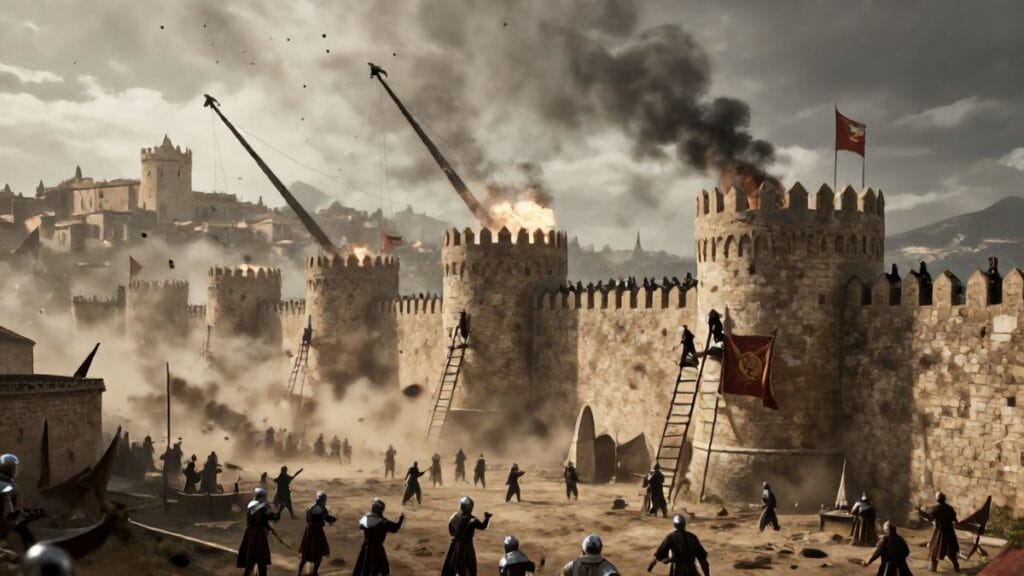
To break a city’s will, medieval besiegers attacked both stone and spirit. Outside Barbastro, the Christian coalition set to work constructing siege engines. Wooden towers, hastily assembled from local timber, could be rolled toward the walls, allowing archers and crossbowmen to fire down onto defenders at close range. Battering rams, sheathed in wet hides to resist fire, swung rhythmically against gates and vulnerable sections of masonry. Mangonels and early trebuchets hurled stones and occasionally incendiary materials over the walls, smashing roofs, chipping parapets, and spreading fear.
These machines were as much psychological weapons as physical ones. To watch a wooden tower gradually approach, despite one’s best efforts to burn or topple it, was to feel the inevitability of breach. The thunder of a ram against a gate reverberated through the very bones of the city. Even when missiles missed their mark, they created an atmosphere of constant peril. There was no truly safe space; any courtyard, any alley might suddenly be shattered by a falling stone.
The defenders answered with their own techniques. Archers lined the battlements, loosing arrows and quarrels at the engineers and soldiers manning the towers and rams. Cauldrons of boiling water or oil might be tipped over the edge, while hooks and poles sought to catch and tear down scaling ladders. In some places, they may have employed counter-mining—digging tunnels to intercept those of the attackers, then collapsing them to create deadly cave-ins. Every day became a contest of wood, iron, and ingenuity.
Yet technology alone did not decide the siege of Barbastro. Morale and supplies were just as critical. Within the walls, food stocks began to run low. Grain measured carefully in the first days of the siege was now stretched with unripe crops, roots, and whatever animals could be spared. For the poor, whose margins were thin even in peacetime, hunger came quickly. Disease followed, for crowded conditions and stress weakened bodies already worn down by scarcity. The sound of siege engines outside mingled with the quiet, persistent coughs of the sick and the cries of children whose bellies ached.
Outside, too, hardship took its toll. Armies in the field were vulnerable to weather, disease, and the grinding boredom of siege warfare. Not every knight relished the slow labor of digging trenches or hauling timber. Some chafed at discipline, seeking unauthorized skirmishes or plunder in the countryside. Commanders had to hold this volatile coalition together, reminding them of the rewards promised—not only in this world but, as priests and chaplains insisted, in the next. Against this backdrop of human frailty and stubborn will, the siege crept on, day by bruising day.
Inside the Besieged City: Hunger, Faith, and Defiance
From the vantage point of chroniclers and military leaders, the siege of Barbastro can look like a chess match of strategies and decisions. But for those trapped within the walls, it was something far more intimate: a daily struggle to reconcile fear with faith, to preserve dignity under the constant shadow of death. In houses pressed against the city’s inner slopes, families gathered to share dwindling meals, to whisper news, to decide what few possessions they might try to save if the worst came.
Religious life intensified under siege. In the central mosque, the imam led prayers for deliverance, reciting verses of the Qur’an that spoke of patience, steadfastness, and God’s ultimate justice. Some Muslims may have taken comfort from stories of early Islamic battles, where smaller forces prevailed against odds by virtue of courage and divine favor. Christian and Jewish inhabitants, too, sought solace in their own rituals—attending clandestine services in small churches or synagogues, lighting candles, reciting psalms. The city became a mosaic of overlapping pleas to heaven, all rising under the same sky crossed by the arcs of enemy stones.
Social tensions, always present beneath the surface, threatened to break through. As food supplies shrank, the wealthy sought to protect their stores, sometimes at the expense of the poor. Rumors of hoarding, betrayal, or secret negotiations could spread like sparks in dry grass. The governor’s task was delicate: he had to maintain order without alienating the very people whose cooperation was essential to the city’s survival. Punishments for theft or dissent might be harsh, yet too much brutality risked stirring rebellion at the worst possible moment.
Meanwhile, on the walls, the city’s defenders—professional soldiers, local militia, and volunteers—fought a battle measured not only in casualties but in hours of vigilance. Sleep became a scarce commodity. Some would have stood watch all night, squinting into the darkness for signs of a stealthy assault, then snatched only a few moments of rest before returning to their posts. The sight of fallen comrades, broken by stones or pierced by arrows, etched itself into memory, leaving scars that would outlast the siege itself.
And yet, defiance endured. So long as the walls held and some hope of relief remained, Barbastro refused to yield. People found ways to adapt: grinding millet into meal, mending damaged roofs between bombardments, comforting children by telling stories of past sieges survived. Perhaps they remembered the words of earlier poets and preachers who had spoken of the ebb and flow of fortune, of how cities rise and fall but faith endures. That determination, born of desperation and pride, prolonged the siege of Barbastro—and deepened the tragedy that would follow.
Breaking Point: The Fall of Barbastro
No medieval siege lasts forever. At some moment—often invisible to those living through it—the balance tips. In Barbastro, that moment came when a crucial section of the defenses gave way, whether through sustained bombardment, successful mining, or a coordinated assault that overwhelmed exhausted defenders. Chroniclers do not provide a detailed battle map, but they agree on one essential fact: the city fell not through negotiation but through violence.
Imagine the decisive day. Dawn breaks over the encircling hills, revealing the familiar pattern of camps and watchfires. But in one sector, perhaps where the walls had been weakened by days of ramming, the attackers gather in unusual numbers. Wooden mantlets—portable shields—are rolled forward to protect sappers. Archers surge to the front, their volleys driving defenders from the parapets. Behind them, infantry with axes and crowbars rush the base of the wall or gate. A ram swings, again and again, its impact now rewarded by the ominous groan of stressed timber or cracking stone.
Inside, the alarm spreads quickly. Bells or drums sound; messengers sprint through narrow streets, calling men to the threatened point. But fatigue and fear cannot be set aside by command. Some defenders fight with reckless courage; others, confronted with the sight of the wall actually crumbling, feel something rupture inside themselves. When a breach finally opens and the first wave of attackers pours through, the fragile equilibrium of resistance shatters.
Battle within the city is more chaotic and intimate than combat on open ground. Streets twist and funnel movement; doorways and alleys offer surprise ambushes but also dead ends. As Christian troops fight their way inward—shouting war cries, crosses and banners raised above the melee—civilian spaces become killing grounds. A courtyard where children once played now echoes with the clash of steel and the screams of the wounded. Smoke begins to rise as fires break out, whether set deliberately or sparked accidentally in the tumult.
Some defenders likely tried to rally around key positions: the governor’s residence, the citadel, the central mosque. Yet as more sections of the walls were compromised and fresh waves of attackers surged into the city, organized resistance collapsed into pockets of last-ditch fighting. For many, the urgent question changed from “How do we save Barbastro?” to “How do we save our families?” The siege of Barbastro, which had once seemed a contest between armies and emirs, was now a desperate struggle for individual survival, played out in the choking smoke of a captured city.
Plunder, Slaughter, and Captivity: The Human Cost Revealed
Medieval custom—and theology as understood by many Christian warriors—held that a city taken by storm was at the mercy of its conquerors. Barbastro, which had resisted and fallen by assault, suffered the full brutality of that rule. Contemporary Christian sources spoke with a mix of triumph and horror about the aftermath. One anonymous chronicler boasted that the victors “killed many of the Saracens, and led others away captive with their wives and children.” Muslim accounts, sparse but pained, remembered a catastrophe of slaughter and enslavement.
Plunder began almost immediately. Soldiers fanned out through the city, breaking into houses, seizing jewelry, coins, textiles, and anything else portable. Wealthy homes were particular targets, but no dwelling was truly safe. Sacred spaces fared no better. The central mosque, which may already have seen fighting within its courtyard, became a focal point for both symbolic and material conquest. Furnishings were stripped, precious objects seized; in time, the building might be rededicated as a church. The transformation of sacred space was part of the message: Christian power now ruled where Muslim prayer had once held sway.
More terrible still was the fate of the people. Many men of fighting age were killed outright, either in the final moments of battle or in the chaotic sweep that followed. Some may have been executed in small groups, others cut down where they stood. Women, children, and the elderly were sorted and appraised as captives. In an age when slavery was a commonplace institution across the Mediterranean, these human beings became spoils of war—assets to be divided among the victors, sold in markets, or held for ransom.
The numbers recorded in some Christian chronicles are staggering—tens of thousands allegedly taken captive. Modern historians view such figures with skepticism, seeing in them the exaggerations typical of medieval rhetoric. Yet even if we reduce the estimates substantially, the human toll remains appalling. Families were torn apart; languages and songs of the city were scattered across distant lands. The siege of Barbastro thus became a demographic as well as a military event, reshaping lives on a scale impossible to count precisely.
For the victors, the carnage was framed as both just punishment and divine reward. Priests might preach that the suffering of Barbastro’s inhabitants was the consequence of their refusal to accept Christian rule or faith. Warriors, counting their share of loot and captives, saw confirmation that God smiled on their arms. But behind the proclamations of righteousness, there must also have been quieter, more troubled reflections. Not every knight could witness the killing of children or the despair of enslaved mothers without unease. The first experiences of sacralized mass violence, such as that at Barbastro, planted seeds that would bear bitter fruit in the era of the Crusades.
Triumph and Unease: How Christendom Read the Victory
News of the fall of Barbastro traveled quickly along the same routes that had earlier carried the call to arms. Messengers rode north into Aragon and across the Pyrenees, bearing tales of a great Muslim city taken, its walls breached by the valor of Christian knights under the blessing of the pope. In churches and monasteries, the victory was celebrated as a sign of divine favor. Prayers of thanksgiving were offered; chronicles were updated; charters referencing the campaign were drafted and preserved.
For King Ramiro I and his successors, Barbastro’s capture represented both a strategic gain and a powerful piece of political theater. Here was proof that alliances with northern knights and the Roman Church could yield tangible results. The victory strengthened Aragon’s standing among the Christian polities of Iberia and across the mountains. It also showed local Muslim rulers that the old balance of power, in which taifas could manage Christian neighbors through tribute, was increasingly unstable.
In Rome and in the reformed monastic networks radiating from Cluny, Barbastro was read differently but no less enthusiastically. Here, it appeared as a vindication of the idea that the Church could harness the violence of lay warriors, redirecting it from internal feuding toward enemies designated as outsiders to the Christian community. A precedent had been set: those who took up arms in such campaigns could aspire not only to earthly rewards but to spiritual credits, a remission of sins. The language that would later be refined into full crusading ideology was already visible in the way the siege of Barbastro was remembered.
Yet behind the celebrations lay unease. The very scale of the slaughter and enslavement was difficult to reconcile fully with Christ’s teachings, at least for more reflective observers. Some clerics worried about the avarice and brutality they saw among the warriors, fearing that the quest for booty overshadowed genuine piety. Others noticed that alliances in Iberia remained fluid: some Christian lords still accepted Muslim gold, and some Muslim rulers quietly preferred Christian neighbors to rival emirs. The stark narrative of holy war, in short, did not map neatly onto the complex realities of frontier politics.
Still, the memory of Barbastro as a holy victory proved resilient. Over the following decades, when churchmen and chroniclers looked for examples to support the notion of fighting for Christ under papal leadership, Barbastro stood ready as a precedent. That it would soon be retaken by Muslim forces did not erase its symbolic value; if anything, the city’s loss only intensified the sense that more such campaigns would be needed to secure and expand Christian gains.
The Muslim Counterstroke: Barbastro Recaptured
If the siege of Barbastro ended with the city in Christian hands, the story of Barbastro as a symbol of triumphant holy war was quickly complicated. Within a relatively short time—sources differ whether months or a few years—Muslim forces launched a counter-campaign and retook the city. This reversal, often compressed or glossed over in Christian narratives, mattered deeply on the ground.
Al-Muqtadir of Zaragoza, perhaps chided by allies and rivals for failing to defend a frontier fortress, had strong incentives to act. The fall of Barbastro revealed how vulnerable his domains were to well-organized Christian coalitions. Allowing the city to remain a Christian stronghold, or worse, a base for further incursions, was unacceptable. Therefore, when the opportunity arose—perhaps when the Christian garrison was weakened, undersupplied, or divided—the emir’s forces moved.
The recapture of Barbastro likely combined negotiation with force. Some Christian defenders might have been offered safe conduct in exchange for withdrawal, especially if local Muslim leaders wished to avoid repeating the kind of massacre that had traumatized the city earlier. Others may have fought and been killed; some may have been taken captive themselves, carried off as spoils in a grim echo of the earlier conquest. In any case, the banner atop Barbastro’s walls changed again, and with it the daily language of power in its streets.
For Muslim chroniclers, the recapture was a vindication. It showed that God had not abandoned the faithful, that patience and resolve could reverse even catastrophic losses. The humiliation of the initial defeat and the suffering of the city’s inhabitants could now be reframed within a narrative of trial and restoration. Yet the memory of what had occurred—slaughter, enslavement, the near-erasure of an urban community—could not simply be undone. The scars remained in family stories, regional politics, and the rhetoric of future calls to arms.
For European observers, Barbastro’s loss was an inconvenient truth. It revealed the fragility of gains made under the banner of holy war, hinting that spiritual zeal did not automatically translate into lasting political control. Some chroniclers, writing at a distance, downplayed or ignored the recapture. Others acknowledged it but framed it as a temporary setback in a longer, inevitable advance of Christendom. The gap between reality and the stories told about Barbastro widened—a gap that historians would later labor to bridge.
Echoes Through Europe: From Barbastro to the First Crusade
When Pope Urban II addressed the crowd at Clermont in 1095, calling for an armed pilgrimage to liberate Jerusalem, he did not mention Barbastro by name. Yet the intellectual and emotional world that made his appeal possible had already been shaped by earlier experiments in sacralized warfare—among which the siege of Barbastro occupies a central place. The notion that lay warriors could earn remission of sins by fighting Muslims under papal auspices did not spring from nowhere; it gestated in campaigns like that of 1064.
Historians such as Carl Erdmann, in his influential work on the origins of the idea of crusade, have argued that Barbastro represents a crucial step in this development. Here was a campaign beyond the immediate frontiers of the French nobility, invited and sanctioned from Rome, directed against non-Christians, and rewarded with spiritual benefits. The participants experienced something new: an international army fighting for a blend of local gain and universal cause. When veterans and their descendants listened to Urban’s words three decades later, memories of Iberian campaigns—of Barbastro among them—surely colored their understanding.
Moreover, the narratives produced about Barbastro circulated in monastic scriptoria, where they were copied, reinterpreted, and integrated into broader histories of Christendom’s struggles. The idea that God concretely rewarded violence wielded in His name against Muslims gathered weight with each retold story of victory. The horrors of the massacre, reframed as just punishment, normalized practices that would be seen again at Antioch, Ma’arrat al-Numan, and Jerusalem during the First Crusade.
The connections were not merely ideological. Some of the same noble families involved in Iberian adventures would later send contingents to the Holy Land. Patterns of recruitment, promises of indulgence, and diplomatic coordination between Rome and local rulers found in embryo at Barbastro were refined and expanded in the decades that followed. While it would be simplistic to call the siege of Barbastro “the first crusade,” it is no exaggeration to view it as a rehearsal—a grim, bloody testing ground where the methods and justifications of crusading took early form.
In that sense, the screams that echoed through the streets of Barbastro in 1064 were not confined to that time and place. They reverberated across the century, haunting sermons, letters, and policy decisions that eventually culminated in the great expeditions to Jerusalem and beyond. The siege of Barbastro stands, therefore, not only as a local Iberian event but as a European one, part of the long prelude to an age of holy wars that would reshape the Mediterranean world.
Faith, Propaganda, and Memory: Writing the Story of Barbastro
The way we know about the siege of Barbastro today owes much to a handful of writers who chose to record it—and to the agendas they served. In the decades after 1064, monastic chroniclers in France and Iberia wrote accounts that blended fact, rumor, and theological interpretation. These texts were not neutral dispatches; they were crafted narratives meant to instruct, edify, and sometimes to justify controversial actions.
Christian chroniclers emphasized certain themes. They highlighted the role of papal authorization, underscoring that Barbastro had not been a mere raid but a campaign blessed from Rome. They celebrated the courage and piety of the knights involved, sometimes elevating key figures to near-heroic status. They lingered on the scale of the victory—exaggerating the city’s wealth, population, and the number of captives taken—to magnify the sense of divine favor. In doing so, they laid the groundwork for later generations to view Barbastro as a model of successful holy war.
Muslim sources, fewer in number and often preserved in later compilations, viewed the event through a different lens. They saw the siege of Barbastro as an example of Christian treachery and brutality, a painful demonstration of what could happen when Muslim rulers were divided or complacent. Some texts invoked the language of jihad, urging greater unity and fervor in defending Islamic lands. Others focused on the suffering of the city’s inhabitants, constructing a martyrology of sorts that preserved the memory of Barbastro’s fall as a warning and a call to steadfastness.
Between these poles of triumph and trauma, the lived complexity of Barbastro risked being flattened. The presence of Mozarabic Christians and Jews within the city rarely received sympathetic treatment in either camp. Their ambiguous position—co-religionists to some attackers yet neighbors and subjects to Muslim rulers—did not fit neatly into stories of clear-cut holy war. Similarly, the messy reality of alliances across religious lines, so common in frontier politics, was often muted or ignored in favor of cleaner narratives of “us” versus “them.”
Modern historians, working with these biased and fragmentary sources, must constantly navigate between credulity and skepticism. Archaeology offers some help, but the traces of a single mid-eleventh-century siege are hard to isolate beneath centuries of urban change. As a result, much of the siege of Barbastro remains contested: how large the armies were, how long the siege lasted, how many people died or were enslaved. Yet in some ways, these uncertainties are fitting. They remind us that what matters as much as the event itself is how it was remembered, deployed, and reshaped in the service of later causes.
Lives in the Shadow of the Walls: Ordinary People and the Siege
Grand narratives of the siege of Barbastro often center on kings, emirs, popes, and knights. But the true weight of the event was borne by people whose names never entered the chronicles. To glimpse their experiences, we must read between the lines and imagine what it meant for ordinary men and women to live through such a storm.
Consider a Muslim artisan in Barbastro—a potter, perhaps—whose family had lived in the city for generations. Before the siege, his concerns revolved around kilns, glazes, and the seasonal rhythms of trade. When the Christian army appeared on the horizon, his work changed abruptly. He might have been pressed into carrying stones to repair damaged walls, or into forming crude projectiles for the city’s own defensive engines. His workshop, with its carefully arranged tools, became a storeroom for supplies or a refuge for neighbors fleeing bombardment. Each day he wondered whether his children would survive, whether his craft would have any place in a city facing annihilation.
Or take a Mozarabic Christian family within the walls. They inhabited a liminal space—sharing the religion of the attackers but the everyday life, language, and neighbors of the defenders. As siege conditions worsened, did they hope in secret for a Christian victory that might improve their status, or did they fear that foreign knights would not recognize them as brethren? When the city fell and chaos reigned, their crosses and liturgical books were no guaranteed protection; to an enraged soldier in the heat of plunder, all inhabitants might look equally like enemies.
Outside the city, in the Christian camp, camp followers—women, servants, and people too poor to bear arms—endured their own hardships. They cooked, mended, tended the wounded, and sometimes faced violence from the very men they supported. For them, the spiritual rhetoric of the siege of Barbastro may have offered little comfort. Survival hinged on maintaining favor with lords, avoiding outbreaks of disease, and dodging the unpredictable threats of a military encampment.
Children on both sides perhaps understood even less but felt more. A boy in Barbastro, once accustomed to playing in the streets, now flinched at every thud of stone on masonry. A girl in the Christian camp, following her mother from tent to tent, stared wide-eyed at the burning city and the streams of captives afterward, images that would haunt her dreams and shape her view of the “infidels” forever. These micro-histories, rarely written down, formed the human fabric of an event that later chroniclers would reduce to lines of Latin or Arabic script.
By restoring these imagined yet plausible lives to the story, we see more clearly that the siege of Barbastro was not only a military and ideological milestone. It was an eruption of suffering and transformation in the intimate spaces of families, workshops, and fields. Its legacy thus belongs not only to the halls of kings and the libraries of scholars, but to the fragile, enduring memories of countless unnamed people who lived and died in its shadow.
A Laboratory of Holy War: Was Barbastro a “Proto-Crusade”?
Few questions have stirred as much debate among historians as the nature of the siege of Barbastro. Was it simply another episode in the long, grinding expansion of Christian polities in Iberia? Or should we see it, as some scholars argue, as a “proto-crusade”—a forerunner that already contained the essential elements of later crusading expeditions?
The case for Barbastro as a proto-crusade rests on several key points. First, papal involvement: evidence suggests that Pope Alexander II, or those acting in his name, explicitly endorsed the campaign and offered spiritual rewards—remission of sins—to participants. This anticipates the famous indulgence proclaimed for the First Crusade. Second, the international character of the army: knights from beyond the immediate frontier, particularly from northern France and possibly Italy, joined local Iberian forces in a kind of transregional coalition. Third, the ideological framing: contemporary texts present the siege of Barbastro not merely as a territorial dispute but as a struggle between Christian and Muslim worlds, a defense and expansion of Christendom.
On the other hand, important differences caution against too hasty an equation. The scale of Barbastro was far smaller than that of the First Crusade, and its objectives more limited. The campaign did not explicitly involve pilgrimage to a universally revered holy site, such as Jerusalem, nor did it give rise to the same enduring institutional structures that later characterized crusading. Moreover, many participants were undoubtedly motivated by traditional concerns—land, loot, and local politics—as much as or more than by spiritual ideals.
Modern scholarship tends to split the difference. Instead of asking whether the siege of Barbastro “was” or “was not” a crusade, historians often view it as one crucial step in the evolution of sacralized warfare in the Latin West. It formed part of a continuum that included campaigns against Normans in southern Italy, efforts to defend or expand papal territories, and other Iberian ventures. In this laboratory of holy war, ideas were tested, refined, and combined in new ways.
For our purposes, what matters is less the label than the lived reality: Barbastro marked a moment when European elites began to see war against Muslims, waged under papal approval, as a spiritually privileged activity. The siege of Barbastro thus stands at the threshold of a new era, one in which the lines between penitence and violence, between piety and plunder, would become dangerously and enduringly blurred.
Legacy on the Iberian Frontier: Reconquista, Jihad, and Coexistence
Within the Iberian Peninsula, the reverberations of Barbastro blended with older and newer discourses: the Christian idea of Reconquista and the Islamic concept of jihad. In the centuries that followed, chroniclers and preachers on both sides increasingly cast frontier conflicts in religious terms, even as daily life remained characterized by a remarkable degree of interdependence.
For Christian writers, Barbastro could be woven into a long narrative in which the northern kingdoms slowly reclaimed lands supposedly lost in the eighth-century Muslim conquest. The siege of Barbastro, with its papal blessing and multinational army, appeared as an early sign that God favored this long-term reconquest. Military successes, however temporary, were offered as proof that perseverance in the faith would eventually be rewarded with territorial and spiritual victory.
Muslim authors, aware of the growing ideological charge behind Christian campaigns, sometimes responded by emphasizing their own duty to defend Islamic lands. References to jihad—struggle in the path of God—appear in texts exhorting rulers and subjects alike to resist Christian encroachment. The trauma of events like the siege of Barbastro could be harnessed to inspire greater unity and resolve, even as internal rivalries among taifas often undermined such calls.
Yet despite these polarizing narratives, coexistence did not vanish overnight. Along the frontier, Muslim and Christian rulers still struck alliances when convenient, hiring each other’s mercenaries and sharing intelligence. In mixed cities, Muslims, Christians, and Jews continued to trade, debate, and occasionally marry across confessional lines. The memory of Barbastro’s horrors coexisted with countless more mundane interactions in markets and fields. The frontier was a place of both confrontation and entanglement, where categories that appear sharp in chronicles blurred in everyday life.
This dual legacy—of sacralized conflict and practical coexistence—would shape Iberia for centuries. Later conquests, such as Toledo in 1085 or Zaragoza in 1118, unfolded under the shadow of earlier episodes like Barbastro. Each new siege invited comparisons, each victory or defeat added another layer to the stories people told about who belonged on the peninsula and why. In that sense, the siege of Barbastro helped define not only the military balance of the eleventh century but also the moral and imaginative geography of medieval Spain.
Modern Historians and a Contested Past
In the twentieth and twenty-first centuries, the siege of Barbastro has attracted renewed scholarly attention, precisely because it sits at the crossroads of several major historical themes: the origins of the crusades, the nature of the Reconquista, and the dynamics of interfaith relations in medieval Iberia. Historians have returned to the sparse sources, re-reading them with fresh questions and more critical eyes.
Some, like Carl Erdmann, emphasized Barbastro’s role in the prehistory of the crusading idea, drawing attention to papal involvement and the language of spiritual reward. Others have pushed back, warning against projecting later concepts backward too neatly. They note that participants at Barbastro did not speak of “crusades” as such, nor did they view their journey as a solemn pilgrimage in the mode of later expeditions to Jerusalem. From this perspective, the siege of Barbastro is better understood as a hybrid—a traditional frontier war newly dressed in the garments of reformist piety.
Recent scholarship has also foregrounded voices and experiences that older narratives marginalized. Social historians have asked about the impact of the siege on urban society, trade networks, and demographic patterns. Cultural historians have examined how memories of Barbastro influenced art, liturgy, and polemical literature. Comparative work, looking at similar campaigns in Sicily or southern Italy, has situated Barbastro within a wider Mediterranean context of Christian–Muslim contact and conflict.
At the same time, the siege of Barbastro has entered public debates about identity and heritage. In Spain and beyond, discussions of the medieval past often carry modern political and cultural tensions: how to remember periods of coexistence versus episodes of atrocity, how to narrate the origins of Europe’s engagement with Islam. In such debates, the facts of 1064 can be overshadowed by present-day agendas. All the more reason, then, to approach the topic with care, recognizing both the limitations of our sources and the responsibility that comes with telling stories of past violence.
One medieval chronicler, reflecting on a different conflict, observed that “war spares neither the innocent nor the guilty, but confuses all in the same ruin.” The siege of Barbastro exemplifies this insight. Its study reminds us that beneath grand narratives of holy war and reconquest lie tangled human realities—realities we must strive to reconstruct, however imperfectly, if we are to do justice to the past.
Conclusion
The siege of Barbastro, fought in the summer of 1064 on a rugged frontier between the Taifa of Zaragoza and the rising kingdom of Aragon, was at once a local calamity and a turning point in European history. On the ground, it meant the encirclement, bombardment, and eventual storming of a multi-faith city, followed by plunder, slaughter, and the forced displacement of countless people. For those who lived and died within its walls, Barbastro was not a “proto-crusade” or a strategic experiment; it was the day their world collapsed.
Yet, as the smoke cleared and tales of the victory spread, the siege of Barbastro became something more than a single battle. In the hands of churchmen and chroniclers, it was transformed into a narrative of divinely sanctioned triumph: a moment when Christian knights from across the Pyrenees, under papal blessing, struck a powerful blow against Islam. That story—partial, self-serving, yet potent—helped prepare the mental and moral landscape for the later crusades. Ideas tested at Barbastro, such as indulgences for fighters and international mobilization under a sacred banner, would be refined and amplified in the campaigns to Jerusalem.
At the same time, Barbastro’s story complicates any simple picture of medieval holy war. Its recapture by Muslim forces exposed the fragility of spiritualized conquest. Its impact on ordinary lives—Muslim, Christian, and Jewish—reveals that beneath ideological slogans lay webs of coexistence and interdependence, suddenly torn apart. The siege thus illuminates both sides of the Iberian frontier: the rise of harsher, more exclusivist visions of religious identity and the stubborn continuance of everyday entanglements that refused to fit cleanly into those visions.
Looking back from our own century, we can see in the siege of Barbastro a warning about the power of stories. How we frame violence—whether as holy war, national destiny, or necessary defense—shapes what we deem acceptable, even righteous. Medieval writers used Barbastro to argue that certain acts of brutality were not only permissible but meritorious. To read their words today is to confront the enduring temptation to sacralize conflict, to let faith or ideology bend our sense of compassion and restraint.
And yet, the very fact that modern historians scrutinize and debate the siege of Barbastro, that we seek to recover the textures of life behind the chronicles, suggests another possibility: that by facing such pasts honestly, we may learn to tell different stories about ourselves. Stories in which courage is measured as much by restraint as by aggression, and in which the lives of artisans, children, and captives matter as much as the ambitions of kings and popes.
FAQs
- What was the siege of Barbastro?
The siege of Barbastro was a military campaign in 1064 in which a coalition of Christian forces from Aragon, France, and possibly Italy attacked and captured the Muslim-held city of Barbastro, part of the Taifa of Zaragoza in northeastern Iberia. The city was taken by storm after a period of blockade and bombardment, leading to widespread slaughter and enslavement of the inhabitants. - Why is the siege of Barbastro considered important by historians?
Historians see the siege of Barbastro as important because it appears to have been endorsed by the papacy and accompanied by promises of spiritual rewards, making it an early example of papally sanctioned holy war against Muslims. Many scholars regard it as a significant precursor to the First Crusade, testing ideas and practices—such as indulgences and international recruitment—that would later define crusading. - Who participated in the siege of Barbastro?
The attacking army included forces from the kingdom of Aragon, led by King Ramiro I or his circle, as well as contingents of northern French knights, particularly from regions like Aquitaine and Burgundy. Catalan nobles and possibly some Italian warriors also joined. On the defending side were the garrison and inhabitants of Barbastro, under a governor linked to the emir al-Muqtadir of the Taifa of Zaragoza. - What happened to the inhabitants of Barbastro after the city fell?
Contemporary accounts describe a brutal aftermath. Many male inhabitants were killed during or immediately after the assault. Large numbers of women and children were taken captive, to be divided as booty among the victors, sold into slavery, or held for ransom. Although medieval chroniclers likely exaggerated the numbers, the human suffering was immense and long remembered in both Christian and Muslim traditions. - Was the siege of Barbastro a crusade?
Most historians stop short of calling the siege of Barbastro a full crusade in the later, formal sense. However, it shared several key features with crusading: papal endorsement, the promise of spiritual rewards, an international Christian coalition, and a focus on fighting Muslims in the name of the faith. For this reason, it is often described as a “proto-crusade” or a crucial step in the development of the crusading movement. - Did Muslims ever recapture Barbastro?
Yes. Within a relatively short period after its capture by Christian forces, Barbastro was retaken by Muslim troops associated with the Taifa of Zaragoza. This recapture underscored the instability of early Christian gains in the region and complicated triumphalist Christian narratives that portrayed the siege as a definitive victory. - How reliable are the sources about the siege of Barbastro?
The sources are limited and biased. Most detailed accounts come from Christian chronicles written in monasteries, which tend to exaggerate numbers and interpret events through a theological lens. Muslim references to the siege are fewer and often preserved in later compilations. As a result, modern historians must carefully cross-examine these texts, adjust for rhetorical flourishes, and acknowledge significant uncertainties about exact troop numbers, casualty figures, and the precise sequence of events. - What role did the papacy play in the siege of Barbastro?
The papacy, under Alexander II, appears to have endorsed the campaign and encouraged Christians to participate, offering some form of spiritual benefit or remission of sins. This involvement signaled a new willingness by the Roman Church to direct lay violence outward against non-Christians, rather than solely attempting to curb internal feuding—a development that would culminate in the formal crusade calls of the late eleventh century. - How did the siege of Barbastro affect Christian–Muslim relations in Iberia?
The siege intensified the religious framing of frontier warfare. It demonstrated that Christian polities, with papal backing and foreign allies, could inflict devastating blows on Muslim-held cities. In response, Muslim rulers increasingly invoked the language of jihad and sought to strengthen defenses. Nonetheless, practical alliances and everyday coexistence persisted along the frontier, producing a complex landscape of both heightened hostility and continued interdependence. - What is the legacy of the siege of Barbastro today?
Today, the siege of Barbastro is studied as an important episode in the intertwined histories of the Reconquista and the crusades. It serves as a case study in how religious rhetoric can sanctify violence, how frontier societies experience war, and how later generations reshape memories of conflict for their own purposes. In public discourse, it also prompts reflection on Europe’s long and often troubled engagement with the Islamic world.
External Resource
Internal Link
Other Resources
- Encyclopaedia Britannica – general search for the exact subject
- Google Scholar – academic search for the exact subject
- Internet Archive – digital library search for the exact subject

