Table of Contents
- A Night When the World Held Its Breath
- From Bid to Blueprint: How Beijing Won the Games
- China Before the Spotlight: A Century of Longing for Recognition
- Designing a Spectacle: Zhang Yimou and the Vision for 08/08/08
- The Bird’s Nest: Forging a Modern Colossus in Steel and Symbolism
- Recruiting an Army of Performers: Discipline, Dreams, and Drill
- Opening the Gates: Dusk Falls on Beijing, the World Tunes In
- The Drums of Time: 2,008 Beating Hearts and the Birth of a Story
- Paper, Ink, and Ideograms: Writing China Onto the World’s Imagination
- Scrolls, Dynasties, and Silk Roads: Re‑staging Five Thousand Years in Minutes
- Children, Ethnic Costumes, and the Politics of Harmony
- The Parade of Nations: Flags, Footsteps, and Subtle Messages
- The Final Ascent: Li Ning’s Flight and the Art of Defying Gravity
- Behind the Camera: Broadcast Alchemy and Choreographed Perfection
- Dissent, Smog, and Stagecraft: The Shadows Beneath the Fireworks
- Soft Power in Flames: How Beijing 2008 Redrew the Global Image of China
- Echoes in London, Rio, and Beyond: Redefining the Olympic Ceremony
- Memory, Myth, and the People Who Were There
- Conclusion
- FAQs
- External Resource
- Internal Link
Article Summary: On the night of August 8, 2008, Beijing staged a summer olympics opening ceremony that felt less like a show and more like a turning point in world history. Under the lattice of the Bird’s Nest stadium, China compressed millennia of culture, decades of rapid modernization, and a fierce desire for recognition into four unforgettable hours. This article traces how that night was conceived, from the country’s long quest to host the Games to the painstaking training of thousands of performers and the creative vision of director Zhang Yimou. It follows the unfolding spectacle—thundering drums, glowing scrolls, children in bright costumes, and the aerial lighting of the cauldron—while also examining the political and social narratives woven into each scene. Along the way, it explores how the ceremony served as a declaration of soft power, even as it concealed controversies over pollution, protest, and image management. The story continues through the ceremony’s global impact, showing how it reset expectations for Olympic hosts from London to Rio. Ultimately, this immersive narrative invites you to reconsider the summer olympics opening ceremony not as a one‑off extravaganza, but as a carefully scripted dialogue between China and the watching world. And as you revisit that night, you may find that its fireworks still echo in today’s geopolitics, media, and memories.
A Night When the World Held Its Breath
On the evening of August 8, 2008, the sky over Beijing glowed an eerie, expectant red. Hours before the first firework would rise, the Bird’s Nest stadium already throbbed with a low, anticipatory roar. Inside, 91,000 spectators—heads tilted, cameras raised, flags wrapped around shoulders—waited for a moment that had been promised for seven long years. Around the globe, nearly 4 billion people tuned in, from dim living rooms in provincial towns to glittering sports bars in world capitals. This was not just another sports introduction; the summer olympics opening ceremony that night felt like the start of a different century altogether, one in which China no longer stood on the margins of the international stage but strode to its center.
The date itself—08/08/08 at 8:08 p.m.—was chosen with almost mystical care. In Chinese numerology, eight signifies fortune and prosperity, and here it became an incantation repeated in steel, fireworks, and choreography. The stadium, officially the National Stadium but already christened the Bird’s Nest by the public, rose from the earth like a piece of futuristic archaeology: latticework steel twisted into a shape that felt both ancient and shockingly new. The air hummed with music, whispers in dozens of languages, and the distant thud of rehearsals, still continuing in the tunnels below. People shifted in their seats, watching as dignitaries filtered in—heads of state, royals, former Olympic champions—each a small supporting character in a much larger drama.
For China, this summer olympics opening ceremony was not simply about sports. It was an answer to a century of humiliation, foreign invasion, and internal upheaval; it was the visual thesis of a nation proclaiming: we have arrived. The organizers knew it, the Communist Party leadership knew it, and so did many of the spectators, even if they did not speak the language. Yet behind the carefully crafted grandeur lay a labyrinth of decisions, debates, and dilemmas. What parts of the country’s vast history should be shown? Which stories should be obscured? How to celebrate national pride without triggering old fears about rising powers?
As the countdown neared its final seconds, the stadium lights dimmed and the audience collectively held its breath. Somewhere beneath the stands, performers in embroidered costumes clutched each other’s hands in the dark. A gymnast tightened the straps around his harness. A girl in a red dress stepped into position. On the world’s television screens, the Olympic rings shimmered into view. The Beijing Games were about to begin—but this was only the beginning of a story that stretched back over a century, and forward into the still‑unfolding politics of the present.
From Bid to Blueprint: How Beijing Won the Games
To understand how that night in August came to be, one must start years earlier, in rooms where applause was replaced by measured speeches and secret ballots. Beijing had already tasted disappointment in 1993, when it lost the right to host the 2000 Olympics to Sydney by a narrow margin. For Chinese officials, that defeat cut deeper than the numbers suggested. It seemed to confirm what many feared: that the world was not yet ready to entrust its most symbolic sporting event to a nation still associated with Tiananmen Square, state control, and economic uncertainty.
In the late 1990s, however, China transformed at a pace that astonished outside observers. Skyscrapers knifed into the sky along the eastern seaboard; highways unfurled across former farmland; foreign brands took root in massive new malls. Within the corridors of the International Olympic Committee (IOC), Beijing’s representatives returned, armed not only with promises of venues and budgets, but with a larger narrative: the Games would catalyze reform, openness, and dialogue. They dangled the prospect of tapping into the world’s largest television audience, claiming that no other host could deliver such an extraordinary reach.
On July 13, 2001, in Moscow, IOC President Juan Antonio Samaranch opened the envelope that would reorient both the Olympic movement and China’s global trajectory. “The Games of the XXIX Olympiad in 2008 are awarded to the city of Beijing,” he announced, and the words were quickly drowned out by cheers from the Chinese delegation. Back home, fireworks lit up the skies above Tiananmen Square as Beijingers poured into the streets, honking car horns and waving flags. One Beijing student told a television reporter, “It feels like we finally got a voice. Now the world will really see us.” It’s astonishing, isn’t it, how a single sentence in a conference room can electrify a billion people?
Within days, preparations began—not just for stadiums and subway lines, but for a narrative. The opening ceremony would be China’s introduction in a language the world could understand: movement, music, light. Early plans were modest compared to what would follow, but even then, the scale dwarfed previous Games. Officials demanded that the ceremony be “unique, emotional, and unmistakably Chinese.” The bid victory had answered the question of whether Beijing could host the Olympics; the looming challenge was whether it could stage a summer olympics opening ceremony that would resonate across cultures without drowning in political overtones.
China Before the Spotlight: A Century of Longing for Recognition
The impulse to use the Olympics as a stage for national reinvention did not appear overnight. For much of the twentieth century, China’s relationship with the modern world had been defined by other people’s narratives: semi‑colonial exploitation, civil war, the Japanese invasion, and ideological struggle. The phrase “sick man of Asia,” once hurled by foreign powers, lingered like a bruise. The founding of the People’s Republic in 1949 promised a new era, yet isolation, famine, and the convulsions of the Cultural Revolution meant that for decades, the country’s image abroad oscillated between threat and tragedy.
Sport offered a pathway out of this bind. In 1971, so‑called “ping‑pong diplomacy” paved the way for President Nixon’s historic visit the following year, symbolizing a quiet thaw through the polite click of table tennis balls. By the time China rejoined the Olympic movement in 1980, leaders recognized that medals and ceremonies could function as a parallel foreign policy. Athletes like gymnast Li Ning—later immortalized in the 2008 ceremony—became national symbols, their triumphs seen as partial redemption for earlier humiliations. Each medal ceremony, each defiant anthem, chipped away at memories of occupation and division.
Yet China also watched from the sidelines as other nations used the Olympics to showcase rebirth. Tokyo in 1964, heralding Japan’s return to the global fold; Seoul in 1988, presenting South Korea’s transformation from authoritarian state to burgeoning democracy. These events did more than entertain. They re‑wrote international perceptions. Chinese scholars and officials studied them closely, asking: what would our moment look like? What would we say if given the same spotlight?
By the dawn of the twenty‑first century, those questions had sharpened into a single burning desire. The country’s leaders wanted the world to see not only its ancient palaces and revolutionary slogans, but its superhighways, bullet trains, and glittering skylines. A summer olympics opening ceremony in Beijing would have to compress this complex history—a mosaic of suffering, resilience, and ambition—into something emotionally legible to a viewer in Johannesburg or São Paulo. It would need to reassure as much as impress, projecting a China that was strong yet peaceful, proud yet harmoniously woven into the global fabric.
Designing a Spectacle: Zhang Yimou and the Vision for 08/08/08
When the time came to select an artistic director, the choice was both daring and symbolic. Zhang Yimou, already one of China’s most acclaimed filmmakers, had made his name with visually sumptuous yet politically thorny films such as “Raise the Red Lantern” and “Hero.” His work was known for its precise use of color, meticulous composition, and sensitivity to the tensions between individual and state—qualities that would prove essential for an undertaking as delicate as the Beijing summer olympics opening ceremony.
Zhang initially hesitated. Rumors circulated that he questioned whether any director could satisfy the expectations of both the Communist Party leadership and an international audience primed to see propaganda in every flourish. But eventually he accepted, recognizing that this arena, while fraught, offered an unparalleled canvas. He assembled a team that included choreographers, historians, musicians, and stage engineers from China and abroad. Storyboards spread over long tables; models of the Bird’s Nest filled cramped offices; samples of fabrics, paints, and fireworks cluttered the space like the debris of some extraordinary construction site of the imagination.
From the start, Zhang insisted on a narrative approach rather than a random pageant of cultural fragments. The ceremony would travel through time: from the invention of Chinese characters to the age of maritime exploration, from traditional opera to spaceflight. Each segment was designed not only to pay homage to the past but to link it to contemporary themes—environmental stewardship, global communication, common destiny. He spoke of wanting “to show a confident nation at peace with its history, looking outward with openness.” Yet behind the celebrations, there were lines he knew he could not cross. Sensitive eras—the Great Leap Forward, the Cultural Revolution, Tiananmen—would be absent, leaving a carefully pruned historical garden.
The planning process was staggering in its complexity. Estimates suggest that over 15,000 performers would be involved in the ceremony, with many thousands more in logistics, security, and technical support. Rehearsals stretched late into the night on remote training fields around Beijing. Drone cameras were still in their infancy, so designer teams devised intricate cable systems for aerial shots. Meanwhile, computer simulations modeled how 29 giant “footprint” fireworks would stride across the Beijing sky from Tiananmen Square to the Bird’s Nest, symbolizing the steps of China toward the Games.
As the months rolled on, the ceremony evolved into something that blended cinema, theatre, and national ritual. Zhang later recalled in an interview, “We had to balance art and politics, tradition and modernity, spectacle and sincerity.” It was an uneasy balance, but one that would define the emotional power of the final performance.
The Bird’s Nest: Forging a Modern Colossus in Steel and Symbolism
Every great ceremony needs a stage, and for Beijing 2008 that stage was as much a protagonist as any performer. Designed by the Swiss firm Herzog & de Meuron in collaboration with artist Ai Weiwei, the National Stadium took six years and roughly US$450 million to complete. From above, it resembled a colossal woven basket; from the ground, a forest of steel beams rising 69 meters into the air. Locals affectionately called it the Bird’s Nest, a name that captured both its fragility and its protective, almost maternal aura.
The stadium’s design was revolutionary in the context of Chinese urban architecture. While earlier monumental structures in Beijing—such as the Great Hall of the People—invoked strict socialist realism, the Bird’s Nest suggested a different aesthetic: organic, abstract, global. Its interlocking steel ribs hinted at brushstrokes, bamboo scaffolding, even calligraphy in three dimensions. At night, when lit from within, it glowed like a lantern, turning the entire building into an enormous luminous vessel for whatever stories it contained.
Constructing the stadium was itself an epic feat. More than 17,000 workers labored on the site, often in harsh winters and sweltering summers, welding and hauling, positioning each massive beam with millimetric precision. Safety procedures tightened after several high‑profile construction accidents elsewhere in China, and the stadium quickly became a test case for whether the country could meet international standards in not only architecture but labor and engineering.
By the time of the summer olympics opening ceremony, the Bird’s Nest had come to embody multiple meanings. To Party officials, it was evidence that China could collaborate with Western architects on equal footing, absorbing global trends and reinterpreting them in its own idiom. To many Chinese citizens, it symbolized opportunity and pride; even those who would never set foot inside took pride in seeing its silhouette on news broadcasts and postcards. To critics like Ai Weiwei, who later distanced himself from the project, it stood as “a kind of beautiful, hollow shell,” a metaphor for a society that invested enormous resources in its image while avoiding deeper structural reforms (as he remarked in later interviews).
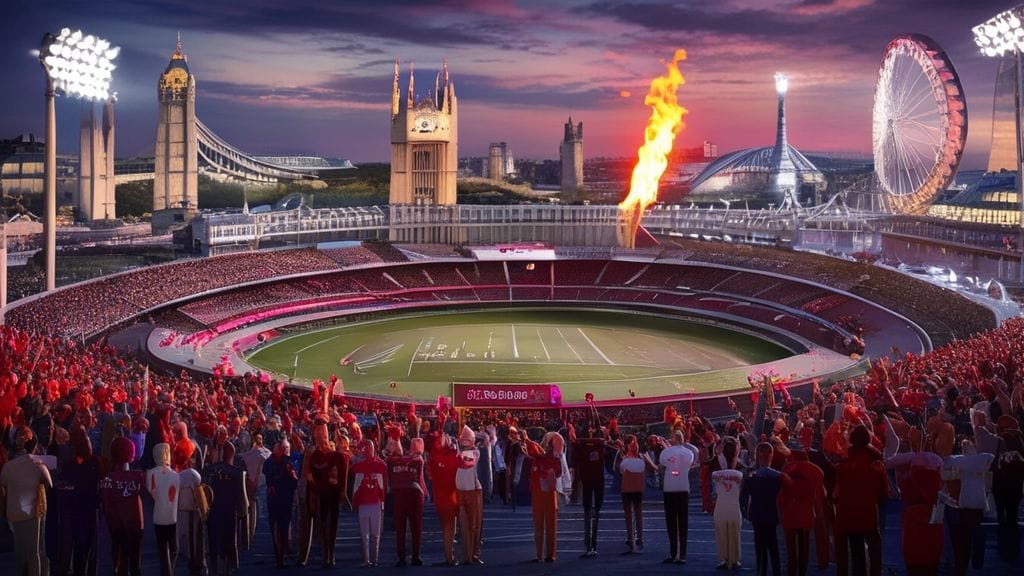
On the night of August 8, the Bird’s Nest became something else again: a crucible for emotion. Its open oval roof framed the sky into which fireworks would bloom. Its sweeping stands embraced performers and spectators in a single, throbbing mass. As the lights dimmed, the stadium seemed to inhale, drawing in not just the athletes and artists on site, but the billions watching through the eyes of cameras positioned at every imaginable angle.
Recruiting an Army of Performers: Discipline, Dreams, and Drill
No summer olympics opening ceremony of such magnitude could be realized without an army of human bodies. The Beijing organizers scoured universities, military academies, dance schools, and communities nationwide for volunteers and professionals. The final cast list read like a census of China in miniature: soldiers in immaculate uniforms, schoolchildren with nervous smiles, veteran opera singers, synchronized drummers, acrobats, and gymnasts whose muscles had been honed since childhood.
Many performers were recruited months, even years in advance. University students signed contracts agreeing to grueling training schedules with minimal breaks, their participation framed as a patriotic duty and a once‑in‑a‑lifetime honor. They practiced in remote fields, often in blistering heat, learning to hold positions without flinching for excruciating periods. One widely circulated anecdote described drummers holding their arms aloft for so long that assistants had to catch them as they fainted, then revive them and send them back into line. The line between dedication and coercion could blur, yet most participants spoke of pride rather than resentment.
Military precision formed the backbone of many routines. Officers helped to drill timing and formation changes, turning human beings into living pixels on a vast moving screen. Choreographers layered artistry atop this discipline, teaching dancers to imbue each gesture with emotion, not just compliance. For all the talk of mass spectacle, countless individual stories quietly converged: a boy from rural Sichuan marveling at his first trip to the capital; a young woman from Harbin spending her nights repairing sequins on her costume; a retired factory worker volunteering as an usher, recalling the hunger of the 1960s and shaking her head in disbelief at the abundance around her.
Behind the scenes, rehearsals unveiled just how fragile the illusion of perfection could be. Rainstorms drenched the stadium during test runs. Microphones cut out. One rehearsal was partly compromised when a curious foreign journalist captured aerial shots, prompting a tightened security cordon. Rumors swirled that some volunteers had dropped out under the sheer physical strain. Yet by the final dress rehearsal, the elements had aligned into an astonishing precision. The performers had internalized their roles so deeply that their bodies reacted almost automatically to the cues. They were ready to step into history.
Opening the Gates: Dusk Falls on Beijing, the World Tunes In
As August 8 approached, Beijing shifted into a different rhythm. Factories on the city’s perimeter were shuttered to reduce the infamous haze that often swallowed its skyline. Alternate driving days based on license plate numbers were enforced to cut traffic and emissions. Residents awoke to rare blue skies and crisp visibility—a manipulated meteorology that many wryly dubbed “Olympic blue.” Police and security personnel multiplied on street corners and subway platforms, their presence a constant reminder that the Games were as much about control as celebration.
On the day itself, crowds began streaming toward the Olympic Green hours before sunset. Streets near the stadium were cordoned off; ticket holders passed through layers of checks that rivaled airport security. Vendors lined approach roads, hawking national flags, red T‑shirts, inflatable cheering sticks, and glow‑in‑the‑dark bracelets. Directions were barked in Mandarin, repeated in accented English and other tongues as volunteers in pale blue uniforms pointed the way with fixed, courteous smiles.
Inside the Bird’s Nest, the pre‑show felt almost like a festival before a coronation. Cameras zoomed in on celebrities and dignitaries: U.S. President George W. Bush seated not far from Russian Prime Minister Vladimir Putin; UN officials rubbing shoulders with corporate magnates. For a brief flicker of time, geopolitical adversaries sat under the same roof, gazing at the same stage, waiting for the same spectacle. It was a rare tableau of forced harmony, fragile and fleeting, yet nevertheless real in that moment.
When the last light of day slipped beyond the rim of the stadium, a hush fell. The giant screen clock began its countdown: 60… 59… The numbers flashed in unison with a deep, resonant drumbeat. Television anchors worldwide lowered their voices, describing scenes that already defied easy description. Viewers at home adjusted their volume, drew closer to their screens, and unconsciously mirrored the posture of those thousands in the stands: leaning forward into the unknown.
The Drums of Time: 2,008 Beating Hearts and the Birth of a Story
The ceremony exploded into life with the sound of thunder. At the base of the stadium floor, 2,008 drummers—each standing before a traditional fou drum—raised their arms in perfect unison. At the first strike, the sound crashed through the Bird’s Nest like a physical force, rippling through chests and rattling the ribcage of the stadium itself. The image was as mesmerizing as the noise: row upon row of drummers clad in simple, earth‑toned outfits, their movements chiseled and fierce.
This opening sequence was more than an aesthetic choice. The number of drummers matched the year, 2008, anchoring the present moment in literal human bodies. Their synchronized beats evoked both ancient rituals and the relentless march of time, linking villagers’ festivals of centuries past to the digital age. With each strike, they shouted a single character: “He” (和)—harmony. In a country whose official rhetoric revolved around the notion of a “harmonious society,” the symbolism was unmistakable.
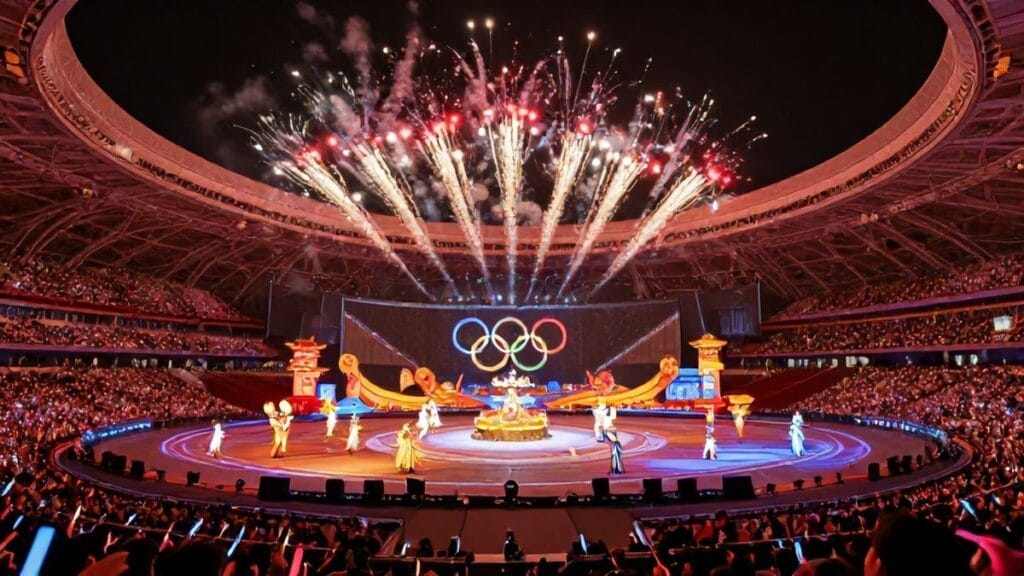
Overhead, the stadium’s giant LED screens flickered to life, showing images of watchful eyes, old clocks, and sweeping landscapes. The effect, beamed to televisions but also palpable to those in the stands, was of being drawn into a myth in which time itself was the protagonist. When the countdown reached zero, a final, deafening strike coincided with the eruption of fireworks above the stadium’s rim, white and gold blossoms that turned the sky into a blazing canopy.
If one listens closely to recordings of that moment, a distinct sound emerges beneath the drums and cheers: the sharp intake of breath by tens of thousands of people, as if the entire stadium had just leaped into cold water together. The drummers’ unison, their disciplined ferocity, sent mixed messages to global viewers. Some saw beauty, others felt unease at the suggestive power of so many bodies moving as one. That duality—between admiration and apprehension—would recur throughout the summer olympics opening ceremony, shaping how different audiences interpreted the same images.
Paper, Ink, and Ideograms: Writing China Onto the World’s Imagination
As the last echoes of the drums faded, the stadium floor transformed into something gentler but no less grand. In the center of the Bird’s Nest, a colossal scroll began to unfurl, its cream‑colored surface lit from below. Dancers dressed in black glided around its edges like ink‑soaked brushes, their movements leaving trails of projected calligraphy that blossomed across the scroll in thick, elegant strokes. This was China’s written language made manifest, centuries of scholarship condensed into a living painting.
Chinese characters—those intricate logograms that had survived dynasties, invasions, and revolutions—appeared one by one: “Peace,” “Friendship,” “Harmony.” Each ideogram bloomed and faded in a choreography that merged tradition with cutting‑edge projection technology. Zhang Yimou’s team had worked closely with calligraphers to ensure authenticity, down to the weight of each stroke and the tempo of each flourish. For audiences unfamiliar with the language, the segment offered an emotional window rather than a didactic lesson, suggesting that at the heart of China’s identity lay not just silk and porcelain, but ideas etched in ink.
At one point, children in simple white costumes emerged, stepping carefully onto the scroll, their small feet leaving behind digital impressions like watery footprints. They were not smudging history; they were inscribing themselves onto it. The message was subtle but clear: our future walks on our past. Around them, dancers in costumes reminiscent of ancient scholars bowed and gestured, as if passing on the baton of knowledge.
There was a delicate irony here. China’s written tradition had often been a gatekeeping device, separating the educated elite from the masses. During the Cultural Revolution, many of those same characters had been weaponized in denunciation posters and slogans. None of that turmoil appeared on the scroll that night. Instead, the written word was stripped of conflict and presented as a shared human inheritance, its particular Chinese roots reshaped into universal values.
The segment culminated with the scroll rolling up again, this time revealing a painting of mountains and rivers in the classic shanshui style, rendered by human performers lying on the floor, their bodies forming peaks and currents. Cameras zoomed in on details: the flex of a calf, the arch of a back, sweat glistening under stage lights. The effect was to remind viewers that behind every symbol—every character, every brushstroke—there were human beings, straining to hold their positions in a story much larger than themselves.
Scrolls, Dynasties, and Silk Roads: Re‑staging Five Thousand Years in Minutes
From the living scroll, the ceremony expanded into a whirlwind tour of what Chinese textbooks often summarize as “five thousand years of civilization.” In practice, this meant a carefully curated selection of iconic motifs: the philosophers of the Hundred Schools, the imperial examinations, the Maritime Silk Road, and the voyages of the admiral Zheng He. Ships’ masts rose from the stadium floor; dancers in flowing robes mimed the rigging of sails as projected waves rose around them. The soundscape shifted from the twang of ancient zithers to the pounding drums of seafaring adventure.
In one memorable sequence, a group of actors portraying Confucius and his disciples walked slowly across the floor, scrolls in hand, reciting aphorisms about benevolence and order. “Within the four seas, all men are brothers,” a line attributed to Confucius, appeared briefly on screen in translation. It was an unmistakable message from the Chinese organizers: we have been theorizing global brotherhood since long before the word “globalization” entered English dictionaries.
Yet history is never neutral. The selected episodes emphasized China’s role as a peaceful cultural exporter, a nation spreading philosophy, silk, and porcelain rather than conquest. Military episodes were largely absent, save for stylized martial arts displays that framed combat as art. The Great Wall, that enduring symbol of both defensive anxiety and architectural marvel, appeared not as a barrier but as a winding dragon‑like line illuminated by dancers in neon‑lit costumes, more festive than forbidding.
Foreign experts watching the ceremony noted what was missing as much as what was shown. There were no references to the Opium Wars, the unequal treaties, or the partitioning of territory by colonial powers. The Mao era flickered by only in the vaguest of images; the red flags and mass rallies of the mid‑twentieth century were deemed too contentious. The late historian Rana Mitter once observed that modern China often tells its story as “a narrative of national resurrection after a century of shame.” During the ceremony, the resurrection remained, but the shame was largely erased, replaced by a seamless continuity of greatness interrupted only by hints of hardship.
For those willing to suspend political analysis, the visual poetry of this historical montage was overwhelming. Acrobats formed human pagodas; dancers, dressed as operatic heroes, seemed to leap through time; ribbons of light traced the imagined paths of caravans and ships connecting China to distant lands. The Bird’s Nest became a time machine, spinning viewers through eras in which ink and sails, not microchips, were the cutting edge of innovation.
Children, Ethnic Costumes, and the Politics of Harmony
After the torrent of historical imagery, the stage softened again as children took center stage. A group of youngsters carrying pastel‑colored kites and balloons ran in loose circles, their laughter audible over the speakers. They were joined by performers wearing the traditional costumes of China’s officially recognized 56 ethnic groups: embroidered jackets, elaborate headdresses, brilliant patterns from the Tibetan Plateau to the jungles of Yunnan. Together, they circled the national flag, which was carried into the stadium and raised with solemn ceremony.
This sequence, perhaps more than any other, revealed the ideological undercurrent of the night. The children represented innocence and the future; the mosaic of ethnic costumes symbolized unity in diversity under the red flag. The message was direct: China, often portrayed abroad as monolithic and Han‑dominated, was in fact a harmonious family of peoples. At a time of tension in regions like Tibet and Xinjiang, the imagery doubled as reassurance and assertion.
But the segment did not pass without controversy. In later days, it emerged that one of the little girls, who famously appeared to sing “Ode to the Motherland,” had been lip‑syncing to the voice of another child. The original singer, organizers explained, did not “fit the image” they wanted to present, prompting a global debate about authenticity and image management. The revelation struck many Western viewers as emblematic of a system more concerned with surface perfection than individual recognition.
Within China, reactions were more nuanced. Some criticized the decision, but others shrugged, seeing it as a minor detail in an otherwise stirring moment of national pride. For many, the sight of hundreds of children standing together around the national flag—faces lit by gentle spotlights, voices joining in song whether live or dubbed—embodied a deeply felt longing for stability after decades of breakneck change.
As the flag reached the top of the pole and the anthem’s final notes hovered in the air, the cameras panned across the stands, capturing teary eyes and clenched jaws. The summer olympics opening ceremony had become more than entertainment. It had turned into a collective rite of affirmation, a public rehearsal of how China wished to see itself, and how it wished to be seen.
The Parade of Nations: Flags, Footsteps, and Subtle Messages
With the conceptual performance segments complete, the ceremony transitioned into one of the Olympics’ oldest rituals: the Parade of Nations. One by one, delegations emerged from the tunnel, led by flag bearers whose images would be replayed in their home countries for months to come. The order followed the traditional Olympic protocol, adapted to Chinese alphabetical order, which meant that teams accustomed to entering early found themselves waiting, while others enjoyed an unexpected spotlight.
The stadium’s energy shifted from choreographed spectacle to improvisational joy. Athletes waved cameras and phones, filmed the crowd, and swayed to the upbeat music that now filled the air. Some danced in their neat blazers; others marched in practical tracksuits, eyes wide. For many, this was their only moment in the Bird’s Nest, a fleeting minute or two before days of competition and grueling focus.
For Beijing, the parade was another chance to send subtle messages of welcome and stature. The television director lingered on shots of athletes from countries where China had invested heavily: African nations with new Chinese‑built roads and stadiums; Latin American delegations whose governments had signed trade deals for oil, copper, or soybeans. The applause often swelled especially loud when such nations entered, a kind of sonic map of Beijing’s diplomatic priorities.
When the team from Chinese Taipei (Taiwan) appeared under the compromise name and flag agreed upon decades before, the moment was tense yet smooth. Both sides had rehearsed this dance of recognition and denial many times. The crowd applauded warmly; the cameras did not overemphasize the delegation, but neither did they cut away. It was a small example of how the summer olympics opening ceremony functioned as geopolitical theater, smoothing over contentious realities in the name of Olympic unity.
Finally, the Chinese team emerged, dressed in bright red and sunshine yellow. The roar that greeted them shook the stadium. Yao Ming, the towering NBA star, carried the flag, walking beside a small boy rescued from the devastating Sichuan earthquake earlier that year. Their pairing told a layered story: of international celebrity paired with anonymous courage; of a nation that had suffered tragedy, mourned, and now stood upright again. In that image—replayed on front pages worldwide—the narrative of a resilient, compassionate China crystallized in the simplest form: a tall man, a small child, one flag.
The Final Ascent: Li Ning’s Flight and the Art of Defying Gravity
As the last delegations took their seats and the Olympic oath was recited, a collective expectation hung over the stadium: how would the cauldron be lit? Every summer olympics opening ceremony is judged by this moment. Barcelona had its flaming arrow, Sydney its hidden fuse, Athens a torchbearer running up a slanted wall of water. Beijing needed something both technologically astounding and emotionally resonant.
The stadium lights dimmed again, and a spotlight fell on a familiar figure: Li Ning, the legendary gymnast whose triumphant 1984 Olympic performance had made him a national icon. Dressed in white, torch in hand, he began to jog around a small platform. In a breathtaking reveal, cables lifted him into the air, tilting his body horizontally. The stadium floor beneath him erupted into a scroll of projected images, and Li Ning began to “run” sideways along the rim of the Bird’s Nest, his silhouette moving against a backdrop of China’s Olympic journey.
Spectators gasped and cheered as he seemed to defy gravity, each step carefully synchronized with the projections. From certain angles, it looked as though he was sprinting through the sky itself. The symbolism was powerful: a national hero from a previous era, carrying the flame of aspiration across a canvas of history, toward a point where past and future would meet. When he reached the upper edge above the cauldron, he paused, struck a pose that photographers captured in a thousand flashes, and then leaned forward to ignite the fuse.
A ring of fire traced its way to the immense cauldron perched on the stadium’s rim. In seconds, the flame exploded upward, blooming into a roaring pillar visible across northern Beijing. Fireworks synchronized with the ignition burst into the air, cascading around the stadium like molten stars. Inside the Bird’s Nest, the glow from the cauldron bathed spectators’ faces in a warm, flickering light. Strangers embraced; athletes lifted their phones to capture a moment they would likely never see again.
Li Ning’s aerial run encapsulated much of what defined the Beijing ceremony: reverence for past heroes, faith in technological mastery, and an almost operatic desire to awe. It also hinted at the costs of such ambition. Every aspect of the stunt—from the strength of the harness cables to the precise angles of the projections—had been rehearsed to the point of exhaustion. The margin for error was nearly nonexistent. One misstep, and the illusion would have shattered live in front of billions. But on that night, the illusion held, and with it, the narrative that China’s rise, like Li Ning’s flight, was a feat of equal parts discipline and daring.
Behind the Camera: Broadcast Alchemy and Choreographed Perfection
For the billions who did not have a seat in the Bird’s Nest, the ceremony existed only through the lens of cameras and the choices of directors and editors. Chinese state broadcaster CCTV coordinated a monumental broadcast operation, deploying more than 100 cameras, including cranes, aerial rigs, and underwater units for other venues. A central control room pulsed with changing feeds, audio levels, and graphics. From there, a team shaped how the world saw the summer olympics opening ceremony, determining which faces, movements, and moments would become iconic.
The broadcast’s visual grammar was precise. Wide shots established the scale of the spectacle, pulling back to show patterns impossible to see from individual seats. Tight close‑ups captured the emotions of children, drummers, and athletes. Slow‑motion replays lingered on fireworks, turning them into abstract blooms of color. Commentary, translated into dozens of languages, attempted to contextualize segments steeped in cultural meaning that might otherwise be opaque.
But the alchemy of broadcasting was not purely aesthetic. It was also about control. Later, international media would reveal that some of the “footprint” fireworks stepping across the city had been pre‑rendered and composited into the live feed for safety and reliability. To many television viewers, this made little difference; the illusion felt real, and that sufficed. To others, it raised questions about the line between documentary and spectacle, a line that had been blurred long before Beijing but was thrown into sharper relief by China’s reputation for stage‑managing national narratives.
Within China, the ceremony’s broadcast became a shared experience of rare intensity. Families who had never flown in an airplane watched images of their capital city stitched into a glittering tapestry of light. Elderly grandparents who still remembered war and famine saw a different China, expansive and confident. For a single night, the normal programming of television dramas, variety shows, and news bulletins gave way to a unified feed. In a vast country often described as fractured by region, class, and ideology, that unity—however temporary and orchestrated—held deep emotional resonance.
Abroad, networks inserted their own commentary and analysis, some admiring, others skeptical. One Western commentator described the ceremony as “as much a message as a performance,” while a different analyst argued that “no country has ever used an opening ceremony so effectively to rebrand itself on the world stage.” Both observations could be true at once. The cameras had captured more than acrobatics and fireworks; they had recorded a shifting relationship between China and the rest of the world, mediated through pixels and curated frames.
Dissent, Smog, and Stagecraft: The Shadows Beneath the Fireworks
Beneath the surreal perfection of the night, unresolved tensions simmered. In the months leading up to the Games, Beijing had faced criticism over air pollution, human rights, and restrictions on freedom of expression. Environmentalists posted satellite images of smog blankets; activists highlighted the displacement of residents due to Olympic construction projects, some estimates putting the number of relocated people in the tens of thousands. Tibetan protests earlier in 2008 had sparked international demonstrations along the Olympic torch relay route, turning what was supposed to be a triumphant world tour into a contest over the meaning of the flame.
The government responded with a mixture of concessions and crackdowns. Factories temporarily closed, construction halted, and vehicles were restricted in a massive, coordinated effort to reduce pollution. Official “protest zones” were established on paper to appease Olympic norms, yet in practice, applications to use them were routinely denied, and some who applied were reportedly detained. Journalists faced complex accreditation processes, their movements monitored. The city was scrubbed and polished, but certain voices were kept carefully offstage.
These contradictions did not go unnoticed. Human rights organizations issued reports accusing Beijing of “using the Olympics to whitewash abuses,” while Chinese officials countered that politics should be kept separate from sport, pointing to the rapid improvements in living standards that many citizens had experienced. Ordinary Beijingers, when interviewed, often expressed a more pragmatic view: they were proud, nervous, and sometimes ambivalent, caught between genuine excitement and a hazy awareness that some of the show’s shine came at a cost.
Even the much‑praised “Olympic blue” skies carried an aftertaste of artificiality. Once factories resumed operations after the Games, pollution levels crept back up, reminding residents that the clarity above had been a performance of environmental policy, not yet a permanent transformation. The summer olympics opening ceremony, in this sense, functioned like a mirror ball: dazzling reflections that enthralled, but only when spun at a certain angle, under controlled lights.
And yet, to deny the sincerity of the joy many felt that night would be to misread the moment. The reality was layered. The ceremony’s beauty existed alongside its omissions; its grandeur rose from both voluntary sacrifice and enforced discipline. In that complexity lay a broader truth about twenty‑first‑century China itself: a place where awe and unease, hope and control, could occupy the same space, separated only by the direction of one’s gaze.
Soft Power in Flames: How Beijing 2008 Redrew the Global Image of China
When the last fireworks faded and the cauldron’s flame settled into a steady burn, the work of interpretation began. The summer olympics opening ceremony had been, by almost every technical metric, an astonishing success. International polls in the days that followed showed spikes in favorable perceptions of China across multiple countries. Headlines spoke of “a new superpower revealed in light and sound.” For a moment, the dominant global narrative of China shifted from cheap manufacturing and political opacity to creativity, efficiency, and cultural depth.
This was soft power in its purest form: the power to attract, persuade, and shape preferences through culture rather than coercion. Chinese strategists had long studied the role of Hollywood, pop music, and global brands in enhancing the influence of the United States and Europe. Beijing 2008 represented a deliberate attempt to craft a comparable cultural milestone, one that married ancient heritage with futuristic showmanship.
The impact was amplified by the medium. In an era before global streaming giants had fully consolidated their power, the Olympic broadcast still functioned as one of the last mass, synchronous media events. Billions watched the same images at roughly the same time, creating a shared reference point that transcended borders. School teachers worldwide used clips from the ceremony in lessons about China; advertisers borrowed its aesthetic cues—scrolls, red lanterns, silhouette acrobats—for years afterward.
Of course, soft power is fragile. It depends not only on spectacular gestures but on sustained behavior. As China’s relations with some Western nations grew more strained in subsequent years over issues like trade, cybersecurity, and territorial disputes, some of the goodwill generated in 2008 eroded. Yet the memory of that night remained lodged in the global imagination, resurfacing whenever debates about China’s capacity for innovation and organization arose. “Remember what they did in 2008,” commentators would say, using the ceremony as shorthand for a particular brand of Chinese capability.
Within China, the ceremony’s soft power effects were turned inward as well. It reinforced a sense of collective accomplishment and national cohesion, especially among younger generations who had grown up in relative prosperity but still carried inherited stories of hardship. The narrative that “we have stood up,” originating from Mao’s famous proclamation in 1949, found a new, less militaristic expression: we have lit up the sky, we have hosted the world, we have told our story in our own way.
Echoes in London, Rio, and Beyond: Redefining the Olympic Ceremony
The ripples from Beijing’s extravaganza reached far beyond China’s borders. Subsequent Olympic hosts confronted an uncomfortable question: how do you follow that? London 2012, under the artistic direction of Danny Boyle, made the strategic decision not to compete with Beijing’s sheer scale, but to pivot to humor, self‑deprecation, and a more intimate, narrative‑driven show. Instead of 2,008 synchronized drummers, there were nurses dancing around glowing hospital beds, Mr. Bean fumbling through “Chariots of Fire,” and the Queen (or at least her stunt double) “parachuting” into the stadium with James Bond.
In interviews, Boyle and his team acknowledged Beijing’s influence. They understood that the bar for originality and coherence had been raised, and that simply assembling random cultural icons would no longer suffice. Instead, London crafted a ceremony that played to its own strengths: pop culture, irony, and the evolution from industrial smoke to multicultural modernity. Rio 2016, constrained by budgetary issues and political turmoil, nonetheless drew lessons from both Beijing and London, emphasizing environmental themes and the contributions of Afro‑Brazilian culture in a more modest but still imaginative show.
Beyond the Olympics, the standards set by Beijing 2008 seeped into other mega‑events: World Expos, national days, even corporate shows. The idea that a nation could compress its identity into a few hours of performance, and that the world would watch with rapt attention, encouraged governments to invest in similar pageants. Some succeeded, others floundered under the weight of imitation.
Yet Beijing’s uniqueness lay not only in its scale, but in its timing. It arrived at the cusp of the social media explosion, when platforms like Facebook and Twitter existed but had not yet fully splintered global audiences into algorithmic micro‑groups. The ceremony was one of the last events to capture a truly planetary live audience before streaming and on‑demand viewing fractured attention. In that sense, the summer olympics opening ceremony in Beijing sits at a crossroads between the broadcast age and the digital age, both product and precursor of a media world that would continue to evolve at dizzying speed.
The echoes of Beijing also forced introspection within the Olympic movement. Critics asked whether such gargantuan spectacles were sustainable in an era of mounting public debt and environmental crises. The IOC began to promote “smarter,” more cost‑effective Games, urging hosts not to bankrupt themselves in pursuit of a fleeting wow factor. Seen in retrospect, Beijing 2008 might be remembered as the apogee of the mega‑ceremony, a summit scaled with astonishing mastery but one that few could afford or justify climbing again.
Memory, Myth, and the People Who Were There
Years after the cauldron was extinguished and the last athlete left the Olympic Village, the night of August 8, 2008, lived on in stories. A middle‑aged taxi driver in Beijing might recall driving visitors that day, stuck in traffic near the closed‑off Olympic Green, unable to see the ceremony but feeling the city tremble with distant fireworks. A volunteer would remember the blisters from standing for hours, then the indescribable rush when the crowd roared in approval. A performer, now older, might watch a replay on a laptop and search for their tiny figure among the thousands on the stadium floor, proof that they had once been part of something impossibly large.
Memory has its own choreography. Over time, criticisms may soften, while awe remains. For some, the summer olympics opening ceremony in Beijing has become a personal anchor: “I watched that with my father before he passed,” someone might say; “I was a teenager then, dreaming of leaving my hometown.” For others, it is a point of contrast with the present, a reminder of a period when globalization still felt, to many, like an unalloyed promise rather than a contested battleground.
Historians, too, have started to situate the ceremony within broader analyses of China’s rise. Some emphasize its continuity with older traditions of imperial spectacle, comparing the Bird’s Nest to ancient palaces where emperors once staged rituals to impress foreign envoys. Others see it as a quintessentially modern performance of nationhood, akin to televised inaugurations, military parades, or royal weddings. In academic articles and books, citations to the ceremony appear alongside references to economic data, diplomatic cables, and policy speeches, as scholars argue that understanding Beijing 2008 is essential to understanding early twenty‑first‑century geopolitics.
One Chinese scholar, writing a few years after the Games, remarked that “for many citizens, 2008 was the year they first felt the world looking at China with curiosity rather than fear or condescension.” That feeling, however, was never universal nor permanent. Events in subsequent years—financial crises, trade wars, pandemics—reshaped global attitudes yet again. Still, the images from the Bird’s Nest on that August night remain vivid, ready to be summoned whenever discussions about national image, power, and culture arise.
In the end, perhaps the ceremony’s true legacy lies less in economic impact studies or foreign policy debates, and more in the intimate, almost tactile memories of those who were there or watching. The crackle of fireworks echoing across Beijing alleys; the flicker of light on a television screen in a village thousands of kilometers away; the moment a child saw a performer soar along the stadium rim and thought, “We can do anything.” These are the threads from which historical myths are woven—myths not in the sense of falsehoods, but in the sense of stories that, repeated often enough, become part of how a society understands itself.
Conclusion
The summer olympics opening ceremony in Beijing on August 8, 2008, was far more than the prelude to a fortnight of sport. It condensed millennia of culture, decades of transformation, and a fragile moment of global optimism into a single, meticulously staged night. Under the steel lattice of the Bird’s Nest, drums beat out the rhythm of time, scrolls unfurled to reveal living ink, children circled a rising flag, and a gymnast‑hero sprinted through the sky to light a flame that seemed to set an entire century alight. In doing so, China offered the world a carefully choreographed vision of itself: ancient yet modern, disciplined yet exuberant, powerful yet yearning for acceptance.
But the glow of fireworks always casts shadows. The ceremony’s breathtaking artistry coexisted with unresolved questions about dissent, displacement, and the management of reality itself, from air quality to lip‑synced songs and digitally enhanced pyrotechnics. It represented both genuine pride and deliberate narrative control, sincerity and spectacle inseparably entwined. As a feat of soft power, it left a deep imprint on global perceptions, even as later events complicated or eroded that initial surge of admiration.
In the years since, no opening ceremony has fully escaped the long shadow of Beijing 2008. Some have wisely chosen not to compete on scale, opting instead for intimacy and irony. Others have echoed its motifs—children, history, technological wizardry—while grappling with new economic and environmental constraints. Yet the essential question the Beijing ceremony posed remains unresolved: how can a nation tell its story to the world in a way that honors complexity without succumbing to propaganda, that inspires without erasing its own contradictions?
Perhaps the truest answer lies not in the official script but in the memories that endure. For individuals around the globe, that night in August has become a touchstone—of wonder, skepticism, or both. The drums still reverberate in recordings, the images still circulate online, the debates continue in classrooms and policy circles. History will likely remember Beijing’s summer olympics opening ceremony as both a pinnacle of Olympic spectacle and a revealing mirror of its host nation at a pivotal moment. And like all great performances, it invites us not just to applaud, but to keep asking what, exactly, we saw when the lights went down and the sky over Beijing turned to fire.
FAQs
- Why was the Beijing 2008 opening ceremony considered so significant?
The Beijing 2008 opening ceremony was significant because it combined unprecedented scale, technical innovation, and tightly scripted storytelling to project a powerful new image of China to the world. With an estimated global audience of almost 4 billion, it functioned as a carefully crafted declaration of national pride and soft power, showcasing both ancient cultural heritage and modern capabilities at a moment when China’s global influence was rapidly expanding. - Who directed the Beijing summer olympics opening ceremony?
The ceremony was directed by Zhang Yimou, one of China’s most renowned filmmakers, known for visually striking films such as “Raise the Red Lantern” and “Hero.” He led a vast creative team of choreographers, composers, and designers, balancing artistic ambition with political expectations to create a show that would resonate with both domestic and international audiences. - How many performers took part in the ceremony?
Rough estimates put the number of performers at over 15,000, including drummers, dancers, acrobats, children, soldiers, and volunteers. When support staff, technicians, and behind‑the‑scenes personnel are included, the total number of people involved in realizing the opening ceremony rises into the tens of thousands, underscoring the extraordinary logistical effort behind the spectacle. - What were the main themes of the Beijing opening ceremony?
The main themes included China’s long history of civilization, the importance of writing and philosophy, the Silk Road and cultural exchange, national unity among diverse ethnic groups, and a forward‑looking vision of technological progress and global harmony. These were conveyed through segments featuring drums, giant scrolls, calligraphy, historical tableaux, children in traditional costumes, and futuristic light displays. - Were there any controversies linked to the ceremony?
Yes. Controversies included the revelation that some “footprint” fireworks seen on television had been digitally enhanced, and that the young girl singing “Ode to the Motherland” was lip‑syncing to another child’s voice judged more suitable by organizers. More broadly, critics pointed to issues such as air pollution, displacement of residents for Olympic construction, and restrictions on protest and free expression in the lead‑up to the Games. - How did the ceremony affect China’s global image?
In the short term, the ceremony significantly improved China’s global image, highlighting creativity, efficiency, and cultural richness rather than only cheap manufacturing or political opacity. Many viewers and commentators saw it as evidence that China possessed not just economic and military power, but also sophisticated cultural soft power. Over time, subsequent political and economic tensions have complicated that image, but the ceremony remains a powerful reference point in discussions of China’s rise. - What made Li Ning’s lighting of the cauldron so memorable?
Li Ning’s ascent was memorable because it combined personal symbolism and visual innovation. As a celebrated gymnast from the 1980s, he embodied an earlier era of Chinese sporting success. Suspended by cables, he appeared to run horizontally around the stadium rim across a projected scroll of images, creating the illusion that he was sprinting through the sky before igniting the cauldron. The sequence perfectly embodied the ceremony’s blend of nostalgia, technological mastery, and theatrical flair. - How did Beijing’s ceremony influence later Olympic opening ceremonies?
Beijing 2008 raised expectations for narrative coherence, visual impact, and national branding in Olympic ceremonies. London 2012 and Rio 2016 responded by adopting different tones—more humorous, intimate, or environmentally focused—but both were shaped by the need to differentiate themselves from Beijing’s monumental scale. More broadly, Beijing contributed to debates about whether such mega‑spectacles are sustainable or desirable in an era of fiscal and ecological constraints. - What role did the Bird’s Nest stadium play in the ceremony’s impact?
The Bird’s Nest served not just as a venue but as a visual symbol of modern China. Its distinctive steel lattice became instantly recognizable worldwide, and its design allowed for dramatic light shows, aerial stunts, and panoramic camera shots. Collaboratively designed by Herzog & de Meuron and Ai Weiwei, the stadium’s form—simultaneously futuristic and organic—reinforced the ceremony’s message of a nation that could blend tradition with global modernity. - Can the Beijing 2008 opening ceremony be seen as purely artistic, or was it mainly propaganda?
It is best understood as both. Artistically, it was a masterful fusion of choreography, music, design, and technology that moved audiences on an emotional level. At the same time, it was undeniably a state‑shaped narrative that emphasized certain historical and political themes while downplaying or omitting others. Its power lies precisely in this dual nature: a genuine cultural achievement that also functioned as a sophisticated instrument of national image‑making.
External Resource
Internal Link
Other Resources
- Encyclopaedia Britannica – general search for the exact subject
- Google Scholar – academic search for the exact subject
- Internet Archive – digital library search for the exact subject