Table of Contents
- Shadows over the Gulf: Setting the Stage in Cold War Vietnam
- An Uneasy Summer: Tension Builds before August 1964
- Destroyers and Patrol Boats: The Naval Chessboard in the Gulf of Tonkin
- August 2, 1964: The First Clash in Murky Waters
- Between Two Nights: Confusion, Intelligence, and Political Desire
- August 4, 1964: The Phantom Battle That Changed a War
- From Radio Reports to the Oval Office: How the Story Reached Washington
- The Gulf of Tonkin Resolution: Congress Writes a Blank Check
- Escalation Unleashed: Rolling Thunder and the Road to Full-Scale War
- Inside Hanoi and Saigon: How the Other Side Saw the Incident
- On the Deck and in the Cockpit: Sailors, Pilots, and Memory
- Truth under Classified Seals: Intelligence, Ambiguity, and Manipulation
- Television War: How the Gulf of Tonkin Incident Shaped Public Opinion
- Protest, Trust, and Trauma: The Incident’s Legacy at Home
- Aftermath in Vietnam: Human Costs of a War Accelerated
- Revelations and Reconsiderations: Declassified Documents and Historians
- Myths, Lessons, and Warnings: The Gulf of Tonkin in Political Memory
- Conclusion
- FAQs
- External Resource
- Internal Link
Article Summary: In the humid, contested waters off the coast of Vietnam in August 1964, a brief, chaotic series of naval confrontations — and perhaps one that never truly happened — became known as the gulf of tonkin incident, setting the United States on a path toward full-scale war. This article traces the political, military, and human story behind those fateful days, from the Cold War tensions and covert operations that framed the events to the conflicting radio reports that rushed into the White House. It explores how uncertain radar blips and nervous sonar readings were transformed into certainties in Washington, giving birth to the Gulf of Tonkin Resolution, a near-unanimous congressional authorization for war. Moving from the deck of the USS Maddox to the halls of Congress, it follows the narrative of escalation, including Operation Rolling Thunder and the deepening American commitment in Vietnam. At the same time, it examines how Hanoi, Saigon, and ordinary Vietnamese experienced the turning of the tide. As later declassified documents surfaced, historians and citizens alike revisited the gulf of tonkin incident, questioning not only what happened in those dark waters but also how leaders shaped and used the story. The article reflects on the incident’s impact on public trust, the antiwar movement, and the bitter memory of Vietnam that still haunts US politics. Ultimately, it presents the episode as both a historical event and a warning about how fear, ambiguity, and power can converge to change the course of nations.
Shadows over the Gulf: Setting the Stage in Cold War Vietnam
The sea that Americans would learn to call the Gulf of Tonkin is a broad, gray-green expanse of water, framed by the jagged coastline of northern Vietnam and the southern reaches of China. In the early 1960s, it was not only a maritime border but also an invisible front line of the Cold War. The United States, still haunted by the “loss” of China in 1949 and the bloody stalemate in Korea, saw Southeast Asia as another domino waiting to fall to communism. Hanoi, for its part, saw the same region through the lens of anti-colonial struggle: France had been forced out at Dien Bien Phu in 1954, but the shadow of foreign intervention remained.
By the time American destroyers sliced through those waters in 1964, Vietnam had already been divided for a decade along the 17th parallel, with a communist government in the North under Ho Chi Minh and an anti-communist regime in the South, backed heavily by Washington. The Geneva Accords had promised elections and national unification, but those elections never came. Instead, there were advisers, weapons shipments, counterinsurgency programs, and a growing insurgency known as the Viet Cong that turned villages and rice paddies into battlegrounds.
The gulf of tonkin incident did not come out of nowhere; it emerged from this layered, tense geography. American policy-makers believed they were operating in a global chess match against Moscow and Beijing, not in a complex, localized civil war. The water off Vietnam became a surveillance corridor, a space where US naval vessels could listen, observe, and test the limits of North Vietnamese resolve. For North Vietnam, those same waters were part of a fragile defensive perimeter, the maritime flank of a nation already under covert attack from the air and sea.
In Washington, President Lyndon B. Johnson, who had inherited the Vietnam problem from John F. Kennedy, tried to balance domestic ambitions — his Great Society — with growing pressure from the Pentagon and hawkish advisers who warned that abandoning South Vietnam would damage American credibility across the world. It is in this climate of calculation, fear, and ideology that the story of early August 1964 begins. The ships, the sailors, the coastal radar operators in North Vietnam, the intelligence officers in Honolulu, the analysts in the National Security Agency (NSA) — all played roles in a drama whose ending none of them could yet see.
An Uneasy Summer: Tension Builds before August 1964
The summer of 1964 in Vietnam was restless and brittle. In South Vietnam, coups and countercoups had shaken the government after the assassination of President Ngo Dinh Diem the previous November. US advisers worked with a carousel of generals in Saigon, trying to shore up a regime whose legitimacy was fragile even among its own citizens. In the countryside, the Viet Cong grew bolder, ambushing units of the Army of the Republic of Vietnam (ARVN) and establishing shadow administrations in hamlets by night.
Across the demilitarized zone, in the Democratic Republic of Vietnam (North Vietnam), leaders in Hanoi tightened their own war plans. They were conducting a delicate balancing act: escalate support for the southern insurgency without provoking direct, overwhelming American retaliation. Meanwhile, a series of covert operations, conceived in Washington and executed from bases outside Vietnam, probed the North’s defenses. These were known as OPLAN 34A — a set of hit-and-run raids, psychological warfare efforts, and maritime sabotage missions carried out largely by South Vietnamese commandos with US support and planning.
The Gulf of Tonkin became a corridor not only for merchant ships and fishing boats but also for small, fast craft slipping close to the North Vietnamese shore under cover of darkness. They planted explosives, shelled radar stations and coastal installations, and then vanished back into the night. From Hanoi’s perspective, these were blatant acts of aggression; from Washington’s, they were deniable tools in a shadow war meant to pressure the North without formal escalation.
It is crucial to understand this context because it was the backdrop against which American destroyers, publicly described as conducting routine patrols in international waters, traveled close to a coast already on high alert. Tension was in the air — tension felt by the North Vietnamese gunners peering into the darkness, by the American sonar operators listening for the whine of approaching torpedoes, and by the officials in Washington eager for demonstrable resolve. When the gulf of tonkin incident unfolded, it was layered atop weeks and months of anger, misperception, and provocation, each side convinced that the other was crossing lines that could not be ignored.
Destroyers and Patrol Boats: The Naval Chessboard in the Gulf of Tonkin
The US Seventh Fleet, with its carriers, cruisers, and destroyers, was the visible tip of American power in the Western Pacific. In 1964, among its ships was the USS Maddox (DD-731), a World War II-era destroyer retrofitted for a new kind of war. Its mission in the Gulf of Tonkin was not to bombard coastal cities or land Marines but to listen — to vacuum up electronic signals, radar emissions, and radio chatter emanating from North Vietnamese defenses. This was a role known as DESOTO patrols, named after an earlier codeword for similar electronic surveillance missions near communist countries.
The Maddox was a sleek silhouette against the horizon, bristling with antennae and armed with five-inch guns, capable of high speed and agile maneuvering. Its crew numbered around 260, a mix of seasoned officers who had served in Korea and younger sailors who had never known anything but the Cold War. They drilled against hypothetical attacks — torpedoes rushing in from unseen boats, aircraft streaking in from the coastline — but many believed the mission to be mostly routine. They were, the official orders said, in international waters, with a right to navigate unmolested.
On the other side of the chessboard, North Vietnam deployed small, Soviet-designed P-4 and P-6 torpedo boats and patrol craft. These vessels, often painted in drab grays and greens, hugged the coastline, darting between small ports and hiding among fishing fleets. Their crews operated near home but under constant pressure. Intelligence reports hinted at foreign ships drawing close and at nighttime raids demolishing coastal installations. Radar blips that might once have been dismissed as harmless now carried the whiff of threat.
Between these forces stretched a strip of ocean that was neither clearly marked nor reliably interpreted. Maritime law granted a belt of territorial water to coastal states, but debates raged over how far that belt extended — three miles, twelve, more? North Vietnam, like other states wary of foreign navies, claimed a larger zone; the United States, intent on freedom of navigation and surveillance, interpreted its rights more broadly. The gulf of tonkin incident would turn on these differences as much as on torpedoes and gunfire. For in such ambiguous waters, what one side called “international,” the other might view as an incursion — and respond with force.
August 2, 1964: The First Clash in Murky Waters
On August 2, 1964, the Gulf of Tonkin was hot and hazy. The USS Maddox steamed off the North Vietnamese coast at a measured distance, its crew cycling through watches, radar scans, and radio checks. Captain John J. Herrick, the ship’s commanding officer, was aware of recent OPLAN 34A raids along the coast but had been assured that his mission was separate — an intelligence-gathering patrol, not a raid. Yet he also knew that to North Vietnamese coastal commanders, the distinction might not be so clear.
In the late morning, lookouts and radar operators aboard the Maddox reported fast-moving craft emerging from the direction of North Vietnam. Three torpedo boats of the North Vietnamese Navy, identified as part of Squadron 135, were closing in. The Maddox went to general quarters. Men scrambled to their battle stations as the ship prepared for a potential engagement. The sea, once merely a backdrop to routine, suddenly felt hostile and alive.
As the range closed, tense radio traffic crackled across the airwaves. The Maddox signaled warnings, insisting that it was in international waters and had no hostile intent. The North Vietnamese boats did not turn away. Their orders, issued from coastal command, were to challenge and, if necessary, attack intruders. They were small and vulnerable compared to the American destroyer, but they were armed with torpedoes that, if properly aimed, could cripple the larger vessel.
What followed was a brief, intense skirmish. The Maddox maneuvered at high speed, its guns thundering. US aircraft from the carrier USS Ticonderoga raced in to offer support, strafing the attacking boats. Torpedoes plowed through the water — at least one, perhaps more — but none found their target. The American destroyer was struck only by a single 14.5 mm machine-gun round, lodging in its superstructure and causing minimal damage. The North Vietnamese boats, hammered by gunfire and air attacks, suffered heavier damage, with at least one crippled.
In Washington, the initial reports framed the clash as a clear-cut case of aggression: a US ship, peacefully operating in international waters, had been attacked without provocation. But even at this early stage, the reality was more complicated. Herrick himself noted the proximity of recent South Vietnamese raids to his patrol route; to Hanoi, the Maddox did not sail in a vacuum but in the wake of hostile actions. Still, the fact remained: shots had been fired, torpedoes launched, lives risked. The first half of the gulf of tonkin incident was real, kinetic, and terrifying to those present. Yet this was only the beginning.
Between Two Nights: Confusion, Intelligence, and Political Desire
In the hours after the August 2 clash, telegrams and secure messages flew across the Pacific. Captain Herrick reported the engagement, his account gradually refined as the chaos subsided and the crew tallied what they had seen. On the other side of the conflict, North Vietnamese dispatches described their actions as a justified response to American intrusion into their territorial waters. Each side, locked into its own narrative, fed information up the chain of command.
At the National Security Agency, analysts listened in on North Vietnamese communications, picking out fragments that seemed to confirm plans for further attacks. Some messages, referencing the earlier clash, were interpreted as preparations for another engagement. Others were misread or placed in the wrong chronological order. It is here, in these dim rooms of intercepts and translations, that the line between what was happening and what was feared began to blur.
President Johnson convened his advisers. Among them were Secretary of Defense Robert McNamara, a brilliant former automotive executive famed for his reliance on data and systems analysis, and key figures from the Joint Chiefs of Staff. They debated options: retaliatory air strikes, diplomatic protests, or a show of restraint. Johnson, facing an election in November 1964, was wary of appearing weak but also deeply conscious of the risks of widening the war. At this point, he leaned toward limited retaliation if North Vietnam could be shown to have attacked again.
Meanwhile, a second destroyer, the USS Turner Joy, joined the Maddox. The two ships resumed patrolling in the Gulf of Tonkin, this time with heightened alertness and under new rules of engagement that allowed them to get closer to North Vietnamese shores for intelligence collection. The sea now carried the echo of the first encounter, the awareness that miscalculation could easily trigger disaster. Sailors scanned the surface and sky with a sharpened edge of fear. Radar screens, sonar traces, and the flicker of distant lights took on new meaning.
Within this tense lull, the second act of the gulf of tonkin incident was poised to unfold — an episode that would prove far more consequential, precisely because it may never have occurred as reported. As one historian later noted, “The most significant battle of the Gulf of Tonkin was fought not on the water but in the minds of men parsing conflicting signals” (Edwin E. Moïse, a leading scholar of the episode). The stage was set for August 4, when uncertainty would be alchemized into conviction, and conviction into war.
August 4, 1964: The Phantom Battle That Changed a War
The night of August 4, 1964, was black and stormy over the Gulf of Tonkin. Heavy weather rolled through the area, churning the sea and disturbing radar and sonar readings. The Maddox and the Turner Joy moved through a world reduced to the glow of instruments and the strain of human eyes against rain and waves. Every blip on a screen, every flicker of light on the horizon, carried the potential weight of enemy contact.
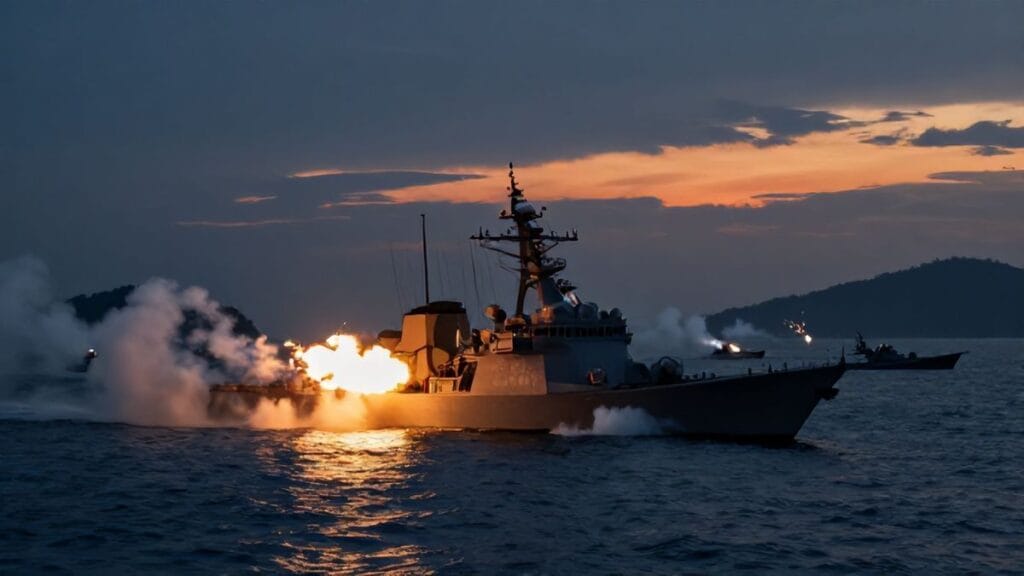
Shortly after nightfall, the two destroyers reported what appeared to be hostile activity. Radar operators saw what they believed to be approaching surface craft. Sonar picked up what were interpreted as high-speed, torpedo-like tracks in the water. Lookouts reported flashes that might be gunfire. Both ships maneuvered aggressively, changing course and speed in an attempt to evade presumed torpedoes. They fired shells into the darkness, blanketing the sea ahead of them with explosions.
On the bridge and in the Combat Information Centers, the atmosphere was electric and chaotic. Orders were shouted; bearings recalculated; new contacts appeared and disappeared. Confirmation bias — the human tendency to see what one expects to see — took hold. Having been attacked once on August 2, the crews were primed for a repeat. Under such conditions, the line between actual torpedo wakes and wave patterns blurred to invisibility.
Messages were sent in quick succession up the chain of command: the destroyers believed they were under attack by North Vietnamese torpedo boats. In Washington, these early cables landed like thunderclaps. Here, at last, seemed to be the clear-cut act of aggression that would justify retaliation. Johnson and his advisers leaned forward, sensing that the moment they had half-feared and half-anticipated was at hand.
But even as the reports flowed, doubt began to seep in from the edges. Captain Herrick, the same calm voice who had reported the August 2 clash, grew uneasy. The evidence, upon reflection, did not quite add up. Radar contacts shifted erratically; sonar “torpedoes” might have been glitches caused by the ships’ own wakes in heavy seas. Minutes after sending urgent messages about an attack, Herrick sent others, more cautious, suggesting that the initial reports might have been based on misread instruments. In one cable, he candidly admitted: “Review of action makes many reported contacts and torpedoes appear doubtful. Freak weather effects on radar and overeager sonar men may have accounted for many reports.”
Yet the momentum of interpretation in Washington outpaced the emerging doubts at sea. Where Herrick and his crew had to live within the fog of war, Johnson and McNamara operated in the much more dangerous fog of politics. The gulf of tonkin incident, as it was quickly framed in the capital, no longer hinged on subtle distinctions between suspected and confirmed torpedoes. It became a story of repeated, unprovoked attacks on American ships, far from any legitimate North Vietnamese claim of territorial waters. In this way, what may well have been a phantom battle — a furious exchange with no actual enemy present — became the hinge on which US policy swung toward full-scale war.
From Radio Reports to the Oval Office: How the Story Reached Washington
The path from the tossing decks of the Maddox and Turner Joy to the calm, wood-paneled offices of Washington was neither straight nor neutral. Intercepts, field reports, and radar logs passed through layers of command, each with its own pressures and predispositions. At the Pentagon, staff officers processed the messages into brief summaries. At the White House, national security aides condensed those summaries further, translating the language of radar bearings and sonar contacts into narratives of attack and response.
President Johnson, who had once confided to a friend that he felt Vietnam was “the biggest damn mess I ever saw,” now heard from his advisers that the mess had escalated. McNamara briefed him by phone and in person, emphasizing that two separate attacks within 48 hours could not be tolerated. The president, recorded in White House tapes, wrestled aloud with the timing of a response: how to show strength without triggering World War III, how to reassure allies and deter enemies while not looking like he sought war for its own sake.
Within hours, Johnson made his decision. The United States would respond with air strikes against North Vietnamese targets — specifically, their naval facilities and selected infrastructure tied to the supposed attacks. He also saw an opportunity to seek a more formal statement of support from Congress, something Kennedy had never obtained. This would become the Gulf of Tonkin Resolution, but at that moment, it was an idea taking shape between the president’s political instincts and his advisers’ strategic calculations.
In briefing congressional leaders and later the public, Johnson and his administration presented the events in the Gulf of Tonkin with an air of unambiguous clarity. Two attacks, they said, had been launched on American warships conducting routine patrols in international waters. The second attack was described as “repeated” and “deliberate.” The doubts expressed by Captain Herrick and some analysts were not highlighted; they were buried, minimized, or framed as insignificant in light of overwhelming evidence. As historian George Herring later summarized, the administration “tended to emphasize the certainty of what was, in reality, deeply ambiguous.”
Television cameras captured Johnson as he addressed the nation, his Texas drawl steady, his demeanor grave but controlled. He spoke of “open aggression on the high seas,” promising that the United States “seeks no wider war” while making clear that it would respond forcefully. It is astonishing, isn’t it, how the language of reluctance so often precedes the deepening of conflict? In these hours, the gulf of tonkin incident was transformed, shaped by selective reading and political necessity, into a foundational myth for escalation.
The Gulf of Tonkin Resolution: Congress Writes a Blank Check
On Capitol Hill, the administration moved swiftly. A draft joint resolution was prepared, its language crafted to be both broad and urgent. It authorized the president “to take all necessary measures to repel any armed attack against the forces of the United States and to prevent further aggression” in Southeast Asia. On its face, it responded to the crisis in the Gulf of Tonkin. In practice, it handed Johnson and his successors an open-ended mandate to wage war without a formal declaration.
Congressional hearings were brief, focused, and constrained by the information the administration chose to share. Few lawmakers were told about OPLAN 34A raids or the fine-grained doubts surrounding the August 4 reports. Instead, they saw a framed narrative: North Vietnam had twice attacked, the second time in especially brazen fashion, and the United States needed to respond decisively. Senators and representatives, wary of appearing weak on communism and mindful of the looming 1964 election, lined up in support.
On August 7, 1964, the Senate passed the Gulf of Tonkin Resolution by a vote of 88 to 2; the House vote was 416 to 0. Only Senators Wayne Morse of Oregon and Ernest Gruening of Alaska dissented, warning that the resolution was a “historic mistake” that effectively transferred Congress’s war-declaring power to the executive. Morse, in particular, argued that the administration had not been candid about the circumstances of the incident. But his voice was a lonely one in a chamber united by fear of communist expansion and deference to presidential leadership in foreign affairs.
Johnson, for his part, presented the resolution as a limited, defensive measure. He compared it to the Tonkin Gulf of the past — the Formosa Resolution of 1955 and the Middle East Resolution of 1957 — suggesting that it, too, merely expressed congressional solidarity and deterrence. Yet behind these words lay a legal instrument that would, within months, justify the deployment of combat troops, the sustained bombing of North Vietnam, and a major land war in Southeast Asia.
In retrospect, the passage of the resolution stands as one of the most consequential legislative acts of the Cold War. It was born in the space between what actually happened in the Gulf of Tonkin and what was believed, or chosen to be believed, in Washington. The gulf of tonkin incident, in this sense, did not end with the fading echo of gunfire on August 4; it lived on in the ink of the resolution, in the votes of hundreds of legislators, and in the expanding orders issued to soldiers and sailors who would soon find themselves in an ever-deepening conflict.
Escalation Unleashed: Rolling Thunder and the Road to Full-Scale War
With the Gulf of Tonkin Resolution secured, the Johnson administration possessed both the political cover and the legal authority to escalate in Vietnam. At first, the steps were incremental. Additional advisers and support units flowed into South Vietnam. American pilots flew more missions, initially in a limited, retaliatory framework. But the logic of escalation has a way of feeding on itself, especially in a conflict framed in zero-sum, ideological terms.
In early 1965, the United States launched Operation Rolling Thunder, a sustained bombing campaign against North Vietnam that would last for years. The goals were mixed and sometimes contradictory: to punish Hanoi for supporting the Viet Cong, to interdict the movement of men and supplies down the Ho Chi Minh Trail, and to signal American resolve. Bridges, rail yards, supply depots, and, eventually, targets closer to populated areas were struck. Aircrews flew through heavy anti-aircraft fire and, later, surface-to-air missiles supplied by the Soviet Union.
On the ground in South Vietnam, the American presence shifted from advisory to combat. In March 1965, the first US Marine units landed at Da Nang, officially to defend the air base. More followed, until by 1968 more than half a million American troops were in Vietnam. Search-and-destroy missions pushed into the countryside; villages suspected of harboring Viet Cong sympathizers faced collective punishment. The war that emerged from the gulf of tonkin incident was no longer limited to the sea or to the secret raids of OPLAN 34A. It became a grinding, attritional conflict, with US forces measuring success in body counts and kill ratios.
Each new step — more troops, more bombs, more targets — was justified, in part, by the authority granted in August 1964. In official statements and internal memos, the resolution was repeatedly cited as the foundation for action, a standing authorization that obviated the need for further congressional debate. Some officials, including McNamara, later admitted that they had underestimated both the resilience of the North Vietnamese and the corrosive effects of a war fought in the name of abstract credibility rather than clear, attainable objectives.
For the Vietnamese, north and south, the consequences were immediate and devastating. Bomb craters gouged the earth; defoliants stripped forests bare; families fled their homes for crowded refugee camps. The link between the firefight in the Gulf of Tonkin and a peasant woman in the Mekong Delta dodging shells may seem distant, but historically they were tightly bound. One could draw a straight line from the misread sonar pings of August 4, 1964, to the roar of B-52s over Hanoi and the shattered streets of Hue during the Tet Offensive. The gulf of tonkin incident had become, in effect, the ignition point of a much larger conflagration.
Inside Hanoi and Saigon: How the Other Side Saw the Incident
While Washington debated resolutions and escalations, leaders in Hanoi and Saigon interpreted the Gulf of Tonkin through their own prisms of ideology, history, and survival. For Ho Chi Minh and his inner circle, the presence of American destroyers close to their shoreline was another chapter in a long story of foreign intrusion. They remembered the French gunboats on the Red River, the Japanese occupation during World War II, and the French return after 1945. The United States, with its immense naval power, appeared as the latest in a line of outside forces trying to dictate Vietnam’s destiny.
North Vietnamese propaganda seized on the August 2 clash as evidence of American aggression. The August 4 “attack” was embraced as well, even if the reality at sea was uncertain. In a sense, it hardly mattered to Hanoi whether every torpedo had been fired or every contact was real. What mattered was the larger truth they perceived: that the United States was testing, probing, and now striking their territory. The subsequent retaliatory raids by US aircraft on North Vietnamese bases made that truth concrete. Hanoi responded by accelerating its own mobilization, deepening alliances with the Soviet Union and China, and hardening its determination to endure.
In Saigon, the regime of South Vietnam — fragile, faction-ridden, and heavily dependent on American support — welcomed the new level of US engagement. Leaders there had long feared that Washington might tire of the conflict and seek a negotiated settlement that would sideline them. The gulf of tonkin incident, by drawing the United States more deeply into the war, seemed to promise the opposite: a firmer American commitment that could stabilize the south and defeat the Viet Cong.
Ordinary Vietnamese, however, experienced the event less as a discrete incident and more as part of a general escalation of violence. In the northern coastal regions, villagers saw American planes overhead and heard the thud of distant explosions. In the south, news of the naval clash was overshadowed by more immediate concerns — village raids, forced relocations, and the ever-present question of which side to trust, if any. For them, the meaning of the gulf of tonkin incident was not a legal resolution or a televised speech but the gradually intensifying storm of war that followed.
In later years, some North Vietnamese veterans would recall the naval engagements with a certain pride, as moments when their small boats had stood up to a mighty superpower. Yet they also recognized that, strategically, the incident had provoked a scale of retaliation that would cost their country dearly. It was a grim irony: a perceived defense of sovereignty at sea had raised the stakes of the entire war, turning Vietnam into the central battlefield of the Cold War for a decade.
On the Deck and in the Cockpit: Sailors, Pilots, and Memory
Beyond the maps and resolutions, the gulf of tonkin incident lived in the memories of those who were there — the sailors on the destroyers, the pilots in their cockpits, the technicians hunched over humming consoles. On the Maddox and the Turner Joy, men remembered the taste of salt spray mingled with fear, the earsplitting boom of five-inch guns firing point-blank into the night, the disorienting flashes of light that might have been enemy guns or simply lightning.
Some crew members, interviewed decades later, expressed lingering uncertainty about what exactly had happened on August 4. They knew what they had believed at the time: that they were under attack, that torpedoes knifed past the hulls, that unseen boats darted in and out of radar range. But with the benefit of later research and declassified documents, many came to accept that the evidence for a real second attack was thin. Still, they resisted simple narratives of deception. One former radar operator described the experience as “a perfect storm of nerves and expectations,” where every splash on the screen could feel like an incoming threat.
Pilots launched from carriers that night remembered vectors and coordinates relayed under pressure, told to attack elusive targets that sometimes vanished before they could be visually confirmed. Some dropped flares and saw nothing; others fired at suspected boats or coastal batteries. The enemy was both everywhere and nowhere. In the aftermath, as claims of destroyed enemy vessels were tallied, doubts crept in. Had they hit anything real, or simply fired into empty water churned by storm and fear?
These personal testimonies complicate any simplistic reading of the gulf of tonkin incident as a mere fabrication. On the tactical level, men were making split-second decisions in conditions ripe for misperception. Their reports, however flawed, were often honest reflections of what they thought they saw and heard. The tragedy lay not only in any individual misreading but in how those subjective experiences were aggregated and presented as objective, unassailable fact by the time they reached Washington.
Memory, too, became part of the incident’s history. Some veterans felt anger at being used, their genuine fear weaponized to justify a policy trajectory they later came to oppose. Others held fast to the belief that they had done their duty in good faith, even if politicians misused the outcome. For all of them, the Gulf of Tonkin was not an abstract prelude to a war; it was a visceral scene — salt, steel, thunder — that would echo through the remainder of their lives.
Truth under Classified Seals: Intelligence, Ambiguity, and Manipulation
The full historical shape of the gulf of tonkin incident only emerged slowly, decades after the events themselves. During the war, key documents — NSA intercepts, internal Pentagon analyses, and field cables — were classified, inaccessible to the public and to most members of Congress. Within those files lay a more troubled, uncertain picture than the confident narrative offered in 1964.
As early as the days immediately after August 4, some intelligence officials voiced private concerns. Analysts at the NSA questioned whether all the intercepted North Vietnamese communications actually described a fresh attack on the destroyers, or whether they referred to the earlier August 2 engagement and its aftermath. Some intercepts had been mistranslated or taken out of context; others had been cherry-picked to bolster the case for aggression. Yet these caveats rarely reached policymakers with equal force.
Over time, as the Vietnam War turned into a quagmire, critics began to dig into the record. Journalists, scholars, and a few members of Congress pressed for greater transparency. During the 1970s, the release of the Pentagon Papers — a massive, secret Defense Department study leaked by Daniel Ellsberg — revealed that successive administrations had often shaded or concealed the truth about Vietnam. The Gulf of Tonkin featured prominently as an early example. The study made clear that doubts about the August 4 attack existed from the start, even if they had been submerged beneath a tide of rhetorical certainty.
Later, in 2005, the NSA itself declassified an internal historical study concluding that “no attack happened” on August 4 in the sense that US officials had described. The report revealed that important pieces of contradictory evidence had been excluded from the intelligence package sent to the White House, creating a misleading impression of clarity. As one scholar later put it in a widely cited analysis, “The administration did not so much lie as choose, consistently, to believe the most hawkish interpretation of ambiguous data” (Moïse, revisiting his earlier work in light of new sources).
This does not mean that the incident was a pure invention. There had been a real clash on August 2, genuine North Vietnamese concerns about coastal incursions, and authentic tension and fear on both sides. But the second “attack,” the centerpiece of the political case for the Gulf of Tonkin Resolution, rested on a foundation of interpretive choices and selective disclosure. The story was not invented from whole cloth; it was sculpted from fog.
The declassification of these materials decades later did more than revise a footnote in naval history. It reshaped how Americans understood their own government’s decision-making, feeding a broader crisis of trust that extended beyond Vietnam. The gulf of tonkin incident became emblematic — a cautionary reference point whenever leaders invoked urgent, ambiguous threats to justify war.
Television War: How the Gulf of Tonkin Incident Shaped Public Opinion
In August 1964, television was becoming the dominant medium of political life in the United States. The images it carried into living rooms were mostly static — presidents at desks, senators at podiums, maps on easels — but their emotional resonance was powerful. When Johnson appeared on screen to describe the events in the Gulf of Tonkin, millions watched. They saw not chaotic radar readings or storm-tossed decks but a solemn leader assuring them that America had been attacked and would respond judiciously.
Polls taken after the incident showed a surge in public support for stronger action in Vietnam. The notion that US ships had been fired upon, not once but twice, tapped into deep currents of post–World War II patriotism and Cold War anxiety. Americans who might have been ambivalent about an abstract commitment to South Vietnam’s government, or wary of open-ended intervention, were more inclined to back the defense of “our boys” at sea. The framing was simple and potent: aggression on the high seas, met by resolute but measured force.
Yet behind the celebrations of unity lay seeds of future disillusionment. As the war escalated and casualties climbed, more citizens began to revisit the origins of the conflict. What exactly had happened in the Gulf of Tonkin? Why had Congress granted such sweeping authority on the basis of such limited debate? Journalists returning to the early coverage noted how uncritically official accounts had been transmitted, with little space given to dissenting voices like Senators Morse and Gruening.
Over the next decade, as nightly newscasts began to show combat footage, wounded soldiers, and burning villages, the public’s understanding of Vietnam grew more complex and more troubled. The stark simplicity of the August 1964 narrative came to seem, to many, like a half-truth at best. By the time of the Tet Offensive in 1968, a growing segment of the American population no longer trusted the optimistic official reports. In that context, the gulf of tonkin incident was frequently invoked in editorials and protest speeches as an original sin — the moment when the war had been sold on a distorted premise.
Television, which had helped build support in 1964, now helped erode it. In archives, one can trace a subtle shift: from the black-and-white reassurance of Johnson’s Tonkin Gulf address to grainier, more skeptical coverage in the early 1970s, when reporters referenced “the disputed Tonkin Gulf attacks” as shorthand for governmental overreach. The incident thus played a dual role in media history: first as a demonstration of how quickly a president could mobilize opinion after a crisis, and later as an example of how that same mobilization could be reinterpreted as manipulation.
Protest, Trust, and Trauma: The Incident’s Legacy at Home
As the war dragged on and the body bags returned home, the gulf of tonkin incident acquired new meaning within the burgeoning antiwar movement. Students on campuses from Berkeley to Columbia held teach-ins where professors and activists dissected the government’s claims. Pamphlets circulated with timelines of the events of early August 1964, highlighting inconsistencies and quoting the few early skeptics in Congress. The incident, once a rallying point, became a focal point of anger.
For many young Americans facing the draft, the idea that they might be sent to fight — and possibly die — in a war that had been fundamentally shaped by a misrepresented naval skirmish was intolerable. Chants of “Hey, hey, LBJ, how many kids did you kill today?” echoed in streets and on college greens. Protesters linked Tonkin to other grievances: secret bombings in Cambodia, the My Lai massacre, and the suppression of dissent at home. Trust in institutions eroded, not only in the presidency but in Congress, the military, and the corporate media.
Vietnam veterans, too, wrestled with the legacy of the incident. Some felt betrayed, believing that the cause for which they had risked everything had been built on lies. Others rejected that framing, emphasizing the complexities of the Cold War and the sincerity of many policymakers. But even among those who maintained faith in the broader anti-communist mission, there was often a recognition that the rushed, opaque way the war had been authorized under the Gulf of Tonkin Resolution had harmed both the military and the nation.
In families across America, the incident became a point of generational rupture. Parents who had watched Johnson’s address in 1964 and supported the resolution now faced children who challenged the very premise of the war. Dinner table arguments replayed, in miniature, the national debate. For some households, the question “What really happened in the Gulf of Tonkin?” was not an abstract historical inquiry but a deeply personal one, bound up with the memory of a son lost, a marriage strained, or a faith in government broken.
By the time US forces withdrew from Vietnam and Saigon fell in 1975, the gulf of tonkin incident had come to symbolize a broader pattern: how fear and ideology could override caution; how intelligence, shrouded in secrecy, could be shaped to fit preexisting policy goals; and how the structures meant to check executive power could fail at a critical moment. Its legacy at home was trauma — not only the obvious trauma of lives lost and communities shattered, but the subtler trauma of democratic trust fractured, perhaps permanently.
Aftermath in Vietnam: Human Costs of a War Accelerated
For the people of Vietnam, the chain reaction set off by the events of August 1964 translated into years of hunger, displacement, and grief. In the North, Operation Rolling Thunder and subsequent bombing campaigns destroyed bridges, power plants, dikes, and transportation networks. Cities like Hanoi and Haiphong huddled under anti-aircraft fire and air raid sirens. Children learned to distinguish, by sound alone, between different types of aircraft and ordnance. Families dug shelters; markets shifted to nighttime hours; entire neighborhoods were reduced to rubble.
In the South, escalating American involvement amplified a conflict that had already been bloody. Villages were caught between the Viet Cong and government forces, often punished by both sides. Strategic hamlet programs uprooted communities; search-and-destroy missions turned rice fields into killing fields. Chemical defoliants such as Agent Orange stripped away forests, poisoning the land and leaving a legacy of birth defects and cancer that would endure long after the last helicopter left the US embassy roof.
Exact casualty figures are contested, but most estimates put Vietnamese deaths — civilian and military, north and south — in the millions. Behind every number was a story: a farmer killed by an unexploded bomb, a child drowned while fleeing across a river, an old woman dying slowly from untreated shrapnel wounds. These lives were not abstract consequences; they were the real-world continuation of a political decision taken in Washington in the wake of the gulf of tonkin incident. To acknowledge this is not to reduce the war to a single cause, but to recognize how crucial that early pivot proved to be.
The land itself bore scars. Huge swaths of countryside were cratered, burned, or contaminated. Economies were shattered. The promise of postcolonial development that had flickered briefly in the 1950s was buried beneath layers of debris and grief. When peace finally came — first in the form of the Paris Peace Accords in 1973, then with the fall of Saigon in 1975 — it arrived in a country exhausted, its infrastructure strained and its people traumatized.
From Hanoi’s point of view, the endurance of the Vietnamese people in the face of massive American might validated decades of sacrifice. Yet even as official narratives celebrated victory, families mourned the dead. In the South, former ARVN soldiers and their families faced reeducation camps, discrimination, and mass exodus by boat. The war that the Gulf of Tonkin helped accelerate shaped not only the political map of Vietnam but also the emotional landscape of generations.
Revelations and Reconsiderations: Declassified Documents and Historians
As archives opened and classified materials were declassified in the late twentieth and early twenty-first centuries, historians revisited the gulf of tonkin incident with fresh eyes. The work of scholars such as Edwin E. Moïse, John Prados, and others combined US, Vietnamese, and international sources to reconstruct the events in unprecedented detail. They cross-referenced NSA intercepts with ship logs, North Vietnamese naval records with White House tapes, seeking to answer basic questions: What exactly happened on August 2 and 4? Who knew what, and when?
The emerging consensus supported a nuanced but damning picture. On August 2, there had indeed been an armed encounter between the Maddox and North Vietnamese torpedo boats, likely triggered in part by Hanoi’s reaction to recent covert raids. On August 4, by contrast, no confirmed enemy attack took place. The destroyers had misinterpreted natural phenomena and technical artifacts as hostile action. Intelligence agencies, under pressure and steeped in Cold War assumptions, assembled a case that overstated the evidence, and the administration seized upon the most hawkish interpretations.
Declassified NSA materials revealed that some intercepts used to support the second attack narrative were, in fact, messages related to the August 2 clash or routine communications. Internal NSA memos admitted translation errors and analytical gaps. Meanwhile, Johnson’s recorded conversations with advisers showed a president aware of some of the doubts but unwilling to publicly acknowledge them, lest he appear hesitant or divided.
Historians debated how to characterize this dynamic. Was it a deliberate deception or a tragic self-deception? Some argued that key officials, including McNamara, had essentially talked themselves into believing what they wanted to be true — that North Vietnam was unambiguously aggressive, that US resolve would deter further challenges, that a quick display of force could prevent a larger war. Others emphasized the structural pressures: the Cold War strategic culture that rewarded toughness, the bureaucratic incentives that favored worst-case scenarios, the political calculus of an election year.
Whatever the exact balance of intent and error, the revised historiography made one point unmistakable: the gulf of tonkin incident, as sold to Congress and the public, did not match the best available evidence even at the time. Later citations in government reports and textbooks that glossed over this fact gradually gave way to more critical accounts. School curricula began to mention Tonkin not just as an event, but as a case study in how democracies can slip into war under the influence of fear, misperception, and executive overreach.
Myths, Lessons, and Warnings: The Gulf of Tonkin in Political Memory
Today, the phrase “Gulf of Tonkin” carries a weight that far exceeds the geographic or tactical details of the original incident. It has become shorthand for a particular pattern of events: ambiguous threat, rapid escalation, and later revelation of misrepresented facts. Politicians, journalists, and citizens reach for it when evaluating new crises — in the Persian Gulf, in the wake of the 9/11 attacks, or in debates over intelligence regarding weapons of mass destruction.
There is a danger, of course, in turning the gulf of tonkin incident into a simple allegory. Not every modern crisis is a clone of 1964; not every intelligence failure or mistaken judgment is born of malice. Yet the incident offers enduring lessons. It warns of the perils of making irrevocable decisions on the basis of incomplete, rapidly evolving information. It highlights the importance of dissenting voices in times of national stress — the Wayne Morses and Ernest Gruenings who, despite being marginalized in their own moment, provide a check against unanimity of error.
The incident also underscores the necessity of robust legislative oversight. Congress, carried along by fear of communism and confidence in the executive, surrendered much of its constitutional power in a single overwhelming vote. The later repeal of the Gulf of Tonkin Resolution in 1971 and the passage of the War Powers Resolution in 1973 were belated attempts to rebalance that relationship. Whether they have succeeded is an open question, but their very existence testifies to the lasting shadow cast by 1964.
Internationally, the story resonates as a cautionary tale about how great powers interpret the actions of smaller states through lenses of ideology and prestige. North Vietnam, a relatively poor, newly postcolonial country, found its local maritime defense decisions magnified into triggers for a superpower’s war. For nations today navigating the patrols and probes of larger rivals, the memory of Tonkin is a reminder that even minor incidents can spiral if misread and politically weaponized.
Ultimately, the mythic dimension of the gulf of tonkin incident lies not in its falsity but in its function. Nations tell stories about their past to make sense of their present. For the United States, Tonkin has come to symbolize the moment when legitimate fears and good-faith errors combined with political opportunism to produce catastrophic overreach. To remember it clearly — in all its complexity, tragedy, and ambiguity — is to keep alive a warning etched not on stone monuments but on declassified transcripts and aging hulls of ships long since retired from the sea.
Conclusion
In the end, the Gulf of Tonkin is both a place on a map and a crossroads in history. In the early days of August 1964, what happened there was a mixture of reality and perception: a genuine skirmish on August 2, followed by a night of confusion on August 4 that was transformed, in distant capitals, into a definitive act of aggression. The ensuing gulf of tonkin incident, as described to Congress and the American public, became the keystone in an arch leading toward full-scale war in Vietnam.
From the vantage point of decades later, with archives opened and scholarly debates matured, the incident appears less as an isolated event and more as a concentrated expression of the era’s anxieties and habits of mind. Fear of communist expansion, faith in military solutions, reliance on secret intelligence, and political imperatives all converged in those hours. The result was the Gulf of Tonkin Resolution, a sweeping grant of authority that allowed escalation with little further scrutiny.
The consequences reverberated far beyond the warships and patrol boats of 1964. They unfolded in the lives of millions of Vietnamese, in the experiences of American soldiers and their families, and in the domestic turmoil that reshaped US politics in the 1960s and 1970s. The incident’s later reexamination, through the Pentagon Papers, NSA studies, and historical scholarship, further reshaped it into a symbol of the dangers of secrecy and executive overreach.
Yet behind all the symbolism lies a simple, sobering truth: decisions made under conditions of uncertainty can change the fate of nations. The gulf of tonkin incident reminds us that leaders have a responsibility not only to defend their countries but to interrogate the stories they tell themselves about threats and necessity. It challenges citizens to insist on transparency, to question swift moves toward war, and to remember that the first reports in a crisis are often the least reliable. In a world where new crises continue to emerge, the waves that once roiled the Gulf of Tonkin still carry a message ashore, urging caution, skepticism, and humility in the face of the unknown.
FAQs
- What was the Gulf of Tonkin Incident?
The Gulf of Tonkin Incident refers to a pair of related naval episodes in early August 1964 involving US destroyers and North Vietnamese torpedo boats in the Gulf of Tonkin, off the coast of Vietnam. A real clash occurred on August 2, while a second alleged attack on August 4 was later shown to be highly doubtful. Nonetheless, US leaders presented both as clear acts of aggression, using them to justify major escalation in the Vietnam War. - Did the second attack on August 4, 1964 actually happen?
Most historians now agree that the August 4 attack, as originally described, did not occur. The US destroyers Maddox and Turner Joy misinterpreted radar and sonar readings in bad weather as signs of enemy torpedoes. Later declassified intelligence, including an internal National Security Agency study, concluded that there was no confirmed North Vietnamese attack that night, even though US officials at the time framed it as a deliberate assault. - How did the Gulf of Tonkin Incident lead to US escalation in Vietnam?
The Johnson administration used reports of the two attacks to seek and obtain the Gulf of Tonkin Resolution from Congress in August 1964. This resolution authorized the president to take “all necessary measures” to repel aggression in Southeast Asia, effectively acting as a broad, open-ended war authorization. It became the legal and political foundation for massive escalation, including large-scale troop deployments and sustained bombing campaigns against North Vietnam. - What was the Gulf of Tonkin Resolution?
The Gulf of Tonkin Resolution was a joint resolution passed by the US Congress on August 7, 1964, after brief hearings and overwhelming votes in both houses. It gave President Lyndon B. Johnson wide authority to use military force in Southeast Asia without a formal declaration of war. Although presented as a limited, defensive measure, it functioned as a “blank check” for escalation and was only repealed in 1971 amid growing opposition to the Vietnam War. - Were Americans misled about the Gulf of Tonkin Incident?
Evidence suggests that key officials, including President Johnson and Secretary of Defense McNamara, emphasized the most certain and alarming interpretations of ambiguous events while downplaying contemporaneous doubts. Congress and the public were not fully informed about covert operations near North Vietnam or about the uncertainty surrounding the August 4 reports. While some debate whether this amounted to deliberate lying or reckless self-deception, there is broad agreement that Americans were given an incomplete and misleading account. - How did the incident affect Vietnamese civilians?
The incident’s main impact on Vietnamese civilians came through the escalation it triggered. Following the Gulf of Tonkin Resolution, the US greatly expanded its military involvement, initiating heavy bombing campaigns in the North and large-scale ground operations in the South. Millions of Vietnamese were killed, wounded, or displaced; villages were destroyed, and the countryside was scarred by bombing and chemical defoliants. The human cost of the war that followed dwarfed the original naval clashes. - What lessons does the Gulf of Tonkin Incident offer today?
The incident highlights the dangers of making far-reaching decisions based on incomplete, rapidly evolving intelligence. It underscores the importance of skepticism, open debate, and legislative oversight in matters of war and peace. It also shows how fear and ideological assumptions can shape the reading of ambiguous events, pushing leaders toward escalation. As such, it is often cited as a warning whenever new crises emerge and governments invoke urgent threats to justify military action.
External Resource
Internal Link
Other Resources
- Encyclopaedia Britannica – general search for the exact subject
- Google Scholar – academic search for the exact subject
- Internet Archive – digital library search for the exact subject