Table of Contents
- A Last Journey Through the Alps
- From Grandson of Charlemagne to Wearied Emperor
- The Kingdoms Fracture: Europe Before 877
- The Italian Campaign That Broke a King
- Crossing the High Passes of Maurienne
- Avrieux at Dusk: The Final Night of Charles the Bald
- The Death of Charles the Bald and the First Reactions
- Funeral Roads: From Avrieux to the Abbey of Saint-Denis
- Sons, Nephews, and Pretenders: A Succession in Flames
- Nobles Without a Master: The Rise of Aristocratic Power
- Bishops, Monks, and the Battle for Charles’s Memory
- Ordinary Lives in an Age of Kings Dying on the Road
- Chroniclers at Work: How We Know What Happened
- From Carolingian Empire to Feudal Mosaic
- The Long Shadow of a Death in the Mountains
- Conclusion
- FAQs
- External Resource
- Internal Link
Article Summary: On 6 October 877, in the Alpine village of Avrieux in the valley of Maurienne, the weary emperor Charles the Bald died on his way home from a disastrous Italian expedition. This article traces the death of Charles the Bald as both a physical event in a cold mountain lodging and a turning point in European political history. It follows his life from the glittering legacy of Charlemagne to the slow unravelling of imperial unity and the rise of powerful nobles who no longer feared the crown. Through the story of his last journey across the passes, we witness a ruler weakened by illness, overburdened by war, and abandoned by fortune. The narrative explores the immediate scramble for power after his passing, the reactions of clerics and magnates, and the fate of common folk living under a collapsing dynasty. At each step it asks what it meant for the Carolingian world when an anointed emperor died not in a palace but in a remote mountain hospice. By weaving narrative, analysis, and contemporary voices, the article shows how the death of Charles the Bald crystallized the transition from a unified Carolingian empire to the fractured, feudal landscape of medieval Europe. It is, in the end, a meditation on how one man’s final breath in Avrieux reshaped the map and imagination of the West.
A Last Journey Through the Alps
The road that led to the death of Charles the Bald did not begin in Avrieux. It began in the restless ambitions of an emperor who refused to accept that his world was shrinking. In the early autumn of 877, Charles rode northward across the Alps, away from Italy and toward his Frankish heartlands. The air in the high passes was thin and sharp, stealing the breath of men already exhausted by a failed campaign. The imperial baggage train stretched along the narrow paths like a wounded serpent: soldiers limping from disease, pack animals groaning under loads of saddles, reliquaries, and royal treasures, attendants shielding their lord from the cutting wind as best they could.
Somewhere above the valley of Maurienne, close to the passes that had long carried armies and merchants between Gaul and Italy, the aging emperor’s strength finally gave way. He was not yet seventy, but years of constant movement—between courts, battlefields, and negotiations—had carved deep lines into his face. He had been king of West Francia for more than three decades, emperor of the Romans for three, and heir to a legacy that could break the back of any mortal man: the empire of his grandfather Charlemagne.
On the slopes above Avrieux, there would have been moments when the world fell silent around him. The muffled thud of hooves in early snow; the distant clang of harness against metal; the murmur of priests chanting psalms under their breath as they marched. It is here, in that thin air, that the story of the death of Charles the Bald truly begins: an emperor slowly turning from the great affairs of Christian Europe to the private battles of illness and exhaustion that no crown can defer.
Yet this was only the beginning. The mountains around him, then as now, appeared eternal, indifferent to the rise and fall of rulers. Charles was no ordinary traveler, but he died like one: far from his principal palaces, dependent on the hospitality of a small Alpine settlement, his last hours recorded not in official decrees but in the terse lines of monastic annals. To follow this final journey is to understand a Europe in transition, a world where emperors could still claim universal dominion—and yet die as weary wayfarers, their bodies shivering beneath woolen blankets in smoky rooms.
From Grandson of Charlemagne to Wearied Emperor
To grasp the meaning of Charles’s last days in Avrieux, we must look back to the beginning of his life, overshadowed from the first by both glory and suspicion. Born in 823, Charles was the youngest son of Louis the Pious, Charlemagne’s heir. His very existence disturbed an already fragile balance of power among Louis’s older sons. They saw in this newborn child a rival they neither wanted nor needed. Some would later claim that his epithet, “the Bald” (Calvus), appeared not because he lacked hair—he probably did not—but because his birth seemed to strip his brothers of territory and hope.
As he grew, Charles moved through a world still shaped by the grand designs of Charlemagne: imperial assemblies in Aachen and Compiègne, bishops who thought in terms of Christendom rather than kingdoms, aristocrats who still dreamed of campaigns across the Pyrenees and the Elbe. But beneath the shimmering surface, cracks widened. Succession disputes spilled into civil war. The empire Charlemagne had once held together through charisma, war, and carefully staged rituals of unity began to fracture along family lines.
Charles’s youth was marked by campaigns not against external enemies but against his own kin. Throughout the 830s and 840s, brothers turned against brothers. Fields that had once seen gathered armies of Christian Europe now witnessed Frankish knights charging one another under opposing standards. At Fontenoy in 841, the battle that haunts the early reign of Charles, the flower of the Frankish nobility cut itself down. Contemporary sources recall it as an unspeakable slaughter: a civil war so fratricidal that poets and bishops grasped for biblical analogies—Cain and Abel, David and Absalom—to describe it.
Out of this maelstrom Charles emerged not as a restorator of his grandfather’s empire, but as a broker in its division. The Treaty of Verdun in 843 carved the Carolingian world into three broad realms: a western kingdom for Charles, a middle realm—stretching from the North Sea to Italy—for his brother Lothar I, and an eastern kingdom for Louis the German. The result was a map that might have satisfied few but at least ended the open war. For Charles, it meant power, responsibility, and a future that looked more like a constant negotiation than a single universal imperial vision.
Over the following decades, Charles proved both resilient and resourceful. He managed Viking incursions that harried the coasts and river valleys of his territories; he cultivated alliances with bishops and abbots; he cultivated a court culture that still echoed Karolingian learning and liturgy. Yet for all his successes, the wear of ruling such a precarious kingdom accumulated. Each passing year brought not only new external threats—from Norse raiders to Muslim fleets—but more internal disputes over land, privilege, and loyalty. The boy born into civil war was becoming an old man surrounded by the familiar sounds of discontent.
By the time he was acclaimed emperor in 875, after the death of his nephew Louis II of Italy, Charles bore the heavy, ambiguous title “Emperor Augustus” with a mixture of pride and anxiety. He had never fully forgotten that the empire had died once already in the violence between his generation of brothers. Now he tried to resurrect it over their sons and grandsons, in a Europe less inclined to accept grand unifying narratives. It is this man—seasoned, subtler, but also exhausted—whom we must picture making his final, fatal journey across the Alps in 877.
The Kingdoms Fracture: Europe Before 877
On the eve of the death of Charles the Bald, Europe was a continent in fragments. The Carolingian Empire, once a single expanse of power and ritual under Charlemagne, now resembled a patchwork cloak pulled at by too many hands. In the west, Charles ruled West Francia, roughly the outline of modern France, but his authority thinned as one traveled from his core domains around the Seine to the margins of Aquitaine or Brittany. In the east, Louis the German and his heirs held sway over East Francia, the heartland that would gradually evolve into the Holy Roman Empire centered in German lands. Between them lay ever-contested regions: Lotharingia, Burgundy, northern Italy.
The political map was not the only thing fracturing. Local aristocrats, counts, and dukes found that the weakness of central royal power could be turned into opportunity. They built private fortifications, collected their own warriors, and increasingly treated the lands they administered as if they were their personal patrimony. Royal decrees were still issued, royal assemblies still met, but the smooth chain of command imagined in capitularies often stalled when it encountered the stubborn reality of local power.
External pressure intensified these processes. Viking fleets rowed up the Seine and the Loire; Norse warbands wintered in fortified encampments within the heart of West Francia. Some years, Charles bought them off with silver and promises of safe passage; other years, he tried to crush them with hastily gathered forces. Along the Mediterranean and Atlantic coasts, Muslim raiders targeted vulnerable monasteries and ports. In the south, sites like Fraxinetum (La Garde-Freinet) in Provence became bases for longer-term Muslim presence in the region, adding another layer of insecurity.
Under such conditions, the ideal of a unified Christian empire felt increasingly distant. And yet, the language of empire persisted, especially among churchmen who saw in the Carolingian project a defense of Christian order against chaos. The pope in Rome, threatened by local Italian power brokers and yearning for a strong protector north of the Alps, still dreamed of emperors who could restore the dignity of Saint Peter’s throne. It was into this complex political and ideological landscape that Charles stepped as emperor in 875, called southward by papal appeals and the lure of imperial legitimacy.
It is astonishing, isn’t it, how often in history a ruler overestimates the practical value of a title? For Charles, the imperial crown promised to raise him above his relatives and rivals. In practice, it dragged him into the dense, shifting web of Italian politics: competing noble families, ambitious bishops, and cities eager to negotiate their own advantage. The empire was still a reality in the minds of some, but on the ground it looked increasingly like a demand for constant travel, negotiation, and war. The stage was set not only for a difficult reign, but for a final Italian campaign that would prove lethal.
The Italian Campaign That Broke a King
The chain of events that led directly to the death of Charles the Bald began in 875, with the death of Emperor Louis II of Italy, Charles’s nephew. His passing left the imperial throne vacant and Italy in a state of uneasy flux. Pope John VIII, anxious to secure a strong northern ally, extended the invitation to Charles: cross the Alps, receive the crown, and become the new emperor. It was both an offer and a plea.
Charles accepted. In December 875, he journeyed to Rome, where he was crowned emperor in Old Saint Peter’s Basilica. The ceremony was steeped in ritual and symbolism, drawing on the memory of Charlemagne’s coronation in 800. Yet behind the celebrations, tensions brewed. Charles’s cousins, the sons of Louis the German, felt cheated; some Italian magnates resented the arrival of a foreign ruler; and the papacy itself wavered between enthusiasm and anxiety about the emperor it had invited.
Over the next two years, Charles oscillated between his western kingdom and Italy, trying to manage crises in both. In West Francia, Viking raids and aristocratic restlessness required a steady presence. In Italy, factions shifted like sand: nobles and bishops regularly recalculated whether allegiance to Charles would benefit them or whether backing his eastern rivals might prove safer. Every royal promise to one faction risked alienating another.
By 877, the strain was immense. Charles decided once again to march into Italy, this time with a large army, hoping to solidify his position against the encroachments of his eastern relatives and their supporters. But even as he prepared to cross the Alps, his own West Frankish nobles grew suspicious of his absence and the burdens of campaigning. They worried about their estates, their rights, and the possibility that the king might grant Italian magnates favors at their expense.
The march south was slow and grueling. Supply lines stretched thin. Disease, the near-constant companion of medieval armies, began to spread. In Italy, things did not go as Charles hoped. Local support proved lukewarm; pressure from the eastern Franks grew; and the pope’s ability to enforce any coherent policy remained limited. As the weeks turned into months, it became painfully clear that the imperial title, far from ensuring dominance, was chaining Charles to a battlefield where victory seemed less and less likely.
By late summer of 877, conscience and necessity told Charles to withdraw. He needed to return to his western kingdom, where discontent among the nobles simmered dangerously. The Italian dream was failing; the emperor had to become, once more, the king of West Francia—or risk losing everything. Thus began the retreat that would carry him toward Avrieux and his final breath.
Crossing the High Passes of Maurienne
When Charles set out from northern Italy toward the Alpine passes in 877, he no longer travelled as a confident conqueror. He moved like a man pressed on all sides: chased by illness, disappointment, and the growing sense that his authority at home might be unraveling in his absence. The route through Maurienne was not chosen at random. For centuries, this valley had offered one of the principal military pathways between Gaul and Italy, connecting plains and palaces across some of the most unforgiving landscapes in Europe.
The emperor’s entourage would have followed the valley of the Arc River, winding its way up toward the high passes. Today, the region is crossed by paved roads and tunnels, but in Charles’s time, it meant steep, narrow paths, prone to rockfalls and treacherous weather. Even in early October, snow and ice were real dangers. Pack animals slipped. Wagons broke. Men who had survived Italian heat now shivered in wet wool and rough cloaks as wind cut through the columns.
Charles’s health was already deteriorating. Chroniclers suggest that he had been suffering for some time—perhaps from a fever, perhaps from a more ingrained malady exacerbated by the stresses of campaign life. Travel in such conditions was no small ordeal for a man of his age and responsibilities. He would have ridden in periods, but he also likely traveled in a carriage or litter when the pain grew too sharp. Each jolt over a stone, each sudden sway near a ravine, reminded him of the fragility of flesh even when wrapped in imperial purple.
The people who marched beside him were not faceless soldiers; they were men with their own fears, loyalties, and hopes. Some were Italian supporters anxious about what his departure would mean for their own position. Others were Frankish nobles whose minds were already turning to affairs across the mountains. Priests and monks, carrying reliquaries and liturgical books, muttered prayers for safe passage. The line of travelers would occasionally pause for mass or at least for brief blessings at roadside chapels or crosses marking dangerous points.
As they climbed, the valley narrowed, the world becoming a corridor of rock and sky. Those who scouted ahead knew the route to be difficult but passable. They also knew that beyond the crest of the pass lay a descent toward Maurienne’s settlements, including Avrieux, where better shelter might be found. For Charles, the prospect of reaching a roofed lodging, where he could lie on a real bed and be attended by physicians and clergy, must have seemed like a distant, aching promise.
But the mountains do not bend easily to human plans. Progress slowed, and with every delay, Charles’s condition worsened. Fever, if he had one, raged in the cold; the weakness in his limbs grew more pronounced. At some point, the question arose among his attendants: could the emperor continue, or must they seek the nearest viable refuge, no matter how modest? The answer led them to the small settlement of Avrieux, nestled in the valley, where an emperor would soon die like any other man.
Avrieux at Dusk: The Final Night of Charles the Bald
Avrieux in 877 was not a city of marble halls and vast reception chambers. It was a modest Alpine village, its houses clustered for shelter against the wind, its people attuned to the rhythms of pastoral life and seasonal travel across the passes. For such a community, the unexpected arrival of a royal procession must have felt surreal: an emperor, his guards, his clergy, and his household seeking refuge under the rough beams and stone walls of local lodgings.
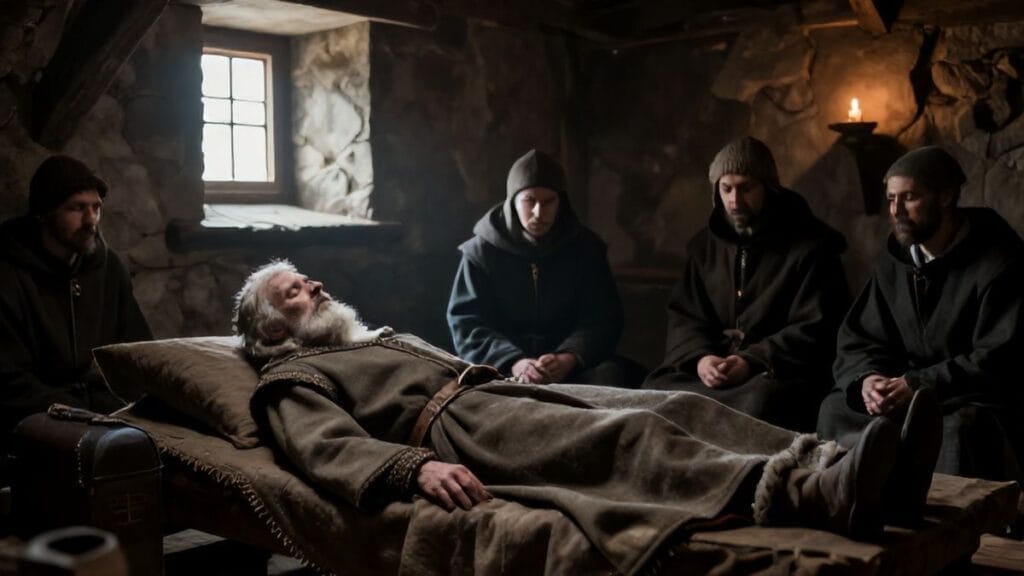
Accounts differ in detail, but the broad strokes are clear. Charles, gravely weakened, could go no farther. His attendants secured the best available quarters—perhaps a local noble’s house, perhaps a hospice associated with travelers and pilgrims crossing the pass. Within these cramped rooms, lit by candles and warmed by a stubborn fire, the emperor of the West was laid down to rest.
Imagine the thick smell of smoke, damp clothes, and human bodies compressed into a confined space. Physicians tried the remedies of their age: perhaps warm drinks infused with herbs, poultices, attempts to ease the emperor’s breathing. Priests and bishops stood by, murmuring the psalms of consolation and the prayers for the sick. Outside, soldiers and servants gathered in uneasy clusters, speaking in hushed tones about what they had seen—the trembling hands, the unfocused eyes, the labored breaths.
Yet behind the whispered concern lay a deeper dread. This was not simply a sick man; this was the king, the emperor, the anointed of God. His body was more than flesh; it was a vessel for political hopes and social order. To admit that he might be dying in a remote village, far from the great chapels and assembly fields where kings were expected to shine, was to admit that the world could tilt toward chaos in a single night.
As dusk gave way to deep night on 5 October, Charles is likely to have received the last rites—the liturgical preparation for a Christian’s death. The ritual of extreme unction, the confession of sins, the reception of the Eucharist: these acts framed his impending death not as a failure but as a passage watched over by the Church. Clerics would have invoked the saints and perhaps especially Saint Denis, patron of the royal abbey where French kings were buried, even as the emperor lay far from its vaults.
Outside the room, some of his closest companions may already have been calculating the implications. Who would carry news of his condition across the mountains? What would the nobles in West Francia do if he died here? Which factions would move first to claim or secure the succession? The air was thick with prayers and politics, grief and calculation. The death of Charles the Bald, which would soon be recorded in curt lines by annalists, was, in that moment, a living, trembling uncertainty shared by everyone packed into the dimly lit space of his final chamber.
The Death of Charles the Bald and the First Reactions
In the early hours of 6 October 877, the long struggle ended. Charles the Bald died in Avrieux, in the valley of Maurienne, an emperor far from the grand ceremonial landscapes of his reign. The chroniclers, terse but clear, note simply that “on the sixth of October, Charles, emperor and king, died on his way back from Italy, in a place called Brigium” (a Latinized form scholars associate with Avrieux). With that, the imperial title, so dearly sought and so painfully worn, fell silent on his lips.
The immediate reaction within the lodging would have been both spiritual and practical. Priests and bishops began the prayers for the dead, commending his soul to God, invoking Christ, Mary, and the saints. They may have placed a simple cross upon his chest, arranged his limbs, and covered his face. Death, so often hovering near medieval travelers, had now claimed the most important man in their company. Yet they could not stop to mourn at length. The body of an anointed ruler demanded careful handling; the news of his passing needed to be managed.
One can imagine the quiet knock on a door as a trusted messenger woke senior nobles and officials, delivering the stark words: “The lord emperor is dead.” Some received the news with genuine sorrow; others, perhaps, with a complex blend of grief and relief. For months, even years, many had feared that the imperial policy in Italy would overextend and weaken the West Frankish realm. Now, with the death of Charles the Bald, a new and uncertain chapter began. Loyal men felt the loss of their master; ambitious men sensed the opening of possibility.
As dawn broke over the valley, word spread through the imperial camp. Soldiers, cooks, baggage handlers, servants—all learned that the man whose banners they had followed for so long would command them no more. Some crossed themselves and whispered a prayer; others talked in low voices of what might happen next. Would they continue homeward? Who would lead them? How would the magnates back in West Francia respond?
The death of Charles the Bald also had an immediate psychological effect on the fragile coherence of his forces. Without a living ruler to embody unity, the campaign’s remnants now risked dissolving into competing groups, each following a favored lord. The presence of the royal corpse could help maintain a degree of order—the duty to escort the king home was a powerful bond—but everyone knew that beyond the mountains, the news would set politics ablaze.
Already, some men were likely planning the routes and messengers that would carry the announcement to key figures: Charles’s son Louis the Stammerer; influential bishops such as Hincmar of Reims; powerful counts whose allegiance would determine the realm’s next shape. In a sense, the emperor’s death turned Avrieux into a nerve center of European communication. From this small village, the news would radiate along roads and mountain paths, across rivers and through forests, reshaping alliances as it traveled.
Modern historians often return to this moment because the death of Charles the Bald marked more than the end of one man’s life. It crystallized the vulnerability of the Carolingian project itself. If an emperor could die like this, far from his great estates and palaces, dependent on the precarious hospitality of a mountain village, how solid was the empire he had tried to embody? The answer, as the coming years would show, was: not solid at all.
Funeral Roads: From Avrieux to the Abbey of Saint-Denis
Once the initial shock of the death of Charles the Bald subsided, a critical question loomed: what to do with the emperor’s body. In the medieval imagination, the burial place of a king was never a trivial matter; it carried profound spiritual and political significance. For the Carolingians, no site held greater resonance than the Abbey of Saint-Denis near Paris, the resting place of earlier Frankish kings and the sacred heart of royal memory.
It was therefore almost inevitable that Charles’s companions resolved to bring his corpse back across the mountains and through the valleys of his kingdom to Saint-Denis. The journey would be long and demanding. The body of the emperor had to be preserved as best as contemporary techniques allowed, safeguarded from both physical decay and any indignities along the way. We can imagine the preparation: washing the corpse, clothing it in royal garments, perhaps wrapping it in linen and placing it within a temporary coffin or on a specially prepared bier.
As the procession moved northward and westward, it transformed from a retreating army into a funerary cortege. At each settlement they passed, the sight must have been striking: a column of armed men accompanying a shrouded figure, priests bearing crosses and relics, banners perhaps draped in black or lowered in mourning. Local clergy would come out to meet them, offering prayers and blessings. For common people along the route, the event made tangible a reality they might otherwise have only heard about from afar: the king was dead, and the world they knew was tilting.
The roads themselves became a kind of moving stage where imperial ritual attempted to reclaim some dignity from the circumstances of Charles’s passing. Church bells might have tolled in towns where they stopped. Masses for the dead were said at monasteries and cathedrals. In many ways, the journey home transformed an accidental death in a remote place into a more public, ceremonial narrative of royal departure.
When at last the cortege approached Saint-Denis, the monks of the great abbey would have prepared to receive not only the body but the memory of Charles the Bald. This was the house where kings lay among kings, where the bones of previous rulers whispered of continuity and sacred order. However disappointing his imperial policies might have been in the eyes of some, Charles arrived at Saint-Denis not as a failure but as a link in the long chain of Christian monarchy in the Frankish lands.
He was laid to rest in the crypt, among his ancestors and kin. The abbey, already rich with Carolingian associations, now added another royal tomb to its collection. Liturgies for his soul continued long after the funeral; anniversaries of his death were marked by commemorative services. In this way, the rough room at Avrieux and the splendid choir of Saint-Denis became bound together in a single story: a king dying on the road, carried by his followers back into the monumental memory of his dynasty.
The funeral journey also carried political messages. By insisting on burial at Saint-Denis, Charles’s supporters proclaimed that whatever his final circumstances, he remained a legitimate and central figure in the royal line. There would be no marginal grave in an Italian chapel or a forgotten tomb in a mountain valley. His body and his legacy were claimed for the core of West Frankish identity. Yet even as bells rang over Saint-Denis, the realm he left behind was entering a new phase of internal contest.
Sons, Nephews, and Pretenders: A Succession in Flames
The death of Charles the Bald instantly reopened the most dangerous question in Carolingian politics: who would rule next, and on what terms? Charles did have a living son, Louis the Stammerer, but Louis’s position was anything but secure. Physically frail and politically overshadowed by his more experienced father, Louis had spent much of his life in the background. Now, suddenly, the shy, hesitant prince was expected to step into the role of king—and potentially emperor—at a time of acute crisis.
Ahead of his Italian expedition, Charles had tried to manage the succession by negotiating with his nobles. In June 877, at the capitulary of Quierzy, he had issued a set of provisions intended to reassure them that their rights and lands would be respected during his absence and in the event of his death. Ironically, this very capitulary is often seen by historians as a key moment in the rise of hereditary aristocratic power: by guaranteeing that the offices and benefices of nobles would pass to their heirs, Charles bound his successors’ hands and loosened central control over appointments.
When news of his death reached West Francia, the great magnates did not automatically rally around Louis the Stammerer. Some hesitated, some maneuvered. Others watched for an opening that might allow them to carve out greater autonomy, or even to invite an alternative Carolingian from the eastern realm to take the throne. The very fact that multiple Carolingian princes—sons and grandsons of Louis the German—still lived gave politics a volatile, dynastic quality.
Louis the Stammerer did eventually succeed his father, but under conditions that underlined his weakness. He had to make concessions to nobles and prelates in order to secure their recognition; he had to rule under the shadow of his father’s imperial experiment and its failure. The fact that he himself was sickly and would die just two years later, in 879, deprived the realm of the stabilizing effect a long reign might have provided.
Beyond West Francia, the death of Charles the Bald also triggered reactions in the eastern kingdom. The sons of Louis the German sensed that the imperial title might once more be within reach. Some hoped to extend their influence into Lotharingia or northern Italy. The papacy, too, looked northward again in search of a protector, assessing which of these men might best serve its interests—or least threaten them.
In this seething context, the memory of Charles’s final journey could be used in different ways. For some, it became a cautionary tale: a king who had stretched too far, who had lost touch with his own base in the west in pursuit of an Italian dream. For others, it was a martyr-like story: an emperor who died on the road, still laboring to hold the empire together. The political implications were enormous. With every retelling of how and where he died, different factions could emphasize different lessons about power, risk, and legitimacy.
What is clear, however, is that the death of Charles the Bald did not usher in a smooth, orderly transition. Instead, it accelerated the tendencies already at work toward fragmentation. Successive partitions, rivalries among Carolingian cousins, and the increasingly assertive autonomy of regional powers would, over the coming decades, further erode any realistic prospect of reconstituting a unified empire like that of Charlemagne.
Nobles Without a Master: The Rise of Aristocratic Power
If one group could be said to have “won” from the death of Charles the Bald, it was the high aristocracy of West Francia. Of course, no noble would have spoken in such bald terms while candles still burned over the king’s bier. Yet the structural effect of his passing, combined with the concessions he made in his final years, amounted to a transfer of real power from crown to counts.
The capitulary of Quierzy, issued just months before his death, looms large in this story. In it, Charles confirmed that if a count died while accompanying him on campaign, that count’s heir would inherit both the lands and the office. On the surface, this looked like a compassionate gesture, meant to reassure men risking their lives on the Italian expedition. Beneath the surface, it meant that key royal posts were sliding, almost imperceptibly, into hereditary possession. Offices that had once been granted and revoked at the king’s pleasure were starting to look like permanent family possessions.
After Charles’s death, Louis the Stammerer and later rulers found it increasingly difficult to reverse this pattern. Each time they needed military or political support from a great lord, they had to negotiate from a weaker position. The counts and dukes who held strategic territories—from Flanders to Aquitaine—could now bargain, delay, or even defy royal commands with a confidence their predecessors had rarely enjoyed. Their castles and private armies turned them into regional powers in their own right.
In the countryside, the effects rippled outward. Local lords, seeing their superiors behave like semi-independent princes, began to do the same on a smaller scale. They fortified their estates, imposed dues and obligations on peasants, and adjusted their allegiances as circumstances required. Royal justice, once the aspirational backbone of Carolingian governance, gave way more and more to private justice administered in manorial courts. The kingdom did not dissolve overnight, but it became visibly more aristocratic, less centrally governed.
From a long-term perspective, historians often see this shift as part of the birth of what we call feudalism. The relationship between lord and vassal, the exchange of land for military service, the dense web of personal loyalties that could rival or override obedience to the king—all these phenomena gained strength in the wake of rulers who could no longer command as Charlemagne once had. The death of Charles the Bald, coming at a moment when these trends were already accelerating, symbolized and intensified the process.
It would be simplistic to say that one night in Avrieux “caused” the rise of feudal structures. Social and economic forces played their part: population pressures, technological changes in agriculture, shifts in trade. Yet it is telling that chroniclers and later commentators associated the end of his reign with a loosening of royal control and a corresponding boldness among nobles. In their eyes, the empire did not merely lose a man; it lost a center of gravity that had, however imperfectly, tried to hold disparate forces together.
Bishops, Monks, and the Battle for Charles’s Memory
No story about a Carolingian ruler ends purely in politics. The Church—its bishops, abbots, and chroniclers—played a decisive role in shaping how contemporaries and later generations would remember Charles the Bald. The death of such a ruler called forth not only prayers but interpretations: was this a divine punishment, a test, or simply the inscrutable timing of God’s will?
Some of the most important voices belonged to men like Hincmar of Reims, one of the era’s most influential bishops. Hincmar had advised and sometimes clashed with Charles during his lifetime. After the king’s death, he was in a position to frame the event in sermons and writings that circulated among clergy and the educated elite. While he did not indulge in crude moralizing, he used the occasion to reflect on the burdens of kingship and the need for rulers to heed ecclesiastical counsel. In his view, the passing of Charles demonstrated both the fragility of earthly power and the enduring necessity of a just Christian order.
Monasteries, too, took up the story. The Annals of Saint-Bertin and other monastic chronicles recorded the bare facts of the death of Charles the Bald, but even their brevity carries an undertone of sadness. Here was a king who had patronized churches, defended (however imperfectly) his Christian people, and upheld the sacral dimension of kingship. His sudden death on the road presented a stark, almost theatrical reminder that no matter how sacred one’s office, one’s body remained vulnerable.
At Saint-Denis, where his tomb lay, the monks had perhaps the most direct stake in cultivating his memory. They celebrated annual commemorations of his death, reading aloud the foundation charters and benefactions he had granted. In their liturgical world, Charles was not just a political figure; he was a soul in need of intercession, a benefactor whose generosity bound him to the prayers of the community. Over time, these repeated acts of remembrance smoothed the rough edges of his reign, turning a complex, often embattled ruler into a more generic image of the Christian king.
Citation from a later historian, Janet L. Nelson, captures the nature of this process: “Charles’s kingship lived on, not simply as a matter of charters and capitularies, but in the monastic memory that re-wove his deeds into a continuous narrative of providential rule” (Nelson, Charles the Bald). Such scholarly reflections highlight how the Church’s narratives were not neutral records but active reconstructions of a life and reign in the light of theology and institutional interests.
At the same time, not all churchmen were satisfied with how Charles had balanced secular and ecclesiastical priorities. Some felt he had conceded too much to restless nobles; others believed he had been too willing to intervene in episcopal disputes. Thus, the memory of his death also formed part of internal Church debates about the proper relationship between altar and throne. In their homilies and treatises, theologians could point to his fate as an example of the impermanence of worldly glory, urging rulers to humility and obedience to spiritual guidance.
In this swirl of interpretations, the physical fact of his death in Avrieux anchored a spectrum of meanings. To ordinary believers, it might simply be the sad end of a familiar name. To bishops and monks, it became a lens through which to think about divine providence, the duties of kings, and the vulnerabilities of any human order not firmly rooted in Christ.
Ordinary Lives in an Age of Kings Dying on the Road
For all the attention historians pay to the great, the death of Charles the Bald unfolded within a world mostly inhabited by people who would never see a court or hold a title. What did his final journey and passing mean to them? The villagers of Avrieux, for instance, suddenly found their homes turned into the backdrop of imperial tragedy. Their barns may have housed royal horses; their hearths may have cooked meals for royal attendants; their modest rooms may have sheltered the sick emperor himself.
In the short term, the experience was likely a mix of disruption and awe. Hosting an imperial entourage was no small burden. Supplies would be requisitioned, often without generous compensation. Noise, crowding, and the constant demands of officials turned quiet routines upside down. Yet there was also the fascination of proximity to power. For a shepherd or peasant in Avrieux, to see the imperial seal, the rich fabrics, and gleaming arms of the royal household must have felt like a story stepping out of rumor and into the village square.
After Charles’s death, some of these villagers may have witnessed the preparation of his body, the solemnity of clerical rites, the guarded conversations among nobles. The memory of that night—of candles flickering in a cramped room where an emperor lay dying—would have been told and retold, woven into local lore long after the cortege had moved on. Even if the broader political implications remained abstract to them, they understood that something momentous had happened among their houses.
Beyond Avrieux, ordinary people in West Francia and beyond learned of the death of Charles the Bald gradually, through a patchwork of oral reports, announcements at church, and, for a tiny literate minority, written notices. For many, the king’s identity was less about his personality than about his function: he was the distant figure who, in theory, upheld justice, defended the realm, and maintained the peace of God. News of his death might bring anxiety—would raids increase? Would local lords grow bolder in exactions? Would war flare between rival princes?
And indeed, in the years following his passing, many communities experienced exactly such consequences. Viking incursions continued; noble feuds intensified; jurisdictional boundaries became more confusing. For peasants tied to the land, for townspeople navigating shifting authorities, the death of a ruler did not always translate into immediate change—but it contributed to a longer trend in which local powers, rather than distant kings, set the tone of daily life.
At the same time, the religious dimension of kingship meant that Charles’s death also entered the spiritual lives of ordinary Christians. Priests might include prayers for his soul in the liturgy, mentioning his name during masses. On the anniversary of his death, some communities—especially those connected to monasteries he had favored—marked the date with particular solemnity. Thus, even those who never benefited directly from his policies participated in a shared ritual of remembrance. The distant emperor, whose passing on the road they had heard of only vaguely, became a name murmured in church, a soul commended alongside their own dead.
Chroniclers at Work: How We Know What Happened
Our knowledge of the death of Charles the Bald is surprisingly detailed for an event that took place in a remote Alpine village over eleven centuries ago. Yet this detail comes not from newspapers or official communiqués—none existed—but from the careful, if often sparse, labors of medieval chroniclers. Monks and clerics in monasteries such as Saint-Bertin, Fulda, and other centers of learning kept annals where they recorded the notable events of each year: eclipses, famines, battles, and, of course, the deaths of kings.
These annals, written in Latin, rarely indulge in vivid description. For them, the death of Charles the Bald merited a sentence or two at most. The Annals of Saint-Bertin, for instance, note succinctly that he died on his way back from Italy, naming the date and place. Yet even that brief entry is invaluable. By cross-referencing such accounts with charters, letters, and later narrative histories, modern scholars can reconstruct not only the bare fact of his death but its context and repercussions.
The work of historians like Janet L. Nelson, whose monograph Charles the Bald remains a foundational study, has shown how much can be drawn from these scattered sources. Through painstaking comparison of different manuscripts, she and others have clarified when and where Charles traveled, which nobles accompanied him, and how his policies shifted in his final years. Her analysis supports the view that his last Italian campaign and Alpine retreat were turning points—both personally and politically. As she writes, “The emperor’s end on the Alpine road encapsulated the hazards he had long courted between Italy and Francia, hazards of distance, delay, and divided loyalty” (Nelson, Charles the Bald).
Alongside annals and treatises, royal charters provide another window. Documents issued in the months immediately preceding his Italian expedition show him making strategic grants, securing loyalty, and attempting to lock in certain arrangements. The abrupt cessation of such charters in October 877 offers silent testimony to his passing. Similarly, the charters issued in his son Louis’s name soon afterward reflect the scramble to assert continuity and maintain control.
Archaeology plays a smaller, but still intriguing, role. At Saint-Denis, centuries of rebuilding and revolution have disturbed the royal tombs, but traces of Carolingian burials and artifacts remain. While we cannot stand before an intact, clearly identified sarcophagus of Charles today, the collective memory of his interment at the abbey aligns with the documentary record. The physical space of Saint-Denis, with its overlapping layers of royal and monastic history, gives a concrete frame to the textual evidence.
Modern historical writing about the death of Charles the Bald thus rests on a web of sources, each partial and silent on some crucial questions. We do not know precisely what words he spoke in his final hours, what private regrets or consolations crossed his mind. We cannot reconstruct exactly how many people stood around his bed in Avrieux, nor the expressions on their faces. But we can, with reasonable confidence, tell the story of why he was there, what condition he was in, and how his passing was perceived in the corridors of power.
In doing so, historians engage in a delicate balance of narrative and analysis. They must respect the sparseness of the sources while recognizing that even brief, formulaic entries were written by human beings who selected what to record. The death of Charles the Bald, recorded across multiple annalistic traditions, stands out as one of those events that medieval record-keepers simply could not ignore.
From Carolingian Empire to Feudal Mosaic
Looking back from the vantage point of later centuries, the death of Charles the Bald in 877 appears as one of several milestones marking the long transformation from a centralized empire to the fragmented feudal order of the High Middle Ages. It did not, by itself, create feudalism or destroy imperial ambitions, but it crystallized a cluster of developments that would shape Western Europe for generations.
First, his death underscored the practical limits of trans-Alpine empire. Charlemagne had once governed a realm stretching from the Ebro to the Elbe and deep into Italy, sustaining it with relentless travel, war, and ritual. By Charles’s time, those same distances had become liabilities. Coordinating responses to Viking raids in the west while managing Italian politics in the south proved nearly impossible, especially for an aging ruler whose support at home was wavering. The spectacle of an emperor dying on the road between these zones of responsibility became a potent symbol of overextension.
Second, the succession crises that followed his death accelerated the division of his domains. Repeated partitions among heirs, rivalries among cousins, and the inability of any one Carolingian to reassert durable, overarching authority created a political landscape in which local power centers flourished. Even when someone wore the imperial crown later—such as Charles the Fat at the end of the ninth century—their actual control on the ground often remained tenuous.
Third, the concessions made to nobles during and after his reign entrenched the logic of hereditary lordship. Counts, dukes, and other magnates turned their offices into family possessions, creating regional dynasties that would later evolve into the great princely houses of medieval France and Germany. Their castles and courts became the primary arenas of power for many people, overshadowing the more distant and often weaker royal centers.
By the tenth and eleventh centuries, this process had produced what historians call the “feudal mosaic”—a landscape of overlapping jurisdictions, personal bonds, and localized lordship. In some ways, this order was more flexible and adaptable than the earlier imperial model; in other ways, it was more prone to private war and fragmentation. The Carolingian memory did not vanish, but it became a distant golden age, a reference point for thinkers and reformers who longed for a stronger, more unified Christian polity.
The death of Charles the Bald thus occupies a special place in the story of European state formation. It invites reflection on the balance between central authority and local autonomy, between grand titles and practical governance. An emperor’s crown could be passed on or re-bestowed, but the networks of loyalty and interest that sustained real power were changing in ways no one could fully control.
And yet, it would be a mistake to read his death as the end of all imperial dreams. In the east, the Ottonian dynasty would later revive the imperial title in the tenth century, claiming continuity with both Rome and the Carolingians. In the west, the Capetian kings of France, emerging from the very aristocratic milieu strengthened by Charles’s concessions, would slowly reassert royal power over their vassals. The mountain room in Avrieux where Charles died thus lies, in a sense, at the crossroads between empires past and kingdoms yet to come.
The Long Shadow of a Death in the Mountains
More than eleven centuries after the death of Charles the Bald, the village of Avrieux is a quiet place, surrounded by the same mountains that watched an emperor’s last breaths in 877. Tourists and travelers who pass through the valley of Maurienne may notice plaques and local histories that recall his final journey. Yet the scene today, with its modern roads and facilities, can make it hard to imagine the raw vulnerability of that earlier moment, when a sick ruler, wrapped in wool and worry, lay dying far from the symbolic heartlands of his rule.
And still, the shadow of that moment reaches far. For those who study the Middle Ages, it marks not just a biographical endpoint but a hinge in the narrative of Western Europe. The death of Charles the Bald exemplifies how the fortunes of individuals and the trajectories of institutions intertwine. His personal choices—pursuing the imperial crown, crossing the Alps repeatedly, negotiating with suspicious nobles—shaped the context in which structural forces played out. When his body failed him in Avrieux, those forces did not pause; they surged into the space he left.
In a broader sense, his death invites meditation on the nature of political mortality. Empires and kingdoms often talk in the language of eternity, of unbroken continuity. Yet they are, like their rulers, finite, subject to the wear of time, conflict, and changing circumstances. The Carolingian Empire had felt robust under Charlemagne; less than seventy-five years after his coronation, one of his grandsons died on a mountain road, having tried and failed to reassemble the old unity. The contrast is stark and instructive.
It also raises questions about how we tell history. The temptation is always strong to pinpoint single events—the fall of a city, the signing of a treaty, the death of a ruler—as decisive turning points. The death of Charles the Bald certainly serves well in that role. Yet it becomes more meaningful when set against the slower rhythms of social change: the gradual empowerment of nobles, the evolution of military technology, the shifting patterns of trade and settlement. The night in Avrieux matters because it condenses those trends into a human story we can see and feel.
In that story, the focus keyword—the death of Charles the Bald—appears not as a sterile phrase but as a lived experience: a man’s labored breathing in a dark room, the whispered Latin prayers, the anxious glances of attendants, the chill of the mountain air pressing against thin walls. Around that room, an army waits; beyond that army, a kingdom trembles; beyond that kingdom, an entire era edges closer to transformation.
Perhaps this is why the image of his final journey persists in historical memory. It reminds us that even the most imposing structures of power ultimately pass through the narrow gate of mortality. On 6 October 877, in Avrieux, Maurienne, empire itself seemed to lie down beside an aging king, share his fever, and awaken altered. The world that rose the next day was still recognizably Carolingian, but already something else as well: a world in which lords, rather than emperors, would increasingly shape the fate of Europe.
Conclusion
The story of the death of Charles the Bald is at once intimate and vast. It is the tale of an elderly man, worn by decades of war and governance, succumbing to illness in a remote mountain village. At the same time, it is the story of an empire’s slow unwinding, of the transition from a unified Carolingian vision to a more fractured, feudal order. In Avrieux on 6 October 877, these two narratives converged in a single, fragile human body.
Tracing his path from grandson of Charlemagne to emperor and finally to weary traveler, we see how the glories and burdens of his lineage shaped his life. His pursuit of the imperial crown drew him again and again across the Alps, into the complex politics of Italy and the anxious embrace of the papacy. That same pursuit overextended his resources and strained his relations with West Frankish nobles, culminating in concessions that empowered aristocrats in ways he could not fully foresee.
When he died in Avrieux, the immediate consequences were a scramble for succession, a long funeral journey to Saint-Denis, and a reconfiguration of political alliances. Over the longer term, his passing accelerated existing trends toward aristocratic autonomy and regionalization. The once-dominant idea of a single, overarching empire faded, replaced by a mosaic of competing powers bound together by personal ties, local interests, and intermittent royal authority.
And yet, through the work of chroniclers, churchmen, and modern historians, Charles the Bald did not disappear into the mists of the Alps. His life and death remain central to our understanding of the ninth century. The thin line of ink that records his final day in the annals anchors a much broader interpretation of how medieval Europe moved from the age of Charlemagne toward the world of castles, vassals, and kings with limited reach. In returning to that cold room in Avrieux, we are reminded that history often turns not at grand ceremonies, but at quiet, vulnerable moments when even emperors are forced to confront their mortality.
FAQs
- Where and when did Charles the Bald die?
Charles the Bald died on 6 October 877 in Avrieux, a village in the valley of Maurienne in the Alps, while returning from an Italian campaign. He was on his way back to his West Frankish kingdom after a difficult and ultimately unsuccessful attempt to assert his authority in Italy as emperor. - What caused the death of Charles the Bald?
The precise medical cause is unknown, but contemporary sources suggest he had been ill for some time. The strain of repeated campaigns, his advanced age, and the harsh conditions of crossing the Alpine passes likely contributed to his decline. He became too weak to travel further and died in lodgings at Avrieux. - Why was Charles the Bald in Italy shortly before his death?
Charles went to Italy to secure and exercise the imperial title he had received in 875 after the death of his nephew Louis II. He sought to protect the papacy and counter the ambitions of his eastern relatives, but Italian politics were unstable, and he failed to gain lasting control, prompting his retreat across the Alps in 877. - What happened to his body after he died in Avrieux?
After his death, Charles’s companions organized a funeral procession to carry his body back across the Alps into West Francia. He was ultimately buried at the Abbey of Saint-Denis near Paris, the traditional burial place of the Frankish kings, reinforcing his place in the royal lineage despite his remote and humble place of death. - Who succeeded Charles the Bald?
His son Louis the Stammerer succeeded him as king of West Francia. However, Louis’s reign was short and marked by frailty and political dependence on powerful nobles. His early death in 879 further fragmented Carolingian authority and contributed to the growing power of regional aristocracies. - Why is the death of Charles the Bald considered historically important?
The death of Charles the Bald is seen as a turning point because it highlighted the limits of Carolingian imperial rule and coincided with the increasing autonomy of regional nobles. His passing accelerated existing trends toward political fragmentation and the rise of feudal structures, making it a key moment in the transition from a unified empire to a more localized, aristocratic Europe. - How do historians know the details of his death?
Information about his death comes from contemporary annals written in monasteries, such as the Annals of Saint-Bertin, and from royal charters and later historical works. Modern historians, notably Janet L. Nelson, have synthesized these sources to reconstruct his final campaign, his route across the Alps, and the immediate political aftermath. - What role did the Church play in interpreting his death?
Bishops and monks saw his death as an occasion to reflect on the responsibilities and fragility of Christian kingship. They commemorated him in liturgy, recorded his passing in chronicles, and sometimes used his fate to argue for closer adherence of rulers to ecclesiastical advice. Over time, monastic remembrance at places like Saint-Denis helped integrate his reign into a broader narrative of providential history.
External Resource
Internal Link
Other Resources
- Encyclopaedia Britannica – general search for the exact subject
- Google Scholar – academic search for the exact subject
- Internet Archive – digital library search for the exact subject